This handout covers Topic 4, Geometry. Parts marked (Extended) are only tested on the Extended papers; everything else is for both levels. In the exam you must give reasons using the correct names below, not just the numbers.
Geometry
IGCSE Mathematics · Topic 4
 13:25
Geometry
Look closely at a honeycomb. Every cell is a hexagon — six straight sides, all the same. Not squares. Not pentagons. Hexagons. Bees never studied geometry, but…
English narration · English + 中文 subtitles burned in
4.1
Lines and angles
Syllabus
| Subject content | Notes and examples |
|---|---|
| 1 Use and interpret the following geometrical terms: • point • vertex • line • parallel • perpendicular • bearing • right angle • acute, obtuse and reflex angles • interior and exterior angles • similar • congruent • scale factor. | Candidates are not expected to show that two shapes are congruent. |
| 2 Use and interpret the vocabulary of: • triangles • special quadrilaterals • polygons • nets • simple solids. | Includes the following terms: Triangles: • equilateral • isosceles • scalene • right-angled. Quadrilaterals: • square • rectangle • kite • rhombus • parallelogram • trapezium. Polygons: • regular and irregular polygons • pentagon • hexagon • octagon • decagon. |
| Simple solids: • cube • cuboid • prism • cylinder • pyramid • cone • sphere (term ‘hemisphere’ not required) • face • surface • edge. | |
| 3 Use and interpret the vocabulary of a circle. | Includes the following terms: • centre • radius (plural radii) • diameter • circumference • semicircle • chord • tangent • arc • sector • segment. |
| Subject content | Notes and examples |
|---|---|
| 1 Use and interpret the following geometrical terms: • point • vertex • line • plane • parallel • perpendicular • perpendicular bisector • bearing • right angle • acute, obtuse and reflex angles • interior and exterior angles • similar • congruent • scale factor. | Candidates are not expected to show that two shapes are congruent. |
| 2 Use and interpret the vocabulary of: • triangles • special quadrilaterals • polygons • nets • solids. | Includes the following terms. Triangles: • equilateral • isosceles • scalene • right-angled. Quadrilaterals: • square • rectangle • kite • rhombus • parallelogram • trapezium. |
| Polygons: • regular and irregular polygons • pentagon • hexagon • octagon • decagon. Solids: • cube • cuboid • prism • cylinder • pyramid • cone • sphere • hemisphere • frustum • face • surface • edge. | |
| 3 Use and interpret the vocabulary of a circle. | Includes the following terms: • centre • radius (plural radii) • diameter • circumference • semicircle • chord • tangent • major and minor arc • sector • segment. |
Source: Cambridge International syllabus
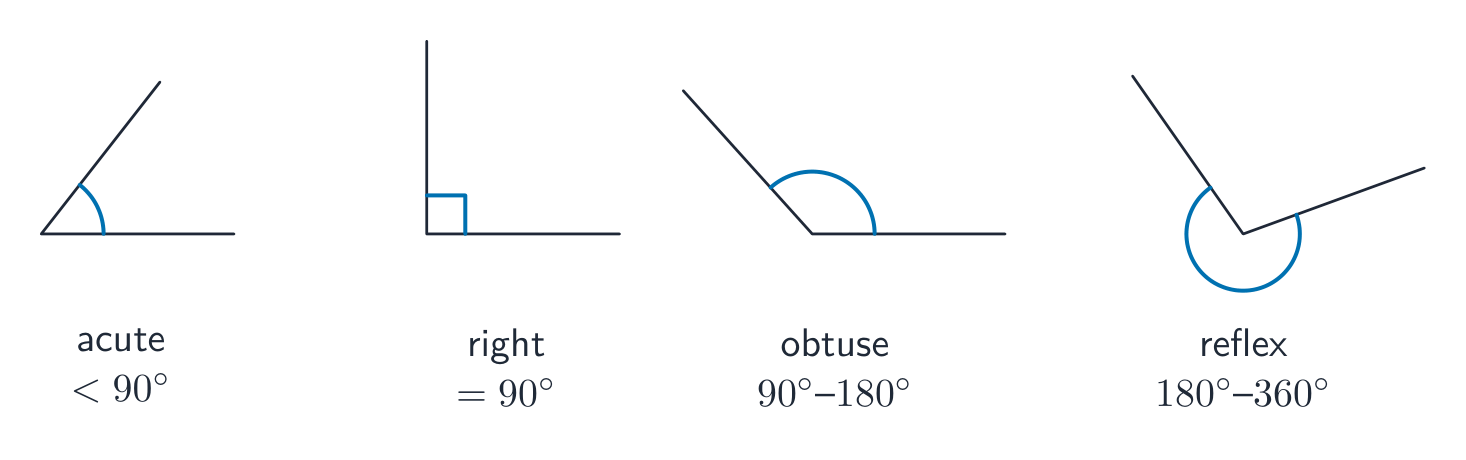
A corner where two lines meet is a vertex 顶点. Two lines are parallel 平行 if they never meet, and perpendicular 垂直 if they meet at a right angle. Angles are named by their size:
| Name | Size |
|---|---|
| acute angle 锐角 | less than $90^{\circ}$ |
| right angle 直角 | exactly $90^{\circ}$ |
| obtuse angle 钝角 | between $90^{\circ}$ and $180^{\circ}$ |
| reflex angle 优角 | between $180^{\circ}$ and $360^{\circ}$ |
We name an angle with three letters, e.g. angle $ABC$ is the angle at $B$.
Explore
Shape and angle lab
Classify angle facts by the diagram feature that creates them.
Vocabulary
Train
| English |
|---|
| vertex/ˈvɜːteks/ |
| parallel/ˈpærəlel/ |
| perpendicular/ˌpɜːpənˈdɪkjʊlə/ |
| acute angle/əˈkjuːt ˈæŋɡl/ |
| right angle/raɪt ˈæŋɡl/ |
| obtuse angle/ɒbˈtjuːs ˈæŋɡl/ |
| reflex angle/ˈriːfleks ˈæŋɡl/ |
4.6
Angle facts

Syllabus
| Subject content | Notes and examples |
|---|---|
| 1 Calculate unknown angles and give simple explanations using the following geometrical properties: • sum of angles at a point = 360° • sum of angles at a point on a straight line = 180° • vertically opposite angles are equal • angle sum of a triangle = 180° and angle sum of a quadrilateral = 360°. | Knowledge of three-letter notation for angles is required, e.g. angle $ABC$. Candidates are expected to use the correct geometrical terminology when giving reasons for answers. |
| 2 Calculate unknown angles and give geometric explanations for angles formed within parallel lines: • corresponding angles are equal • alternate angles are equal • co-interior angles sum to 180° (supplementary). | |
| 3 Know and use angle properties of regular polygons. | Includes exterior and interior angles, and angle sum. |
| Subject content | Notes and examples |
|---|---|
| 1 Calculate unknown angles and give simple explanations using the following geometrical properties: • sum of angles at a point = 360° • sum of angles at a point on a straight line = 180° • vertically opposite angles are equal • angle sum of a triangle = 180° and angle sum of a quadrilateral = 360°. | Knowledge of 3-letter notation for angles is required, e.g. angle $ABC$. Candidates are expected to use the correct geometrical terminology when giving reasons for answers. |
| 2 Calculate unknown angles and give geometric explanations for angles formed within parallel lines: • corresponding angles are equal • alternate angles are equal • co-interior angles sum to 180° (supplementary). | |
| 3 Know and use angle properties of regular and irregular polygons. | Includes exterior and interior angles, and angle sum. |
Source: Cambridge International syllabus
Learn these basic facts. Each one is a valid reason in the exam.
- Angles at a point add up to $360^{\circ}$.
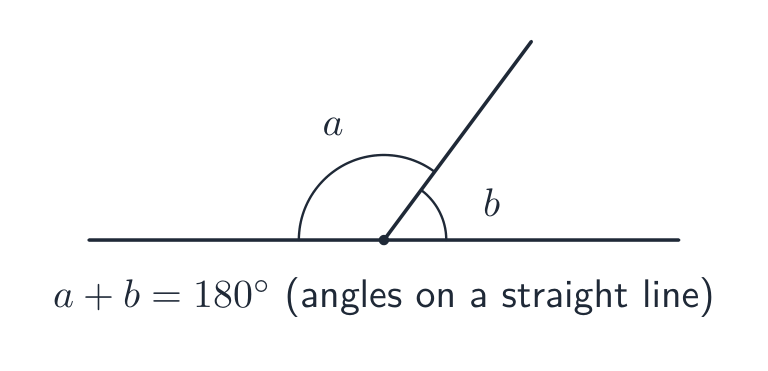
- Angles on a straight line add up to $180^{\circ}$.
- Vertically opposite angles 对顶角 (made by two crossing lines) are equal.
Worked example. Three angles on a straight line are $x$, $50^{\circ}$ and $70^{\circ}$. Find $x$.
$$x + 50 + 70 = 180 \;\Rightarrow\; x = 60^{\circ}.$$
Explore
Parallel line and polygon lab
Pick the angle rule that unlocks each diagram.
Vocabulary
Train
| English |
|---|
| vertically opposite angles/ˈvɜːtɪkli ˈɒpəzɪt ˈæŋɡlz/ |
4.6
Angles in parallel lines

Syllabus
| Subject content | Notes and examples |
|---|---|
| 1 Calculate unknown angles and give simple explanations using the following geometrical properties: • sum of angles at a point = 360° • sum of angles at a point on a straight line = 180° • vertically opposite angles are equal • angle sum of a triangle = 180° and angle sum of a quadrilateral = 360°. | Knowledge of three-letter notation for angles is required, e.g. angle $ABC$. Candidates are expected to use the correct geometrical terminology when giving reasons for answers. |
| 2 Calculate unknown angles and give geometric explanations for angles formed within parallel lines: • corresponding angles are equal • alternate angles are equal • co-interior angles sum to 180° (supplementary). | |
| 3 Know and use angle properties of regular polygons. | Includes exterior and interior angles, and angle sum. |
| Subject content | Notes and examples |
|---|---|
| 1 Calculate unknown angles and give simple explanations using the following geometrical properties: • sum of angles at a point = 360° • sum of angles at a point on a straight line = 180° • vertically opposite angles are equal • angle sum of a triangle = 180° and angle sum of a quadrilateral = 360°. | Knowledge of 3-letter notation for angles is required, e.g. angle $ABC$. Candidates are expected to use the correct geometrical terminology when giving reasons for answers. |
| 2 Calculate unknown angles and give geometric explanations for angles formed within parallel lines: • corresponding angles are equal • alternate angles are equal • co-interior angles sum to 180° (supplementary). | |
| 3 Know and use angle properties of regular and irregular polygons. | Includes exterior and interior angles, and angle sum. |
Source: Cambridge International syllabus
When a line crosses two parallel lines:
- Corresponding angles 同位角 (in matching positions, an "F" shape) are equal.
- Alternate angles 内错角 (opposite sides of the crossing line, a "Z" shape) are equal.
- Co-interior angles 同旁内角 (a "C" shape) add up to $180^{\circ}$; we say they are supplementary 互补.
Worked example. A straight line crosses two parallel lines. One angle is $110^{\circ}$. The co-interior angle $y$ satisfies $110 + y = 180$, so $y = 70^{\circ}$.
Worked example: two steps with reasons. Lines $PQ$ and $RS$ are parallel, with $P$ and $R$ on the same side. A transversal makes angle $PXY = 65^{\circ}$ at $X$ on $PQ$, where $Y$ is the point where the transversal meets $RS$. Find angle $XYS$ and the obtuse angle $XYR$.
Angle $XYS = 65^{\circ}$ (alternate angles are equal). Angle $XYR = 180^{\circ} - 65^{\circ} = 115^{\circ}$ (angles on a straight line add to $180^{\circ}$).
Each step gets its own reason, written with the correct name. "Because of the Z" or "parallel lines" alone does not earn the mark.
Vocabulary
Train
| English |
|---|
| corresponding angles/ˌkɒrɪˈspɒndɪŋ ˈæŋɡlz/ |
| alternate angles/ɔːlˈtɜːnət ˈæŋɡlz/ |
| co-interior angles/kəʊ ɪnˈtɪərɪə ˈæŋɡlz/ |
| supplementary/ˌsʌplɪˈmentəri/ |
4.1
Triangles

Syllabus
| Subject content | Notes and examples |
|---|---|
| 1 Use and interpret the following geometrical terms: • point • vertex • line • parallel • perpendicular • bearing • right angle • acute, obtuse and reflex angles • interior and exterior angles • similar • congruent • scale factor. | Candidates are not expected to show that two shapes are congruent. |
| 2 Use and interpret the vocabulary of: • triangles • special quadrilaterals • polygons • nets • simple solids. | Includes the following terms: Triangles: • equilateral • isosceles • scalene • right-angled. Quadrilaterals: • square • rectangle • kite • rhombus • parallelogram • trapezium. Polygons: • regular and irregular polygons • pentagon • hexagon • octagon • decagon. |
| Simple solids: • cube • cuboid • prism • cylinder • pyramid • cone • sphere (term ‘hemisphere’ not required) • face • surface • edge. | |
| 3 Use and interpret the vocabulary of a circle. | Includes the following terms: • centre • radius (plural radii) • diameter • circumference • semicircle • chord • tangent • arc • sector • segment. |
| Subject content | Notes and examples |
|---|---|
| 1 Use and interpret the following geometrical terms: • point • vertex • line • plane • parallel • perpendicular • perpendicular bisector • bearing • right angle • acute, obtuse and reflex angles • interior and exterior angles • similar • congruent • scale factor. | Candidates are not expected to show that two shapes are congruent. |
| 2 Use and interpret the vocabulary of: • triangles • special quadrilaterals • polygons • nets • solids. | Includes the following terms. Triangles: • equilateral • isosceles • scalene • right-angled. Quadrilaterals: • square • rectangle • kite • rhombus • parallelogram • trapezium. |
| Polygons: • regular and irregular polygons • pentagon • hexagon • octagon • decagon. Solids: • cube • cuboid • prism • cylinder • pyramid • cone • sphere • hemisphere • frustum • face • surface • edge. | |
| 3 Use and interpret the vocabulary of a circle. | Includes the following terms: • centre • radius (plural radii) • diameter • circumference • semicircle • chord • tangent • major and minor arc • sector • segment. |
Source: Cambridge International syllabus
A triangle 三角形 has three sides and angles that add up to $180^{\circ}$.
| Type | Property |
|---|---|
| equilateral 等边 | all sides equal, all angles $60^{\circ}$ |
| isosceles 等腰 | two sides equal, two angles equal |
| scalene 不等边 | all sides and angles different |
| right-angled | has one right angle |
Worked example. A triangle has angles $x$, $2x$ and $90^{\circ}$. Find $x$.
$$x + 2x + 90 = 180 \;\Rightarrow\; 3x = 90 \;\Rightarrow\; x = 30^{\circ}.$$
Vocabulary
Train
| English |
|---|
| triangle/ˈtraɪæŋɡl/ |
| equilateral/ˌiːkwɪˈlætərəl/ |
| isosceles/aɪˈsɒsəliːz/ |
| scalene/ˈskeɪliːn/ |
4.1
Quadrilaterals
Syllabus
| Subject content | Notes and examples |
|---|---|
| 1 Use and interpret the following geometrical terms: • point • vertex • line • parallel • perpendicular • bearing • right angle • acute, obtuse and reflex angles • interior and exterior angles • similar • congruent • scale factor. | Candidates are not expected to show that two shapes are congruent. |
| 2 Use and interpret the vocabulary of: • triangles • special quadrilaterals • polygons • nets • simple solids. | Includes the following terms: Triangles: • equilateral • isosceles • scalene • right-angled. Quadrilaterals: • square • rectangle • kite • rhombus • parallelogram • trapezium. Polygons: • regular and irregular polygons • pentagon • hexagon • octagon • decagon. |
| Simple solids: • cube • cuboid • prism • cylinder • pyramid • cone • sphere (term ‘hemisphere’ not required) • face • surface • edge. | |
| 3 Use and interpret the vocabulary of a circle. | Includes the following terms: • centre • radius (plural radii) • diameter • circumference • semicircle • chord • tangent • arc • sector • segment. |
| Subject content | Notes and examples |
|---|---|
| 1 Use and interpret the following geometrical terms: • point • vertex • line • plane • parallel • perpendicular • perpendicular bisector • bearing • right angle • acute, obtuse and reflex angles • interior and exterior angles • similar • congruent • scale factor. | Candidates are not expected to show that two shapes are congruent. |
| 2 Use and interpret the vocabulary of: • triangles • special quadrilaterals • polygons • nets • solids. | Includes the following terms. Triangles: • equilateral • isosceles • scalene • right-angled. Quadrilaterals: • square • rectangle • kite • rhombus • parallelogram • trapezium. |
| Polygons: • regular and irregular polygons • pentagon • hexagon • octagon • decagon. Solids: • cube • cuboid • prism • cylinder • pyramid • cone • sphere • hemisphere • frustum • face • surface • edge. | |
| 3 Use and interpret the vocabulary of a circle. | Includes the following terms: • centre • radius (plural radii) • diameter • circumference • semicircle • chord • tangent • major and minor arc • sector • segment. |
Source: Cambridge International syllabus
A quadrilateral 四边形 has four sides and angles that add up to $360^{\circ}$.
| Shape | Property |
|---|---|
| square 正方形 | four equal sides, four right angles |
| rectangle 矩形 | opposite sides equal, four right angles |
| parallelogram 平行四边形 | opposite sides parallel and equal |
| rhombus 菱形 | four equal sides, opposite sides parallel |
| kite 鸢形 | two pairs of equal sides next to each other |
| trapezium 梯形 | one pair of parallel sides |
Vocabulary
Train
| English |
|---|
| quadrilateral/ˌkwɒdrɪˈlætərəl/ |
| square/skweə/ |
| rectangle/ˈrektæŋɡl/ |
| parallelogram/ˌpærəˈleləɡræm/ |
| rhombus/ˈrɒmbəs/ |
| kite/kaɪt/ |
| trapezium/trəˈpiːzɪəm/ |
4.6
Polygons

Syllabus
| Subject content | Notes and examples |
|---|---|
| 1 Calculate unknown angles and give simple explanations using the following geometrical properties: • sum of angles at a point = 360° • sum of angles at a point on a straight line = 180° • vertically opposite angles are equal • angle sum of a triangle = 180° and angle sum of a quadrilateral = 360°. | Knowledge of three-letter notation for angles is required, e.g. angle $ABC$. Candidates are expected to use the correct geometrical terminology when giving reasons for answers. |
| 2 Calculate unknown angles and give geometric explanations for angles formed within parallel lines: • corresponding angles are equal • alternate angles are equal • co-interior angles sum to 180° (supplementary). | |
| 3 Know and use angle properties of regular polygons. | Includes exterior and interior angles, and angle sum. |
| Subject content | Notes and examples |
|---|---|
| 1 Calculate unknown angles and give simple explanations using the following geometrical properties: • sum of angles at a point = 360° • sum of angles at a point on a straight line = 180° • vertically opposite angles are equal • angle sum of a triangle = 180° and angle sum of a quadrilateral = 360°. | Knowledge of 3-letter notation for angles is required, e.g. angle $ABC$. Candidates are expected to use the correct geometrical terminology when giving reasons for answers. |
| 2 Calculate unknown angles and give geometric explanations for angles formed within parallel lines: • corresponding angles are equal • alternate angles are equal • co-interior angles sum to 180° (supplementary). | |
| 3 Know and use angle properties of regular and irregular polygons. | Includes exterior and interior angles, and angle sum. |
Source: Cambridge International syllabus
A polygon 多边形 is a shape with straight sides. A regular polygon 正多边形 has all sides and all angles equal.
| Sides | Name |
|---|---|
| 5 | pentagon 五边形 |
| 6 | hexagon 六边形 |
| 8 | octagon 八边形 |
| 10 | decagon 十边形 |
For a polygon with $n$ sides:
$$\text{sum of interior angles} = (n - 2) \times 180^{\circ}, \qquad \text{sum of exterior angles} = 360^{\circ}.$$
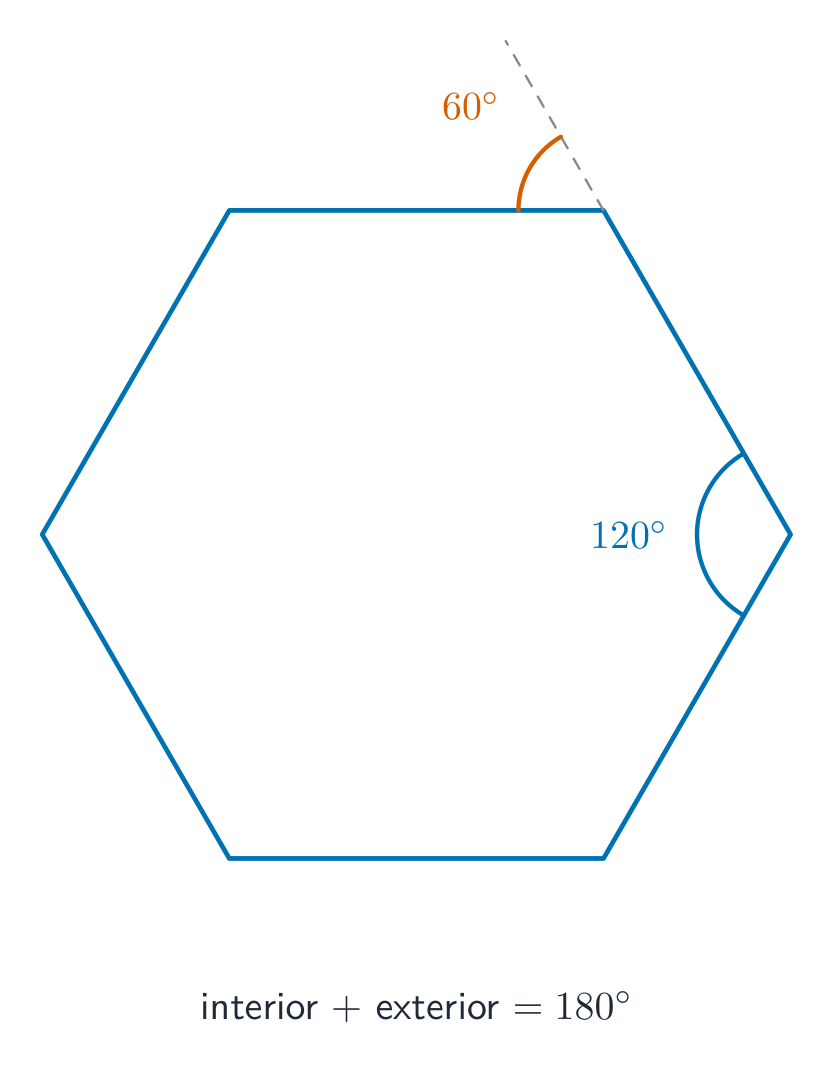
The interior angle 内角 and the exterior angle 外角 at each corner add up to $180^{\circ}$.
Worked example. Find each interior angle of a regular hexagon.
The exterior angle is $\dfrac{360^{\circ}}{6} = 60^{\circ}$, so each interior angle is $180^{\circ} - 60^{\circ} = 120^{\circ}$.
Worked example: find the number of sides. Each interior angle of a regular polygon is $156^{\circ}$. How many sides does it have?
Each exterior angle is $180^{\circ} - 156^{\circ} = 24^{\circ}$, and the exterior angles add to $360^{\circ}$, so there are $360 \div 24 = 15$ sides.
Worked example: an irregular polygon. A pentagon has angles $100^{\circ}$, $110^{\circ}$, $120^{\circ}$, $x$ and $2x$. Find $x$.
The interior angles of a pentagon add to $(5 - 2) \times 180^{\circ} = 540^{\circ}$, so
$$330 + 3x = 540 \quad\Rightarrow\quad 3x = 210 \quad\Rightarrow\quad x = 70^{\circ}.$$
Vocabulary
Train
| English |
|---|
| polygon/ˈpɒlɪɡən/ |
| regular polygon/ˈreɡjʊlə ˈpɒlɪɡən/ |
| pentagon/ˈpentæɡən/ |
| hexagon/ˈheksæɡən/ |
| octagon/ˈɒktæɡən/ |
| decagon/dɪˈkæɡən/ |
| interior angle/ɪnˈtɪərɪə ˈæŋɡl/ |
| exterior angle/ekˈstɪərɪə ˈæŋɡl/ |
4.5
Symmetry

Syllabus
| Subject content | Notes and examples |
|---|---|
| Recognise line symmetry and order of rotational symmetry in two dimensions. | Includes properties of triangles, quadrilaterals and polygons directly related to their symmetries. |
| Subject content | Notes and examples |
|---|---|
| 1 Recognise line symmetry and order of rotational symmetry in two dimensions. | Includes properties of triangles, quadrilaterals and polygons directly related to their symmetries. |
| 2 Recognise symmetry properties of prisms, cylinders, pyramids and cones. | e.g. identify planes and axes of symmetry. |
Source: Cambridge International syllabus
- A shape has line symmetry 轴对称 if a mirror line splits it into two matching halves.
- A shape has rotational symmetry 旋转对称 if it fits onto itself as you turn it. The order is how many times it fits in one full turn.
For solids (Extended), a flat slice that splits the solid into mirror halves is a plane of symmetry 对称面, and a line you can spin it around is an axis of symmetry 对称轴.
Explore
Symmetry as a reflection
A shape has line symmetry if reflecting it leaves it unchanged. Reflect the shape and watch what is preserved.
Vocabulary
Train
| English |
|---|
| line symmetry/laɪn ˈsɪmətri/ |
| rotational symmetry/rəʊˈteɪʃənl ˈsɪmətri/ |
| plane of symmetry/pleɪn ɒv ˈsɪmətri/ |
| axis of symmetry/ˈæksɪs ɒv ˈsɪmətri/ |
4.1
Circles: the parts

Syllabus
| Subject content | Notes and examples |
|---|---|
| 1 Use and interpret the following geometrical terms: • point • vertex • line • parallel • perpendicular • bearing • right angle • acute, obtuse and reflex angles • interior and exterior angles • similar • congruent • scale factor. | Candidates are not expected to show that two shapes are congruent. |
| 2 Use and interpret the vocabulary of: • triangles • special quadrilaterals • polygons • nets • simple solids. | Includes the following terms: Triangles: • equilateral • isosceles • scalene • right-angled. Quadrilaterals: • square • rectangle • kite • rhombus • parallelogram • trapezium. Polygons: • regular and irregular polygons • pentagon • hexagon • octagon • decagon. |
| Simple solids: • cube • cuboid • prism • cylinder • pyramid • cone • sphere (term ‘hemisphere’ not required) • face • surface • edge. | |
| 3 Use and interpret the vocabulary of a circle. | Includes the following terms: • centre • radius (plural radii) • diameter • circumference • semicircle • chord • tangent • arc • sector • segment. |
| Subject content | Notes and examples |
|---|---|
| 1 Use and interpret the following geometrical terms: • point • vertex • line • plane • parallel • perpendicular • perpendicular bisector • bearing • right angle • acute, obtuse and reflex angles • interior and exterior angles • similar • congruent • scale factor. | Candidates are not expected to show that two shapes are congruent. |
| 2 Use and interpret the vocabulary of: • triangles • special quadrilaterals • polygons • nets • solids. | Includes the following terms. Triangles: • equilateral • isosceles • scalene • right-angled. Quadrilaterals: • square • rectangle • kite • rhombus • parallelogram • trapezium. |
| Polygons: • regular and irregular polygons • pentagon • hexagon • octagon • decagon. Solids: • cube • cuboid • prism • cylinder • pyramid • cone • sphere • hemisphere • frustum • face • surface • edge. | |
| 3 Use and interpret the vocabulary of a circle. | Includes the following terms: • centre • radius (plural radii) • diameter • circumference • semicircle • chord • tangent • major and minor arc • sector • segment. |
Source: Cambridge International syllabus
| Term | Meaning |
|---|---|
| circle 圆 | all points the same distance from a centre |
| centre 圆心 | the middle point |
| radius 半径 | centre to edge (plural radii) |
| diameter 直径 | right across through the centre ($= 2 \times$ radius) |
| circumference 圆周 | the distance all the way round |
| chord 弦 | a straight line joining two points on the circle |
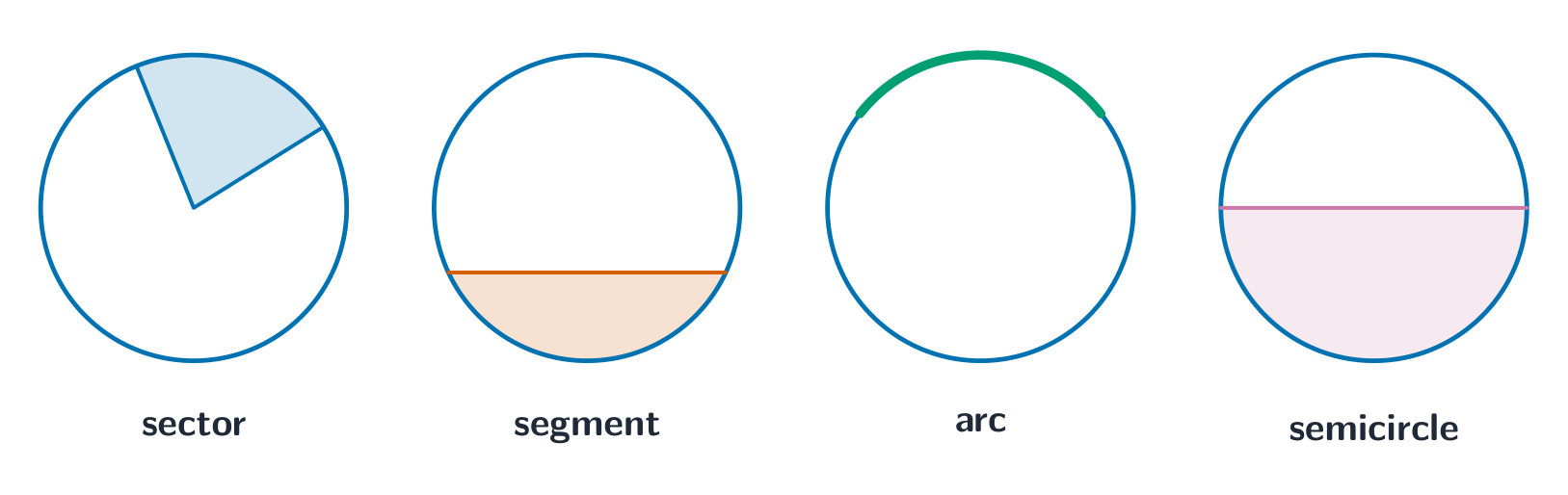
| arc 弧 | part of the circumference |
| sector 扇形 | a "pizza slice" between two radii |
| segment 弓形 | the region cut off by a chord |
| semicircle 半圆 | half a circle |
| tangent 切线 | a line that touches the circle at one point |
Explore
Arc and sector
Drag the angle and radius to see the arc (part of the circumference) and the sector (pie slice) it cuts off.
Vocabulary
Train
| English |
|---|
| circle/ˈsɜːkl/ |
| centre/ˈsentə/ |
| radius/ˈreɪdɪəs/ |
| diameter/daɪˈæmɪtə/ |
| circumference/sɜːˈkʌmfrəns/ |
| chord/kɔːd/ |
| arc/ɑːk/ |
| sector/ˈsektə/ |
| segment/ˈseɡmənt/ |
| semicircle/ˈsemɪsɜːkl/ |
| tangent/ˈtændʒənt/ |
4.7 4.8
Circle theorems

Syllabus
| Subject content | Notes and examples |
|---|---|
| Calculate unknown angles and give explanations using the following geometrical properties of circles: • angle in a semicircle = 90° • angle between tangent and radius = 90°. | Candidates will be expected to use the geometrical properties listed in the syllabus when giving reasons for answers. |
| Subject content | Notes and examples |
|---|---|
| Calculate unknown angles and give explanations using the following geometrical properties of circles: • angle in a semicircle = 90° • angle between tangent and radius = 90° • angle at the centre is twice the angle at the circumference • angles in the same segment are equal • opposite angles of a cyclic quadrilateral sum to 180° (supplementary) • alternate segment theorem. | Candidates are expected to use the geometrical properties listed in the syllabus when giving reasons for answers. |
| Subject content | Notes and examples |
|---|---|
| Use the following symmetry properties of circles: • equal chords are equidistant from the centre • the perpendicular bisector of a chord passes through the centre • tangents from an external point are equal in length. | Candidates are expected to use the geometrical properties listed in the syllabus when giving reasons for answers. |
Source: Cambridge International syllabus
Use these to find unknown angles, always giving the reason.
For both levels:
- The angle in a semicircle is $90^{\circ}$.
- The angle between a tangent and a radius is $90^{\circ}$.
Extended (theorems I):
- The angle at the centre is twice the angle at the circumference (standing on the same arc).
- Angles in the same segment are equal.
- Opposite angles of a cyclic quadrilateral 圆内接四边形 add up to $180^{\circ}$.
- The alternate segment theorem 弦切角定理: the angle between a tangent and a chord equals the angle in the other segment.
Extended (theorems II): equal chords are the same distance from the centre; the perpendicular bisector of a chord passes through the centre; two tangents from the same outside point are equal in length.
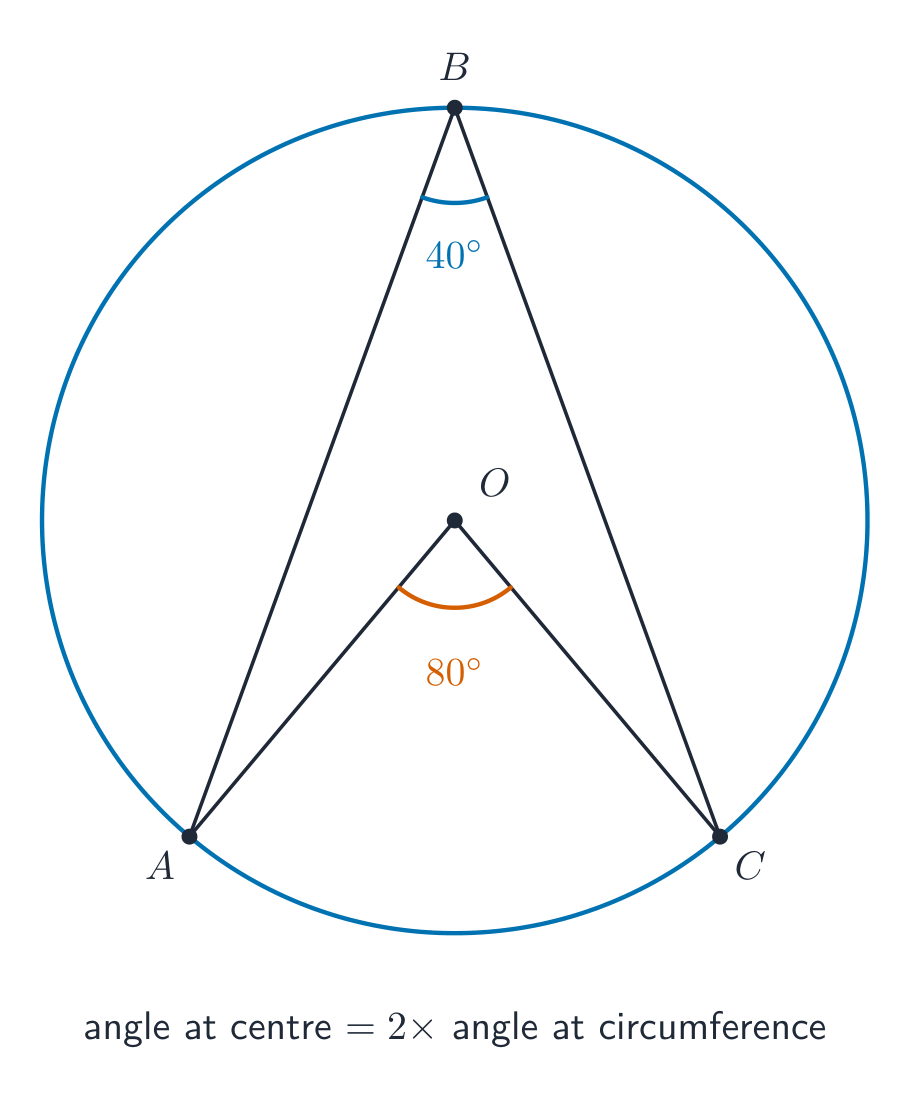
Worked example. A, B, C are on a circle. The angle at the circumference $ABC$ is $40^{\circ}$. Find the angle $AOC$ at the centre $O$.
The angle at the centre is twice the angle at the circumference: $2 \times 40^{\circ} = 80^{\circ}$.
Worked example (both levels). $AB$ is a diameter of a circle and $C$ is a point on the circle. Angle $CAB = 35^{\circ}$. Find angle $ABC$.
Angle $ACB = 90^{\circ}$ (angle in a semicircle). Then angle $ABC = 180^{\circ} - 90^{\circ} - 35^{\circ} = 55^{\circ}$ (angles in a triangle add to $180^{\circ}$).
Worked example (both levels). $PT$ is a tangent to a circle with centre $O$, touching it at $T$. Angle $TOP = 62^{\circ}$. Find angle $OPT$.
Angle $OTP = 90^{\circ}$ (tangent meets radius at $90^{\circ}$), so angle $OPT = 180^{\circ} - 90^{\circ} - 62^{\circ} = 28^{\circ}$ (angles in a triangle).
Worked example (Extended). $ABCD$ is a cyclic quadrilateral with angle $DAB = 105^{\circ}$. Find angle $BCD$.
Angle $BCD = 180^{\circ} - 105^{\circ} = 75^{\circ}$ (opposite angles of a cyclic quadrilateral add to $180^{\circ}$).
Worked example (Extended: several steps). Two tangents from a point $P$ touch a circle with centre $O$ at $A$ and $B$. Angle $APB = 50^{\circ}$, and $C$ is a point on the major arc. Find angle $ACB$.
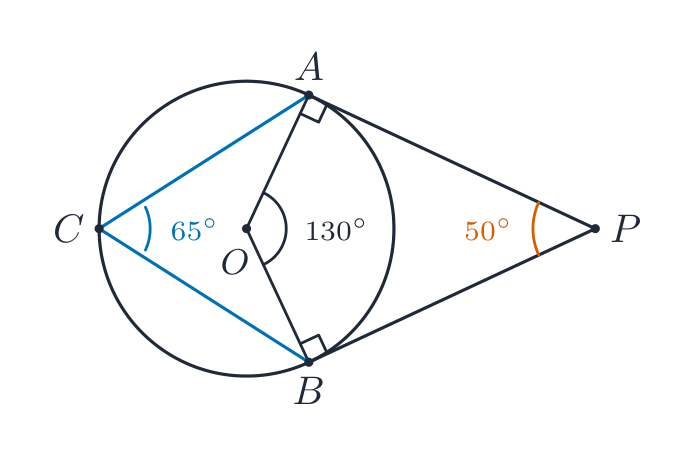
- Angles $OAP$ and $OBP$ are $90^{\circ}$ (tangent meets radius at $90^{\circ}$).
- Angle $AOB = 360^{\circ} - 90^{\circ} - 90^{\circ} - 50^{\circ} = 130^{\circ}$ (angles in a quadrilateral add to $360^{\circ}$).
- Angle $ACB = 130^{\circ} \div 2 = 65^{\circ}$ (angle at the centre is twice the angle at the circumference).
Worked example (Extended: alternate segment). A tangent touches a circle at $A$. The angle between the tangent and the chord $AB$ is $58^{\circ}$. $C$ is a point on the circle in the other segment. Then angle $ACB = 58^{\circ}$ (alternate segment theorem).
Common mistakes. Giving an angle with no reason, or with an informal reason such as "it looks like $90^{\circ}$"; using the angle-at-the-centre rule when the two angles do not stand on the same arc; and assuming a line is a diameter because it looks like one (the question must say so, or it must pass through $O$).
Vocabulary
Train
| English |
|---|
| cyclic quadrilateral/ˈsaɪklɪk ˌkwɒdrɪˈlætərəl/ |
| alternate segment theorem/ɔːlˈtɜːnət ˈseɡmənt ˈθɪərəm/ |
4.4
Similar shapes

Syllabus
| Subject content | Notes and examples |
|---|---|
| Calculate lengths of similar shapes. |
| Subject content | Notes and examples |
|---|---|
| 1 Calculate lengths of similar shapes. | |
| 2 Use the relationships between lengths and areas of similar shapes and lengths, surface areas and volumes of similar solids. | Includes use of scale factor, e.g. $$\frac{\text{Volume of } A}{\text{Volume of } B} = \frac{(\text{Length of } A)^3}{(\text{Length of } B)^3}$$ |
| 3 Solve problems and give simple explanations involving similarity. | Includes showing that two triangles are similar using geometric reasons. |
Source: Cambridge International syllabus
Two shapes are similar 相似 if one is an enlargement of the other: same angles, and all sides multiplied by the same scale factor 比例因子 $k$. (Shapes that are exactly the same size and shape are congruent 全等.)
For similar shapes and solids:
$$\frac{\text{area of } A}{\text{area of } B} = k^{2}, \qquad \frac{\text{volume of } A}{\text{volume of } B} = k^{3}.$$
Worked example. Two similar solids have lengths in the ratio $2 : 3$. The smaller has volume $40\text{ cm}^{3}$. Find the volume of the larger.
The volume ratio is $2^{3} : 3^{3} = 8 : 27$. So the larger volume is $40 \times \dfrac{27}{8} = 135\text{ cm}^{3}$.
Worked example: lengths (both levels). In triangle $ABC$, $D$ is on $AB$ and $E$ is on $AC$, with $DE$ parallel to $BC$. $AD = 4\text{ cm}$, $AB = 10\text{ cm}$ and $DE = 6\text{ cm}$. Find $BC$.
Triangles $ADE$ and $ABC$ are similar. (Extended reason: angle $A$ is shared, and angles $ADE$ and $ABC$ are equal because they are corresponding angles.) The scale factor is $\dfrac{AB}{AD} = \dfrac{10}{4} = 2.5$, so
$$BC = 6 \times 2.5 = 15\text{ cm}.$$
Worked example: area to length (Extended). Two similar shapes have areas $20\text{ cm}^{2}$ and $45\text{ cm}^{2}$. The smaller is $8\text{ cm}$ tall. How tall is the larger?
The area ratio is $20 : 45 = 4 : 9$, so the length ratio is $\sqrt{4} : \sqrt{9} = 2 : 3$. The larger is $8 \times \dfrac{3}{2} = 12\text{ cm}$ tall.
Common mistakes. Multiplying an area by the length scale factor $k$ (use $k^{2}$ for area and $k^{3}$ for volume), and matching the wrong pairs of sides. Match sides that sit opposite equal angles.
Explore
Similar shapes — enlargement
Similar shapes are the same shape but a different size. An enlargement scales every length by the same factor; angles stay the same.
Vocabulary
Train
| English |
|---|
| similar/ˈsɪmɪlə/ |
| scale factor/skeɪl ˈfæktə/ |
| congruent/ˈkɒŋɡruːənt/ |
4.6
Bearings

Syllabus
| Subject content | Notes and examples |
|---|---|
| 1 Calculate unknown angles and give simple explanations using the following geometrical properties: • sum of angles at a point = 360° • sum of angles at a point on a straight line = 180° • vertically opposite angles are equal • angle sum of a triangle = 180° and angle sum of a quadrilateral = 360°. | Knowledge of three-letter notation for angles is required, e.g. angle $ABC$. Candidates are expected to use the correct geometrical terminology when giving reasons for answers. |
| 2 Calculate unknown angles and give geometric explanations for angles formed within parallel lines: • corresponding angles are equal • alternate angles are equal • co-interior angles sum to 180° (supplementary). | |
| 3 Know and use angle properties of regular polygons. | Includes exterior and interior angles, and angle sum. |
| Subject content | Notes and examples |
|---|---|
| 1 Calculate unknown angles and give simple explanations using the following geometrical properties: • sum of angles at a point = 360° • sum of angles at a point on a straight line = 180° • vertically opposite angles are equal • angle sum of a triangle = 180° and angle sum of a quadrilateral = 360°. | Knowledge of 3-letter notation for angles is required, e.g. angle $ABC$. Candidates are expected to use the correct geometrical terminology when giving reasons for answers. |
| 2 Calculate unknown angles and give geometric explanations for angles formed within parallel lines: • corresponding angles are equal • alternate angles are equal • co-interior angles sum to 180° (supplementary). | |
| 3 Know and use angle properties of regular and irregular polygons. | Includes exterior and interior angles, and angle sum. |
Source: Cambridge International syllabus
A bearing 方位角 gives a direction as a three-figure angle, measured clockwise 顺时针 from north, from $000^{\circ}$ to $360^{\circ}$. So due east is $090^{\circ}$ and due south is $180^{\circ}$.
Worked example. The bearing of $B$ from $A$ is $025^{\circ}$. Find the bearing of $A$ from $B$.
The return (back) bearing differs by $180^{\circ}$: $025^{\circ} + 180^{\circ} = 205^{\circ}$.
Explore
Bearings route
Follow how to measure a bearing correctly from north.
Vocabulary
Train
| English |
|---|
| bearing/ˈbeərɪŋ/ |
| clockwise/ˈklɒkwaɪz/ |
4.2 4.3
Constructions, nets and solids

Syllabus
| Subject content | Notes and examples |
|---|---|
| 1 Measure and draw lines and angles. | A ruler should be used for all straight edges. Constructions of perpendicular bisectors and angle bisectors are not required. |
| 2 Construct a triangle, given the lengths of all sides, using a ruler and pair of compasses only. | e.g. construct a rhombus by drawing two triangles. Construction arcs must be shown. |
| 3 Draw, use and interpret nets. | Examples include: • draw nets of cubes, cuboids, prisms and pyramids • use measurements from nets to calculate volumes and surface areas. |
| Subject content | Notes and examples |
|---|---|
| 1 Draw and interpret scale drawings. | A ruler must be used for all straight edges. |
| 2 Use and interpret three-figure bearings. | Bearings are measured clockwise from north (000° to 360°). e.g. find the bearing of A from B if the bearing of B from A is 025°. |
| Includes an understanding of the terms north, east, south and west. e.g. point D is due east of point C. |
| Subject content | Notes and examples |
|---|---|
| 1 Draw and interpret scale drawings. | A ruler must be used for all straight edges. |
| 2 Use and interpret three-figure bearings. | Bearings are measured clockwise from north ($000^{\circ}$ to $360^{\circ}$). e.g. find the bearing of $A$ from $B$ if the bearing of $B$ from $A$ is $025^{\circ}$. Includes an understanding of the terms north, east, south and west. e.g. point $D$ is due east of point $C$. |
Source: Cambridge International syllabus
- To construct 作图 a triangle from three given sides, draw the base with a ruler, then use a pair of compasses 圆规 to mark each other side as an arc. Leave the construction arcs showing.
- A net 展开图 is a flat shape that folds up into a solid. You can use a net to work out surface areas.
- A scale drawing 比例图 shows a real object smaller (or larger) by a fixed scale, such as $1\text{ cm}$ to $5\text{ m}$.
Common solids 几何体 and their parts:
| Solid | Note |
|---|---|
| cube 立方体 / cuboid 长方体 | box shapes |
| prism 棱柱 | the same shape all along its length |
| cylinder 圆柱 | a circular prism |
| pyramid 棱锥 / cone 圆锥 | come to a point |
| sphere 球 / hemisphere 半球 | a ball / half a ball |
| frustum 平截头体 | a cone or pyramid with the top cut off |
A flat side of a solid is a face 面, two faces meet at an edge 棱, and the whole outside is its surface 表面.
Explore
Construction and solid lab
Classify geometry tasks by the tool or representation needed.
Vocabulary
Train
| English |
|---|
| construct/ˈkɒnstrʌkt/ |
| compasses/ˈkʌmpəsɪz/ |
| net/net/ |
| scale drawing/skeɪl ˈdrɔːɪŋ/ |
| solids/ˈsɒlɪdz/ |
| cube/kjuːb/ |
| cuboid/ˈkjuːbɔɪd/ |
| prism/ˈprɪzəm/ |
| cylinder/ˈsɪlɪndə/ |
| pyramid/ˈpɪrəmɪd/ |
| cone/kəʊn/ |
| sphere/sfɪə/ |
| hemisphere/ˈhemɪsfɪə/ |
| frustum/ˈfrʌstəm/ |
| face/feɪs/ |
| edge/edʒ/ |
| surface/ˈsɜːfɪs/ |
4.2 4.3
Exam tips
- Angles on a straight line add to $180°$, around a point to $360°$, and in a triangle to $180°$. Give a reason for every step of an angle question.
- Learn the circle theorems: the angle at the centre is twice the angle at the circumference; the angle in a semicircle is $90°$; angles in the same segment are equal; opposite angles of a cyclic quadrilateral add to $180°$.
- The exterior angles of a convex polygon, one at each vertex, add to $360°$, and each interior angle + its exterior angle = $180°$.
- Bearings are measured clockwise from north and always written with three figures (e.g. $072°$).
Interactive lessons on this topic
Work through it step by step, with instant-check exercises.