Skip to content

5 · Operations and break-even decisions

International Baccalaureate · IB Diploma · Business Management · SL · Topic 5

Video lesson for this topic Open the video page
4:07

Operations management

In March twenty eleven an earthquake and tsunami hit north-east Japan. Many of Toyota's suppliers stopped work. Toyota held very little stock, so within days…

English narration · English + 中文 subtitles burned in

5.1

Operations management

IB Diploma Programme Business Management SL, Unit 5 Operations management (first assessment 2024). This topic covers the SL content of sections 5.1 to 5.5: the role of operations, operations methods, location and break-even analysis. Lean production and quality (5.3), production planning (5.6), crisis management (5.7), research and development (5.8) and management information systems (5.9) are HL only and are left out. The worked examples use the course's repair business, and the numbers fit Unit 3: each repair sells for 25 on average, uses 15 of parts and direct labour, and fixed costs are 12,500 a month.

In March 2011 a huge earthquake and tsunami hit north-east Japan. Many of Toyota's suppliers stopped work. Toyota was famous for holding very little stock, so within days some of its factories in Japan and abroad had no parts, and output stayed low for months. Toyota did not give up its low-stock system. Instead it built a database of every supplier behind its suppliers, so it could act faster next time. This topic is about how a business makes its products: which production method to use, where to produce, and how many it must sell to cover its costs.

Must-know for this topic:

Idea Key content
operations inputs → process → outputs; links to finance, HR and marketing
methods job, batch, mass/flow, mass customisation
location reasons; outsourcing, offshoring, insourcing, reshoring
break-even contribution 10; break-even 1,250 repairs; margin of safety 750
5.2

The role of operations and operations methods

Operations management 运营管理 is the part of a business that makes its goods or provides its services. It turns inputs 投入 (labour, materials, machines, money and information) into outputs 产出 that are worth more than the inputs. The extra value is value added 附加值.

Inputs (materials, labour, machines, money) flow into a process and out as outputs (finished goods and services)

Inputs are transformed into outputs worth more than the inputs: value added

Operations links to every other part of the business. Marketing says what customers want; finance pays for the machines; human resources finds the skilled staff. Operations must also be sustainable: a workshop that recycles oil and old tyres cuts its costs and its harm to the environment.

There are four main operations methods 生产方法:

Method What it is Example For and against
job production 单件生产 one item made to a customer's order restoring a classic car high quality and high prices; slow, skilled staff, high cost per unit
batch production 批量生产 a group of identical items, then a switch to the next group servicing 40 taxis from one company in one week some variety, lower cost; time is lost when switching between batches
mass production 大规模生产 (flow) the same item made without stopping a car factory line lowest cost per unit; expensive to set up, little choice, boring work
mass customisation 大规模定制 flow-line speed, but each customer chooses features a car ordered online in your choice of colour and wheels choice at a low cost; needs flexible machines and good data
Vocabulary Train
English
operations management/ˌɒpəˈreɪʃnz ˈmænɪdʒmənt/
inputs/ˈɪnpʊts/
outputs/ˈaʊtpʊts/
value added/ˈvæljuː ˈædɪd/
operations methods
job production/dʒɒb prəˈdʌkʃn/
batch production/bætʃ prəˈdʌkʃn/
mass production
mass customisation/mæs ˌkʌstəmaɪˈzeɪʃn/
5.3

Location

Businesses choose a location by weighing:

  • costs: land, rent, wages and transport;
  • the labour available and its skills;
  • nearness to customers (most important for services, such as repairs) and to suppliers (important for heavy materials);
  • infrastructure: roads, ports, power and internet;
  • government: taxes, grants, rules and political stability;
  • culture and language, for a business moving abroad.

A business can also change who does the work and where.

A two-by-two map: outsourcing moves a task from our business to another firm and insourcing brings it back; offshoring moves it from the home country abroad and reshoring brings it back

Outsourcing and insourcing change who does the work; offshoring and reshoring change where

  • Outsourcing 外包 (subcontracting) gives a task to another firm, such as the repair business paying a firm to run its booking app. It is often cheaper and uses the other firm's skills, but the business loses some control over quality.
  • Offshoring 离岸外包 moves work to another country, for lower costs or to be near new markets.
  • Insourcing 内包 brings an outsourced task back inside the business, usually for better control or quality.
  • Reshoring 回流 brings work back to the home country, often after supply problems abroad.
Vocabulary Train
English
outsourcing/aʊtˈsɔːsɪŋ/
offshoring/ˈɒfʃərɪŋ/
insourcing
reshoring
5.4

Break-even analysis

Contribution 边际贡献 per unit is the price minus the variable cost per unit. It is the amount each sale adds towards paying the fixed costs.

$$\text{contribution per unit} = 25 - 15 = 10$$

Total contribution is contribution per unit × output. At 2,000 repairs a month it is $2{,}000 \times 10 = 20{,}000$. Profit is total contribution minus fixed costs: $20{,}000 - 12{,}500 = 7{,}500$ a month.

The break-even 盈亏平衡 output is where total revenue equals total cost, so there is no profit and no loss.

$$\text{break-even output} = \frac{\text{fixed costs}}{\text{contribution per unit}} = \frac{12{,}500}{10} = 1{,}250 \text{ repairs a month}$$

The margin of safety 安全边际 is how far sales can fall before the business makes a loss.

$$\text{margin of safety} = \text{actual output} - \text{break-even output} = 2{,}000 - 1{,}250 = 750 \text{ repairs}$$
A break-even chart for the repair business: total revenue and total cost cross at 1,250 repairs; at 2,000 repairs the margin of safety is 750 and the profit 7,500

Break-even at 1,250 repairs a month; at 2,000 repairs the margin of safety is 750 repairs

A business can also work out the output or price it needs for a target profit 目标利润:

  • target output $= \dfrac{\text{fixed costs} + \text{target profit}}{\text{contribution per unit}}$. For a profit of 15,000: $(12{,}500 + 15{,}000) \div 10 = 2{,}750$ repairs.
  • target price $= \dfrac{\text{fixed costs} + \text{target profit}}{\text{output}} + \text{variable cost per unit}$. For a profit of 10,000 at 2,000 repairs: $(12{,}500 + 10{,}000) \div 2{,}000 + 15 = 26.25$.

Worked example: a change in price and cost. The business raises its price to 27, so contribution rises to 12. In the same month the rent rises by 3,000, so fixed costs become 15,500. The new break-even output is $15{,}500 \div 12 = 1{,}291.7$, which rounds up to 1,292 repairs. If sales stay at 2,000, profit rises to $2{,}000 \times 12 - 15{,}500 = 8{,}500$, but the margin of safety falls from 750 to 708. If the higher price drives some customers away, the business is closer to a loss than before.

Break-even analysis is quick and easy to show on a chart, and it helps when planning prices or a new product. But it assumes that every unit made is sold, that the price and the variable cost per unit stay the same at every output, and that fixed costs never change. In real life, buying in bulk lowers variable costs, a bigger output may need a new workshop, and sales forecasts can be wrong.

Explore

Can the sales forecast cover fixed costs?

$Q_{BE}=\frac{F}{p-v};\quad \pi=(p-v)Q-F$

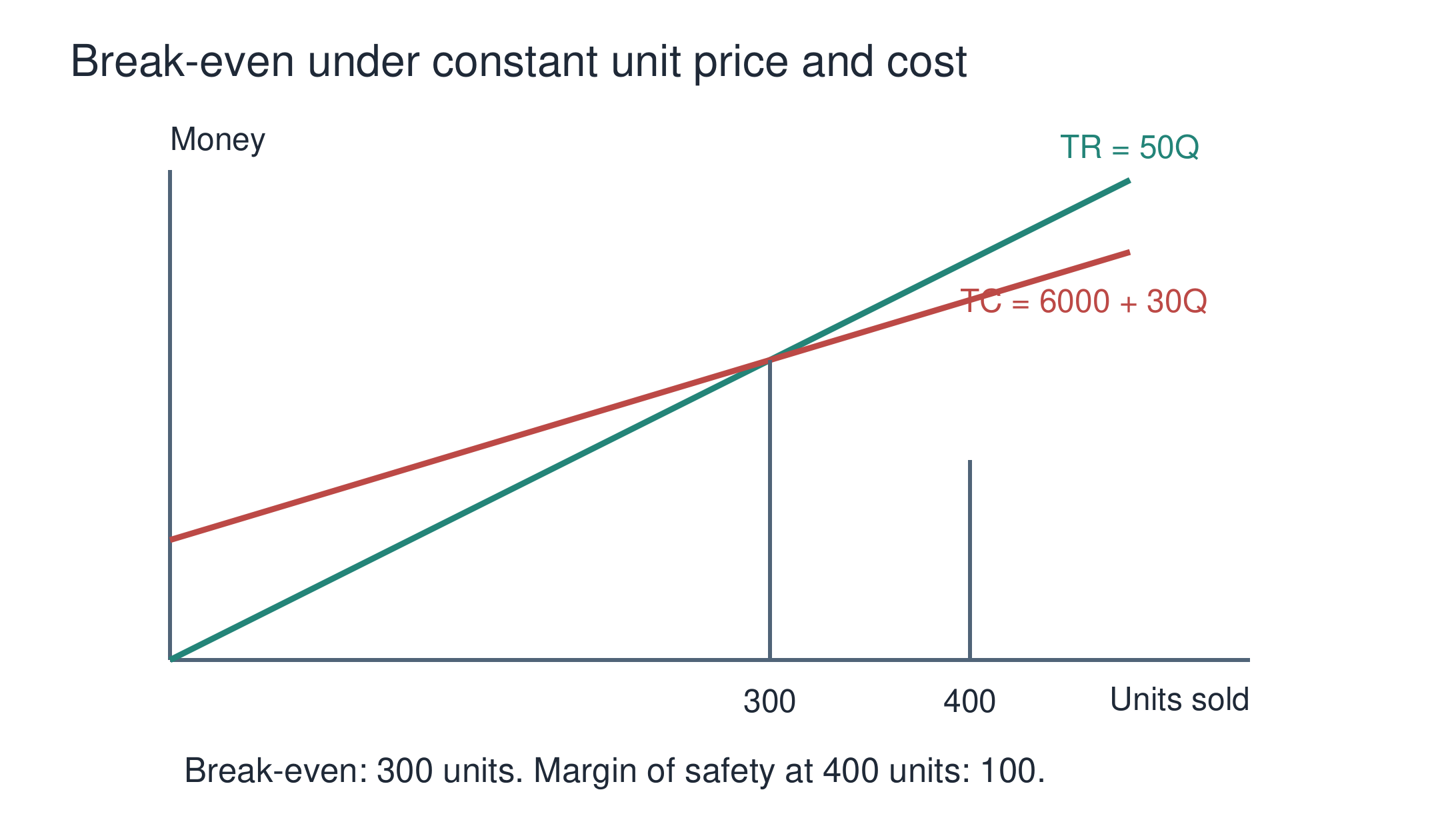
The worked case breaks even at 300 units; 400 sales leave a margin of safety of 100 units.

Vocabulary Train
English
contribution/ˌkɒntrɪˈbjuːʃn/
break-even/breɪk ˈiːvən/
margin of safety/ˈmɑːdʒɪn ɒv ˈseɪfti/
target profit
5.5

Checklist

  • The transformation process and value added; links between operations and the other functions; sustainability (5.1).
  • Job, batch, mass and mass customisation, with an example and the advantages and disadvantages of each (5.2).
  • Location factors; outsourcing, offshoring, insourcing and reshoring (5.4).
  • Contribution 10, total contribution 20,000, break-even 1,250 repairs, margin of safety 750, target output 2,750 for a profit of 15,000, target price 26.25; the change to price 27 and rent +3,000 (break-even 1,292, margin 708); the limits of the model (5.5).

Paper 2 tests the calculations: write the formula, put in the numbers and give the answer with its unit, then say what it means for the business. Paper 1 asks about operations methods, quality and location in the case-study business. All numbers here are original.

Additional notes PDF
Supported preparation: Operations and break-even

Scope and prerequisites

IB business management first assessment 2024. Business research project investigates one real organization through a conceptual lens. The toolkit and change, creativity, ethics and sustainability connect units; HL-only topics remain marked.

Mapped preparation outcomes: ib_business_management_sl.5.1, ib_business_management_sl.5.2. Read the matching native lesson first. Actual approved choices, evidence and final learner work remain separate.

Source vocabulary

contribution 边际贡献; margin of safety 安全边际.

Explanation and worked method

Job production suits customized work; batch production groups similar jobs; flow production suits repeated standardized output. Location trades access, labour, transport and costs. Break-even uses constant price and variable cost per unit, fixed costs and output sold.

Existing original lesson representation: Break-even under constant unit price and cost. It illustrates its source lesson, not invented research results.

Task: fixed cost 4,800 units, price 40 units per item, variable cost 24 units per item, expected sales 360 items. Calculate break-even and margin of safety, then evaluate capacity of 280.

Contribution per item=price−variable cost=40−24=16 units/item. Break-even quantity=fixed cost/contribution=4,800/(16 units/item)=300 items. Margin of safety=expected sales−break-even=360−300=60 items. Capacity 280 is below break-even, so the assumed 360 sales are infeasible without changing capacity or costs. HL may examine quality, contingency and information systems; claims require operational evidence.

Independent transfer

Price falls from 40 to 36 while variable cost stays 24 and fixed cost stays 4,800. Recalculate break-even.

Attempt independently before reading the model.

Checked original model

Contribution per item=price−variable cost=36−24=12 currency units/item. Break-even quantity=fixed cost/contribution=4,800/12=400 items. At expected sales of 360, margin of safety=360−400=−40 items; the model predicts a shortfall. Capacity and demand must be checked again.

These are authored formative expectations, not official IB descriptors. Accept other justified arguments with evidence and material limits.

Source and task holds

This supplement teaches the method for this part of the course. The full assessment criteria and any texts your school chooses come from your teacher.

Interactive lessons on this topic

Work through it step by step, with instant-check exercises.

More topics in International Baccalaureate · IB Diploma · Business Management · SL

Log in or create account

IGCSE, A-Level & AP