Skip to content

4 · Marketing decisions

International Baccalaureate · IB Diploma · Business Management · SL · Topic 4

Video lesson for this topic Open the video page
5:46

Marketing

Luckin Coffee opened its first shop in Beijing in 2017. Within two years it had more shops in China than Starbucks. It did not win with better coffee alone. It…

English narration · English + 中文 subtitles burned in

4.1

Marketing

IB Diploma Programme Business Management SL, Unit 4 Marketing (first assessment 2024). This topic covers the SL content of sections 4.1 to 4.6: the role of marketing, marketing planning, market research and the seven Ps of the marketing mix. Sales forecasting (4.3) and international marketing (4.6) are HL only and are left out. The worked examples use the course's repair business. Its city has a market of 8,000 car repairs a month, and the business does 2,000 of them.

Luckin Coffee opened its first shop in Beijing in 2017. Within two years it had more shops in China than Starbucks. It did not win with better coffee alone. It used an app for every order, small pick-up shops instead of big cafés, and large discounts to win first-time buyers. Every one of those choices is a marketing decision: product, price, place and promotion. This topic shows how a business decides who its customers are and how to reach them.

Must-know for this topic:

Idea Key content
orientation market orientation against product orientation
market share $\dfrac{\text{firm's sales}}{\text{total market sales}} \times 100$: $2{,}000 \div 8{,}000 \times 100 = 25\%$
planning segmentation, targeting, positioning; position map; USP
research primary and secondary; qualitative and quantitative; sampling
the 7Ps product, price, promotion, place, people, processes, physical evidence
4.2

The role of marketing

Marketing 营销 means finding out what customers want and supplying it at a profit. It links the business to its customers.

  • A business with market orientation 市场导向 starts with customers: it researches what they want, then makes it. This is the usual approach today, because tastes change fast.
  • A business with product orientation 产品导向 starts with the product: it makes what it is good at, then tries to sell it. This can work for new technology, where customers do not yet know what they want, but it is risky.

Social enterprises market too, but their aim may be to change behaviour (for example, to make people recycle) rather than to earn profit.

Market share 市场份额 is a firm's sales as a percentage of the whole market's sales.

Worked example. The city's garages do 8,000 repairs a month, and the repair business does 2,000. Its market share $= 2{,}000 \div 8{,}000 \times 100 = 25\%$. If the market grows to 10,000 repairs and the business does 2,400, its sales rise by 20% but its market share falls to 24%. Rivals grew faster.

A high market share brings economies of scale, a strong brand and power over suppliers. The firm with the largest share is the market leader 市场领导者.

Vocabulary Train
English
marketing/ˈmɑːkɪtɪŋ/
market orientation/ˈmɑːkɪt ˌɔːrɪənˈteɪʃn/
product orientation
market share/ˈmɑːkɪt ʃeə/
market leader
4.3

Marketing planning

A marketing plan 营销计划 sets out the marketing objectives, the target market, the marketing mix, the budget and how success will be measured. Marketing objectives must fit the business's main objectives: for example, "raise market share from 25% to 30% in two years".

Segmentation, targeting and positioning

  1. Segmentation 市场细分: dividing a market into groups of customers with similar needs. Common ways: by demographics 人口统计特征 (age, income, gender), by geography, and by psychographics 消费心理特征 (lifestyle, values, interests).
  2. Targeting 目标市场选择: choosing which segments to serve. A niche market 利基市场 is a small, specialised segment; a mass market 大众市场 is a large one with similar needs.
  3. Positioning 市场定位: deciding how the product should be seen compared with rivals in the customer's mind.

A position map 定位图 (perception map) places rival products on two features that customers care about, such as price and quality. It shows where competition is crowded and where there is a gap.

Position map of six garages on price against quality: a dealer garage high price and high quality, two chains in the middle, a cheap roadside workshop, an airport garage high price and low quality, the repair business high quality at a middle price, and a gap at high quality and lower price
A position map shows where rivals compete and where gaps exist

A gap is not always a chance: there may be no customers there, or it may cost too much to serve. A business stands out through its unique selling point 独特卖点 (USP): something rivals do not offer. The repair business's USP is a 24-hour repair promise with a free replacement car.

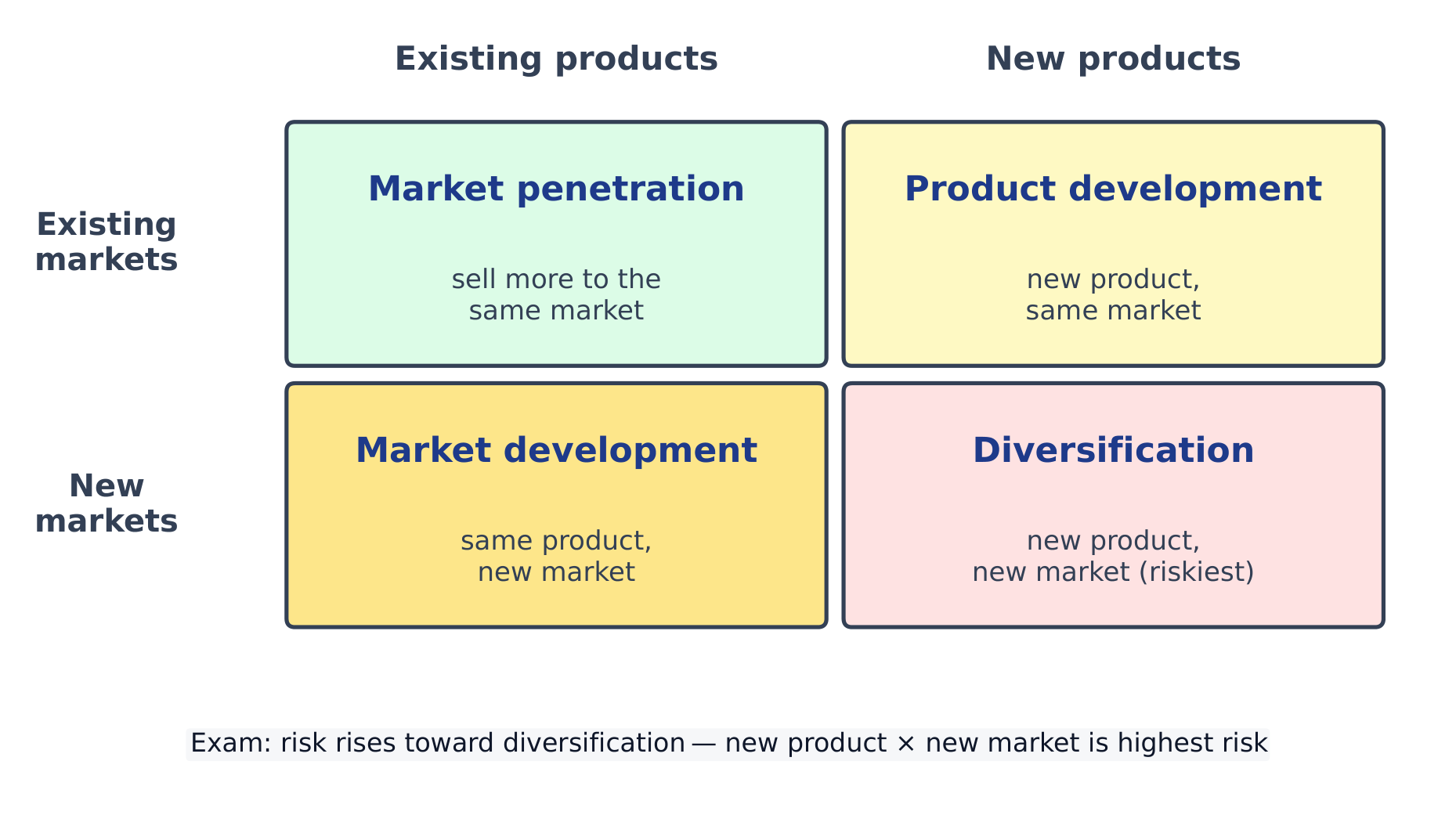
The Ansoff matrix 安索夫矩阵 (from the business management toolkit) shows four growth strategies and their risk:

A two-by-two grid of existing and new products against existing and new markets: market penetration, product development, market development and diversification
Ansoff matrix: risk rises from market penetration to diversification
Vocabulary Train
English
marketing plan/ˈmɑːkɪtɪŋ plæn/
segmentation/ˌseɡmənˈteɪʃn/
demographics
psychographics
targeting
niche market/niːʃ ˈmɑːkɪt/
mass market/mæs ˈmɑːkɪt/
positioning/pəˈzɪʃənɪŋ/
position map
unique selling point
Ansoff matrix/ˈænsɒf ˈmeɪtrɪks/
4.4

Market research

Market research 市场调研 collects information about customers, competitors and markets to reduce the risk of decisions.

  • Primary research 一手调研 collects new data for the business's own purpose: surveys 问卷调查, interviews, focus groups 焦点小组 (a small group discussing a product), observation and test marketing. It fits the question exactly and is up to date, but it is slow and costly.
  • Secondary research 二手调研 uses data that already exists: government statistics, industry reports, newspapers, competitors' websites and the firm's own sales records. It is quick and cheap, but it may be out of date or collected for another purpose.

Quantitative data 定量数据 is numbers ("62% of drivers service their car once a year"). Qualitative data 定性数据 is opinions and reasons ("drivers distrust garages that do not explain the fault"). Good research uses both.

Researchers usually ask a sample 样本 instead of everyone:

Sampling method How it works Weakness
random sampling 随机抽样 everyone has an equal chance of being chosen needs a full list of the population
stratified sampling 分层抽样 the sample matches the population's groups (age, area) needs data on the groups
quota sampling 配额抽样 the researcher fills a set number from each group not random, so bias is possible
convenience sampling 便利抽样 whoever is easy to reach often unrepresentative
snowballing 滚雪球抽样 each person suggests others biased towards one social circle

Sampling error 抽样误差 happens when the sample does not represent the population, often because it is too small. Research can also be biased by leading questions. And collecting customer data online raises ethical questions about privacy and consent.

Vocabulary Train
English
market research/ˈmɑːkɪt rɪˈsɜːtʃ/
primary research/ˈpraɪməri rɪˈsɜːtʃ/
surveys/ˈsɜːveɪz/
focus groups/ˈfəʊkəs ɡruːps/
secondary research/ˈsekəndəri rɪˈsɜːtʃ/
quantitative data/ˈkwɒntɪteɪtɪv ˈdeɪtə/
qualitative data/ˈkwɒlɪteɪtɪv ˈdeɪtə/
sample/ˈsæmpl/
random sampling/ˈrændəm ˈsæmplɪŋ/
stratified sampling/ˈstrætɪfaɪd ˈsæmplɪŋ/
quota sampling/ˈkwəʊtə ˈsæmplɪŋ/
convenience sampling
snowballing
sampling error
4.5

The seven Ps of the marketing mix

The marketing mix 营销组合 is the set of decisions a business makes to sell its product. For goods there are four Ps: product, price, promotion and place. Services add three more: people, processes and physical evidence. All seven must fit together: a premium brand with a very low price confuses customers.

Product

The product life cycle 产品生命周期 shows the stages of a product's sales over time:

A product life cycle curve of sales over time through introduction, growth, maturity and decline, with a dashed extension strategy
Sales through introduction, growth, maturity and decline; an extension strategy can delay the decline
Stage Sales Cash flow Typical marketing
development none negative research and testing
introduction low, slow growth negative heavy promotion; skimming or penetration price
growth rising fast turning positive more outlets; build the brand
maturity high, levelling off strongly positive compete on price and features; extension strategies
decline falling falling cut costs, then withdraw

Extension strategies 延伸策略 delay the decline: a new feature, a new design, a new market, or a new use.

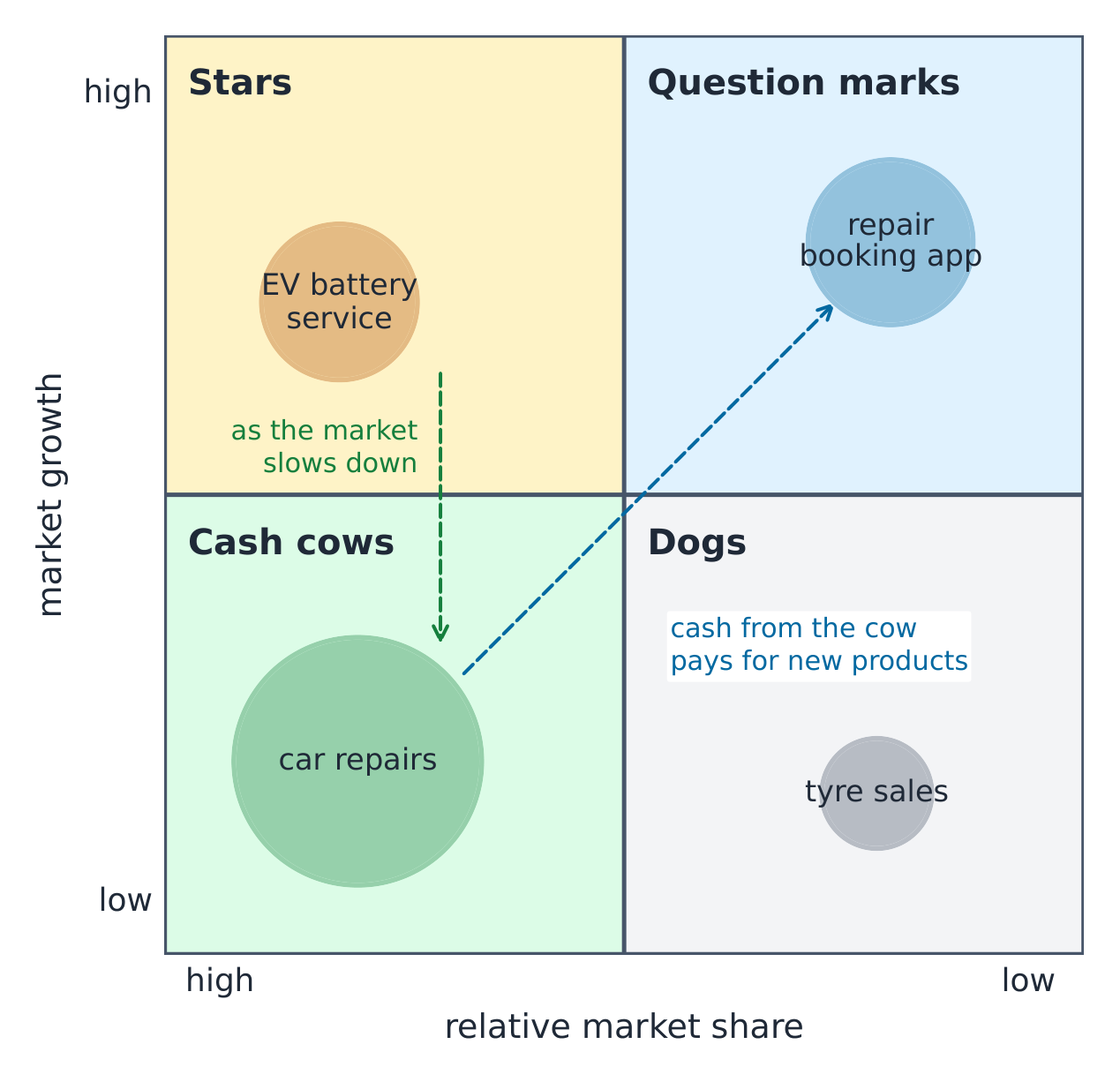
The Boston Consulting Group matrix 波士顿矩阵 (BCG matrix) looks at a firm's whole range of products, its product portfolio 产品组合, using market growth and relative market share:

Boston matrix with four product lines of the repair business: EV battery service as a star, a repair booking app as a question mark, car repairs as a cash cow, tyre sales as a dog
The repair business's products on the Boston matrix: the cash cow pays for the star and the question mark
  • Stars 明星产品: high share of a fast-growing market. They need cash to keep growing. EV battery servicing.
  • Cash cows 现金牛: high share of a slow-growing market. They earn more cash than they need. Ordinary car repairs.
  • Question marks 问题产品: low share of a fast-growing market. Invest to build share, or drop them. The new repair booking app.
  • Dogs 瘦狗产品: low share of a slow-growing market. Usually sold or closed. Tyre sales, where large chains are much cheaper.

A balanced portfolio uses the cash from cows to turn question marks into stars, which later become the next cash cows.

Branding 品牌建设 gives a product a name, logo and identity. A strong brand builds brand loyalty 品牌忠诚度 and lets the firm charge more. Packaging protects the product, but also informs and attracts buyers.

Price

Pricing method How it works When it is used
cost-plus pricing 成本加成定价 average cost plus a fixed percentage simple; common in shops
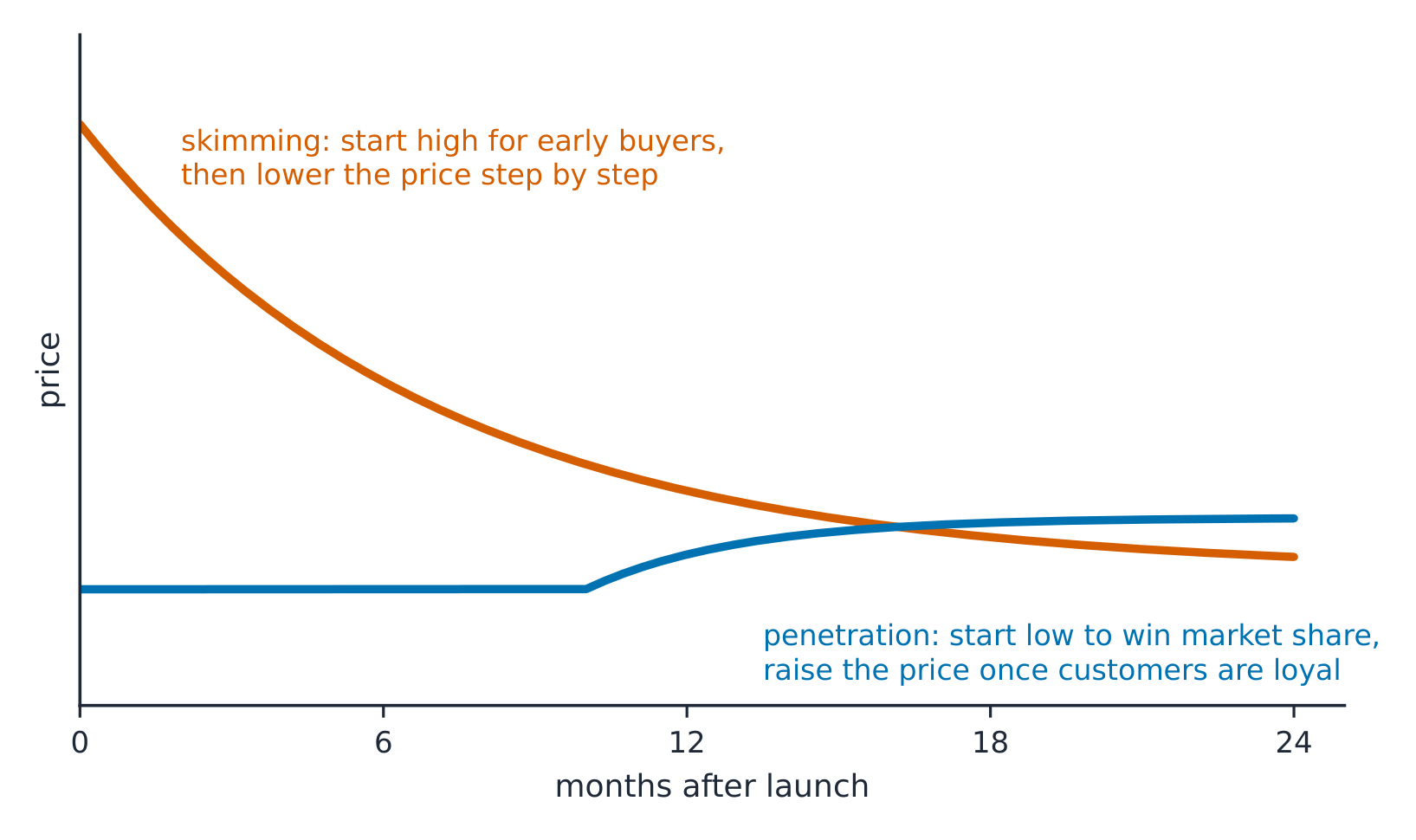
penetration pricing 渗透定价 a low price at launch to win market share mass markets; new firms
price skimming 撇脂定价 a high price at launch, lowered over time new technology with keen early buyers
psychological pricing 心理定价 prices such as 99 instead of 100 consumer goods
loss leader 招徕定价 one item sold below cost to bring in customers supermarkets
price discrimination 价格歧视 different prices for different groups for the same product cinemas, airlines, student discounts
dynamic pricing 动态定价 prices change with demand in real time ride-hailing apps, hotels
competitive pricing 竞争定价 prices set close to rivals' many similar products
contribution pricing 贡献定价 price covers the variable cost and adds something towards fixed costs spare capacity
Two price paths after a launch: skimming starts high and falls over time; penetration starts low and rises once customers are loyal
Skimming and penetration pricing move in opposite directions after launch

Promotion

  • Above-the-line promotion 线上促销 uses paid mass media: television, newspapers, cinema, billboards and online adverts. It reaches many people, but it is costly and hard to target.
  • Below-the-line promotion 线下促销 is targeted and often cheaper: sales promotions (discounts, free gifts), sponsorship, direct marketing, personal selling and public relations 公共关系 (PR).
  • Social media marketing 社交媒体营销 uses platforms such as WeChat, Douyin and Instagram. It is cheap and two-way, and messages can go viral, but bad comments spread just as fast.
  • Guerrilla marketing 游击营销 uses surprising, low-cost stunts in public places to get attention.

The promotional mix 促销组合 is the combination a business chooses.

Place

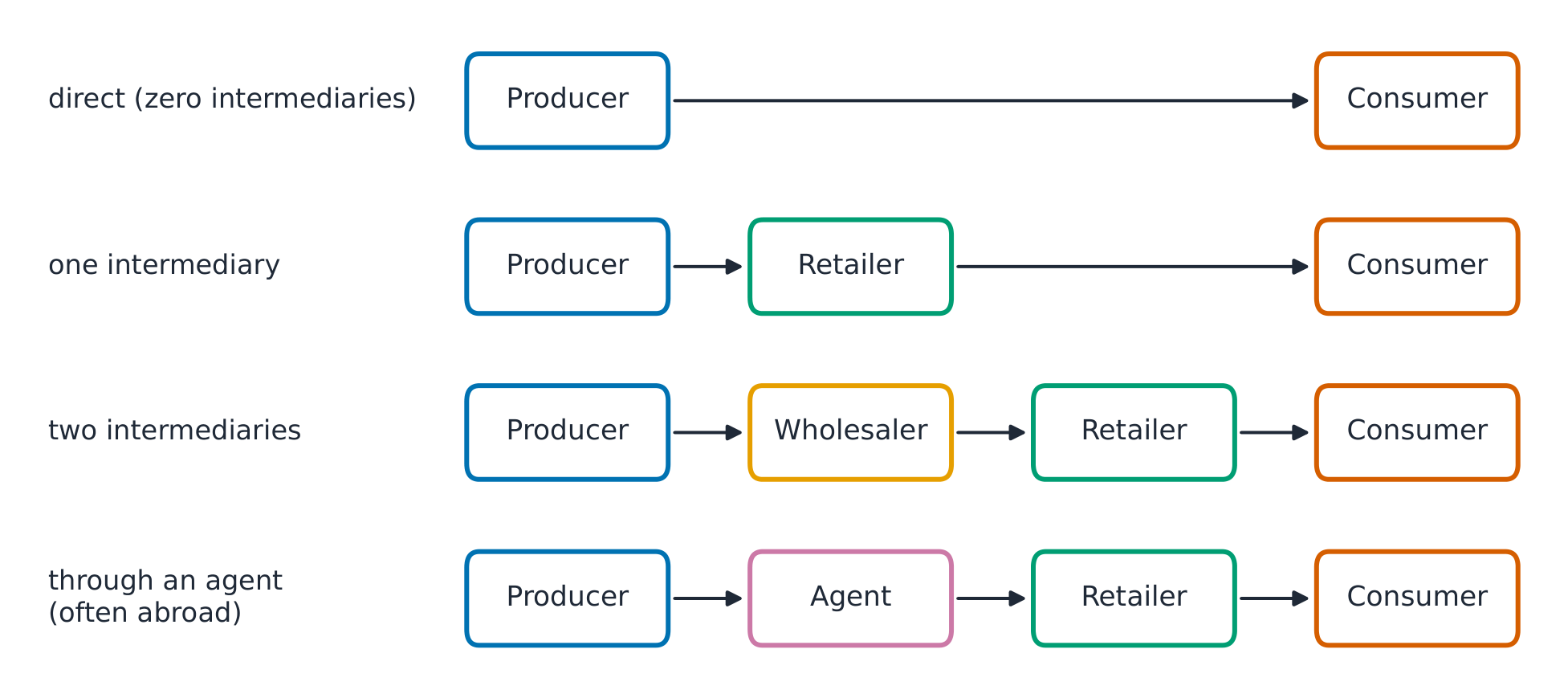
Place 渠道 is how the product reaches the customer. A distribution channel 分销渠道 is the path from producer to consumer.

Four distribution channels: producer straight to consumer; producer to retailer to consumer; producer to wholesaler to retailer to consumer; producer to agent to retailer to consumer
Each intermediary adds reach but takes a share of the price

Each intermediary 中间商 (wholesaler, retailer or agent) adds reach and convenience, but takes part of the profit and reduces the producer's control. Selling online (e-commerce 电子商务) lets even small firms sell directly to customers far away.

People, processes and physical evidence

  • People 人员: the staff who deal with customers. In a service, the mechanic who explains a fault clearly is part of the product.
  • Processes 流程: how the service is delivered: online booking, waiting times, how complaints are handled.
  • Physical evidence 有形展示: what customers can see: a clean workshop, uniforms, a clear invoice, online reviews.
Vocabulary Train
English
marketing mix/ˈmɑːkɪtɪŋ mɪks/
product life cycle/ˈprɒdʌkt laɪf ˈsaɪkl/
extension strategies/ekˈstenʃn ˈstrætədʒiz/
Boston Consulting Group matrix
product portfolio/ˈprɒdʌkt pɔːtˈfəʊlɪəʊ/
stars/stɑːz/
cash cows/kæʃ kaʊz/
question marks/ˈkwestʃn mɑːks/
dogs/dɒɡz/
branding/ˈbrændɪŋ/
brand loyalty
cost-plus pricing/kɒst plʌs ˈpraɪsɪŋ/
penetration pricing/ˌpenɪˈtreɪʃn ˈpraɪsɪŋ/
price skimming/praɪs ˈskɪmɪŋ/
psychological pricing/saɪkəˈlɒdʒɪkl ˈpraɪsɪŋ/
loss leader
price discrimination/praɪs dɪˌskrɪmɪˈneɪʃn/
dynamic pricing/daɪˈnæmɪk ˈpraɪsɪŋ/
competitive pricing/kəmˈpetɪtɪv ˈpraɪsɪŋ/
contribution pricing
above-the-line promotion/əˈbʌv ðə laɪn prəˈməʊʃn/
below-the-line promotion/bɪˈləʊ ðə laɪn prəˈməʊʃn/
public relations
social media marketing
guerrilla marketing
promotional mix
place/pleɪs/
distribution channel/ˌdɪstrɪˈbjuːʃn ˈtʃænl/
intermediary
e-commerce/iː ˈkɒmɜːs/
people
processes/ˈprəʊsesɪz/
physical evidence
4.6

Checklist

  • Marketing; market against product orientation; marketing in social enterprises; market share $2{,}000 \div 8{,}000 = 25\%$ and why share can fall as sales rise; market leadership (4.1).
  • The marketing plan; segmentation by demographics, geography and psychographics; targeting niche and mass markets; positioning, position maps and the USP; the Ansoff matrix (4.2).
  • Primary and secondary research; qualitative and quantitative data; random, stratified, quota, convenience and snowball sampling; sampling error and ethics (4.4).
  • The seven Ps: the product life cycle and extension strategies; the BCG matrix with stars, cash cows, question marks and dogs; branding; the nine pricing methods; above- and below-the-line, social media and guerrilla promotion; distribution channels and intermediaries; people, processes and physical evidence (4.5).
Additional notes PDF
Supported preparation: Marketing evidence and the seven Ps

Scope and prerequisites

IB business management first assessment 2024. Business research project investigates one real organization through a conceptual lens. The toolkit and change, creativity, ethics and sustainability connect units; HL-only topics remain marked.

Mapped preparation outcomes: ib_business_management_sl.4.1, ib_business_management_sl.4.2. Read the matching native lesson first. Actual approved choices, evidence and final learner work remain separate.

Source vocabulary

segmentation 市场细分; primary research 一手研究.

Explanation and worked method

Segment by relevant needs, select a target and explain a position relative to alternatives. Product, price, place, promotion, people, process and physical evidence must support that position. Research existing customers and potential non-customers; stated intention differs from purchases.

Original classroom evidence panel for Marketing evidence and the seven Ps

Task: eighty existing customers like a premium design, so the cooperative predicts success with all local residents. Evaluate and design a better check.

Customer-only recruitment excludes people deterred by price, access or existing offers. Define the target, sample relevant groups and test a feasible offer with voluntary trial purchases. Compare willingness to pay with contribution and capacity. Explain privacy and truthful promotion. For HL international decisions, investigate local context rather than assuming an unchanged campaign transfers.

Independent transfer

A very large customer-only survey predicts demand from non-customers. Evaluate the inference.

Attempt independently before reading the model.

Checked original model

Sample size can reduce some random uncertainty while preserving systematic exclusion. Customers may differ in income, tastes and access. Sample the defined new target and test purchases at the proposed price before projecting sales.

These are authored formative expectations, not official IB descriptors. Accept other justified arguments with evidence and material limits.

Source and task holds

This supplement teaches the method for this part of the course. The full assessment criteria and any texts your school chooses come from your teacher.

Interactive lessons on this topic

Work through it step by step, with instant-check exercises.

More topics in International Baccalaureate · IB Diploma · Business Management · SL

Log in or create account

IGCSE, A-Level & AP