Skip to content

1 · Business organization and stakeholders

International Baccalaureate · IB Diploma · Business Management · SL · Topic 1

Video lesson for this topic Open the video page
5:49

Introduction to business management

In 1995 Wang Chuanfu started BYD in Shenzhen with about twenty workers, making batteries for mobile phones. It grew by building more factories, then by buying…

English narration · English + 中文 subtitles burned in

1.1

Introduction to business management

IB Diploma Programme Business Management SL, Unit 1 Introduction to business management (first assessment 2024). This topic covers sections 1.1 to 1.6: what a business is, types of business entities, business objectives, stakeholders, growth and evolution, and multinational companies. Unit 1 is the same at SL and HL. The course's four concepts, change 变革, creativity 创造力, ethics 伦理 and sustainability 可持续性, run through every section. The worked examples follow one car-repair business from its start, and its numbers fit every later unit.

In 1995 Wang Chuanfu started BYD in Shenzhen with about 20 workers, making batteries for mobile phones. It grew by building more factories, then by buying a small car maker in 2003. By 2023 BYD sold more new-energy cars than any other company in the world. This topic shows the choices behind a story like that: what form a business takes, what it aims for, whom it must keep happy, and how it grows.

Must-know for this topic:

Idea Key content
business resources → goods and services; four functions; four sectors; entrepreneurs
entities sole trader, partnership, privately and publicly held companies; social enterprises
objectives vision and mission; strategic and tactical objectives; CSR
stakeholders internal and external; conflicts between them
growth economies and diseconomies of scale; internal and external growth
MNCs good and bad effects on the host country
Vocabulary Train
English
change/tʃeɪndʒ/
creativity/kriːˌeɪˈtɪvɪti/
ethics/ˈeθɪks/
sustainability/səˌsteɪnəˈbɪlɪti/
host country/həʊst ˈkʌntri/
1.2

What a business is

A business 企业 is an organisation that uses resources to make goods or services that people want. It combines:

  • human resources 人力资源: the people who work in it;
  • physical resources 实物资源: buildings, machines, materials;
  • financial resources 财务资源: the money to start and run it.

Every business has four business functions 业务职能, and each is one unit of this course: human resources (Unit 2), finance and accounts (Unit 3), marketing (Unit 4) and operations (Unit 5).

Businesses work in four sectors 产业部门:

Sector What it does Examples
primary sector 第一产业 takes natural resources from the earth farming, fishing, mining
secondary sector 第二产业 makes goods from materials car factories, building
tertiary sector 第三产业 provides services shops, banks, car repairs
quaternary sector 第四产业 works with knowledge and information software, research, consulting

As a country develops, jobs move from the primary sector to the secondary and then the tertiary sector. This is called sectoral change 产业结构变化.

Two stacked bars of China's employment by sector: in 1980 primary 69%, secondary 18%, tertiary 13%; in 2023 primary 23%, secondary 29%, tertiary 48%

China's jobs moved from farming to services in four decades

An entrepreneur 企业家 starts a new business and takes the risk that it may fail. An intrapreneur 内部创业者 has new ideas and leads new projects inside an existing business. People start businesses to be their own boss, to follow an idea, or to earn more. They meet problems: finding finance, finding customers, little experience, strong rivals and the law's rules.

Vocabulary Train
English
business/ˈbɪznəs/
human resources
physical resources
financial resources
business functions
sectors/ˈsektəz/
primary sector/ˈpraɪməri ˈsektə/
secondary sector/ˈsekəndəri ˈsektə/
tertiary sector/ˈtɜːʃjəri ˈsektə/
quaternary sector/kwəˈtɜːnəri ˈsektə/
sectoral change
entrepreneur/ˌɒntrɪprəˈnjʊə/
intrapreneur/ˌɪntrəprəˈnjʊə/
1.3

Types of business entities

The private sector 私营部门 is owned by individuals and private firms. The public sector 公共部门 is owned by the government.

The most important difference between the types is liability 责任, which means who pays the business's debts if it fails.

  • With unlimited liability 无限责任, the owners must pay the debts from their own money, even by selling their home.
  • With limited liability 有限责任, owners can only lose the money they put into the business. This is possible because a company is a separate legal person from its owners.
Type Owners Liability For Against
sole trader 个体经营者 one person unlimited easy to set up; owner keeps all profit and makes every decision hard to raise money; long hours; the business may end when the owner stops
partnership 合伙企业 two or more partners usually unlimited more money and more skills; work is shared partners may disagree; each is responsible for the others' decisions
privately held company 私人控股公司 shareholders, often a family; shares are not sold to the public limited owners keep control; limited liability must register and publish some accounts; harder to raise large sums
publicly held company 上市公司 anyone can buy shares on a stock exchange limited can raise very large amounts of money must publish full accounts; owners can lose control in a takeover; pressure for short-term profit

A social enterprise 社会企业 is a business whose main aim is to help people or the environment. It earns money by trading, but it puts its surplus 盈余 back into its aim.

  • For-profit social enterprises 营利性社会企业 include private-sector companies with a social aim, public-sector companies owned by the government, and cooperatives 合作社, which are owned and run by their members (such as workers or farmers) and share profits among them.
  • Non-profit social enterprises 非营利性社会企业 include non-governmental organisations 非政府组织 (NGOs) and charities. They depend on donations and grants as well as trading.

Worked example. The car-repair business starts as a sole trader with 20,000 of savings. After a year the owner takes a partner, who adds another 20,000 and shares the long working week. Now each partner is responsible for the other's decisions and debts. When the business opens a second workshop, the owners form a privately held company. Their homes are now safe if the business fails, but they must register the company and publish accounts.

Vocabulary Train
English
private sector/ˈpraɪvət ˈsektə/
public sector/ˈpʌblɪk ˈsektə/
liability/ˌlaɪəˈbɪlɪti/
unlimited liability/ʌnˈlɪmɪtɪd ˌlaɪəˈbɪlɪti/
limited liability/ˈlɪmɪtɪd ˌlaɪəˈbɪlɪti/
sole trader/səʊl ˈtreɪdə/
partnership/ˈpɑːtnəʃɪp/
privately held company
publicly held company/ˈpʌblɪkli held ˈkʌmpəni/
social enterprise/ˈsəʊʃl ˈentəpraɪz/
surplus/ˈsɜːpləs/
for-profit social enterprises
cooperatives
non-profit social enterprises
non-governmental organisations
1.4

Business objectives

A business sets its aims from the top down.

  • A vision statement 愿景宣言 says what the business hopes to become in the long run: "To be the repair garage every family in the city trusts."
  • A mission statement 使命宣言 says what the business does, for whom and how: "We repair family cars quickly, at a fair price, and explain every bill."
  • Strategic objectives 战略目标 are long-term aims set by senior managers: growth, profit, market share, protecting the value of the shares, and ethical aims.
  • Tactical objectives 战术目标 are shorter-term, smaller steps, often set for one department, that help to reach a strategic objective.
A pyramid with the vision at the top, then the mission, then strategic objectives, then tactical objectives at the base, each more detailed and shorter-term than the one above

Each level turns the one above it into more detailed, shorter-term aims

Worked example. The repair business sets a strategic objective of 30% of the local repair market within three years. Its tactical objectives are to open on Saturdays within six months and to reach an average online review of 4.5 stars.

Objectives change when the situation changes. A new rival, a recession, new technology such as electric cars, or a new owner can all make a business rethink its aims.

Corporate social responsibility 企业社会责任 (CSR) means a business aims to act ethically towards workers, customers, the community and the environment, not only to make a profit. The repair business recycles all its oil and old batteries and trains two young apprentices a year. CSR costs money in the short term, but it can build a good reputation, attract customers and staff, and avoid fines. Critics say some firms use CSR only for advertising.

Vocabulary Train
English
vision statement
mission statement/ˈmɪʃn ˈsteɪtmənt/
strategic objectives
tactical objectives
corporate social responsibility/ˈkɔːpərət ˈsəʊʃl rɪˌspɒnsəˈbɪlɪti/
1.5

Stakeholders

A stakeholder 利益相关者 is any person or group affected by what a business does.

A business at the centre linked to internal stakeholders (owners, managers, employees) and external ones (customers, suppliers, lenders, government, community, pressure groups)

Internal stakeholders work inside the business; external stakeholders are affected from outside

  • Internal stakeholders 内部利益相关者 are inside the business: owners or shareholders, managers and employees.
  • External stakeholders 外部利益相关者 are outside it: customers, suppliers, banks and other lenders, the government, competitors, pressure groups 压力集团 (groups that campaign on an issue, such as the environment) and the local community.

Stakeholders often want different things, so there is stakeholder conflict 利益相关者冲突. Shareholders want higher dividends, but employees want higher wages. Customers want low prices, but suppliers want high prices. The local community wants peace and quiet, but the business wants to grow. Managers deal with conflict by deciding whose needs matter most, by talking and agreeing a compromise, or by changing the plan so that more groups gain.

Worked example. Saturday opening pleases customers and the owners, but the mechanics lose their weekend. The owners agree a rota, so each mechanic works one Saturday in four, and pay 50% extra for Saturday hours.

Vocabulary Train
English
stakeholder/ˈsteɪkhəʊldə/
internal stakeholders/ɪnˈtɜːnl ˈsteɪkhəʊldəz/
external stakeholders/ekˈstɜːnl ˈsteɪkhəʊldəz/
pressure groups/ˈpreʃə ɡruːps/
stakeholder conflict
1.6

Growth and evolution

Economies and diseconomies of scale

Economies of scale 规模经济 are the fall in average cost (cost per unit) as a business grows. Internal economies of scale 内部规模经济 come from the business's own growth:

  • purchasing economies 采购经济: discounts for buying in bulk;
  • technical economies 技术经济: bigger, better machines used fully;
  • managerial economies 管理经济: hiring specialist managers;
  • financial economies 财务经济: big firms borrow more cheaply;
  • marketing economies 营销经济: one advert reaches more customers per unit sold.

External economies of scale 外部规模经济 come from the growth of the whole industry in an area, such as colleges that train mechanics, or parts suppliers that open nearby.

Diseconomies of scale 规模不经济 are the rise in average cost when a business grows too big. Communication becomes slow, managers lose control, decisions take longer, and workers feel less valued, so motivation falls.

Worked example. Average cost = total cost ÷ output.

Repairs a month Total cost Average cost
one workshop 1,000 26,000 26.00
two workshops 2,000 42,500 21.25
five workshops 5,000 115,000 23.00

Going from one workshop to two lowers average cost by 4.75 a repair: bulk discounts on parts and one manager for both sites. At five workshops the owners expect average cost to rise again, because they could no longer watch every site and parts would have to travel between them. This is the point where diseconomies begin.

A U-shaped average cost curve: average cost falls from 26 at 1,000 repairs to 21.25 at 2,000 (economies of scale) and rises to 23 at 5,000 (diseconomies of scale)

Average cost falls with economies of scale, then rises once diseconomies set in

Small businesses have advantages too. They can give personal service, change quickly, and keep the owner in control. Many owners choose to stay small for these reasons.

Internal and external growth

Internal growth 内部增长 (organic growth) means growing from inside: opening new branches, selling new products, or winning more customers. It is slow but safe, and the business keeps its own culture.

External growth 外部增长 means growing by joining with other firms. It is faster, but it is expensive and the two cultures may clash.

Method Meaning
merger 合并 two firms agree to join and become one new firm
acquisition 收购 / takeover 接管 one firm buys more than half the shares of another; a takeover is an acquisition the target does not want
joint venture 合资企业 two firms create a new firm together and share its costs, profits and control
strategic alliance 战略联盟 firms work together on a project but stay separate and do not create a new firm
franchising 特许经营 a franchisor sells others the right to use its brand and methods, for a fee and a share of sales

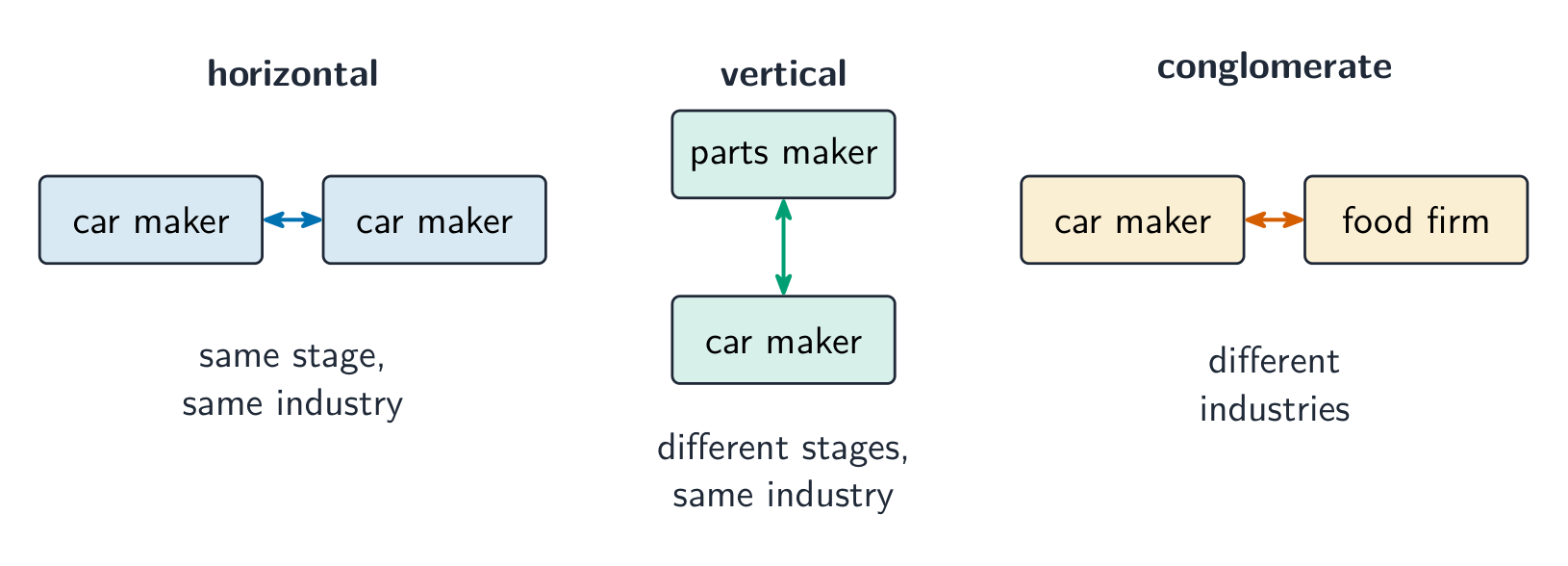
When firms join, the type of integration depends on how their businesses relate.

Three pairs of firms joining: two car makers (horizontal), a parts maker and a car maker (vertical), a car maker and a food firm (conglomerate)

Horizontal, vertical and conglomerate integration: same stage, different stages, different industries

Vocabulary Train
English
economies of scale/ɪˈkɒnəmiz ɒv skeɪl/
internal economies of scale/ɪnˈtɜːnl ɪˈkɒnəmiz ɒv skeɪl/
purchasing economies
technical economies
managerial economies
financial economies
marketing economies
external economies of scale/ekˈstɜːnl ɪˈkɒnəmiz ɒv skeɪl/
diseconomies of scale/ˌdɪsɪˈkɒnəmiz ɒv skeɪl/
internal growth/ɪnˈtɜːnl ɡrəʊθ/
external growth/ekˈstɜːnl ɡrəʊθ/
merger/ˈmɜːdʒə/
acquisition/əkwɪˈsɪʃn/
takeover/ˈteɪkəʊvə/
joint venture/dʒɔɪnt ˈventʃə/
strategic alliance
franchising/ˈfræntʃaɪzɪŋ/
1.7

Multinational companies

A multinational company 跨国公司 (MNC) has operations in more than one country. The country where it opens a factory or office is the host country 东道国.

Good effects on the host country Bad effects on the host country
new jobs and better training profits may be sent back to the MNC's home country
investment and new technology local firms may not survive the competition
tax revenue for the government local culture may change, with fewer local brands
more choice for consumers pollution and heavy use of resources
local suppliers win new orders an MNC may pressure the government on tax or rules

The balance depends on the MNC, the host country and the time period. A car factory may bring thousands of jobs, but if it closes ten years later the town loses most of them at once. Governments try to keep the good effects by setting rules on pay, pollution and local partners.

Vocabulary Train
English
multinational company/ˌmʌltɪˈnæʃənl ˈkʌmpəni/
1.8

Checklist

  • Resources; the four functions; the four sectors and China's sectoral change; entrepreneurs and intrapreneurs; why businesses start and the problems they meet (1.1).
  • Private and public sector; sole trader, partnership, privately held and publicly held company with liability and finance compared; for-profit and non-profit social enterprises, including cooperatives and NGOs (1.2).
  • Vision and mission statements; strategic and tactical objectives; why objectives change; CSR (1.3).
  • Internal and external stakeholders; conflicts between them and how managers deal with them; the Saturday-opening example (1.4).
  • Internal and external economies of scale, diseconomies, the average cost of 26.00, 21.25 and 23.00; reasons to stay small; internal and external growth; mergers, acquisitions, joint ventures, strategic alliances and franchising; horizontal, vertical and conglomerate integration (1.5).
  • The good and bad effects of MNCs on host countries (1.6).

Paper 1 asks you to define terms, explain them and discuss them in the case-study business. Paper 2 may ask for the average-cost calculation. All numbers about the repair business are original.

Additional notes PDF
Supported preparation: Objectives, ownership and stakeholders

Scope and prerequisites

IB business management first assessment 2024. Business research project investigates one real organization through a conceptual lens. The toolkit and change, creativity, ethics and sustainability connect units; HL-only topics remain marked.

Mapped preparation outcomes: ib_business_management_sl.1.1, ib_business_management_sl.1.2. Read the matching native lesson first. Actual approved choices, evidence and final learner work remain separate.

Source vocabulary

stakeholder 利益相关者; limited liability 有限责任.

Explanation and worked method

An owner-controlled small business may decide quickly but face limited finance; an incorporated enterprise can access different finance while changing control and accountability. Growth can lower average costs yet create coordination costs. Multinational operations add context-specific regulation, currency and stakeholder issues. Use the actual entity and evidence before recommending expansion.

Original classroom evidence panel for Objectives, ownership and stakeholders

Original case: a repair cooperative wants affordable service and enough surplus to maintain tools. Members oppose a uniform price rise. Evaluate a basic affordable offer plus optional premium service.

A basic offer protects access; optional service may generate contribution for maintenance. Test demand and capacity, because richer customers or extra work cannot be assumed. Explain how members, workers and customers gain or lose; evaluate ethics and sustainability alongside cash viability.

Independent transfer

Premium repairs earn surplus but delay basic repairs. Reassess the compromise.

Attempt independently before reading the model.

Checked original model

Financial sustainability improves while access may deteriorate. Protect basic capacity, trial limits or separate staffing, and compare waiting times with cash contribution. Recommend continuation only under a feasible capacity rule that serves the cooperative's stated purpose.

These are authored formative expectations, not official IB descriptors. Accept other justified arguments with evidence and material limits.

Source and task holds

This supplement teaches the method for this part of the course. The full assessment criteria and any texts your school chooses come from your teacher.

Interactive lessons on this topic

Work through it step by step, with instant-check exercises.

More topics in International Baccalaureate · IB Diploma · Business Management · SL

Log in or create account

IGCSE, A-Level & AP