Skip to content

2 · Human resources and motivation

International Baccalaureate · IB Diploma · Business Management · SL · Topic 2

Video lesson for this topic Open the video page
6:32

Human resource management

Haidilao's waiters are famous for friendly service, and the company gives them real power. A waiter can give a free dish or a discount without asking a…

English narration · English + 中文 subtitles burned in

2.1

Human resource management

IB Diploma Programme Business Management SL, Unit 2 Human resource management (first assessment 2024). This topic covers sections 2.1 to 2.7 at SL: human resource planning, organisational structure, leadership, motivation and communication. Resistance to change, the shamrock organisation, process theories of motivation, organisational culture (2.5) and employee relations (2.7) are HL only and are left out. The worked examples follow the course's repair business, which has now grown to 80 employees in four workshops.

Every year Google, Haidilao and many other firms spend large sums on staff benefits, training and team events. Haidilao's waiters are famous for their friendly service, and the company gives them real power to please customers: a waiter can give a free dish or a discount without asking a manager. Why would a firm trust its lowest-paid workers like this? This topic is about the people in a business: how they are organised, led, motivated and kept.

Must-know for this topic:

Idea Key content
HR planning workforce planning; internal and external factors; recruitment, training, appraisal, dismissal
labour turnover $\dfrac{\text{number of staff leaving}}{\text{average number of staff}} \times 100$: $12 \div 80 \times 100 = 15\%$
structure span of control, levels, chain of command, delegation; tall against flat; matrix
leadership autocratic, paternalistic, democratic, laissez-faire, situational
motivation Taylor, Maslow, Herzberg, McClelland, Deci and Ryan; financial and non-financial rewards
communication formal and informal; barriers
2.2

Introduction to human resource management

Workforce planning

Human resource management 人力资源管理 (HRM) makes sure the business has the right number of people, with the right skills, in the right jobs, at the right time. Workforce planning 劳动力规划 compares the staff a business will need with the staff it has, and plans how to close the gap.

Labour turnover 员工流动率 measures how many workers leave in a year:

$$\text{labour turnover} = \frac{\text{number of staff leaving in a year}}{\text{average number of staff}} \times 100$$

Worked example. The repair business has an average of 80 staff. In one year 12 leave. Labour turnover $= 12 \div 80 \times 100 = 15\%$. Each leaver must be replaced, so the business pays for recruitment and training, and it loses skills and customer knowledge. Some turnover is healthy: new staff bring new ideas.

Internal and external factors

Internal factors include the firm's objectives, its budget, its structure, and changes in technology. External factors include:

  • demographic change 人口结构变化: for example, an ageing workforce;
  • labour mobility 劳动力流动性: how easily workers move between jobs and places;
  • migration 移民: workers coming from or going to other countries;
  • new working patterns: flexi-time 弹性工作制 (choosing when to work the agreed hours), teleworking 远程办公 (working from home or elsewhere), and the gig economy 零工经济 of short-term jobs paid task by task, as for delivery riders.

Recruitment, training, appraisal and dismissal

Recruitment 招聘 follows common steps: identify the vacancy, write a job description 职位描述 (the tasks of the job) and a person specification 人员规格 (the skills and qualities needed), advertise, shortlist, interview or test, and appoint.

  • Internal recruitment fills the job with someone already in the firm. It is quicker and cheaper, and the person knows the business. But it brings no new ideas, and it leaves another job empty.
  • External recruitment brings in new skills and ideas, but it costs more and takes longer.

Training 培训:

  • Induction training 入职培训 introduces new staff to the firm, its rules and its people.
  • On-the-job training 在职培训 happens while working, for example by watching an experienced worker. Off-the-job training 脱产培训 happens away from the workplace, such as a college course.
  • Cognitive training 认知培训 develops thinking skills; behavioural training 行为培训 develops how people act with others, such as teamwork and dealing with customers.

Appraisal 绩效评估 judges how well an employee is doing:

  • formative: ongoing feedback to help the person improve;
  • summative: a final judgement at the end of a period, often linked to pay;
  • 360-degree: feedback from managers, colleagues, junior staff and sometimes customers;
  • self-appraisal: employees judge their own work.

Employment can end through dismissal 解雇 (for a fair reason, such as serious misconduct) or redundancy 裁员 (the job itself is no longer needed). Redundancy is not the worker's fault, so laws often require a payment.

Vocabulary Train
English
Human resource management/ˈhjuːmən rɪˈzɔːs ˈmænɪdʒmənt/
workforce planning/ˈwɜːkfɔːs ˈplænɪŋ/
labour turnover/ˈleɪbə ˈtɜːnəʊvə/
demographic change
labour mobility/ˈleɪbə məʊˈbɪlɪti/
migration/maɪˈɡreɪʃn/
flexi-time
teleworking
gig economy
recruitment/rɪˈkruːtmənt/
job description/dʒɒb dɪˈskrɪpʃn/
person specification/ˈpɜːsn ˌspesɪfɪˈkeɪʃn/
training/ˈtreɪnɪŋ/
induction training/ɪnˈdʌkʃn ˈtreɪnɪŋ/
on-the-job training/ɒnðə dʒɒb ˈtreɪnɪŋ/
off-the-job training/ɒf ðə dʒɒb ˈtreɪnɪŋ/
cognitive training
behavioural training
appraisal/əˈpreɪzl/
dismissal/dɪˈsmɪsl/
redundancy/rɪˈdʌndənsi/
2.3

Organisational structure

The key terms

  • Span of control 管理幅度: the number of people a manager directly supervises.
  • Levels of hierarchy 层级: the number of layers of management.
  • Chain of command 指挥链: the line of authority from the top to the bottom.
  • Delegation 授权: passing authority to a junior. The manager still keeps the responsibility.
  • Centralisation 集权 keeps decisions at the top; decentralisation 分权 passes them down.
  • Bureaucracy 官僚制度: many rules and procedures.
  • Delayering 减少层级: removing levels of management.
Two organisation charts: a tall one with three levels and narrow spans, and a flat one with two levels and a wide span
A tall structure has many levels and narrow spans; a flat one has few levels and wide spans
Tall structure Flat structure
levels many few
span of control narrow wide
communication slow, through many levels fast and direct
supervision close less close; workers need more trust
promotion many small steps fewer chances
cost of managers high low

Worked example. At the repair business, the owner and four workshop managers supervise 75 mechanics: three levels, and a span of 18 or 19 mechanics per workshop manager. That is too wide for coaching new mechanics. The owner adds a senior mechanic in each workshop. Now there are four levels and each senior mechanic supervises 9 or 10 people. Training improves, but a customer complaint now passes through one more link in the chain of command.

Types of structure

An organisation chart 组织结构图 can be arranged:

  • by function, as a functional structure 职能型结构: departments for marketing, finance, operations and HR;
  • by product, as a product-based structure 产品型结构: a division for each product line;
  • by region, as a regional structure 地区型结构: a division for each country or area.

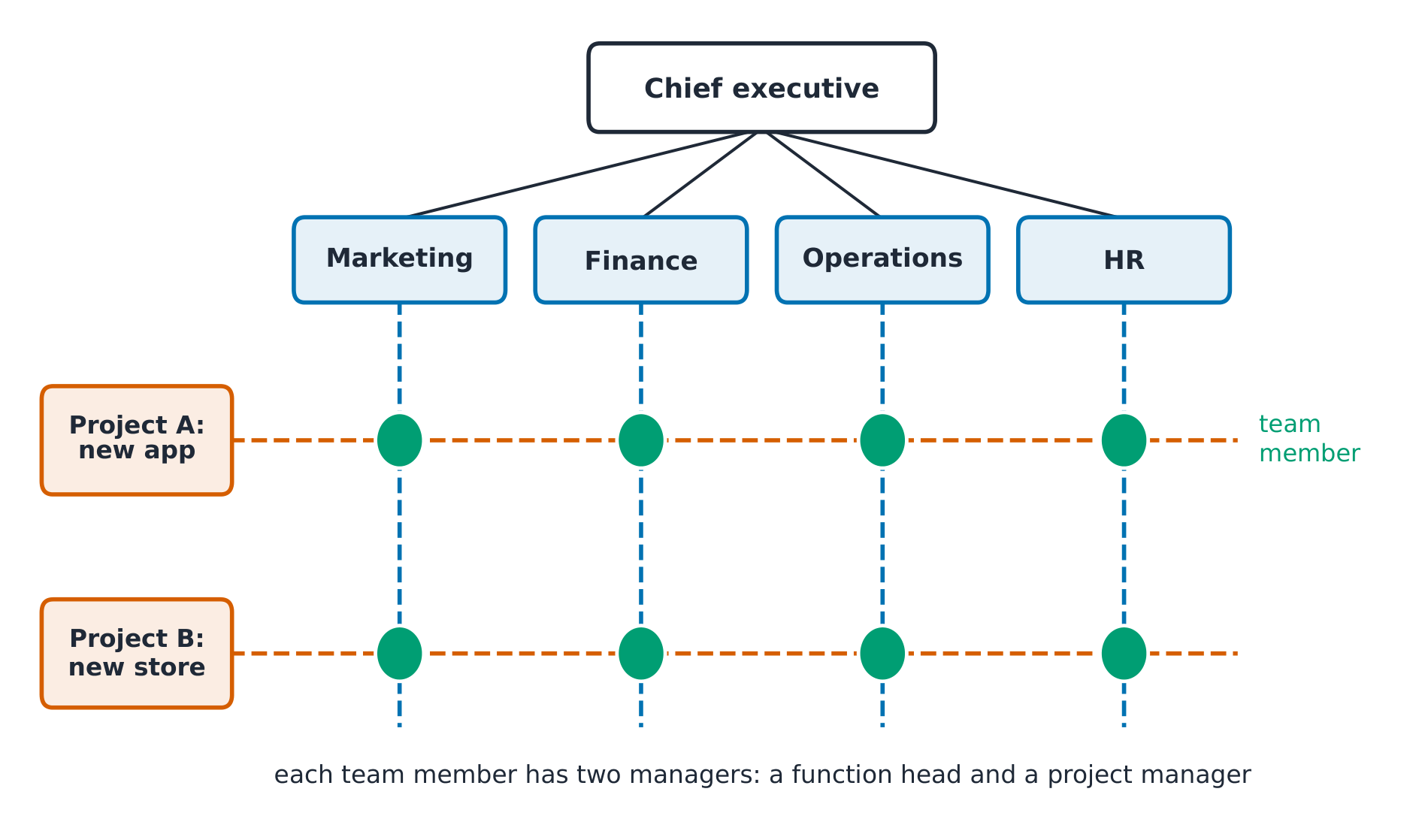
A matrix structure 矩阵结构 crosses functions with projects. Each person works in a project team but also belongs to a department, so they have two managers. This brings mixed skills together, but two bosses can give different orders.

Matrix structure: four function heads across the top and two project teams down the side; each team member sits where a function line meets a project line
In a matrix structure, each person reports to a function head and a project manager
Vocabulary Train
English
span of control/spæn ɒv kənˈtrəʊl/
levels of hierarchy
chain of command/tʃeɪn ɒv kəˈmænd/
delegation/ˌdelɪˈɡeɪʃn/
centralisation/ˌsentrəlaɪˈzeɪʃn/
decentralisation/dɪˌsentrəlaɪˈzeɪʃn/
bureaucracy/bjʊəˈrɒkrəsi/
delayering/dɪˈleɪərɪŋ/
organisation chart/ˌɔːɡənaɪˈzeɪʃn tʃɑːt/
functional structure
product-based structure
regional structure
matrix structure/ˈmeɪtrɪks ˈstrʌktʃə/
2.4

Leadership and management

Management and leadership

Management 管理 is about getting things done. Henri Fayol listed its functions: planning, organising, commanding, coordinating and controlling. Leadership 领导力 is about setting a direction and inspiring people to follow it. A good manager is not always a good leader, and the reverse is also true.

Leadership styles

Style How decisions are made Works well when Problems
autocratic 专制型 the leader decides alone and gives orders quick decisions are needed; a crisis; unskilled staff workers feel unvalued; no ideas from below
paternalistic 家长型 the leader decides, but in what they think is the workers' interest staff want security and care workers may become dependent
democratic 民主型 the leader consults and the group shares decisions skilled staff; complex problems slow; needs good communication
laissez-faire 放任型 the leader leaves decisions to the workers creative experts who need freedom lack of direction; poor coordination
situational 情境型 the leader changes style to fit the task and the people most real businesses needs a very skilled leader

The best style depends on the situation: the task, the time available, the skills of the workers, and the culture of the business.

A continuum from leader-centred to worker-centred decisions: autocratic, paternalistic, democratic and laissez-faire, with situational leadership moving along the line
Leadership styles differ in how much decision-making the leader shares
Vocabulary Train
English
management/ˈmænɪdʒmənt/
leadership/ˈliːdəʃɪp/
autocratic/ˌɔːtəʊˈkrætɪk/
paternalistic/pəˌtɜːnəˈlɪstɪk/
democratic/ˌdeməˈkrætɪk/
laissez-faire/ˈleɪsez feə/
situational/ˌsɪtʃuːˈeɪʃənl/
2.5

Motivation and demotivation

Motivation 激励 is the will to work hard and well. Motivated workers produce more, make fewer mistakes, and are less likely to leave. Demotivation 积极性下降 shows up as absence, low effort and high labour turnover.

Content theories

  • Frederick Taylor 泰勒: workers are motivated mainly by money. He used scientific management 科学管理: break each job into simple tasks, find the fastest method, and pay by output (piece rate 计件工资). Critics say people want more than money, and repeated simple tasks are boring.

  • Abraham Maslow 马斯洛: people have a hierarchy of needs 需求层次. A lower need must be met before the next one motivates.

    At work: pay meets physiological needs; a safe job and a contract meet safety needs; teams meet social needs; praise and job titles meet esteem needs; challenging work meets self-actualisation 自我实现 needs. The order does not fit everyone: an artist may chase self-actualisation before security.

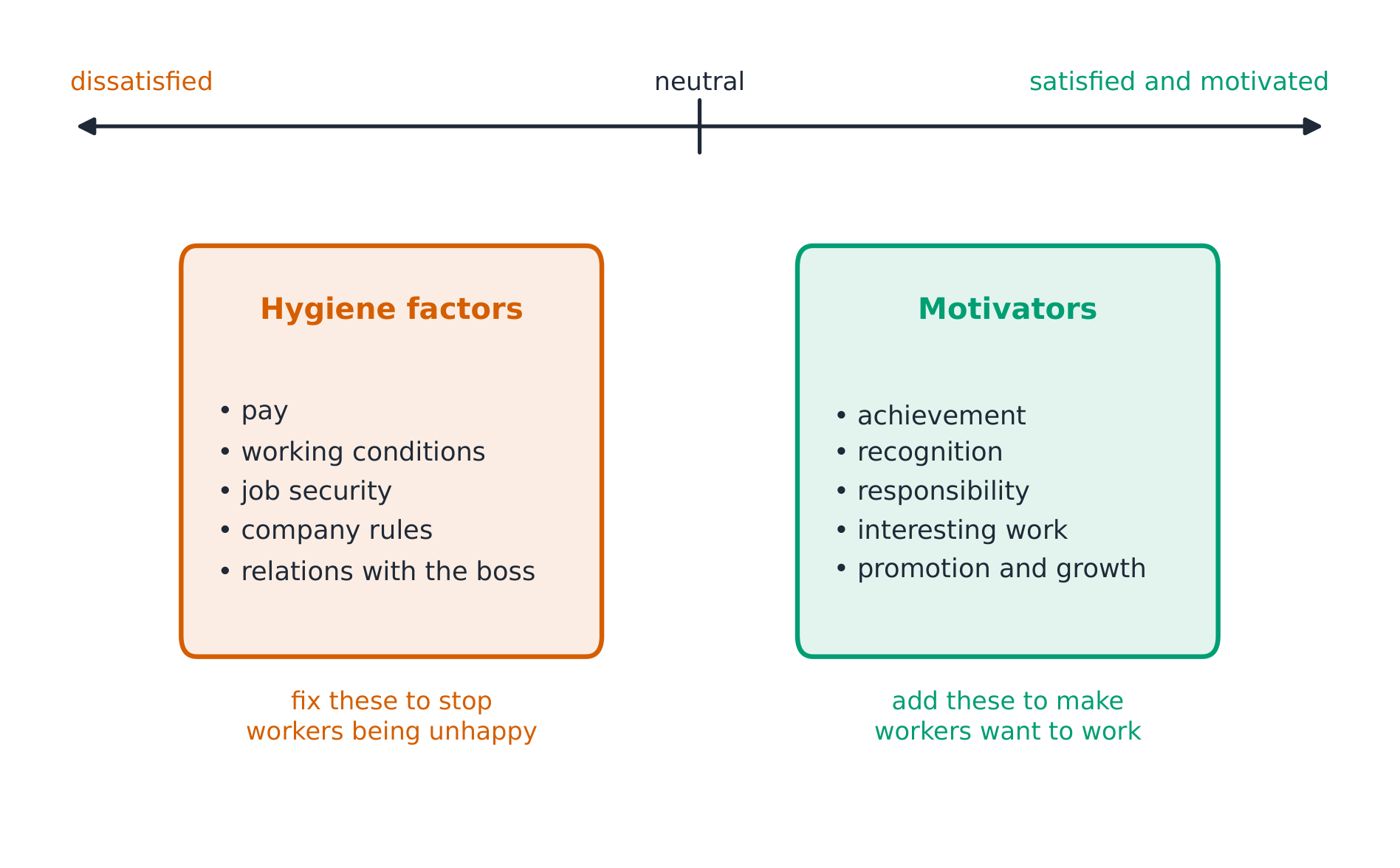
  • Frederick Herzberg 赫茨伯格: two separate sets of factors. Hygiene factors 保健因素 such as pay and conditions do not motivate, but if they are poor, workers become unhappy. Motivators 激励因素 such as recognition and responsibility create real motivation.

  • David McClelland 麦克利兰: people are driven by three learned needs: the need for achievement 成就需要 (to do well), the need for affiliation 亲和需要 (to be liked and belong) and the need for power 权力需要 (to influence others). Managers should match jobs to each person's strongest need.

  • Deci and Ryan 德西和瑞安: self-determination theory 自我决定理论. People are most motivated when they feel autonomy 自主 (control over their work), competence 胜任 (being good at it) and relatedness 关联 (connection to others).

Maslow's pyramid from physiological needs at the base through safety, social and esteem to self-actualisation at the top
Maslow: lower needs are met first, from physiological to self-actualisation
Herzberg's two factors: hygiene factors (pay, conditions, security, rules, relations with the boss) stop dissatisfaction; motivators (achievement, recognition, responsibility, interesting work, growth) create satisfaction
Herzberg: fixing hygiene factors removes unhappiness; only motivators create motivation

Financial and non-financial rewards

Financial rewards Non-financial rewards
salary 薪水 (a fixed yearly amount) job enrichment 工作丰富化: more challenging tasks and responsibility
wages 工资 paid by time or by output (piece rate) job rotation 工作轮换: moving between tasks
commission 佣金: a share of the value of sales job enlargement 工作扩大化: more tasks at the same level
profit-related pay 利润分享: a share of the firm's profit empowerment 授权赋能: freedom to make decisions
performance-related pay 绩效工资: pay linked to targets purpose 使命感: work that feels meaningful
employee share ownership 员工持股 teamwork 团队合作
fringe payments 附加福利: free meals, health insurance, a car

Worked example. At the repair business, most of the 12 leavers were mechanics on piece rates. They felt their effort was wasted when spare parts arrived late. Herzberg would say late parts and pay disputes are hygiene failures to fix first. The owner fixes parts delivery, changes pay to a basic salary plus a team bonus, and starts formative appraisal. If turnover falls to 6 leavers a year, the rate becomes $6 \div 80 \times 100 = 7.5\%$, and the business saves the cost of six replacements.

Vocabulary Train
English
motivation/ˌməʊtɪˈveɪʃn/
demotivation
Frederick Taylor
scientific management/saɪənˈtɪfɪk ˈmænɪdʒmənt/
piece rate/piːs reɪt/
Abraham Maslow
hierarchy of needs/ˈhaɪərɑːki ɒv niːdz/
self-actualisation/self ˌæktʃuːəlaɪˈzeɪʃn/
Frederick Herzberg
hygiene factors/ˈhaɪdʒiːn ˈfæktəz/
motivators/ˈməʊtɪveɪtəz/
David McClelland
need for achievement
need for affiliation
need for power
Deci and Ryan
self-determination theory/self dɪˌtɜːmɪˈneɪʃn ˈθɪəri/
autonomy/ɔːˈtɒnəmi/
competence
relatedness
salary/ˈsæləri/
job enrichment/dʒɒb enˈrɪtʃmənt/
wages/ˈweɪdʒɪz/
job rotation/dʒɒb rəʊˈteɪʃn/
commission/kəˈmɪʃn/
job enlargement/dʒɒb enˈlɑːdʒmənt/
profit-related pay
empowerment/emˈpaʊəmənt/
performance-related pay/pəˈfɔːməns rɪˈleɪtɪd peɪ/
purpose/ˈpɜːpəs/
employee share ownership
teamwork
fringe payments
2.6

Communication

Communication 沟通 is the passing of information from a sender to a receiver.

  • Formal communication 正式沟通 follows official channels: meetings, reports, emails and notices.
  • Informal communication 非正式沟通 happens outside them: chats and rumours (the grapevine 小道消息). It is fast, but often wrong.

Barriers to communication 沟通障碍 include language and jargon 行话 (technical words others do not know), too much information, the wrong channel (bad news by email), physical distance and time zones, cultural differences, and lack of trust. A tall structure adds another barrier: messages change as they pass through many levels.

Vocabulary Train
English
communication/kəˌmjuːnɪˈkeɪʃn/
formal communication
informal communication
grapevine/ˈɡreɪpvaɪn/
barriers to communication
jargon/ˈdʒɑːɡən/
2.7

Checklist

  • The role of HRM and workforce planning; labour turnover $= 12 \div 80 \times 100 = 15\%$ and its costs (2.1).
  • Internal and external factors: demographic change, labour mobility, migration, flexi-time, teleworking and the gig economy (2.1).
  • Recruitment steps, job description and person specification, internal against external; induction, on-the-job, off-the-job, cognitive and behavioural training; formative, summative, 360-degree and self-appraisal; dismissal against redundancy (2.1).
  • Span of control, levels, chain of command, delegation, centralisation, bureaucracy, delayering; tall against flat; by function, product or region; matrix (2.2).
  • Management functions; management against leadership; autocratic, paternalistic, democratic, laissez-faire and situational styles (2.3).
  • Taylor, Maslow, Herzberg, McClelland, Deci and Ryan; financial and non-financial rewards; the turnover fix from 15% to 7.5% (2.4).
  • Formal and informal communication; the barriers (2.6).
Additional notes PDF
Supported preparation: Human resources in context

Scope and prerequisites

IB business management first assessment 2024. Business research project investigates one real organization through a conceptual lens. The toolkit and change, creativity, ethics and sustainability connect units; HL-only topics remain marked.

Mapped preparation outcomes: ib_business_management_sl.2.1, ib_business_management_sl.2.2. Read the matching native lesson first. Actual approved choices, evidence and final learner work remain separate.

Source vocabulary

motivation 动机; delegation 授权.

Explanation and worked method

Structure allocates authority; delegation gives a worker authority for specified decisions while the manager retains responsibility. Motivation depends on the task and workers' circumstances. Communication needs feedback as well as an outgoing instruction.

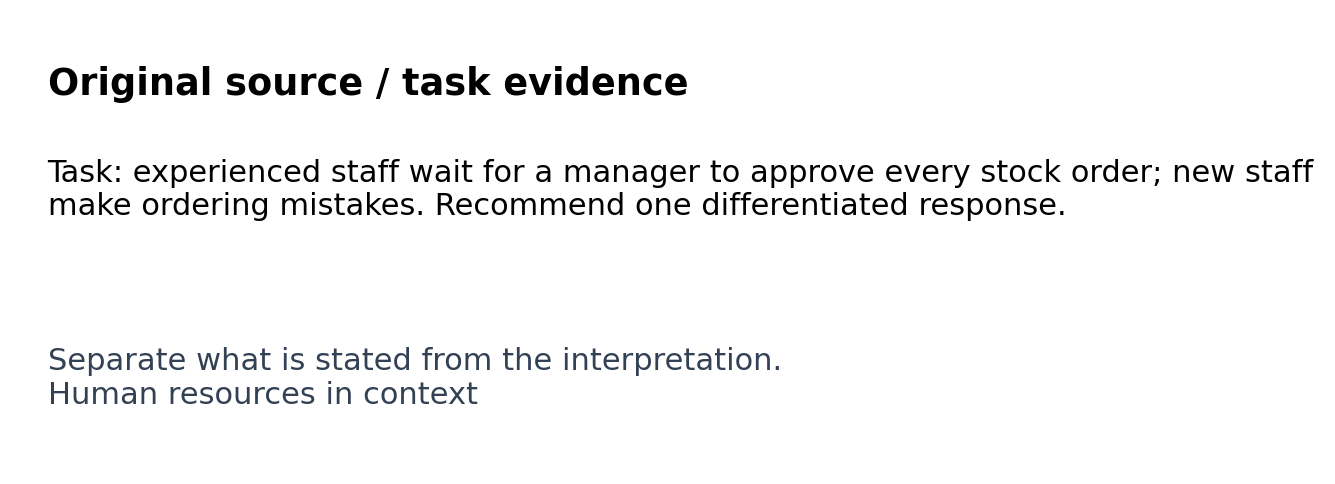
Original classroom evidence panel for Human resources in context

Task: experienced staff wait for a manager to approve every stock order; new staff make ordering mistakes. Recommend one differentiated response.

Delegate routine orders to trained experienced staff within limits and retain supervision/training for new staff. Publish responsibilities and a feedback route; monitor stock-outs and errors. This may improve autonomy and speed without assuming every worker wants the same responsibility. HL can extend the analysis to culture and employee relations; these are not silently added as mandatory SL content.

Independent transfer

Growth doubles staff and informal orders are missed. Recommend a communication change with a limitation.

Attempt independently before reading the model.

Checked original model

Use clear responsibility, a shared order record and confirmation of receipt so staff can detect omissions. Train users and retain a feedback route. More reporting can slow work, so monitor errors and time rather than assuming formalization always improves performance.

These are authored formative expectations, not official IB descriptors. Accept other justified arguments with evidence and material limits.

Source and task holds

This supplement teaches the method for this part of the course. The full assessment criteria and any texts your school chooses come from your teacher.

Interactive lessons on this topic

Work through it step by step, with instant-check exercises.

More topics in International Baccalaureate · IB Diploma · Business Management · SL

Log in or create account

IGCSE, A-Level & AP