Elastic and Inelastic Collisions
Introduced| English | Meaning |
|---|---|
| elastic collision/ɪˈlæstɪk kəˈlɪʒn/ | A collision in which total kinetic energy and momentum are conserved. |
| inelastic collision/ɪnɪˈlæstɪk kəˈlɪʒn/ | A collision in which the total kinetic energy of the colliding objects is not conserved. |
| perfectly inelastic collision/ˈpɜːfektlɪ ɪnɪˈlæstɪk kəˈlɪʒn/ | A collision in which objects stick together with one final velocity; total momentum is conserved if the net external impulse is negligible, while kinetic energy decreases. |
| energy lost/ˈenədʒi lɒst/ | energy lost |
Pool balls versus clay
- Two pool balls click off each other and both keep rolling briskly.
- Two lumps of clay smack together and stop dead, stuck as one.
- Both obey the same momentum law — yet feel completely different.
- The difference is what happens to the energy.
Momentum yes, energy maybe
- Momentum is conserved in every collision — always.
- Kinetic energy is not always conserved — some can turn to heat, sound, or dents.
- That single difference sorts collisions into two families.
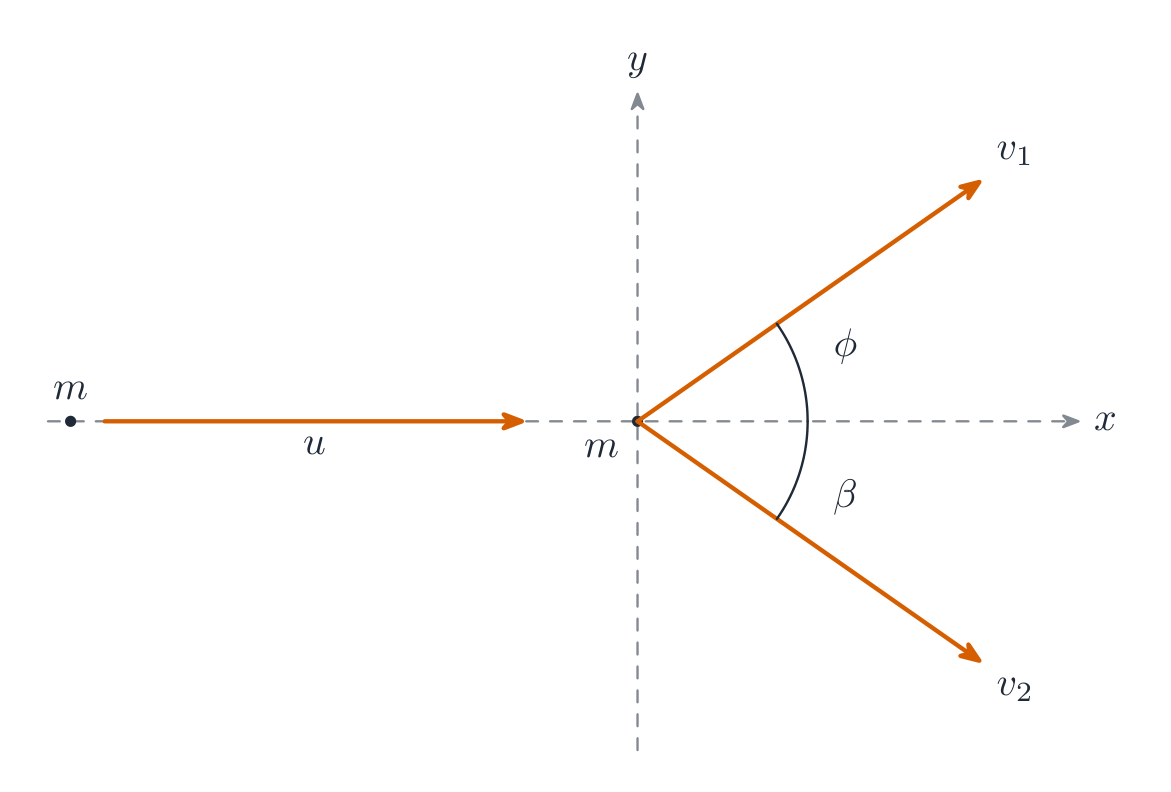
A glancing collision, resolved along two perpendicular axes
Momentum is conserved in every collision, elastic or not.
Difficulty 1/5 · 100 coins + a small bonus on first completion today
Yes -- momentum is always conserved (no net external force). Only kinetic energy may or may not be.
Elastic versus inelastic
- An elastic collision 弹性碰撞 conserves kinetic energy too (ideal, like hard spheres).
- An inelastic collision 非弹性碰撞 loses some kinetic energy to other forms.
- Most real collisions are at least a little inelastic.
In which collision is kinetic energy conserved?
Difficulty 1/5 · 100 coins + a small bonus on first completion today
Only an elastic collision conserves kinetic energy. Momentum, though, is conserved in all of them.
Select all true statements about collisions.
Difficulty 2/5 · 140 coins + a small bonus on first completion today
Momentum always holds; kinetic energy holds only when the collision is elastic.
Perfectly inelastic
- A perfectly inelastic collision 完全非弹性碰撞 is the extreme case: the objects stick together and move off with one common velocity.
- Momentum conservation alone gives that final velocity.
- The clay lumps are the classic example.
Elastic or inelastic?
Momentum is always conserved, but kinetic energy is not. Sort each collision.
A $3\ \text{kg}$ cart at $4\ \tfrac{\text{m}}{\text{s}}$ sticks to a stationary $1\ \text{kg}$ cart. Their common speed afterward (in m/s)?
Difficulty 2/5 · 140 coins + a small bonus on first completion today
$3(4) = (3 + 1)v_f$, so $v_f = 12/4 = 3\ \tfrac{\text{m}}{\text{s}}$.
A collision where the objects stick together is called perfectly ____.
Difficulty 1/5 · 100 coins + a small bonus on first completion today
In a perfectly inelastic collision the objects move off with one common velocity.
Finding the energy lost
- Compare total kinetic energy before and after the collision.
- Any drop is the energy lost 损失的能量 — gone to heat, sound, or deformation.
- In a perfectly inelastic collision this loss is the largest.
Before a collision the total KE is $20\ \text{J}$; after it is $14\ \text{J}$. How much energy was lost (in J)?
Difficulty 2/5 · 140 coins + a small bonus on first completion today
Energy lost $= 20 - 14 = 6\ \text{J}$, gone to heat, sound, or deformation.
A $2\ \text{kg}$ cart at $3\ \tfrac{\text{m}}{\text{s}}$ hits and sticks to a stationary $4\ \text{kg}$ cart.
- Momentum: $2(3) = (2 + 4)v_f$, so $v_f = 1\ \tfrac{\text{m}}{\text{s}}$.
- KE before $= \tfrac{1}{2}(2)(9) = 9\ \text{J}$; after $= \tfrac{1}{2}(6)(1) = 3\ \text{J}$ — so $6\ \text{J}$ was lost to heat.
Never assume kinetic energy is conserved unless a collision is stated to be elastic. Using energy conservation on an inelastic collision gives a wrong answer — momentum is the law that always holds.
Momentum is conserved in every collision; kinetic energy only in an elastic collision. An inelastic collision loses some energy; a perfectly inelastic collision (objects stick together) loses the most. Compare KE before and after to find the energy lost to heat and sound.
Write from a common speed of 2 and a loss of 8
- A 2 kg cart at 4 m/s sticks to a 2 kg cart at rest.
- Find the common speed and the kinetic energy lost.
A 2 kg cart at 4 m/s hits and sticks to a 2 kg cart at rest. What is their common speed, and how much kinetic energy is lost?
8 divided by 4 is 2. Half of 4 times 4 is 8 J after the collision, against 16 J before.
How much kinetic energy is lost?
Difficulty 1/5 · 100 coins + a small bonus on first completion today
16 J becomes 8 J, so 8 J is lost to the sticking. Other options — 6 J (the lesson loss); 0 (because momentum is conserved).