| Enduring Understanding | Learning Objective | Essential Knowledge |
|---|---|---|
MEA-4 | MEA-4.A |
|
Open Economy—International Trade and Finance
AP Macroeconomics · Topic 6
 8:01
Open Economy—International Trade and Finance
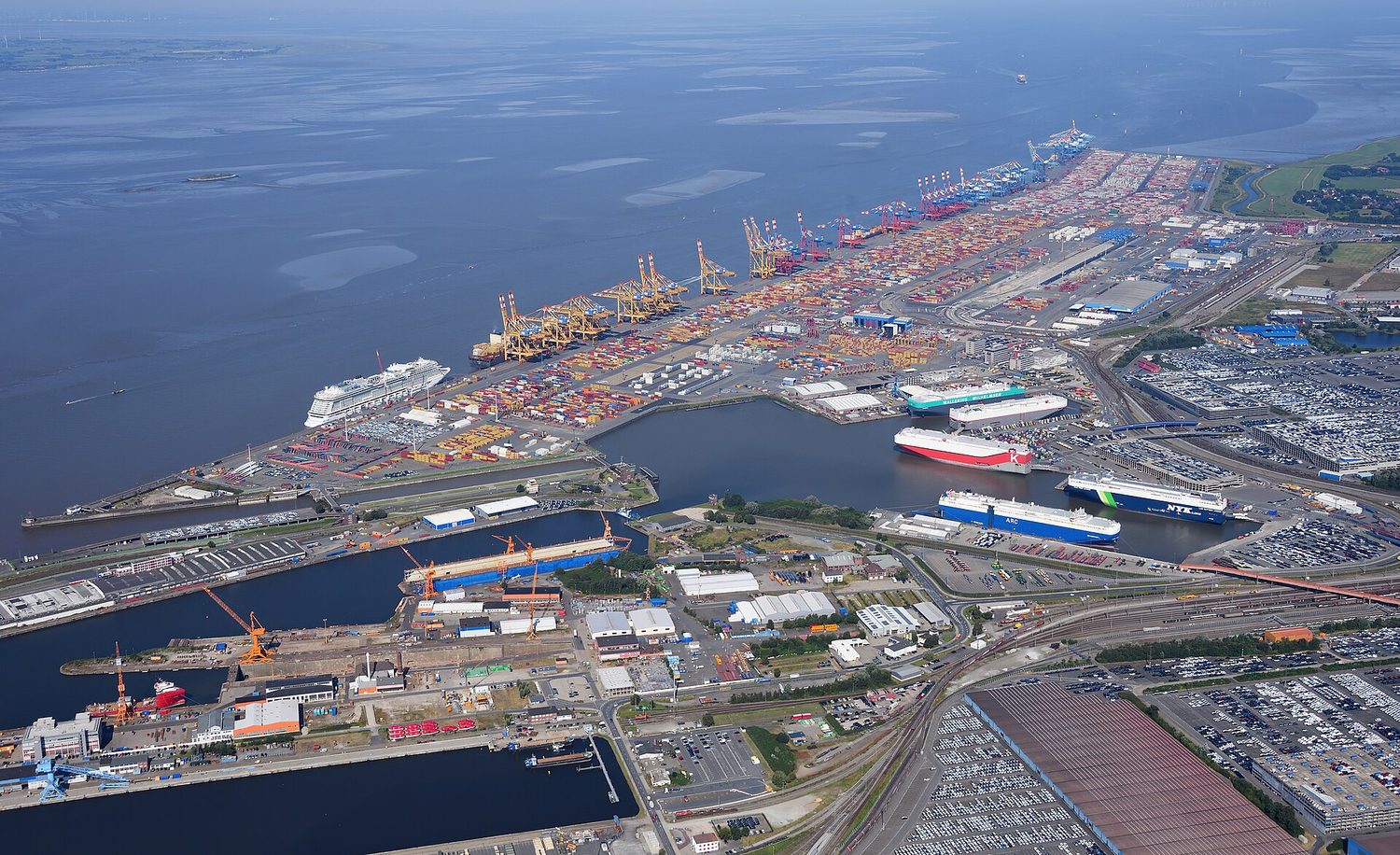
Check the label on almost anything you own. Made somewhere else. It crossed an ocean in a steel box like these, and somebody paid for it in a different money.…
English narration · English + 中文 subtitles burned in
6.1
Balance of Payments Accounts
Syllabus
Source: College Board AP Course and Exam Description
The balance of payments 国际收支 records all transactions 交易 between a country and the rest of the world, in two main accounts:

- The current account 经常账户 tracks trade in goods and services 商品和服务 (exports 出口 minus imports 进口), plus income and transfers 转移支付. A trade deficit 贸易逆差 makes it negative.
- The capital (financial) account 资本账户 tracks flows of financial assets 金融资产 – foreigners buying domestic assets, and residents buying foreign assets.
The two are mirror images 镜像: a current-account deficit is matched by a capital-account surplus 资本账户顺差 (a country that imports more than it exports pays with assets, so foreign investment 外国投资 flows in). They sum to zero.
Vocabulary
Train
| English |
|---|
| balance of payments/ˈbæləns ɒv ˈpeɪmənts/ |
| transactions/trænˈsækʃnz/ |
| current account/ˈkʌrənt əˈkaʊnt/ |
| goods and services |
| exports/ˈekspɔːts/ |
| imports/ɪmˈpɔːts/ |
| transfers/ˈtrænsfɜːz/ |
| trade deficit/treɪd ˈdefɪsɪt/ |
| capital (financial) account/ˈkæpɪtl əˈkaʊnt/ |
| financial assets |
| mirror images |
| capital-account surplus |
| foreign investment/ˈfɒrən ɪnˈvestmənt/ |
6.2
Exchange Rates

Syllabus
| Enduring Understanding | Learning Objective | Essential Knowledge |
|---|---|---|
MKT-5 | MKT-5.A |
|
Source: College Board AP Course and Exam Description
An exchange rate 汇率 is the price of one currency in terms of another. A currency appreciates 升值 when it gains value (buys more foreign currency) and depreciates 贬值 when it loses value. Always track which currency: if the US dollar appreciates against the euro, the euro depreciates against the dollar – the same event from two sides.
Worked example. Suppose $\$1=\text{€}0.90$, so $\text{€}1=\dfrac{1}{0.90}\approx\$1.11$. If the dollar then appreciates to $\$1=\text{€}1.00$, each dollar now buys more euros, while the euro has depreciated – it now buys only $\$1.00$ instead of $\$1.11$. The single event is an appreciation of the dollar and a depreciation of the euro.

Most currencies today are floating 浮动, set by supply and demand in the foreign-exchange market 外汇市场.
Explore
Appreciation or depreciation?
A currency appreciates when it buys more foreign currency, and depreciates when it buys less. One currency's appreciation is the other's depreciation.
Vocabulary
Train
| English |
|---|
| exchange rate/eksˈtʃeɪndʒ reɪt/ |
| appreciates/əˈpriːʃɪeɪts/ |
| depreciates/dɪˈpriːʃɪeɪts/ |
| floating/ˈfləʊtɪŋ/ |
| foreign-exchange market |
6.3
The Foreign Exchange Market

Syllabus
| Enduring Understanding | Learning Objective | Essential Knowledge |
|---|---|---|
MKT-5 | MKT-5.B |
|
MKT-5.C |
| |
MKT-5.D |
|
Source: College Board AP Course and Exam Description
Each currency has its own supply-and-demand graph (price $=$ the exchange rate, quantity $=$ amount of that currency).
- Demand for a currency comes from foreigners wanting its goods, services, or assets.
- Supply of a currency comes from its own residents wanting foreign goods, services, or assets.
The equilibrium exchange rate 均衡汇率 is where they cross. A rightward shift in demand for a currency causes it to appreciate; a rightward shift in supply causes it to depreciate.
Exam skill: always draw the graph for the currency named in the question, label the axis with that currency's price, and shift the correct curve – mixing up the two currencies' graphs is the most common error.
Read the two graphs together. To buy U.S. bonds, a European investor must sell euros and buy dollars. So one event moves a demand curve in the dollar market and a supply curve in the euro market. The vertical axes are each other's inverse: "euros per dollar" on the left, "dollars per euro" on the right. If the left price rises, the right price must fall.
| Event (U.S. and euro area) | Market for dollars | Market for euros | Dollar |
|---|---|---|---|
| Europeans buy more U.S. goods or assets | demand for $ right | supply of € right | appreciates |
| Americans buy more European goods or assets | supply of $ right | demand for € right | depreciates |
| U.S. real interest rate rises | demand for $ right (capital inflow) | supply of € right | appreciates |
| U.S. inflation rises faster than Europe's | demand for $ left, supply of $ right | the reverse | depreciates |
Explore
The foreign-exchange market
A currency's exchange rate is set where demand for it meets supply. Higher demand for exports or higher interest rates appreciate the currency.
Vocabulary
Train
| English |
|---|
| equilibrium exchange rate/ˌiːkwɪˈlɪbrɪəm eksˈtʃeɪndʒ reɪt/ |
6.4
Changes in Policies and Economic Conditions
Syllabus
| Enduring Understanding | Learning Objective | Essential Knowledge |
|---|---|---|
MKT-5 | MKT-5.E |
|
Source: College Board AP Course and Exam Description
Exchange rates respond to:
- Relative interest rates: a higher domestic 国内的 real interest rate 实际利率 attracts foreign financial investment, raising demand for the currency and causing appreciation.
- Relative price levels/inflation: higher domestic inflation 通货膨胀 makes goods less competitive 有竞争力的, lowering demand for the currency (depreciation).
- Relative incomes: higher domestic income raises imports, increasing the supply of domestic currency (depreciation).
- Tastes 偏好 and expectations 预期 about future value.
Monetary policy 货币政策 has a strong link: expansionary 扩张性 monetary policy lowers interest rates, reduces demand for the currency, and causes depreciation (which then boosts net exports).
Explore
Does it appreciate or depreciate the dollar?
Higher domestic interest rates appreciate a currency; higher inflation or higher income (more imports) depreciate it.
Vocabulary
Train
| English |
|---|
| domestic/dəˈmestɪk/ |
| real interest rate/rɪəl ˈɪntrest reɪt/ |
| inflation/ɪnˈfleɪʃn/ |
| competitive/kəmˈpetɪtɪv/ |
| Tastes/teɪsts/ |
| expectations |
| Monetary policy/ˈmʌnɪtəri ˈpɒlɪsi/ |
| expansionary/ekˈspænʃənəri/ |
6.5
Exchange Rates and Net Exports
Syllabus
| Enduring Understanding | Learning Objective | Essential Knowledge |
|---|---|---|
MKT-5 | MKT-5.F |
|
Source: College Board AP Course and Exam Description
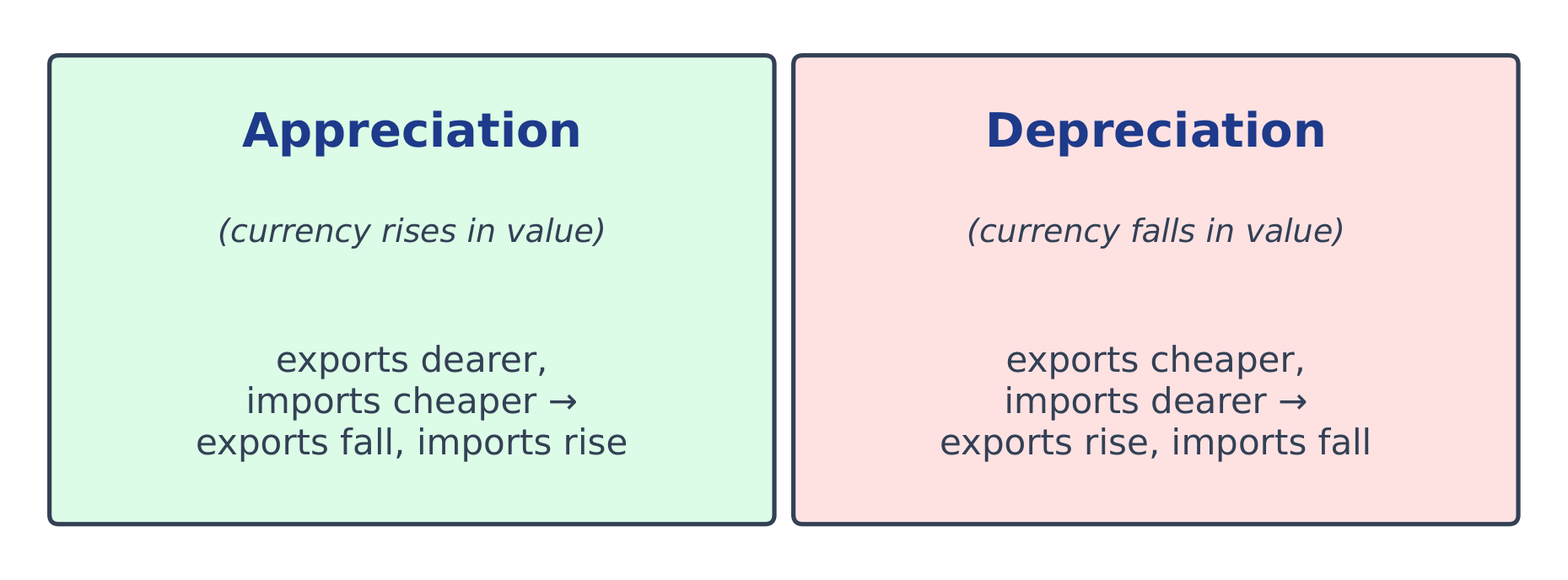
Exchange rates feed back into aggregate demand 总需求 (AD) through net exports 净出口:
- A depreciation makes exports cheaper for foreigners and imports dearer, so net exports rise and AD shifts right.
- An appreciation makes exports dearer and imports cheaper, so net exports fall and AD shifts left.
Worked example. A US car priced at $\$30{,}000$ costs a European buyer $\text{€}27{,}000$ when $\$1=\text{€}0.90$. If the dollar depreciates to $\$1=\text{€}0.80$, the same car now costs only $\text{€}24{,}000$ – cheaper for foreigners, so US exports rise while imports (now dearer in dollars) fall, lifting net exports and shifting AD right.
This is how the foreign-exchange market and the AD-AS model connect – a currency change is a channel through which policy reaches output.
Explore
Stronger or weaker currency?
A stronger currency lowers net exports and shifts AD left; a weaker currency raises net exports and shifts AD right.
Vocabulary
Train
| English |
|---|
| aggregate demand/ˈæɡrɪɡeɪt dɪˈmænd/ |
| net exports/net ˈekspɔːts/ |
6.6
Real Interest Rates and International Capital Flows

Syllabus
| Enduring Understanding | Learning Objective | Essential Knowledge |
|---|---|---|
MKT-5 | MKT-5.G |
|
Source: College Board AP Course and Exam Description
Money chases the highest real return, so capital flows 资本流动 respond to real interest rates:
- A higher domestic real interest rate attracts inflows 流入 of foreign financial capital – foreigners buy domestic bonds 债券, raising currency demand and causing appreciation.
- A lower real rate causes outflows 流出 and depreciation.
This ties the whole course together: government borrowing 政府借款 raises the real interest rate (loanable funds 可贷资金), which attracts foreign capital, appreciates the currency, and reduces net exports – so a budget deficit 预算赤字 can widen a trade deficit (the "twin deficits 双赤字"). Tracing these linked effects across the loanable-funds, forex, and AD-AS graphs is the capstone skill of AP Macroeconomics.
A real example. In 2022 the Federal Reserve raised interest rates faster than the European Central Bank. Investors moved funds into U.S. dollar assets, and in July 2022 the euro fell below one dollar for the first time in twenty years. A stronger dollar made U.S. exports dearer abroad and imports cheaper at home, and the U.S. trade deficit in goods and services reached a record of about $950 billion that year.
Explore
Capital inflow or outflow?
Money chases the best real return. Sort each case by which way capital flows.
Vocabulary
Train
| English |
|---|
| capital flows/ˈkæpɪtl fləʊz/ |
| inflows/ˈɪnfləʊz/ |
| bonds/bɒndz/ |
| outflows/aʊtˈfləʊz/ |
| government borrowing |
| loanable funds/ˈləʊnəbl fʌndz/ |
| budget deficit/ˈbʌdʒɪt ˈdefɪsɪt/ |
| twin deficits |
6.4 6.5 6.6
Worked FRQ: Open-Economy Links
Syllabus
| Enduring Understanding | Learning Objective | Essential Knowledge |
|---|---|---|
MKT-5 | MKT-5.E |
|
| Enduring Understanding | Learning Objective | Essential Knowledge |
|---|---|---|
MKT-5 | MKT-5.F |
|
| Enduring Understanding | Learning Objective | Essential Knowledge |
|---|---|---|
MKT-5 | MKT-5.G |
|
Source: College Board AP Course and Exam Description
Country Z has a flexible exchange rate. Its central bank uses contractionary monetary policy to fight inflation, and its real interest rate rises relative to the rest of the world.
(a) What happens to financial capital flows into Country Z? Explain. Capital inflows rise: foreign savers earn a higher real return on Country Z's bonds.
(b) Draw the foreign-exchange market for Country Z's currency (the zed). Show the effect. Label the vertical axis with the zed's price in another currency (for example "dollars per zed") and the horizontal axis "quantity of zed". Demand for zed shifts right, so the zed appreciates. (Not supply: foreigners must buy zed to buy the bonds.)
(c) What happens to Country Z's net exports? Explain. Net exports fall: the stronger zed makes Country Z's exports dearer for foreigners and imports cheaper for its residents.
(d) Does this change in net exports strengthen or weaken the policy? It strengthens contractionary policy: lower net exports shift AD further left, adding to the fall in investment. Expansionary policy works the other way round, with a weaker currency raising net exports.
(e) Country Z's current account was balanced at first. What happens to its financial (capital) account? The financial account moves towards a surplus (more foreign purchases of Z's assets), and the current account moves towards a deficit by the same amount, because the two accounts sum to zero.
Common ways to lose the mark: drawing the graph for the wrong currency; shifting supply when the event is foreigners buying the currency; saying "exports rise because the currency is stronger"; leaving out the link from net exports to AD.
6.4 6.5 6.6
Exam tips
- The current account and financial account are mirror images and sum to zero.
- Always draw the forex graph for the currency named, and label its price with that currency; one currency appreciating is the other depreciating.
- A depreciation raises net exports (exports cheaper); an appreciation lowers them.
- Higher domestic real interest rates attract capital inflows → currency appreciates → net exports fall.
- Link it all: a budget deficit raises the real rate, appreciates the currency, and can widen the trade deficit (twin deficits).
- One event shows in both currency markets: buying a currency is demand in its own market and supply in the other currency's market.
Interactive lessons on this topic
Work through it step by step, with instant-check exercises.