Real Interest Rates and International Capital Flows
Introduced| English | Meaning |
|---|---|
| real interest rates/rɪəl ˈɪntrest reɪts/ | An interest rate adjusted for inflation, approximately the nominal rate minus the inflation rate when rates are small. |
| capital inflow/ˈkæpɪtl ˈɪnfləʊ/ | Financial investment entering an economy, such as non-residents buying domestic assets or lending to domestic borrowers. |
| capital flows/ˈkæpɪtl fləʊz/ | Movements of funds between countries for investment, lending or purchases of financial assets. |
Money chases the best return
- Savers everywhere want the highest return they can get.
- So real interest rates 实际利率 drive money between countries.
- Raise your real rate above the world's, and foreign money flows in.
- This is the last link that ties the whole open economy together.
International capital flows are driven mainly by differences in:
Difficulty 1/5 · 100 coins + a small bonus on first completion today
Money moves toward the highest real return.
Foreign savers sending money into a high-rate country create a capital ______.
Difficulty 1/5 · 100 coins + a small bonus on first completion today
A capital inflow is money entering to earn the higher rate.
A capital inflow appreciates the currency because foreigners:
Difficulty 1/5 · 100 coins + a small bonus on first completion today
Buying the currency to invest raises demand, so it appreciates.
Capital inflows raise the currency
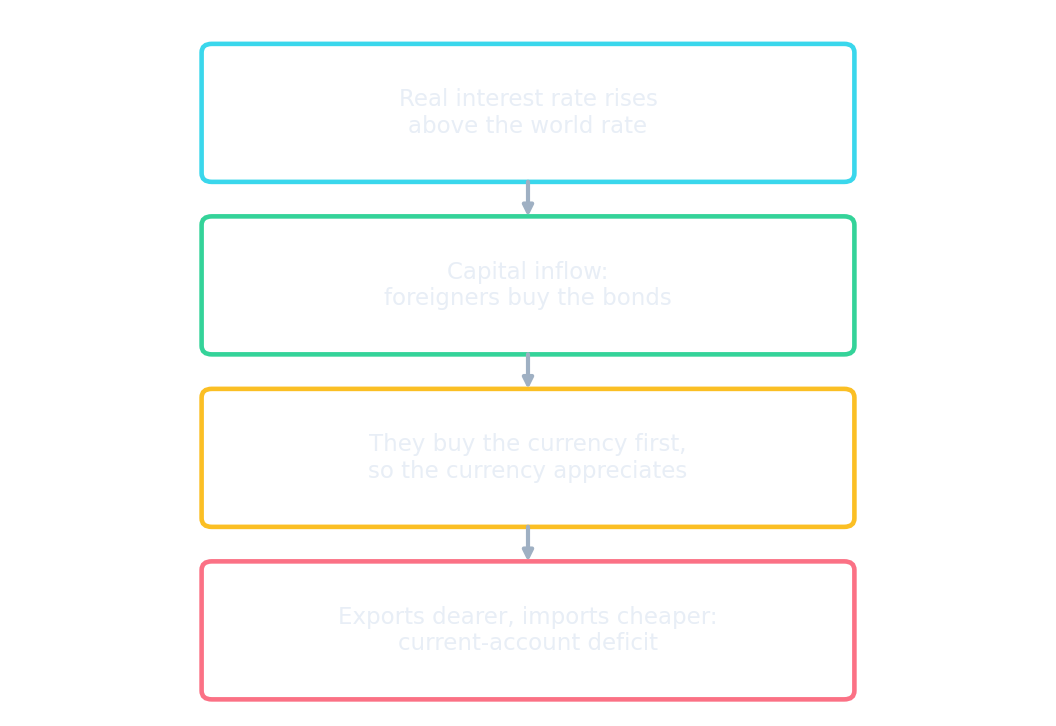
- When a country's real interest rate rises above the rest of the world's, foreign savers send money in — a capital inflow 资本流入.
- To invest, those foreigners must first buy the country's currency.
- So the inflow raises demand for the currency, and it appreciates.
- High real rates therefore mean a strong currency.
A financial account surplus (capital inflow) is matched by a current account:
Difficulty 1/5 · 100 coins + a small bonus on first completion today
The appreciation makes exports dearer and imports cheaper, pushing the current account to deficit.
How the two accounts tie together
- These capital flows 资本流动 link the two balance-of-payments accounts.
- A financial account surplus (money flowing in to buy assets) matches a current account deficit.
- Why? The stronger currency the inflow creates makes exports dearer and imports cheaper.
- That pushes the trade balance the other way — into deficit — exactly offsetting the inflow.
A country raises its real interest rate from 2% to 5%. By how many percentage points did it rise?
Difficulty 2/5 · 140 coins + a small bonus on first completion today
5 − 2 = 3 percentage points, far above the world rate — drawing capital in.
Order the chain from a higher real rate to a current-account deficit.
Difficulty 3/5 · 200 coins + a small bonus on first completion today
Higher rate → inflow → appreciation → trade gap widens.
Worked example
- Worked idea. A country lifts its real interest rate from 2% to 5%, far above the world's.
- Foreign investors pour money in to buy its bonds — a capital inflow — buying its currency first, so it appreciates.
- The stronger currency then makes exports dearer, so the current account moves toward deficit.
- Higher real rates draw in capital but widen the trade gap — the two accounts offset.
Capital inflow or outflow?
Money chases the best real return. Sort each case by which way capital flows.
Real interest rates drive capital flows. A rate above the world's brings a capital inflow: foreigners buy the currency, which appreciates. The stronger currency makes exports dearer and imports cheaper, moving the current account toward deficit — so a financial account surplus offsets a current account deficit ($2\% \to 5\%$ draws capital in but widens the trade gap).
Write from a real-rate rise of 5 percentage points
- A country raises its real interest rate from 1 percent to 6 percent.
- Find the rise and say what capital does.
A country raises its real interest rate from 1 percent to 6 percent, while the rest of the world does not. By how many percentage points did the rate rise, and what happens to capital flows and the currency?
6 minus 1 is 5.
By how many percentage points did the real rate rise?
Difficulty 1/5 · 100 coins + a small bonus on first completion today
6 percent minus 1 percent is a rise of 5 percentage points. Other options — 3 (the lesson rise); 6 (the new rate).