Skip to content · ⁨コンテンツへスキップ⁩

Open Economy—International Trade and Finance · ⁨開放経済—国際貿易と金融⁩

AP Macroeconomics · ⁨AP マクロ経済学⁩ · Topic 6 · ⁨トピック 6⁩

View Slides · ⁨查看幻灯片⁩ Train · ⁨練習する⁩
Video lesson for this topic · ⁨このトピックのビデオレッスン⁩ Open the video page · ⁨動画ページを開く⁩
8:01

開放経済—国際貿易と金融

所有物のほとんどのラベルを確認してみよ。別の場所で製造された。これらのような鉄箱の中で海を渡り、別のカネで誰かが支払った。…

English narration · English + 中文 subtitles burned in · ⁨英語ナレーション・英語+中文字幕 burning-in⁩

6.1

Balance of Payments Accounts · ⁨国際収支計算⁩

Syllabus · ⁨シラバス⁩
English

Enduring Understanding (MEA-4): Foreign trade accounting measures the flow of goods, services, and financial capital between countries.

Learning Objective MEA-4.A: a. Define the current account (CA), the capital and financial account (CFA), and the balance of payments (BOP). b. Explain how changes in the components of the CA and CFA affect a country's BOP. c. Calculate the CA, the CFA, and the BOP.

  • MEA-4.A.1 The current account (CA) records net exports, net income from abroad, and net unilateral transfers.
  • MEA-4.A.2 The CA is not always balanced; it may show a surplus or a deficit. A nation's balance of trade (i.e., net exports) is part of the current account and may also show a surplus or a deficit.
  • MEA-4.A.3 The capital and financial account (CFA) records financial capital transfers and purchases and sales of assets between countries.
  • MEA-4.A.4 The CFA is not always balanced; it may show a surplus (financial capital inflow) or a deficit (financial capital outflow).
  • MEA-4.A.5 The balance of payments (BOP) is an accounting system that records a country's international transactions for a particular time period. It consists of the CA and the CFA.
  • MEA-4.A.6 Any transaction that causes money to flow into a country is a credit to its BOP account, and any transaction that causes money to flow out is a debit. The sum of all credit entries should match the sum of all debit entries ($CA + CFA = 0$).
日本語

永続的理解 (MEA-4): 対外貿易会計は、国々と国々の間で流れる商品、サービス、金融資本の流れを計測するものである。

学習目標 MEA-4.A: a. 経常収支(CA)、資本・金融収支(CFA)、および国際収支(BOP)を定義せよ。 b. CAおよびCFAの構成要素の変化が、一国のBOPに与える影響を説明せよ。 c. CA、CFA、およびBOPを計算せよ。

  • MEA-4.A.1 経常収支(CA)は、純輸出、海外からの純収入、および純単方向移転を記録する。
  • MEA-4.A.2 CAは常にバランスするわけではなく、黒字または赤字を示すことがある。一国の貿易収支(すなわち純輸出)はCAの一部であり、同様に黒字または赤字を示すことがある。
  • MEA-4.A.3 資本・金融収支(CFA)は、国々と国々間での金融資本の移転および資産の売買を記録する。
  • MEA-4.A.4 CFAは常にバランスするわけではなく、黒字(金融資本の流入)または赤字(金融資本の流出)を示すことがある。
  • MEA-4.A.5 国際収支(BOP)とは、特定の期間における一国の対外取引を記録する会計システムである。CAとCFAから構成される。
  • MEA-4.A.6 国への資金流入をもたらす取引はBOP accountのクレジット(借方)とし、国からの資金流出をもたらす取引はデビット(貸方)とする。すべてのクレジット項目の合計は、すべてのデビット項目の合計と等しくなるはずである($CA + CFA = 0$)。

Source: College Board AP Course and Exam Description · ⁨出典: College Board AP コースおよび試験説明書⁩

English

The balance of payments 国际收支 records all transactions between a country and the rest of the world, in two main accounts:

  • The current account 经常账户 tracks trade in goods and services (exports minus imports), plus income and transfers. A trade deficit makes it negative.
  • The capital (financial) account 资本账户 tracks flows of financial assets – foreigners buying domestic assets, and residents buying foreign assets.

The two are mirror images: a current-account deficit is matched by a capital-account surplus (a country that imports more than it exports pays with assets, so foreign investment flows in). They sum to zero.

日本語
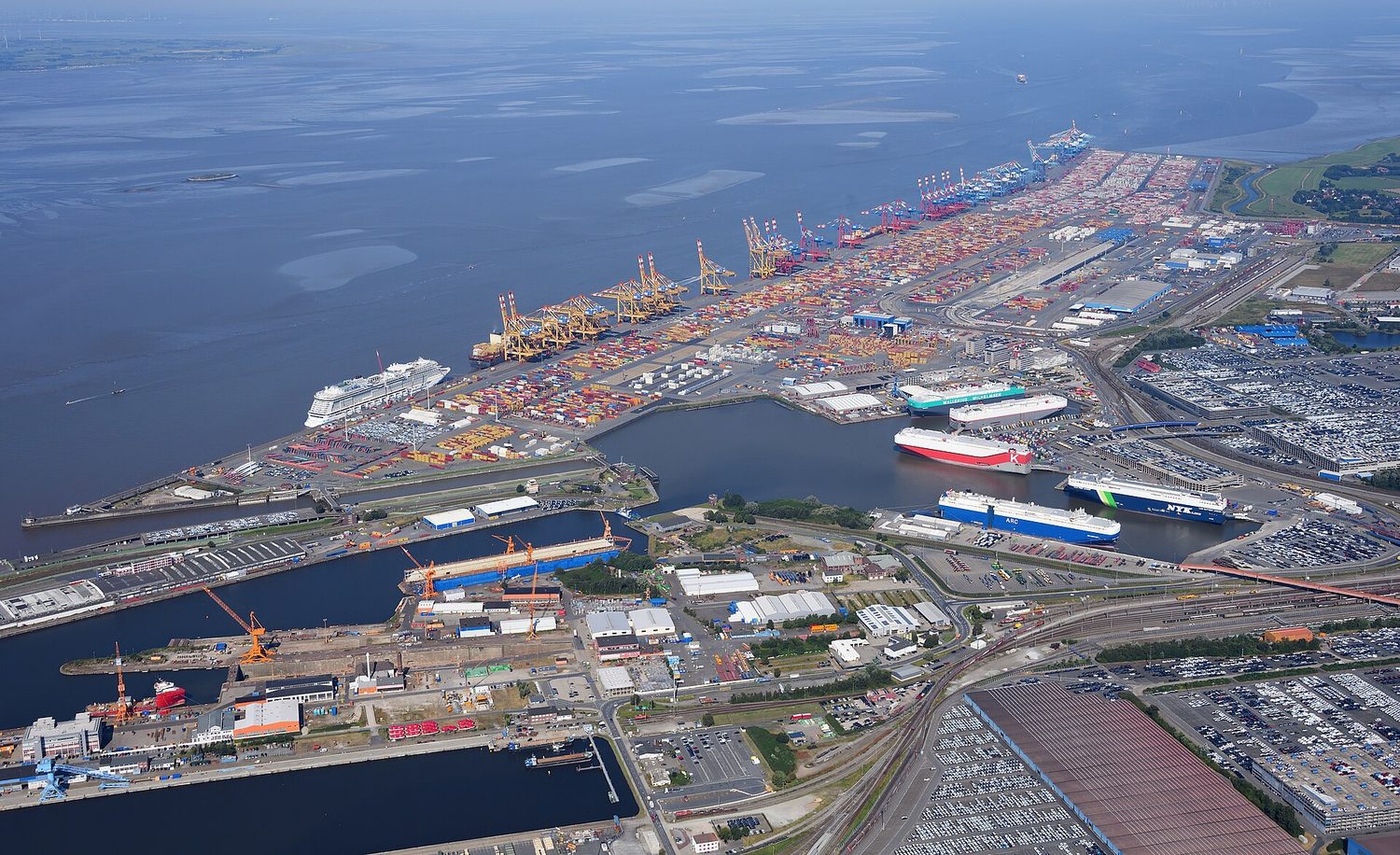
コンテナターミナル: 輸出と輸入は国際収支に記録される

国際収支 は、ある国と世界他の国との間のすべての取引を、2つの主要な勘定で記録する:

経常勘定の4つの構成要素
経常勘定の4つの構成要素
  • 経常勘定 は 商品およびサービス の取引(輸出 minus 輸入)、所得および移転を追跡する。貿易赤字はこれをマイナスにする。
  • 資本(金融)勘定 は 金融資産 の流れを追跡する——外国人による国内資産の購入、および居住者による海外資産の購入。

これら2つは 鏡像関係 にあり、経常勘定の赤字は資本勘定の黒字によって相殺される(輸出より輸入が多い国は資産で支払うため、外国からの投資流入が生じる)。合計はゼロになる。

Vocabulary · ⁨語彙⁩ Train · ⁨練習する⁩
English 日本語
balance of payments/ˈbæləns ɒv ˈpeɪmənts/ 国際収支
current account/ˈkʌrənt əˈkaʊnt/ 経常収支
capital (financial) account/ˈkæpɪtl əˈkaʊnt/ 資本(金融)勘定
6.2

Exchange Rates · ⁨為替レート⁩

Syllabus · ⁨シラバス⁩
English

Enduring Understanding (MKT-5): The interaction of buyers and sellers exchanging the currency of one country for the currency of another determines the equilibrium exchange rate in a flexible exchange market and influences the flow of goods, services, and financial capital between countries.

Learning Objective MKT-5.A: a. Define the exchange rate, currency appreciation, and currency depreciation. b. Explain how currencies are valued relative to one another. c. Calculate the value of one currency relative to another.

  • MKT-5.A.1 In the foreign exchange market, one currency is exchanged for another; the price of one currency in terms of the other is the exchange rate.
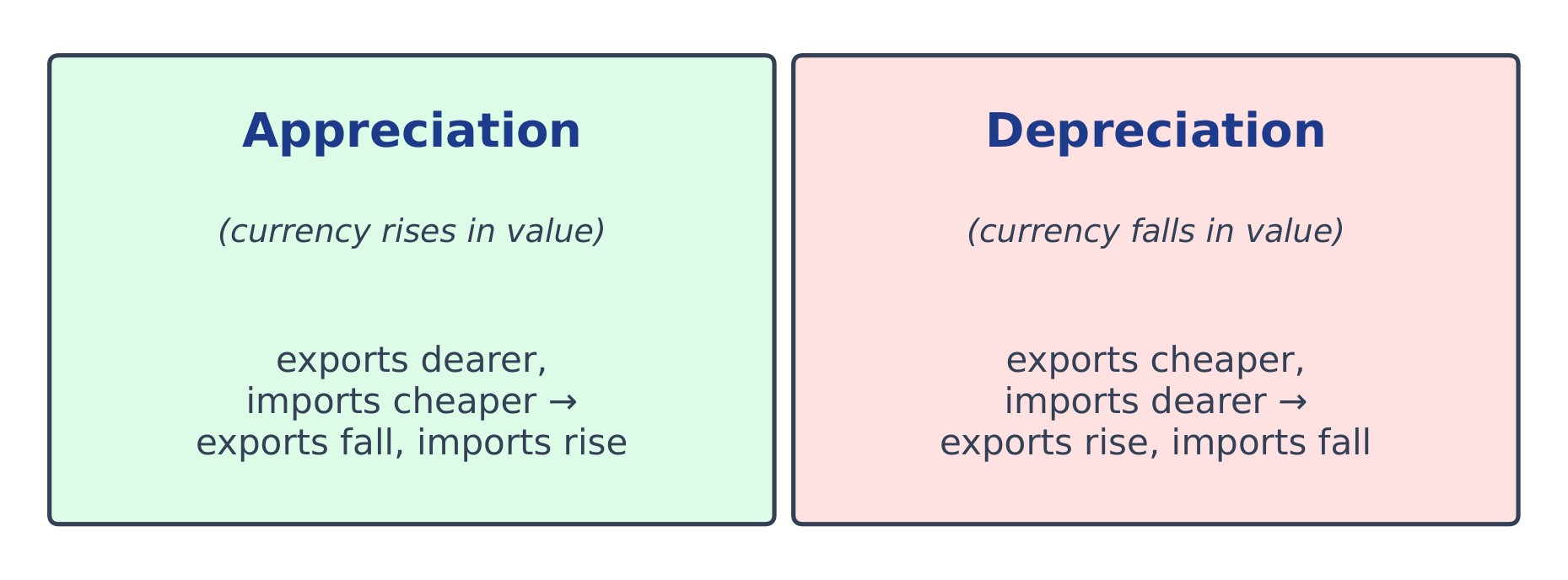
  • MKT-5.A.2 If one currency becomes more valuable in terms of the other, it is said to appreciate. If one currency becomes less valuable in terms of the other, it is said to depreciate.
日本語

持続的認識(MKT-5): 買手と売手の間での、ある国の通貨を別の国の通貨に交換する相互作用は、柔軟な為替市場における均衡為替レートを決定し、国間の商品・サービス・金融資本の移動に影響を与える。

学習目標 MKT-5.A: a. 為替レート、通貨高、通貨安を定義する。 b. 通貨が互いにどう評価されているかを説明する。 c. 一方の通貨が他方に対して持つ価値を計算する。

  • MKT-5.A.1 外為市場では、ある通貨が別の通貨と交換され、ある通貨が他方通貨で表した価格が為替レートである。
  • MKT-5.A.2 ある通貨が他方通貨に対して価値が高まると「高まる(appreciate)」といい、逆に価値が低下すると「低まる(depreciate)」という。

Source: College Board AP Course and Exam Description · ⁨出典: College Board AP コースおよび試験説明書⁩

English

An exchange rate 汇率 is the price of one currency in terms of another. A currency appreciates 升值 when it gains value (buys more foreign currency) and depreciates 贬值 when it loses value. Always track which currency: if the US dollar appreciates against the euro, the euro depreciates against the dollar – the same event from two sides.

Worked example. Suppose $\$1=\text{€}0.90$, so $\text{€}1=\dfrac{1}{0.90}\approx\$1.11$. If the dollar then appreciates to $\$1=\text{€}1.00$, each dollar now buys more euros, while the euro has depreciated – it now buys only $\$1.00$ instead of $\$1.11$. The single event is an appreciation of the dollar and a depreciation of the euro.

Most currencies today are floating 浮动, set by supply and demand in the foreign-exchange market.

日本語
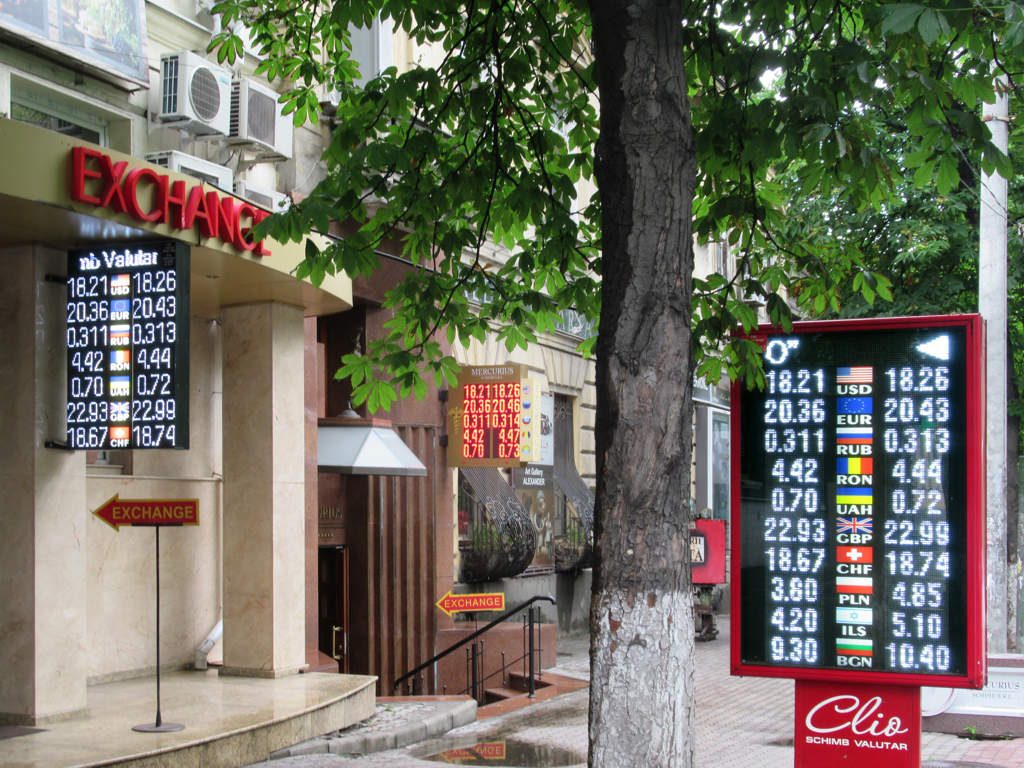
通貨交換ボード: 為替レートは、ある通貨を別の通貨で表した価格である

為替レートとは、ある通貨が他通貨で表した価格のことである。通貨の価値が増加してより多くの外国貨を購入できる場合は**高値(icated)となり、価値が減少する場合は安値(depreciates)**となる。常にどの通貨に注目するかを確認すること:米ドルがユーロに対して高値になれば、ユーロは米ドルに対して安値となる——同一の出来事を2つの側面から見たものである。

演習例。 $\$1=\text{€}0.90$, so $\text{€}1=\dfrac{1}{0.90}\approx\$1.11$ と仮定します。もしドルが $\$1=\text{€}1.00$, each dollar now buys more euros, while the euro has depreciated – it now buys only $\$1.00$ に高騰し、$\$1.11$ であった場合、単一の変化はドルの高騰でありかつユーロの下落です。

通貨の需給によって設定される変動相場制
通貨の需給によって設定される変動相場制

現代のほとんどの通貨は変動相場制であり、為替市場における需給によって決定される。

Vocabulary · ⁨語彙⁩ Train · ⁨練習する⁩
English 日本語
exchange rate/eksˈtʃeɪndʒ reɪt/ 為替レートである
appreciates/əˈpriːʃɪeɪts/ 上昇する
depreciates/dɪˈpriːʃɪeɪts/ 下落する
floating/ˈfləʊtɪŋ/ 自由為替
capital flows/ˈkæpɪtl fləʊz/ 資本移動
6.3

The Foreign Exchange Market · ⁨為替市場⁩

Syllabus · ⁨シラバス⁩
English

Enduring Understanding (MKT-5): The interaction of buyers and sellers exchanging the currency of one country for the currency of another determines the equilibrium exchange rate in a flexible exchange market and influences the flow of goods, services, and financial capital between countries.

Learning Objective MKT-5.B: a. Define the foreign exchange market, demand for currency, and supply of currency. b. Explain (using graphs as appropriate) the relationship between the exchange rate and the quantity of currency demanded (supplied).

  • MKT-5.B.1 The demand for a currency in a foreign exchange market arises from the demand for the country's goods, services, and financial assets and shows the inverse relationship between the exchange rate and the quantity demanded of a currency.
  • MKT-5.B.2 The supply of a currency in a foreign exchange market arises from making payments in other currencies and shows the positive relationship between the exchange rate and the quantity supplied of a currency.

Learning Objective MKT-5.C: Define (using graphs as appropriate) the equilibrium exchange rate.

  • MKT-5.C.1 In the foreign exchange market, equilibrium is achieved when the exchange rate is such that the quantities demanded and supplied of the currency are equal.

Learning Objective MKT-5.D: Explain (using graphs as appropriate) how exchange rates adjust to restore equilibrium in the foreign exchange market.

  • MKT-5.D.1 Disequilibrium exchange rates create surpluses and shortages in the foreign exchange market. Market forces drive exchange rates toward equilibrium.
日本語

持続的認識(MKT-5): 買手と売手の間での、ある国の通貨を別の国の通貨に交換する相互作用は、柔軟な為替市場における均衡為替レートを決定し、国間の商品・サービス・金融資本の移動に影響を与える。

学習目標 MKT-5.B: a. 外為市場、通貨需要、通貨供給を定義する。 b. (適切な場合、グラフを用いて)為替レートと通貨需要量(供給量)との関係性を説明する。

  • MKT-5.B.1 外為市場における通貨の需要は、その国の商品・サービス・金融資産に対する需要から生じ、為替レートと通貨の需要量の間に逆の相関関係があることを示す。
  • MKT-5.B.2 外為市場における通貨の供給は、他の通貨での支払いを行うことから生じ、為替レートと通貨の供給量の間に正の相関関係があることを示す。

学習目標 MKT-5.C: (適切な場合、グラフを用いて)均衡為替レートを定義する。

  • MKT-5.C.1 外為市場において、為替レートが通貨の需要量と供給量を等しくする水準にあるとき、均衡が達成される。

学習目標 MKT-5.D: (適切な場合、グラフを用いて)為替レートがどのように調整して外為市場の均衡を取り戻すかを説明する。

  • MKT-5.D.1 不均衡な為替レートは外為市場に過剰供給や不足を生じさせる。市場の力が為替レートを均衡方向へ動かす。

Source: College Board AP Course and Exam Description · ⁨出典: College Board AP コースおよび試験説明書⁩

English
The foreign exchange market

Each currency has its own supply-and-demand graph (price $=$ the exchange rate, quantity $=$ amount of that currency).

  • Demand for a currency comes from foreigners wanting its goods, services, or assets.
  • Supply of a currency comes from its own residents wanting foreign goods, services, or assets.

The equilibrium exchange rate is where they cross. A rightward shift in demand for a currency causes it to appreciate; a rightward shift in supply causes it to depreciate.

Exam skill: always draw the graph for the currency named in the question, label the axis with that currency's price, and shift the correct curve – mixing up the two currencies' graphs is the most common error.

日本語
為替市場

各通貨には独自の需給曲線がある(価格$=$は為替レート、数量$=$はその通貨の量)。

  • 需要は、外国人がその国の商品、サービス、資産を欲しがることから生じる。
  • 供給は、自国居民が外国の商品、サービス、資産を欲しがることから生じる。

均衡為替レートは両曲線の交点にある。需要の右側シフトは通貨を高値にし、供給の右側シフトは通貨を安値にする。

試験技能: 必ず問題文で指定された通貨のグラフを描き、軸にその通貨の価格をラベル付けし、正しい曲線をシフトさせること。2つの通貨のグラフを混同することが最も一般的な誤りである。

Explore · ⁨探索⁩

The foreign-exchange market · ⁨為替市場⁩

A currency's exchange rate is set where demand for it meets supply. Higher demand for exports or higher interest rates appreciate the currency. · ⁨通貨の為替レートは、その通貨に対する需要と供給が一致する地点で決定される。輸出への需要増加や金利の上昇は通貨高(評価額上昇)をもたらす。⁩

6.4

Changes in Policies and Economic Conditions · ⁨政策と経済状況の変化⁩

Syllabus · ⁨シラバス⁩
English

Enduring Understanding (MKT-5): The interaction of buyers and sellers exchanging the currency of one country for the currency of another determines the equilibrium exchange rate in a flexible exchange market and influences the flow of goods, services, and financial capital between countries.

Learning Objective MKT-5.E: a. Explain (using graphs as appropriate) the determinants of currency demand and supply. b. Explain (using graphs as appropriate) how changes in demand and supply in the foreign exchange market affect the equilibrium exchange rate.

  • MKT-5.E.1 Factors that shift the demand for a currency (such as the demand for that country's goods, services, or assets) and the supply of a currency (such as tariffs or quotas on the other country's goods and services) change the equilibrium exchange rate.
  • MKT-5.E.2 Fiscal policy can influence aggregate demand, real output, the price level, and exchange rates.
  • MKT-5.E.3 Monetary policy can influence aggregate demand, real output, the price level, and interest rates, and thereby affect exchange rates.
日本語

持続的認識(MKT-5): 買手と売手の間での、ある国の通貨を別の国の通貨に交換する相互作用は、柔軟な為替市場における均衡為替レートを決定し、国間の商品・サービス・金融資本の移動に影響を与える。

学習目標 MKT-5.E: a. (適切な場合、グラフを用いて)通貨の需要と供給を決定する要因を説明する。 b. (適切な場合、グラフを用いて)外為市場における需要と供給の変化が均衡為替レートに与える影響を説明する。

  • MKT-5.E.1 通貨の需要(例:その国の商品・サービス・資産への需要)や通貨の供給(例:他国商品・サービスに対する関税や数量制限)を変化させる要因は、均衡為替レートを変える。
  • MKT-5.E.2 財政政策は総需要、実質生産、物価水準、為替レートに影響を与えることができる。
  • MKT-5.E.3 金融政策は総需要、実質生産、物価水準、利率に影響を与え、結果として為替レートにも影響する。

Source: College Board AP Course and Exam Description · ⁨出典: College Board AP コースおよび試験説明書⁩

English

Exchange rates respond to:

  • Relative interest rates: a higher domestic real interest rate attracts foreign financial investment, raising demand for the currency and causing appreciation.
  • Relative price levels/inflation: higher domestic inflation makes goods less competitive, lowering demand for the currency (depreciation).
  • Relative incomes: higher domestic income raises imports, increasing the supply of domestic currency (depreciation).
  • Tastes and expectations about future value.

Monetary policy has a strong link: expansionary monetary policy lowers interest rates, reduces demand for the currency, and causes depreciation (which then boosts net exports).

日本語

為替レートは次の要因に応じて変動する:

  • 相対利子率: 国内の実質利子率が上昇すると、海外金融投資が引き寄せられ、通貨の需要が増加して高値になる。
  • 相対物価水準/インフレ: 国内のインフレ率が高いと商品の競争力が低下し、通貨の需要が減る(安値)。
  • 相対所得: 国内の所得が上昇すると輸入が増加し、国内通貨の供給が増える(安値)。
  • 嗜好や将来の価値に対する見通し。

金融政策との関連が強い:拡張的な金融政策は利子率を下げ、通貨の需要を減らし、安値をもたらす(その後、純輸出を増やす)。

6.5

Exchange Rates and Net Exports · ⁨為替レートと純輸出⁩

Syllabus · ⁨シラバス⁩
English

Enduring Understanding (MKT-5): The interaction of buyers and sellers exchanging the currency of one country for the currency of another determines the equilibrium exchange rate in a flexible exchange market and influences the flow of goods, services, and financial capital between countries.

Learning Objective MKT-5.F: Explain (using graphs as appropriate) how changes in the value of a currency can lead to changes in a country's net exports and aggregate demand.

  • MKT-5.F.1 Factors that cause a currency to appreciate cause that country's exports to decrease and its imports to increase. As a result, net exports will decrease.
  • MKT-5.F.2 Factors that cause a currency to depreciate cause that country's exports to increase and its imports to decrease. As a result, net exports will increase. [See EK MOD-2.A.3 and EK MOD-2.H.1 for explanations of the effect of changes in net exports on aggregate demand and the resulting effects on output, employment, and the price level.]
日本語

持続的認識(MKT-5): 買手と売手の間での、ある国の通貨を別の国の通貨に交換する相互作用は、柔軟な為替市場における均衡為替レートを決定し、国間の商品・サービス・金融資本の移動に影響を与える。

学習目標 MKT-5.F: (適切な場合、グラフを用いて)通貨価値の変化が国の純輸出および総需要に変化をもたらす仕組みを説明する。

  • MKT-5.F.1 通貨を高める要因は、その国の輸出を減少させ輸入を増加させる。したがって、純輸出は減少する。
  • MKT-5.F.2 通貨を安くする要因は、その国の輸出を増加させ輸入を減少させる。したがって、純輸出は増加する。[EK MOD-2.A.3 および EK MOD-2.H.1 を参照。純輸出の変化が総需要に与える影響、およびそれに伴う生産、雇用、物価レベルへの影響について解説している。]

Source: College Board AP Course and Exam Description · ⁨出典: College Board AP コースおよび試験説明書⁩

English

Exchange rates feed back into AD through net exports:

  • A depreciation makes exports cheaper for foreigners and imports dearer, so net exports rise and AD shifts right.
  • An appreciation makes exports dearer and imports cheaper, so net exports fall and AD shifts left.

Worked example. A US car priced at $\$30{,}000$ costs a European buyer $\text{€}27{,}000$ when $\$1=\text{€}0.90$. If the dollar depreciates to $\$1=\text{€}0.80$, the same car now costs only $\text{€}24{,}000$ – cheaper for foreigners, so US exports rise while imports (now dearer in dollars) fall, lifting net exports and shifting AD right.

This is how the foreign-exchange market and the AD-AS model connect – a currency change is a channel through which policy reaches output.

日本語

為替レートは純輸出を通じて総需要(AD)にフィードバックする:

高値は輸出を高くし輸入を安くします;安値はその逆
  • 安値になると輸出が安くなり輸入が高くなるため、純輸出が増加しADは右にシフトする。
  • 高値になると輸出が高くなり輸入が安くなるため、純輸出が減少しADは左にシフトする。

計算例。 米国産自動車の価格が $\$30{,}000$ costs a European buyer $\text{€}27{,}000$ when $\$1=\text{€}0.90$ である。もしドルが $\$1=\text{€}0.80$, the same car now costs only $\text{€}24{,}000$ に贬值すれば、外国人にとって安くなり、米国輸出が増加し、輸入(ドル建てではclud高騰)が減少するため、正味輸出が増加しADが右へシフトする。

これが為替市場とAD-ASモデルをつなぐ方法である——通貨の変動は政策が生産額に影響を与える経路である。

6.6

Real Interest Rates and International Capital Flows · ⁨実質利子率と国際資本移動⁩

Syllabus · ⁨シラバス⁩
English

Enduring Understanding (MKT-5): The interaction of buyers and sellers exchanging the currency of one country for the currency of another determines the equilibrium exchange rate in a flexible exchange market and influences the flow of goods, services, and financial capital between countries.

Learning Objective MKT-5.G: Explain (using graphs as appropriate) how differences in real interest rates across countries affect financial capital flows, foreign exchange markets, and loanable funds markets.

  • MKT-5.G.1 In an open economy, differences in real interest rates across countries change the relative values of domestic and foreign assets. Financial capital will flow toward the country with the relatively higher interest rate. [See EK MKT-4.E.2 and EK MEA-4.A.6 for explanations of the impact on the loanable funds market and on net exports.]
  • MKT-5.G.2 Central banks can influence the domestic interest rate in the short run, which in turn will affect net capital inflows.
日本語

持続的認識(MKT-5): 買手と売手の間での、ある国の通貨を別の国の通貨に交換する相互作用は、柔軟な為替市場における均衡為替レートを決定し、国間の商品・サービス・金融資本の移動に影響を与える。

学習目標 MKT-5.G: (適切な場合、グラフを用いて)各国の実質利子率の違いが金融資本の移動、外為市場、貸出可能資金市場に与える影響を説明する。

  • MKT-5.G.1 開放経済において、各国の実質利子率の違いは国内資産と国外資産の相対的な価値を変化させる。金融資本は利子率が比較的高い国へと流入する。[EK MKT-4.E.2 および EK MEA-4.A.6 を参照。貸出可能資金市場および純輸出への影響について解説している。]
  • MKT-5.G.2 中央銀行は短期間で国内利子率に影響を与えることができ、それが純資本流入に影響を与える。

Source: College Board AP Course and Exam Description · ⁨出典: College Board AP コースおよび試験説明書⁩

English

Money chases the highest real return, so capital flows 资本流动 respond to real interest rates:

  • A higher domestic real interest rate attracts inflows of foreign financial capital – foreigners buy domestic bonds, raising currency demand and causing appreciation.
  • A lower real rate causes outflows and depreciation.

This ties the whole course together: government borrowing raises the real interest rate (loanable funds), which attracts foreign capital, appreciates the currency, and reduces net exports – so a budget deficit can widen a trade deficit (the "twin deficits"). Tracing these linked effects across the loanable-funds, forex, and AD-AS graphs is the capstone skill of AP Macroeconomics.

日本語

お金は最高の実質収益を求めて動くため、資本移動は実質利子率に応答する:

  • 国内の実質利子率が高いと、海外金融資本の流入を引き寄せる——外国人が国内債券を購入し、通貨の需要を増加させて高値にする。
  • 実質利子率が低いと、流出と安値をもたらす。

これにより全コースが結びつく:政府の借入は実質利子率を上げる(貸出可能資金)、海外資本を引き寄せ、通貨を高値にし、純輸出を減少させる——したがって、予算赤字は貿易赤字を拡大させる可能性がある(「ツイン・ディフェイット」)。貸出可能資金、為替、AD-ASのグラフ Across these linked effects を追跡することはAPマクロ経済学のカップストーンスキルである。

6.6

Exam tips · ⁨試験対策⁩

English
  • The current account and financial account are mirror images and sum to zero.
  • Always draw the forex graph for the currency named, and label its price with that currency; one currency appreciating is the other depreciating.
  • A depreciation raises net exports (exports cheaper); an appreciation lowers them.
  • Higher domestic real interest rates attract capital inflows → currency appreciates → net exports fall.
  • Link it all: a budget deficit raises the real rate, appreciates the currency, and can widen the trade deficit (twin deficits).
日本語
  • 経常収支と金融収支は鏡像であり、合計はゼロである。
  • 必ず指定された通貨の為替グラフを描き、その通貨で価格をラベル付けすること。一つの通貨が高値なら、もう一つは安値である。
  • 安値は純輸出を増加させ(輸出が安くなる)、高値はそれを減少させる。
  • 国内の実質利子率が上昇 → 資本流入 → 通貨高値 → 純輸出減少。
  • これらをすべて結ぶ:予算赤字は実質利子率を上げ、通貨を高値にし、貿易赤字を拡大させる可能性がある(ツイン・ディフェイット)。

Interactive lessons on this topic · ⁨このトピックのインタラクティブ授業⁩

Work through it step by step, with instant-check exercises. · ⁨一歩ずつ進め、即時チェック付きの問題で学習します。⁩

Past Papers · ⁨過去問⁩

More topics in AP Macroeconomics · ⁨AP マクロ経済学⁩ · ⁨AP Macroeconomics · ⁨AP マクロ経済学⁩ の他のトピック⁩

Log in or create account · ⁨ログインまたはアカウント作成⁩

IGCSE, A-Level & AP