This handout covers Topic 1, Number. Cambridge Maths has two levels: Core and Extended. Parts marked (Extended) are only tested on the Extended papers; everything else is for both levels.
Tips
Matematika IGCSE (0580) mencakup bilangan, aljabar dan grafik, geometri koordinat, geometri, mensurasi, trigonometri, transformasi dan vektor, probabilitas dan statistika.
Pendaftaran dibagi antara Inti dan Lanjutan, dan level Lanjutan mencapai jauh lebih dalam pada aljabar dan trigonometri — konfirmasi tingkatan Anda sebelum memilih apa yang akan dilatih.
Poin metode diberikan untuk pekerjaan tertulis. Jawaban numerik yang salah masih bisa mendapat sebagian besar poin jika langkah pengerjaannya terlihat, dan jawaban yang benar tanpa langkah pengerjaan bisa mendapat poin lebih sedikit. Menulis setiap baris bukanlah kerapian — itu adalah poin.
-
1
Number · Angka
Watch lesson · Tonton pelajaran1.1
Types of number

Syllabus · Silabus
EnglishSubject content Notes and examples Identify and use: • natural numbers • integers (positive, zero and negative) • prime numbers • square numbers • cube numbers • common factors • common multiples • rational and irrational numbers • reciprocals. Example tasks include: • convert between numbers and words, e.g. six billion is 6000000000 10007 is ten thousand and seven • express 72 as a product of its prime factors • find the highest common factor (HCF) of two numbers • find the lowest common multiple (LCM) of two numbers. Bahasa IndonesiaKonten mata pelajaran Catatan dan contoh Kenali dan gunakan: • bilangan asli • bilangan bulat (positif, nol, dan negatif) • bilangan prima • bilangan kuadrat • bilangan pangkat tiga • faktor persekutuan • kelipatan persekutuan • bilangan rasional dan irrasional • resiprokal. Contoh tugas meliputi: • konversi antara angka dan kata, mis. enam miliar adalah 6000000000; 10007 adalah sepuluh ribu tujuh • nyatakan 72 sebagai hasil kali faktor-faktor primanya • temukan Faktor Persekutuan Terbesar (FPB) dari dua bilangan • temukan Kelipatan Persekutuan Terkecil (KPK) dari dua bilangan. Source: Cambridge International syllabus · Sumber: Silabus Cambridge International
You must know the words for the different kinds of number. Examiners give marks for using them correctly.
Each set sits inside the next: every natural number is an integer, every integer is rational, every rational is real. Irrational numbers are real but not rational. Counting numbers and integers
- natural numbers 自然数 — the counting numbers $1, 2, 3, 4, \dots$
- integers 整数 — whole numbers, positive, negative or zero: $\dots, -2, -1, 0, 1, 2, \dots$
Factors and multiples
- A factor 因数 of a number divides into it exactly, leaving no remainder 余数. The factors of $18$ are $1, 2, 3, 6, 9, 18$.
- A multiple 倍数 of a number is that number times an integer. Multiples of $6$ are $6, 12, 18, 24, \dots$
- A common factor 公因数 of two numbers is a factor of both.
- A common multiple 公倍数 of two numbers is a multiple of both.
Prime, square and cube numbers
- A prime number 质数 has exactly two factors: $1$ and itself. The first primes are $2, 3, 5, 7, 11, 13, \dots$ Note that $1$ is not prime.
- A square number 平方数 is a whole number times itself: $1, 4, 9, 16, 25, \dots$
- A cube number 立方数 uses a whole number three times: $1, 8, 27, 64, \dots$
Rational, irrational and reciprocal
- A rational number 有理数 can be written as a fraction 分数 $\frac{a}{b}$ of two integers. Examples: $\frac{3}{4}$, $5$, $0.7$.
- An irrational number 无理数 cannot be written this way. Examples: $\pi$ and $\sqrt{2}$.
- The reciprocal 倒数 of a number is $1$ divided by that number. The reciprocal of $4$ is $\frac{1}{4}$; the reciprocal of $0.25$ is $4$; the reciprocal of $\frac{2}{3}$ is $\frac{3}{2}$.
Prime factors, HCF and LCM
Every integer above $1$ is prime, or can be written as a product 乘积 of prime numbers. To write a number as a product of its prime factors 质因数, keep dividing by the smallest prime that fits.
Worked example. Write $72$ as a product of its prime factors.
$$72 = 2 \times 36 = 2 \times 2 \times 18 = 2 \times 2 \times 2 \times 9 = 2 \times 2 \times 2 \times 3 \times 3 = 2^{3} \times 3^{2}.$$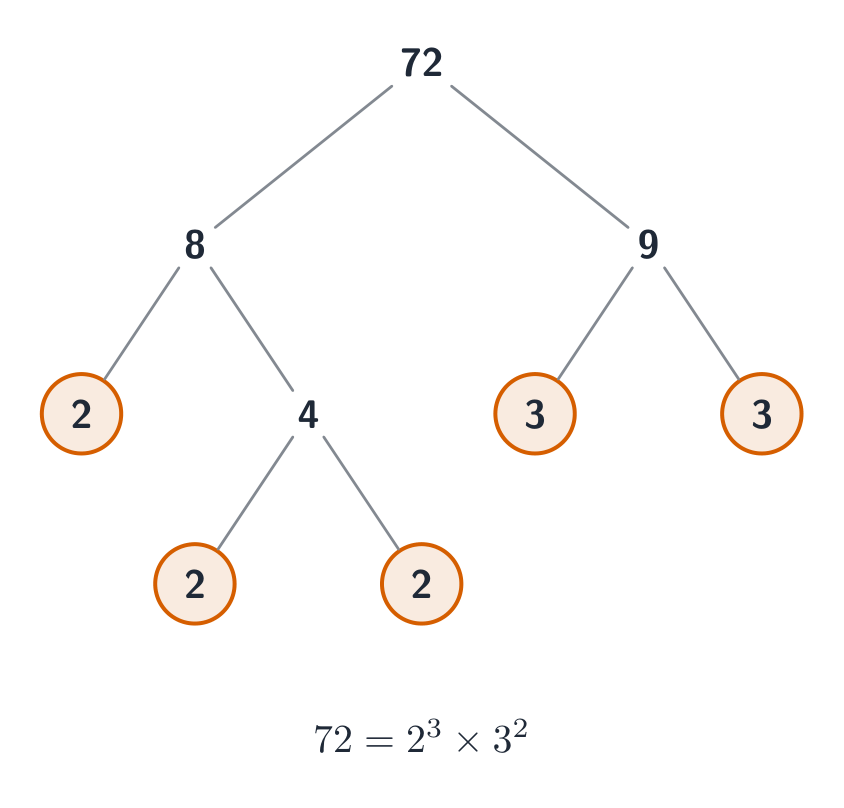
Keep splitting until every branch ends on a prime (circled); collecting them gives $72 = 2^{3} \times 3^{2}$. The highest common factor (HCF) 最大公因数 of two numbers is the largest factor they share. The lowest common multiple (LCM) 最小公倍数 is the smallest multiple they share. Prime factors give a quick method.
Worked example. Find the HCF and LCM of $72$ and $120$.
First write each as a product of primes:
$$72 = 2^{3} \times 3^{2}, \qquad 120 = 2^{3} \times 3 \times 5.$$- HCF: take the lowest power of each prime that appears in both: $2^{3} \times 3 = 24$.
- LCM: take the highest power of every prime that appears: $2^{3} \times 3^{2} \times 5 = 360$.
Explore · JelajahiSets of numbers · Kumpulan angka
Every counting number is also an integer, every integer a rational — see how the number sets nest, and how union and intersection combine them. · Setiap bilangan hitung juga merupakan integer, setiap integer adalah rasional — lihat bagaimana himpunan angka bersarang, dan bagaimana gabungan serta irisan menggabungkannya.
Vocabulary · Kosa kata Train · LatihEnglish Bahasa Indonesia natural number/ˈnætʃərəl ˈnʌmbə/ bilangan asli integer/ˈɪntɪdʒə/ integer factor/ˈfæktə/ faktor remainder/rɪˈmeɪndə/ sisa multiple/ˈmʌltɪpl/ kelipatan common factor/ˈkɒmən ˈfæktə/ faktor persekutuan common multiple/ˈkɒmən ˈmʌltɪpl/ kpk prime number/praɪm ˈnʌmbə/ bilangan prima square number/skweə ˈnʌmbə/ bilangan kuadrat cube number/kjuːb ˈnʌmbə/ bilangan pangkat tiga rational number/ˈræʃənl ˈnʌmbə/ bilangan rasional fraction/ˈfrækʃn/ pecahan irrational number/ɪˈræʃənl ˈnʌmbə/ bilangan irrasional reciprocal/rɪˈsɪprəkl/ resiprokal product/ˈprɒdʌkt/ produk prime factor/praɪm ˈfæktə/ faktor prima highest common factor/ˈhaɪɪst ˈkɒmən ˈfæktə/ faktor persekutuan tertinggi lowest common multiple/ˈləʊɪst ˈkɒmən ˈmʌltɪpl/ kelipatan persekutuan terendah 1.2
Sets and Venn diagrams

Syllabus · Silabus
EnglishSubject content Notes and examples Understand and use set language, notation and Venn diagrams to describe sets. Venn diagrams are limited to two sets. The following set notation will be used: • $n(A)$ Number of elements in set $A$ • $A'$ Complement of set $A$ • $\mathscr{E}$ Universal set • $A \cup B$ Union of $A$ and $B$ • $A \cap B$ Intersection of $A$ and $B$. Example definition of sets: $A = \{x : x \text{ is a natural number}\}$ $B = \{a, b, c, \dots\}$ $C = \{x : a \leqslant x \leqslant b\}$. Bahasa IndonesiaKonten mata pelajaran Catatan dan contoh Pahami dan gunakan bahasa himpunan, notasi, dan diagram Venn untuk mendeskripsikan himpunan. Diagram Venn terbatas pada dua himpunan. Notasi himpunan berikut akan digunakan: • $n(A)$ Banyaknya elemen dalam himpunan $A$ • $A'$ Komplemen himpunan $A$ • $\mathscr{E}$ Himpunan semesta • $A \cup B$ Gabungan $A$ dan $B$ • $A \cap B$ Irisan $A$ dan $B$. Contoh definisi himpunan: $A = \{x : x \text{ is a natural number}\}$ $B = \{a, b, c, \dots\}$ $C = \{x : a \leqslant x \leqslant b\}$. EnglishSubject content Notes and examples Understand and use set language, notation and Venn diagrams to describe sets and represent relationships between sets. Venn diagrams are limited to two or three sets. The following set notation will be used: • $n(A)$ Number of elements in set $A$ • $\in$ "... is an element of ..." • $\notin$ "... is not an element of ..." • $A'$ Complement of set $A$ • $\varnothing$ The empty set • $\mathscr{E}$ Universal set • $A \subseteq B$ $A$ is a subset of $B$ • $A \nsubseteq B$ $A$ is not a subset of $B$ • $A \cup B$ Union of $A$ and $B$ • $A \cap B$ Intersection of $A$ and $B$. Example definition of sets: $A = \{x : x \text{ is a natural number}\}$ $B = \{(x, y) : y = mx + c\}$ $C = \{x : a \leqslant x \leqslant b\}$ $D = \{a, b, c, \dots\}$. Bahasa IndonesiaKonten mata pelajaran Catatan dan contoh Fahami dan gunakan bahasa set, notasi dan diagram Venn untuk menerangkan set dan mewakili hubungan antara set. Diagram Venn terhad kepada dua atau tiga set. Notasi set berikut akan digunakan: • $n(A)$ Bilangan elemen dalam set $A$ • $\in$ "... adalah elemen bagi ..." • $\notin$ "... bukan elemen bagi ..." • $A'$ Pelengkap set $A$ • $\varnothing$ Set kosong • $\mathscr{E}$ Set universal • $A \subseteq B$ $A$ adalah subset bagi $B$ • $A \nsubseteq B$ $A$ bukan subset bagi $B$ • $A \cup B$ Gabungan $A$ dan $B$ • $A \cap B$ Potongan $A$ dan $B$. Contoh definisi set: $A = \{x : x \text{ is a natural number}\}$ $B = \{(x, y) : y = mx + c\}$ $C = \{x : a \leqslant x \leqslant b\}$ $D = \{a, b, c, \dots\}$. Source: Cambridge International syllabus · Sumber: Silabus Cambridge International
A set 集合 is a collection of objects. Each object in the set is an element 元素 of the set. You should know this notation:
Symbol Meaning $n(A)$ the number of elements in set $A$ $x \in A$ $x$ is an element of $A$ $x \notin A$ $x$ is not an element of $A$ $\mathscr{E}$ the universal set 全集 — everything being talked about $A'$ the complement 补集 of $A$ — everything not in $A$ $\varnothing$ the empty set 空集 — a set with no elements $A \subseteq B$ $A$ is a subset 子集 of $B$ — every element of $A$ is also in $B$ $A \cup B$ the union 并集 — elements in $A$ or $B$ or both $A \cap B$ the intersection 交集 — elements in both $A$ and $B$ A Venn diagram 维恩图 draws each set as a circle inside a rectangle (the universal set). Core uses two sets; Extended may use three.
Worked example. $\mathscr{E} = \{1,2,3,4,5,6,7,8,9,10\}$, $A = \{\text{even numbers}\}$, $B = \{\text{multiples of } 3\}$.
- $A = \{2,4,6,8,10\}$ and $B = \{3,6,9\}$.
- $A \cap B = \{6\}$ — the only number in both.
- $A \cup B = \{2,3,4,6,8,9,10\}$ — the numbers in either set.
- $n(A \cup B) = 7$.
$A \cap B = \{6\}$ is the only number in both circles; $A \cup B$ is everything inside either circle. You may also see a set written as a rule, e.g. $C = \{x : 1 \leqslant x \leqslant 5\}$ means "all values $x$ such that $1 \leqslant x \leqslant 5$".
Explore · JelajahiVenn diagrams · Diagram Venn
Tap the regions to see union, intersection and complement — the language of sets. · Ketuk wilayah untuk melihat gabungan, irisan dan komplemen — bahasa himpunan.
Vocabulary · Kosa kata Train · LatihEnglish Bahasa Indonesia set/set/ set element/ˈelɪmənt/ unsur universal set/ˌjuːnɪˈvɜːsl set/ himpunan semesta complement/ˈkɒmplɪmənt/ komplemen empty set/ˈempti set/ himpunan kosong subset/ˈsʌbset/ himpunan bagian union/ˈjuːnɪən/ serikat pekerja intersection/ˌɪntəˈsekʃn/ perpotongan Venn diagram/ven ˈdaɪəɡræm/ diagram Venn 1.3
Powers and roots
Syllabus · Silabus
EnglishSubject content Notes and examples Calculate with the following: • squares • square roots • cubes • cube roots • other powers and roots of numbers. Includes recall of squares and their corresponding roots from 1 to 15, and recall of cubes and their corresponding roots of 1, 2, 3, 4, 5 and 10, e.g.: • Write down the value of $\sqrt{169}$ . • Work out $5^2 \times \sqrt[3]{8}$ . Bahasa IndonesiaKonten mata pelajaran Catatan dan contoh Hitung dengan menggunakan: • kuadrat • akar kuadrat • pangkat tiga • akar pangkat tiga • pangkat dan akar lainnya dari bilangan. Termasuk mengingat kuadrat dan akarnya dari 1 sampai 15, serta mengingat pangkat tiga dan akarnya dari 1, 2, 3, 4, 5 dan 10, mis.: • Tuliskan nilai $\sqrt{169}$ . • Tentukan $5^2 \times \sqrt[3]{8}$ . EnglishSubject content Notes and examples Calculate with the following: • squares • square roots • cubes • cube roots • other powers and roots of numbers. Includes recall of squares and their corresponding roots from 1 to 15, and recall of cubes and their corresponding roots of 1, 2, 3, 4, 5 and 10, e.g.: • Write down the value of $\sqrt{169}$. • Work out $5^2 \times \sqrt[3]{8}$. Bahasa IndonesiaKonten mata pelajaran Catatan dan contoh Kira dengan perkara berikut: • kuasa dua • punca kuasa dua • kuasa tiga • punca kuasa tiga • kuasa dan punca kuasa lain bagi nombor. Termasuk hafalan kuasa dua dan punca kuasa mereka dari 1 hingga 15, dan hafalan kuasa tiga dan punca kuasa mereka bagi 1, 2, 3, 4, 5 dan 10, cth.: • Tulis nilai $\sqrt{169}$. • Kira $5^2 \times \sqrt[3]{8}$. Source: Cambridge International syllabus · Sumber: Silabus Cambridge International
- A power 幂 (also called an index 指数, plural indices) shows how many times to multiply a number by itself: $2^{5} = 2 \times 2 \times 2 \times 2 \times 2 = 32$.
- A square root 平方根 of a number gives that number when squared: $\sqrt{169} = 13$ because $13^{2} = 169$.
- A cube root 立方根 works the same way for cubes: $\sqrt[3]{8} = 2$ because $2^{3} = 8$.
You should be able to recall the squares from $1^2$ to $15^2$ (and their roots), and the cubes of $1, 2, 3, 4, 5$ and $10$.
Worked example. Work out $5^{2} \times \sqrt[3]{8}$.
$$5^{2} \times \sqrt[3]{8} = 25 \times 2 = 50.$$Explore · JelajahiPowers and roots lab · Laboratorium pangkat dan akar
square = x^2 · kuadrat = x^2
Change the base and see powers grow while roots undo powers. · Ubah basis dan lihat pangkat tumbuh sementara akar membatalkan pangkat.
Vocabulary · Kosa kata Train · LatihEnglish Bahasa Indonesia power/ˈpaʊə/ kuasa index/ˈɪndeks/ indeks square root/skweə ruːt/ akar kuadrat cube root/kjuːb ruːt/ akar pangkat tiga 1.7
The laws of indices

Syllabus · Silabus
EnglishSubject content Notes and examples 1 Understand and use indices (positive, zero and negative integers). e.g. find the value of $7^{-2}$. 2 Understand and use the rules of indices. e.g. find the value of $2^{-3} \times 2^4$, $(2^3)^2$, $2^3 \div 2^4$. Bahasa IndonesiaKonten mata pelajaran Catatan dan contoh 1 Pahami dan gunakan eksponen (bilangan bulat positif, nol, dan negatif). mis. temukan nilai dari $7^{-2}$. 2 Pahami dan gunakan aturan eksponen. mis. temukan nilai dari $2^{-3} \times 2^4$, $(2^3)^2$, $2^3 \div 2^4$. EnglishSubject content Notes and examples 1 Understand and use indices (positive, zero, negative, and fractional). Examples include: • $6^{\frac{1}{2}} = \sqrt{6}$ • $16^{\frac{1}{4}} = \sqrt[4]{16}$ • find the value of $7^{-2}$, $81^{\frac{1}{2}}$, $8^{-\frac{2}{3}}$. 2 Understand and use the rules of indices. e.g. find the value of $2^{-3} \times 2^4$, $(2^3)^2$, $2^3 \div 2^4$. Bahasa IndonesiaKonten mata pelajaran Catatan dan contoh 1 Fahami dan gunakan indeks (positif, sifar, negatif, dan pecahan). Contoh termasuk: • $6^{\frac{1}{2}} = \sqrt{6}$ • $16^{\frac{1}{4}} = \sqrt[4]{16}$ • cari nilai $7^{-2}$, $81^{\frac{1}{2}}$, $8^{-\frac{2}{3}}$. 2 Pahami dan gunakan aturan eksponen. mis. temukan nilai dari $2^{-3} \times 2^4$, $(2^3)^2$, $2^3 \div 2^4$. Source: Cambridge International syllabus · Sumber: Silabus Cambridge International
When you multiply or divide powers of the same base 底数, use these rules:
$$a^{m} \times a^{n} = a^{m+n}, \qquad a^{m} \div a^{n} = a^{m-n}, \qquad (a^{m})^{n} = a^{mn}.$$Some special powers:
$$a^{0} = 1, \qquad a^{-n} = \frac{1}{a^{n}}, \qquad a^{\frac{1}{n}} = \sqrt[n]{a}, \qquad a^{\frac{m}{n}} = \left(\sqrt[n]{a}\right)^{m}.$$(Fractional powers like $a^{\frac{m}{n}}$ are Extended.)
Worked examples.
- $2^{-3} \times 2^{4} = 2^{-3+4} = 2^{1} = 2.$
- $(2^{3})^{2} = 2^{6} = 64.$
- $2^{3} \div 2^{4} = 2^{3-4} = 2^{-1} = \dfrac{1}{2}.$
- $7^{-2} = \dfrac{1}{7^{2}} = \dfrac{1}{49}.$
- $81^{\frac{1}{2}} = \sqrt{81} = 9.$
- $8^{-\frac{2}{3}} = \dfrac{1}{8^{\frac{2}{3}}} = \dfrac{1}{\left(\sqrt[3]{8}\right)^{2}} = \dfrac{1}{2^{2}} = \dfrac{1}{4}.$
The three index laws: multiply adds the powers, divide subtracts them, a power of a power multiplies them Vocabulary · Kosa kata Train · LatihEnglish Bahasa Indonesia base/beɪs/ basis 1.8
Standard form

Syllabus · Silabus
EnglishSubject content Notes and examples 1 Use the standard form $A \times 10^n$ where $n$ is a positive or negative integer and $1 \leqslant A < 10$. 2 Convert numbers into and out of standard form. 3 Calculate with values in standard form. Core candidates are expected to calculate with standard form only on Paper 3. Bahasa IndonesiaKonten mata pelajaran Catatan dan contoh 1 Gunakan bentuk baku $A \times 10^n$ di mana $n$ adalah bilangan bulat positif atau negatif dan $1 \leqslant A < 10$. 2 Konversikan angka masuk dan keluar dari bentuk baku. 3 Lakukan perhitungan dengan nilai dalam bentuk baku. Kandidat inti diharapkan melakukan perhitungan dengan bentuk baku hanya pada Kertas 3. EnglishSubject content Notes and examples 1 Use the standard form $A \times 10^n$ where $n$ is a positive or negative integer and $1 \leqslant A < 10$. 2 Convert numbers into and out of standard form. 3 Calculate with values in standard form. Bahasa IndonesiaKonten mata pelajaran Catatan dan contoh 1 Gunakan bentuk baku $A \times 10^n$ di mana $n$ adalah bilangan bulat positif atau negatif dan $1 \leqslant A < 10$. 2 Konversikan angka masuk dan keluar dari bentuk baku. 3 Kira dengan nilai dalam bentuk piawai. Source: Cambridge International syllabus · Sumber: Silabus Cambridge International
A galaxy: huge distances are written compactly in standard form. Standard form 科学记数法 writes a number as $A \times 10^{n}$, where $1 \leqslant A < 10$ and $n$ is an integer. It is used for very large or very small numbers.
To convert, count how many places the decimal point moves:
- $4\,500\,000 = 4.5 \times 10^{6}$ — the point moves $6$ places left, so the power is positive.
- $0.00072 = 7.2 \times 10^{-4}$ — the point moves $4$ places right, so the power is negative.
Worked example. Work out $(3 \times 10^{5}) \times (2 \times 10^{-2})$.
Multiply the front numbers and add the powers:
$$3 \times 2 = 6, \qquad 10^{5} \times 10^{-2} = 10^{3}, \qquad \text{so the answer is } 6 \times 10^{3}.$$
Standard form: a number written as a × 10^n with 1 ≤ a < 10 Explore · JelajahiStandard form route · Rute notasi ilmiah
Follow a large or small number into a x 10^n form. · Ikuti angka besar atau kecil ke dalam bentuk A x 10^n.
Vocabulary · Kosa kata Train · LatihEnglish Bahasa Indonesia standard form/ˈstændəd fɔːm/ bentuk baku 1.18
Surds (Extended)

Syllabus · Silabus
EnglishSubject content Notes and examples 1 Understand and use surds, including simplifying expressions. Examples include: • $\sqrt{20} = 2\sqrt{5}$ • $\sqrt{200} - \sqrt{32} = 6\sqrt{2}$. 2 Rationalise the denominator. Examples include: • $\frac{10}{\sqrt{5}} = 2\sqrt{5}$ • $\frac{1}{-1 + \sqrt{3}} = \frac{1 + \sqrt{3}}{2}$. Bahasa IndonesiaKonten mata pelajaran Catatan dan contoh 1 Fahami dan gunakan surd, termasuk penyederhanaan ungkapan. Contoh termasuk: • $\sqrt{20} = 2\sqrt{5}$ • $\sqrt{200} - \sqrt{32} = 6\sqrt{2}$. 2 Rasionalkan penyebut. Contoh termasuk: • $\frac{10}{\sqrt{5}} = 2\sqrt{5}$ • $\frac{1}{-1 + \sqrt{3}} = \frac{1 + \sqrt{3}}{2}$. Source: Cambridge International syllabus · Sumber: Silabus Cambridge International
A surd 根式 is a root that is irrational, such as $\sqrt{5}$. Leave it in exact form instead of rounding. Two useful rules:
$$\sqrt{a} \times \sqrt{b} = \sqrt{ab}, \qquad \sqrt{\frac{a}{b}} = \frac{\sqrt{a}}{\sqrt{b}}.$$Simplify a surd by taking out the largest square factor.
Worked example. Simplify $\sqrt{20}$ and $\sqrt{200} - \sqrt{32}$.
$$\sqrt{20} = \sqrt{4 \times 5} = \sqrt{4}\,\sqrt{5} = 2\sqrt{5}.$$$$\sqrt{200} - \sqrt{32} = \sqrt{100 \times 2} - \sqrt{16 \times 2} = 10\sqrt{2} - 4\sqrt{2} = 6\sqrt{2}.$$Simplifying a surd: take out the largest square factor To rationalise the denominator 分母有理化 means to remove a surd from the bottom of a fraction (the denominator 分母). Multiply the top and bottom by a value that clears the surd.
Worked example. Rationalise $\dfrac{10}{\sqrt{5}}$ and $\dfrac{1}{-1+\sqrt{3}}$.
$$\frac{10}{\sqrt{5}} = \frac{10}{\sqrt{5}} \times \frac{\sqrt{5}}{\sqrt{5}} = \frac{10\sqrt{5}}{5} = 2\sqrt{5}.$$$$\frac{1}{-1+\sqrt{3}} = \frac{1}{\sqrt{3}-1} \times \frac{\sqrt{3}+1}{\sqrt{3}+1} = \frac{\sqrt{3}+1}{3-1} = \frac{1+\sqrt{3}}{2}.$$Explore · JelajahiSurd simplification route · Jalur penyederhanaan surd
Break a surd into square factors and simplify it. · Pecah surd menjadi faktor kuadrat lalu sederhanakan.
Vocabulary · Kosa kata Train · LatihEnglish Bahasa Indonesia surd/sɜːd/ surd rationalise the denominator/ˈræʃənəlaɪz ðə dɪˈnɒmɪneɪtə/ merasionalkan penyebut denominator/dɪˈnɒmɪneɪtə/ penyebut 1.4
Fractions, decimals and percentages

Syllabus · Silabus
EnglishSubject content Notes and examples 1 Use the language and notation of the following in appropriate contexts: • proper fractions • improper fractions • mixed numbers • decimals • percentages. Candidates are expected to be able to write fractions in their simplest form. Candidates are not expected to use recurring decimal notation. 2 Recognise equivalence and convert between these forms. Candidates are not expected to demonstrate the conversion of a recurring decimal to a fraction and vice versa. Bahasa IndonesiaKonten mata pelajaran Catatan dan contoh 1 Gunakan bahasa dan notasi berikut dalam konteks yang sesuai: • pecahan biasa • pecahan tak wajar • bilangan campuran • desimal • persentase. Kandidat diharapkan dapat menulis pecahan dalam bentuk paling sederhana. Kandidat tidak diharapkan menggunakan notasi desimal berulang. 2 Kenali kesetaraan dan konversikan di antara bentuk-bentuk ini. Kandidat tidak diharapkan mendemonstrasikan konversi desimal berulang menjadi pecahan dan sebaliknya. EnglishSubject content Notes and examples 1 Use the language and notation of the following in appropriate contexts: • proper fractions • improper fractions • mixed numbers • decimals • percentages. Candidates are expected to be able to write fractions in their simplest form. Recurring decimal notation is required, e.g. • $0.1\dot{7} = 0.1777...$ • $0.1\dot{2}\dot{3} = 0.1232323...$ • $0.\dot{1}2\dot{3} = 0.123123...$ 2 Recognise equivalence and convert between these forms. Includes converting between recurring decimals and fractions and vice versa, e.g. write $0.1\dot{7}$ as a fraction. Bahasa IndonesiaKonten mata pelajaran Catatan dan contoh 1 Gunakan bahasa dan notasi perkara berikut dalam konteks yang sesuai: • pecahan benar • pecahan tak wajar • nombor campur • perpuluhan • peratusan. Calon dijangka mampu menulis pecahan dalam bentuk paling ringkas. Notasi perpuluhan berulang diperlukan, cth. • $0.1\dot{7} = 0.1777...$ • $0.1\dot{2}\dot{3} = 0.1232323...$ • $0.\dot{1}2\dot{3} = 0.123123...$ 2 Kenal pasti kesetaraan dan tukar antara bentuk-bentuk ini. Termasuk menukar antara perpuluhan berulang dan pecahan dan sebaliknya, cth. tulis $0.1\dot{7}$ sebagai pecahan. Source: Cambridge International syllabus · Sumber: Silabus Cambridge International
A fraction has a numerator 分子 (the top) and a denominator (the bottom).
One value three ways: a fraction, a decimal and a percentage - proper fraction 真分数: numerator smaller than denominator, e.g. $\frac{3}{4}$.
- improper fraction 假分数: numerator the same or larger, e.g. $\frac{7}{4}$.
- mixed number 带分数: a whole number plus a fraction, e.g. $1\frac{3}{4}$.
Change between improper and mixed: $\frac{7}{4} = 1\frac{3}{4}$ because $7 \div 4 = 1$ remainder $3$.
A decimal 小数 uses place value after a point. A percentage 百分比 means "out of $100$", so $37\% = \frac{37}{100} = 0.37$.
Converting between forms
To change Method Example fraction → decimal divide top by bottom $\frac{3}{8} = 3 \div 8 = 0.375$ decimal → percentage multiply by $100$ $0.07 = 7\%$ percentage → fraction put over $100$, then simplify $7\% = \frac{7}{100}$ percentage → decimal divide by $100$ $34\% = 0.34$ Write a fraction in its simplest form 最简形式 by dividing the top and bottom by their HCF: $\frac{18}{24} = \frac{3}{4}$ (both divided by $6$).
Recurring decimals (Extended)
A recurring decimal 循环小数 repeats the same digits forever. Dots mark the repeating part: $0.1\dot{7} = 0.1777\ldots$ and $0.\dot{1}2\dot{3} = 0.123123\ldots$
To turn a recurring decimal into a fraction, multiply so the repeating parts line up, then subtract.
Worked example. Write $0.1\dot{7}$ as a fraction.
Let $x = 0.1777\ldots$ Only the $7$ repeats, so use $10x$ and $100x$:
$$100x = 17.777\ldots, \qquad 10x = 1.777\ldots$$$$100x - 10x = 16, \qquad 90x = 16, \qquad x = \frac{16}{90} = \frac{8}{45}.$$
Line up the repeating tails, subtract, and the tails cancel Explore · JelajahiNumber form lab · Lab bentuk bilangan
Classify equivalent number forms and operations. · Klasifikasikan bentuk bilangan ekuivalen dan operasinya.
Vocabulary · Kosa kata Train · LatihEnglish Bahasa Indonesia numerator/ˈnjuːməreɪtə/ pembilang proper fraction/ˈprɒpə ˈfrækʃn/ pecahan biasa improper fraction/ɪmˈprɒpə ˈfrækʃn/ pecahan tak wajar mixed number/mɪkst ˈnʌmbə/ bilangan campuran decimal/ˈdesɪml/ desimal percentage/pəˈsentɪdʒ/ persentase simplest form/ˈsɪmpəlɪst fɔːm/ bentuk paling sederhana recurring decimal/rɪˈkɜːrɪŋ ˈdesɪml/ desimal berulang 1.6
The four operations

Syllabus · Silabus
EnglishSubject content Notes and examples Use the four operations for calculations with integers, fractions and decimals, including correct ordering of operations and use of brackets. Includes: • negative numbers • improper fractions • mixed numbers • practical situations, e.g. temperature changes. Bahasa IndonesiaKonten mata pelajaran Catatan dan contoh Gunakan empat operasi untuk perhitungan dengan bilangan bulat, pecahan, dan desimal, termasuk urutan operasi yang benar dan penggunaan tanda kurung. Termasuk: • bilangan negatif • pecahan tak wajar • bilangan campuran • situasi praktis, mis. perubahan suhu. Source: Cambridge International syllabus · Sumber: Silabus Cambridge International
Order of operations
Work in this order — the order of operations 运算顺序: brackets first, then indices (powers and roots), then multiply and divide (left to right), then add and subtract (left to right).
Worked example. Work out $-6 \times -3 + 7 \times 2$.
Do the multiplications first: $-6 \times -3 = 18$ and $7 \times 2 = 14$. Then add: $18 + 14 = 32$.
The order of operations, applied to the worked example Negative numbers
- Adding a negative: $5 + (-3) = 5 - 3 = 2$.
- Subtracting a negative: $5 - (-3) = 5 + 3 = 8$.
- Multiplying or dividing: same signs give a positive; different signs give a negative. So $-6 \times -3 = 18$ but $-12 \div 4 = -3$.
A change in temperature from $-5\,{}^{\circ}\text{C}$ to $3\,{}^{\circ}\text{C}$ is a rise of $8\,{}^{\circ}\text{C}$.
Calculating with fractions
- Multiply: multiply the tops, multiply the bottoms: $\frac{2}{3} \times \frac{4}{5} = \frac{8}{15}$.
- Divide: multiply by the reciprocal of the second fraction: $\frac{2}{3} \div \frac{4}{5} = \frac{2}{3} \times \frac{5}{4} = \frac{10}{12} = \frac{5}{6}$.
- Add or subtract: use a common denominator (the LCM of the bottoms).
Worked example. Work out $1\frac{7}{15} - \frac{4}{5}$, giving the answer in its simplest form.
Change the mixed number to an improper fraction, then use denominator $15$:
$$1\frac{7}{15} = \frac{22}{15}, \qquad \frac{4}{5} = \frac{12}{15}, \qquad \frac{22}{15} - \frac{12}{15} = \frac{10}{15} = \frac{2}{3}.$$Vocabulary · Kosa kata Train · LatihEnglish Bahasa Indonesia order of operations/ˈɔːdə ɒv ˌɒpəˈreɪʃnz/ urutan operasi 1.5
Ordering

Syllabus · Silabus
EnglishSubject content Notes and examples Order quantities by magnitude and demonstrate familiarity with the symbols $=, \ne, >, <, \geqslant$ and $\leqslant$. Bahasa IndonesiaKonten mata pelajaran Catatan dan contoh Urutkan besaran berdasarkan magnitudo dan tunjukkan pemahaman terhadap simbol $=, \ne, >, <, \geqslant$ dan $\leqslant$. EnglishSubject content Notes and examples Order quantities by magnitude and demonstrate familiarity with the symbols $=, \neq, >, <, \geqslant$ and $\leqslant$. Bahasa IndonesiaKonten mata pelajaran Catatan dan contoh Urutkan besaran berdasarkan magnitudo dan tunjukkan pemahaman terhadap simbol $=, \neq, >, <, \geqslant$ dan $\leqslant$. Source: Cambridge International syllabus · Sumber: Silabus Cambridge International
Use these symbols to compare numbers by magnitude 大小 (size):
Symbol Meaning $=$ is equal to $\neq$ is not equal to $>$ is greater than $<$ is less than $\geqslant$ is greater than or equal to $\leqslant$ is less than or equal to To put a mixed list in order, change every value to a decimal first.
Worked example. Put $34\%$, $\frac{1}{3}$ and $\frac{3}{10}$ in order, smallest first.
As decimals: $34\% = 0.34$, $\frac{1}{3} = 0.333\ldots$, $\frac{3}{10} = 0.3$. So the order is
$$\frac{3}{10} < \frac{1}{3} < 34\%.$$Convert every value to a decimal, then place them on a number line Vocabulary · Kosa kata Train · LatihEnglish Bahasa Indonesia magnitude/ˈmæɡnɪtjuːd/ besarnya 1.13
Percentages

Syllabus · Silabus
EnglishSubject content Notes and examples 1 Calculate a given percentage of a quantity. 2 Express one quantity as a percentage of another. 3 Calculate percentage increase or decrease. 4 Calculate with simple and compound interest. Formulas are not given. Percentage calculations may include: • deposit • discount • profit and loss (as an amount or a percentage) • earnings • percentages over 100%. Bahasa IndonesiaKonten mata pelajaran Catatan dan contoh 1 Hitung persentase tertentu dari suatu kuantitas. 2 Ekspresikan satu kuantitas sebagai persentase dari kuantitas lainnya. 3 Hitung kenaikan atau penurunan persentase. 4 Hitung dengan bunga tunggal dan majemuk. Rumus tidak diberikan. Perhitungan persentase dapat mencakup: • setoran • diskon • laba dan rugi (sebagai jumlah atau persentase) • pendapatan • persentase di atas 100%. EnglishSubject content Notes and examples 1 Calculate a given percentage of a quantity. 2 Express one quantity as a percentage of another. 3 Calculate percentage increase or decrease. 4 Calculate with simple and compound interest. Problems may include repeated percentage change. Formulas are not given. 5 Calculate using reverse percentages. e.g. find the cost price given the selling price and the percentage profit. Percentage calculations may include: • deposit • discount • profit and loss (as an amount or a percentage) • earnings • percentages over 100%. Bahasa IndonesiaKonten mata pelajaran Catatan dan contoh 1 Hitung persentase tertentu dari suatu kuantitas. 2 Ekspresikan satu kuantitas sebagai persentase dari kuantitas lainnya. 3 Hitung kenaikan atau penurunan persentase. 4 Kira dengan faedah mudah dan majmuk. Masalah mungkin termasuk perubahan peratusan berulang. Formula tidak diberikan. 5 Kira menggunakan peratusan songsang. Cth: cari harga beli given harga jual dan peratusan keuntungan. Pengiraan peratusan mungkin termasuk: • deposit • diskaun • keuntungan dan kerugian (sebagai jumlah atau peratusan) • pendapatan • peratusan melebihi 100%. Source: Cambridge International syllabus · Sumber: Silabus Cambridge International
Shops use percentages for discounts, sales tax and profit margins. Find a percentage of an amount. $15\%$ of $\$80 = 0.15 \times 80 = \$12$.
Write one amount as a percentage of another. A score of $18$ out of $25$ is $\frac{18}{25} \times 100\% = 72\%$.
Percentage increase or decrease uses
$$\text{percentage change} = \frac{\text{change}}{\text{original amount}} \times 100\%.$$Worked example. A price rises from $\$40$ to $\$50$. Find the percentage increase.
The change is $\$10$, so $\frac{10}{40} \times 100\% = 25\%$ increase.
A quick way is a multiplier 乘数. To increase by $15\%$, multiply by $1.15$; to decrease by $15\%$, multiply by $0.85$.
Simple and compound interest
Interest 利息 is money paid for borrowing or for saving. The principal 本金 is the starting amount.
- Simple interest 单利 pays the same amount each year, worked out on the principal only:
$$I = \frac{P \times r \times t}{100},$$where $P$ is the principal, $r$ is the rate per year (as a percentage) and $t$ is the number of years.
- Compound interest 复利 adds the interest on each year, so the next year earns interest on a larger total:
$$\text{final value} = P\left(1 + \frac{r}{100}\right)^{t}.$$
Worked example. Find the value of $\$500$ saved at $4\%$ compound interest for $3$ years.
$$500 \times 1.04^{3} = 500 \times 1.124864 = \$562.43 \ (\text{to the nearest cent}).$$
Simple interest grows in a straight line; compound interest grows faster every year Reverse percentages (Extended)
A reverse percentage 逆百分比 problem gives the amount after a change and asks for the original. To solve it, divide by the multiplier — do not just take the percentage off.
Worked example. A coat costs $\$60$ after a $20\%$ increase. Find the original price.
$\$60$ is $120\%$ of the original, so the original price is $60 \div 1.2 = \$50$.
Explore · JelajahiPercentage change lab · Lab perubahan persentase
new value = old value x multiplier · nilai baru = nilai lama x pengali
Change the multiplier and see the final value change. · Ubah pengali dan lihat bagaimana nilai akhir berubah.
Vocabulary · Kosa kata Train · LatihEnglish Bahasa Indonesia multiplier/ˌmʌltɪˈplaɪə/ multiplier interest/ˈɪntrest/ bunga principal/ˈprɪnsɪpl/ utama simple interest/ˈsɪmpl ˈɪntrest/ bunga tunggal compound interest/ˈkɒmpaʊnd ˈɪntrest/ bunga majemuk reverse percentage/rɪˈvɜːs pəˈsentɪdʒ/ persentase terbalik 1.17
Exponential growth and decay (Extended)

Syllabus · Silabus
EnglishSubject content Notes and examples Use exponential growth and decay. e.g. depreciation, population change. Knowledge of e is not required. Bahasa IndonesiaKonten mata pelajaran Catatan dan contoh Gunakan pertumbuhan dan pengurangan eksponen. Cth: penyusutan, perubahan populasi. Pengetahuan mengenai e tidak diperlukan. Source: Cambridge International syllabus · Sumber: Silabus Cambridge International
When a quantity changes by the same percentage in each time period, it shows exponential growth 指数增长 (it gets bigger) or exponential decay 指数衰减 (it gets smaller). Use the compound formula. Depreciation 折旧, where something like a car loses value each year, is decay.
Worked example. A car worth $\$20\,000$ loses $15\%$ of its value each year. Find its value after $4$ years.
The multiplier is $0.85$, so
$$20\,000 \times 0.85^{4} = 20\,000 \times 0.522\ldots = \$10\,440 \ (\text{to the nearest dollar}).$$Exponential decay: the car loses 15 percent of its current value every year Explore · JelajahiCompound interest · Bunga majemuk
Money grows by (1 + r) every year, so compound interest curves above simple interest. Drag the rate and the number of years. · Uang bertambah sebesar (1 + r) setiap tahun, sehingga kurva bunga majemuk berada di atas bunga tunggal. Seret tingkat dan jumlah tahun.
Explore · JelajahiExponential growth & decay · Pertumbuhan & peluruhan eksponensial
y = a·bˣ
Change the base b: b > 1 grows, 0 < b < 1 decays — useful for interest and populations. · Ubah basis b: b > 1 bertumbuh, 0 < b < 1 meluruh — berguna untuk bunga dan populasi.
Vocabulary · Kosa kata Train · LatihEnglish Bahasa Indonesia exponential growth/ˌekspəˈnenʃl ɡrəʊθ/ pertumbuhan eksponensial exponential decay/ˌekspəˈnenʃl dɪˈkeɪ/ peluruhan eksponensial depreciation/dɪˌpriːʃɪˈeɪʃn/ depresiasi 1.11
Ratio and proportion

Syllabus · Silabus
EnglishSubject content Notes and examples Understand and use ratio and proportion to: • give ratios in their simplest form e.g. 20:30:40 in its simplest form is 2:3:4. • divide a quantity in a given ratio • use proportional reasoning and ratios in context. e.g. adapt recipes; use map scales; determine best value. Bahasa IndonesiaKonten mata pelajaran Catatan dan contoh Pahami dan gunakan rasio dan proporsi untuk: • menyatakan rasio dalam bentuk paling sederhana mis. 20:30:40 dalam bentuk paling sederhana adalah 2:3:4. • membagi suatu kuantitas dalam rasio tertentu • menggunakan penalaran proporsional dan rasio dalam konteks. mis. sesuaikan resep; gunakan skala peta; tentukan nilai terbaik. Source: Cambridge International syllabus · Sumber: Silabus Cambridge International
A ratio 比 compares quantities, written like $a:b$. Simplify it like a fraction by dividing by the HCF: $20:30:40 = 2:3:4$.
Dividing in a ratio. Share $\$48$ in the ratio $3:5$.
The total number of parts is $3 + 5 = 8$. One part is $48 \div 8 = \$6$. So the shares are $3 \times 6 = \$18$ and $5 \times 6 = \$30$.
A bar model for sharing 48 dollars in the ratio 3 to 5 Proportion 比例 means two ratios are equal. Use it for recipes, map scales 比例尺 and finding best value.
Worked example. $3$ pens cost $\$1.80$. Find the cost of $7$ pens.
One pen costs $1.80 \div 3 = \$0.60$. So $7$ pens cost $7 \times 0.60 = \$4.20$.
Explore · JelajahiDirect proportion · Proporsi langsung
y = ax
Direct proportion is a straight line through the origin — double x and you double y. · Proporsi langsung adalah garis lurus melalui titik asal — gandakan x dan Anda akan menggandakan y.
Vocabulary · Kosa kata Train · LatihEnglish Bahasa Indonesia ratio/ˈreɪʃɪəʊ/ rasio proportion/prəˈpɔːʃn/ proporsi scale/skeɪl/ skala 1.12
Rates and average speed

Syllabus · Silabus
EnglishSubject content Notes and examples 1 Use common measures of rate. e.g. calculate with: • hourly rates of pay • exchange rates between currencies • flow rates • fuel consumption. 2 Apply other measures of rate. e.g. calculate with: • pressure • density • population density. Required formulas will be given in the question. 3 Solve problems involving average speed. Knowledge of speed/distance/time formula is required. e.g. A cyclist travels 45 km in 3 hours 45 minutes. What is their average speed? Notation used will be, e.g. m/s (metres per second), $\text{g/cm}^3$ (grams per cubic centimetre). Bahasa IndonesiaKonten mata pelajaran Catatan dan contoh 1 Gunakan ukuran laju umum. mis. hitung dengan: • tarif upah per jam • kurs valuta asing • laju aliran • konsumsi bahan bakar. 2 Terapkan ukuran laju lainnya. mis. hitung dengan: • tekanan • densitas • kepadatan penduduk. Rumus yang diperlukan akan diberikan dalam soal. 3 Selesaikan masalah yang melibatkan kecepatan rata-rata. Pengetahuan tentang rumus kecepatan/jarak/waktu diperlukan. mis. Seorang pejalan sepeda menempuh jarak 45 km dalam waktu 3 jam 45 menit. Berapa kecepatan rata-ratanya? Notasi yang digunakan akan berupa, mis. m/s (meter per detik), $\text{g/cm}^3$ (gram per sentimeter kubik). EnglishSubject content Notes and examples 1 Use common measures of rate. e.g. calculate with: • hourly rates of pay • exchange rates between currencies • flow rates • fuel consumption. 2 Apply other measures of rate. e.g. calculate with: • pressure • density • population density. Required formulas will be given in the question. 3 Solve problems involving average speed. Knowledge of speed/distance/time formula is required. e.g. A cyclist travels 45 km in 3 hours 45 minutes. What is their average speed? Notation used will be, e.g. m/s (metres per second), g/cm$^{3}$ (grams per cubic centimetre). Bahasa IndonesiaKonten mata pelajaran Catatan dan contoh 1 Gunakan ukuran laju umum. mis. hitung dengan: • tarif upah per jam • kurs valuta asing • laju aliran • konsumsi bahan bakar. 2 Terapkan ukuran laju lainnya. mis. hitung dengan: • tekanan • densitas • kepadatan penduduk. Rumus yang diperlukan akan diberikan dalam soal. 3 Selesaikan masalah yang melibatkan kelajuan purata. Pemahaman tentang formula kelajuan/jarak/masa diperlukan. Cth: Seorang penunggang basikal menempuh jarak 45 km dalam masa 3 jam 45 minit. Apakah kelajuan puratanya? Notasi yang digunakan ialah, cth. m/s (meter per saat), g/cm$^{3}$ (gram per sentimeter padu). Source: Cambridge International syllabus · Sumber: Silabus Cambridge International
A rate 比率 compares two quantities measured in different units, such as price per kilogram, or distance per hour.
Average speed 平均速度 uses
$$\text{average speed} = \frac{\text{total distance}}{\text{total time}}.$$Worked example. A cyclist travels $45\text{ km}$ in $3$ hours $45$ minutes. Find the average speed.
First change the time to hours: $3$ h $45$ min $= 3.75$ h. Then
$$\text{average speed} = \frac{45}{3.75} = 12\text{ km/h}.$$The distance-speed-time triangle: cover the one you want Other rates work the same way. Density 密度 is found from mass 质量 and volume 体积:
$$\text{density} = \frac{\text{mass}}{\text{volume}}.$$Other examples are flow rate, fuel consumption and population density 人口密度. If a rate needs a special formula (such as pressure 压强), the question will give it to you.
Vocabulary · Kosa kata Train · LatihEnglish Bahasa Indonesia rate/reɪt/ laju average speed/ˈævrɪdʒ spiːd/ kecepatan rata-rata density/ˈdensɪti/ densitas mass/mæs/ massa volume/ˈvɒljuːm/ volume population density/ˌpɒpjʊˈleɪʃn ˈdensɪti/ kepadatan penduduk pressure/ˈpreʃə/ tekanan 1.9
Rounding and estimation
Syllabus · Silabus
EnglishSubject content Notes and examples 1 Round values to a specified degree of accuracy. Includes decimal places and significant figures. 2 Make estimates for calculations involving numbers, quantities and measurements. e.g. write 5764 correct to the nearest thousand. e.g. by writing each number correct to 1 significant figure, estimate the value of $$\frac{41.3}{9.79 \times 0.765}$$.3 Round answers to a reasonable degree of accuracy in the context of a given problem. Bahasa IndonesiaKonten mata pelajaran Catatan dan contoh 1 Bulatkan nilai ke tingkat ketepatan yang ditentukan. Termasuk tempat desimal dan angka penting. 2 Buat anggaran untuk pengiraan yang melibatkan nombor, kuantiti dan ukuran. cth. tulis 5764 pembundaran kepada ribuan terdekat. cth. dengan menulis setiap nombor pembundaran kepada 1 angka penting, anggaran nilai $$\frac{41.3}{9.79 \times 0.765}$$.3 Bulatkan jawapan ke tingkat ketepatan yang munasabah dalam konteks masalah yang diberikan. EnglishSubject content Notes and examples 1 Round values to a specified degree of accuracy. Includes decimal places and significant figures. e.g. write 5764 correct to the nearest thousand. 2 Make estimates for calculations involving numbers, quantities and measurements. e.g. by writing each number correct to 1 significant figure, estimate the value of $$\frac{41.3}{9.79 \times 0.765}$$.3 Round answers to a reasonable degree of accuracy in the context of a given problem. Bahasa IndonesiaKonten mata pelajaran Catatan dan contoh 1 Bulatkan nilai kepada ketepatan yang ditentukan. Termasuk tempat perpuluhan dan angka bererti. Cth. tulis 5764 betul kepada ribuan terdekat. 2 Buat taksiran untuk pengiraan yang melibatkan nombor, kuantiti dan ukuran. Cth. dengan menulis setiap nombor betul kepada 1 angka bererti, taksir nilai $$\frac{41.3}{9.79 \times 0.765}$$.3 Bulatkan jawapan ke tingkat ketepatan yang munasabah dalam konteks masalah yang diberikan. Source: Cambridge International syllabus · Sumber: Silabus Cambridge International
Rounding
- decimal places (d.p.) 小数位: digits counted after the point. $3.14159$ to $2$ d.p. is $3.14$.
- significant figures (s.f.) 有效数字: digits counted from the first non-zero digit. $5764$ to $1$ s.f. is $6000$; $0.004067$ to $2$ s.f. is $0.0041$.
Rule: look at the next digit. If it is $5$ or more, round up; if it is less, round down.
Estimation
To estimate 估算 an answer, round every number to $1$ s.f., then calculate.
Worked example. Estimate $\dfrac{41.3}{9.79 \times 0.765}$.
$$\frac{41.3}{9.79 \times 0.765} \approx \frac{40}{10 \times 0.8} = \frac{40}{8} = 5.$$Explore · JelajahiRounding and bounds lab · Lab pembulatan dan batas
Classify numbers by the decision needed for accuracy. · Klasifikasikan bilangan berdasarkan keputusan yang diperlukan untuk ketelitian.
Vocabulary · Kosa kata Train · LatihEnglish Bahasa Indonesia decimal place/ˈdesɪml pleɪs/ tempat desimal significant figure/sɪɡˈnɪfɪkənt ˈfɪɡə/ angka penting estimate/ˈestɪmət/ estimasi 1.10
Limits of accuracy

Syllabus · Silabus
EnglishSubject content Notes and examples Give upper and lower bounds for data rounded to a specified accuracy. e.g. write down the upper bound of a length measured correct to the nearest metre. Candidates are not expected to find the bounds of the results of calculations which have used data rounded to a specified accuracy. Bahasa IndonesiaKonten mata pelajaran Catatan dan contoh Berikan batas atas dan batas bawah untuk data yang dibulatkan pada ketepatan tertentu. mis. tuliskan batas atas dari panjang yang diukur benar hingga meter terdekat. Kandidat tidak diharapkan menemukan batas dari hasil perhitungan yang menggunakan data yang dibulatkan pada ketepatan tertentu. EnglishSubject content Notes and examples 1 Give upper and lower bounds for data rounded to a specified accuracy. e.g. write down the upper bound of a length measured correct to the nearest metre. 2 Find upper and lower bounds of the results of calculations which have used data rounded to a specified accuracy. Example calculations include: • calculate the upper bound of the perimeter or the area of a rectangle given dimensions measured to the nearest centimetre • find the lower bound of the speed given rounded values of distance and time. Bahasa IndonesiaKonten mata pelajaran Catatan dan contoh 1 Berikan batas atas dan batas bawah untuk data yang dibulatkan ke ketepatan yang ditentukan. mis. tuliskan batas atas dari panjang yang diukur benar hingga meter terdekat. 2 Temukan batas atas dan batas bawah dari hasil perhitungan yang telah menggunakan data yang dibulatkan ke ketepatan yang ditentukan. Contoh perhitungan meliputi: • hitung batas atas dari keliling atau luas persegi panjanggiven dimensi yang diukur benar hingga sentimeter terdekat • temukan batas bawah dari kecepatan given nilai yang dibulatkan dari jarak dan waktu. Source: Cambridge International syllabus · Sumber: Silabus Cambridge International
A rounded value could really be anything that rounds to it. The smallest possible value is the lower bound 下界; the largest is the upper bound 上界. For a value rounded to the nearest unit, the bounds lie half a unit on each side.
Worked example. A height $h$ is $635\text{ m}$, correct to the nearest metre. Give the bounds.
$$634.5 \leqslant h < 635.5.$$Everything in the band rounds to 635: the lower bound is included, the upper bound is not So the lower bound is $634.5\text{ m}$ and the upper bound is $635.5\text{ m}$.
Bounds in calculations (Extended)
Combine the bounds to get the bound you want.
Worked example. A rectangle is $8\text{ cm}$ by $5\text{ cm}$, each side to the nearest cm. Find the largest possible area 面积.
Use the upper bounds of both sides: $8.5 \times 5.5 = 46.75\text{ cm}^{2}$. (The smallest area uses the lower bounds: $7.5 \times 4.5 = 33.75\text{ cm}^{2}$.)
For a divided quantity such as $\text{speed} = \dfrac{\text{distance}}{\text{time}}$, the largest speed comes from the largest distance divided by the smallest time.
Vocabulary · Kosa kata Train · LatihEnglish Bahasa Indonesia lower bound/ˈləʊə baʊnd/ batas bawah upper bound/ˈʌpə baʊnd/ batas atas area/ˈeərɪə/ luas 1.15
Time
Syllabus · Silabus
EnglishSubject content Notes and examples 1 Calculate with time: seconds (s), minutes (min), hours (h), days, weeks, months, years, including the relationship between units. 1 year = 365 days. 2 Calculate times in terms of the 24-hour and 12-hour clock. In the 24-hour clock, for example, 3.15 a.m. will be denoted by 03 15 and 3.15 p.m. by 15 15. 3 Read clocks and timetables. Includes problems involving time zones, local times and time differences. Bahasa IndonesiaKonten mata pelajaran Catatan dan contoh 1 Hitung dengan waktu: detik (d), menit (mn), jam (j), hari, minggu, bulan, tahun, termasuk hubungan antar satuan. 1 tahun = 365 hari. 2 Hitung waktu dalam format jam 24 dan jam 12. Dalam format jam 24, misalnya, pukul 3.15 pagi akan ditulis sebagai 03 15 dan pukul 3.15 sore sebagai 15 15. 3 Baca jam dan jadwal. Termasuk masalah yang melibatkan zona waktu, waktu lokal, dan selisih waktu. EnglishSubject content Notes and examples 1 Calculate with time: seconds (s), minutes (min), hours (h), days, weeks, months, years, including the relationship between units. 1 year = 365 days. 2 Calculate times in terms of the 24-hour and 12-hour clock. In the 24-hour clock, for example, 3.15 a.m. will be denoted by 0315 and 3.15 p.m. by 1515. 3 Read clocks and timetables. Includes problems involving time zones, local times and time differences. Bahasa IndonesiaKonten mata pelajaran Catatan dan contoh 1 Hitung dengan waktu: detik (d), menit (mn), jam (j), hari, minggu, bulan, tahun, termasuk hubungan antar satuan. 1 tahun = 365 hari. 2 Kira masa berdasarkan jam 24 jam dan jam 12 jam. Dalam jam 24 jam, contohnya, 3.15 a.m. akan ditandakan sebagai 0315 dan 3.15 p.m. sebagai 1515. 3 Baca jam dan jadwal. Termasuk masalah yang melibatkan zona waktu, waktu lokal, dan selisih waktu. Source: Cambridge International syllabus · Sumber: Silabus Cambridge International
- $60$ seconds $= 1$ minute, $60$ minutes $= 1$ hour, $24$ hours $= 1$ day, and $1$ year $= 365$ days.
- The 24-hour clock writes a time as four digits: $3.15$ p.m. is $15\,15$.
Worked example. A film starts at $19\,35$ and lasts $70$ minutes. Find the time it finishes.
$70$ min $= 1$ h $10$ min. Adding $1$ hour gives $20\,35$; adding $10$ minutes gives $20\,45$.
For timetables and time zone 时区 problems, add or subtract the time difference between the places.
Explore · JelajahiTime, money and calculator lab · Laboratorium waktu, uang, dan kalkulator
Choose the operation that matches a real measurement problem. · Pilih operasi yang sesuai dengan masalah pengukuran nyata.
Vocabulary · Kosa kata Train · LatihEnglish Bahasa Indonesia time zone/taɪm zəʊn/ zona waktu 1.16
Money
Syllabus · Silabus
EnglishSubject content Notes and examples 1 Calculate with money. 2 Convert from one currency to another. Bahasa IndonesiaKonten mata pelajaran Catatan dan contoh 1 Lakukan perhitungan dengan mata uang. 2 Konversikan dari satu mata uang ke mata uang lain. Source: Cambridge International syllabus · Sumber: Silabus Cambridge International
Work with money as ordinary decimals, but give answers to $2$ d.p. (so $\$4.8$ is written $\$4.80$).
Currency conversion. Use the exchange rate 汇率 as a multiplier.
Worked example. The exchange rate is $\$1 = €0.92$. Convert $\$150$ to euros, and convert $€138$ back to dollars.
$$150 \times 0.92 = €138, \qquad 138 \div 0.92 = \$150.$$Vocabulary · Kosa kata Train · LatihEnglish Bahasa Indonesia exchange rate/eksˈtʃeɪndʒ reɪt/ kurs mata uang 1.14
Using a calculator
Syllabus · Silabus
EnglishSubject content Notes and examples 1 Use a calculator efficiently. e.g. know not to round values within a calculation and to only round the final answer. 2 Enter values appropriately on a calculator. e.g. enter 2 hours 30 minutes as 2.5 hours or 2° 30’ 0’’. 3 Interpret the calculator display appropriately. e.g. in money 4.8 means $4.80; in time 3.25 means 3 hours 15 minutes. Bahasa IndonesiaKonten mata pelajaran Catatan dan contoh 1 Gunakan kalkulator secara efisien. mis. tahu untuk tidak membulatkan nilai di tengah perhitungan dan hanya membulatkan jawaban akhir. 2 Masukkan nilai dengan tepat ke dalam kalkulator. mis. masukkan 2 jam 30 menit sebagai 2,5 jam atau 2° 30’ 0’’. 3 Interpretasikan tampilan kalkulator dengan tepat. mis. dalam uang 4,8 berarti $4,80; dalam waktu 3,25 berarti 3 jam 15 menit. EnglishSubject content Notes and examples 1 Use a calculator efficiently. e.g. know not to round values within a calculation and to only round the final answer. 2 Enter values appropriately on a calculator. e.g. enter 2 hours 30 minutes as 2.5 hours or 2° 30' 0''. 3 Interpret the calculator display appropriately. e.g. in money 4.8 means $4.80; in time 3.25 means 3 hours 15 minutes. Bahasa IndonesiaKonten mata pelajaran Catatan dan contoh 1 Gunakan kalkulator secara efisien. mis. tahu untuk tidak membulatkan nilai di tengah perhitungan dan hanya membulatkan jawaban akhir. 2 Masukkan nilai dengan sesuai pada kalkulator. Cth: masukkan 2 jam 30 minit sebagai 2.5 jam atau 2° 30' 0''. 3 Interpretasikan tampilan kalkulator dengan tepat. mis. dalam uang 4,8 berarti $4,80; dalam waktu 3,25 berarti 3 jam 15 menit. Source: Cambridge International syllabus · Sumber: Silabus Cambridge International
- Do not round part-way through a calculation. Keep the full value and round only the final answer.
- Enter time as a decimal of an hour: $2$ hours $30$ minutes is $2.5$ hours, not $2.30$.
- Read the display in context: in money, $4.8$ means $\$4.80$; in time, $3.25$ hours means $3$ hours $15$ minutes.
1.14
Exam tips
- Follow BIDMAS (brackets, indices, division/multiplication, addition/subtraction) in order, and remember a negative times a negative is positive.
- In standard form the number in front is between 1 and 10; a small number (like $0.0004$) has a negative power of 10.
- A percentage change is worked out on the original amount. For a reverse percentage, divide by the multiplier (e.g. $\div 1.2$ undoes a $20\%$ rise).
- Do not round part-way through — keep the full value and round only at the end, to the accuracy the question asks for (decimal places or significant figures).
- For limits of accuracy, a value rounded to the nearest whole number can be up to $0.5$ either side (so $8$ means $7.5 \le x < 8.5$).
-
2
Algebra and graphs · Aljabar dan grafik
Watch lesson · Tonton pelajaranThis handout covers Topic 2, Algebra and graphs. Parts marked (Extended) are only tested on the Extended papers; everything else is for both levels.
2.1
Working with algebra
Syllabus · Silabus
EnglishSubject content Notes and examples 1 Know that letters can be used to represent generalised numbers. 2 Substitute numbers into expressions and formulas. Bahasa IndonesiaKonten mata pelajaran Catatan dan contoh 1 Tahu bahawa huruf boleh digunakan untuk mewakili nombor am. 2 Gantikan nombor ke dalam ungkapan dan formula. Source: Cambridge International syllabus · Sumber: Silabus Cambridge International
In algebra 代数 we use letters to stand for numbers. A letter whose value can change is a variable 变量. To substitute 代入 means to put a number in place of a letter.
Worked example. Find the value of $3x^{2} - 2y$ when $x = 4$ and $y = 5$.
$$3 \times 4^{2} - 2 \times 5 = 3 \times 16 - 10 = 48 - 10 = 38.$$Explore · JelajahiAlgebra manipulation route · Rute manipulasi aljabar
Follow expression work from collecting terms to solving. · Ikuti langkah kerja ekspresi dari pengelompokan suku hingga penyelesaian.
Vocabulary · Kosa kata Train · LatihEnglish Bahasa Indonesia algebra/ˈældʒɪbrə/ aljabar variable/ˈveərɪəbl/ pembolehubah substitute/ˈsʌbstɪtjuːt/ substitusi 2.2
Simplifying and expanding

Syllabus · Silabus
EnglishSubject content Notes and examples 1 Simplify expressions by collecting like terms. Simplify means give the answer in its simplest form, e.g. $2a + 3b + 5a - 9b = 7a - 6b$. 2 Expand products of algebraic expressions. e.g. expand $3x(2x - 4y)$. Includes products of two brackets involving one variable, e.g. expand $(2x + 1)(x - 4)$. 3 Factorise by extracting common factors. Factorise means factorise fully, e.g. $9x^2 + 15xy = 3x(3x + 5y)$. Bahasa IndonesiaKonten mata pelajaran Catatan dan contoh 1 Permudahkan ungkapan dengan menggabungkan sebutan sejenis. Mempermudahkan bermaksud memberikan jawapan dalam bentuk paling mudah, cth. $2a + 3b + 5a - 9b = 7a - 6b$. 2 Kembangkan hasil darab ungkapan algebra. cth. kembangkan $3x(2x - 4y)$. Termasuk hasil darab dua kurung yang melibatkan satu pemboleh ubah, cth. kembangkan $(2x + 1)(x - 4)$. 3 Pemfaktoran dengan mengeluarkan faktor sepunya. Pemfaktoran bermaksud memfaktorkan sepenuhnya, cth. $9x^2 + 15xy = 3x(3x + 5y)$. EnglishSubject content Notes and examples 1 Simplify expressions by collecting like terms. Simplify means give the answer in its simplest form, e.g. $2a^2 + 3ab - 1 + 5a^2 - 9ab + 4 = 7a^2 - 6ab + 3$. 2 Expand products of algebraic expressions. e.g. expand $3x(2x - 4y)$, $(3x + y)(x - 4y)$. Includes products of more than two brackets, e.g. expand $(x - 2)(x + 3)(2x + 1)$. 3 Factorise by extracting common factors. Factorise means factorise fully, e.g. $9x^2 + 15xy = 3x(3x + 5y)$. 4 Factorise expressions of the form: • $ax + bx + kay + kby$ • $a^2x^2 - b^2y^2$ • $a^2 + 2ab + b^2$ • $ax^2 + bx + c$ • $ax^3 + bx^2 + cx$. 5 Complete the square for expressions in the form $ax^2 + bx + c$. Bahasa IndonesiaKonten mata pelajaran Catatan dan contoh 1 Permudahkan ungkapan dengan menggabungkan sebutan sejenis. Mempermudahkan bermaksud memberikan jawapan dalam bentuk paling mudah, cth. $2a^2 + 3ab - 1 + 5a^2 - 9ab + 4 = 7a^2 - 6ab + 3$. 2 Jabarkan hasil kali ekspresi aljabar. mis. jabarkan $3x(2x - 4y)$, $(3x + y)(x - 4y)$. Termasuk hasil kali lebih dari dua kurung, mis. jabarkan $(x - 2)(x + 3)(2x + 1)$. 3 Pemfaktoran dengan mengeluarkan faktor sepunya. Pemfaktoran bermaksud memfaktorkan sepenuhnya, cth. $9x^2 + 15xy = 3x(3x + 5y)$. 4 Faktorkan ekspresi berbentuk: • $ax + bx + kay + kby$ • $a^2x^2 - b^2y^2$ • $a^2 + 2ab + b^2$ • $ax^2 + bx + c$ • $ax^3 + bx^2 + cx$. 5 Lengkapi kuadrat untuk ekspresi berbentuk $ax^2 + bx + c$. Source: Cambridge International syllabus · Sumber: Silabus Cambridge International
A term 项 is a single part of an expression 表达式, such as $5a$ or $-9b$. Like terms 同类项 have exactly the same letters; you may add or subtract them. The number in front of the letter is the coefficient 系数.
Expanding a bracket with an area model 
Collecting like terms: add terms with the same letter Worked example. Simplify $2a^{2} + 3ab - 1 + 5a^{2} - 9ab + 4$.
Collect like terms: $2a^{2} + 5a^{2} = 7a^{2}$, $3ab - 9ab = -6ab$, $-1 + 4 = 3$. So the answer is
$$7a^{2} - 6ab + 3.$$To expand 展开 means to multiply out brackets 括号. Multiply every term inside by the term outside; for two brackets, multiply every term in the first by every term in the second.
Worked examples.
$$3x(2x - 4y) = 6x^{2} - 12xy.$$$$(2x + 1)(x - 4) = 2x^{2} - 8x + x - 4 = 2x^{2} - 7x - 4.$$For three brackets (Extended), expand two first, then multiply by the third:
$$(x - 2)(x + 3)(2x + 1) = (x^{2} + x - 6)(2x + 1) = 2x^{3} + 3x^{2} - 11x - 6.$$
Like terms share the same letters and powers — add coefficients only 
Expand by distributing: a(b+c)=ab+ac (area model) Vocabulary · Kosa kata Train · LatihEnglish Bahasa Indonesia term/tɜːm/ suku expression/ekˈspreʃn/ ekspresi like terms/laɪk tɜːmz/ suku sejenis coefficient/ˌkəʊɪˈfɪʃənt/ koefisien expand/ekˈspænd/ jabarkan brackets/ˈbrækɪts/ kurung 2.2
Factorising
Syllabus · Silabus
EnglishSubject content Notes and examples 1 Simplify expressions by collecting like terms. Simplify means give the answer in its simplest form, e.g. $2a + 3b + 5a - 9b = 7a - 6b$. 2 Expand products of algebraic expressions. e.g. expand $3x(2x - 4y)$. Includes products of two brackets involving one variable, e.g. expand $(2x + 1)(x - 4)$. 3 Factorise by extracting common factors. Factorise means factorise fully, e.g. $9x^2 + 15xy = 3x(3x + 5y)$. Bahasa IndonesiaKonten mata pelajaran Catatan dan contoh 1 Permudahkan ungkapan dengan menggabungkan sebutan sejenis. Mempermudahkan bermaksud memberikan jawapan dalam bentuk paling mudah, cth. $2a + 3b + 5a - 9b = 7a - 6b$. 2 Kembangkan hasil darab ungkapan algebra. cth. kembangkan $3x(2x - 4y)$. Termasuk hasil darab dua kurung yang melibatkan satu pemboleh ubah, cth. kembangkan $(2x + 1)(x - 4)$. 3 Pemfaktoran dengan mengeluarkan faktor sepunya. Pemfaktoran bermaksud memfaktorkan sepenuhnya, cth. $9x^2 + 15xy = 3x(3x + 5y)$. EnglishSubject content Notes and examples 1 Simplify expressions by collecting like terms. Simplify means give the answer in its simplest form, e.g. $2a^2 + 3ab - 1 + 5a^2 - 9ab + 4 = 7a^2 - 6ab + 3$. 2 Expand products of algebraic expressions. e.g. expand $3x(2x - 4y)$, $(3x + y)(x - 4y)$. Includes products of more than two brackets, e.g. expand $(x - 2)(x + 3)(2x + 1)$. 3 Factorise by extracting common factors. Factorise means factorise fully, e.g. $9x^2 + 15xy = 3x(3x + 5y)$. 4 Factorise expressions of the form: • $ax + bx + kay + kby$ • $a^2x^2 - b^2y^2$ • $a^2 + 2ab + b^2$ • $ax^2 + bx + c$ • $ax^3 + bx^2 + cx$. 5 Complete the square for expressions in the form $ax^2 + bx + c$. Bahasa IndonesiaKonten mata pelajaran Catatan dan contoh 1 Permudahkan ungkapan dengan menggabungkan sebutan sejenis. Mempermudahkan bermaksud memberikan jawapan dalam bentuk paling mudah, cth. $2a^2 + 3ab - 1 + 5a^2 - 9ab + 4 = 7a^2 - 6ab + 3$. 2 Jabarkan hasil kali ekspresi aljabar. mis. jabarkan $3x(2x - 4y)$, $(3x + y)(x - 4y)$. Termasuk hasil kali lebih dari dua kurung, mis. jabarkan $(x - 2)(x + 3)(2x + 1)$. 3 Pemfaktoran dengan mengeluarkan faktor sepunya. Pemfaktoran bermaksud memfaktorkan sepenuhnya, cth. $9x^2 + 15xy = 3x(3x + 5y)$. 4 Faktorkan ekspresi berbentuk: • $ax + bx + kay + kby$ • $a^2x^2 - b^2y^2$ • $a^2 + 2ab + b^2$ • $ax^2 + bx + c$ • $ax^3 + bx^2 + cx$. 5 Lengkapi kuadrat untuk ekspresi berbentuk $ax^2 + bx + c$. Source: Cambridge International syllabus · Sumber: Silabus Cambridge International
To factorise 因式分解 is the opposite of expanding: write the expression as a product of brackets. Always take out the common factor 公因式 first.
Worked example. $9x^{2} + 15xy = 3x(3x + 5y)$, because $3x$ divides both terms.
The following patterns are Extended.
Grouping (four terms): take a common factor from each pair.
$$xy + 2x + 3y + 6 = x(y + 2) + 3(y + 2) = (x + 3)(y + 2).$$Difference of two squares 平方差: $a^{2} - b^{2} = (a + b)(a - b)$.
$$9x^{2} - 16 = (3x + 4)(3x - 4).$$Perfect square 完全平方: $a^{2} + 2ab + b^{2} = (a + b)^{2}$.
$$x^{2} + 6x + 9 = (x + 3)^{2}.$$Quadratic 二次 expressions $ax^{2} + bx + c$: find two numbers that multiply to $a \times c$ and add to $b$, then split the middle term.
Worked example. Factorise $2x^{2} + 7x + 3$.
Here $a \times c = 6$ and $b = 7$. The numbers $1$ and $6$ work. Split and group:
$$2x^{2} + x + 6x + 3 = x(2x + 1) + 3(2x + 1) = (x + 3)(2x + 1).$$For $ax^{3} + bx^{2} + cx$, take out the common $x$ first: $2x^{3} + 7x^{2} + 3x = x(2x^{2} + 7x + 3) = x(x + 3)(2x + 1)$.
Vocabulary · Kosa kata Train · LatihEnglish Bahasa Indonesia factorise/ˈfæktəraɪz/ faktorkan common factor/ˈkɒmən ˈfæktə/ faktor persekutuan difference of two squares/ˈdɪfrəns ɒv tuː skweəz/ selisih dua kuadrat perfect square/ˈpɜːfekt skweə/ kuadrat sempurna quadratic/kwɒˈdrætɪk/ kuadratik 2.2
Completing the square (Extended)

Syllabus · Silabus
EnglishSubject content Notes and examples 1 Simplify expressions by collecting like terms. Simplify means give the answer in its simplest form, e.g. $2a^2 + 3ab - 1 + 5a^2 - 9ab + 4 = 7a^2 - 6ab + 3$. 2 Expand products of algebraic expressions. e.g. expand $3x(2x - 4y)$, $(3x + y)(x - 4y)$. Includes products of more than two brackets, e.g. expand $(x - 2)(x + 3)(2x + 1)$. 3 Factorise by extracting common factors. Factorise means factorise fully, e.g. $9x^2 + 15xy = 3x(3x + 5y)$. 4 Factorise expressions of the form: • $ax + bx + kay + kby$ • $a^2x^2 - b^2y^2$ • $a^2 + 2ab + b^2$ • $ax^2 + bx + c$ • $ax^3 + bx^2 + cx$. 5 Complete the square for expressions in the form $ax^2 + bx + c$. Bahasa IndonesiaKonten mata pelajaran Catatan dan contoh 1 Permudahkan ungkapan dengan menggabungkan sebutan sejenis. Mempermudahkan bermaksud memberikan jawapan dalam bentuk paling mudah, cth. $2a^2 + 3ab - 1 + 5a^2 - 9ab + 4 = 7a^2 - 6ab + 3$. 2 Jabarkan hasil kali ekspresi aljabar. mis. jabarkan $3x(2x - 4y)$, $(3x + y)(x - 4y)$. Termasuk hasil kali lebih dari dua kurung, mis. jabarkan $(x - 2)(x + 3)(2x + 1)$. 3 Pemfaktoran dengan mengeluarkan faktor sepunya. Pemfaktoran bermaksud memfaktorkan sepenuhnya, cth. $9x^2 + 15xy = 3x(3x + 5y)$. 4 Faktorkan ekspresi berbentuk: • $ax + bx + kay + kby$ • $a^2x^2 - b^2y^2$ • $a^2 + 2ab + b^2$ • $ax^2 + bx + c$ • $ax^3 + bx^2 + cx$. 5 Lengkapi kuadrat untuk ekspresi berbentuk $ax^2 + bx + c$. Source: Cambridge International syllabus · Sumber: Silabus Cambridge International
A suspension bridge cable hangs in a parabola — the graph of a quadratic. Completing the square 配方法 rewrites $x^{2} + bx + c$ as $(x + p)^{2} + q$. Take half of the $x$-coefficient, square it, then balance.
Worked example. Write $x^{2} + 6x + 1$ in completed-square form.
Half of $6$ is $3$, and $3^{2} = 9$:
$$x^{2} + 6x + 1 = (x + 3)^{2} - 9 + 1 = (x + 3)^{2} - 8.$$When the $x^{2}$ has a coefficient, take it out of the first two terms first:
$$2x^{2} + 8x + 3 = 2(x^{2} + 4x) + 3 = 2\big((x + 2)^{2} - 4\big) + 3 = 2(x + 2)^{2} - 5.$$Vocabulary · Kosa kata Train · LatihEnglish Bahasa Indonesia completing the square/kəmˈpliːtɪŋ ðə skweə/ melengkapkan kuadrat sempurna 2.3
Algebraic fractions (Extended)
Syllabus · Silabus
EnglishSubject content Notes and examples 1 Manipulate algebraic fractions. Examples include: • $\frac{x}{3} + \frac{x - 4}{2}$ • $\frac{2x}{3} - \frac{3(x - 5)}{2}$ • $\frac{3a}{4} \times \frac{9a}{10}$ • $\frac{3a}{4} \div \frac{9a}{10}$ • $\frac{1}{x - 2} + \frac{x + 1}{x - 3}$. 2 Factorise and simplify rational expressions. e.g. $\frac{x^2 - 2x}{x^2 - 5x + 6}$. Bahasa IndonesiaKonten mata pelajaran Catatan dan contoh 1 Manipulasi pecahan aljabar. Contoh meliputi: • $\frac{x}{3} + \frac{x - 4}{2}$ • $\frac{2x}{3} - \frac{3(x - 5)}{2}$ • $\frac{3a}{4} \times \frac{9a}{10}$ • $\frac{3a}{4} \div \frac{9a}{10}$ • $\frac{1}{x - 2} + \frac{x + 1}{x - 3}$. 2 Faktorkan dan sederhanakan ekspresi rasional. mis. $\frac{x^2 - 2x}{x^2 - 5x + 6}$. Source: Cambridge International syllabus · Sumber: Silabus Cambridge International
An algebraic fraction 分式 has algebra on the top or bottom. Add and subtract using a common denominator; multiply and divide as with ordinary fractions.
Worked examples.
$$\frac{x}{3} + \frac{x - 4}{2} = \frac{2x}{6} + \frac{3(x - 4)}{6} = \frac{2x + 3x - 12}{6} = \frac{5x - 12}{6}.$$$$\frac{3a}{4} \div \frac{9a}{10} = \frac{3a}{4} \times \frac{10}{9a} = \frac{30a}{36a} = \frac{5}{6}.$$To simplify a rational expression 有理式, factorise the top and bottom, then cancel common brackets.
$$\frac{x^{2} - 2x}{x^{2} - 5x + 6} = \frac{x(x - 2)}{(x - 2)(x - 3)} = \frac{x}{x - 3}.$$Explore · JelajahiAlgebraic fraction route · Rute pecahan aljabar
Simplify algebraic fractions by factorising before cancelling. · Sederhanakan pecahan aljabar dengan memfaktorkan sebelum mencoret.
Vocabulary · Kosa kata Train · LatihEnglish Bahasa Indonesia algebraic fraction/ˌældʒɪˈbreɪɪk ˈfrækʃn/ pecahan aljabar rational expression/ˈræʃənl ekˈspreʃn/ ekspresi rasional 2.4
Indices in algebra
Syllabus · Silabus
EnglishSubject content Notes and examples 1 Understand and use indices (positive, zero and negative). e.g. $2^x = 32$. Find the value of $x$. 2 Understand and use the rules of indices. e.g. simplify: • $(5x^3)^2$ • $12a^5 \div 3a^{-2}$ • $6x^7y^4 \times 5x^{-5}y$. Knowledge of logarithms is not required. Bahasa IndonesiaKonten mata pelajaran Catatan dan contoh 1 Memahami dan menggunakan indeks (positif, sifar dan negatif). cth. $2^x = 32$. Cari nilai $x$. 2 Memahami dan menggunakan hukum indeks. cth. permudahkan: • $(5x^3)^2$ • $12a^5 \div 3a^{-2}$ • $6x^7y^4 \times 5x^{-5}y$. Pengetahuan tentang logaritma tidak diperlukan. EnglishSubject content Notes and examples 1 Understand and use indices (positive, zero, negative and fractional). e.g. solve: • $32^x = 2$ • $5^{x+1} = 25^x$. 2 Understand and use the rules of indices. e.g. simplify: • $3x^{-4} \times \frac{2}{3}x^{\frac{1}{2}}$ • $\frac{2}{5}x^{\frac{1}{2}} \div 2x^{-2}$ • $\left(\frac{2x^5}{3}\right)^3$. Knowledge of logarithms is not required. Bahasa IndonesiaKonten mata pelajaran Catatan dan contoh 1 Pahami dan gunakan indeks (positif, nol, negatif dan pecahan). mis. selesaikan: • $32^x = 2$ • $5^{x+1} = 25^x$. 2 Memahami dan menggunakan hukum indeks. cth. permudahkan: • $3x^{-4} \times \frac{2}{3}x^{\frac{1}{2}}$ • $\frac{2}{5}x^{\frac{1}{2}} \div 2x^{-2}$ • $\left(\frac{2x^5}{3}\right)^3$. Pengetahuan tentang logaritma tidak diperlukan. Source: Cambridge International syllabus · Sumber: Silabus Cambridge International
The laws of indices 指数 work with letters too: $a^{m} \times a^{n} = a^{m+n}$, $a^{m} \div a^{n} = a^{m-n}$, and $(a^{m})^{n} = a^{mn}$.
Worked examples.
$$(5x^{3})^{2} = 25x^{6}, \qquad 12a^{5} \div 3a^{-2} = 4a^{7}, \qquad 6x^{7}y^{4} \times 5x^{-5}y = 30x^{2}y^{5}.$$You can also solve simple index equations by writing both sides with the same base 底数.
Worked example. Solve $2^{x} = 32$. Since $32 = 2^{5}$, you get $x = 5$.
Explore · JelajahiAlgebraic index law lab · Laboratorium hukum indeks aljabar
Classify index-law examples by the rule being used. · Klasifikasikan contoh hukum indeks berdasarkan aturan yang digunakan.
Vocabulary · Kosa kata Train · LatihEnglish Bahasa Indonesia indices/ˈɪndɪsiːz/ eksponen base/beɪs/ basis 2.5
Equations

Syllabus · Silabus
EnglishSubject content Notes and examples 1 Construct simple expressions, equations and formulas. e.g. write an expression for a number that is 2 more than $n$. Includes constructing linear simultaneous equations. 2 Solve linear equations in one unknown. Examples include: • $3x + 4 = 10$ • $5 - 2x = 3(x + 7)$. 3 Solve simultaneous linear equations in two unknowns. 4 Change the subject of simple formulas. e.g. change the subject of formulas where: • the subject only appears once • there is not a power or root of the subject. Bahasa IndonesiaKonten mata pelajaran Catatan dan contoh 1 Bina ungkapan, persamaan dan formula ringkas. cth. tulis ungkapan bagi sebuah nombor yang 2 lebih daripada $n$. Termasuk membina persamaan serentak linear. 2 Selesaikan persamaan linear dalam satu variabel. Contoh meliputi: • $3x + 4 = 10$ • $5 - 2x = 3(x + 7)$. 3 Selesaikan sistem persamaan linear dua variabel. 4 Ubah subjek dari rumus sederhana. mis. ubah subjek dari rumus di mana: • subjek hanya muncul sekali • tidak ada pangkat atau akar dari subjek tersebut. EnglishSubject content Notes and examples 1 Construct expressions, equations and formulas. e.g. write an expression for the product of two consecutive even numbers. Includes constructing simultaneous equations. 2 Solve linear equations in one unknown. Examples include: • $3x + 4 = 10$ • $5 - 2x = 3(x + 7)$. 3 Solve fractional equations with numerical and linear algebraic denominators. Examples include: • $\frac{x}{2x + 1} = 4$ • $\frac{2}{x + 2} + \frac{3}{2x - 1} = 1$ • $\frac{x}{x + 2} = \frac{3}{x - 6}$. 4 Solve simultaneous linear equations in two unknowns. 5 Solve simultaneous equations, involving one linear and one non-linear. With powers no higher than two. 6 Solve quadratic equations by factorisation, completing the square and by use of the quadratic formula. Includes writing a quadratic expression in completed square form. Candidates may be expected to give solutions in surd form. The quadratic formula is given in the List of formulas. 7 Change the subject of formulas. e.g. change the subject of a formula where: • the subject appears twice • there is a power or root of the subject. Bahasa IndonesiaKonten mata pelajaran Catatan dan contoh 1 Susun ekspresi, persamaan dan rumus. mis. tulis ekspresi untuk hasil kali dua bilangan genap berurutan. Termasuk penyusunan persamaan simultan. 2 Selesaikan persamaan linear dalam satu variabel. Contoh meliputi: • $3x + 4 = 10$ • $5 - 2x = 3(x + 7)$. 3 Selesaikan persamaan pecahan dengan penyebut numerik dan aljabar linear. Contoh meliputi: • $\frac{x}{2x + 1} = 4$ • $\frac{2}{x + 2} + \frac{3}{2x - 1} = 1$ • $\frac{x}{x + 2} = \frac{3}{x - 6}$. 4 Selesaikan persamaan simultan linear dalam dua variabel tak diketahui. 5 Selesaikan persamaan simultan, melibatkan satu linear dan satu non-linear. Dengan pangkat tidak lebih dari dua. 6 Selesaikan persamaan kuadrat dengan faktorisasi, melengkapkan kuadrat dan menggunakan rumus kuadrat. Termasuk penulisan ekspresi kuadrat dalam bentuk lengkap kuadrat. Calon mungkin diharapkan memberikan solusi dalam bentuk surd. Rumus kuadrat diberikan dalam Daftar rumus. 7 Ubah subjek rumus. mis. ubah subjek rumus di mana: • subjek muncul dua kali • ada pangkat atau akar dari subjek. Source: Cambridge International syllabus · Sumber: Silabus Cambridge International
Simultaneous equations: where the lines cross An equation 方程 says two expressions are equal. To solve a linear 一次 equation, do the same operation to both sides until the unknown 未知数 is alone.
Solve by doing the same to both sides Worked example. Solve $5 - 2x = 3(x + 7)$.
$$5 - 2x = 3x + 21 \;\Rightarrow\; 5 - 21 = 3x + 2x \;\Rightarrow\; -16 = 5x \;\Rightarrow\; x = -\tfrac{16}{5}.$$Fractional equations (Extended)
A fractional equation 分式方程 has the unknown in a denominator. Multiply both sides by the denominator to clear it.
Worked example. Solve $\dfrac{x}{2x + 1} = 4$.
$$x = 4(2x + 1) = 8x + 4 \;\Rightarrow\; -7x = 4 \;\Rightarrow\; x = -\tfrac{4}{7}.$$Simultaneous equations
Simultaneous equations 联立方程 are two equations solved together. For two linear equations, add or subtract to remove one letter.
Worked example. Solve $2x + y = 7$ and $3x - y = 8$.
Adding removes $y$: $5x = 15$, so $x = 3$. Then $y = 7 - 2(3) = 1$.
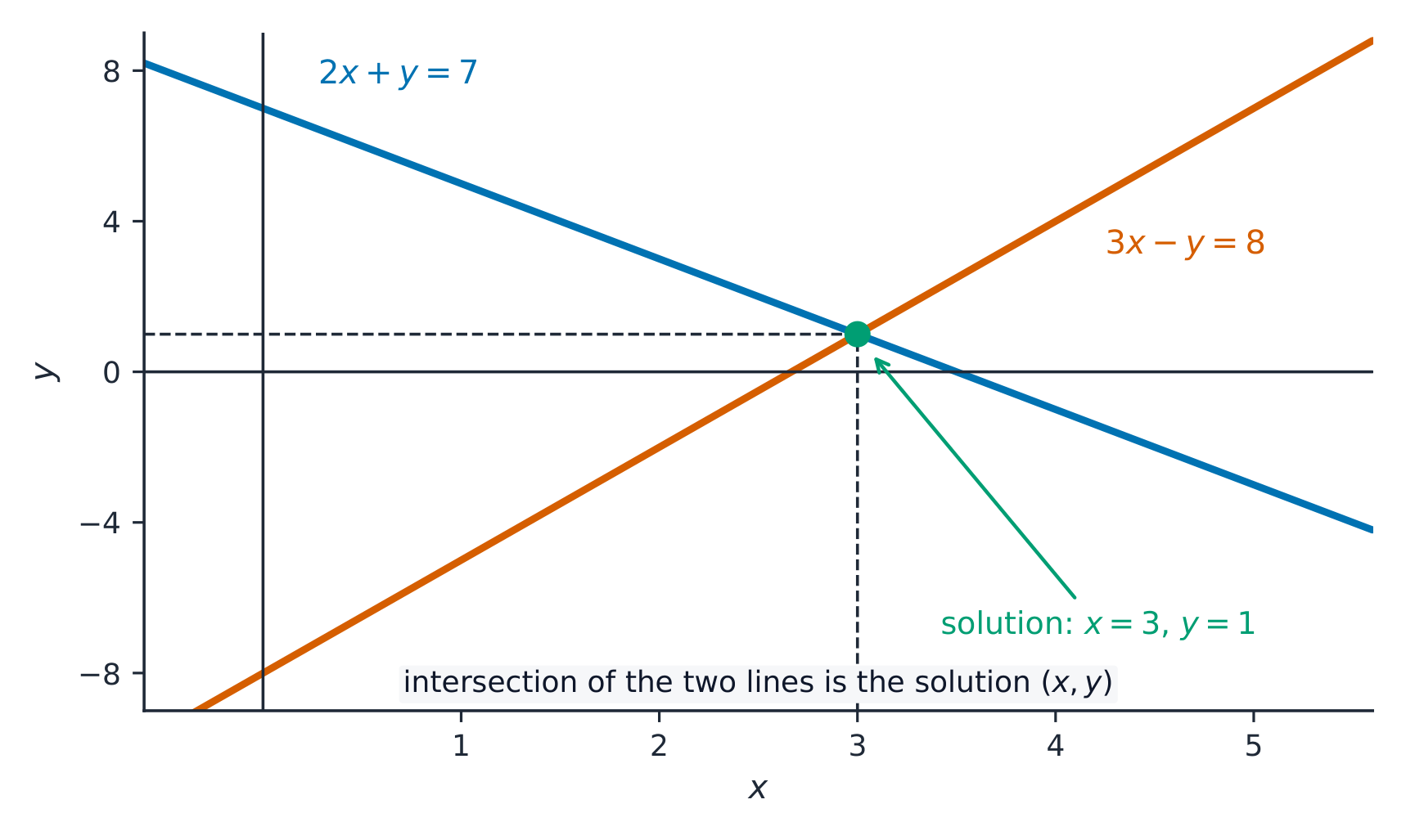
The solution of simultaneous equations is where their graphs cross For one linear and one quadratic equation (Extended), substitute the linear into the curve.
Worked example. Solve $y = x + 2$ and $y = x^{2}$.
$$x^{2} = x + 2 \;\Rightarrow\; x^{2} - x - 2 = 0 \;\Rightarrow\; (x - 2)(x + 1) = 0,$$so $x = 2$ (giving $y = 4$) or $x = -1$ (giving $y = 1$).
Solving quadratic equations (Extended)
There are three methods.
- By factorising: $x^{2} + 5x + 6 = 0 \Rightarrow (x + 2)(x + 3) = 0 \Rightarrow x = -2$ or $x = -3$.
- By completing the square: $x^{2} + 6x + 1 = 0 \Rightarrow (x + 3)^{2} = 8 \Rightarrow x + 3 = \pm 2\sqrt{2} \Rightarrow x = -3 \pm 2\sqrt{2}$.
- By the quadratic formula 求根公式, which is given in the exam:
$$x = \frac{-b \pm \sqrt{b^{2} - 4ac}}{2a}.$$
Worked example (formula). Solve $2x^{2} + 3x - 1 = 0$. Here $a = 2$, $b = 3$, $c = -1$:
$$x = \frac{-3 \pm \sqrt{9 + 8}}{4} = \frac{-3 \pm \sqrt{17}}{4}.$$Changing the subject
To change the subject 公式变形 of a formula means to rearrange it so a chosen letter is alone on one side.
Worked example. Make $r$ the subject of $A = \pi r^{2}$ (Extended, because of the power).
$$r^{2} = \frac{A}{\pi} \;\Rightarrow\; r = \sqrt{\frac{A}{\pi}}.$$When the letter appears twice (Extended), collect those terms and factorise. To make $x$ the subject of $y = \dfrac{x + 1}{x - 1}$:
$$y(x - 1) = x + 1 \;\Rightarrow\; yx - x = 1 + y \;\Rightarrow\; x(y - 1) = 1 + y \;\Rightarrow\; x = \frac{1 + y}{y - 1}.$$Explore · JelajahiSolving an equation · Menyelesaikan persamaan
y = ax² + bx + c
Solving means finding the roots — where the curve crosses the x-axis. · Menyelesaikan berarti menemukan akar — di mana kurva memotong sumbu x.
Vocabulary · Kosa kata Train · LatihEnglish Bahasa Indonesia equation/ɪˈkweɪʒn/ persamaan linear/ˈlɪnɪə/ linear unknown/ʌnˈnəʊn/ tidak diketahui fractional equation/ˈfrækʃənl ɪˈkweɪʒn/ persamaan pecahan simultaneous equations/ˌsɪməlˈteɪnɪəs ɪˈkweɪʒnz/ persamaan linear simultan quadratic formula/kwɒˈdrætɪk ˈfɔːmjʊlə/ rumus kuadrat change the subject/tʃeɪndʒ ðə ˈsʌbdʒekt/ memindahkan subjek 2.6
Inequalities

Syllabus · Silabus
EnglishSubject content Notes and examples Represent and interpret inequalities, including on a number line. When representing and interpreting inequalities on a number line: • open circles should be used to represent strict inequalities (<, >) • closed circles should be used to represent inclusive inequalities ($\leqslant$, $\geqslant$) e.g. $-3 \leqslant x < 1$ Bahasa IndonesiaKonten mata pelajaran Catatan dan contoh Mewakili dan menafsirkan pertidaksamaan, termasuk pada garis bilangan. Saat mewakili dan menafsirkan pertidaksamaan pada garis bilangan: • lingkaran terbuka harus digunakan untuk mewakili pertidaksamaan ketat (<, >) • lingkaran tertutup harus digunakan untuk mewakili pertidaksamaan inklusif ($\leqslant$, $\geqslant$) mis. $-3 \leqslant x < 1$ EnglishSubject content Notes and examples 1 Represent and interpret inequalities, including on a number line. When representing and interpreting inequalities on a number line: • open circles should be used to represent strict inequalities (<, >) • closed circles should be used to represent inclusive inequalities ($\leqslant$, $\geqslant$). e.g. $-3 \leqslant x < 1$ 2 Construct, solve and interpret linear inequalities. Examples include: • $3x < 2x + 4$ • $-3 \leqslant 3x - 2 < 7$. 3 Represent and interpret linear inequalities in two variables graphically. The following conventions should be used: • broken lines should be used to represent strict inequalities (<, >) • solid lines should be used to represent inclusive inequalities ($\leqslant$, $\geqslant$) • shading should be used to represent unwanted regions (unless otherwise directed in the question). e.g. graphs of $x < 1$ and $y \geqslant 1$ 4 List inequalities that define a given region. Linear programming problems are not included. Bahasa IndonesiaKonten mata pelajaran Catatan dan contoh 1 Representasikan dan interpretasikan pertidaksamaan, termasuk pada garis bilangan. Saat merepresentasikan dan menginterpretasikan pertidaksamaan pada garis bilangan: • lingkaran terbuka harus digunakan untuk merepresentasikan pertidaksamaan ketat (<, >) • lingkaran tertutup harus digunakan untuk merepresentasikan pertidaksamaan inklusif ($\leqslant$, $\geqslant$). mis. $-3 \leqslant x < 1$ 2 Susun, selesaikan dan interpretasikan pertidaksamaan linear. Contoh meliputi: • $3x < 2x + 4$ • $-3 \leqslant 3x - 2 < 7$. 3 Representasikan dan interpretasikan pertidaksamaan linear dalam dua variabel secara grafis. Konvensi berikut harus digunakan: • garis putus-putus harus digunakan untuk merepresentasikan pertidaksamaan ketat (<, >) • garis solid harus digunakan untuk merepresentasikan pertidaksamaan inklusif ($\leqslant$, $\geqslant$) • arsiran harus digunakan untuk merepresentasikan daerah yang tidak diinginkan (kecuali jika diarahkan lain dalam soal). mis. grafik dari $x < 1$ dan $y \geqslant 1$ 4 Daftar pertidaksamaan yang mendefinisikan daerah tertentu. Masalah program linear tidak termasuk. Source: Cambridge International syllabus · Sumber: Silabus Cambridge International
An inequality 不等式 uses $<$, $>$, $\leqslant$ or $\geqslant$. Solve it like an equation, but reverse the sign if you multiply or divide by a negative number.
Worked example. Solve $-3 \leqslant 3x - 2 < 7$.
Add $2$ to all parts, then divide by $3$:
$$-1 \leqslant 3x < 9 \;\Rightarrow\; -\tfrac{1}{3} \leqslant x < 3.$$On a number line 数轴, use an open circle for $<$ or $>$ (value not included) and a closed circle for $\leqslant$ or $\geqslant$ (value included).
$-\tfrac{1}{3} \leqslant x < 3$: a closed circle includes the end value, an open circle excludes it. Regions (Extended)
An inequality in two letters describes a region 区域 of the graph. Draw the boundary line (broken for $<$ or $>$, solid for $\leqslant$ or $\geqslant$) and shade the unwanted side. You may also be asked to list the inequalities that define a given region.
Explore · JelajahiInequalities · Pertidaksamaan
y = ax + b
An inequality asks where the line is above or below a value. · Pertidaksamaan menanyakan di mana garis berada di atas atau di bawah suatu nilai.
Vocabulary · Kosa kata Train · LatihEnglish Bahasa Indonesia inequality/ɪniːˈkwɒlɪti/ ketimpangan number line/ˈnʌmbə laɪn/ garis bilangan region/ˈriːdʒn/ wilayah 2.7
Sequences

Syllabus · Silabus
EnglishSubject content Notes and examples 1 Continue a given number sequence or pattern. e.g. write the next two terms in this sequence: 1, 3, 6, 10, 15, ... , ... 2 Recognise patterns in sequences, including the term-to-term rule, and relationships between different sequences. 3 Find and use the $n$th term of the following sequences: (a) linear (b) simple quadratic (c) simple cubic. e.g. find the $n$th term of 2, 5, 10, 17 Bahasa IndonesiaKonten mata pelajaran Catatan dan contoh 1 Lanjutkan barisan angka atau pola yang diberikan. mis. tuliskan dua suku berikutnya dalam barisan ini: 1, 3, 6, 10, 15, ... , ... 2 Kenali pola dalam barisan, termasuk aturan suku ke-suku, dan hubungan antar barisan berbeda. 3 Temukan dan gunakan suku ke-$n$ dari barisan berikut: (a) linear (b) kuadrat sederhana (c) kubik sederhana. mis. temukan suku ke-$n$ dari 2, 5, 10, 17 EnglishSubject content Notes and examples 1 Continue a given number sequence or pattern. Subscript notation may be used, e.g. $T_n$ is the $n$th term of sequence $T$. 2 Recognise patterns in sequences, including the term-to-term rule, and relationships between different sequences. Includes linear, quadratic, cubic and exponential sequences and simple combinations of these. 3 Find and use the $n$th term of sequences. Bahasa IndonesiaKonten mata pelajaran Catatan dan contoh 1 Lanjutkan barisan angka atau pola yang diberikan. Notasi subscript dapat digunakan, mis. $T_n$ adalah suku ke-$n$ dari barisan $T$. 2 Kenali pola dalam barisan, termasuk aturan suku-ke-suku, dan hubungan antar barisan berbeda. Termasuk barisan linear, kuadrat, kubik dan eksponensial serta kombinasi sederhana dari barisan-barisan tersebut. 3 Temukan dan gunakan suku ke-$n$ dari barisan. Source: Cambridge International syllabus · Sumber: Silabus Cambridge International
Romanesco broccoli: self-similar spirals form a natural number pattern. A sequence 数列 is a list of numbers that follow a rule. The term-to-term rule 递推规则 tells you how to get the next term from the one before.
To find the rule for the term in position $n$ (the $n$th term), look at how the terms change.
Linear sequence (the terms go up by the same amount each time). The difference is the multiple of $n$.
Worked example. Find the $n$th term of $2, 5, 8, 11, \dots$
The terms go up by $3$, so start with $3n$. Since $3 \times 1 = 3$ but the first term is $2$, subtract $1$: the $n$th term is $3n - 1$.
Quadratic sequence (the differences themselves change by the same amount). The second difference equals $2 \times$ the coefficient of $n^{2}$.
Worked example. Find the $n$th term of $2, 5, 10, 17, \dots$
First differences are $3, 5, 7$; the second difference is $2$, so the $n^{2}$ part is $1n^{2}$. Subtracting $n^{2}$ ($1, 4, 9, 16$) from the sequence leaves $1, 1, 1, 1$. So the $n$th term is $n^{2} + 1$.
A cubic 三次 sequence such as $1, 8, 27, 64, \dots$ has $n$th term $n^{3}$. An exponential sequence 指数数列 such as $2, 6, 18, 54, \dots$ multiplies by a fixed number each time; here the $n$th term is $2 \times 3^{\,n-1}$.
Explore · JelajahiNumber sequences · Urutan bilangan
Build an arithmetic (add d) or geometric (times r) sequence term by term. · Bangun suku urutan aritmatika (tambah d) atau geometri (kali r) suku demi suku.
Vocabulary · Kosa kata Train · LatihEnglish Bahasa Indonesia sequence/ˈsiːkwəns/ urutan term-to-term rule/tɜːm tə tɜːm ruːl/ aturan suku ke suku cubic/ˈkjuːbɪk/ kubik exponential sequence/ˌekspəˈnenʃl ˈsiːkwəns/ barisan eksponensial 2.8
Direct and inverse proportion (Extended)
Syllabus · Silabus
EnglishSubject content Notes and examples Express direct and inverse proportion in algebraic terms and use this form of expression to find unknown quantities. Includes linear, square, square root, cube and cube root proportion. Knowledge of proportional symbol ($\propto$) is required. Bahasa IndonesiaKonten mata pelajaran Catatan dan contoh Nyatakan proporsionalitas langsung dan terbalik dalam istilah aljabar dan gunakan bentuk ekspresi ini untuk mencari kuantitas tak diketahui. Termasuk proporsionalitas linear, kuadrat, akar kuadrat, kubik dan akar kubik. Pengetahuan tentang simbol proporsionalitas ($\propto$) diperlukan. Source: Cambridge International syllabus · Sumber: Silabus Cambridge International
Two quantities are in direct proportion 正比例 if one is always a fixed multiple of the other: $y \propto x$ means $y = kx$, where $k$ is a constant 常数. They are in inverse proportion 反比例 if one rises as the other falls: $y \propto \dfrac{1}{x}$ means $y = \dfrac{k}{x}$. The symbol $\propto$ is read "is proportional to". You can also have proportion to a square, square root, cube or cube root.
Worked example. $y$ is in direct proportion to $x$, and $y = 12$ when $x = 3$. Find $y$ when $x = 7$.
First find $k$: $12 = k \times 3$, so $k = 4$ and $y = 4x$. Then $y = 4 \times 7 = 28$.
Explore · JelajahiInverse proportion · Proporsionalitas terbalik
y = a/x
Inverse proportion: as x doubles, y halves — a reciprocal curve with two asymptotes. · Proporsionalitas terbalik: saat x menjadi dua kali lipatnya, y menjadi setengah — kurva resiprokal dengan dua asimtot.
Vocabulary · Kosa kata Train · LatihEnglish Bahasa Indonesia direct proportion/daɪˈrekt prəˈpɔːʃn/ proporsi langsung constant/ˈkɒnstənt/ konstan inverse proportion/ɪnˈvɜːs prəˈpɔːʃn/ proporsi terbalik 2.9
Graphs in practical situations

Syllabus · Silabus
EnglishSubject content Notes and examples 1 Use and interpret graphs in practical situations including travel graphs and conversion graphs. e.g. interpret the gradient of a straight-line graph as a rate of change. 2 Draw graphs from given data. e.g. draw a distance–time graph to represent a journey. Bahasa IndonesiaKonten mata pelajaran Catatan dan contoh 1 Gunakan dan tafsirkan grafik dalam situasi praktis termasuk grafik perjalanan dan grafik konversi. mis. tafsirkan gradien dari grafik garis lurus sebagai tingkat perubahan. 2 Gambar grafik berdasarkan data yang diberikan. mis. gambar grafik jarak–waktu untuk merepresentasikan sebuah perjalanan. EnglishSubject content Notes and examples 1 Use and interpret graphs in practical situations including travel graphs and conversion graphs. Includes estimation and interpretation of the gradient of a tangent at a point. 2 Draw graphs from given data. 3 Apply the idea of rate of change to simple kinematics involving distance–time and speed–time graphs, acceleration and deceleration. 4 Calculate distance travelled as area under a speed–time graph. Areas will involve linear sections of the graph only. Bahasa IndonesiaKonten mata pelajaran Catatan dan contoh 1 Gunakan dan interpretasikan grafik dalam situasi praktis termasuk grafik perjalanan dan grafik konversi. Termasuk estimasi dan interpretasi gradien garis singgung pada suatu titik. 2 Gambar grafik dari data yang diberikan. 3 Terapkan ide laju perubahan pada kinematika sederhana yang melibatkan grafik jarak–waktu dan kecepatan–waktu, percepatan dan perlambatan. 4 Hitung jarak tempuh sebagai area di bawah grafik kecepatan–waktu. Area akan melibatkan bagian linear dari grafik saja. Source: Cambridge International syllabus · Sumber: Silabus Cambridge International
Speed-time graphs: gradient and area The gradient 斜率 (steepness) of a graph shows a rate of change 变化率.
- A travel graph 行程图 (distance–time graph) has gradient equal to speed; a flat part means the object is not moving.
- A conversion graph 换算图 is a straight line used to change between two units (for example, miles and kilometres).
On a distance–time graph the gradient is the speed; a flat section means the object has stopped. Speed–time graphs (Extended)
On a speed–time graph the gradient is the acceleration 加速度 (or deceleration 减速度 if the speed falls), and the area 面积 under the graph is the distance 距离 travelled.
Worked example. A car speeds up from rest to $20\text{ m/s}$ in $8\text{ s}$, then stays at $20\text{ m/s}$ for $12\text{ s}$. Find the acceleration and the total distance.
Acceleration $= \dfrac{20}{8} = 2.5\text{ m/s}^{2}$. The distance is the area: a triangle plus a rectangle,
$$\tfrac{1}{2} \times 8 \times 20 + 12 \times 20 = 80 + 240 = 320\text{ m}.$$
On a speed–time graph the gradient is the acceleration and the area underneath is the distance travelled. Explore · JelajahiReal-life graphs · Graf kehidupan nyata
y = ax + b
A distance–time or cost graph is read from its gradient and its intercept. · Graf jarak–waktu atau biaya dibaca dari gradien dan intersep-nya.
Vocabulary · Kosa kata Train · LatihEnglish Bahasa Indonesia gradient/ˈɡreɪdɪənt/ gradien rate of change/reɪt ɒv tʃeɪndʒ/ laju perubahan travel graph/ˈtrævl ɡræf/ grafik perjalanan conversion graph/kənˈvɜːʃn ɡræf/ graf konversi acceleration/əkˌseləˈreɪʃn/ percepatan deceleration/dɪˌseləˈreɪʃn/ perlambatan area/ˈeərɪə/ luas distance/ˈdɪstəns/ jarak tempuh 2.10
Graphs of functions
Syllabus · Silabus
Subject content Notes and examples 1 Construct tables of values, and draw, recognise and interpret graphs for functions of the following forms: • $ax + b$ • $\pm x^2 + ax + b$ • $\frac{a}{x} \ (x \neq 0)$ where $a$ and $b$ are integer constants. 2 Solve associated equations graphically, including finding and interpreting roots by graphical methods. e.g. find the intersection of a line and a curve. EnglishSubject content Notes and examples 1 Construct tables of values, and draw, recognise and interpret graphs for functions of the following forms: • $a x^n$ (includes sums of no more than three of these) • $a b^x + c$ where $n = -2, -1, -\frac{1}{2}, 0, \frac{1}{2}, 1, 2, 3$; $a$ and $c$ are rational numbers; and $b$ is a positive integer. Examples include: • $y = x^3 + x - 4$ • $y = 2x + \frac{3}{x^2}$ • $y = \frac{1}{4} \times 2^x$. 2 Solve associated equations graphically, including finding and interpreting roots by graphical methods. e.g. finding the intersection of a line and a curve. 3 Draw and interpret graphs representing exponential growth and decay problems. Bahasa IndonesiaKonten mata pelajaran Catatan dan contoh 1 Bina jadual nilai, dan lukis, kenal pasti serta mentafsir graf untuk fungsi bagi bentuk berikut: • $a x^n$ (termasuk hasil tambah tidak lebih daripada tiga daripadanya) • $a b^x + c$ di mana $n = -2, -1, -\frac{1}{2}, 0, \frac{1}{2}, 1, 2, 3$; $a$ dan $c$ adalah nombor rasional; dan $b$ adalah integer positif. Contoh termasuk: • $y = x^3 + x - 4$ • $y = 2x + \frac{3}{x^2}$ • $y = \frac{1}{4} \times 2^x$. 2 Selesaikan persamaan berkaitan secara grafik, termasuk mencari dan mentafsir punca kaedah grafik. Cth. mencari persilangan garis dan lengkung. 3 Lukis dan tafsir graf yang mewakili masalah pertumbuhan dan pengurangan eksponen. Source: Cambridge International syllabus · Sumber: Silabus Cambridge International
To draw a graph, make a table of values 数值表: choose values of $x$, work out $y$, then plot the coordinates 坐标 and join them with a smooth curve.
The points where a graph crosses the $x$-axis (the horizontal axis 坐标轴) are the roots 根 — the solutions of $y = 0$.
You can solve an equation by reading a graph. The intersection point 交点 of a line and a curve gives the solution of the two equations together.
For exponential growth 指数增长 and exponential decay 指数衰减, the graph of $y = a\,b^{x} + c$ rises (or falls) faster and faster and flattens towards a horizontal line.
Explore · JelajahiGraphing a quadratic · Menggambar kuadratik
y = ax² + bx + c
Drag a, b and c and watch the parabola move — its turning point and where it crosses the axes. · Tarik a, b, dan c dan lihat parabola bergerak — titik beloknya dan tempat ia memotong sumbu.
Vocabulary · Kosa kata Train · LatihEnglish Bahasa Indonesia table of values/ˈteɪbl ɒv ˈvæljuːz/ tabel nilai coordinates/kəʊˈɔːdɪnəts/ koordinat axis/ˈæksɪs/ sumbu roots/ruːts/ roots intersection point/ˌɪntəˈsekʃn pɔɪnt/ titik potong exponential growth/ˌekspəˈnenʃl ɡrəʊθ/ pertumbuhan eksponensial exponential decay/ˌekspəˈnenʃl dɪˈkeɪ/ peluruhan eksponensial 2.11
Sketching curves

Syllabus · Silabus
EnglishSubject content Notes and examples Recognise, sketch and interpret graphs of the following functions: (a) linear (b) quadratic. Knowledge of symmetry and roots is required. Knowledge of turning points is not required. Bahasa IndonesiaKonten mata pelajaran Catatan dan contoh Mengenal, menggambar sketsa, dan menafsirkan grafik dari fungsi-fungsi berikut: (a) linear (b) kuadrat. Pengetahuan tentang simetri dan akar diperlukan. Pengetahuan tentang titik belok tidak diperlukan. EnglishSubject content Notes and examples Recognise, sketch and interpret graphs of the following functions: (a) linear (b) quadratic (c) cubic (d) reciprocal (e) exponential. Functions will be equivalent to: • $ax + by = c$ • $y = ax^2 + bx + c$ • $y = ax^3 + b$ • $y = ax^3 + bx^2 + cx$ • $y = \frac{a}{x} + b$ • $y = ar^x + b$ where $a$, $b$ and $c$ are rational numbers and $r$ is a rational, positive number. Knowledge of turning points, roots and symmetry is required. Knowledge of vertical and horizontal asymptotes is required. Finding turning points of quadratics by completing the square is required. Bahasa IndonesiaKonten mata pelajaran Catatan dan contoh Kenal pasti, lukis dan tafsir graf bagi fungsi berikut: (a) linear (b) kuadratik (c) kubik (d) resiprokal (e) eksponen. Fungsi akan setara dengan: • $ax + by = c$ • $y = ax^2 + bx + c$ • $y = ax^3 + b$ • $y = ax^3 + bx^2 + cx$ • $y = \frac{a}{x} + b$ • $y = ar^x + b$ di mana $a$, $b$ dan $c$ adalah nombor rasional dan $r$ adalah nombor rasional positif. Pengetahuan tentang titik belok, punca dan simetri diperlukan. Pengetahuan tentang asimtot menegak dan mendatar diperlukan. Mencari titik belok kuadratik dengan melengkapkan kuasa dua diperlukan. Source: Cambridge International syllabus · Sumber: Silabus Cambridge International
A quick sketch should show the right shape and the key features: where it crosses the axes, any symmetry 对称, and any line the curve gets close to.
Function Shape linear, $y = mx + c$ straight line; gradient $m$, $y$-intercept 截距 $c$ quadratic, $y = ax^{2} + bx + c$ a parabola 抛物线 (U-shape if $a>0$, $\cap$-shape if $a<0$) cubic, $y = ax^{3} + bx + c$ an S-shaped curve reciprocal, $y = \dfrac{a}{x} + b$ two separate curves exponential, $y = a\,r^{x} + b$ fast growth or decay The basic graph shapes; knowing each shape lets you sketch quickly from the equation. For a parabola, completing the square gives the turning point 转折点 (the lowest or highest point). For example $y = (x + 3)^{2} - 8$ has its turning point at $(-3, -8)$.

Completing the square, $y=(x+3)^2-8$, shows the turning point $(-3,-8)$ and the line of symmetry $x=-3$. An asymptote 渐近线 is a line that the curve gets closer and closer to but never touches — for example, the $x$-axis for $y = \dfrac{a}{x}$, or the line $y = b$ for $y = a\,r^{x} + b$.
Vocabulary · Kosa kata Train · LatihEnglish Bahasa Indonesia symmetry/ˈsɪmətri/ simetri intercept/ˌɪntəˈsept/ intersep parabola/pəˈræbələ/ parabola turning point/ˈtɜːnɪŋ pɔɪnt/ titik balik asymptote/ˈæsɪmptəʊt/ asimtot 2.12
Differentiation (Extended)

Syllabus · Silabus
EnglishSubject content Notes and examples 1 Estimate gradients of curves by drawing tangents. 2 Use the derivatives of functions of the form $ax^n$, where $a$ is a rational constant and $n$ is a positive integer or zero, and simple sums of not more than three of these. $\frac{\mathrm{d}y}{\mathrm{d}x}$ notation will be expected. 3 Apply differentiation to gradients and stationary points (turning points). 4 Discriminate between maxima and minima by any method. Maximum and minimum points may be identified by: • an accurate sketch • use of the second differential • inspecting the gradient either side of a turning point. Candidates are not expected to identify points of inflection. Bahasa IndonesiaKonten mata pelajaran Catatan dan contoh 1 Taksir kecerunan lengkung dengan melukis tangen. 2 Gunakan pembezaan fungsi bagi bentuk $ax^n$, di mana $a$ adalah pemalar rasional dan $n$ adalah integer positif atau sifar, dan hasil tambah mudah tidak lebih daripada tiga daripadanya. Notasi $\frac{\mathrm{d}y}{\mathrm{d}x}$ akan dijangka. 3 Terapkan pembezaan kepada kecerunan dan titik stasioner (titik belok). 4 Bezakan antara maksimum dan minimum dengan sebarang kaedah. Titik maksimum dan minimum boleh dikenal pasti melalui: • lukisan yang tepat • penggunaan pembezaan kedua • menyemak kecerunan di sebelah titik belok. Calon tidak dijangka mengenal pasti titik pintasan. Source: Cambridge International syllabus · Sumber: Silabus Cambridge International
Differentiation 微分 finds the gradient of a curve at any point. You can estimate it by drawing a tangent 切线 (a line that just touches the curve) and measuring its gradient.
The gradient of a curve at a point equals the gradient of the tangent there — what differentiation finds. The exact rule: if $y = ax^{n}$, then the derivative 导数 is
$$\frac{\mathrm{d}y}{\mathrm{d}x} = a\,n\,x^{\,n-1}.$$Differentiate a sum term by term.
Worked example. If $y = x^{3} + 2x^{2} - 5x$, then $\dfrac{\mathrm{d}y}{\mathrm{d}x} = 3x^{2} + 4x - 5$.
A stationary point 驻点 (turning point) is where the gradient is zero, so set $\dfrac{\mathrm{d}y}{\mathrm{d}x} = 0$.
Worked example. Find the turning point of $y = x^{2} - 6x + 5$.
$$\frac{\mathrm{d}y}{\mathrm{d}x} = 2x - 6 = 0 \;\Rightarrow\; x = 3, \quad y = 3^{2} - 6(3) + 5 = -4.$$The turning point is $(3, -4)$. To decide whether a turning point is a maximum 最大值 or a minimum 最小值, check the sign of the gradient on each side, or use the second derivative (positive means a minimum).
Explore · JelajahiGradient of a curve · Gradien kurva
y = ax³ + bx² + cx + d
Move the point: the tangent shows the gradient there, which is what differentiation finds. · Gerakkan titik: garis singgung menunjukkan gradien di sana, yang merupakan hasil diferensiasi.
Vocabulary · Kosa kata Train · LatihEnglish Bahasa Indonesia differentiation/ˌdɪfəˌrenʃɪˈeɪʃn/ turunan tangent/ˈtændʒənt/ tangens derivative/dɪˈrɪvətɪv/ turunan stationary point/ˈsteɪʃənəri pɔɪnt/ titik stasioner maximum/ˈmæksɪməm/ maksimum minimum/ˈmɪnɪməm/ minimum 2.13
Functions (Extended)

Syllabus · Silabus
EnglishSubject content Notes and examples 1 Understand functions, domain and range and use function notation. Examples include: • $f(x) = 3x - 5$ • $g(x) = \frac{3(x + 4)}{5}$ • $h(x) = 2x^2 + 3$. 2 Understand and find inverse functions $f^{-1}(x)$. 3 Form composite functions as defined by $gf(x) = g(f(x))$. e.g. $f(x) = \frac{3}{x + 2}$ and $g(x) = (3x + 5)^2$. Find $fg(x)$. Give your answer as a fraction in its simplest form. Candidates are not expected to find the domains and ranges of composite functions. This topic may include mapping diagrams. Bahasa IndonesiaKonten mata pelajaran Catatan dan contoh 1 Pahami fungsi, domain dan range serta gunakan notasi fungsi. Contoh meliputi: • $f(x) = 3x - 5$ • $g(x) = \frac{3(x + 4)}{5}$ • $h(x) = 2x^2 + 3$. 2 Pahami dan temukan fungsi invers $f^{-1}(x)$. 3 Bentuk fungsi komposit sesuai definisi $gf(x) = g(f(x))$. mis. $f(x) = \frac{3}{x + 2}$ dan $g(x) = (3x + 5)^2$. Temukan $fg(x)$. Berikan jawaban sebagai pecahan dalam bentuk paling sederhana. Calon tidak diharapkan menemukan domain dan range dari fungsi komposit. Topik ini mungkin mencakup diagram pemetaan. Source: Cambridge International syllabus · Sumber: Silabus Cambridge International
A function 函数 turns each input into one output. We write $f(x)$, for example $f(x) = 3x - 5$, so $f(2) = 1$. The set of allowed inputs is the domain 定义域; the set of possible outputs is the range 值域.
The inverse function 反函数 $f^{-1}(x)$ undoes the function. To find it, write $y = f(x)$, swap the roles, and make $x$ the subject.
Worked example. Find the inverse of $f(x) = 3x - 5$.
$$y = 3x - 5 \;\Rightarrow\; x = \frac{y + 5}{3}, \quad \text{so} \quad f^{-1}(x) = \frac{x + 5}{3}.$$A function as a machine; the inverse runs it backwards - reverse the order, undo each step A composite function 复合函数 applies one function after another: $gf(x)$ means "do $f$ first, then $g$".
Worked example. If $f(x) = 2x$ and $g(x) = x + 3$, then
$$gf(x) = g(2x) = 2x + 3, \qquad fg(x) = f(x + 3) = 2(x + 3) = 2x + 6.$$Explore · JelajahiFunctions · Fungsi
y = f(x)
A function turns each input into exactly one output — watch its shape. · Sebuah fungsi mengubah setiap masukan menjadi tepat satu keluaran — perhatikan bentuknya.
Vocabulary · Kosa kata Train · LatihEnglish Bahasa Indonesia function/ˈfʌŋkʃn/ fungsi domain/dəˈmeɪn/ domain range/reɪndʒ/ jangkauannya inverse function/ɪnˈvɜːs ˈfʌŋkʃn/ fungsi invers composite function/ˈkɒmpəzɪt ˈfʌŋkʃn/ fungsi komposit 2.13
Exam tips
- When you expand brackets, multiply every term and watch the signs, especially with a minus in front: $-(x - 3) = -x + 3$.
- To solve an equation, do the same thing to both sides. When you multiply or divide an inequality by a negative number, flip the sign.
- Factorise fully: take out the highest common factor first, then look for a difference of two squares or a quadratic pattern.
- A quadratic usually has two solutions — give both. Check whether the question wants factorising, the formula, or completing the square.
- When substituting into a formula, put each value in brackets first, so signs and powers come out right.
-
3
Coordinate geometry · Geometri koordinat
Watch lesson · Tonton pelajaranEnglishThis handout covers Topic 3, Coordinate geometry. Parts marked (Extended) are only tested on the Extended papers; everything else is for both levels.
Bahasa IndonesiaLembar kerja ini mencakup Topik 3, Geometri koordinat. Bagian yang ditandai (Diperluas) hanya diujikan pada kertas Extended; semuanya lainnya untuk kedua tingkatan.
3.1
Coordinates · Koordinat

Syllabus · Silabus
EnglishSubject content Notes and examples Use and interpret Cartesian coordinates in two dimensions. Bahasa IndonesiaKonten mata pelajaran Catatan dan contoh Gunakan dan tafsirkan koordinat Kartesius dalam dua dimensi. Source: Cambridge International syllabus · Sumber: Silabus Cambridge International
EnglishA point on a graph is described by its coordinates 坐标, sometimes called Cartesian coordinates, written $(x, y)$. The first number is the across value and the second is the up value.
- The two number lines are the axes 坐标轴: the horizontal 水平 $x$-axis and the vertical 竖直 $y$-axis.
- They cross at the origin 原点, the point $(0, 0)$.
- The axes split the grid into four quadrants 象限.
So the point $(3, -2)$ is found by going $3$ to the right and $2$ down.
Bahasa IndonesiaGrid jalan kota: setiap tempat ditentukan oleh koordinatnya. Sebuah titik pada grafik dijelaskan oleh koordinatnya, kadang-kadang disebut koordinat Kartesius, ditulis $(x, y)$. Angka pertama adalah nilai horizontal dan angka kedua adalah nilai vertikal.
- Dua garis bilangan adalah sumbu: sumbu horizontal $x$ dan sumbu vertikal $y$.
- Mereka berpotongan di asal, yaitu titik $(0, 0)$.
- Sumbu membagi grid menjadi empat kuadran.
Jadi titik $(3, -2)$ ditemukan dengan bergerak $3$ ke kanan dan $2$ ke bawah.
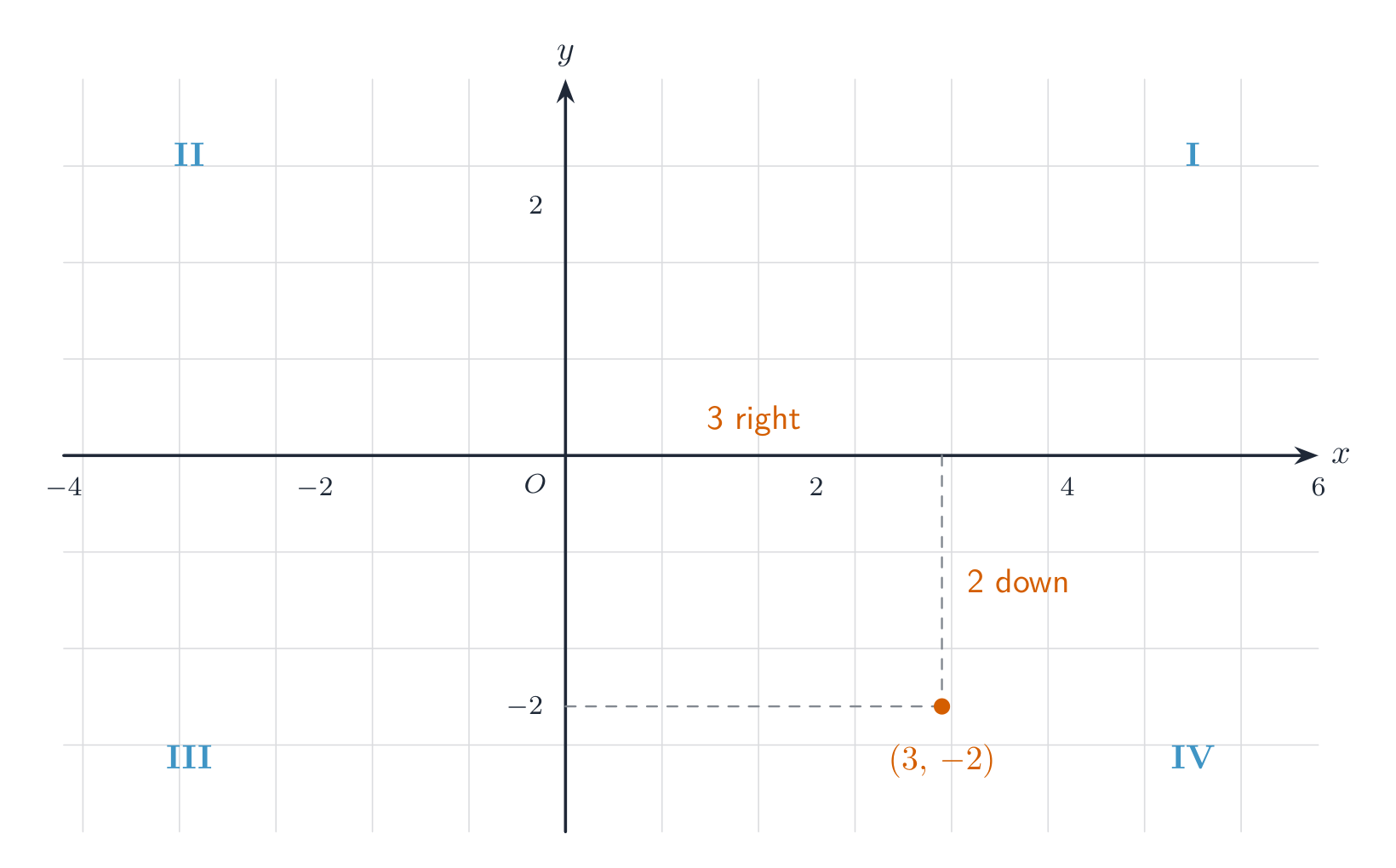
Sumbu bertemu di titik asal $O$ dan membagi bidang menjadi empat kuadran; $(3,-2)$ berarti 3 ke kanan lalu 2 ke bawah. Explore · JelajahiThe coordinate plane · Bidang koordinat
y = mx + c
Every point has an (x, y) coordinate. A straight line is the set of points where y depends on x in a fixed way. · Setiap titik memiliki koordinat (x, y). Garis lurus adalah himpunan titik di mana y bergantung pada x dengan cara tetap.
Vocabulary · Kosa kata Train · LatihEnglish Bahasa Indonesia coordinates/kəʊˈɔːdɪnəts/ koordinat axes/ˈæksɪz/ sumbu horizontal/ˌhɒrɪˈzɒntl/ horizontal vertical/ˈvɜːtɪkl/ vertikal origin/ˈɒrɪdʒɪn/ titik awal quadrants/ˈkwɒdrənts/ kuadran 3.5
The equation of a straight line · Persamaan garis lurus
Syllabus · Silabus
EnglishSubject content Notes and examples Interpret and obtain the equation of a straight-line graph in the form $y = mx + c$. Questions may: • use and request lines in the forms $y = mx + c$, $x = k$ • involve finding the equation when the graph is given • ask for the gradient or $y$-intercept of a graph from an equation, e.g. find the gradient and $y$-intercept of the graph with the equation $y = 6x + 3$. Candidates are expected to give equations of a line in a fully simplified form. Bahasa IndonesiaKonten mata pelajaran Catatan dan contoh Interpretasikan dan peroleh persamaan grafik garis lurus dalam bentuk $y = mx + c$. Pertanyaan mungkin: • menggunakan dan meminta garis dalam bentuk $y = mx + c$, $x = k$ • melibatkan penemuan persamaan ketika grafik diberikan • meminta gradien atau $y$-intercept dari grafik berdasarkan persamaan, mis. temukan gradien dan $y$-intercept dari grafik dengan persamaan $y = 6x + 3$. Kandidat diharapkan memberikan persamaan garis dalam bentuk yang disederhanakan sepenuhnya. EnglishSubject content Notes and examples Interpret and obtain the equation of a straight-line graph. Questions may: • use and request lines in different forms, e.g. $ax + by = c$, $y = mx + c$, $x = k$ • involve finding the equation when the graph is given • ask for the gradient or $y$-intercept of a graph from an equation, e.g. find the gradient and $y$-intercept of the graph with equation $5x + 4y = 8$. Candidates are expected to give equations of a line in a fully simplified form. Bahasa IndonesiaKonten mata pelajaran Catatan dan contoh Interpretasikan dan peroleh persamaan grafik garis lurus. Soal mungkin: • menggunakan dan meminta garis dalam berbagai bentuk, mis. $ax + by = c$, $y = mx + c$, $x = k$ • melibatkan penemuan persamaan ketika grafik diberikan • meminta gradien atau $y$-intercept dari grafik berdasarkan persamaan, mis. temukan gradien dan $y$-intercept dari grafik dengan persamaan $5x + 4y = 8$. Calon diharapkan memberikan persamaan garis dalam bentuk yang disederhanakan sepenuhnya. Source: Cambridge International syllabus · Sumber: Silabus Cambridge International
EnglishMost straight lines can be written as
$$y = mx + c,$$where $m$ is the gradient 斜率 (steepness) and $c$ is the intercept 截距 — the $y$-value where the line crosses the $y$-axis.
- A line like $x = k$ (for example $x = 3$) is vertical.
- A line like $y = k$ (for example $y = 3$) is horizontal.
A line may also be given as $ax + by = c$. Rearrange it into $y = mx + c$ to read off the gradient and intercept.
Worked example. Find the gradient and $y$-intercept of $5x + 4y = 8$.
$$4y = -5x + 8 \;\Rightarrow\; y = -\tfrac{5}{4}x + 2.$$So the gradient is $-\tfrac{5}{4}$ and the $y$-intercept is $2$.
Bahasa IndonesiaSebagian besar garis lurus dapat ditulis sebagai
$$y = mx + c,$$di mana $m$ adalah gradien (kemiringan) dan $c$ adalah intersep — nilai $y$ di mana garis memotong sumbu $y$.
- Garis seperti $x = k$ (contohnya $x = 3$) adalah vertikal.
- Garis seperti $y = k$ (contohnya $y = 3$) adalah horizontal.
Garis juga dapat diberikan dalam bentuk $ax + by = c$. Susun ulang menjadi $y = mx + c$ untuk membaca gradien dan intersep.
Contoh terpecahkan. Temukan gradien dan intersep $y$ dari $5x + 4y = 8$.
$$4y = -5x + 8 \;\Rightarrow\; y = -\tfrac{5}{4}x + 2.$$Jadi gradiennya adalah $-\tfrac{5}{4}$ dan intersep $y$ adalah $2$.
Explore · Jelajahiy = mx + c
y = ax + b
Drag the gradient and the intercept. a is the gradient (steepness) and b is where the line crosses the y-axis. · Tarik gradien dan intersep. a adalah gradien (kemiringan) dan b adalah tempat garis memotong sumbu y.
3.3
Gradient · Gradien

Syllabus · Silabus
EnglishSubject content Notes and examples Find the gradient of a straight line. From a grid only. Bahasa IndonesiaKonten mata pelajaran Catatan dan contoh Temukan gradien garis lurus. Hanya dari grid. EnglishSubject content Notes and examples 1 Find the gradient of a straight line. 2 Calculate the gradient of a straight line from the coordinates of two points on it. Bahasa IndonesiaKonten mata pelajaran Catatan dan contoh 1 Temukan gradien garis lurus. 2 Hitung gradien garis lurus dari koordinat dua titik di atasnya. Source: Cambridge International syllabus · Sumber: Silabus Cambridge International
Englishy = mx + c: gradient and intercept, live The gradient measures how steep a line is:
$$m = \frac{\text{change in } y}{\text{change in } x} = \frac{\text{rise}}{\text{run}}.$$A positive gradient goes up to the right; a negative gradient goes down to the right.
Worked example. Find the gradient of the line through $(1, 2)$ and $(4, 11)$.
$$m = \frac{11 - 2}{4 - 1} = \frac{9}{3} = 3.$$Bahasa Indonesiay = mx + c: gradien dan intersep, langsung Jalan pegunungan yang curam: gradien mengukur kemiringan sebagai kenaikan dibagi jarak horizontal. Gradien mengukur seberapa curam sebuah garis:
$$m = \frac{\text{change in } y}{\text{change in } x} = \frac{\text{rise}}{\text{run}}.$$Gradien positif naik ke kanan; gradien negatif turun ke kanan.
Contoh terpecahkan. Temukan gradien garis melalui $(1, 2)$ dan $(4, 11)$.
$$m = \frac{11 - 2}{4 - 1} = \frac{9}{3} = 3.$$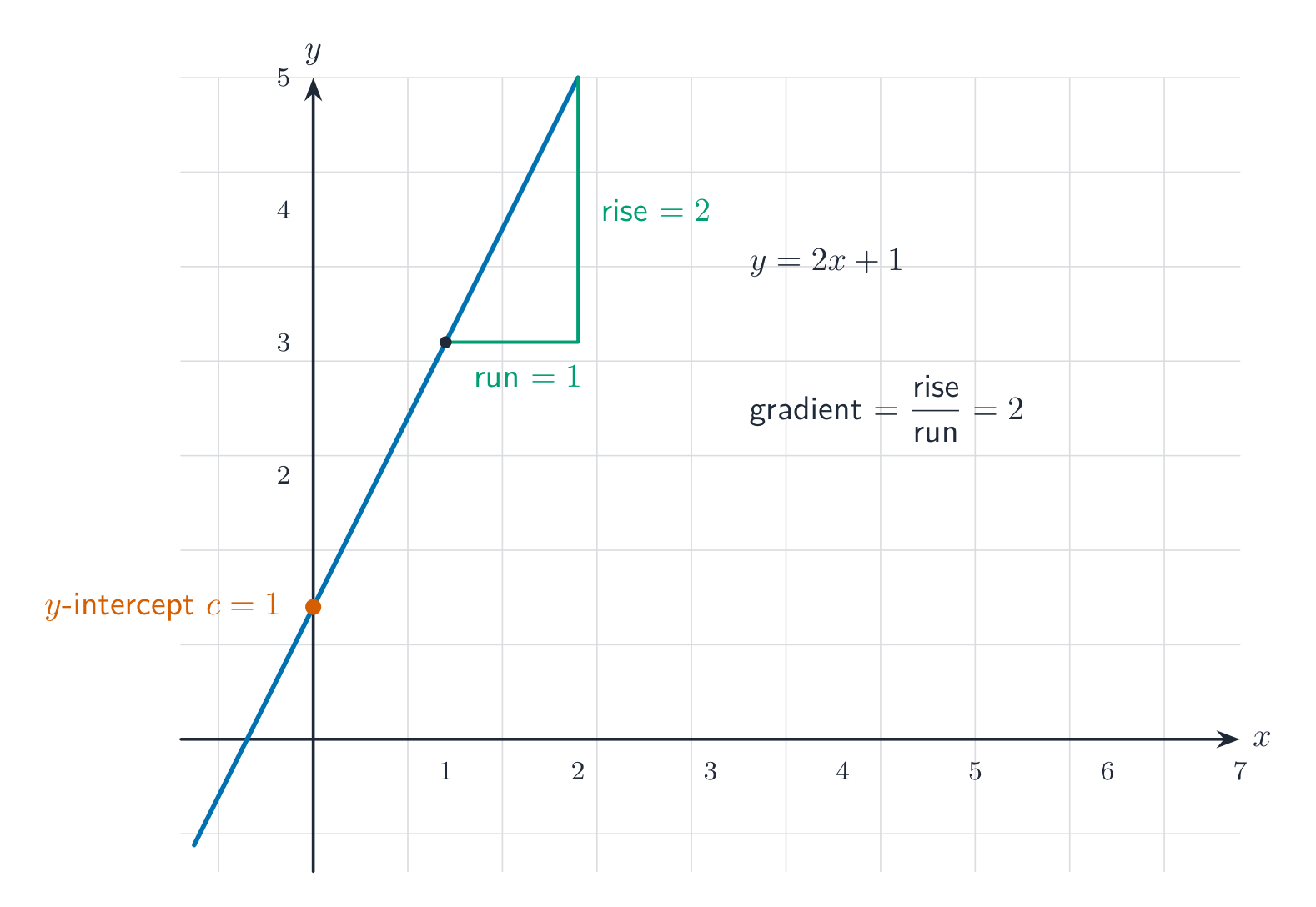
Untuk $y=mx+c$, garis memotong sumbu $y$ di $c$ dan gradien $m$ adalah kenaikan dibagi jarak horizontal. Explore · JelajahiGradient · Gradien
y = ax + b
The gradient a measures steepness — rise over run. · Gradien a mengukur kemiringan — kenaikan dibagi jarak mendatar.
Vocabulary · Kosa kata Train · LatihEnglish Bahasa Indonesia gradient/ˈɡreɪdɪənt/ gradien intercept/ˌɪntəˈsept/ intersep table of values/ˈteɪbl ɒv ˈvæljuːz/ tabel nilai line segment/laɪn ˈseɡmənt/ segsis garis 3.2
Drawing a straight-line graph · Menggambar grafik garis lurus

Syllabus · Silabus
EnglishSubject content Notes and examples Draw straight-line graphs for linear equations. Equations will be given in the form $y = mx + c$ (e.g. $y = -2x + 5$), unless a table of values is given. Bahasa IndonesiaKonten mata pelajaran Catatan dan contoh Gambar grafik garis lurus untuk persamaan linear. Persamaan akan diberikan dalam bentuk $y = mx + c$ (mis. $y = -2x + 5$), kecuali tabel nilai diberikan. Subject content Notes and examples Draw straight-line graphs for linear equations. Examples include: • $y = -2x + 5$ • $y = 7 - 4x$ • $3x + 2y = 5$. Source: Cambridge International syllabus · Sumber: Silabus Cambridge International
EnglishTo draw $y = mx + c$, the quickest way is:
- Mark the intercept $c$ on the $y$-axis.
- Use the gradient to step to more points (for $m = 3$, go $1$ right and $3$ up).
- Join the points with a straight line.
You can also make a small table of values 数值表: choose two or three $x$-values, work out $y$, and plot the points.
Bahasa IndonesiaUntuk menggambar $y = mx + c$, cara tercepat adalah:
- Tandai intersep $c$ pada sumbu $y$.
- Gunakan gradien untuk melangkah ke titik lain (untuk $m = 3$, pergi $1$ ke kanan dan $3$ ke atas).
- Hubungkan titik-titik dengan garis lurus.
Anda juga dapat membuat tabel nilai kecil: pilih dua atau tiga nilai $x$, hitung $y$, dan gambar titik-titiknya.
Menggambar garis cepat: tandai intersep, lalu gunakan gradien untuk melangkah ke titik baru 3.5
Finding the equation of a line · Menemukan persamaan garis
Syllabus · Silabus
EnglishSubject content Notes and examples Interpret and obtain the equation of a straight-line graph in the form $y = mx + c$. Questions may: • use and request lines in the forms $y = mx + c$, $x = k$ • involve finding the equation when the graph is given • ask for the gradient or $y$-intercept of a graph from an equation, e.g. find the gradient and $y$-intercept of the graph with the equation $y = 6x + 3$. Candidates are expected to give equations of a line in a fully simplified form. Bahasa IndonesiaKonten mata pelajaran Catatan dan contoh Interpretasikan dan peroleh persamaan grafik garis lurus dalam bentuk $y = mx + c$. Pertanyaan mungkin: • menggunakan dan meminta garis dalam bentuk $y = mx + c$, $x = k$ • melibatkan penemuan persamaan ketika grafik diberikan • meminta gradien atau $y$-intercept dari grafik berdasarkan persamaan, mis. temukan gradien dan $y$-intercept dari grafik dengan persamaan $y = 6x + 3$. Kandidat diharapkan memberikan persamaan garis dalam bentuk yang disederhanakan sepenuhnya. EnglishSubject content Notes and examples Interpret and obtain the equation of a straight-line graph. Questions may: • use and request lines in different forms, e.g. $ax + by = c$, $y = mx + c$, $x = k$ • involve finding the equation when the graph is given • ask for the gradient or $y$-intercept of a graph from an equation, e.g. find the gradient and $y$-intercept of the graph with equation $5x + 4y = 8$. Candidates are expected to give equations of a line in a fully simplified form. Bahasa IndonesiaKonten mata pelajaran Catatan dan contoh Interpretasikan dan peroleh persamaan grafik garis lurus. Soal mungkin: • menggunakan dan meminta garis dalam berbagai bentuk, mis. $ax + by = c$, $y = mx + c$, $x = k$ • melibatkan penemuan persamaan ketika grafik diberikan • meminta gradien atau $y$-intercept dari grafik berdasarkan persamaan, mis. temukan gradien dan $y$-intercept dari grafik dengan persamaan $5x + 4y = 8$. Calon diharapkan memberikan persamaan garis dalam bentuk yang disederhanakan sepenuhnya. Source: Cambridge International syllabus · Sumber: Silabus Cambridge International
EnglishIf you know the gradient $m$ and one point on the line, put the point into $y = mx + c$ to find $c$.
Worked example. A line has gradient $3$ and passes through $(1, 2)$. Find its equation.
$$y = 3x + c, \qquad 2 = 3(1) + c, \qquad c = -1.$$So the equation is $y = 3x - 1$. (If you are given two points, first find the gradient, then do this.)
Bahasa IndonesiaJika Anda mengetahui gradien $m$ dan satu titik pada garis, masukkan titik tersebut ke $y = mx + c$ untuk menemukan $c$.
Contoh terpecahkan. Sebuah garis memiliki gradien $3$ dan melewati $(1, 2)$. Temukan persamaannya.
$$y = 3x + c, \qquad 2 = 3(1) + c, \qquad c = -1.$$Jadi persamaannya adalah $y = 3x - 1$. (Jika Anda diberikan dua titik, cari gradien terlebih dahulu, lalu lakukan ini.)
3.4
Length and midpoint (Extended) · Panjang dan titik tengah (Lanjutan)

Syllabus · Silabus
EnglishSubject content Notes and examples 1 Calculate the length of a line segment. 2 Find the coordinates of the midpoint of a line segment. Bahasa IndonesiaKonten mata pelajaran Catatan dan contoh 1 Hitung panjang segmen garis. 2 Temukan koordinat titik tengah dari segmen garis. Source: Cambridge International syllabus · Sumber: Silabus Cambridge International
EnglishA line segment 线段 is the straight piece between two points.
To find the length 长度 of the segment between $(x_1, y_1)$ and $(x_2, y_2)$, use Pythagoras' theorem 勾股定理 on the horizontal and vertical gaps:
$$\text{length} = \sqrt{(x_2 - x_1)^2 + (y_2 - y_1)^2}.$$To find the midpoint 中点 (the point exactly in the middle), average the coordinates:
$$\text{midpoint} = \left( \frac{x_1 + x_2}{2}, \; \frac{y_1 + y_2}{2} \right).$$Worked example. Find the length and midpoint of the segment from $(1, 2)$ to $(4, 6)$.
$$\text{length} = \sqrt{(4 - 1)^2 + (6 - 2)^2} = \sqrt{9 + 16} = \sqrt{25} = 5.$$$$\text{midpoint} = \left( \frac{1 + 4}{2}, \; \frac{2 + 6}{2} \right) = (2.5, \, 4).$$Bahasa IndonesiaSegmen garis adalah bagian lurus antara dua titik.
Untuk mencari panjang segmen antara $(x_1, y_1)$ dan $(x_2, y_2)$, gunakan teorema Pythagoras pada selisih horizontal dan vertikal:
$$\text{length} = \sqrt{(x_2 - x_1)^2 + (y_2 - y_1)^2}.$$Untuk mencari titik tengah (titik tepat di tengah), rata-ratakan koordinatnya:
$$\text{midpoint} = \left( \frac{x_1 + x_2}{2}, \; \frac{y_1 + y_2}{2} \right).$$Contoh terpecahkan. Temukan panjang dan titik tengah segmen dari $(1, 2)$ ke $(4, 6)$.
$$\text{length} = \sqrt{(4 - 1)^2 + (6 - 2)^2} = \sqrt{9 + 16} = \sqrt{25} = 5.$$$$\text{midpoint} = \left( \frac{1 + 4}{2}, \; \frac{2 + 6}{2} \right) = (2.5, \, 4).$$Selisih horizontal (3) dan selisih vertikal (4) membentuk segitiga siku-siku, sehingga panjangnya adalah $\sqrt{3^2+4^2}=5$; titik tengah adalah rata-rata koordinat. Explore · JelajahiLength and midpoint lab · Lab panjang dan titik tengah
midpoint is halfway between endpoints · titik tengah berada di tengah antara titik ujung
Move along a line segment and see midpoint as halfway. · Gerakkan sepanjang segmen garis dan lihat titik tengah sebagai setengahnya.
Vocabulary · Kosa kata Train · LatihEnglish Bahasa Indonesia length/leŋθ/ panjang Pythagoras' theorem/paɪˈθæɡərəs ˈθɪərəm/ Teorema Pythagoras midpoint/ˈmɪdpɔɪnt/ titik tengah 3.6
Parallel lines · Garis sejajar

Syllabus · Silabus
EnglishSubject content Notes and examples Find the gradient and equation of a straight line parallel to a given line. e.g. find the equation of the line parallel to $y = 4x - 1$ that passes through $(1, -3)$. Bahasa IndonesiaKonten mata pelajaran Catatan dan contoh Temukan gradien dan persamaan garis lurus yang sejajar dengan garis yang diberikan. mis. temukan persamaan garis yang sejajar dengan $y = 4x - 1$ yang melalui $(1, -3)$. Source: Cambridge International syllabus · Sumber: Silabus Cambridge International
EnglishParallel 平行 lines never meet, so they have the same gradient.
Worked example. Find the equation of the line parallel to $y = 4x - 1$ that passes through $(1, -3)$.
The gradient is also $4$. Put the point in:
$$-3 = 4(1) + c \;\Rightarrow\; c = -7,$$so the line is $y = 4x - 7$.
Bahasa IndonesiaGaris sejajar tidak pernah bertemu, sehingga mereka memiliki gradien yang sama.
Contoh terpecahkan. Temukan persamaan garis sejajar dengan $y = 4x - 1$ yang melewati $(1, -3)$.
Gradiennya juga $4$. Masukkan titiknya:
$$-3 = 4(1) + c \;\Rightarrow\; c = -7,$$sehingga garisnya adalah $y = 4x - 7$.
Garis sejajar: gradien sama, intersep berbeda Explore · JelajahiParallel & perpendicular · Sejajar & tegak lurus
y = ax + b
Parallel lines share a gradient; perpendicular gradients multiply to −1. · Sejajar garis berbagi gradien; tegak lurus gradien dikalikan menghasilkan −1.
Vocabulary · Kosa kata Train · LatihEnglish Bahasa Indonesia parallel/ˈpærəlel/ paralel 3.7
Perpendicular lines (Extended) · Garis tegak lurus (Lanjutan)
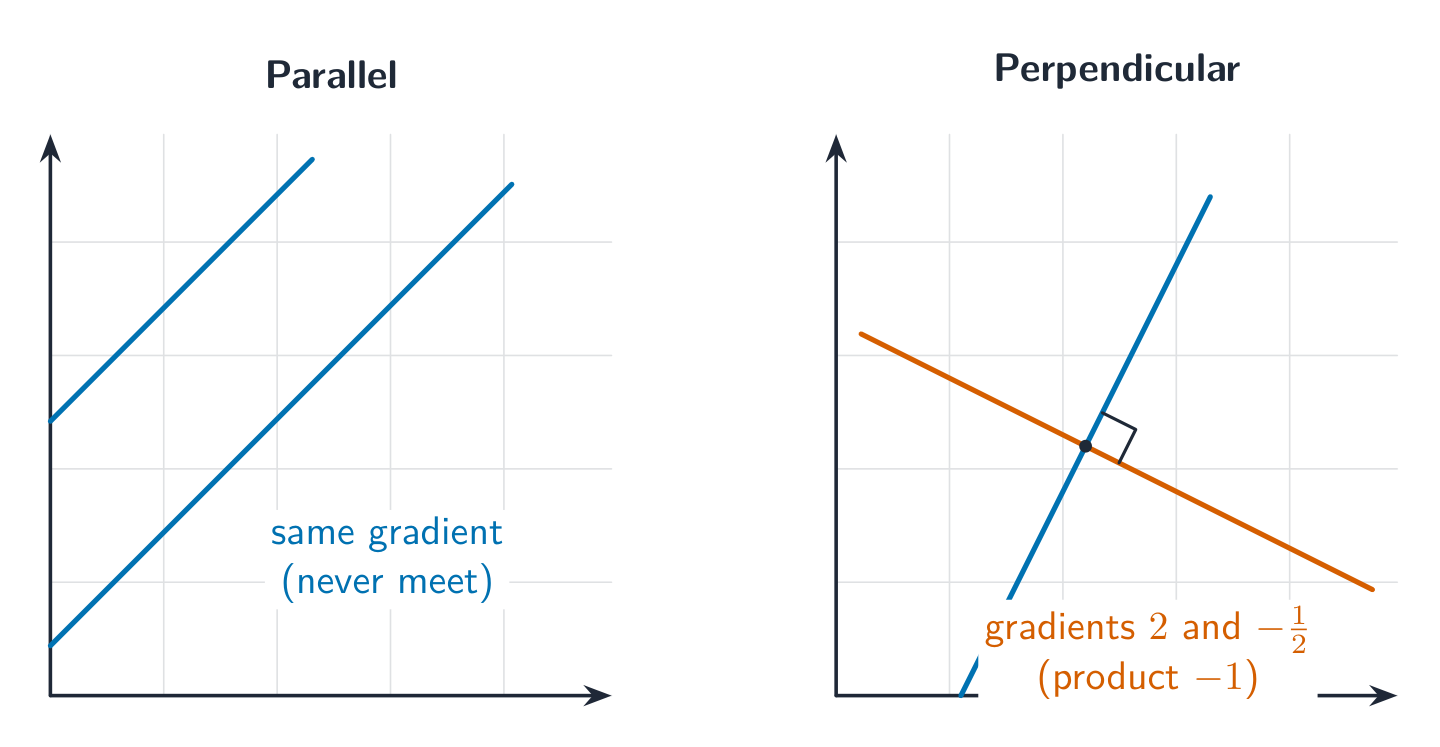
Syllabus · Silabus
EnglishSubject content Notes and examples Find the gradient and equation of a straight line perpendicular to a given line. Examples include: • find the gradient of a line perpendicular to $2y = 3x + 1$ • find the equation of the perpendicular bisector of the line joining the points $(-3, 8)$ and $(9, -2)$. Bahasa IndonesiaKonten mata pelajaran Catatan dan contoh Temukan gradien dan persamaan garis lurus yang tegak lurus terhadap garis yang diberikan. Contoh meliputi: • temukan gradien garis yang tegak lurus terhadap $2y = 3x + 1$ • temukan persamaan garis bagi tegak lurus dari garis yang menghubungkan titik $(-3, 8)$ dan $(9, -2)$. Source: Cambridge International syllabus · Sumber: Silabus Cambridge International
EnglishTwo lines are perpendicular 垂直 if they meet at a right angle 直角. Their gradients multiply to $-1$:
$$m_1 \times m_2 = -1, \qquad \text{so} \qquad m_2 = -\frac{1}{m_1}.$$In words: flip the fraction and change the sign.
Worked example. Find the gradient of a line perpendicular to $2y = 3x + 1$.
Rearrange: $y = \tfrac{3}{2}x + \tfrac{1}{2}$, so the gradient is $\tfrac{3}{2}$. The perpendicular gradient is $-\tfrac{2}{3}$.
Perpendicular bisector
The perpendicular bisector 垂直平分线 of a segment cuts it in half at a right angle. To find its equation: get the midpoint, then use the perpendicular gradient through that midpoint.
Worked example. Find the perpendicular bisector of the segment joining $(-3, 8)$ and $(9, -2)$.
- Midpoint: $\left( \frac{-3 + 9}{2}, \frac{8 + (-2)}{2} \right) = (3, 3)$.
- Gradient of the segment: $\frac{-2 - 8}{9 - (-3)} = \frac{-10}{12} = -\tfrac{5}{6}$.
- Perpendicular gradient: $\frac{6}{5}$.
Through $(3, 3)$: $\; 3 = \tfrac{6}{5}(3) + c \Rightarrow c = 3 - \tfrac{18}{5} = -\tfrac{3}{5}$. So the bisector is
$$y = \tfrac{6}{5}x - \tfrac{3}{5}.$$Bahasa IndonesiaDua garis tegak lurus jika mereka bertemu pada sudut siku-siku. Hasil kali gradiennya adalah $-1$:
$$m_1 \times m_2 = -1, \qquad \text{so} \qquad m_2 = -\frac{1}{m_1}.$$Dalam kata-kata: balik pecahan dan ubah tanda.
Contoh terpecahkan. Temukan gradien garis tegak lurus terhadap $2y = 3x + 1$.
Susun ulang: $y = \tfrac{3}{2}x + \tfrac{1}{2}$, jadi gradiennya adalah $\tfrac{3}{2}$. Gradien tegak lurusnya adalah $-\tfrac{2}{3}$.
Garis sejajar berbagi gradien yang sama; gradien tegak lurus hasil kalinya adalah $-1$. Persegi panjang tegak
Persegi panjang tegak dari sebuah segmen memotongnya di tengahnya pada sudut siku-siku. Untuk menemukan persamaannya: dapatkan titik tengah, lalu gunakan gradien tegak lurus melalui titik tengah tersebut.
Contoh terpecahkan. Temukan persegi panjang tegak dari segmen yang menghubungkan $(-3, 8)$ dan $(9, -2)$.
- Titik tengah: $\left( \frac{-3 + 9}{2}, \frac{8 + (-2)}{2} \right) = (3, 3)$.
- Gradien segmen: $\frac{-2 - 8}{9 - (-3)} = \frac{-10}{12} = -\tfrac{5}{6}$.
- Gradien tegak lurus: $\frac{6}{5}$.
Melalui $(3, 3)$: $\; 3 = \tfrac{6}{5}(3) + c \Rightarrow c = 3 - \tfrac{18}{5} = -\tfrac{3}{5}$. Jadi persegi panjang tegaknya adalah
$$y = \tfrac{6}{5}x - \tfrac{3}{5}.$$Vocabulary · Kosa kata Train · LatihEnglish Bahasa Indonesia perpendicular/ˌpɜːpənˈdɪkjʊlə/ tegak lurus right angle/raɪt ˈæŋɡl/ sudut siku-siku perpendicular bisector/ˌpɜːpənˈdɪkjʊlə baɪˈsektə/ garis bagi tegak lurus 3.7
Exam tips · Tips ujian
English- The straight line is $y = mx + c$: $m$ is the gradient and $c$ is where the line crosses the $y$-axis.
- Gradient = (change in $y$) ÷ (change in $x$). Keep the two coordinates in the same order on the top and the bottom.
- Parallel lines have the same gradient; perpendicular lines have gradients that multiply to $-1$ (the negative reciprocal).
- The midpoint is the average of the coordinates; the distance between two points comes from Pythagoras on the differences.
Bahasa Indonesia- Garis lurus tersebut adalah $y = mx + c$: $m$ adalah gradien dan $c$ adalah tempat garis memotong sumbu $y$.
- Gradien = (perubahan pada $y$) ÷ (perubahan pada $x$). Jaga agar kedua koordinat berada dalam urutan yang sama di bagian atas dan bawah.
- Garis sejajar memiliki gradien yang sama; garis tegak lurus memiliki gradien yang hasil kalinya $-1$ (kebalikan negatif).
- Titik tengah adalah rata-rata dari koordinat; jarak antara dua titik berasal dari Pythagoras pada selisihnya.
-
4
Geometry · Geometri
Watch lesson · Tonton pelajaranEnglishThis handout covers Topic 4, Geometry. Parts marked (Extended) are only tested on the Extended papers; everything else is for both levels. In the exam you must give reasons using the correct names below, not just the numbers.
Bahasa IndonesiaLembar kerja ini mencakup Topik 4, Geometri. Bagian yang ditandai (Extended) hanya diujikan pada kertas Extended; semua bagian lain berlaku untuk kedua tingkatan. Dalam ujian Anda harus memberikan alasan menggunakan nama yang benar di bawah ini, bukan sekadar angka.
4.1
Lines and angles · Garis dan sudut
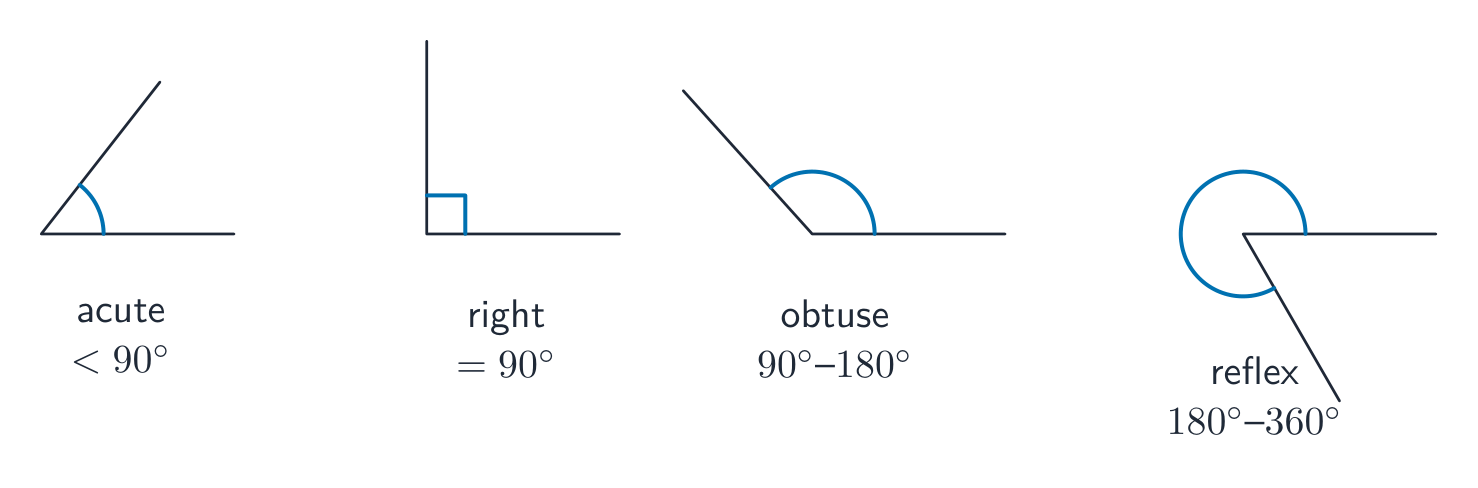
Syllabus · Silabus
EnglishSubject content Notes and examples 1 Use and interpret the following geometrical terms: • point • vertex • line • parallel • perpendicular • bearing • right angle • acute, obtuse and reflex angles • interior and exterior angles • similar • congruent • scale factor. Candidates are not expected to show that two shapes are congruent. 2 Use and interpret the vocabulary of: • triangles • special quadrilaterals • polygons • nets • simple solids. Includes the following terms: Triangles: • equilateral • isosceles • scalene • right-angled. Quadrilaterals: • square • rectangle • kite • rhombus • parallelogram • trapezium. Polygons: • regular and irregular polygons • pentagon • hexagon • octagon • decagon. Simple solids: • cube • cuboid • prism • cylinder • pyramid • cone • sphere (term ‘hemisphere’ not required) • face • surface • edge. 3 Use and interpret the vocabulary of a circle. Includes the following terms: • centre • radius (plural radii) • diameter • circumference • semicircle • chord • tangent • arc • sector • segment. Bahasa IndonesiaKonten mata pelajaran Catatan dan contoh 1 Gunakan dan interpretasikan istilah geometri berikut: • titik • titik sudut • garis • sejajar • tegak lurus • arah mata angin • sudut siku-siku • sudut lancip, tumpul, dan refleks • sudut dalam dan luar • sebangun • kongruen • faktor skala. Kandidat tidak diharapkan membuktikan bahwa dua bangun adalah kongruen. 2 Gunakan dan interpretasikan kosakata: • segitiga • segiempat khusus • poligon • jaring-jaring • benda padat sederhana. Termasuk istilah berikut: Segitiga: • sama sisi • sama kaki • sembarang • siku-siku. Segiempat: • persegi • persegi panjang • layang-layang • belah ketupat • jajargenjang • trapesium. Poligon: • poligon beraturan dan tak beraturan • pentagon • heksagon • oktagon • dekagon. Benda padat sederhana: • kubus • balok • prisma • silinder • limas • kerucut • bola (istilah 'hemisfer' tidak diperlukan) • sisi • permukaan • rusuk. 3 Gunakan dan interpretasikan kosakata lingkaran. Termasuk istilah berikut: • pusat • jari-jari (jamak jari-jari) • diameter • keliling • setengah lingkaran • tali busur • garis singgung • busur • juring • tembereng. EnglishSubject content Notes and examples 1 Use and interpret the following geometrical terms: • point • vertex • line • plane • parallel • perpendicular • perpendicular bisector • bearing • right angle • acute, obtuse and reflex angles • interior and exterior angles • similar • congruent • scale factor. Candidates are not expected to show that two shapes are congruent. 2 Use and interpret the vocabulary of: • triangles • special quadrilaterals • polygons • nets • solids. Includes the following terms. Triangles: • equilateral • isosceles • scalene • right-angled. Quadrilaterals: • square • rectangle • kite • rhombus • parallelogram • trapezium. Polygons: • regular and irregular polygons • pentagon • hexagon • octagon • decagon. Solids: • cube • cuboid • prism • cylinder • pyramid • cone • sphere • hemisphere • frustum • face • surface • edge. 3 Use and interpret the vocabulary of a circle. Includes the following terms: • centre • radius (plural radii) • diameter • circumference • semicircle • chord • tangent • major and minor arc • sector • segment. Bahasa IndonesiaKonten mata pelajaran Catatan dan contoh 1 Gunakan dan tafsirkan istilah-istilah geometri berikut: • titik • titik sudut • garis • bidang • sejajar • tegak lurus • garis bagi tegak lurus • arah (bearing) • sudut siku-siku • sudut lancip, tumpul dan refleks • sudut dalam dan luar • sebangun • kongruen • faktor skala. Kandidat tidak diharapkan untuk membuktikan bahwa dua bangun adalah kongruen. 2 Gunakan dan tafsirkan kosakata dari: • segitiga • segiempat khusus • poligon • jaring-jaring • padatan. Termasuk istilah-istilah berikut. Segitiga: • sama sisi • sama kaki • sembarang • siku-siku. Segiempat: • persegi • persegi panjang • layang-layang • belah ketupat • jajar genjang • trapesium. Poligon: • poligon beraturan dan tak beraturan • pentagon • heksagon • oktagon • dekagon. Padatan: • kubus • balok • prisma • silinder • limas • kerucut • bola • hemisfer • frustum • muka • permukaan • rusuk. 3 Gunakan dan tafsirkan kosakata dari lingkaran. Termasuk istilah-istilah berikut: • pusat • jari-jari (jamak radii) • diameter • keliling • setengah lingkaran • tali busur • garis singgung • busur besar dan kecil • sektor • tembereng. Source: Cambridge International syllabus · Sumber: Silabus Cambridge International
EnglishA corner where two lines meet is a vertex 顶点. Two lines are parallel 平行 if they never meet, and perpendicular 垂直 if they meet at a right angle. Angles are named by their size:
Name Size acute angle 锐角 less than $90^{\circ}$ right angle 直角 exactly $90^{\circ}$ obtuse angle 钝角 between $90^{\circ}$ and $180^{\circ}$ reflex angle 优角 between $180^{\circ}$ and $360^{\circ}$ We name an angle with three letters, e.g. angle $ABC$ is the angle at $B$.
Bahasa IndonesiaSudut di mana dua garis bertemu disebut titik sudut. Dua garis sejajar jika tidak pernah bertemu, dan tegak lurus jika bertemu membentuk sudut siku-siku. Sudut dinamakan berdasarkan besarannya:
Nama Ukuran sudut lancip kurang dari $90^{\circ}$ sudut siku-siku tepat $90^{\circ}$ sudut tumpul antara $90^{\circ}$ dan $180^{\circ}$ sudut refleks antara $180^{\circ}$ dan $360^{\circ}$ Sudut berdasarkan ukuran: lancip (di bawah $90^\circ$), siku-siku ($90^\circ$, ditandai dengan kotak), tumpul ($90^\circ$–$180^\circ$) dan refleks ($180^\circ$–$360^\circ$). Kita menamai sudut dengan tiga huruf, misalnya sudut $ABC$ adalah sudut di $B$.
Explore · JelajahiShape and angle lab · Lab bentuk dan sudut
Classify angle facts by the diagram feature that creates them. · Klasifikasikan fakta sudut berdasarkan fitur diagram yang menyebabkannya.
4.6
Angle facts · Fakta sudut

Syllabus · Silabus
EnglishSubject content Notes and examples 1 Calculate unknown angles and give simple explanations using the following geometrical properties: • sum of angles at a point = 360° • sum of angles at a point on a straight line = 180° • vertically opposite angles are equal • angle sum of a triangle = 180° and angle sum of a quadrilateral = 360°. Knowledge of three-letter notation for angles is required, e.g. angle $ABC$. Candidates are expected to use the correct geometrical terminology when giving reasons for answers. 2 Calculate unknown angles and give geometric explanations for angles formed within parallel lines: • corresponding angles are equal • alternate angles are equal • co-interior angles sum to 180° (supplementary). 3 Know and use angle properties of regular polygons. Includes exterior and interior angles, and angle sum. Bahasa IndonesiaKonten mata pelajaran Catatan dan contoh 1 Hitung sudut yang belum diketahui dan berikan penjelasan sederhana menggunakan sifat geometri berikut: • jumlah sudut di satu titik = 360° • jumlah sudut di satu titik pada garis lurus = 180° • sudut bertolak belakang sama besar • jumlah sudut segitiga = 180° dan jumlah sudut segiempat = 360°. Pengetahuan tentang notasi tiga huruf untuk sudut diperlukan, mis. sudut $ABC$. Kandidat diharapkan menggunakan terminologi geometri yang benar saat memberikan alasan untuk jawaban. 2 Hitung sudut yang belum diketahui dan berikan penjelasan geometris untuk sudut yang terbentuk di antara garis sejajar: • sudut sehadap sama besar • sudut berseberangan sama besar • sudut sepihak berjumlah 180° (suplemen). 3 Tahu dan gunakan sifat sudut poligon beraturan. Termasuk sudut dalam dan luar, serta jumlah sudut. EnglishSubject content Notes and examples 1 Calculate unknown angles and give simple explanations using the following geometrical properties: • sum of angles at a point = 360° • sum of angles at a point on a straight line = 180° • vertically opposite angles are equal • angle sum of a triangle = 180° and angle sum of a quadrilateral = 360°. Knowledge of 3-letter notation for angles is required, e.g. angle $ABC$. Candidates are expected to use the correct geometrical terminology when giving reasons for answers. 2 Calculate unknown angles and give geometric explanations for angles formed within parallel lines: • corresponding angles are equal • alternate angles are equal • co-interior angles sum to 180° (supplementary). 3 Know and use angle properties of regular and irregular polygons. Includes exterior and interior angles, and angle sum. Bahasa IndonesiaKonten mata pelajaran Catatan dan contoh 1 Hitung sudut yang belum diketahui dan berikan penjelasan sederhana menggunakan sifat-sifat geometri berikut: • jumlah sudut di satu titik = 360° • jumlah sudut di satu titik pada garis lurus = 180° • sudut vertikal saling sama • jumlah sudut segitiga = 180° dan jumlah sudut segiempat = 360°. Pengetahuan tentang notasi sudut 3 huruf diperlukan, mis. sudut $ABC$. Kandidat diharapkan menggunakan terminologi geometri yang benar saat memberikan alasan jawaban. 2 Hitung sudut yang belum diketahui dan berikan penjelasan geometris untuk sudut yang terbentuk di antara garis sejajar: • sudut sehadap sama besar • sudut berseberangan sama besar • sudut sepihak berjumlah 180° (suplemen). 3 Tahu dan gunakan sifat-sifat sudut pada poligon beraturan dan tak beraturan. Termasuk sudut dalam dan luar, serta jumlah sudut. Source: Cambridge International syllabus · Sumber: Silabus Cambridge International
EnglishLearn these basic facts. Each one is a valid reason in the exam.
- Angles at a point add up to $360^{\circ}$.
- Angles on a straight line add up to $180^{\circ}$.
- Vertically opposite angles 对顶角 (made by two crossing lines) are equal.
Worked example. Three angles on a straight line are $x$, $50^{\circ}$ and $70^{\circ}$. Find $x$.
$$x + 50 + 70 = 180 \;\Rightarrow\; x = 60^{\circ}.$$Bahasa IndonesiaPelajari fakta-fakta dasar ini. Setiap facts adalah alasan yang sah dalam ujian.
Sudut di sekitar satu titik berjumlah 360 derajat 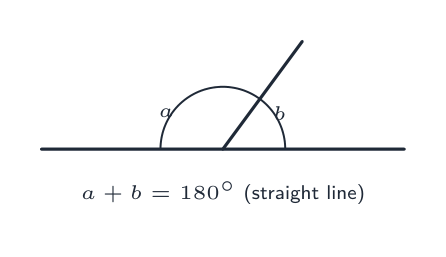
Sudut pada garis lurus berjumlah 180 derajat - Sudut di sekitar satu titik menjumlahkan $360^{\circ}$.
- Sudut pada garis lurus menjumlahkan $180^{\circ}$.
- Sudut berhadapan vertikal (dibentuk oleh dua garis bersilangan) sama besar.
Contoh terpecahkan. Tiga sudut pada garis lurus adalah $x$, $50^{\circ}$ dan $70^{\circ}$. Temukan $x$.
$$x + 50 + 70 = 180 \;\Rightarrow\; x = 60^{\circ}.$$Explore · JelajahiParallel line and polygon lab · Lab garis sejajar dan poligon
Pick the angle rule that unlocks each diagram. · Pilih aturan sudut yang membuka setiap diagram.
4.6
Angles in parallel lines · Sudut pada garis sejajar

Syllabus · Silabus
EnglishSubject content Notes and examples 1 Calculate unknown angles and give simple explanations using the following geometrical properties: • sum of angles at a point = 360° • sum of angles at a point on a straight line = 180° • vertically opposite angles are equal • angle sum of a triangle = 180° and angle sum of a quadrilateral = 360°. Knowledge of three-letter notation for angles is required, e.g. angle $ABC$. Candidates are expected to use the correct geometrical terminology when giving reasons for answers. 2 Calculate unknown angles and give geometric explanations for angles formed within parallel lines: • corresponding angles are equal • alternate angles are equal • co-interior angles sum to 180° (supplementary). 3 Know and use angle properties of regular polygons. Includes exterior and interior angles, and angle sum. Bahasa IndonesiaKonten mata pelajaran Catatan dan contoh 1 Hitung sudut yang belum diketahui dan berikan penjelasan sederhana menggunakan sifat geometri berikut: • jumlah sudut di satu titik = 360° • jumlah sudut di satu titik pada garis lurus = 180° • sudut bertolak belakang sama besar • jumlah sudut segitiga = 180° dan jumlah sudut segiempat = 360°. Pengetahuan tentang notasi tiga huruf untuk sudut diperlukan, mis. sudut $ABC$. Kandidat diharapkan menggunakan terminologi geometri yang benar saat memberikan alasan untuk jawaban. 2 Hitung sudut yang belum diketahui dan berikan penjelasan geometris untuk sudut yang terbentuk di antara garis sejajar: • sudut sehadap sama besar • sudut berseberangan sama besar • sudut sepihak berjumlah 180° (suplemen). 3 Tahu dan gunakan sifat sudut poligon beraturan. Termasuk sudut dalam dan luar, serta jumlah sudut. EnglishSubject content Notes and examples 1 Calculate unknown angles and give simple explanations using the following geometrical properties: • sum of angles at a point = 360° • sum of angles at a point on a straight line = 180° • vertically opposite angles are equal • angle sum of a triangle = 180° and angle sum of a quadrilateral = 360°. Knowledge of 3-letter notation for angles is required, e.g. angle $ABC$. Candidates are expected to use the correct geometrical terminology when giving reasons for answers. 2 Calculate unknown angles and give geometric explanations for angles formed within parallel lines: • corresponding angles are equal • alternate angles are equal • co-interior angles sum to 180° (supplementary). 3 Know and use angle properties of regular and irregular polygons. Includes exterior and interior angles, and angle sum. Bahasa IndonesiaKonten mata pelajaran Catatan dan contoh 1 Hitung sudut yang belum diketahui dan berikan penjelasan sederhana menggunakan sifat-sifat geometri berikut: • jumlah sudut di satu titik = 360° • jumlah sudut di satu titik pada garis lurus = 180° • sudut vertikal saling sama • jumlah sudut segitiga = 180° dan jumlah sudut segiempat = 360°. Pengetahuan tentang notasi sudut 3 huruf diperlukan, mis. sudut $ABC$. Kandidat diharapkan menggunakan terminologi geometri yang benar saat memberikan alasan jawaban. 2 Hitung sudut yang belum diketahui dan berikan penjelasan geometris untuk sudut yang terbentuk di antara garis sejajar: • sudut sehadap sama besar • sudut berseberangan sama besar • sudut sepihak berjumlah 180° (suplemen). 3 Tahu dan gunakan sifat-sifat sudut pada poligon beraturan dan tak beraturan. Termasuk sudut dalam dan luar, serta jumlah sudut. Source: Cambridge International syllabus · Sumber: Silabus Cambridge International
EnglishWhen a line crosses two parallel lines:
- Corresponding angles 同位角 (in matching positions, an "F" shape) are equal.
- Alternate angles 内错角 (opposite sides of the crossing line, a "Z" shape) are equal.
- Co-interior angles 同旁内角 (a "C" shape) add up to $180^{\circ}$; we say they are supplementary 互补.
Worked example. A straight line crosses two parallel lines. One angle is $110^{\circ}$. The co-interior angle $y$ satisfies $110 + y = 180$, so $y = 70^{\circ}$.
Bahasa IndonesiaKetika sebuah garis memotong dua garis sejajar:
- Sudut seletak (pada posisi yang sesuai, bentuk "F") sama besar.
- Sudut berseberangan (sisi berlawanan dari garis pemotong, bentuk "Z") sama besar.
- Sudut dalam sepihak (bentuk "C") menjumlahkan $180^{\circ}$; kita sebut mereka suplemen.
Contoh terpecahkan. Sebuah garis lurus memotong dua garis sejajar. Satu sudut adalah $110^{\circ}$. Sudut dalam sepihak $y$ memenuhi $110 + y = 180$, sehingga $y = 70^{\circ}$.
Sudut seletak (F) dan sudut berseberangan (Z) sama besar; sudut dalam sepihak (C) menjumlahkan $180^\circ$. Vocabulary · Kosa kata Train · LatihEnglish Bahasa Indonesia vertex/ˈvɜːteks/ vertex parallel/ˈpærəlel/ paralel perpendicular/ˌpɜːpənˈdɪkjʊlə/ tegak lurus acute angle/əˈkjuːt ˈæŋɡl/ sudut lancip right angle/raɪt ˈæŋɡl/ sudut siku-siku obtuse angle/ɒbˈtjuːs ˈæŋɡl/ sudut tumpul reflex angle/ˈriːfleks ˈæŋɡl/ sudut refleks vertically opposite angles/ˈvɜːtɪkli ˈɒpəzɪt ˈæŋɡlz/ sudut bertolak belakang corresponding angles/ˌkɒrɪˈspɒndɪŋ ˈæŋɡlz/ sudut sehadap alternate angles/ɔːlˈtɜːnət ˈæŋɡlz/ sudut berselang-seling co-interior angles/kəʊ ɪnˈtɪərɪə ˈæŋɡlz/ sudut dalam bersebelahan supplementary/ˌsʌplɪˈmentəri/ suplemen 4.1
Triangles · Segitiga

Syllabus · Silabus
EnglishSubject content Notes and examples 1 Use and interpret the following geometrical terms: • point • vertex • line • parallel • perpendicular • bearing • right angle • acute, obtuse and reflex angles • interior and exterior angles • similar • congruent • scale factor. Candidates are not expected to show that two shapes are congruent. 2 Use and interpret the vocabulary of: • triangles • special quadrilaterals • polygons • nets • simple solids. Includes the following terms: Triangles: • equilateral • isosceles • scalene • right-angled. Quadrilaterals: • square • rectangle • kite • rhombus • parallelogram • trapezium. Polygons: • regular and irregular polygons • pentagon • hexagon • octagon • decagon. Simple solids: • cube • cuboid • prism • cylinder • pyramid • cone • sphere (term ‘hemisphere’ not required) • face • surface • edge. 3 Use and interpret the vocabulary of a circle. Includes the following terms: • centre • radius (plural radii) • diameter • circumference • semicircle • chord • tangent • arc • sector • segment. Bahasa IndonesiaKonten mata pelajaran Catatan dan contoh 1 Gunakan dan interpretasikan istilah geometri berikut: • titik • titik sudut • garis • sejajar • tegak lurus • arah mata angin • sudut siku-siku • sudut lancip, tumpul, dan refleks • sudut dalam dan luar • sebangun • kongruen • faktor skala. Kandidat tidak diharapkan membuktikan bahwa dua bangun adalah kongruen. 2 Gunakan dan interpretasikan kosakata: • segitiga • segiempat khusus • poligon • jaring-jaring • benda padat sederhana. Termasuk istilah berikut: Segitiga: • sama sisi • sama kaki • sembarang • siku-siku. Segiempat: • persegi • persegi panjang • layang-layang • belah ketupat • jajargenjang • trapesium. Poligon: • poligon beraturan dan tak beraturan • pentagon • heksagon • oktagon • dekagon. Benda padat sederhana: • kubus • balok • prisma • silinder • limas • kerucut • bola (istilah 'hemisfer' tidak diperlukan) • sisi • permukaan • rusuk. 3 Gunakan dan interpretasikan kosakata lingkaran. Termasuk istilah berikut: • pusat • jari-jari (jamak jari-jari) • diameter • keliling • setengah lingkaran • tali busur • garis singgung • busur • juring • tembereng. EnglishSubject content Notes and examples 1 Use and interpret the following geometrical terms: • point • vertex • line • plane • parallel • perpendicular • perpendicular bisector • bearing • right angle • acute, obtuse and reflex angles • interior and exterior angles • similar • congruent • scale factor. Candidates are not expected to show that two shapes are congruent. 2 Use and interpret the vocabulary of: • triangles • special quadrilaterals • polygons • nets • solids. Includes the following terms. Triangles: • equilateral • isosceles • scalene • right-angled. Quadrilaterals: • square • rectangle • kite • rhombus • parallelogram • trapezium. Polygons: • regular and irregular polygons • pentagon • hexagon • octagon • decagon. Solids: • cube • cuboid • prism • cylinder • pyramid • cone • sphere • hemisphere • frustum • face • surface • edge. 3 Use and interpret the vocabulary of a circle. Includes the following terms: • centre • radius (plural radii) • diameter • circumference • semicircle • chord • tangent • major and minor arc • sector • segment. Bahasa IndonesiaKonten mata pelajaran Catatan dan contoh 1 Gunakan dan tafsirkan istilah-istilah geometri berikut: • titik • titik sudut • garis • bidang • sejajar • tegak lurus • garis bagi tegak lurus • arah (bearing) • sudut siku-siku • sudut lancip, tumpul dan refleks • sudut dalam dan luar • sebangun • kongruen • faktor skala. Kandidat tidak diharapkan untuk membuktikan bahwa dua bangun adalah kongruen. 2 Gunakan dan tafsirkan kosakata dari: • segitiga • segiempat khusus • poligon • jaring-jaring • padatan. Termasuk istilah-istilah berikut. Segitiga: • sama sisi • sama kaki • sembarang • siku-siku. Segiempat: • persegi • persegi panjang • layang-layang • belah ketupat • jajar genjang • trapesium. Poligon: • poligon beraturan dan tak beraturan • pentagon • heksagon • oktagon • dekagon. Padatan: • kubus • balok • prisma • silinder • limas • kerucut • bola • hemisfer • frustum • muka • permukaan • rusuk. 3 Gunakan dan tafsirkan kosakata dari lingkaran. Termasuk istilah-istilah berikut: • pusat • jari-jari (jamak radii) • diameter • keliling • setengah lingkaran • tali busur • garis singgung • busur besar dan kecil • sektor • tembereng. Source: Cambridge International syllabus · Sumber: Silabus Cambridge International
EnglishA triangle 三角形 has three sides and angles that add up to $180^{\circ}$.
Type Property equilateral 等边 all sides equal, all angles $60^{\circ}$ isosceles 等腰 two sides equal, two angles equal scalene 不等边 all sides and angles different right-angled has one right angle Worked example. A triangle has angles $x$, $2x$ and $90^{\circ}$. Find $x$.
$$x + 2x + 90 = 180 \;\Rightarrow\; 3x = 90 \;\Rightarrow\; x = 30^{\circ}.$$Bahasa IndonesiaSebuah segitiga memiliki tiga sisi dan sudut yang menjumlahkan $180^{\circ}$.
Tiga sudut segitiga menjumlahkan 180 derajat Jenis Sifat segi tiga sama sisi semua sisi sama, semua sudut $60^{\circ}$ segi tiga sama kaki dua sisi sama, dua sudut sama segi tiga sembarang semua sisi dan sudut berbeda segi tiga siku-siku memiliki satu sudut siku-siku Contoh terpecahkan. Sebuah segitiga memiliki sudut-sudut $x$, $2x$, dan $90^{\circ}$. Temukan $x$.
$$x + 2x + 90 = 180 \;\Rightarrow\; 3x = 90 \;\Rightarrow\; x = 30^{\circ}.$$Vocabulary · Kosa kata Train · LatihEnglish Bahasa Indonesia triangle/ˈtraɪæŋɡl/ segitiga equilateral/ˌiːkwɪˈlætərəl/ segitiga sama sisi isosceles/aɪˈsɒsəliːz/ segitiga sama kaki scalene/ˈskeɪliːn/ segitiga sembarang quadrilateral/ˌkwɒdrɪˈlætərəl/ segi empat square/skweə/ persegi rectangle/ˈrektæŋɡl/ persegi panjang parallelogram/ˌpærəˈleləɡræm/ jajargenjang rhombus/ˈrɒmbəs/ belah ketupat kite/kaɪt/ layang-layang trapezium/trəˈpiːzɪəm/ trapesium 4.1
Quadrilaterals · Bangun segi empat
Syllabus · Silabus
EnglishSubject content Notes and examples 1 Use and interpret the following geometrical terms: • point • vertex • line • parallel • perpendicular • bearing • right angle • acute, obtuse and reflex angles • interior and exterior angles • similar • congruent • scale factor. Candidates are not expected to show that two shapes are congruent. 2 Use and interpret the vocabulary of: • triangles • special quadrilaterals • polygons • nets • simple solids. Includes the following terms: Triangles: • equilateral • isosceles • scalene • right-angled. Quadrilaterals: • square • rectangle • kite • rhombus • parallelogram • trapezium. Polygons: • regular and irregular polygons • pentagon • hexagon • octagon • decagon. Simple solids: • cube • cuboid • prism • cylinder • pyramid • cone • sphere (term ‘hemisphere’ not required) • face • surface • edge. 3 Use and interpret the vocabulary of a circle. Includes the following terms: • centre • radius (plural radii) • diameter • circumference • semicircle • chord • tangent • arc • sector • segment. Bahasa IndonesiaKonten mata pelajaran Catatan dan contoh 1 Gunakan dan interpretasikan istilah geometri berikut: • titik • titik sudut • garis • sejajar • tegak lurus • arah mata angin • sudut siku-siku • sudut lancip, tumpul, dan refleks • sudut dalam dan luar • sebangun • kongruen • faktor skala. Kandidat tidak diharapkan membuktikan bahwa dua bangun adalah kongruen. 2 Gunakan dan interpretasikan kosakata: • segitiga • segiempat khusus • poligon • jaring-jaring • benda padat sederhana. Termasuk istilah berikut: Segitiga: • sama sisi • sama kaki • sembarang • siku-siku. Segiempat: • persegi • persegi panjang • layang-layang • belah ketupat • jajargenjang • trapesium. Poligon: • poligon beraturan dan tak beraturan • pentagon • heksagon • oktagon • dekagon. Benda padat sederhana: • kubus • balok • prisma • silinder • limas • kerucut • bola (istilah 'hemisfer' tidak diperlukan) • sisi • permukaan • rusuk. 3 Gunakan dan interpretasikan kosakata lingkaran. Termasuk istilah berikut: • pusat • jari-jari (jamak jari-jari) • diameter • keliling • setengah lingkaran • tali busur • garis singgung • busur • juring • tembereng. EnglishSubject content Notes and examples 1 Use and interpret the following geometrical terms: • point • vertex • line • plane • parallel • perpendicular • perpendicular bisector • bearing • right angle • acute, obtuse and reflex angles • interior and exterior angles • similar • congruent • scale factor. Candidates are not expected to show that two shapes are congruent. 2 Use and interpret the vocabulary of: • triangles • special quadrilaterals • polygons • nets • solids. Includes the following terms. Triangles: • equilateral • isosceles • scalene • right-angled. Quadrilaterals: • square • rectangle • kite • rhombus • parallelogram • trapezium. Polygons: • regular and irregular polygons • pentagon • hexagon • octagon • decagon. Solids: • cube • cuboid • prism • cylinder • pyramid • cone • sphere • hemisphere • frustum • face • surface • edge. 3 Use and interpret the vocabulary of a circle. Includes the following terms: • centre • radius (plural radii) • diameter • circumference • semicircle • chord • tangent • major and minor arc • sector • segment. Bahasa IndonesiaKonten mata pelajaran Catatan dan contoh 1 Gunakan dan tafsirkan istilah-istilah geometri berikut: • titik • titik sudut • garis • bidang • sejajar • tegak lurus • garis bagi tegak lurus • arah (bearing) • sudut siku-siku • sudut lancip, tumpul dan refleks • sudut dalam dan luar • sebangun • kongruen • faktor skala. Kandidat tidak diharapkan untuk membuktikan bahwa dua bangun adalah kongruen. 2 Gunakan dan tafsirkan kosakata dari: • segitiga • segiempat khusus • poligon • jaring-jaring • padatan. Termasuk istilah-istilah berikut. Segitiga: • sama sisi • sama kaki • sembarang • siku-siku. Segiempat: • persegi • persegi panjang • layang-layang • belah ketupat • jajar genjang • trapesium. Poligon: • poligon beraturan dan tak beraturan • pentagon • heksagon • oktagon • dekagon. Padatan: • kubus • balok • prisma • silinder • limas • kerucut • bola • hemisfer • frustum • muka • permukaan • rusuk. 3 Gunakan dan tafsirkan kosakata dari lingkaran. Termasuk istilah-istilah berikut: • pusat • jari-jari (jamak radii) • diameter • keliling • setengah lingkaran • tali busur • garis singgung • busur besar dan kecil • sektor • tembereng. Source: Cambridge International syllabus · Sumber: Silabus Cambridge International
EnglishA quadrilateral 四边形 has four sides and angles that add up to $360^{\circ}$.
Shape Property square 正方形 four equal sides, four right angles rectangle 矩形 opposite sides equal, four right angles parallelogram 平行四边形 opposite sides parallel and equal rhombus 菱形 four equal sides, opposite sides parallel kite 鸢形 two pairs of equal sides next to each other trapezium 梯形 one pair of parallel sides Bahasa IndonesiaSebuah bangun segi empat memiliki empat sisi dan sudut yang menjumlahkan $360^{\circ}$.
Bentuk Sifat persegi empat sisi sama, empat sudut siku-siku persegi panjang sisi berhadapan sama, empat sudut siku-siku jajargenjang sisi berhadapan sejajar dan sama belah ketupat empat sisi sama, sisi berhadapan sejajar layang-layang dua pasang sisi sama bersebelahan trapesium satu pasang sisi sejajar 4.6
Polygons · Poligon

Syllabus · Silabus
EnglishSubject content Notes and examples 1 Calculate unknown angles and give simple explanations using the following geometrical properties: • sum of angles at a point = 360° • sum of angles at a point on a straight line = 180° • vertically opposite angles are equal • angle sum of a triangle = 180° and angle sum of a quadrilateral = 360°. Knowledge of three-letter notation for angles is required, e.g. angle $ABC$. Candidates are expected to use the correct geometrical terminology when giving reasons for answers. 2 Calculate unknown angles and give geometric explanations for angles formed within parallel lines: • corresponding angles are equal • alternate angles are equal • co-interior angles sum to 180° (supplementary). 3 Know and use angle properties of regular polygons. Includes exterior and interior angles, and angle sum. Bahasa IndonesiaKonten mata pelajaran Catatan dan contoh 1 Hitung sudut yang belum diketahui dan berikan penjelasan sederhana menggunakan sifat geometri berikut: • jumlah sudut di satu titik = 360° • jumlah sudut di satu titik pada garis lurus = 180° • sudut bertolak belakang sama besar • jumlah sudut segitiga = 180° dan jumlah sudut segiempat = 360°. Pengetahuan tentang notasi tiga huruf untuk sudut diperlukan, mis. sudut $ABC$. Kandidat diharapkan menggunakan terminologi geometri yang benar saat memberikan alasan untuk jawaban. 2 Hitung sudut yang belum diketahui dan berikan penjelasan geometris untuk sudut yang terbentuk di antara garis sejajar: • sudut sehadap sama besar • sudut berseberangan sama besar • sudut sepihak berjumlah 180° (suplemen). 3 Tahu dan gunakan sifat sudut poligon beraturan. Termasuk sudut dalam dan luar, serta jumlah sudut. EnglishSubject content Notes and examples 1 Calculate unknown angles and give simple explanations using the following geometrical properties: • sum of angles at a point = 360° • sum of angles at a point on a straight line = 180° • vertically opposite angles are equal • angle sum of a triangle = 180° and angle sum of a quadrilateral = 360°. Knowledge of 3-letter notation for angles is required, e.g. angle $ABC$. Candidates are expected to use the correct geometrical terminology when giving reasons for answers. 2 Calculate unknown angles and give geometric explanations for angles formed within parallel lines: • corresponding angles are equal • alternate angles are equal • co-interior angles sum to 180° (supplementary). 3 Know and use angle properties of regular and irregular polygons. Includes exterior and interior angles, and angle sum. Bahasa IndonesiaKonten mata pelajaran Catatan dan contoh 1 Hitung sudut yang belum diketahui dan berikan penjelasan sederhana menggunakan sifat-sifat geometri berikut: • jumlah sudut di satu titik = 360° • jumlah sudut di satu titik pada garis lurus = 180° • sudut vertikal saling sama • jumlah sudut segitiga = 180° dan jumlah sudut segiempat = 360°. Pengetahuan tentang notasi sudut 3 huruf diperlukan, mis. sudut $ABC$. Kandidat diharapkan menggunakan terminologi geometri yang benar saat memberikan alasan jawaban. 2 Hitung sudut yang belum diketahui dan berikan penjelasan geometris untuk sudut yang terbentuk di antara garis sejajar: • sudut sehadap sama besar • sudut berseberangan sama besar • sudut sepihak berjumlah 180° (suplemen). 3 Tahu dan gunakan sifat-sifat sudut pada poligon beraturan dan tak beraturan. Termasuk sudut dalam dan luar, serta jumlah sudut. Source: Cambridge International syllabus · Sumber: Silabus Cambridge International
EnglishA polygon 多边形 is a shape with straight sides. A regular polygon 正多边形 has all sides and all angles equal.
Sides Name 5 pentagon 五边形 6 hexagon 六边形 8 octagon 八边形 10 decagon 十边形 For a polygon with $n$ sides:
$$\text{sum of interior angles} = (n - 2) \times 180^{\circ}, \qquad \text{sum of exterior angles} = 360^{\circ}.$$The interior angle 内角 and the exterior angle 外角 at each corner add up to $180^{\circ}$.
Worked example. Find each interior angle of a regular hexagon.
The exterior angle is $\dfrac{360^{\circ}}{6} = 60^{\circ}$, so each interior angle is $180^{\circ} - 60^{\circ} = 120^{\circ}$.
Bahasa IndonesiaSarang lebah menutupi bidang dengan heksagon beraturan. Sebuah poligon adalah bangun dengan sisi lurus. Poligon beraturan memiliki semua sisi dan semua sudut sama.
Sisi Nama 5 pentagon 6 heksagon 8 oktagon 10 dekagon Untuk poligon dengan $n$ sisi:
$$\text{sum of interior angles} = (n - 2) \times 180^{\circ}, \qquad \text{sum of exterior angles} = 360^{\circ}.$$Sudut dalam dan sudut luar di setiap sudut menjumlahkan $180^{\circ}$.
Contoh terpecahkan. Temukan setiap sudut dalam heksagon beraturan.
Sudut luar adalah $\dfrac{360^{\circ}}{6} = 60^{\circ}$, jadi setiap sudut dalam adalah $180^{\circ} - 60^{\circ} = 120^{\circ}$.
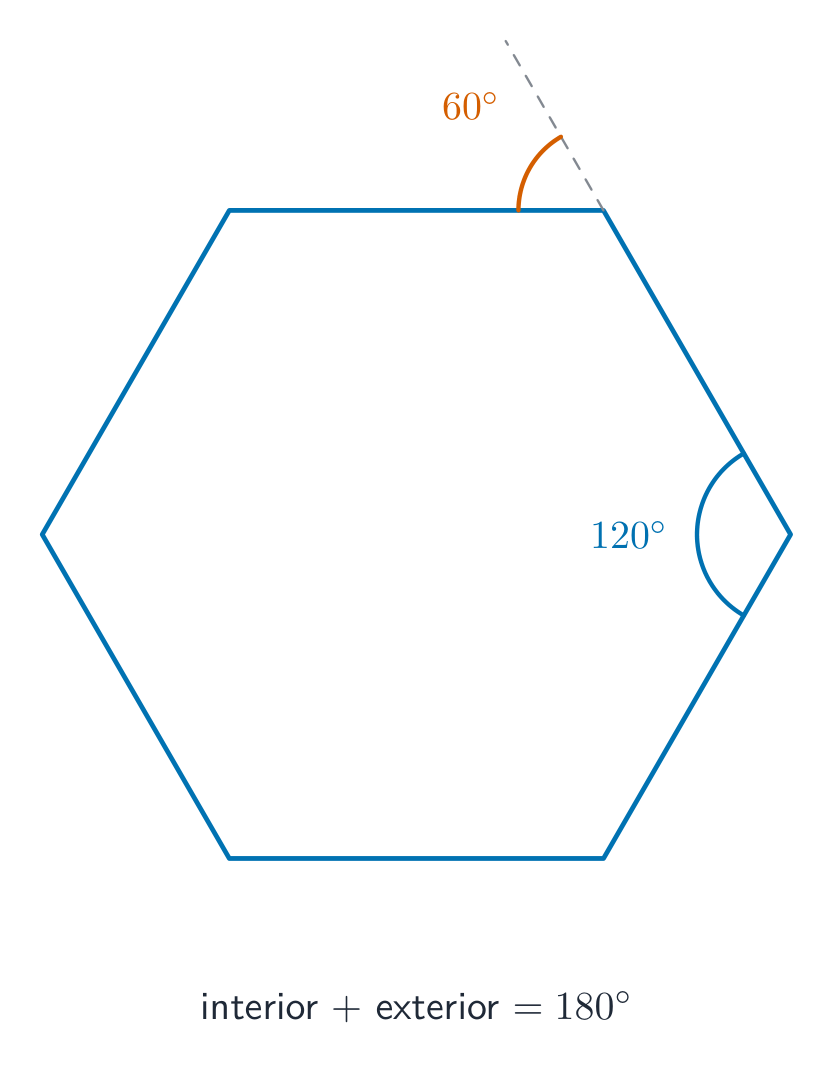
Di setiap sudut sudut dalam dan luar menjumlahkan $180^\circ$; heksagon beraturan memiliki $60^\circ$ sudut luar dan $120^\circ$ sudut dalam. Vocabulary · Kosa kata Train · LatihEnglish Bahasa Indonesia polygon/ˈpɒlɪɡən/ poligon regular polygon/ˈreɡjʊlə ˈpɒlɪɡən/ poligon beraturan pentagon/ˈpentæɡən/ pentagon hexagon/ˈheksæɡən/ heksagon octagon/ˈɒktæɡən/ oktagon decagon/dɪˈkæɡən/ dekagon interior angle/ɪnˈtɪərɪə ˈæŋɡl/ sudut dalam exterior angle/ekˈstɪərɪə ˈæŋɡl/ sudut luar line symmetry/laɪn ˈsɪmətri/ simetri garis rotational symmetry/rəʊˈteɪʃənl ˈsɪmətri/ simetri rotasi plane of symmetry/pleɪn ɒv ˈsɪmətri/ bidang simetri axis of symmetry/ˈæksɪs ɒv ˈsɪmətri/ sumbu simetri 4.5
Symmetry · Simetri

Syllabus · Silabus
EnglishSubject content Notes and examples Recognise line symmetry and order of rotational symmetry in two dimensions. Includes properties of triangles, quadrilaterals and polygons directly related to their symmetries. Bahasa IndonesiaKonten mata pelajaran Catatan dan contoh Kenali simetri garis dan orde simetri putar dalam dua dimensi. Termasuk sifat segitiga, segiempat, dan poligon yang terkait langsung dengan simetri mereka. EnglishSubject content Notes and examples 1 Recognise line symmetry and order of rotational symmetry in two dimensions. Includes properties of triangles, quadrilaterals and polygons directly related to their symmetries. 2 Recognise symmetry properties of prisms, cylinders, pyramids and cones. e.g. identify planes and axes of symmetry. Bahasa IndonesiaKonten mata pelajaran Catatan dan contoh 1 Kenali simetri garis dan orde simetri putar dalam dua dimensi. Termasuk sifat-sifat segitiga, segiempat dan poligon yang berkaitan langsung dengan simetrinya. 2 Kenali sifat-sifat simetri dari prisma, silinder, limas dan kerucut. Mis. identifikasi bidang dan sumbu simetri. Source: Cambridge International syllabus · Sumber: Silabus Cambridge International
English- A shape has line symmetry 轴对称 if a mirror line splits it into two matching halves.
- A shape has rotational symmetry 旋转对称 if it fits onto itself as you turn it. The order is how many times it fits in one full turn.
For solids (Extended), a flat slice that splits the solid into mirror halves is a plane of symmetry 对称面, and a line you can spin it around is an axis of symmetry 对称轴.
Bahasa IndonesiaTaj Mahal memiliki garis simetri yang jelas di tengahnya. - Sebuah bangun memiliki simetri garis jika garis cermin membaginya menjadi dua setengah yang cocok.
- Sebuah bangun memiliki simetri putar jika pas ke dirinya sendiri saat diputar. Orde adalah berapa kali ia pas dalam satu putaran penuh.
Untuk benda padat (Extended), irisan datar yang membagi benda menjadi dua setengah cermin disebut bidang simetri, dan garis yang bisa diputar di sekitarnya disebut sumbu simetri.
Explore · JelajahiSymmetry as a reflection · Simetri sebagai pencerminan
A shape has line symmetry if reflecting it leaves it unchanged. Reflect the shape and watch what is preserved. · Suatu bangun memiliki simetri garis jika memantulkannya tidak mengubah bentuknya. Pantulkan bangun tersebut dan perhatikan apa yang tetap sama.
4.1
Circles: the parts · Lingkaran: bagian-bagiannya

Syllabus · Silabus
EnglishSubject content Notes and examples 1 Use and interpret the following geometrical terms: • point • vertex • line • parallel • perpendicular • bearing • right angle • acute, obtuse and reflex angles • interior and exterior angles • similar • congruent • scale factor. Candidates are not expected to show that two shapes are congruent. 2 Use and interpret the vocabulary of: • triangles • special quadrilaterals • polygons • nets • simple solids. Includes the following terms: Triangles: • equilateral • isosceles • scalene • right-angled. Quadrilaterals: • square • rectangle • kite • rhombus • parallelogram • trapezium. Polygons: • regular and irregular polygons • pentagon • hexagon • octagon • decagon. Simple solids: • cube • cuboid • prism • cylinder • pyramid • cone • sphere (term ‘hemisphere’ not required) • face • surface • edge. 3 Use and interpret the vocabulary of a circle. Includes the following terms: • centre • radius (plural radii) • diameter • circumference • semicircle • chord • tangent • arc • sector • segment. Bahasa IndonesiaKonten mata pelajaran Catatan dan contoh 1 Gunakan dan interpretasikan istilah geometri berikut: • titik • titik sudut • garis • sejajar • tegak lurus • arah mata angin • sudut siku-siku • sudut lancip, tumpul, dan refleks • sudut dalam dan luar • sebangun • kongruen • faktor skala. Kandidat tidak diharapkan membuktikan bahwa dua bangun adalah kongruen. 2 Gunakan dan interpretasikan kosakata: • segitiga • segiempat khusus • poligon • jaring-jaring • benda padat sederhana. Termasuk istilah berikut: Segitiga: • sama sisi • sama kaki • sembarang • siku-siku. Segiempat: • persegi • persegi panjang • layang-layang • belah ketupat • jajargenjang • trapesium. Poligon: • poligon beraturan dan tak beraturan • pentagon • heksagon • oktagon • dekagon. Benda padat sederhana: • kubus • balok • prisma • silinder • limas • kerucut • bola (istilah 'hemisfer' tidak diperlukan) • sisi • permukaan • rusuk. 3 Gunakan dan interpretasikan kosakata lingkaran. Termasuk istilah berikut: • pusat • jari-jari (jamak jari-jari) • diameter • keliling • setengah lingkaran • tali busur • garis singgung • busur • juring • tembereng. EnglishSubject content Notes and examples 1 Use and interpret the following geometrical terms: • point • vertex • line • plane • parallel • perpendicular • perpendicular bisector • bearing • right angle • acute, obtuse and reflex angles • interior and exterior angles • similar • congruent • scale factor. Candidates are not expected to show that two shapes are congruent. 2 Use and interpret the vocabulary of: • triangles • special quadrilaterals • polygons • nets • solids. Includes the following terms. Triangles: • equilateral • isosceles • scalene • right-angled. Quadrilaterals: • square • rectangle • kite • rhombus • parallelogram • trapezium. Polygons: • regular and irregular polygons • pentagon • hexagon • octagon • decagon. Solids: • cube • cuboid • prism • cylinder • pyramid • cone • sphere • hemisphere • frustum • face • surface • edge. 3 Use and interpret the vocabulary of a circle. Includes the following terms: • centre • radius (plural radii) • diameter • circumference • semicircle • chord • tangent • major and minor arc • sector • segment. Bahasa IndonesiaKonten mata pelajaran Catatan dan contoh 1 Gunakan dan tafsirkan istilah-istilah geometri berikut: • titik • titik sudut • garis • bidang • sejajar • tegak lurus • garis bagi tegak lurus • arah (bearing) • sudut siku-siku • sudut lancip, tumpul dan refleks • sudut dalam dan luar • sebangun • kongruen • faktor skala. Kandidat tidak diharapkan untuk membuktikan bahwa dua bangun adalah kongruen. 2 Gunakan dan tafsirkan kosakata dari: • segitiga • segiempat khusus • poligon • jaring-jaring • padatan. Termasuk istilah-istilah berikut. Segitiga: • sama sisi • sama kaki • sembarang • siku-siku. Segiempat: • persegi • persegi panjang • layang-layang • belah ketupat • jajar genjang • trapesium. Poligon: • poligon beraturan dan tak beraturan • pentagon • heksagon • oktagon • dekagon. Padatan: • kubus • balok • prisma • silinder • limas • kerucut • bola • hemisfer • frustum • muka • permukaan • rusuk. 3 Gunakan dan tafsirkan kosakata dari lingkaran. Termasuk istilah-istilah berikut: • pusat • jari-jari (jamak radii) • diameter • keliling • setengah lingkaran • tali busur • garis singgung • busur besar dan kecil • sektor • tembereng. Source: Cambridge International syllabus · Sumber: Silabus Cambridge International
EnglishTerm Meaning circle 圆 all points the same distance from a centre centre 圆心 the middle point radius 半径 centre to edge (plural radii) diameter 直径 right across through the centre ($= 2 \times$ radius) circumference 圆周 the distance all the way round chord 弦 a straight line joining two points on the circle arc 弧 part of the circumference sector 扇形 a "pizza slice" between two radii segment 弓形 the region cut off by a chord semicircle 半圆 half a circle tangent 切线 a line that touches the circle at one point Bahasa IndonesiaIstilah Makna lingkaran semua titik berjarak sama dari pusat pusat titik tengah jari-jari pusat ke tepi (jamak radii) diameter melintang tepat melalui pusat ($= 2 \times$ jari-jari) keliling jarak keliling sepenuhnya tali busur garis lurus menghubungkan dua titik pada lingkaran busur bagian dari keliling sektor "potongan pizza" antara dua jari-jari segmen daerah yang dipotong oleh tali busur setengah lingkaran setengah dari lingkaran garis singgung garis yang menyentuh lingkaran di satu titik Bagian utama lingkaran: tali busur menghubungkan dua titik, sedangkan garis singgung menyentuh tepat di satu titik. 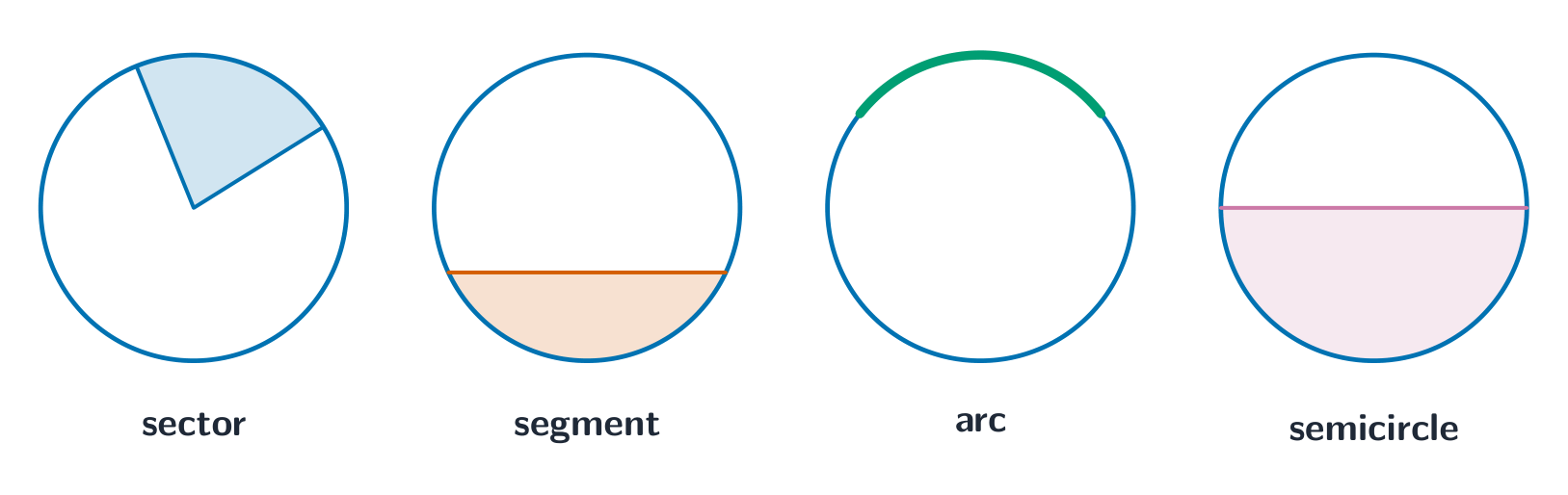
Sektor adalah irisan antara dua jari-jari, segmen dipotong oleh tali busur, busur adalah bagian dari keliling lingkaran, dan setengah lingkaran adalah separuh dari lingkaran. Explore · JelajahiArc and sector · Busur dan juring
Drag the angle and radius to see the arc (part of the circumference) and the sector (pie slice) it cuts off. · Seret sudut dan jari-jari untuk melihat busur (bagian keliling) dan juring (potongan pie) yang dipotongnya.
Vocabulary · Kosa kata Train · LatihEnglish Bahasa Indonesia circle/ˈsɜːkl/ lingkaran diameter/daɪˈæmɪtə/ diameter circumference/sɜːˈkʌmfrəns/ keliling chord/kɔːd/ tali busur arc/ɑːk/ busur sector/ˈsektə/ sektor segment/ˈseɡmənt/ segmen 4.7 4.8
Circle theorems · Teorema lingkaran

Syllabus · Silabus
EnglishSubject content Notes and examples Calculate unknown angles and give explanations using the following geometrical properties of circles: • angle in a semicircle = 90° • angle between tangent and radius = 90°. Candidates will be expected to use the geometrical properties listed in the syllabus when giving reasons for answers. Bahasa IndonesiaKonten mata pelajaran Catatan dan contoh Hitung sudut yang belum diketahui dan berikan penjelasan menggunakan sifat geometri lingkaran berikut: • sudut dalam setengah lingkaran = 90° • sudut antara garis singgung dan jari-jari = 90°. Kandidat diharapkan menggunakan sifat geometri yang tercantum dalam silabus saat memberikan alasan untuk jawaban. EnglishSubject content Notes and examples Calculate unknown angles and give explanations using the following geometrical properties of circles: • angle in a semicircle = 90° • angle between tangent and radius = 90° • angle at the centre is twice the angle at the circumference • angles in the same segment are equal • opposite angles of a cyclic quadrilateral sum to 180° (supplementary) • alternate segment theorem. Candidates are expected to use the geometrical properties listed in the syllabus when giving reasons for answers. Bahasa IndonesiaKonten mata pelajaran Catatan dan contoh Hitung sudut yang belum diketahui dan berikan penjelasan menggunakan sifat-sifat geometri lingkaran berikut: • sudut dalam setengah lingkaran = 90° • sudut antara garis singgung dan jari-jari = 90° • sudut di pusat adalah dua kali sudut di keliling • sudut dalam busur yang sama adalah sama • sudut berhadapan pada segiempat talibusur berjumlah 180° (suplemen) • teorema busur bergantian. Kandidat diharapkan menggunakan sifat-sifat geometri yang tercantum dalam silabus saat memberikan alasan jawaban. EnglishSubject content Notes and examples Use the following symmetry properties of circles: • equal chords are equidistant from the centre • the perpendicular bisector of a chord passes through the centre • tangents from an external point are equal in length. Candidates are expected to use the geometrical properties listed in the syllabus when giving reasons for answers. Bahasa IndonesiaKonten mata pelajaran Catatan dan contoh Gunakan sifat-sifat simetri lingkaran berikut: • tali busur yang sama berjarak sama dari pusat • garis bagi tegak lurus tali busur melalui pusat • garis singgung dari titik luar sama panjang. Kandidat diharapkan menggunakan sifat-sifat geometri yang tercantum dalam silabus saat memberikan alasan jawaban. Source: Cambridge International syllabus · Sumber: Silabus Cambridge International
EnglishAngle in a semicircle: always 90 degrees Angle at the centre: always double Use these to find unknown angles, always giving the reason.
For both levels:
- The angle in a semicircle is $90^{\circ}$.
- The angle between a tangent and a radius is $90^{\circ}$.
Extended (theorems I):
- The angle at the centre is twice the angle at the circumference (standing on the same arc).
- Angles in the same segment are equal.
- Opposite angles of a cyclic quadrilateral 圆内接四边形 add up to $180^{\circ}$.
- The alternate segment theorem 弦切角定理: the angle between a tangent and a chord equals the angle in the other segment.
Extended (theorems II): equal chords are the same distance from the centre; the perpendicular bisector of a chord passes through the centre; two tangents from the same outside point are equal in length.
Worked example. A, B, C are on a circle. The angle at the circumference $ABC$ is $40^{\circ}$. Find the angle $AOC$ at the centre $O$.
The angle at the centre is twice the angle at the circumference: $2 \times 40^{\circ} = 80^{\circ}$.
Bahasa IndonesiaSudut dalam setengah lingkaran: selalu 90 derajat Sudut di pusat: selalu dua kali lipat Gunakan ini untuk mencari sudut yang tidak diketahui, selalu berikan alasannya.
Untuk kedua tingkatan:
- Sudut dalam setengah lingkaran adalah $90^{\circ}$.
- Sudut antara garis singgung dan jari-jari adalah $90^{\circ}$.
Dua teorema untuk kedua tingkatan: sudut dalam setengah lingkaran adalah $90^\circ$, dan garis singgung bertemu jari-jari pada $90^\circ$. Tingkat Lanjut (teorema I):
- Sudut di pusat adalah dua kali sudut di keliling (berdiri pada busur yang sama).
- Sudut-sudut dalam segmen yang sama adalah sama besar.
- Sudut berhadapan pada jajargenjang siklis menjumlahkan $180^{\circ}$.
- Teorema segmen berselang: sudut antara garis singgung dan tali busur sama dengan sudut di segmen lainnya.
Tingkat Lanjut (teorema II): tali busur yang sama panjang berjarak sama dari pusat; garis bagi tegak lurus dari tali busur melalui pusat; dua garis singgung dari titik luar yang sama memiliki panjang yang sama.
Contoh terarah. A, B, C berada pada sebuah lingkaran. Sudut di keliling $ABC$ adalah $40^{\circ}$. Temukan sudut $AOC$ di pusat $O$.
Sudut di pusat adalah dua kali sudut di keliling: $2 \times 40^{\circ} = 80^{\circ}$.
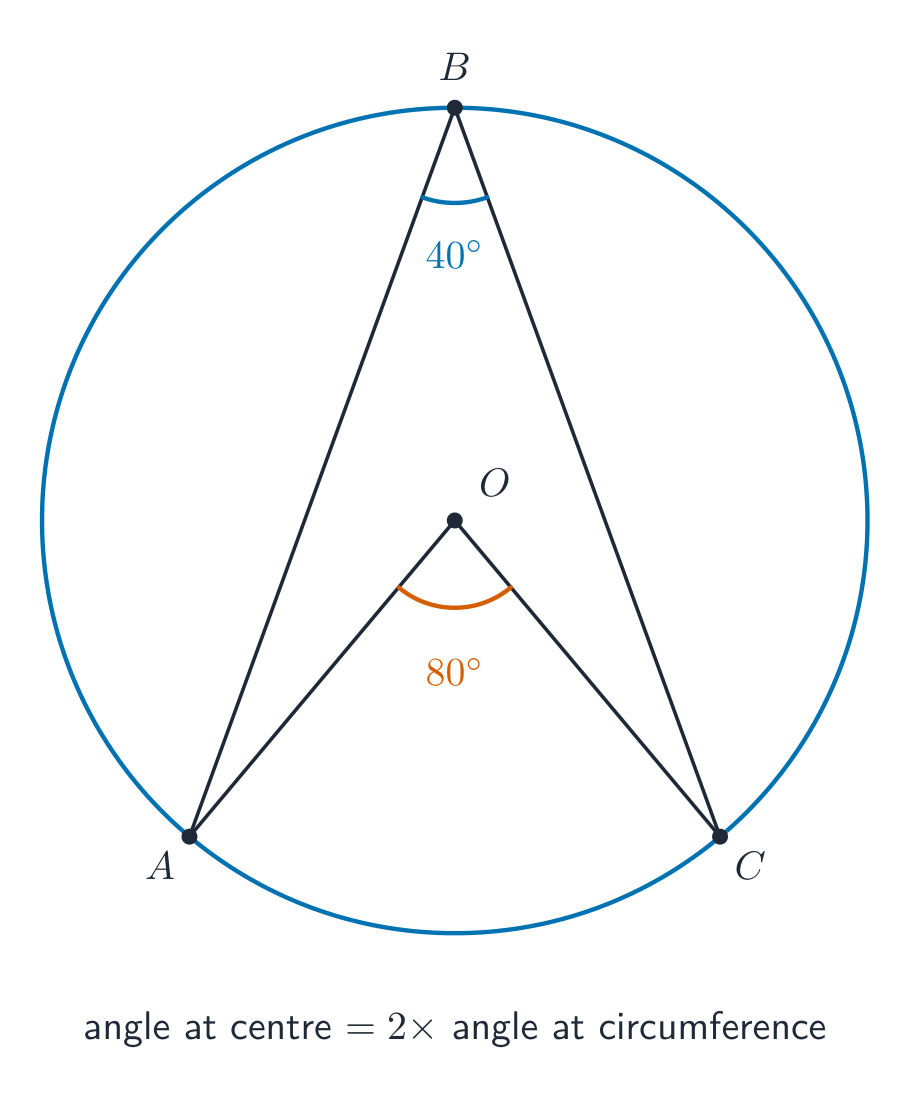
Sudut di pusat ($80^\circ$) adalah dua kali sudut di keliling ($40^\circ$) berdiri pada busur yang sama. Vocabulary · Kosa kata Train · LatihEnglish Bahasa Indonesia centre/ˈsentə/ pusat radius/ˈreɪdɪəs/ jari-jari semicircle/ˈsemɪsɜːkl/ setengah lingkaran tangent/ˈtændʒənt/ tangens cyclic quadrilateral/ˈsaɪklɪk ˌkwɒdrɪˈlætərəl/ segi empat siklis alternate segment theorem/ɔːlˈtɜːnət ˈseɡmənt ˈθɪərəm/ teorema segmen berselang-seling 4.4
Similar shapes · Bangun sebangun

Syllabus · Silabus
EnglishSubject content Notes and examples Calculate lengths of similar shapes. Bahasa IndonesiaKonten mata pelajaran Catatan dan contoh Hitung panjang bangun yang sebangun. EnglishSubject content Notes and examples 1 Calculate lengths of similar shapes. 2 Use the relationships between lengths and areas of similar shapes and lengths, surface areas and volumes of similar solids. Includes use of scale factor, e.g. $$\frac{\text{Volume of } A}{\text{Volume of } B} = \frac{(\text{Length of } A)^3}{(\text{Length of } B)^3}$$3 Solve problems and give simple explanations involving similarity. Includes showing that two triangles are similar using geometric reasons. Bahasa IndonesiaKonten mata pelajaran Catatan dan contoh 1 Hitung panjang pada bangun-bangun yang sebangun. 2 Gunakan hubungan antara panjang dan luas pada bangun sebangun serta panjang, luas permukaan dan volume pada padatan sebangun. Termasuk penggunaan faktor skala, mis. $$\frac{\text{Volume of } A}{\text{Volume of } B} = \frac{(\text{Length of } A)^3}{(\text{Length of } B)^3}$$3 Selesaikan masalah dan berikan penjelasan sederhana yang melibatkan kesamaan. Termasuk menunjukkan bahwa dua segitiga adalah sebangun menggunakan alasan geometris. Source: Cambridge International syllabus · Sumber: Silabus Cambridge International
EnglishTwo shapes are similar 相似 if one is an enlargement of the other: same angles, and all sides multiplied by the same scale factor 比例因子 $k$. (Shapes that are exactly the same size and shape are congruent 全等.)
For similar shapes and solids:
$$\frac{\text{area of } A}{\text{area of } B} = k^{2}, \qquad \frac{\text{volume of } A}{\text{volume of } B} = k^{3}.$$Worked example. Two similar solids have lengths in the ratio $2 : 3$. The smaller has volume $40\text{ cm}^{3}$. Find the volume of the larger.
The volume ratio is $2^{3} : 3^{3} = 8 : 27$. So the larger volume is $40 \times \dfrac{27}{8} = 135\text{ cm}^{3}$.
Bahasa IndonesiaDua bentuk sebangun jika salah satunya adalah pembesaran dari yang lain: sudut yang sama, dan semua sisi dikalikan dengan faktor skala yang sama $k$. (Bangun yang ukurannya dan bentuknya persis sama disebut kongruen.)
Boneka bertumpuk adalah bentuk sebangun: masing-masing memiliki bentuk yang sama dengan yang lain, hanya dikalikan dengan faktor skala Untuk bangun dan benda sebangun:
$$\frac{\text{area of } A}{\text{area of } B} = k^{2}, \qquad \frac{\text{volume of } A}{\text{volume of } B} = k^{3}.$$Contoh terarah. Dua benda sebangun memiliki panjang dalam perbandingan $2 : 3$. Yang lebih kecil memiliki volume $40\text{ cm}^{3}$. Temukan volume yang lebih besar.
Perbandingan volumenya adalah $2^{3} : 3^{3} = 8 : 27$. Jadi volume yang lebih besar adalah $40 \times \dfrac{27}{8} = 135\text{ cm}^{3}$.
Explore · JelajahiSimilar shapes — enlargement · Bangun-bangun serupa — perbesaran
Similar shapes are the same shape but a different size. An enlargement scales every length by the same factor; angles stay the same. · Bangun-bangun serupa memiliki bentuk yang sama tetapi ukuran berbeda. Perbesaran mengalikan setiap panjang dengan faktor yang sama; sudut tetap sama.
Vocabulary · Kosa kata Train · LatihEnglish Bahasa Indonesia similar/ˈsɪmɪlə/ sebangun scale factor/skeɪl ˈfæktə/ faktor skala congruent/ˈkɒŋɡruːənt/ kongruen 4.6
Bearings · Arah mata angin

Syllabus · Silabus
EnglishSubject content Notes and examples 1 Calculate unknown angles and give simple explanations using the following geometrical properties: • sum of angles at a point = 360° • sum of angles at a point on a straight line = 180° • vertically opposite angles are equal • angle sum of a triangle = 180° and angle sum of a quadrilateral = 360°. Knowledge of three-letter notation for angles is required, e.g. angle $ABC$. Candidates are expected to use the correct geometrical terminology when giving reasons for answers. 2 Calculate unknown angles and give geometric explanations for angles formed within parallel lines: • corresponding angles are equal • alternate angles are equal • co-interior angles sum to 180° (supplementary). 3 Know and use angle properties of regular polygons. Includes exterior and interior angles, and angle sum. Bahasa IndonesiaKonten mata pelajaran Catatan dan contoh 1 Hitung sudut yang belum diketahui dan berikan penjelasan sederhana menggunakan sifat geometri berikut: • jumlah sudut di satu titik = 360° • jumlah sudut di satu titik pada garis lurus = 180° • sudut bertolak belakang sama besar • jumlah sudut segitiga = 180° dan jumlah sudut segiempat = 360°. Pengetahuan tentang notasi tiga huruf untuk sudut diperlukan, mis. sudut $ABC$. Kandidat diharapkan menggunakan terminologi geometri yang benar saat memberikan alasan untuk jawaban. 2 Hitung sudut yang belum diketahui dan berikan penjelasan geometris untuk sudut yang terbentuk di antara garis sejajar: • sudut sehadap sama besar • sudut berseberangan sama besar • sudut sepihak berjumlah 180° (suplemen). 3 Tahu dan gunakan sifat sudut poligon beraturan. Termasuk sudut dalam dan luar, serta jumlah sudut. EnglishSubject content Notes and examples 1 Calculate unknown angles and give simple explanations using the following geometrical properties: • sum of angles at a point = 360° • sum of angles at a point on a straight line = 180° • vertically opposite angles are equal • angle sum of a triangle = 180° and angle sum of a quadrilateral = 360°. Knowledge of 3-letter notation for angles is required, e.g. angle $ABC$. Candidates are expected to use the correct geometrical terminology when giving reasons for answers. 2 Calculate unknown angles and give geometric explanations for angles formed within parallel lines: • corresponding angles are equal • alternate angles are equal • co-interior angles sum to 180° (supplementary). 3 Know and use angle properties of regular and irregular polygons. Includes exterior and interior angles, and angle sum. Bahasa IndonesiaKonten mata pelajaran Catatan dan contoh 1 Hitung sudut yang belum diketahui dan berikan penjelasan sederhana menggunakan sifat-sifat geometri berikut: • jumlah sudut di satu titik = 360° • jumlah sudut di satu titik pada garis lurus = 180° • sudut vertikal saling sama • jumlah sudut segitiga = 180° dan jumlah sudut segiempat = 360°. Pengetahuan tentang notasi sudut 3 huruf diperlukan, mis. sudut $ABC$. Kandidat diharapkan menggunakan terminologi geometri yang benar saat memberikan alasan jawaban. 2 Hitung sudut yang belum diketahui dan berikan penjelasan geometris untuk sudut yang terbentuk di antara garis sejajar: • sudut sehadap sama besar • sudut berseberangan sama besar • sudut sepihak berjumlah 180° (suplemen). 3 Tahu dan gunakan sifat-sifat sudut pada poligon beraturan dan tak beraturan. Termasuk sudut dalam dan luar, serta jumlah sudut. Source: Cambridge International syllabus · Sumber: Silabus Cambridge International
EnglishA bearing 方位角 gives a direction as a three-figure angle, measured clockwise 顺时针 from north, from $000^{\circ}$ to $360^{\circ}$. So due east is $090^{\circ}$ and due south is $180^{\circ}$.
Worked example. The bearing of $B$ from $A$ is $025^{\circ}$. Find the bearing of $A$ from $B$.
The return (back) bearing differs by $180^{\circ}$: $025^{\circ} + 180^{\circ} = 205^{\circ}$.
Bahasa IndonesiaArah mata angin memberikan arah sebagai sudut tiga angka, diukur searah jarum jam dari utara, dari $000^{\circ}$ hingga $360^{\circ}$. Jadi timur tepat adalah $090^{\circ}$ dan selatan tepat adalah $180^{\circ}$.
Contoh terarah. Arah mata angin dari $B$ ke $A$ adalah $025^{\circ}$. Temukan arah mata angin dari $A$ ke $B$.
Arah balik (return/back bearing) berbeda sebesar $180^{\circ}$: $025^{\circ} + 180^{\circ} = 205^{\circ}$.
Arah mata angin diukur searah jarum jam dari utara sebagai tiga angka; arah balik berbeda sebesar $180^\circ$. Explore · JelajahiBearings route · Rute azimut
Follow how to measure a bearing correctly from north. · Ikuti cara mengukur azimut dengan benar dari arah utara.
Vocabulary · Kosa kata Train · LatihEnglish Bahasa Indonesia bearing/ˈbeərɪŋ/ arah clockwise/ˈklɒkwaɪz/ searah jarum jam construct/ˈkɒnstrʌkt/ membangun compasses/ˈkʌmpəsɪz/ jangka 4.2 4.3
Constructions, nets and solids · Konstruksi, jaring-jaring, dan benda

Syllabus · Silabus
EnglishSubject content Notes and examples 1 Measure and draw lines and angles. A ruler should be used for all straight edges. Constructions of perpendicular bisectors and angle bisectors are not required. 2 Construct a triangle, given the lengths of all sides, using a ruler and pair of compasses only. e.g. construct a rhombus by drawing two triangles. Construction arcs must be shown. 3 Draw, use and interpret nets. Examples include: • draw nets of cubes, cuboids, prisms and pyramids • use measurements from nets to calculate volumes and surface areas. Bahasa IndonesiaKonten mata pelajaran Catatan dan contoh 1 Ukur dan gambar garis serta sudut. Penggaris harus digunakan untuk semua tepi lurus. Konstruksi garis bagi tegak lurus dan garis bagi sudut tidak diperlukan. 2 Konstruksikan segitiga, diberikan panjang semua sisinya, hanya menggunakan penggaris dan jangka. mis. konstruksikan belah ketupat dengan menggambar dua segitiga. Busur konstruksi harus ditampilkan. 3 Gambar, gunakan, dan interpretasikan jaring-jaring. Contoh termasuk: • gambar jaring-jaring kubus, balok, prisma, dan limas • gunakan ukuran dari jaring-jaring untuk menghitung volume dan luas permukaan. EnglishSubject content Notes and examples 1 Draw and interpret scale drawings. A ruler must be used for all straight edges. 2 Use and interpret three-figure bearings. Bearings are measured clockwise from north (000° to 360°). e.g. find the bearing of A from B if the bearing of B from A is 025°. Includes an understanding of the terms north, east, south and west. e.g. point D is due east of point C. Bahasa IndonesiaKonten mata pelajaran Catatan dan contoh 1 Gambar dan interpretasikan gambar berskala. Penggaris harus digunakan untuk semua tepi lurus. 2 Gunakan dan interpretasikan arah mata angin tiga angka. Arah diukur searah jarum jam dari utara (000° hingga 360°). mis. temukan arah mata angin A dari B jika arah mata angin B dari A adalah 025°. Termasuk pemahaman tentang istilah utara, timur, selatan, dan barat. mis. titik D berada tepat di timur titik C. EnglishSubject content Notes and examples 1 Draw and interpret scale drawings. A ruler must be used for all straight edges. 2 Use and interpret three-figure bearings. Bearings are measured clockwise from north ($000^{\circ}$ to $360^{\circ}$). e.g. find the bearing of $A$ from $B$ if the bearing of $B$ from $A$ is $025^{\circ}$. Includes an understanding of the terms north, east, south and west. e.g. point $D$ is due east of point $C$. Bahasa IndonesiaKonten mata pelajaran Catatan dan contoh 1 Gambar dan interpretasikan gambar berskala. Penggaris harus digunakan untuk semua tepi lurus. 2 Gunakan dan tafsirkan tiga angka bearing. Bearing diukur searah jarum jam dari utara ($000^{\circ}$ hingga $360^{\circ}$). Mis. tentukan bearing $A$ dari $B$ jika bearing $B$ dari $A$ adalah $025^{\circ}$. Termasuk pemahaman terhadap istilah utara, timur, selatan dan barat. Mis. titik $D$ berada tepat di sebelah timur titik $C$. Source: Cambridge International syllabus · Sumber: Silabus Cambridge International
English- To construct 作图 a triangle from three given sides, draw the base with a ruler, then use a pair of compasses 圆规 to mark each other side as an arc. Leave the construction arcs showing.
- A net 展开图 is a flat shape that folds up into a solid. You can use a net to work out surface areas.
- A scale drawing 比例图 shows a real object smaller (or larger) by a fixed scale, such as $1\text{ cm}$ to $5\text{ m}$.
Common solids 几何体 and their parts:
Solid Note cube 立方体 / cuboid 长方体 box shapes prism 棱柱 the same shape all along its length cylinder 圆柱 a circular prism pyramid 棱锥 / cone 圆锥 come to a point sphere 球 / hemisphere 半球 a ball / half a ball frustum 平截头体 a cone or pyramid with the top cut off A flat side of a solid is a face 面, two faces meet at an edge 棱, and the whole outside is its surface 表面.
Bahasa Indonesia- Untuk membangun segitiga dari tiga sisi yang diberikan, gambar alas dengan penggaris, lalu gunakan jangka untuk menandai sisi lainnya sebagai busur. Biarkan busur konstruksi tetap terlihat.
- Jaring-jaring adalah bentuk datar yang dapat dilipat menjadi suatu benda. Anda dapat menggunakan jaring-jaring untuk menghitung luas permukaan.
- Gambar skala menunjukkan objek nyata lebih kecil (atau lebih besar) dengan skala tetap, seperti $1\text{ cm}$ hingga $5\text{ m}$.
Membuka benda akan menghasilkan jaring-jaringnya. Jumlahkan luas potongan-potongannya untuk mendapatkan luas permukaan: silinder adalah $2\pi r^{2} + 2\pi r h$. Benda-benda umum dan bagian-bagiannya:
Benda Catatan kubus / balok bentuk kotak prisma bentuk yang sama sepanjang panjangnya silinder prisma berbentuk lingkaran limas / kerucut meruncing ke satu titik bola / belahan bola bola / setengah bola frustum kerucut atau limas dengan bagian atas dipotong Sisi datar dari suatu benda adalah sisi, dua sisi bertemu pada rusuk, dan seluruh bagian luarnya adalah permukaan-nya.
Explore · JelajahiConstruction and solid lab · Lab konstruksi dan bangun ruang
Classify geometry tasks by the tool or representation needed. · Klasifikasikan tugas geometri berdasarkan alat atau representasi yang diperlukan.
Vocabulary · Kosa kata Train · LatihEnglish Bahasa Indonesia net/net/ bersih scale drawing/skeɪl ˈdrɔːɪŋ/ gambar skala solids/ˈsɒlɪdz/ padatan cube/kjuːb/ kubus cuboid/ˈkjuːbɔɪd/ balok prism/ˈprɪzəm/ prisma cylinder/ˈsɪlɪndə/ silinder pyramid/ˈpɪrəmɪd/ piramida cone/kəʊn/ kerucut sphere/sfɪə/ bola hemisphere/ˈhemɪsfɪə/ hemisfer frustum/ˈfrʌstəm/ frustum face/feɪs/ bidang edge/edʒ/ rusuk surface/ˈsɜːfɪs/ permukaan 4.2 4.3
Exam tips · Tips ujian
English- Angles on a straight line add to $180°$, around a point to $360°$, and in a triangle to $180°$. Give a reason for every step of an angle question.
- Learn the circle theorems: the angle at the centre is twice the angle at the circumference; the angle in a semicircle is $90°$; angles in the same segment are equal; opposite angles of a cyclic quadrilateral add to $180°$.
- The exterior angles of any polygon add to $360°$, and each interior angle + its exterior angle = $180°$.
- Bearings are measured clockwise from north and always written with three figures (e.g. $072°$).
Bahasa Indonesia- Sudut pada garis lurus berjumlah $180°$, di sekitar titik $360°$, dan dalam segitiga $180°$. Berikan alasan untuk setiap langkah soal sudut.
- Hafalkan teorema lingkaran: sudut di pusat adalah dua kali sudut di keliling; sudut dalam setengah lingkaran adalah $90°$; sudut-sudut dalam segmen yang sama sama besar; sudut berhadapan segiempat talimaks berjumlah $180°$.
- Sudut luar dari poligon apa pun berjumlah $360°$, dan setiap sudut dalam + sudut luarnya = $180°$.
- Arah mata angin diukur searah jarum jam dari utara dan selalu ditulis dengan tiga angka (mis. $072°$).
-
5
Mensuration · Metrasi
Watch lesson · Tonton pelajaranEnglishThis handout covers Topic 5, Mensuration (measuring length, area and volume). The Core and Extended content here is almost the same. In the exam, some formulas are given in the List of formulas, but you should still learn them all.
Bahasa IndonesiaLembar kerja ini mencakup Topik 5, Mensurasi (mengukur panjang, luas, dan volume). Konten Inti dan Lanjut di sini hampir sama. Dalam ujian, beberapa rumus diberikan dalam Daftar rumus, tetapi Anda tetap harus menghafalnya semua.
5.1
Units of measure · Satuan ukuran

Syllabus · Silabus
EnglishSubject content Notes and examples Use metric units of mass, length, area, volume and capacity in practical situations and convert quantities into larger or smaller units. Units include: • mm, cm, m, km • $\text{mm}^2$, $\text{cm}^2$, $\text{m}^2$, $\text{km}^2$ • $\text{mm}^3$, $\text{cm}^3$, $\text{m}^3$ • ml, l • g, kg. Conversion between units includes: • between different units of area, e.g. $\text{cm}^2 \leftrightarrow \text{m}^2$ • between units of volume and capacity, e.g. $\text{m}^3 \leftrightarrow \text{litres}$. Bahasa IndonesiaKonten mata pelajaran Catatan dan contoh Gunakan satuan metrik massa, panjang, luas, volume, dan kapasitas dalam situasi praktis dan konversikan kuantitas ke satuan yang lebih besar atau lebih kecil. Unit termasuk: • mm, cm, m, km • $\text{mm}^2$, $\text{cm}^2$, $\text{m}^2$, $\text{km}^2$ • $\text{mm}^3$, $\text{cm}^3$, $\text{m}^3$ • ml, l • g, kg. Konversi antar unit mencakup: • antar satuan luas yang berbeda, mis. $\text{cm}^2 \leftrightarrow \text{m}^2$ • antar satuan volume dan kapasitas, mis. $\text{m}^3 \leftrightarrow \text{litres}$. Source: Cambridge International syllabus · Sumber: Silabus Cambridge International
EnglishWe use metric 公制 units for mass 质量 (g, kg), length 长度 (mm, cm, m, km), area 面积, volume 体积 and capacity 容量 (ml, litres — the space inside a container).
To change units, be careful with squares and cubes:
- Length: $1\text{ m} = 100\text{ cm}$.
- Area: $1\text{ m}^{2} = 100^{2} = 10\,000\text{ cm}^{2}$.
- Volume: $1\text{ m}^{3} = 100^{3} = 1\,000\,000\text{ cm}^{3}$.
- Capacity: $1\text{ litre} = 1000\text{ cm}^{3}$, so $1\text{ m}^{3} = 1000$ litres.
Worked example. Convert $3\text{ m}^{2}$ to $\text{cm}^{2}$.
$$3 \times 10\,000 = 30\,000\text{ cm}^{2}.$$Bahasa IndonesiaKami menggunakan satuan metrik untuk massa (g, kg), panjang (mm, cm, m, km), luas, volume, dan kapasitas (ml, liter — ruang di dalam wadah).
Perubahan satuan panjang: kalikan saat turun, bagi saat naik Untuk mengubah satuan, perhatikan kuadrat dan pangkat tiga:
- Panjang: $1\text{ m} = 100\text{ cm}$.
- Luas: $1\text{ m}^{2} = 100^{2} = 10\,000\text{ cm}^{2}$.
- Volume: $1\text{ m}^{3} = 100^{3} = 1\,000\,000\text{ cm}^{3}$.
- Kapasitas: $1\text{ litre} = 1000\text{ cm}^{3}$, sehingga $1\text{ m}^{3} = 1000$ liter.
Contoh terpecahkan. Konversi $3\text{ m}^{2}$ ke $\text{cm}^{2}$.
$$3 \times 10\,000 = 30\,000\text{ cm}^{2}.$$Explore · JelajahiUnit choice lab · Lab pemilihan satuan
Choose the unit that matches the measurement scale. · Pilih satuan yang sesuai dengan skala pengukuran.
Vocabulary · Kosa kata Train · LatihEnglish Bahasa Indonesia metric/ˈmetrɪk/ metrik mass/mæs/ massa volume/ˈvɒljuːm/ volume capacity/kəˈpæsɪti/ daya dukung perimeter/pəˈrɪmɪtə/ keliling 5.2
Perimeter and area of basic shapes · Keliling dan luas bangun dasar

Syllabus · Silabus
EnglishSubject content Notes and examples Carry out calculations involving the perimeter and area of a rectangle, triangle, parallelogram and trapezium. Except for area of a triangle, formulas are not given. Bahasa IndonesiaKonten mata pelajaran Catatan dan contoh Lakukan perhitungan yang melibatkan keliling dan luas persegi panjang, segitiga, jajargenjang, dan trapesium. Kecuali untuk luas segitiga, rumus tidak diberikan. EnglishSubject content Notes and examples Carry out calculations involving the perimeter and area of a rectangle, triangle, parallelogram and trapezium. Except for the area of a triangle, formulas are not given. Bahasa IndonesiaKonten mata pelajaran Catatan dan contoh Lakukan perhitungan yang melibatkan keliling dan luas persegi, segitiga, jajar genjang dan trapesium. Kecuali untuk luas segitiga, rumus tidak diberikan. Source: Cambridge International syllabus · Sumber: Silabus Cambridge International
EnglishThe perimeter 周长 is the distance all the way round a shape. The area is the amount of flat space inside it. Here $b$ is the base 底 and $h$ is the perpendicular height 高.
Shape Area rectangle 矩形 $\text{length} \times \text{width}$ triangle 三角形 $\tfrac{1}{2} \times b \times h$ parallelogram 平行四边形 $b \times h$ trapezium 梯形 $\tfrac{1}{2}(a + b)h$, where $a$ and $b$ are the two parallel sides Worked example. A trapezium has parallel sides $6\text{ cm}$ and $10\text{ cm}$, and height $4\text{ cm}$. Find its area.
$$\tfrac{1}{2}(6 + 10) \times 4 = \tfrac{1}{2} \times 16 \times 4 = 32\text{ cm}^{2}.$$Bahasa IndonesiaKeliling adalah jarak mengelilingi seluruh bangun. Luas adalah jumlah ruang datar di dalamnya. Di sini $b$ adalah alas dan $h$ adalah tinggi tegak lurus.
Bangun Luas persegi panjang $\text{length} \times \text{width}$ segitiga $\tfrac{1}{2} \times b \times h$ jajar genjang $b \times h$ trapesium $\tfrac{1}{2}(a + b)h$, di mana $a$ dan $b$ adalah dua sisi sejajar Luas bangun dasar; $b$ adalah alas, $h$ tinggi tegak lurus, dan $a$, $b$ dua sisi sejajar dari trapesium. Contoh terpecahkan. Sebuah trapesium memiliki sisi sejajar $6\text{ cm}$ dan $10\text{ cm}$, serta tinggi $4\text{ cm}$. Tentukan luasnya.
$$\tfrac{1}{2}(6 + 10) \times 4 = \tfrac{1}{2} \times 16 \times 4 = 32\text{ cm}^{2}.$$Explore · JelajahiArea scaling lab · Lab skala luas
area = side^2 · luas = sisi^2
Change side length and see why area grows quadratically. · Ubah panjang sisi dan lihat mengapa luas bertambah secara kuadrat.
Vocabulary · Kosa kata Train · LatihEnglish Bahasa Indonesia length/leŋθ/ panjang area/ˈeərɪə/ luas 5.3
Circles · Lingkaran

Syllabus · Silabus
EnglishSubject content Notes and examples 1 Carry out calculations involving the circumference and area of a circle. Answers may be asked for in terms of $\pi$. 2 Carry out calculations involving arc length and sector area as fractions of the circumference and area of a circle, where the sector angle is a factor of $360^\circ$. Formulas are given in the List of formulas. Bahasa IndonesiaKonten mata pelajaran Catatan dan contoh 1 Lakukan perhitungan yang melibatkan keliling dan luas lingkaran. Jawaban mungkin diminta dalam bentuk $\pi$. 2 Lakukan perhitungan yang melibatkan panjang busur dan luas juring sebagai pecahan dari keliling dan luas lingkaran, di mana sudut juring merupakan faktor dari $360^\circ$. Rumus diberikan dalam Daftar rumus. EnglishSubject content Notes and examples 1 Carry out calculations involving the circumference and area of a circle. Answers may be asked for in terms of $\pi$. Formulas are given in the List of formulas. 2 Carry out calculations involving arc length and sector area as fractions of the circumference and area of a circle. Includes minor and major sectors. Bahasa IndonesiaKonten mata pelajaran Catatan dan contoh 1 Lakukan perhitungan yang melibatkan keliling dan luas lingkaran. Jawaban mungkin diminta dalam bentuk $\pi$. Rumus diberikan dalam Daftar rumus. 2 Lakukan perhitungan yang melibatkan panjang busur dan luas sektor sebagai pecahan dari keliling dan luas lingkaran. Termasuk sektor minor dan major. Source: Cambridge International syllabus · Sumber: Silabus Cambridge International
EnglishFor a circle 圆 with radius 半径 $r$ (and diameter 直径 $d = 2r$):
$$\text{circumference} = 2\pi r = \pi d, \qquad \text{area} = \pi r^{2}.$$The circumference 圆周 is the distance round the circle.
Worked example. A circle has radius $7\text{ cm}$. Find its circumference and area (leave $\pi$ in the answer).
$$\text{circumference} = 2\pi \times 7 = 14\pi\text{ cm}, \qquad \text{area} = \pi \times 7^{2} = 49\pi\text{ cm}^{2}.$$Bahasa IndonesiaUntuk lingkaran dengan jari-jari $r$ (dan diameter $d = 2r$):
Lingkaran: keliling = pi d dan luas = pi r kuadrat $$\text{circumference} = 2\pi r = \pi d, \qquad \text{area} = \pi r^{2}.$$Keliling lingkaran adalah jarak mengelilingi lingkaran.
Contoh terpecahkan. Sebuah lingkaran memiliki jari-jari $7\text{ cm}$. Temukan keliling dan luasnya (biarkan $\pi$ dalam jawaban).
$$\text{circumference} = 2\pi \times 7 = 14\pi\text{ cm}, \qquad \text{area} = \pi \times 7^{2} = 49\pi\text{ cm}^{2}.$$Vocabulary · Kosa kata Train · LatihEnglish Bahasa Indonesia circle/ˈsɜːkl/ lingkaran radius/ˈreɪdɪəs/ jari-jari diameter/daɪˈæmɪtə/ diameter circumference/sɜːˈkʌmfrəns/ keliling 5.3
Arcs and sectors · Busur dan juring

Syllabus · Silabus
EnglishSubject content Notes and examples 1 Carry out calculations involving the circumference and area of a circle. Answers may be asked for in terms of $\pi$. 2 Carry out calculations involving arc length and sector area as fractions of the circumference and area of a circle, where the sector angle is a factor of $360^\circ$. Formulas are given in the List of formulas. Bahasa IndonesiaKonten mata pelajaran Catatan dan contoh 1 Lakukan perhitungan yang melibatkan keliling dan luas lingkaran. Jawaban mungkin diminta dalam bentuk $\pi$. 2 Lakukan perhitungan yang melibatkan panjang busur dan luas juring sebagai pecahan dari keliling dan luas lingkaran, di mana sudut juring merupakan faktor dari $360^\circ$. Rumus diberikan dalam Daftar rumus. EnglishSubject content Notes and examples 1 Carry out calculations involving the circumference and area of a circle. Answers may be asked for in terms of $\pi$. Formulas are given in the List of formulas. 2 Carry out calculations involving arc length and sector area as fractions of the circumference and area of a circle. Includes minor and major sectors. Bahasa IndonesiaKonten mata pelajaran Catatan dan contoh 1 Lakukan perhitungan yang melibatkan keliling dan luas lingkaran. Jawaban mungkin diminta dalam bentuk $\pi$. Rumus diberikan dalam Daftar rumus. 2 Lakukan perhitungan yang melibatkan panjang busur dan luas sektor sebagai pecahan dari keliling dan luas lingkaran. Termasuk sektor minor dan major. Source: Cambridge International syllabus · Sumber: Silabus Cambridge International
EnglishAn arc 弧 is part of the circumference. A sector 扇形 is a "pizza slice" between two radii. If the sector angle is $\theta$, the arc and sector are that fraction $\dfrac{\theta}{360}$ of the whole circle:
$$\text{arc length} = \frac{\theta}{360} \times 2\pi r, \qquad \text{sector area} = \frac{\theta}{360} \times \pi r^{2}.$$A small slice is a minor sector 小扇形; the large rest is a major sector 大扇形.
Worked example. Find the arc length 弧长 and area of a sector with angle $90^{\circ}$ and radius $8\text{ cm}$.
The fraction is $\dfrac{90}{360} = \dfrac{1}{4}$, so
$$\text{arc} = \tfrac{1}{4} \times 2\pi \times 8 = 4\pi\text{ cm}, \qquad \text{area} = \tfrac{1}{4} \times \pi \times 8^{2} = 16\pi\text{ cm}^{2}.$$Bahasa IndonesiaBusur adalah bagian dari keliling lingkaran. Juring adalah "irisan pizza" antara dua jari-jari. Jika sudut juring adalah $\theta$, busur dan juring tersebut merupakan pecahan $\dfrac{\theta}{360}$ dari seluruh lingkaran:
$$\text{arc length} = \frac{\theta}{360} \times 2\pi r, \qquad \text{sector area} = \frac{\theta}{360} \times \pi r^{2}.$$Juring adalah pecahan $\tfrac{\theta}{360}$ dari seluruh lingkaran, sehingga busur dan luasnya adalah pecahan tersebut dari keliling dan luas lingkaran. Irisan kecil disebut juring minor; sisa besar disebut juring mayor.
Contoh terpecahkan. Tentukan panjang busur dan luas juring dengan sudut $90^{\circ}$ dan jari-jari $8\text{ cm}$.
Pecahannya adalah $\dfrac{90}{360} = \dfrac{1}{4}$, sehingga
$$\text{arc} = \tfrac{1}{4} \times 2\pi \times 8 = 4\pi\text{ cm}, \qquad \text{area} = \tfrac{1}{4} \times \pi \times 8^{2} = 16\pi\text{ cm}^{2}.$$Explore · JelajahiArcs & sectors · Busur & juring
s = rθ · A = ½r²θ
A bigger angle or radius means a longer arc and larger sector area. · Sudut lebih besar atau jari-jari lebih besar berarti busur yang lebih panjang dan area juring yang lebih besar.
Explore · JelajahiArc length and sector area · Panjang busur dan luas juring
Change the angle and radius and read off the arc length and sector area — a fraction of the whole circle. · Ubah sudut dan jari-jari dan baca panjang busur dan luas juring — pecahan dari seluruh lingkaran.
Vocabulary · Kosa kata Train · LatihEnglish Bahasa Indonesia arc/ɑːk/ busur sector/ˈsektə/ sektor minor sector/ˈmaɪnə ˈsektə/ sektor minor major sector/ˈmeɪdʒə ˈsektə/ sektor mayor arc length/ɑːk leŋθ/ panjang busur 5.4
Surface area and volume of solids · Luas permukaan dan volume benda padu

Syllabus · Silabus
EnglishSubject content Notes and examples Carry out calculations and solve problems involving the surface area and volume of a: • cuboid • prism • cylinder • sphere • pyramid • cone. Answers may be asked for in terms of $\pi$. The following formulas are given in the List of formulas: • curved surface area of a cylinder • curved surface area of a cone • surface area of a sphere • volume of a prism • volume of a pyramid • volume of a cylinder • volume of a cone • volume of a sphere. The term prism refers to any solid with a uniform cross-section, e.g. a cylindrical sector. Bahasa IndonesiaKonten mata pelajaran Catatan dan contoh Lakukan perhitungan dan selesaikan masalah yang melibatkan luas permukaan dan volume dari: • balok • prisma • silinder • bola • limas • kerucut. Jawaban dapat diminta dalam bentuk $\pi$. Rumus-rumus berikut diberikan dalam Daftar rumus: • luas permukaan lengkung silinder • luas permukaan lengkung kerucut • luas permukaan bola • volume prisma • volume limas • volume silinder • volume kerucut • volume bola. Istilah prisma merujuk pada setiap benda padat dengan penampang seragam, mis. sektor silinder. Source: Cambridge International syllabus · Sumber: Silabus Cambridge International
EnglishThe surface area 表面积 is the total area of all the outside faces. The volume is the space inside. For these solids ($r$ = radius, $h$ = height):
Solid Volume Surface area cuboid 长方体 $\text{length} \times \text{width} \times \text{height}$ add the six faces prism 棱柱 (cross-section 横截面 area) $\times$ length — cylinder 圆柱 $\pi r^{2} h$ $2\pi r h$ (curved surface area 侧面积) $+\, 2\pi r^{2}$ pyramid 棱锥 $\tfrac{1}{3} \times \text{base area} \times h$ — cone 圆锥 $\tfrac{1}{3}\pi r^{2} h$ $\pi r l$ (curved) $+\, \pi r^{2}$, where $l$ is the slant height 斜高 sphere 球 $\tfrac{4}{3}\pi r^{3}$ $4\pi r^{2}$ Worked example. A cylinder has radius $5\text{ cm}$ and height $10\text{ cm}$. Find its volume and total surface area (in terms of $\pi$).
$$\text{volume} = \pi \times 5^{2} \times 10 = 250\pi\text{ cm}^{3}.$$$$\text{surface area} = 2\pi(5)(10) + 2\pi(5)^{2} = 100\pi + 50\pi = 150\pi\text{ cm}^{2}.$$Bahasa IndonesiaPiramida Giza adalah piramida beralas persegi — sebuah benda padu 3-D. Luas permukaan adalah total luas semua sisi luar. Volume adalah ruang di dalamnya. Untuk benda-benda ini ($r$ = jari-jari, $h$ = tinggi):
Benda Padu Volume Luas Permukaan balok $\text{length} \times \text{width} \times \text{height}$ tambahkan enam sisi prisma (luas potongan melintang) $\times$ × panjang — silinder $\pi r^{2} h$ $2\pi r h$ (luas permukaan lengkung) $+\, 2\pi r^{2}$ piramida $\tfrac{1}{3} \times \text{base area} \times h$ — kerucut $\tfrac{1}{3}\pi r^{2} h$ $\pi r l$ (melengkung) $+\, \pi r^{2}$, di mana $l$ adalah garis pelukis bola $\tfrac{4}{3}\pi r^{3}$ $4\pi r^{2}$ 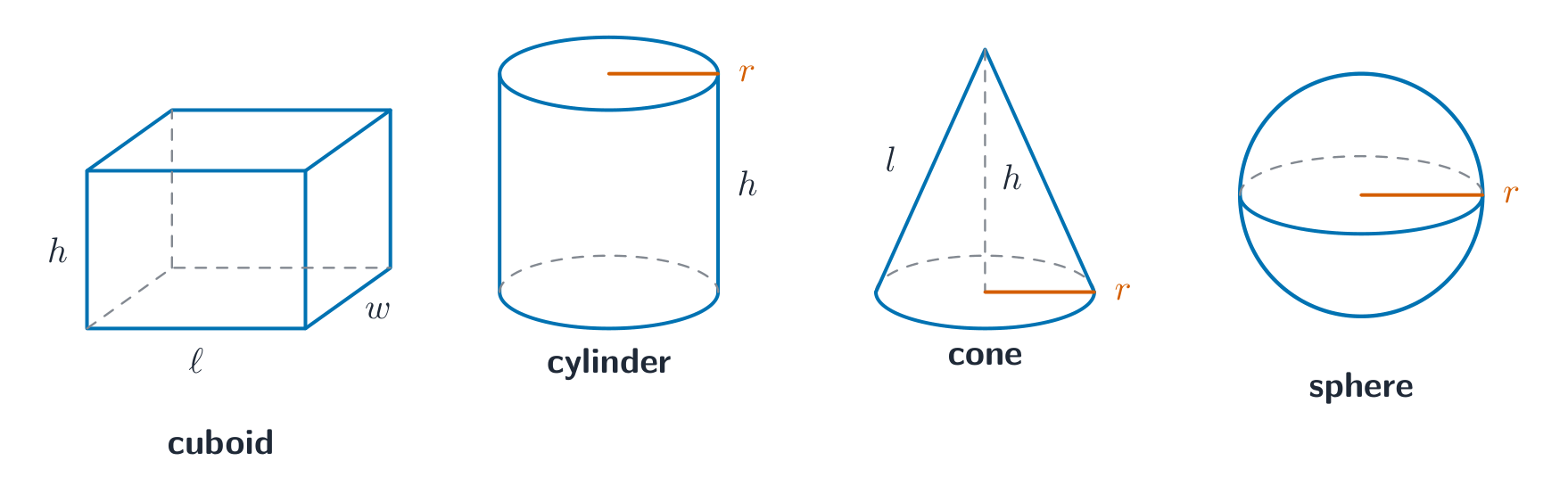
Benda padu umum dan dimensinya ($r$, $h$, $\ell$, tinggi $l$) yang digunakan dalam rumus volume dan luas permukaannya. Contoh terpecahkan. Sebuah silinder memiliki jari-jari $5\text{ cm}$ dan tinggi $10\text{ cm}$. Tentukan volumenya dan luas permukaan totalnya (dalam bentuk $\pi$).
$$\text{volume} = \pi \times 5^{2} \times 10 = 250\pi\text{ cm}^{3}.$$$$\text{surface area} = 2\pi(5)(10) + 2\pi(5)^{2} = 100\pi + 50\pi = 150\pi\text{ cm}^{2}.$$Explore · JelajahiVolume scaling lab · Lab skala volume
surface area grows with scale^2 · luas permukaan tumbuh sebanding dengan scale^2
Change length scale and see volume grow faster than surface area. · Ubah skala panjang dan lihat volume tumbuh lebih cepat daripada luas permukaan.
Vocabulary · Kosa kata Train · LatihEnglish Bahasa Indonesia base/beɪs/ basis height/haɪt/ tinggi rectangle/ˈrektæŋɡl/ persegi panjang triangle/ˈtraɪæŋɡl/ segitiga parallelogram/ˌpærəˈleləɡræm/ jajargenjang trapezium/trəˈpiːzɪəm/ trapesium surface area/ˈsɜːfɪs ˈeərɪə/ luas permukaan cuboid/ˈkjuːbɔɪd/ balok prism/ˈprɪzəm/ prisma cross-section/krɒs ˈsekʃn/ potongan melintang cylinder/ˈsɪlɪndə/ silinder curved surface area/kɜːvd ˈsɜːfɪs ˈeərɪə/ luas permukaan lengkung pyramid/ˈpɪrəmɪd/ piramida cone/kəʊn/ kerucut slant height/slænt haɪt/ garis miring sphere/sfɪə/ bola 5.5
Compound shapes and parts of shapes · Bangun gabungan dan bagian-bagian bangun

Syllabus · Silabus
EnglishSubject content Notes and examples 1 Carry out calculations and solve problems involving perimeters and areas of: • compound shapes • parts of shapes. Answers may be asked for in terms of $\pi$. 2 Carry out calculations and solve problems involving surface areas and volumes of: • compound solids • parts of solids. e.g. find the volume of half of a sphere. Bahasa IndonesiaKonten mata pelajaran Catatan dan contoh 1 Lakukan perhitungan dan selesaikan masalah yang melibatkan keliling dan luas: • bangun majemuk • bagian-bagian bangun. Jawaban dapat diminta dalam bentuk $\pi$. 2 Lakukan perhitungan dan selesaikan masalah yang melibatkan luas permukaan dan volume: • bangun majemuk • bagian-bagian bangun. mis. temukan volume setengah dari sebuah bola. EnglishSubject content Notes and examples 1 Carry out calculations and solve problems involving perimeters and areas of: • compound shapes • parts of shapes. Answers may be asked for in terms of $\pi$. 2 Carry out calculations and solve problems involving surface areas and volumes of: • compound solids • parts of solids. e.g. find the surface area and volume of a frustum. Bahasa IndonesiaKonten mata pelajaran Catatan dan contoh 1 Lakukan perhitungan dan selesaikan masalah yang melibatkan keliling dan luas: • bangun majemuk • bagian-bagian bangun. Jawaban dapat diminta dalam bentuk $\pi$. 2 Lakukan perhitungan dan selesaikan masalah yang melibatkan luas permukaan dan volume dari: • padatan majemuk • bagian-bagian padatan. Mis. temukan luas permukaan dan volume frustum. Source: Cambridge International syllabus · Sumber: Silabus Cambridge International
EnglishA compound shape 组合图形 is made by joining or cutting simple shapes. Split it into parts you know, then add or subtract.
For "parts" of a circle or solid, take the right fraction. For example, a hemisphere 半球 (half a sphere) has volume
$$\tfrac{1}{2} \times \tfrac{4}{3}\pi r^{3} = \tfrac{2}{3}\pi r^{3}.$$A frustum 平截头体 is a cone or pyramid with its top cut off; find its volume by subtracting the small top cone from the whole cone.
Worked example. Find the area of a shape made of a rectangle $8\text{ cm} \times 5\text{ cm}$ with a semicircle of diameter $5\text{ cm}$ on one end.
The semicircle has radius $2.5\text{ cm}$:
$$\text{area} = 8 \times 5 + \tfrac{1}{2}\pi (2.5)^{2} = 40 + 3.125\pi \approx 49.8\text{ cm}^{2}.$$Bahasa IndonesiaKontainer bertumpuk adalah balok; volume adalah panjang dikali lebar dikali tinggi. Bangun gabungan dibuat dengan menyambungkan atau memotong bangun sederhana. Pisahkan menjadi bagian-bagian yang Anda ketahui, lalu tambahkan atau kurangkan.
Untuk "bagian" lingkaran atau benda padu, ambil pecahan yang tepat. Misalnya, hemisfer (setengah bola) memiliki volume
$$\tfrac{1}{2} \times \tfrac{4}{3}\pi r^{3} = \tfrac{2}{3}\pi r^{3}.$$Frustum adalah kerucut atau piramida dengan bagian atasnya dipotong; temukan volumenya dengan mengurangi kerucut kecil di atas dari kerucut utuh.
Contoh terpecahkan. Tentukan luas bangun yang terdiri dari persegi panjang $8\text{ cm} \times 5\text{ cm}$ dengan setengah lingkaran berdiameter $5\text{ cm}$ di salah satu ujungnya.
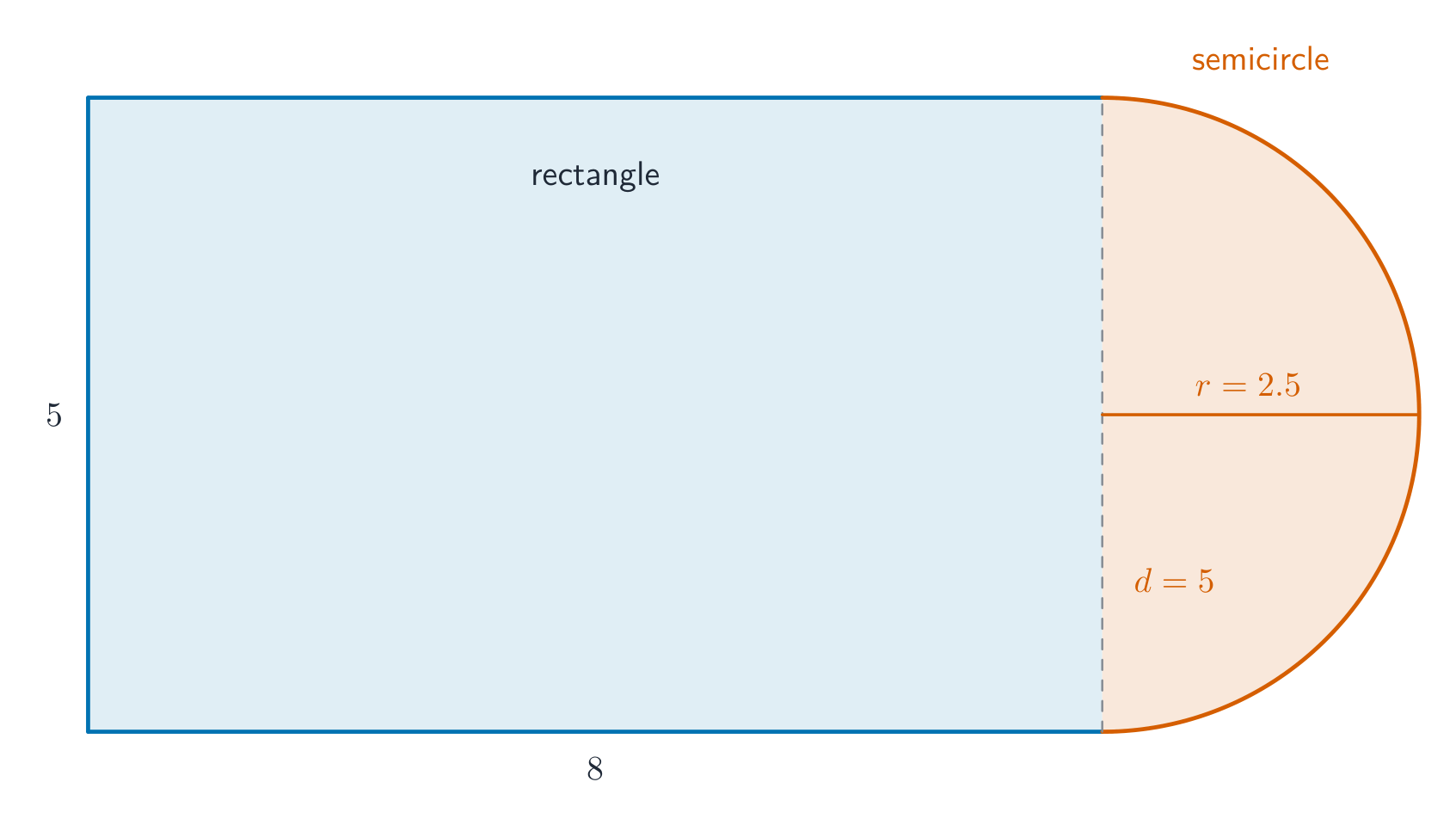
Pisahkan bangun gabungan menjadi bagian-bagian yang Anda ketahui — di sini persegi panjang ditambah setengah lingkaran — lalu tambahkan luasnya. Setengah lingkaran tersebut memiliki jari-jari $2.5\text{ cm}$:
$$\text{area} = 8 \times 5 + \tfrac{1}{2}\pi (2.5)^{2} = 40 + 3.125\pi \approx 49.8\text{ cm}^{2}.$$Explore · JelajahiCompound shape route · Strategi bangun majemuk
Break a compound shape into simple parts, then recombine. · Belah bangun majemuk menjadi bagian sederhana, lalu gabungkan kembali.
Vocabulary · Kosa kata Train · LatihEnglish Bahasa Indonesia compound shape/ˈkɒmpaʊnd ʃeɪp/ bentuk majemuk hemisphere/ˈhemɪsfɪə/ hemisfer frustum/ˈfrʌstəm/ frustum 5.5
Exam tips · Tips ujian
English- Match the formula to the shape: the area of a circle is $\pi r^2$, the circumference is $\pi d$ (or $2\pi r$) — do not mix them up.
- Keep units consistent, and remember area units are squared and volume units cubed (e.g. $1\text{ m}^2 = 10\,000\text{ cm}^2$).
- For an arc or sector, take the fraction $\frac{\theta}{360}$ of the whole circumference or area.
- Surface area is the total of all the faces — draw the net if you are unsure. Leave an answer in terms of $\pi$ only if the question allows it.
Bahasa Indonesia- Cocokkan rumus dengan bangun: luas lingkaran adalah $\pi r^2$, kelilingnya adalah $\pi d$ (atau $2\pi r$) — jangan tertukar.
- Pertahankan satuan tetap konsisten, dan ingatlah bahwa satuan luas dikuadratkan dan satuan volume dipangkatkan tiga (misalnya $1\text{ m}^2 = 10\,000\text{ cm}^2$).
- Untuk busur atau juring, ambil pecahan $\frac{\theta}{360}$ dari seluruh keliling atau luas.
- Luas permukaan adalah total dari semua sisi — gambarlah net jika Anda ragu. Biarkan jawaban dalam bentuk $\pi$ saja jika soal mengizinkannya.
-
6
Trigonometry · Trigonometri
Watch lesson · Tonton pelajaranEnglishThis handout covers Topic 6, Trigonometry. Parts marked (Extended) are only tested on the Extended papers; everything else is for both levels. Give angle answers to one decimal place.
Bahasa IndonesiaLembar kerja ini mencakup Topik 6, Trigonometri. Bagian yang ditandai (Tingkat Lanjut) hanya diujikan dalam kertas Tingkat Lanjut; semuanya lainnya berlaku untuk kedua tingkatan. Berikan jawaban sudut hingga satu tempat desimal.
6.1
Pythagoras' theorem · Teorema Pythagoras

Syllabus · Silabus
EnglishSubject content Notes and examples Know and use Pythagoras’ theorem. Bahasa IndonesiaKonten mata pelajaran Catatan dan contoh Tahu dan gunakan teorema Pythagoras. Source: Cambridge International syllabus · Sumber: Silabus Cambridge International
EnglishPythagoras: the rearrangement proof Pythagoras' theorem 勾股定理 links the three sides of a right-angled triangle 直角三角形 (a triangle 三角形 with one $90^{\circ}$ angle). If the longest side (the hypotenuse 斜边, opposite the right angle) is $c$, then
$$a^{2} + b^{2} = c^{2}.$$Use it to find a missing side.
Worked example. A right-angled triangle has a hypotenuse of $13\text{ cm}$ and one short side of $5\text{ cm}$. Find the other short side.
$$b^{2} = 13^{2} - 5^{2} = 169 - 25 = 144, \qquad b = \sqrt{144} = 12\text{ cm}.$$Bahasa IndonesiaPythagoras: pembuktian penyusunan ulang Teorema Pythagoras menghubungkan tiga sisi segitiga siku-siku (sebuah segitiga dengan satu sudut $90^{\circ}$). Jika sisi terpanjang (sisi miring, berhadapan dengan sudut siku-siku) adalah $c$, maka
$$a^{2} + b^{2} = c^{2}.$$Gunakan untuk mencari sisi yang hilang.
Pythagoras sebagai luas: kuadrat pada dua sisi terpendek ($9+16$) jika dijumlahkan sama dengan kuadrat pada sisi miring ($25$). Contoh terpecahkan. Sebuah segitiga siku-siku memiliki sisi miring $13\text{ cm}$ dan salah satu sisi pendek $5\text{ cm}$. Tentukan sisi pendek lainnya.
$$b^{2} = 13^{2} - 5^{2} = 169 - 25 = 144, \qquad b = \sqrt{144} = 12\text{ cm}.$$Explore · JelajahiPythagoras' theorem · Teorema Pythagoras
Change the two short sides and see $a^2 + b^2 = c^2$ — the squares on the sides really do add up. · Ubah dua sisi pendek dan lihat $a^2 + b^2 = c^2$ — kuadrat pada sisi-sisi tersebut benar-benar menjumlahkan.
6.2
Trigonometry in right-angled triangles · Trigonometri dalam segitiga siku-siku

Syllabus · Silabus
EnglishSubject content Notes and examples 1 Know and use the sine, cosine and tangent ratios for acute angles in calculations involving sides and angles of a right-angled triangle. Angles will be given in degrees and answers should be written in degrees, with decimals correct to one decimal place. 2 Solve problems in two dimensions using Pythagoras’ theorem and trigonometry. Knowledge of bearings may be required. Bahasa IndonesiaKonten mata pelajaran Catatan dan contoh 1 Pahami dan gunakan rasio sinus, kosinus, dan tangen untuk sudut lancip dalam perhitungan yang melibatkan sisi dan sudut segitiga siku-siku. Sudut akan diberikan dalam derajat dan jawaban harus ditulis dalam derajat, dengan desimal benar hingga satu tempat desimal. 2 Selesaikan masalah dua dimensi menggunakan teorema Pythagoras dan trigonometri. Pengetahuan tentang arah mata angin mungkin diperlukan. EnglishSubject content Notes and examples 1 Know and use the sine, cosine and tangent ratios for acute angles in calculations involving sides and angles of a right-angled triangle. Angles will be given in degrees and answers should be written in degrees, with decimals correct to one decimal place. 2 Solve problems in two dimensions using Pythagoras’ theorem and trigonometry. Knowledge of bearings may be required. 3 Know that the perpendicular distance from a point to a line is the shortest distance to the line. 4 Carry out calculations involving angles of elevation and depression. Bahasa IndonesiaKonten mata pelajaran Catatan dan contoh 1 Pahami dan gunakan rasio sinus, kosinus, dan tangen untuk sudut lancip dalam perhitungan yang melibatkan sisi dan sudut segitiga siku-siku. Sudut akan diberikan dalam derajat dan jawaban harus ditulis dalam derajat, dengan desimal benar hingga satu tempat desimal. 2 Selesaikan masalah dua dimensi menggunakan teorema Pythagoras dan trigonometri. Pengetahuan tentang arah mata angin mungkin diperlukan. 3 Tahu bahwa jarak tegak lurus dari sebuah titik ke sebuah garis adalah jarak terpendek ke garis tersebut. 4 Lakukan perhitungan yang melibatkan sudut elevasi dan depresi. Source: Cambridge International syllabus · Sumber: Silabus Cambridge International
EnglishSOH CAH TOA: the ratio belongs to the angle Label the sides from the angle you are using: the opposite 对边 (across from the angle), the adjacent 邻边 (next to the angle), and the hypotenuse. The three ratios are the sine 正弦, cosine 余弦 and tangent ratio 正切 (sin, cos, tan):
$$\sin\theta = \frac{\text{opp}}{\text{hyp}}, \qquad \cos\theta = \frac{\text{adj}}{\text{hyp}}, \qquad \tan\theta = \frac{\text{opp}}{\text{adj}}.$$Remember them as SOH-CAH-TOA. To find an angle, use the inverse ($\sin^{-1}$, $\cos^{-1}$, $\tan^{-1}$).
Worked example (find a side). In a right-angled triangle the hypotenuse is $10\text{ cm}$ and the angle is $30^{\circ}$. Find the opposite side.
$$\text{opp} = 10 \times \sin 30^{\circ} = 10 \times 0.5 = 5\text{ cm}.$$Worked example (find an angle). The opposite side is $4\text{ cm}$ and the adjacent side is $3\text{ cm}$.
$$\tan\theta = \frac{4}{3}, \qquad \theta = \tan^{-1}\!\left(\frac{4}{3}\right) = 53.1^{\circ}.$$Bahasa IndonesiaSOH CAH TOA: rasio sesuai dengan sudut Berikan label pada sisi dari sudut yang Anda gunakan: sisi depan (di seberang sudut), sisi samping (di sebelah sudut), dan hipotenusa. Tiga rasio adalah rasio sinus, rasio kosinus, dan rasio tangen (sin, cos, tan):
$$\sin\theta = \frac{\text{opp}}{\text{hyp}}, \qquad \cos\theta = \frac{\text{adj}}{\text{hyp}}, \qquad \tan\theta = \frac{\text{opp}}{\text{adj}}.$$Ingatlah sebagai SOH-CAH-TOA. Untuk mencari sudut, gunakan inversnya ($\sin^{-1}$, $\cos^{-1}$, $\tan^{-1}$).
Sebutkan nama sisi dari sudut $\theta$: sisi depan berada di seberangnya, sisi samping di sebelahnya, dan hipotenusa berhadapan dengan sudut siku-siku (SOH-CAH-TOA). Contoh terpecahkan (mencari sisi). Dalam segitiga siku-siku, hipotenusanya adalah $10\text{ cm}$ dan sudutnya $30^{\circ}$. Temukan sisi depannya.
$$\text{opp} = 10 \times \sin 30^{\circ} = 10 \times 0.5 = 5\text{ cm}.$$Contoh terpecahkan (mencari sudut). Sisi depannya adalah $4\text{ cm}$ dan sisi sampingnya adalah $3\text{ cm}$.
$$\tan\theta = \frac{4}{3}, \qquad \theta = \tan^{-1}\!\left(\frac{4}{3}\right) = 53.1^{\circ}.$$Explore · JelajahiSine, cosine and tangent · Sine, kosinus, dan tangen
Drag the angle on the unit circle to see where sin, cos and tan come from. · Tarik sudut pada lingkaran satuan untuk melihat dari mana sin, cos, dan tan berasal.
Vocabulary · Kosa kata Train · LatihEnglish Bahasa Indonesia Pythagoras' theorem/paɪˈθæɡərəs ˈθɪərəm/ Teorema Pythagoras right-angled triangle/raɪt ˈæŋɡld ˈtraɪæŋɡl/ segitiga siku-siku triangle/ˈtraɪæŋɡl/ segitiga hypotenuse/haɪˈpɒtənjuːs/ sisi miring opposite/ˈɒpəzɪt/ kebalikan adjacent/əˈdʒeɪsənt/ samping 6.2
Angles of elevation and depression (Extended) · Sudut elevasi dan depresi (Lanjutan)
Syllabus · Silabus
EnglishSubject content Notes and examples 1 Know and use the sine, cosine and tangent ratios for acute angles in calculations involving sides and angles of a right-angled triangle. Angles will be given in degrees and answers should be written in degrees, with decimals correct to one decimal place. 2 Solve problems in two dimensions using Pythagoras’ theorem and trigonometry. Knowledge of bearings may be required. 3 Know that the perpendicular distance from a point to a line is the shortest distance to the line. 4 Carry out calculations involving angles of elevation and depression. Bahasa IndonesiaKonten mata pelajaran Catatan dan contoh 1 Pahami dan gunakan rasio sinus, kosinus, dan tangen untuk sudut lancip dalam perhitungan yang melibatkan sisi dan sudut segitiga siku-siku. Sudut akan diberikan dalam derajat dan jawaban harus ditulis dalam derajat, dengan desimal benar hingga satu tempat desimal. 2 Selesaikan masalah dua dimensi menggunakan teorema Pythagoras dan trigonometri. Pengetahuan tentang arah mata angin mungkin diperlukan. 3 Tahu bahwa jarak tegak lurus dari sebuah titik ke sebuah garis adalah jarak terpendek ke garis tersebut. 4 Lakukan perhitungan yang melibatkan sudut elevasi dan depresi. Source: Cambridge International syllabus · Sumber: Silabus Cambridge International
EnglishThe angle of elevation 仰角 is the angle up from the horizontal to an object above you. The angle of depression 俯角 is the angle down from the horizontal to an object below you. The shortest distance from a point to a line is the perpendicular 垂直 distance.
Worked example. From a point $50\text{ m}$ from the foot of a tower, the angle of elevation to the top is $40^{\circ}$. Find the height of the tower.
$$\text{height} = 50 \times \tan 40^{\circ} = 50 \times 0.839 = 42.0\text{ m}.$$Bahasa IndonesiaMelihat ke atas ke sebuah menara melibatkan sudut elevasi. Sudut elevasi adalah sudut ke atas dari garis horizontal menuju objek di atas Anda. Sudut depresi adalah sudut ke bawah dari garis horizontal menuju objek di bawah Anda. Jarak terpendek dari sebuah titik ke sebuah garis adalah jarak tegak lurus.
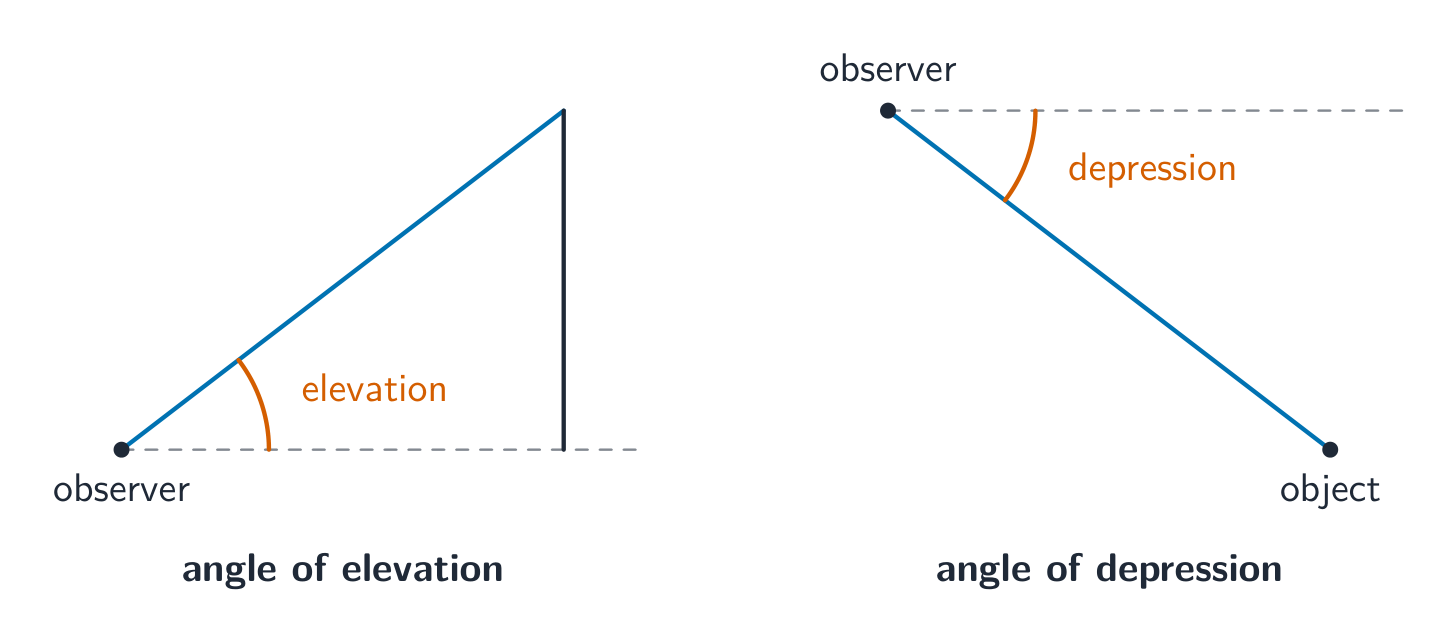
Sudut elevasi melihat ke atas dari horizontal; sudut depresi melihat ke bawah. Contoh terpecahkan. Dari titik $50\text{ m}$ dari dasar sebuah menara, sudut elevasi ke puncak adalah $40^{\circ}$. Temukan tinggi menara tersebut.
$$\text{height} = 50 \times \tan 40^{\circ} = 50 \times 0.839 = 42.0\text{ m}.$$6.3
Exact trigonometric values (Extended) · Nilai trigonometri eksak (Lanjutan)

Syllabus · Silabus
EnglishSubject content Notes and examples Know the exact values of: 1 $\sin x$ and $\cos x$ for $x = 0^\circ, 30^\circ, 45^\circ, 60^\circ$ and $90^\circ$. 2 $\tan x$ for $x = 0^\circ, 30^\circ, 45^\circ$ and $60^\circ$. Bahasa IndonesiaKonten mata pelajaran Catatan dan contoh Tahu nilai eksak dari: 1 $\sin x$ dan $\cos x$ untuk $x = 0^\circ, 30^\circ, 45^\circ, 60^\circ$ dan $90^\circ$. 2 $\tan x$ untuk $x = 0^\circ, 30^\circ, 45^\circ$ dan $60^\circ$. Source: Cambridge International syllabus · Sumber: Silabus Cambridge International
EnglishYou must know these exact values without a calculator.
$x$ $0^{\circ}$ $30^{\circ}$ $45^{\circ}$ $60^{\circ}$ $90^{\circ}$ $\sin x$ $0$ $\tfrac{1}{2}$ $\tfrac{\sqrt{2}}{2}$ $\tfrac{\sqrt{3}}{2}$ $1$ $\cos x$ $1$ $\tfrac{\sqrt{3}}{2}$ $\tfrac{\sqrt{2}}{2}$ $\tfrac{1}{2}$ $0$ $\tan x$ $0$ $\tfrac{1}{\sqrt{3}}$ $1$ $\sqrt{3}$ — Bahasa IndonesiaAnda harus menghafal nilai-nilai eksak ini tanpa kalkulator.
$x$ $0^{\circ}$ $30^{\circ}$ $45^{\circ}$ $60^{\circ}$ $90^{\circ}$ $\sin x$ $0$ $\tfrac{1}{2}$ $\tfrac{\sqrt{2}}{2}$ $\tfrac{\sqrt{3}}{2}$ $1$ $\cos x$ $1$ $\tfrac{\sqrt{3}}{2}$ $\tfrac{\sqrt{2}}{2}$ $\tfrac{1}{2}$ $0$ $\tan x$ $0$ $\tfrac{1}{\sqrt{3}}$ $1$ $\sqrt{3}$ — Dua segitiga istimewa ini adalah sumber nilai-nilai eksak — layak untuk dihafal. 6.4
Graphs and trigonometric equations (Extended) · Grafik dan persamaan trigonometri (Lanjutan)

Syllabus · Silabus
EnglishSubject content Notes and examples 1 Recognise, sketch and interpret the following graphs for $0^\circ \leqslant x \leqslant 360^\circ$: • $y = \sin x$ • $y = \cos x$ • $y = \tan x$. 2 Solve trigonometric equations involving $\sin x$, $\cos x$ or $\tan x$, for $0^\circ \leqslant x \leqslant 360^\circ$. e.g. solve: • $\sin x = \frac{\sqrt{3}}{2}$ for $0^\circ \leqslant x \leqslant 360^\circ$ • $2 \cos x + 1 = 0$ for $0^\circ \leqslant x \leqslant 360^\circ$. Bahasa IndonesiaKonten mata pelajaran Catatan dan contoh 1 Kenali, sketsa dan tafsirkan grafik berikut untuk $0^\circ \leqslant x \leqslant 360^\circ$: • $y = \sin x$ • $y = \cos x$ • $y = \tan x$. 2 Selesaikan persamaan trigonometri yang melibatkan $\sin x$, $\cos x$ atau $\tan x$, untuk $0^\circ \leqslant x \leqslant 360^\circ$. Mis. selesaikan: • $\sin x = \frac{\sqrt{3}}{2}$ untuk $0^\circ \leqslant x \leqslant 360^\circ$ • $2 \cos x + 1 = 0$ untuk $0^\circ \leqslant x \leqslant 360^\circ$. Source: Cambridge International syllabus · Sumber: Silabus Cambridge International
EnglishFor $0^{\circ} \leqslant x \leqslant 360^{\circ}$:
- $y = \sin x$ is a wave starting at $0$, peaking at $90^{\circ}$, back to $0$ at $180^{\circ}$, down to $-1$ at $270^{\circ}$.
- $y = \cos x$ is the same wave but starting at $1$.
- $y = \tan x$ rises steeply and repeats every $180^{\circ}$.
A trigonometric equation 三角方程 often has more than one answer in this range. Use the graph (or the symmetry of the wave) to find them all.
Worked example. Solve $\sin x = \tfrac{\sqrt{3}}{2}$ for $0^{\circ} \leqslant x \leqslant 360^{\circ}$.
One answer is $x = 60^{\circ}$. The sine wave is also $\tfrac{\sqrt{3}}{2}$ at $180^{\circ} - 60^{\circ} = 120^{\circ}$. So $x = 60^{\circ}$ or $120^{\circ}$.
Worked example. Solve $2\cos x + 1 = 0$ for $0^{\circ} \leqslant x \leqslant 360^{\circ}$.
$$\cos x = -\tfrac{1}{2} \;\Rightarrow\; x = 120^{\circ} \text{ or } 240^{\circ}.$$Bahasa IndonesiaSebuah roda Ferris: sebuah titik di tepinya melacak kurva sinus saat berputar. Untuk $0^{\circ} \leqslant x \leqslant 360^{\circ}$:
- $y = \sin x$ adalah gelombang yang dimulai dari $0$, mencapai puncak di $90^{\circ}$, kembali ke $0$ di $180^{\circ}$, turun ke $-1$ di $270^{\circ}$.
- $y = \cos x$ adalah gelombang yang sama tetapi dimulai dari $1$.
- $y = \tan x$ naik curam dan berulang setiap $180^{\circ}$.

$y=\sin x$ dan $y=\cos x$ adalah gelombang halus antara $-1$ dan $1$; kosinus adalah sinus yang digeser ke kiri sebesar $90^\circ$. Sebuah persamaan trigonometri sering memiliki lebih dari satu jawaban dalam rentang ini. Gunakan grafik (atau simetri gelombang) untuk menemukan semuanya.
Contoh terpecahkan. Selesaikan $\sin x = \tfrac{\sqrt{3}}{2}$ untuk $0^{\circ} \leqslant x \leqslant 360^{\circ}$.
Salah satu jawabannya adalah $x = 60^{\circ}$. Gelombang sinus juga $\tfrac{\sqrt{3}}{2}$ pada $180^{\circ} - 60^{\circ} = 120^{\circ}$. Jadi $x = 60^{\circ}$ atau $120^{\circ}$.
Contoh terpecahkan. Selesaikan $2\cos x + 1 = 0$ untuk $0^{\circ} \leqslant x \leqslant 360^{\circ}$.
$$\cos x = -\tfrac{1}{2} \;\Rightarrow\; x = 120^{\circ} \text{ or } 240^{\circ}.$$Explore · JelajahiTrig graphs & equations · Grafik & persamaan trigonometri
(cos θ, sin θ)
As θ turns, sin and cos trace their waves — and repeat every 360°. · Saat θ berubah, sin dan cos melacak gelombang mereka — dan berulang setiap 360°.
Vocabulary · Kosa kata Train · LatihEnglish Bahasa Indonesia sine/saɪn/ sine cosine/ˈkəʊsaɪn/ kosinus tangent ratio/ˈtændʒənt ˈreɪʃɪəʊ/ rasio tangen angle of elevation/ˈæŋɡl ɒv ˌelɪˈveɪʃn/ sudut elevasi angle of depression/ˈæŋɡl ɒv dɪˈpreʃn/ sudut depresi perpendicular/ˌpɜːpənˈdɪkjʊlə/ tegak lurus trigonometric equation/ˌtrɪɡənəʊˈmetrɪk ɪˈkweɪʒn/ persamaan trigonometri 6.5
The sine and cosine rules (Extended) · Aturan sinus dan kosinus (Lanjutan)

Syllabus · Silabus
EnglishSubject content Notes and examples 1 Use the sine and cosine rules in calculations involving lengths and angles for any triangle. Includes problems involving obtuse angles and the ambiguous case. 2 Use the formula $\text{area of triangle} = \frac{1}{2} ab \sin C$. The sine and cosine rules and the formula for area of a triangle are given in the List of formulas. Bahasa IndonesiaKonten mata pelajaran Catatan dan contoh 1 Gunakan aturan sinus dan kosinus dalam perhitungan yang melibatkan panjang dan sudut untuk sembarang segitiga. Termasuk masalah yang melibatkan sudut tumpul dan kasus ambigu. 2 Gunakan rumus $\text{area of triangle} = \frac{1}{2} ab \sin C$. Aturan sinus dan aturan kosinus serta rumus untuk luas segitiga tercantum dalam Daftar rumus. Source: Cambridge International syllabus · Sumber: Silabus Cambridge International
EnglishFor any triangle (not just right-angled), with sides $a, b, c$ opposite angles $A, B, C$:
$$\text{sine rule:}\quad \frac{a}{\sin A} = \frac{b}{\sin B} = \frac{c}{\sin C},$$$$\text{cosine rule:}\quad a^{2} = b^{2} + c^{2} - 2bc\cos A.$$Use the sine rule 正弦定理 when you have a side and its opposite angle. Use the cosine rule 余弦定理 when you have two sides and the angle between them, or all three sides. With the sine rule, watch for the ambiguous case 两解情况, where an angle could be acute or obtuse.
The area of any triangle is
$$\text{area} = \tfrac{1}{2}ab\sin C.$$Worked example. A triangle has $b = 7\text{ cm}$, $c = 8\text{ cm}$ and the angle between them $A = 40^{\circ}$. Find side $a$.
$$a^{2} = 7^{2} + 8^{2} - 2(7)(8)\cos 40^{\circ} = 113 - 112 \times 0.766 = 27.2,$$$$a = \sqrt{27.2} = 5.2\text{ cm}.$$Bahasa IndonesiaUntuk segala jenis segitiga (tidak hanya siku-siku), dengan sisi-sisi $a, b, c$ berhadapan dengan sudut-sudut $A, B, C$:
$$\text{sine rule:}\quad \frac{a}{\sin A} = \frac{b}{\sin B} = \frac{c}{\sin C},$$$$\text{cosine rule:}\quad a^{2} = b^{2} + c^{2} - 2bc\cos A.$$Dalam segala segitiga, sisi-sisi $a$, $b$, $c$ berhadapan dengan sudut-sudut $A$, $B$, $C$ yang memiliki huruf yang sama. Gunakan aturan sinus ketika Anda memiliki satu sisi dan sudut di hadapannya. Gunakan aturan kosinus ketika Anda memiliki dua sisi dan sudut di antaranya, atau ketiga sisinya. Dengan aturan sinus, waspadalah terhadap kasus ambigu, di mana sebuah sudut bisa berupa lancip atau tumpul.
Luas segitiga apa pun adalah
$$\text{area} = \tfrac{1}{2}ab\sin C.$$Contoh terpecahkan. Sebuah segitiga memiliki $b = 7\text{ cm}$, $c = 8\text{ cm}$, dan sudut di antaranya $A = 40^{\circ}$. Temukan sisi $a$.
$$a^{2} = 7^{2} + 8^{2} - 2(7)(8)\cos 40^{\circ} = 113 - 112 \times 0.766 = 27.2,$$$$a = \sqrt{27.2} = 5.2\text{ cm}.$$Explore · JelajahiSine & cosine rule · Aturan sinus & kosinus
Two sides and the angle between them fix the triangle: the cosine rule finds the third side, the sine rule the other angles. · Dua sisi dan sudut di antaranya menentukan segitiga: aturan kosinus mencari sisi ketiga, aturan sinus mencari sudut lainnya.
Explore · JelajahiWhat sin and cos mean · Apa arti sin dan cos
Spin the angle on the unit circle: the horizontal leg is cos θ and the vertical leg is sin θ — the same ratios the sine and cosine rules use. · Putar sudut pada lingkaran satuan: kaki horizontal adalah cos θ dan kaki vertikal adalah sin θ — rasio yang sama yang digunakan oleh aturan sinus dan kosinus.
Vocabulary · Kosa kata Train · LatihEnglish Bahasa Indonesia sine rule/saɪn ruːl/ aturan sinus cosine rule/ˈkəʊsaɪn ruːl/ aturan kosinus ambiguous case/æmˈbɪɡjuːəs keɪs/ kasus ambigu plane/pleɪn/ bidang 6.6
Pythagoras and trigonometry in 3D (Extended) · Pythagoras dan trigonometri dalam 3D (Lanjutan)
Syllabus · Silabus
EnglishSubject content Notes and examples Carry out calculations and solve problems in three dimensions using Pythagoras' theorem and trigonometry, including calculating the angle between a line and a plane. Bahasa IndonesiaKonten mata pelajaran Catatan dan contoh Lakukan perhitungan dan selesaikan masalah dalam tiga dimensi menggunakan teorema Pythagoras dan trigonometri, termasuk menghitung sudut antara garis dan bidang. Source: Cambridge International syllabus · Sumber: Silabus Cambridge International
EnglishIn three dimensions, find a right-angled triangle inside the solid, then use Pythagoras or trigonometry on it. A common task is the angle between a line and a flat surface (a plane 平面).
Worked example. A box has a base $6\text{ cm}$ by $8\text{ cm}$ and height $5\text{ cm}$. Find the angle between a space diagonal and the base.
First the base diagonal: $\sqrt{6^{2} + 8^{2}} = \sqrt{100} = 10\text{ cm}$. This diagonal and the height form a right-angled triangle, so the angle $\theta$ with the base is
$$\tan\theta = \frac{5}{10} = 0.5, \qquad \theta = \tan^{-1}(0.5) = 26.6^{\circ}.$$Bahasa IndonesiaDalam tiga dimensi, temukan segitiga siku-siku di dalam benda padat, lalu gunakan Pythagoras atau trigonometri pada segitiga tersebut. Tugas yang umum adalah sudut antara sebuah garis dan bidang datar (sebuah bidang).
Contoh terpecahkan. Sebuah kotak memiliki alas $6\text{ cm}$ × $8\text{ cm}$ dan tinggi $5\text{ cm}$. Temukan sudut antara diagonal ruang dan alas.
Pertama-tama diagonal alas: $\sqrt{6^{2} + 8^{2}} = \sqrt{100} = 10\text{ cm}$. Diagonal ini dan tingginya membentuk segitiga siku-siku, sehingga sudut $\theta$ terhadap alas adalah
$$\tan\theta = \frac{5}{10} = 0.5, \qquad \theta = \tan^{-1}(0.5) = 26.6^{\circ}.$$Explore · JelajahiPythagoras' theorem · Teorema Pythagoras
In a right-angled triangle a² + b² = c². The same idea, applied twice, gives lengths inside 3-D solids. · Dalam segitiga siku-siku a² + b² = c². Ide yang sama, diterapkan dua kali, memberikan panjang di dalam benda 3-D.
6.6
Exam tips · Tips ujian
English- Use Pythagoras ($a^2 + b^2 = c^2$) when there is no angle; use SOH-CAH-TOA when an angle is involved.
- The hypotenuse is always opposite the right angle. Label the sides (opposite, adjacent, hypotenuse) relative to the angle you are using.
- To find an angle, use the inverse ($\sin^{-1}$, $\cos^{-1}$, $\tan^{-1}$), and check your calculator is set to degrees.
- For a triangle with no right angle, use the sine rule or the cosine rule — the cosine rule when you know two sides and the angle between them.
Bahasa Indonesia- Gunakan Pythagoras ($a^2 + b^2 = c^2$) jika tidak ada sudut; gunakan SOH-CAH-TOA jika melibatkan sudut.
- Hipotenusa selalu berhadapan dengan sudut siku-siku. Berikan label pada sisi (depan, samping, hipotenusa) relatif terhadap sudut yang Anda gunakan.
- Untuk mencari sudut, gunakan inversnya ($\sin^{-1}$, $\cos^{-1}$, $\tan^{-1}$), dan pastikan kalkulator Anda diatur ke derajat.
- Untuk segitiga tanpa sudut siku-siku, gunakan aturan sinus atau aturan kosinus — aturan kosinus jika Anda mengetahui dua sisi dan sudut di antaranya.
-
7
Transformations and vectors · Transformasi dan vektor
Watch lesson · Tonton pelajaranEnglishThis handout covers Topic 7, Transformations and vectors. Parts marked (Extended) are only tested on the Extended papers; everything else is for both levels. Vectors as a whole topic are Extended.
Bahasa IndonesiaLembar kerja ini mencakup Topik 7, Transformasi dan vektor. Bagian yang ditandai (Lanjutan) hanya diujikan dalam kertas lanjutan; semua lainnya berlaku untuk kedua tingkat. Vektor sebagai topik keseluruhan termasuk lanjutan.
7.1
Transformations · Transformasi

Syllabus · Silabus
EnglishSubject content Notes and examples Recognise, describe and draw the following transformations: Questions will not involve combinations of transformations. A ruler must be used for all straight edges. 1 Reflection of a shape in a vertical or horizontal line. 2 Rotation of a shape about the origin, vertices or midpoints of edges of the shape, through multiples of 90°. 3 Enlargement of a shape from a centre by a scale factor. Positive and fractional scale factors only. 4 Translation of a shape by a vector $\begin{pmatrix} x \\ y \end{pmatrix}$. Bahasa IndonesiaKonten mata pelajaran Catatan dan contoh Kenali, jelaskan, dan gambar transformasi berikut: Soal tidak akan melibatkan kombinasi transformasi. Penggaris harus digunakan untuk semua garis lurus. 1 Refleksi bentuk pada garis vertikal atau horizontal. 2 Rotasi bentuk terhadap titik asal, titik sudut, atau titik tengah sisi-sisi bentuk, dengan kelipatan 90°. 3 Perbesaran suatu bangun dari pusat dengan faktor skala. Hanya faktor skala positif dan pecahan. 4 Translasi bentuk oleh vektor $\begin{pmatrix} x \\ y \end{pmatrix}$. EnglishTransformations Notes and examples Recognise, describe and draw the following transformations: Questions may involve combinations of transformations. A ruler must be used for all straight edges. 1 Reflection of a shape in a straight line. 2 Rotation of a shape about a centre through multiples of 90°. 3 Enlargement of a shape from a centre by a scale factor. Positive, fractional and negative scale factors may be used. 4 Translation of a shape by a vector $\begin{pmatrix} x \\ y \end{pmatrix}$. Bahasa IndonesiaTransformasi Catatan dan contoh Kenali, jelaskan, dan gambar transformasi berikut: Soal mungkin melibatkan kombinasi transformasi. Penggaris harus digunakan untuk semua garis lurus. 1 Refleksi bangun pada garis lurus. 2 Rotasi bangun di sekitar pusat dengan kelipatan 90°. 3 Perbesaran bangun dari sebuah pusat dengan faktor skala. Faktor skala positif, pecahan, dan negatif dapat digunakan. 4 Translasi bentuk oleh vektor $\begin{pmatrix} x \\ y \end{pmatrix}$. Source: Cambridge International syllabus · Sumber: Silabus Cambridge International
EnglishTranslate, reflect, rotate, enlarge A transformation 变换 changes the position or size of a shape. The original is the object and the result is the image. There are four types. When asked to describe one, you must name the type and give all the details below.
Reflection
A reflection 反射 flips the shape over a mirror line 对称轴. Each image point is the same distance from the line as the object point, on the other side.
- To describe it, give the equation of the mirror line (for Core, a horizontal or vertical line; Extended allows any line such as $y = x$).
Worked example. Reflect the point $(3, 2)$ in the $y$-axis. Only the sign of $x$ changes: the image is $(-3, 2)$. (In the $x$-axis it would be $(3, -2)$.)
Rotation
A rotation 旋转 turns the shape about a fixed point, the centre 中心 of rotation, through multiples of $90^{\circ}$.
- To describe it, give the centre, the angle, and the direction (clockwise or anticlockwise).
Worked example. Rotate $(3, 1)$ by $90^{\circ}$ anticlockwise about the origin. The rule is $(x, y) \to (-y, x)$, so the image is $(-1, 3)$.
Enlargement
An enlargement 放大 changes the size by a scale factor 比例因子 $k$, measured from a fixed centre. Each distance from the centre is multiplied by $k$.
- To describe it, give the centre and the scale factor. A fractional scale factor (between 0 and 1) makes the shape smaller. For Extended, $k$ may also be negative (the image appears on the other side of the centre).
Worked example. Enlarge $(1, 2)$ from the origin by scale factor $2$. Multiply both coordinates: the image is $(2, 4)$.
Translation
A translation 平移 slides the shape with no turning, by a vector 向量 written as a column vector 列向量 $\begin{pmatrix} x \\ y \end{pmatrix}$ ($x$ across, $y$ up).
Worked example. Translate $(5, 3)$ by $\begin{pmatrix} -2 \\ 4 \end{pmatrix}$: move $2$ left and $4$ up to get $(3, 7)$.
(Extended: a question may ask you to combine two transformations and describe the single transformation that has the same effect.)
Bahasa IndonesiaTranslasi, refleksi, rotasi, pembesaran Ubin geometris dibangun dengan memantulkan, memutar, dan mentranslasikan bentuk-bentuk. Sebuah transformasi mengubah posisi atau ukuran suatu bentuk. Bentuk aslinya disebut objek dan hasilnya disebut gambar. Ada empat jenis. Ketika diminta untuk mendeskripsikan salah satunya, Anda harus menyebutkan jenisnya dan memberikan semua detail di bawah ini.
Refleksi
Sebuah refleksi membalikkan bentuk melalui garis cermin. Setiap titik gambar berjarak sama dari garis tersebut dengan titik objek, namun di sisi yang lain.
- Untuk mendeskripsikannya, berikan persamaan garis cermin (untuk Core, garis horizontal atau vertikal; Extended mengizinkan garis apa pun seperti $y = x$).
Contoh terpecahkan. Refleksikan titik $(3, 2)$ terhadap sumbu $y$. Hanya tanda dari $x$ yang berubah: citranya adalah $(-3, 2)$. (Pada sumbu $x$ akan menjadi $(3, -2)$.)
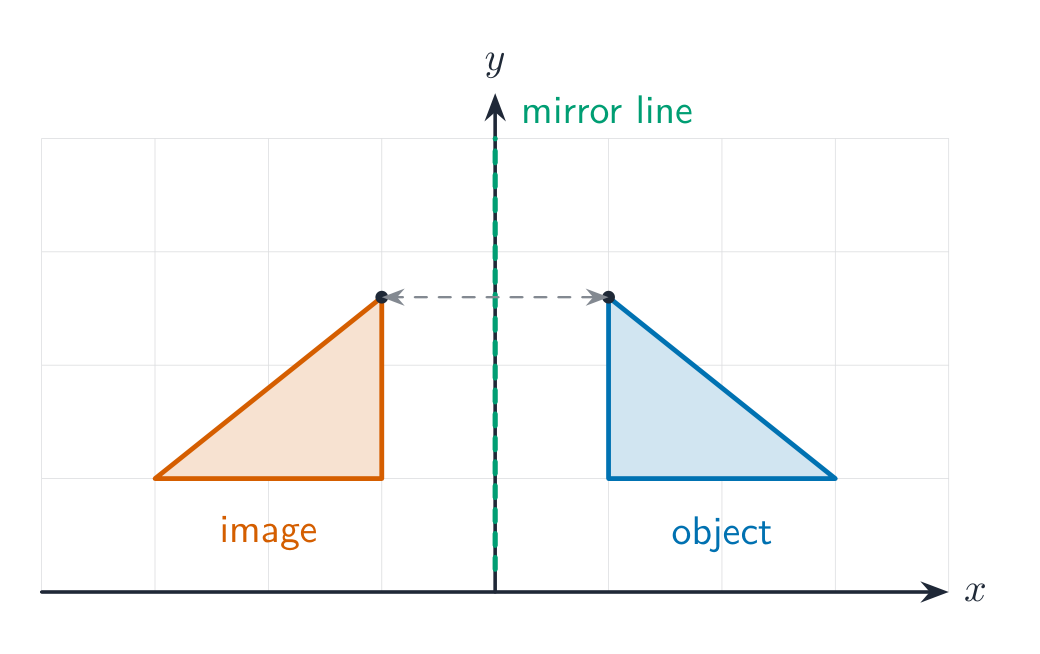
Refleksi membalikkan bentuk melintasi garis cermin (di sini sumbu $y$); setiap titik dan bayangannya memiliki jarak yang sama dari garis tersebut. Rotasi
Sebuah rotasi memutar bentuk sekitar titik tetap, yaitu pusat rotasi, melalui kelipatan dari $90^{\circ}$.
- Untuk mendeskripsikannya, berikan pusat, sudut, dan arah (searah jarum jam atau berlawanan arah jarum jam).
Contoh terpecahkan. Rotasikan $(3, 1)$ sebesar $90^{\circ}$ berlawanan arah jarum jam tentang titik asal. Aturannya adalah $(x, y) \to (-y, x)$, sehingga citranya adalah $(-1, 3)$.

Rotasi memutar bentuk tentang pusat tetap — di sini $90^\circ$ berlawanan arah jarum jam tentang titik asal. Perbesaran
Sebuah perbesaran mengubah ukuran dengan faktor skala $k$, diukur dari pusat tetap. Setiap jarak dari pusat dikalikan dengan $k$.
- Untuk mendeskripsikannya, berikan pusat dan faktor skala. Faktor skala pecahan (antara 0 dan 1) membuat bentuk lebih kecil. Untuk Extended, $k$ juga dapat negatif (citra muncul di sisi lain dari pusat).
Contoh terpecahkan. Perbesar $(1, 2)$ dari titik asal dengan faktor skala $2$. Kalikan kedua koordinat: citranya adalah $(2, 4)$.

Perbesaran mengalikan setiap jarak dari pusat dengan faktor skala (di sini $2$). Translasi
Sebuah translasi menggeser bentuk tanpa memutar, oleh vektor yang ditulis sebagai vektor kolom $\begin{pmatrix} x \\ y \end{pmatrix}$ ($x$ ke kanan, $y$ ke atas).
Contoh terpecahkan. Terapkan translasi pada $(5, 3)$ oleh $\begin{pmatrix} -2 \\ 4 \end{pmatrix}$: gerakkan $2$ ke kiri dan $4$ ke atas untuk mendapatkan $(3, 7)$.

Translasi menggeser setiap titik oleh vektor kolom yang sama, tanpa memutar. (Extended: pertanyaan mungkin meminta Anda untuk menggabungkan dua transformasi dan mendeskripsikan transformasi tunggal yang memiliki efek yang sama.)
Explore · JelajahiTransforming a shape · Mentransformasi bentuk
Translate, reflect, rotate or enlarge the shape and watch where it lands. · Terjemahkan, refleksikan, rotasikan, atau perbesar bentuk dan lihat ke mana ia mendarat.
Vocabulary · Kosa kata Train · LatihEnglish Bahasa Indonesia transformation/trænsfɔːˈmeɪʃn/ transformasi reflection/rɪˈflekʃn/ pemantulan mirror line/ˈmɪrə laɪn/ garis cermin rotation/rəʊˈteɪʃn/ rotasi centre/ˈsentə/ pusat enlargement/enˈlɑːdʒmənt/ pembesaran scale factor/skeɪl ˈfæktə/ faktor skala translation/trænˈsleɪʃn/ terjemahan 7.2
Vectors in two dimensions (Extended) · Vektor dalam dua dimensi (Extended)

Syllabus · Silabus
EnglishVectors in two dimensions Notes and examples 1 Describe a translation using a vector represented by $\begin{pmatrix} x \\ y \end{pmatrix}$, $\overrightarrow{AB}$ or $\mathbf{a}$. Vectors will be printed as $\overrightarrow{AB}$ or $\mathbf{a}$. 2 Add and subtract vectors. 3 Multiply a vector by a scalar. Bahasa IndonesiaVektor dalam dua dimensi Catatan dan contoh 1 Deskripsikan translasi menggunakan vektor yang direpresentasikan oleh $\begin{pmatrix} x \\ y \end{pmatrix}$, $\overrightarrow{AB}$ atau $\mathbf{a}$. Vektor akan dicetak sebagai $\overrightarrow{AB}$ atau $\mathbf{a}$. 2 Tambahkan dan kurangkan vektor. 3 Kalikan vektor dengan skalar. Source: Cambridge International syllabus · Sumber: Silabus Cambridge International
EnglishA vector has both size and direction. It can be written as a column vector, as $\overrightarrow{AB}$ (from $A$ to $B$), or in bold as $\mathbf{a}$.
- Add or subtract by working on the top and bottom numbers separately.
- Multiply by a scalar 标量 (an ordinary number) by multiplying both numbers.
Worked example. If $\mathbf{a} = \begin{pmatrix} 3 \\ 1 \end{pmatrix}$ and $\mathbf{b} = \begin{pmatrix} 2 \\ -4 \end{pmatrix}$, then
$$\mathbf{a} + \mathbf{b} = \begin{pmatrix} 5 \\ -3 \end{pmatrix}, \qquad 3\mathbf{a} = \begin{pmatrix} 9 \\ 3 \end{pmatrix}.$$Bahasa IndonesiaGaya seperti angin adalah vektor, dengan besaran dan arah. Vektor memiliki baik besaran maupun arah. Dapat ditulis sebagai vektor kolom, seperti $\overrightarrow{AB}$ (dari $A$ ke $B$), atau dalam huruf tebal sebagai $\mathbf{a}$.
- Tambah atau kurangkan dengan bekerja pada angka bagian atas dan bawah secara terpisah.
- Kalikan dengan skalar (angka biasa) dengan mengalikan kedua angka.
Contoh terpecahkan. Jika $\mathbf{a} = \begin{pmatrix} 3 \\ 1 \end{pmatrix}$ dan $\mathbf{b} = \begin{pmatrix} 2 \\ -4 \end{pmatrix}$, maka
$$\mathbf{a} + \mathbf{b} = \begin{pmatrix} 5 \\ -3 \end{pmatrix}, \qquad 3\mathbf{a} = \begin{pmatrix} 9 \\ 3 \end{pmatrix}.$$
Penjumlahan dengan hukum segitiga: gambar $\mathbf{b}$ dari ujung $\mathbf{a}$, dan $\mathbf{a}+\mathbf{b}$ berjalan dari awal hingga akhir. Explore · JelajahiAdding vectors · Menambahkan vektor
Drag two vectors and add them tip to tail to get the resultant. · Tarik dua vektor dan jumlahkan mereka ujung ke ekor untuk mendapatkan resultan.
Vocabulary · Kosa kata Train · LatihEnglish Bahasa Indonesia vector/ˈvektə/ vektor column vector/ˈkɒlʌm ˈvektə/ vektor kolom scalar/ˈskeɪlə/ skalar 7.3
Magnitude of a vector (Extended) · Magnitudo vektor (Extended)

Syllabus · Silabus
EnglishMagnitude of a vector Notes and examples Calculate the magnitude of a vector $\begin{pmatrix} x \\ y \end{pmatrix}$ as $\sqrt{x^2 + y^2}$. The magnitudes of vectors will be denoted by modulus signs, e.g. • $|\mathbf{a}|$ is the magnitude of $\mathbf{a}$ • $|\overrightarrow{AB}|$ is the magnitude of $\overrightarrow{AB}$. Bahasa IndonesiaMagnitudo vektor Catatan dan contoh Hitung magnitudo vektor $\begin{pmatrix} x \\ y \end{pmatrix}$ sebagai $\sqrt{x^2 + y^2}$. Magnitudo vektor akan dinyatakan dengan tanda modulus, mis. • $|\mathbf{a}|$ adalah magnitudo dari $\mathbf{a}$ • $|\overrightarrow{AB}|$ adalah magnitudo dari $\overrightarrow{AB}$. Source: Cambridge International syllabus · Sumber: Silabus Cambridge International
EnglishThe magnitude 模 (length) of a vector is found with Pythagoras. For $\begin{pmatrix} x \\ y \end{pmatrix}$,
$$\left| \begin{pmatrix} x \\ y \end{pmatrix} \right| = \sqrt{x^{2} + y^{2}}.$$Worked example. The magnitude of $\begin{pmatrix} 3 \\ 4 \end{pmatrix}$ is $\sqrt{3^{2} + 4^{2}} = \sqrt{25} = 5$.
Bahasa IndonesiaMagnitudo (panjang) dari sebuah vektor ditemukan menggunakan Pythagoras. Untuk $\begin{pmatrix} x \\ y \end{pmatrix}$,
$$\left| \begin{pmatrix} x \\ y \end{pmatrix} \right| = \sqrt{x^{2} + y^{2}}.$$Contoh terpecahkan. Magnitudo dari $\begin{pmatrix} 3 \\ 4 \end{pmatrix}$ adalah $\sqrt{3^{2} + 4^{2}} = \sqrt{25} = 5$.
Magnitudo dari $\begin{pmatrix}3\\4\end{pmatrix}$ berasal dari Pythagoras pada komponen horizontal dan vertikalnya. Vocabulary · Kosa kata Train · LatihEnglish Bahasa Indonesia magnitude/ˈmæɡnɪtjuːd/ besarnya directed line segment/daɪˈrektɪd laɪn ˈseɡmənt/ segmen garis terarah position vector/pəˈzɪʃn ˈvektə/ vektor posisi parallel/ˈpærəlel/ paralel collinear/ˈkɒlɪnɪə/ kolinear coplanar/ˌkəʊˈpleɪnə/ koplanar 7.4
Vector geometry (Extended) · Geometri vektor (Extended)
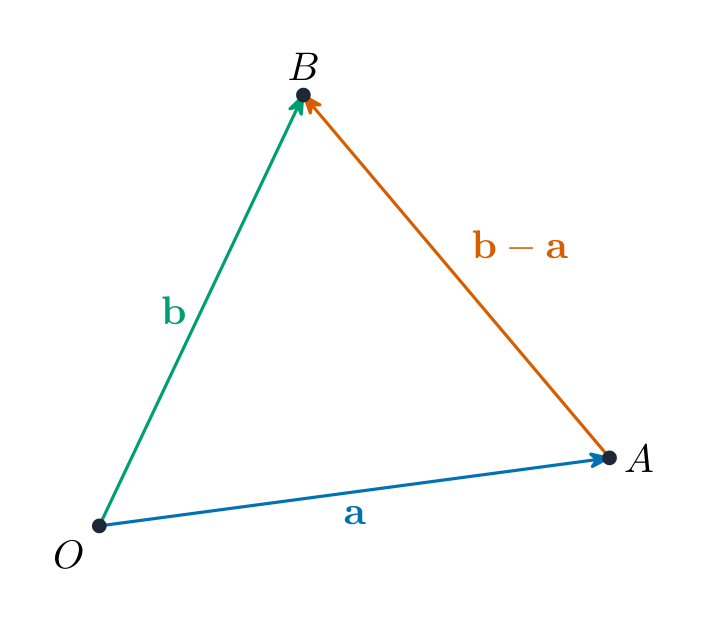
Syllabus · Silabus
EnglishVector geometry Notes and examples 1 Represent vectors by directed line segments. 2 Use position vectors. 3 Use the sum and difference of two or more vectors to express given vectors in terms of two coplanar vectors. 4 Use vectors to reason and to solve geometric problems. Examples include: • show that vectors are parallel • show that 3 points are collinear • solve vector problems involving ratio and similarity. Bahasa IndonesiaGeometri vektor Catatan dan contoh 1 Representasikan vektor dengan segaris berarah. 2 Gunakan vektor posisi. 3 Gunakan penjumlahan dan pengurangan dua vektor atau lebih untuk menyatakan vektor-vektor tertentu dalam bentuk dua vektor koplanar. 4 Gunakan vektor untuk bernalar dan menyelesaikan masalah geometri. Contoh meliputi: • tunjukkan bahwa vektor sejajar • tunjukkan bahwa 3 titik segaris • selesaikan masalah vektor yang melibatkan rasio dan kemiripan. Source: Cambridge International syllabus · Sumber: Silabus Cambridge International
EnglishA vector can be drawn as a directed line segment 有向线段 (an arrow). The position vector 位置向量 of a point is the vector from the origin $O$ to that point.
A key idea: the vector from $A$ to $B$ is
$$\overrightarrow{AB} = \mathbf{b} - \mathbf{a},$$where $\mathbf{a}$ and $\mathbf{b}$ are the position vectors of $A$ and $B$.
Two vectors are parallel 平行 if one is a scalar multiple of the other (for example $\overrightarrow{AB} = 2\,\overrightarrow{CD}$). Three points are collinear 共线 (in a straight line) if the vectors between them are parallel and share a point. You can express any vector in terms of two coplanar 共面 vectors.
Worked example. $O$ is the origin, with $\overrightarrow{OA} = \mathbf{a}$ and $\overrightarrow{OB} = \mathbf{b}$. $M$ is the midpoint of $AB$. Find $\overrightarrow{OM}$ in terms of $\mathbf{a}$ and $\mathbf{b}$.
$$\overrightarrow{OM} = \mathbf{a} + \tfrac{1}{2}\overrightarrow{AB} = \mathbf{a} + \tfrac{1}{2}(\mathbf{b} - \mathbf{a}) = \tfrac{1}{2}(\mathbf{a} + \mathbf{b}).$$Bahasa IndonesiaVektor dapat digambar sebagai segmen garis berarah (panah). Vektor posisi dari sebuah titik adalah vektor dari titik asal $O$ ke titik tersebut.
Ide kunci: vektor dari $A$ ke $B$ adalah
$$\overrightarrow{AB} = \mathbf{b} - \mathbf{a},$$di mana $\mathbf{a}$ dan $\mathbf{b}$ adalah vektor posisi dari $A$ dan $B$.
Untuk pergi dari $A$ ke $B$, bergerak kembali sepanjang $\mathbf{a}$ ke $O$ lalu maju sepanjang $\mathbf{b}$: jadi $\overrightarrow{AB} = \mathbf{b} - \mathbf{a}$. Dua vektor sejajar jika salah satu merupakan kelipatan skalar dari yang lain (misalnya $\overrightarrow{AB} = 2\,\overrightarrow{CD}$). Tiga titik kolinear (segaris) jika vektor di antara mereka sejajar dan berbagi satu titik. Anda dapat mengekspresikan vektor apa pun dalam istilah dua vektor koplanar.
Contoh terpecahkan. $O$ adalah titik asal, dengan $\overrightarrow{OA} = \mathbf{a}$ dan $\overrightarrow{OB} = \mathbf{b}$. $M$ adalah titik tengah dari $AB$. Temukan $\overrightarrow{OM}$ dalam istilah $\mathbf{a}$ dan $\mathbf{b}$.
$$\overrightarrow{OM} = \mathbf{a} + \tfrac{1}{2}\overrightarrow{AB} = \mathbf{a} + \tfrac{1}{2}(\mathbf{b} - \mathbf{a}) = \tfrac{1}{2}(\mathbf{a} + \mathbf{b}).$$Explore · JelajahiVector geometry · Geometri vektor
resultant = a + b · resultan = a + b
Combine vectors to reach a point — the resultant is the direct route. · Gabungkan vektor untuk mencapai suatu titik — resultannya adalah rute langsung.
7.4
Exam tips · Tips ujian
English- Fully describe each transformation: a translation (a vector), a reflection (the mirror line), a rotation (centre, angle and direction), an enlargement (centre and scale factor).
- A negative scale factor turns the image upside down through the centre; a fractional one (between 0 and 1) makes it smaller.
- Add vectors tip-to-tail — add the top numbers, then the bottom numbers. The magnitude of a vector comes from Pythagoras on its components.
- $\overrightarrow{AB} = \mathbf{b} - \mathbf{a}$ (end minus start). Two vectors are parallel if one is a scalar multiple of the other.
Bahasa Indonesia- Deskripsikan setiap transformasi sepenuhnya: translasi (vektor), refleksi (garis cermin), rotasi (pusat, sudut dan arah), perbesaran (pusat dan faktor skala).
- Faktor skala negatif membalikkan citra secara terbalik melalui pusat; faktor pecahan (antara 0 dan 1) membuatnya lebih kecil.
- Tambahkan vektor ujung-ke-ujung — tambahkan angka bagian atas, lalu angka bagian bawah. Magnitudo vektor berasal dari Pythagoras pada komponennya.
- $\overrightarrow{AB} = \mathbf{b} - \mathbf{a}$ (akhir dikurangi awal). Dua vektor sejajar jika salah satu merupakan kelipatan skalar dari yang lain.
-
8
Probability · Probabilitas
Watch lesson · Tonton pelajaranEnglishThis handout covers Topic 8, Probability. Parts marked (Extended) are only tested on the Extended papers; everything else is for both levels.
Bahasa IndonesiaLembar kerja ini mencakup Topik 8, Probabilitas. Bagian yang ditandai (Extended) hanya diuji pada kertas Extended; semuanya lainnya untuk kedua tingkat.
8.1
The probability scale · Skala probabilitas

Syllabus · Silabus
EnglishSubject content Notes and examples 1 Understand and use the probability scale from 0 to 1. Probability notation is not required. Probabilities should be given as a fraction, decimal or percentage. Problems may require using information from tables, graphs or Venn diagrams (limited to two sets). 2 Calculate the probability of a single event. 3 Understand that the probability of an event not occurring = 1 – the probability of the event occurring. e.g. The probability that a counter is blue is 0.8. What is the probability that it is not blue? Bahasa IndonesiaKonten mata pelajaran Catatan dan contoh 1 Pahami dan gunakan skala probabilitas dari 0 hingga 1. Notasi probabilitas tidak diperlukan. Probabilitas harus diberikan sebagai pecahan, desimal, atau persentase. Masalah mungkin memerlukan penggunaan informasi dari tabel, grafik, atau diagram Venn (terbatas pada dua himpunan). 2 Hitung probabilitas suatu kejadian tunggal. 3 Pahami bahwa probabilitas suatu peristiwa tidak terjadi = 1 – probabilitas peristiwa tersebut terjadi. Mis. Probabilitas counter berwarna biru adalah 0.8. Berapakah probabilitas bahwa ia bukan biru? EnglishSubject content Notes and examples 1 Understand and use the probability scale from 0 to 1. $\text{P}(A)$ is the probability of $A$ 2 Understand and use probability notation. $\text{P}(A')$ is the probability of not $A$ 3 Calculate the probability of a single event. Probabilities should be given as a fraction, decimal or percentage. Problems may require using information from tables, graphs or Venn diagrams. 4 Understand that the probability of an event not occurring = 1 – the probability of the event occurring. e.g. $\text{P}(B) = 0.8$, find $\text{P}(B')$ Bahasa IndonesiaKonten mata pelajaran Catatan dan contoh 1 Pahami dan gunakan skala probabilitas dari 0 hingga 1. $\text{P}(A)$ adalah probabilitas dari $A$ 2 Pahami dan gunakan notasi probabilitas. $\text{P}(A')$ adalah probabilitas dari tidak $A$ 3 Hitung probabilitas suatu peristiwa tunggal. Probabilitas harus diberikan dalam bentuk pecahan, desimal, atau persentase. Soal mungkin memerlukan penggunaan informasi dari tabel, grafik, atau diagram Venn. 4 Pahami bahwa probabilitas suatu peristiwa tidak terjadi = 1 – probabilitas peristiwa tersebut terjadi. Mis. $\text{P}(B) = 0.8$, cari $\text{P}(B')$ Source: Cambridge International syllabus · Sumber: Silabus Cambridge International
EnglishProbability 概率 measures how likely an event 事件 is. It runs on a scale from $0$ (impossible) to $1$ (certain), and can be written as a fraction, decimal or percentage. We write $\text{P}(A)$ for the probability of event $A$.
For equally likely outcomes 结果,
$$\text{P}(\text{event}) = \frac{\text{number of favourable outcomes}}{\text{total number of outcomes}}.$$The probability that an event does not happen is
$$\text{P}(A') = 1 - \text{P}(A).$$Worked example. A bag has $3$ red and $5$ blue counters. Find the probability of not drawing red.
$$\text{P}(\text{red}) = \frac{3}{8}, \qquad \text{P}(\text{not red}) = 1 - \frac{3}{8} = \frac{5}{8}.$$Bahasa IndonesiaKeping dadu: skala probabilitas berjalan dari mustahil (0) hingga pasti (1). Probabilitas mengukur seberapa besar kemungkinan sebuah kejadian. Berjalan pada skala dari $0$ (mustahil) hingga $1$ (pasti), dan dapat ditulis sebagai pecahan, desimal, atau persentase. Kita menulis $\text{P}(A)$ untuk probabilitas kejadian $A$.

Probabilitas berkisar dari $0$ (mustahil) hingga $1$ (pasti), dengan $\tfrac12$ sebagai peluang yang sama. Untuk hasil yang sama kemungkinan,
$$\text{P}(\text{event}) = \frac{\text{number of favourable outcomes}}{\text{total number of outcomes}}.$$
Roda roulette: karena setiap saku memiliki ukuran yang sama, hasil-hasilnya sama kemungkinannya dan probabilitasnya hanyalah sebuah hitungan Probabilitas bahwa suatu peristiwa tidak terjadi adalah
$$\text{P}(A') = 1 - \text{P}(A).$$Contoh terpecahkan. Sebuah tas berisi $3$ koin merah dan $5$ koin biru. Temukan probabilitas tidak menarik merah.
$$\text{P}(\text{red}) = \frac{3}{8}, \qquad \text{P}(\text{not red}) = 1 - \frac{3}{8} = \frac{5}{8}.$$Explore · JelajahiThe probability scale · Skala probabilitas
Slide the marker from 0 (impossible) to 1 (certain) to place an event on the probability scale. · Geser penanda dari 0 (mustahil) hingga 1 (pasti) untuk menempatkan suatu peristiwa pada skala probabilitas.
Vocabulary · Kosa kata Train · LatihEnglish Bahasa Indonesia probability/ˌprɒbəˈbɪlɪti/ probabilitas event/ɪˈvent/ peristiwa outcome/ˈaʊtkʌm/ hasil 8.2
Relative frequency and expected frequency · Frekuensi relatif dan frekuensi harapan
Syllabus · Silabus
EnglishSubject content Notes and examples 1 Understand relative frequency as an estimate of probability. e.g. use results of experiments with a spinner to estimate the probability of a given outcome. 2 Calculate expected frequencies. e.g. use probability to estimate an expected value from a population. Includes understanding what is meant by fair, bias and random. Bahasa IndonesiaKonten mata pelajaran Catatan dan contoh 1 Pahami frekuensi relatif sebagai estimasi probabilitas. mis. gunakan hasil percobaan dengan pemutar untuk memperkirakan probabilitas hasil tertentu. 2 Hitung frekuensi yang diharapkan. mis. gunakan probabilitas untuk memperkirakan nilai harapan dari suatu populasi. Termasuk memahami apa yang dimaksud dengan adil, bias, dan acak. EnglishSubject content Notes and examples 1 Understand relative frequency as an estimate of probability. e.g. use results of experiments with a spinner to estimate the probability of a given outcome. 2 Calculate expected frequencies. e.g. use probability to estimate an expected value from a population. Includes understanding what is meant by fair, bias and random. Bahasa IndonesiaKonten mata pelajaran Catatan dan contoh 1 Pahami frekuensi relatif sebagai estimasi probabilitas. mis. gunakan hasil percobaan dengan pemutar untuk memperkirakan probabilitas hasil tertentu. 2 Hitung frekuensi harapan. mis. gunakan probabilitas untuk memperkirakan nilai harapan dari suatu populasi. Termasuk memahami makna adil, bias, dan acak. Source: Cambridge International syllabus · Sumber: Silabus Cambridge International
EnglishWhen outcomes are not equally likely, do an experiment. The relative frequency 相对频率 estimates the probability:
$$\text{relative frequency} = \frac{\text{number of times it happened}}{\text{total number of trials}}.$$The more trials you do, the better the estimate. A fair 公平 object gives equal chances; one with bias 偏倚 does not; random 随机 means each outcome happens by chance.
The expected frequency 期望频数 is how many times you expect an event in $n$ trials:
$$\text{expected frequency} = \text{P}(\text{event}) \times n.$$Worked example. The probability of rolling a six is $\tfrac{1}{6}$. How many sixes are expected in $300$ rolls?
$$\frac{1}{6} \times 300 = 50.$$Bahasa IndonesiaKetika hasil tidak sama kemungkinannya, lakukan percobaan. Frekuensi relatif memperkirakan probabilitas:
$$\text{relative frequency} = \frac{\text{number of times it happened}}{\text{total number of trials}}.$$Semakin banyak percobaan yang Anda lakukan, semakin baik estimasinya. Benda adil memberikan peluang yang sama; benda yang berbias tidak; acak berarti setiap hasil terjadi secara kebetulan.
Frekuensi harapan adalah berapa kali Anda mengharapkan suatu peristiwa dalam $n$ percobaan:
$$\text{expected frequency} = \text{P}(\text{event}) \times n.$$Contoh terpecahkan. Probabilitas melempar enam adalah $\tfrac{1}{6}$. Berapa banyak enam yang diharapkan dalam $300$ lemparan?
$$\frac{1}{6} \times 300 = 50.$$Explore · JelajahiTwo-dice probability · Probabilitas dua dadu
Roll the two dice many times: the bars start jumpy but settle into the theoretical triangle peaking at 7 — experimental probability closing in on theory. · Lempar dua dadu berkali-kali: batang-batangnya mulai tidak stabil tetapi menstabilkan diri menjadi segitiga teoritis yang memuncak di 7 — probabilitas eksperimental mendekati teori.
Vocabulary · Kosa kata Train · LatihEnglish Bahasa Indonesia relative frequency/ˈrelətɪv ˈfriːkwənsi/ frekuensi relatif fair/feə/ adil bias/ˈbaɪəs/ bias random/ˈrændəm/ acak expected frequency/ekˈspektɪd ˈfriːkwənsi/ frekuensi yang diharapkan combined events/kəmˈbaɪnd ɪˈvents/ peristiwa gabungan independent events/ˌɪndɪˈpendənt ɪˈvents/ peristiwa independen mutually exclusive/ˈmjuːtʃuːəli eksˈkluːsɪv/ saling lepas sample space diagram/ˈsæmpl speɪs ˈdaɪəɡræm/ diagram ruang sampel Venn diagram/ven ˈdaɪəɡræm/ diagram Venn 8.3
Combined events · Peristiwa gabungan

Syllabus · Silabus
EnglishSubject content Notes and examples Calculate the probability of combined events using, where appropriate: • sample space diagrams • Venn diagrams • tree diagrams. Combined events will only be with replacement. Venn diagrams will be limited to two sets. In tree diagrams, outcomes will be written at the end of the branches and probabilities by the side of the branches. Bahasa IndonesiaKonten mata pelajaran Catatan dan contoh Hitung probabilitas peristiwa gabungan menggunakan, jika sesuai: • diagram ruang sampel • diagram Venn • diagram pohon. Peristiwa gabungan hanya akan dilakukan dengan pengembalian. Diagram Venn akan terbatas pada dua himpunan. Dalam diagram pohon, hasil akan ditulis di ujung cabang dan probabilitas di samping cabang. EnglishSubject content Notes and examples Calculate the probability of combined events using, where appropriate: • sample space diagrams • Venn diagrams Combined events could be with or without replacement. The notation $\text{P}(A \cap B)$ and $\text{P}(A \cup B)$ may be used in the context of Venn diagrams. • tree diagrams. On tree diagrams outcomes will be written at the end of branches and probabilities by the side of the branches. Bahasa IndonesiaKonten mata pelajaran Catatan dan contoh Hitung probabilitas peristiwa gabungan dengan menggunakan, jika sesuai: • diagram ruang sampel • diagram Venn Peristiwa gabungan bisa dengan atau tanpa pengembalian. Notasi $\text{P}(A \cap B)$ dan $\text{P}(A \cup B)$ dapat digunakan dalam konteks diagram Venn. • diagram pohon. Pada diagram pohon, hasil akan ditulis di ujung cabang dan probabilitas di samping cabang. Source: Cambridge International syllabus · Sumber: Silabus Cambridge International
EnglishFor two or more events together (combined events 组合事件), two rules help:
- AND (both happen): multiply the probabilities — when the events are independent 独立事件 (one does not affect the other).
- OR (either happens): add the probabilities — when the events are mutually exclusive 互斥 (they cannot both happen).
Three pictures help you organise the work.
Sample space diagrams
A sample space diagram 样本空间图 is a table or grid listing every possible outcome — useful for two dice or two spinners. Count the outcomes you want out of the total.
Venn diagrams
A Venn diagram 维恩图 sorts outcomes into overlapping sets. From it you can read $\text{P}(A \cap B)$ (in both) and $\text{P}(A \cup B)$ (in either).
Tree diagrams
A tree diagram 树状图 shows each stage as a set of branches. Write the probability on each branch and the outcome at the end. Multiply along the branches, then add the paths you want.
Worked example (with replacement). From the bag ($3$ red, $5$ blue), a counter is drawn, replaced, then a second is drawn. This is with replacement 有放回, so the chances do not change. Find the probability of two reds.
$$\text{P}(\text{red, red}) = \frac{3}{8} \times \frac{3}{8} = \frac{9}{64}.$$Worked example (without replacement, Extended). Now the first counter is not replaced — drawing without replacement 无放回. After one red is taken, $2$ reds remain out of $7$:
$$\text{P}(\text{red, red}) = \frac{3}{8} \times \frac{2}{7} = \frac{6}{56} = \frac{3}{28}.$$Bahasa IndonesiaPenggulung adil: delapan sektor identik, sehingga setiap angka adalah hasil yang sama kemungkinannya. Untuk dua atau lebih peristiwa bersama (peristiwa gabungan), dua aturan membantu:
- DAN (keduanya terjadi): kalikan probabilitasnya — ketika peristiwa-peristiwa tersebut independen (satu tidak mempengaruhi yang lain).
- ATAU (salah satu terjadi): tambahkan probabilitasnya — ketika peristiwa-peristiwa tersebut saling lepas (mereka tidak dapat keduanya terjadi).
Tiga gambar membantu Anda mengatur pekerjaan.
Diagram ruang sampel
Sebuah diagram ruang sampel adalah tabel atau grid yang mencantumkan setiap kemungkinan hasil — berguna untuk dua dadu atau dua penggulung. Hitung hasil yang Anda inginkan dari totalnya.
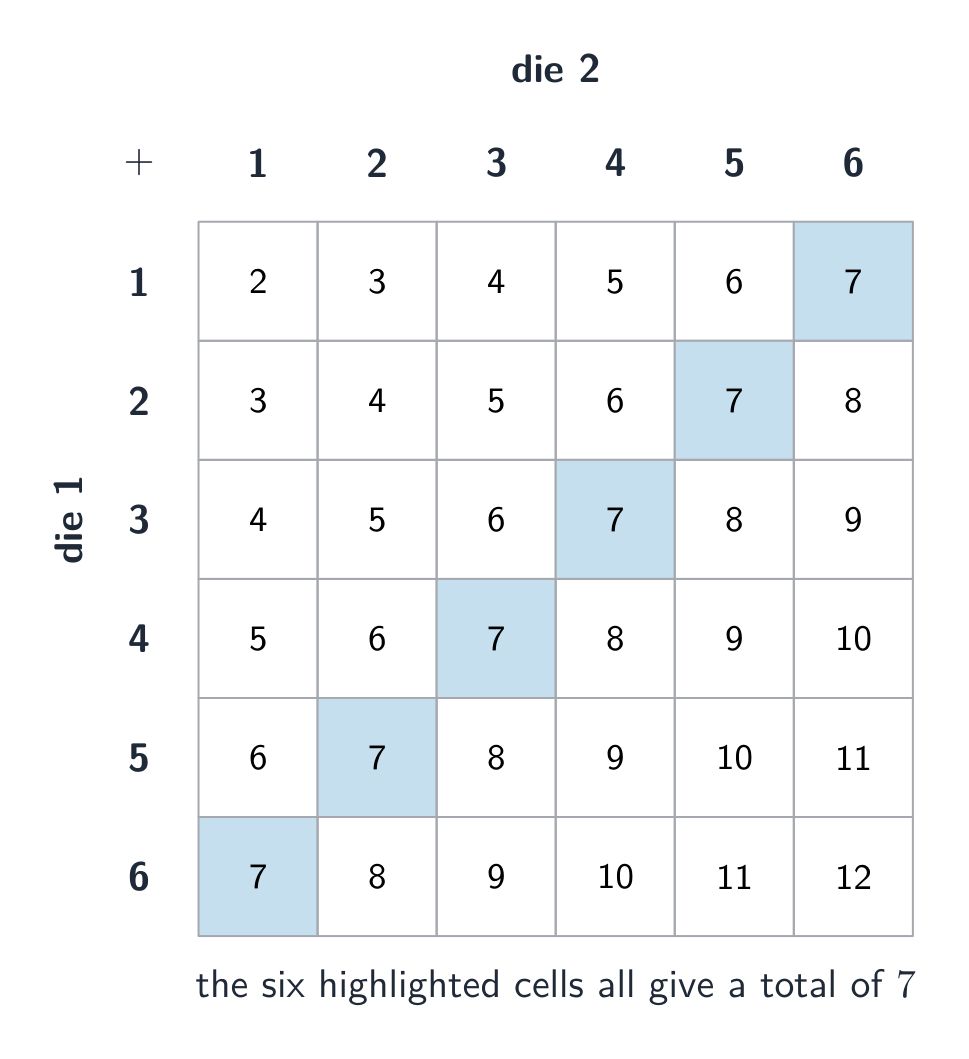
Diagram ruang sampel mencantumkan setiap hasil; untuk jumlah dua dadu terdapat $36$ sel yang sama kemungkinannya. Diagram Venn
Sebuah Diagram Venn mengelompokkan hasil ke dalam himpunan yang tumpang tindih. Dari sana Anda dapat membaca $\text{P}(A \cap B)$ (di kedua) dan $\text{P}(A \cup B)$ (di salah satu).

Area tumpang tindih adalah $\text{P}(A\cap B)=0.2$; semuanya di dalam salah satu lingkaran adalah $\text{P}(A\cup B)=0.6$; di luar keduanya adalah $0.4$. Diagram pohon
Sebuah diagram pohon menunjukkan setiap tahap sebagai serangkaian cabang. Tulis probabilitas pada setiap cabang dan hasil di ujungnya. Kalikan sepanjang cabang, lalu tambahkan jalur yang Anda inginkan.
Contoh terpecahkan (dengan pengembalian). Dari tas ($3$ merah, $5$ biru), sebuah koin diambil, dikembalikan, lalu yang kedua diambil. Ini adalah dengan pengembalian, jadi peluangnya tidak berubah. Temukan probabilitas dua merah.
$$\text{P}(\text{red, red}) = \frac{3}{8} \times \frac{3}{8} = \frac{9}{64}.$$
Pada diagram pohon, kalikan probabilitas sepanjang cabang; probabilitas keempat hasil menjumlahkan ke $1$. Contoh terpecahkan (tanpa pengembalian, Diperluas). Sekarang koin pertama tidak dikembalikan — mengambil tanpa pengembalian. Setelah satu merah diambil, $2$ merah tersisa dari $7$:
$$\text{P}(\text{red, red}) = \frac{3}{8} \times \frac{2}{7} = \frac{6}{56} = \frac{3}{28}.$$Explore · JelajahiProbability tree · Pohon probabilitas
Multiply the probabilities along each branch; the four outcomes always add up to 1. · Kalikan probabilitas di sepanjang setiap cabang; keempat hasil selalu berjumlah 1.
Explore · JelajahiCombined events · Peristiwa gabungan
P(A ∩ B) = P(A)·P(B|A)
Combine two events: the area model shows AND (overlap) versus OR (union). · Gabungkan dua peristiwa: model area menunjukkan DAN (tumpang tindih) versus ATAU (gabungan).
Vocabulary · Kosa kata Train · LatihEnglish Bahasa Indonesia tree diagram/triː ˈdaɪəɡræm/ diagram pohon with replacement/wɪð rɪˈpleɪsmənt/ dengan pengembalian without replacement/wɪˈðaʊt rɪˈpleɪsmənt/ tanpa pengembalian conditional probability/kənˈdɪʃənl ˌprɒbəˈbɪlɪti/ probabilitas bersyarat 8.4
Conditional probability (Extended) · Probabilitas bersyarat (Diperluas)
Syllabus · Silabus
EnglishSubject content Notes and examples Calculate conditional probability using Venn diagrams, tree diagrams and tables. Knowledge of notation, $\text{P}(A|B)$, and formulas relating to conditional probability is not required. Bahasa IndonesiaKonten mata pelajaran Catatan dan contoh Hitung probabilitas bersyarat menggunakan diagram Venn, diagram pohon, dan tabel. Pengetahuan tentang notasi, $\text{P}(A|B)$, dan rumus yang berkaitan dengan probabilitas bersyarat tidak diperlukan. Source: Cambridge International syllabus · Sumber: Silabus Cambridge International
EnglishConditional probability 条件概率 is the probability of one event given that another has already happened. Read it from a Venn diagram, two-way table or tree diagram by looking only at the part that matches the condition.
Worked example. In a class of $30$, $18$ study French and, of those, $7$ also study German. A French student is picked. Find the probability they also study German.
Look only at the $18$ French students:
$$\text{P}(\text{German} \mid \text{French}) = \frac{7}{18}.$$Bahasa IndonesiaProbabilitas bersyarat adalah probabilitas satu peristiwa dengan syarat peristiwa lain sudah terjadi. Bacalah dari diagram Venn, tabel dua arah, atau diagram pohon dengan hanya melihat bagian yang sesuai dengan kondisi.
Contoh terpecahkan. Di kelas $30$, $18$ mempelajari bahasa Prancis, dan di antaranya, $7$ juga mempelajari bahasa Jerman. Seorang siswa Prancis dipilih. Temukan probabilitas mereka juga mempelajari bahasa Jerman.
Lihatlah hanya pada $18$ siswa Prancis:
$$\text{P}(\text{German} \mid \text{French}) = \frac{7}{18}.$$Explore · JelajahiProbability trees · Pohon probabilitas
Change the branch probabilities and read combined and conditional probabilities off the tree. · Ubah probabilitas cabang dan baca probabilitas gabungan serta bersyarat dari pohon tersebut.
8.4
Exam tips · Tips ujian
English- Every probability lies between $0$ and $1$, and the probabilities of all the outcomes add to $1$.
- For "and" (both events) multiply the probabilities; for "or" (either event) add them. On a tree diagram, multiply along the branches.
- Watch for without replacement: the second probability changes because one item has already been removed.
- Expected frequency = probability × number of trials.
Bahasa Indonesia- Setiap probabilitas terletak antara $0$ dan $1$, dan probabilitas dari semua hasil menjumlahkan ke $1$.
- Untuk "dan" (kedua peristiwa) kalikan probabilitasnya; untuk "atau" (salah satu peristiwa) tambahkan它们. Pada diagram pohon, kalikan sepanjang cabang.
- Waspadai tanpa pengembalian: probabilitas kedua berubah karena satu item telah dilepas sebelumnya.
- Frekuensi harapan = probabilitas × jumlah percobaan.
-
9
Statistics · Statistik
Watch lesson · Tonton pelajaranEnglishThis handout covers Topic 9, Statistics. Parts marked (Extended) are only tested on the Extended papers; everything else is for both levels.
Bahasa IndonesiaLembar kerja ini mencakup Topik 9, Statistik. Bagian yang ditandai (Diperluas) hanya diujikan pada kertas Diperluas; segalanya lainnya untuk kedua tingkat.
9.1 9.2
Collecting and showing data · Mengumpulkan dan menampilkan data

Syllabus · Silabus
EnglishSubject content Notes and examples Classify and tabulate statistical data. e.g. tally tables, two-way tables. Bahasa IndonesiaKonten mata pelajaran Catatan dan contoh Klasifikasikan dan buat tabel data statistik. mis. tabel tally, tabel dua arah. Subject content Notes and examples 1 Read, interpret and draw inferences from tables and statistical diagrams. 2 Compare sets of data using tables, graphs and statistical measures. e.g. compare averages and ranges between two data sets. 3 Appreciate restrictions on drawing conclusions from given data. Subject content Notes and examples 1 Read, interpret and draw inferences from tables and statistical diagrams. 2 Compare sets of data using tables, graphs and statistical measures. e.g. compare averages and measures of spread between two data sets. 3 Appreciate restrictions on drawing conclusions from given data. Source: Cambridge International syllabus · Sumber: Silabus Cambridge International
EnglishTo organise statistical 统计 data 数据, use:
- a tally table 计数表 — make a mark for each value, then count.
- a two-way table 双向表 — sorts data by two features at once (for example, boys/girls against walk/bus).
When you read a diagram, only draw conclusions the data really supports.
Bahasa IndonesiaData dikumpulkan dari orang-orang — sampel yang diambil dari populasi. Untuk mengorganisir data statistik, gunakan:
- tabel tally — buat tanda untuk setiap nilai, lalu hitung.
- tabel dua arah — mengklasifikasikan data berdasarkan dua fitur sekaligus (misalnya, laki-laki/perempuan terhadap jalan kaki/bus).
Ketika Anda membaca diagram, hanya tarik kesimpulan yang benar-benar didukung oleh data.
Explore · JelajahiData handling cycle · Siklus penanganan data
Follow a statistical question from collection to display. · Ikuti pertanyaan statistik dari pengumpulan hingga penyajian.
Vocabulary · Kosa kata Train · LatihEnglish Bahasa Indonesia statistical/stəˈtɪstɪkl/ statistik data/ˈdeɪtə/ data tally table/ˈtælɪ ˈteɪbl/ tabel frekuensi two-way table/tuː weɪ ˈteɪbl/ tabel silang 9.3
Averages and range · Rata-rata dan jangkauan

Syllabus · Silabus
EnglishSubject content Notes and examples Calculate the mean, median, mode and range for individual data and distinguish between the purposes for which these are used. Data may be in a list or frequency table, but will not be grouped. Bahasa IndonesiaKonten mata pelajaran Catatan dan contoh Hitung mean, median, modus, dan jangkauan untuk data individu dan bedakan tujuan penggunaannya. Data mungkin berupa daftar atau tabel frekuensi, tetapi tidak akan dikelompokkan. EnglishSubject content Notes and examples 1 Calculate the mean, median, mode, quartiles, range and interquartile range for individual data and distinguish between the purposes for which these are used. 2 Calculate an estimate of the mean for grouped discrete or grouped continuous data. 3 Identify the modal class from a grouped frequency distribution. Bahasa IndonesiaKonten mata pelajaran Catatan dan contoh 1 Hitung mean, median, modus, kuartil, jangkauan, dan jangkauan antarkuartil untuk data individu dan bedakan tujuan penggunaannya. 2 Hitung estimasi mean untuk data diskrit berkelompok atau data kontinu berkelompok. 3 Identifikasikan kelas modus dari distribusi frekuensi berkelompok. Source: Cambridge International syllabus · Sumber: Silabus Cambridge International
EnglishThree averages describe a typical value of the data, and the range shows how spread out it is. Each is used for a different purpose:
- mean 平均数 $= \dfrac{\text{sum of all values}}{\text{how many values}}$.
- median 中位数 $=$ the middle value when the data is put in order.
- mode 众数 $=$ the value that appears most often.
- range 极差 $=$ largest value $-$ smallest value (it shows how spread out the data is).
Worked example. Find the mean, median, mode and range of $4, 7, 7, 2, 5$.
Order the data: $2, 4, 5, 7, 7$.
$$\text{mean} = \frac{4 + 7 + 7 + 2 + 5}{5} = \frac{25}{5} = 5, \quad \text{median} = 5, \quad \text{mode} = 7, \quad \text{range} = 7 - 2 = 5.$$Bahasa IndonesiaTiga rata-rata menggambarkan nilai tipikal dari data, dan jangkauan menunjukkan seberapa tersebar data itu. Masing-masing digunakan untuk tujuan yang berbeda:
Rata-rata, median, modus, dan jangkauan dari himpunan data kecil - mean $= \dfrac{\text{sum of all values}}{\text{how many values}}$.
- median $=$ nilai tengah ketika data disusun secara berurutan.
- mode $=$ nilai yang muncul paling sering.
- range $=$ nilai terbesar $-$ nilai terkecil (menunjukkan bagaimana data tersebar).
Contoh terpecahkan. Temukan mean, median, modus, dan jangkuan dari $4, 7, 7, 2, 5$.
Urutkan data: $2, 4, 5, 7, 7$.
$$\text{mean} = \frac{4 + 7 + 7 + 2 + 5}{5} = \frac{25}{5} = 5, \quad \text{median} = 5, \quad \text{mode} = 7, \quad \text{range} = 7 - 2 = 5.$$Explore · JelajahiAverage choice lab · Laboratorium pilihan rata-rata
Choose the average that fits the data situation. · Pilih rata-rata yang sesuai dengan situasi data.
Vocabulary · Kosa kata Train · LatihEnglish Bahasa Indonesia mean/miːn/ rata-rata median/ˈmiːdiːən/ median mode/məʊd/ moda range/reɪndʒ/ jangkauannya 9.3
Averages from a frequency table · Rata-rata dari tabel frekuensi
Syllabus · Silabus
EnglishSubject content Notes and examples Calculate the mean, median, mode and range for individual data and distinguish between the purposes for which these are used. Data may be in a list or frequency table, but will not be grouped. Bahasa IndonesiaKonten mata pelajaran Catatan dan contoh Hitung mean, median, modus, dan jangkauan untuk data individu dan bedakan tujuan penggunaannya. Data mungkin berupa daftar atau tabel frekuensi, tetapi tidak akan dikelompokkan. EnglishSubject content Notes and examples 1 Calculate the mean, median, mode, quartiles, range and interquartile range for individual data and distinguish between the purposes for which these are used. 2 Calculate an estimate of the mean for grouped discrete or grouped continuous data. 3 Identify the modal class from a grouped frequency distribution. Bahasa IndonesiaKonten mata pelajaran Catatan dan contoh 1 Hitung mean, median, modus, kuartil, jangkauan, dan jangkauan antarkuartil untuk data individu dan bedakan tujuan penggunaannya. 2 Hitung estimasi mean untuk data diskrit berkelompok atau data kontinu berkelompok. 3 Identifikasikan kelas modus dari distribusi frekuensi berkelompok. Source: Cambridge International syllabus · Sumber: Silabus Cambridge International
EnglishWhen data is listed with its frequency 频数 (how many times each value occurs), the mean is
$$\text{mean} = \frac{\sum (\text{value} \times \text{frequency})}{\sum \text{frequency}}.$$Worked example. Values $1, 2, 3$ occur with frequencies $4, 5, 1$. Find the mean.
$$\text{mean} = \frac{1(4) + 2(5) + 3(1)}{4 + 5 + 1} = \frac{17}{10} = 1.7.$$Grouped data (Extended)
For grouped data 分组数据, you cannot find the exact mean, so estimate it using the midpoint of each group as the value. The modal class 众数组 is simply the group with the highest frequency.
Bahasa IndonesiaKetika data terdaftar beserta frekuensinya (berapa sering setiap nilai muncul), mean adalah
$$\text{mean} = \frac{\sum (\text{value} \times \text{frequency})}{\sum \text{frequency}}.$$Contoh terpecahkan. Nilai $1, 2, 3$ terjadi dengan frekuensi $4, 5, 1$. Temukan mean.
$$\text{mean} = \frac{1(4) + 2(5) + 3(1)}{4 + 5 + 1} = \frac{17}{10} = 1.7.$$Data berkelompok (Diperluas)
Untuk data berkelompok, Anda tidak dapat menemukan rata-rata yang tepat, jadi perkiraan menggunakan nilai tengah dari setiap kelompok sebagai nilainya. Kelas modus adalah sekadar kelompok dengan frekuensi tertinggi.
Vocabulary · Kosa kata Train · LatihEnglish Bahasa Indonesia frequency/ˈfriːkwənsi/ frekuensi grouped data/ɡruːpt ˈdeɪtə/ data berkelompok modal class/ˈməʊdl klæs/ kelas modus 9.3
Measures of spread (Extended) · Ukuran sebaran (Diperluas)

Syllabus · Silabus
EnglishSubject content Notes and examples 1 Calculate the mean, median, mode, quartiles, range and interquartile range for individual data and distinguish between the purposes for which these are used. 2 Calculate an estimate of the mean for grouped discrete or grouped continuous data. 3 Identify the modal class from a grouped frequency distribution. Bahasa IndonesiaKonten mata pelajaran Catatan dan contoh 1 Hitung mean, median, modus, kuartil, jangkauan, dan jangkauan antarkuartil untuk data individu dan bedakan tujuan penggunaannya. 2 Hitung estimasi mean untuk data diskrit berkelompok atau data kontinu berkelompok. 3 Identifikasikan kelas modus dari distribusi frekuensi berkelompok. Source: Cambridge International syllabus · Sumber: Silabus Cambridge International
EnglishWhen data is in order, the quartiles 四分位数 cut it into four equal parts. The lower quartile (LQ) is one quarter of the way up; the upper quartile (UQ) is three quarters of the way up. The interquartile range 四分位距 measures the spread of the middle half:
$$\text{interquartile range} = \text{UQ} - \text{LQ}.$$The interquartile range is useful because, unlike the range, it ignores extreme values.
Bahasa IndonesiaKetika data tersusun, kuartil membaginya menjadi empat bagian yang sama. Kuartil bawah (LQ) berada di sepertiga jalan ke atas; kuartil atas (UQ) berada di tiga perempat jalan ke atas. Jangkauan interkuartil mengukur sebaran separuh tengah:
$$\text{interquartile range} = \text{UQ} - \text{LQ}.$$Jangkauan interkuartil berguna karena, berbeda dengan jangkauan, hal ini mengabaikan nilai ekstrem.
Diagram kotak-garis menunjukkan ringkasan lima angka; panjang kotak adalah jangkauan interkuartil. Explore · JelajahiBox-and-whisker plot · Diagram kotak-garis
Build a box plot from the five-number summary: the box is the middle 50% (the interquartile range) and the median's position shows the skew. · Buat plot kotak dari ringkasan lima angka: kotaknya adalah 50% tengah (jangkauan antarkuartil) dan posisi median menunjukkan kemiringan.
Vocabulary · Kosa kata Train · LatihEnglish Bahasa Indonesia quartile/ˈkwɔːtaɪl/ kuartil interquartile range/ˌɪntəˈkwɔːtaɪl reɪndʒ/ jangkauan interkuartil 9.4
Charts and diagrams · Grafik dan diagram

Syllabus · Silabus
EnglishSubject content Notes and examples Draw and interpret: (a) bar charts (b) pie charts (c) pictograms (d) stem-and-leaf diagrams (e) simple frequency distributions. Includes composite (stacked) and dual (side-by-side) bar charts. Stem-and-leaf diagrams should have ordered data with a key. Bahasa IndonesiaKonten mata pelajaran Catatan dan contoh Gambar dan tafsirkan: (a) diagram batang (b) diagram lingkaran (c) pictogram (d) diagram batang-daun (e) distribusi frekuensi sederhana. Termasuk diagram batang komposit (tumpuk) dan diagram batang ganda (bersebelahan). Diagram batang-daun harus memiliki data terurut dengan kunci. Source: Cambridge International syllabus · Sumber: Silabus Cambridge International
EnglishChart What it shows bar chart 条形图 a bar for each category; height is the frequency pie chart 饼图 a circle split into slices, each a fraction of $360^{\circ}$ pictogram 象形图 uses a symbol to stand for a number of items stem-and-leaf diagram 茎叶图 keeps the digits of ordered data, with a key frequency distribution 频数分布 a table of values and their frequencies Worked example (pie chart). Out of $120$ people, $30$ chose tea. Find the angle of the tea slice.
$$\frac{30}{120} \times 360^{\circ} = 90^{\circ}.$$Bahasa IndonesiaPapan Galton menunjukkan bagaimana data menumpuk membentuk distribusi. 
Piktogram menggunakan simbol untuk mewakili sejumlah item 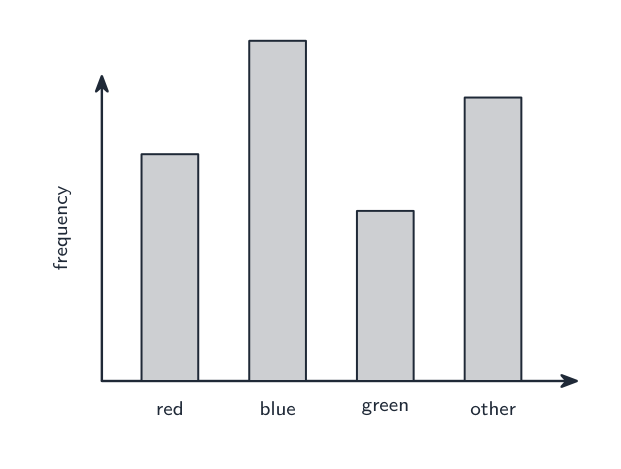
Diagram batang menunjukkan frekuensi setiap kelompok Grafik Yang ditampilkan grafik batang batang untuk setiap kategori; tinggi adalah frekuensi grafik pie lingkaran terbelah menjadi irisan, masing-masing merupakan pecahan $360^{\circ}$ piktogram menggunakan simbol untuk mewakili sejumlah item diagram batang-daun mempertahankan digit dari data yang tersusun, dengan kunci distribusi frekuensi tabel nilai dan frekuensinya Contoh terpecahkan (grafik pie). Dari $120$ orang, $30$ memilih teh. Temukan sudut irisan teh.
$$\frac{30}{120} \times 360^{\circ} = 90^{\circ}.$$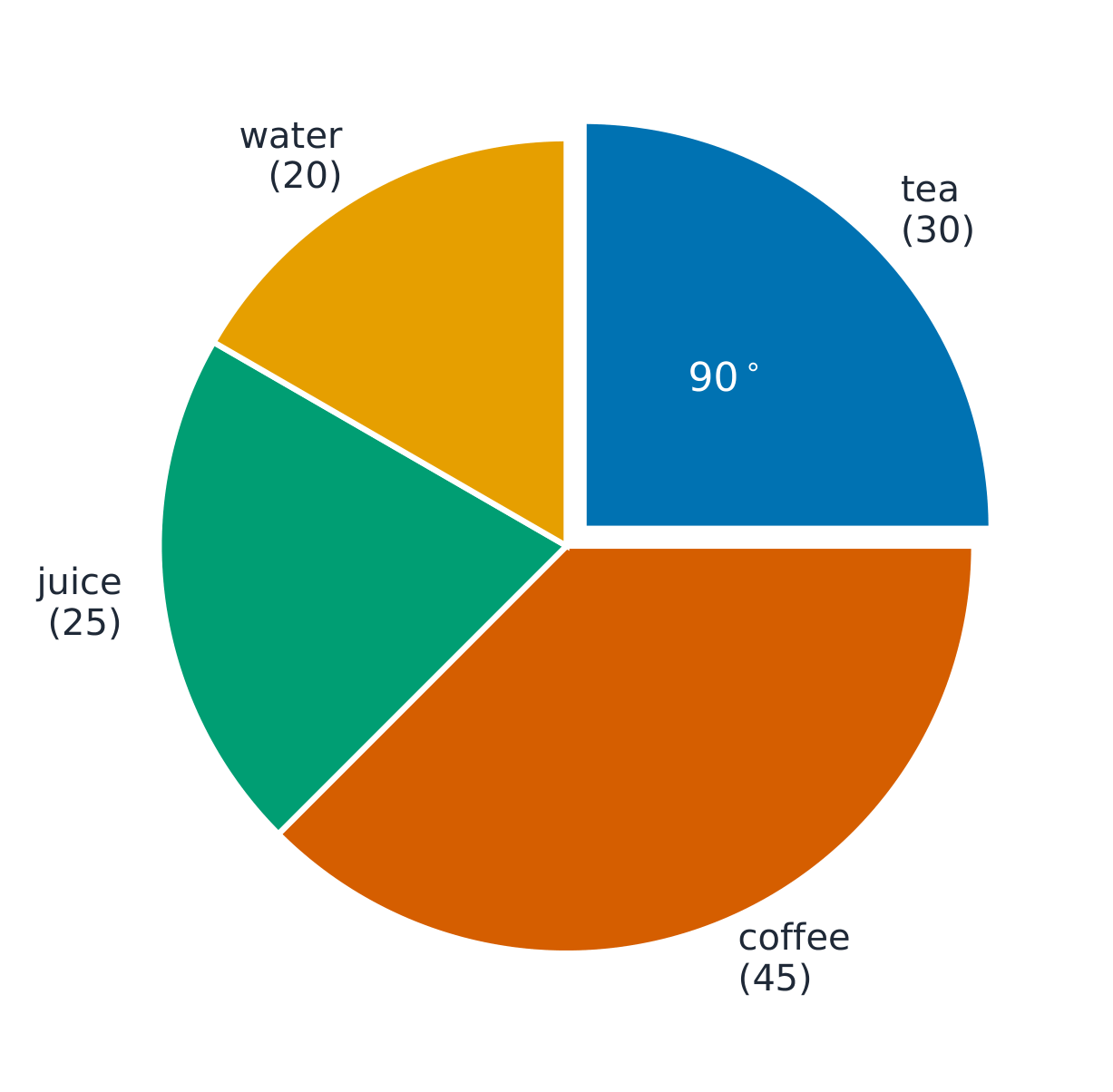
Setiap irisan adalah pecahan dari $360^\circ$; teh adalah $\tfrac{30}{120}\times360^\circ=90^\circ$. Explore · JelajahiPie-chart angles · Sudut diagram lingkaran
Each slice's angle is its share of the whole turned into degrees — frequency ÷ total × 360 — and the slices always add to 360°. · Setiap irisan sudutnya adalah bagian dari keseluruhan yang diubah menjadi derajat — frekuensi ÷ total × 360 — dan irisan selalu berjumlah 360°.
Explore · JelajahiChart choice lab · Laboratorium pemilihan grafik
Choose the chart that fits the kind of data. · Pilih grafik yang sesuai dengan jenis data.
Vocabulary · Kosa kata Train · LatihEnglish Bahasa Indonesia bar chart/bɑː tʃɑːt/ diagram batang pie chart/paɪ tʃɑːt/ diagram lingkaran pictogram/ˈpɪktəɡræm/ piktogram stem-and-leaf diagram/stem ænd liːf ˈdaɪəɡræm/ diagram batang dan daun frequency distribution/ˈfriːkwənsi ˌdɪstrɪˈbjuːʃn/ distribusi frekuensi scatter diagram/ˈskætə ˈdaɪəɡræm/ diagram sebar 9.5
Scatter diagrams and correlation · Diagram pencar dan korelasi
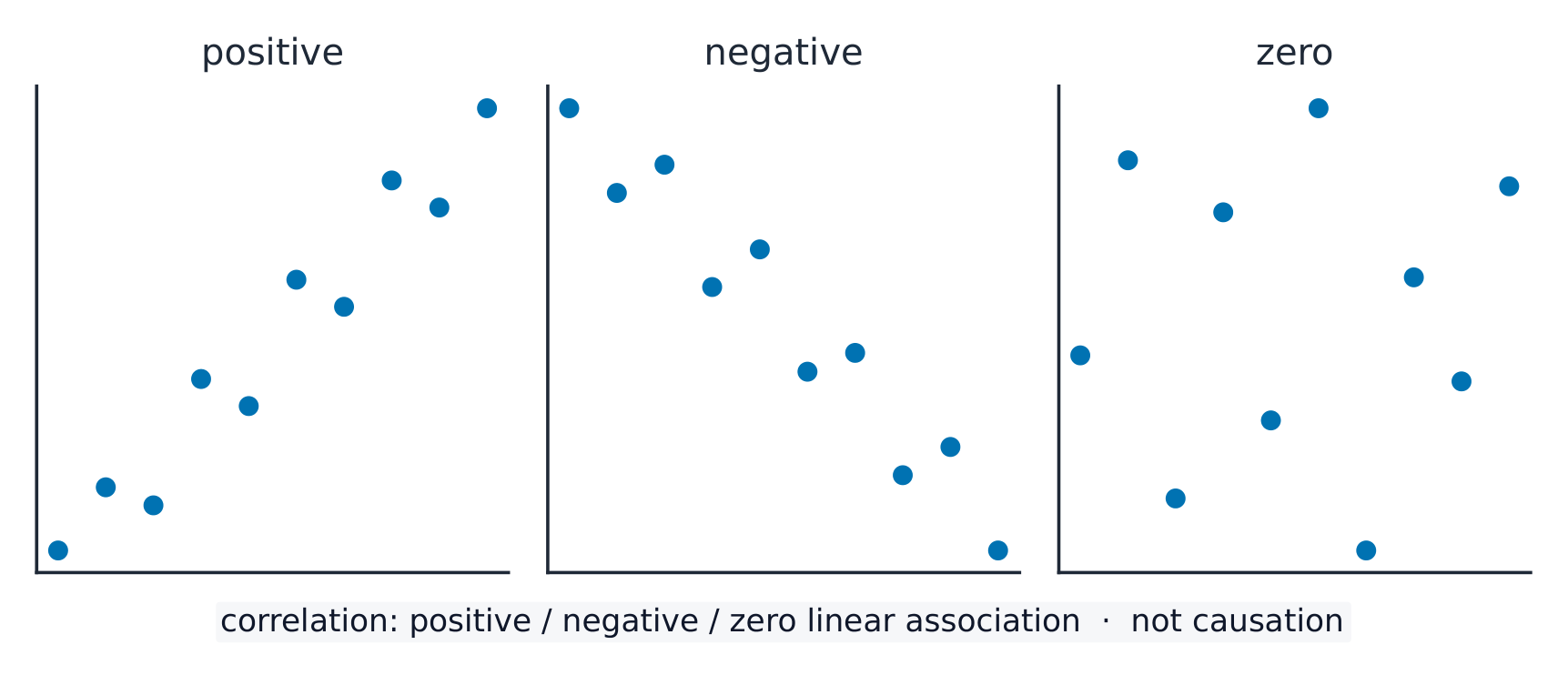
Syllabus · Silabus
Subject content Notes and examples 1 Draw and interpret scatter diagrams. Plotted points should be clearly marked, for example as small crosses (×). 2 Understand what is meant by positive, negative and zero correlation. 3 Draw by eye, interpret and use a straight line of best fit. A line of best fit: • should be a single ruled line drawn by inspection • should extend across the full data set • does not need to coincide exactly with any of the points but there should be a roughly even distribution of points either side of the line over its entire length. Subject content Notes and examples 1 Draw and interpret scatter diagrams. Plotted points should be clearly marked, for example as small crosses (x). 2 Understand what is meant by positive, negative and zero correlation. 3 Draw by eye, interpret and use a straight line of best fit. A line of best fit: • should be a single ruled line drawn by inspection • should extend across the full data set • does not need to coincide exactly with any of the points but there should be a roughly even distribution of points either side of the line over its entire length. Source: Cambridge International syllabus · Sumber: Silabus Cambridge International
EnglishA scatter diagram 散点图 plots pairs of values as points to show whether two things are linked. The link is the correlation 相关性:
- positive correlation 正相关 — as one goes up, the other goes up.
- negative correlation 负相关 — as one goes up, the other goes down.
- zero correlation 零相关 — no clear link.
If there is correlation, draw a line of best fit 最佳拟合线: one straight ruled line through the middle of the points, with about the same number of points on each side. Use it to predict values.
Bahasa IndonesiaDiagram pencar memplot pasangan nilai sebagai titik untuk menunjukkan apakah dua hal terkait. Hubungan tersebut adalah korelasi:
- korelasi positif — saat satu naik, yang lain juga naik.
- korelasi negatif — saat satu naik, yang lain turun.
- korelasi nol — tidak ada hubungan jelas.
Korelasi positif naik bersama; negatif turun saat yang lain naik; nol menunjukkan tidak ada hubungan jelas. Jika ada korelasi, gambarlah garis regresi: satu garis lurus yang melalui tengah-tengah titik-titik, dengan jumlah titik yang kira-kira sama di masing-masing sisi. Gunakan untuk memprediksi nilai.
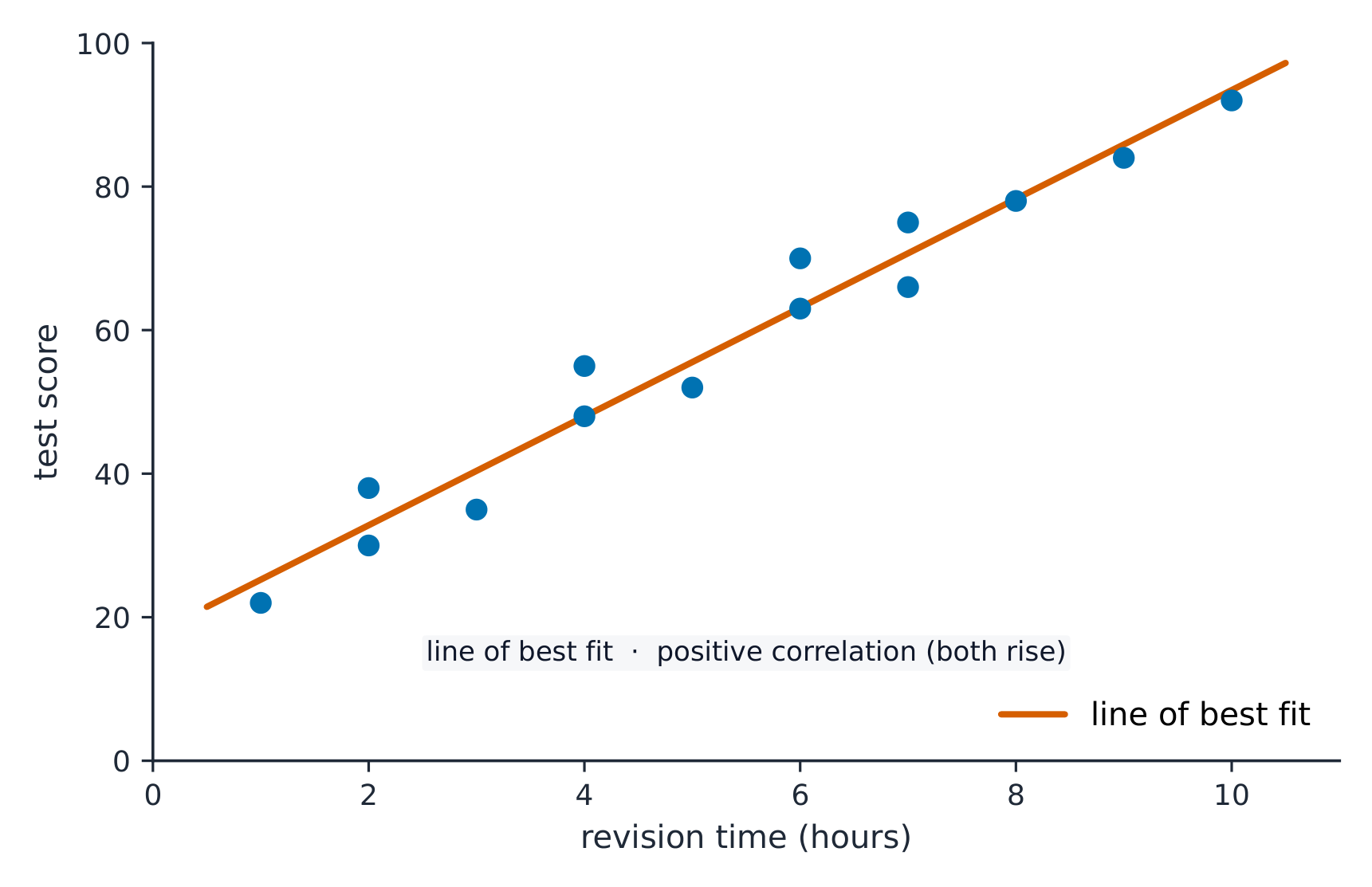
Garis regresi adalah satu garis lurus yang melalui tengah-tengah titik-titik; gunakan untuk memprediksi. Explore · JelajahiScatter and correlation · Sebaran dan korelasi
Change the strength of the relationship and add a line of best fit to spot the trend. · Ubah kekuatan hubungan dan tambahkan garis regresi untuk melihat tren.
Vocabulary · Kosa kata Train · LatihEnglish Bahasa Indonesia correlation/ˌkɒrɪˈleɪʃn/ korelasi positive correlation/ˈpɒzɪtɪv ˌkɒrɪˈleɪʃn/ korelasi positif negative correlation/ˈneɡətɪv ˌkɒrɪˈleɪʃn/ korelasi negatif zero correlation/ˈzɪərəʊ ˌkɒrɪˈleɪʃn/ tiada korelasi line of best fit/laɪn ɒv best fɪt/ garis tren terbaik 9.6
Cumulative frequency diagrams (Extended) · Diagram frekuensi kumulatif (Diperluas)

Syllabus · Silabus
EnglishSubject content Notes and examples 1 Draw and interpret cumulative frequency tables and diagrams. Plotted points on a cumulative frequency diagram should be clearly marked, for example as small crosses (x), and be joined with a smooth curve. 2 Estimate and interpret the median, percentiles, quartiles and interquartile range from cumulative frequency diagrams. Bahasa IndonesiaKonten mata pelajaran Catatan dan contoh 1 Gambar dan tafsirkan tabel dan diagram frekuensi kumulatif. Titik-titik yang dipetakan pada diagram frekuensi kumulatif harus ditandai dengan jelas, misalnya sebagai silang kecil (x), dan dihubungkan dengan kurva halus. 2 Estimasi dan tafsirkan median, persentil, kuartil, dan jangkauan antarkuartil dari diagram frekuensi kumulatif. Source: Cambridge International syllabus · Sumber: Silabus Cambridge International
EnglishThe cumulative frequency 累积频数 is a running total of the frequencies. Plot it against the upper end of each class and join the points with a smooth curve.
From the curve you can read the median (at half the total), the quartiles (at one quarter and three quarters), and any percentile 百分位数 (for example, the $90$th percentile is at $90\%$ of the total).
Bahasa IndonesiaFrekuensi kumulatif adalah total berjalan dari frekuensi. Plot terhadap ujung atas setiap kelas dan hubungkan titik-titik dengan kurva halus.
Dari kurva Anda dapat membaca median (pada setengah total), kuartil (pada satu pertiga dan tiga perempat), dan persentil apa pun (misalnya, persentil ke-$90$ berada di $90\%$ dari total).
Baca median pada setengah total, dan kuartil pada satu pertiga dan tiga perempat: menyamping ke kurva, lalu turun. Explore · JelajahiCumulative frequency route · Langkah frekuensi kumulatif
Follow raw data into a cumulative frequency curve and percentile reading. · Ikuti data mentah ke dalam lengkung frekuensi kumulatif dan baca persentil.
Vocabulary · Kosa kata Train · LatihEnglish Bahasa Indonesia cumulative frequency/ˈkjuːmjʊlətɪv ˈfriːkwənsi/ frekuensi kumulatif percentile/pəˈsentaɪl/ persentil 9.7
Histograms (Extended) · Histogram (Diperluas)
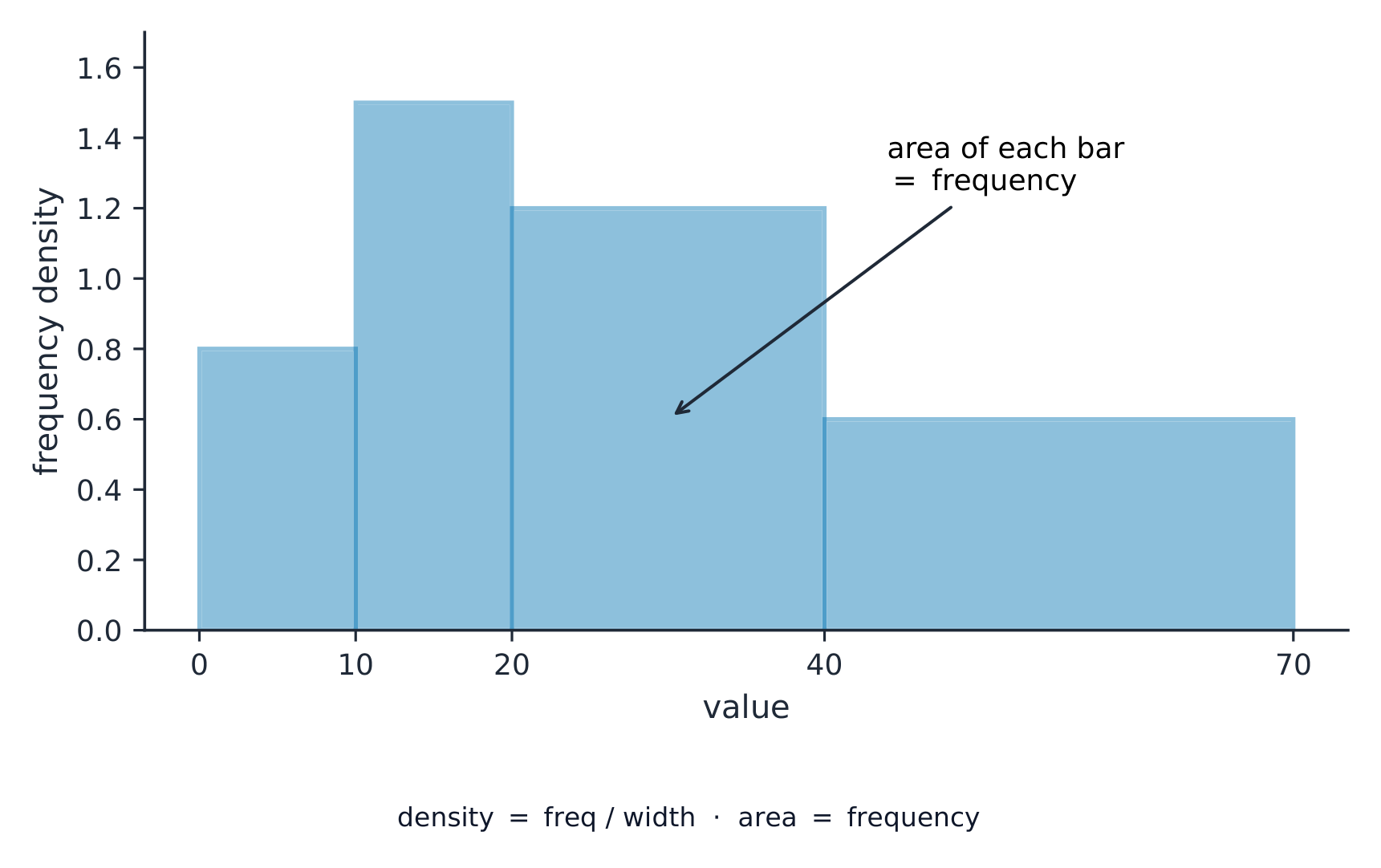
Syllabus · Silabus
EnglishSubject content Notes and examples 1 Draw and interpret histograms. On histograms, the vertical axis is labelled 'Frequency density'. 2 Calculate with frequency density. Frequency density is defined as $\text{frequency density} = \text{frequency} \div \text{class width}$. Bahasa IndonesiaKonten mata pelajaran Catatan dan contoh 1 Gambar dan tafsirkan histogram. Pada histogram, sumbu vertikal diberi label 'Kepadatan frekuensi'. 2 Hitung dengan kepadatan frekuensi. Kepadatan frekuensi didefinisikan sebagai $\text{frequency density} = \text{frequency} \div \text{class width}$. Source: Cambridge International syllabus · Sumber: Silabus Cambridge International
EnglishA histogram 直方图 looks like a bar chart, but the bars can have different widths and the area of each bar (not its height) shows the frequency. The vertical axis is the frequency density 频数密度:
$$\text{frequency density} = \frac{\text{frequency}}{\text{class width}}.$$Worked example. A class has class width 组距 $10$ and frequency $25$. Find the frequency density.
$$\text{frequency density} = \frac{25}{10} = 2.5.$$Bahasa IndonesiaHistogram terlihat seperti grafik batang, tetapi batangnya bisa memiliki lebar berbeda dan area setiap batang (bukan tingginya) menunjukkan frekuensi. Sumbu vertikal adalah densitas frekuensi:
$$\text{frequency density} = \frac{\text{frequency}}{\text{class width}}.$$
*Dengan lebar kelas tidak sama, AREA batang (bukan tingginya) adalah frekuensi, jadi aksisnya adalah densitas frekuensi.Contoh terpecahkan. Sebuah kelas memiliki lebar kelas $10$ dan frekuensi $25$. Temukan densitas frekuensi.
$$\text{frequency density} = \frac{25}{10} = 2.5.$$Explore · JelajahiFrequency-density histogram · Histogram ketumpatan frekuensi
With unequal class widths the bar height is frequency density, so the area (not the height) represents the frequency. · Dengan lebar kelas tidak sama, tinggi bar ialah ketumpatan frekuensi, jadi luas (bukan tinggi) mewakili frekuensi.
Vocabulary · Kosa kata Train · LatihEnglish Bahasa Indonesia histogram/ˈhɪstəɡræm/ histogram frequency density/ˈfriːkwənsi ˈdensɪti/ kerapatan frekuensi class width/klæs wɪtθ/ lebar kelas 9.7
Exam tips · Tips ujian
English- Know the three averages: mean (add up ÷ how many), median (the middle value when in order), mode (the most common). The range is highest − lowest.
- From a frequency table the mean is $\frac{\sum fx}{\sum f}$ — divide by the total frequency, not the number of rows.
- On a scatter diagram, describe the correlation as positive, negative or none, and draw the line of best fit through the mean point.
- For a histogram with unequal class widths, the height is the frequency density (frequency ÷ class width), not the frequency.
Bahasa Indonesia- Kenali tiga rata-rata: mean (jumlah ÷ berapa banyak), median (nilai tengah ketika tersusun), modus (yang paling umum). Jangkauan adalah tertinggi − terendah.
- Dari tabel frekuensi mean adalah $\frac{\sum fx}{\sum f}$ — bagi dengan total frekuensi, bukan jumlah baris.
- Pada diagram pencar, deskripsikan korelasi sebagai positif, negatif atau tidak ada, dan gambarlah garis regresi melalui titik mean.
- Untuk histogram dengan lebar kelas tidak sama, tingginya adalah densitas frekuensi (frekuensi ÷ lebar kelas), bukan frekuensinya.