Lompat ke konten

Rangkaian Listrik

AP Fisika C: Listrik dan Magnetisme · Topik 11

Pelajaran video untuk topik ini Buka halaman video
8:44

Rangkaian Listrik

Anda menghidupkan sakelar, dan lampu menyala seketika. Jadi elektron harus berlari turun di kawat — benar? Tidak sama sekali. Di dalam kawat tembaga itu, pembawa muatan merayap…

Narasi bahasa Inggris · Subtitle bahasa Inggris + 中文 disematkan langsung

11.1

Arus Listrik
Silabus
Learning ObjectiveEssential Knowledge

11.1.A
Describe the movement of electric charges through a medium.

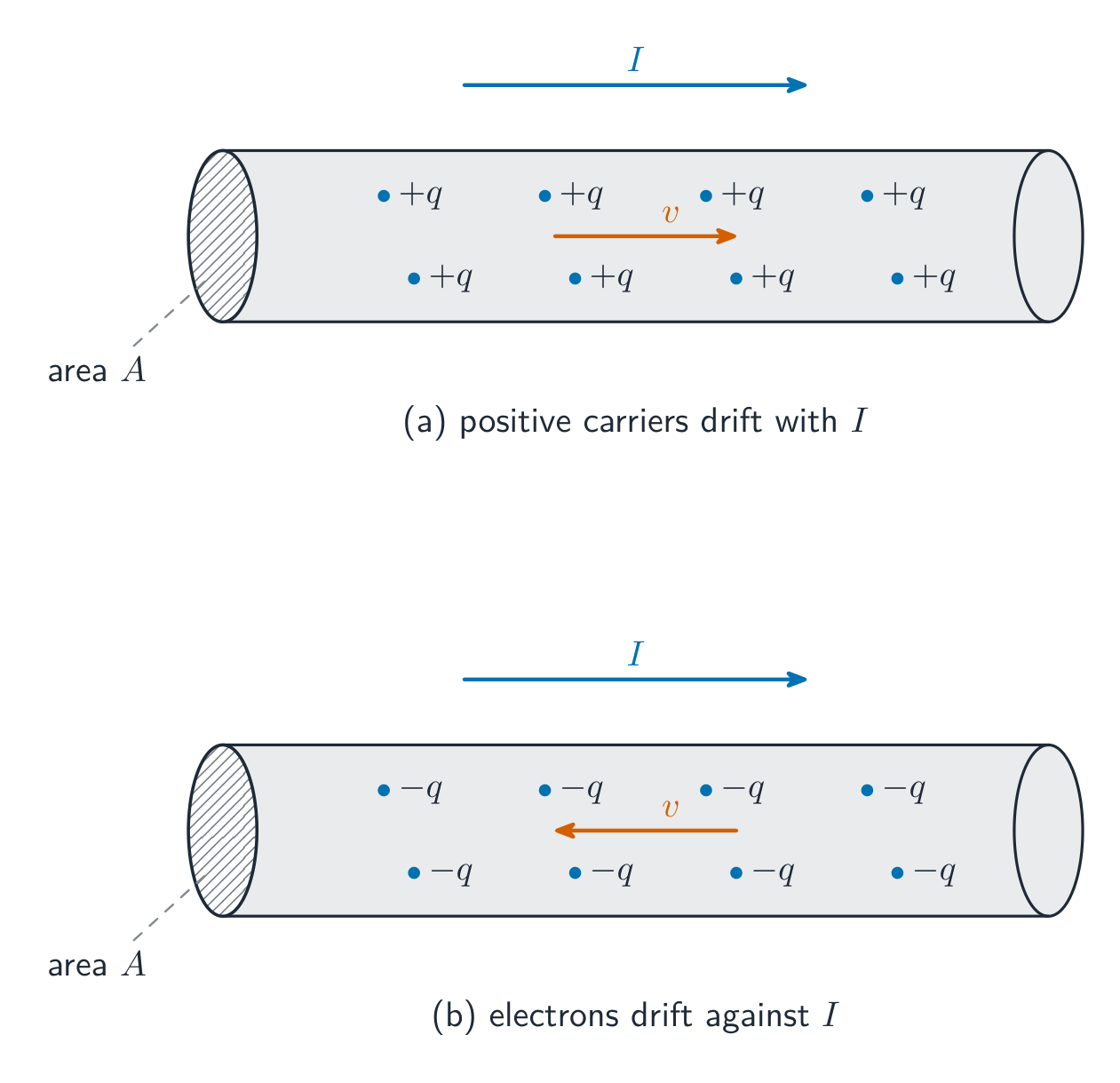
  • 11.1.A.1 Current is the rate at which charge passes through a cross-sectional area of a wire.
    • Equation: $I = \dfrac{dq}{dt}$
    • 11.1.A.1.i Current within a conductor consists of charge carriers traveling through the conductor with an average drift velocity.
      • Equation: $I = nqv_d A$
    • 11.1.A.1.ii Electric charge moves in a circuit in response to an electric potential difference, sometimes referred to as electromotive force, or $\mathrm{emf}$ ($\mathcal{E}$).
    • 11.1.A.1.iii If the current is zero in a section of wire, the net motion of charge carriers in the wire is also zero, although individual charge carriers will not have zero speed.
  • 11.1.A.2 Current density is the flow of charge per unit area.
    • Equation: $I = \int \vec{J} \cdot d\vec{A}$
    • 11.1.A.2.i Current density is related to the motion of the charge carriers within a conductor.
      • Equation: $\vec{J} = nq\vec{v}_d$
    • 11.1.A.2.ii Current density is a vector quantity.
    • 11.1.A.2.iii A potential difference across a conductor creates an electric field within the conductor that is proportional to the resistivity of the conductor and the current density.
      • Equation: $\vec{E} = \rho\vec{J}$
  • 11.1.A.3 If a function of current density is given, the total current can be determined by integrating the current density over the area.
    • Equation: $I_{\text{tot}} = \int \vec{J}(r) \cdot d\vec{A}$
  • 11.1.A.4 Although current is a scalar quantity, it does have a direction. Because its direction is relative to the current carrier and not space, current does not obey the laws of vector addition and has no vector components.
    • 11.1.A.4.i The direction of conventional current is chosen to be the direction in which positive charge would move.
    • 11.1.A.4.ii In common circuits, the current is actually due to the movement of electrons (negative charge carriers).

Sumber: Deskripsi Kursus dan Ujian College Board AP

Arus listrik adalah laju muatan yang melewati penampang kawat, $I=\dfrac{dq}{dt}$, diukur dalam amperes. Arus konvensional menunjuk arah positif muatan akan bergerak. Secara mikroskopis, arus adalah aliran lambat banyak pembawa:

$$I=nqv_dA,$$

dengan $n$ jumlah pembawa per volume, $q$ muatan yang dibawanya, $v_d$ kecepatan hanyut, dan $A$ luas penampang.

Pembawa muatan mengalir lambat melalui konduktor untuk menghasilkan arus
Pembawa muatan melambat merayap melalui konduktor untuk menghasilkan arus

Contoh terpecahkan. Kawat tembaga dengan $A=1.0\times10^{-6}\ \text{m}^2$ dan $n=8.5\times10^{28}\ \text{m}^{-3}$ membawa $1.7\ \text{A}$. Maka $v_d=\dfrac{I}{nqA}=\dfrac{1.7}{(8.5\times10^{28})(1.6\times10^{-19})(1.0\times10^{-6})}\approx1.3\times10^{-4}\ \text{m/s}$ – pembawa bergerak lebih lambat dari siput, meskipun sinyal berjalan mendekati kecepatan cahaya.

Kepadatan arus adalah aliran muatan per satuan area, $\vec{J}=nq\vec{v}_d$, terkait dengan medan yang menggerakkannya melalui $\vec{E}=\rho\vec{J}$. Secara umum $I=\int\vec{J}\cdot d\vec{A}$; jika $J(r)$ bervariasi di seluruh kawat, integralkan di atas penampang untuk mendapatkan arus total. Satu catatan: arus memiliki arah sepanjang kawatnya, tetapi ia adalah skalar – arus tidak dijumlahkan sebagai vektor, dan tidak ada "komponen arus".
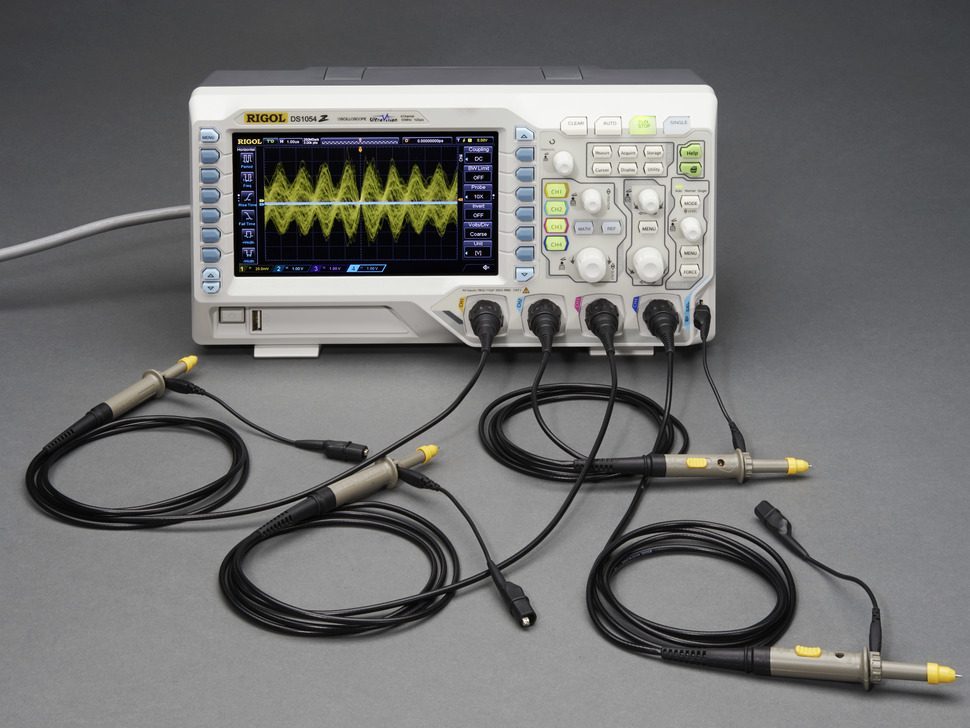
Osiloskop: tegangan terhadap waktu menunjukkan bagaimana arus dan muatan berevolusi dalam sirkuit
Osiloskop: tegangan terhadap waktu mengungkap bagaimana arus dan muatan berevolusi dalam sebuah sirkuit
Kosa kata Latih
English Bahasa Indonesia
Electric current/ɪˈlektrɪk ˈkʌrənt/ Arus listrik
amperes/ˈæmpeəz/ ampere
drift velocity/drɪft vəˈlɒsɪti/ kecepatan rambat
cross-sectional area/krɒs ˈsekʃənl ˈeərɪə/ luas penampang
Current density/ˈkʌrənt ˈdensɪti/ Kepadatan arus
scalar/ˈskeɪlə/ skalar
circuit diagram/ˈsɜːkɪt ˈdaɪəɡræm/ Diagram rangkaian
series/ˈsɪəriːz/ seri
11.2

Sirkuit Listrik

Silabus
Learning ObjectiveEssential Knowledge

11.2.A
Describe the behavior of a circuit.

  • 11.2.A.1 A circuit is composed of electrical loops, which can include wires, batteries, resistors, lightbulbs, capacitors, inductors, switches, ammeters, and voltmeters.
  • 11.2.A.2 A closed electrical loop is a closed path through which charges may flow.
    • 11.2.A.2.i A closed circuit is one in which charges would be able to flow.
    • 11.2.A.2.ii An open circuit is one in which charges would not be able to flow.
    • 11.2.A.2.iii A short circuit is one in which charges would be able to flow with no change in potential difference.
  • 11.2.A.3 A single circuit element may be part of multiple electrical loops.
  • 11.2.A.4 Circuit schematics are representations used to describe and analyze electric circuits.
    • 11.2.A.4.i The properties of an electric circuit are dependent on the physical arrangement of its constituent elements.
    • 11.2.A.4.ii Circuit elements have common symbols that are used to create schematic diagrams. Variable elements are indicated by a diagonal strikethrough arrow across the standard symbol for that element. (Symbols: Battery, Bulb, Switch, Capacitor, Resistor, Ammeter, Voltmeter, Inductor.)

Boundary statement: Unless otherwise specified, all circuit schematic diagrams will be drawn using conventional current.

Sumber: Deskripsi Kursus dan Ujian College Board AP

Sebuah sirkuit adalah sekumpulan loop tertutup yang dibangun dari kawat, baterai, resistor, bohlam, kapasitor, induktor, sakelar, dan meter; muatan hanya dapat mengalir mengelilingi jalur tertutup. Satu elemen dapat menjadi bagian dari beberapa loop sekaligus – itulah yang membuat masalah multi-loop menarik. Setiap analisis dimulai dengan membaca diagram sirkuit: telusuri setiap loop dan identifikasi elemen mana yang memiliki arus yang sama (seri) dan mana yang memiliki beda potensial yang sama (paralel).

Jelajahi

Bangun rangkaian seri dan paralel

Dalam seri, arus yang sama mengalir melalui setiap bola lampu dan tegangan terbagi; dalam paralel, setiap cabang mendapat tegangan penuh. Ubah mode untuk melihat perubahan kecerahan bola lampu.

11.3

Resistansi, Resistivitas, dan Hukum Ohm
Silabus
Learning ObjectiveEssential Knowledge

11.3.A
Describe the resistance of an object using physical properties of that object.

  • 11.3.A.1 Resistance is a measure of the degree to which an object opposes the movement of electric charge.
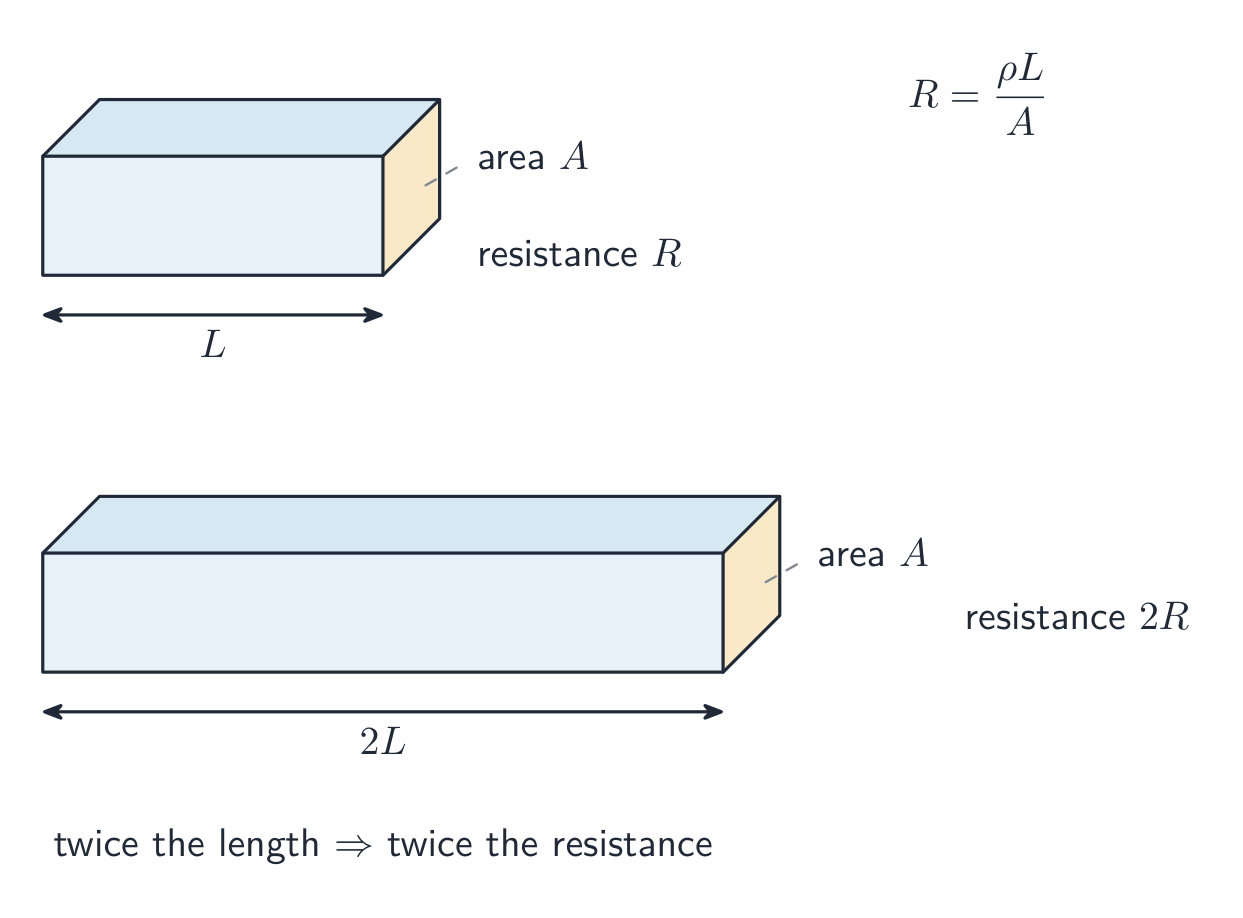
  • 11.3.A.2 The resistance of a resistor with uniform geometry is proportional to its resistivity and length and is inversely proportional to its cross-sectional area.
    • Equation: $R = \dfrac{\rho\ell}{A}$
    • 11.3.A.2.i Resistivity is a fundamental property of a material that depends on its atomic and molecular structure and quantifies how strongly the material opposes the motion of electric charge.
    • 11.3.A.2.ii The resistivity of a conductor typically increases with temperature.
    • 11.3.A.2.iii The total resistance of a resistor with uniform geometry, but that is made of a material whose resistivity varies along the length of the resistor, is given by $R = \int \dfrac{\rho(\ell)\,d\ell}{A}$.

11.3.B
Describe the electrical characteristics of elements of a circuit.

  • 11.3.B.1 Ohm's law relates current, resistance, and potential difference across a conductive element of a circuit.
    • Equation: $I = \dfrac{\Delta V}{R}$
    • 11.3.B.1.i Materials that obey Ohm's law have constant resistance for all currents and are called ohmic materials.
    • 11.3.B.1.ii The resistivity of an ohmic material is constant regardless of temperature.
    • 11.3.B.1.iii Resistors can also convert electrical energy to thermal energy, which may change the temperature of both the resistor and the resistor's environment.
    • 11.3.B.1.iv The resistance of an ohmic circuit element can be determined from the slope of a graph of the current in the element as a function of the potential difference across the element.

Sumber: Deskripsi Kursus dan Ujian College Board AP

Resistansi mengukur seberapa kuat suatu objek melawan aliran muatan. Resistansi meningkat seiring dengan resistivitas material dan panjang konduktor, serta menurun seiring dengan luas permukaannya:

$$R=\frac{\rho\,\ell}{A}.$$

Hukum Ohm menghubungkan arus melalui suatu elemen dengan beda potensial di atasnya:

$$I=\frac{\Delta V}{R}.$$
Konduktor yang lebih panjang memiliki resistansi lebih besar; yang lebih lebar memiliki lebih sedikit

Contoh terpecahkan. Regangkan kawat hingga gandakan panjangnya: volumenya tetap, sehingga luasnya berkurang separuh, dan $R=\rho\ell/A$ menjadi $\rho(2\ell)/(A/2)=4R$ – empat kali resistansi. Suatu elemen disebut ohmik jika $R$ tetap konstan (garis lurus melalui titik asal pada grafik $I$–$\Delta V$); filamen bohlam, yang memanas, tidak.

Jelajahi

Terapkan Hukum Ohm

Hukum Ohm $V=IR$: untuk hambatan tetap, arus berbanding lurus dengan tegangan. Naikkan hambatan dan tegangan yang sama mendorong arus lebih sedikit.

Kosa kata Latih
English Bahasa Indonesia
resistivity/ˌriːzɪˈstɪvəti/ resistivitas
Ohm's law/əʊmz lɔː/ Hukum Ohm
ohmic/ˈəʊmɪk/ Ohmik
equivalent resistance/ɪˈkwɪvələnt rɪˈzɪstəns/ resistansi ekuivalen
ideal battery/aɪˈdɪəl ˈbætəri/ Baterai ideal
internal resistance/ɪnˈtɜːnl rɪˈzɪstəns/ resistansi dalam
terminal voltage/ˈtɜːmɪnl ˈvəʊltɪdʒ/ Tegangan terminal
11.4

Daya Listrik

Silabus

Tujuan Pembelajaran 11.4.A: Jelaskan transfer energi masuk, keluar, atau di dalam sebuah sirkuit listrik, berdasarkan daya.

  • 11.4.A.1 Laju transfer, konversi, atau pelepasan energi oleh elemen sirkuit bergantung pada arus dalam elemen tersebut dan beda potensial listrik melintasinya.
    • Persamaan: $P = I\Delta V$
    • Persamaan: $P = I^2 R = \dfrac{\Delta V^2}{R}$
  • 11.4.A.2 Kehebatan mentol meningkat dengan kuasa, maka kuasa boleh digunakan untuk meramal kehebatan mentol dalam litar secara kualitatif.

Pernyataan sempadan: AP Physics C: Elektrik & Magnetisme hanya mengharapkan pelajar menganalisis pemindahan tenaga mekanikal dan elektrik, walaupun pelajar harus menyedari bahawa tenaga elektrik juga boleh terlarap dalam bentuk tenaga haba.

Sumber: Deskripsi Kursus dan Ujian College Board AP

Muatan $q$ yang jatuh melewati beda potensial $\Delta V$ melepaskan energi $q\Delta V$, sehingga laju transfer energi dalam suatu elemen adalah

$$P=I\,\Delta V=I^2R=\frac{(\Delta V)^2}{R}.$$

Dalam resistor semuanya berubah menjadi panas. Gunakan bentuk yang besaran-besarannya Anda ketahui sebenarnya – dan gunakan daya untuk peringkat kecerahan bohlam: lebih terang = lebih banyak daya, tidak selalu resistansi lebih besar. Dalam seri, resistansi yang lebih besar lebih terang ($P=I^2R$, arus $I$ sama); dalam paralel, yang lebih kecil yang lebih terang ($P=\Delta V^2/R$, beda potensial $\Delta V$ sama).

Jelajahi

Baca karakteristik I-V

Daya adalah $P=IV$. Garis I-V resistor lurus, tetapi lampu melengkung saat memanas dan hambatannya naik. Area di bawah I-V berkaitan dengan energi yang disalurkan.

11.5

Sirkuit Arus Langsung Majemuk
Silabus
Learning ObjectiveEssential Knowledge

11.5.A
Describe the equivalent resistance of multiple resistors connected in a circuit.

  • 11.5.A.1 Circuit elements may be connected in series and/or in parallel.
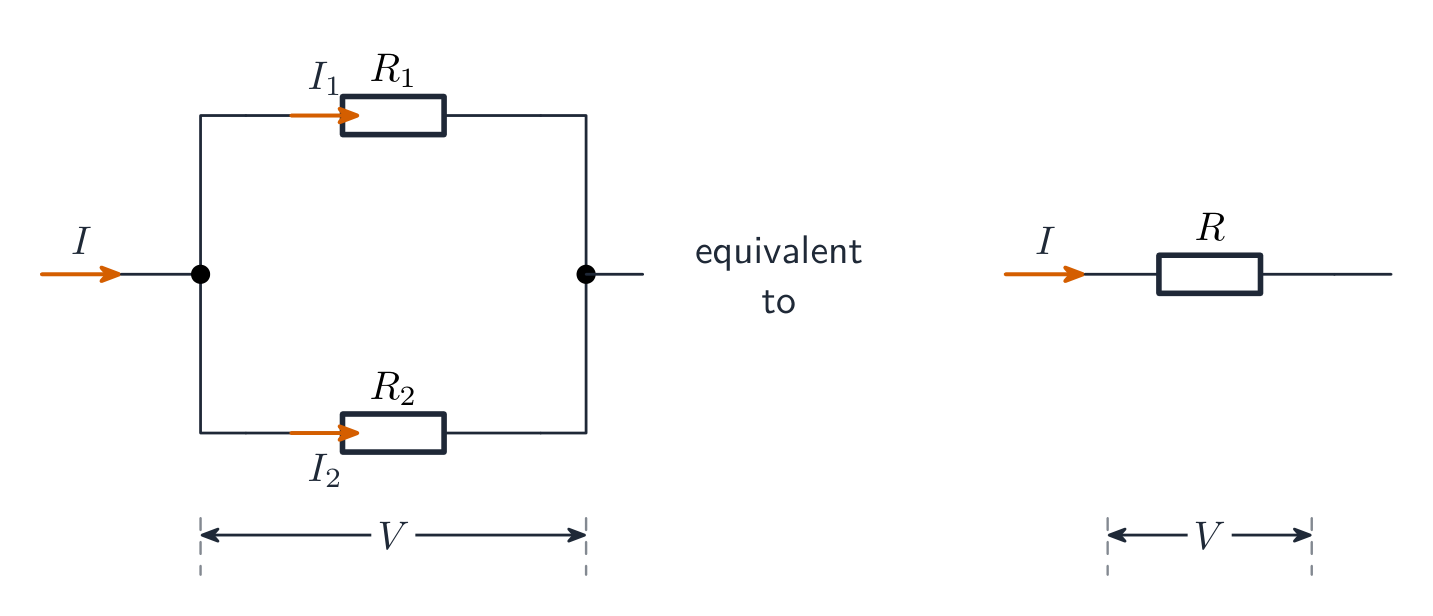
    • 11.5.A.1.i A series connection is one in which any charge passing through one circuit element must proceed through all elements in that connection and has no other path available. The current in each element in series must be the same.
    • 11.5.A.1.ii A parallel connection is one in which charges may pass through one of two or more paths. Across each path, the potential difference is the same.
  • 11.5.A.2 A collection of resistors in a circuit may be analyzed as though it were a single resistor with an equivalent resistance $R_{\text{eq}}$.
    • 11.5.A.2.i The equivalent resistance of a set of resistors in series is the sum of the individual resistances.
      • Equation: $R_{\text{eq},s} = \sum_{i} R_i$
    • 11.5.A.2.ii The inverse of the equivalent resistance of a set of resistors connected in parallel is equal to the sum of the inverses of the individual resistances.
      • Equation: $\dfrac{1}{R_{\text{eq},p}} = \sum_{i} \dfrac{1}{R_i}$
    • 11.5.A.2.iii When resistors are connected in parallel, the number of paths available to charges increases, and the equivalent resistance of the group of resistors decreases.

11.5.B
Describe a circuit with resistive wires and a battery with internal resistance.

  • 11.5.B.1 Ideal batteries have negligible internal resistance. Ideal wires have negligible resistance.
    • 11.5.B.1.i The resistance of wires that are good conductors may normally be neglected, because their resistance is much smaller than that of other elements of a circuit.
    • 11.5.B.1.ii The resistance of wires may only be neglected if the circuit contains other elements that do have resistance.
    • 11.5.B.1.iii The potential difference a battery would supply if it were ideal is the potential difference measured across the terminals when there is no current in the battery and is sometimes referred to as its $\mathrm{emf}$ ($\mathcal{E}$).
  • 11.5.B.2 The internal resistance of a nonideal battery may be treated as the resistance of a resistor in series with an ideal battery and the remainder of the circuit.
  • 11.5.B.3 When there is current in a nonideal battery with internal resistance $r$, the potential difference across the terminals of the battery is reduced relative to the potential difference when there is no current in the battery.
    • Equation: $\Delta V_{\text{terminal}} = \mathcal{E} - Ir$

11.5.C
Describe the measurement of current and potential difference in a circuit.

  • 11.5.C.1 Ammeters are used to measure current at a specific point in a circuit.
    • 11.5.C.1.i Ammeters must be connected in series with the element in which current is being measured.
    • 11.5.C.1.ii Ideal ammeters have zero resistance so that they do not affect the current in the element that they are in series with.
  • 11.5.C.2 Voltmeters are used to measure electric potential difference between two points in a circuit.
    • 11.5.C.2.i Voltmeters must be connected in parallel with the element across which potential difference is being measured.
    • 11.5.C.2.ii Ideal voltmeters have infinite resistance so that no charge flows through them.
  • 11.5.C.3 Nonideal ammeters and voltmeters will change the properties of the circuit being measured.

Boundary statement: Unless otherwise stated, all batteries, wires, and meters are assumed to be ideal. Circuits with batteries of different potential differences connected in parallel will not be assessed.

Sumber: Deskripsi Kursus dan Ujian College Board AP

Sederhanakan jaringan resistor menjadi resistansi ekuivalen: resistansi seri ditambahkan ($R_{\text{eq}}=R_1+R_2+\cdots$), sementara resistansi paralel ditambahkan sebagai resiprokal ($\tfrac{1}{R_{\text{eq}}}=\tfrac{1}{R_1}+\tfrac{1}{R_2}+\cdots$ – selalu kurang dari cabang terkecil). Runtuhkan jaringan langkah demi langkah untuk menemukan arus baterai, lalu kembangkan kembali untuk menemukan arus dan tegangan setiap elemen.

Contoh terpecahkan. Sebuah baterai $12\ \text{V}$ mendorong arus melalui resistor $4.0\ \Omega$ dan $2.0\ \Omega$ secara seri: $R_{\text{eq}}=6.0\ \Omega$, $I=2.0\ \text{A}$, tegangan terbagi menjadi $8.0\ \text{V}$ dan $4.0\ \text{V}$, dan resistor $4.0\ \Omega$ mendissipasi $P=I^2R=16\ \text{W}$.

Resistor dalam paralel bergabung menjadi resistansi ekuivalen yang lebih kecil

Baterai nyata tidak ideal. Modelkan baterai sebagai baterai ideal dengan GGL $\varepsilon$ yang dirangkai seri dengan resistansi internal sendiri $r$. Ketika arus mengalir, sebagian GGL habis di dalam, sehingga tegangan terminal – apa yang dibaca voltmeter melintasi baterai sebenarnya – turun:

$$\Delta V_{\text{terminal}}=\varepsilon-Ir.$$

Contoh terpecahkan. Sebuah baterai dengan $\varepsilon=12\ \text{V}$ dan $r=0.50\ \Omega$ menyediakan $2.0\ \text{A}$: terminal-nya berada pada $\Delta V=12-2.0(0.50)=11\ \text{V}$. Tanpa arus, voltmeter menunjukkan $12\ \text{V}$ penuh.

Meteran: ammeter dipasang seri pada titik di mana arusnya ingin Anda ukur (ammeter ideal: nol resistansi); voltmeter dipasang paralel melintasi elemen (voltmeter ideal: resistansi tak terhingga). Meteran non-ideal mengganggu sirkuit yang diukurnya – ammeter nyata menambah resistansi seri, voltmeter nyata mengambil arus.

Kosa kata Latih
English Bahasa Indonesia
parallel/ˈpærəlel/ paralel
Resistance/rɪˈzɪstəns/ Penolakan
ammeter/ˈæmiːtə/ amperemeter
voltmeter/ˈvəʊltmiːtə/ voltmeter
Kirchhoff's loop rule/ˈkɜːkhɒfs luːp ruːl/ Aturan loop Kirchhoff
Kirchhoff's junction rule/ˈkɜːkhɒfs ˈdʒʌŋkʃn ruːl/ Aturan titik simpul Kirchhoff
junction/ˈdʒʌŋkʃn/ sambungan
equivalent capacitance/ɪˈkwɪvələnt kəˈpæsɪtəns/ Kapasitansi ekuivalen
RC circuit/ˌɑː ˈsiː ˈsɜːkɪt/ sirkuit RC
time constant/taɪm ˈkɒnstənt/ konstanta waktu
steady state/ˈstedi steɪt/ keadaan tunak
11.6

Aturan Loop Kirchhoff

Silabus
Learning ObjectiveEssential Knowledge

11.6.A
Describe a circuit or elements of a circuit by applying Kirchhoff's loop rule.

  • 11.6.A.1 Energy changes in simple electrical circuits may be represented in terms of charges moving through electric potential differences within circuit elements.
    • Equation: $\Delta U_E = q\Delta V$
  • 11.6.A.2 Kirchhoff's loop rule is a consequence of the conservation of energy.
    • 11.6.A.2.i Kirchhoff's loop rule states that the sum of potential differences across all circuit elements in a single closed loop must equal zero.
      • Equation: $\sum \Delta V = 0$
    • 11.6.A.2.ii The values of electric potential at points in a circuit can be represented by a graph of electric potential as a function of position within a loop.

Sumber: Deskripsi Kursus dan Ujian College Board AP

Muatan yang bergerak melalui beda potensial bertukar energi ($\Delta U_E=q\Delta V$), dan energi harus seimbang di sekitar jalur tertutup apa pun. Itu adalah aturan loop Kirchhoff:

$$\sum\Delta V=0\ \text{around any closed loop}.$$

Disiplin tanda memenangkan masalah ini: menyeberangi baterai dari $-$ ke $+$ adalah $+\varepsilon$; menyeberangi resistor searah dengan arus yang diasumsikan adalah $-IR$ (melawannya, $+IR$). Tulis satu persamaan per loop independen.

11.7

Aturan Simpul Kirchhoff
Silabus

Tujuan Pembelajaran 11.7.A: Deskripsikan sebuah sirkuit atau elemen-elemen sirkuit dengan menerapkan aturan titik simpul Kirchhoff.

  • 11.7.A.1 Aturan titik simpul Kirchhoff merupakan konsekuensi dari kekekalan muatan listrik.
  • 11.7.A.2 Aturan titik simpul Kirchhoff menyatakan bahwa total jumlah muatan yang masuk ke sebuah titik simpul per satuan waktu harus sama dengan total jumlah muatan yang keluar dari titik simpul tersebut per satuan waktu.
    • Persamaan: $\sum I_{\text{in}} = \sum I_{\text{out}}$

Sumber: Deskripsi Kursus dan Ujian College Board AP

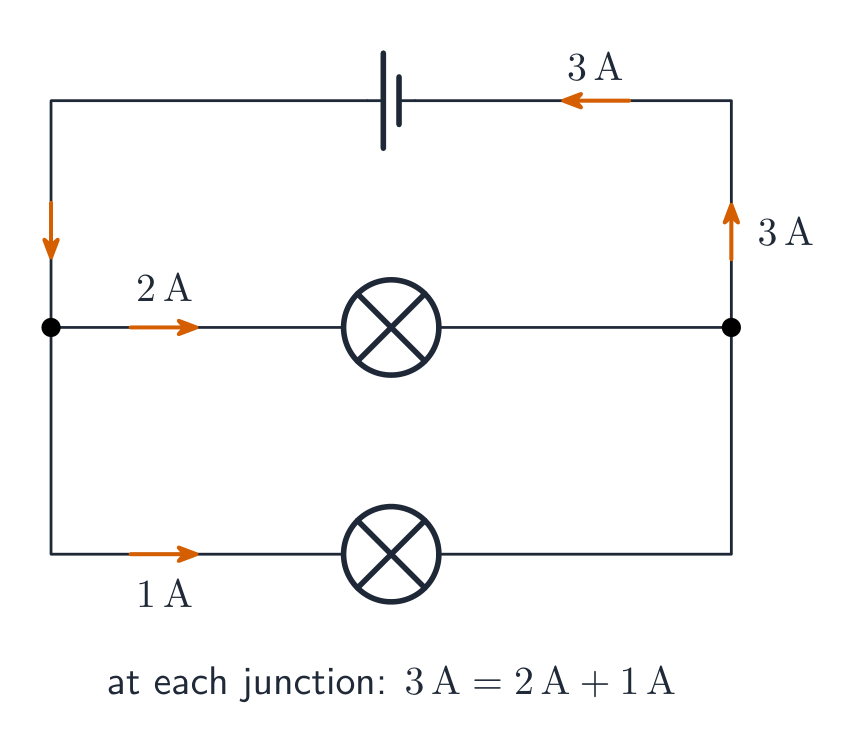
Aturan simpul Kirchhoff adalah konservasi muatan di simpul:

$$\sum I_{\text{in}}=\sum I_{\text{out}}.$$
Arus terbagi di simpul: apa yang masuk sama dengan apa yang keluar

Bersama-sama kedua aturan tersebut menyelesaikan sirkuit multi-loop apa pun: tentukan arus untuk setiap cabang, tulis persamaan simpul, lalu persamaan loop, dan selesaikan. Jawaban negatif hanya berarti arus mengalir berlawanan dengan arah asumsi Anda.
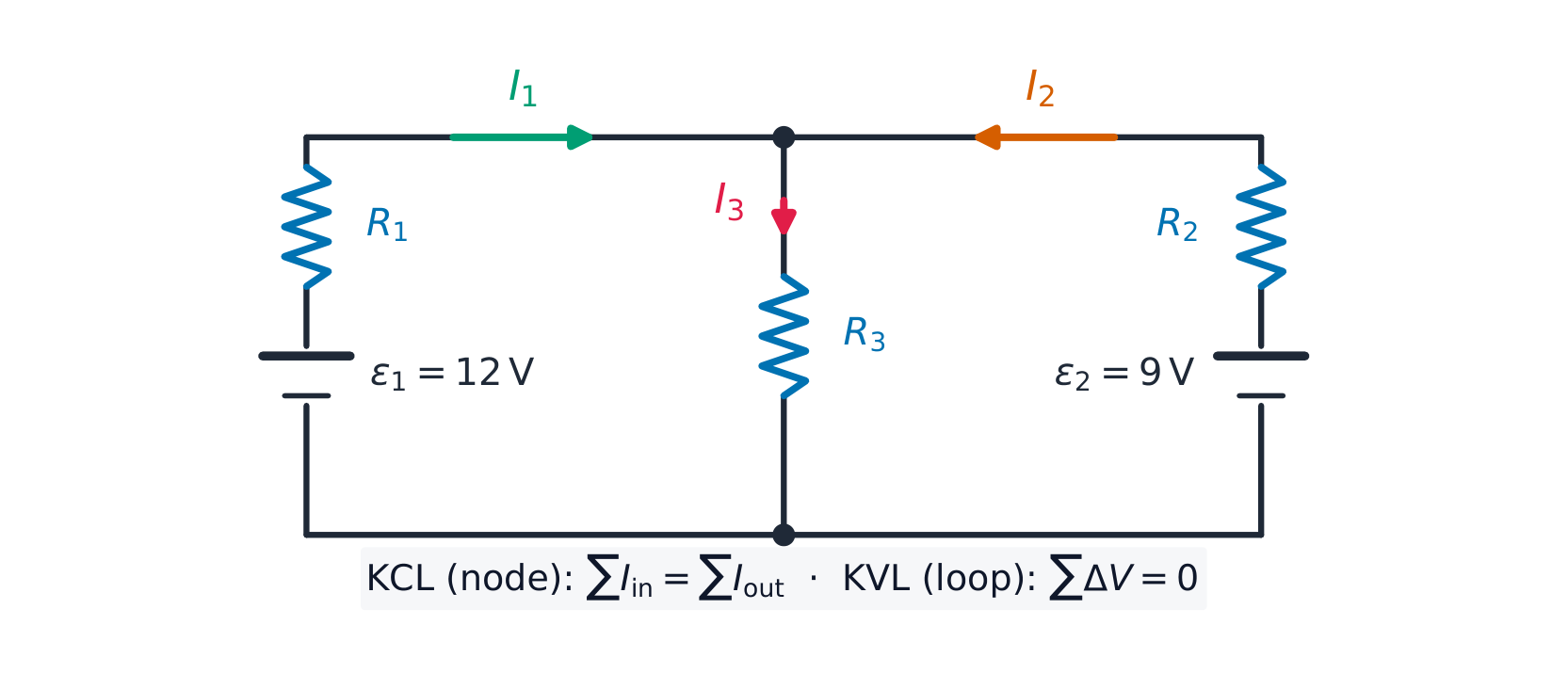
Dua persamaan loop dan satu persamaan simpul menyelesaikan sirkuit dua-baterai ini

Contoh terpecahkan. Pada sirkuit di atas, $\varepsilon_1=12\ \text{V}$ dengan $R_1=1.0\ \Omega$ di sebelah kiri, $\varepsilon_2=9.0\ \text{V}$ dengan $R_2=1.0\ \Omega$ di sebelah kanan, dan resistor tengah bersama $R_3=2.0\ \Omega$ yang membawa $I_3=I_1+I_2$ (aturan simpul). Dua persamaan loop adalah

$$12=I_1+2(I_1+I_2)=3I_1+2I_2,\qquad 9=I_2+2(I_1+I_2)=2I_1+3I_2.$$

Menyelesaikan: $I_1=3.6\ \text{A}$, $I_2=0.60\ \text{A}$, sehingga $I_3=4.2\ \text{A}$ melalui bagian tengah. Periksa dengan loop kedua: $2(3.6)+3(0.60)=9.0$ ✓.

11.8

Sirkuit Resistor-Kapasitor (RC)
Silabus
Learning ObjectiveEssential Knowledge

11.8.A
Describe the equivalent capacitance of multiple capacitors.

  • 11.8.A.1 A collection of capacitors in a circuit may be analyzed as though it was a single capacitor with an equivalent capacitance $C_{\text{eq}}$.
    • 11.8.A.1.i The inverse of the equivalent capacitance of a set of capacitors connected in series is equal to the sum of the inverses of the individual capacitances.
      • Equation: $\dfrac{1}{C_{\text{eq},s}} = \sum_{i} \dfrac{1}{C_i}$
    • 11.8.A.1.ii The equivalent capacitance of a set of capacitors in series is less than the capacitance of the smallest capacitor.
    • 11.8.A.1.iii The equivalent capacitance of a set of capacitors in parallel is the sum of the individual capacitances.
      • Equation: $C_{\text{eq},p} = \sum_{i} C_i$
  • 11.8.A.2 As a result of conservation of charge, each of the capacitors in series must have the same magnitude of charge on each plate.

11.8.B
Describe the behavior of a circuit containing combinations of resistors and capacitors.

  • 11.8.B.1 The charge on a capacitor or the current in a resistor in an RC circuit can be described by a fundamental differential equation derived from Kirchhoff's loop rule.
    • Equation: $\mathcal{E} = \dfrac{dq}{dt}R + \dfrac{q}{C}$
  • 11.8.B.2 The time constant ($\tau$) is a significant feature of an RC circuit.
    • 11.8.B.2.i The time constant of an RC circuit is a measure of how quickly the capacitor will charge or discharge and is defined as $\tau = R_{\text{eq}}C_{\text{eq}}$.
    • 11.8.B.2.ii For a charging capacitor, the time constant represents the time required for the capacitor's charge to increase from zero to approximately 63 percent of its final asymptotic value.
    • 11.8.B.2.iii For a discharging capacitor, the time constant represents the time required for the capacitor's charge to decrease from fully charged to approximately 37 percent of its initial value.
  • 11.8.B.3 The potential difference across a capacitor and the current in the branch of the circuit containing the capacitor each change over time as the capacitor charges and discharges, but both will reach a steady state after a long time interval.
    • 11.8.B.3.i Immediately after being placed in a circuit, an uncharged capacitor acts like a wire, and charge can easily flow to or from the plates of the capacitor.
    • 11.8.B.3.ii As a capacitor charges, changes to the potential difference across the capacitor affect the charge on the plates of the capacitor, the current in the circuit branch in which the capacitor is located, and the electric potential energy stored in the capacitor.
    • 11.8.B.3.iii The potential difference across a capacitor, the current in the circuit branch in which the capacitor is located, and the electric potential energy stored in the capacitor all change with respect to time and asymptotically approach steady state conditions.
    • 11.8.B.3.iv After a long time, a charging capacitor approaches a state of being fully charged, reaching a maximum potential difference at which there is zero current in the circuit branch in which the capacitor is located.
    • 11.8.B.3.v Immediately after a charged capacitor begins discharging, the amount of charge on the capacitor and the energy stored in the capacitor begin to decrease.
    • 11.8.B.3.vi As a capacitor discharges, the amount of charge on the capacitor, the potential difference across the capacitor, and the current in the circuit branch in which the capacitor is located all decrease until a steady state is reached.
    • 11.8.B.3.vii After either charging or discharging for times much greater than the time constant, the capacitor and the relevant circuit branch may be modeled using steady-state conditions.

Sumber: Deskripsi Kursus dan Ujian College Board AP

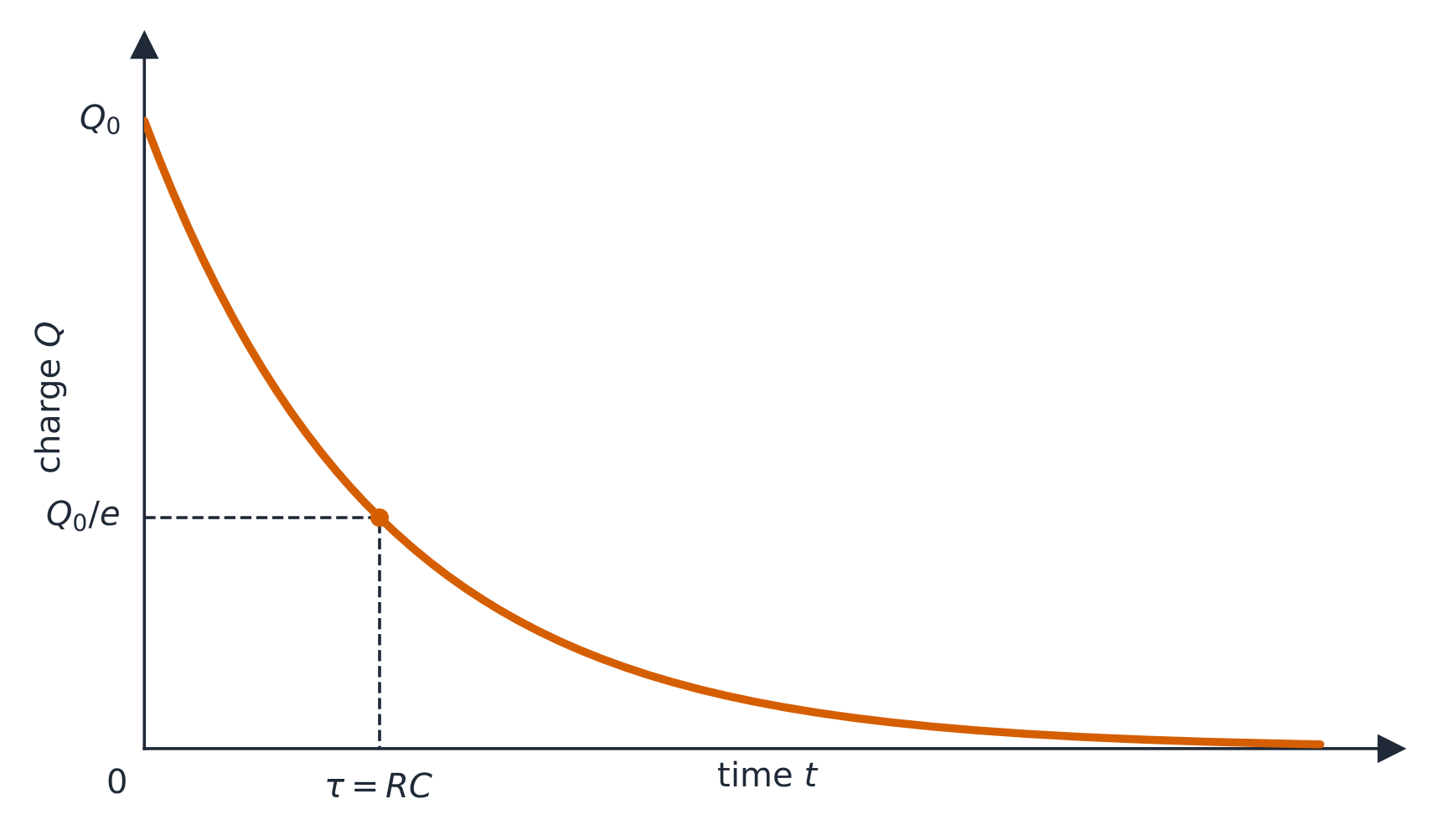
Mengosongkan kapasitor: τ = RC
Mengisi kapasitor (RC)

Jaringan kapasitor disederhanakan seperti resistor tetapi dengan aturan yang ditukar: kapasitansi paralel ditambahkan ($C_{\text{eq}}=C_1+C_2$), seri ditambahkan sebagai resiprokal – dan kapasitor dalam seri harus membawa muatan yang sama di setiap pelat, oleh karena konservasi muatan. Gunakan kapasitansi ekuivalen untuk menganalisis jaringan, kemudian kembangkan kembali.

Dalam sirkuit RC RC, aturan loop Kirchhoff memberikan persamaan diferensial

$$\varepsilon=R\frac{dq}{dt}+\frac{q}{C},$$

yang solusinya adalah eksponensial dengan konstanta waktu $\tau=RC$:

$$q(t)=Q\big(1-e^{-t/RC}\big)\ \text{(charging)},\qquad q(t)=Q\,e^{-t/RC}\ \text{(discharging)},\qquad i(t)=\frac{\varepsilon}{R}e^{-t/RC}.$$

Arus terbesar pada saat pertama dan meluruh – ia tidak pernah "menunggu" kapasitor. Pelajari dua batas: pada $t=0$ kapasitor tanpa muatan bertindak seperti kawat biasa (arus maksimum); setelah waktu lama ia terisi penuh, tidak ada arus mengalir di cabangnya, dan ia bertindak seperti pemutusan. Dalam keadaan stabil apa pun, tutup cabang kapasitor dengan jari Anda, selesaikan sirkuit resistor, lalu baca tegangan kapasitor dari elemen yang dilintasi olehnya.

Muatan pada kapasitor meluruh secara eksponensial saat melepaskan muatan

Contoh terpecahkan. Dengan $R=5.0\ \text{k}\Omega$, $C=200\ \mu\text{F}$, dan baterai $10\ \text{V}$: $\tau=RC=1.0\ \text{s}$; arus awal $\dfrac{\varepsilon}{R}=2.0\ \text{mA}$; setelah satu konstanta waktu muatannya adalah $q=CV(1-e^{-1})\approx1.3\times10^{-3}\ \text{C}$, sekitar $63\%$ dari muatan penuh, dan arus telah turun ke $37\%$ dari nilainya awal.
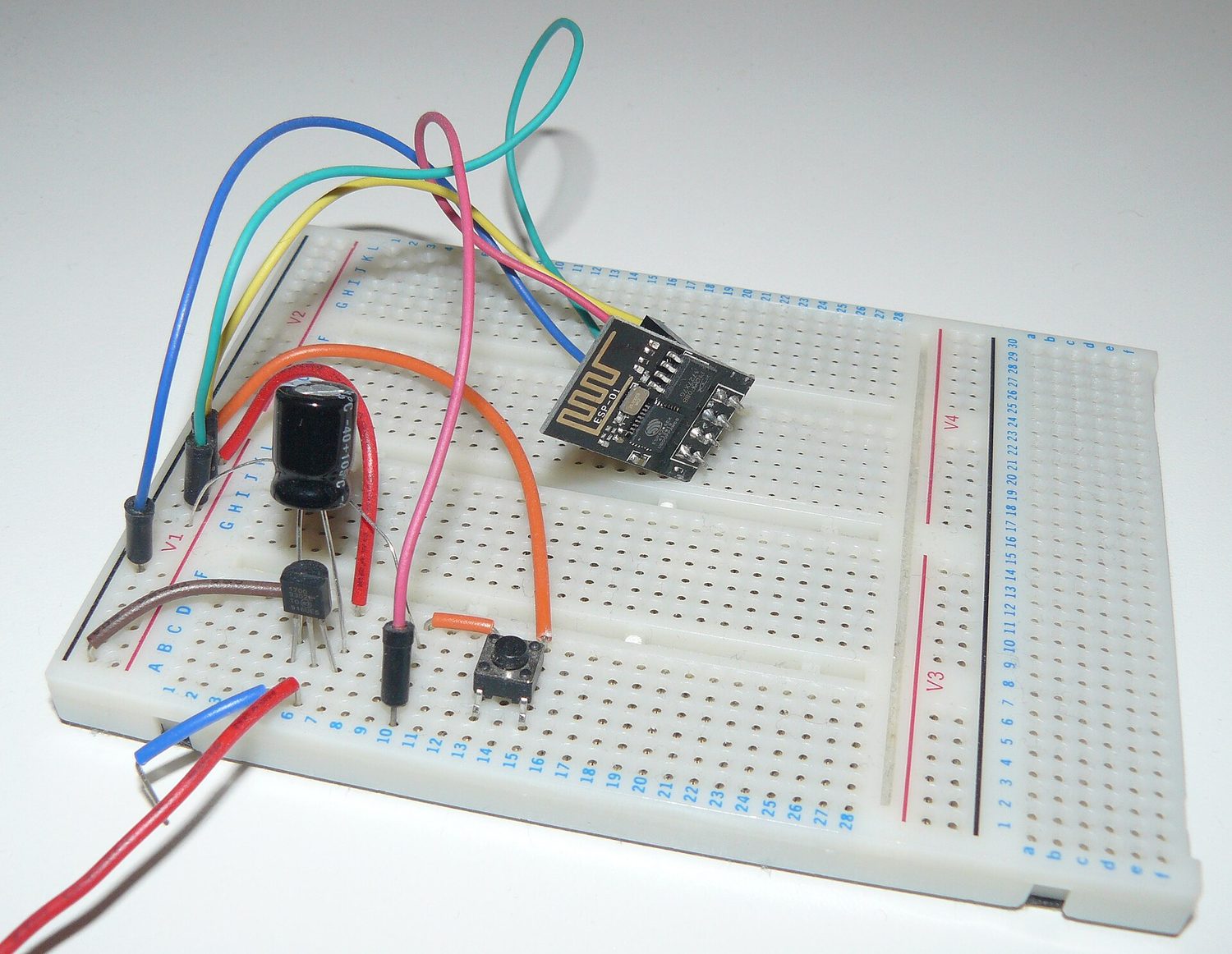
Sirkuit elektronik yang dibangun di atas papan prototipe
Sirkuit nyata di papan breadboard: resistor dan kapasitor bersama-sama menentukan seberapa cepat tegangan naik dan turun
11.8

Tips ujian

  • Hubungkan arus dengan aliran muatan $I=\tfrac{dQ}{dt}$ dan gunakan $J=\sigma E$, $R=\tfrac{\rho L}{A}$ untuk hambatan.
  • Terapkan hukum Kirchhoff (simpul: muatan; loop: energi) dengan konvensi tanda yang konsisten.
  • Analisis sirkuit RC dengan kalkulus: pengisian/pengosongan menghasilkan eksponensial dengan konstanta waktu $\tau=RC$.
  • Gabungkan resistor (seri tambahkan, paralel resiprokal) dan lacak daya $P=IV=I^2R$.
  • Pada $t=0$ kapasitor bertindak seperti kawat; setelah waktu lama ($t\to\infty$) ia bertindak seperti cabang terbuka.

Pelajaran interaktif untuk topik ini

Kerjakan langkah demi langkah, dengan latihan pengecekan instan.

Soal-Soil Masa Lalu

Topik lain dalam AP Fisika C: Listrik dan Magnetisme

Masuk atau buat akun

IGCSE, A-Level & AP