Resistance, Resistivity, and Ohm's Law
Introduced| English | Meaning |
|---|---|
| resistance/rɪˈzɪstəns/ | The ratio of potential difference to electric current. |
| resistivity/ˌriːzɪˈstɪvəti/ | A material property relating resistance to length and cross-sectional area at a specified temperature. |
| ohms/əʊmz/ | Units of electrical resistance, with one ohm equal to one volt per ampere. |
Why does a thin wire get hot while a thick one stays cool?
- Push the same current through a thin wire and it heats up fast.
- The thin wire fights the flow more — it has more resistance 电阻.
- Resistance is how hard a component makes it for charge to pass.
- Two ideas run this lesson: Ohm's law and resistivity.
Ohm's law: V = IR
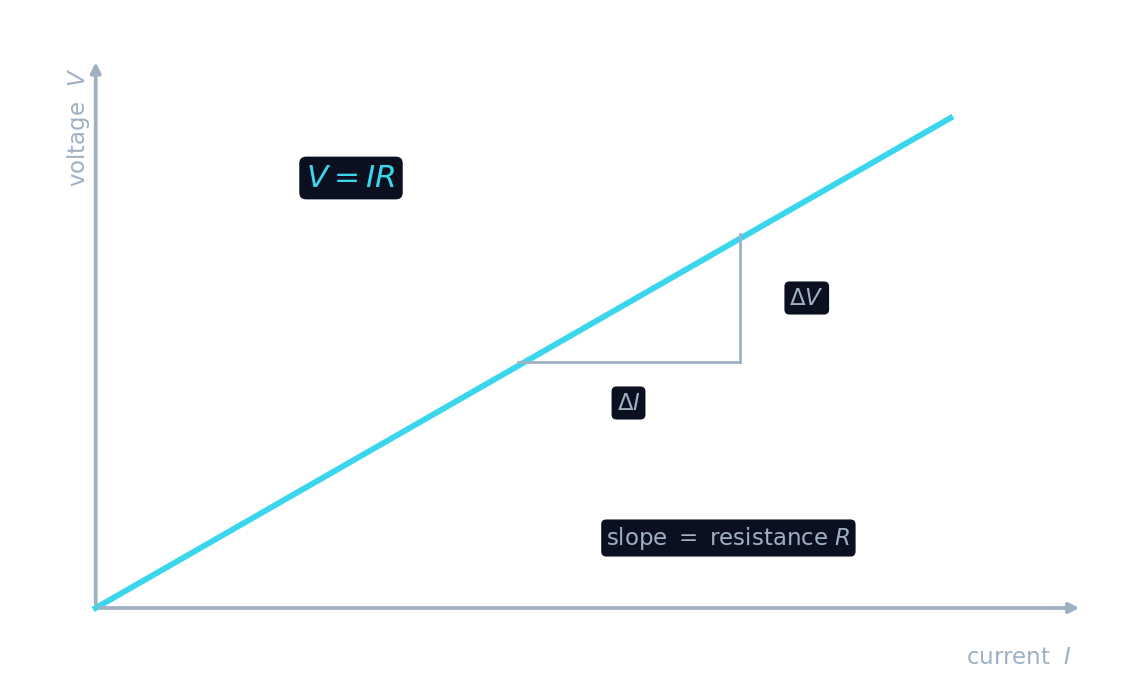
- For many materials, voltage and current are proportional: $V = IR$.
- The constant $R$ is the resistance, in ohms 欧姆 ($\Omega$).
- On an $I$–$V$ graph this is a straight line through the origin.
- Rearranged: more resistance means less current for a given voltage.
Trace the I–V line
Vary the voltage across a resistor and watch the current follow a straight line.
Ohm's law relates voltage, current and resistance as:
Difficulty 1/5 · 100 coins + a small bonus on first completion today
$V = IR$ for an ohmic device.
A $9\ \text{V}$ supply drives $3\ \text{A}$ through a resistor. Find $R$ (in Ω).
Difficulty 2/5 · 140 coins + a small bonus on first completion today
$R = V/I = 9/3 = 3\ \Omega$.
Resistivity: material and shape
- Resistance depends on the wire's shape and its material: $R = \dfrac{\rho L}{A}$.
- Resistivity 电阻率 $\rho$ is the material's own opposition to flow.
- Longer wire → more resistance; thicker wire (bigger $A$) → less.
- Copper has low $\rho$ (a good conductor); nichrome has high $\rho$ (a heater).
Using $R = \rho L/A$, a longer, thinner wire has:
Difficulty 1/5 · 100 coins + a small bonus on first completion today
More length and less area both raise $R = \rho L/A$.
A material's own opposition to current, symbol $\rho$, is its ____.
Difficulty 1/5 · 100 coins + a small bonus on first completion today
Resistivity $\rho$ is the material property in $R = \rho L/A$.
Ohmic vs non-ohmic
- Ohmic devices keep a constant $R$ — a straight $I$–$V$ line.
- Non-ohmic devices (a bulb, a diode) bend the line.
- A bulb's filament heats up, so its resistance rises with current.
- Always check whether $R$ is really constant before using $V = IR$ blindly.
A filament bulb is non-ohmic — its resistance rises as it heats up.
Difficulty 1/5 · 100 coins + a small bonus on first completion today
A hot filament has higher resistance, so its I–V line curves.
Select all true statements about resistance.
Difficulty 2/5 · 140 coins + a small bonus on first completion today
Ohmic V=IR, R=ρL/A, metals rise with temperature. Bulbs and diodes are non-ohmic.
Temperature matters
- In metals, hotter atoms jostle the electrons more.
- So a metal's resistance increases with temperature.
- That is why a bulb's cold resistance is far below its glowing resistance.
- Some materials do the opposite, and a few lose all resistance (superconductors).
A $12\ \text{V}$ battery drives $3\ \text{A}$ through a resistor. Find $R$.
- $R = \dfrac{V}{I} = \dfrac{12}{3} = 4\ \Omega$.
- Double the voltage and (if ohmic) the current doubles too.
Ohm's law $V = IR$ only holds for ohmic devices with constant $R$. A bulb or diode is non-ohmic — its resistance changes, so its $I$–$V$ graph is a curve, not a line. Don't assume a fixed $R$ for those.
Resistance opposes current: Ohm's law $V = IR$ (ohms), a straight $I$–$V$ line for ohmic devices. Resistivity gives $R = \rho L/A$ — longer and thinner means more resistance. In metals, resistance rises with temperature.
Write from a resistance of 6 ohms
- A wire has resistivity 4 times 10 to the minus 6 ohm metres, length 3.0 m and area 2.0 times 10 to the minus 6 square metres.
- Find the resistance. Say what doubling the thickness does to resistance.
Find the resistance of a wire with resistivity 4 times 10 to the minus 6 ohm metres, length 3.0 m and cross-sectional area 2.0 times 10 to the minus 6 square metres. What does a larger area do to the resistance?
4 times 10 to the minus 6 times 3.0, divided by 2.0 times 10 to the minus 6, is 6 ohms.
What is the resistance of this wire?
Difficulty 1/5 · 100 coins + a small bonus on first completion today
Resistivity times length over area is 12 times 10 to the minus 6 divided by 2 times 10 to the minus 6, which is 6 ohms.