Compound Direct Current Circuits
Introduced| English | Meaning |
|---|---|
| series/ˈsɪəriːz/ | An arrangement in which components lie along a single electrical path. |
| parallel/ˈpærəlel/ | An electrical arrangement in which components are connected across the same two points and have the same potential difference. |
| equivalent resistance/ɪˈkwɪvələnt rɪˈzɪstəns/ | The single resistance that produces the same current-voltage relationship as a specified resistor combination between two terminals. |
One bulb dies — does the whole string go dark?
- Old fairy lights: one bulb fails and the entire string goes out.
- Newer ones: a bulb fails but the rest stay lit.
- The difference is series 串联 versus parallel 并联 wiring.
- Real circuits mix both, so we need rules to combine resistors.
Series: resistances add
- In series, components sit one after another on a single path.
- The same current flows through each; their voltages add up.
- The total resistance is just the sum: $R = R_1 + R_2 + \cdots$.
- Adding a series resistor always increases the total resistance.
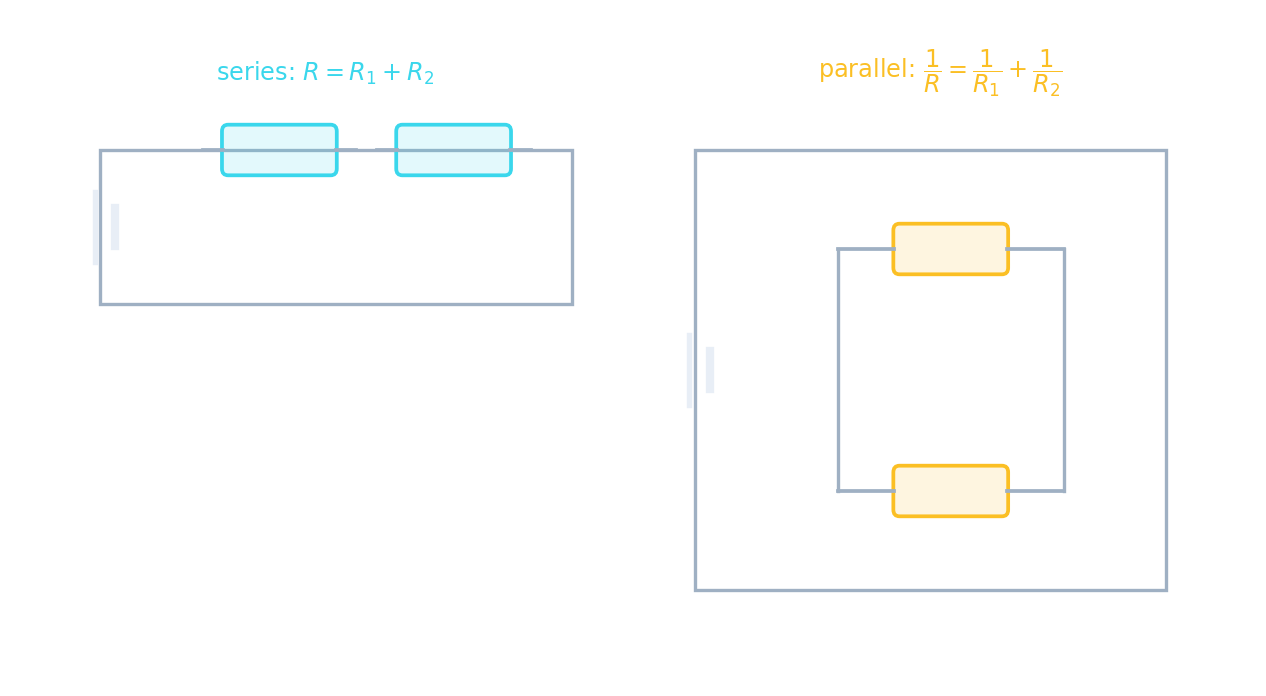
Two resistors in series have a total resistance of:
Difficulty 1/5 · 100 coins + a small bonus on first completion today
Series resistances add: $R = R_1 + R_2$.
In a series circuit, what is the same through every component?
Difficulty 1/5 · 100 coins + a small bonus on first completion today
Series shares one current; voltages add.
Parallel: reciprocals add
- In parallel, components share the same two ends.
- Each gets the same voltage; their currents add up.
- The reciprocals add: $\dfrac{1}{R} = \dfrac{1}{R_1} + \dfrac{1}{R_2} + \cdots$.
- The total is smaller than any single branch — more paths, less resistance.
Series vs parallel
Wire bulbs in parallel and compare the current and brightness with a series wiring.
Two $4\ \Omega$ resistors in parallel give what total resistance (in Ω)?
Difficulty 2/5 · 140 coins + a small bonus on first completion today
$1/R = 1/4 + 1/4 = 1/2$, so $R = 2\ \Omega$.
The total resistance of a parallel combination is larger than the largest branch.
Difficulty 1/5 · 100 coins + a small bonus on first completion today
False. Adding branches gives the current more paths, so the total resistance is smaller than any single branch.
Reduce a network step by step
- Find any pure series or pure parallel group and replace it with one resistor.
- Repeat, shrinking the circuit until a single resistor remains.
- That final value is the equivalent resistance 等效电阻.
- Then use $V = IR$ to find the total current from the battery.
The single resistor that replaces a whole network is its ____ resistance.
Difficulty 1/5 · 100 coins + a small bonus on first completion today
That value is the equivalent resistance.
What each wiring means
- Series: one break kills the whole loop (old fairy lights).
- Parallel: each branch is independent (house wiring, new lights).
- Parallel also draws more total current — every branch adds its own.
- Homes use parallel so one switch doesn't turn off everything.
Select all true statements about series and parallel.
Difficulty 2/5 · 140 coins + a small bonus on first completion today
Series adds, parallel adds reciprocals, and they share current/voltage respectively. Parallel is NOT a sum.
Two $6\ \Omega$ resistors: find the total in series, then in parallel.
- Series: $R = 6 + 6 = 12\ \Omega$.
- Parallel: $\dfrac{1}{R} = \dfrac{1}{6} + \dfrac{1}{6} = \dfrac{2}{6}$, so $R = 3\ \Omega$.
Parallel resistance is not the sum. Add the reciprocals, then flip: the total is always less than the smallest branch. Writing $R = R_1 + R_2$ for parallel is the most common circuit error.
In series, resistances add ($R = R_1 + R_2$) and share the current; in parallel, reciprocals add ($1/R = 1/R_1 + 1/R_2$) and share the voltage, giving a smaller total. Reduce a network step by step to its equivalent resistance.
Write from 25 ohms in series and 6 ohms in parallel
- One resistor is 10 ohms and the other is 15 ohms.
- Find the series total and the parallel total.
Find the total resistance of a 10 ohm resistor and a 15 ohm resistor in series, and then in parallel.
10 plus 15 is 25. The product over the sum is 150 divided by 25, which is 6.
What are the two totals?
Difficulty 1/5 · 100 coins + a small bonus on first completion today
Series addition gives 25 ohms. Parallel product over sum gives 6 ohms.