A-Level Further Mathematics · Matematika Lanjutan A-Level
Tips
A-Level Further Mathematics (9231) berada di atas 9709 dan mengasumsikan pemahaman terhadapnya: Further Pure 1 and 2, Further Mechanics, dan Further Probability & Statistics. Mata kuliah ini diambil bersamaan dengan Matematika, bukan sebagai pengganti, dan komponen mana yang harus Anda kerjakan bergantung pada persyaratan masuk sekolah Anda.
Further Pure memuat sebagian besar alat baru — matriks dan transformasi linear, bilangan kompleks dalam bentuk polar dan eksponensial, kurva polar, fungsi hiperbolik, persamaan diferensial, pembuktian dengan induksi. Ini adalah konten benar-benar baru, bukan versi lebih sulit dari materi yang sudah dikenal.
Tingkat kesulitan yang realistis terletak pada waktu, bukan ide. Aljabarnya cukup panjang sehingga kesalahan di baris kedua dapat bertahan hingga akhir, jadi tuliskan metode secara lengkap dan periksa di titik tengah.
This handout covers Topic 1: Further Pure Mathematics 进阶纯数学 1. It adds new algebra, matrices, polar coordinates, more vectors, and proof by induction.
Bahasa Indonesia
Lembar kerja ini mencakup Topik 1: Matematika Murni Lanjutan 1. Materi ini menambahkan aljabar baru, matriks, koordinat polar, vektor tambahan, dan pembuktian dengan induksi.
1.1
Roots of polynomial equations · Akar persamaan polinomial
Syllabus · Silabus
English
Candidates should be able to:
Notes and examples
• recall and use the relations between the roots and coefficients of polynomial equations
e.g. to evaluate symmetric functions of the roots or to solve problems involving unknown coefficients in equations; restricted to equations of degree 2, 3 or 4 only.
• use a substitution to obtain an equation whose roots are related in a simple way to those of the original equation
Substitutions will not be given for the easiest cases, e.g. where the new roots are reciprocals or squares or a simple linear function of the old roots.
Bahasa Indonesia
Calon peserta harus mampu:
Catatan dan contoh
• mengingat dan menggunakan hubungan antara akar dan koefisien persamaan polinomial
Mis. untuk mengevaluasi fungsi simetris dari akar atau untuk memecahkan masalah yang melibatkan koefisien tak diketahui dalam persamaan; dibatasi hanya pada persamaan berderajat 2, 3 atau 4.
• gunakan substitusi untuk mendapatkan persamaan yang akarnya terkait secara sederhana dengan akar persamaan asli
Substitusi tidak akan diberikan untuk kasus termudah, mis. di mana akar baru adalah resiprokal atau kuadrat atau fungsi linear sederhana dari akar lama.
Source: Cambridge International syllabus · Sumber: Silabus Cambridge International
English
For a polynomial equation, the roots 根 are linked to the coefficients 系数. For $ax^2 + bx + c = 0$ with roots $\alpha, \beta$:
Sums like $\sum\alpha$ and $\sum\alpha\beta$ are symmetric functions 对称函数 of the roots (unchanged if the roots are swapped). To find an equation whose roots are changed in a simple way, use a substitution 代换 (for example, put $w = \alpha + 1$).
Worked example. The equation $x^2 - 5x + 6 = 0$ has roots $\alpha, \beta$. Find the equation with roots $\alpha + 1, \beta + 1$.
Here $\alpha + \beta = 5$ and $\alpha\beta = 6$. The new sum is $(\alpha + 1) + (\beta + 1) = 7$, and the new product is $(\alpha + 1)(\beta + 1) = \alpha\beta + \alpha + \beta + 1 = 6 + 5 + 1 = 12$. So the new equation is
$$x^2 - 7x + 12 = 0.$$
Bahasa Indonesia
Untuk persamaan polinomial, akar-akarnya terkait dengan koefisien-koefisiennya. Untuk $ax^2 + bx + c = 0$ dengan akar $\alpha, \beta$:
Jumlah seperti $\sum\alpha$ dan $\sum\alpha\beta$ adalah fungsi simetris dari akar-akarnya (tidak berubah jika akar ditukar). Untuk menemukan persamaan yang akarnya berubah dengan cara sederhana, gunakan substitusi (misalnya, masukkan $w = \alpha + 1$).
Di sini $\alpha + \beta = 5$ dan $\alpha\beta = 6$. Jumlah baru adalah $(\alpha + 1) + (\beta + 1) = 7$, dan hasil kali baru adalah $(\alpha + 1)(\beta + 1) = \alpha\beta + \alpha + \beta + 1 = 6 + 5 + 1 = 12$. Jadi persamaan barunya adalah
$$x^2 - 7x + 12 = 0.$$
Explore · Jelajahi
Roots of a polynomial · Akar polinomial
y = ax³ + bx² + cx + d
The roots are where the curve meets the x-axis — their sum and product link to the coefficients. · Akar adalah tempat kurva bertemu sumbu x — jumlah dan perkaliannya berkaitan dengan koefisien.
1.2
Rational functions and graphs · Fungsi rasional dan grafiknya
Syllabus · Silabus
English
Candidates should be able to:
Notes and examples
• sketch graphs of simple rational functions, including the determination of oblique asymptotes, in cases where the degree of the numerator and the denominator are at most 2
Including determination of the set of values taken by the function, e.g. by the use of a discriminant. Detailed plotting of curves will not be required, but sketches will generally be expected to show significant features, such as turning points, asymptotes and intersections with the axes.
• understand and use relationships between the graphs of $y = f(x)$, $y^2 = f(x)$, $y = \frac{1}{f(x)}$, $y = |f(x)|$ and $y = f(|x|)$
Including use of such sketch graphs in the course of solving equations or inequalities.
Bahasa Indonesia
Calon peserta harus mampu:
Catatan dan contoh
• membuat sketsa grafik dari fungsi rasional sederhana, termasuk penentuan asimtot miring, dalam kasus di mana derajat pembilang dan penyebut paling banyak 2
Termasuk penentuan himpunan nilai yang diambil oleh fungsi, mis. dengan penggunaan diskriminan. Penggambaran kurva secara rinci tidak diperlukan, tetapi sketsa umumnya diharapkan menunjukkan fitur signifikan, seperti titik belok, asimtot dan perpotongan dengan sumbu.
• memahami dan menggunakan hubungan antara grafik $y = f(x)$, $y^2 = f(x)$, $y = \frac{1}{f(x)}$, $y = |f(x)|$ dan $y = f(|x|)$
Termasuk penggunaan sketsa grafik tersebut dalam penyelesaian persamaan atau pertidaksamaan.
Source: Cambridge International syllabus · Sumber: Silabus Cambridge International
English
A rational function 有理函数 is a fraction of two polynomials. When the top has degree exactly one higher than the bottom, the graph has an oblique asymptote 斜渐近线 (a slanted line the curve approaches); find it by dividing out. You should also be able to relate the graph of $y = f(x)$ to those of $y^2 = f(x)$, $y = \dfrac{1}{f(x)}$, $y = |f(x)|$ and $y = f(|x|)$. Find the set of values the function can take using the discriminant 判别式, and locate its turning points 驻点.
Worked example. Find the oblique asymptote of $y = \dfrac{x^2 + x + 1}{x + 1}$.
Divide out the fraction: $\dfrac{x^2 + x + 1}{x + 1} = x + \dfrac{1}{x + 1}$. As $x \to \pm\infty$ the remainder $\dfrac{1}{x+1} \to 0$, so the curve approaches the line $y = x$ — the oblique asymptote.
Bahasa Indonesia
Fungsi rasional adalah pecahan dari dua polinomial. Ketika bagian atas berderajat tepat satu lebih tinggi dari bagian bawah, grafik memiliki asimtot miring (garis miring yang didekati kurva); temukan dengan pembagian bersusun. Anda juga harus mampu menghubungkan grafik $y = f(x)$ dengan grafik $y^2 = f(x)$, $y = \dfrac{1}{f(x)}$, $y = |f(x)|$, dan $y = f(|x|)$. Temukan himpunan nilai yang dapat diambil fungsi menggunakan diskriminan, dan tentukan titik balik-nya.
Jauh dari titik asal kurva mendekati garis miring $y=x$; dekat $x=0$ ia menjauh sepanjang asimtot vertikal.
Contoh dikerjakan. Temukan asimtot miring dari $y = \dfrac{x^2 + x + 1}{x + 1}$.
Bagilah pecahan tersebut: $\dfrac{x^2 + x + 1}{x + 1} = x + \dfrac{1}{x + 1}$. Karena $x \to \pm\infty$, sisa $\dfrac{1}{x+1} \to 0$, sehingga kurva mendekati garis $y = x$ — asimtot miring.
Explore · Jelajahi
Rational functions · Fungsi rasional
y = a/(x − b) + c
A rational function has asymptotes the curve approaches but never touches. · Fungsi rasional memiliki asimtot yang didekati kurva tetapi tidak pernah disentuh.
• use the standard results for $\sum r$, $\sum r^2$, $\sum r^3$ to find related sums
• use the method of differences to obtain the sum of a finite series
Use of partial fractions to express a general term in a suitable form may be required.
• recognise, by direct consideration of a sum to $n$ terms, when a series is convergent, and find the sum to infinity in such cases
Bahasa Indonesia
Calon peserta harus mampu:
Catatan dan contoh
• gunakan hasil standar untuk $\sum r$, $\sum r^2$, $\sum r^3$ untuk menemukan jumlah yang terkait
• gunakan metode selisih untuk mendapatkan jumlah deret terbatas
Penggunaan pecahan parsial untuk menyatakan suku umum dalam bentuk yang sesuai mungkin diperlukan.
• mengenali, melalui pertimbangan langsung terhadap jumlah $n$ suku, kapan suatu deret konvergen, dan menemukan jumlah tak hingga dalam kasus-kasus seperti itu
Source: Cambridge International syllabus · Sumber: Silabus Cambridge International
The method of differences 差分法 sums a series by cancelling middle terms: if partial fractions 部分分式 write each term as $f(r) - f(r+1)$, almost everything cancels. From the sum to $n$ terms you can see whether a series is convergent 收敛 and, if so, find its sum to infinity 无穷和.
Worked example. Find $\displaystyle\sum_{r=1}^{n} (2r + 1)$.
$$\sum_{r=1}^{n}(2r + 1) = 2\sum_{r=1}^{n} r + \sum_{r=1}^{n} 1 = 2\cdot\tfrac12 n(n+1) + n = n(n+1) + n = n(n+2).$$
Metode selisih menjumlahkan deret dengan membatalkan suku tengah: jika pecahan parsial tulis setiap suku sebagai $f(r) - f(r+1)$, hampir semuanya akan saling menghilangkan. Dari penjumlahan sampai $n$ suku, Anda dapat melihat apakah sebuah deret konvergen dan, jika ya, temukan jumlah tak hingga-nya.
$$\sum_{r=1}^{n}(2r + 1) = 2\sum_{r=1}^{n} r + \sum_{r=1}^{n} 1 = 2\cdot\tfrac12 n(n+1) + n = n(n+1) + n = n(n+2).$$
Explore · Jelajahi
Sequences and their sums · Urutan dan jumlahannya
Step through the terms and the running total — the idea behind a series and its sum to n terms. · Langkahkan suku-suku dan total berjalan — gagasan di balik deret dan jumlahnya hingga n suku.
carry out operations of matrix addition, subtraction and multiplication, and recognise the terms zero matrix and identity (or unit) matrix
Including non-square matrices. Matrices will have at most 3 rows and columns.
recall the meaning of the terms singular and non-singular as applied to square matrices and, for $2 \times 2$ and $3 \times 3$ matrices, evaluate determinants and find inverses of non-singular matrices
The notations $\det \mathbf{M}$ for the determinant of a matrix $\mathbf{M}$, and $\mathbf{I}$ for the identity matrix, will be used.
understand and use the result, for non-singular matrices, $(\mathbf{AB})^{-1} = \mathbf{B}^{-1}\mathbf{A}^{-1}$
Extension to the product of more than two matrices may be required.
understand the use of $2 \times 2$ matrices to represent certain geometric transformations in the $x$-$y$ plane, in particular: – understand the relationship between the transformations represented by $\mathbf{A}$ and $\mathbf{A}^{-1}$ – recognise that the matrix product $\mathbf{AB}$ represents the transformation that results from the transformation represented by $\mathbf{B}$ followed by the transformation represented by $\mathbf{A}$ – recall how the area scale factor of a transformation is related to the determinant of the corresponding matrix – find the matrix that represents a given transformation or sequence of transformations
Understanding of the terms rotation, reflection, enlargement, stretch and shear for 2D transformations will be required. Other 2D transformations may be included, but no particular knowledge of them is expected.
understand the meaning of invariant as applied to points and lines in the context of transformations represented by matrices, and solve simple problems involving invariant points and invariant lines.
e.g. to locate the invariant points of the transformation represented by $\begin{pmatrix} 6 & 5 \\ 2 & 3 \end{pmatrix}$, or to find the invariant lines through the origin for $\begin{pmatrix} 4 & -1 \\ 2 & 1 \end{pmatrix}$, or to show that any line with gradient 1 is invariant for $\begin{pmatrix} 2 & 0 \\ 1 & 1 \end{pmatrix}$.
Bahasa Indonesia
Calon peserta harus mampu:
Catatan dan contoh
melakukan operasi penjumlahan matriks, pengurangan, dan perkalian, serta mengenali istilah matriks nol dan matriks identitas (atau unit)
Termasuk matriks bukan persegi. Matriks akan memiliki maksimal 3 baris dan kolom.
mengingat makna istilah singular dan non-singular yang diterapkan pada matriks persegi, dan untuk matriks $2 \times 2$ dan $3 \times 3$, menghitung determinan dan menemukan invers dari matriks non-singular
Notasi $\det \mathbf{M}$ untuk determinan matriks $\mathbf{M}$, dan $\mathbf{I}$ untuk matriks identitas, akan digunakan.
memahami dan menggunakan hasil, untuk matriks non-singular, $(\mathbf{AB})^{-1} = \mathbf{B}^{-1}\mathbf{A}^{-1}$
Perluasan ke perkalian lebih dari dua matriks mungkin diperlukan.
memahami penggunaan matriks $2 \times 2$ untuk merepresentasikan transformasi geometris tertentu di bidang $x$-$y$, khususnya: – memahami hubungan antara transformasi yang direpresentasikan oleh $\mathbf{A}$ dan $\mathbf{A}^{-1}$ – mengenali bahwa hasil kali matriks $\mathbf{AB}$ merepresentasikan transformasi yang dihasilkan dari transformasi yang direpresentasikan oleh $\mathbf{B}$ diikuti oleh transformasi yang direpresentasikan oleh $\mathbf{A}$ – mengingat bagaimana faktor skala luas dari sebuah transformasi berkaitan dengan determinan matriks yang sesuai – mencari matriks yang merepresentasikan transformasi atau urutan transformasi tertentu
Pemahaman tentang istilah rotasi, refleksi, perbesaran, regangan, dan geser untuk transformasi 2D akan dibutuhkan. Transformasi 2D lainnya mungkin termasuk, tetapi tidak ada pengetahuan khusus tentangnya yang diharapkan.
memahami makna invarian yang diterapkan pada titik dan garis dalam konteks transformasi yang direpresentasikan oleh matriks, dan menyelesaikan masalah sederhana yang melibatkan titik invarian dan garis invarian.
Mis. untuk menandai posisi titik-titik invarian dari transformasi yang direpresentasikan oleh $\begin{pmatrix} 6 & 5 \\ 2 & 3 \end{pmatrix}$, atau untuk mencari garis-garis invarian yang melalui titik asal untuk $\begin{pmatrix} 4 & -1 \\ 2 & 1 \end{pmatrix}$, atau untuk menunjukkan bahwa setiap garis dengan gradien 1 adalah invarian untuk $\begin{pmatrix} 2 & 0 \\ 1 & 1 \end{pmatrix}$.
Source: Cambridge International syllabus · Sumber: Silabus Cambridge International
English
A matrix moves the plane
A matrix 矩阵 is a rectangular block of numbers. Matrix addition adds entries in matching positions; you can also subtract and multiply matrices (multiplication is row $\times$ column). The zero matrix 零矩阵 has every entry $0$, and the identity matrix 单位矩阵 (or unit matrix) $I$ leaves any matrix unchanged under multiplication.
For a $2\times 2$ matrix $A = \begin{pmatrix} a & b \\ c & d \end{pmatrix}$, the determinant 行列式 is $\det A = ad - bc$. If $\det A \neq 0$ the matrix is non-singular (otherwise it is a singular matrix 奇异矩阵), and the inverse matrix 逆矩阵 is
$$A^{-1} = \frac{1}{ad - bc}\begin{pmatrix} d & -b \\ -c & a \end{pmatrix}.$$
For a product, $(AB)^{-1} = B^{-1}A^{-1}$. A $2\times 2$ matrix can represent a geometric transformation 几何变换 of the plane — a rotation 旋转, reflection 反射, enlargement 放大, stretch 拉伸 or shear 切变: the determinant gives the area scale factor, and a product $AB$ means "do $B$, then $A$". Points or lines that do not move are called invariant points 不变点 and invariant lines 不变直线.
Worked example. Find the inverse of $A = \begin{pmatrix} 3 & 1 \\ 2 & 4 \end{pmatrix}$.
Sebuah matriks adalah blok persegi panjang dari angka-angka. Penjumlahan matriks menjumlahkan entri pada posisi yang sesuai; Anda juga dapat mengurangkan dan mengalikan matriks (perkalian adalah baris $\times$ kolom). Matriks nol memiliki setiap entri $0$, dan matriks identitas (atau matriks satuan) $I$ tidak mengubah matriks apa pun di bawah perkalian.
Untuk matriks $2\times 2$$A = \begin{pmatrix} a & b \\ c & d \end{pmatrix}$, determinan adalah $\det A = ad - bc$. Jika $\det A \neq 0$ matriks tersebut nonsingular (sebaliknya disebut matriks singular), dan matriks invers adalah
$$A^{-1} = \frac{1}{ad - bc}\begin{pmatrix} d & -b \\ -c & a \end{pmatrix}.$$
Untuk suatu perkalian, $(AB)^{-1} = B^{-1}A^{-1}$. Sebuah matriks $2\times 2$ dapat merepresentasikan transformasi geometri pada bidang — rotasi, refleksi, pembesaran, peregangan atau geser: determinan memberikan faktor skala luas, dan perkalian $AB$ berarti "lakukan $B$, lalu $A$". Titik atau garis yang tidak bergerak disebut titik invarian dan garis invarian.
Matriks mengirim segi empat satuan ke jajar genjang yang luasnya sama dengan determinannya.
Matrices as transformations · Matriks sebagai transformasi
Change the four entries and watch the unit square map to a new shape. The determinant is the area scale factor. · Ubah empat entri dan saksikan persegi satuan dipetakan ke bentuk baru. Determinan adalah faktor skala luas.
understand the relations between Cartesian and polar coordinates, and convert equations of curves from Cartesian to polar form and vice versa
The convention $r \geqslant 0$ will be used.
sketch simple polar curves, for $0 \leqslant \theta < 2\pi$ or $-\pi < \theta \leqslant \pi$ or a subset of either of these intervals
Detailed plotting of curves will not be required, but sketches will generally be expected to show significant features, such as symmetry, coordinates of intersections with the initial line, the form of the curve at the pole and least/greatest values of $r$.
recall the formula $\frac{1}{2} \int r^2 \mathrm{d}\theta$ for the area of a sector, and use this formula in simple cases.
Bahasa Indonesia
Calon peserta harus mampu:
Catatan dan contoh
memahami hubungan antara koordinat Kartesius dan koordinat polar, serta mengonversi persamaan kurva dari bentuk Kartesius ke bentuk polar dan sebaliknya
Konvensi $r \geqslant 0$ akan digunakan.
membuat sketsa kurva polar sederhana, untuk $0 \leqslant \theta < 2\pi$ atau $-\pi < \theta \leqslant \pi$ atau bagian dari kedua interval tersebut
Penggambaran detail kurva tidak diperlukan, namun sketsa umumnya diharapkan menunjukkan fitur-fitur penting, seperti simetri, koordinat perpotongan dengan garis awal, bentuk kurva di kutub, dan nilai terkecil/terbesar dari $r$.
mengingat rumus $\frac{1}{2} \int r^2 \mathrm{d}\theta$ untuk luas juring, dan menggunakan rumus ini dalam kasus-kasus sederhana.
Source: Cambridge International syllabus · Sumber: Silabus Cambridge International
English
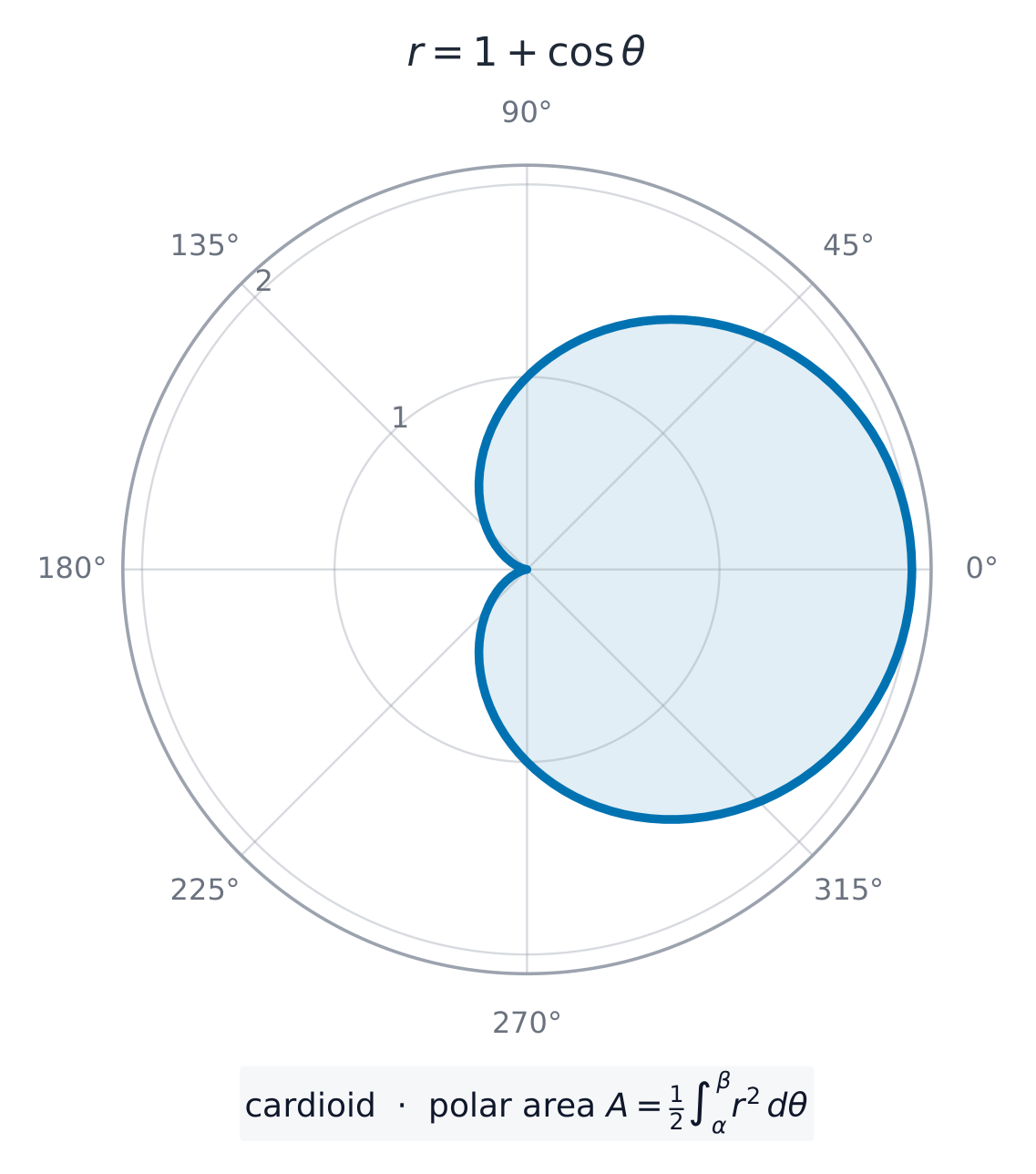
Tracing a polar curve: the cardioid
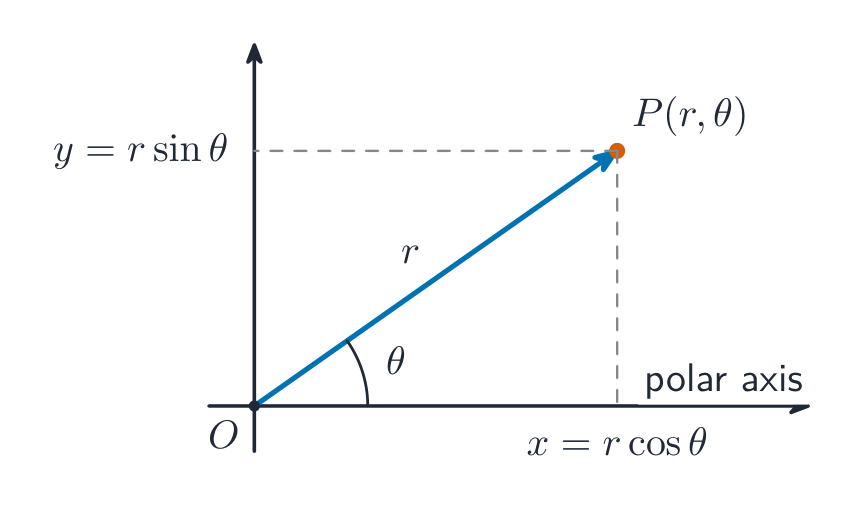
Polar coordinates 极坐标 give a point by its distance $r$ from the origin and its angle $\theta$. They link to Cartesian coordinates 直角坐标 by
You should sketch simple polar curves 极坐标曲线, and find the area of a sector with
$$\text{area} = \tfrac12\int r^2\,d\theta.$$
Worked example. Convert the polar equation $r = 4\cos\theta$ to Cartesian form.
Multiply both sides by $r$: $r^2 = 4r\cos\theta$, so $x^2 + y^2 = 4x$. Completing the square gives $(x - 2)^2 + y^2 = 4$, a circle of radius $2$ centred at $(2, 0)$.
Bahasa Indonesia
Menggambar kurva polar: kardioidaTangga spiral: spiral dijelaskan secara alami menggunakan koordinat polar.
Koordinat polar menentukan titik oleh jaraknya $r$ dari titik asal dan sudutnya $\theta$. Mereka terhubung ke koordinat Kartesius melalui
Koordinat polar $(r,\theta)$ dikonversi ke Kartesius melalui $x=r\cos\theta$ dan $y=r\sin\theta$.
Anda harus menggambar sketsa kurva polar sederhana, dan menemukan luas sektor dengan
$$\text{area} = \tfrac12\int r^2\,d\theta.$$
Kardioida $r=1+\cos\theta$, digambar langsung dari $r$ sebagai fungsi dari $\theta$.
Contoh terarah. Konversikan persamaan polar $r = 4\cos\theta$ ke bentuk Kartesius.
Kalikan kedua ruas dengan $r$: $r^2 = 4r\cos\theta$, sehingga $x^2 + y^2 = 4x$. Melengkapi kuadrat menghasilkan $(x - 2)^2 + y^2 = 4$, sebuah lingkaran berjari-jari $2$ berpusat di $(2, 0)$.
Explore · Jelajahi
Polar curves · Kurva polar
Pick a curve and change a. In polar form a point is set by its distance r and angle θ — that draws roses, cardioids and spirals. · Pilih kurva dan ubah a. Dalam bentuk polar, suatu titik ditentukan oleh jarak r dan sudut θ — itu menghasilkan mawar, kardioida, dan spiral.
use the equation of a plane in any of the forms $ax + by + cz = d$ or $\mathbf{r.n} = p$ or $\mathbf{r} = \mathbf{a} + \lambda\mathbf{b} + \mu\mathbf{c}$ and convert equations of planes from one form to another as necessary in solving problems
recall that the vector product$\mathbf{a} \times \mathbf{b}$ of two vectors can be expressed either as $|\mathbf{a}||\mathbf{b}|\sin\theta\hat{\mathbf{n}}$, where $\hat{\mathbf{n}}$ is a unit vector, or in component form as $(a_2b_3 - a_3b_2)\mathbf{i} + (a_3b_1 - a_1b_3)\mathbf{j} + (a_1b_2 - a_2b_1)\mathbf{k}$
use equations of lines and planes, together with scalar and vector products where appropriate, to solve problems concerning distances, angles and intersections, including: – determining whether a line lies in a plane, is parallel to a plane or intersects a plane, and finding the point of intersection of a line and a plane when it exists – finding the foot of the perpendicular from a point to a plane – finding the angle between a line and a plane, and the angle between two planes – finding an equation for the line of intersection of two planes – calculating the shortest distance between two skew lines – finding an equation for the common perpendicular to two skew lines.
Bahasa Indonesia
Calon peserta harus mampu:
Catatan dan contoh
menggunakan persamaan bidang dalam salah satu bentuk $ax + by + cz = d$ atau $\mathbf{r.n} = p$ atau $\mathbf{r} = \mathbf{a} + \lambda\mathbf{b} + \mu\mathbf{c}$ dan mengonversi persamaan bidang dari satu bentuk ke bentuk lain jika diperlukan dalam memecahkan masalah
mengingat bahwa produk vektor$\mathbf{a} \times \mathbf{b}$ dari dua vektor dapat dinyatakan baik sebagai $|\mathbf{a}||\mathbf{b}|\sin\theta\hat{\mathbf{n}}$, di mana $\hat{\mathbf{n}}$ adalah vektor satuan, atau dalam bentuk komponen sebagai $(a_2b_3 - a_3b_2)\mathbf{i} + (a_3b_1 - a_1b_3)\mathbf{j} + (a_1b_2 - a_2b_1)\mathbf{k}$
menggunakan persamaan garis dan bidang, bersama dengan produk skalar dan vektor di mana tepat, untuk memecahkan masalah mengenai jarak, sudut, dan irisan, termasuk: – menentukan apakah sebuah garis terletak dalam bidang, sejajar dengan bidang, atau berpotongan dengan bidang, dan menemukan titik potong antara garis dan bidang jika ada – finding the foot of the perpendicular from a point to a plane – finding the angle between a line and a plane, and the angle between two planes – finding an equation for the line of intersection of two planes – calculating the shortest distance between two skew lines – finding an equation for the common perpendicular to two skew lines.
Source: Cambridge International syllabus · Sumber: Silabus Cambridge International
English
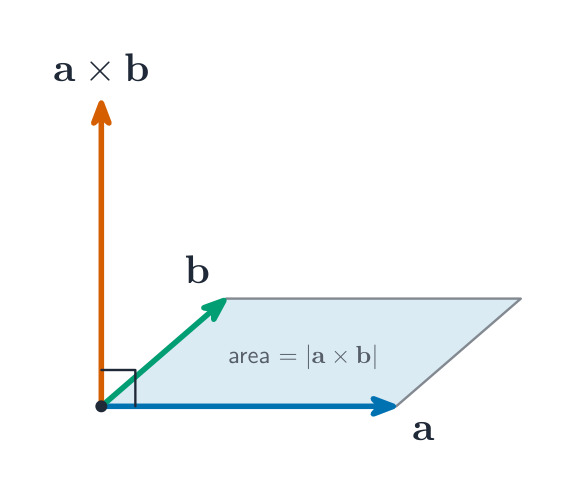
In three dimensions a plane 平面 can be written as $ax + by + cz = d$, or $\mathbf{r}\cdot\mathbf{n} = p$, or $\mathbf{r} = \mathbf{a} + \lambda\mathbf{b} + \mu\mathbf{c}$. Besides the scalar product, there is the vector product 向量积 of two vectors 向量:
which gives a vector at right angles to both. With scalar and vector products you can find distances, angles, and where lines and planes meet — including the shortest distance between skew lines 异面直线.
Worked example. Find $\mathbf{a}\times\mathbf{b}$ for $\mathbf{a} = \mathbf{i} + \mathbf{j}$ and $\mathbf{b} = \mathbf{j} + \mathbf{k}$.
Gaya seperti angin dan air adalah vektor — mereka memiliki besaran dan arah.
Dalam tiga dimensi, sebuah bidang dapat ditulis sebagai $ax + by + cz = d$, atau $\mathbf{r}\cdot\mathbf{n} = p$, atau $\mathbf{r} = \mathbf{a} + \lambda\mathbf{b} + \mu\mathbf{c}$. Selain hasil kali skalar, terdapat hasil kali vektor dari dua vektor:
yang menghasilkan vektor tegak lurus terhadap keduanya. Dengan hasil kali skalar dan vektor, Anda dapat menemukan jarak, sudut, dan tempat pertemuan garis dan bidang — termasuk jarak terpendek antara garis menyilang.
$\mathbf{a}\times\mathbf{b}$ tegak lurus terhadap kedua vektor; panjangnya sama dengan luas jajar genjang yang direntangnya.
Contoh terarah. Temukan $\mathbf{a}\times\mathbf{b}$ untuk $\mathbf{a} = \mathbf{i} + \mathbf{j}$ dan $\mathbf{b} = \mathbf{j} + \mathbf{k}$.
mengenali situasi di mana konjektur berdasarkan uji terbatas diikuti oleh pembuktian induktif merupakan strategi yang berguna, dan melaksanakannya dalam kasus-kasus sederhana.
Mis. cari turunan ke-$n$ dari $x e^x$, cari $\sum_{r=1}^{n} r \times r!$.
Source: Cambridge International syllabus · Sumber: Silabus Cambridge International
English
Induction: the domino proof
Mathematical induction 数学归纳法 proves a result for every positive integer $n$ in two steps:
Base case: show the result is true for $n = 1$.
Inductive step: assume it is true for $n = k$, then prove it for $n = k + 1$.
If both steps work, the result is true for all $n$. Often you first make a conjecture 猜想 (a sensible guess) from a few cases, then confirm it by inductive proof 归纳证明.
Worked example. Prove that $\displaystyle\sum_{r=1}^{n} r = \tfrac12 n(n+1)$.
Base case$n = 1$: the left side is $1$ and the right side is $\tfrac12(1)(2) = 1$. True.
Inductive step: assume $\displaystyle\sum_{r=1}^{k} r = \tfrac12 k(k+1)$. Then
This is the formula with $n = k + 1$, so by induction it holds for all $n$.
Bahasa Indonesia
Induksi: pembuktian domino
Induksi matematika membuktikan suatu hasil untuk setiap bilangan bulat positif $n$ dalam dua langkah:
Kasus dasar: tunjukkan bahwa hasilnya benar untuk $n = 1$.
Langkah induktif: asumsikan benar untuk $n = k$, kemudian buktikan untuk $n = k + 1$.
Jika kedua langkah berhasil, hasilnya benar untuk semua $n$. Seringkali Anda terlebih dahulu membuat konjektur (tebakan yang masuk akal) dari beberapa kasus, lalu mengonfirmasinya dengan pembuktian induktif.
Induksi seperti domino: kasus dasar menjatuhkan yang pertama, dan langkah induktif membuat masing-masing menjatuhkan berikutnya — sehingga hasil berlaku untuk setiap n
Contoh terarah. Buktikan bahwa $\displaystyle\sum_{r=1}^{n} r = \tfrac12 n(n+1)$.
Kasus dasar$n = 1$: sisi kiri adalah $1$ dan sisi kanan adalah $\tfrac12(1)(2) = 1$. Benar.
Langkah induktif: asumsikan $\displaystyle\sum_{r=1}^{k} r = \tfrac12 k(k+1)$. Maka
Ini adalah rumus dengan $n = k + 1$, jadi menurut induksi hal ini berlaku untuk semua $n$.
Explore · Jelajahi
Proof by induction route · Rute bukti dengan induksi
See induction as a first domino plus a rule that pushes every next case. · Anggap induksi sebagai domino pertama ditambah aturan yang mendorong setiap kasus berikutnya.
Use the relationships between roots and coefficients (sum, sum of pairs, product) instead of solving the polynomial.
For proof by induction, set out the base case, assume the result for $n = k$, prove it for $n = k+1$, and write a clear closing statement.
Sketch rational-function graphs with their asymptotes and turning points; use the method of differences for a summation.
For matrices, know the determinant, inverse and invariant lines, and interpret each transformation geometrically.
Bahasa Indonesia
Gunakan hubungan antara akar dan koefisien (jumlah, jumlah pasangan, hasil kali) alih-alih menyelesaikan polinomial.
Untuk pembuktian dengan induksi, susun kasus dasar, asumsikan hasilnya untuk $n = k$, buktikan untuk $n = k+1$, dan tulis pernyataan penutup yang jelas.
Gambar sketsa grafik fungsi rasional dengan asimtot dan titik beloknya; gunakan metode selisih untuk penjumlahan.
Untuk matriks, ketahui determinan, invers, dan garis invarian, serta tafsirkan setiap transformasi secara geometris.
2
Further Pure Mathematics 2 · Matematika Murni Lanjutan 2
This handout covers Topic 2: Further Pure Mathematics 进阶纯数学 2. It adds hyperbolic functions, eigenvalues, new differentiation and integration, de Moivre's theorem, and methods for differential equations.
2.1
Hyperbolic functions
Syllabus · Silabus
English
Candidates should be able to:
Notes and examples
understand the definitions of the hyperbolic functions$\sinh x$, $\cosh x$, $\tanh x$, $\text{sech } x$, $\text{cosech } x$, $\text{coth } x$ in terms of the exponential function
sketch the graphs of hyperbolic functions
prove and use identities involving hyperbolic functions
e.g. $\cosh^2 x - \sinh^2 x \equiv 1$, $\sinh 2x \equiv 2 \sinh x \cosh x$, and similar results corresponding to the standard trigonometric identities.
understand and use the definitions of the inverse hyperbolic functions and derive and use the logarithmic forms
Bahasa Indonesia
Calon peserta harus mampu:
Catatan dan contoh
memahami definisi fungsi hiperbolik$\sinh x$, $\cosh x$, $\tanh x$, $\text{sech } x$, $\text{cosech } x$, $\text{coth } x$ dalam hal fungsi eksponensial
membuat sketsa grafik fungsi hiperbolik
membuktikan dan menggunakan identitas yang melibatkan fungsi hiperbolik
Mis. $\cosh^2 x - \sinh^2 x \equiv 1$, $\sinh 2x \equiv 2 \sinh x \cosh x$, dan hasil serupa yang sesuai dengan identitas trigonometri standar.
memahami dan menggunakan definisi fungsi invers hiperbolik dan menurunkan serta menggunakan bentuk logaritmiknya
Source: Cambridge International syllabus · Sumber: Silabus Cambridge International
cosh and sinh built from exponentialsA hanging cable forms a catenary — the curve of the hyperbolic cosine.
The hyperbolic functions 双曲函数 are built from the exponential function:
$$\cosh x = \frac{e^x + e^{-x}}{2}, \qquad \sinh x = \frac{e^x - e^{-x}}{2}, \qquad \tanh x = \frac{\sinh x}{\cosh x}.$$
$\cosh$ is the average of $e^x$ and $e^{-x}$; $\sinh$ is half their difference.
They obey identities much like the trigonometric ones, the main one being $\cosh^2 x - \sinh^2 x = 1$. The three reciprocals complete the set: $\operatorname{sech} x = \dfrac{1}{\cosh x}$, $\operatorname{cosech} x = \dfrac{1}{\sinh x}$, and $\coth x = \dfrac{1}{\tanh x} = \dfrac{\cosh x}{\sinh x}$ – all built from $e^x$ too, and worth recognising in integrals and mark schemes. The inverse hyperbolic functions 反双曲函数 have a logarithmic form 对数形式, for example $\sinh^{-1} x = \ln\!\left(x + \sqrt{x^2 + 1}\right)$.
Worked example. Show that $\cosh^2 x - \sinh^2 x = 1$.
cosh is the catenary (a hanging chain) — even, with its minimum at (0, a). · cosh adalah katenari (rantai yang menggantung) — bahkan, dengan minimumnya di (0, a).
formulate a problem involving the solution of 3 linear simultaneous equations in 3 unknowns as a problem involving the solution of a matrix equation, or vice versa
understand the cases that may arise concerning the consistency or inconsistency of 3 linear simultaneous equations, relate them to the singularity or otherwise of the corresponding matrix, solve consistent systems, and interpret geometrically in terms of lines and planes
e.g. three planes meeting in a common point, or in a common line, or having no common points.
understand the terms 'characteristic equation', 'eigenvalue' and 'eigenvector', as applied to square matrices
Including use of the definition $\mathbf{Ae} = \lambda \mathbf{e}$ to prove simple properties, e.g. that $\lambda^n$ is an eigenvalue of $\mathbf{A}^n$.
find eigenvalues and eigenvectors of $2 \times 2$ and $3 \times 3$ matrices
Restricted to cases where the eigenvalues are real and distinct.
express a square matrix in the form $\mathbf{QDQ}^{-1}$, where $\mathbf{D}$ is a diagonal matrix of eigenvalues and $\mathbf{Q}$ is a matrix whose columns are eigenvectors, and use this expression
e.g. in calculating powers of $2 \times 2$ or $3 \times 3$ matrices.
use the fact that a square matrix satisfies its own characteristic equation.
e.g. in finding successive powers of a matrix or finding an inverse matrix; restricted to $2 \times 2$ or $3 \times 3$ matrices only.
Bahasa Indonesia
Calon peserta harus mampu:
Catatan dan contoh
merumuskan masalah yang melibatkan penyelesaian 3 persamaan linear simultan dalam 3 variabel tak diketahui sebagai masalah yang melibatkan penyelesaian persamaan matriks, atau sebaliknya
memahami kasus-kasus yang mungkin muncul terkait konsistensi atau inkonsistensi 3 persamaan linear simultan, menghubungkannya dengan singularity atau tidaknya matriks yang sesuai, menyelesaikan sistem yang konsisten, dan menafsirkannya secara geometris dalam hal garis dan bidang
Mis. tiga bidang yang bertemu di satu titik bersama, atau pada garis bersama, atau tidak memiliki titik bersama.
memahami istilah 'persamaan karakteristik', nilai eigen dan vektor eigen, yang diterapkan pada matriks persegi
Termasuk penggunaan definisi $\mathbf{Ae} = \lambda \mathbf{e}$ untuk membuktikan sifat-sifat sederhana, mis. bahwa $\lambda^n$ adalah nilai eigen dari $\mathbf{A}^n$.
temukan nilai eigen dan vektor eigen dari matriks $2 \times 2$ dan $3 \times 3$
Dibatasi pada kasus di mana nilai eigen bersifat real dan berbeda.
nyatakan sebuah matriks persegi dalam bentuk $\mathbf{QDQ}^{-1}$, di mana $\mathbf{D}$ adalah matriks diagonal dari nilai eigen dan $\mathbf{Q}$ adalah matriks yang kolom-kolomnya adalah vektor eigen, dan gunakan ekspresi ini
mis. dalam menghitung pangkat dari matriks $2 \times 2$ atau $3 \times 3$.
gunakan fakta bahwa matriks persegi memenuhi persamaan karakteristiknya sendiri.
mis. dalam mencari pangkat berurutan dari suatu matriks atau mencari matriks invers; dibatasi hanya untuk matriks $2 \times 2$ atau $3 \times 3$.
Source: Cambridge International syllabus · Sumber: Silabus Cambridge International
A matrix moves the plane
You can write three linear equations in three unknowns as a single matrix equation 矩阵方程$A\mathbf{x} = \mathbf{b}$. If $A$ is non-singular there is one solution; if $A$ is singular the equations are either inconsistent (no solution) or have infinitely many.
For a square matrix $A$, the characteristic equation 特征方程 is $\det(A - \lambda I) = 0$. Its solutions are the eigenvalues 特征值$\lambda$, and for each one the vector $\mathbf{v}$ with $A\mathbf{v} = \lambda\mathbf{v}$ is an eigenvector 特征向量. You can then write $A = QDQ^{-1}$, where $D$ is a diagonal matrix 对角矩阵 of eigenvalues and the columns of $Q$ are the eigenvectors.
Multiplying an eigenvector by $A$ only stretches it; a general vector is turned to a new direction.
Worked example. Find the eigenvalues of $A = \begin{pmatrix} 2 & 1 \\ 1 & 2 \end{pmatrix}$.
So $\lambda = 1$ or $\lambda = 3$. (The eigenvector for $\lambda = 3$ is $\begin{pmatrix} 1 \\ 1 \end{pmatrix}$ and for $\lambda = 1$ is $\begin{pmatrix} 1 \\ -1 \end{pmatrix}$.)
Explore · Jelajahi
Transformations and the determinant · Transformasi dan determinan
Change the matrix to rotate, stretch or shear the unit square; the determinant shows how area changes. · Ubah matriks untuk memutar, meregangkan, atau menggeser persegi satuan; determinan menunjukkan bagaimana luas berubah.
• differentiate hyperbolic functions and differentiate $\sin^{-1}x$, $\cos^{-1}x$, $\sinh^{-1}x$, $\cosh^{-1}x$ and $\tanh^{-1}x$
• obtain an expression for $\frac{\text{d}^2y}{\text{d}x^2}$ in cases where the relation between $x$ and $y$ is defined implicitly or parametrically
• derive and use the first few terms of a Maclaurin's series for a function.
Derivation of a general term is not included, but successive 'implicit' differentiation steps may be required, e.g. for $y = \tan x$ following an initial differentiation rearranged as $y' = 1 + y^2$.
Bahasa Indonesia
Calon peserta harus mampu:
Catatan dan contoh
• turunkan fungsi hiperbolik dan turunkan $\sin^{-1}x$, $\cos^{-1}x$, $\sinh^{-1}x$, $\cosh^{-1}x$ dan $\tanh^{-1}x$
• peroleh ekspresi untuk $\frac{\text{d}^2y}{\text{d}x^2}$ dalam kasus di mana hubungan antara $x$ dan $y$ didefinisikan secara implisit atau parametrik
• turunkan dan gunakan beberapa suku pertama dari deret Maclaurin untuk suatu fungsi.
Penurunan suku umum tidak termasuk, tetapi langkah diferensiasi 'implisit' berurutan mungkin diperlukan, mis. untuk $y = \tan x$ setelah penyusunan ulang diferensiasi awal menjadi $y' = 1 + y^2$.
Source: Cambridge International syllabus · Sumber: Silabus Cambridge International
You can now differentiate the hyperbolic functions and the inverse functions $\sin^{-1}x$, $\tan^{-1}x$, $\sinh^{-1}x$ and so on. You can also find $\dfrac{d^2y}{dx^2}$ for curves given implicitly or parametrically.
A Maclaurin's series 麦克劳林级数 writes a function as a power series:
For example $e^x = 1 + x + \dfrac{x^2}{2!} + \dfrac{x^3}{3!} + \cdots$Adding more terms makes the polynomial match $e^x$ over a wider stretch around $x=0$.
Worked example. Find the Maclaurin series of $f(x) = \ln(1+x)$ up to the term in $x^3$.
$f(0) = 0$; $f'(x) = \dfrac{1}{1+x}$ so $f'(0) = 1$; $f''(x) = \dfrac{-1}{(1+x)^2}$ so $f''(0) = -1$; $f'''(x) = \dfrac{2}{(1+x)^3}$ so $f'''(0) = 2$. Substituting into the series:
$$\ln(1+x) = x - \frac{x^2}{2} + \frac{x^3}{3} - \cdots$$
Explore · Jelajahi
The gradient at a point · Gradien pada suatu titik
gradient = dy/dx · gradien = dy/dx
The derivative is the slope of the tangent, however exotic the function. · Turunan adalah kemiringan garis singgung, seekstrem apapun fungsinya.
• integrate hyperbolic functions and recognise integrals of functions of the form $\frac{1}{\sqrt{a^2 - x^2}}$, $\frac{1}{\sqrt{x^2 + a^2}}$ and $\frac{1}{\sqrt{x^2 - a^2}}$, and integrate associated functions using trigonometric substitutions or hyperbolic substitutions as appropriate
Including use of completing the square where necessary, e.g. to integrate $\frac{1}{\sqrt{x^2 + x}}$.
• derive and use reduction formulae for the evaluation of definite integrals
e.g. $\int_0^{\frac{1}{2}\pi} \sin^n x \text{ d}x$, $\int_0^1 \text{e}^{-x}(1-x)^n \text{ d}x$. In harder cases hints may be given, e.g. $\int_0^{\frac{1}{4}\pi} \sec^n x \text{ d}x$ by considering $\frac{\text{d}}{\text{d}x}(\tan x \sec^n x)$.
• understand how the area under a curve may be approximated by areas of rectangles, and use rectangles to estimate or set bounds for the area under a curve or to derive inequalities or limits concerning sums
Questions may involve either rectangles of unit width or rectangles whose width can tend to zero, e.g. $1 + \ln n > \sum_{r=1}^n \frac{1}{r} > \ln(n+1)$, $\sum_{r=1}^n \frac{1}{n}\left(1 + \frac{r}{n}\right)^{-1} \approx \int_0^1 (1+x)^{-1} \text{ d}x$. continued
• use integration to find – arc lengths for curves with equations in Cartesian coordinates, including the use of a parameter, or in polar coordinates – surface areas of revolution about one of the axes for curves with equations in Cartesian coordinates, including the use of a parameter.
Any questions involving integration may require techniques from Cambridge International A Level Mathematics (9709) applied to more difficult cases, e.g. integration by parts for $\int e^x \sin x \mathrm{d}x$, or use of the substitution $t = \tan \frac{1}{2}x$. Surface areas of revolution for curves with equations in polar coordinates will not be required.
Bahasa Indonesia
Calon peserta harus mampu:
Catatan dan contoh
• integralkan fungsi hiperbolik dan kenali integral dari fungsi berbentuk $\frac{1}{\sqrt{a^2 - x^2}}$, $\frac{1}{\sqrt{x^2 + a^2}}$ dan $\frac{1}{\sqrt{x^2 - a^2}}$, serta integralkan fungsi terkait menggunakan substitusi trigonometri atau substitusi hiperbolik sesuai kebutuhan
Termasuk penggunaan melengkapkan kuadrat sempurna jika perlu, mis. untuk mengintegralkan $\frac{1}{\sqrt{x^2 + x}}$.
• turunkan dan gunakan rumus reduksi untuk evaluasi integral tentu
mis. $\int_0^{\frac{1}{2}\pi} \sin^n x \text{ d}x$, $\int_0^1 \text{e}^{-x}(1-x)^n \text{ d}x$. Pada kasus yang lebih sulit, petunjuk mungkin diberikan, mis. $\int_0^{\frac{1}{4}\pi} \sec^n x \text{ d}x$ dengan mempertimbangkan $\frac{\text{d}}{\text{d}x}(\tan x \sec^n x)$.
• pahami bagaimana luas di bawah kurva dapat didekati oleh luas persegi panjang, dan gunakan persegi panjang untuk memperkirakan atau menetapkan batas atas/bawah untuk luas di bawah kurva atau untuk menurunkan ketaksamaan atau limit mengenai jumlah
Pertanyaan dapat melibatkan persegi panjang dengan lebar satuan atau persegi panjang yang lebarnya cenderung ke nol, mis. $1 + \ln n > \sum_{r=1}^n \frac{1}{r} > \ln(n+1)$, $\sum_{r=1}^n \frac{1}{n}\left(1 + \frac{r}{n}\right)^{-1} \approx \int_0^1 (1+x)^{-1} \text{ d}x$. berlanjut
• gunakan integrasi untuk mencari – panjang busur untuk kurva dengan persamaan dalam koordinat Kartesius, termasuk penggunaan parameter, atau dalam koordinat polar – luas permukaan revolusi terhadap salah satu sumbu untuk kurva dengan persamaan dalam koordinat Kartesius, termasuk penggunaan parameter.
Pertanyaan yang melibatkan integrasi mungkin memerlukan teknik dari Matematika Cambridge International A Level (9709) yang diterapkan pada kasus yang lebih sulit, mis. integrasi parsial untuk $\int e^x \sin x \mathrm{d}x$, atau penggunaan substitusi $t = \tan \frac{1}{2}x$. Luas permukaan revolusi untuk kurva dengan persamaan dalam koordinat polar tidak diperlukan.
Source: Cambridge International syllabus · Sumber: Silabus Cambridge International
A trigonometric substitution, a hyperbolic substitution, or completing the square 配方法 in the denominator handles related forms. A reduction formula 递推公式 links an integral $I_n$ to $I_{n-1}$, so you can work down step by step. Integration also gives the arc length 弧长 of a curve and the surface area of revolution 旋转曲面面积 when a curve is turned about an axis.
Worked example. Find $\displaystyle\int \frac{1}{\sqrt{4 - x^2}}\,dx$.
Bounding a sum by an integral. Draw rectangles of unit width under, or over, a decreasing curve such as $y=\frac1x$. Each rectangle of height $\frac1r$ is trapped between two integral strips, so summing gives
$$\ln(n+1) < \sum_{r=1}^{n}\frac1r < 1 + \ln n.$$
Shrinking the rectangle width to $\frac1n\to 0$ turns such a sum into a Riemann sum 黎曼和 that equals the integral in the limit, e.g. $\displaystyle\lim_{n\to\infty}\frac1n\sum_{r=1}^{n}f\!\left(\frac{r}{n}\right)=\int_0^1 f(x)\,dx$.
Explore · Jelajahi
The area under the curve · Luas di bawah kurva
area = ∫ f(x) dx · luas = ∫ f(x) dx
Every integral measures the area under the curve — drag the limits. · Setiap integral mengukur luas di bawah kurva — seret batas-batasnya.
• understand de Moivre’s theorem, for a positive or negative integer exponent, in terms of the geometrical effect of multiplication and division of complex numbers
• prove de Moivre’s theorem for a positive integer exponent
e.g. by induction.
• use de Moivre’s theorem for a positive or negative rational exponent
e.g. expressing $\cos 5\theta$ in terms of $\cos \theta$ or $\tan 5\theta$ in terms of $\tan \theta$.
– to express trigonometrical ratios of multiple angles in terms of powers of trigonometrical ratios of the fundamental angle
e.g. expressing $\sin^6 \theta$ in terms of $\cos 2\theta$, $\cos 4\theta$ and $\cos 6\theta$.
– to express powers of $\sin \theta$ and $\cos \theta$ in terms of multiple angles
– in the summation of series
e.g. using the '$C + \mathrm{i}S$' method to sum series such as $\sum_{r=1}^{n} \binom{n}{r} \sin r\theta$.
– in finding and using the $n$th roots of unity.
Bahasa Indonesia
Calon peserta harus mampu:
Catatan dan contoh
• pahami teorema de Moivre, untuk eksponen bilangan bulat positif atau negatif, dalam hal efek geometris perkalian dan pembagian bilangan kompleks
• buktikan teorema de Moivre untuk eksponen bilangan bulat positif
mis. melalui induksi.
• gunakan teorema de Moivre untuk eksponen bilangan rasional positif atau negatif
mis. mengekspresikan $\cos 5\theta$ dalam istilah $\cos \theta$ atau $\tan 5\theta$ dalam istilah $\tan \theta$.
– untuk menyatakan rasio trigonometri sudut majemuk dalam bentuk pangkat dari rasio trigonometri sudut dasar
mis. mengekspresikan $\sin^6 \theta$ dalam istilah $\cos 2\theta$, $\cos 4\theta$ dan $\cos 6\theta$.
– untuk menyatakan pangkat dari $\sin \theta$ dan $\cos \theta$ dalam istilah sudut majemuk
– dalam penjumlahan deret
mis. menggunakan metode '$C + \mathrm{i}S$' untuk menjumlahkan deret seperti $\sum_{r=1}^{n} \binom{n}{r} \sin r\theta$.
– dalam menemukan dan menggunakan akar kesatuan ke-$n$.
Source: Cambridge International syllabus · Sumber: Silabus Cambridge International
The nth roots of unity form a polygonMultiplying complex numbers: lengths multiply, angles addMultiplying by i is a rotationSelf-similar patterns like Romanesco broccoli arise from iterating functions in the complex plane.
A complex number 复数 in polar form is $z = r(\cos\theta + i\sin\theta)$. De Moivre's theorem 棣莫弗定理 says that for any integer $n$,
It is used to expand $\cos n\theta$ and $\sin n\theta$ in powers, to sum series, and to find the $n$roots of unity 单位根 (the solutions of $z^n = 1$, equally spaced around the unit circle).
The five solutions of $z^5=1$ are equally spaced $72^\circ$ apart on the unit circle.
Worked example. Use de Moivre's theorem to express $\cos 3\theta$ in terms of $\cos\theta$.
Take the real part of $(\cos\theta + i\sin\theta)^3 = \cos 3\theta + i\sin 3\theta$:
Drag the point to explore modulus and argument — the language of complex numbers in polar (modulus–argument) form. · Seret titik untuk mengeksplorasi modulus dan argumen — bahasa bilangan kompleks dalam bentuk polar (modulus–argumen).
• find an integrating factor for a first order linear differential equation, and use an integrating factor to find the general solution
e.g. $\frac{\mathrm{d}y}{\mathrm{d}x} - 2y = x^2$, $x\frac{\mathrm{d}y}{\mathrm{d}x} - y = x^4$, $\frac{\mathrm{d}y}{\mathrm{d}x} + y\coth x = \cosh x$.
• recall the meaning of the terms 'complementary function' and 'particular integral' in the context of linear differential equations, and recall that the general solution is the sum of the complementary function and a particular integral
find the complementary function for a first or second order linear differential equation with constant coefficients
For second order equations, including the cases where the auxiliary equation has distinct real roots, a repeated real root or conjugate complex roots.
recall the form of, and find, a particular integral for a first or second order linear differential equation in the cases where a polynomial or $ae^{bx}$ or $a\cos px + b\sin px$ is a suitable form, and in other simple cases find the appropriate coefficient(s) given a suitable form of particular integral
e.g. evaluate $k$ given that $kx \cos 2x$ is a particular integral of
use a given substitution to reduce a differential equation to a first or second order linear equation with constant coefficients or to a first order equation with separable variables
e.g. the substitution $x = e^t$ to reduce to linear form a differential equation with terms of the form
use initial conditions to find a particular solution to a differential equation, and interpret a solution in terms of a problem modelled by a differential equation.
Bahasa Indonesia
Calon peserta harus mampu:
Catatan dan contoh
• temukan faktor peng integrating untuk persamaan diferial linear orde pertama, dan gunakan faktor peng integrating untuk menemukan solusi umum
mis. $\frac{\mathrm{d}y}{\mathrm{d}x} - 2y = x^2$, $x\frac{\mathrm{d}y}{\mathrm{d}x} - y = x^4$, $\frac{\mathrm{d}y}{\mathrm{d}x} + y\coth x = \cosh x$.
• ingat arti istilah 'fungsi komplementer' dan 'integral khusus' dalam konteks persamaan diferial linear, dan ingat bahwa solusi umum adalah jumlah dari fungsi komplementer dan integral khusus
temukan fungsi komplementer untuk persamaan diferial linear orde pertama atau kedua dengan koefisien konstan
Untuk persamaan orde kedua, termasuk kasus di mana persamaan bantu memiliki akar real yang berbeda, akar real ganda, atau akar kompleks konjugat.
ingat bentuk, dan temukan integral khusus untuk persamaan diferial linear orde pertama atau kedua dalam kasus di mana polinomial atau $ae^{bx}$ atau $a\cos px + b\sin px$ merupakan bentuk yang sesuai, dan dalam kasus sederhana lainnya temukan koefisien yang tepat given a suitable form of particular integral
mis. evaluasi $k$ given that $kx \cos 2x$ is a particular integral of
gunakan substitusi yang diberikan untuk mengurangi persamaan diferial menjadi persamaan linear orde pertama atau kedua dengan koefisien konstan atau menjadi persamaan orde pertama dengan variabel terpisah
mis. substitusi $x = e^t$ untuk mengurangi ke bentuk linear persamaan diferial dengan suku-suku berbentuk
gunakan kondisi awal untuk menemukan solusi khusus dari persamaan diferial, dan interpretasikan solusi dalam kaitannya dengan model masalah yang dimodelkan oleh persamaan diferial.
Source: Cambridge International syllabus · Sumber: Silabus Cambridge International
For a first order linear equation $\dfrac{dy}{dx} + P(x)\,y = Q(x)$, multiply by the integrating factor 积分因子$\mu = e^{\int P\,dx}$. The left side then becomes $\dfrac{d}{dx}(\mu y)$, so you can integrate directly.
For a linear equation with constant coefficients, the general solution 通解 is the sum of two parts: the complementary function 余函数 (the solution of the equation with the right side set to $0$, found from the auxiliary equation) and a particular integral 特积分 (any one solution of the full equation). Initial conditions then fix the constants to give the particular solution 特解; simpler equations with separable variables 可分离变量 are integrated directly.
A solution curve follows the slope field, staying tangent to the little segments everywhere.
Worked example. Solve $\dfrac{dy}{dx} + 2y = e^x$.
The integrating factor is $\mu = e^{\int 2\,dx} = e^{2x}$. Multiplying through gives $\dfrac{d}{dx}\!\left(y\,e^{2x}\right) = e^{3x}$, so
$$y\,e^{2x} = \tfrac13 e^{3x} + C \;\Rightarrow\; y = \tfrac13 e^x + C e^{-2x}.$$
Second order, constant coefficients. For $\dfrac{d^2y}{dx^2}+b\dfrac{dy}{dx}+cy=f(x)$, solve the auxiliary equation 辅助方程$m^2+bm+c=0$. The complementary function depends on its roots:
two distinct real roots $m_1,m_2$: $y=Ae^{m_1x}+Be^{m_2x}$;
Then add a particular integral by trying a form matching $f(x)$ (a polynomial, $ae^{bx}$, or $a\cos px+b\sin px$); if that trial already appears in the complementary function, multiply it by $x$.
Worked example. Solve $\dfrac{d^2y}{dx^2}-4\dfrac{dy}{dx}+4y=0$. The auxiliary equation $m^2-4m+4=(m-2)^2=0$ has a repeated root $m=2$, so $y=(A+Bx)e^{2x}$.
Explore · Jelajahi
Differential equations · Persamaan diferensial
dy/dx = a y
The equation sets the slope everywhere; the solution follows those slopes. · Persamaan menetapkan kemiringan di mana-mana; solusi mengikuti kemiringan-kemiringan tersebut.
This handout covers Topic 3: Further Mechanics 进阶力学. It extends mechanics to projectiles, rigid bodies, circular motion, elastic strings, variable forces and collisions. Take $g = 10\ \text{m s}^{-2}$.
Bahasa Indonesia
Lembar kerja ini mencakup Topik 3: Mekanika Lanjutan. Materi ini memperluas mekanika ke proyektil, benda kaku, gerak melingkar, tali elastis, gaya variabel, dan tumbukan. Ambil $g = 10\ \text{m s}^{-2}$.
3.1
Motion of a projectile · Gerak proyektil
Syllabus · Silabus
English
Candidates should be able to:
Notes and examples
• model the motion of a projectile as a particle moving with constant acceleration and understand any limitations of the model
Vector methods are not required
• use horizontal and vertical equations of motion to solve problems on the motion of projectiles, including finding the magnitude and direction of the velocity at a given time or position, the range on a horizontal plane and the greatest height reached
• derive and use the Cartesian equation of the trajectory of a projectile, including problems in which the initial speed and/or angle of projection may be unknown.
Knowledge of the 'bounding parabola' for accessible points is not included.
Bahasa Indonesia
Calon peserta harus mampu:
Catatan dan contoh
• modelkan gerak peluru sebagai partikel yang bergerak dengan percepatan konstan dan pahami keterbatasan model tersebut
Metode vektor tidak diperlukan
• gunakan persamaan gerak horizontal dan vertikal untuk menyelesaikan masalah gerak peluru, termasuk menemukan besaran dan arah kecepatan pada waktu atau posisi tertentu, jangkauan pada bidang horizontal dan ketinggian maksimum yang dicapai
• turunkan dan gunakan persamaan Kartesius lintasan peluru, termasuk masalah di mana kecepatan awal dan/atau sudut tembak mungkin tidak diketahui.
Pengetahuan tentang 'parabola batas' untuk titik-titik yang dapat dicapai tidak termasuk.
Source: Cambridge International syllabus · Sumber: Silabus Cambridge International
English
Dropped vs thrown: falling together
A projectile 抛射体 moves freely under gravity, so it has constant acceleration 匀加速$g$ downwards and no horizontal acceleration. Treat the horizontal and vertical motions separately. If it is launched at speed $u$ and angle $\alpha$:
$$\text{horizontal: } x = u\cos\alpha\,\cdot t, \qquad \text{vertical: } y = u\sin\alpha\,\cdot t - \tfrac12 g t^2.$$
Eliminating $t$ gives the Cartesian equation 直角坐标方程 of the trajectory 轨迹 (the path), which is a parabola. For a fixed launch speed, all the trajectories lie under a bounding parabola 包络抛物线 (the envelope of reachable points). The range on level ground is $\dfrac{u^2\sin 2\alpha}{g}$ and the greatest height is $\dfrac{u^2\sin^2\alpha}{2g}$.
Worked example. A ball is thrown at $u = 20\ \text{m s}^{-1}$ at $30^\circ$ to the horizontal. Find the range and greatest height.
Dilempar vs dilemparkan: jatuh bersamaanSemburan air mengikuti lintasan parabola — gerak proyektil klasik di bawah gravitasi.
Sebuah proyektil bergerak bebas di bawah gravitasi, sehingga mengalami percepatan konstan$g$ ke bawah dan tidak ada percepatan horizontal. Perlakukan gerak horizontal dan vertikal secara terpisah. Jika diluncurkan dengan kecepatan $u$ dan sudut $\alpha$:
$$\text{horizontal: } x = u\cos\alpha\,\cdot t, \qquad \text{vertical: } y = u\sin\alpha\,\cdot t - \tfrac12 g t^2.$$
Mengeliminasi $t$ menghasilkan persamaan Kartesius dari lintasan (jalur), yaitu sebuah parabola. Untuk kecepatan peluncuran tetap, semua lintasan berada di bawah parabola pembatas (selubung titik-titik yang dapat dicapai). Jarak jangkauan di tanah datar adalah $\dfrac{u^2\sin 2\alpha}{g}$ dan ketinggian maksimum adalah $\dfrac{u^2\sin^2\alpha}{2g}$.
Lintasannya adalah parabola; kecepatan peluncuran $u$ terbagi menjadi komponen horizontal yang stabil dan komponen vertikal yang diperlambat oleh gravitasi.
Contoh terpecahkan. Sebuah bola dilempar dengan kecepatan $u = 20\ \text{m s}^{-1}$ pada sudut $30^\circ$ terhadap horizontal. Tentukan jarak jangkauan dan ketinggian maksimum.
Fire the ball, then change the angle and speed. The horizontal motion is steady while gravity pulls it down — together they trace a parabola. Find the angle for the longest range, and try the Moon. · Tembak bola, lalu ubah sudut dan kecepatan. Gerak horizontal tetap konstan sementara gravitasi menariknya ke bawah — bersama-sama mereka melacak parabola. Temukan sudut untuk jangkauan terjauh, dan coba di Bulan.
Equilibrium of a rigid body · Kesetimbangan benda kaku
Syllabus · Silabus
English
Candidates should be able to:
Notes and examples
• calculate the moment of a force about a point
For questions involving coplanar forces only; understanding of the vector nature of moments is not required.
• use the result that the effect of gravity on a rigid body is equivalent to a single force acting at the centre of mass of the body, and identify the position of the centre of mass of a uniform body using considerations of symmetry
• use given information about the position of the centre of mass of a triangular lamina and other simple shapes
Proofs of results given in the MF19 List of formulae are not required.
• determine the position of the centre of mass of a composite body by considering an equivalent system of particles
Simple cases only, e.g. a uniform L-shaped lamina, or a uniform cone joined at its base to a uniform hemisphere of the same radius.
• use the principle that if a rigid body is in equilibrium under the action of coplanar forces then the vector sum of the forces is zero and the sum of the moments of the forces about any point is zero, and the converse of this
• solve problems involving the equilibrium of a single rigid body under the action of coplanar forces, including those involving toppling or sliding.
Bahasa Indonesia
Calon peserta harus mampu:
Catatan dan contoh
• hitung momen gaya terhadap suatu titik
Untuk soal yang melibatkan gaya koplanar saja; pemahaman mengenai sifat vektor dari momen tidak diperlukan.
• gunakan hasil bahwa efek gravitasi pada benda kaku setara dengan satu gaya yang bekerja pada pusat massa benda tersebut, dan tentukan posisi pusat massa dari benda seragam menggunakan pertimbangan simetri
• gunakan informasi yang diberikan tentang posisi pusat massa dari pelat segitiga dan bentuk sederhana lainnya
Pembuktian hasil yang diberikan dalam Daftar Rumus MF19 tidak diperlukan.
• tentukan posisi pusat massa dari benda komposit dengan mempertimbangkan sistem partikel ekuivalen
Kasus-kasus sederhana saja, mis. pelat L-shaped seragam, atau kerucut seragam yang disambungkan pada dasarnya ke hemisfer seragam dengan jari-jari yang sama.
• gunakan prinsip bahwa jika sebuah benda kaku berada dalam keseimbangan di bawah aksi gaya-gaya koplanar maka jumlah vektor gayanya adalah nol dan jumlah momen gaya-gaya tersebut terhadap sembarang titik adalah nol, serta konversinya
• selesaikan masalah yang melibatkan keseimbangan satu benda kaku di bawah aksi gaya-gaya koplanar, termasuk yang melibatkan terbalik atau meluncur.
Source: Cambridge International syllabus · Sumber: Silabus Cambridge International
English
The moment 力矩 of a force about a point is force $\times$ perpendicular distance; it measures turning effect. The weight of a body acts at its centre of mass 质心, which you can find using symmetry 对称 for a uniform flat shape (a lamina 薄片), or by treating a composite body as a set of particles.
A rigid body under coplanar forces 共面力 is in equilibrium 平衡 when two conditions both hold: the vector sum of the forces is zero, and the sum of the moments about any point is zero. A body may also be on the edge of toppling 翻倒 (turning over) or sliding 滑动 (slipping).
Worked example. A uniform beam $AB$ of length $4\ \text{m}$ and weight $100\ \text{N}$ rests on a pivot at $A$. A vertical force $F$ at $B$ keeps it horizontal. Find $F$.
Take moments about $A$ (the weight acts at the centre, $2\ \text{m}$ from $A$):
$$F\times 4 = 100\times 2 \;\Rightarrow\; F = 50\ \text{N}.$$
Bahasa Indonesia
Momen gaya terhadap suatu titik adalah gaya $\times$ dikali jarak tegak lurus; momen mengukur efek memutar. Berat tubuh bekerja pada pusat massa, yang dapat Anda temukan menggunakan simetri untuk bidang datar seragam (lamina), atau dengan menganggap benda majemuk sebagai kumpulan partikel.
Benda kaku di bawah gaya koplanar berada dalam kesetimbangan ketika dua kondisi terpenuhi: jumlah vektor gayanya nol, dan jumlah momen terhadap titik apa pun juga nol. Benda juga mungkin berada di ambang terbalik (mengguling) atau meluncur (slip).
Mengambil momen terhadap tumpuan $A$ menyeimbangkan efek memutar: $F\times4 = 100\times2$.
Contoh terpecahkan. Sebuah balok seragam $AB$ dengan panjang $4\ \text{m}$ dan berat $100\ \text{N}$ bertumpu pada sebuah tumpuan di $A$. Gaya vertikal $F$ di $B$ menahannya tetap horizontal. Tentukan $F$.
Ambil momen terhadap $A$ (berat bekerja di tengah, $2\ \text{m}$ dari $A$):
$$F\times 4 = 100\times 2 \;\Rightarrow\; F = 50\ \text{N}.$$
Explore · Jelajahi
Equilibrium of forces · Kesetimbangan gaya
resultant = 0 · resultan = 0
A body is in equilibrium when the forces add tip-to-tail back to zero. · Benda berada dalam kesetimbangan ketika gaya-gaya yang bekerja ujung-ke-ujung kembali ke nol.
understand the concept of angular speed for a particle moving in a circle, and use the relation $v = r\omega$
understand that the acceleration of a particle moving in a circle with constant speed is directed towards the centre of the circle, and use the formulae $r\omega^2$ and $\frac{v^2}{r}$.
Proof of the acceleration formulae is not required.
solve problems which can be modelled by the motion of a particle moving in a horizontal circle with constant speed
solve problems which can be modelled by the motion of a particle in a vertical circle without loss of energy.
Including finding a normal contact force or the tension in a string, locating points at which these are zero, and conditions for complete circular motion.
Bahasa Indonesia
Calon peserta harus mampu:
Catatan dan contoh
pahami konsep kecepatan sudut untuk partikel yang bergerak dalam lingkaran, dan gunakan hubungan $v = r\omega$
pahami bahwa percepatan partikel yang bergerak dalam lingkaran dengan kecepatan konstan diarahkan menuju pusat lingkaran, dan gunakan rumus $r\omega^2$ dan $\frac{v^2}{r}$.
Pembuktian rumus percepatan tidak diperlukan.
selesaikan masalah yang dapat dimodelkan oleh gerak partikel yang bergerak dalam lingkaran horizontal dengan kecepatan konstan
selesaikan masalah yang dapat dimodelkan oleh gerak partikel dalam lingkaran vertikal tanpa kehilangan energi.
Termasuk menemukan gaya kontak normal atau tegangan pada tali, menentukan titik di mana keduanya bernilai nol, dan kondisi untuk gerak melingkar penuh.
Source: Cambridge International syllabus · Sumber: Silabus Cambridge International
English
For a particle moving in a circle of radius $r$, the angular speed 角速度$\omega$ links to the speed by $v = r\omega$. The acceleration points towards the centre — the centripetal acceleration 向心加速度 — with size
$$a = r\omega^2 = \frac{v^2}{r}.$$
In a horizontal circle 水平圆 the speed is constant — as in a conical pendulum 圆锥摆 (a mass swung on a string). In a vertical circle 竖直圆 use energy conservation, because the speed changes with height; the normal contact force 法向接触力 or string tension provides the centripetal force.
Worked example. A particle moves in a horizontal circle of radius $2\ \text{m}$ with angular speed $3\ \text{rad s}^{-1}$. Find its speed and acceleration.
Untuk partikel yang bergerak dalam lingkaran berjari-jari $r$, kecepatan sudut$\omega$ terhubung dengan kecepatan melalui $v = r\omega$. Percepatan mengarah ke pusat — percepatan sentripetal — dengan besaran
$$a = r\omega^2 = \frac{v^2}{r}.$$
Kecepatan mengarah sepanjang garis singgung; percepatan mengarah ke dalam menuju pusat.Pelempar palu adalah diagram bergerak dari halaman ini. Kawat tegang menarik bola menuju pusat — tarikan ke dalam itu adalah gaya sentripetal — sementara kecepatan bola mengarah sepanjang garis singgung. Lepaskan, dan tanpa gaya ke dalam tersisa, bola terbang lurus keluar dari garis singgung tersebut
Dalam lingkaran horizontal kecepatannya konstan — seperti pada bandul kerucut (massa yang diayunkan pada tali). Dalam lingkaran vertikal gunakan kekekalan energi, karena kecepatan berubah seiring ketinggian; gaya kontak normal atau tegangan tali menyediakan gaya sentripetal.
Contoh terpecahkan. Partikel bergerak dalam lingkaran horizontal berjari-jari $2\ \text{m}$ dengan kecepatan sudut $3\ \text{rad s}^{-1}$. Temukan kecepatannya dan percepatannya.
Circular motion is measured in radians: drag the angle θ and radius r to see the arc swept — angular speed ω turns this into v = rω. · Gerak melingkar diukur dalam radian: seret sudut θ dan jari-jari r untuk melihat busur yang disapu — kecepatan sudut ω mengubah ini menjadi v = rω.
3.4
Hooke's law · Hukum Hooke
Syllabus · Silabus
English
Candidates should be able to:
Notes and examples
use Hooke’s law as a model relating the force in an elastic string or spring to the extension or compression, and understand the term modulus of elasticity
use the formula for the elastic potential energy stored in a string or spring
Proof of the formula is not required.
solve problems involving forces due to elastic strings or springs, including those where considerations of work and energy are needed.
e.g. a particle moving horizontally or vertically or on an inclined plane while attached to one or more strings or springs, or a particle attached to an elastic string acting as a 'conical pendulum'.
Bahasa Indonesia
Calon peserta harus mampu:
Catatan dan contoh
gunakan Hukum Hooke sebagai model yang mengaitkan gaya dalam tali elastis atau pegas dengan pertambahan panjang atau pemampatan, dan pahami istilah modulus kekakuan
gunakan rumus untuk energi potensial elastis yang tersimpan dalam tali atau pegas
Pembuktian rumus tidak diperlukan.
selesaikan masalah yang melibatkan gaya akibat tali elastis atau pegas, termasuk di mana pertimbangan kerja dan energi diperlukan.
mis. partikel yang bergerak secara horizontal, vertikal, atau pada bidang miring sambil terikat pada satu atau lebih tali/pegas, atau partikel yang terikat pada tali elastis yang bertindak sebagai 'pendulum kerucut'.
Source: Cambridge International syllabus · Sumber: Silabus Cambridge International
English
Hooke's law 胡克定律 says the tension in an elastic string or spring is proportional to its extension $x$:
$$T = \frac{\lambda x}{L},$$
where $L$ is the natural length and $\lambda$ is the modulus of elasticity 弹性模量. Stretching stores elastic potential energy 弹性势能:
$$E = \frac{\lambda x^2}{2L}.$$
Worked example. An elastic string of natural length $2\ \text{m}$ and modulus $50\ \text{N}$ is stretched by $0.5\ \text{m}$. Find the tension and the stored energy.
Hukum Hooke menyatakan bahwa tegangan dalam tali elastis atau pegas sebanding dengan perpanjangannya $x$:
$$T = \frac{\lambda x}{L},$$
di mana $L$ adalah panjang alami dan $\lambda$ adalah modulus elastisitas. Meregangkan menyimpan energi potensial elastis:
$$E = \frac{\lambda x^2}{2L}.$$
Tegangan meningkat sebanding dengan perpanjangan; segitiga yang diarsir adalah energi elastis yang tersimpan.
Contoh terpecahkan. Tali elastis dengan panjang alami $2\ \text{m}$ dan modulus $50\ \text{N}$ diregangkan sejauh $0.5\ \text{m}$. Temukan tegangan dan energi yang tersimpan.
Force is proportional to extension — the gradient is the stiffness k. · Gaya berbanding lurus dengan regangan — gradiennya adalah kekakuan k.
3.5
Linear motion under a variable force · Gerak linear di bawah gaya variabel
Syllabus · Silabus
English
Candidates should be able to:
Notes and examples
solve problems which can be modelled as the linear motion of a particle under the action of a variable force, by setting up and solving an appropriate differential equation.
Including use of $v \frac{\mathrm{d}v}{\mathrm{d}x}$ for acceleration, where appropriate. Calculus required is restricted to content from Pure Mathematics 3 in Cambridge International A Level Mathematics (9709). Only differential equations in which the variables are separable are included.
Bahasa Indonesia
Calon peserta harus mampu:
Catatan dan contoh
selesaikan masalah yang dapat dimodelkan sebagai gerak linear partikel di bawah aksi gaya variabel, dengan menyusun dan menyelesaikan persamaan diferensial yang sesuai.
Termasuk penggunaan $v \frac{\mathrm{d}v}{\mathrm{d}x}$ untuk percepatan, di mana sesuai. Kalkulus yang dibutuhkan dibatasi pada materi dari Pure Mathematics 3 dalam Cambridge International A Level Mathematics (9709). Hanya persamaan diferensial di mana variabelnya dapat dipisahkan yang termasuk.
Source: Cambridge International syllabus · Sumber: Silabus Cambridge International
English
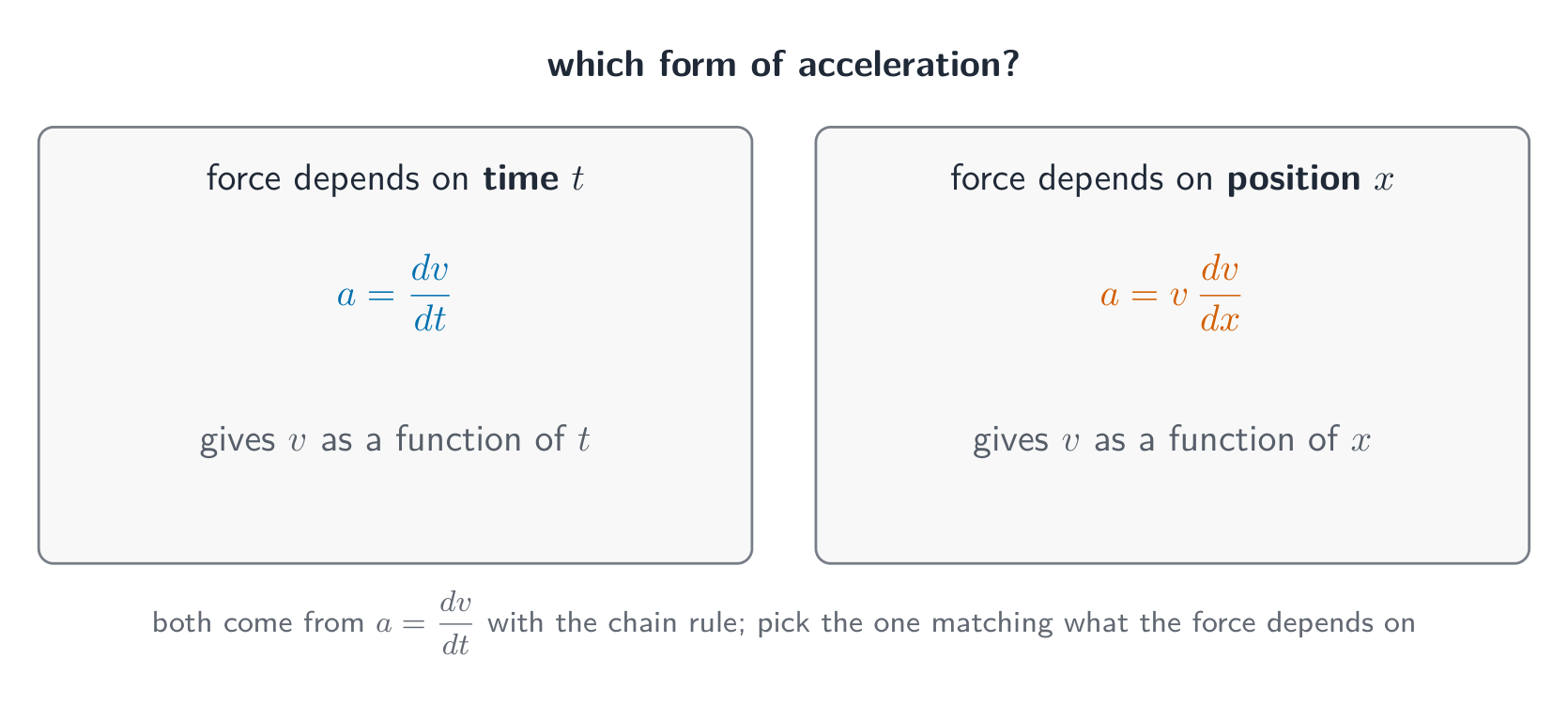
When the force depends on position $x$, use acceleration in the form $a = v\dfrac{dv}{dx}$, which turns Newton's law into a differential equation 微分方程 relating $v$ and $x$.
Worked example. A particle of mass $8\ \text{kg}$ moves along a line under a variable force 变力 of size $(x^3 + 4x)\ \text{N}$ acting in the direction of motion. When $x = 0$, $v = 1$. Find $v$ in terms of $x$.
Newton's law gives $8v\dfrac{dv}{dx} = x^3 + 4x$. Separating and integrating:
Ketika gaya bergantung pada posisi $x$, gunakan percepatan dalam bentuk $a = v\dfrac{dv}{dx}$, yang mengubah hukum Newton menjadi persamaan diferensial yang menghubungkan $v$ dan $x$.
Gunakan dv/dt saat gaya bergantung pada waktu, v dv/dx saat bergantung pada posisi
Contoh terpecahkan. Sebuah partikel bermassa $8\ \text{kg}$ bergerak sepanjang garis di bawah gaya yang berubah-ubah sebesar $(x^3 + 4x)\ \text{N}$ yang bekerja searah gerak. Ketika $x = 0$, $v = 1$. Temukan $v$ dalam bentuk $x$.
Hukum Newton menghasilkan $8v\dfrac{dv}{dx} = x^3 + 4x$. Pisahkan dan integralkan:
Pada $x = 0$, $v = 1$ menghasilkan $C = 4$, sehingga $4v^2 = \tfrac14 x^4 + 2x^2 + 4 = 4\left(\tfrac{x^2}{4} + 1\right)^2$. Oleh karena itu $v = \tfrac14 x^2 + 1$.
Gaya yang bergantung pada posisi menjadi persamaan diferensial dalam v dan x
Explore · Jelajahi
Work from a variable force · Usaha dari gaya variabel
W = ∫ F dx
When the force changes, the work done is the area under the force–distance graph. · Ketika gaya berubah, usaha yang dilakukan adalah luas di bawah grafik gaya–jarak.
coefficient of restitution/ˌkəʊɪˈfɪʃənt ɒv rɪstɪˈtjuːʃn/
koefisien restitusi
bounding parabola/ˈbaʊndɪŋ pəˈræbələ/
parabola pembatas
3.6
Momentum
Syllabus · Silabus
English
Candidates should be able to:
Notes and examples
recall Newton’s experimental law and the definition of the coefficient of restitution, the property $0 \leqslant e \leqslant 1$, and the meaning of the terms ‘perfectly elastic’ ($e = 1$) and ‘inelastic’ ($e = 0$)
use conservation of linear momentum and/or Newton’s experimental law to solve problems that may be modelled as the direct or oblique impact of two smooth spheres, or the direct or oblique impact of a smooth sphere with a fixed surface.
Bahasa Indonesia
Calon peserta harus mampu:
Catatan dan contoh
ingat hukum eksperimental Newton dan definisi koefisien restitusi, properti $0 \leqslant e \leqslant 1$, dan arti istilah 'elastis sempurna' ($e = 1$) dan 'inelastis' ($e = 0$)
gunakan kekekalan momentum linear dan/atau hukum eksperimental Newton untuk menyelesaikan masalah yang dapat dimodelkan sebagai tumbukan langsung atau tumbukan miring dua bola licin, atau tumbukan langsung atau tumbukan miring bola licin dengan permukaan tetap.
Source: Cambridge International syllabus · Sumber: Silabus Cambridge International
English
In a collision, total linear momentum is conserved — the conservation of linear momentum 动量守恒. The bounciness is measured by Newton's experimental law 牛顿实验定律, which defines the coefficient of restitution 恢复系数$e$:
$$e = \frac{\text{speed of separation}}{\text{speed of approach}}, \qquad 0 \leqslant e \leqslant 1.$$
Here $e = 1$ is perfectly elastic (no energy lost) and $e = 0$ is inelastic (the bodies stay together). In an oblique impact 斜碰撞, resolve the velocities along and perpendicular to the line of impact, applying restitution along it.
Worked example. A sphere $A$ of mass $2\ \text{kg}$ moving at $5\ \text{m s}^{-1}$ hits a stationary sphere $B$ of mass $3\ \text{kg}$, with $e = 0.5$. Find the speeds afterwards.
Pulau Newton mendemonstrasikan kekekalan momentum dalam tumbukan.
Dalam tumbukan, momentum linear total kekal — kekekalan momentum linear. Kelenturan diukur oleh hukum eksperimental Newton, yang mendefinisikan koefisien restitusi$e$:
$$e = \frac{\text{speed of separation}}{\text{speed of approach}}, \qquad 0 \leqslant e \leqslant 1.$$
Di sini $e = 1$ adalah elastis sempurna (tidak ada energi hilang) dan $e = 0$ tidak elastis (benda-benda tetap menyatu). Dalam tumbukan miring, uraikan kecepatan sejajar dan tegak lurus terhadap garis tumbukan, terapkan restitusi sepanjang garis tersebut.
Koefisien restitusi $e$ membandingkan seberapa cepat benda-benda menjauh dibandingkan seberapa cepat mereka mendekat.
Contoh terpecahkan. Sebuah bola $A$ bermassa $2\ \text{kg}$ bergerak pada $5\ \text{m s}^{-1}$ menabrak bola diam $B$ bermassa $3\ \text{kg}$, dengan $e = 0.5$. Temukan kecepatannya afterwards.
Momentum: $2(5) = 2v_A + 3v_B$, sehingga $2v_A + 3v_B = 10$. Restitusi: $v_B - v_A = 0.5(5) = 2.5$. Menyelesaikan bersama-sama menghasilkan $v_A = 0.5\ \text{m s}^{-1}$ dan $v_B = 3.0\ \text{m s}^{-1}$.
Explore · Jelajahi
A collision · Sebuah tabrakan
Set each mass and speed, then collide them. Total momentum is conserved — see how the velocities come out. · Setel massa dan kecepatan masing-masing, lalu tabrakan mereka. Total momentum kekal — lihat bagaimana kecepatannya keluar.
3.6
Exam tips · Tips ujian
English
For projectiles, resolve into horizontal (constant velocity) and vertical ($a = g$) motion, linked by the same time.
For a rigid body in equilibrium, take moments about a point that removes an unknown force.
For circular motion, use $F = mv^2/r = m\omega^2 r$ towards the centre; in a vertical circle check the minimum speed at the top.
With a variable force, use $a = v\,\frac{dv}{dx}$ and integrate; elastic PE $= \frac{\lambda x^2}{2L}$.
Bahasa Indonesia
Untuk proyektil, uraikan menjadi gerak horizontal (kecepatan konstan) dan vertikal ($a = g$), terhubung oleh waktu yang sama.
Untuk benda kaku dalam kesetimbangan, ambil momen tentang titik yang menghilangkan gaya tak diketahui.
Untuk gerak melingkar, gunakan $F = mv^2/r = m\omega^2 r$ menuju pusat; dalam lingkaran vertikal periksa kecepatan minimum di bagian atas.
Dengan gaya yang berubah-ubah, gunakan $a = v\,\frac{dv}{dx}$ dan integralkan; energi potensial elastis $= \frac{\lambda x^2}{2L}$.
4
Further Probability & Statistics · Probabilitas & Statistik Lanjutan
This handout covers Topic 4: Further Probability & Statistics 进阶概率统计. It adds continuous distributions, small-sample inference, the chi-squared and non-parametric tests, and probability generating functions.
Bahasa Indonesia
Lembaran ini mencakup Topik 4: Probabilitas & Statistika Lanjutan. Ini menambahkan distribusi kontinu, inferensi sampel kecil, uji chi-squared dan non-parametrik, serta fungsi pembangkit probabilitas.
4.1
Continuous random variables · Variabel acak kontinu
Syllabus · Silabus
English
Candidates should be able to:
Notes and examples
use a probability density function which may be defined piecewise
use the general result $\text{E}(g(X)) = \int f(x)g(x) \, \mathrm{d}x$ where $f(x)$ is the probability density function of the continuous random variable $X$ and $g(X)$ is a function of $X$
understand and use the relationship between the probability density function (PDF) and the cumulative distribution function (CDF), and use either to evaluate probabilities or percentiles
use cumulative distribution functions (CDFs) of related variables in simple cases.
e.g. given the CDF of a variable $X$, find the CDF of a related variable $Y$, and hence its PDF, e.g. where $Y = X^3$.
Bahasa Indonesia
Calon peserta harus mampu:
Catatan dan contoh
gunakan fungsi kepadatan probabilitas yang mungkin didefinisikan secara bagian-bagian
gunakan hasil umum $\text{E}(g(X)) = \int f(x)g(x) \, \mathrm{d}x$ di mana $f(x)$ adalah fungsi kepadatan probabilitas dari variabel acak kontinu $X$ dan $g(X)$ adalah fungsi dari $X$
pahami dan gunakan hubungan antara fungsi kepadatan probabilitas (PDF) dan fungsi distribusi kumulatif (CDF), dan gunakan keduanya untuk mengevaluasi probabilitas atau persentil
gunakan fungsi distribusi kumulatif (CDFs) dari variabel terkait dalam kasus sederhana.
mis. diberikan CDF dari variabel $X$, temukan CDF dari variabel terkait $Y$, dan karenanya PDF-nya, mis. di mana $Y = X^3$.
Source: Cambridge International syllabus · Sumber: Silabus Cambridge International
English
A continuous variable $X$ is described by a probability density function 概率密度函数$f(x)$, which may be defined piecewise. The probability over a range is the area under $f$, and the mean of any function of $X$ is
$$E(g(X)) = \int g(x)\,f(x)\,dx.$$
The cumulative distribution function 累积分布函数$F(x) = P(X \leqslant x)$ is the running total: $F(x) = \displaystyle\int_{-\infty}^{x} f(t)\,dt$, and $f(x) = F'(x)$. Use $F$ to find probabilities and percentiles 百分位数 (for example, the median 中位数 solves $F(x) = 0.5$).
Worked example. A variable has $f(x) = \tfrac12 x$ for $0 \leqslant x \leqslant 2$. Find the median.
The cumulative distribution function is $F(x) = \displaystyle\int_0^x \tfrac12 t\,dt = \tfrac14 x^2$. Set $F(m) = 0.5$:
The distribution of a related variable. If $Y=g(X)$, find $Y$'s distribution through its cumulative function. For $Y=X^2$: $F_Y(y)=P(X^2\leqslant y)=P(-\sqrt y\leqslant X\leqslant\sqrt y)=F_X(\sqrt y)-F_X(-\sqrt y)$, then differentiate for $f_Y=F_Y'$. When $g$ is monotonic increasing there is a shortcut, $F_Y(y)=F_X\big(g^{-1}(y)\big)$.
Worked example. With $f_X(x)=\tfrac12 x$ on $[0,2]$ (so $F_X(x)=\tfrac14 x^2$), let $Y=X^2$. For $0\leqslant y\leqslant 4$, $F_Y(y)=F_X(\sqrt y)=\tfrac14 y$, so $f_Y(y)=F_Y'(y)=\tfrac14$ – that is, $Y$ is uniform on $[0,4]$.
Bahasa Indonesia
Variabel kontinu $X$ dijelaskan oleh fungsi kepadatan probabilitas$f(x)$, yang mungkin didefinisikan secara berselang-seling. Probabilitas dalam suatu rentang adalah area di bawah $f$, dan rata-rata dari setiap fungsi dari $X$ adalah
$$E(g(X)) = \int g(x)\,f(x)\,dx.$$
Median berada di mana area di bawah $f(x)$ di sebelah kirinya tepat $0.5$.
Fungsi distribusi kumulatif$F(x) = P(X \leqslant x)$ adalah total berjalan: $F(x) = \displaystyle\int_{-\infty}^{x} f(t)\,dt$, dan $f(x) = F'(x)$. Gunakan $F$ untuk menemukan probabilitas dan persentil (misalnya, median menyelesaikan $F(x) = 0.5$).
Graf kumulatif $F(x)$ naik dari $0$ ke $1$; ketinggian $0.5$ dicapai pada median.
Contoh terpecahkan. Sebuah variabel memiliki $f(x) = \tfrac12 x$ untuk $0 \leqslant x \leqslant 2$. Temukan median.
Fungsi distribusi kumulatif adalah $F(x) = \displaystyle\int_0^x \tfrac12 t\,dt = \tfrac14 x^2$. Tetapkan $F(m) = 0.5$:
Distribusi variabel terkait. Jika $Y=g(X)$, temukan distribusi $Y$ melalui fungsi kumulatifnya. Untuk $Y=X^2$: $F_Y(y)=P(X^2\leqslant y)=P(-\sqrt y\leqslant X\leqslant\sqrt y)=F_X(\sqrt y)-F_X(-\sqrt y)$, kemudian turunkan untuk $f_Y=F_Y'$. Ketika $g$ monoton naik terdapat jalan pintas, $F_Y(y)=F_X\big(g^{-1}(y)\big)$.
Contoh terpecahkan. Dengan $f_X(x)=\tfrac12 x$ pada $[0,2]$ (sehingga $F_X(x)=\tfrac14 x^2$), misalkan $Y=X^2$. Untuk $0\leqslant y\leqslant 4$, $F_Y(y)=F_X(\sqrt y)=\tfrac14 y$, sehingga $f_Y(y)=F_Y'(y)=\tfrac14$ – yaitu, $Y$ bersifat seragam pada $[0,4]$.
Explore · Jelajahi
Continuous random variables · Variabel acak kontinu
P(a < X < b) = ∫ f(x) dx
For a continuous variable, probability is the area under the density curve. · Untuk variabel kontinu, probabilitas adalah luas di bawah kurva densitas.
Inference using normal and t-distributions · Inferensi menggunakan distribusi normal dan t
Syllabus · Silabus
English
Candidates should be able to:
Notes and examples
formulate hypotheses and apply a hypothesis test concerning the population mean using a small sample drawn from a normal population of unknown variance, using a t-test
calculate a pooled estimate of a population variance from two samples
Calculations based on either raw or summarised data may be required.
formulate hypotheses concerning the difference of population means, and apply, as appropriate: - a 2-sample t-test - a paired sample t-test - a test using a normal distribution
The ability to select the test appropriate to the circumstances of a problem is expected.
determine a confidence interval for a population mean, based on a small sample from a normal population with unknown variance, using a t-distribution
determine a confidence interval for a difference of population means, using a t-distribution or a normal distribution, as appropriate.
Bahasa Indonesia
Calon peserta harus mampu:
Catatan dan contoh
susun hipotesis dan terapkan uji hipotesis mengenai rata-rata populasi menggunakan sampel kecil yang diambil dari populasi normal dengan variansi tak diketahui, menggunakan uji-t
hitung estimasi gabungan variansi populasi dari dua sampel
Perhitungan berdasarkan data mentah atau data yang diringkas mungkin diperlukan.
susun hipotesis mengenai perbedaan rata-rata populasi, dan terapkan, sesuai: - uji-t 2 sampel - uji-t sampel berpasangan - uji menggunakan distribusi normal
Kemampuan untuk memilih uji yang sesuai dengan situasi masalah diharapkan.
tentukan interval kepercayaan untuk rata-rata populasi, berdasarkan sampel kecil dari populasi normal dengan variansi tak diketahui, menggunakan distribusi-t
tentukan interval kepercayaan untuk perbedaan rata-rata populasi, menggunakan distribusi-t atau distribusi normal, sesuai.
Source: Cambridge International syllabus · Sumber: Silabus Cambridge International
English
When a sample is small and the population variance is unknown, base your hypothesis test 假设检验 on the $t$-distribution instead of the normal. The same idea gives a confidence interval 置信区间 for the mean:
$$\bar{x} \pm t\,\frac{s}{\sqrt{n}},$$
where $t$ comes from the $t$-tables with $n - 1$ degrees of freedom. To compare two populations, use a two-sample (2-sample) or paired-sample$t$-test, after finding a pooled estimate 合并估计 of the shared variance when appropriate.
Worked example. A sample of $n = 10$ has mean $\bar{x} = 50$ and standard deviation $s = 4$. Find a $95\%$ confidence interval for the mean (use $t = 2.262$ for $9$ degrees of freedom).
Papan Galton: bola jatuh melalui pin menumpuk menjadi distribusi normal berbentuk lonceng.
Ketika sampel kecil dan varians populasi tidak diketahui, dasar uji hipotesis Anda pada distribusi $t$ daripada normal. Ide yang sama memberikan interval kepercayaan untuk rata-rata:
$$\bar{x} \pm t\,\frac{s}{\sqrt{n}},$$
di mana $t$ berasal dari tabel $t$ dengan $n - 1$ derajat kebebasan. Untuk membandingkan dua populasi, gunakan uji-$t$dua-sampel (2-sampel) atau sampel berpasangan, setelah menemukan estimasi gabungan dari varians bersama yang sesuai.
Untuk sampel kecil distribusi $t$ lebih datar dengan ekor lebih tebal, sehingga nilai kritisnya lebih besar.
Contoh terpecahkan. Sebuah sampel $n = 10$ memiliki rata-rata $\bar{x} = 50$ dan simpangan baku $s = 4$. Temukan interval kepercayaan $95\%$ untuk rata-rata (gunakan $t = 2.262$ untuk derajat kebebasan $9$).
Why small samples need t instead of z · Mengapa sampel kecil membutuhkan t alih-alih z
With $\sigma$ unknown you use $t$, and $t$ has heavier tails than the normal (drawn dashed behind it) — so its critical values are larger and the interval is wider. At the worked example's $9$ degrees of freedom the widget reads $t^* = 2.262$, exactly the table value used above. Sweep df up and $t$ collapses onto the normal. · Dengan $\sigma$ yang tidak diketahui Anda menggunakan $t$, dan $t$ memiliki ekor lebih berat daripada normal (digambar putus-putus di belakangnya) — sehingga nilai kritisnya lebih besar dan intervalnya lebih lebar. Pada $9$ derajat kebebasan contoh terpecahkan, widget membaca $t^* = 2.262$, tepat nilai tabel yang digunakan di atas. Sweep df naik dan $t$ merapat ke normal.
Explore · Jelajahi
The normal distribution · Distribusi normal
Shade a tail to find a probability — the basis of confidence intervals and hypothesis tests. · Arsir ekor untuk menemukan probabilitas — dasar dari interval kepercayaan dan uji hipotesis.
4.3
Chi-squared tests · Uji chi-squared
Syllabus · Silabus
English
Candidates should be able to:
Notes and examples
fit a theoretical distribution, as prescribed by a given hypothesis, to given data
Questions will not involve lengthy calculations.
use a $\chi^2$-test, with the appropriate number of degrees of freedom, to carry out the corresponding goodness of fit analysis
Classes should be combined so that each expected frequency is at least 5.
use a $\chi^2$-test, with the appropriate number of degrees of freedom, for independence in a contingency table.
Yates’ correction is not required. Where appropriate, either rows or columns should be combined so that the expected frequency in each cell is at least 5.
Bahasa Indonesia
Calon peserta harus mampu:
Catatan dan contoh
sesuaikan distribusi teoritis, sesuai dengan hipotesis yang diberikan, pada data yang ada
Soal tidak akan melibatkan perhitungan yang panjang.
lakukan uji $\chi^2$, dengan jumlah derajat kebebasan yang sesuai, untuk melakukan analisis kesesuaian (goodness of fit) yang bersangkutan
Kelas harus digabungkan sedemikian rupa sehingga frekuensi harapan setiap kelas minimal 5.
lakukan uji $\chi^2$, dengan jumlah derajat kebebasan yang sesuai, untuk independensi dalam tabel kontingensi.
Koreksi Yates tidak diperlukan. Di mana perlu, baris atau kolom harus digabungkan sedemikian rupa sehingga frekuensi harapan di setiap sel minimal 5.
Source: Cambridge International syllabus · Sumber: Silabus Cambridge International
English
A $\chi^2$-test (chi-squared test 卡方检验) compares observed counts $O$ with expected counts $E$ from a theoretical distribution 理论分布:
$$\chi^2 = \sum \frac{(O - E)^2}{E}.$$
Compare this with a table value for the right number of degrees of freedom 自由度. Two uses: a goodness of fit 拟合优度 test (does the data follow the proposed model?), and a test for independence 独立性 of two variables in a contingency table 列联表.
Worked example. Four equally likely categories give observed counts $20, 30, 25, 25$ (so each expected count is $25$). Test the fit at the $5\%$ level.
With $4 - 1 = 3$ degrees of freedom the table value is $7.815$. Since $2 < 7.815$, do not reject the model.
Bahasa Indonesia
Uji $\chi^2$ (uji chi-kuadrat) membandingkan jumlah observasi $O$ dengan jumlah ekspektasi $E$ dari distribusi teoritis:
$$\chi^2 = \sum \frac{(O - E)^2}{E}.$$
Bandingkan ini dengan nilai tabel untuk jumlah derajat kebebasan yang benar. Dua penggunaan: uji kesesuaian (apakah data mengikuti model yang diusulkan?), dan uji ketergantungan dua variabel dalam tabel kontingensi.
Uji menolak model ketika $\chi^2$ melebihi nilai kritis, jatuh ke ekor diarsir $5\%$.
Contoh terpecahkan. Empat kategori yang setara kemungkinan memberikan jumlah observasi $20, 30, 25, 25$ (sehingga setiap jumlah ekspektasi adalah $25$). Uji kesesuaian pada tingkat $5\%$.
Dengan $4 - 1 = 3$ derajat kebebasan nilai tabel adalah $7.815$. Karena $2 < 7.815$, tolak model.
Explore · Jelajahi
The chi-squared distribution and its 5% tail · Distribusi chi-squared dan ekor 5%-nya
The worked example on this page gives $\chi^2 = 2$ with $3$ degrees of freedom against a table value of $7.815$ — the widget reproduces both. Drag df to see why the critical value changes with the number of categories. · Contoh terpecahkan di halaman ini memberikan $\chi^2 = 2$ dengan $3$ derajat kebebasan berbanding nilai tabel $7.815$ — widget mereproduksi keduanya. Seret df untuk melihat mengapa nilai kritis berubah dengan jumlah kategori.
Explore · Jelajahi
Chi-squared test route · Alur uji chi-squared
Follow observed and expected counts to a test decision. · Ikuti jumlah observasi dan ekspektasi menuju keputusan uji.
4.4
Non-parametric tests · Uji non-parametrik
Syllabus · Silabus
English
Candidates should be able to:
Notes and examples
understand the idea of a non-parametric test and appreciate situations in which such a test might be useful
e.g. when sampling from a population which cannot be assumed to be normally distributed.
understand the basis of the sign test, the Wilcoxon signed-rank test and the Wilcoxon rank-sum test
Including knowledge that Wilcoxon tests are valid only for symmetrical distributions.
use a single-sample sign test and a single-sample Wilcoxon signed-rank test to test a hypothesis concerning a population median
Including the use of normal approximations where appropriate. Questions will not involve tied ranks or observations equal to the population median value being tested.
use a paired-sample sign test, a Wilcoxon matched-pairs signed-rank test and a Wilcoxon rank-sum test, as appropriate, to test for identity of populations.
Including the use of normal approximations where appropriate. Questions will not involve tied ranks or zero‑difference pairs.
Bahasa Indonesia
Calon peserta harus mampu:
Catatan dan contoh
pahami konsep uji non-parametrik dan persepsi situasi di mana uji semacam itu mungkin berguna
mis. saat mengambil sampel dari populasi yang tidak dapat diasumsikan berdistribusi normal.
pahami dasar uji tanda, uji Wilcoxon signed-rank dan uji Wilcoxon rank-sum
Termasuk pengetahuan bahwa uji Wilcoxon hanya valid untuk distribusi simetris.
gunakan uji tanda satu sampel dan uji Wilcoxon signed-rank satu sampel untuk menguji hipotesis mengenai median populasi
Termasuk penggunaan pendekatan normal di mana perlu. Soal tidak akan melibatkan peringkat terikat atau observasi yang sama dengan nilai median populasi yang diuji.
gunakan uji tanda pasangan sampel, uji Wilcoxon matched-pairs signed-rank dan uji Wilcoxon rank-sum, secukupnya, untuk menguji kesamaan populasi.
Termasuk penggunaan pendekatan normal di mana perlu. Soal tidak akan melibatkan peringkat terikat atau pasangan dengan perbedaan nol.
Source: Cambridge International syllabus · Sumber: Silabus Cambridge International
English
A non-parametric test 非参数检验 makes no assumption that the data is normal, so it is useful when that assumption fails. The basic ones are:
the sign test 符号检验: count how many values fall above and below a proposed median, and test those counts with a binomial model;
the Wilcoxon signed-rank test 威尔科克森符号秩检验 (the matched-pairs test for paired data), which also uses the sizes of the differences, not just their signs;
the Wilcoxon rank-sum test 威尔科克森秩和检验, for comparing two separate samples.
Worked example. Test whether a median is $5$. In a sample of $10$ values (none equal to $5$), $9$ lie above$5$ and $1$ lies below. Test at the $5\%$ level (two-tailed).
Under $H_0$ (median $= 5$) the number above follows $B(10, 0.5)$. The observed result ($9$ above) is extreme, so find $P(X \geq 9) = \binom{10}{9}(0.5)^{10} + (0.5)^{10} = \dfrac{11}{1024} = 0.0107$. For a two-tailed test compare with $\tfrac{1}{2}(5\%) = 0.025$. Since $0.0107 < 0.025$, reject $H_0$: there is evidence the median is not $5$.
Bahasa Indonesia
Uji non-parametrik tidak mengasumsikan data berdistribusi normal, sehingga berguna ketika asumsi tersebut tidak terpenuhi. Uji dasar meliputi:
uji tanda: hitung berapa banyak nilai yang berada di atas dan di bawah median yang diusulkan, lalu uji jumlah tersebut dengan model binomial;
uji Wilcoxon bertanda-berperingkat (uji pasangan cocok untuk data berpasangan), yang juga menggunakan besaran selisihnya, bukan hanya tandanya;
uji Wilcoxon penjumlahan peringkat, untuk membandingkan dua sampel terpisah.
Uji tanda menghitung berapa banyak nilai yang berada di atas dan di bawah median yang diusulkan, kemudian menguji jumlah tersebut dengan model binomial
Contoh terpecahkan. Uji apakah sebuah median adalah $5$. Dalam sampel $10$ nilai (tidak ada yang sama dengan $5$), $9$ terletak di atas$5$ dan $1$ terletak di bawahnya. Ujilah pada tingkat $5\%$ (dua sisi).
Di bawah $H_0$ (median $= 5$) jumlah nilai di atas mengikuti $B(10, 0.5)$. Hasil yang diamati ($9$ di atas) bersifat ekstrem, sehingga cari $P(X \geq 9) = \binom{10}{9}(0.5)^{10} + (0.5)^{10} = \dfrac{11}{1024} = 0.0107$. Untuk uji dua sisi, bandingkan dengan $\tfrac{1}{2}(5\%) = 0.025$. Karena $0.0107 < 0.025$, tolak $H_0$: terdapat bukti bahwa median bukan $5$.
Explore · Jelajahi
Non-parametric test chooser · Pemilih uji non-parametrik
Choose the rank-based test that matches the data situation. · Pilih uji berbasis peringkat yang sesuai dengan situasi data.
probability generating function/ˌprɒbəˈbɪlɪti ˈdʒenəreɪtɪŋ ˈfʌŋkʃn/
fungsi pembangkit peluang
Further Probability & Statistics/ˈfɜːðə ˌprɒbəˈbɪlɪti ænd stəˈtɪstɪks/
Probabilitas & Statistik Lanjutan
4.5
Probability generating functions · Fungsi pembangkit peluang
Syllabus · Silabus
English
Candidates should be able to:
Notes and examples
understand the concept of a probability generating function (PGF) and construct and use the PGF for given distributions
Including the discrete uniform, binomial, geometric and Poisson distributions.
use formulae for the mean and variance of a discrete random variable in terms of its PGF, and use these formulae to calculate the mean and variance of a given probability distribution
use the result that the PGF of the sum of independent random variables is the product of the PGFs of those random variables.
Bahasa Indonesia
Calon peserta harus mampu:
Catatan dan contoh
pahami konsep fungsi pembangkit peluang (PGF) dan susun serta gunakan PGF untuk distribusi yang diberikan
Termasuk distribusi seragam diskrit, binomial, geometrik, dan Poisson.
gunakan rumus untuk rata-rata dan varians variabel acak diskrit dalam bentuk PGF-nya, dan gunakan rumus-rumus ini untuk menghitung rata-rata dan varians dari suatu distribusi peluang yang diberikan
gunakan hasil bahwa PGF dari jumlah variabel acak independen adalah hasil kali PGF dari variabel-variabel acak tersebut.
Source: Cambridge International syllabus · Sumber: Silabus Cambridge International
English
The probability generating function 概率母函数 of a discrete variable $X$ is
$$G(t) = E(t^X) = \sum_x P(X = x)\,t^x.$$
It packs the whole distribution into one function. The mean and variance come from its derivatives at $t = 1$: $E(X) = G'(1)$ and $\mathrm{Var}(X) = G''(1) + G'(1) - \big(G'(1)\big)^2$. Also, the PGF of a sum of independent variables is the product of their PGFs.
Worked example.$X$ has $P(X=0) = 0.5$, $P(X=1) = 0.3$, $P(X=2) = 0.2$. Find $E(X)$ using the PGF.
Here $G(t) = 0.5 + 0.3t + 0.2t^2$, so $G'(t) = 0.3 + 0.4t$ and
$$E(X) = G'(1) = 0.3 + 0.4 = 0.7.$$
Bahasa Indonesia
Dadu: titik awal untuk probabilitas dan variabel acak diskrit.
Fungsi pembangkit peluang dari variabel diskrit $X$ adalah
$$G(t) = E(t^X) = \sum_x P(X = x)\,t^x.$$
Fungsi ini memadatkan seluruh distribusi ke dalam satu fungsi. Rata-rata dan varians diperoleh dari turunannya di $t = 1$: $E(X) = G'(1)$ dan $\mathrm{Var}(X) = G''(1) + G'(1) - \big(G'(1)\big)^2$. Selain itu, PGF dari penjumlahan variabel independen adalah hasil kali PGF masing-masing variabel.
Contoh terpecahkan.$X$ memiliki $P(X=0) = 0.5$, $P(X=1) = 0.3$, $P(X=2) = 0.2$. Temukan $E(X)$ menggunakan PGF.
Di sini $G(t) = 0.5 + 0.3t + 0.2t^2$, sehingga $G'(t) = 0.3 + 0.4t$ dan
$$E(X) = G'(1) = 0.3 + 0.4 = 0.7.$$
PGF dadu adil memadatkan massa yang sama pada angka 1 hingga 6 ke dalam G(t)
Explore · Jelajahi
Probability generating function lab · Laboratorium fungsi pembangkit peluang
G(x) = p0 + p1 x + p2 x^2 + ...
Change x and see how a PGF stores probabilities in powers of x. · Ubah x dan lihat bagaimana PGF menyimpan peluang dalam pangkat x.
4.5
Exam tips · Tips ujian
English
For a continuous random variable, the pdf integrates to $1$ over its range, and $E(X) = \int x f(x)\,dx$.
Use the $t$-distribution when the sample is small and the population variance is unknown; state the degrees of freedom.
For a chi-squared test compute $\sum (O-E)^2/E$, compare with the critical value at the right degrees of freedom, and combine classes with $E < 5$.
State $H_0$ and $H_1$ and give the conclusion in context for every test.
Bahasa Indonesia
Untuk variabel acak kontinu, pdf terintegrasi menjadi $1$ sepanjang rentangnya, dan $E(X) = \int x f(x)\,dx$.
Gunakan distribusi-$t$ jika sampel kecil dan varians populasi tidak diketahui; nyatakan derajat kebebasannya.
Untuk uji chi-squared hitung $\sum (O-E)^2/E$, bandingkan dengan nilai kritis pada derajat kebebasan yang sesuai, dan gabungkan kelas dengan $E < 5$.
Nyatakan $H_0$ dan $H_1$ serta berikan kesimpulan dalam konteks untuk setiap uji.
Pick one and the site follows you — notes, papers, videos and practice all open on it. · Pilih satu dan situs mengikuti Anda — catatan, kertas, video, dan latihan semua terbuka di sana.
Type to search notes, lessons, code, vocabulary and past-paper questions across every subject. · Ketik untuk mencari catatan, pelajaran, kode, kosakata, dan pertanyaan soal lama di setiap mata pelajaran.