IGCSE Mathematics (0580) covers number, algebra and graphs, coordinate geometry, geometry, mensuration, trigonometry, transformations and vectors, probability and statistics.
Entry splits between Core and Extended, and Extended reaches noticeably further in algebra and trigonometry — confirm your tier before choosing what to practise.
Method marks are given for written work. A numerically wrong answer can still score most of the marks if the working is visible, and a correct answer with no working can score fewer. Writing every line is not neatness — it is points.
This handout covers Topic 1, Number. Cambridge Maths has two levels: Core and Extended. Parts marked (Extended) are only tested on the Extended papers; everything else is for both levels.
עברית
דף זה מכסה את הנושא 1, מספר. מתמטיקה Cambridge מציעה שני רמות: בסיסית (Core) ומורחבת (Extended). חלקים המסומנים (Extended) נבדקים רק בבחנים המורחבים; שאר החלקים מתאימים לשתי הרמות.
1.1
Types of number · סוגי מספרים
Syllabus · סיילבוס
English
Subject content
Notes and examples
Identify and use: • natural numbers • integers (positive, zero and negative) • prime numbers • square numbers • cube numbers • common factors • common multiples • rational and irrational numbers • reciprocals.
Example tasks include: • convert between numbers and words, e.g. six billion is 6000000000 10007 is ten thousand and seven • express 72 as a product of its prime factors • find the highest common factor (HCF) of two numbers • find the lowest common multiple (LCM) of two numbers.
עברית
תוכן נושא
הערות ות examples
זיהוי ושימוש ב: • מספרים טבעיים • שלמים (חיוביים, אפס ושליליים) • מספרים ראשוניים • מספרים ריבועיים • מספרים מעוכבים • גורמים משותפים • מכפלות משותפות • מספרים רציונליים ואי-רציונליים • הפוכים.
דוגמאות למשימות כוללות: • המרה בין מספרים למילים, לדוגמה: שישה מיליארד הם 6000000000 10007 הם עשר אלפים ושבע • ביטוי 72 כמכפלה של גורמים ראשוניים • מציאת הגורם המשותף הגדול ביותר (HCF) של שני מספרים • מציאת המכפלה המשותפת הקטנה ביותר (LCM) של שני מספרים.
Source: Cambridge International syllabus · מקור: הסיילבוס הבינלאומי של קמבריד'ג'
English
You must know the words for the different kinds of number. Examiners give marks for using them correctly.
A factor 因数 of a number divides into it exactly, leaving no remainder 余数. The factors of $18$ are $1, 2, 3, 6, 9, 18$.
A multiple 倍数 of a number is that number times an integer. Multiples of $6$ are $6, 12, 18, 24, \dots$
A common factor 公因数 of two numbers is a factor of both.
A common multiple 公倍数 of two numbers is a multiple of both.
Prime, square and cube numbers
A prime number 质数 has exactly two factors: $1$ and itself. The first primes are $2, 3, 5, 7, 11, 13, \dots$ Note that $1$ is not prime.
A square number 平方数 is a whole number times itself: $1, 4, 9, 16, 25, \dots$
A cube number 立方数 uses a whole number three times: $1, 8, 27, 64, \dots$
Rational, irrational and reciprocal
A rational number 有理数 can be written as a fraction 分数$\frac{a}{b}$ of two integers. Examples: $\frac{3}{4}$, $5$, $0.7$.
An irrational number 无理数 cannot be written this way. Examples: $\pi$ and $\sqrt{2}$.
The reciprocal 倒数 of a number is $1$ divided by that number. The reciprocal of $4$ is $\frac{1}{4}$; the reciprocal of $0.25$ is $4$; the reciprocal of $\frac{2}{3}$ is $\frac{3}{2}$.
Prime factors, HCF and LCM
Every integer above $1$ is prime, or can be written as a product 乘积 of prime numbers. To write a number as a product of its prime factors 质因数, keep dividing by the smallest prime that fits.
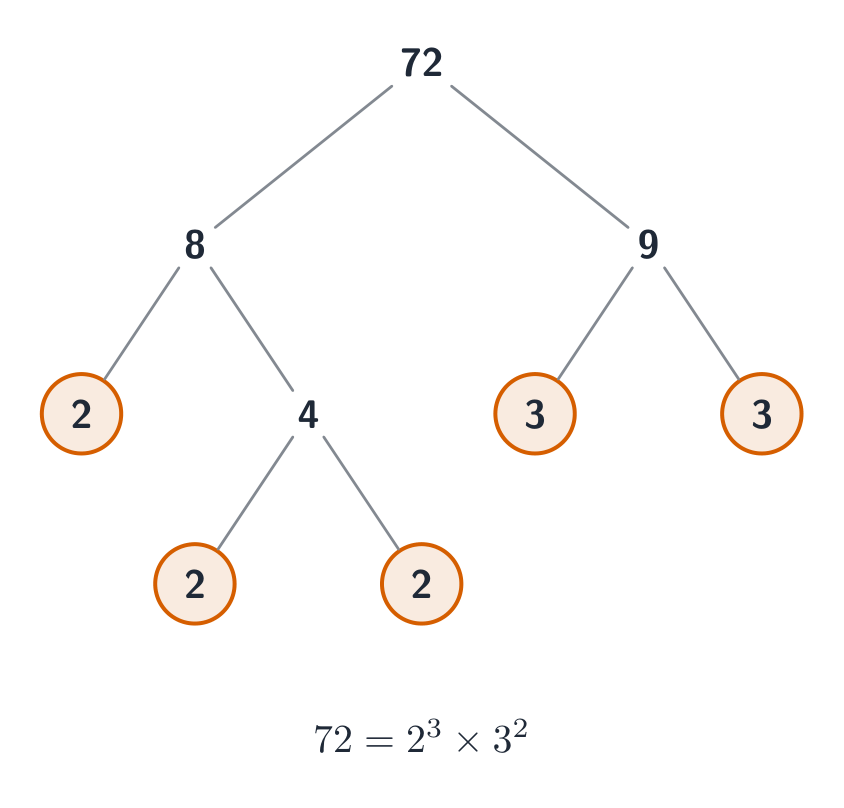
Worked example. Write $72$ as a product of its prime factors.
The highest common factor (HCF) 最大公因数 of two numbers is the largest factor they share. The lowest common multiple (LCM) 最小公倍数 is the smallest multiple they share. Prime factors give a quick method.
Worked example. Find the HCF and LCM of $72$ and $120$.
HCF: take the lowest power of each prime that appears in both: $2^{3} \times 3 = 24$.
LCM: take the highest power of every prime that appears: $2^{3} \times 3^{2} \times 5 = 360$.
עברית
אתה חייב לדעת את המילים עבור סוגי המספרים השונים. בוחנים נותנים ציונים על שימוש נכון בהם.
כל קבוצה נמצאת בתוך הקבוצה הבאה: כל מספר טבעי הוא שלם, כל מספר שלם הוא רציונלי, כל מספר רציונלי הוא ממשי. מספרים אירציונליים הם ממשיים אך לא רציונליים.
ספירה ומספרים שלמים
מספרים טבעיים — המספרים הסופרים $1, 2, 3, 4, \dots$
מספרים שלמים — מספרים שלמים, חיוביים, שליליים או אפס: $\dots, -2, -1, 0, 1, 2, \dots$
גורמים וכפולים
גורם של מספר מחלק אותו במדויק, ללא שארית. הגורמים של $18$ הם $1, 2, 3, 6, 9, 18$.
כפול של מספר הוא המספר כפול בשלם. הכפולים של $6$ הם $6, 12, 18, 24, \dots$
גורם משותף של שני מספרים הוא גורם של שניהם.
כפול משותף של שני מספרים הוא כפול של שניהם.
מספרים ראשוניים, ריבועיים ומעריכיים
מספר ראשוני יש לו בדיוק שני גורמים: $1$ ועצמו. הראשונים הם $2, 3, 5, 7, 11, 13, \dots$. שימו לב ש$1$אינו ראשוני.
מספר ריבועי הוא מספר שלמים כפול בעצמו: $1, 4, 9, 16, 25, \dots$
מספר מעריכי משתמש במספר שלמים שלוש פעמים: $1, 8, 27, 64, \dots$
רציונלי, אירציונלי והופך
מספר רציונלי ניתן לכתוב כ-שבר$\frac{a}{b}$ של שני שלמים. דוגמאות: $\frac{3}{4}$, $5$, $0.7$.
מספר אירציונלי לא ניתן לכתוב כך. דוגמאות: $\pi$ ו$\sqrt{2}$.
ה-הופך של מספר הוא $1$ חלוקי במספר זה. ההופך של $4$ הוא $\frac{1}{4}$; ההופך של $0.25$ הוא $4$; ההופך של $\frac{2}{3}$ הוא $\frac{3}{2}$.
גורמים ראשוניים, HCF ו-LCM
כל שלם מעל $1$ הוא ראשוני, או ניתן לכתוב כ-מכפלה של מספרים ראשוניים. כדי לכתוב מספר כמכפלה של גורמים ראשוניים, משיכים לחלק בקטן ביותר שמתאים.
המשיכו לפצל עד שכל ענף מסתיים בגורם ראשוני (מעוגל); איסוף הגורמים נותן $72 = 2^{3} \times 3^{2}$.
הגורם המשותף הגדול ביותר (HCF) של שני מספרים הוא הגורם הגדול ביותר שהם משתפים ביניהם. המכפלה המשותפת הקטנה ביותר (LCM) היא המכפלה הקטנה ביותר שהם משתפים ביניהם. גורמים ראשוניים מספקים שיטה מהירה.
דוגמה מופתרת. מצאו את ה-HCF וה-LCM של $72$ ו-$120$.
GCD: קחו את החזקה המינימלית של כל מספר ראשוני הנוצר בשניהם: $2^{3} \times 3 = 24$.
LCM: קחו את החזקה המקסימלית של כל גורם ראשוני שמופיע: $2^{3} \times 3^{2} \times 5 = 360$.
Explore · חקור
Sets of numbers · קבוצות מספרים
Every counting number is also an integer, every integer a rational — see how the number sets nest, and how union and intersection combine them. · כל מספר חיובי שלמה הוא גם מספר שלם, וכל מספר שלם הוא רציונלי — ראו כיצד קבוצות המספרים משתלבות זו בתוך זו, וכיצד איחוד וחיתוך משלבים אותן.
Understand and use set language, notation and Venn diagrams to describe sets.
Venn diagrams are limited to two sets. The following set notation will be used: • $n(A)$ Number of elements in set $A$ • $A'$ Complement of set $A$ • $\mathscr{E}$ Universal set • $A \cup B$ Union of $A$ and $B$ • $A \cap B$ Intersection of $A$ and $B$. Example definition of sets: $A = \{x : x \text{ is a natural number}\}$$B = \{a, b, c, \dots\}$$C = \{x : a \leqslant x \leqslant b\}$.
עברית
תוכן נושא
הערות ות examples
הבן והשתמש בשפה, סימונים ותרשימי ון כדי לתאר קבוצות.
תרשימי ון מוגבלים לשתי קבוצות. הסימונים הבאים עבור קבוצות יושמשו: • $n(A)$ מספר האלמנטים בקבוצה $A$ • $A'$ משלים של קבוצה $A$ • $\mathscr{E}$ קבוצה אוניברסלית • $A \cup B$ איחוד של $A$ ו$B$ • $A \cap B$ חיתוך של $A$ ו$B$. הגדרת דוגמה לקבוצות: $A = \{x : x \text{ is a natural number}\}$$B = \{a, b, c, \dots\}$$C = \{x : a \leqslant x \leqslant b\}$.
English
Subject content
Notes and examples
Understand and use set language, notation and Venn diagrams to describe sets and represent relationships between sets.
Venn diagrams are limited to two or three sets. The following set notation will be used: • $n(A)$ Number of elements in set $A$ • $\in$ "... is an element of ..." • $\notin$ "... is not an element of ..." • $A'$ Complement of set $A$ • $\varnothing$ The empty set • $\mathscr{E}$ Universal set • $A \subseteq B$$A$ is a subset of $B$ • $A \nsubseteq B$$A$ is not a subset of $B$ • $A \cup B$ Union of $A$ and $B$ • $A \cap B$ Intersection of $A$ and $B$. Example definition of sets: $A = \{x : x \text{ is a natural number}\}$$B = \{(x, y) : y = mx + c\}$$C = \{x : a \leqslant x \leqslant b\}$$D = \{a, b, c, \dots\}$.
עברית
תוכן נושא
הערות ות examples
הבן והשתמש בשפת קבוצות, סימון ודיאגרמות ון כדי לתאר קבוצות ולהציג יחסים ביניהן.
דיאגרמות ון מוגבלות לשתי או שלוש קבוצות. הסימום הבא יושמש: • $n(A)$ מספר האלמנטים בקבוצה $A$ • $\in$ "... הוא אלמנט של ..." • $\notin$ "... אינו אלמנט של ..." • $A'$ משלים של קבוצה $A$ • $\varnothing$ הקבוצה הריקה • $\mathscr{E}$ הקבוצה האוניברסלית • $A \subseteq B$$A$ היא תת-קבוצה של $B$ • $A \nsubseteq B$$A$ אינה תת-קבוצה של $B$ • $A \cup B$ איחוד של $A$ ו-$B$ • $A \cap B$ חיתוך של $A$ ו-$B$. הגדרת דוגמה לקבוצות: $A = \{x : x \text{ is a natural number}\}$$B = \{(x, y) : y = mx + c\}$$C = \{x : a \leqslant x \leqslant b\}$$D = \{a, b, c, \dots\}$.
Source: Cambridge International syllabus · מקור: הסיילבוס הבינלאומי של קמבריד'ג'
English
A set 集合 is a collection of objects. Each object in the set is an element 元素 of the set. You should know this notation:
Symbol
Meaning
$n(A)$
the number of elements in set $A$
$x \in A$
$x$ is an element of $A$
$x \notin A$
$x$ is not an element of $A$
$\mathscr{E}$
the universal set 全集 — everything being talked about
$A'$
the complement 补集 of $A$ — everything not in $A$
$\varnothing$
the empty set 空集 — a set with no elements
$A \subseteq B$
$A$ is a subset 子集 of $B$ — every element of $A$ is also in $B$
$A \cup B$
the union 并集 — elements in $A$ or $B$ or both
$A \cap B$
the intersection 交集 — elements in both $A$ and $B$
A Venn diagram 维恩图 draws each set as a circle inside a rectangle (the universal set). Core uses two sets; Extended may use three.
Worked example.$\mathscr{E} = \{1,2,3,4,5,6,7,8,9,10\}$, $A = \{\text{even numbers}\}$, $B = \{\text{multiples of } 3\}$.
$A = \{2,4,6,8,10\}$ and $B = \{3,6,9\}$.
$A \cap B = \{6\}$ — the only number in both.
$A \cup B = \{2,3,4,6,8,9,10\}$ — the numbers in either set.
$n(A \cup B) = 7$.
You may also see a set written as a rule, e.g. $C = \{x : 1 \leqslant x \leqslant 5\}$ means "all values $x$ such that $1 \leqslant x \leqslant 5$".
עברית
קבוצה היא אוסף של אובייקטים. כל אובייקט בקבוצה הוא איבר של הקבוצה. עליכם לדעת סימון זה:
סמל
משמעות
$n(A)$
מספר האיברים בקבוצה $A$
$x \in A$
$x$ הוא איבר של $A$
$x \notin A$
$x$ אינו איבר של $A$
$\mathscr{E}$
הקבוצה האוניברסלית — כל מה שנדון
$A'$
המשלים של $A$ — כל מה שלא נמצא ב-$A$
$\varnothing$
הקבוצה הריקה — קבוצה ללא איברים
$A \subseteq B$
$A$ היא תת-קבוצה של $B$ — כל אלמנט ב-$A$ נמצא גם ב-$B$
$A \cup B$
איחוד — איברים הנמצאים ב-$A$ או ב-$B$ או בשניהם
$A \cap B$
חיתוך — איברים הנמצאים גם ב-$A$ וגם ב-$B$
תרשים ון מצייר כל קבוצה כמעגל בתוך מלבן (הקבוצה האוניברסלית). השימוש הבסיסי כולל שתי קבוצות; הרחבה עשויה להשתמש בשלוש.
דוגמה מפורטת.$\mathscr{E} = \{1,2,3,4,5,6,7,8,9,10\}$, $A = \{\text{even numbers}\}$, $B = \{\text{multiples of } 3\}$.
$A = \{2,4,6,8,10\}$ ו$B = \{3,6,9\}$.
$A \cap B = \{6\}$ — המספר היחיד בשני הקבוצות.
$A \cup B = \{2,3,4,6,8,9,10\}$ — המספרים באחת או בשתי הקבוצות.
$n(A \cup B) = 7$.
$A \cap B = \{6\}$ הוא המספר היחיד בשני המעגלים; $A \cup B$ הוא הכל תוכן בכל מעגל.
ייתכן ותראה קבוצה כתובה לפי כלל, למשל $C = \{x : 1 \leqslant x \leqslant 5\}$ פירושו "כל הערכים $x$ כך ש-$1 \leqslant x \leqslant 5$".
Explore · חקור
Venn diagrams · דיאגרמות ון
Tap the regions to see union, intersection and complement — the language of sets. · לחץ באזורים כדי לראות איחוד, חיתוך ומשלים — השפה של קבוצות.
Calculate with the following: • squares • square roots • cubes • cube roots • other powers and roots of numbers.
Includes recall of squares and their corresponding roots from 1 to 15, and recall of cubes and their corresponding roots of 1, 2, 3, 4, 5 and 10, e.g.: • Write down the value of $\sqrt{169}$ . • Work out $5^2 \times \sqrt[3]{8}$ .
עברית
תוכן נושא
הערות ות examples
חשבון עם הפעולות הבאות: • ריבועים • שורשים ריבועיים • מעריכים • שורשים מעריכיים • מערכים ושורשים אחרים של מספרים.
כולל זיכרון של ריבועים ושורשיהם המתאימים מ-1 עד 15, וזיכרון של מעריכים ושורשיהם המתאימים של 1, 2, 3, 4, 5 ו-10, למשל: • כתוב את הערך של $\sqrt{169}$. • חשב את $5^2 \times \sqrt[3]{8}$.
English
Subject content
Notes and examples
Calculate with the following: • squares • square roots • cubes • cube roots • other powers and roots of numbers.
Includes recall of squares and their corresponding roots from 1 to 15, and recall of cubes and their corresponding roots of 1, 2, 3, 4, 5 and 10, e.g.: • Write down the value of $\sqrt{169}$. • Work out $5^2 \times \sqrt[3]{8}$.
עברית
תוכן נושא
הערות ות examples
חשב עם הפעולות הבאות: • ריבועים • שורשים ריבועיים • קוביות • שורשי קוביה • חזקות ושורשים אחרים למספרים.
כולל היכרות עם ריבועים ושורשיהם המתאימים מה-1 ל-15, והיכרות עם קוביות ושורשיהם המתאימים של 1, 2, 3, 4, 5 ו-10, לדוגמה: • כתוב את הערך של $\sqrt{169}$. • חשב את $5^2 \times \sqrt[3]{8}$.
Source: Cambridge International syllabus · מקור: הסיילבוס הבינלאומי של קמבריד'ג'
English
A power 幂 (also called an index 指数, plural indices) shows how many times to multiply a number by itself: $2^{5} = 2 \times 2 \times 2 \times 2 \times 2 = 32$.
A square root 平方根 of a number gives that number when squared: $\sqrt{169} = 13$ because $13^{2} = 169$.
A cube root 立方根 works the same way for cubes: $\sqrt[3]{8} = 2$ because $2^{3} = 8$.
You should be able to recall the squares from $1^2$ to $15^2$ (and their roots), and the cubes of $1, 2, 3, 4, 5$ and $10$.
Worked example. Work out $5^{2} \times \sqrt[3]{8}$.
$$5^{2} \times \sqrt[3]{8} = 25 \times 2 = 50.$$
עברית
חזקה (נקראת גם מעריך, רב-מספר מעריכים) מציינת כמה פעמים יש להכפיל מספר בעצמו: $2^{5} = 2 \times 2 \times 2 \times 2 \times 2 = 32$.
שורש ריבועי של מספר נותן את המספר עצמו כאשר מרובעים אותו: $\sqrt{169} = 13$ כי $13^{2} = 169$.
שורש קובי עובד באותו אופן עבור קוביות: $\sqrt[3]{8} = 2$ כי $2^{3} = 8$.
יש לזכור את הריבועים מהמספר $1^2$ ועד המספר $15^2$ (ושורשיהם), ואת הקוביות של $1, 2, 3, 4, 5$ ו-$10$.
דוגמה מפורטת. חשב את $5^{2} \times \sqrt[3]{8}$.
$$5^{2} \times \sqrt[3]{8} = 25 \times 2 = 50.$$
Explore · חקור
Powers and roots lab · מעבדת מערכים ושורשים
square = x^2 · ריבוע = x^2
Change the base and see powers grow while roots undo powers. · שנו את הבסיס וראו כיצד מערכים גדלים בעוד ששורשים מבטלים מערכים.
1.7
The laws of indices · חוקי המעריכים
Syllabus · סיילבוס
English
Subject content
Notes and examples
1 Understand and use indices (positive, zero and negative integers).
e.g. find the value of $7^{-2}$.
2 Understand and use the rules of indices.
e.g. find the value of $2^{-3} \times 2^4$, $(2^3)^2$, $2^3 \div 2^4$.
שלושת חוקי המעריכים: כפל מחבר את החזקות, חילוק מוריד אותן, וחזקה של חזקה כופלת אותן
1.8
Standard form · סדר גודל
Syllabus · סיילבוס
English
Subject content
Notes and examples
1 Use the standard form $A \times 10^n$ where $n$ is a positive or negative integer and $1 \leqslant A < 10$.
2 Convert numbers into and out of standard form.
3 Calculate with values in standard form.
Core candidates are expected to calculate with standard form only on Paper 3.
עברית
תוכן נושא
הערות ות examples
1 השתמש בצורה הסטנדרטית $A \times 10^n$ כאשר $n$ הוא מספר שלם חיובי או שלילי ו$1 \leqslant A < 10$.
2 המרת מספרים לתוך ומהצורה הסטנדרטית.
3 חשבון עם ערכים בצורה סטנדרטית.
נבחנים בסיסיים צפויים לבצע חשבון בצורה סטנדרטית רק במסמך 3.
English
Subject content
Notes and examples
1 Use the standard form $A \times 10^n$ where $n$ is a positive or negative integer and $1 \leqslant A < 10$.
2 Convert numbers into and out of standard form.
3 Calculate with values in standard form.
עברית
תוכן נושא
הערות ות examples
1 השתמש בצורה הסטנדרטית $A \times 10^n$ כאשר $n$ הוא מספר שלם חיובי או שלילי ו$1 \leqslant A < 10$.
2 המרת מספרים לתוך ומהצורה הסטנדרטית.
3 ביצוע חישובים עם ערכים בצורה סטנדרטית.
Source: Cambridge International syllabus · מקור: הסיילבוס הבינלאומי של קמבריד'ג'
English
Standard form 科学记数法 writes a number as $A \times 10^{n}$, where $1 \leqslant A < 10$ and $n$ is an integer. It is used for very large or very small numbers.
To convert, count how many places the decimal point moves:
$4\,500\,000 = 4.5 \times 10^{6}$ — the point moves $6$ places left, so the power is positive.
$0.00072 = 7.2 \times 10^{-4}$ — the point moves $4$ places right, so the power is negative.
Worked example. Work out $(3 \times 10^{5}) \times (2 \times 10^{-2})$.
Multiply the front numbers and add the powers:
$$3 \times 2 = 6, \qquad 10^{5} \times 10^{-2} = 10^{3}, \qquad \text{so the answer is } 6 \times 10^{3}.$$
עברית
גלקסיה: מרחקים גדולים מאוד נכתבים בצורה קומפקטית בפורמט סטנדרטי.
פורמט סטנדרטי כותב מספר כ $A \times 10^{n}$, כאשר $1 \leqslant A < 10$ ו-$n$ הם שלמים. הוא משמש למספרים גדולים מאוד או קטנים מאוד.
להמרה, ספרו כמה מקומות הנקודה העשרונית זזה:
$4\,500\,000 = 4.5 \times 10^{6}$ — הנקודה זזה $6$ מקומות שמאלה, ולכן החזקה חיובית.
$0.00072 = 7.2 \times 10^{-4}$ — הנקודה זזה $4$ מקומות ימינה, ולכן החזקה שלילית.
דוגמה מפורטת. חשב את $(3 \times 10^{5}) \times (2 \times 10^{-2})$.
כפלו את המספרים הקדמיים והוסיפו את החזקות:
$$3 \times 2 = 6, \qquad 10^{5} \times 10^{-2} = 10^{3}, \qquad \text{so the answer is } 6 \times 10^{3}.$$
פורמט סטנדרטי: מספר הכתוב כ-a × 10^n כאשר 1 ≤ a < 10
Explore · חקור
Standard form route · דרך הכתיב המקצועי
Follow a large or small number into a x 10^n form. · מרת מספר גדול או קטן לצורה A × 10^n.
To rationalise the denominator 分母有理化 means to remove a surd from the bottom of a fraction (the denominator 分母). Multiply the top and bottom by a value that clears the surd.
Worked example. Rationalise $\dfrac{10}{\sqrt{5}}$ and $\dfrac{1}{-1+\sqrt{3}}$.
rationalise the denominator/ˈræʃənəlaɪz ðə dɪˈnɒmɪneɪtə/
השכלת המכנה
denominator/dɪˈnɒmɪneɪtə/
מכנה
numerator/ˈnjuːməreɪtə/
מונה
proper fraction/ˈprɒpə ˈfrækʃn/
שבר מצומצם
improper fraction/ɪmˈprɒpə ˈfrækʃn/
שבר לא רגיל
mixed number/mɪkst ˈnʌmbə/
מספר מעורב
1.4
Fractions, decimals and percentages · שברים, עשרוניים ואחוזים
Syllabus · סיילבוס
English
Subject content
Notes and examples
1 Use the language and notation of the following in appropriate contexts: • proper fractions • improper fractions • mixed numbers • decimals • percentages.
Candidates are expected to be able to write fractions in their simplest form. Candidates are not expected to use recurring decimal notation.
2 Recognise equivalence and convert between these forms.
Candidates are not expected to demonstrate the conversion of a recurring decimal to a fraction and vice versa.
עברית
תוכן נושא
הערות ות examples
1 השתמש בשפה ובסימון של הדברים הבאים בהקשרים מתאימים: • שברים מצומצמים • שברים לא מצומצמים • מספרים מעורבים • עשרוניים • אחוזים.
נבחנים צפויים להיותHandler לכתוב שברים בצורתם המצומצמת ביותר. נבחנים אינם צפויים להשתמש בסימון עשרוני חוזר.
2 זיהוי שוויון והמרה בין צורות אלו.
נבחנים אינם צפויים להדגיש המרת עשרוני חוזר לשבר ולהפך.
English
Subject content
Notes and examples
1 Use the language and notation of the following in appropriate contexts: • proper fractions • improper fractions • mixed numbers • decimals • percentages.
Candidates are expected to be able to write fractions in their simplest form. Recurring decimal notation is required, e.g. • $0.1\dot{7} = 0.1777...$ • $0.1\dot{2}\dot{3} = 0.1232323...$ • $0.\dot{1}2\dot{3} = 0.123123...$
2 Recognise equivalence and convert between these forms.
Includes converting between recurring decimals and fractions and vice versa, e.g. write $0.1\dot{7}$ as a fraction.
עברית
תוכן נושא
הערות ות examples
1 השתמש בשפה ובסימון של הפעולות הבאות בהקשרים המתאימים: • שברים רגילים • שברים לא רגילים • מספרים מעורבים • עשרונות • אחוזים.
מצופה מהנבחרים שיHandler to לכתוב שברים בצורתם המקומיינת. נדרש שימוש בסימון של עשרונות מחזוריים, לדוגמה: • $0.1\dot{7} = 0.1777...$ • $0.1\dot{2}\dot{3} = 0.1232323...$ • $0.\dot{1}2\dot{3} = 0.123123...$
2 זיהוי שוויון והמרה בין צורות אלו.
כולל המרה בין עשרונות מחזוריים לשברים והפך, לדוגמה, כתוב את $0.1\dot{7}$ כשבר.
Source: Cambridge International syllabus · מקור: הסיילבוס הבינלאומי של קמבריד'ג'
English
A fraction has a numerator 分子 (the top) and a denominator (the bottom).
proper fraction 真分数: numerator smaller than denominator, e.g. $\frac{3}{4}$.
improper fraction 假分数: numerator the same or larger, e.g. $\frac{7}{4}$.
mixed number 带分数: a whole number plus a fraction, e.g. $1\frac{3}{4}$.
Change between improper and mixed: $\frac{7}{4} = 1\frac{3}{4}$ because $7 \div 4 = 1$ remainder $3$.
A decimal 小数 uses place value after a point. A percentage 百分比 means "out of $100$", so $37\% = \frac{37}{100} = 0.37$.
Converting between forms
To change
Method
Example
fraction → decimal
divide top by bottom
$\frac{3}{8} = 3 \div 8 = 0.375$
decimal → percentage
multiply by $100$
$0.07 = 7\%$
percentage → fraction
put over $100$, then simplify
$7\% = \frac{7}{100}$
percentage → decimal
divide by $100$
$34\% = 0.34$
Write a fraction in its simplest form 最简形式 by dividing the top and bottom by their HCF: $\frac{18}{24} = \frac{3}{4}$ (both divided by $6$).
Recurring decimals (Extended)
A recurring decimal 循环小数 repeats the same digits forever. Dots mark the repeating part: $0.1\dot{7} = 0.1777\ldots$ and $0.\dot{1}2\dot{3} = 0.123123\ldots$
To turn a recurring decimal into a fraction, multiply so the repeating parts line up, then subtract.
Worked example. Write $0.1\dot{7}$ as a fraction.
Let $x = 0.1777\ldots$ Only the $7$ repeats, so use $10x$ and $100x$:
Use the four operations for calculations with integers, fractions and decimals, including correct ordering of operations and use of brackets.
Includes: • negative numbers • improper fractions • mixed numbers • practical situations, e.g. temperature changes.
עברית
תוכן נושא
הערות ות examples
השתמש בארבע הפעולות לחישוב עם מסרים שלמים, שברים ועשרוניים, כולל סדר נכון לפעולות השימוש בסוגריים.
כולל: • מסרים שליליים • שברים לא מצומצמים • מספרים מעורבים • מצבים פרקטיים, למשל שינויי טמפרטורה.
Source: Cambridge International syllabus · מקור: הסיילבוס הבינלאומי של קמבריד'ג'
English
Order of operations
Work in this order — the order of operations 运算顺序: brackets first, then indices (powers and roots), then multiply and divide (left to right), then add and subtract (left to right).
Worked example. Work out $-6 \times -3 + 7 \times 2$.
Do the multiplications first: $-6 \times -3 = 18$ and $7 \times 2 = 14$. Then add: $18 + 14 = 32$.
Negative numbers
Adding a negative: $5 + (-3) = 5 - 3 = 2$.
Subtracting a negative: $5 - (-3) = 5 + 3 = 8$.
Multiplying or dividing: same signs give a positive; different signs give a negative. So $-6 \times -3 = 18$ but $-12 \div 4 = -3$.
A change in temperature from $-5\,{}^{\circ}\text{C}$ to $3\,{}^{\circ}\text{C}$ is a rise of $8\,{}^{\circ}\text{C}$.
Calculating with fractions
Multiply: multiply the tops, multiply the bottoms: $\frac{2}{3} \times \frac{4}{5} = \frac{8}{15}$.
Divide: multiply by the reciprocal of the second fraction: $\frac{2}{3} \div \frac{4}{5} = \frac{2}{3} \times \frac{5}{4} = \frac{10}{12} = \frac{5}{6}$.
Add or subtract: use a common denominator (the LCM of the bottoms).
Worked example. Work out $1\frac{7}{15} - \frac{4}{5}$, giving the answer in its simplest form.
Change the mixed number to an improper fraction, then use denominator $15$:
Order quantities by magnitude and demonstrate familiarity with the symbols $=, \ne, >, <, \geqslant$ and $\leqslant$.
עברית
תוכן נושא
הערות ות examples
סדר כמויות לפי גודלן והראיית היכרות עם הסימנים $=, \ne, >, <, \geqslant$ ו$\leqslant$.
English
Subject content
Notes and examples
Order quantities by magnitude and demonstrate familiarity with the symbols $=, \neq, >, <, \geqslant$ and $\leqslant$.
עברית
תוכן נושא
הערות ות examples
סדר כמויות לפי גודלן והראיית היכרות עם הסימנים $=, \neq, >, <, \geqslant$ ו$\leqslant$.
Source: Cambridge International syllabus · מקור: הסיילבוס הבינלאומי של קמבריד'ג'
English
Use these symbols to compare numbers by magnitude 大小 (size):
Symbol
Meaning
$=$
is equal to
$\neq$
is not equal to
$>$
is greater than
$<$
is less than
$\geqslant$
is greater than or equal to
$\leqslant$
is less than or equal to
To put a mixed list in order, change every value to a decimal first.
Worked example. Put $34\%$, $\frac{1}{3}$ and $\frac{3}{10}$ in order, smallest first.
As decimals: $34\% = 0.34$, $\frac{1}{3} = 0.333\ldots$, $\frac{3}{10} = 0.3$. So the order is
$$\frac{3}{10} < \frac{1}{3} < 34\%.$$
עברית
השתמש בסמלים הללו כדי להשוות בין מספרים לפי גודל (גודל):
סמל
משמעות
$=$
שווה ל-
$\neq$
אינו שווה ל-
$>$
גדול מ-
$<$
קטן מ-
$\geqslant$
גדול או שווה ל-
$\leqslant$
קטן או שווה ל-
כדי לסדר רשימה מעורבת, יש להמיר כל ערך לקדמי תחילה.
דוגמה מופרשת. סדרו את $34\%$, $\frac{1}{3}$ ו-$\frac{3}{10}$, מהקטן לגדול.
כקדמים: $34\% = 0.34$, $\frac{1}{3} = 0.333\ldots$, $\frac{3}{10} = 0.3$. ולכן הסדר הוא
$$\frac{3}{10} < \frac{1}{3} < 34\%.$$
המירו כל ערך לקדמי, ולאחר מכן הניחו אותם על ציר מספר
1.13
Percentages · אחוזים
Syllabus · סיילבוס
English
Subject content
Notes and examples
1 Calculate a given percentage of a quantity.
2 Express one quantity as a percentage of another.
3 Calculate percentage increase or decrease.
4 Calculate with simple and compound interest.
Formulas are not given. Percentage calculations may include: • deposit • discount • profit and loss (as an amount or a percentage) • earnings • percentages over 100%.
עברית
תוכן נושא
הערות ות examples
1 חשב אחוז נתון מכמות.
2 ביטא כמות כאחוז מכמות אחרת.
3 חשב עלייה או ירידה באחוזים.
4 חשב עם ריבית פשוטה וריבית מורכבת.
הנוסחות אינן נתונות. חישובי אחוזים עשויים לכלול: • פיקדון • הנחה • רווח והפסד (כערך או כאחוז) • הכנסות • אחוזים מעל 100%.
English
Subject content
Notes and examples
1 Calculate a given percentage of a quantity.
2 Express one quantity as a percentage of another.
3 Calculate percentage increase or decrease.
4 Calculate with simple and compound interest.
Problems may include repeated percentage change. Formulas are not given.
5 Calculate using reverse percentages.
e.g. find the cost price given the selling price and the percentage profit. Percentage calculations may include: • deposit • discount • profit and loss (as an amount or a percentage) • earnings • percentages over 100%.
עברית
תוכן נושא
הערות ות examples
1 חשב אחוז נתון מכמות.
2 ביטא כמות כאחוז מכמות אחרת.
3 חשב עלייה או ירידה באחוזים.
4 חישובים עם ריבית פשוטה וריבית מורכבת.
בעיות עשויות להכליל שינוי אחוזי חוזר. הנוסחאות אינן מועطات.
5 חישובים באמצעות אחוזים הפוכים.
לדוגמה: מציאת מחיר הרכישה בהתאם למחיר המכירה ולאחוז הרווח. חישובי אחוזים עשויים להכליל: • פקדונט • הנחה • רווח והפסד (כערך או כאחוז) • הכנסות • אחוזים מעל 100%.
Source: Cambridge International syllabus · מקור: הסיילבוס הבינלאומי של קמבריד'ג'
English
Find a percentage of an amount.$15\%$ of $\$80 = 0.15 \times 80 = \$12$.
Write one amount as a percentage of another. A score of $18$ out of $25$ is $\frac{18}{25} \times 100\% = 72\%$.
A reverse percentage 逆百分比 problem gives the amount after a change and asks for the original. To solve it, divide by the multiplier — do not just take the percentage off.
Worked example. A coat costs $\$60$ after a $20\%$ increase. Find the original price.
$\$60$ is $120\%$ of the original, so the original price is $60 \div 1.2 = \$50$.
Exponential growth and decay (Extended) · גידול ודעיכה אקספוננציאלית (מתקדם)
Syllabus · סיילבוס
English
Subject content
Notes and examples
Use exponential growth and decay.
e.g. depreciation, population change. Knowledge of e is not required.
עברית
תוכן נושא
הערות ות examples
השתמש בצמיחה ודעיכה מעריכית.
לדוגמה, נזילה, שינוי בגודל אוכלוסייה. אין צורך בדעת המספר e.
Source: Cambridge International syllabus · מקור: הסיילבוס הבינלאומי של קמבריד'ג'
English
When a quantity changes by the same percentage in each time period, it shows exponential growth 指数增长 (it gets bigger) or exponential decay 指数衰减 (it gets smaller). Use the compound formula. Depreciation 折旧, where something like a car loses value each year, is decay.
Worked example. A car worth $\$20\,000$ loses $15\%$ of its value each year. Find its value after $4$ years.
כאשר כמות משתנה באותו אחוז בכל תקופת זמן, זהו גידול אקספוננציאלי (היא גדלה) או דעיכה אקספוננציאלית (היא קטנה). השתמש בנוסחת הריבית המורכבת. השקה, כאשר משהו כמו רכב מאבד ערך כל שנה, היא דעיכה.
דוגמה מפורטת. רכב ששוויו $\$20\,000$ loses $15\%$ of its value each year. Find its value after $4$ שנים.
דעיכה אקספוננציאלית: הרכב מאבד 15 אחוז מערכו הנוכחי כל שנה
Explore · חקור
Compound interest · ריבית מורכבת
Money grows by (1 + r) every year, so compound interest curves above simple interest. Drag the rate and the number of years. · הכסף גדל פי (1 + r) כל שנה, ולכן עקומות הריבית המורכבת נמצאות מעל פני הריבית הפשוטה. גררו את קצב השינוי ואת מספר השנים.
Change the base b: b > 1 grows, 0 < b < 1 decays — useful for interest and populations. · שנו את הבסיס b: אם b > 1 מתרחש צמיחה, ואם 0 < b < 1 מתרחשת דעיכה — שימושי לריבית ולאוכלוסיות.
• use proportional reasoning and ratios in context.
e.g. adapt recipes; use map scales; determine best value.
עברית
תוכן נושא
הערות ות examples
הבנה ושימוש ביחס ובפרופורציה ל:
• לתת יחס בצורה המוקצרת ביותר
לדוגמה: ⟦20:30:40⟧ בצורה המוקצרת ביותר הוא ⟦2:3:4⟧.
• לחלק כמות ביחס נתון
• להשתמש בהסקה פרופורציונלית וביחסים בהקשר.
לדוגמה: התאמת מתכון; שימוש בקנה מידה במפה; קביעת ערך הטוב ביותר.
Source: Cambridge International syllabus · מקור: הסיילבוס הבינלאומי של קמבריד'ג'
English
A ratio 比 compares quantities, written like $a:b$. Simplify it like a fraction by dividing by the HCF: $20:30:40 = 2:3:4$.
Dividing in a ratio. Share $\$48$ in the ratio $3:5$.
The total number of parts is $3 + 5 = 8$. One part is $48 \div 8 = \$6$. So the shares are $3 \times 6 = \$18$ and $5 \times 6 = \$30$.
Proportion 比例 means two ratios are equal. Use it for recipes, map scales 比例尺 and finding best value.
Worked example.$3$ pens cost $\$1.80$. Find the cost of $7$ pens.
One pen costs $1.80 \div 3 = \$0.60$. So $7$ pens cost $7 \times 0.60 = \$4.20$.
עברית
יחס משווה בין כמויות, מכתיב כ$a:b$. פשוטו כשבר על ידי חלוקה ב-GCD: $20:30:40 = 2:3:4$.
חלוקה ביחס. חלק $\$48$ in the ratio $3:5$.
הסך הכל של החלקים הוא $3 + 5 = 8$. חלק אחד הוא $48 \div 8 = \$6$. So the shares are $3 \times 6 = \$18$ ו$5 \times 6 = \$30$.
מודל מוט לחלוקת 48 דולרים ביחס 3 ל-5
פרופורציה משמעותה שני יחסים שווים. השתמש בזה במתכונות, קנה מידה של מפות ובחישוב ערך הטוב ביותר.
דוגמה פותרת.$3$ עטים עולים $\$1.80$. Find the cost of $7$ עטים.
עט אחד עולה $1.80 \div 3 = \$0.60$. So $7$ pens cost $7 × 0.60 = \$4.20$.
Explore · חקור
Direct proportion · פרופורציה ישרה
y = ax
Direct proportion is a straight line through the origin — double x and you double y. · יחס ישר הוא קו ישר העובר באפס — כפול את x וכפול את y.
1.12
Rates and average speed · קצבים ומהירות ממוצעת
Syllabus · סיילבוס
English
Subject content
Notes and examples
1 Use common measures of rate.
e.g. calculate with: • hourly rates of pay • exchange rates between currencies • flow rates • fuel consumption.
2 Apply other measures of rate.
e.g. calculate with: • pressure • density • population density. Required formulas will be given in the question.
3 Solve problems involving average speed.
Knowledge of speed/distance/time formula is required. e.g. A cyclist travels 45 km in 3 hours 45 minutes. What is their average speed? Notation used will be, e.g. m/s (metres per second), $\text{g/cm}^3$ (grams per cubic centimetre).
נדרשת ידע בנוסחת מהירות/מרחק/זמן. לדוגמה: רוכב אופניים עובר 45 ק"מ ב-3 שעות ו-45 דקות. מהי המהירות הממוצעת שלו? הסימון המשמש יהיה, לדוגמה, m/s (מטר לשנייה), $\text{g/cm}^3$ (גרם לס"מ מעוקבת).
Subject content
Notes and examples
1 Use common measures of rate.
e.g. calculate with: • hourly rates of pay • exchange rates between currencies • flow rates • fuel consumption.
2 Apply other measures of rate.
e.g. calculate with: • pressure • density • population density. Required formulas will be given in the question.
3 Solve problems involving average speed.
Knowledge of speed/distance/time formula is required. e.g. A cyclist travels 45 km in 3 hours 45 minutes. What is their average speed? Notation used will be, e.g. m/s (metres per second), g/cm$^{3}$ (grams per cubic centimetre).
Source: Cambridge International syllabus · מקור: הסיילבוס הבינלאומי של קמבריד'ג'
English
A rate 比率 compares two quantities measured in different units, such as price per kilogram, or distance per hour.
Other examples are flow rate, fuel consumption and population density 人口密度. If a rate needs a special formula (such as pressure 压强), the question will give it to you.
עברית
קצב הוא השוואה בין שתי כמויות שנמדדו ביחידות שונות, כמו מחיר לקילוגרם או מרחק לשעה.
Classify numbers by the decision needed for accuracy. · מיינוס מספרים לפי ההחלטה הנדרשת לדיוק.
1.10
Limits of accuracy · גבולות דיוק
Syllabus · סיילבוס
English
Subject content
Notes and examples
Give upper and lower bounds for data rounded to a specified accuracy.
e.g. write down the upper bound of a length measured correct to the nearest metre. Candidates are not expected to find the bounds of the results of calculations which have used data rounded to a specified accuracy.
עברית
תוכן נושא
הערות ות examples
ציינו גבול עליון ותחתון עבור נתונים מעוגלים לדיוק מצוין.
לדוגמה: כתבו את הגבול העליון של אורך שנמדד בעגול לסנטימטר הקרוב ביותר. אינכם נדרשים למצוא את הגבולות של תוצאות חישוב שהשתמשו בנתונים מעוגלים לדיוק מצוין.
English
Subject content
Notes and examples
1 Give upper and lower bounds for data rounded to a specified accuracy.
e.g. write down the upper bound of a length measured correct to the nearest metre.
2 Find upper and lower bounds of the results of calculations which have used data rounded to a specified accuracy.
Example calculations include: • calculate the upper bound of the perimeter or the area of a rectangle given dimensions measured to the nearest centimetre • find the lower bound of the speed given rounded values of distance and time.
עברית
תוכן נושא
הערות ות examples
1 מתן גבול עליון ותחתון לנתונים מעוגלים לדיוק מצוין.
לדוגמה: כתוב את הגבול העליון של אורך שנמדד לערבה הקרובה ביותר למטר.
חישובי לדוגמה כוללים: • חישוב הגבול העליון של היקף או שטח של מלבן בהתאם למידות שנמדדו לערבה הקרובה ביותר לסנטימטר • מציאת הגבול התחתון של המהירות בהתאם לערכים מעוגלים של מרחק וזמן.
Source: Cambridge International syllabus · מקור: הסיילבוס הבינלאומי של קמבריד'ג'
English
A rounded value could really be anything that rounds to it. The smallest possible value is the lower bound 下界; the largest is the upper bound 上界. For a value rounded to the nearest unit, the bounds lie half a unit on each side.
Worked example. A height $h$ is $635\text{ m}$, correct to the nearest metre. Give the bounds.
$$634.5 \leqslant h < 635.5.$$
So the lower bound is $634.5\text{ m}$ and the upper bound is $635.5\text{ m}$.
Bounds in calculations (Extended)
Combine the bounds to get the bound you want.
Worked example. A rectangle is $8\text{ cm}$ by $5\text{ cm}$, each side to the nearest cm. Find the largest possible area 面积.
Use the upper bounds of both sides: $8.5 \times 5.5 = 46.75\text{ cm}^{2}$. (The smallest area uses the lower bounds: $7.5 \times 4.5 = 33.75\text{ cm}^{2}$.)
For a divided quantity such as $\text{speed} = \dfrac{\text{distance}}{\text{time}}$, the largest speed comes from the largest distance divided by the smallest time.
עברית
ערך מעוגל יכול למעשה להיות כל מה שמעוגל אליו. הערך הקטן האפשרי הוא גבול התחתון; הגדול ביותר הוא גבול העליון. עבור ערך שעוגל לקרוב ליחידה השלמה, הגבולות נמצאים בחצי יחידה משני צדדים.
דוגמה פותרת. גובה של $h$ הוא $635\text{ m}$, מעוגל לקרוב למטר. נתנו את הגבולות.
$$634.5 \leqslant h < 635.5.$$
כל מה שבפסקה מעוגל ל-635: גבול התחתון כלול, גבול העליון אינו כלול
לכן גבול התחתון הוא $634.5\text{ m}$ וגבול העליון הוא $635.5\text{ m}$.
גבולות בחישובים (מתקדם)
שלבו את הגבולות כדי לקבל את הגבול הרצוי.
דוגמה פותרת. מלבן הוא $8\text{ cm}$ על $5\text{ cm}$, כל צלע מעוגלת לסנטימטר הקרוב. מצאו את ה-שטח האפשרי הגדול ביותר.
השתמשו בגבולות העליונים של שני הצלעות: $8.5 \times 5.5 = 46.75\text{ cm}^{2}$. (השטח הקטן ביותר משתמש בגבולות התחתונים: $7.5 \times 4.5 = 33.75\text{ cm}^{2}$.)
כמות מחולקת כגון $\text{speed} = \dfrac{\text{distance}}{\text{time}}$, ה-מהירות הגדולה ביותר מגיעה מה-מרחק הגדול ביותר מחולק ב-זמן הקטן ביותר.
1.15
Time · זמן
Syllabus · סיילבוס
Subject content
Notes and examples
1 Calculate with time: seconds (s), minutes (min), hours (h), days, weeks, months, years, including the relationship between units.
1 year = 365 days.
2 Calculate times in terms of the 24-hour and 12-hour clock.
In the 24-hour clock, for example, 3.15 a.m. will be denoted by 03 15 and 3.15 p.m. by 15 15.
3 Read clocks and timetables.
Includes problems involving time zones, local times and time differences.
English
Subject content
Notes and examples
1 Calculate with time: seconds (s), minutes (min), hours (h), days, weeks, months, years, including the relationship between units.
1 year = 365 days.
2 Calculate times in terms of the 24-hour and 12-hour clock.
In the 24-hour clock, for example, 3.15 a.m. will be denoted by 0315 and 3.15 p.m. by 1515.
3 Read clocks and timetables.
Includes problems involving time zones, local times and time differences.
עברית
תוכן נושא
הערות ות examples
1 חישוב עם זמן: שניות (s), דקות (min), שעות (h), ימים, שבועות, חודשים, שנים, כולל היחס בין היחידות.
1 שנה = 365 ימים.
2 חישוב זמנים ביחס לשעון ה-24-שעתי ושעון ה-12-שעתי.
בשעון ה-24-שעתי, לדוגמה, 3.15 בבוקר יוסמן על ידי 0315 ו-3.15 בערב על ידי 1515.
3 קרא שעונים וטבלאות זמנים.
כולל בעיות הקשורות לשדות זמן, זמנים מקומיים והפרשי זמן.
Source: Cambridge International syllabus · מקור: הסיילבוס הבינלאומי של קמבריד'ג'
e.g. know not to round values within a calculation and to only round the final answer.
2 Enter values appropriately on a calculator.
e.g. enter 2 hours 30 minutes as 2.5 hours or 2° 30’ 0’’.
3 Interpret the calculator display appropriately.
e.g. in money 4.8 means $4.80; in time 3.25 means 3 hours 15 minutes.
עברית
תוכן נושא
הערות ות examples
1 השתמש במחשבון בצורה יעילה.
לדוגמה: לדעת שלא יש לעגל ערכים בתוך החישוב אלא רק את התשובה הסופית.
2 הזן ערכים באופן מתאים במחשבון.
לדוגמה: הזן 2 שעות ו-30 דקות כ-2.5 שעות או 2° 30’ 0’’.
3 פרשן תצוגת המחשבון באופן מתאים.
לדוגמה: בכסף, 4.8 משמעות $4.80; בזמן, 3.25 משמעות 3 שעות ו-15 דקות.
English
Subject content
Notes and examples
1 Use a calculator efficiently.
e.g. know not to round values within a calculation and to only round the final answer.
2 Enter values appropriately on a calculator.
e.g. enter 2 hours 30 minutes as 2.5 hours or 2° 30' 0''.
3 Interpret the calculator display appropriately.
e.g. in money 4.8 means $4.80; in time 3.25 means 3 hours 15 minutes.
עברית
תוכן נושא
הערות ות examples
1 השתמש במחשבון בצורה יעילה.
לדוגמה: לדעת שלא יש לעגל ערכים בתוך החישוב אלא רק את התשובה הסופית.
2 הכנס ערכים באופן מתאים במחשבון.
לדוגמה, הכנס 2 שעות ו-30 דקות כ-2.5 שעות או כ-2° 30' 0''.
3 פרשן תצוגת המחשבון באופן מתאים.
לדוגמה: בכסף, 4.8 משמעות $4.80; בזמן, 3.25 משמעות 3 שעות ו-15 דקות.
Source: Cambridge International syllabus · מקור: הסיילבוס הבינלאומי של קמבריד'ג'
English
Do not round part-way through a calculation. Keep the full value and round only the final answer.
Enter time as a decimal of an hour: $2$ hours $30$ minutes is $2.5$ hours, not $2.30$.
Read the display in context: in money, $4.8$ means $\$4.80$; in time, $3.25$ hours means $3$ hours $15$ minutes.
עברית
אל תעגלו באמצע החישוב. שמרו על הערך המלא ועגלו רק את התשובה הסופית.
הקלידו זמן כשבר עשרוני של שעה: $2$ שעות $30$ דקות הן $2.5$ שעות, ולא $2.30$.
קראו את התצוגה בהקשר: בכסף, $4.8$ מייצג $\$4.80$; in time, $3.25$ hours means $3$ hours $15$ דקות.
1.14
Exam tips · טיפים לבחינות
English
Follow BIDMAS (brackets, indices, division/multiplication, addition/subtraction) in order, and remember a negative times a negative is positive.
In standard form the number in front is between 1 and 10; a small number (like $0.0004$) has a negative power of 10.
A percentage change is worked out on the original amount. For a reverse percentage, divide by the multiplier (e.g. $\div 1.2$ undoes a $20\%$ rise).
Do not round part-way through — keep the full value and round only at the end, to the accuracy the question asks for (decimal places or significant figures).
For limits of accuracy, a value rounded to the nearest whole number can be up to $0.5$ either side (so $8$ means $7.5 \le x < 8.5$).
עברית
עקבו אחר BIDMAS (סוגריים, חזקות, חלוקה/כפל, חיבור/חסר) בסדר הנכון, וזכרו שהכפלה של מספר שלילי במספר שלילי נותנת תוצאה חיובית.
בכתיב סטנדרטי, המספר שמופיע לפני האותיות נע בין 1 ל-10; למספר קטן (כמו $0.0004$) יש מעריך שלילי של 10.
שינוי באחוזים מחושב על הסכום המקורי. עבור אחוז הפוך, חלקו במכפיל (למשל, $\div 1.2$ מבטל עלייה של $20\%$).
אל תעגלו באמצע החישוב — שמרו על הערך המלא ועגלו רק בסוף, בדיוק שנקשה בשאלה (מקומות עשרוניות או ספרות משמעותיות).
עבור גבולות דיוק, ערך שעוגל למספר שלם הקרוב ביותר יכול להיות עד $0.5$ משני צדדים (כלומר, $8$ מייצג $7.5 \le x < 8.5$).
This handout covers Topic 2, Algebra and graphs. Parts marked (Extended) are only tested on the Extended papers; everything else is for both levels.
2.1
Working with algebra
Syllabus · סיילבוס
English
Subject content
Notes and examples
1 Know that letters can be used to represent generalised numbers.
2 Substitute numbers into expressions and formulas.
עברית
תוכן נושא
הערות ות examples
1 יש לדעת שאותיות יכולות לייצג מספרים כלליים.
2 להציב מספרים בתעריפים ובנוסחאות.
Source: Cambridge International syllabus · מקור: הסיילבוס הבינלאומי של קמבריד'ג'
In algebra 代数 we use letters to stand for numbers. A letter whose value can change is a variable 变量. To substitute 代入 means to put a number in place of a letter.
Worked example. Find the value of $3x^{2} - 2y$ when $x = 4$ and $y = 5$.
Source: Cambridge International syllabus · מקור: הסיילבוס הבינלאומי של קמבריד'ג'
A term 项 is a single part of an expression 表达式, such as $5a$ or $-9b$. Like terms 同类项 have exactly the same letters; you may add or subtract them. The number in front of the letter is the coefficient 系数.
Expanding a bracket with an area modelCollecting like terms: add terms with the same letter
Collect like terms: $2a^{2} + 5a^{2} = 7a^{2}$, $3ab - 9ab = -6ab$, $-1 + 4 = 3$. So the answer is
$$7a^{2} - 6ab + 3.$$
To expand 展开 means to multiply out brackets 括号. Multiply every term inside by the term outside; for two brackets, multiply every term in the first by every term in the second.
Source: Cambridge International syllabus · מקור: הסיילבוס הבינלאומי של קמבריד'ג'
An algebraic fraction 分式 has algebra on the top or bottom. Add and subtract using a common denominator; multiply and divide as with ordinary fractions.
1 Understand and use indices (positive, zero and negative).
e.g. $2^x = 32$. Find the value of $x$.
2 Understand and use the rules of indices.
e.g. simplify: • $(5x^3)^2$ • $12a^5 \div 3a^{-2}$ • $6x^7y^4 \times 5x^{-5}y$. Knowledge of logarithms is not required.
עברית
תוכן נושא
הערות ות examples
1 להבין ולהשתמש במעריכים (חיוביים, אפס ושליליים).
לדוגמה: $2^x = 32$. למצוא את הערך של $x$.
2 להבין ולהשתמש בחוקי המעריכים.
לדוגמה: לפשט: • $(5x^3)^2$ • $12a^5 \div 3a^{-2}$ • $6x^7y^4 \times 5x^{-5}y$. ידע בלוגריתמים אינו נדרש.
English
Subject content
Notes and examples
1 Understand and use indices (positive, zero, negative and fractional).
e.g. solve: • $32^x = 2$ • $5^{x+1} = 25^x$.
2 Understand and use the rules of indices.
e.g. simplify: • $3x^{-4} \times \frac{2}{3}x^{\frac{1}{2}}$ • $\frac{2}{5}x^{\frac{1}{2}} \div 2x^{-2}$ • $\left(\frac{2x^5}{3}\right)^3$. Knowledge of logarithms is not required.
עברית
תוכן נושא
הערות ות examples
1 מבין ומשתמש בחזקות (חיוביות, אפס, שליליות ושבריות).
לדוגמה: פתור: • $32^x = 2$ • $5^{x+1} = 25^x$.
2 להבין ולהשתמש בחוקי המעריכים.
לדוגמה: לפשט: • $3x^{-4} \times \frac{2}{3}x^{\frac{1}{2}}$ • $\frac{2}{5}x^{\frac{1}{2}} \div 2x^{-2}$ • $\left(\frac{2x^5}{3}\right)^3$. ידע בלוגריתמים אינו נדרש.
Source: Cambridge International syllabus · מקור: הסיילבוס הבינלאומי של קמבריד'ג'
The laws of indices 指数 work with letters too: $a^{m} \times a^{n} = a^{m+n}$, $a^{m} \div a^{n} = a^{m-n}$, and $(a^{m})^{n} = a^{mn}$.
4 Solve simultaneous linear equations in two unknowns.
5 Solve simultaneous equations, involving one linear and one non-linear.
With powers no higher than two.
6 Solve quadratic equations by factorisation, completing the square and by use of the quadratic formula.
Includes writing a quadratic expression in completed square form. Candidates may be expected to give solutions in surd form. The quadratic formula is given in the List of formulas.
7 Change the subject of formulas.
e.g. change the subject of a formula where: • the subject appears twice • there is a power or root of the subject.
עברית
תוכן נושא
הערות ות examples
1 בונה ביטויים, משוואות ונוסחות.
לדוגמה: כתוב ביטוי למכפלה של שני מספרים זוגיים רציפים. כולל בניית מערכת משוואות.
Represent and interpret inequalities, including on a number line.
When representing and interpreting inequalities on a number line: • open circles should be used to represent strict inequalities (<, >) • closed circles should be used to represent inclusive inequalities ($\leqslant$, $\geqslant$) e.g. $-3 \leqslant x < 1$
עברית
תוכן נושא
הערות ות examples
לייצג ולפרש אי-שוויונים, כולל על ציר המספרים.
בעת ייצוג ופרשנות של אי-שוויונים על ציר המספרים: • יש להשתמש בנקודות פתוחות כדי לייצג אי-שוויונים קפדניים (<, >) • יש להשתמש בנקודות סגורות כדי לייצג אי-שוויונים כלולים ($\leqslant$, $\geqslant$) לדוגמה: $-3 \leqslant x < 1$
English
Subject content
Notes and examples
1 Represent and interpret inequalities, including on a number line.
When representing and interpreting inequalities on a number line: • open circles should be used to represent strict inequalities (<, >) • closed circles should be used to represent inclusive inequalities ($\leqslant$, $\geqslant$). e.g. $-3 \leqslant x < 1$
2 Construct, solve and interpret linear inequalities.
3 Represent and interpret linear inequalities in two variables graphically.
The following conventions should be used: • broken lines should be used to represent strict inequalities (<, >) • solid lines should be used to represent inclusive inequalities ($\leqslant$, $\geqslant$) • shading should be used to represent unwanted regions (unless otherwise directed in the question). e.g. graphs of $x < 1$ and $y \geqslant 1$
4 List inequalities that define a given region.
Linear programming problems are not included.
עברית
תוכן נושא
הערות ות examples
1 מייצג ומפרש אי-שוויונות, כולל על ציר המספרים.
בעת הייצוג והפרשנת אי-שוויונות על ציר המספרים: • יש להשתמש בעיגולים פתוחים כדי לייצג אי-שוויונות קפדניים (<, >) • יש להשתמש בעיגולים סגורים כדי לייצג אי-שוויונות כלולים ($\leqslant$, $\geqslant$). לדוגמה: $-3 \leqslant x < 1$
3 ייצוג ופרשנות של אי-שוויונים ליניאריים בשתי משתנים גרפית.
יש להשתמש בהנחיות הבאות: • קווים מקוטעים יוצגו אי-שוויונים מחמירים (<, >) • קווים מלאים יוצגו אי-שוויונים כוללים ($\leqslant$, $\geqslant$) • הצללה תציג אזורים שאינם רצויים (אלא אם כן נדרש אחרת בשאלה). לדוגמה, גרפים של $x < 1$ ו$y \geqslant 1$
4 רשימת אי-שוויונים המגדירים אזור נתון.
בעיות תכנון ליניארי אינן כלולות.
Source: Cambridge International syllabus · מקור: הסיילבוס הבינלאומי של קמבריד'ג'
An inequality 不等式 uses $<$, $>$, $\leqslant$ or $\geqslant$. Solve it like an equation, but reverse the sign if you multiply or divide by a negative number.
On a number line 数轴, use an open circle for $<$ or $>$ (value not included) and a closed circle for $\leqslant$ or $\geqslant$ (value included).
$-\tfrac{1}{3} \leqslant x < 3$: a closed circle includes the end value, an open circle excludes it.
Regions (Extended)
An inequality in two letters describes a region 区域 of the graph. Draw the boundary line (broken for $<$ or $>$, solid for $\leqslant$ or $\geqslant$) and shade the unwanted side. You may also be asked to list the inequalities that define a given region.
Explore · חקור
Inequalities · אי-שוויונות
y = ax + b
An inequality asks where the line is above or below a value. · אי-שוויון שואל האם הקו נמצא מעל או מתחת לערך מסוים.
Subscript notation may be used, e.g. $T_n$ is the $n$th term of sequence $T$.
2 Recognise patterns in sequences, including the term-to-term rule, and relationships between different sequences.
Includes linear, quadratic, cubic and exponential sequences and simple combinations of these.
3 Find and use the $n$th term of sequences.
עברית
תוכן נושא
הערות ות examples
1 המשך סדרה או דפוס נתון.
ייתכן שיستخدم סימון תת-כתובתי, לדוגמה: $T_n$ הוא האיבר ה-$n$ בסדרה $T$.
2 זיהוי דפוסים בסדרות, כולל הכלל מהאיבר לאיבר, ומערכים בין סדרות שונות.
כולל סדרות ליניאריות, ריבועיות, קוביות ואקספוננציאליות ושילובים פשוטים שלהן.
3 מציאת שימוש באיבר ה$n$ בסדרות.
Source: Cambridge International syllabus · מקור: הסיילבוס הבינלאומי של קמבריד'ג'
Romanesco broccoli: self-similar spirals form a natural number pattern.
A sequence 数列 is a list of numbers that follow a rule. The term-to-term rule 递推规则 tells you how to get the next term from the one before.
To find the rule for the term in position $n$ (the $n$th term), look at how the terms change.
Linear sequence (the terms go up by the same amount each time). The difference is the multiple of $n$.
Worked example. Find the $n$th term of $2, 5, 8, 11, \dots$
The terms go up by $3$, so start with $3n$. Since $3 \times 1 = 3$ but the first term is $2$, subtract $1$: the $n$th term is $3n - 1$.
Quadratic sequence (the differences themselves change by the same amount). The second difference equals $2 \times$ the coefficient of $n^{2}$.
Worked example. Find the $n$th term of $2, 5, 10, 17, \dots$
First differences are $3, 5, 7$; the second difference is $2$, so the $n^{2}$ part is $1n^{2}$. Subtracting $n^{2}$ ($1, 4, 9, 16$) from the sequence leaves $1, 1, 1, 1$. So the $n$th term is $n^{2} + 1$.
A cubic 三次 sequence such as $1, 8, 27, 64, \dots$ has $n$th term $n^{3}$. An exponential sequence 指数数列 such as $2, 6, 18, 54, \dots$ multiplies by a fixed number each time; here the $n$th term is $2 \times 3^{\,n-1}$.
Explore · חקור
Number sequences · סדרות מספרים
Build an arithmetic (add d) or geometric (times r) sequence term by term. · בנה סדרה אריתמטית (חיבור d) או גיאומטרית (כפל r) איבר-איבר.
Express direct and inverse proportion in algebraic terms and use this form of expression to find unknown quantities.
Includes linear, square, square root, cube and cube root proportion. Knowledge of proportional symbol ($\propto$) is required.
עברית
תוכן נושא
הערות ות examples
ביטוי פרופורציה ישירה והפוכה במונחים אלגבריים והשתמש בצורה זו למציאת גדלים לא ידועים.
כולל פרופורציה ליניארית, ריבועית, שורש ריבועי, קובית ושורש קובי. נדרש ידע בסימן פרופורציונליות ($\propto$).
Source: Cambridge International syllabus · מקור: הסיילבוס הבינלאומי של קמבריד'ג'
Two quantities are in direct proportion 正比例 if one is always a fixed multiple of the other: $y \propto x$ means $y = kx$, where $k$ is a constant 常数. They are in inverse proportion 反比例 if one rises as the other falls: $y \propto \dfrac{1}{x}$ means $y = \dfrac{k}{x}$. The symbol $\propto$ is read "is proportional to". You can also have proportion to a square, square root, cube or cube root.
Worked example.$y$ is in direct proportion to $x$, and $y = 12$ when $x = 3$. Find $y$ when $x = 7$.
First find $k$: $12 = k \times 3$, so $k = 4$ and $y = 4x$. Then $y = 4 \times 7 = 28$.
Explore · חקור
Inverse proportion · יחס הפוך
y = a/x
Inverse proportion: as x doubles, y halves — a reciprocal curve with two asymptotes. · יחס הפוך: כאשר x כפול, y חצוי — עקומה היפוכית עם שתי אסימפטות.
1 Use and interpret graphs in practical situations including travel graphs and conversion graphs.
e.g. interpret the gradient of a straight-line graph as a rate of change.
2 Draw graphs from given data.
e.g. draw a distance–time graph to represent a journey.
עברית
תוכן נושא
הערות ות examples
1 להשתמש בגרפים ולפרש אותם במצבים מעשיים, כולל גרפי נסיעות וגרפי המרה.
לדוגמה: פרש את השיפוע של גרף ישר כקצב שינוי.
2 לצייר גרפים מתוך נתונים נתונים.
לדוגמה: צייר גרף מרחק–זמן כדי לייצג נסיעה.
English
Subject content
Notes and examples
1 Use and interpret graphs in practical situations including travel graphs and conversion graphs.
Includes estimation and interpretation of the gradient of a tangent at a point.
2 Draw graphs from given data.
3 Apply the idea of rate of change to simple kinematics involving distance–time and speed–time graphs, acceleration and deceleration.
4 Calculate distance travelled as area under a speed–time graph.
Areas will involve linear sections of the graph only.
עברית
תוכן נושא
הערות ות examples
1 שימוש ופרשנת גרפים במצבים מעשיים, כולל גרפי נסיעה וגרפי המרה.
כולל הערכה ופרשנת השיפוע של משיק בנקודה.
2 ציור גרפים מתוך נתונים נתונים.
3 יישום רעיון קצב השינוי על קינמטיקה פשוטה הכוללת גרפי מרחק-זמן ומהירות-זמן, תאוצה והאטה.
4 חישוב המרחק שנעבר כשטח מתחת לגרף מהירות-זמן.
השטחים יכללו רק חלקים ליניאריים של הגרף.
Source: Cambridge International syllabus · מקור: הסיילבוס הבינלאומי של קמבריד'ג'
Speed-time graphs: gradient and area
The gradient 斜率 (steepness) of a graph shows a rate of change 变化率.
A travel graph 行程图 (distance–time graph) has gradient equal to speed; a flat part means the object is not moving.
A conversion graph 换算图 is a straight line used to change between two units (for example, miles and kilometres).
On a distance–time graph the gradient is the speed; a flat section means the object has stopped.
Speed–time graphs (Extended)
On a speed–time graph the gradient is the acceleration 加速度 (or deceleration 减速度 if the speed falls), and the area 面积 under the graph is the distance 距离 travelled.
Worked example. A car speeds up from rest to $20\text{ m/s}$ in $8\text{ s}$, then stays at $20\text{ m/s}$ for $12\text{ s}$. Find the acceleration and the total distance.
Acceleration $= \dfrac{20}{8} = 2.5\text{ m/s}^{2}$. The distance is the area: a triangle plus a rectangle,
1 Construct tables of values, and draw, recognise and interpret graphs for functions of the following forms: • $ax + b$ • $\pm x^2 + ax + b$ • $\frac{a}{x} \ (x \neq 0)$ where $a$ and $b$ are integer constants.
2 Solve associated equations graphically, including finding and interpreting roots by graphical methods.
e.g. find the intersection of a line and a curve.
עברית
תוכן נושא
הערות ות examples
1 לבנות טבלאות ערכים, לשרטט, לזהות ולפרש גרפים עבור הפונקציות מהצורות הבאות: • $ax + b$ • $\pm x^2 + ax + b$ • $\frac{a}{x} \ (x \neq 0)$ כאשר $a$ ו-$b$ הם קבועים שלמים.
2 לפתור משוואות נלוות גרפית, כולל מציאת שורשים ופרשנותם באמצעות שיטות גרפיות.
דוגמה: למצוא את חיתוך הקו הישר והעקומה.
English
Subject content
Notes and examples
1 Construct tables of values, and draw, recognise and interpret graphs for functions of the following forms: • $a x^n$ (includes sums of no more than three of these) • $a b^x + c$ where $n = -2, -1, -\frac{1}{2}, 0, \frac{1}{2}, 1, 2, 3$; $a$ and $c$ are rational numbers; and $b$ is a positive integer.
2 Solve associated equations graphically, including finding and interpreting roots by graphical methods.
e.g. finding the intersection of a line and a curve.
3 Draw and interpret graphs representing exponential growth and decay problems.
עברית
תוכן נושא
הערות ות examples
1 בניט טבלאות ערכים, וציור, זיהוי ופרשנות גרפים עבור פונקציות מהצורות הבאות: • $a x^n$ (כולל סכומים של עד שלושה מאלו) • $a b^x + c$ כאשר $n = -2, -1, -\frac{1}{2}, 0, \frac{1}{2}, 1, 2, 3$; $a$ ו-$c$ הם מספרים רציונליים; ו-$b$ הוא מספר טבעי חיובי.
2 פתרון משוואות קשורות בגרף, כולל מציאת ופרשנות שורשים באמצעים גרפיים.
לדוגמה: מציאת נקודת החיתוך של ישר ועקומה.
3 ציור ופרשנות גרפים המייצגים בעיות של גידול ודעיכה אקספוננציאליים.
Source: Cambridge International syllabus · מקור: הסיילבוס הבינלאומי של קמבריד'ג'
To draw a graph, make a table of values 数值表: choose values of $x$, work out $y$, then plot the coordinates 坐标 and join them with a smooth curve.
The points where a graph crosses the $x$-axis (the horizontal axis 坐标轴) are the roots 根 — the solutions of $y = 0$.
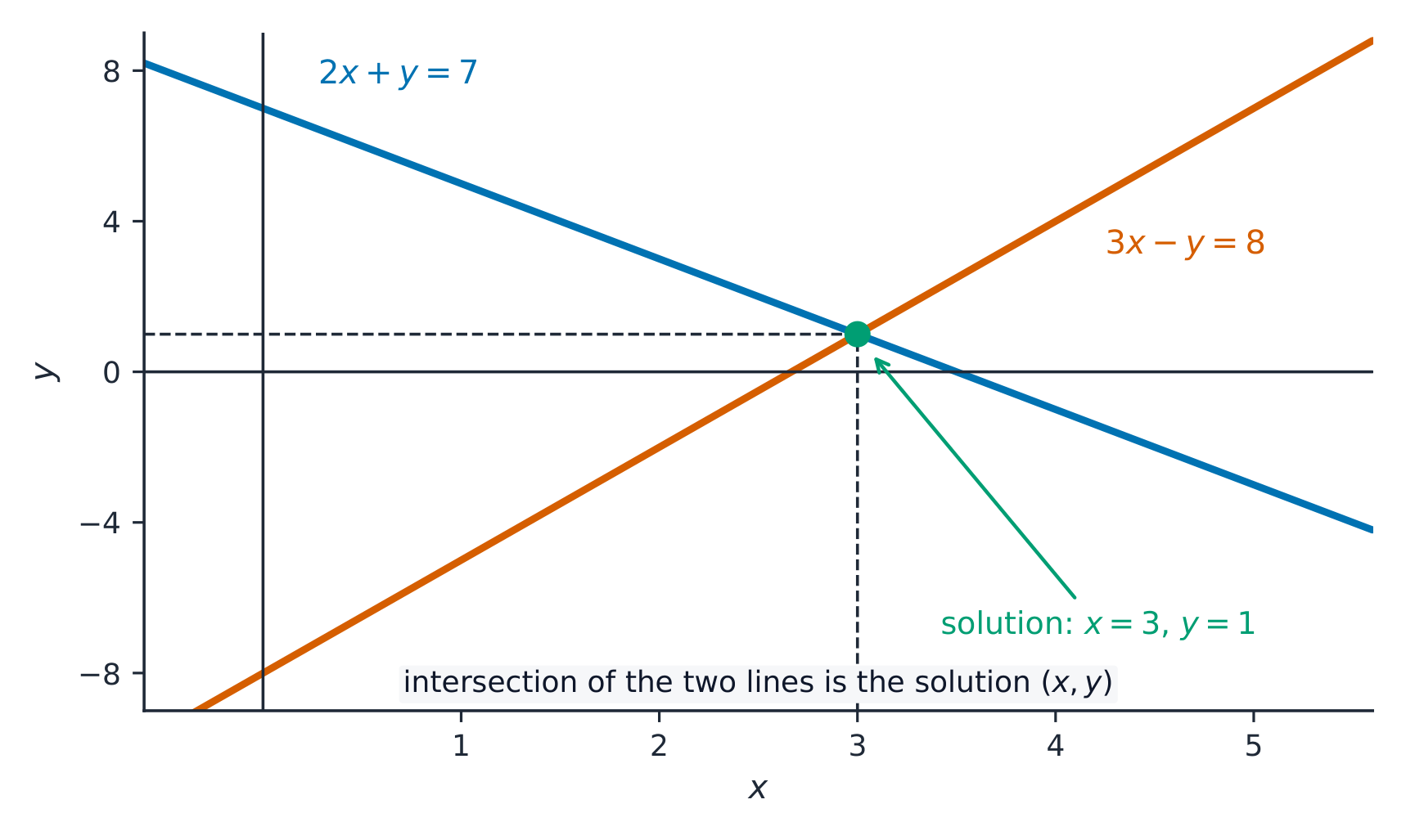
You can solve an equation by reading a graph. The intersection point 交点 of a line and a curve gives the solution of the two equations together.
For exponential growth 指数增长 and exponential decay 指数衰减, the graph of $y = a\,b^{x} + c$ rises (or falls) faster and faster and flattens towards a horizontal line.
Explore · חקור
Graphing a quadratic · ציור פונקציה ריבועית
y = ax² + bx + c
Drag a, b and c and watch the parabola move — its turning point and where it crosses the axes. · גרור את a, b וc והצפה את הפרבולה זזה — את נקודת ההפיכה ואת מקום החצייה עם הצירים.
נדרשת ידע בסימטריה ושורשים. ידע בנקודות קיצון אינו נדרש.
English
Subject content
Notes and examples
Recognise, sketch and interpret graphs of the following functions: (a) linear (b) quadratic (c) cubic (d) reciprocal (e) exponential.
Functions will be equivalent to: • $ax + by = c$ • $y = ax^2 + bx + c$ • $y = ax^3 + b$ • $y = ax^3 + bx^2 + cx$ • $y = \frac{a}{x} + b$ • $y = ar^x + b$ where $a$, $b$ and $c$ are rational numbers and $r$ is a rational, positive number. Knowledge of turning points, roots and symmetry is required. Knowledge of vertical and horizontal asymptotes is required. Finding turning points of quadratics by completing the square is required.
הפונקציות יהיו שוות ערך ל: • $ax + by = c$ • $y = ax^2 + bx + c$ • $y = ax^3 + b$ • $y = ax^3 + bx^2 + cx$ • $y = \frac{a}{x} + b$ • $y = ar^x + b$ כאשר $a$, $b$ ו-$c$ הם מספרים רציונליים ו-$r$ הוא מספר רציונלי חיובי. נדרשת ידע בנקודות קיצון, שורשים וסימטריות. נדרשת ידע בחסמים אנכיים ואופקיים. מציאת נקודות קיצון של פונקציות ריבועיות באמצעות השלמה לריבוע היא נדרשת.
Source: Cambridge International syllabus · מקור: הסיילבוס הבינלאומי של קמבריד'ג'
A quick sketch should show the right shape and the key features: where it crosses the axes, any symmetry 对称, and any line the curve gets close to.
Function
Shape
linear, $y = mx + c$
straight line; gradient $m$, $y$-intercept 截距$c$
quadratic, $y = ax^{2} + bx + c$
a parabola 抛物线 (U-shape if $a>0$, $\cap$-shape if $a<0$)
cubic, $y = ax^{3} + bx + c$
an S-shaped curve
reciprocal, $y = \dfrac{a}{x} + b$
two separate curves
exponential, $y = a\,r^{x} + b$
fast growth or decay
The basic graph shapes; knowing each shape lets you sketch quickly from the equation.
For a parabola, completing the square gives the turning point 转折点 (the lowest or highest point). For example $y = (x + 3)^{2} - 8$ has its turning point at $(-3, -8)$.
Completing the square, $y=(x+3)^2-8$, shows the turning point $(-3,-8)$ and the line of symmetry $x=-3$.
An asymptote 渐近线 is a line that the curve gets closer and closer to but never touches — for example, the $x$-axis for $y = \dfrac{a}{x}$, or the line $y = b$ for $y = a\,r^{x} + b$.
1 Estimate gradients of curves by drawing tangents.
2 Use the derivatives of functions of the form $ax^n$, where $a$ is a rational constant and $n$ is a positive integer or zero, and simple sums of not more than three of these.
$\frac{\mathrm{d}y}{\mathrm{d}x}$ notation will be expected.
3 Apply differentiation to gradients and stationary points (turning points).
4 Discriminate between maxima and minima by any method.
Maximum and minimum points may be identified by: • an accurate sketch • use of the second differential • inspecting the gradient either side of a turning point. Candidates are not expected to identify points of inflection.
עברית
תוכן נושא
הערות ות examples
1 הערכת שיפועי עקומות על ידי ציור מגע.
2 שימוש בגזירות של פונקציות מהצורה $ax^n$, כאשר $a$ הוא קבוע רציונלי ו-$n$ הוא מספר טבעי או אפס, וסכומים פשוטים של עד שלושה מאלו.
נקודות מקסימום ומינימום עשויות להיות מזוהות על ידי: • סקיצה מדויקת • שימוש בגזרה שנייה • בדיקת השיפוע משני צדי נקודת קיצון. אינו מתבקש מהמועמדים לזהות נקודות היפוך.
Source: Cambridge International syllabus · מקור: הסיילבוס הבינלאומי של קמבריד'ג'
Differentiation 微分 finds the gradient of a curve at any point. You can estimate it by drawing a tangent 切线 (a line that just touches the curve) and measuring its gradient.
The gradient of a curve at a point equals the gradient of the tangent there — what differentiation finds.
The exact rule: if $y = ax^{n}$, then the derivative 导数 is
The turning point is $(3, -4)$. To decide whether a turning point is a maximum 最大值 or a minimum 最小值, check the sign of the gradient on each side, or use the second derivative (positive means a minimum).
Explore · חקור
Gradient of a curve · שיפוע של עקומה
y = ax³ + bx² + cx + d
Move the point: the tangent shows the gradient there, which is what differentiation finds. · זוז בנקודה: המשיק מראה את השיפוע בנקודה זו, מה שמייצג מה שמחשבת הנגזרת.
2 Understand and find inverse functions $f^{-1}(x)$.
3 Form composite functions as defined by $gf(x) = g(f(x))$.
e.g. $f(x) = \frac{3}{x + 2}$ and $g(x) = (3x + 5)^2$. Find $fg(x)$. Give your answer as a fraction in its simplest form. Candidates are not expected to find the domains and ranges of composite functions. This topic may include mapping diagrams.
עברית
תוכן נושא
הערות ות examples
1 הבנת פונקציות, תחום והיקף ושימוש בסימון פונקציות.
3 הרכב פונקציות מורכבות כפי שמוגדר ב-$gf(x) = g(f(x))$.
לדוגמה: $f(x) = \frac{3}{x + 2}$ ו-$g(x) = (3x + 5)^2$. מצא את $fg(x)$. תן את התשובה בשבר בצורה הפשוטה ביותר. מועמדים אינם מצופים למצוא את התחומים והטווחים של פונקציות מורכבות. נושא זה עשוי לכלול דיאגרמות מיפוי.
Source: Cambridge International syllabus · מקור: הסיילבוס הבינלאומי של קמבריד'ג'
A function 函数 turns each input into one output. We write $f(x)$, for example $f(x) = 3x - 5$, so $f(2) = 1$. The set of allowed inputs is the domain 定义域; the set of possible outputs is the range 值域.
The inverse function 反函数$f^{-1}(x)$ undoes the function. To find it, write $y = f(x)$, swap the roles, and make $x$ the subject.
Worked example. Find the inverse of $f(x) = 3x - 5$.
This handout covers Topic 3, Coordinate geometry. Parts marked (Extended) are only tested on the Extended papers; everything else is for both levels.
עברית
גיליון זה מכסה נושא 3, גיאומטריה אנליטית. חלקים המסומנים (הרחבה) נבדקים רק בבחינות הרחבה; הכל שאר הוא לשני רמות.
3.1
Coordinates · נקודות
Syllabus · סיילבוס
English
Subject content
Notes and examples
Use and interpret Cartesian coordinates in two dimensions.
עברית
תוכן נושא
הערות ות examples
להשתמש בקואורדינטות קרטזיות בשתי מימד ולפרש אותן.
Source: Cambridge International syllabus · מקור: הסיילבוס הבינלאומי של קמבריד'ג'
English
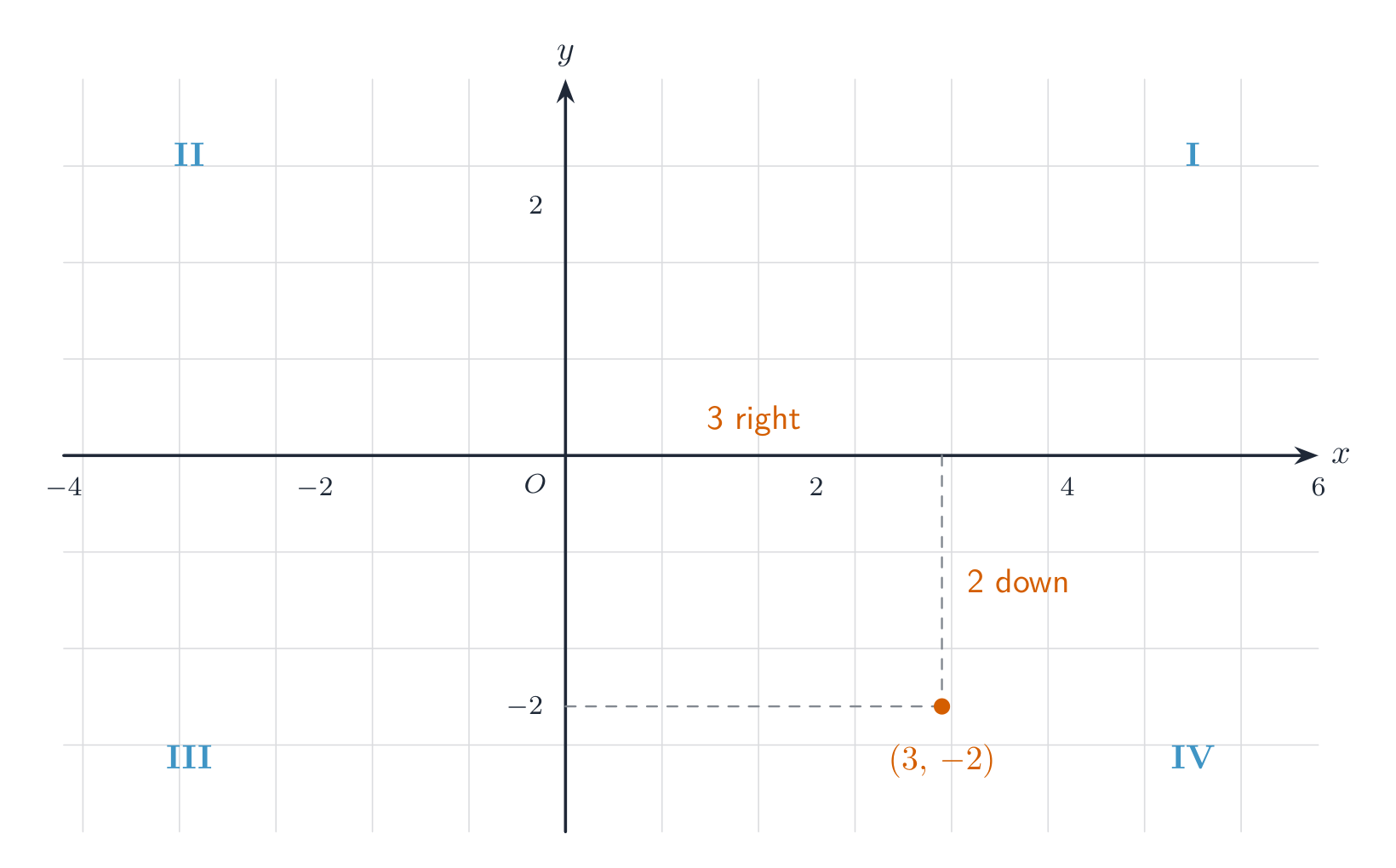
A point on a graph is described by its coordinates 坐标, sometimes called Cartesian coordinates, written $(x, y)$. The first number is the across value and the second is the up value.
The two number lines are the axes 坐标轴: the horizontal 水平$x$-axis and the vertical 竖直$y$-axis.
They cross at the origin 原点, the point $(0, 0)$.
The axes split the grid into four quadrants 象限.
So the point $(3, -2)$ is found by going $3$ to the right and $2$ down.
עברית
רשת רחובות עירונית: כל מקום קבוע על ידי נקודות.
נקודה בגרף מתוארת על ידי נקודות, לעיתים נקראות נקודות קרטזיות, כתוב $(x, y)$. המספר הראשון הוא הערך האופקי והשני הוא הערך האנכי.
שני קווי המספר הם הצירים: ציר אופקי$x$ וציר אנכי$y$.
הם נחתכים בראשית, הנקודה $(0, 0)$.
הצירים מחלקים את הרשת לארבעה רביעים.
לכן, הנקודה $(3, -2)$ נמצאת על ידי מעבר $3$ ימינה ו$2$ למטה.
הצירים נפגשים במוצא $O$ ומחלקים את המישור לארבע רבעיות; $(3,-2)$ פירושו 3 ימינה ואז 2 למטה.
Explore · חקור
The coordinate plane · מישור הקואורדינטות
y = mx + c
Every point has an (x, y) coordinate. A straight line is the set of points where y depends on x in a fixed way. · לכל נקודה יש קואורדינatas (x, y). ישר הוא קבוצת הנקודות בהן y תלויה ב-x באופן קבוע.
Interpret and obtain the equation of a straight-line graph in the form $y = mx + c$.
Questions may: • use and request lines in the forms $y = mx + c$, $x = k$ • involve finding the equation when the graph is given • ask for the gradient or $y$-intercept of a graph from an equation, e.g. find the gradient and $y$-intercept of the graph with the equation $y = 6x + 3$. Candidates are expected to give equations of a line in a fully simplified form.
עברית
תוכן נושא
הערות ות examples
לפרש ולקבל את משוואת גרף ישר בצורה $y = mx + c$.
השאלות עשויות: • להשתמש ולבקש קווים בצורות $y = mx + c$, $x = k$ • לעסוק במציאת המשוואה כאשר הגרף נתון • לבקש את השיפוע או החיתוך עם $y$-ציר של גרף מתוך משוואה, לדוגמה: מצא את השיפוע והחיתוך עם $y$-ציר של הגרף עם המשוואה $y = 6x + 3$. מועמד צפוי לתת משוואות של קו בצורה מפושטת לחלוטין.
Subject content
Notes and examples
Interpret and obtain the equation of a straight-line graph.
Questions may: • use and request lines in different forms, e.g. $ax + by = c$, $y = mx + c$, $x = k$ • involve finding the equation when the graph is given • ask for the gradient or $y$-intercept of a graph from an equation, e.g. find the gradient and $y$-intercept of the graph with equation $5x + 4y = 8$. Candidates are expected to give equations of a line in a fully simplified form.
Source: Cambridge International syllabus · מקור: הסיילבוס הבינלאומי של קמבריד'ג'
English
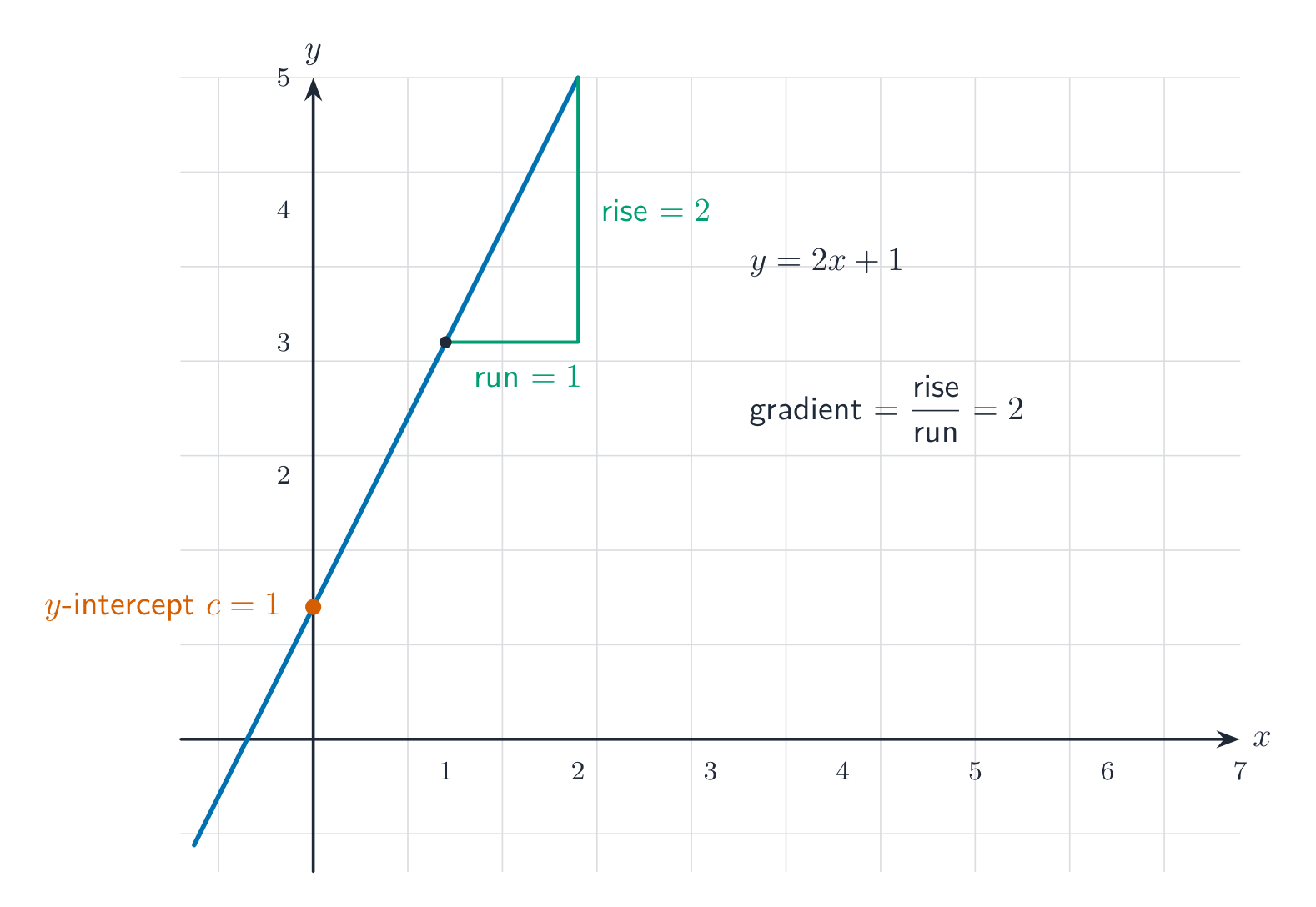
Most straight lines can be written as
$$y = mx + c,$$
where $m$ is the gradient 斜率 (steepness) and $c$ is the intercept 截距 — the $y$-value where the line crosses the $y$-axis.
A line like $x = k$ (for example $x = 3$) is vertical.
A line like $y = k$ (for example $y = 3$) is horizontal.
A line may also be given as $ax + by = c$. Rearrange it into $y = mx + c$ to read off the gradient and intercept.
Worked example. Find the gradient and $y$-intercept of $5x + 4y = 8$.
לכן השיפוע הוא $-\tfrac{5}{4}$ וחיתוך ה-$y$ הוא $2$.
Explore · חקור
y = mx + c
y = ax + b
Drag the gradient and the intercept. a is the gradient (steepness) and b is where the line crosses the y-axis. · גרור את השיפוע ואת החיתוך. a הוא השיפוע (השיפועיות) ו-b הוא הנקודה שבה הישר חוצה את ציר y.
3.3
Gradient · שיפוע
Syllabus · סיילבוס
English
Subject content
Notes and examples
Find the gradient of a straight line.
From a grid only.
עברית
תוכן נושא
הערות ות examples
למצוא את השיפוע של קו ישר.
מתוך רשת בלבד.
English
Subject content
Notes and examples
1 Find the gradient of a straight line.
2 Calculate the gradient of a straight line from the coordinates of two points on it.
עברית
תוכן נושא
הערות ות examples
1 מציאת שיפוע של קו ישר.
2 חישוב שיפוע של קו ישר מהקואורדינטות של שתי נקודות עליו.
Source: Cambridge International syllabus · מקור: הסיילבוס הבינלאומי של קמבריד'ג'
English
y = mx + c: gradient and intercept, live
The gradient measures how steep a line is:
$$m = \frac{\text{change in } y}{\text{change in } x} = \frac{\text{rise}}{\text{run}}.$$
A positive gradient goes up to the right; a negative gradient goes down to the right.
Worked example. Find the gradient of the line through $(1, 2)$ and $(4, 11)$.
$$m = \frac{11 - 2}{4 - 1} = \frac{9}{3} = 3.$$
עברית
y = mx + c: שיפוע וחיתוך, חידרך הרים תלולה: השיפוע מדד תלילות כעלייה על פריצה.
השיפוע מדד עד כמה קו תלול:
$$m = \frac{\text{change in } y}{\text{change in } x} = \frac{\text{rise}}{\text{run}}.$$
שיפוע חיובי עולה לימין; שיפוע שלילי יורד לימין.
דוגמא מפורטת. מצאו את השיפוע של הקו העובר דרך $(1, 2)$ ו$(4, 11)$.
$$m = \frac{11 - 2}{4 - 1} = \frac{9}{3} = 3.$$
עבור $y=mx+c$, הישר חוצה את ציר ה-$y$ בנקודה $c$ והשיפוע $m$ הוא העלייה חלקי המרוצ.
Explore · חקור
Gradient · שיפוע
y = ax + b
The gradient a measures steepness — rise over run. · השיפוע a מדד את המדרון — עלות חלוקה במרחק אופקי.
Source: Cambridge International syllabus · מקור: הסיילבוס הבינלאומי של קמבריד'ג'
English
To draw $y = mx + c$, the quickest way is:
Mark the intercept $c$ on the $y$-axis.
Use the gradient to step to more points (for $m = 3$, go $1$ right and $3$ up).
Join the points with a straight line.
You can also make a small table of values 数值表: choose two or three $x$-values, work out $y$, and plot the points.
עברית
כדי לשרטט $y = mx + c$, הדרך המהירה ביותר היא:
סמן את נקודת החיתוך $c$ על ציר ה-$y$.
השתמש בשיפוע כדי לעבור לנקודות נוספות (עבור $m = 3$, זז $1$ ימינה ו-$3$ למעלה).
חבר את הנקודות בקו ישר.
ניתן גם לבנות טבלת ערכים קטנה: בחר שתי או שלוש ערכי $x$, חשב את הערכים המתאימים ל-$y$, ושרטט את הנקודות.
שרטוט מהיר של קו: סמן את נקודת החיתוך, ולאחר מכן השתמש בשיפוע כדי לעבור לנקודות חדשות
3.5
Finding the equation of a line · מציאת משוואת הקו
Syllabus · סיילבוס
English
Subject content
Notes and examples
Interpret and obtain the equation of a straight-line graph in the form $y = mx + c$.
Questions may: • use and request lines in the forms $y = mx + c$, $x = k$ • involve finding the equation when the graph is given • ask for the gradient or $y$-intercept of a graph from an equation, e.g. find the gradient and $y$-intercept of the graph with the equation $y = 6x + 3$. Candidates are expected to give equations of a line in a fully simplified form.
עברית
תוכן נושא
הערות ות examples
לפרש ולקבל את משוואת גרף ישר בצורה $y = mx + c$.
השאלות עשויות: • להשתמש ולבקש קווים בצורות $y = mx + c$, $x = k$ • לעסוק במציאת המשוואה כאשר הגרף נתון • לבקש את השיפוע או החיתוך עם $y$-ציר של גרף מתוך משוואה, לדוגמה: מצא את השיפוע והחיתוך עם $y$-ציר של הגרף עם המשוואה $y = 6x + 3$. מועמד צפוי לתת משוואות של קו בצורה מפושטת לחלוטין.
Subject content
Notes and examples
Interpret and obtain the equation of a straight-line graph.
Questions may: • use and request lines in different forms, e.g. $ax + by = c$, $y = mx + c$, $x = k$ • involve finding the equation when the graph is given • ask for the gradient or $y$-intercept of a graph from an equation, e.g. find the gradient and $y$-intercept of the graph with equation $5x + 4y = 8$. Candidates are expected to give equations of a line in a fully simplified form.
Source: Cambridge International syllabus · מקור: הסיילבוס הבינלאומי של קמבריד'ג'
English
If you know the gradient $m$ and one point on the line, put the point into $y = mx + c$ to find $c$.
Worked example. A line has gradient $3$ and passes through $(1, 2)$. Find its equation.
Find the gradient and equation of a straight line perpendicular to a given line.
Examples include: • find the gradient of a line perpendicular to $2y = 3x + 1$ • find the equation of the perpendicular bisector of the line joining the points $(-3, 8)$ and $(9, -2)$.
עברית
תוכן נושא
הערות ות examples
מציאת השיפוע ומשוואה של קו ישר המאונך לקו נתון.
דוגמאות כוללות: • מציאת השיפוע של קו המאונך ל-$2y = 3x + 1$ • מציאת משוואת האנכי באמצע של הקטע המחבר בין הנקודות $(-3, 8)$ ו-$(9, -2)$.
Source: Cambridge International syllabus · מקור: הסיילבוס הבינלאומי של קמבריד'ג'
English
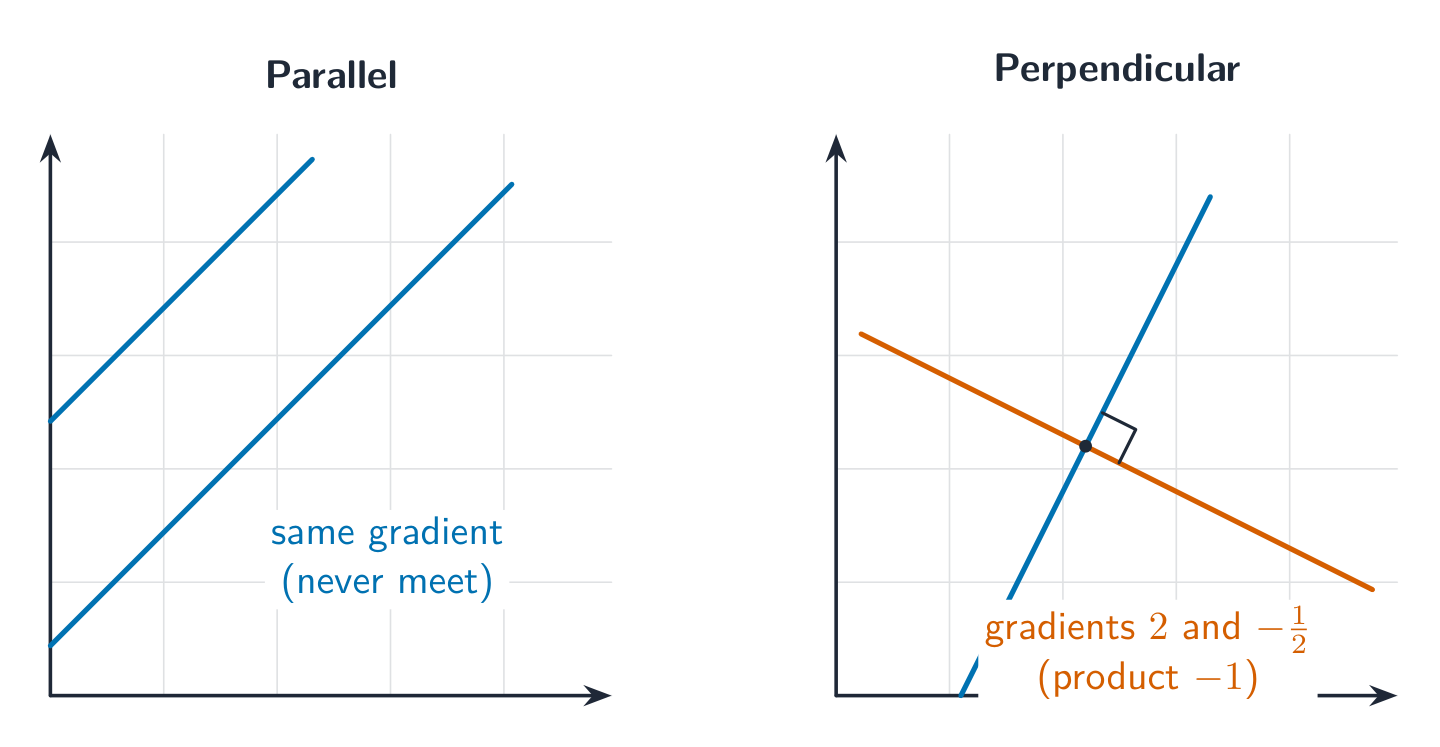
Two lines are perpendicular 垂直 if they meet at a right angle 直角. Their gradients multiply to $-1$:
Worked example. Find the gradient of a line perpendicular to $2y = 3x + 1$.
Rearrange: $y = \tfrac{3}{2}x + \tfrac{1}{2}$, so the gradient is $\tfrac{3}{2}$. The perpendicular gradient is $-\tfrac{2}{3}$.
Perpendicular bisector
The perpendicular bisector 垂直平分线 of a segment cuts it in half at a right angle. To find its equation: get the midpoint, then use the perpendicular gradient through that midpoint.
Worked example. Find the perpendicular bisector of the segment joining $(-3, 8)$ and $(9, -2)$.
דוגמה מפורטת. מצאו את השיפוע של קו מאונך ל-$2y = 3x + 1$.
סדרו מחדש: $y = \tfrac{3}{2}x + \tfrac{1}{2}$, ולכן השיפוע הוא $\tfrac{3}{2}$. השיפוע המאונך הוא $-\tfrac{2}{3}$.
קווים מקבילים משתפים אותה שיפוע; מכפלת שיפועים מאונכים היא $-1$.
חוצה מאונך
חוצה המאונך לקטע מחלק אותו לשתי חלקים שווים בזווית ישרה. כדי למצוא את המשוואה שלו: קבלו את נקודת האמצע, ולאחר מכן השתמשו בשיפוע המאונך העובר דרך נקודת האמצע הזו.
דוגמה מפורטת. מצאו את החוצה המאונך לקטע המחבר בין $(-3, 8)$ ל-$(9, -2)$.
This handout covers Topic 4, Geometry. Parts marked (Extended) are only tested on the Extended papers; everything else is for both levels. In the exam you must give reasons using the correct names below, not just the numbers.
עברית
דף עבודה זה מכסה נושא 4, גיאומטריה. חלקים המסומנים (מתקדם) נבדקים רק במבחני המתקדם; כל שאר החומר מתאים לשני הרמות. בבחון עליכם לספק סיבות באמצעות השמות הנכונים למטה, ולא רק מספרים.
4.1
Lines and angles · קווים וזוויות
Syllabus · סיילבוס
English
Subject content
Notes and examples
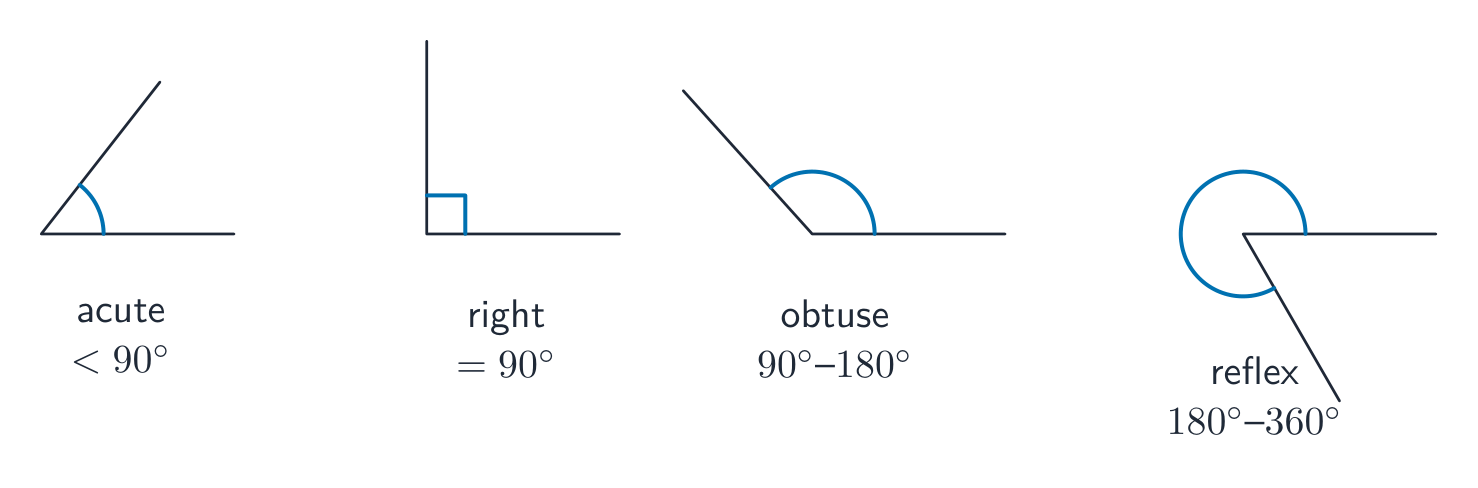
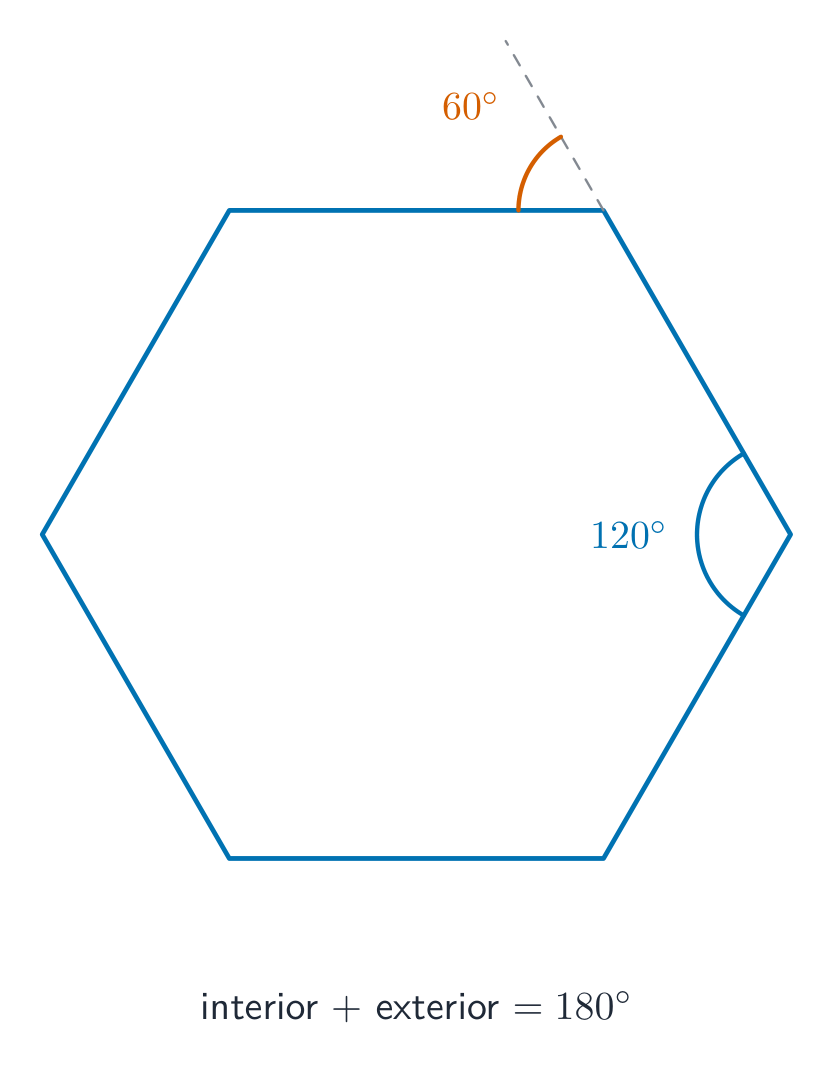
1 Use and interpret the following geometrical terms: • point • vertex • line • parallel • perpendicular • bearing • right angle • acute, obtuse and reflex angles • interior and exterior angles • similar • congruent • scale factor.
Candidates are not expected to show that two shapes are congruent.
2 Use and interpret the vocabulary of: • triangles • special quadrilaterals • polygons • nets • simple solids.
Includes the following terms: Triangles: • equilateral • isosceles • scalene • right-angled. Quadrilaterals: • square • rectangle • kite • rhombus • parallelogram • trapezium. Polygons: • regular and irregular polygons • pentagon • hexagon • octagon • decagon.
גופים פשוטים: • קוביה • תיבה • פרזמה • צילינדר • פירמידה • חרוט • כדור (המונח 'כדור למחצית' אינו נדרש) • פני שטח • משטח • קצה.
3 השתמש והבן במונחים של עיגול.
כולל את המונחים הבאים: • מרכז • רדיוס (רבים-רדיוסים) • קוטר • היקף • חצי-עיגול • מיתר • מגע • קשת • מוסך • מוסיקאלי.
English
Subject content
Notes and examples
1 Use and interpret the following geometrical terms: • point • vertex • line • plane • parallel • perpendicular • perpendicular bisector • bearing • right angle • acute, obtuse and reflex angles • interior and exterior angles • similar • congruent • scale factor.
Candidates are not expected to show that two shapes are congruent.
2 Use and interpret the vocabulary of: • triangles • special quadrilaterals • polygons • nets • solids.
Includes the following terms. Triangles: • equilateral • isosceles • scalene • right-angled. Quadrilaterals: • square • rectangle • kite • rhombus • parallelogram • trapezium.
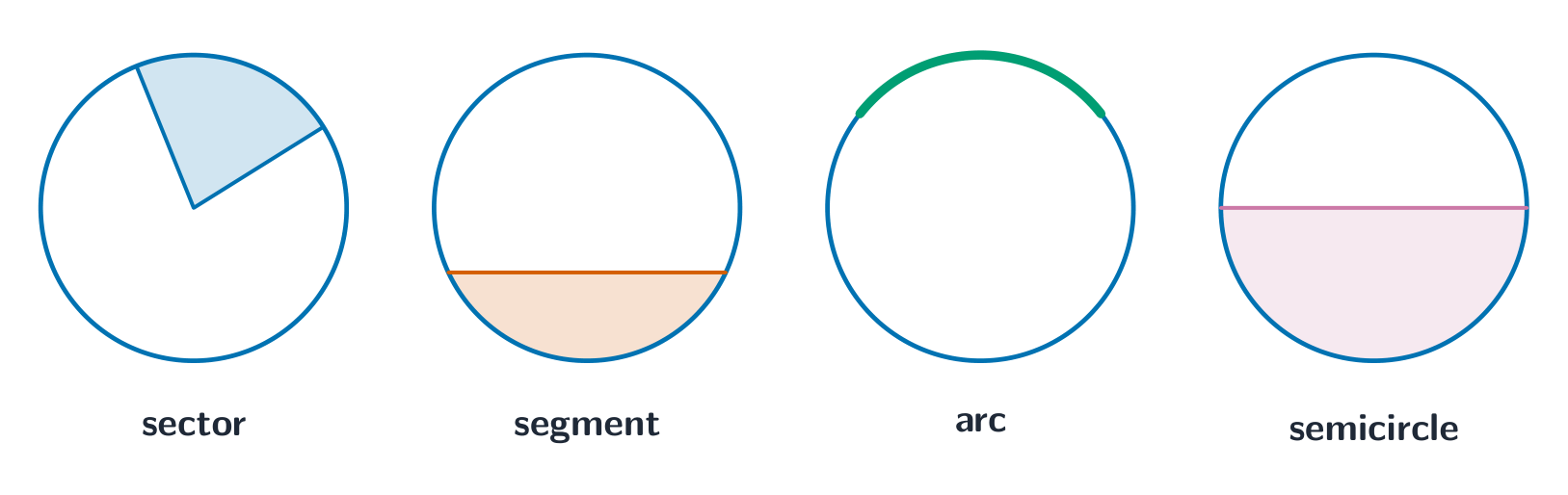
Includes the following terms: • centre • radius (plural radii) • diameter • circumference • semicircle • chord • tangent • major and minor arc • sector • segment.
עברית
תוכן נושא
הערות ות examples
1 שימוש ופרשנות של המושגים הגיאומטריים הבאים: • נקודה • קודקוד • קו • מישור • מקביל • אנכי • מאונך אמצעי • כיוון (bearing) • זווית ישרה • זוויות חדות, קהות ומחזוריות • זוויות פנימיות וחיצוניות • דומים • חופפים • גורם קנה מידה.
מועמד אינו צפוי להוכיח כי שתי צורות הם חופפים.
2 שימוש ופרשנות של הלקסיקון של: • משולשים • מרובעים מיוחדים • פוליגונים • רשתות • גופים מsolid.
כולל את המושגים הבאים. משולשים: • שווה שוקיים • שווה שוקיים • שווה צלעות • ישר-זווית. מרובעים: • ריבוע • מלבן • נזר • משולש • מקבילית • טרפז.
מצולעים: • מצולעים משוכללים ולא משוכללים • חמישי • משושה • שמונית • עשרית. גוף תלת-ממדי: • קוביה • גוף ארגז • פריזה • צילינדר • פירמידה • חרוט • כדור • חצי כדור • פרוסטום • פנים • פני שטח • קצה.
3 שימוש ופרשנות במונחים של עיגול.
כולל את המונחים הבאים: • מרכז • רדיוס (רבים: רדיוסים) • קוטר • היקף • חצי עיגול • מיתר • מגע • קשת גדולה וקשת קטנה • מניירה • קטע.
Source: Cambridge International syllabus · מקור: הסיילבוס הבינלאומי של קמבריד'ג'
English
A corner where two lines meet is a vertex 顶点. Two lines are parallel 平行 if they never meet, and perpendicular 垂直 if they meet at a right angle. Angles are named by their size:
Name
Size
acute angle 锐角
less than $90^{\circ}$
right angle 直角
exactly $90^{\circ}$
obtuse angle 钝角
between $90^{\circ}$ and $180^{\circ}$
reflex angle 优角
between $180^{\circ}$ and $360^{\circ}$
We name an angle with three letters, e.g. angle $ABC$ is the angle at $B$.
עברית
פינה שבה שני קווים נפגשים היא ראש זווית. שני קווים הם מקבילים אם לעולם אינם נפגשים, ו-מאונכים אם נפגשים בזווית ישרה. זוויות נקראות לפי הגודל שלהן:
אנו קוראים לזווית בשלוש אותיות, לדוגמה, זווית $ABC$ היא הזווית בנקודה $B$.
Explore · חקור
Shape and angle lab · מעבדת צורה וזווית
Classify angle facts by the diagram feature that creates them. · מיינו עובדות זוויות לפי המאפיין בתרשים שיוצר אותן.
4.6
Angle facts · עובדות על זוויות
Syllabus · סיילבוס
English
Subject content
Notes and examples
1 Calculate unknown angles and give simple explanations using the following geometrical properties: • sum of angles at a point = 360° • sum of angles at a point on a straight line = 180° • vertically opposite angles are equal • angle sum of a triangle = 180° and angle sum of a quadrilateral = 360°.
Knowledge of three-letter notation for angles is required, e.g. angle $ABC$. Candidates are expected to use the correct geometrical terminology when giving reasons for answers.
2 Calculate unknown angles and give geometric explanations for angles formed within parallel lines: • corresponding angles are equal • alternate angles are equal • co-interior angles sum to 180° (supplementary).
3 Know and use angle properties of regular polygons.
Includes exterior and interior angles, and angle sum.
עברית
תוכן נושא
הערות ות examples
1 חשב זוויות לא ידועות ותן הסברים פשוטים באמצעות המאפיין הגיאומטרי הבאים: • סכום הזוויות בנקודה = 360° • סכום הזוויות בנקודה על קו ישר = 180° • זוויות נגדיות בראש הן שוות • סכום הזוויות במשולש = 180° וסכום הזוויות בצורת ארבע-צלעות = 360°.
נדרש ידע בסימון זוויות בשלושה אותיות, לדוגמה זווית $ABC$. מתבקש מהמועמדים להשתמש במונחות גיאומטריים הנכונים בהצעת הסיבות לתשובות.
2 חשב זוויות לא ידועות ותן הסברים גיאומטריים לזוויות שנוצרו בתוך קווים מקבילים: • זוויות מול זוויות הן שוות • זוויות אלטרנטביות הן שוות • זוויות צמודות פנימיות סוכמות ל-180° (משלימות).
3 הכן והשתמש במאפיין הזוויות של פוליגונים קבוצים.
כולל זוויות חיצוניות ופנימיות, וסכום זוויות.
English
Subject content
Notes and examples
1 Calculate unknown angles and give simple explanations using the following geometrical properties: • sum of angles at a point = 360° • sum of angles at a point on a straight line = 180° • vertically opposite angles are equal • angle sum of a triangle = 180° and angle sum of a quadrilateral = 360°.
Knowledge of 3-letter notation for angles is required, e.g. angle $ABC$. Candidates are expected to use the correct geometrical terminology when giving reasons for answers.
2 Calculate unknown angles and give geometric explanations for angles formed within parallel lines: • corresponding angles are equal • alternate angles are equal • co-interior angles sum to 180° (supplementary).
3 Know and use angle properties of regular and irregular polygons.
Includes exterior and interior angles, and angle sum.
עברית
תוכן נושא
הערות ות examples
1 חישוב זוויות לא ידועות ומתן הסברים פשוטים באמצעות התכונות הגיאומטריות הבאות: • סכום הזוויות בנקודה = ⟦360°⟧ • סכום הזוויות בנקודה על קו ישר = ⟦180°⟧ • זוויות נגודות בקודקוד שוות • סכום הזוויות במשולש = ⟦180°⟧ וסכום הזוויות בריבוע = ⟦360°⟧.
נדרשת היכרות עם סימון זוויות בעל-3 אותיות, לדוגמה זווית $ABC$. נציבים מצופים להשתמש במונחים גיאומטריים הנכונים בעת מתן נימוקים לתשובותיהם.
2 חשב זוויות לא ידועות ותן הסברים גיאומטריים לזוויות שנוצרו בתוך קווים מקבילים: • זוויות מול זוויות הן שוות • זוויות אלטרנטביות הן שוות • זוויות צמודות פנימיות סוכמות ל-180° (משלימות).
3 ידע שימוש בתכונות הזוויות של פוליגונים קבוצים ולא קבוצים.
כולל זוויות חיצוניות ופנימיות, וסכום זוויות.
Source: Cambridge International syllabus · מקור: הסיילבוס הבינלאומי של קמבריד'ג'
English
Learn these basic facts. Each one is a valid reason in the exam.
Angles at a point add up to $360^{\circ}$.
Angles on a straight line add up to $180^{\circ}$.
Vertically opposite angles 对顶角 (made by two crossing lines) are equal.
Worked example. Three angles on a straight line are $x$, $50^{\circ}$ and $70^{\circ}$. Find $x$.
Parallel line and polygon lab · מעבדה: קווים מקבילים ורבועים
Pick the angle rule that unlocks each diagram. · בחר את חוק הזוויות שמפתח כל דיאגרמה.
4.6
Angles in parallel lines · זוויות בקווים מקבילים
Syllabus · סיילבוס
English
Subject content
Notes and examples
1 Calculate unknown angles and give simple explanations using the following geometrical properties: • sum of angles at a point = 360° • sum of angles at a point on a straight line = 180° • vertically opposite angles are equal • angle sum of a triangle = 180° and angle sum of a quadrilateral = 360°.
Knowledge of three-letter notation for angles is required, e.g. angle $ABC$. Candidates are expected to use the correct geometrical terminology when giving reasons for answers.
2 Calculate unknown angles and give geometric explanations for angles formed within parallel lines: • corresponding angles are equal • alternate angles are equal • co-interior angles sum to 180° (supplementary).
3 Know and use angle properties of regular polygons.
Includes exterior and interior angles, and angle sum.
עברית
תוכן נושא
הערות ות examples
1 חשב זוויות לא ידועות ותן הסברים פשוטים באמצעות המאפיין הגיאומטרי הבאים: • סכום הזוויות בנקודה = 360° • סכום הזוויות בנקודה על קו ישר = 180° • זוויות נגדיות בראש הן שוות • סכום הזוויות במשולש = 180° וסכום הזוויות בצורת ארבע-צלעות = 360°.
נדרש ידע בסימון זוויות בשלושה אותיות, לדוגמה זווית $ABC$. מתבקש מהמועמדים להשתמש במונחות גיאומטריים הנכונים בהצעת הסיבות לתשובות.
2 חשב זוויות לא ידועות ותן הסברים גיאומטריים לזוויות שנוצרו בתוך קווים מקבילים: • זוויות מול זוויות הן שוות • זוויות אלטרנטביות הן שוות • זוויות צמודות פנימיות סוכמות ל-180° (משלימות).
3 הכן והשתמש במאפיין הזוויות של פוליגונים קבוצים.
כולל זוויות חיצוניות ופנימיות, וסכום זוויות.
English
Subject content
Notes and examples
1 Calculate unknown angles and give simple explanations using the following geometrical properties: • sum of angles at a point = 360° • sum of angles at a point on a straight line = 180° • vertically opposite angles are equal • angle sum of a triangle = 180° and angle sum of a quadrilateral = 360°.
Knowledge of 3-letter notation for angles is required, e.g. angle $ABC$. Candidates are expected to use the correct geometrical terminology when giving reasons for answers.
2 Calculate unknown angles and give geometric explanations for angles formed within parallel lines: • corresponding angles are equal • alternate angles are equal • co-interior angles sum to 180° (supplementary).
3 Know and use angle properties of regular and irregular polygons.
Includes exterior and interior angles, and angle sum.
עברית
תוכן נושא
הערות ות examples
1 חישוב זוויות לא ידועות ומתן הסברים פשוטים באמצעות התכונות הגיאומטריות הבאות: • סכום הזוויות בנקודה = ⟦360°⟧ • סכום הזוויות בנקודה על קו ישר = ⟦180°⟧ • זוויות נגודות בקודקוד שוות • סכום הזוויות במשולש = ⟦180°⟧ וסכום הזוויות בריבוע = ⟦360°⟧.
נדרשת היכרות עם סימון זוויות בעל-3 אותיות, לדוגמה זווית $ABC$. נציבים מצופים להשתמש במונחים גיאומטריים הנכונים בעת מתן נימוקים לתשובותיהם.
2 חשב זוויות לא ידועות ותן הסברים גיאומטריים לזוויות שנוצרו בתוך קווים מקבילים: • זוויות מול זוויות הן שוות • זוויות אלטרנטביות הן שוות • זוויות צמודות פנימיות סוכמות ל-180° (משלימות).
3 ידע שימוש בתכונות הזוויות של פוליגונים קבוצים ולא קבוצים.
כולל זוויות חיצוניות ופנימיות, וסכום זוויות.
Source: Cambridge International syllabus · מקור: הסיילבוס הבינלאומי של קמבריד'ג'
English
When a line crosses two parallel lines:
Corresponding angles 同位角 (in matching positions, an "F" shape) are equal.
Alternate angles 内错角 (opposite sides of the crossing line, a "Z" shape) are equal.
Co-interior angles 同旁内角 (a "C" shape) add up to $180^{\circ}$; we say they are supplementary 互补.
Worked example. A straight line crosses two parallel lines. One angle is $110^{\circ}$. The co-interior angle $y$ satisfies $110 + y = 180$, so $y = 70^{\circ}$.
עברית
כאשר קו חוצה שני קווים מקבילים:
זוויות מתאימות (במיקום תואם, בצורת "F") שוות.
זוויות אלטרנטיות (בצדדים מנוגדים של הקו החוצה, בצורת "Z") שוות.
זוויות פנימיות צמודות (בצורת "C") סכומן $180^{\circ}$; אנו אומרים שהן זוויות משלימות.
דוגמה מפורטת. קו ישר חוצה שני קווים מקבילים. אחת הזוויות היא $110^{\circ}$. הזווית הפנימית הצמודה $y$ מקיימת $110 + y = 180$, ולכן $y = 70^{\circ}$.
1 Use and interpret the following geometrical terms: • point • vertex • line • parallel • perpendicular • bearing • right angle • acute, obtuse and reflex angles • interior and exterior angles • similar • congruent • scale factor.
Candidates are not expected to show that two shapes are congruent.
2 Use and interpret the vocabulary of: • triangles • special quadrilaterals • polygons • nets • simple solids.
Includes the following terms: Triangles: • equilateral • isosceles • scalene • right-angled. Quadrilaterals: • square • rectangle • kite • rhombus • parallelogram • trapezium. Polygons: • regular and irregular polygons • pentagon • hexagon • octagon • decagon.
גופים פשוטים: • קוביה • תיבה • פרזמה • צילינדר • פירמידה • חרוט • כדור (המונח 'כדור למחצית' אינו נדרש) • פני שטח • משטח • קצה.
3 השתמש והבן במונחים של עיגול.
כולל את המונחים הבאים: • מרכז • רדיוס (רבים-רדיוסים) • קוטר • היקף • חצי-עיגול • מיתר • מגע • קשת • מוסך • מוסיקאלי.
English
Subject content
Notes and examples
1 Use and interpret the following geometrical terms: • point • vertex • line • plane • parallel • perpendicular • perpendicular bisector • bearing • right angle • acute, obtuse and reflex angles • interior and exterior angles • similar • congruent • scale factor.
Candidates are not expected to show that two shapes are congruent.
2 Use and interpret the vocabulary of: • triangles • special quadrilaterals • polygons • nets • solids.
Includes the following terms. Triangles: • equilateral • isosceles • scalene • right-angled. Quadrilaterals: • square • rectangle • kite • rhombus • parallelogram • trapezium.
Includes the following terms: • centre • radius (plural radii) • diameter • circumference • semicircle • chord • tangent • major and minor arc • sector • segment.
עברית
תוכן נושא
הערות ות examples
1 שימוש ופרשנות של המושגים הגיאומטריים הבאים: • נקודה • קודקוד • קו • מישור • מקביל • אנכי • מאונך אמצעי • כיוון (bearing) • זווית ישרה • זוויות חדות, קהות ומחזוריות • זוויות פנימיות וחיצוניות • דומים • חופפים • גורם קנה מידה.
מועמד אינו צפוי להוכיח כי שתי צורות הם חופפים.
2 שימוש ופרשנות של הלקסיקון של: • משולשים • מרובעים מיוחדים • פוליגונים • רשתות • גופים מsolid.
כולל את המושגים הבאים. משולשים: • שווה שוקיים • שווה שוקיים • שווה צלעות • ישר-זווית. מרובעים: • ריבוע • מלבן • נזר • משולש • מקבילית • טרפז.
מצולעים: • מצולעים משוכללים ולא משוכללים • חמישי • משושה • שמונית • עשרית. גוף תלת-ממדי: • קוביה • גוף ארגז • פריזה • צילינדר • פירמידה • חרוט • כדור • חצי כדור • פרוסטום • פנים • פני שטח • קצה.
3 שימוש ופרשנות במונחים של עיגול.
כולל את המונחים הבאים: • מרכז • רדיוס (רבים: רדיוסים) • קוטר • היקף • חצי עיגול • מיתר • מגע • קשת גדולה וקשת קטנה • מניירה • קטע.
Source: Cambridge International syllabus · מקור: הסיילבוס הבינלאומי של קמבריד'ג'
English
A triangle 三角形 has three sides and angles that add up to $180^{\circ}$.
Type
Property
equilateral 等边
all sides equal, all angles $60^{\circ}$
isosceles 等腰
two sides equal, two angles equal
scalene 不等边
all sides and angles different
right-angled
has one right angle
Worked example. A triangle has angles $x$, $2x$ and $90^{\circ}$. Find $x$.
1 Use and interpret the following geometrical terms: • point • vertex • line • parallel • perpendicular • bearing • right angle • acute, obtuse and reflex angles • interior and exterior angles • similar • congruent • scale factor.
Candidates are not expected to show that two shapes are congruent.
2 Use and interpret the vocabulary of: • triangles • special quadrilaterals • polygons • nets • simple solids.
Includes the following terms: Triangles: • equilateral • isosceles • scalene • right-angled. Quadrilaterals: • square • rectangle • kite • rhombus • parallelogram • trapezium. Polygons: • regular and irregular polygons • pentagon • hexagon • octagon • decagon.
גופים פשוטים: • קוביה • תיבה • פרזמה • צילינדר • פירמידה • חרוט • כדור (המונח 'כדור למחצית' אינו נדרש) • פני שטח • משטח • קצה.
3 השתמש והבן במונחים של עיגול.
כולל את המונחים הבאים: • מרכז • רדיוס (רבים-רדיוסים) • קוטר • היקף • חצי-עיגול • מיתר • מגע • קשת • מוסך • מוסיקאלי.
English
Subject content
Notes and examples
1 Use and interpret the following geometrical terms: • point • vertex • line • plane • parallel • perpendicular • perpendicular bisector • bearing • right angle • acute, obtuse and reflex angles • interior and exterior angles • similar • congruent • scale factor.
Candidates are not expected to show that two shapes are congruent.
2 Use and interpret the vocabulary of: • triangles • special quadrilaterals • polygons • nets • solids.
Includes the following terms. Triangles: • equilateral • isosceles • scalene • right-angled. Quadrilaterals: • square • rectangle • kite • rhombus • parallelogram • trapezium.
Includes the following terms: • centre • radius (plural radii) • diameter • circumference • semicircle • chord • tangent • major and minor arc • sector • segment.
עברית
תוכן נושא
הערות ות examples
1 שימוש ופרשנות של המושגים הגיאומטריים הבאים: • נקודה • קודקוד • קו • מישור • מקביל • אנכי • מאונך אמצעי • כיוון (bearing) • זווית ישרה • זוויות חדות, קהות ומחזוריות • זוויות פנימיות וחיצוניות • דומים • חופפים • גורם קנה מידה.
מועמד אינו צפוי להוכיח כי שתי צורות הם חופפים.
2 שימוש ופרשנות של הלקסיקון של: • משולשים • מרובעים מיוחדים • פוליגונים • רשתות • גופים מsolid.
כולל את המושגים הבאים. משולשים: • שווה שוקיים • שווה שוקיים • שווה צלעות • ישר-זווית. מרובעים: • ריבוע • מלבן • נזר • משולש • מקבילית • טרפז.
מצולעים: • מצולעים משוכללים ולא משוכללים • חמישי • משושה • שמונית • עשרית. גוף תלת-ממדי: • קוביה • גוף ארגז • פריזה • צילינדר • פירמידה • חרוט • כדור • חצי כדור • פרוסטום • פנים • פני שטח • קצה.
3 שימוש ופרשנות במונחים של עיגול.
כולל את המונחים הבאים: • מרכז • רדיוס (רבים: רדיוסים) • קוטר • היקף • חצי עיגול • מיתר • מגע • קשת גדולה וקשת קטנה • מניירה • קטע.
Source: Cambridge International syllabus · מקור: הסיילבוס הבינלאומי של קמבריד'ג'
English
A quadrilateral 四边形 has four sides and angles that add up to $360^{\circ}$.
Shape
Property
square 正方形
four equal sides, four right angles
rectangle 矩形
opposite sides equal, four right angles
parallelogram 平行四边形
opposite sides parallel and equal
rhombus 菱形
four equal sides, opposite sides parallel
kite 鸢形
two pairs of equal sides next to each other
trapezium 梯形
one pair of parallel sides
עברית
לרבוע ארבע צלעות וארבע זוויות שסכומן $360^{\circ}$.
צורה
תכונה
ריבוע
ארבע צלעות שוות, ארבע זוויות ישרות
מלבן
צלעות נגדיות שוות, ארבע זוויות ישרות
פראללוגרם
צלעות נגדיות מקבילות ושוות
רומבוס
ארבע צלעות שוות, צלעות נגדיות מקבילות
עוגן
שני זוגות של צלעות שוות סמוכות זו לזו
טראפזיה
זוג אחד של צלעות מקבילות
4.6
Polygons · פוליגונים
Syllabus · סיילבוס
English
Subject content
Notes and examples
1 Calculate unknown angles and give simple explanations using the following geometrical properties: • sum of angles at a point = 360° • sum of angles at a point on a straight line = 180° • vertically opposite angles are equal • angle sum of a triangle = 180° and angle sum of a quadrilateral = 360°.
Knowledge of three-letter notation for angles is required, e.g. angle $ABC$. Candidates are expected to use the correct geometrical terminology when giving reasons for answers.
2 Calculate unknown angles and give geometric explanations for angles formed within parallel lines: • corresponding angles are equal • alternate angles are equal • co-interior angles sum to 180° (supplementary).
3 Know and use angle properties of regular polygons.
Includes exterior and interior angles, and angle sum.
עברית
תוכן נושא
הערות ות examples
1 חשב זוויות לא ידועות ותן הסברים פשוטים באמצעות המאפיין הגיאומטרי הבאים: • סכום הזוויות בנקודה = 360° • סכום הזוויות בנקודה על קו ישר = 180° • זוויות נגדיות בראש הן שוות • סכום הזוויות במשולש = 180° וסכום הזוויות בצורת ארבע-צלעות = 360°.
נדרש ידע בסימון זוויות בשלושה אותיות, לדוגמה זווית $ABC$. מתבקש מהמועמדים להשתמש במונחות גיאומטריים הנכונים בהצעת הסיבות לתשובות.
2 חשב זוויות לא ידועות ותן הסברים גיאומטריים לזוויות שנוצרו בתוך קווים מקבילים: • זוויות מול זוויות הן שוות • זוויות אלטרנטביות הן שוות • זוויות צמודות פנימיות סוכמות ל-180° (משלימות).
3 הכן והשתמש במאפיין הזוויות של פוליגונים קבוצים.
כולל זוויות חיצוניות ופנימיות, וסכום זוויות.
English
Subject content
Notes and examples
1 Calculate unknown angles and give simple explanations using the following geometrical properties: • sum of angles at a point = 360° • sum of angles at a point on a straight line = 180° • vertically opposite angles are equal • angle sum of a triangle = 180° and angle sum of a quadrilateral = 360°.
Knowledge of 3-letter notation for angles is required, e.g. angle $ABC$. Candidates are expected to use the correct geometrical terminology when giving reasons for answers.
2 Calculate unknown angles and give geometric explanations for angles formed within parallel lines: • corresponding angles are equal • alternate angles are equal • co-interior angles sum to 180° (supplementary).
3 Know and use angle properties of regular and irregular polygons.
Includes exterior and interior angles, and angle sum.
עברית
תוכן נושא
הערות ות examples
1 חישוב זוויות לא ידועות ומתן הסברים פשוטים באמצעות התכונות הגיאומטריות הבאות: • סכום הזוויות בנקודה = ⟦360°⟧ • סכום הזוויות בנקודה על קו ישר = ⟦180°⟧ • זוויות נגודות בקודקוד שוות • סכום הזוויות במשולש = ⟦180°⟧ וסכום הזוויות בריבוע = ⟦360°⟧.
נדרשת היכרות עם סימון זוויות בעל-3 אותיות, לדוגמה זווית $ABC$. נציבים מצופים להשתמש במונחים גיאומטריים הנכונים בעת מתן נימוקים לתשובותיהם.
2 חשב זוויות לא ידועות ותן הסברים גיאומטריים לזוויות שנוצרו בתוך קווים מקבילים: • זוויות מול זוויות הן שוות • זוויות אלטרנטביות הן שוות • זוויות צמודות פנימיות סוכמות ל-180° (משלימות).
3 ידע שימוש בתכונות הזוויות של פוליגונים קבוצים ולא קבוצים.
כולל זוויות חיצוניות ופנימיות, וסכום זוויות.
Source: Cambridge International syllabus · מקור: הסיילבוס הבינלאומי של קמבריד'ג'
English
A polygon 多边形 is a shape with straight sides. A regular polygon 正多边形 has all sides and all angles equal.
Sides
Name
5
pentagon 五边形
6
hexagon 六边形
8
octagon 八边形
10
decagon 十边形
For a polygon with $n$ sides:
$$\text{sum of interior angles} = (n - 2) \times 180^{\circ}, \qquad \text{sum of exterior angles} = 360^{\circ}.$$
The interior angle 内角 and the exterior angle 外角 at each corner add up to $180^{\circ}$.
Worked example. Find each interior angle of a regular hexagon.
The exterior angle is $\dfrac{360^{\circ}}{6} = 60^{\circ}$, so each interior angle is $180^{\circ} - 60^{\circ} = 120^{\circ}$.
עברית
חלת דבש ממשתלת את המישור עם משושים קבועים.
פוליגון הוא צורה בעלת צלעות ישרות. פוליגון קבוע הוא בעל כל הצלעות וכל הזוויות שוות.
צלעות
שם
5
חמישי-צלע
6
משושה
8
שמונה-צלע
10
עשר-צלע
לפוליגון עם $n$ צלעות:
$$\text{sum of interior angles} = (n - 2) \times 180^{\circ}, \qquad \text{sum of exterior angles} = 360^{\circ}.$$
הזווית הפנימית והזווית החיצונית בכל ראש מצטברים ל$180^{\circ}$.
דוגמה מופת. מצאו את כל הזוויות הפנימיות של משושה שווה-צלעות.
הזווית החיצונית היא $\dfrac{360^{\circ}}{6} = 60^{\circ}$, ולכן כל זווית פנימית היא $180^{\circ} - 60^{\circ} = 120^{\circ}$.
בכל קודקוד הסכום של הזוויות הפנימית והחיצונית הוא $180^\circ$; למשושה שווה-צלעות יש $60^\circ$ זוויות חיצוניות ו$120^\circ$ זוויות פנימיות.
Recognise line symmetry and order of rotational symmetry in two dimensions.
Includes properties of triangles, quadrilaterals and polygons directly related to their symmetries.
עברית
תוכן נושא
הערות ות examples
זיהה סימטריה צירית וסדר סימטריה סיבובית במישור.
כולל מאפיין של משולשים, צורות ארבע-צלעות ופוליגונים הקשורים ישירות לסימטריות שלהם.
English
Subject content
Notes and examples
1 Recognise line symmetry and order of rotational symmetry in two dimensions.
Includes properties of triangles, quadrilaterals and polygons directly related to their symmetries.
2 Recognise symmetry properties of prisms, cylinders, pyramids and cones.
e.g. identify planes and axes of symmetry.
עברית
תוכן נושא
הערות ות examples
1 זיהוי סימטריה קווית וסדר הסימטריה הסיבובית בממד שני.
כולל תכונות של משולשים, ריבועים ופוליגונים הקשורים ישירות לסימטריות שלהם.
2 זיהוי תכונות הסימטריה של פריזמות, צילינדרים, פירמידות וקונוסים.
לדוגמה: זיהוי מישורי וצירים של סימטריה.
Source: Cambridge International syllabus · מקור: הסיילבוס הבינלאומי של קמבריד'ג'
English
A shape has line symmetry 轴对称 if a mirror line splits it into two matching halves.
A shape has rotational symmetry 旋转对称 if it fits onto itself as you turn it. The order is how many times it fits in one full turn.
For solids (Extended), a flat slice that splits the solid into mirror halves is a plane of symmetry 对称面, and a line you can spin it around is an axis of symmetry 对称轴.
עברית
לטאג' מאהל יש קו סימטריה ברור לאורך מרכזו.
לצורה יש סימטריה קווית אם קו מראה מחלק אותה לשתי חצאים תואמים.
לצורה יש סימטריה סיבובית אם היא מתאימה לעצמה כשמוסים אותה. הסדר הוא כמה פעמים היא מתאימה במלוא סיבוב.
לגופים (הרחבה), חתך שטוח המחלק את הגוף לחצאים המראתיים נקרא מישור סימטריה, וקו סביבו ניתן לסובב אותו נקרא ציר סימטריה.
Explore · חקור
Symmetry as a reflection · סימטריה כהשתקפות
A shape has line symmetry if reflecting it leaves it unchanged. Reflect the shape and watch what is preserved. · לצורה יש סימטריה קווית אם ההשתקפות שלה משאירה אותה ללא שינוי. השתקפו את הצורה וצפו מה נשאר קבוע.
4.1
Circles: the parts · עיגולים: החלקים
Syllabus · סיילבוס
English
Subject content
Notes and examples
1 Use and interpret the following geometrical terms: • point • vertex • line • parallel • perpendicular • bearing • right angle • acute, obtuse and reflex angles • interior and exterior angles • similar • congruent • scale factor.
Candidates are not expected to show that two shapes are congruent.
2 Use and interpret the vocabulary of: • triangles • special quadrilaterals • polygons • nets • simple solids.
Includes the following terms: Triangles: • equilateral • isosceles • scalene • right-angled. Quadrilaterals: • square • rectangle • kite • rhombus • parallelogram • trapezium. Polygons: • regular and irregular polygons • pentagon • hexagon • octagon • decagon.
גופים פשוטים: • קוביה • תיבה • פרזמה • צילינדר • פירמידה • חרוט • כדור (המונח 'כדור למחצית' אינו נדרש) • פני שטח • משטח • קצה.
3 השתמש והבן במונחים של עיגול.
כולל את המונחים הבאים: • מרכז • רדיוס (רבים-רדיוסים) • קוטר • היקף • חצי-עיגול • מיתר • מגע • קשת • מוסך • מוסיקאלי.
English
Subject content
Notes and examples
1 Use and interpret the following geometrical terms: • point • vertex • line • plane • parallel • perpendicular • perpendicular bisector • bearing • right angle • acute, obtuse and reflex angles • interior and exterior angles • similar • congruent • scale factor.
Candidates are not expected to show that two shapes are congruent.
2 Use and interpret the vocabulary of: • triangles • special quadrilaterals • polygons • nets • solids.
Includes the following terms. Triangles: • equilateral • isosceles • scalene • right-angled. Quadrilaterals: • square • rectangle • kite • rhombus • parallelogram • trapezium.
Includes the following terms: • centre • radius (plural radii) • diameter • circumference • semicircle • chord • tangent • major and minor arc • sector • segment.
עברית
תוכן נושא
הערות ות examples
1 שימוש ופרשנות של המושגים הגיאומטריים הבאים: • נקודה • קודקוד • קו • מישור • מקביל • אנכי • מאונך אמצעי • כיוון (bearing) • זווית ישרה • זוויות חדות, קהות ומחזוריות • זוויות פנימיות וחיצוניות • דומים • חופפים • גורם קנה מידה.
מועמד אינו צפוי להוכיח כי שתי צורות הם חופפים.
2 שימוש ופרשנות של הלקסיקון של: • משולשים • מרובעים מיוחדים • פוליגונים • רשתות • גופים מsolid.
כולל את המושגים הבאים. משולשים: • שווה שוקיים • שווה שוקיים • שווה צלעות • ישר-זווית. מרובעים: • ריבוע • מלבן • נזר • משולש • מקבילית • טרפז.
מצולעים: • מצולעים משוכללים ולא משוכללים • חמישי • משושה • שמונית • עשרית. גוף תלת-ממדי: • קוביה • גוף ארגז • פריזה • צילינדר • פירמידה • חרוט • כדור • חצי כדור • פרוסטום • פנים • פני שטח • קצה.
3 שימוש ופרשנות במונחים של עיגול.
כולל את המונחים הבאים: • מרכז • רדיוס (רבים: רדיוסים) • קוטר • היקף • חצי עיגול • מיתר • מגע • קשת גדולה וקשת קטנה • מניירה • קטע.
Source: Cambridge International syllabus · מקור: הסיילבוס הבינלאומי של קמבריד'ג'
English
Term
Meaning
circle 圆
all points the same distance from a centre
centre 圆心
the middle point
radius 半径
centre to edge (plural radii)
diameter 直径
right across through the centre ($= 2 \times$ radius)
circumference 圆周
the distance all the way round
chord 弦
a straight line joining two points on the circle
arc 弧
part of the circumference
sector 扇形
a "pizza slice" between two radii
segment 弓形
the region cut off by a chord
semicircle 半圆
half a circle
tangent 切线
a line that touches the circle at one point
עברית
מונח
משמעות
עיגול
כל הנקודות באותו מרחק ממרכז
מרכז
הנקודה האמצעית
רדיוס
מהמרכז לקצה (רב-יחידה רדיאים)
קוטר
ישר דרך המרכז ($= 2 \times$ רדיוסים)
היקף
המרחק לכל אורך המעגל
מיתר
קו ישר המקשר שתי נקודות על העיגול
קשת
חלק מההיקף
מסלה
"פרוסת פיצה" בין שני רדיוסים
חוטם
האזור החתוך על ידי מיתר
חצי עיגול
חצי מעגל
משיק
ישר הנוגע במעגל בנקודה אחת
החלקים הראשיים של מעגל: מיתר מחבר שתי נקודות, בעוד שמשיק נוגע בנקודה אחת בלבד.מגזר הוא פרוסה בין שתי קרניים, מנוסה חתוכה על ידי מיתר, קשת היא חלק מהקוטר, וחצי עיגול הוא חציו של המעגל.
Explore · חקור
Arc and sector · קשת ומשולש מעגלי
Drag the angle and radius to see the arc (part of the circumference) and the sector (pie slice) it cuts off. · גררו את הזווית והרדיוס כדי לראות את הקשת (חלק מהמעגל) ואת המשולש המעגלי (פרוסת העוגה) שהיא חותכת.
Calculate unknown angles and give explanations using the following geometrical properties of circles: • angle in a semicircle = 90° • angle between tangent and radius = 90°.
Candidates will be expected to use the geometrical properties listed in the syllabus when giving reasons for answers.
עברית
תוכן נושא
הערות ות examples
חשב זוויות לא ידועות ותן הסברים באמצעות התכונות הגיאומטריות הבאות של מעגלים: • זווית במעגל מחציתי = 90° • זווית בין משיק למשוט = 90°.
מועמדים צפויים להשתמש בתכונות הגיאומטריות המפורטות בתוכנית הלימודים בעת מתן נימוקים לתשובות.
English
Subject content
Notes and examples
Calculate unknown angles and give explanations using the following geometrical properties of circles: • angle in a semicircle = 90° • angle between tangent and radius = 90° • angle at the centre is twice the angle at the circumference • angles in the same segment are equal • opposite angles of a cyclic quadrilateral sum to 180° (supplementary) • alternate segment theorem.
Candidates are expected to use the geometrical properties listed in the syllabus when giving reasons for answers.
עברית
תוכן נושא
הערות ות examples
חישוב זוויות לא ידועות ומתן הסברים באמצעות התכונות הגיאומטריות הבאות של מעגלים: • זווית בתוך חצי מעגל = ⟦90°⟧ • זווית בין מגע למחלק = ⟦90°⟧ • זווית במרכז היא פי שתיים מהזווית על המעגל • זוויות באותו מקטע שוות • סכום הזוויות הנגודיות ברבעון מחובר (מעגלי) הוא ⟦180°⟧ (משלימת זוויות) • משפט המקטע החלפי.
נציבים מצופים להשתמש בתכונות הגיאומטריות הרשומות בסילבוס בעת מתן נימוקים לתשובותיהם.
English
Subject content
Notes and examples
Use the following symmetry properties of circles: • equal chords are equidistant from the centre • the perpendicular bisector of a chord passes through the centre • tangents from an external point are equal in length.
Candidates are expected to use the geometrical properties listed in the syllabus when giving reasons for answers.
עברית
תוכן נושא
הערות ות examples
שימוש בתכונות הסימטריה הבאות של מעגלים: • מיתרים שווים נמצאים במרחק שווה מהמרכז • האנכי למחלק של מיתר עובר דרך המרכז • המשיכים מאחד נקודה חיצונית שווים באורכם.
נציבים מצופים להשתמש בתכונות הגיאומטריות הרשומות בסילבוס בעת מתן נימוקים לתשובותיהם.
Source: Cambridge International syllabus · מקור: הסיילבוס הבינלאומי של קמבריד'ג'
English
Angle in a semicircle: always 90 degreesAngle at the centre: always double
Use these to find unknown angles, always giving the reason.
For both levels:
The angle in a semicircle is $90^{\circ}$.
The angle between a tangent and a radius is $90^{\circ}$.
Extended (theorems I):
The angle at the centre is twice the angle at the circumference (standing on the same arc).
Angles in the same segment are equal.
Opposite angles of a cyclic quadrilateral 圆内接四边形 add up to $180^{\circ}$.
The alternate segment theorem 弦切角定理: the angle between a tangent and a chord equals the angle in the other segment.
Extended (theorems II): equal chords are the same distance from the centre; the perpendicular bisector of a chord passes through the centre; two tangents from the same outside point are equal in length.
Worked example. A, B, C are on a circle. The angle at the circumference $ABC$ is $40^{\circ}$. Find the angle $AOC$ at the centre $O$.
The angle at the centre is twice the angle at the circumference: $2 \times 40^{\circ} = 80^{\circ}$.
עברית
זווית בחצי עיגול: תמיד 90 מעלותזווית במרכז: תמיד כפולה
השתמש במשפטים אלו כדי למצוא זוויות לא ידועות, תמיד עם ציון הסיבה.
לשני הרמות:
הזווית בחצי עיגול היא $90^{\circ}$.
הזווית בין משיק ל-רדיוס היא $90^{\circ}$.
שני משפטים לשתי הרמות: הזווית בחצי עיגול היא $90^\circ$, ומשיק פוגע בקרן ב$90^\circ$.
הרחבה (משפטים I):
הזווית במרכז היא פי שתיים מהזווית על הקוטר (העומדת באותה קשת).
זוויות באותה מנוסה שוות.
סכום הזוויות הנגודיות במעגלין הוא $180^{\circ}$.
משפט המנוסה החלופית: הזווית בין המשיק למיתר שווה לזווית במנוסה האחרת.
משפטים מורחבים (תורות II): מיתרים שווים נמצאים במרחק זהה ממרכז; האנך למחצית של מיתר עובר דרך המרכז; שני מגעים מאותו נקודה חיצונית שווים באורכם.
דוגמה מופת. A, B, C נמצאים על מעגל. הזווית על המעגל $ABC$ היא $40^{\circ}$. מצאו את הזווית $AOC$ במוקד $O$.
2 Use the relationships between lengths and areas of similar shapes and lengths, surface areas and volumes of similar solids.
Includes use of scale factor, e.g.
$$\frac{\text{Volume of } A}{\text{Volume of } B} = \frac{(\text{Length of } A)^3}{(\text{Length of } B)^3}$$
3 Solve problems and give simple explanations involving similarity.
Includes showing that two triangles are similar using geometric reasons.
עברית
תוכן נושא
הערות ות examples
1 חשב אורכים של צורות דומות.
2 השתמש בקשרים בין אורכים ושטחים של צורות דומות, ובין אורכים, שטחי פנים ונפחים של גוף תלת-ממדי דומה.
כולל שימוש בגורם קנה מידה, למשל:
$$\frac{\text{Volume of } A}{\text{Volume of } B} = \frac{(\text{Length of } A)^3}{(\text{Length of } B)^3}$$
3 פתור בעיות ותן הסברים פשוטים הקשורים לדמיון.
כולל הוכחה כי שני משולשים הם דומים באמצעות טענות גיאומטריות.
Source: Cambridge International syllabus · מקור: הסיילבוס הבינלאומי של קמבריד'ג'
English
Two shapes are similar 相似 if one is an enlargement of the other: same angles, and all sides multiplied by the same scale factor 比例因子$k$. (Shapes that are exactly the same size and shape are congruent 全等.)
For similar shapes and solids:
$$\frac{\text{area of } A}{\text{area of } B} = k^{2}, \qquad \frac{\text{volume of } A}{\text{volume of } B} = k^{3}.$$
Worked example. Two similar solids have lengths in the ratio $2 : 3$. The smaller has volume $40\text{ cm}^{3}$. Find the volume of the larger.
The volume ratio is $2^{3} : 3^{3} = 8 : 27$. So the larger volume is $40 \times \dfrac{27}{8} = 135\text{ cm}^{3}$.
עברית
שתי צורות הן דומות אם אחת היא הגדלת השנייה: אותם זוויות, וכל הצלעות כפולות ב-גורם קנה מידה$k$. (צורות שאינן זהות בדיוק בגודל ובצורה הן חופפות.)
בובות רוסיות הן צורות דומות: כל אחת היא באותה צורה של השניות, אך כפולה בגורם קנה מידה
לצורות וצלעות דומות:
$$\frac{\text{area of } A}{\text{area of } B} = k^{2}, \qquad \frac{\text{volume of } A}{\text{volume of } B} = k^{3}.$$
דוגמה מופת. לשתי צלעות דומות אורכים ביחס $2 : 3$. לאלקטרונית יש נפח $40\text{ cm}^{3}$. מצאו את הנפח של הגדולה יותר.
יחס הנפחים הוא $2^{3} : 3^{3} = 8 : 27$. לכן הנפח הגדול יותר הוא $40 \times \dfrac{27}{8} = 135\text{ cm}^{3}$.
Explore · חקור
Similar shapes — enlargement · צורות דומות — הגדלה
Similar shapes are the same shape but a different size. An enlargement scales every length by the same factor; angles stay the same. · צורות דומות הן בעלות אותו צורה אך בגודל שונה. בהגדלה מושקל כל אורך באותו גורם; הזוויות נשארות ללא שינוי.
1 Calculate unknown angles and give simple explanations using the following geometrical properties: • sum of angles at a point = 360° • sum of angles at a point on a straight line = 180° • vertically opposite angles are equal • angle sum of a triangle = 180° and angle sum of a quadrilateral = 360°.
Knowledge of three-letter notation for angles is required, e.g. angle $ABC$. Candidates are expected to use the correct geometrical terminology when giving reasons for answers.
2 Calculate unknown angles and give geometric explanations for angles formed within parallel lines: • corresponding angles are equal • alternate angles are equal • co-interior angles sum to 180° (supplementary).
3 Know and use angle properties of regular polygons.
Includes exterior and interior angles, and angle sum.
עברית
תוכן נושא
הערות ות examples
1 חשב זוויות לא ידועות ותן הסברים פשוטים באמצעות המאפיין הגיאומטרי הבאים: • סכום הזוויות בנקודה = 360° • סכום הזוויות בנקודה על קו ישר = 180° • זוויות נגדיות בראש הן שוות • סכום הזוויות במשולש = 180° וסכום הזוויות בצורת ארבע-צלעות = 360°.
נדרש ידע בסימון זוויות בשלושה אותיות, לדוגמה זווית $ABC$. מתבקש מהמועמדים להשתמש במונחות גיאומטריים הנכונים בהצעת הסיבות לתשובות.
2 חשב זוויות לא ידועות ותן הסברים גיאומטריים לזוויות שנוצרו בתוך קווים מקבילים: • זוויות מול זוויות הן שוות • זוויות אלטרנטביות הן שוות • זוויות צמודות פנימיות סוכמות ל-180° (משלימות).
3 הכן והשתמש במאפיין הזוויות של פוליגונים קבוצים.
כולל זוויות חיצוניות ופנימיות, וסכום זוויות.
English
Subject content
Notes and examples
1 Calculate unknown angles and give simple explanations using the following geometrical properties: • sum of angles at a point = 360° • sum of angles at a point on a straight line = 180° • vertically opposite angles are equal • angle sum of a triangle = 180° and angle sum of a quadrilateral = 360°.
Knowledge of 3-letter notation for angles is required, e.g. angle $ABC$. Candidates are expected to use the correct geometrical terminology when giving reasons for answers.
2 Calculate unknown angles and give geometric explanations for angles formed within parallel lines: • corresponding angles are equal • alternate angles are equal • co-interior angles sum to 180° (supplementary).
3 Know and use angle properties of regular and irregular polygons.
Includes exterior and interior angles, and angle sum.
עברית
תוכן נושא
הערות ות examples
1 חישוב זוויות לא ידועות ומתן הסברים פשוטים באמצעות התכונות הגיאומטריות הבאות: • סכום הזוויות בנקודה = ⟦360°⟧ • סכום הזוויות בנקודה על קו ישר = ⟦180°⟧ • זוויות נגודות בקודקוד שוות • סכום הזוויות במשולש = ⟦180°⟧ וסכום הזוויות בריבוע = ⟦360°⟧.
נדרשת היכרות עם סימון זוויות בעל-3 אותיות, לדוגמה זווית $ABC$. נציבים מצופים להשתמש במונחים גיאומטריים הנכונים בעת מתן נימוקים לתשובותיהם.
2 חשב זוויות לא ידועות ותן הסברים גיאומטריים לזוויות שנוצרו בתוך קווים מקבילים: • זוויות מול זוויות הן שוות • זוויות אלטרנטביות הן שוות • זוויות צמודות פנימיות סוכמות ל-180° (משלימות).
3 ידע שימוש בתכונות הזוויות של פוליגונים קבוצים ולא קבוצים.
כולל זוויות חיצוניות ופנימיות, וסכום זוויות.
Source: Cambridge International syllabus · מקור: הסיילבוס הבינלאומי של קמבריד'ג'
English
A bearing 方位角 gives a direction as a three-figure angle, measured clockwise 顺时针 from north, from $000^{\circ}$ to $360^{\circ}$. So due east is $090^{\circ}$ and due south is $180^{\circ}$.
Worked example. The bearing of $B$ from $A$ is $025^{\circ}$. Find the bearing of $A$ from $B$.
The return (back) bearing differs by $180^{\circ}$: $025^{\circ} + 180^{\circ} = 205^{\circ}$.
עברית
כיוון הוא זווית בעלת שלושה ספרות, נמדדת בכיוון השעון מהצפון, מ-$000^{\circ}$ עד $360^{\circ}$. לכן מזרח טהור הוא $090^{\circ}$ ודרום טהור הוא $180^{\circ}$.
דוגמה מופת. הכיוון של $B$ מ$A$ הוא $025^{\circ}$. מצאו את הכיוון של $A$ מ$B$.
הכיוון החוזר (אחורי) שונה ב-$180^{\circ}$: $025^{\circ} + 180^{\circ} = 205^{\circ}$.
הכיוון נמדד בכיוון השעון מהצפון כשלושה ספרות; הכיוון החוזר שונה ב-$180^\circ$.
Explore · חקור
Bearings route · מסלול מדידות כיוון
Follow how to measure a bearing correctly from north. · עקבו אחר ההוראות למדידה נכונה של מדידת כיוון מהצפון.
Constructions, nets and solids · בנייה, פריסות וצלעות
Syllabus · סיילבוס
English
Subject content
Notes and examples
1 Measure and draw lines and angles.
A ruler should be used for all straight edges. Constructions of perpendicular bisectors and angle bisectors are not required.
2 Construct a triangle, given the lengths of all sides, using a ruler and pair of compasses only.
e.g. construct a rhombus by drawing two triangles. Construction arcs must be shown.
3 Draw, use and interpret nets.
Examples include: • draw nets of cubes, cuboids, prisms and pyramids • use measurements from nets to calculate volumes and surface areas.
עברית
תוכן נושא
הערות ות examples
1 מדוד וצייר קווים וזוויות.
יש להשתמש בסרגל עבור כל הקווים הישרים. לא נדרש ביצוע בניית אנכים או בניית חוצי זוויות.
2 בנה משולש, נתונה אורך כל הצלעות, באמצעות סרגל ומחוגה בלבד.
לדוגמה: בנה מעוין על ידי ציור שני משולשים. יש להציג קשתות בנייה.
3 צייר, השתמש והבן ברשתות.
הדוגמאות כוללות: • ציור רשתות של קוביות, תיבות, פרזמות ופירמידות • שימוש במידות מרשתות לחישוב נפח ושטח.
English
Subject content
Notes and examples
1 Draw and interpret scale drawings.
A ruler must be used for all straight edges.
2 Use and interpret three-figure bearings.
Bearings are measured clockwise from north (000° to 360°). e.g. find the bearing of A from B if the bearing of B from A is 025°.
Includes an understanding of the terms north, east, south and west. e.g. point D is due east of point C.
עברית
תוכן נושא
הערות ות examples
1 שרטט והבן בשרטוט בקנה מידה.
יש להשתמש בסרגל עבור כל הקווים הישרים.
2 השתמש והבן בכיווני מפתח בעלי שלושה ספרות.
כיווני מפתח נמדדים בשעון מהצפון (000° עד 360°). לדוגמה: מצא את כיוון המפתח של נקודה A מנקודה B אם כיוון המפתח של B מ-A הוא 025°.
כולל הבנה של המונחים צפון, מזרח, דרום ומערב. לדוגמה: נקודה D נמצאת ממזרח לנקודה C.
English
Subject content
Notes and examples
1 Draw and interpret scale drawings.
A ruler must be used for all straight edges.
2 Use and interpret three-figure bearings.
Bearings are measured clockwise from north ($000^{\circ}$ to $360^{\circ}$). e.g. find the bearing of $A$ from $B$ if the bearing of $B$ from $A$ is $025^{\circ}$. Includes an understanding of the terms north, east, south and west. e.g. point $D$ is due east of point $C$.
עברית
תוכן נושא
הערות ות examples
1 שרטט והבן בשרטוט בקנה מידה.
יש להשתמש בסרגל עבור כל הקווים הישרים.
2 שימוש ופרשנות בזוויות נווט תלת-ספרתיות.
זוויות נווט נמדדות בכיוון השעון ממערך ($000^{\circ}$ עד $360^{\circ}$). לדוגמה: מצאו את זווית הנווט של $A$ מבחינת $B$ אם זווית הנווט של $B$ מבחינת $A$ היא $025^{\circ}$. כולל הבנה של המונחים צפון, מזרח, דרום ומערב. לדוגמה: הנקודה $D$ נמצאת במזרח ישיר של הנקודה $C$.
Source: Cambridge International syllabus · מקור: הסיילבוס הבינלאומי של קמבריד'ג'
English
To construct 作图 a triangle from three given sides, draw the base with a ruler, then use a pair of compasses 圆规 to mark each other side as an arc. Leave the construction arcs showing.
A net 展开图 is a flat shape that folds up into a solid. You can use a net to work out surface areas.
A scale drawing 比例图 shows a real object smaller (or larger) by a fixed scale, such as $1\text{ cm}$ to $5\text{ m}$.
Common solids 几何体 and their parts:
Solid
Note
cube 立方体 / cuboid 长方体
box shapes
prism 棱柱
the same shape all along its length
cylinder 圆柱
a circular prism
pyramid 棱锥 / cone 圆锥
come to a point
sphere 球 / hemisphere 半球
a ball / half a ball
frustum 平截头体
a cone or pyramid with the top cut off
A flat side of a solid is a face 面, two faces meet at an edge 棱, and the whole outside is its surface 表面.
עברית
כדי לבנות משולש משלושה צלעות נתונות, שרטטו את הבסיס עם סרגל, ולאחר מכן השתמשו במחוגה כדי לסמן כל צלע אחרת כקשת. השאירו את קשתות הבנייה גלויות.
רשת היא צורה שטוחה מתקפלת לתוך גוף תלת-ממדי. ניתן להשתמש ברשת כדי לחשב את שטח הפנים.
שרטוט בקנה מידה מציג אובייקט אמיתי (קטן או גדול) לפי קנה מידה קבוע, כגון $1\text{ cm}$ ל-$5\text{ m}$.
פירוק גוף תלת-ממדי נותן את הרשת שלו. יש להוסיף את השטחים של החלקים כדי לקבל את שטח הפנים: עבור צילינדר זה שווה ל-$2\pi r^{2} + 2\pi r h$.
גופים תלת-ממדיים נפוצים וחלקיהם:
גוף
הערה
קוביה / תא דו-כיווני
צורות קופסה
פרזמה
אותו צורך לאורך כל האורך שלה
צילינדר
פרזמה מעגלית
פירמידה / חרוט
מסתיימים בנקודה
כדור / חצי כדור
כדור / חצי מכדור
גזרת
חרוט או פירמידה עם החלק העליון נחתך
צד שטוח של גוף הוא פנים, שני פנים נפגשים ב-קצה, והחלק החיצוני כולו הוא ה-שטח.
Explore · חקור
Construction and solid lab · מעבדת בנייה וצורות תלת-ממדיות
Classify geometry tasks by the tool or representation needed. · סווגו משימות גיאומטריה לפי הכלי או ההצגה הנדרשים.
Angles on a straight line add to $180°$, around a point to $360°$, and in a triangle to $180°$. Give a reason for every step of an angle question.
Learn the circle theorems: the angle at the centre is twice the angle at the circumference; the angle in a semicircle is $90°$; angles in the same segment are equal; opposite angles of a cyclic quadrilateral add to $180°$.
The exterior angles of any polygon add to $360°$, and each interior angle + its exterior angle = $180°$.
Bearings are measured clockwise from north and always written with three figures (e.g. $072°$).
עברית
זוויות על קו ישר מתווספות ל-$180°$, סביב נקודה ל-$360°$, ובמשולש ל-$180°$. יש לתת סיבה לכל שלב בשאלת זוויות.
לשנן את משפטי המעגל: הזווית במרכז היא כפולה מהזווית על המישור; הזווית בתוך חצי מעגל היא $90°$; זוויות באותו קטע שוות; זוויות מוליות של רבוע מחזורי מתווספות ל-$180°$.
הזוויות החיצוניות של כל מצולעת מתווספות ל-$360°$, וכל זווית פנימית + הזווית החיצונית שלה = $180°$.
נווט נמדד בכיוון השעון מהצפון ומתועד תמיד עם שלושה ספרות (למשל $072°$).
This handout covers Topic 5, Mensuration (measuring length, area and volume). The Core and Extended content here is almost the same. In the exam, some formulas are given in the List of formulas, but you should still learn them all.
עברית
דף זה מכסה נושא 5, מנסורציה (מדידת אורך, שטח ונפח). התוכן הבסיסי והמתקדם כאן זהה כמעט לחלוטין. במבחן, חלק מהפורמולות נתונות בטבלת הפורמולות, אך עדיין יש ללמוד אותן כולן.
5.1
Units of measure · יחידות מידה
Syllabus · סיילבוס
English
Subject content
Notes and examples
Use metric units of mass, length, area, volume and capacity in practical situations and convert quantities into larger or smaller units.
Units include: • mm, cm, m, km • $\text{mm}^2$, $\text{cm}^2$, $\text{m}^2$, $\text{km}^2$ • $\text{mm}^3$, $\text{cm}^3$, $\text{m}^3$ • ml, l • g, kg. Conversion between units includes: • between different units of area, e.g. $\text{cm}^2 \leftrightarrow \text{m}^2$ • between units of volume and capacity, e.g. $\text{m}^3 \leftrightarrow \text{litres}$.
עברית
תוכן נושא
הערות ות examples
השתמש ביחידות מטריות של מסה, אורך, שטח, נפח וקיבולת במצבים פרקטיים והפך כמות ליחידות גדולות או קטנות יותר.
היחידות כוללות: • מ"מ, ס"מ, מ', ק"מ • $\text{mm}^2$, $\text{cm}^2$, $\text{m}^2$, $\text{km}^2$ • $\text{mm}^3$, $\text{cm}^3$, $\text{m}^3$ • מ"ל, ל' • ג', ק"ג. ההמרה בין יחידות כוללת: • בין יחידות שונות של שטח, לדוגמה $\text{cm}^2 \leftrightarrow \text{m}^2$ • בין יחידות של נפח וקיבולת, לדוגמה $\text{m}^3 \leftrightarrow \text{litres}$.
Source: Cambridge International syllabus · מקור: הסיילבוס הבינלאומי של קמבריד'ג'
English
We use metric 公制 units for mass 质量 (g, kg), length 长度 (mm, cm, m, km), area 面积, volume 体积 and capacity 容量 (ml, litres — the space inside a container).
To change units, be careful with squares and cubes:
דוגמה מופתרת. המירו $3\text{ m}^{2}$ ל$\text{cm}^{2}$.
$$3 \times 10\,000 = 30\,000\text{ cm}^{2}.$$
Explore · חקור
Unit choice lab · מעבדת בחירת יחידות
Choose the unit that matches the measurement scale. · בחר את היחידה המתאימה לקנה מידת המדידה.
5.2
Perimeter and area of basic shapes · היקף ושטח של צורות בסיסיות
Syllabus · סיילבוס
English
Subject content
Notes and examples
Carry out calculations involving the perimeter and area of a rectangle, triangle, parallelogram and trapezium.
Except for area of a triangle, formulas are not given.
עברית
תוכן נושא
הערות ות examples
בצע חישובים הקשורים להיקף ולשטח של מלבן, משולש, מקבילית ומלבנה.
למעט שטח של משולש, הנוסחות אינן נתונות.
English
Subject content
Notes and examples
Carry out calculations involving the perimeter and area of a rectangle, triangle, parallelogram and trapezium.
Except for the area of a triangle, formulas are not given.
עברית
תוכן נושא
הערות ות examples
ביצוע חישובים העוסקים בהיקף ובשטח של מלבן, משולש, מקבילית וטרפז.
למעט שטח של משולש, הנוסחות אינן נתונות.
Source: Cambridge International syllabus · מקור: הסיילבוס הבינלאומי של קמבריד'ג'
English
The perimeter 周长 is the distance all the way round a shape. The area is the amount of flat space inside it. Here $b$ is the base 底 and $h$ is the perpendicular height 高.
Shape
Area
rectangle 矩形
$\text{length} \times \text{width}$
triangle 三角形
$\tfrac{1}{2} \times b \times h$
parallelogram 平行四边形
$b \times h$
trapezium 梯形
$\tfrac{1}{2}(a + b)h$, where $a$ and $b$ are the two parallel sides
Worked example. A trapezium has parallel sides $6\text{ cm}$ and $10\text{ cm}$, and height $4\text{ cm}$. Find its area.
1 Carry out calculations involving the circumference and area of a circle.
Answers may be asked for in terms of $\pi$.
2 Carry out calculations involving arc length and sector area as fractions of the circumference and area of a circle, where the sector angle is a factor of $360^\circ$.
Formulas are given in the List of formulas.
עברית
תוכן נושא
הערות ות examples
1 בצוע חישובים הקשורים להיקף ולשטח של מעגל.
ייתכן שתתבקש לתת תשובות בצורה עם $\pi$.
2 בצוע חישובים הקשורים לאורך קשת ושטח משולש כשבר מההיקף והשטח של מעגל, כאשר זווית המשולש היא גורם של $360^\circ$.
הנוסחאות נתונות ברשימת הנוסחאות.
English
Subject content
Notes and examples
1 Carry out calculations involving the circumference and area of a circle.
Answers may be asked for in terms of $\pi$. Formulas are given in the List of formulas.
2 Carry out calculations involving arc length and sector area as fractions of the circumference and area of a circle.
Includes minor and major sectors.
עברית
תוכן נושא
הערות ות examples
1 ביצוע חישובים העוסקים בהיקף ובשטח של מעגל.
ייתכן שתתבקש לענות במונחי $\pi$. הנוסחאות ניתנות ברשימת הנוסחאות.
2 ביצוע חישובים העוסקים באורך קשת ובשטח מקטע כשבר מההיקף ובשטח של מעגל.
כולל מקטעים מינוריים ומג'ורים.
Source: Cambridge International syllabus · מקור: הסיילבוס הבינלאומי של קמבריד'ג'
English
For a circle 圆 with radius 半径$r$ (and diameter 直径$d = 2r$):
1 Carry out calculations involving the circumference and area of a circle.
Answers may be asked for in terms of $\pi$.
2 Carry out calculations involving arc length and sector area as fractions of the circumference and area of a circle, where the sector angle is a factor of $360^\circ$.
Formulas are given in the List of formulas.
עברית
תוכן נושא
הערות ות examples
1 בצוע חישובים הקשורים להיקף ולשטח של מעגל.
ייתכן שתתבקש לתת תשובות בצורה עם $\pi$.
2 בצוע חישובים הקשורים לאורך קשת ושטח משולש כשבר מההיקף והשטח של מעגל, כאשר זווית המשולש היא גורם של $360^\circ$.
הנוסחאות נתונות ברשימת הנוסחאות.
English
Subject content
Notes and examples
1 Carry out calculations involving the circumference and area of a circle.
Answers may be asked for in terms of $\pi$. Formulas are given in the List of formulas.
2 Carry out calculations involving arc length and sector area as fractions of the circumference and area of a circle.
Includes minor and major sectors.
עברית
תוכן נושא
הערות ות examples
1 ביצוע חישובים העוסקים בהיקף ובשטח של מעגל.
ייתכן שתתבקש לענות במונחי $\pi$. הנוסחאות ניתנות ברשימת הנוסחאות.
2 ביצוע חישובים העוסקים באורך קשת ובשטח מקטע כשבר מההיקף ובשטח של מעגל.
כולל מקטעים מינוריים ומג'ורים.
Source: Cambridge International syllabus · מקור: הסיילבוס הבינלאומי של קמבריד'ג'
English
An arc 弧 is part of the circumference. A sector 扇形 is a "pizza slice" between two radii. If the sector angle is $\theta$, the arc and sector are that fraction $\dfrac{\theta}{360}$ of the whole circle:
קשת היא חלק מההיקף. משולש מעגלי הוא "פרוסת פיצה" בין שני רדיוסים. אם זווית המשולש היא $\theta$, הקשת והמשולש הם השבר $\dfrac{\theta}{360}$ של המעגל כולו:
A bigger angle or radius means a longer arc and larger sector area. · זווית או רדיוס גדולים יותר מובילים לקשת ארוכה ושטח סקטור גדול יותר.
Explore · חקור
Arc length and sector area · אורך קשת ושטח מלבנת
Change the angle and radius and read off the arc length and sector area — a fraction of the whole circle. · שנה את הזווית ואת הרדיוס וקרא את אורך הקשת ושטח המלבנת — כשבר מכל המעגל.
Surface area and volume of solids · שטח פנים נפח של גוף תלת-ממדי
Syllabus · סיילבוס
English
Subject content
Notes and examples
Carry out calculations and solve problems involving the surface area and volume of a: • cuboid • prism • cylinder • sphere • pyramid • cone.
Answers may be asked for in terms of $\pi$. The following formulas are given in the List of formulas: • curved surface area of a cylinder • curved surface area of a cone • surface area of a sphere • volume of a prism • volume of a pyramid • volume of a cylinder • volume of a cone • volume of a sphere. The term prism refers to any solid with a uniform cross-section, e.g. a cylindrical sector.
עברית
תוכן נושא
הערות ות examples
בצע חישובים ופתור בעיות הקשורות לשטח הפנים ולנפח של: • קובייה • גוף ישר • צילינדר • כדור • פירמידה • חרוט.
ייתכן שתתבקש לתת תשובות בצורה עם $\pi$. הנוסחאות הבאות נתונות ברשימת הנוסחאות: • שטח הצד של צילינדר • שטח הצד של חרוט • שטח הפנים של כדור • נפח של גוף ישר • נפח של פירמידה • נפח של צילינדר • נפח של חרוט • נפח של כדור. המונח "גוף ישר" מתייחס לכל גוף בעל חתך אחיד, לדוגמה ערך צילינדרלי.
Source: Cambridge International syllabus · מקור: הסיילבוס הבינלאומי של קמבריד'ג'
English
The surface area 表面积 is the total area of all the outside faces. The volume is the space inside. For these solids ($r$ = radius, $h$ = height):
This handout covers Topic 6, Trigonometry. Parts marked (Extended) are only tested on the Extended papers; everything else is for both levels. Give angle answers to one decimal place.
6.1
Pythagoras' theorem
Syllabus · סיילבוס
English
Subject content
Notes and examples
Know and use Pythagoras’ theorem.
עברית
תוכן נושא
הערות ות examples
הכן ועשה שימוש במשפט פיתגורס.
Source: Cambridge International syllabus · מקור: הסיילבוס הבינלאומי של קמבריד'ג'
Pythagoras: the rearrangement proof
Pythagoras' theorem 勾股定理 links the three sides of a right-angled triangle 直角三角形 (a triangle 三角形 with one $90^{\circ}$ angle). If the longest side (the hypotenuse 斜边, opposite the right angle) is $c$, then
$$a^{2} + b^{2} = c^{2}.$$
Use it to find a missing side.
Pythagoras as areas: the squares on the two shorter sides ($9+16$) add up to the square on the hypotenuse ($25$).
Worked example. A right-angled triangle has a hypotenuse of $13\text{ cm}$ and one short side of $5\text{ cm}$. Find the other short side.
1 Know and use the sine, cosine and tangent ratios for acute angles in calculations involving sides and angles of a right-angled triangle.
Angles will be given in degrees and answers should be written in degrees, with decimals correct to one decimal place.
2 Solve problems in two dimensions using Pythagoras’ theorem and trigonometry.
Knowledge of bearings may be required.
עברית
תוכן נושא
הערות ות examples
1 הכן ועשה שימוש ביחסים של סינוס, קוסינוס וטנגנס עבור זוויות חדות בחישובים הקשורים לצלעות ולזוויות של משולש ישר-זווית.
הזוויות ינתנו בדרגות והתשובות יכתבו בדרגות, עם עשרוניים מדויקים לעשרון אחד.
2 פתור בעיות בשני ממדים באמצעות משפט פיתגורס וטריגונומטריה.
ייתכן שתידרש ידע בנושא נווטים (כיוונים).
English
Subject content
Notes and examples
1 Know and use the sine, cosine and tangent ratios for acute angles in calculations involving sides and angles of a right-angled triangle.
Angles will be given in degrees and answers should be written in degrees, with decimals correct to one decimal place.
2 Solve problems in two dimensions using Pythagoras’ theorem and trigonometry.
Knowledge of bearings may be required.
3 Know that the perpendicular distance from a point to a line is the shortest distance to the line.
4 Carry out calculations involving angles of elevation and depression.
עברית
תוכן נושא
הערות ות examples
1 הכן ועשה שימוש ביחסים של סינוס, קוסינוס וטנגנס עבור זוויות חדות בחישובים הקשורים לצלעות ולזוויות של משולש ישר-זווית.
הזוויות ינתנו בדרגות והתשובות יכתבו בדרגות, עם עשרוניים מדויקים לעשרון אחד.
2 פתור בעיות בשני ממדים באמצעות משפט פיתגורס וטריגונומטריה.
ייתכן שתידרש ידע בנושא נווטים (כיוונים).
3 יש לדעת שהמרחק האנכי מנקודה לקו הוא המרחק הקצר ביותר לקו.
4 לבצע חישובים הכוללים זוויות הרמה וירידה.
Source: Cambridge International syllabus · מקור: הסיילבוס הבינלאומי של קמבריד'ג'
SOH CAH TOA: the ratio belongs to the angle
Label the sides from the angle you are using: the opposite 对边 (across from the angle), the adjacent 邻边 (next to the angle), and the hypotenuse. The three ratios are the sine 正弦, cosine 余弦 and tangent ratio 正切 (sin, cos, tan):
Remember them as SOH-CAH-TOA. To find an angle, use the inverse ($\sin^{-1}$, $\cos^{-1}$, $\tan^{-1}$).
Name the sides from the angle $\theta$: the opposite is across from it, the adjacent next to it, and the hypotenuse opposite the right angle (SOH-CAH-TOA).
Worked example (find a side). In a right-angled triangle the hypotenuse is $10\text{ cm}$ and the angle is $30^{\circ}$. Find the opposite side.
1 Know and use the sine, cosine and tangent ratios for acute angles in calculations involving sides and angles of a right-angled triangle.
Angles will be given in degrees and answers should be written in degrees, with decimals correct to one decimal place.
2 Solve problems in two dimensions using Pythagoras’ theorem and trigonometry.
Knowledge of bearings may be required.
3 Know that the perpendicular distance from a point to a line is the shortest distance to the line.
4 Carry out calculations involving angles of elevation and depression.
עברית
תוכן נושא
הערות ות examples
1 הכן ועשה שימוש ביחסים של סינוס, קוסינוס וטנגנס עבור זוויות חדות בחישובים הקשורים לצלעות ולזוויות של משולש ישר-זווית.
הזוויות ינתנו בדרגות והתשובות יכתבו בדרגות, עם עשרוניים מדויקים לעשרון אחד.
2 פתור בעיות בשני ממדים באמצעות משפט פיתגורס וטריגונומטריה.
ייתכן שתידרש ידע בנושא נווטים (כיוונים).
3 יש לדעת שהמרחק האנכי מנקודה לקו הוא המרחק הקצר ביותר לקו.
4 לבצע חישובים הכוללים זוויות הרמה וירידה.
Source: Cambridge International syllabus · מקור: הסיילבוס הבינלאומי של קמבריד'ג'
Looking up at a tower involves an angle of elevation.
The angle of elevation 仰角 is the angle up from the horizontal to an object above you. The angle of depression 俯角 is the angle down from the horizontal to an object below you. The shortest distance from a point to a line is the perpendicular 垂直 distance.
The angle of elevation looks up from the horizontal; the angle of depression looks down.
Worked example. From a point $50\text{ m}$ from the foot of a tower, the angle of elevation to the top is $40^{\circ}$. Find the height of the tower.
Know the exact values of: 1 $\sin x$ and $\cos x$ for $x = 0^\circ, 30^\circ, 45^\circ, 60^\circ$ and $90^\circ$. 2 $\tan x$ for $x = 0^\circ, 30^\circ, 45^\circ$ and $60^\circ$.
עברית
תוכן נושא
הערות ות examples
לדעת את הערכים המדויקים של: 1 $\sin x$ ו-$\cos x$ עבור $x = 0^\circ, 30^\circ, 45^\circ, 60^\circ$ ו-$90^\circ$. 2 $\tan x$ עבור $x = 0^\circ, 30^\circ, 45^\circ$ ו-$60^\circ$.
Source: Cambridge International syllabus · מקור: הסיילבוס הבינלאומי של קמבריד'ג'
You must know these exact values without a calculator.
$x$
$0^{\circ}$
$30^{\circ}$
$45^{\circ}$
$60^{\circ}$
$90^{\circ}$
$\sin x$
$0$
$\tfrac{1}{2}$
$\tfrac{\sqrt{2}}{2}$
$\tfrac{\sqrt{3}}{2}$
$1$
$\cos x$
$1$
$\tfrac{\sqrt{3}}{2}$
$\tfrac{\sqrt{2}}{2}$
$\tfrac{1}{2}$
$0$
$\tan x$
$0$
$\tfrac{1}{\sqrt{3}}$
$1$
$\sqrt{3}$
—
These two special triangles are where the exact values come from — worth memorising.
6.4
Graphs and trigonometric equations (Extended)
Syllabus · סיילבוס
English
Subject content
Notes and examples
1 Recognise, sketch and interpret the following graphs for $0^\circ \leqslant x \leqslant 360^\circ$: • $y = \sin x$ • $y = \cos x$ • $y = \tan x$.
2 Solve trigonometric equations involving $\sin x$, $\cos x$ or $\tan x$, for $0^\circ \leqslant x \leqslant 360^\circ$.
e.g. solve: • $\sin x = \frac{\sqrt{3}}{2}$ for $0^\circ \leqslant x \leqslant 360^\circ$ • $2 \cos x + 1 = 0$ for $0^\circ \leqslant x \leqslant 360^\circ$.
עברית
תוכן נושא
הערות ות examples
1 לזהות, לעיפר ולפרש גרפים הבאים עבור $0^\circ \leqslant x \leqslant 360^\circ$: • $y = \sin x$ • $y = \cos x$ • $y = \tan x$.
2 לפתור משוואות טריגונומטריות הכוללות $\sin x$, $\cos x$ או $\tan x$, עבור $0^\circ \leqslant x \leqslant 360^\circ$.
דוגמא: פתרון: • $\sin x = \frac{\sqrt{3}}{2}$ עבור $0^\circ \leqslant x \leqslant 360^\circ$ • $2 \cos x + 1 = 0$ עבור $0^\circ \leqslant x \leqslant 360^\circ$.
Source: Cambridge International syllabus · מקור: הסיילבוס הבינלאומי של קמבריד'ג'
A Ferris wheel: a point on the rim traces a sine curve as it turns.
For $0^{\circ} \leqslant x \leqslant 360^{\circ}$:
$y = \sin x$ is a wave starting at $0$, peaking at $90^{\circ}$, back to $0$ at $180^{\circ}$, down to $-1$ at $270^{\circ}$.
$y = \cos x$ is the same wave but starting at $1$.
$y = \tan x$ rises steeply and repeats every $180^{\circ}$.
$y=\sin x$ and $y=\cos x$ are smooth waves between $-1$ and $1$; cosine is sine shifted left by $90^\circ$.
A trigonometric equation 三角方程 often has more than one answer in this range. Use the graph (or the symmetry of the wave) to find them all.
Worked example. Solve $\sin x = \tfrac{\sqrt{3}}{2}$ for $0^{\circ} \leqslant x \leqslant 360^{\circ}$.
One answer is $x = 60^{\circ}$. The sine wave is also $\tfrac{\sqrt{3}}{2}$ at $180^{\circ} - 60^{\circ} = 120^{\circ}$. So $x = 60^{\circ}$ or $120^{\circ}$.
Worked example. Solve $2\cos x + 1 = 0$ for $0^{\circ} \leqslant x \leqslant 360^{\circ}$.
$$\cos x = -\tfrac{1}{2} \;\Rightarrow\; x = 120^{\circ} \text{ or } 240^{\circ}.$$
Explore · חקור
Trig graphs & equations
(cos θ, sin θ)
As θ turns, sin and cos trace their waves — and repeat every 360°.
In any triangle, sides $a$, $b$, $c$ lie opposite the angles $A$, $B$, $C$ of the same letter.
Use the sine rule 正弦定理 when you have a side and its opposite angle. Use the cosine rule 余弦定理 when you have two sides and the angle between them, or all three sides. With the sine rule, watch for the ambiguous case 两解情况, where an angle could be acute or obtuse.
The area of any triangle is
$$\text{area} = \tfrac{1}{2}ab\sin C.$$
Worked example. A triangle has $b = 7\text{ cm}$, $c = 8\text{ cm}$ and the angle between them $A = 40^{\circ}$. Find side $a$.
Carry out calculations and solve problems in three dimensions using Pythagoras' theorem and trigonometry, including calculating the angle between a line and a plane.
עברית
תוכן נושא
הערות ות examples
לבצע חישובים ולפתור בעיות בתלת-ממד באמצעות משפט פיתגורס וטריגונומטריה, כולל החישוב של הזווית בין קו למישור.
Source: Cambridge International syllabus · מקור: הסיילבוס הבינלאומי של קמבריד'ג'
In three dimensions, find a right-angled triangle inside the solid, then use Pythagoras or trigonometry on it. A common task is the angle between a line and a flat surface (a plane 平面).
Worked example. A box has a base $6\text{ cm}$ by $8\text{ cm}$ and height $5\text{ cm}$. Find the angle between a space diagonal and the base.
First the base diagonal: $\sqrt{6^{2} + 8^{2}} = \sqrt{100} = 10\text{ cm}$. This diagonal and the height form a right-angled triangle, so the angle $\theta$ with the base is
This handout covers Topic 7, Transformations and vectors. Parts marked (Extended) are only tested on the Extended papers; everything else is for both levels. Vectors as a whole topic are Extended.
7.1
Transformations
Syllabus · סיילבוס
English
Subject content
Notes and examples
Recognise, describe and draw the following transformations:
Questions will not involve combinations of transformations. A ruler must be used for all straight edges.
1 Reflection of a shape in a vertical or horizontal line.
2 Rotation of a shape about the origin, vertices or midpoints of edges of the shape, through multiples of 90°.
3 Enlargement of a shape from a centre by a scale factor.
Positive and fractional scale factors only.
4 Translation of a shape by a vector $\begin{pmatrix} x \\ y \end{pmatrix}$.
עברית
תוכן נושא
הערות ות examples
זיהה, תאר וצייר את הטרנספורמציות הבאות:
השאלות לא יכללו שילובים של טרנספורמציות. יש להשתמש בסרגל בכל הקווים הישרים.
1 החזר של צורה בקו אנכי או אופקי.
2 סיבוב של צורה סביב הראשית, קודקודים או אמצעי צלעות הצורה, בסיבובים כפולים של 90°.
3 הגדלת צורה ממרכז באמצעות מקדם קנה מידה.
רק מקדמי קנה מידה חיוביים ושבריים.
4 הזזה של צורה על ידי וקטור $\begin{pmatrix} x \\ y \end{pmatrix}$.
English
Transformations
Notes and examples
Recognise, describe and draw the following transformations:
Questions may involve combinations of transformations. A ruler must be used for all straight edges.
1 Reflection of a shape in a straight line.
2 Rotation of a shape about a centre through multiples of 90°.
3 Enlargement of a shape from a centre by a scale factor.
Positive, fractional and negative scale factors may be used.
4 Translation of a shape by a vector $\begin{pmatrix} x \\ y \end{pmatrix}$.
עברית
תמורות
הערות ותמונות
לזהות, לתאר ולעבור על התמורות הבאות:
השאלות עשויות לכלול שילובים של תמורות. יש להשתמש בסרגל לכל הקווים הישרים.
1 סימטריה (השתקפות) של צורה ביחס לקו ישר.
2 סיבוב של צורה סביב נקודת מרכז בזוויות כפולות של 90°.
3 הגדלה של צורה ממרכז עם מקדם הדמייה.
ניתן להשתמש במקדמי הדמייה חיוביים, שבריים ושליליים.
4 הזזה של צורה על ידי וקטור $\begin{pmatrix} x \\ y \end{pmatrix}$.
Source: Cambridge International syllabus · מקור: הסיילבוס הבינלאומי של קמבריד'ג'
Translate, reflect, rotate, enlargeGeometric tiles are built by reflecting, rotating and translating shapes.
A transformation 变换 changes the position or size of a shape. The original is the object and the result is the image. There are four types. When asked to describe one, you must name the type and give all the details below.
Reflection
A reflection 反射 flips the shape over a mirror line 对称轴. Each image point is the same distance from the line as the object point, on the other side.
To describe it, give the equation of the mirror line (for Core, a horizontal or vertical line; Extended allows any line such as $y = x$).
Worked example. Reflect the point $(3, 2)$ in the $y$-axis. Only the sign of $x$ changes: the image is $(-3, 2)$. (In the $x$-axis it would be $(3, -2)$.)
A reflection flips the shape over a mirror line (here the $y$-axis); each point and its image are the same distance from the line.
Rotation
A rotation 旋转 turns the shape about a fixed point, the centre 中心 of rotation, through multiples of $90^{\circ}$.
To describe it, give the centre, the angle, and the direction (clockwise or anticlockwise).
Worked example. Rotate $(3, 1)$ by $90^{\circ}$ anticlockwise about the origin. The rule is $(x, y) \to (-y, x)$, so the image is $(-1, 3)$.
A rotation turns the shape about a fixed centre — here $90^\circ$ anticlockwise about the origin.
Enlargement
An enlargement 放大 changes the size by a scale factor 比例因子$k$, measured from a fixed centre. Each distance from the centre is multiplied by $k$.
To describe it, give the centre and the scale factor. A fractional scale factor (between 0 and 1) makes the shape smaller. For Extended, $k$ may also be negative (the image appears on the other side of the centre).
Worked example. Enlarge $(1, 2)$ from the origin by scale factor $2$. Multiply both coordinates: the image is $(2, 4)$.
An enlargement multiplies every distance from the centre by the scale factor (here $2$).
Translation
A translation 平移 slides the shape with no turning, by a vector 向量 written as a column vector 列向量$\begin{pmatrix} x \\ y \end{pmatrix}$ ($x$ across, $y$ up).
Worked example. Translate $(5, 3)$ by $\begin{pmatrix} -2 \\ 4 \end{pmatrix}$: move $2$ left and $4$ up to get $(3, 7)$.
A translation slides every point by the same column vector, with no turning.
(Extended: a question may ask you to combine two transformations and describe the single transformation that has the same effect.)
Explore · חקור
Transforming a shape · שינוי צורה
Translate, reflect, rotate or enlarge the shape and watch where it lands. · הזז, השתקף, סובב או הגדל את הצורה וצפה לאיפה היא נפלת.
Calculate the magnitude of a vector $\begin{pmatrix} x \\ y \end{pmatrix}$ as $\sqrt{x^2 + y^2}$.
The magnitudes of vectors will be denoted by modulus signs, e.g. • $|\mathbf{a}|$ is the magnitude of $\mathbf{a}$ • $|\overrightarrow{AB}|$ is the magnitude of $\overrightarrow{AB}$.
עברית
גודל של וקטור
הערות ומינים
חשב את הגודל של וקטור $\begin{pmatrix} x \\ y \end{pmatrix}$ כ $\sqrt{x^2 + y^2}$.
הגדלים של וקטורים מסומנים בסימני מודולוס, לדוגמה: • $|\mathbf{a}|$ הוא הגודל של $\mathbf{a}$ • $|\overrightarrow{AB}|$ הוא הגודל של $\overrightarrow{AB}$.
Source: Cambridge International syllabus · מקור: הסיילבוס הבינלאומי של קמבריד'ג'
The magnitude 模 (length) of a vector is found with Pythagoras. For $\begin{pmatrix} x \\ y \end{pmatrix}$,
$$\left| \begin{pmatrix} x \\ y \end{pmatrix} \right| = \sqrt{x^{2} + y^{2}}.$$
Worked example. The magnitude of $\begin{pmatrix} 3 \\ 4 \end{pmatrix}$ is $\sqrt{3^{2} + 4^{2}} = \sqrt{25} = 5$.
The magnitude of $\begin{pmatrix}3\\4\end{pmatrix}$ comes from Pythagoras on its horizontal and vertical parts.
where $\mathbf{a}$ and $\mathbf{b}$ are the position vectors of $A$ and $B$.
To go from $A$ to $B$, travel back along $\mathbf{a}$ to $O$ then forward along $\mathbf{b}$: so $\overrightarrow{AB} = \mathbf{b} - \mathbf{a}$.
Two vectors are parallel 平行 if one is a scalar multiple of the other (for example $\overrightarrow{AB} = 2\,\overrightarrow{CD}$). Three points are collinear 共线 (in a straight line) if the vectors between them are parallel and share a point. You can express any vector in terms of two coplanar 共面 vectors.
Worked example.$O$ is the origin, with $\overrightarrow{OA} = \mathbf{a}$ and $\overrightarrow{OB} = \mathbf{b}$. $M$ is the midpoint of $AB$. Find $\overrightarrow{OM}$ in terms of $\mathbf{a}$ and $\mathbf{b}$.
Fully describe each transformation: a translation (a vector), a reflection (the mirror line), a rotation (centre, angle and direction), an enlargement (centre and scale factor).
A negative scale factor turns the image upside down through the centre; a fractional one (between 0 and 1) makes it smaller.
Add vectors tip-to-tail — add the top numbers, then the bottom numbers. The magnitude of a vector comes from Pythagoras on its components.
$\overrightarrow{AB} = \mathbf{b} - \mathbf{a}$ (end minus start). Two vectors are parallel if one is a scalar multiple of the other.
This handout covers Topic 8, Probability. Parts marked (Extended) are only tested on the Extended papers; everything else is for both levels.
עברית
שורה זו מכסה נושא 8, הסתברות. חלקים מסומנים (מתרחב) נבחנים רק במבחני המתרחב; כל שאר החלקים מתאימים לשני הרמות.
8.1
The probability scale · סולם ההסתברות
Syllabus · סיילבוס
English
Subject content
Notes and examples
1 Understand and use the probability scale from 0 to 1.
Probability notation is not required. Probabilities should be given as a fraction, decimal or percentage. Problems may require using information from tables, graphs or Venn diagrams (limited to two sets).
2 Calculate the probability of a single event.
3 Understand that the probability of an event not occurring = 1 – the probability of the event occurring.
e.g. The probability that a counter is blue is 0.8. What is the probability that it is not blue?
עברית
תוכן נושא
הערות ות examples
1 הבן והשתמש בסולם ההסתברות מ-0 עד 1.
אינו נדרש שימוש בסימון הסתברות. יש לתת את ההסתברות בשבר, מספר עשרוני או אחוז. ייתכן שבעיות דורשות שימוש במידע מטבלות, גרפים או תרשימי ון (מוגבל לשני קבוצות).
2 חשב את ההסתברות לאירוע יחיד.
3 הבן שההסתברות לאירוע שלא מתרחש = 1 – ההסתברות לאירוע שמתרחש.
לדוגמה: ההסתברות לכך שמטבע הוא כחול היא 0.8. מהי ההסתברות שהוא אינו כחול?
English
Subject content
Notes and examples
1 Understand and use the probability scale from 0 to 1.
$\text{P}(A)$ is the probability of $A$
2 Understand and use probability notation.
$\text{P}(A')$ is the probability of not $A$
3 Calculate the probability of a single event.
Probabilities should be given as a fraction, decimal or percentage. Problems may require using information from tables, graphs or Venn diagrams.
4 Understand that the probability of an event not occurring = 1 – the probability of the event occurring.
e.g. $\text{P}(B) = 0.8$, find $\text{P}(B')$
עברית
תוכן נושא
הערות ות examples
1 הבן והשתמש בקנה מידת ההסתברות מ-0 עד 1.
$\text{P}(A)$ היא ההסתברות ל$A$
2 הבן והשתמש בסימוני הסתברות.
$\text{P}(A')$ היא ההסתברות לא-$A$
3 חשב את ההסתברות לאירוע יחיד.
ההסתברויות צריכות להיות מוצגות כשובר, עשרוני או אחוז. ייתכן שתצטרך להשתמש במידע מטבלות, גרפים או דיאגרמות ון.
4 הבן כי ההסתברות לאירוע שלא מתרחש = 1 – ההסתברות לאירוע שמתרחש.
לדוגמה: $\text{P}(B) = 0.8$, חשב $\text{P}(B')$
Source: Cambridge International syllabus · מקור: הסיילבוס הבינלאומי של קמבריד'ג'
English
Probability 概率 measures how likely an event 事件 is. It runs on a scale from $0$ (impossible) to $1$ (certain), and can be written as a fraction, decimal or percentage. We write $\text{P}(A)$ for the probability of event $A$.
For equally likely outcomes 结果,
$$\text{P}(\text{event}) = \frac{\text{number of favourable outcomes}}{\text{total number of outcomes}}.$$
The probability that an event does not happen is
$$\text{P}(A') = 1 - \text{P}(A).$$
Worked example. A bag has $3$ red and $5$ blue counters. Find the probability of not drawing red.
קוביות: סולם ההסתברות נע מאפשר לא ייתכן (0) ועד בטוח (1).
הסתברות מדדה עד כמה אירוע סביר. היא נעה בסולם מ-$0$ (אפשר לא ייתכן) ל-$1$ (בטוח), וניתן לבטאה בשבר, עשרוני או אחוז. אנחנו כותבים $\text{P}(A)$ עבור ההסתברות של אירוע $A$.
ההסתברות נעה מ-$0$ (אפשר לא ייתכן) ל-$1$ (בטוח), כאשר $\tfrac12$ הוא סיכוי שווה.
לעבורים שווי-סיכוי,
$$\text{P}(\text{event}) = \frac{\text{number of favourable outcomes}}{\text{total number of outcomes}}.$$
גלגלת רוlette: מכיוון שכל הכיסים זהים בגודלם, העבורים הם שוווי-סיכוי וההסתברות היא פשוט ספירה
ההסתברות לאירוע שלא מתרחש היא
$$\text{P}(A') = 1 - \text{P}(A).$$
דוגמה מופת. שקית מכילה $3$ מטבעות אדומים ו-$5$ מטבעות כחולים. מצאו את ההסתברות לא למשוך אדום.
Slide the marker from 0 (impossible) to 1 (certain) to place an event on the probability scale. · החלק את המסומן מ0 (בלתי אפשרי) ל1 (מוכרח) כדי למקם אירוע על קנה המידה האלגנטי. אל תשכח: קנה מידה הוא כלי להמרת נתונים, לא ערך עצמי!
Relative frequency and expected frequency · תדר יחסי ותדר צפוי
Syllabus · סיילבוס
English
Subject content
Notes and examples
1 Understand relative frequency as an estimate of probability.
e.g. use results of experiments with a spinner to estimate the probability of a given outcome.
2 Calculate expected frequencies.
e.g. use probability to estimate an expected value from a population. Includes understanding what is meant by fair, bias and random.
עברית
תוכן נושא
הערות ות examples
1 הבן תדירות יחסית כאומד להסתברות.
לדוגמה: השתמש בתוצאות ניסויים עם מציינת כדי להעריך את ההסתברות לתוצאה נתונה.
2 חשב תדירויות תוחזקות.
לדוגמה: השתמש בהסתברות כדי להעריך ערך תוחזק מתוך אוכלוסייה. כולל הבנה של המשמעות של הוגנות, טיוח ואקראיות.
English
Subject content
Notes and examples
1 Understand relative frequency as an estimate of probability.
e.g. use results of experiments with a spinner to estimate the probability of a given outcome.
2 Calculate expected frequencies.
e.g. use probability to estimate an expected value from a population.
Includes understanding what is meant by fair, bias and random.
עברית
תוכן נושא
הערות ות examples
1 הבן תדירות יחסית כאומד להסתברות.
לדוגמה: השתמש בתוצאות ניסויים עם מציינת כדי להעריך את ההסתברות לתוצאה נתונה.
2 חשב תדירויות צפויות.
לדוגמה: השתמש בהסתברות כדי להעריך ערך צפוי מאוכלוסייה.
כולל הבנת המשמעות של הוגנות, טויה ואקראיות.
Source: Cambridge International syllabus · מקור: הסיילבוס הבינלאומי של קמבריד'ג'
English
When outcomes are not equally likely, do an experiment. The relative frequency 相对频率 estimates the probability:
$$\text{relative frequency} = \frac{\text{number of times it happened}}{\text{total number of trials}}.$$
The more trials you do, the better the estimate. A fair 公平 object gives equal chances; one with bias 偏倚 does not; random 随机 means each outcome happens by chance.
The expected frequency 期望频数 is how many times you expect an event in $n$ trials:
דוגמא פתורה. ההסתברות לקבלת שש היא $\tfrac{1}{6}$. כמה ששים צפויות ב$300$ הטלות?
$$\frac{1}{6} \times 300 = 50.$$
Explore · חקור
Two-dice probability · הסתברות השלכת שני קוביות
Roll the two dice many times: the bars start jumpy but settle into the theoretical triangle peaking at 7 — experimental probability closing in on theory. · השלך את שתי הקוביות מספר רב של פעמים: הפסים מתחילים להיות תנודתיים אך יציבים לתוך המשולש התאורטי עם שיא ב-7 — ההסתברות האמפירית מתקרבת לתאוריה.
Calculate the probability of combined events using, where appropriate: • sample space diagrams • Venn diagrams • tree diagrams.
Combined events will only be with replacement.
Venn diagrams will be limited to two sets.
In tree diagrams, outcomes will be written at the end of the branches and probabilities by the side of the branches.
עברית
תוכן נושא
הערות ות examples
חשב את ההסתברות של אירועים משולבים באמצעות, כאשר רלוונטי: • תרשימי מרחב דגימה • תרשימי ון • תרשימי עץ.
אירועים משולבים יהיו רק עם החזרה.
תרשימי ון יוגבלו לשתי קבוצות.
בתרשימי עץ, התוצאות יכתבו בקצוות הענפים וההסתברות בצד הענפים.
English
Subject content
Notes and examples
Calculate the probability of combined events using, where appropriate: • sample space diagrams • Venn diagrams
Combined events could be with or without replacement.
The notation $\text{P}(A \cap B)$ and $\text{P}(A \cup B)$ may be used in the context of Venn diagrams.
• tree diagrams.
On tree diagrams outcomes will be written at the end of branches and probabilities by the side of the branches.
עברית
תוכן נושא
הערות ות examples
לחשב את ההסתברות של אירועים משולבים באמצעות, כשהדבר מתאים: • טבלאות מרחב דגימה • דיאגרמות ון
אירועים משולבים עשויים להיות עם או בלי החזרה.
הסימון $\text{P}(A \cap B)$ והסימון $\text{P}(A \cup B)$ עשויים לשמש בהקשר של דיאגרמות ון.
• דיאגרמות עץ.
על דיאגרמות עץ התוצאות ייכתבו בקצוות הענפים וההסתברות בצד הענפים.
Source: Cambridge International syllabus · מקור: הסיילבוס הבינלאומי של קמבריד'ג'
English
For two or more events together (combined events 组合事件), two rules help:
AND (both happen): multiply the probabilities — when the events are independent 独立事件 (one does not affect the other).
OR (either happens): add the probabilities — when the events are mutually exclusive 互斥 (they cannot both happen).
Three pictures help you organise the work.
Sample space diagrams
A sample space diagram 样本空间图 is a table or grid listing every possible outcome — useful for two dice or two spinners. Count the outcomes you want out of the total.
Venn diagrams
A Venn diagram 维恩图 sorts outcomes into overlapping sets. From it you can read $\text{P}(A \cap B)$ (in both) and $\text{P}(A \cup B)$ (in either).
Tree diagrams
A tree diagram 树状图 shows each stage as a set of branches. Write the probability on each branch and the outcome at the end. Multiply along the branches, then add the paths you want.
Worked example (with replacement). From the bag ($3$ red, $5$ blue), a counter is drawn, replaced, then a second is drawn. This is with replacement 有放回, so the chances do not change. Find the probability of two reds.
Worked example (without replacement, Extended). Now the first counter is not replaced — drawing without replacement 无放回. After one red is taken, $2$ reds remain out of $7$:
סביבון הוגן: שמונה סקטורים זהים, ולכן כל מספר הוא תוצאה סבירה באופן שווה.
עבור שני אירועים או יותר יחד (אירועים משולבים), שתי כללים עוזרים:
ו (שניהם קורעים): כפול את ההסתברויות — כאשר האירועים הם בלתי תלויים (אחד אינו משפיע על השני).
או (אחד מהם קורע): חבר את ההסתברויות — כאשר האירועים הם בלתי תואמים (לא יכול להיות שהשניים יקרעו יחד).
שלושה תמונות עוזרות לך לארגן את העבודה.
טבלאות מרחב דגימה
טבלת מרחב דגימה היא טבלה או רשת המפרטת כל תוצאה אפשרית — שימושי לשני קוביות או שני סביבונים. ספור את התוצאות הרצויות מתוך הסך הכל.
טבלת מרחב דגימה מפרטת כל תוצאה; עבור הסכום של שני קוביות ישנם $36$ תאים בעלי סיכוי שווה.
דיאגרמות ון
דיאגרמת ון מחלקת תוצאות לקבוצות חופפות. ממנה ניתן לקרוא $\text{P}(A \cap B)$ (בשתי הקבוצות) ו$\text{P}(A \cup B)$ (באחת מהן או בשתייהן).
החפיפה היא $\text{P}(A\cap B)=0.2$; כל מה שנמצא בתוך אחד מהמעגלים הוא $\text{P}(A\cup B)=0.6$; מחוץ לשתי הקבוצות נמצא $0.4$.
דיאגרמות עצים
דיאגרמת עץ מציגה כל שלב כסט של ענפים. כתוב את ההסתברות בכל ענף ואת התוצאה בסוף. כפל לאורך הענפים, ואז חבר את הנתיבים הרצויים.
דוגמא פתורה (עם החזרה). מהתיק ($3$ אדומים, $5$ כחולים), נשלף סימן, מוחזר, ולאחר מכן נשלף סימן שני. זוהי החזרה, ולכן הסיכויים אינם משתנים. מצא את ההסתברות לשני אדומים.
Conditional probability (Extended) · הסבר סטטיסטי (הרחבה)
Syllabus · סיילבוס
English
Subject content
Notes and examples
Calculate conditional probability using Venn diagrams, tree diagrams and tables.
Knowledge of notation, $\text{P}(A|B)$, and formulas relating to conditional probability is not required.
עברית
תוכן נושא
הערות ות examples
לחשב הסתברות תנאיית באמצעות דיאגרמות ון, דיאגרמות עץ וטבלאות.
ידע בסימון, $\text{P}(A|B)$, ובנוסחאות הקשורות להסתברות תנאיית אינו נדרש.
Source: Cambridge International syllabus · מקור: הסיילבוס הבינלאומי של קמבריד'ג'
English
Conditional probability 条件概率 is the probability of one event given that another has already happened. Read it from a Venn diagram, two-way table or tree diagram by looking only at the part that matches the condition.
Worked example. In a class of $30$, $18$ study French and, of those, $7$ also study German. A French student is picked. Find the probability they also study German.
הסבר סטטיסטי הוא ההסבר של אירוע מסוים בתנאי שאירוע אחר כבר התרחש. קראו אותו ממפת ון, טבלה דו-כיוונית או דיאגרמת עץ על ידי הצבטת מבט רק בחלק שמתאים לתנאי.
דוגמה מופת. בכיתה של $30$ תלמידים, $18$ לומדים צרפתית, ומתוכם, $7$ לומדים גם גרמנית. נבחר תלמיד לומד צרפתית. מצאו את ההסבר שהוא לומד גם גרמנית.
Change the branch probabilities and read combined and conditional probabilities off the tree. · שנה את הסבירויות של הענפים וקרא סבירויות משולבות ותנאייות מהעץ.
8.4
Exam tips · טיפים לבחינות
English
Every probability lies between $0$ and $1$, and the probabilities of all the outcomes add to $1$.
For "and" (both events) multiply the probabilities; for "or" (either event) add them. On a tree diagram, multiply along the branches.
Watch for without replacement: the second probability changes because one item has already been removed.
Expected frequency = probability × number of trials.
עברית
כל הסבר נע בין $0$ ל$1$, וההסברים של כל התוצאות מתווספים ל$1$.
עבור "וגם" (שני אירועים) כפולו את ההסברים; עבור "או" (אחד משניהם) הוסיפו אותם. בדיאגרמת עץ, כפלו לאורך הענפים.
שימו לב לללא החזרה: ההסבר השני משתנה כי פריט אחד נשלף כבר.
Calculate the mean, median, mode and range for individual data and distinguish between the purposes for which these are used.
Data may be in a list or frequency table, but will not be grouped.
עברית
תוכן נושא
הערות ות examples
חשב ממוצע, חציון, מודה וטווח לנתונים פרטיים והבחן בין המטרות שבהן משתמשים בכל אחד מהם.
הנתונים יכולים להיות ברשימה או בטבלת תדירות, אך לא יהיו מקבוצות.
English
Subject content
Notes and examples
1 Calculate the mean, median, mode, quartiles, range and interquartile range for individual data and distinguish between the purposes for which these are used.
2 Calculate an estimate of the mean for grouped discrete or grouped continuous data.
3 Identify the modal class from a grouped frequency distribution.
עברית
תוכן נושא
הערות ות examples
1 לחשב את הממוצע, התיכון, המוד, הרביעיות, הטווח והטווח הרביעי עבור נתונים בודדים ולהבחין בין המטרות שבהם משמשים אותם.
2 לחשב הערכה של הממוצע עבור נתונים מפוקדים (discrete) או רציף מפוקד (continuous).
3 לזהות את מחלקת המוד מתוך חלוקת תדירות מפוקדת.
Source: Cambridge International syllabus · מקור: הסיילבוס הבינלאומי של קמבריד'ג'
Three averages describe a typical value of the data, and the range shows how spread out it is. Each is used for a different purpose:
Mean, median, mode and range of a small data set
mean 平均数$= \dfrac{\text{sum of all values}}{\text{how many values}}$.
median 中位数$=$ the middle value when the data is put in order.
mode 众数$=$ the value that appears most often.
range 极差$=$ largest value $-$ smallest value (it shows how spread out the data is).
Worked example. Find the mean, median, mode and range of $4, 7, 7, 2, 5$.
Calculate the mean, median, mode and range for individual data and distinguish between the purposes for which these are used.
Data may be in a list or frequency table, but will not be grouped.
עברית
תוכן נושא
הערות ות examples
חשב ממוצע, חציון, מודה וטווח לנתונים פרטיים והבחן בין המטרות שבהן משתמשים בכל אחד מהם.
הנתונים יכולים להיות ברשימה או בטבלת תדירות, אך לא יהיו מקבוצות.
English
Subject content
Notes and examples
1 Calculate the mean, median, mode, quartiles, range and interquartile range for individual data and distinguish between the purposes for which these are used.
2 Calculate an estimate of the mean for grouped discrete or grouped continuous data.
3 Identify the modal class from a grouped frequency distribution.
עברית
תוכן נושא
הערות ות examples
1 לחשב את הממוצע, התיכון, המוד, הרביעיות, הטווח והטווח הרביעי עבור נתונים בודדים ולהבחין בין המטרות שבהם משמשים אותם.
2 לחשב הערכה של הממוצע עבור נתונים מפוקדים (discrete) או רציף מפוקד (continuous).
3 לזהות את מחלקת המוד מתוך חלוקת תדירות מפוקדת.
Source: Cambridge International syllabus · מקור: הסיילבוס הבינלאומי של קמבריד'ג'
When data is listed with its frequency 频数 (how many times each value occurs), the mean is
For grouped data 分组数据, you cannot find the exact mean, so estimate it using the midpoint of each group as the value. The modal class 众数组 is simply the group with the highest frequency.
1 Calculate the mean, median, mode, quartiles, range and interquartile range for individual data and distinguish between the purposes for which these are used.
2 Calculate an estimate of the mean for grouped discrete or grouped continuous data.
3 Identify the modal class from a grouped frequency distribution.
עברית
תוכן נושא
הערות ות examples
1 לחשב את הממוצע, התיכון, המוד, הרביעיות, הטווח והטווח הרביעי עבור נתונים בודדים ולהבחין בין המטרות שבהם משמשים אותם.
2 לחשב הערכה של הממוצע עבור נתונים מפוקדים (discrete) או רציף מפוקד (continuous).
3 לזהות את מחלקת המוד מתוך חלוקת תדירות מפוקדת.
Source: Cambridge International syllabus · מקור: הסיילבוס הבינלאומי של קמבריד'ג'
When data is in order, the quartiles 四分位数 cut it into four equal parts. The lower quartile (LQ) is one quarter of the way up; the upper quartile (UQ) is three quarters of the way up. The interquartile range 四分位距 measures the spread of the middle half:
The interquartile range is useful because, unlike the range, it ignores extreme values.
A box-and-whisker plot shows the five-number summary; the box length is the interquartile range.
Explore · חקור
Box-and-whisker plot · תרשים קופסה וזנבות
Build a box plot from the five-number summary: the box is the middle 50% (the interquartile range) and the median's position shows the skew. · בניית תרשים קופסה מתוך סיכום חמישת המספרים: הקופסה מייצגת את 50% האמצעיים (הטווח הרבעוני) ומיקום התיכון מצביע על עיוות הנתונים.
כולל גרפי עמודות מורכבים (ערוכים על גובה) וגרפי עמודות כפולים (צמודים זה לזה). תרשימי גבעה ועלים צריכים להכיל נתונים מסודרים עם מקרא.
Source: Cambridge International syllabus · מקור: הסיילבוס הבינלאומי של קמבריד'ג'
A Galton board shows how data piles up into a distribution.A pictogram uses a symbol to stand for a number of itemsA bar chart shows the frequency of each group
Chart
What it shows
bar chart 条形图
a bar for each category; height is the frequency
pie chart 饼图
a circle split into slices, each a fraction of $360^{\circ}$
pictogram 象形图
uses a symbol to stand for a number of items
stem-and-leaf diagram 茎叶图
keeps the digits of ordered data, with a key
frequency distribution 频数分布
a table of values and their frequencies
Worked example (pie chart). Out of $120$ people, $30$ chose tea. Find the angle of the tea slice.
Each slice is its fraction of $360^\circ$; tea is $\tfrac{30}{120}\times360^\circ=90^\circ$.
Explore · חקור
Pie-chart angles · זוויות עוגת עיגול
Each slice's angle is its share of the whole turned into degrees — frequency ÷ total × 360 — and the slices always add to 360°. · זווית כל פרוסה היא חלקה מהכלל המומש לדרגות — תדירות ÷ סך הכל × 360 — והפרוסות תמיד מתחברות ל-360°.
Explore · חקור
Chart choice lab · מעבדת בחירת תרשים
Choose the chart that fits the kind of data. · בחר את התרשים שמתאים לסוג הנתונים.
frequency distribution/ˈfriːkwənsi ˌdɪstrɪˈbjuːʃn/
התפלגות תדירות
9.5
Scatter diagrams and correlation
Syllabus · סיילבוס
English
Subject content
Notes and examples
1 Draw and interpret scatter diagrams.
Plotted points should be clearly marked, for example as small crosses (×).
2 Understand what is meant by positive, negative and zero correlation.
3 Draw by eye, interpret and use a straight line of best fit.
A line of best fit: • should be a single ruled line drawn by inspection • should extend across the full data set • does not need to coincide exactly with any of the points but there should be a roughly even distribution of points either side of the line over its entire length.
עברית
תוכן נושא
הערות ות examples
1 שרטוט ופרשנת תרשימי פיזור.
נקודות המיוצגות צריכות להיות סימון ברור, למשל כצלב קטן (×).
2 הבנה של מהות הקורלציה החיובית, השלילית והאפס.
3 שרטוט בעין, פרשנות ושימוש בקו התאמה הטוב ביותר.
קו התאמה הטוב ביותר: • צריך להיות קו ישר אחד שנמשך באינספקציה • צריך להסתחבר לאורך כל数据集 הנתונים • אינו צריך להתאים בדיוק לכל נקודה, אך חייב להיות חלוקה מאוזנת בקירוב של נקודות משני צדי הקו לאורך כל אורכו.
English
Subject content
Notes and examples
1 Draw and interpret scatter diagrams.
Plotted points should be clearly marked, for example as small crosses (x).
2 Understand what is meant by positive, negative and zero correlation.
3 Draw by eye, interpret and use a straight line of best fit.
A line of best fit: • should be a single ruled line drawn by inspection • should extend across the full data set • does not need to coincide exactly with any of the points but there should be a roughly even distribution of points either side of the line over its entire length.
עברית
תוכן נושא
הערות ות examples
1 לצייר ולפרש דיאגרמות פיזור.
הנקודות המתוכתבות צריכות להיות מסומנות בבירור, לדוגמה כצלב קטן (x).
2 הבנה של מהות הקורלציה החיובית, השלילית והאפס.
3 שרטוט בעין, פרשנות ושימוש בקו התאמה הטוב ביותר.
קו התאמה הטוב ביותר: • צריך להיות קו ישר אחד שנמשך באינספקציה • צריך להסתחבר לאורך כל数据集 הנתונים • אינו צריך להתאים בדיוק לכל נקודה, אך חייב להיות חלוקה מאוזנת בקירוב של נקודות משני צדי הקו לאורך כל אורכו.
Source: Cambridge International syllabus · מקור: הסיילבוס הבינלאומי של קמבריד'ג'
A scatter diagram 散点图 plots pairs of values as points to show whether two things are linked. The link is the correlation 相关性:
positive correlation 正相关 — as one goes up, the other goes up.
negative correlation 负相关 — as one goes up, the other goes down.
zero correlation 零相关 — no clear link.
Positive correlation rises together; negative falls as the other rises; zero shows no clear link.
If there is correlation, draw a line of best fit 最佳拟合线: one straight ruled line through the middle of the points, with about the same number of points on each side. Use it to predict values.
A line of best fit is one straight ruled line through the middle of the points; use it to predict.
Explore · חקור
Scatter and correlation · פיזור וקורלציה
Change the strength of the relationship and add a line of best fit to spot the trend. · שנה את חוזק הקשר והוסף קו התאמה מיטבית כדי לזהות את הטרנד.
1 Draw and interpret cumulative frequency tables and diagrams.
Plotted points on a cumulative frequency diagram should be clearly marked, for example as small crosses (x), and be joined with a smooth curve.
2 Estimate and interpret the median, percentiles, quartiles and interquartile range from cumulative frequency diagrams.
עברית
תוכן נושא
הערות ות examples
1 לצייר ולפרש טבלאות ודיאגרמות תדירות מצטברת.
הנקודות המתוכתבות בדיאגרמת תדירות מצטברת צריכות להיות מסומנות בבירור, לדוגמה כצלב קטן (x), ומחוברות בקו חלק.
2 להעריך ולפרש את התיכון, האחוזונים, הרביעיות והטווח הרביעי מתוך דיאגרמות תדירות מצטברת.
Source: Cambridge International syllabus · מקור: הסיילבוס הבינלאומי של קמבריד'ג'
The cumulative frequency 累积频数 is a running total of the frequencies. Plot it against the upper end of each class and join the points with a smooth curve.
From the curve you can read the median (at half the total), the quartiles (at one quarter and three quarters), and any percentile 百分位数 (for example, the $90$th percentile is at $90\%$ of the total).
Read the median at half the total, and the quartiles at one quarter and three quarters: across to the curve, then down.
Explore · חקור
Cumulative frequency route · מסלול תדירות מצטברת
Follow raw data into a cumulative frequency curve and percentile reading. · מעקב אחר הנתונים הראשוניים לתוך עקומת תדירות מצטברת וקריאת אחוזון.
Source: Cambridge International syllabus · מקור: הסיילבוס הבינלאומי של קמבריד'ג'
A histogram 直方图 looks like a bar chart, but the bars can have different widths and the area of each bar (not its height) shows the frequency. The vertical axis is the frequency density 频数密度:
With unequal class widths the bar height is frequency density, so the area (not the height) represents the frequency. · עם רוחבי קלאסים לא שווים, גובה העמודה הוא צפיפות התדירות, ולכן השטח (ולא הגובה) מייצג את התדירות.
Pick one and the site follows you — notes, papers, videos and practice all open on it. · בחרו נושא אחד והאתר יעקוב אחריו — הערות, מסמכים, וידאו ותרגולים פתוחים בו.
Type to search notes, lessons, code, vocabulary and past-paper questions across every subject. · הקלד כדי לחפש הערות, שיעורים, קוד, אוצר מילים ושאלות מבחנים בכל הנושאים.