| Learning Objective | Essential Knowledge |
|---|---|
1.1.A |
|
Tips · טיפים
AP Physics C: Mechanics is the calculus-based version: kinematics, forces, work, energy and power, momentum, torque and rotation, and oscillations. It covers less ground than Physics 1 but goes much deeper, and calculus is not decoration — it is how the results are derived and how the exam expects them to be used.
In practice: integrate to get a total from a varying quantity, and differentiate from position to velocity to acceleration, comfortably and without being prompted.
Rotational dynamics is where time goes, because moments of inertia must be set up as integrals rather than recalled.
The notes take each unit in CED order with the calculus set out in full. Released past papers and scoring guidelines sit in the library. Because so many marks ride on the setup rather than the arithmetic, the worked examples deliberately show the integral being built before it is evaluated.
-
1
Kinematics · קינמטיקה
Watch lesson · צפה בשיעור1.1
Scalars and Vectors · גדלים סקלאריים ווקטוריים
Syllabus · סיילבוס
Source: College Board AP Course and Exam Description · מקור: תיאור הקורס והמבחן של College Board AP
EnglishKinematics 运动学 describes motion. Two kinds of quantity:
- A scalar 标量 has only size (magnitude 大小): distance, speed, mass, time.
- A vector 矢量 has magnitude and direction: displacement, velocity, acceleration, force.
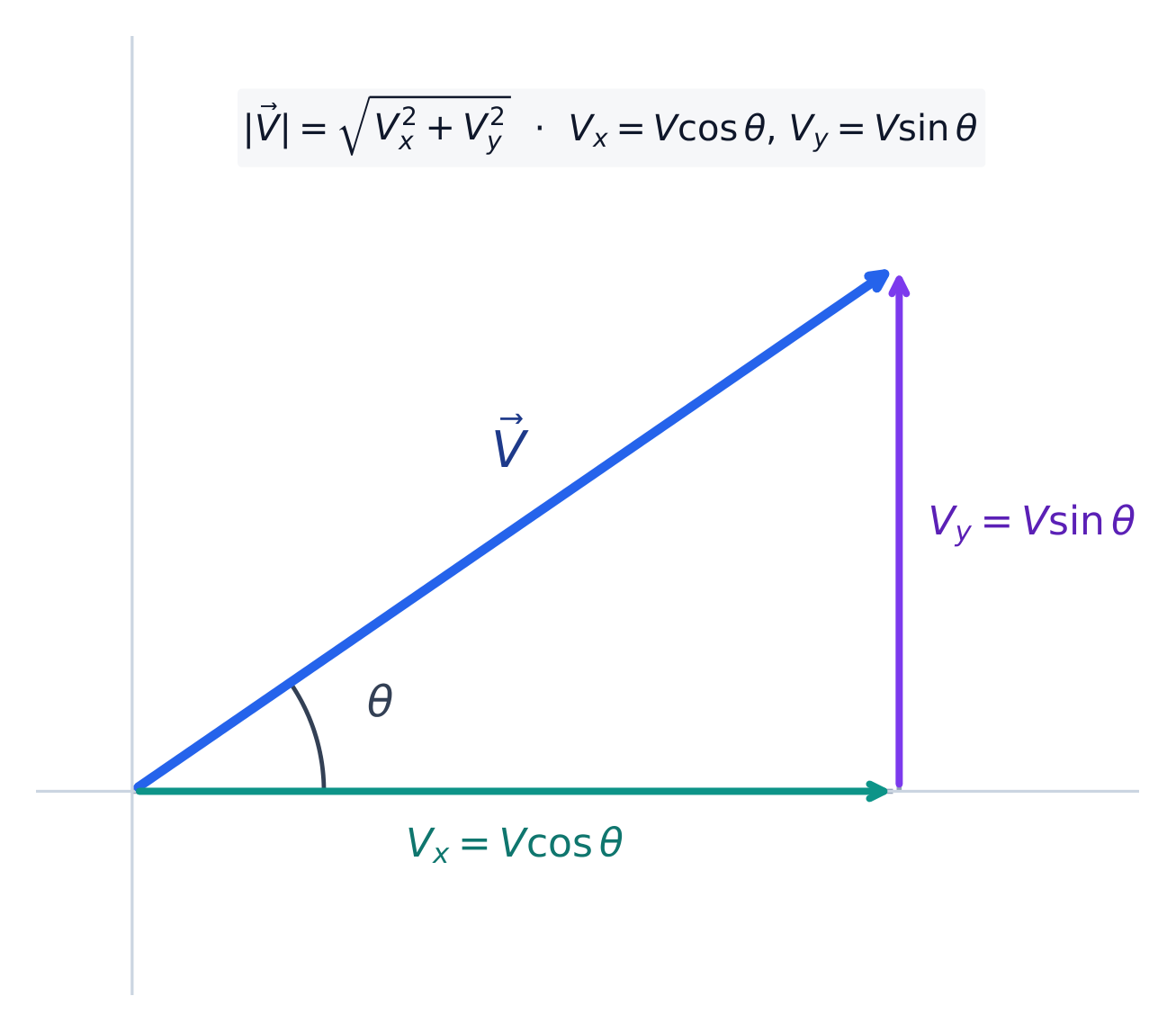
In this calculus-based course you resolve vectors into components 分量 and add them component by component; a vector's magnitude is $\sqrt{v_x^2+v_y^2+\cdots}$. Physics C also writes vectors with unit vectors 单位矢量: $\vec{v}=v_x\hat{i}+v_y\hat{j}$, where $\hat{i}$ and $\hat{j}$ are directions of length one along $x$ and $y$ – handy because calculus can then act on each component separately.
עבריתקינמטיקה מתארת תנועה. שני סוגים של גדלים:
- סקלאר הוא גדל בעל רק גודל (גודל מוחלט): מרחק, מהירות, מסה, זמן.
- לווקטור יש גודל וגם כיוון: תזחה, מהירות, תאוצה, כוח.
בקורס זה המבוסס על חשבון אינטגרלי פתחתם וקטורים לרכיבים ותוסיפו אותם רכיב-ברכיב; הגודל המוחלט של וקטור הוא $\sqrt{v_x^2+v_y^2+\cdots}$. פיזיקה C גם כותבת וקטורים עם ווקטורי יחיד: $\vec{v}=v_x\hat{i}+v_y\hat{j}$, כאשר $\hat{i}$ ו$\hat{j}$ הם כיוונים בגודל אחת לאורך $x$ ו$y$ – נוח מכיוון שמחשוב אינטגרלי יכול לפעול על כל רכיב בנפרד.
פירוק וקטור לרכיבי ה-x וה-y שלו 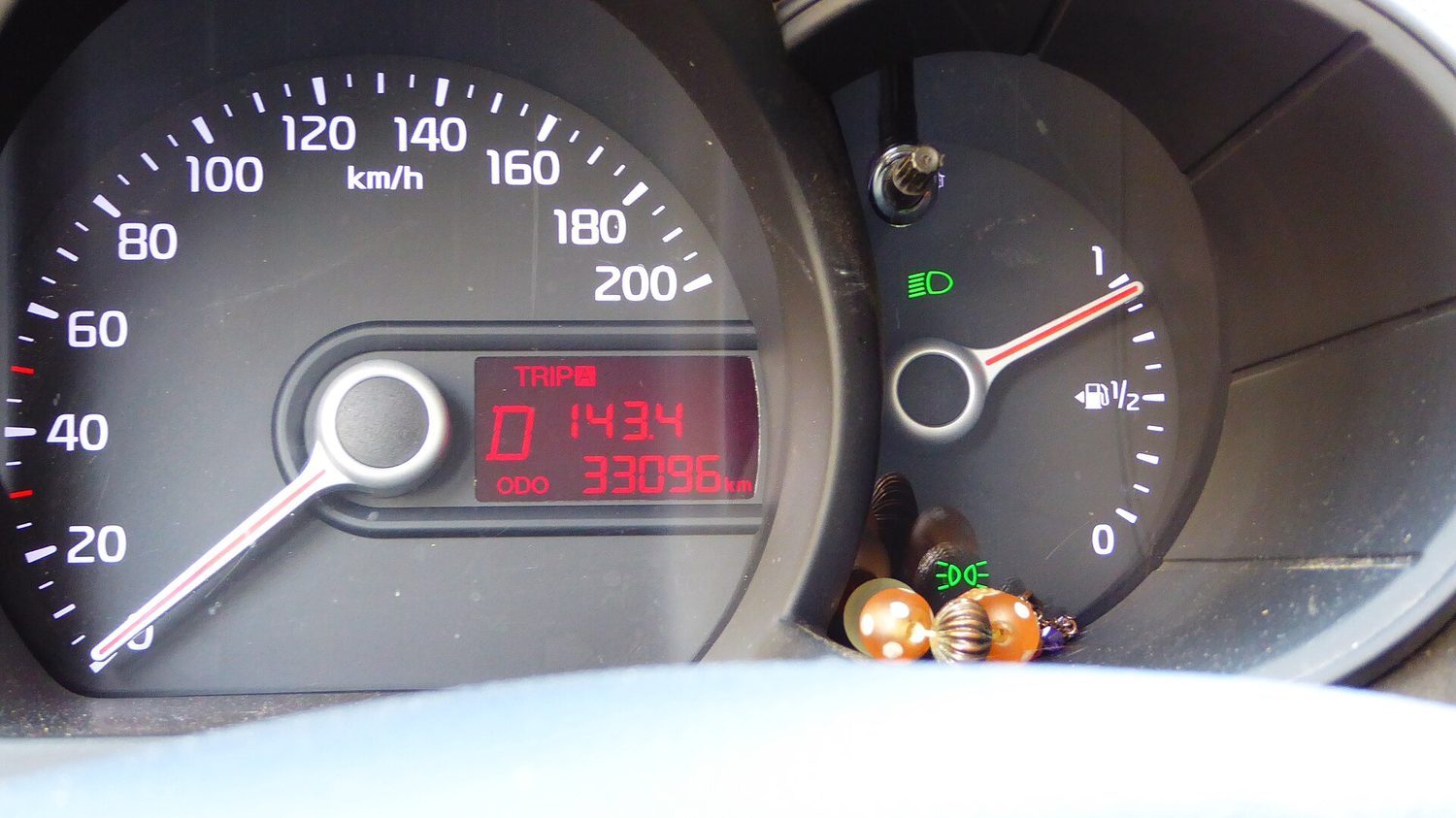
מד מהירות ברכב: המהירות היא הגודל של המהירות — סקלר של קצב תנועה Explore · חקורExplore the dot product · חקור את מכפלת נקודתית
Drag the components of $\vec{A}$ and $\vec{B}$. The dot product $\vec{A}\cdot\vec{B}=A_xB_x+A_yB_y$ reaches zero exactly when the two vectors are perpendicular — the geometry behind $\cos\theta$. · גרור את רכיבי $\vec{A}$ ו$\vec{B}$. מכפלת נקודתית $\vec{A}\cdot\vec{B}=A_xB_x+A_yB_y$ מגיעה ל-אפס בדיוק כאשר שני הווקטורים מאונכים — הגיאומטריה העומדת מאחורי $\cos\theta$.
Vocabulary · מילון מונחים Train · אימוןEnglish עברית vector/ˈvektə/ מסיר מחלות components/kəmˈpəʊnənts/ רכיבים unit vectors/ˈjuːnɪt ˈvektəz/ וקטורים יחידה derivatives/dɪˈrɪvətɪvz/ נגזרות average velocity/ˈævrɪdʒ vəˈlɒsɪti/ מהירות ממוצעת instantaneous velocity/ˌɪnstənˈteɪnɪəs vəˈlɒsɪti/ מהירות רגעית free fall/friː fɔːl/ נפילה חופשית reference frame/ˈrefrəns freɪm/ מערכת ייחוס relative motion/ˈrelətɪv ˈməʊʃn/ תנועה יחסית projectile motion/prəˈdʒektaɪl ˈməʊʃn/ תנועת פרויקטייל 1.2
Displacement, Velocity, and Acceleration · תזחה, מהירות ותאוצה
Syllabus · סיילבוס
Learning Objective Essential Knowledge 1.2.A
Describe a change in an object's position.- 1.2.A.1 When using the object model, the size, shape, and internal configuration are ignored. The object may be treated as a single point with extensive properties such as mass and charge.
- 1.2.A.2 Displacement is the change in an object's position.
- Equation: $\Delta x = x - x_0$
1.2.B
Describe the average velocity and acceleration of an object.- 1.2.B.1 Averages of velocity and acceleration are calculated considering the initial and final states of an object over an interval of time.
- 1.2.B.2 Average velocity is the displacement of an object divided by the interval of time in which that displacement occurs.
- Equation: $\vec{v}_{\text{avg}} = \dfrac{\Delta \vec{x}}{\Delta t}$
- 1.2.B.3 Average acceleration is the change in velocity divided by the interval of time in which that change in velocity occurs.
- Equation: $\vec{a}_{\text{avg}} = \dfrac{\Delta \vec{v}}{\Delta t}$
- 1.2.B.4 An object is accelerating if either the magnitude and/or direction of the object's velocity are changing.
- 1.2.B.5 Calculating average velocity or average acceleration over a very small time interval yields a value that is very close to the instantaneous velocity or instantaneous acceleration.
1.2.C
Describe the instantaneous position, velocity, and acceleration of an object as a function of time.- 1.2.C.1 As the time interval used to calculate the average value of a quantity approaches zero, the average value of that quantity approaches the value of the quantity at that instant, called the instantaneous value.
- 1.2.C.1.i Instantaneous velocity is the rate of change of the object's position, which is equal to the derivative of position with respect to time.
- Equation: $\vec{v} = \dfrac{d\vec{r}}{dt}$
- Equation: $v_x = \dfrac{dx}{dt}$
- 1.2.C.1.ii Instantaneous acceleration is the rate of change of the object's velocity, which is equal to the derivative of velocity with respect to time.
- Equation: $\vec{a} = \dfrac{d\vec{v}}{dt}$
- Equation: $a_x = \dfrac{dv_x}{dt}$
- 1.2.C.1.i Instantaneous velocity is the rate of change of the object's position, which is equal to the derivative of position with respect to time.
- 1.2.C.2 Time-dependent functions and instantaneous values of position, velocity, and acceleration can be determined using differentiation and integration.
Source: College Board AP Course and Exam Description · מקור: תיאור הקורס והמבחן של College Board AP
EnglishProjectile motion is two independent motions Because motion can change continuously, define the rates as derivatives 导数:
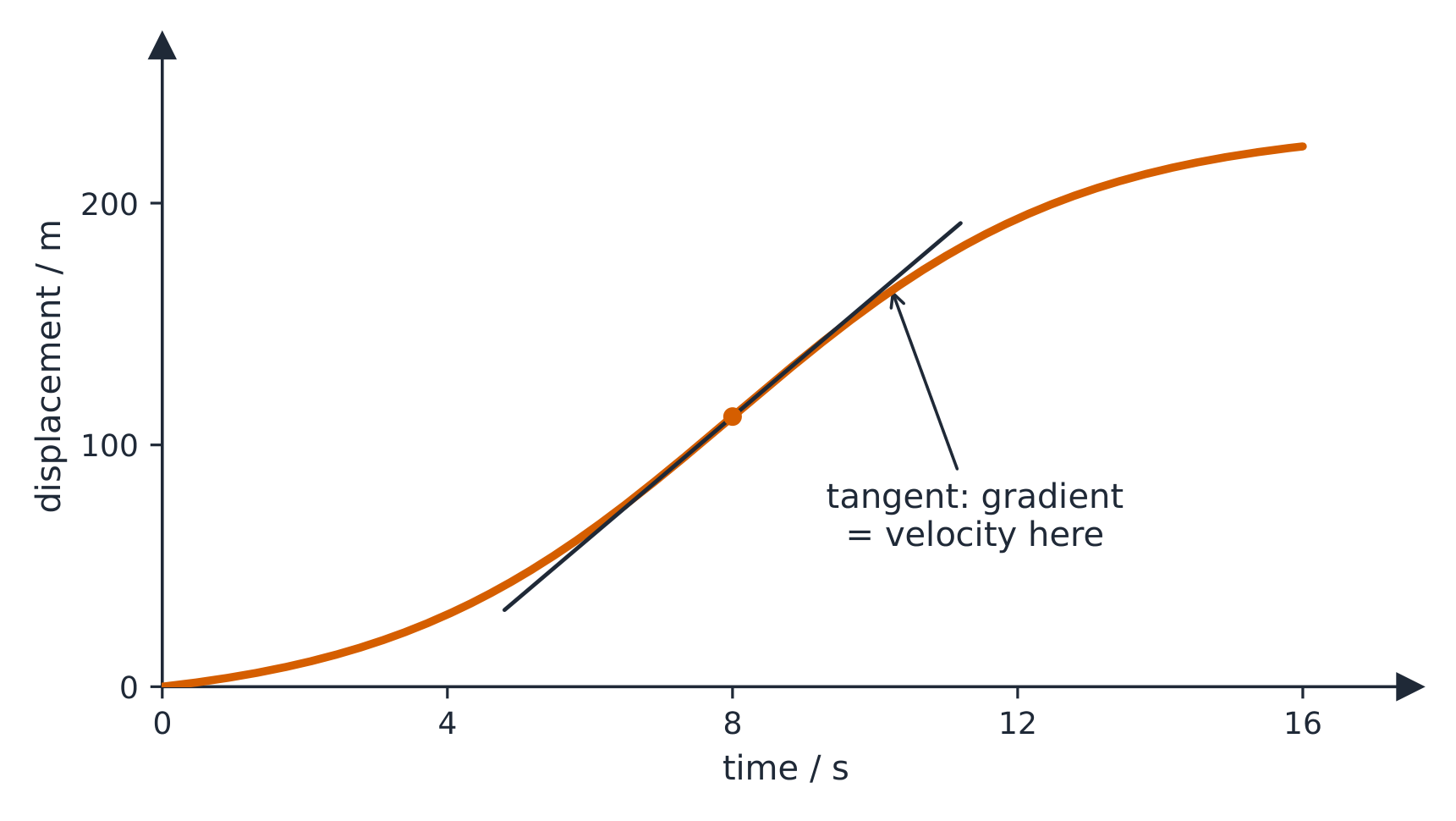
$$v=\frac{dx}{dt},\qquad a=\frac{dv}{dt}=\frac{d^2x}{dt^2}.$$Reversing this, integrate to recover velocity and position:$$v(t)=v_0+\int_0^t a\,dt,\qquad x(t)=x_0+\int_0^t v\,dt.$$Distinguish the average from the instantaneous: average velocity 平均速度 is $\Delta x/\Delta t$ over an interval, while instantaneous velocity 瞬时速度 is the derivative at one moment – the slope of the tangent line, and what a speedometer shows.For constant acceleration these give the familiar kinematic equations ($v=v_0+at$, $x=x_0+v_0t+\tfrac12at^2$, $v^2=v_0^2+2a\,\Delta x$). The most important constant-$a$ case is free fall 自由落体: near Earth's surface every object, heavy or light, accelerates downward at $g=9.8\ \text{m/s}^2$ once air resistance is negligible. When $a$ or $v$ varies with time, use the integrals directly.
Worked example. A particle moves with $x(t)=2t^3-3t^2$ (metres). Differentiate for velocity and acceleration:
$$v=\frac{dx}{dt}=6t^2-6t,\qquad a=\frac{dv}{dt}=12t-6.$$At $t=2\ \text{s}$, $v=24-12=12\ \text{m/s}$ and $a=24-6=18\ \text{m/s}^2$. This calculus link – not just the constant-$a$ formulas – is what distinguishes Physics C.Worked example. A particle starts from rest at the origin with $a(t)=6t$. Integrate: $v=\int 6t\,dt=3t^2$ and $x=\int 3t^2\,dt=t^3$. At $t=2\ \text{s}$, $v=12\ \text{m/s}$ and $x=8\ \text{m}$.
עבריתתנועת פרויקטייל היא שתי תנועות עצמאיות מכיוון שתנועה עשויה להשתנות ברצף, הגדרו קצבים כנגזרות:
$$v=\frac{dx}{dt},\qquad a=\frac{dv}{dt}=\frac{d^2x}{dt^2}.$$בהפיכה, אינטגרל כדי לשחזר את המהירות והמיקום:$$v(t)=v_0+\int_0^t a\,dt,\qquad x(t)=x_0+\int_0^t v\,dt.$$הבחינו בין ממוצע לבין רגעי: מהירות ממוצעת היא $\Delta x/\Delta t$ בתוך מרווח זמן, בעוד מהירות רגעית היא הנגזרת ברגע מסוים — השיפוע של המשיק, ומה שהמדומטר מראה.עבור תאוצה קבועה, אלו נותנות את משוואות הקינמטיקה המוכרות ($v=v_0+at$, $x=x_0+v_0t+\tfrac12at^2$, $v^2=v_0^2+2a\,\Delta x$). המקרה החשוב ביותר של תאוצה קבועה-$a$ הוא נפילה חופשית: קרוב לפני השטח של כדור הארץ כל גוף, כבד או קל, מאיץ כלפי מטה ב$g=9.8\ \text{m/s}^2$ ברגע שהתנגדות האוויר becomes זניחה. כאשר $a$ או $v$ משתנה עם הזמן, השתמשו באינטגרלים ישירות.
דוגמה מפורטת. חלקיק נע לפי $x(t)=2t^3-3t^2$ (מטרים). גזרו עבור מהירות ותאוצה:
$$v=\frac{dx}{dt}=6t^2-6t,\qquad a=\frac{dv}{dt}=12t-6.$$על $t=2\ \text{s}$, $v=24-12=12\ \text{m/s}$ ועל $a=24-6=18\ \text{m/s}^2$. הקשר החישובי הזה — ולא רק הנוסחות לתאוצה קבועה-$a$ — הוא מה שמבדיל את פיזיקה C.דוגמה מפורטת. חלקיק מתחיל מנקודת הרגיעה בראשית הצירים עם $a(t)=6t$. אינטגרלו: $v=\int 6t\,dt=3t^2$ ועל $x=\int 3t^2\,dt=t^3$. על $t=2\ \text{s}$, $v=12\ \text{m/s}$ ועל $x=8\ \text{m}$.
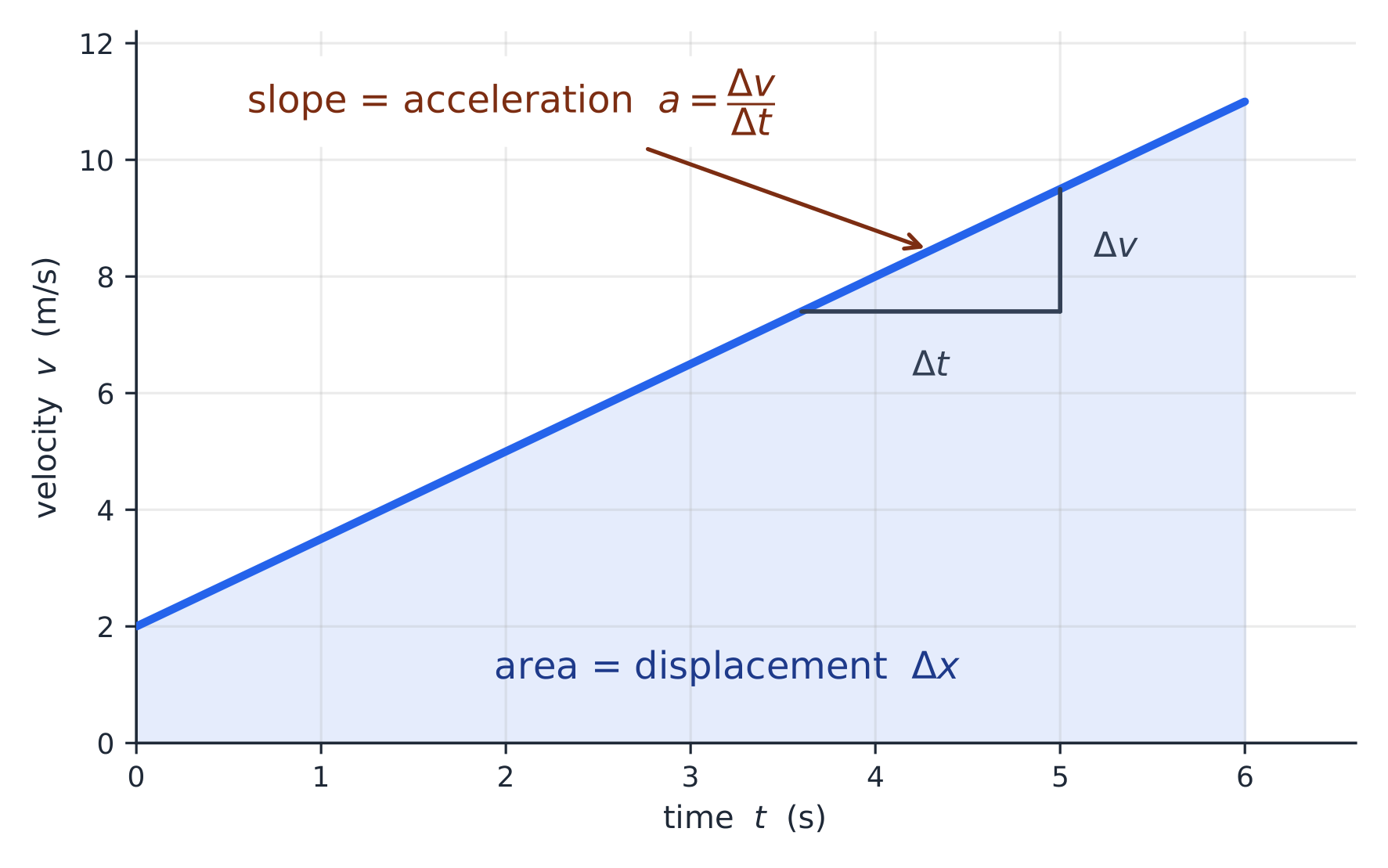
בגרף מהירות-זמן, השיפוע הוא התאוצה והשטח הוא ההזזה 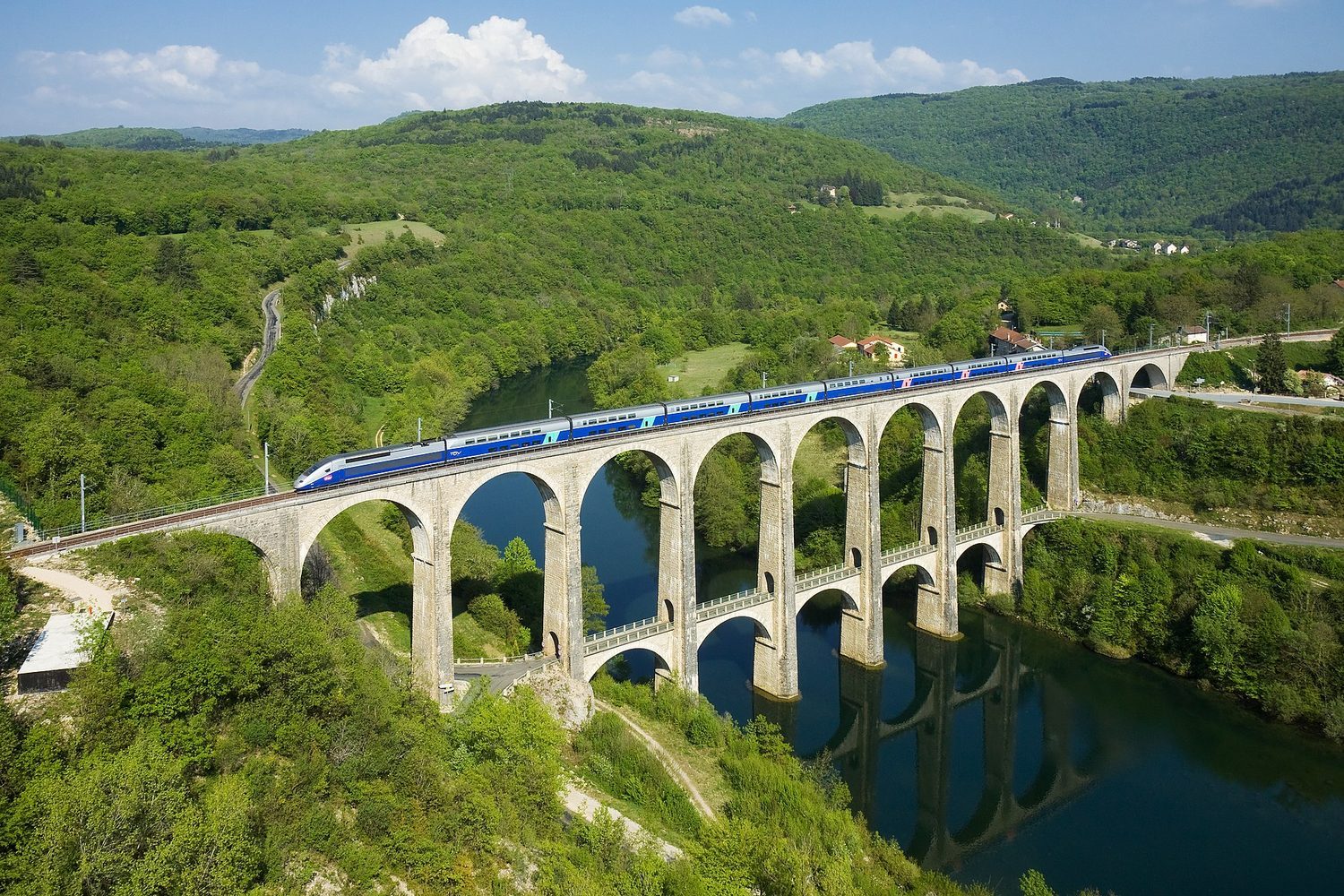
רכבת מהירה: קינמטיקה מתארת תזחה, מהירות ותאוצה לאורך זן Vocabulary · מילון מונחים Train · אימוןEnglish עברית Kinematics/ˌkɪnɪˈmætɪks/ קינמטיקה scalar/ˈskeɪlə/ סקאלר magnitude/ˈmæɡnɪtjuːd/ גודל 1.3
Representing Motion · ייצוג תנועה
Syllabus · סיילבוס
Learning Objective Essential Knowledge 1.3.A
Describe the position, velocity, and acceleration of an object using representations of that object's motion.- 1.3.A.1 Motion can be represented by motion diagrams, figures, graphs, equations, and narrative descriptions.
- 1.3.A.2 For constant acceleration, three kinematic equations can be used to describe instantaneous linear motion in one dimension:
- Equation: $v_x = v_{x0} + a_x t$
- Equation: $x = x_0 + v_{x0} t + \dfrac{1}{2} a_x t^2$
- Equation: $v_x^2 = v_{x0}^2 + 2a_x \left( x - x_0 \right)$
- Note: The equations above are written to indicate motion in the $x$-direction, but these equations can be used in any single dimension as appropriate.
- 1.3.A.3 Near the surface of Earth, the vertical acceleration caused by the force of gravity is downward, constant, and has a measured value approximately equal to
- Equation: $a_g = g \approx 10 \ \text{m/s}^2$.
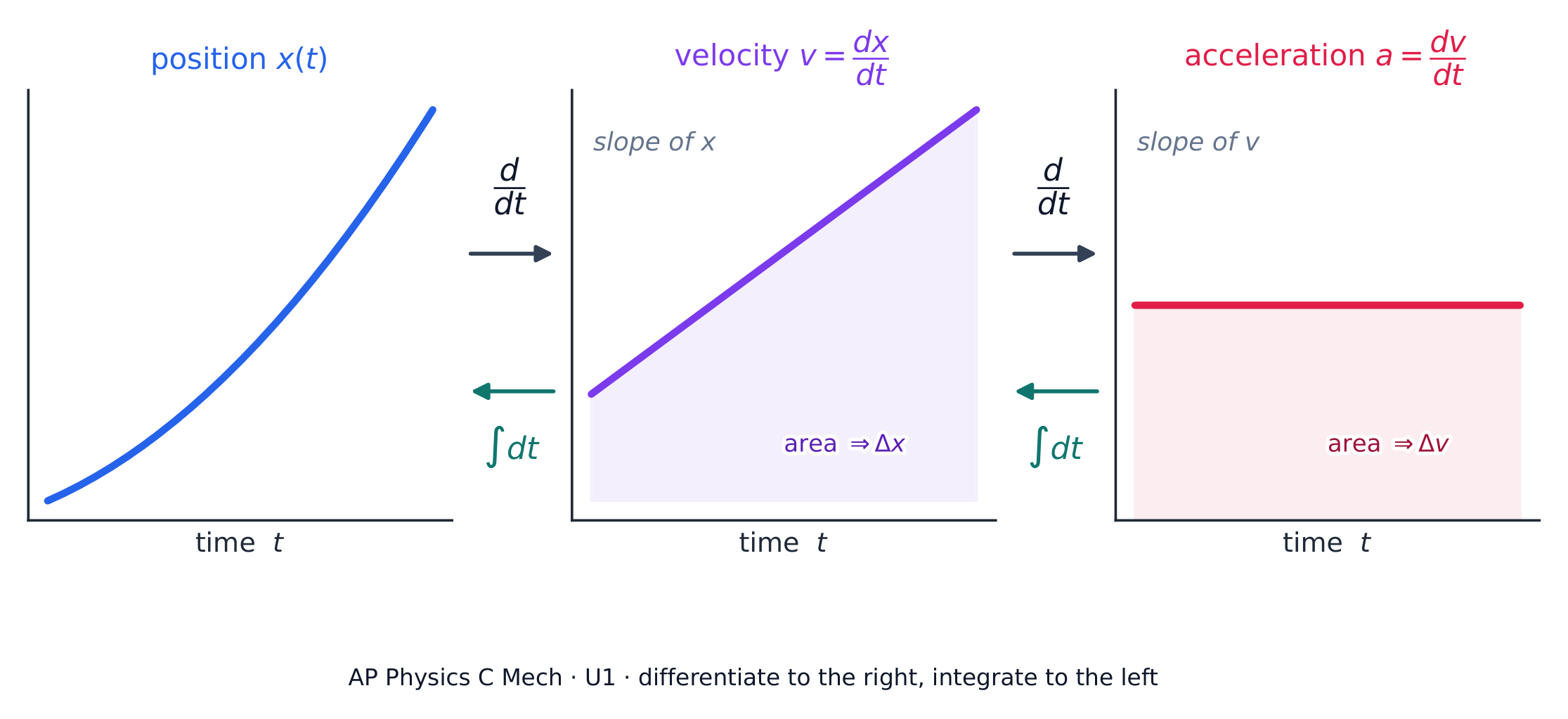
- 1.3.A.4 Graphs of position, velocity, and acceleration as functions of time can be used to find the relationships between those quantities.
- 1.3.A.4.i An object's instantaneous velocity is the rate of change of the object's position, which is equal to the slope of a line tangent to a point on a graph of the object's position as a function of time.
- Equation: $v_x = \dfrac{dx}{dt}$
- 1.3.A.4.ii An object's instantaneous acceleration is the rate of change of the object's velocity, which is equal to the slope of a line tangent to a point on a graph of the object's velocity as a function of time.
- Equation: $a_x = \dfrac{dv_x}{dt}$
- 1.3.A.4.iii The displacement of an object during a time interval is equal to the area under the curve of a graph of the object's velocity as a function of time (i.e., the area bounded by the function and the horizontal axis for the appropriate interval).
- Equation: $\Delta x = \displaystyle\int_{t_1}^{t_2} v_x(t) \ dt$
- 1.3.A.4.iv The change in velocity of an object during a time interval is equal to the area under the curve of a graph of the acceleration of the object as a function of time.
- Equation: $\Delta v_x = \displaystyle\int_{t_1}^{t_2} a_x(t) \ dt$
- 1.3.A.4.i An object's instantaneous velocity is the rate of change of the object's position, which is equal to the slope of a line tangent to a point on a graph of the object's position as a function of time.
Boundary statement: AP Physics C: Mechanics and AP Physics C: Electricity and Magnetism expects that for all situations in which a numerical quantity is required for g, the value $g \approx 10 \ \text{m/s}^2$ will be used. However, students will not be penalized for correctly using the more precise commonly accepted values of $g = 9.81 \ \text{m/s}^2$ or $g = 9.8 \ \text{m/s}^2$.
Source: College Board AP Course and Exam Description · מקור: תיאור הקורס והמבחן של College Board AP
EnglishMove fluently between description, graph, table, and equation:
- On a position–time graph, the slope ($dx/dt$) is velocity.
- On a velocity–time graph, the slope is acceleration and the area ($\int v\,dt$) is displacement.
- On an acceleration–time graph, the area ($\int a\,dt$) is the change in velocity.
Slopes are derivatives; areas are integrals – the two are inverse operations here.
עבריתמעבר זורם בין תיאור, גרף, טבלה ומשוואה:
גרף מיקום-זמן: השיפוע בכל רגע הוא המהירות - בגרף מיקום–זמן, השיפוע ($dx/dt$) הוא מהירות.
- בגרף מהירות–זמן, השיפוע הוא תאוצה והשטח ($\int v\,dt$) הוא הגבהל.
- בגרף תאוצה–זמן, השטח ($\int a\,dt$) הוא השינוי במהירות.
שיפועים הם נגזרות; שטחים הם אינטגרלים – שתי הפעולות הן הפוכות זו לזו כאן.
מיקום, מהירות ותאוצה קשורים באמצעות נגזרת Explore · חקורExplore the velocity–time graph · חקרו את הגרף מהירות-זמן
Change the start velocity and acceleration. The slope of a $v$–$t$ line is the acceleration $a=\tfrac{dv}{dt}$, and the area underneath is the displacement $\Delta x=\int v\,dt$ — slope and area are the graphical faces of the derivative and the integral. · שנה את מהירות ההתחלה והתאוצה. השיפוע של קו $v$–$t$ הוא התאוצה $a=\tfrac{dv}{dt}$, וה-שטח מתחתיו הוא ההזזה $\Delta x=\int v\,dt$ — שיפוע ושטח הם הפנים הגרפיות של הנגזרת והאינטגרל.
1.4
Reference Frames and Relative Motion · מערכות ייחוס ותנועה יחסית
Syllabus · סיילבוס
EnglishLearning Objective 1.4.A: Describe the reference frame of a given observer.
- 1.4.A.1 The choice of reference frame will determine the direction and magnitude of quantities measured by an observer in that reference frame.
Learning Objective 1.4.B: Describe the motion of objects as measured by observers in different inertial reference frames.
- 1.4.B.1 Measurements from a given reference frame may be converted to measurements from another reference frame.
- 1.4.B.2 The observed velocity of an object results from the combination of the object's velocity and the velocity of the observer's reference frame.
- 1.4.B.2.i Combining the motion of an object and the motion of an observer in a given reference frame involves the addition or subtraction of vectors.
- 1.4.B.2.ii The acceleration of any object is the same as measured from all inertial reference frames.
Boundary statement: Unless otherwise stated, the frame of reference of any problem may be assumed to be inertial.
עבריתמטרות למידה 1.4.A: לתאר את מערכת הייחוס של צופה נתון.
- 1.4.A.1 בחירת מערכת הייחוס תקבע את הכיוון והגודל של כמויות שנמדדות על ידי צופה במערכת זו.
מטרות למידה 1.4.B: לתאר את תנועת אובייקטים כפי שנמדדו על ידי צופים במערכות ייחוס אינרציאליות שונות.
- 1.4.B.1 מדידות ממערכת ייחוס נתונה יכולות להיות מומשות למדידות ממערכת ייחוס אחרת.
- 1.4.B.2 המהירות הנצפתה של אובייקט נובעת משילוב מהירות האובייקט ומהירות מערכת הייחוס של הצופה.
- 1.4.B.2.i שילוב תנועת אובייקט ותנועת צופה במערכת ייחוס נתונה מחייב חיבור או חיסור של וקטורים.
- 1.4.B.2.ii התאוצה של כל אובייקט זהה כפי שנמדדת מכל מערכות הייחוס האינרציאליות.
הצהרת גבול: אלא אם כן צוין אחרת, ניתן להניח שמערכת הייחוס של כל בעיה היא אינרציאלית.
Source: College Board AP Course and Exam Description · מקור: תיאור הקורס והמבחן של College Board AP
EnglishAll motion is relative to a reference frame 参考系. Combine velocities by vector addition: $\vec{v}_{A/C}=\vec{v}_{A/B}+\vec{v}_{B/C}$. This handles boats crossing rivers and passengers on moving vehicles – relative motion 相对运动 problems. Read the subscripts as a chain: "A relative to B" plus "B relative to C" gives "A relative to C".
Worked example. A boat that moves at $4.0\ \text{m/s}$ in still water heads straight across a river flowing at $3.0\ \text{m/s}$. Relative to the ground the boat moves at $\sqrt{4.0^2+3.0^2}=5.0\ \text{m/s}$, angled downstream. If the river is $80\ \text{m}$ wide, the crossing still takes $t=\dfrac{80}{4.0}=20\ \text{s}$ – only the across-stream component crosses the river; the current just carries the boat $60\ \text{m}$ downstream.
עבריתכל התנועה היא יחסית למערכת ייחוס. שילוב מהירויות מתבצע באמצעות חיבור וקטורי: $\vec{v}_{A/C}=\vec{v}_{A/B}+\vec{v}_{B/C}$. הדבר חל על ספינות החוצות נהרות ומסיעים ברכבים זזים – בעיות שלתנועה יחסית. קראו את המקדמים כשרשרת: "A ביחס ל-B" פלו "B ביחס ל-C" נותן "A ביחס ל-C".
דוגמה מוצגת. סירה הנעה במהירות $4.0\ \text{m/s}$ במים שקטים פונה ישר כלפי חוצה נהר זורם במהירות $3.0\ \text{m/s}$. ביחס לקרקע הסירה נעה במהירות $\sqrt{4.0^2+3.0^2}=5.0\ \text{m/s}$, בזווית כלפי מטה הזרם. אם רוחב הנהר הוא $80\ \text{m}$, עדיין לוקח לה לצלוח אותו $t=\dfrac{80}{4.0}=20\ \text{s}$ – רק המרכיב החוצני של מהירותה מצטלח את הנהר; הזרם פשוט נשא את הסירה $60\ \text{m}$ כלפי מטה הזרם.
1.5
Motion in Two or Three Dimensions · תנועה בשתי או שלושה ממדים
Syllabus · סיילבוס
EnglishLearning Objective 1.5.A: Describe the motion of an object moving in two or three dimensions.
- 1.5.A.1 Motion in two or three dimensions can be analyzed using one-dimensional kinematic relationships if the motion is separated into components.
- 1.5.A.2 Velocity and acceleration may be different in each dimension and may be nonuniform.
- 1.5.A.3 Motion in one dimension may be changed without causing a change in a perpendicular dimension.
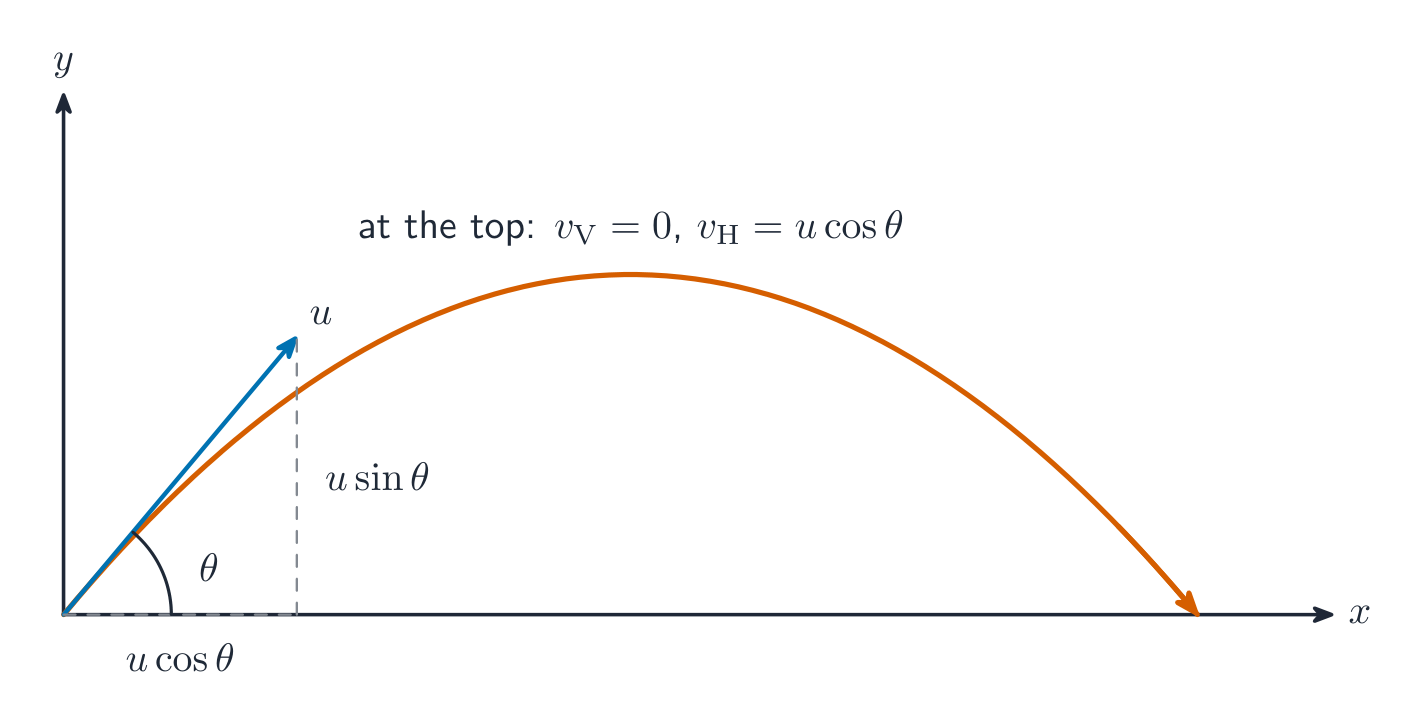
- 1.5.A.4 Projectile motion is a special case of two-dimensional motion that has zero acceleration in one dimension and constant, nonzero acceleration in the second dimension.
Boundary statement: AP Physics C: Mechanics only expects students to quantitatively analyze the motion of an object in two dimensions. AP Physics C: Electricity and Magnetism expects students to also qualitatively describe the motion of a particle in three dimensions.
עבריתמטרת למידה 1.5.A: לתאר את תנועת גוף הנע בשני ממדים או שלושה ממדים.
- 1.5.A.1 תנועה בשני ממדים או שלושה ממדים ניתנת לניתוח באמצעות קשרים קינמטיים חד-ממדיים, אם התנועה מפוצלת לרכיבים.
- 1.5.A.2 מהירות ואיטוב עשויים להיות שונים בכל ממד ועשויים להיות לא אחידים.
- 1.5.A.3 תנועה בממד אחד עשויה להשתנות ללא גרימת שינוי בממד מאונך.
- 1.5.A.4 תנועת פרוקטייל היא מקרה פרטי של תנועה דו-ממדית המאופיינת באיטוב אפס בממד אחד ואיטוב קבוע ולא-אפסי בממד השני.
הצהרת גבול: AP Physics C: Mechanics מצפה רק מן התלמידים לבצע ניתוח כמותי של תנועת גוף בשני ממדים. AP Physics C: Electricity and Magnetism מצפה מן התלמידים גם לתאר איכותית תנועת חלקיק בשלושה ממדים.
Source: College Board AP Course and Exam Description · מקור: תיאור הקורס והמבחן של College Board AP
EnglishIn two or three dimensions, position is a vector $\vec{r}(t)=\langle x(t),y(t),z(t)\rangle$, and velocity and acceleration are its successive derivatives – each component handled independently.
Worked example. $\vec{r}(t)=\big(2t^2\big)\hat{i}+\big(4t-t^3\big)\hat{j}$ (metres). Differentiating each component: $\vec{v}=4t\,\hat{i}+(4-3t^2)\,\hat{j}$ and $\vec{a}=4\,\hat{i}-6t\,\hat{j}$. At $t=1\ \text{s}$: $\vec{v}=4\hat{i}+1\hat{j}$, so the speed is $\sqrt{17}\approx4.1\ \text{m/s}$ – no new physics, just one derivative per component.
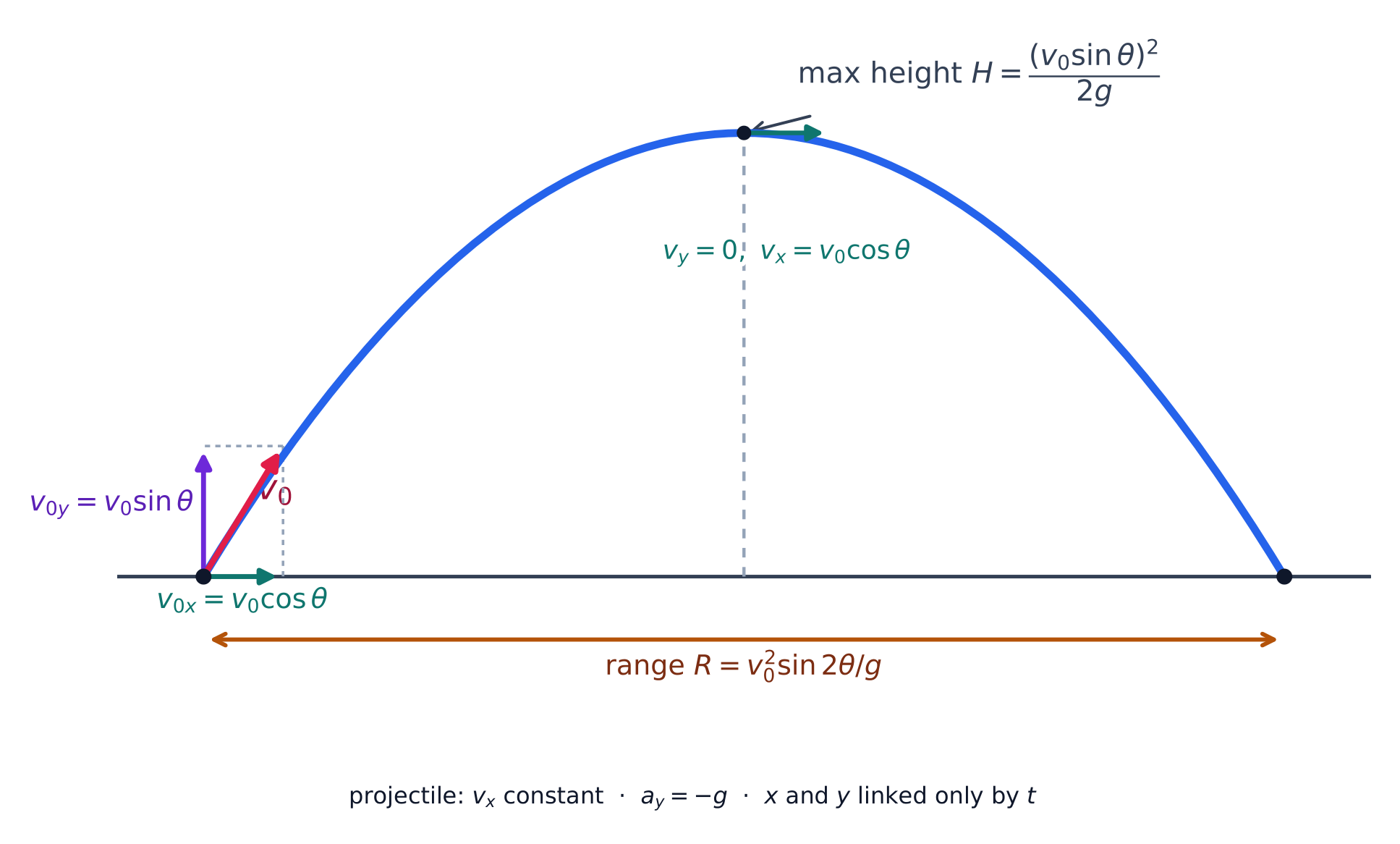
For projectile motion 抛体运动, horizontal and vertical motions are independent, linked only by time $t$: horizontally $a_x=0$ (constant velocity), vertically $a_y=-g$. The path is a parabola. This component method extends to any two-dimensional motion where the accelerations along each axis are known.
Worked example. A ball is launched at $20\ \text{m/s}$, $30^{\circ}$ above the horizontal ($g=9.8\ \text{m/s}^2$). The components are $v_{0x}=20\cos30^{\circ}=17.3\ \text{m/s}$ and $v_{0y}=20\sin30^{\circ}=10\ \text{m/s}$. The vertical motion sets the time: total flight $=\dfrac{2v_{0y}}{g}=\dfrac{20}{9.8}=2.0\ \text{s}$, maximum height $=\dfrac{v_{0y}^2}{2g}=5.1\ \text{m}$, and range $=v_{0x}\times2.0=35\ \text{m}$.
עבריתבשני או שלושה ממדים, המיקום הוא וקטור $\vec{r}(t)=\langle x(t),y(t),z(t)\rangle$, והמהירות והתאוצה הן הנגזרות העוקבות שלו – כל רכיב מטופל בנפרד.
דוגמה מופרזת. $\vec{r}(t)=\big(2t^2\big)\hat{i}+\big(4t-t^3\big)\hat{j}$ (מטר). נגזרת כל רכיב: $\vec{v}=4t\,\hat{i}+(4-3t^2)\,\hat{j}$ ו$\vec{a}=4\,\hat{i}-6t\,\hat{j}$. ב$t=1\ \text{s}$: $\vec{v}=4\hat{i}+1\hat{j}$, ולכן המהירות היא $\sqrt{17}\approx4.1\ \text{m/s}$ – אין כאן פיזיקה חדשה, רק נגזרת אחת לכל רכיב.
פרויקטיל שנורה בזווית: התנועה האופקית והתנועה האנכית הן בלתי תלויות עבורתנועת פרaboile, התנועה האופקית והתנועה האנכיות הן עצמאיות, מקושרות רק על ידי הזמן $t$: אופקית $a_x=0$ (מהירות קבועה), אנכית $a_y=-g$. המסלול הוא פרבולה. שיטה זו מתרחבת לכל תנועה דו-ממדית שבה ידועות התאוצות לאורך ציר כל אחד.
דוגמה מופרזת. כדור משוגע במהירות $20\ \text{m/s}$, בزاوية $30^{\circ}$ מעל האופק ($g=9.8\ \text{m/s}^2$). הרכיבים הם $v_{0x}=20\cos30^{\circ}=17.3\ \text{m/s}$ ו$v_{0y}=20\sin30^{\circ}=10\ \text{m/s}$. התנועה האנכית קובעת את הזמן: זמן טיסה כולל $=\dfrac{2v_{0y}}{g}=\dfrac{20}{9.8}=2.0\ \text{s}$, גובה מקסימלי $=\dfrac{v_{0y}^2}{2g}=5.1\ \text{m}$, וטווח $=v_{0x}\times2.0=35\ \text{m}$.
פרaboile שנורה בזווית: רכיבי מהירות, גובה מקסימלי וטווח Explore · חקורExplore projectile motion · חקרו תנועת פריל
Fire the projectile, then vary the angle and speed. The horizontal motion is steady while gravity acts only downward — together they trace a parabola. Find the angle that gives the greatest range (it peaks near $45^\circ$), and try the Moon. · שחרר את הפרויקטייל, ואז משנה את הזווית והמהירות. התנועה האופקית היא אחידה בעוד שכובד פועל רק כלפי מטה — יחד הם משרטטים פרבולה. מצא את הזווית הנותנת את הטווח הגדול ביותר (הוא מקבל שיא בקרבת $45^\circ$), ונסה את הירח.
1.5
Exam tips · טיפים לבחינות
English- Resolve every vector into components before adding — never add magnitudes at an angle directly.
- On Physics C you are expected to use calculus: velocity is $\vec v=\tfrac{d\vec r}{dt}$ and acceleration $\vec a=\tfrac{d\vec v}{dt}$; reverse with integration.
- Carry and check units and treat direction with signs (choose a positive axis and stick to it).
- Use the dot product for work-type quantities and the cross product for torque and angular momentum.
- Sketch the vectors — a diagram catches sign and direction errors the algebra hides.
עברית- פירקו כל וקטור לרכיבים לפני החיבור – לעולם אל תחברו גדלים בזווית ישירות.
- בקורס Physics C מצופים שתשתמשו בק্যালקולוס: מהירות היא $\vec v=\tfrac{d\vec r}{dt}$ ותאוצה $\vec a=\tfrac{d\vec v}{dt}$; הפוך באמצעות אינטגרציה.
- שמרו עליחידות ובדקו אותן, וטפל בכיוון באמצעות סימנים (בחרו ציר חיובי והתמידו בו).
- השתמשו ב מכפלה נקודתית לכמויות מסוג עבודה ובמכפלה צולבת למומנט ולתנע זוויתי.
- שרטט את הווקטורים — דיאגרמה חושפת טעויות סימן וכיוון שהאלגברה מחביאה.
-
2
Force and Translational Dynamics · כוח ודינמיקה תרגולית
Watch lesson · צפה בשיעור2.1
Systems and Center of Mass
Syllabus · סיילבוס
EnglishLearning Objective 2.1.A: Describe the properties and interactions of a system.
- 2.1.A.1 System properties are determined by the interactions between objects within the system.
- 2.1.A.2 If the properties or interactions of the constituent objects within a system are not important in modeling the behavior of the macroscopic system, the system can itself be treated as a single object.
- 2.1.A.3 Systems may allow interactions between constituent parts of the system and the environment, which may result in the transfer of energy or mass.
- 2.1.A.4 Individual objects within a chosen system may behave differently from each other as well as from the system as a whole.
- 2.1.A.5 The internal structure of a system affects the analysis of that system.
- 2.1.A.6 As variables external to a system are changed, the system's substructure may change.
Learning Objective 2.1.B: Describe the location of a system's center of mass with respect to the system's constituent parts.
- 2.1.B.1 For objects or systems with symmetrical mass distributions, the center of mass is located on lines of symmetry.
- 2.1.B.2 The location of a system's center of mass along a given axis can be calculated using the equation
- Equation: $\vec{x}_{\text{cm}} = \dfrac{\sum m_i \vec{x}_i}{\sum m_i}$
- 2.1.B.3 For a nonuniform solid that can be considered as a collection of differential masses, $dm$, the solid's center of mass can be calculated using the equation
- Equation: $\vec{r}_{\text{cm}} = \dfrac{\int \vec{r}\, dm}{\int dm}$
- 2.1.B.3.i The linear mass density of a rod or other linear rigid body is the derivative of the rod's mass with respect to the position of the differential mass element on the rigid body.
- Equation: $\lambda = \dfrac{d}{d\ell} m(\ell)$
- 2.1.B.3.ii If a function of mass density is given for a solid, the total mass can be determined by integrating the mass density over the length (one dimension), area (two dimensions), or volume (three dimensions) of the solid. For example:
- Equation: $M_{\text{total}} = \int \rho(r)\, dV$
- 2.1.B.4 A system can be modeled as a singular object that is located at the system's center of mass.
עבריתמטרת למידה 2.1.A: לתאר את המאפיינים והאינטראקציות של מערכת.
- 2.1.A.1 מאפייני מערכת נקבעים על ידי האינטראקציות בין חלקי המערכת.
- 2.1.A.2 אם המאפיינים או האינטראקציות של החלקים המרכיבים את המערכת אינם חשובים בדגם התנהגות המערכת המקרוסקופית, ניתן לטפל במערכת כבדיד אחד.
- 2.1.A.3 מערכות עשויות לאפשר אינטראקציות בין חלקיה לבין הסביבה, שיכולות להוביל להעברת אנרגיה או מסה.
- 2.1.A.4 בדידים יחידים בתוך מערכת שנבחרה עשויים להתנהג שונה זה מזה וכן שונה מהמערכת כולה.
- 2.1.A.5 המבנה הפנימי של מערכת משפיע על ניתוחה.
- 2.1.A.6 כאשר משתנים חיצוניים למערכת משתנים, תת-מבנה המערכת עשוי להשתנות.
מטרת למידה 2.1.B: לתאר את מיקום מרכז המסה של מערכת ביחס לחלקיה המרכיבים אותה.
- 2.1.B.1 לגופים או למערכות בעלות חלוקת מסה סימטרית, מרכז המסה ממוקם על קווי הסימטריה.
- 2.1.B.2 מיקום מרכז המסה של מערכת לאורך ציר נתון ניתן לחשב באמצעות המשוואה ⟦⟧
- משוואה: $\vec{x}_{\text{cm}} = \dfrac{\sum m_i \vec{x}_i}{\sum m_i}$
- 2.1.B.3 עבור גוף מוצק לא-אחיד שניתן להיחשב כמערך של מסות דיפרנציאליות, $dm$, ניתן לחשב את מרכז המסה של הגוף באמצעות המשוואה
- משוואה: $\vec{r}_{\text{cm}} = \dfrac{\int \vec{r}\, dm}{\int dm}$
- 2.1.B.3.i הצפיפות הקווית של מוט או גוף קשיח ליניארי אחר היא הנגזרת של מסת המוט ביחס למיקום אלמנט המסה הדיפרנציאלי על הגוף הקשיח.
- משוואה: $\lambda = \dfrac{d}{d\ell} m(\ell)$
- 2.1.B.3.ii אם נתונה פונקציה של צפיפות מסה לגוף מוצק, ניתן לקבוע את המסה הכוללת על ידי אינטגרציה של צפיפות המסה לאורך (מימד אחד), שטח (שני מימדים) או נפח (שלושה מימדים) של הגוף. לדוגמה:
- משוואה: $M_{\text{total}} = \int \rho(r)\, dV$
- 2.1.B.4 מערכת יכולה להיות מודלית כגוף יחיד השוכן במרכז המסה שלה.
Source: College Board AP Course and Exam Description · מקור: תיאור הקורס והמבחן של College Board AP
A system 系统 is the object or objects you analyze, treated as a point at its center of mass 质心. For a set of masses, $x_{\text{cm}}=\dfrac{\sum m_i x_i}{\sum m_i}$; for a continuous body, $x_{\text{cm}}=\dfrac{1}{M}\int x\,dm$. Only external forces move the center of mass.
Vocabulary · מילון מונחים Train · אימוןEnglish עברית system/ˈsɪstəm/ מערכת center of mass/ˈsentə ɒv mæs/ מרכז המסה 2.2
Forces and Free-Body Diagrams
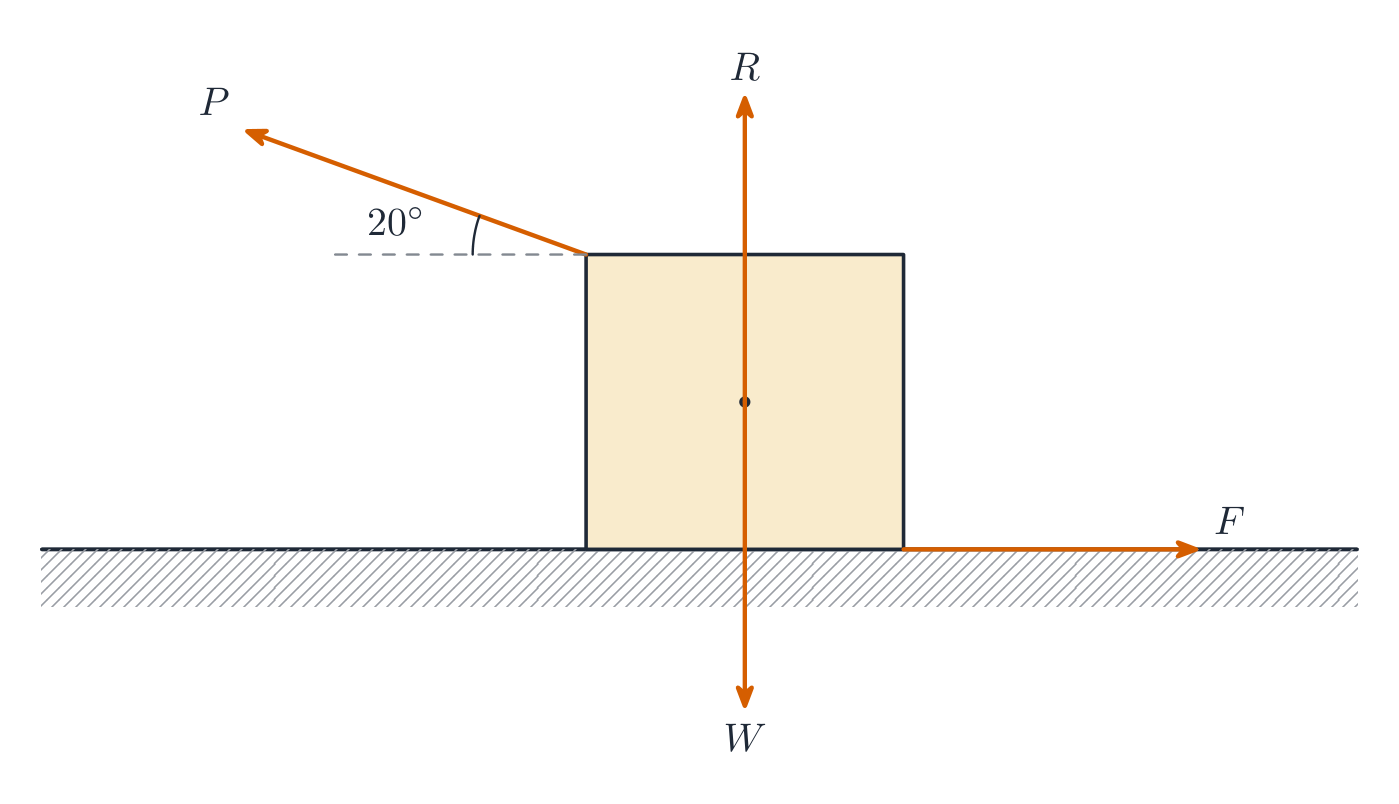
Syllabus · סיילבוס
EnglishLearning Objective 2.2.A: Describe a force as an interaction between two objects or systems
- 2.2.A.1 Forces are vector quantities that describe the interactions between objects or systems.
- 2.2.A.1.i A force exerted on an object or system is always due to the interaction of that object or system with another object or system.
- 2.2.A.1.ii An object or system cannot exert a net force on itself.
- 2.2.A.2 Contact forces describe the interaction of an object or system touching another object or system and are macroscopic effects of interatomic electric forces.
Learning Objective 2.2.B: Describe the forces exerted on an object or system using a free-body diagram.
- 2.2.B.1 Free-body diagrams are useful tools for visualizing forces being exerted on a single object or system and for determining the equations that represent a physical situation.
- 2.2.B.2 The free-body diagram of an object or system shows each of the forces exerted on the object or system by the environment.
- 2.2.B.3 Forces exerted on an object or system are represented as vectors originating from the representation of the center of mass, such as a dot. A system is treated as though all of its mass is located at the center of mass.
- 2.2.B.4 A coordinate system with one axis parallel to the direction of acceleration of the object or system simplifies the translation from free-body diagram to algebraic representation. For example, in a free-body diagram of an object on an inclined plane, it is useful to set one axis parallel to the surface of the incline.
Boundary statement: AP Physics C: Mechanics and AP Physics C: Electricity and Magnetism only expect students to depict the forces exerted on objects, not the force components on free-body diagrams. On the AP Physics exams, individual forces represented on a free-body diagram must be drawn as individual straight arrows, originating on the dot and pointing in the direction of the force. Individual forces that are in the same direction must be drawn side by side, not overlapping.
עבריתמטרת לימוד 2.2.A: לתאר כוח כאינטראקציה בין שני אובייקטים או מערכות
- 2.2.A.1 כוחות הם גדלים וקטוריים המתארים את האינטראקציות בין בדידים או מערכות.
- 2.2.A.1.i כוח המופעל על אובייקט או מערכת נובע תמיד מאינטראקציה של אובייקט או מערכת זו עם אובייקט או מערכת אחרת.
- 2.2.A.1.ii בדיד או מערכת אינו יכול להפעיל כוח נקי על עצמו.
- 2.2.A.2 כוחות מגע מתארים את האינטראקציה של בדיד או מערכת הנוגעת בבדיד או מערכת אחרת, והן תוצאות מקרוסקופיות של כוחות חשמליים בין-אטומיים.
מטרת למידה 2.2.B: לתאר את הכוחות המופעלים על בדיד או מערכת באמצעות תרשים גוף חופשי.
- 2.2.B.1 דיאגרמות גוף חופשי הן כלי עזר לייצוג ויזואלי של כוחות הפועלים על גוף או מערכת בודדים, ולקביעת המשוואות המתארות מצב פיזיקלי.
- 2.2.B.2 דיאגרמת הגוף החופשי של אובייקט או מערכת מציגה את כל הכוחות המופעלים על האובייקט או המערכת על ידי הסביבה.
- 2.2.B.3 כוחות הפועלים על גוף או מערכת מתוארים כווקטורים היוצאים מהייצוג של מרכז הכובד, כמו נקודה. מערכת מטופלת כאילו כל מסתה ממוקמת במרכז הכובד.
- 2.2.B.4 שימוש במערכת צירים שבה אחד הצירים מקביל לכיוון ההאצה של הגוף או המערכת מקל על המרת דיאגרמת גוף חופשי לייצוג אלגברי. לדוגמה, בדיאגרמת גוף חופשי של גוף על משטח משופע, כדאי לקבוע ציר אחד מקביל לפני המשופע.
הצהרת גבול: AP Physics C: Mechanics ו-AP Physics C: Electricity and Magnetism מצפים מהתלמידים רק להציג את הכוחות המופעלים על אובייקטים, ולא את רכיבי הכוח בדיאגרמות גוף חופשי. במבחני AP Physics, כוחות יחידים המופיעים בדיאגרמת גוף חופשי צריכים להיות מצורעים כחצים ישרים נפרדים, המתחילים בנקודה ומצביעים לכיוון הכוח. כוחות יחידים באותו כיוון צריכים להיות מצורעים לצד זה לזה, ולא חופפים זה על זה.
Source: College Board AP Course and Exam Description · מקור: תיאור הקורס והמבחן של College Board AP
A force 力 is a push or pull (a vector, in newtons). A free-body diagram 受力图 draws one object with an arrow for every force on it – weight, normal, tension, friction, applied, drag. Draw it first; it sets up every dynamics equation.
A free-body diagram shows every force acting on one object Explore · חקורBalance the forces on a free-body diagram · איזון הכוחות במדיה של גוף חופשי
A free-body diagram shows every force on one object as an arrow. The object accelerates only if the forces don't cancel — the net force sets $a=F/m$. · מדיה של גוף חופשי מציגה כל כוח הפועל על גוף אחד בחץ. הגוף מאיץ רק אם הכוחות אינם מבטלים זה את זה — ה-כוח הנקי קובע את ה$a=F/m$.
Vocabulary · מילון מונחים Train · אימוןEnglish עברית force/fɔːs/ כוח free-body diagram/friː ˈbɒdi ˈdaɪəɡræm/ תרשים כוחות חופשי 2.3
Newton's Third Law
Syllabus · סיילבוס
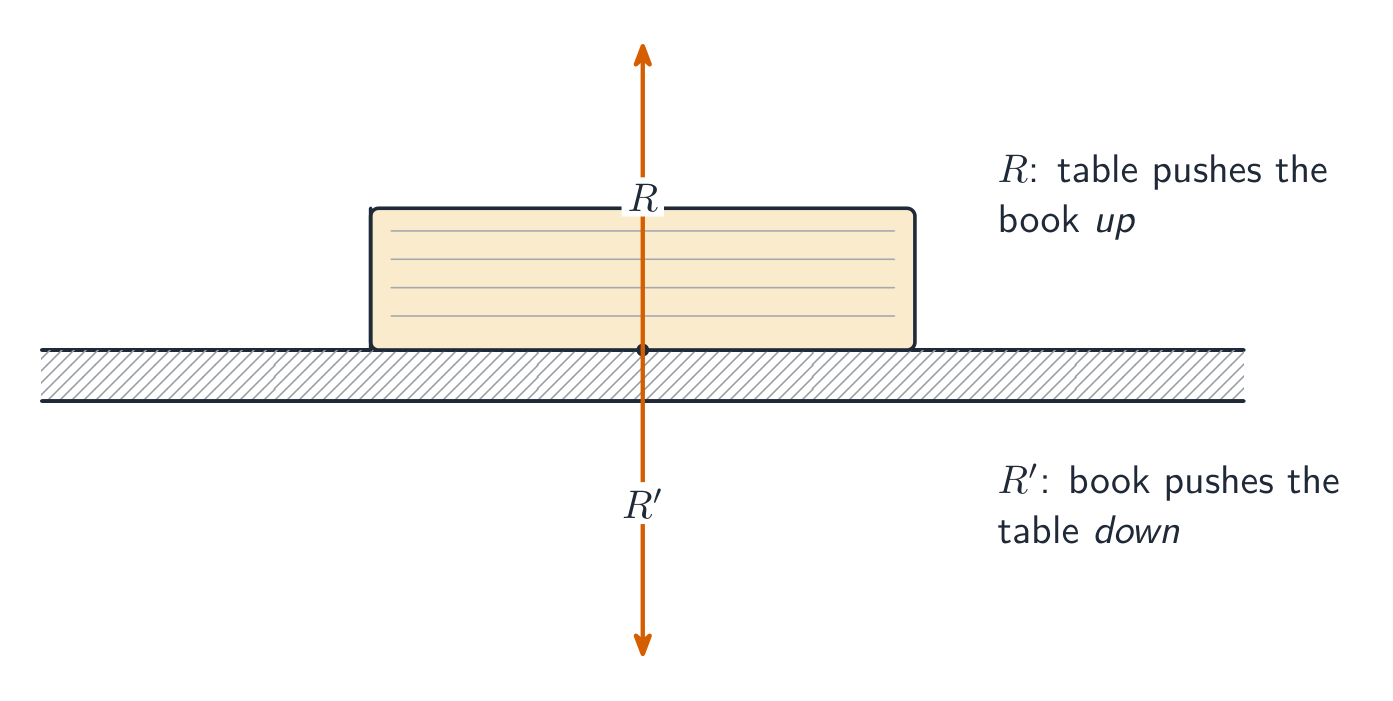
EnglishLearning Objective 2.3.A: Describe the interaction of two objects or systems using Newton's third law and a representation of paired forces exerted on each object or system.
- 2.3.A.1 Newton's third law describes the interaction of two objects or systems in terms of the paired forces that each exerts on the other.
- Equation: $\vec{F}_{\text{A on B}} = -\vec{F}_{\text{B on A}}$
- 2.3.A.2 Interactions between objects within a system (internal forces) do not influence the motion of a system's center of mass.
- 2.3.A.3 Tension is the macroscopic net result of forces that infinitesimal segments of a string, cable, chain, or similar system exert on each other in response to an external force.
- 2.3.A.3.i An ideal string has negligible mass and does not stretch when under tension.
- 2.3.A.3.ii The tension in an ideal string is the same at all points within the string.
- 2.3.A.3.iii In a string with nonnegligible mass, tension may not be the same at all points within the string.
- 2.3.A.3.iv An ideal pulley is a pulley that has negligible mass and rotates about an axle through its center of mass with negligible friction.
עבריתמטרת לימוד 2.3.A: לתאר את האינטראקציה בין שני אובייקטים או מערכות באמצעות חוק השלישי של ניוטון ובאמצעות הצגה של זוג כוחות המופעלים על כל אובייקט או מערכת.
- 2.3.A.1 חוק השלישי של ניוטן מתאר את האינטראקציה בין שני אובייקטים או מערכות באמצעות הזוגות כוחות שמכל אחד מהם מפעיל על השני.
- משוואה: $\vec{F}_{\text{A on B}} = -\vec{F}_{\text{B on A}}$
- 2.3.A.2 אינטראקציות בין גופים בתוך מערכת (כוחות פנימיים) אינן משפיעות על תנועת מרכז הכובד של המערכת.
- 2.3.A.3 מתח הוא התוצאה המקרוסקופית הכוללת של כוחות שחלקים אינפיניטסימליים של חוט, כבל, שרשרת או מערכת דומה מפעילים זה על זה כתגובה לכוח חיצוני.
- 2.3.A.3.i חוט אידיאלי בעל מסה זניחה ואינו נמתח כאשר הוא נתון למתח.
- 2.3.A.3.ii המתח בחוט אידיאלי הוא זהה בכל נקודה בתוך החוט.
- 2.3.A.3.iii בחוט בעל מסה לא זניחה, המתח עשוי להשתנות בכל נקודה בתוך החוט.
- 2.3.A.3.iv גלגלת אידיאלית היא גלגלת בעלת מסה זניחה המסתובבת סביב ציר העובר דרך מרכז הכובד שלה עם חיכוך זניח.
Source: College Board AP Course and Exam Description · מקור: תיאור הקורס והמבחן של College Board AP
Newton's third law 牛顿第三定律: A pushes B, B pushes back equally and oppositely. The pair acts on different objects, so it never cancels within one free-body diagram.
A Newton's third-law pair: equal and opposite forces on two different objects Vocabulary · מילון מונחים Train · אימוןEnglish עברית Newton's third law/ˈnjuːtnz θɜːd lɔː/ חוק השלישי של ניוטון 2.4
Newton's First Law
Syllabus · סיילבוס
EnglishLearning Objective 2.4.A: Describe the conditions under which a system's velocity remains constant.
- 2.4.A.1 The net force on a system is the vector sum of all forces exerted on the system.
- 2.4.A.2 Translational equilibrium is the configuration of forces such that the net force exerted on a system is zero.
- Derived equation: $\sum \vec{F}_i = 0$
- 2.4.A.3 Newton's first law states that if the net force exerted on a system is zero, the velocity of that system will remain constant.
- 2.4.A.4 Forces may be balanced in one dimension but unbalanced in another. The system's velocity will change only in the direction of the unbalanced force.
- 2.4.A.5 An inertial reference frame is one from which an observer would verify Newton's first law of motion.
עבריתמטרות למידה 2.4.A: לתאר את התנאים שבהם מהירות המערכת נשארת קבועה.
- 2.4.A.1 הכוח הכולל הפועל על מערכת הוא הסכום הווקטורי של כל הכוחות הפועלים עליה.
- 2.4.A.2 איזון תרגולתי הוא מצב כוחות כך שהכוח הכולל המופעל על מערכת הוא אפס.
- משוואה גזורה: $\sum \vec{F}_i = 0$
- 2.4.A.3 חוק ראשון של ניוטון קובע כי אם הכוח הנקי הפועל על מערכת הוא אפס, מהירות המערכת תישאר קבועה.
- 2.4.A.4 כוחות עשויים להיות מאוזנים בממד אחד אך לא מאוזנים בממד אחר. מהירות המערכת תשתנה רק בכיוון הכוח הלא מאוזן.
- 2.4.A.5 מסגרת ייחוס אינרציאלית היא מסגרת שבה צופה יאמת את חוק התנועה הראשון של ניוטון.
Source: College Board AP Course and Exam Description · מקור: תיאור הקורס והמבחן של College Board AP
Newton's first law (inertia 惯性): with zero net force 合力, velocity stays constant – the object is in translational equilibrium 平动平衡.
Vocabulary · מילון מונחים Train · אימוןEnglish עברית inertia/ɪˈnɜːʃə/ אינרציה net force/net fɔːs/ כוח נטו translational equilibrium/trænˈsleɪʃənl ˌiːkwɪˈlɪbrɪəm/ איזון תרגולי 2.5
Newton's Second Law
Syllabus · סיילבוס
EnglishLearning Objective 2.5.A: Describe the conditions under which a system's velocity changes.
- 2.5.A.1 Unbalanced forces are a configuration of forces such that the net force exerted on a system is not equal to zero.
- 2.5.A.2 Newton's second law of motion states that the acceleration of a system's center of mass has a magnitude proportional to the magnitude of the net force exerted on the system and is in the same direction as that net force.
- Equation: $\vec{a}_{\text{sys}} = \dfrac{\sum \vec{F}}{m_{\text{sys}}} = \dfrac{\vec{F}_{\text{net}}}{m_{\text{sys}}}$
- 2.5.A.3 The velocity of a system's center of mass will only change if a nonzero net external force is exerted on that system.
עבריתמטרות למידה 2.5.A: תאר את התנאים שבהם מהירות מערכת משתנה.
- 2.5.A.1 כוחות לא מאוזנים הם מצב כוחות כך שהכוח הנקי הפועל על מערכת אינו שווה לאפס.
- 2.5.A.2 חוק התנועה השני של ניוטון קובע שאיץ מרכז המסה של מערכת יש לו גודל פרופורציונלי לגודל הכוח הנקי הפועל על המערכת והוא באותו כיוון כמו הכוח הנקי הזה.
- משוואה: $\vec{a}_{\text{sys}} = \dfrac{\sum \vec{F}}{m_{\text{sys}}} = \dfrac{\vec{F}_{\text{net}}}{m_{\text{sys}}}$
- 2.5.A.3 מהירות מרכז המסה של מערכת תשתנה רק אם כוח חיצוני נקי שאינו אפס פועל על המערכת הזו.
Source: College Board AP Course and Exam Description · מקור: תיאור הקורס והמבחן של College Board AP
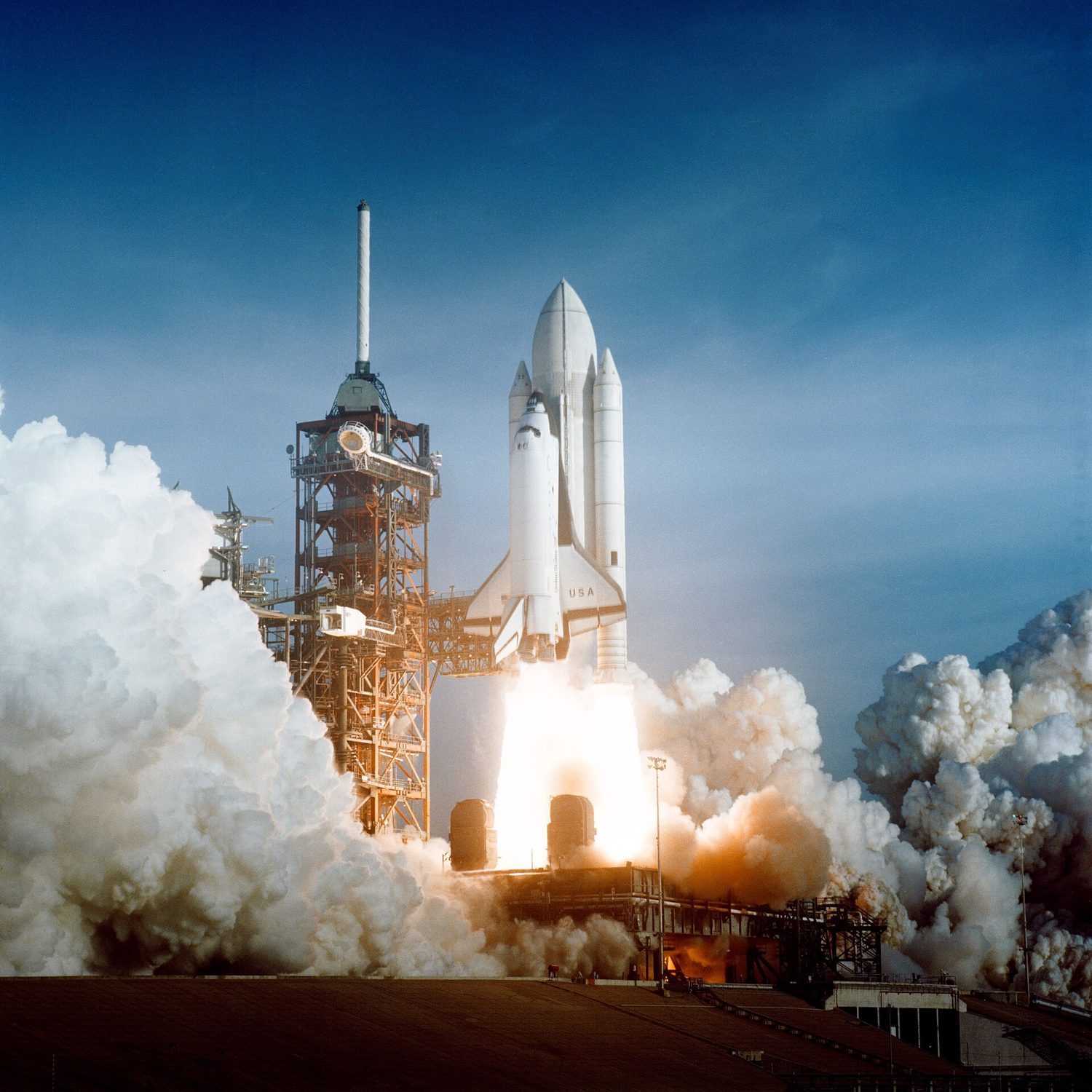
The general form uses momentum:
$$\sum\vec{F}=\frac{d\vec{p}}{dt}=m\vec{a}\ \ (\text{for constant mass}).$$Apply it one axis at a time. When forces depend on velocity or position, this becomes a differential equation 微分方程 to solve.Worked example. A $2.0\ \text{kg}$ block slides down a frictionless incline 斜面 at $30^{\circ}$. Only the along-ramp component of gravity drives it, so $a=g\sin30^{\circ}=9.8(0.5)=4.9\ \text{m/s}^2$, independent of the mass.
Worked example (two bodies). A $6.0\ \text{kg}$ cart on a frictionless table is pulled by a string over a light pulley to a hanging $2.0\ \text{kg}$ mass. Treat the pair as one system: only the hanging weight drives it, so $a=\dfrac{2.0(9.8)}{8.0}=2.45\ \text{m/s}^2$. Then isolate the cart alone to find the string tension 张力: $T=6.0(2.45)\approx15\ \text{N}$. System first for $a$, single body for internal forces – that two-step is the standard pattern.
A rocket launch: net force changes momentum — F_net = ma for translational dynamics Vocabulary · מילון מונחים Train · אימוןEnglish עברית differential equation/ˌdɪfəˈrenʃl ɪˈkweɪʒn/ משוואה דיפרנציאלית incline/ɪnˈklaɪn/ שיפוע tension/ˈtenʃn/ מתח 2.6
Gravitational Force
Syllabus · סיילבוס
EnglishLearning Objective 2.6.A: Describe the gravitational interaction between two objects or systems with mass.
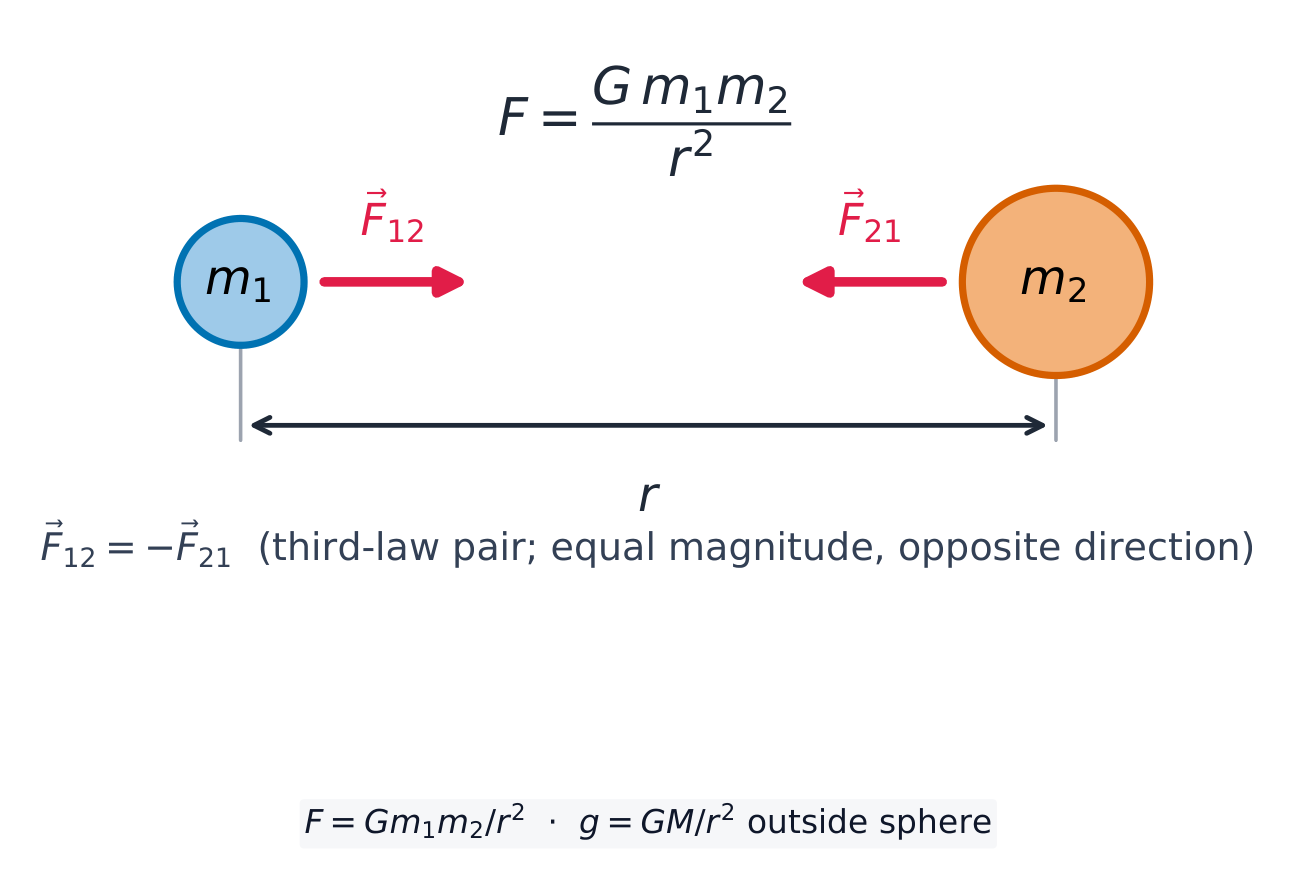
- 2.6.A.1 Newton's law of universal gravitation describes the gravitational force between two objects or systems as directly proportional to each of their masses and inversely proportional to the square of the distance between the systems' centers of mass.
- Equation: $\left| \vec{F}_g \right| = G \dfrac{m_1 m_2}{r^2}$
- 2.6.A.1.i The gravitational force is attractive.
- 2.6.A.1.ii The gravitational force is always exerted along the line connecting the center of mass of the two interacting systems.
- 2.6.A.1.iii The gravitational force on a system can be considered to be exerted on the system's center of mass.
- 2.6.A.2 A field models the effects of a noncontact force exerted on an object at various positions in space.
- 2.6.A.2.i The magnitude of the gravitational field created by a system of mass $M$ at a point in space is equal to the ratio of the gravitational force exerted by the system on a test object of mass $m$ to the mass of the test object.
- Derived equation: $\left| \vec{g} \right| = \dfrac{\left| \vec{F}_g \right|}{m} = G \dfrac{M}{r^2}$
- 2.6.A.2.ii If the gravitational force is the only force exerted on an object, the observed acceleration of the object (in $\text{m/s}^2$) is numerically equal to the magnitude of the gravitational field strength (in $\text{N/kg}$) at that location.
- 2.6.A.2.i The magnitude of the gravitational field created by a system of mass $M$ at a point in space is equal to the ratio of the gravitational force exerted by the system on a test object of mass $m$ to the mass of the test object.
- 2.6.A.3 The gravitational force exerted by an astronomical body on a relatively small nearby object is called weight.
- Derived equation: $\text{Weight} = F_g = mg$
Learning Objective 2.6.B: Describe situations in which the gravitational force can be considered constant.
- 2.6.B.1 If the gravitational force between two systems' centers of mass has a negligible change as the relative position of the two systems changes, the gravitational force can be considered constant at all points between the initial and final positions of the systems.
- 2.6.B.2 Near the surface of Earth, the strength of the gravitational field is
- Equation: $g \approx 10\ \text{N/kg}$
Learning Objective 2.6.C: Describe the conditions under which the magnitude of a system's apparent weight is different from the magnitude of the gravitational force exerted on that system.
- 2.6.C.1 The magnitude of the apparent weight of a system is the magnitude of the normal force exerted on the system.
- 2.6.C.2 If the system is accelerating, the apparent weight of the system is not equal to the magnitude of the gravitational force exerted on the system.
- 2.6.C.3 A system appears weightless when there are no forces exerted on the system or when the force of gravity is the only force exerted on the system.
- 2.6.C.4 The equivalence principle states that an observer in a noninertial reference frame is unable to distinguish between an object's apparent weight and the gravitational force exerted on the object by a gravitational field.
Learning Objective 2.6.D: Describe inertial and gravitational mass.
- 2.6.D.1 Objects have inertial mass, or inertia, a property that determines how much an object's motion resists changes when interacting with another object.
- 2.6.D.2 Gravitational mass is related to the force of attraction between two systems with mass.
- 2.6.D.3 Inertial mass and gravitational mass have been experimentally verified to be equivalent.
Learning Objective 2.6.E: Describe the gravitational force exerted on an object by a uniform spherical distribution of mass.
- 2.6.E.1 The net gravitational force exerted on an object by a uniform spherical distribution of mass is the sum of the individual forces from small differential masses that comprise the distribution.
- 2.6.E.2 Newton's shell theorem describes the net gravitational force exerted on an object by a uniform spherical shell of mass.
- 2.6.E.2.i The net gravitational force exerted on an object inside a thin spherical shell is zero.
- 2.6.E.2.ii The net gravitational force exerted on an object outside a thin spherical shell can be determined by treating the shell as a single massive object located at the center of the shell.
- 2.6.E.2.iii An object inside a sphere of uniform density experiences a net gravitational force from only a partial mass of the sphere.
- 2.6.E.2.iv The partial mass of a sphere that contributes to the net gravitational force exerted on an object within that sphere is the portion of the sphere's mass located a distance less than or equal to the object's distance from the center of the sphere and can be calculated using the density of the sphere.
- Derived equation: $m_{\text{partial}} = \rho \dfrac{4}{3} \pi \left( r_{\text{partial}} \right)^3$
- 2.6.E.3 The gravitational force exerted on an object within a uniform sphere can be shown to be proportional to the object's distance from the sphere's center.
- Derived equation: $F_{g,\text{partial}} = -k r_{\text{partial}}$
Boundary statement: AP Physics C: Mechanics does not expect students to mathematically prove or derive Newton's shell theorem.
עבריתמטרות למידה 2.6.A: תאר את האינטראקציה הכבידתית בין שני עצמים או מערכות בעלות מסה.
- 2.6.A.1 חוק הכבידה האוניברסלי של ניוטון מתאר את הכוח הכבידתי בין שני עצמים או מערכות כפרופורציונלי ישירות לכל אחת ממסותיהם ובלבילי פרופורציונלי לריבוע המרחק בין מרכזי המסה שלהם.
- משוואה: $\left| \vec{F}_g \right| = G \dfrac{m_1 m_2}{r^2}$
- 2.6.A.1.i הכוח הכבידתי הוא מושך.
- 2.6.A.1.ii הכוח הכבידתי מופעל תמיד לאורך הקו המחבר בין מרכז המסה של שתי המערכות המואינות.
- 2.6.A.1.iii ניתן להסתכל על הכוח הכבידתי הפועל על מערכת כאילו הוא פועל על מרכז המסה שלה.
- 2.6.A.2 שדה דגם את ההשפעות של כוח שאינו נוגע (noncontact force) הפועל על עצם במיקומים שונים במרחב.
- 2.6.A.2.i גודל השדה הכבידתי שנוצר על ידי מערכת מסה $M$ בנקודה במרחב שווה ליחס בין כוח הכביד שהמערכת מפעילה על חפץ מבחן בעל מסה $m$ לבין מסת חפץ המבחן.
- משוואה נגזרת: $\left| \vec{g} \right| = \dfrac{\left| \vec{F}_g \right|}{m} = G \dfrac{M}{r^2}$
- 2.6.A.2.ii אם הכוח הכבידתי הוא הכוח היחיד המופעל על אובייקט, התאוצה הנצפתה של האובייקט (יחידות $\text{m/s}^2$) היא מספרית שווה לגודל עוצמת השדה הכבידתי (יחידות $\text{N/kg}$) במקום זה.
- 2.6.A.2.i גודל השדה הכבידתי שנוצר על ידי מערכת מסה $M$ בנקודה במרחב שווה ליחס בין כוח הכביד שהמערכת מפעילה על חפץ מבחן בעל מסה $m$ לבין מסת חפץ המבחן.
- 2.6.A.3 הכוח הכבידתי הפועל על ידי גוף אסטרונומי על עצם קרוב יחסית הוא קטן נקרא משקל.
- משוואה גזורה: $\text{Weight} = F_g = mg$
מטרות למידה 2.6.B: תאר מצבים שבהם ניתן להסתכל על הכוח הכבידתי כאילו הוא קבוע.
- 2.6.B.1 אם שינוי הכוח הכבידתי בין מרכזי המסה של שני מערכות הוא זניח כאשר משתנה המיקום היחסי שלהן, ניתן להסתכל על הכוח הכבידתי כקבוע בכל נקודה בין המיקומים ההתחלתי והסופי של המערכות.
- 2.6.B.2 בסמוך לפני השטח של כדור הארץ, עוצמת השדה הכבידתי היא
- משוואה: $g \approx 10\ \text{N/kg}$
מטרת הלמידה 2.6.C: לתאר את התנאים שבהם הגודל של המשקל apparent (הכאורי) של מערכת שונה מגודל הכוח הכבידתי הפועל עליה.
- 2.6.C.1 גודל המשקל apparent של מערכת הוא גודל הכוח הנורמלי הפועל עליה.
- 2.6.C.2 אם המערכת מאיצה, המשקל apparent שלה אינו שווה לגודל הכוח הכבידתי הפועל עליה.
- 2.6.C.3 מערכת נראית חסרת משקל כאשר אין כוחות הפועלים עליה או כאשר הכוח הכבידתי הוא הכוח היחיד הפועל עליה.
- 2.6.C.4 עקרון השוויון קובע כי צופה במערכת ייחוס לא-אינרציאלית אינו יכול להבחין בין המשקל apparent של אובייקט לבין הכוח הכבידתי הפועל עליו בשדה כבידתי.
מטרת הלמידה 2.6.D: לתאר מסה אינרציאלית ומסה כבידתית.
- 2.6.D.1 לרצפים יש מסה אינרציאלית, או אינרציה, תכונה הקובעת כמה התנועה של רצף מתנגדת לשינויים כאשר היא נמצאת באינטראקציה עם רצף אחר.
- 2.6.D.2 מסה כבידתית קשורה לכוח המשיכה בין שני רצפים בעלי מסה.
- 2.6.D.3 הוכח ניסויית שהמסה האינרציאלית והמסה הכבידתית שוות זו לזו.
מטרת לימוד 2.6.E: לתאר את הכוח הכבידתי המופעל על אובייקט על ידי חלוקת מסה כדורית אחידה.
- 2.6.E.1 הכוח הכבידתי הכולל המופעל על אובייקט על ידי חלוקת מסה כדורית אחידה הוא הסכום של הכוחות הבודדים ממסות דיפרנציאליות קטנות המרכבות את החלוקה.
- 2.6.E.2 משפט העטף של ניוטן מתאר את הכוח הכבידתי הכולל המופעל על אובייקט על ידי עטף כדורי אחיד של מסה.
- 2.6.E.2.i הכוח הכבידתי הכולל המופעל על אובייקט בתוך עטף כדורי דק הוא אפס.
- 2.6.E.2.ii הכוח הכבידתי הכולל המופעל על אובייקט מחוץ לעטף כדורי דק ניתן לקבוע על ידי טיפול בעטף כאובייקט מסה יחיד הממוקם במרכז העטף.
- 2.6.E.2.iii אובייקט בתוך כדור בצפיפות אחידה חווה כוח כבידתי כולל רק ממסה חלקית של הכדור.
- 2.6.E.2.iv המסה החלקית של כדור שתורמת לכוח הכבידתי הכולל המופעל על אובייקט בתוך אותו כדור היא החלק ממסת הכדור הממוקם במרחק פחות או שווה למרחק האובייקט ממרכז הכדור, וניתן לחשב אותה באמצעות צפיפות הכדור.
- משוואה נגזרת: $m_{\text{partial}} = \rho \dfrac{4}{3} \pi \left( r_{\text{partial}} \right)^3$
- 2.6.E.3 ניתן להראות כי הכוח הכבידתי הפועל על גוף בתוך כדור אחיד פרופורציונלי למרחק הגוף ממרכז הכדור.
- משוואה גזורה: $F_{g,\text{partial}} = -k r_{\text{partial}}$
הצהרת גבול: AP Physics C: Mechanics אינה מצפה מתלמידים להוכיח או ללגזור מתמטית את משפט השלוליות של ניוטון.
Source: College Board AP Course and Exam Description · מקור: תיאור הקורס והמבחן של College Board AP
Orbital motion (Kepler's 2nd law) Near a surface, weight is $F_g=mg$. In general, Newton's law of gravitation 万有引力定律:
$$F_g=\frac{Gm_1m_2}{r^2},$$attractive and inverse-square. The gravitational field is $g=\dfrac{GM}{r^2}$.Two masses attract each other with equal, opposite, inverse-square forces along the line joining them Vocabulary · מילון מונחים Train · אימוןEnglish עברית Newton's law of gravitation/ˈnjuːtnz lɔː ɒv ˌɡrævɪˈteɪʃn/ חוק הכבידה של ניוטון 2.7
Kinetic and Static Friction
Syllabus · סיילבוס
EnglishLearning Objective 2.7.A: Describe kinetic friction between two surfaces.
- 2.7.A.1 Kinetic friction occurs when two surfaces in contact move relative to each other.
- 2.7.A.1.i The kinetic friction force is exerted in a direction opposite the motion of each surface relative to the other surface.
- 2.7.A.1.ii The force of friction between two surfaces does not depend on the size of the surface area of contact.
- 2.7.A.2 The magnitude of the kinetic friction force exerted on an object is the product of the normal force the surface exerts on the object and the coefficient of kinetic friction.
- Equation: $\left| \vec{F}_{f,k} \right| = \left| \mu_k \vec{F}_N \right|$
- 2.7.A.2.i The coefficient of kinetic friction depends on the material properties of the surfaces that are in contact.
- 2.7.A.2.ii Normal force is the perpendicular component of the force exerted on an object by the surface with which it is in contact; it is directed away from the surface.
Learning Objective 2.7.B: Describe static friction between two surfaces.
- 2.7.B.1 Static friction may occur between the contacting surfaces of two objects that are not moving relative to each other.
- 2.7.B.2 Static friction adopts the value and direction required to prevent an object from slipping or sliding on a surface.
- Equation: $\left| \vec{F}_{f,s} \right| \leq \left| \mu_s \vec{F}_n \right|$
- 2.7.B.2.i Slipping and sliding refer to situations in which two surfaces are moving relative to each other.
- 2.7.B.2.ii There exists a maximum value for which static friction will prevent an object from slipping on a given surface.
- Derived equation: $F_{f,s,\text{max}} = \mu_s F_N$
- 2.7.B.3 The coefficient of static friction is typically greater than the coefficient of kinetic friction for a given pair of surfaces.
עבריתמטרות לימוד 2.7.A: תאר חיכוך קינטי בין שני משטחים.
- 2.7.A.1 חיכוך קינטי מתרחש כאשר שני משטחים בנגיעה נעים ביחס זה לזה.
- 2.7.A.1.i כוח החיכוך הקינטי פועל בכיוון מנוגד לתנועת כל משטח ביחס למשטח האחר.
- 2.7.A.1.ii כוח החיכוך בין שני משטחים אינו תלוי בגודל שטח המגע.
- 2.7.A.2 גודל כוח החיכוך הקינטי הפועל על אובייקט הוא מכפלת הכוח הנורמלי שמפעיל עליו המשטח ומקדם החיכוך הקינטי.
- משוואה: $\left| \vec{F}_{f,k} \right| = \left| \mu_k \vec{F}_N \right|$
- 2.7.A.2.i מקדם החיכוך הקינטי תלוי בתכונות החומר של המשטחים הנמצאים בנגיעה.
- 2.7.A.2.ii כוח נורמלי הוא המרכיב האנכי של הכוח הפועל על אובייקט על ידי המשטח שבו הוא נוגע; הוא מופנה הרחק מהמשטח.
מטרת הלמידה 2.7.B: לתאר חיכוך סטטי בין שני משטחים.
- 2.7.B.1 חיכוך סטטי עשוי להופיע בין משטחי המגע של שני גופים שאינם נעים ביחס זה לזה.
- 2.7.B.2 חיכוך סטטי מקבל את הערך והכיוון הנדרשים כדי למנוע מחלקה החלקה או החלקה על פני משטח.
- משוואה: $\left| \vec{F}_{f,s} \right| \leq \left| \mu_s \vec{F}_n \right|$
- 2.7.B.2.i החלקה והחלקה מתייחסות למצבים שבהם שני משטחים נעים ביחס זה לזה.
- 2.7.B.2.ii קיים ערך מקסימלי עבורו חיכוך סטטי ימנע מחלקה מהחלקה על משטח נתון.
- משוואה נגזרת: $F_{f,s,\text{max}} = \mu_s F_N$
- 2.7.B.3 מקדם החיכוך הסטטי הוא בדרך כלל גדול יותר ממקדם החיכוך הקינטי עבור זוג משטחים נתון.
Source: College Board AP Course and Exam Description · מקור: תיאור הקורס והמבחן של College Board AP
Friction 摩擦力 opposes sliding along a surface: kinetic 动摩擦 $f_k=\mu_k N$ while sliding, and static 静摩擦 $f_s\le\mu_s N$ up to a maximum before sliding. $N$ is the normal force 法向力. Note the inequality: static friction is only as large as it needs to be, and $\mu_s N$ is its ceiling, not its value.
Worked example. The same block on the same $30^{\circ}$ incline, now with $\mu_k=0.20$. Perpendicular to the ramp: $N=mg\cos30^{\circ}$. Along the ramp: $ma=mg\sin30^{\circ}-\mu_k mg\cos30^{\circ}$, so $a=g(\sin30^{\circ}-0.20\cos30^{\circ})=9.8(0.500-0.173)=3.2\ \text{m/s}^2$ – the mass cancels again.
Explore · חקורSlide a block down a slope with friction · החלק בלוק לאורך משטח משופע עם חיכוך
Friction opposes motion up to a maximum $\mu N$. Tilt the slope until gravity's pull along it beats static friction and the block starts to slide. · חיכוך מתנגד לתנועה עד סף מקסימלי של $\mu N$. שיפ את המשטח עד שהמשיכה הכבידתית לאורכו עולה על החיכוך הסטטי והבלוק מתחיל להחליק.
Vocabulary · מילון מונחים Train · אימוןEnglish עברית Friction/ˈfrɪkʃn/ חיכוך kinetic/kɪˈnetɪk/ קינטי static/ˈstætɪk/ סטטי normal force/ˈnɔːml fɔːs/ כוח נורמלי 2.8
Spring Forces
Syllabus · סיילבוס
EnglishLearning Objective 2.8.A: Describe the force exerted on an object by an ideal spring.
- 2.8.A.1 An ideal spring has negligible mass and exerts a force that is proportional to the change in its length as measured from its relaxed length. A nonideal spring either has nonnegligible mass or exerts a force that is not proportional to the change in its length as measured from its relaxed length.
- 2.8.A.2 The magnitude of the force exerted by an ideal spring on an object is given by Hooke's law:
- Equation: $\vec{F}_s = -k \Delta \vec{x}$
- 2.8.A.3 The force exerted on an object by a spring is always directed toward the equilibrium position of the object–spring system.
Learning Objective 2.8.B: Describe the equivalent spring constant of a combination of springs exerting forces on an object.
- 2.8.B.1 A collection of springs that exert forces on an object may behave as though they were a single spring with an equivalent spring constant $k_{\text{eq}}$.
- 2.8.B.1.i The inverse of the equivalent spring constant of a set of springs in series is equal to the sum of the inverses of the individual spring constants.
- Derived equation: $\dfrac{1}{k_{\text{eq, series}}} = \sum_i \dfrac{1}{k_i} = \dfrac{1}{k_1} + \dfrac{1}{k_2} + \dots$
- 2.8.B.1.ii The equivalent spring constant of a set of springs arranged in series is smaller than the smallest constituent spring constant.
- 2.8.B.1.iii The equivalent spring constant of a set of springs arranged in parallel is the sum of the individual spring constants.
- Derived equation: $k_{\text{eq, parallel}} = \sum_i k_i = k_1 + k_2 + \dots$
- 2.8.B.1.i The inverse of the equivalent spring constant of a set of springs in series is equal to the sum of the inverses of the individual spring constants.
Boundary statement: AP Physics C: Mechanics only expects students to find the effective spring constant of systems of springs that are arranged either in series or in parallel and does not expect students to find the effective spring constant of a system in which springs are arranged in both series and parallel.
עבריתמטרות לימוד 2.8.A: תאר את הכוח הפועל על גוף על ידי קפיץ אידיאלי.
- 2.8.A.1 לקפיץ אידיאלי מסה זניחה והוא מפעיל כוח הפרופורציונלי לשינוי באורכו במדידה מהאורך הרפוי שלו. קפיץ לא-אידיאלי בעל מסה שאינה זניחה או מפעיל כוח שאינו פרופורציונלי לשינוי באורכו במדידה מהאורך הרפוי שלו.
- 2.8.A.2 הגודל של הכוח שמפעיל קפיץ אידיאלי על גוף נתון על ידי חוק הוק:
- משוואה: $\vec{F}_s = -k \Delta \vec{x}$
- 2.8.A.3 הכוח שמפעיל קפיץ על גוף מופנה תמיד אל מיקום האיזון של מערכת הגוף-קפיץ.
מטרות לימוד 2.8.B: תאר את קבוע הקפיץ השווה של ערכה של קפיצים המפעילים כוחות על גוף.
- 2.8.B.1 ערכה של קפיצים המפעילים כוחות על גוף עשויה להתנהג כאילו היו קפיץ יחיד עם קבוע קפיץ שווה $k_{\text{eq}}$.
- 2.8.B.1.i ההופכי של קבוע הקפיץ השווה לערכה של קפיצים בסדרה שווה לסכום ההופכים של קבועי הקפיצים הבודדים.
- משוואה נגזרת: $\dfrac{1}{k_{\text{eq, series}}} = \sum_i \dfrac{1}{k_i} = \dfrac{1}{k_1} + \dfrac{1}{k_2} + \dots$
- 2.8.B.1.ii קבוע הקפיץ השווה לערכה של קפיצים המסודרים בסדרה הוא קטן מקבוע הקפיץ המרכיב הקטן ביותר.
- 2.8.B.1.iii קבוע הקפיץ השווה לערכה של קפיצים המסודרים במקבוי הוא סכום קבועי הקפיצים הבודדים.
- משוואה נגזרת: $k_{\text{eq, parallel}} = \sum_i k_i = k_1 + k_2 + \dots$
- 2.8.B.1.i ההופכי של קבוע הקפיץ השווה לערכה של קפיצים בסדרה שווה לסכום ההופכים של קבועי הקפיצים הבודדים.
הצהרת גבול: AP Physics C: Mechanics מצפה מתלמידים רק למצוא את קבוע הקפיץ האפקטיבי של מערכות קפיצים המסודרות או בסדרה או במקבוי ואינה מצפה מתלמידים למצוא את קבוע הקפיץ האפקטיבי של מערכת שבה הקפיצים מסודרים גם בסדרה וגם במקבוי.
Source: College Board AP Course and Exam Description · מקור: תיאור הקורס והמבחן של College Board AP
Hooke's law & the elastic limit An ideal spring obeys Hooke's law 胡克定律 $F_s=-kx$, a restoring force set by the spring constant 弹簧劲度系数 $k$. Its stored energy is $U=\tfrac12 kx^2$.
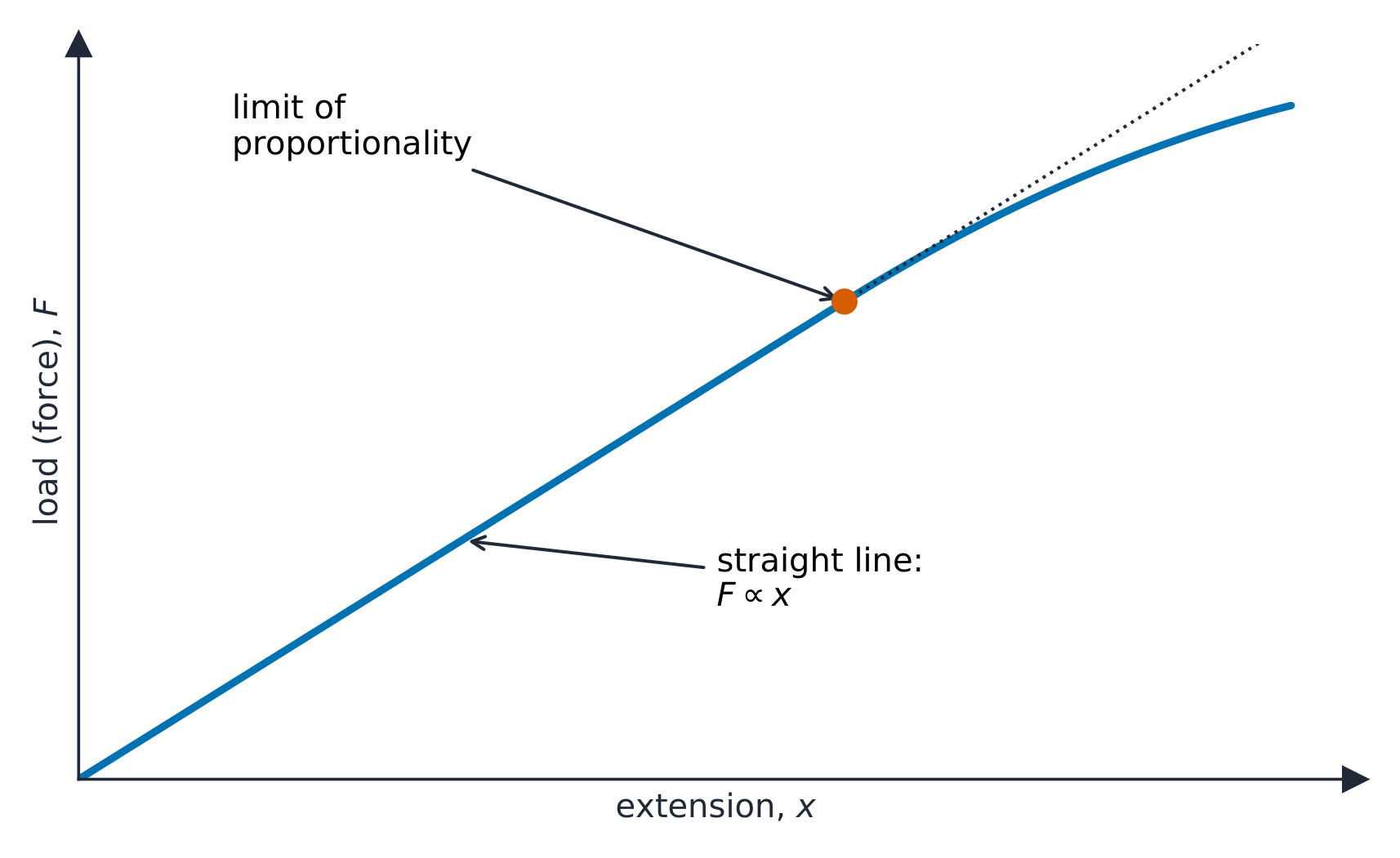
Hooke's law: extension is proportional to load up to the limit of proportionality Combined springs act as one equivalent spring of constant $k_{\text{eq}}$. In parallel (side by side, sharing the load) the constants add, $k_{\text{eq}}=k_1+k_2$ – stiffer than either. In series (end to end) they combine as $\dfrac{1}{k_{\text{eq}}}=\dfrac{1}{k_1}+\dfrac{1}{k_2}$ – softer than the softest one. Two springs pulling a mass from opposite sides also act in parallel, giving a restoring constant $k_1+k_2$. Whichever you have, the SHM period uses $k_{\text{eq}}$: $T=2\pi\sqrt{m/k_{\text{eq}}}$.
Explore · חקורStretch a spring (Hooke's law) · מתיחת קפיץ (חוק הוק)
A spring's force is proportional to its extension, $F=kx$ (Hooke's law). Pull harder and the extension grows in step — until the spring's limit. · כוח הקפיץ פרופורציונלי למתיחתו, $F=kx$ (חוק הוק). משוך חזק יותר והמתיחה גדלה בצעד — עד לגבול ההתמתחות של הקפיץ.
Vocabulary · מילון מונחים Train · אימוןEnglish עברית Hooke's law/hʊks lɔː/ חוק הוק spring constant/sprɪŋ ˈkɒnstənt/ קבוע קפיץ 2.9
Resistive Forces
Syllabus · סיילבוס
EnglishLearning Objective 2.9.A: Describe the motion of an object subject to a resistive force.
- 2.9.A.1 A resistive force is defined as a velocity-dependent force in the opposite direction of an object's velocity, for example:
- Equation: $\vec{F}_r = -k\vec{v}$
- 2.9.A.2 Applying Newton's second law to an object upon which a resistive force is exerted results in a differential equation for velocity.
- 2.9.A.2.i Using the method of separation of variables, the velocity can be determined by integrating over the proper limits of integration.
- 2.9.A.2.ii The acceleration or position of a moving object that is subject to a velocity-dependent force may be determined using initial conditions of the object and methods of calculus, once a function for velocity is determined.
- 2.9.A.2.iii The position, velocity, and acceleration as functions of time of an object under the influence of a resistive force of the form $\vec{F}_r = -k\vec{v}$ are exponential and have asymptotes that are determined by the initial conditions of the object and the forces exerted on the object.
- 2.9.A.3 Terminal velocity is defined as the maximum speed achieved by an object moving under the influence of a constant force and a resistive force that are exerted on the object in opposite directions. The terminal condition is reached when the net force exerted on the object is zero.
עבריתמטרות לימוד 2.9.A: תאר את תנועת גוף הנמצא תחת השפעת כוח התנגדות.
- 2.9.A.1 כוח התנגדות מוגדר ככוח התלוי במהירות ובכיוון מנוגד למהירות הגוף, לדוגמה:
- משוואה: $\vec{F}_r = -k\vec{v}$
- 2.9.A.2 יישום חוק השני של ניוטון על גוף שעליו מפעיל כוח התנגדות מוביל למשוואה דיפרנציאלית עבור המהירות.
- 2.9.A.2.i באמצעות שיטת הפרדת משתנים, ניתן לקבוע את המהירות על ידי אינטגרציה על גבולות האינטגרציה המתאימים.
- 2.9.A.2.ii האוצר או המיקום של גוף נע הנמצא תחת השפעת כוח התלוי במהירות יכולים להיות נקבעים באמצעות תנאים התחלתיים של הגוף ושיטות ק্যালקולוס, לאחר שמצויה פונקציה עבור המהירות.
- 2.9.A.2.iii המיקום, המהירות והאוצר כפונקציות של הזמן של גוף הנמצא תחת השפעת כוח התנגדות בצורה $\vec{F}_r = -k\vec{v}$ הם אקספוננציאליים ומכילים אסימפטוטות הנקבעות על ידי התנאים ההתחלתיים של הגוף וכוחות הפועלים עליו.
- 2.9.A.3 מהירות סופית מוגדרת כמהירות המקסימלית שהגיע גוף הנע תחת השפעת כוח קבוע וכוח התנגדות הפועלים על הגוף בכיוונים מנוגדים. תנאי הסופיות מושגת כאשר הכוח הנקי הפועל על הגוף הוא אפס.
Source: College Board AP Course and Exam Description · מקור: תיאור הקורס והמבחן של College Board AP
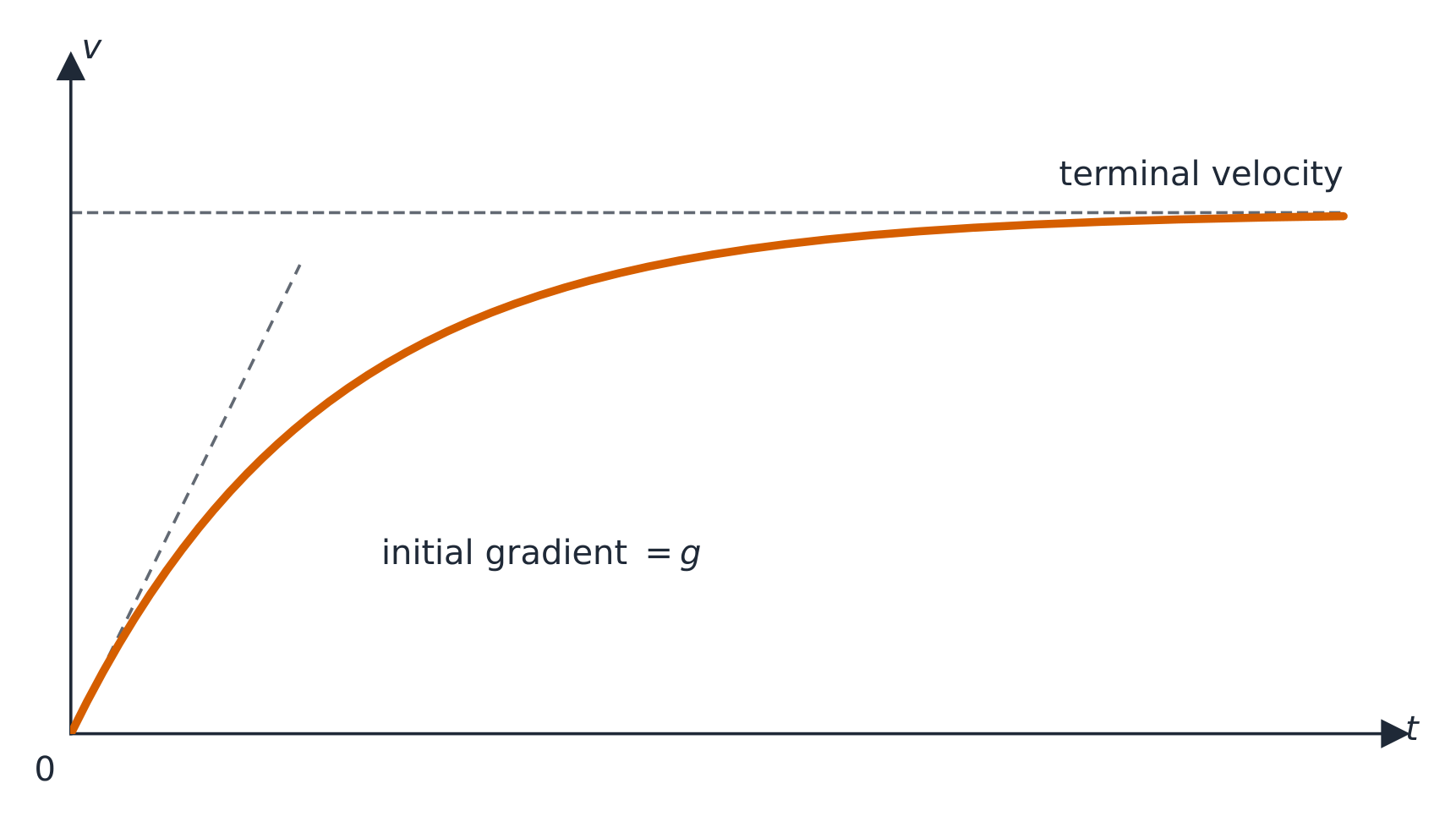
A resistive force 阻力 (drag) opposes motion through a fluid and grows with speed, often modeled as $F=-bv$ or $F=-cv^2$. Newton's second law then gives a differential equation, e.g. $m\dfrac{dv}{dt}=mg-bv$ for a falling object. As speed rises, drag builds until it balances the driving force; the object then stops accelerating and moves at a constant terminal velocity 终极速度, found by setting the net force (and $dv/dt$) to zero.
Worked example. For a falling object with $m\dfrac{dv}{dt}=mg-bv$, the terminal velocity is where $\dfrac{dv}{dt}=0$: $mg=bv_T$, so $v_T=\dfrac{mg}{b}$. With $m=0.10\ \text{kg}$ and $b=0.50\ \text{kg/s}$, $v_T=\dfrac{0.10(9.8)}{0.50}=2.0\ \text{m/s}$.
To get the full motion $v(t)$, separate the variables 分离变量 and integrate from rest:
$$\int_0^{v}\frac{dv'}{mg-bv'}=\int_0^{t}\frac{dt'}{m}\;\Rightarrow\;-\frac{1}{b}\ln\!\frac{mg-bv}{mg}=\frac{t}{m},$$which rearranges to $v(t)=v_T\left(1-e^{-bt/m}\right)$ – the speed rising exponentially toward $v_T$. Showing this integration is the calculus skill a Physics C free-response rewards, not just quoting the final formula.An object falling through a fluid speeds up to a terminal velocity 
Skydivers in freefall: drag grows with speed until it balances weight at terminal velocity Vocabulary · מילון מונחים Train · אימוןEnglish עברית resistive force/rɪˈzɪstɪv fɔːs/ כוח התנגדות terminal velocity/ˈtɜːmɪnl vəˈlɒsɪti/ מהירות סופית separate the variables/ˈseprət ðə ˈveərɪəblz/ הפרדת משתנים 2.10
Circular Motion
Syllabus · סיילבוס
EnglishLearning Objective 2.10.A: Describe the motion of an object traveling in a circular path.
- 2.10.A.1 Centripetal acceleration is the component of an object's acceleration directed toward the center of the object's circular path.
- 2.10.A.1.i The magnitude of centripetal acceleration for an object moving in a circular path is the ratio of the object's tangential speed squared to the radius of the circular path.
- Equation: $a_c = \dfrac{v^2}{r}$
- 2.10.A.1.ii Centripetal acceleration is directed toward the center of an object's circular path.
- 2.10.A.1.i The magnitude of centripetal acceleration for an object moving in a circular path is the ratio of the object's tangential speed squared to the radius of the circular path.
- 2.10.A.2 Centripetal acceleration can result from a single force, more than one force, or components of forces that are exerted on an object in circular motion.
- 2.10.A.2.i At the top of a vertical, circular loop, an object requires a minimum speed to maintain circular motion. At this point, and with this minimum velocity, the gravitational force is the only force that causes the centripetal acceleration.
- Derived equation: $v = \sqrt{gr}$
- 2.10.A.2.ii Components of the static friction force and the normal force can contribute to the net force producing centripetal acceleration of an object traveling in a circle on a banked surface.
- 2.10.A.2.iii A component of tension contributes to the net force producing centripetal acceleration experienced by a conical pendulum.
- 2.10.A.2.i At the top of a vertical, circular loop, an object requires a minimum speed to maintain circular motion. At this point, and with this minimum velocity, the gravitational force is the only force that causes the centripetal acceleration.
- 2.10.A.3 Tangential acceleration is the rate at which an object's speed changes and is directed tangent to the object's circular path.
- 2.10.A.4 The net acceleration of an object moving in a circle is the vector sum of the centripetal acceleration and tangential acceleration.
- 2.10.A.5 The revolution of an object traveling in a circular path at a constant speed (uniform circular motion) can be described using period and frequency.
- 2.10.A.5.i The time to complete one full circular path, one full rotation, or a full cycle of oscillatory motion is defined as period, $T$.
- 2.10.A.5.ii The rate at which an object is completing revolutions is defined as frequency, $f$.
- Equation: $T = \dfrac{1}{f}$
- 2.10.A.5.iii For an object traveling at a constant speed in a circular path, the period is given by the derived equation
- Derived equation: $T = \dfrac{2\pi r}{v}$
Learning Objective 2.10.B: Describe circular orbits using Kepler's third law.
- 2.10.B.1 For a satellite in circular orbit around a central body, the satellite's centripetal acceleration is caused only by gravitational attraction. The period and radius of the circular orbit are related to the mass of the central body.
- Derived equation: $T^2 = \dfrac{4\pi^2}{GM} R^3$
Boundary statement: AP Physics C: Mechanics does not expect students to know Kepler's first or second laws of planetary motion.
עבריתמטרות הלמידה 2.10.A: לתאר את תנועתו של גוף הנע בתוך מסלול עגול.
- 2.10.A.1 תאוצה מרכזית היא רכיב התאוצה של גוף המופנה לכיוון מרכז המסלול העגול שלו.
- 2.10.A.1.i הגודל של התאוצה המרכזית עבור גוף הנע בתוך מסלול עגול הוא היחס בין ריבוע מהירות המגע של הגוף לבין רדיוס המסלול העגול.
- משוואה: $a_c = \dfrac{v^2}{r}$
- 2.10.A.1.ii התאוצה המרכזית מופנית לכיוון מרכז המסלול העגול של הגוף.
- 2.10.A.1.i הגודל של התאוצה המרכזית עבור גוף הנע בתוך מסלול עגול הוא היחס בין ריבוע מהירות המגע של הגוף לבין רדיוס המסלול העגול.
- 2.10.A.2 התאוצה המרכזית יכולה לנבוע מכוח בודד, מכוחים רבים, או מרכיבי כוחות המופעלים על גוף הנע במסלול עגול.
- 2.10.A.2.i בראש לולאה אנכית-מעגלית, גוף זקוק למהירות מינימלית כדי לשמור על תנועה מעגלית. בנקודה זו, ובמהירות מינימלית זו, הכוח הכובד הוא הכוח היחיד הגורם להתאוצה המרכזית.
- משוואה נגזרת: $v = \sqrt{gr}$
- 2.10.A.2.ii רכיבים של כוח החיכוך הסטטי וכוח הרצפה יכולים לתרום לכוח הנטו המייצר את התאוצה המרכזית של גוף הנע בעיגול על משטח נוטה.
- 2.10.A.2.iii רכיב של מתח תורם לכוח הנטו המייצר את התאוצה המרכזית שחווה נדנד קוני.
- 2.10.A.2.i בראש לולאה אנכית-מעגלית, גוף זקוק למהירות מינימלית כדי לשמור על תנועה מעגלית. בנקודה זו, ובמהירות מינימלית זו, הכוח הכובד הוא הכוח היחיד הגורם להתאוצה המרכזית.
- 2.10.A.3 תאוצה מגנטית היא קצב השינוי במהירותו של גוף והיא מופנת במשיק למסלול העגול שלו.
- 2.10.A.4 התאוצה הנטו של גוף הנע בעיגול היא סכום הווקטורים של התאוצה המרכזית והתאוצה המגנטית.
- 2.10.A.5 סיבובו של גוף הנע בתוך מסלול עגול במהירות קבועה (תנועה מעגלית אחידה) ניתן לתאר באמצעות תקופה ותדר.
- 2.10.A.5.i הזמן הנדרש להשלמת מסלול עגול מלא, סיבוב מלא או מחזור מלא של תנועה תנודתית מוגדר כתקופה, $T$.
- 2.10.A.5.ii הקצב שבו גוף מבצע סיבובים מוגדר כתדר, $f$.
- משוואה: $T = \dfrac{1}{f}$
- 2.10.A.5.iii עבור גוף הנע במהירות קבועה בתוך מסלול עגול, התקופה נתונה על ידי המשוואה המופקת
- משוואה נגזרת: $T = \dfrac{2\pi r}{v}$
מטרות הלמידה 2.10.B: לתאר מסלולים מעגליים באמצעות חוק השלישי של קפלר.
- 2.10.B.1 עבור לוויין במסלול מעגלי סביב גוף מרכזי, התאוצה המרכזית של הלוויין נובעת אך ורק מגרירה כבידתית. התקופה והרדיוס של המסלול המעגלי קשורים למסת הגוף המרכזי.
- משוואה גזורה: $T^2 = \dfrac{4\pi^2}{GM} R^3$
הצהרת גבול: AP Physics C: Mechanics אינה מצפה מהתלמידים שידעו את החוק הראשון או השני של קפלר לתנועת כוכבי לכת.
Source: College Board AP Course and Exam Description · מקור: תיאור הקורס והמבחן של College Board AP
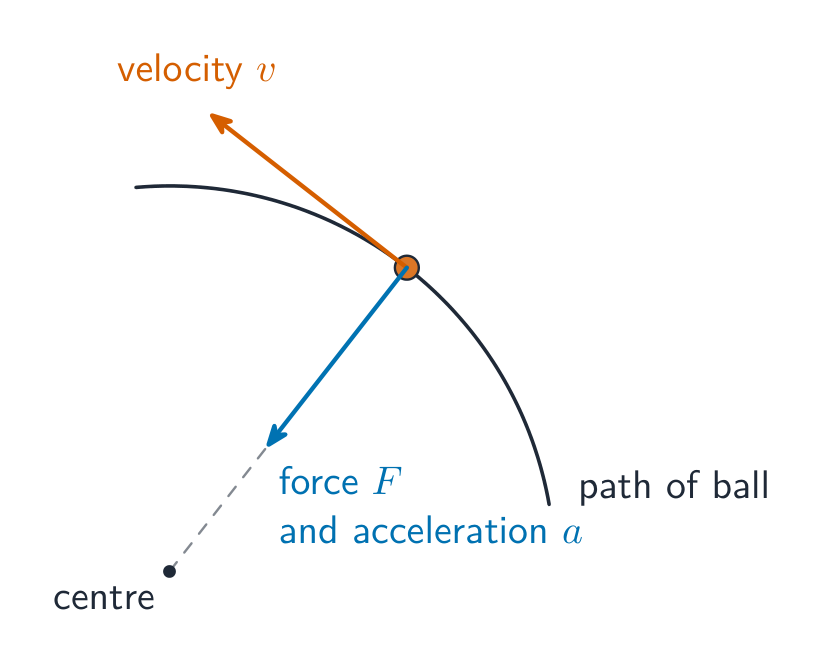
Uniform circular motion Uniform circular motion has a centripetal acceleration 向心加速度 $a_c=\dfrac{v^2}{r}$ pointing to the center, requiring a net inward force $F_c=\dfrac{mv^2}{r}$ supplied by a real force (tension, gravity, friction, normal). There is no outward force. For vertical circles and banked curves, decompose the real forces to find which provides the centripetal requirement.
Worked example. A $0.50\ \text{kg}$ ball is whirled on a $1.0\ \text{m}$ string in a horizontal circle at $3.0\ \text{m/s}$. The string tension supplies the whole centripetal force: $T=\dfrac{mv^2}{r}=\dfrac{0.50(3.0)^2}{1.0}=4.5\ \text{N}$.
Worked example (vertical circle). At the top of a vertical loop of radius $r$, gravity and the normal force both point toward the center: $N+mg=\dfrac{mv^2}{r}$. The slowest possible speed at the top is where the track pushes with nothing at all ($N=0$): $v_{\min}=\sqrt{gr}$. For $r=2.5\ \text{m}$: $v_{\min}=\sqrt{9.8(2.5)}=4.9\ \text{m/s}$. Any slower and the cart leaves the track before the top.
The velocity points along the tangent; the centripetal force points to the centre Vocabulary · מילון מונחים Train · אימוןEnglish עברית centripetal acceleration/senˈtrɪpɪtl əkˌseləˈreɪʃn/ תאוצה צנטריפטלית 2.10
Exam tips
- Locate the center of mass with $x_{cm}=\tfrac{1}{M}\int x\,dm$ (or $\tfrac{\sum m_i x_i}{\sum m_i}$ for point masses) and use $\lambda,\sigma,\rho$ for the mass element.
- The net external force moves the center of mass as if all mass sat there: $\vec F_{net}=M\vec a_{cm}$.
- Define your system clearly — internal forces cancel, so only external forces change its momentum.
- Exploit symmetry to shortcut a center-of-mass integral.
- Distinguish center of mass from center of gravity (identical in a uniform field).
-
3
Work, Energy, and Power · עבודה, אנרגיה והספק
Watch lesson · צפה בשיעור3.1
Translational Kinetic Energy
Syllabus · סיילבוס
EnglishLearning Objective 3.1.A: Describe the translational kinetic energy of an object in terms of the object's mass and velocity.
- 3.1.A.1 An object's translational kinetic energy is given by the equation
- Equation: $K = \dfrac{1}{2}mv^2$
- 3.1.A.2 Translational kinetic energy is a scalar quantity.
- 3.1.A.3 Different observers may measure different values of the translational kinetic energy of an object, depending on the observer's frame of reference.
עבריתמטרות למידה 3.1.A: לתאר את האנרגיה הקינטית התרגולית של גוף בהתאם למסתו ולמהירותו.
- 3.1.A.1 האנרגיה הקינטית התרגולית של גוף נתונה על ידי המשוואה
- משוואה: $K = \dfrac{1}{2}mv^2$
- 3.1.A.2 אנרגיה קינטית תרגולית היא גודל סקלרי.
- 3.1.A.3 צופים שונים עשויים למדוד ערכים שונים של האנרגיה הקינטית התרגולית של גוף, בהתאם למערכת הייחוס שלהם.
Source: College Board AP Course and Exam Description · מקור: תיאור הקורס והמבחן של College Board AP
Kinetic energy 动能 is the energy of motion, a scalar 标量 measured in joules 焦耳 (J):
$$K=\tfrac{1}{2}mv^2.$$It grows with the square of speed – doubling the speed quadruples $K$. One subtlety worth knowing: kinetic energy depends on the observer's reference frame 参考系. A passenger walking down a train has a small $K$ measured inside the train and a huge one measured from the ground – both observers are right, each in their own frame.
Vocabulary · מילון מונחים Train · אימוןEnglish עברית Kinetic energy/kɪˈnetɪk ˈenədʒi/ אנרגיה קינטית scalar/ˈskeɪlə/ סקאלר joules/dʒuːlz/ ג'ואול reference frame/ˈrefrəns freɪm/ מערכת ייחוס 3.2
Work
Syllabus · סיילבוס
Learning Objective Essential Knowledge 3.2.A
Describe the work done on an object or system by a given force or collection of forces.- 3.2.A.1 Work is the amount of energy transferred into or out of a system by a force exerted on that system over a distance.
- 3.2.A.1.i The work done by a conservative force exerted on a system is path-independent and only depends on the initial and final configurations of that system.
- 3.2.A.1.ii The work done by a conservative force on a system—or the change in the potential energy of the system—will be zero if the system returns to its initial configuration.
- 3.2.A.1.iii Potential energies are associated only with conservative forces.
- 3.2.A.1.iv The work done by a nonconservative force is path-dependent.
- 3.2.A.1.v The most common nonconservative forces are friction and air resistance.
- 3.2.A.2 Work is a scalar quantity that may be positive, negative, or zero.
- 3.2.A.3 The work done on an object by a variable force is calculated using
- Equation: $W = \displaystyle\int_a^b \vec{F}(r) \cdot d\vec{r}$, where the integral is taken over the path from point $a$ to point $b$.
- 3.2.A.3.i The dot product between two vectors, $\vec{A}$ and $\vec{B}$, results in a scalar quantity of magnitude $\vec{A} \cdot \vec{B} = AB\cos\theta$.
- 3.2.A.3.ii Only the component of the force exerted on a system that is parallel to the displacement of the point of application of the force will change the system's total energy.
- 3.2.A.3.iii If the component of the force exerted on a system that is parallel to the displacement is constant, the work done on the system by the force is given by the derived equation $W = F_{\parallel}d = Fd\cos\theta$.
- 3.2.A.3.iv The component of the force exerted on a system perpendicular to the direction of the displacement of the system's center of mass can change the direction of the system's motion without changing the system's kinetic energy.
- 3.2.A.4 The work–energy theorem states that the change in an object's kinetic energy is equal to the sum of the work (net work) being done by all forces exerted on the object.
- Equation: $\Delta K = \displaystyle\sum W_i = \sum F_{\parallel,i}\, d_i$
- 3.2.A.4.i An external force may change the configuration of a system. The component of the external force parallel to the displacement times the displacement of the point of application of the force gives the change in kinetic energy of the system.
- 3.2.A.4.ii If the system's center of mass and the point of application of the force move the same distance when a force is exerted on a system, then the system may be modeled as an object, and only the system's kinetic energy can change.
- 3.2.A.4.iii The energy dissipated by friction is typically equated to the force of friction times the length of the path over which the force is exerted.
- Equation: $\Delta E_{\text{mech}} = F_f d\cos\theta$
- 3.2.A.5 Work is equal to the area under the curve of a graph of $F_{\parallel}$ as a function of displacement.
Boundary statement: AP Physics C: Mechanics only expects students to analyze the transfer of mechanical energy, although students should be aware that mechanical energy may be dissipated in the form of thermal energy or sound.
Source: College Board AP Course and Exam Description · מקור: תיאור הקורס והמבחן של College Board AP
Work 功 is energy transferred into or out of a system by a force acting over a distance. For a variable force it is an integral 积分 along the path:
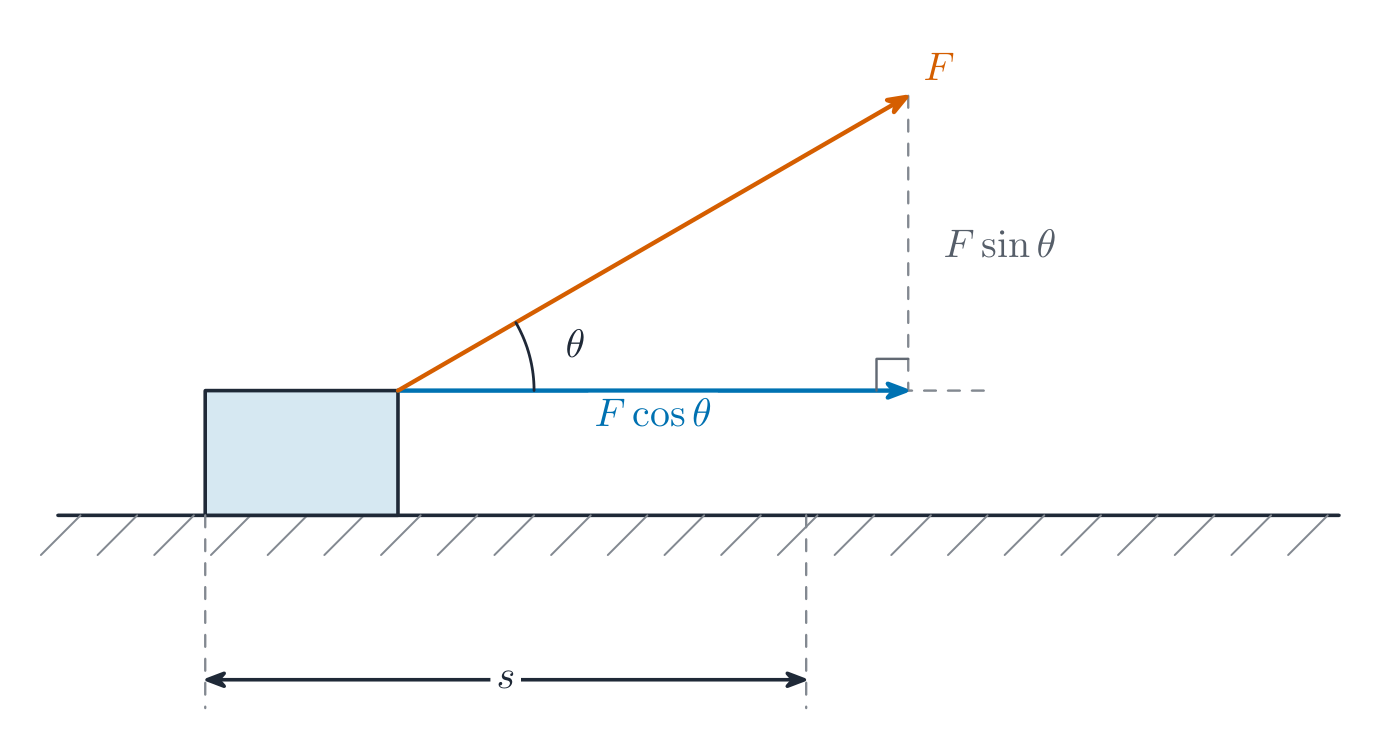
$$W=\int_a^b \vec{F}\cdot d\vec{r}=\int F\cos\theta\,dr.$$For a constant force this reduces to $W=Fd\cos\theta$; on a force–position graph, work is the area under the curve. Work is a scalar with a sign, and the sign is physics, not bookkeeping:
- Positive – force has a component along the motion (it speeds the object up).
- Negative – force opposes the motion (friction 摩擦力 and air drag do negative work).
- Zero – force perpendicular to the motion (the normal force 法向力 on a sliding block, gravity on a horizontal move, tension in a circular swing).
Only the force component along the displacement does work The work–energy theorem 动能定理 collects every force's contribution: the net work equals the change in kinetic energy,
$$W_{\text{net}}=\sum W_i=\Delta K.$$Worked example. A variable force $F(x)=3x^2\ \text{N}$ (along the motion) acts from $x=0$ to $x=2\ \text{m}$: $W=\displaystyle\int_0^2 3x^2\,dx=\big[x^3\big]_0^2=8\ \text{J}$. Acting alone on a body starting from rest, it would raise the kinetic energy to exactly $8\ \text{J}$.
Vocabulary · מילון מונחים Train · אימוןEnglish עברית Work/wɜːk/ עבודה integral/ˈɪntɪɡrəl/ אינטגרל friction/ˈfrɪkʃn/ חיכוך normal force/ˈnɔːml fɔːs/ כוח נורמלי work–energy theorem/wɜːk ˈenədʒi ˈθɪərəm/ משפט העבודה-אנרגיה 3.3
Potential Energy
Syllabus · סיילבוס
Learning Objective Essential Knowledge 3.3.A
Describe the potential energy of a system.- 3.3.A.1 A system composed of two or more objects has potential energy if the objects within that system only interact with each other through conservative forces.
- 3.3.A.2 Potential energy is a scalar quantity associated with the position of objects within a system.
- 3.3.A.3 The definition of zero potential energy for a given system is a decision made by the observer considering the situation to simplify or otherwise assist in analysis.
- 3.3.A.4 The relationship between conservative forces exerted on a system and the system's potential energy is
- Equation: $\Delta U = -\displaystyle\int_a^b \vec{F}_{cf}(r) \cdot d\vec{r}$
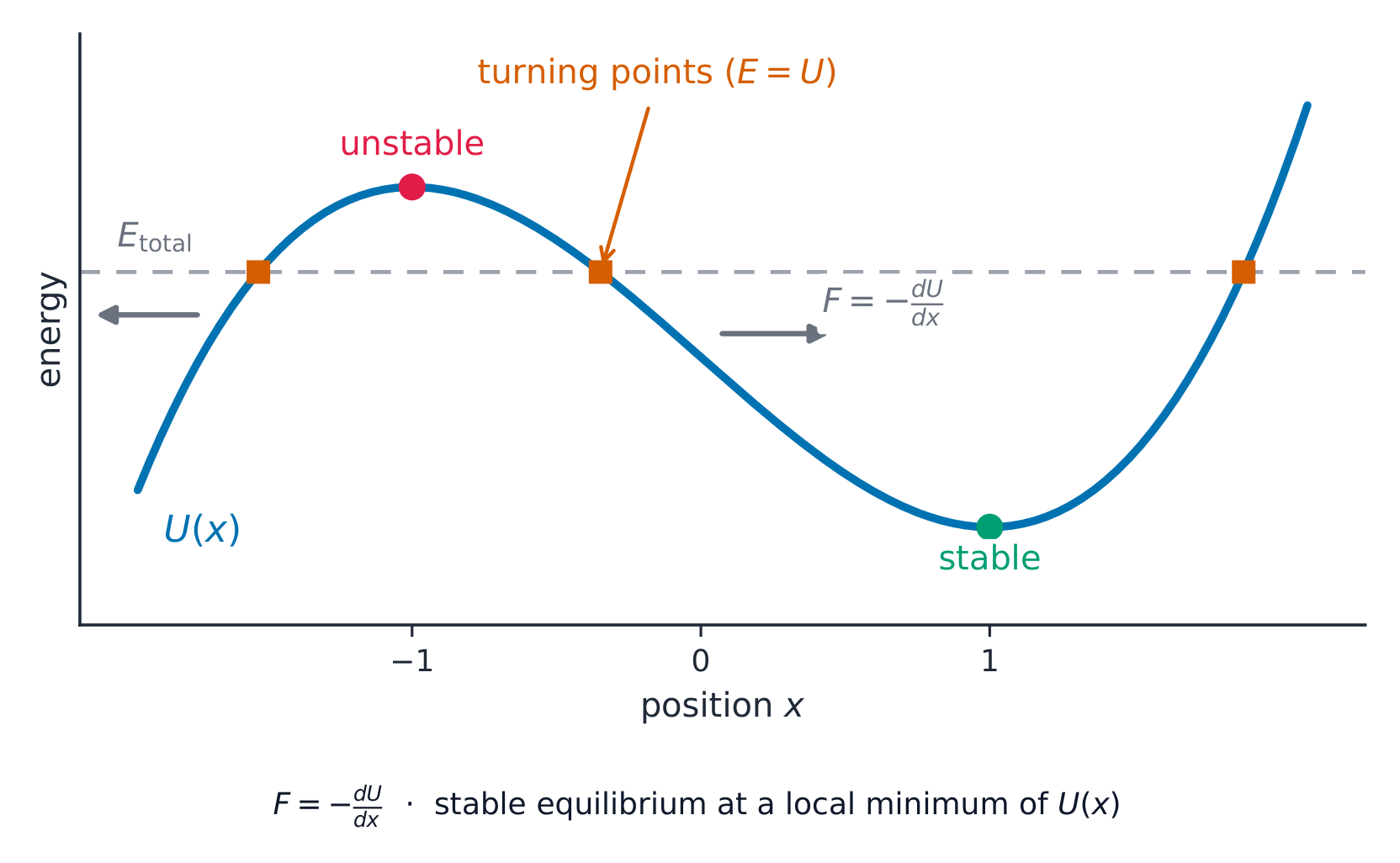
- 3.3.A.5 The conservative forces exerted on a system in a single dimension can be determined using the slope of the system's potential energy with respect to position in that dimension; these forces point in the direction of decreasing potential energy.
- Equation: $F_x = -\dfrac{dU(x)}{dx}$
- 3.3.A.6 Graphs of a system's potential energy as a function of its position can be useful in determining physical properties of that system.
- 3.3.A.6.i Stable equilibrium is a location at which a small displacement in an object's position results in a force exerted on the object opposite to the direction of the small displacement, accelerating the object back toward the equilibrium position.
- 3.3.A.6.ii Unstable equilibrium is a location at which a small displacement in an object's position results in a force exerted on the object in the same direction as the small displacement, accelerating the object away from the equilibrium position.
- 3.3.A.6.iii In a given dimension, stable equilibrium positions exist at locations where the potential energy as a function of position in that dimension has a local minimum.
- 3.3.A.6.iv In a given dimension, unstable equilibrium positions occur at locations where the potential energy as a function of position in that dimension has a local maximum.
- 3.3.A.7 The potential energy of common physical systems can be described using the physical properties of that system.
- 3.3.A.7.i The elastic potential energy of an ideal spring is given by the following equation, where $\Delta x$ is the distance the spring has been stretched or compressed from its equilibrium length.
- Equation: $U_s = \dfrac{1}{2}k(\Delta x)^2$
- 3.3.A.7.ii The general form for the gravitational potential energy of a system consisting of two approximately spherical distributions of mass (e.g., moons, planets, or stars) is given by the equation
- Equation: $U_g = -G\dfrac{m_1 m_2}{r}$
- 3.3.A.7.iii Because the gravitational field near the surface of a planet is nearly constant, the change in gravitational potential energy in a system consisting of an object with mass $m$ and a planet with gravitational field of magnitude $g$ when the object is near the surface of the planet may be approximated by the equation
- Equation: $\Delta U_g = mg\Delta y$
- 3.3.A.7.i The elastic potential energy of an ideal spring is given by the following equation, where $\Delta x$ is the distance the spring has been stretched or compressed from its equilibrium length.
- 3.3.A.8 The total potential energy of a system containing more than two objects is the sum of the potential energy of each pair of objects within the system.
Source: College Board AP Course and Exam Description · מקור: תיאור הקורס והמבחן של College Board AP
Potential energy 势能 is energy a system stores by the positions of its parts – it exists only for conservative forces 保守力, whose work is path independent. It is defined through work:
$$\Delta U=-\int_a^b\vec{F}\cdot d\vec{r},$$and you are free to choose where $U=0$ – only changes in $U$ matter, so pick the zero that makes the problem simplest. The standard results:
- Gravity near a surface: $\Delta U_g=mg\,\Delta y$.
- Gravity in general: $U_g=-\dfrac{Gm_1m_2}{r}$ (zero at infinite separation).
- Spring: $U_s=\tfrac12k(\Delta x)^2$, with $\Delta x$ measured from natural length.
For systems of several objects, add the potential energy of each pair. Turning the definition around, a conservative force is minus the derivative 导数 of its potential energy:
$$F_x=-\frac{dU}{dx}.$$The force points "downhill" on the $U(x)$ curve. Equilibrium sits where the slope is zero: a minimum is a stable equilibrium 稳定平衡 (displaced, the force pushes back), a maximum is an unstable equilibrium 不稳定平衡 (displaced, the force pushes away).
On a potential-energy curve the force points downhill and E = U marks the turning points Worked example. Given $U(x)=2x^3-6x$ (joules), the force is $F=-\dfrac{dU}{dx}=6-6x^2$. Equilibria sit at $F=0$: $x=\pm1$. Since $\dfrac{d^2U}{dx^2}=12x$ is positive at $x=+1$ (a minimum – stable) and negative at $x=-1$ (a maximum – unstable), the two points behave oppositely.
Explore · חקורStore elastic potential energy in a spring · אחסון אנרגיה פוטנציאלית אלסטית בקפיץ
Stretching a spring stores elastic potential energy $\tfrac12 kx^2$ — the area under the force-extension line. Release it and that energy becomes kinetic. · מתיחת קפיץ אוכפת אנרגיה פוטנציאלית אלסטית $\tfrac12 kx^2$ — השטח מתחת לקו הכוח-המתיחה. שחרר אותו ואותה אנרגיה הופכת לקינטית.
Vocabulary · מילון מונחים Train · אימוןEnglish עברית Potential energy/pəˈtenʃl ˈenədʒi/ אנרגיה פוטנציאלית conservative forces/kənˈsɜːvətɪv ˈfɔːsɪz/ כוחות שמרניים derivative/dɪˈrɪvətɪv/ נגזרת stable equilibrium/ˈsteɪbl ˌiːkwɪˈlɪbrɪəm/ איזון יציב unstable equilibrium/ʌnˈsteɪbl ˌiːkwɪˈlɪbrɪəm/ איזון לא יציב 3.4
Conservation of Energy
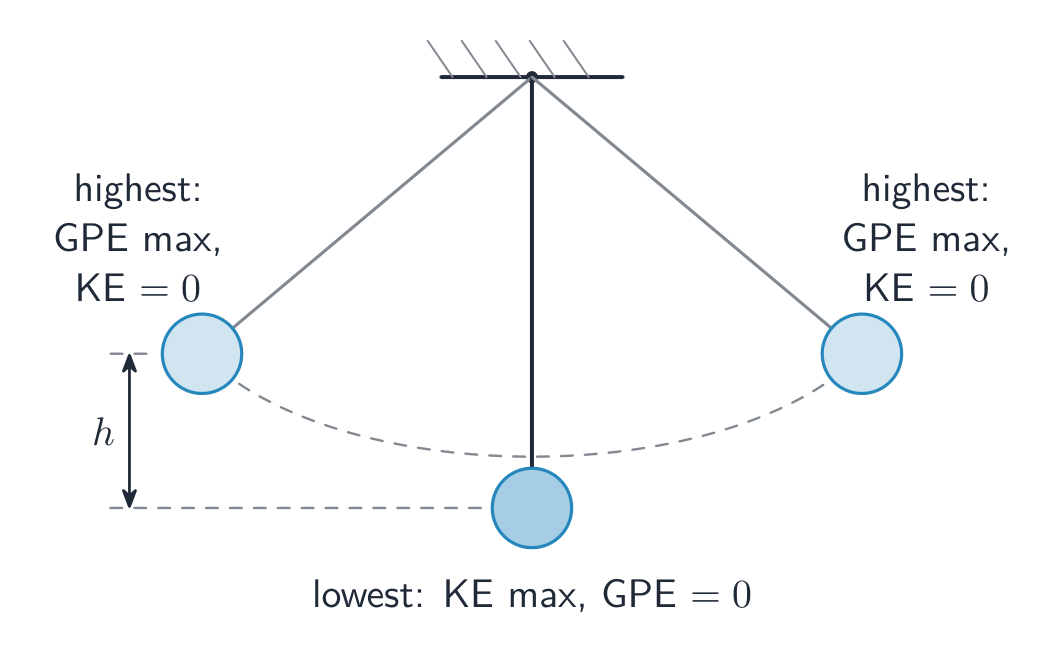
Syllabus · סיילבוס
EnglishLearning Objective 3.4.A: Describe the energies present in a system.
- 3.4.A.1 A system composed of only a single object can only have kinetic energy.
- 3.4.A.2 A system that contains objects that interact via conservative forces or that can change its shape reversibly may have both kinetic and potential energies.
Learning Objective 3.4.B: Describe the behavior of a system using conservation of mechanical energy principles.
- 3.4.B.1 Mechanical energy is the sum of a system's kinetic and potential energies.
- 3.4.B.2 Any change to a type of energy within a system must be balanced by an equivalent change of other types of energies within the system or by a transfer of energy between the system and its surroundings.
- 3.4.B.3 A system may be selected so that the total energy of that system is constant.
- 3.4.B.4 If the total energy of a system changes, that change will be equivalent to the energy transferred into or out of the system.
Learning Objective 3.4.C: Describe how the selection of a system determines whether the energy of that system changes.
- 3.4.C.1 Energy is conserved in all interactions.
- 3.4.C.2 If the work done on a selected system is zero and there are no nonconservative interactions within the system, the total mechanical energy of the system is constant.
- 3.4.C.3 If the work done on a selected system is nonzero, energy is transferred between the system and the environment.
Boundary statement: AP Physics C: Mechanics expects students to know that mechanical energy can be dissipated as thermal energy or sound by nonconservative forces.
עבריתמטרות למידה 3.4.A: לתאר את האנרגיות הקיימות במערכת.
- 3.4.A.1 מערכת המורכבת מאובייקט יחיד יכולה להיות לה רק אנרגיה קינטית.
- 3.4.A.2 מערכת המכילה אובייקטים המגיבים זה לזה באמצעות כוחות שימוריים או שמסוגלים לשנות את צורתם באופן הפיכי יכולה להיות לה גם אנרגיה קינטית וגם אנרגיה פוטנציאלית.
מטרות למידה 3.4.B: לתאר את התנהגות מערכת באמצעות עקרונות שימור אנרגיה מכנית.
- 3.4.B.1 האנרגיה המכנית היא סכום האנרגיה הקינטית והפוטנציאלית של מערכת.
- 3.4.B.2 כל שינוי בסוג אנרגיה בתוך מערכת חייב להיות מאוזן על ידי שינוי שווה בסוגי אנרגיה אחרים בתוך המערכת או על ידי העברת אנרגיה בין המערכת לסביבתה.
- 3.4.B.3 ניתן לבחור מערכת כך שהאנרגיה הכוללת שלה תהיה קבועה.
- 3.4.B.4 אם האנרגיה הכוללת של מערכת משתנה, השינוי יהיה שווה לאנרגיה שהועברה לתוך המערכת או מחוץ לה.
מטרת למידה 3.4.C: תאר כיצד בחירת המערכת קובעת האם האנרגיה שלה משתנה.
- 3.4.C.1 האנרגיה נשמרת בכל האינטראקציות.
- 3.4.C.2 אם העבודה שנעשתה על מערכת הנבחרת היא אפס ואין אינטראקציות לא-שימוריות בתוך המערכת, האנרגיה המכנית הכוללת שלה תהיה קבועה.
- 3.4.C.3 אם העבודה שנעשתה על מערכת הנבחרת אינה אפס, אנרגיה מועברת בין המערכת לסביבה.
הצהרת גבול: AP Physics C: Mechanics מצפה מתלמידים שיודעים שאנרגיה מכנית עשויה להתפזר כאנרגיה תרמית או כקול על ידי כוחות לא-שימוריים.
Source: College Board AP Course and Exam Description · מקור: תיאור הקורס והמבחן של College Board AP
Energy conservation: KE ⇄ PE Energy is conserved in all interactions – the question is only where it goes. Mechanical energy 机械能 is the sum $E=K+U$. If the external work on a system is zero and nothing inside it acts through nonconservative forces 非保守力, then
$$K_1+U_1=K_2+U_2.$$When friction or drag act, they convert mechanical energy into thermal energy 热能 ($\Delta E_{\text{mech}}=-F_fd$), and the balance must include that term. If external work is done, the system's total energy changes by exactly the energy transferred: $W_{\text{ext}}=\Delta E_{\text{sys}}$. Choosing the system is choosing the bookkeeping – a single object can only have kinetic energy; include the Earth or the spring and the system can store potential energy too.
A pendulum trades gravitational potential energy for kinetic energy and back A potential-energy graph is a complete motion map: the horizontal line at height $E$ is the total energy, the gap $E-U(x)$ is the kinetic energy at each $x$, and the crossings $E=U$ are the turning points 转折点 where the object momentarily stops and reverses.
Worked example. A $2.0\ \text{kg}$ block slides down a ramp from rest at height $1.5\ \text{m}$, arriving at the bottom at $4.0\ \text{m/s}$. Energy accounting: $mgh=29.4\ \text{J}$ available; $\tfrac12mv^2=16\ \text{J}$ arrives as kinetic energy; so friction converted $29.4-16=13\ \text{J}$ into thermal energy along the way.
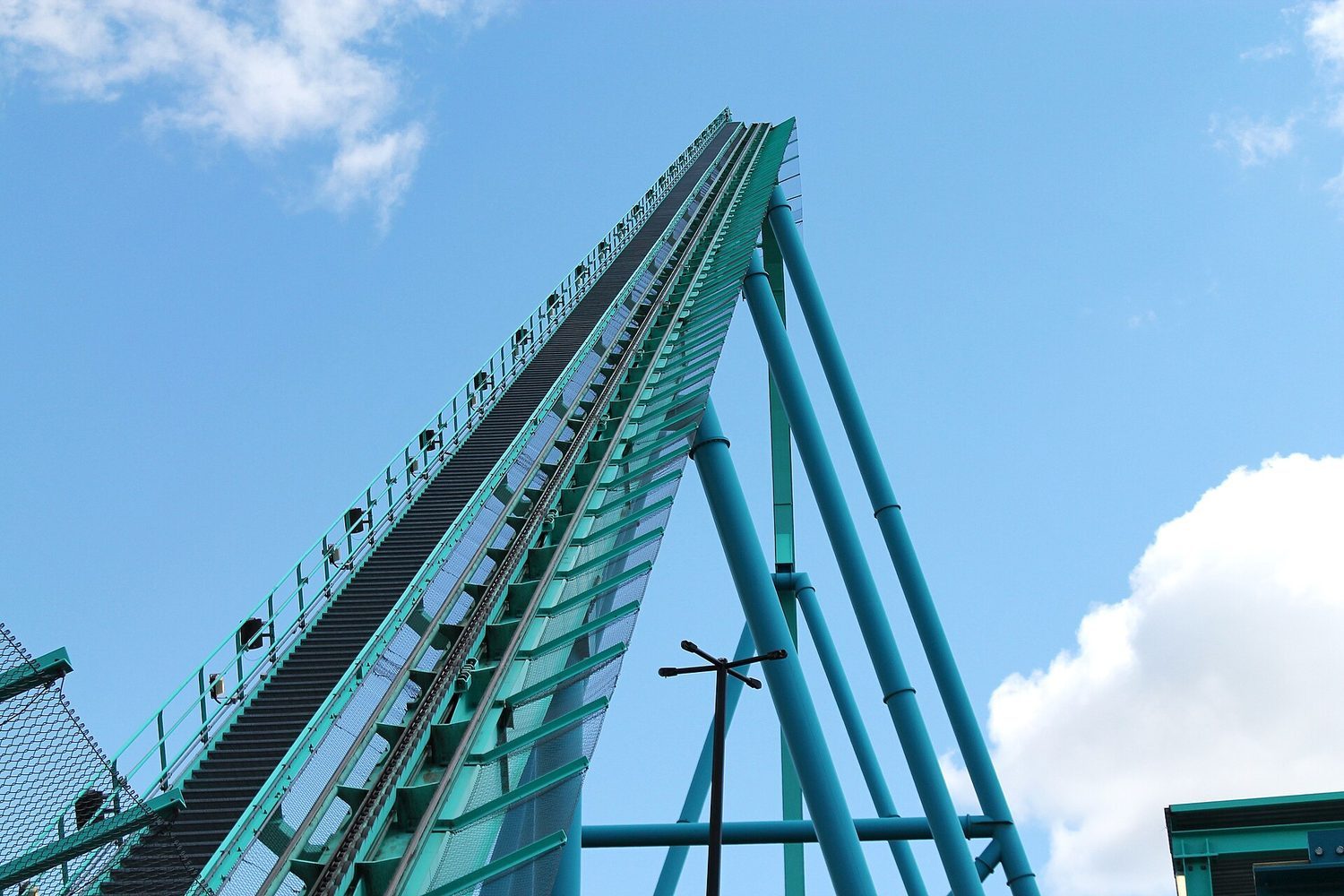
A roller coaster trades energy back and forth: highest (most PE) at the top, fastest (most KE) at the bottom Explore · חקורWatch energy convert as an object falls · צפה בהמרת אנרגיה כאשר גוף צולל
With no friction, mechanical energy is conserved: as an object falls, gravitational potential energy turns into kinetic energy while the total stays fixed. · ללא חיכוך, אנרגיה מכנית נשמרת: כאשר גוף צולל, אנרגיה פוטנציאלית כבידתית הופכת לאנרגיה קינטית בעוד שהסך הכל נשאר קבוע.
Vocabulary · מילון מונחים Train · אימוןEnglish עברית Mechanical energy/mɪˈkænɪkl ˈenədʒi/ אנרגיה מכנית nonconservative forces/ˌnɒŋkənˈsɜːvətɪv ˈfɔːsɪz/ כוחות לא שימוריים thermal energy/ˈθɜːml ˈenədʒi/ אנרגיה תרמית turning points/ˈtɜːnɪŋ pɔɪnts/ נקודות קיצון 3.5
Power
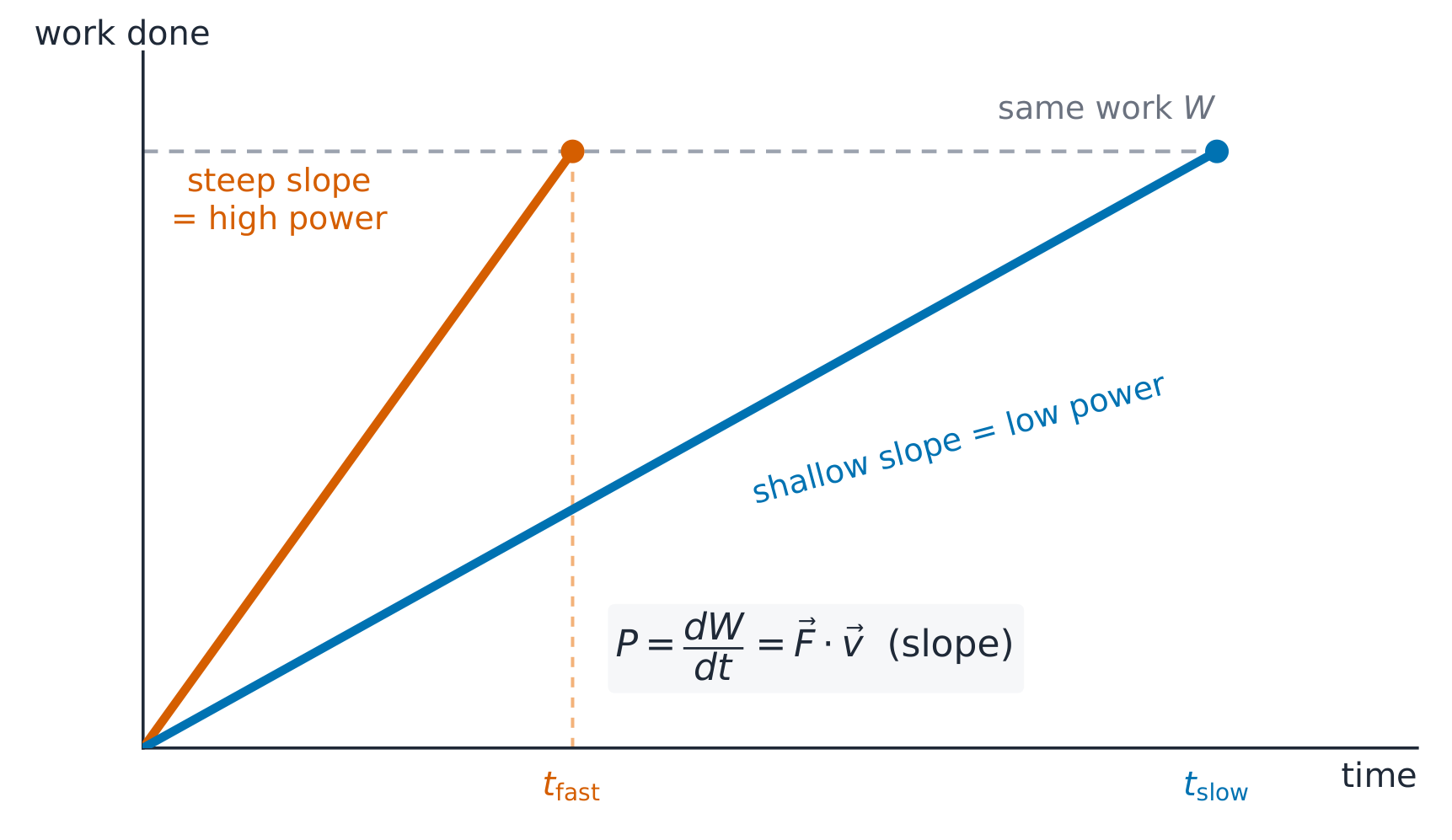
Syllabus · סיילבוס
EnglishLearning Objective 3.5.A: Describe the transfer of energy into, out of, or within a system in terms of power.
- 3.5.A.1 Power is the rate at which energy changes with respect to time, either by transfer into or out of a system or by conversion from one type to another within a system.
- 3.5.A.2 Average power is the amount of energy being transferred or converted, divided by the time it took for that transfer or conversion to occur.
- Equation: $P_{\text{avg}} = \dfrac{\Delta E}{\Delta t}$
- 3.5.A.3 Because work is the change in energy of an object or system due to a force, average power is the total work done, divided by the time during which that work was done.
- Equation: $P_{\text{avg}} = \dfrac{W}{\Delta t}$
- 3.5.A.4 The instantaneous power delivered to an object by a force is given by the equation
- Equation: $P_{\text{inst}} = \dfrac{dW}{dt}$
- 3.5.A.5 The instantaneous power delivered to an object by the component of a constant force parallel to the object's velocity can be described with the derived equation
- Equation: $P_{\text{inst}} = F_{\parallel}v = Fv\cos\theta$
עבריתמטרת למידה 3.5.A: תאר את ההעברה של אנרגיה לתוך, מחוץ או בתוך מערכת באמצעות הספק.
- 3.5.A.1 הספק הוא הקצב שבו אנרגיה משתנה בהתאם לזמן, הן על ידי העברה לתוך או מחוץ למערכת והן על ידי המרה מסוג אחד לשני בתוך המערכת.
- 3.5.A.2 הספק ממוצע הוא כמות האנרגיה המועברת או המומרת, חלקי הזמן שגם להעברה זו או המרה זו התרחשה.
- משוואה: $P_{\text{avg}} = \dfrac{\Delta E}{\Delta t}$
- 3.5.A.3 מכיוון שעבודה היא השינוי באנרגיה של גוף או מערכת בשל כוח, הספק ממוצע הוא העבודה הכוללת שביוצעה, חלקית בזמן שבו עבודה זו בוצעה.
- משוואה: $P_{\text{avg}} = \dfrac{W}{\Delta t}$
- 3.5.A.4 ההספק הרגעי המסופק לגוף על ידי כוח נתון על ידי המשוואה
- משוואה: $P_{\text{inst}} = \dfrac{dW}{dt}$
- 3.5.A.5 ההספק הרגעי המסופק לגוף על ידי רכיבו של כוח קבוע המקביל למהירות הגוף ניתן לתאר באמצעות המשוואה הנגזרת
- משוואה: $P_{\text{inst}} = F_{\parallel}v = Fv\cos\theta$
Source: College Board AP Course and Exam Description · מקור: תיאור הקורס והמבחן של College Board AP
Power 功率 is the rate of energy transfer, in watts 瓦特 (W):
$$P_{\text{avg}}=\frac{\Delta E}{\Delta t}=\frac{W}{\Delta t},\qquad P_{\text{inst}}=\frac{dW}{dt}=\vec{F}\cdot\vec{v}.$$It measures how fast work is done, not how much. The dot product matters: only the force component along the velocity delivers power.
Power is the slope of the work-time graph: the same work in less time means more power Worked example. A block released from rest at the top of a frictionless $3.0\ \text{m}$-high ramp reaches the bottom at $v=\sqrt{2gh}=7.7\ \text{m/s}$ (from $mgh=\tfrac12mv^2$). A motor that then drives it at a steady $7.7\ \text{m/s}$ against a $20\ \text{N}$ resistance delivers $P=Fv=20(7.7)\approx150\ \text{W}$.
Worked example. A $1200\ \text{kg}$ car climbs a hill that rises $1.0\ \text{m}$ for every $20\ \text{m}$ of road, at a steady $15\ \text{m/s}$. The engine must supply gravity's power drain: $P=mg\,v\sin\theta=1200(9.8)(15)\big(\tfrac{1}{20}\big)\approx8.8\ \text{kW}$ – before adding air resistance.
Exam skill. Energy FRQs reward the accounting sentence: name your system, state which forces do work on it, and write the balance ($W_{\text{ext}}=\Delta K+\Delta U+\Delta E_{\text{thermal}}$) before plugging in numbers. "Friction is present, so mechanical energy is not conserved" is a scored statement.
Vocabulary · מילון מונחים Train · אימוןEnglish עברית Power/ˈpaʊə/ הספק watts/wɒts/ וואט 3.5
Exam tips
- Use the work–energy theorem $W_{net}=\Delta KE$ and compute work as $W=\int \vec F\cdot d\vec r$ for a variable force.
- Read work off a force–position graph as the area under the curve.
- Power is $P=\tfrac{dW}{dt}=\vec F\cdot\vec v$; watch instantaneous vs average.
- Split forces into conservative (define a potential energy) and non-conservative (dissipate energy).
- Choose energy methods over kinematics when the force varies or the path is complex.
- 3.1.A.1 An object's translational kinetic energy is given by the equation
-
4
Linear Momentum · תנע ליניארי
Watch lesson · צפה בשיעור4.1
Linear Momentum · תנע ליני
Syllabus · סיילבוס
EnglishLearning Objective 4.1.A: Describe the linear momentum of an object or system.
- 4.1.A.1 Linear momentum is defined by the equation $\vec{p} = m\vec{v}$.
- 4.1.A.2 Momentum is a vector quantity and has the same direction as the velocity.
- 4.1.A.3 Momentum can be used to analyze collisions and explosions.
- 4.1.A.3.i A collision is a model for an interaction where the forces exerted between the involved objects in the system are much larger than the net external force exerted on those objects during the interaction.
- 4.1.A.3.ii As only the initial and final states of a collision are analyzed, the object model may be used to analyze collisions.
- 4.1.A.3.iii An explosion is a model for an interaction in which forces internal to the system move objects within that system apart.
עבריתמטרות למידה 4.1.A: תיאור התנע הליניארי של גוף או מערכת.
- 4.1.A.1 התנע הליניארי מוגדר על ידי המשוואה $\vec{p} = m\vec{v}$.
- 4.1.A.2 התנע הוא גודל וקטורי ולו אותה כיוון כמו המהירות.
- 4.1.A.3 ניתן להשתמש בתנע כדי לנתח התנגשויות והתפוצצויות.
- 4.1.A.3.i התנגשות היא דגם לאינטראקציה שבה הכוחות המופעלים בין הגופים המעורבים במערכת הם גדולים משמעותית מהכוח החיצוני הכולל הפועל עליהם במהלך האינטראקציה.
- 4.1.A.3.ii מכיוון שננתחים רק המצבים ההתחלתי והסופי של התנגשות, ניתן להשתמש בדגם הגוף כדי לנתח התנגשויות.
- 4.1.A.3.iii התפוצצות היא דגם לאינטראקציה שבה כוחות פנימיים למערכת מזיזים גופים בתוך המערכת זה הרחק מזה.
Source: College Board AP Course and Exam Description · מקור: תיאור הקורס והמבחן של College Board AP
EnglishLinear momentum 动量 is mass times velocity:
$$\vec{p}=m\vec{v}.$$It is a vector 矢量 pointing along the velocity, and it is the quantity for analysing collisions 碰撞 and explosions 爆炸. A collection of objects can be treated as one system moving with the velocity of its center of mass 质心:
$$\vec{v}_{\text{cm}}=\frac{\sum m_i\vec{v}_i}{\sum m_i},$$so the system's total momentum is its total mass times $\vec{v}_{\text{cm}}$ – one object's worth of bookkeeping for any number of parts.
עבריתתנע ליניארי הוא מסה כפול מהירות:
$$\vec{p}=m\vec{v}.$$זהו ווקטור המצביח לאורך המהירות, והוא הכמות המתאימה ביותר לניתוח התנגשויות ופיצוץ. קבוצת גופים ניתן לטפל בה כמערכת אחת הנעה במהירות של מרכז המסה שלה:
$$\vec{v}_{\text{cm}}=\frac{\sum m_i\vec{v}_i}{\sum m_i},$$ולכן התנע הכולל של המערכת הוא מסתה הכוללת כפול $\vec{v}_{\text{cm}}$ – חשבון בודד לכל מספר של חלקים.
4.2
Change in Momentum and Impulse · שינוי בתנע ותנופה
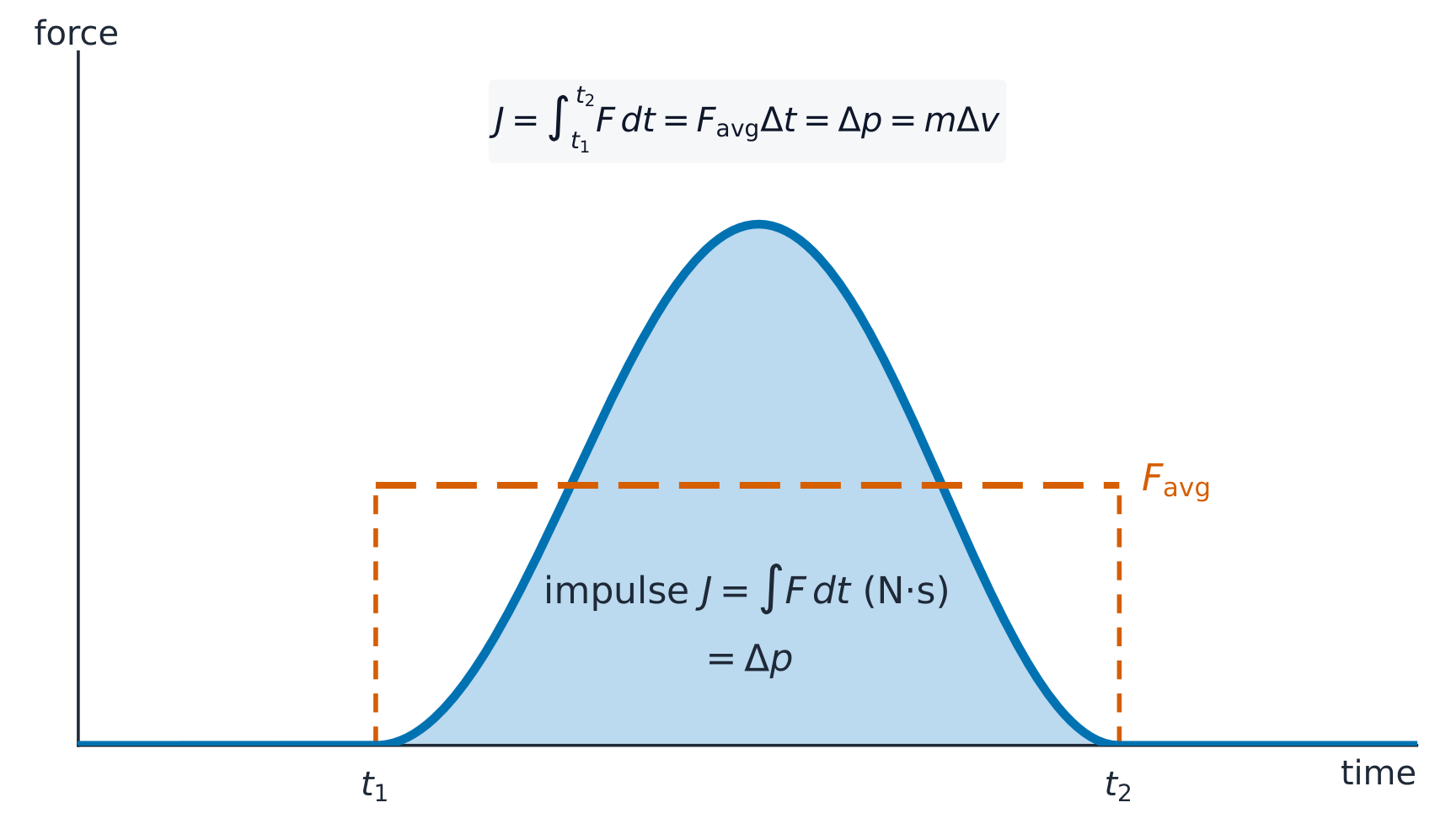
Syllabus · סיילבוס
EnglishLearning Objective 4.2.A: Describe the impulse delivered to an object or system.
- 4.2.A.1 The rate of change of a system's momentum is equal to the net external force exerted on that system.
- Equation: $\vec{F}_{\text{net}} = \dfrac{d\vec{p}}{dt}$
- 4.2.A.2 Impulse is defined as the integral of a force exerted on an object or system over a time interval.
- Equation: $\vec{J} = \displaystyle\int_{t_1}^{t_2} \vec{F}_{\text{net}}(t)\,dt$
- 4.2.A.3 Impulse is a vector quantity and has the same direction as the net force exerted on the system.
- 4.2.A.4 The impulse delivered to a system by a net external force is equal to the area under the curve of a graph of the net external force exerted on the system as a function of time.
- 4.2.A.5 The net external force exerted on a system is equal to the slope of a graph of the momentum of the system as a function of time.
Learning Objective 4.2.B: Describe the relationship between the impulse exerted on an object or system and the change in momentum of the object or system.
- 4.2.B.1 Change in momentum is the difference between a system's final momentum and its initial momentum.
- Equation: $\Delta\vec{p} = \vec{p} - \vec{p}_0$
- 4.2.B.2 The impulse–momentum theorem relates the impulse delivered to an object and the object's change in momentum.
- 4.2.B.2.i The impulse exerted on an object is equal to the object's change in momentum.
- Equation: $\vec{J} = \displaystyle\int_{t_1}^{t_2} \vec{F}_{\text{net}}(t)\,dt = \Delta\vec{p}$
- 4.2.B.2.ii Newton's second law of motion is a direct result of the impulse–momentum theorem applied to systems with constant mass.
- Equation: $\vec{F}_{\text{net}} = \dfrac{d\vec{p}}{dt} = m\dfrac{d\vec{v}}{dt} = m\vec{a}$
- 4.2.B.2.iii The impulse–momentum theorem also describes the behavior of a system in which the velocity is constant but the mass changes with respect to time.
- Equation: $\vec{F}_{\text{net}} = \dfrac{d\vec{p}}{dt} = \dfrac{dm}{dt}\vec{v}$
- 4.2.B.2.i The impulse exerted on an object is equal to the object's change in momentum.
עבריתמטרות למידה 4.2.A: תיאור התנופה המסופקת לגוף או למערכת.
- 4.2.A.1 קצב השינוי בנתוני התנועה של מערכת שווה לכוח החיצוני הכולל הפועל על המערכת.
- משוואה: $\vec{F}_{\text{net}} = \dfrac{d\vec{p}}{dt}$
- 4.2.A.2 האימפולס מוגדר כאינטגרל של כוח הפועל על גוף או מערכת לאורך פרק זמן.
- משוואה: $\vec{J} = \displaystyle\int_{t_1}^{t_2} \vec{F}_{\text{net}}(t)\,dt$
- 4.2.A.3 תנופה היא גודל וקטורי ולו אותה כיוון כמו הכוח הכולל הפועל על המערכת.
- 4.2.A.4 התנופה המסופקת למערכת על ידי כוח חיצוני כולל שווה לשטח מתחת לעקומה בגרף של הכוח החיצוני הכולל הפועל על המערכת כתלות בזמן.
- 4.2.A.5 הכוח החיצוני הכולל הפועל על מערכת שווה לשיפוע בגרף של התנע של המערכת כתלות בזמן.
מטרת למידה 4.2.B: לתאר את הקשר בין האימפולס הפועל על גוף או מערכת לבין השינוי בנתוני התנועה של הגוף או המערכת.
- 4.2.B.1 שינוי בתנע הוא ההפרש בין התנע הסופי של המערכת לתנע ההתחלתי שלה.
- משוואה: $\Delta\vec{p} = \vec{p} - \vec{p}_0$
- 4.2.B.2 משפט האימפולס-נתוני התנועה מקשר בין האימפולס המסופק לגוף לבין השינוי בנתוני התנועה שלו.
- 4.2.B.2.i האימפולס הפועל על גוף שווה לשינוי בנתוני התנועה של הגוף.
- משוואה: $\vec{J} = \displaystyle\int_{t_1}^{t_2} \vec{F}_{\text{net}}(t)\,dt = \Delta\vec{p}$
- 4.2.B.2.ii חוק התנועה השני של ניוטון הוא תוצאה ישירה של משפט האימפולס-נתוני התנועה המיושם על מערכות בעלות מסה קבועה.
- משוואה: $\vec{F}_{\text{net}} = \dfrac{d\vec{p}}{dt} = m\dfrac{d\vec{v}}{dt} = m\vec{a}$
- 4.2.B.2.iii משפט האימפולס-נתוני התנועה מתאר גם את התנהגות מערכת שבה המהירות קבועה אך המסה משתנה לאורך הזמן.
- משוואה: $\vec{F}_{\text{net}} = \dfrac{d\vec{p}}{dt} = \dfrac{dm}{dt}\vec{v}$
- 4.2.B.2.i האימפולס הפועל על גוף שווה לשינוי בנתוני התנועה של הגוף.
Source: College Board AP Course and Exam Description · מקור: תיאור הקורס והמבחן של College Board AP
EnglishNewton's second law is really a statement about momentum:
$$\vec{F}_{\text{net}}=\frac{d\vec{p}}{dt},$$which reduces to $m\vec{a}$ when the mass is constant – and handles a changing mass when it is not (the special case $\vec{F}=\dfrac{dm}{dt}\vec{v}$ holds only when the velocity is constant, e.g. a chain piling onto a scale or sand landing on a belt moving at fixed speed; a rocket does not fit, since it accelerates). The impulse 冲量 delivered by a force is its time integral, and the impulse–momentum theorem 冲量-动量定理 says it equals the change in momentum:
$$\vec{J}=\int_{t_1}^{t_2}\vec{F}_{\text{net}}\,dt=\Delta\vec{p}.$$Impulse is a vector along the net force. Read it off graphs both ways:
- On a force–time graph, impulse is the area under the curve.
- On a momentum–time graph, the net force is the slope 斜率 at each instant.
Spreading the same $\Delta p$ over a longer time lowers the force – that is why airbags, crumple zones, and soft landings work, and why you bend your knees when you land.
Worked example. A time-varying force $F(t)=10t\ \text{N}$ acts on a $2.0\ \text{kg}$ object for $2.0\ \text{s}$. The impulse is $J=\displaystyle\int_0^2 10t\,dt=\big[5t^2\big]_0^2=20\ \text{N}\cdot\text{s}$, so the speed changes by $\Delta v=J/m=10\ \text{m/s}$.
עבריתחוק השני של ניוטון הוא למעשה הצהרה על תנע:
$$\vec{F}_{\text{net}}=\frac{d\vec{p}}{dt},$$שהוא מצטמצם ל$m\vec{a}$ כאשר המסה קבועה – ומטפל במסה מתغيرة כאשר זו אינה כזו (המקרה המיוחד $\vec{F}=\dfrac{dm}{dt}\vec{v}$ תקף רק כאשר המהירות קבועה, למשל שרשרת מצטברת על משקל או חול נופל על חגורה הנעה במהירות קבועה; רקטור לא מתאים, שכן הוא מאיץ). התנעה המסופקת על ידי כוח היא האיגרל של הזמן שלו, ומשפט התנעה-תנע- אומר שהוא שווה לשינוי בתנע:
$$\vec{J}=\int_{t_1}^{t_2}\vec{F}_{\text{net}}\,dt=\Delta\vec{p}.$$התנעה היא וקטור לאורך הכוח הכולל. קראו אותה בגרפים בשתי דרכים:
- בגרף כוח-זמן, התנעה היא שטח מתחת לעקומה.
- בגרף התנע–זמן, הכוח הכולל הוא השיפוע בכל רגע נתון.
העתק הוא השטח מתחת לעקומת הכוח-זמן, שווה לכוח הממוצע כפול זמן המגע פיזור אותו $\Delta p$ על פני זמן ארוך יותר מפחית את הכוח – ולכן בוליות אוויר, אזורי התכווצות ונחיתה רכה עובדים, וכך גם כיפוף הברכיים בזמן הנחיתה.
דוגמה מפורטת. כוח תלוי-זמן $F(t)=10t\ \text{N}$ פועל על גוף בעל מסת $2.0\ \text{kg}$ למשך $2.0\ \text{s}$. האימפולס הוא $J=\displaystyle\int_0^2 10t\,dt=\big[5t^2\big]_0^2=20\ \text{N}\cdot\text{s}$, ולכן המהירות משתנה ב-$\Delta v=J/m=10\ \text{m/s}$.
Vocabulary · מילון מונחים Train · אימוןEnglish עברית Linear momentum/ˈlɪnɪə məʊˈmentəm/ תנע קווי vector/ˈvektə/ מסיר מחלות collisions/kəˈlɪʒnz/ התנגשויות explosions/ekˈspləʊʒnz/ פיצוצים center of mass/ˈsentə ɒv mæs/ מרכז המסה impulse/ˈɪmpʌls/ תנע כוח impulse–momentum theorem/ˈɪmpʌls məʊˈmentəm ˈθɪərəm/ משפט הדחיפה–תנע slope/sləʊp/ שיפוע conserved/kənˈsɜːvd/ שמור על ערכו kinetic energy/kɪˈnetɪk ˈenədʒi/ אנרגיה קינטית elastic collision/ɪˈlæstɪk kəˈlɪʒn/ התנגשות אלסטית inelastic collision/ɪnɪˈlæstɪk kəˈlɪʒn/ התנגשות לא-אלסטית deformation/ˌdiːfɔːˈmeɪʃn/ עיוות perfectly inelastic collision/ˈpɜːfektlɪ ɪnɪˈlæstɪk kəˈlɪʒn/ התנגשות פלסטית מושלמת 4.3
Conservation of Linear Momentum · שימור תנע ליני
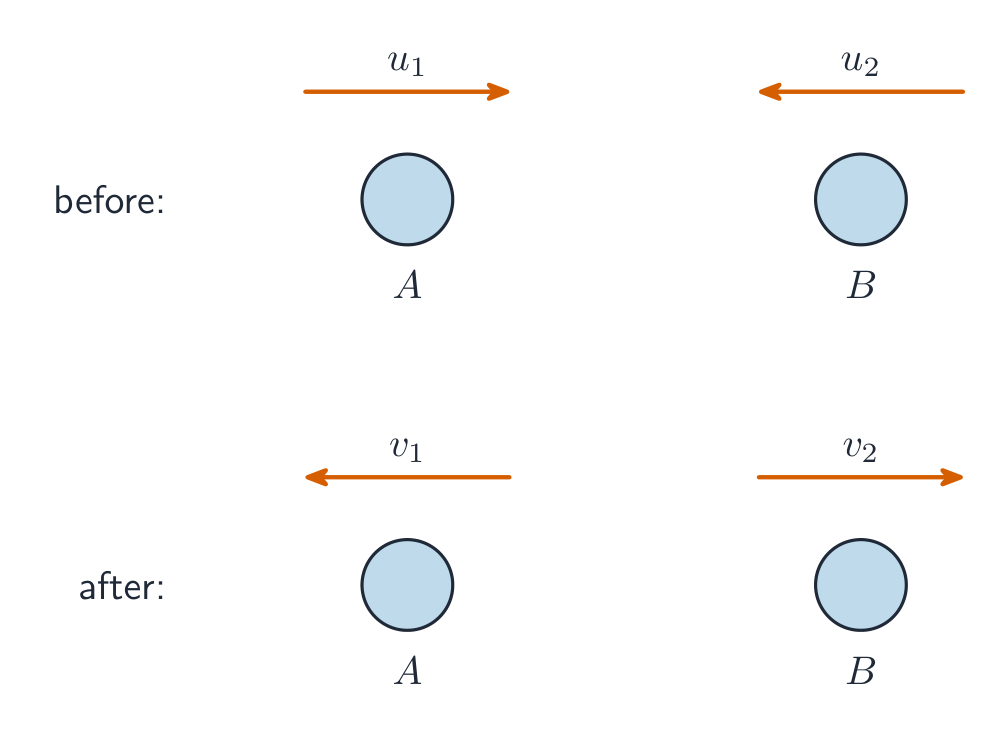
Syllabus · סיילבוס
EnglishLearning Objective 4.3.A: Describe the behavior of a system using conservation of linear momentum.
- 4.3.A.1 A collection of objects with individual momenta can be described as one system with one center-of-mass velocity.
- 4.3.A.1.i For a collection of objects, the velocity of a system's center of mass can be calculated using the equation
- Equation: $\vec{v}_{\text{cm}} = \dfrac{\sum \vec{p}_i}{\sum m_i} = \dfrac{\sum (m_i \vec{v}_i)}{\sum m_i}$
- 4.3.A.1.ii The velocity of a system's center of mass is constant in the absence of a net external force.
- 4.3.A.1.i For a collection of objects, the velocity of a system's center of mass can be calculated using the equation
- 4.3.A.2 The total momentum of a system is the sum of the momenta of the system's constituent parts.
- 4.3.A.3 In the absence of net external forces, any change to the momentum of an object within a system must be balanced by an equivalent and opposite change of momentum elsewhere within the system. Any change to the momentum of a system is due to a transfer of momentum between the system and its surroundings.
- 4.3.A.3.i The impulse exerted by one object on a second object is equal and opposite to the impulse exerted by the second object on the first. This is a direct result of Newton's third law.
- 4.3.A.3.ii A system may be selected so that the total momentum of that system is constant.
- 4.3.A.3.iii If the total momentum of a system changes, that change will be equivalent to the impulse exerted on the system.
- Equation: $\vec{J} = \Delta\vec{p}$
- 4.3.A.4 Correct application of conservation of momentum can be used to determine the velocity of a system immediately before and immediately after collisions or explosions.
Boundary statement: AP Physics C: Mechanics only expects students to quantitatively analyze collisions and interactions in one or two dimensions. Three-dimensional collisions may be analyzed qualitatively.
Learning Objective 4.3.B: Describe how the selection of a system determines whether the momentum of that system changes.
- 4.3.B.1 Momentum is conserved in all interactions.
- 4.3.B.2 If the net external force on the selected system is zero, the total momentum of the system is constant.
- 4.3.B.3 If the net external force on the selected system is nonzero, momentum is transferred between the system and the environment.
עבריתמטרות למידה 4.3.A: לתאר את התנהגות המערכת באמצעות שימור תנע ליני.
- 4.3.A.1 אוסף של עצמים עם תנעים פרטיים ניתן לתיאור כמערכת אחת עם מהירות מרכז המסה אחת.
- 4.3.A.1.i עבור קבוצת גופים, מהירות מרכז המסה של מערכת ניתנת לחישוב באמצעות המשוואה
- משוואה: $\vec{v}_{\text{cm}} = \dfrac{\sum \vec{p}_i}{\sum m_i} = \dfrac{\sum (m_i \vec{v}_i)}{\sum m_i}$
- 4.3.A.1.ii מהירות מרכז המסה של המערכת היא קבועה בהיעדר כוח חיצוני נטו.
- 4.3.A.1.i עבור קבוצת גופים, מהירות מרכז המסה של מערכת ניתנת לחישוב באמצעות המשוואה
- 4.3.A.2 התנע הכולל של מערכת הוא סכום התנעים של החלקים המרכיבים אותה.
- 4.3.A.3 בהיעדר כוחות חיצוניים נטו, כל שינוי בתנע של גוף כלשהו בתוך המערכת חייב להיות מאוזן על ידי שינוי תנע שווה בגודלו אך מנוגד בכיוונו במקום אחר בתוך המערכת. כל שינוי בתנע המערכת נובע מהעברת תנע בין המערכת לסביבתה.
- 4.3.A.3.i הדחיפה שמפעיל גוף אחד על גוף שני שווה בגודלה ומנוגדת בכיוונה לדחיפה שמפעיל הגוף השני על הראשון. זהו תוצאה ישירה של חוק השלישי של ניוטון.
- 4.3.A.3.ii ניתן לבחור מערכת כך שתנעה הכולל שלה יהיה קבוע.
- 4.3.A.3.iii אם התנע הכולל של המערכת משתנה, השינוי הזה יהיה שקול לדחיפה שהופעלה על המערכת.
- משוואה: $\vec{J} = \Delta\vec{p}$
- 4.3.A.4 יישום נכון של שימור התנע יכול לשמש לקביעת מהירות המערכת מיד לפני ומיד לאחר התנגשות או פיצוץ.
הצהרת גבול: AP Physics C: Mechanics מצפה מתלמידים לניתוח כמותי של התנגשויות ופעולות ממדים אחד או שניים בלבד. התנגשויות תלת-ממדיות ניתנות לניתוח איכותי בלבד.
מטרות למידה 4.3.B: לתאר כיצד בחירת המערכת קובעת האם תנעה שלה משתנה.
- 4.3.B.1 תנע נשמר בכל האינטראקציות.
- 4.3.B.2 אם הכוח החיצוני הנטו על המערכת הנבחרת הוא אפס, התנע הכולל של המערכת הוא קבוע.
- 4.3.B.3 אם הכוח החיצוני הנטו על המערכת הנבחרת אינו אפס, מתבצע העברת תנע בין המערכת לסביבה.
Source: College Board AP Course and Exam Description · מקור: תיאור הקורס והמבחן של College Board AP
EnglishInternal forces come in Newton's-third-law pairs, so they cancel inside any system: they can shuffle momentum between parts but never change the total. Momentum only enters or leaves a system through a net external force ($\vec{J}=\Delta\vec{p}$). So, with zero net external force, total momentum is conserved 守恒:
$$\sum\vec{p}_{\text{before}}=\sum\vec{p}_{\text{after}}.$$Momentum is conserved in every collision, however violent – choose the system large enough that the collision forces are internal. Apply conservation separately along each axis; AP asks for quantitative work in one or two dimensions.
Worked example (explosion). A $6.0\ \text{kg}$ shell at rest splits into a $2.0\ \text{kg}$ piece moving at $9.0\ \text{m/s}$ east and a $4.0\ \text{kg}$ piece. Total momentum stays zero, so the heavy piece moves west at $v=\dfrac{2.0(9.0)}{4.0}=4.5\ \text{m/s}$. The kinetic energy came from stored (chemical or spring) energy – momentum conservation does not require kinetic-energy conservation.
עבריתכוחות פנימיים מגיעים בזוגות החוק השלישי של ניוטון, ולכן הם מתאפסים בתוך כל מערכת: הם יכולים להעביר תנע בין חלקי המערכת אך לעולם לא לשנות את הסך הכל. תנע נכנס או יוצא ממערכת רק דרך כוח חיצוני נטו ($\vec{J}=\Delta\vec{p}$). לכן, עם כוח חיצוני נטו אפס, התנע הכולל נשמר:
$$\sum\vec{p}_{\text{before}}=\sum\vec{p}_{\text{after}}.$$תנע נשמר בכל התנגשות, ללא קשר לווריאנטיות – יש לבחור במערכת גדולה מספיק כך שכוחות ההתנגשות יהיו פנימיים. יש לחייב שמירה בנפרד לאורך כל ציר; AP דורשת עבודה כמותית בממד אחד או שניים.
התנגשות ראש-בראש: התנע הכולל לפני שווה להתנע הכולל אחרי דוגמה פתורה (פיצוץ). קליע בעל מסה $6.0\ \text{kg}$ בשקט מתפצל לחתיכה בעלת מסה $2.0\ \text{kg}$ הנעה במהירות $9.0\ \text{m/s}$ מזרח וחתיכה בעלת מסה $4.0\ \text{kg}$. התנע הכולל נשאר אפס, ולכן החתיכה הכבדה נעה מערב במהירות $v=\dfrac{2.0(9.0)}{4.0}=4.5\ \text{m/s}$. האנרגיה הקינטית הגיעה מאנרגיה מאוגרת (כימית או קפיצית) – שמירת תנע אינה דורשת שמירת אנרגיה קינטית.
Explore · חקורCollide two carts and conserve momentum · התנגשות בין שני עגלות ושימור תנע
In any collision the total momentum $\sum mv$ before equals the total after. Set the masses and speeds and check the momentum bookkeeping. · בהתנגשות כלשהי ה-תנע הכולל $\sum mv$ לפני שווה לזה לאחר. הגדר את המסות והמהירויות ובדוק את חשבונות התנע.
4.4
Elastic and Inelastic Collisions · התנגשויות אלסטיות ולא-אלסטיות
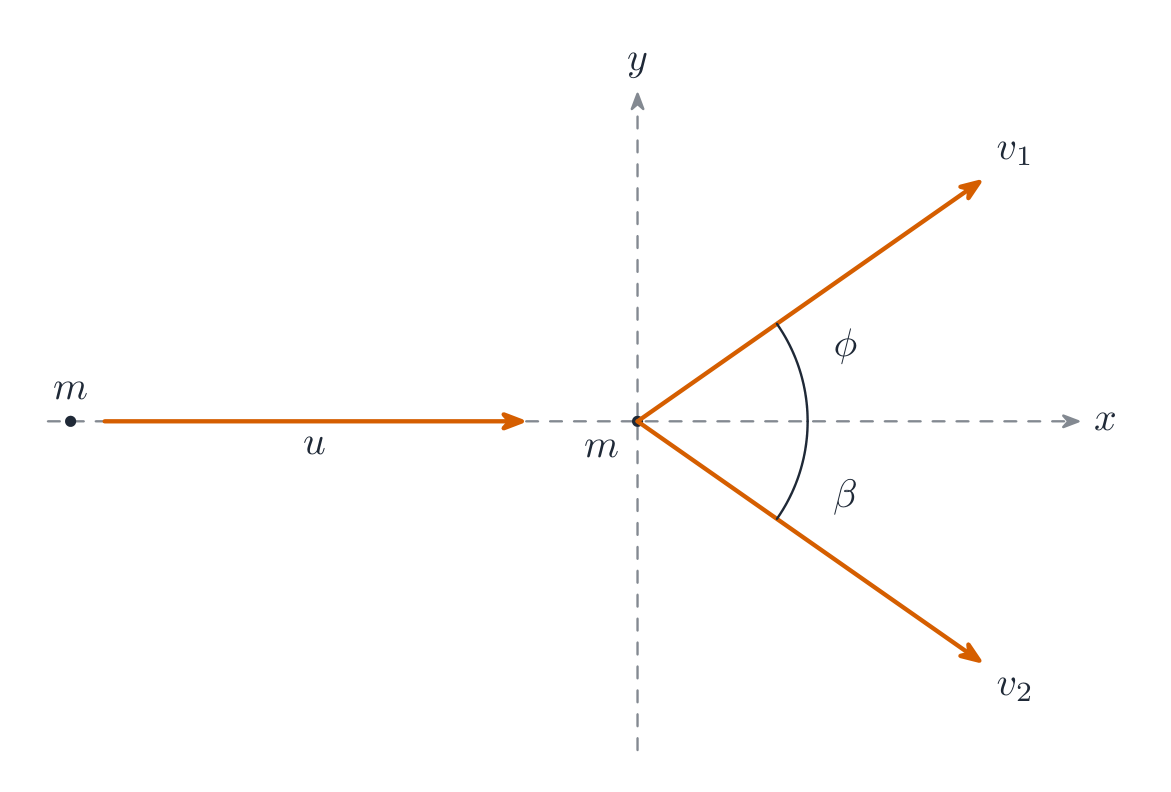
Syllabus · סיילבוס
EnglishLearning Objective 4.4.A: Describe whether an interaction between objects is elastic or inelastic.
- 4.4.A.1 An elastic collision between objects is one in which the initial kinetic energy of the system is equal to the final kinetic energy of the system.
- 4.4.A.2 In an elastic collision, the final kinetic energies of each of the objects within the system may be different from their initial kinetic energies.
- 4.4.A.3 An inelastic collision between objects is one in which the total kinetic energy of the system decreases.
- 4.4.A.4 In an inelastic collision, some of the initial kinetic energy is not restored to kinetic energy but is transformed by nonconservative forces into other forms of energy.
- 4.4.A.5 In a perfectly inelastic collision, the objects stick together and move with the same velocity after the collision.
עבריתמטרת למידה 4.4.A: תאר האם האינטראקציה בין גופים היא אלסטית או לא-אלסטית.
- 4.4.A.1 התנגשות אלסטית בין גופים היא זו שבה אנרגיית הקינטיקה ההתחלתית של המערכת שווה לאנרגיית הקינטיקה הסופית של המערכת.
- 4.4.A.2 בהתנגשות אלסטית, אנרגיות הקינטיקה הסופיות של כל אחד מהגופים בתוך המערכת עשויות להיות שונות מאנרגיות הקינטיקה ההתחלתיות שלהם.
- 4.4.A.3 התנגשות לא-אלסטית בין גופים היא זו שבה סך אנרגיית הקינטיקה של המערכת יורדת.
- 4.4.A.4 בהתנגשות לא-אלסטית, חלק מאנרגיית הקינטיקה ההתחלתית אינו מוחזר כאנרגיית קינטיקה אלא הופץ על ידי כוחות לא-שמרניים לצורות אנרגיה אחרות.
- 4.4.A.5 בהתנגשות לא-אלסטית מושלמת, הגופים נדבקים זה לזה ונעים במהירות זהה לאחר ההתנגשות.
Source: College Board AP Course and Exam Description · מקור: תיאור הקורס והמבחן של College Board AP
EnglishConservation of momentum in a collision All collisions conserve momentum; they differ in what happens to the kinetic energy 动能:
type momentum kinetic energy elastic collision 弹性碰撞 conserved total conserved (individual shares may change) inelastic collision 非弹性碰撞 conserved decreases – some becomes heat, sound, deformation 形变 perfectly inelastic collision 完全非弹性碰撞 conserved largest possible loss – the objects stick and share one velocity Strategy: always write momentum conservation first; add the kinetic-energy equation only when the problem says "elastic". Two useful elastic facts: equal masses in a 1D elastic collision simply exchange velocities, and in the center-of-mass frame each object just reverses its velocity.
Worked example. A $1000\ \text{kg}$ car at $20\ \text{m/s}$ strikes a stationary $1500\ \text{kg}$ car and they lock together – perfectly inelastic. Momentum: $v=\dfrac{1000(20)}{2500}=8.0\ \text{m/s}$. Kinetic energy falls from $2.0\times10^5\ \text{J}$ to $\tfrac12(2500)(8.0)^2=8.0\times10^4\ \text{J}$: about $60\%$ is lost, even though momentum is exactly conserved.
Worked example (2D). A puck moving east at $4.0\ \text{m/s}$ strikes an identical puck at rest; after the glancing hit, one moves at $2.0\ \text{m/s}$ at $60^\circ$ north of east. Conserve each axis: east–west, $m(4.0)=m(2.0)\cos60^\circ+mv_x$, so $v_x=3.0\ \text{m/s}$; north–south, $0=m(2.0)\sin60^\circ-mv_y$, so $v_y=1.7\ \text{m/s}$. The second puck moves at $\sqrt{3.0^2+1.7^2}=3.5\ \text{m/s}$, about $30^\circ$ south of east.
Exam skill. On FRQs, justify with the condition, not the slogan: "the net external force on the two-puck system is zero during the collision, so its total momentum is constant." If asked whether the collision is elastic, compute the kinetic energy before and after and compare – never assume.
עבריתשימור תנע בהתנגשות כל ההתנגשותות שומרות על תנע; הן נבדלות זה מזה במה שקורה לאנרגיה הקינטית:
סוג תנע אנרגיה קינטית התנגשות אלסטית נשמר סך הכל נשמר (חלקים פרטיים עשויים להשתנות) התנגשות לא-אלסטית נשמר יורדת – חלק מהם הופך לחום, קול או עיוות התנגשות לא-אלסטית מושלמת נשמר איבוד האנרגיה הגדול ביותר – האובייקטים נדבקים ומשתפים מהירות אחת אסטרטגיה: תמיד כתבו שימור תנע קודם כל; הוסיפו את משוואת האנרגיה הקינטית רק כאשר השאלה אומרת "אלסטית". שתי עובדות שימושיות לגבי התנגשויות אלסטיות: מסות שוות בהתנגשות אלסטית ב1D פשוט מחליפות מהירויות, ובמסגרת הייחוס של מרכז המסה כל גוף פשוט מקבל את כיוון המהירות הפוך.
דוגמה מפורטת. רכב בעל מסת $1000\ \text{kg}$ המנוע במהירות $20\ \text{m/s}$ פוגע ברכב נח不动 בעל מסת $1500\ \text{kg}$ והם ננעלים יחד – התנגשות לא-אלסטית מושלמת. תנע: $v=\dfrac{1000(20)}{2500}=8.0\ \text{m/s}$. אנרגיה קינטית יורדת מ-$2.0\times10^5\ \text{J}$ ל-$\tfrac12(2500)(8.0)^2=8.0\times10^4\ \text{J}$: כ-$60\%$ אובדו, אף על פי שהתנע שמור בדיוק.
דוגמה פתורה (2D). פאנק נעים מזרח במהירות $4.0\ \text{m/s}$ פוגע בפאנק זהה בשקט; לאחר הפגיעה הרחבה, אחד נע במהירות $2.0\ \text{m/s}$ בזווית $60^\circ$ צפון-מזרח. שמור על כל ציר: מזרח-מערב, $m(4.0)=m(2.0)\cos60^\circ+mv_x$, ולכן $v_x=3.0\ \text{m/s}$; צפון-דרום, $0=m(2.0)\sin60^\circ-mv_y$, ולכן $v_y=1.7\ \text{m/s}$. הפאנק השני נע במהירות $\sqrt{3.0^2+1.7^2}=3.5\ \text{m/s}$, כ-$30^\circ$ דרום-מזרח.
התנגשות צדדית, פרוקה לאורך שני צירים מאונכים מיומנות מבחן. בקטעי FRQ, נמקו לפי התנאי, לא לפי הלחש: "הכוח החיצוני הנטו על מערכת שני הפאנקים הוא אפס במהלך ההתנגשות, ולכן התנע הכולל שלה קבוע". אם נשאל האם ההתנגשות היא אלסטית, חשב את האנרגיה הקינטית לפני ואחרי והשווה – לעולם אל תניח.
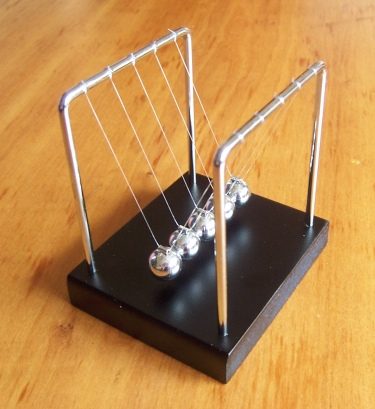
כדור ניוטון מדגים העברת תנע ואנרגיה קינטית דרך התנגשות כמעט אלסטית Explore · חקורCompare elastic and inelastic collisions · השוואת התנגשות אלסטית ולא-אלסטית
Momentum is always conserved, but kinetic energy is only conserved in an elastic collision. In an inelastic one the carts stick and some energy becomes heat. · תנע תמיד נשמר, אך אנרגיה קינטית נשמרת רק בהתנגשות אלסטית. בהתנגשות לא-אלסטית העגלות נדבקות וחלק מהאנרגיה הופך לחום.
4.4
Exam tips · טיפים לבחינות
English- Impulse equals the momentum change: $\vec J=\int \vec F\,dt=\Delta\vec p$, and it is the area under a force–time graph.
- Momentum is conserved whenever the net external force is zero — always the go-to for collisions.
- Distinguish elastic (kinetic energy conserved) from inelastic (kinetic energy decreases) collisions; in a perfectly inelastic collision the objects stick and move with one velocity.
- Apply conservation to each component (x and y) separately in 2-D.
- Connect to center of mass: total momentum $=M\vec v_{cm}$.
עברית- האימפולס שווה לשינוי התנע: $\vec J=\int \vec F\,dt=\Delta\vec p$, והוא השטח מתחת לגרף כוח-זמן.
- תנע נשמר בכל פעם שהכוח החיצוני הנטו הוא אפס – תמיד הכלי היעיל ביותר להתנגשותות.
- הבדל בין התנגשות אלסטית (אנרגיה קינטית נשמרת) להתנגשות לא-אלסטית (אנרגיה קינטית יורדת); בהתנגשות לא-אלסטית מושלמת האובייקטים נדבקים ונעים במהירות אחת.
- חייב שמירה על כל רכיב (x ו-y) בנפרד ב-2-D.
- קשר למרכז המסה: התנע הכולל $=M\vec v_{cm}$.
-
5
Torque and Rotational Dynamics · מומנט וכוח ודינמיקה סיבובית
Watch lesson · צפה בשיעור5.1
Rotational Kinematics
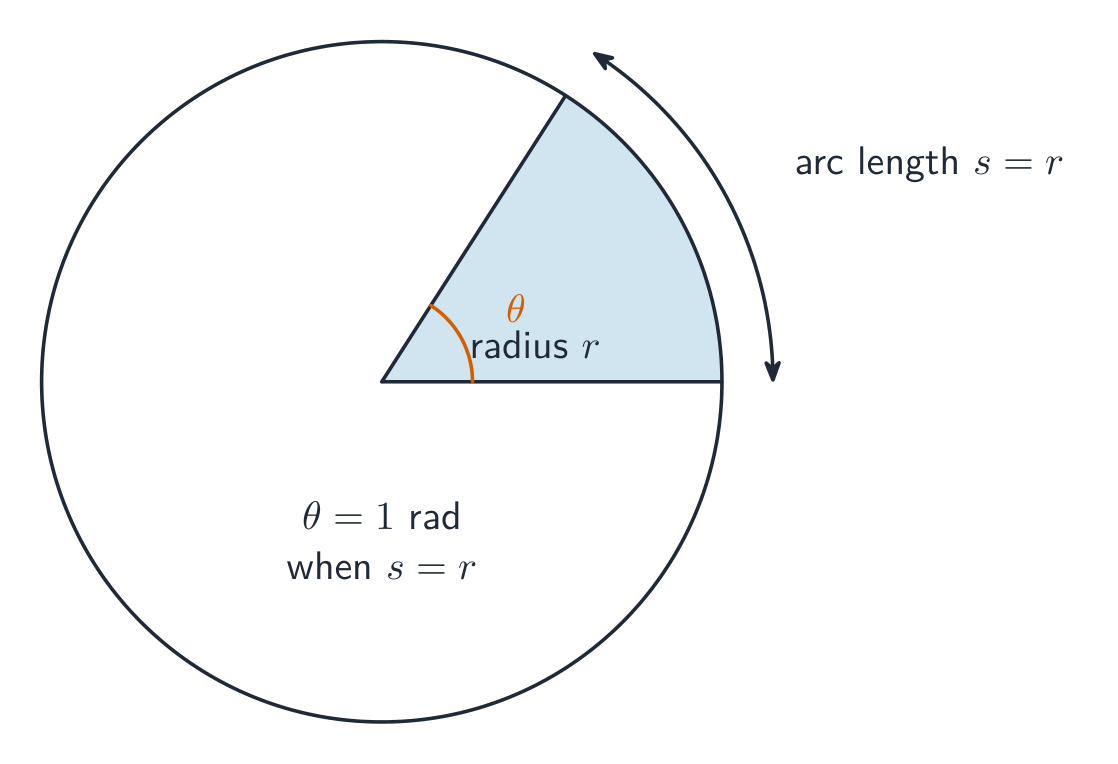
Syllabus · סיילבוס
EnglishLearning Objective 5.1.A: Describe the rotation of a system with respect to time using angular displacement, angular velocity, and angular acceleration.
- 5.1.A.1 Angular displacement is the measurement of the angle, in radians, through which a point on a rigid system rotates about a specified axis.
- Equation: $\Delta\theta = \theta - \theta_0$
- 5.1.A.1.i A rigid system is one that holds its shape but in which different points on the system move in different directions during rotation. A rigid system cannot be modeled as an object.
- 5.1.A.1.ii One direction of angular displacement about an axis of rotation—clockwise or counterclockwise—is typically indicated as mathematically positive, with the other direction becoming mathematically negative.
- 5.1.A.1.iii If the rotation of a system about an axis may be well described using the motion of the system's center of mass, the system may be treated as a single object. For example, the rotation of Earth about its axis may be considered negligible when considering the revolution of Earth about the center of mass of the Earth–Sun system.
- 5.1.A.2 Angular velocity is the rate at which angular position changes with respect to time.
- Equation: $\omega = \dfrac{d\theta}{dt}$
- 5.1.A.3 Angular acceleration is the rate at which angular velocity changes with respect to time.
- Equation: $\alpha = \dfrac{d\omega}{dt}$
- 5.1.A.4 Angular displacement, angular velocity, and angular acceleration around one axis are analogous to linear displacement, velocity, and acceleration in one dimension and demonstrate the same mathematical relationships.
- 5.1.A.4.i For constant angular acceleration, the mathematical relationships between angular displacement, angular velocity, and angular acceleration can be described with the following equations:
- $\omega = \omega_0 + \alpha t$
- $\theta = \theta_0 + \omega_0 t + \dfrac{1}{2}\alpha t^2$
- $\omega^2 = \omega_0^2 + 2\alpha(\theta - \theta_0)$
- 5.1.A.4.ii Graphs of angular displacement, angular velocity, and angular acceleration as functions of time can be used to find the relationships between those quantities.
- 5.1.A.4.i For constant angular acceleration, the mathematical relationships between angular displacement, angular velocity, and angular acceleration can be described with the following equations:
Boundary statement: AP Physics C: Mechanics expects students to be able to mathematically manipulate the magnitudes of angular displacement, angular velocity, and angular acceleration using vector conventions. However, the directions of said vectors will not be assessed on the exam.
Descriptions of the directions of rotational kinematics quantities for a point or rigid body are limited to clockwise and counterclockwise with respect to a given axis of rotation.
עבריתמטרת למידה 5.1.A: תאר את הסיבוב של מערכת ביחס לזמן באמצעות הזזה זוויתית, מהירות זוויתית ותאוצה זוויתית.
- 5.1.A.1 הזזה זוויתית היא מדידת הזווית, ברדיאנים, דרך נקודה מערכת קשיחה מסתובבת סביב ציר מסוים.
- משוואה: $\Delta\theta = \theta - \theta_0$
- 5.1.A.1.i מערכת קשיחה היא אחת ששומרת על צורה אך שבה נקודות שונות במערכת נעות בכיוונים שונים בזמן הסיבוב. מערכת קשיחה לא ניתן לדמות כגוף.
- 5.1.A.1.ii כיוון אחד של הזזה זוויתית סביב ציר סיבוב – עם כיוון השעון או נגד כיוון השעון – מצוין בדרך כלל כחיובי מתמטית, כאשר הכיוון השני הופך לשלילי מתמטית.
- 5.1.A.1.iii אם סיבוב מערכת סביב ציר ניתן לתאר היטב באמצעות תנועת מרכז המסה שלה, ניתן להתייחס למערכת כגוף בודד. לדוגמה, סיבוב כדור הארץ סביב צירו יכול להיחשב לזניח בעת בחינת החצייה של כדור הארץ סביב מרכז המסה של מערכת כדור הארץ-שמש.
- 5.1.A.2 מהירות זוויתית היא קצב השינוי של המיקום הזוויתי ביחס לזמן.
- משוואה: $\omega = \dfrac{d\theta}{dt}$
- 5.1.A.3 תאוצה זוויתית היא קצב השינוי של המהירות הזוויתית ביחס לזמן.
- משוואה: $\alpha = \dfrac{d\omega}{dt}$
- 5.1.A.4 הזזה זוויתית, מהירות זוויתית ותאוצה זוויתית סביב ציר אחד הם אנלוגיים להזזה, מהירות ותאצה ליניאריות בממד אחד ומדגימים את אותן קשרים מתמטיים.
- 5.1.A.4.i עבור תאוצה זוויתית קבועה, הקשרים המתמטיים בין הזזה זוויתית, מהירות זוויתית ותאוצה זוויתית ניתן לתאר באמצעות המשוואות הבאות:
- $\omega = \omega_0 + \alpha t$
- $\theta = \theta_0 + \omega_0 t + \dfrac{1}{2}\alpha t^2$
- $\omega^2 = \omega_0^2 + 2\alpha(\theta - \theta_0)$
- 5.1.A.4.ii גרפים של הזזה זוויתית, מהירות זוויתית ותאוצה זוויתית כפונקציות של זמן יכולים לשמש למציאת הקשרים בין כמותות אלו.
- 5.1.A.4.i עבור תאוצה זוויתית קבועה, הקשרים המתמטיים בין הזזה זוויתית, מהירות זוויתית ותאוצה זוויתית ניתן לתאר באמצעות המשוואות הבאות:
הצהרת גבול: AP Physics C: Mechanics מצפה מתלמידים שיכולים לבצע פעולות מתמטיות על גדלים של תזוזה זוויתית, מהירות זוויתית ותאוצה זוויתית באמצעות קונבנציות וקטוריות. עם זאת, כיווני הווקטורים הללו לא ייבדקו במבחן.
תיאורי הכיוונים של גודלי קינמטיקה סיבובית לנקודה או לגוף קשיח מוגבלים לשעון-העקיפה ולכיוון נגד כיוון השעון ביחס לציר סיבוב נתון.
Source: College Board AP Course and Exam Description · מקור: תיאור הקורס והמבחן של College Board AP
Rotation mirrors linear motion with angular quantities, defined as derivatives:
$$\omega=\frac{d\theta}{dt},\qquad \alpha=\frac{d\omega}{dt}=\frac{d^2\theta}{dt^2}.$$Here $\theta$ is angular displacement 角位移 in radians 弧度, $\omega$ the angular velocity 角速度, and $\alpha$ the angular acceleration 角加速度. (AP works with their magnitudes and signs; the 3D vector directions are not assessed.) For constant $\alpha$, the kinematic equations are the linear ones re-lettered:
$$\omega=\omega_0+\alpha t,\qquad \Delta\theta=\omega_0t+\tfrac12\alpha t^2,\qquad \omega^2=\omega_0^2+2\alpha\,\Delta\theta.$$One radian is the angle whose arc length equals the radius Worked example. A fan blade slows from $30\ \text{rad/s}$ to rest with $\alpha=-6.0\ \text{rad/s}^2$: it takes $t=5.0\ \text{s}$ and turns through $\Delta\theta=\dfrac{0-30^2}{2(-6.0)}=75\ \text{rad}$ – about $12$ revolutions.
Vocabulary · מילון מונחים Train · אימוןEnglish עברית angular displacement/ˈæŋɡjʊlə dɪˈspleɪsmənt/ הזזה זוויתית radians/ˈreɪdɪənz/ רדיאנים angular velocity/ˈæŋɡjʊlə vəˈlɒsɪti/ מהירות זוויתית angular acceleration/ˈæŋɡjʊlə əkˌseləˈreɪʃn/ תאוצה זוויתית 5.2
Connecting Linear and Rotational Motion
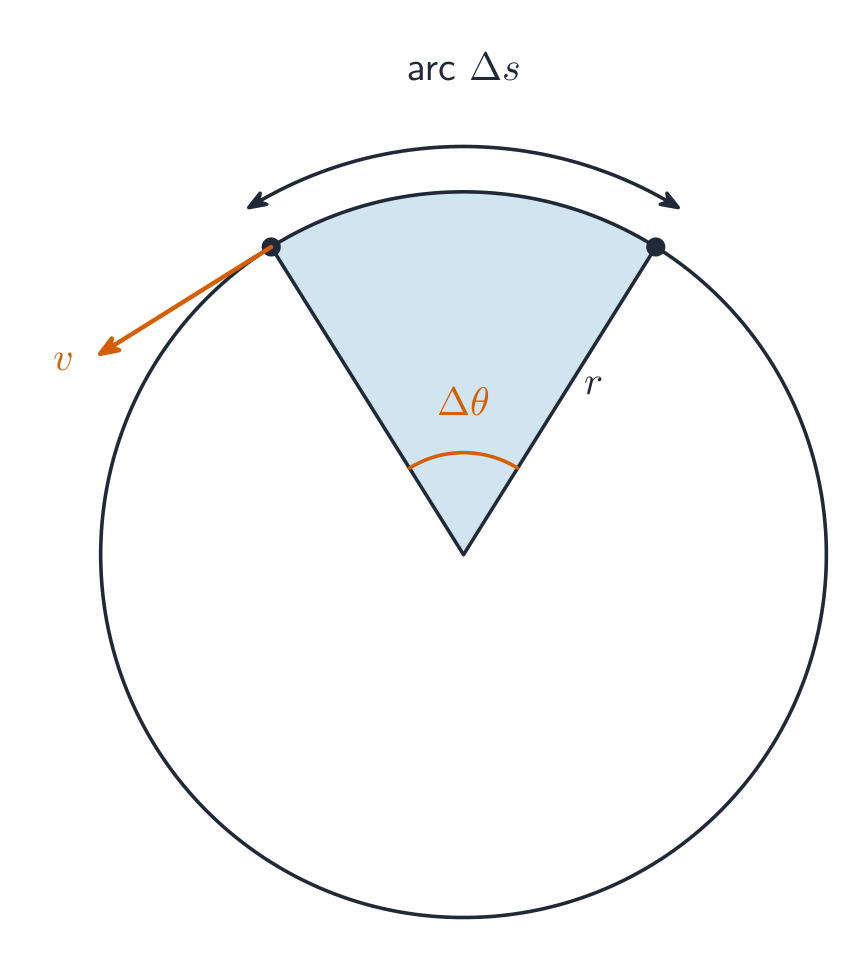
Syllabus · סיילבוס
EnglishLearning Objective 5.2.A: Describe the linear motion of a point on a rotating rigid system that corresponds to the rotational motion of that point, and vice versa.
- 5.2.A.1 For a point at a distance $r$ from a fixed axis of rotation, the linear distance $s$ traveled by the point as the system rotates through an angle $\Delta\theta$ is given by the equation $\Delta s = r\Delta\theta$.
- 5.2.A.2 Derived relationships of linear velocity and of the tangential component of acceleration to their respective angular quantities are given by the following equations:
- $s = r\theta$
- $v = r\omega$
- $a_T = r\alpha$
- 5.2.A.3 For a rigid system, all points within that system have the same angular velocity and angular acceleration.
Boundary statement: AP Physics C: Mechanics expects students to be able to mathematically manipulate the magnitudes of angular displacement, angular velocity, and angular acceleration using vector conventions. However, the directions of the vectors will not be assessed on the exam.
Descriptions of the directions of rotational kinematics quantities for a point or rigid body are limited to clockwise and counterclockwise with respect to a given axis of rotation.
עבריתמטרת למידה 5.2.A: תאר את התנועה הליניארית של נקודה על מערכת קשיחה מסתובבת העוקבת אחר התנועה הסיבובית של הנקודה, ולהפך.
- 5.2.A.1 עבור נקודה במרחק $r$ ממסב סיבוב קבוע, המרחק הליניירי $s$ שעברה הנקודה כאשר המערכת מסתובבת בזווית $\Delta\theta$ נתון על ידי המשוואה $\Delta s = r\Delta\theta$.
- 5.2.A.2 הקשרים הגזורים מהמהירות הליניארית ומרכיב המשיק של התאוצה לגודלים האנגולריים המתאימים שלהם נתונים על ידי המשוואות הבאות:
- $s = r\theta$
- $v = r\omega$
- $a_T = r\alpha$
- 5.2.A.3 עבור מערכת קשיחה, לכל הנקודות בתוך המערכת יש אותה מהירות זוויתית ואותה תאוצה זוויתית.
הצהרת גבול: AP Physics C: Mechanics מצפה מתלמידים שיכולים לבצע פעולות מתמטיות על גדלים של תזוזה זוויתית, מהירות זוויתית ותאוצה זוויתית באמצעות קונבנציות וקטוריות. עם זאת, כיווני הווקטורים לא ייבדקו במבחן.
תיאורי הכיוונים של גודלי קינמטיקה סיבובית לנקודה או לגוף קשיח מוגבלים לשעון-העקיפה ולכיוון נגד כיוון השעון ביחס לציר סיבוב נתון.
Source: College Board AP Course and Exam Description · מקור: תיאור הקורס והמבחן של College Board AP
A point at radius $r$ from the axis moves along its arc with
$$s=r\theta,\qquad v=r\omega,\qquad a_t=r\alpha,$$so points farther out move faster. A rotating point generally has two acceleration components at once: the tangential acceleration 切向加速度 $a_t=r\alpha$ (speeding up along the arc) and the centripetal acceleration 向心加速度 $a_c=\dfrac{v^2}{r}=r\omega^2$ (turning, towards the axis). They are perpendicular, so $a=\sqrt{a_t^2+a_c^2}$.
As the radius turns through an angle, a point moves along an arc at speed v Vocabulary · מילון מונחים Train · אימוןEnglish עברית tangential acceleration/tænˈdʒenʃl əkˌseləˈreɪʃn/ תאוצה מגנטית centripetal acceleration/senˈtrɪpɪtl əkˌseləˈreɪʃn/ תאוצה צנטריפטלית 5.3
Torque
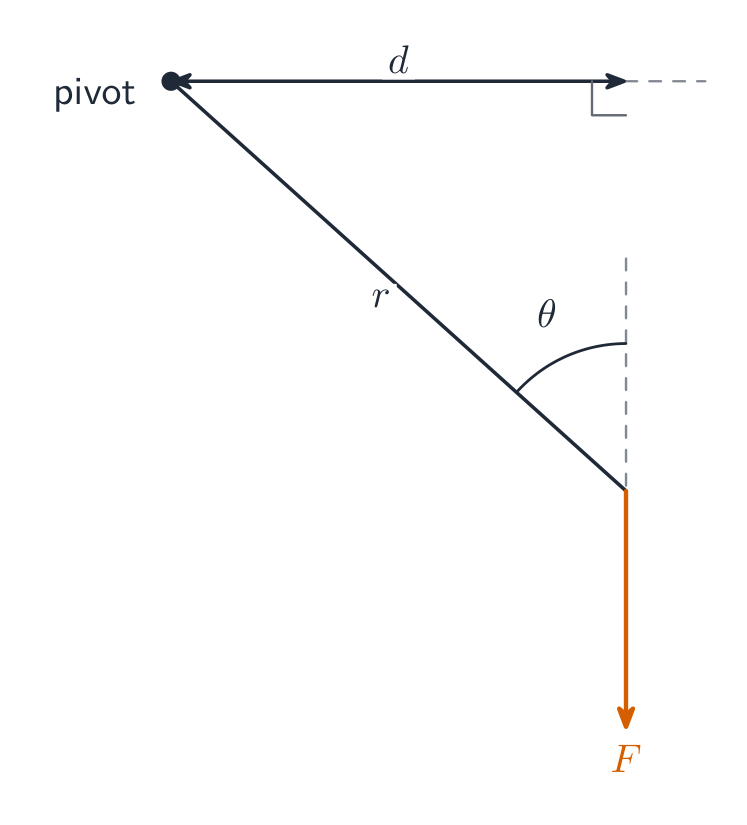
Syllabus · סיילבוס
EnglishLearning Objective 5.3.A: Identify the torques exerted on a rigid system.
- 5.3.A.1 Torque results only from the force component perpendicular to the position vector from the axis of rotation to the point of application of the force.
- 5.3.A.2 The lever arm is the perpendicular distance from the axis of rotation to the line of action of the exerted force.
Learning Objective 5.3.B: Describe the torques exerted on a rigid system.
- 5.3.B.1 Torques can be described using force diagrams.
- 5.3.B.1.i Force diagrams are similar to free-body diagrams and are used to analyze the torques exerted on a rigid system.
- 5.3.B.1.ii Similar to free-body diagrams, force diagrams represent the relative magnitude and direction of the forces exerted on a rigid system. Force diagrams also depict the location at which those forces are exerted relative to the axis of rotation.
- 5.3.B.2 The torque exerted on a rigid system about a chosen pivot point by a given force is described by $\vec{\tau} = \vec{r} \times \vec{F}$.
- 5.3.B.2.i The cross-product between two vectors, $\vec{A}$ and $\vec{B}$, results in a vector quantity of magnitude $\vec{A} \times \vec{B} = AB\sin\theta$.
- 5.3.B.2.ii The direction of the vector resulting from the cross-product of vectors $\vec{A}$ and $\vec{B}$ is perpendicular to both vectors $\vec{A}$ and $\vec{B}$ and therefore is normal to the plane defined by vectors $\vec{A}$ and $\vec{B}$.
- 5.3.B.2.iii The direction of the vector resulting from the cross-product of vectors $\vec{A}$ and $\vec{B}$ can be qualitatively determined by applying the appropriate right-hand rule.
עבריתמטרת למידה 5.3.A: לזהות את מומנטי הכוח הפועלים על מערכת קשיחה.
- 5.3.A.1 מומנט כוח נובע רק מהרכיב האנכי לכוח ביחס לווקטור המיקום ממסב הסיבוב לנקודת יישום הכוח.
- 5.3.A.2 רדיוס המנוף הוא המרחק האנכי ממסב הסיבוב לקו פעולת הכוח המופעל.
מטרת למידה 5.3.B: לתאר את מומנטי הכוח הפועלים על מערכת קשיחה.
- 5.3.B.1 ניתן לתאר מומנטי כוח באמצעות דיאגרמות כוח.
- 5.3.B.1.i דיאגרמות כוח דומות לדיאגרמות גוף חופשי ומשמשות לניתוח מומנטי הכוח הפועלים על מערכת קשיחה.
- 5.3.B.1.ii כמו דיאגרמות גוף חופשי, דיאגרמות כוח מייצגות את הגודל היחסי והכיוון של הכוחות הפועלים על מערכת קשיחה. דיאגרמות כוח מציגות גם את המיקום בו הכוחות פועלים ביחס למסב הסיבוב.
- 5.3.B.2 המומנט הפועל על מערכת קשיחה סביב נקודת צירוח נבחרת על ידי כוח נתון מתואר על ידי $\vec{\tau} = \vec{r} \times \vec{F}$.
- 5.3.B.2.i מכפלת השרון בין שני וקטורים, $\vec{A}$ ו$\vec{B}$, מובילה לגודל וקטורי של $\vec{A} \times \vec{B} = AB\sin\theta$.
- 5.3.B.2.ii הכיוון של הווקטור הנובע ממכפלת השרון של הווקטורים $\vec{A}$ ו$\vec{B}$ מאונך לשני הווקטורים $\vec{A}$ ו$\vec{B}$ ולכן הוא נורמלי למישור שהוגדר על ידי הווקטורים $\vec{A}$ ו$\vec{B}$.
- 5.3.B.2.iii את כיוון הווקטור הנובע ממכפלת השרון של הווקטורים $\vec{A}$ ו$\vec{B}$ ניתן לקבוע באופן איכותי על ידי יישום כלל היד הימנית המתאים.
Source: College Board AP Course and Exam Description · מקור: תיאור הקורס והמבחן של College Board AP
The principle of moments (torque) Torque 力矩 is the turning effect of a force – the rotational cause, as force is the translational cause. It is a vector product 矢量积:
$$\vec{\tau}=\vec{r}\times\vec{F},\qquad \tau=rF\sin\theta=F\,r_\perp,$$where $r_\perp$, the moment arm 力臂, is the perpendicular distance from the axis to the force's line of action. More force, applied farther from the axis, more perpendicular: more torque. A force pointing straight at (or away from) the axis has zero torque. In a plane, give counterclockwise and clockwise torques opposite signs and add.
As a vector product, $\vec\tau=\vec r\times\vec F$ points perpendicular to the plane of $\vec r$ and $\vec F$, with its direction fixed by the right-hand rule 右手定则: curl your right fingers from $\vec r$ toward $\vec F$ and your thumb points along $\vec\tau$ – out of the page for a counterclockwise turn, into it for a clockwise one. The same rule gives the direction of angular momentum $\vec L=\vec r\times\vec p$.
The torque of a force depends on the perpendicular distance from the axis 
A gear train: torques and rotational inertia couple through the gear ratio Explore · חקורBalance torques on a beam · איזון מומנטים בקורה
Torque is force times perpendicular distance, $\tau=Fd$. The beam is in rotational equilibrium when the torques on each side are equal. · מומנט הוא כוח כפול במרחק האנכי, $\tau=Fd$. הקורה נמצאת באיזון סיבובי כשהמומנטים בשני הצדדים שווים.
Vocabulary · מילון מונחים Train · אימוןEnglish עברית Torque/tɔːk/ מומנט vector product/ˈvektə ˈprɒdʌkt/ מכפלה וקטורית moment arm/ˈməʊmənt ɑːm/ זרוע מומנט right-hand rule/raɪt hænd ruːl/ כלל היד ימין 5.4
Rotational Inertia
Syllabus · סיילבוס
EnglishLearning Objective 5.4.A: Describe the rotational inertia of a rigid system relative to a given axis of rotation.
- 5.4.A.1 Rotational inertia measures a rigid system's resistance to changes in rotation and is related to the mass of the system and the distribution of that mass relative to the axis of rotation.
- 5.4.A.2 The rotational inertia of an object rotating a perpendicular distance $r$ from an axis is described by the equation $I = mr^2$.
- 5.4.A.3 The total rotational inertia of a collection of objects about an axis is the sum of the rotational inertias of each object about that axis.
- Equation: $I_{\text{tot}} = \sum I_i = \sum m_i r_i^2$
- 5.4.A.4 For a solid that can be considered as a collection of differential masses, $dm$, the solid's rotational inertia can be calculated using the equation $I = \int r^2\, dm$, where $r$ is the perpendicular distance from $dm$ to the axis of rotation.
Learning Objective 5.4.B: Describe the rotational inertia of a rigid system rotating about an axis that does not pass through the system's center of mass.
- 5.4.B.1 A rigid system's rotational inertia in a given plane is at a minimum when the rotational axis passes through the system's center of mass.
- 5.4.B.2 The parallel axis theorem uses the following equation to relate the rotational inertia of a rigid system about any axis that is parallel to an axis through its center of mass:
- Equation: $I' = I_{\text{cm}} + Md^2$
Boundary statement: AP Physics C: Mechanics only expects students to use calculus in the derivations of the rotational inertia of thin rods of uniform or nonuniform density about an arbitrary axis perpendicular to the rod, as well as derivations of the rotational inertia of a thin cylindrical shell, disk, or rigid bodies that can be considered to be made up of coaxial rings or shells about an axis that passes through their centers (e.g., annular rings).
Students should have a qualitative understanding of the factors that affect rotational inertia; for example, how rotational inertia is greater when mass is farther from the axis of rotation, which is why a hoop has more rotational inertia than a solid puck of the same mass and radius.
עבריתמטרת למידה 5.4.A: לתאר את האינרציה הסיבובית של מערכת קשיחה ביחס למסב סיבוב נתון.
- 5.4.A.1 האינרציה הסיבובית מודדת את התנגדותה של מערכת קשיחה לשינויים בסיבוב והיא קשורה למסת המערכת ולחלוקת המסה ביחס למסב הסיבוב.
- 5.4.A.2 המומנט העצמי של גוף מסתובב במרחק אנכי $r$ מציר נתון מתואר על ידי המשוואה $I = mr^2$.
- 5.4.A.3 המומנט העצמי הכולל של אוסף גופים סביב ציר נתון הוא סכום המומנטים העצמיים של כל גוף בנפרד סביב אותו ציר.
- משוואה: $I_{\text{tot}} = \sum I_i = \sum m_i r_i^2$
- 5.4.A.4 עבור מוצק שניתן לראות כאוסף של מסות דיפרנציאליות, $dm$, ניתן לחשב את המומנט העצמי של המוצק באמצעות המשוואה $I = \int r^2\, dm$, כאשר $r$ הוא המרחק האנכי מ$dm$ לציר הסיבוב.
מטרת למידה 5.4.B: לתאר את האינרציה הסיבובית של מערכת קשיחה מסתובבת סביב ציר שאינו עובר דרך מרכז הכובד של המערכת.
- 5.4.B.1 האינרציה הסיבובית של מערכת קשיחה במישור נתון מינימלית כאשר ציר הסיבוב עובר דרך מרכז הכובד של המערכת.
- 5.4.B.2 משפט ציר מקביל משתמש במשוואה הבאה כדי לקשר את המומנט האינרציה של מערכת קשיחה סביב כל ציר המקביל לציר העובר דרך מרכז הכובד שלה:
- משוואה: $I' = I_{\text{cm}} + Md^2$
הצהרת גבול: AP Physics C: Mechanics מצפה רק משתמשים להשתמש בקalkulus בהסחות של המומנט העצמי של מוטות דקים בצפיפות אחידה או לא-אחידה סביב ציר אקראי המאונך למוט, כמו גם הסחות של המומנט העצמי של מעטפת צילינדרית דקה, דיסק או גופים קשיחים שניתן לראות כעשויים מטבעות או מעטפות קו-ציריים סביב ציר העובר דרך מרכזיהם (למשל, טבעות עגוליות).
התלמידים צריכים להיות עם הבנה איכותית של הגורמים המשפיעים על המומנט העצמי; לדוגמה, כיצד המומנט העצמי גדול יותר כאשר המסה נמצאת רחוק יותר מציר הסיבוב, מה שמסביר מדוע לטבע יש מומנט עצמי גדול יותר מאשר לדיסק מלא באותו מסה ואותו רדיוס.
Source: College Board AP Course and Exam Description · מקור: תיאור הקורס והמבחן של College Board AP
Rotational inertia 转动惯量 $I$ measures resistance to angular acceleration – the rotational analog of mass, but it depends on where the mass sits. For point masses, $I=\sum m_ir_i^2$; for a continuous body,
$$I=\int r^2\,dm.$$Mass far from the axis dominates, because of the $r^2$.
Worked example (rod). A uniform rod (mass $M$, length $L$) about its centre: with linear density 线密度 $\lambda=M/L$, $dm=\lambda\,dx$, so $I=\displaystyle\int_{-L/2}^{L/2}x^2\,\frac{M}{L}\,dx=\frac{1}{12}ML^2$. AP also expects nonuniform rods: if $\lambda(x)=cx$ on $[0,L]$, first find $M=\int_0^L cx\,dx=\tfrac12cL^2$, then $I=\int_0^L x^2(cx)\,dx=\tfrac14cL^4=\tfrac12ML^2$ about the light end.
Worked example (disk from rings). A solid disk is a nest of rings: a ring at radius $r$ of width $dr$ has $dm=\dfrac{M}{\pi R^2}\,2\pi r\,dr$, so
$$I=\int_0^R r^2\,dm=\frac{2M}{R^2}\int_0^R r^3\,dr=\tfrac12MR^2.$$The same coaxial-shell method handles cylindrical shells and annular rings.
The parallel-axis theorem 平行轴定理 shifts any known $I$ to a parallel axis a distance $d$ away:
$$I'=I_{\text{cm}}+Md^2.$$For the rod about one end: $I=\tfrac1{12}ML^2+M\big(\tfrac{L}{2}\big)^2=\tfrac13ML^2$.
Vocabulary · מילון מונחים Train · אימוןEnglish עברית Rotational inertia/rəʊˈteɪʃənl ɪˈnɜːʃə/ אינרציה סיבובית linear density/ˈlɪnɪə ˈdensɪti/ צפיפות קווית parallel-axis theorem/ˈpærəlel ˈæksɪs ˈθɪərəm/ משפט הציר המקביל 5.5
Rotational Equilibrium
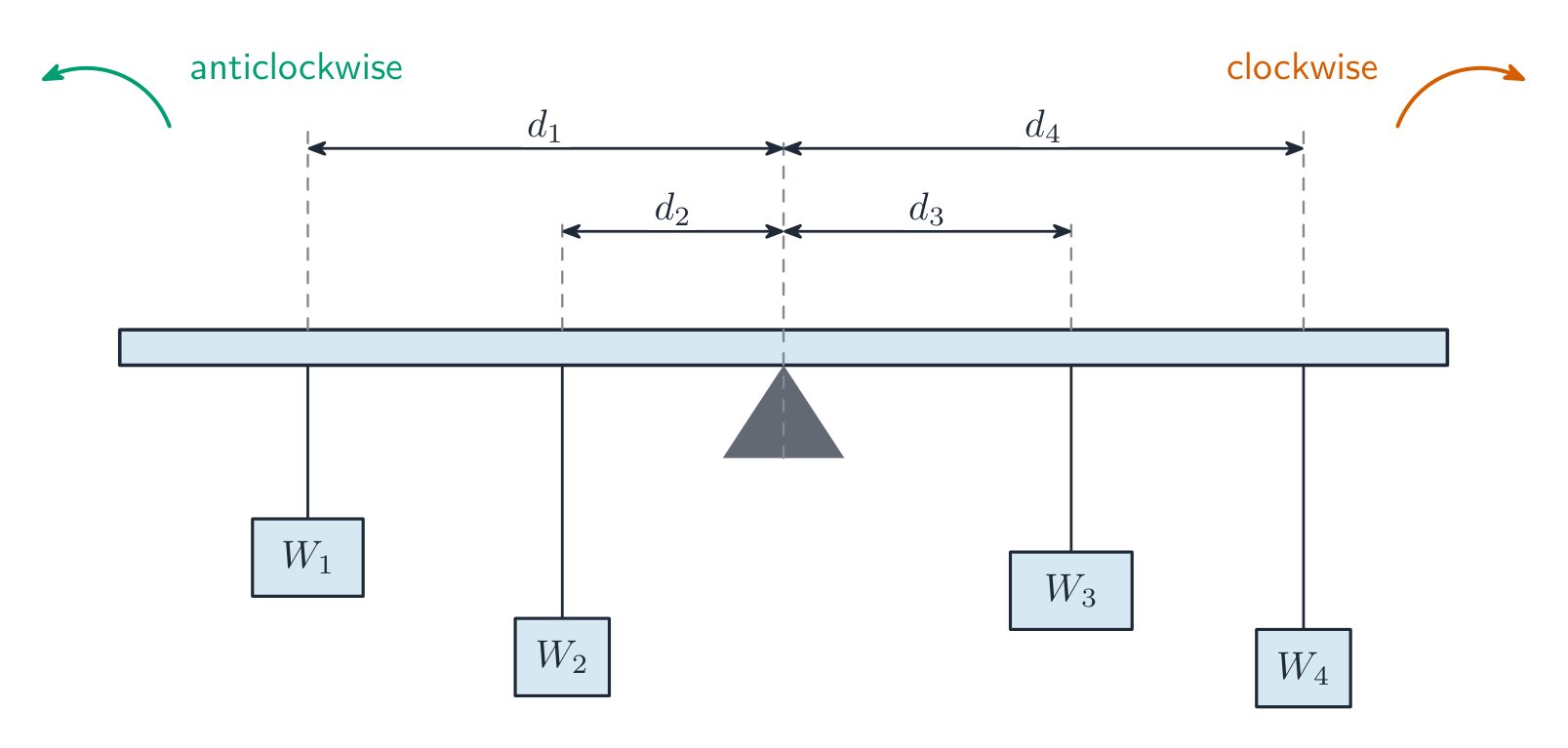
Syllabus · סיילבוס
EnglishLearning Objective 5.5.A: Describe the conditions under which a system's angular velocity remains constant.
- 5.5.A.1 A system may exhibit rotational equilibrium (constant angular velocity) without being in translational equilibrium, and vice versa.
- 5.5.A.1.i Free-body and force diagrams describe the nature of the forces and torques exerted on an object or rigid system.
- 5.5.A.1.ii Rotational equilibrium is a configuration of torques such that the net torque exerted on the system is zero.
- Equation: $\sum \tau_i = 0$
- 5.5.A.1.iii The rotational analog of Newton's first law is that a system will have a constant angular velocity only if the net torque exerted on the system is zero.
- 5.5.A.2 A rotational corollary to Newton's second law states that if the torques exerted on a rigid system are not balanced, the system's angular velocity must be changing.
Boundary statement: AP Physics C: Mechanics does not expect students to simultaneously analyze rotation in multiple planes.
עבריתמטרת לימוד 5.5.A: לתאר את התנאים שבהם מהירות הזוויתית של מערכת נשארת קבועה.
- 5.5.A.1 מערכת עשויה להציג איזון סיבובי (מהירות זוויתית קבועה) מבלי להיות באיזון תרגולי, ולהפך.
- 5.5.A.1.i דיאגרמות גוף חופשי ודיאגרמות כוח מתארות את אופי הכוחות והמומנטים הפועלים על גוף או מערכת קשיחה.
- 5.5.A.1.ii איזון סיבובי הוא מצב של מומנטים כך שהמומנט הכולל הפועל על המערכת הוא אפס.
- משוואה: $\sum \tau_i = 0$
- 5.5.A.1.iii האנלוג הסיבובי לחוק ראשון של ניוטון קובע שמערכת תהיה בעלת מהירות זוויתית קבועה רק אם המומנט הכולל הפועל עליה הוא אפס.
- 5.5.A.2 קורולרי סיבובי לחוק השני של ניוטון קובע שאם המומנטים הפועלים על מערכת קשיחה אינם מאוזנים, מהירות הזוויתית של המערכת חייבתשתנות.
הצהרת גבול: AP Physics C: Mechanics אינה מצפה מהתלמידים לבצע ניתוח סיבובי בו-זמנית במספר מישורים.
Source: College Board AP Course and Exam Description · מקור: תיאור הקורס והמבחן של College Board AP
Newton's first law has a rotational form: with zero net torque, angular velocity is constant – an object in rotational equilibrium 转动平衡 either does not rotate or rotates steadily. Full static equilibrium 静平衡 needs both $\sum F=0$ and $\sum\tau=0$ (about any axis). The standard move for beams and ladders: put the axis at the point where an unknown force acts, so that force drops out of the torque equation.
At balance the clockwise and anticlockwise torques about the axis are equal Worked example. A uniform $20\ \text{kg}$ beam, $4.0\ \text{m}$ long, is pivoted at its left end and held horizontal by a vertical rope at its right end. A $40\ \text{kg}$ child sits $1.0\ \text{m}$ from the pivot. Torques about the pivot: $T(4.0)=20g(2.0)+40g(1.0)$, so $T=\dfrac{392+392}{4.0}=196\ \text{N}$. Then vertical force balance gives the pivot's upward push: $F_p=(60)(9.8)-196=392\ \text{N}$. Choosing the pivot as the axis removed $F_p$ from the torque equation entirely.
A beam balance: rotational equilibrium when clockwise and anticlockwise torques match Explore · חקורFind the balance point · מצא את נקודת האיזון
For rotational equilibrium the total clockwise torque equals the total anticlockwise torque. Move the forces and distances until the beam balances. · עבור איזון סיבובי, סך המומנטים השעוניים שווה לסך המומנטים נגד השעון. הזז את הכוחות והמרחקים עד שקורה מאוזנת.
Vocabulary · מילון מונחים Train · אימוןEnglish עברית rotational equilibrium/rəʊˈteɪʃənl ˌiːkwɪˈlɪbrɪəm/ איזון סיבובי static equilibrium/ˈstætɪk ˌiːkwɪˈlɪbrɪəm/ איזון סטטי 5.6
Newton's Second Law in Rotational Form
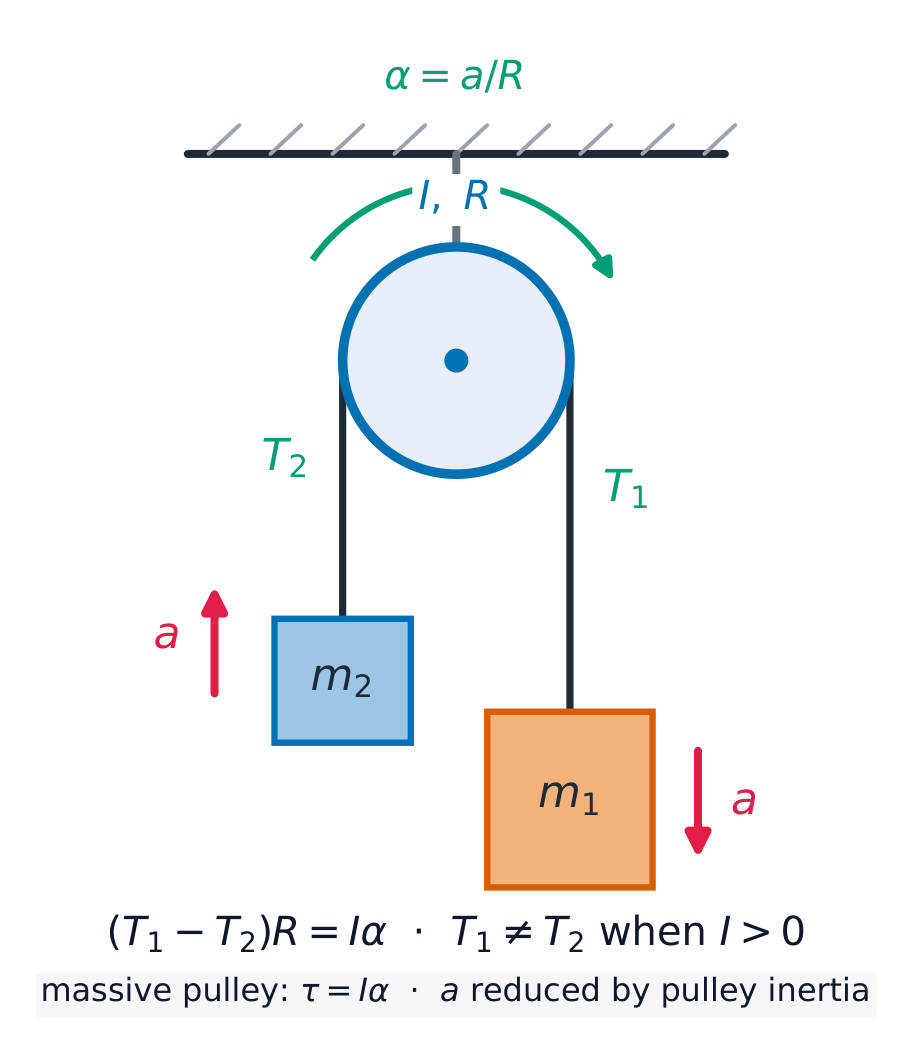
Syllabus · סיילבוס
EnglishLearning Objective 5.6.A: Describe the conditions under which a system's angular velocity changes.
- 5.6.A.1 Angular velocity changes when the net torque exerted on the object or system is not equal to zero.
- 5.6.A.2 The rate at which the angular velocity of a rigid system changes is directly proportional to the net torque exerted on the rigid system and is in the same direction. The angular acceleration of the rigid system is inversely proportional to the rotational inertia of the rigid system.
- Equation: $\alpha_{\text{sys}} = \dfrac{\Sigma\tau}{I_{\text{sys}}} = \dfrac{\tau_{\text{net}}}{I_{\text{sys}}}$
- 5.6.A.3 To fully describe a rotating rigid system, linear and rotational analyses may need to be performed independently.
עבריתמטרת לימוד 5.6.A: לתאר את התנאים שבהם מהירות הזוויתית של מערכת משתנה.
- 5.6.A.1 מהירות זוויתית משתנה כאשר המומנט הכולל הפועל על הגוף או המערכת אינו שווה לאפס.
- 5.6.A.2 הקצב שבו מהירות הזוויתית של מערכת קשיחה משתנה פרופורציונלי ישירות למומנט הכולל הפועל על המערכת הקשיחה ובאותו כיוון. התאוצה הזוויתית של המערכת הקשיחה פרופורציונלית הפוכה למומנט האינרציה הסיבובי שלה.
- משוואה: $\alpha_{\text{sys}} = \dfrac{\Sigma\tau}{I_{\text{sys}}} = \dfrac{\tau_{\text{net}}}{I_{\text{sys}}}$
- 5.6.A.3 כדי לתאר במלואו מערכת קשיחה מסתובבת, ייתכן שיש לבצע ניתוחים ליניאריים וסיבוביים בנפרד.
Source: College Board AP Course and Exam Description · מקור: תיאור הקורס והמבחן של College Board AP
A net torque produces angular acceleration in proportion to the rotational inertia:
$$\alpha=\frac{\sum\tau}{I}\qquad\Big(\text{more generally }\sum\vec{\tau}=\frac{d\vec{L}}{dt}\Big).$$Solve rotational dynamics exactly like translational dynamics, with $\tau\leftrightarrow F$, $I\leftrightarrow m$, $\alpha\leftrightarrow a$ – free-body diagram, equations, solve.
A massive pulley: the two tensions differ because the pulley needs net torque Worked example (massive pulley). Masses $m_1=4.0\ \text{kg}$ and $m_2=2.0\ \text{kg}$ hang from a rope over a pulley 滑轮 of rotational inertia $I=0.50\ \text{kg}\cdot\text{m}^2$ and radius $R=0.20\ \text{m}$. Three Newton's-law equations, one per body:
$$m_1g-T_1=m_1a,\qquad T_2-m_2g=m_2a,\qquad (T_1-T_2)R=I\alpha=\frac{Ia}{R}.$$Adding them (with $I/R^2=12.5\ \text{kg}$): $a=\dfrac{(m_1-m_2)g}{m_1+m_2+I/R^2}=\dfrac{19.6}{18.5}=1.1\ \text{m/s}^2$. Then $T_1=m_1(g-a)=35\ \text{N}$ and $T_2=m_2(g+a)=22\ \text{N}$. The tensions must differ – otherwise nothing would spin the pulley. (If a problem says the pulley is light, then $I\approx0$ and the tensions become equal again.)
Exam skill. Rotational FRQs score the setup: separate free-body diagrams for each mass and the pulley, the string constraint $a=R\alpha$ stated, and the sign convention consistent. The single most common error is assuming one tension throughout a rope that passes over a massive pulley.
Vocabulary · מילון מונחים Train · אימוןEnglish עברית pulley/ˈpʊli/ גלגלת 5.6
Exam tips
- Use the rotational analogues: $\theta,\omega=\tfrac{d\theta}{dt},\alpha=\tfrac{d\omega}{dt}$, with the constant-$\alpha$ equations mirroring linear kinematics.
- Convert between linear and angular with $v=r\omega$ and $a_t=r\alpha$ (plus centripetal $a_c=\tfrac{v^2}{r}=\omega^2 r$).
- Keep radians throughout and fix a positive sense of rotation.
- Relate torque to angular acceleration through $\tau=I\alpha$.
- Draw the rotation axis — the moment arm is the perpendicular distance to it.
- 5.1.A.1 Angular displacement is the measurement of the angle, in radians, through which a point on a rigid system rotates about a specified axis.
-
6
Energy and Momentum of Rotating Systems · אנרגיה ותנע של מערכות מסתובבות
Watch lesson · צפה בשיעור6.1
Rotational Kinetic Energy · אנרגיה קינטית סיבובית
Syllabus · סיילבוס
EnglishLearning Objective 6.1.A: Describe the rotational kinetic energy of a rigid system in terms of the rotational inertia and angular velocity of that rigid system.
- 6.1.A.1 The rotational kinetic energy of an object or rigid system is related to the rotational inertia and angular velocity of the rigid system and is given by the equation $K_{\text{rot}} = \dfrac{1}{2} I \omega^2$.
- Equation: $K_{\text{rot}} = \dfrac{1}{2} I \omega^2$
- 6.1.A.1.i The rotational inertia of an object about a fixed axis can be used to show that the rotational kinetic energy of that object is equivalent to its translational kinetic energy, which is its total kinetic energy.
- 6.1.A.1.ii The total kinetic energy of a rigid system is the sum of its rotational kinetic energy due to its rotation about its center of mass and the translational kinetic energy due to the linear motion of its center of mass.
- 6.1.A.2 A rigid system can have rotational kinetic energy while its center of mass is at rest due to the individual points within the rigid system having linear speed and, therefore, kinetic energy.
- 6.1.A.3 Rotational kinetic energy is a scalar quantity.
עבריתמטרת לימוד 6.1.A: לתאר את האנרגיה הקינטית הסיבובית של מערכת קשיחה בהתבסס על מומנט האינרציה הסיבובי והמהירות הזוויתית של מערכת זו.
- 6.1.A.1 האנרגיה הקינטית הסיבובית של גוף או מערכת קשיחה קשורה למומנט האינרציה הסיבובי ולמהירות הזוויתית של המערכת הקשיחה, ונתונה על ידי המשוואה $K_{\text{rot}} = \dfrac{1}{2} I \omega^2$.
- משוואה: $K_{\text{rot}} = \dfrac{1}{2} I \omega^2$
- 6.1.A.1.i מומנט האינרציה של גוף סביב ציר קבוע יכול לשמש להראות שהאנרגיה הקינטית הסיבובית של הגוף שקולה לאנרגיה הקינטית התרגולית שלו, שהיא האנרגיה הקינטית הכוללת שלו.
- 6.1.A.1.ii האנרגיה הקינטית הכוללת של מערכת קשיחה היא סכום האנרגיה הקינטית הסיבובית הנובעת מסביבתה סביב מרכז המסה והאנרגיה הקינטית התנועתית הנובעת מתנועה ליניארית של מרכז המסה.
- 6.1.A.2 למערכת קשיחה יכולה להיות אנרגיה קינטית סיבובית גם כאשר מרכז המסה שלה נמצא במנוחה, בשל העובדה שנקודות יחידיות בתוך המערכת הקשיחה בעלות מהירות ליניארית ולכן אנרגיה קינטית.
- 6.1.A.3 אנרגיה קינטית סיבובית היא גודל סקלרי.
Source: College Board AP Course and Exam Description · מקור: תיאור הקורס והמבחן של College Board AP
EnglishA spinning body has rotational kinetic energy 转动动能
$$K_{\text{rot}}=\tfrac12 I\omega^2,$$the rotational twin of $\tfrac12mv^2$, with the rotational inertia 转动惯量 $I$ playing the role of mass. A body that both moves and spins carries both terms:
$$K=\tfrac12 mv_{\text{cm}}^2+\tfrac12 I\omega^2.$$Worked example. A uniform cylinder ($I=\tfrac12mr^2$) rolls at speed $v$. Its kinetic energy is $K=\tfrac12mv^2+\tfrac12\big(\tfrac12mr^2\big)\big(\tfrac{v}{r}\big)^2=\tfrac34mv^2$ – one third of it is rotational. The same ball of energy bookkeeping decides every rolling problem.
עבריתגוף מסתובב בעל אנרגיה קינטית סיבובית
$$K_{\text{rot}}=\tfrac12 I\omega^2,$$התאום הסיבובי של $\tfrac12mv^2$, כאשר המסה האינרציה הסיבובית $I$ ממלאת את תפקיד המסה. גוף הנע ומסתובב בו-זמנית נושא שתי התרומות הללו:
$$K=\tfrac12 mv_{\text{cm}}^2+\tfrac12 I\omega^2.$$הדגמה פתורה. צילינדר אחיד ($I=\tfrac12mr^2$) מתגלגל במהירות $v$. האנרגיה הקינטית שלו היא $K=\tfrac12mv^2+\tfrac12\big(\tfrac12mr^2\big)\big(\tfrac{v}{r}\big)^2=\tfrac34mv^2$ – שליש ממנה הוא סיבובי. אותו חשבון אנרגיה קובע כל שאלת גלילה.
6.2
Torque and Work · מומנט ועבודה
Syllabus · סיילבוס
EnglishLearning Objective 6.2.A: Describe the work done on a rigid system by a given torque or collection of torques.
- 6.2.A.1 A torque can transfer energy into or out of an object or rigid system if the torque is exerted over an angular displacement.
- 6.2.A.2 The amount of work done on a rigid system by a torque is related to the magnitude of that torque and the angular displacement through which the rigid system rotates during the interval in which that torque is exerted.
- Equation: $W = \displaystyle\int_{\theta_1}^{\theta_2} \tau \, d\theta$
- 6.2.A.3 Work done on a rigid system by a given torque can be found from the area under the curve of a graph of the torque as a function of angular position.
עבריתמטרות למידה 6.2.A: לתאר את העבודה שנעשתה על מערכת קשיחה על ידי מומנט נתון או קבוצת מומנטים.
- 6.2.A.1 מומנט יכול להעביר אנרגיה אל תוך אובייקט או מערכת קשיחה או מחוץ אליה אם המומנט מופעל לאורך הסטה זוויתית.
- 6.2.A.2 כמות העבודה שנעשתה על מערכת קשיחה על ידי מומנת קשורה לגודלו של המומנט הזה ול ההסתה הזוויתית דרכה מסתובבת המערכת הקשיחה במהלך הפרק בזמן בו המומנט מופעל.
- משוואה: $W = \displaystyle\int_{\theta_1}^{\theta_2} \tau \, d\theta$
- 6.2.A.3 העבודה שנעשתה על מערכת קשיחה על ידי מומנט נתון יכולה להתקבל מאזור מתחת לעקומה בגרף של המומנט כפונקציה של המיקום הזוויתי.
Source: College Board AP Course and Exam Description · מקור: תיאור הקורס והמבחן של College Board AP
EnglishA torque 力矩 acting through an angular displacement 角位移 does work, and power is torque times angular velocity:
$$W=\int_{\theta_1}^{\theta_2}\tau\,d\theta,\qquad P=\tau\omega.$$These are the rotational forms of $W=\int F\,dx$ and $P=Fv$ – the whole translational energy toolkit carries over with $F\to\tau$, $x\to\theta$, $v\to\omega$.
Worked example. A motor applies a constant $8.0\ \text{N}\cdot\text{m}$ torque to a flywheel for $5.0$ full turns: $W=\tau\,\Delta\theta=8.0(5.0)(2\pi)=250\ \text{J}$, which appears as rotational kinetic energy if friction is negligible.
עבריתמומנט הפועל דרך הזזה זוויתית מבצע עבודה, וההספק הוא מומנט כפול מהמהירות הזוויתית:
$$W=\int_{\theta_1}^{\theta_2}\tau\,d\theta,\qquad P=\tau\omega.$$אלו הן צורות הסיבוב של $W=\int F\,dx$ ו$P=Fv$ – כל ערכת הכלים האנרגטית התנועתית כוללת גם את $F\to\tau$, $x\to\theta$, $v\to\omega$.
דוגמה פתורה. מנוע מפעיל מומנט קבוע של $8.0\ \text{N}\cdot\text{m}$ על גלגל משקל (פלייוויל) במשך $5.0$ סיבובים מלאים: $W=\tau\,\Delta\theta=8.0(5.0)(2\pi)=250\ \text{J}$, שמופיע כאנרגיה קינטית סיבובית אם חיכוך הוא זניח.
Explore · חקורBalance torques on a beam · איזון מומנטים בקורה
Torque is force times perpendicular distance, $\tau=Fd$. Equal torques on each side keep the beam in rotational equilibrium. · מומנט כוח הוא כוח כפול במרחק אנכי, $\tau=Fd$. מומנטים שווים בשני הצדדים שומרים על קורה באיזון סיבובי.
6.3
Angular Momentum and Angular Impulse · תנע זוויתי ותנע זוויתי
Syllabus · סיילבוס
EnglishLearning Objective 6.3.A: Describe the angular momentum of an object or rigid system.
- 6.3.A.1 The magnitude of the angular momentum of a rigid system about a specific axis can be described with the equation $L = I\omega$.
- Equation: $L = I\omega$
- 6.3.A.2 The angular momentum of an object about a given point is $\vec{L} = \vec{r} \times \vec{p}$.
- Equation: $\vec{L} = \vec{r} \times \vec{p}$
- 6.3.A.2.i The selection of the axis about which an object is considered to rotate influences the determination of the angular momentum of that object.
- 6.3.A.2.ii The measured angular momentum of an object traveling in a straight line depends on the distance between the reference point and the object, the mass of the object, the speed of the object, and the angle between the radial distance and the velocity of the object.
Learning Objective 6.3.B: Describe the angular impulse delivered to an object or rigid system by a torque.
- 6.3.B.1 Angular impulse is defined as the product of the torque exerted on an object or rigid system and the time interval during which the torque is exerted.
- Equation: $\text{angular impulse} = \displaystyle\int \tau \, dt$
- 6.3.B.2 Angular impulse has the same direction as the torque imparting it.
- 6.3.B.3 The angular impulse delivered to an object or rigid system by a torque can be found from the area under the curve of a graph of the torque as a function of time.
Learning Objective 6.3.C: Relate the change in angular momentum of an object or rigid system to the angular impulse given to that object or rigid system.
- 6.3.C.1 The magnitude of the change in angular momentum can be described by comparing the magnitudes of the final and initial momenta of the object or rigid system.
- Equation: $\Delta L = L - L_0$
- 6.3.C.2 A rotational form of the impulse–momentum theorem relates the angular impulse delivered to an object or rigid system and the change in angular momentum of that object or rigid system.
- 6.3.C.2.i The angular impulse exerted on an object or rigid system is equal to the change in angular momentum of that object or rigid system.
- Equation: $\Delta L = \displaystyle\int_{t_1}^{t_2} \tau \, dt$
- 6.3.C.2.ii The rotational form of the impulse–momentum theorem is a direct result of Newton's second law of motion for cases in which rotational inertia is constant.
- Equation: $\tau_{\text{net}} = \dfrac{dL}{dt} = I\dfrac{d\omega}{dt} = I\alpha$
- 6.3.C.2.i The angular impulse exerted on an object or rigid system is equal to the change in angular momentum of that object or rigid system.
- 6.3.C.3 The net torque exerted on an object or rigid system is equal to the slope of the graph of the angular momentum of an object as a function of time.
- 6.3.C.4 The angular impulse delivered to an object or rigid system is equal to the area under the curve of a graph of the net external torque exerted on an object as a function of time.
עבריתמטרות למידה 6.3.A: לתאר את התנע הזוויתי של אובייקט או מערכת קשיחה.
- 6.3.A.1 הגודל של התנע הזוויתי של מערכת קשיחה סביב ציר ספציפי ניתן לתאר באמצעות המשוואה $L = I\omega$.
- משוואה: $L = I\omega$
- 6.3.A.2 התנע הזוויתי של גוף סביב נקודה נתונה הוא $\vec{L} = \vec{r} \times \vec{p}$.
- משוואה: $\vec{L} = \vec{r} \times \vec{p}$
- 6.3.A.2.i בחירת הציר סביב אובייקט נחשב מסתובב משפיעה על קביעת התנע הזוויתי של אובייקט זה.
- 6.3.A.2.ii התנע הזוויתי הנמדד של אובייקט הנע בקו ישר תלוי במרחק בין נקודת הייחס לבין האובייקט, במסת האובייקט, במהירות האובייקט ובזווית בין המרחק הרדיאלי לבין וקטור המהירות של האובייקט.
מטרות למידה 6.3.B: לתאר את תנע הזוויתי (האימפולס הזוויתי) שהועבר לאובייקט או מערכת קשיחה על ידי מומנט.
- 6.3.B.1 תנע זוויתי מוגדר כמכפלת המומנט המופעל על אובייקט או מערכת קשיחה ופרק הזמן שבו המומנט מופעל.
- משוואה: $\text{angular impulse} = \displaystyle\int \tau \, dt$
- 6.3.B.2 ההדחיפה הזוויתית היא בעלת אותו כיוון כמו המומנט שמעניק אותה.
- 6.3.B.3 תנע זוויתי שהועבר לאובייקט או מערכת קשיחה על ידי מומנט ניתן לחשב באמצעות השטח מתחת לעקומה של גרף של המומנט כפונקציה של זמן.
מטרות למידה 6.3.C: לקשר את השינוי בתנע הזוויתי של אובייקט או מערכת קשיחה לתנע הזוויתי (האימפולס הזוויתי) שהועבר לאובייקט או למערכת הקשיחה.
- 6.3.C.1 הגודל של השינוי בתנע הזוויתי יכול להתואר על ידי השוואת הגדלים של התנעים הסופיים והתחלתיים של הגוף או המערכת הקשיחה.
- משוואה: $\Delta L = L - L_0$
- 6.3.C.2 צורה סיבובית של משפט ההשפעה-תנע מקשרת בין ההשפעה הזוויתית המופעלת על גוף או מערכת קשיחה לבין השינוי בתנע הזוויתי של הגוף או המערכת הקשיחה.
- 6.3.C.2.i ההשפעה הזוויתית המופעלת על גוף או מערכת קשיחה שווה לשינוי בתנע הזוויתי של גוף או המערכת הקשיחה.
- משוואה: $\Delta L = \displaystyle\int_{t_1}^{t_2} \tau \, dt$
- 6.3.C.2.ii הצורה הסיבובית של משפט ההדחיפה-התנע היא תוצאה ישירה של חוק התנועה השני של ניוטון במקרים שבהם המומנט העצמי קבוע.
- משוואה: $\tau_{\text{net}} = \dfrac{dL}{dt} = I\dfrac{d\omega}{dt} = I\alpha$
- 6.3.C.2.i ההשפעה הזוויתית המופעלת על גוף או מערכת קשיחה שווה לשינוי בתנע הזוויתי של גוף או המערכת הקשיחה.
- 6.3.C.3 המומנט הנטו הפועל על גוף או מערכת קשיחה שווה לשיפוע הגרף של התנע הזוויתי של גוף כפונקציה של זמן.
- 6.3.C.4 ההדחיפה הזוויתית שסופקה לגוף או מערכת קשיחה שווה לאזור מתחת לעקומה בגרף של המומנט החיצוני הנטו הפועל על גוף כפונקציה של זמן.
Source: College Board AP Course and Exam Description · מקור: תיאור הקורס והמבחן של College Board AP
EnglishAngular momentum 角动量 for a particle is
$$\vec{L}=\vec{r}\times\vec{p},\qquad |L|=mvr\sin\theta,$$so even a particle moving in a straight line has angular momentum about any point not on that line ($L=mv\,d$, with $d$ the perpendicular distance). For a rigid body spinning about a fixed axis, $L=I\omega$. Newton's second law in rotational form is
$$\vec{\tau}_{\text{net}}=\frac{d\vec{L}}{dt}\quad(=I\alpha\ \text{when }I\text{ is constant}),$$and a net torque acting over time delivers an angular impulse 角冲量 $\int\tau\,dt=\Delta L$ – the rotational impulse–momentum theorem.
עבריתתנע זוויתי עבור חלקיק נתון הוא
$$\vec{L}=\vec{r}\times\vec{p},\qquad |L|=mvr\sin\theta,$$ולכן גם חלקיק הנע בקו ישר יש לו תנע זוויתי סביב כל נקודה שאינה על הקו הזה ($L=mv\,d$, כאשר $d$ היא המרחק האנכי). לגוף קשיח מסתובב סביב ציר קבוע, $L=I\omega$. החוק השני של ניוטון בצורת הסיבוב הוא
$$\vec{\tau}_{\text{net}}=\frac{d\vec{L}}{dt}\quad(=I\alpha\ \text{when }I\text{ is constant}),$$ומומנט נטו הפועל לאורך זמן מספק אימפולס זוויתי $\int\tau\,dt=\Delta L$ – משפט האימפולס-תנע הסיבובי.
6.4
Conservation of Angular Momentum · שימור תנע זוויתי
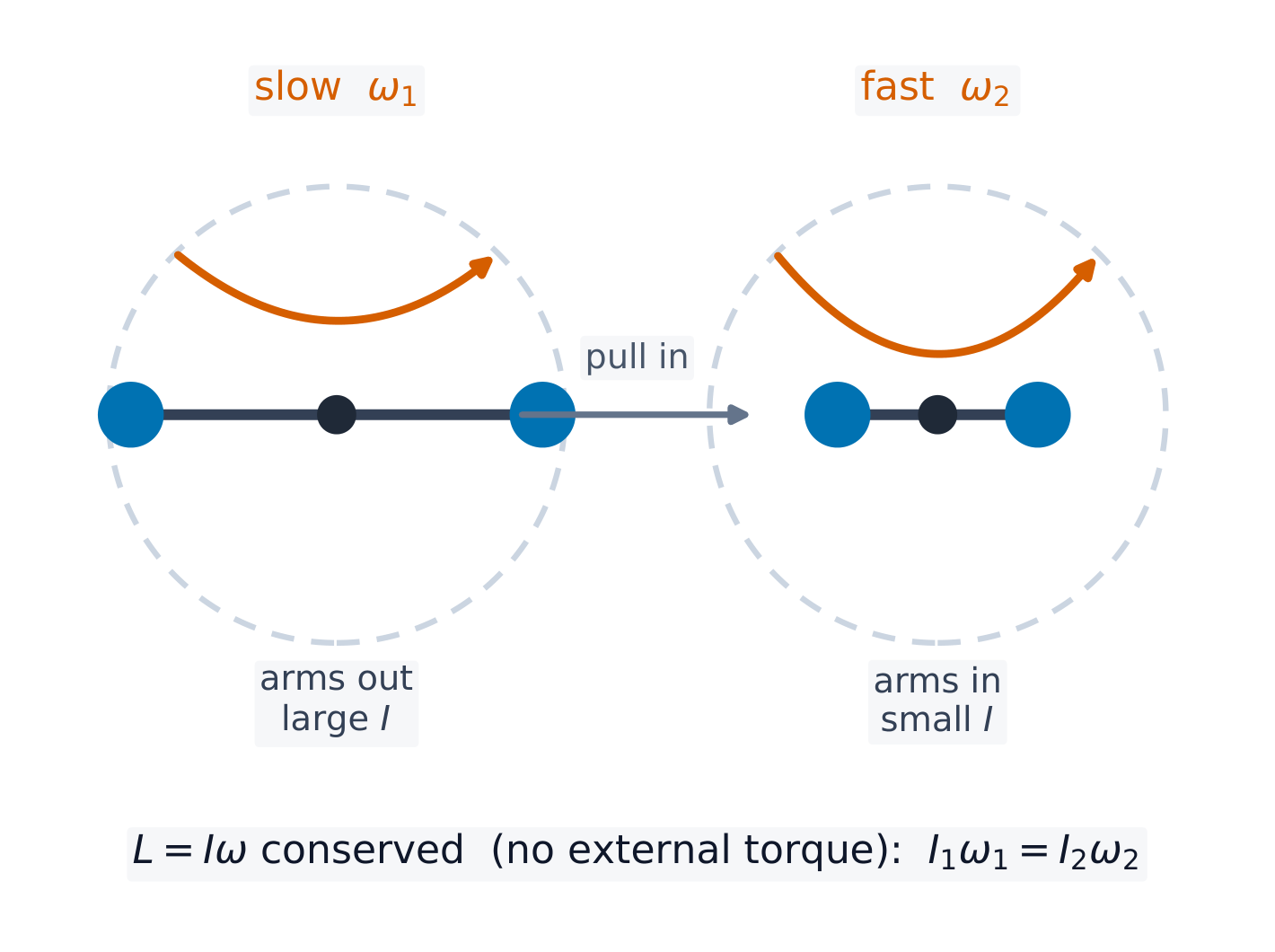
Syllabus · סיילבוס
EnglishLearning Objective 6.4.A: Describe the behavior of a system using conservation of angular momentum.
- 6.4.A.1 The total angular momentum of a system about a rotational axis is the sum of the angular momenta of the system's constituent parts about that rotational axis.
- 6.4.A.2 Any change to a system's angular momentum must be due to an interaction between the system and its surroundings.
- 6.4.A.2.i The angular impulse exerted by one object or system on a second object or system is equal and opposite to the angular impulse exerted by the second object or system on the first. This is a direct result of Newton's third law.
- 6.4.A.2.ii A system may be selected so that the total angular momentum of that system is constant.
- 6.4.A.2.iii The angular speed of a nonrigid system may change without the angular momentum of the system changing if the system changes shape by moving mass closer to or farther from the rotational axis.
- 6.4.A.2.iv If the total angular momentum of a system changes, that change will be equivalent to the angular impulse exerted on the system.
Learning Objective 6.4.B: Describe how the selection of a system determines whether the angular momentum of that system changes.
- 6.4.B.1 Angular momentum is conserved in all interactions.
- 6.4.B.2 If the net external torque exerted on a selected object or rigid system is zero, the total angular momentum of that system is constant.
- 6.4.B.3 If the net external torque exerted on a selected object or rigid system is nonzero, angular momentum is transferred between the system and the environment.
עבריתמטרות למידה 6.4.A: לתאר את התנהגות מערכת באמצעות שימור תנע זוויתי.
- 6.4.A.1 התנע הזוויתי הכולל של מערכת סביב ציר סיבוב הוא סכום התנעים הזוויתיים של חלקי המערכת המרכיבים אותה סביב ציר הסיבוב הזה.
- 6.4.A.2 כל שינוי בתנע הזוויתי של מערכת חייב להיות תוצאה של אינטראקציה בין המערכת לסביבתה.
- 6.4.A.2.i ההשפעה הזוויתית המופעלת על ידי גוף או מערכת על גוף או מערכת שנייה שווה בכמותה אך הפוכה בכיוונה להשפעה הזוויתית המופעלת על ידי הגוף או המערכת השנייה על הראשונה. זוהי תוצאה ישירה של חוק השלישי של ניוטון.
- 6.4.A.2.ii ניתן לבחור מערכת כך שאתר תנע הזוויתי הכולל שלה יהיה קבוע.
- 6.4.A.2.iii המהירות הזוויתית של מערכת לא-קשיחה עשויה להשתנות ללא שינוי בתנע הזוויתי של המערכת אם המערכת משנה את צורתה על ידי הזזת מססה קרובה יותר או רחוק יותר מציר הסיבוב.
- 6.4.A.2.iv אם תנע הזוויתי הכולל של מערכת משתנה, השינוי הזה יהיה שקול להשפעה הזוויתית המופעלת על המערכת.
מטרות למידה 6.4.B: לתאר כיצד בחירת המערכת קובעת האם תנע הזוויתי שלה משתנה.
- 6.4.B.1 תנע זוויתי שמר בכל האינטראקציות.
- 6.4.B.2 אם המומנט החיצוני הכולל המופעל על גוף או מערכת קשיחה שנבחרה הוא אפס, תנע הזוויתי הכולל של מערכת זו יהיה קבוע.
- 6.4.B.3 אם המומנט החיצוני הכולל המופעל על גוף או מערכת קשיחה שנבחרה אינו אפס, תנע זוויתי מועבר בין המערכת לסביבה.
Source: College Board AP Course and Exam Description · מקור: תיאור הקורס והמבחן של College Board AP
EnglishAngular momentum: pull in, spin faster With zero net external torque, total angular momentum is conserved 守恒:
$$L_{\text{before}}=L_{\text{after}},\qquad I_1\omega_1=I_2\omega_2\ \text{(one rigid body reshaping)}.$$If $I$ shrinks, $\omega$ grows – a spinning skater speeds up pulling her arms in. The rule survives collisions and shape changes, which is what makes it so useful: pick the axis so that every external force (gravity, the pivot force) exerts no torque about it.
Worked example. A skater spins at $2.0\ \text{rev/s}$ with $I_1=4.0\ \text{kg}\cdot\text{m}^2$. Pulling in her arms drops it to $I_2=1.6\ \text{kg}\cdot\text{m}^2$: $\omega_2=\dfrac{4.0}{1.6}(2.0)=5.0\ \text{rev/s}$. Her kinetic energy rises – the extra energy is the work her muscles do pulling her arms inward.
Worked example (rotational collision). A $0.020\ \text{kg}$ bullet at $300\ \text{m/s}$ strikes the tip of a uniform rod ($M=1.5\ \text{kg}$, length $l=0.60\ \text{m}$) hanging from a pivot, and embeds. About the pivot, gravity and the pivot force exert no torque during the strike, so $L$ is conserved: $L=mvl=0.020(300)(0.60)=3.6\ \text{kg}\cdot\text{m}^2/\text{s}$. Afterwards $I=\tfrac13Ml^2+ml^2=0.18+0.0072=0.187\ \text{kg}\cdot\text{m}^2$, so $\omega=\dfrac{3.6}{0.187}\approx19\ \text{rad/s}$. (Linear momentum is not conserved here – the pivot pushes on the rod – and kinetic energy certainly is not: check both before claiming them.)
עבריתתנע זוויתי: כיווץ, סיבוב מהיר יותר עם מומנט חיצוני נטו אפס, תנע זוויתי כולל נשמר:
$$L_{\text{before}}=L_{\text{after}},\qquad I_1\omega_1=I_2\omega_2\ \text{(one rigid body reshaping)}.$$אם $I$ מתקטן, $\omega$ גדל – מחליקה המסתובבת מאיטה כשהיא מכניסה את זרעותיה. הכלל עובר התנגשויות ושנויי צורה, דבר שמעניק לו כך רבות שימושיות: בחרו ציר כך שכל כוח חיצוני (כובד, כוח הציר) לא יפעיל מומנט סביבו.
דוגמה פתורה. מחליקה מסתובבת ב$2.0\ \text{rev/s}$ עם $I_1=4.0\ \text{kg}\cdot\text{m}^2$. הכנסת זרעותיה מורידה אותה ל$I_2=1.6\ \text{kg}\cdot\text{m}^2$: $\omega_2=\dfrac{4.0}{1.6}(2.0)=5.0\ \text{rev/s}$. האנרגיה הקינטית שלה עולה – האנרגיה הנוספת היא העבודה שהשרירים שלה מבצעים בהכנסת הזרעות פנימה.
משיכת מסה פנימה מפחיתה את I, ולכן ω עולה כדי לשמור על L = Iω 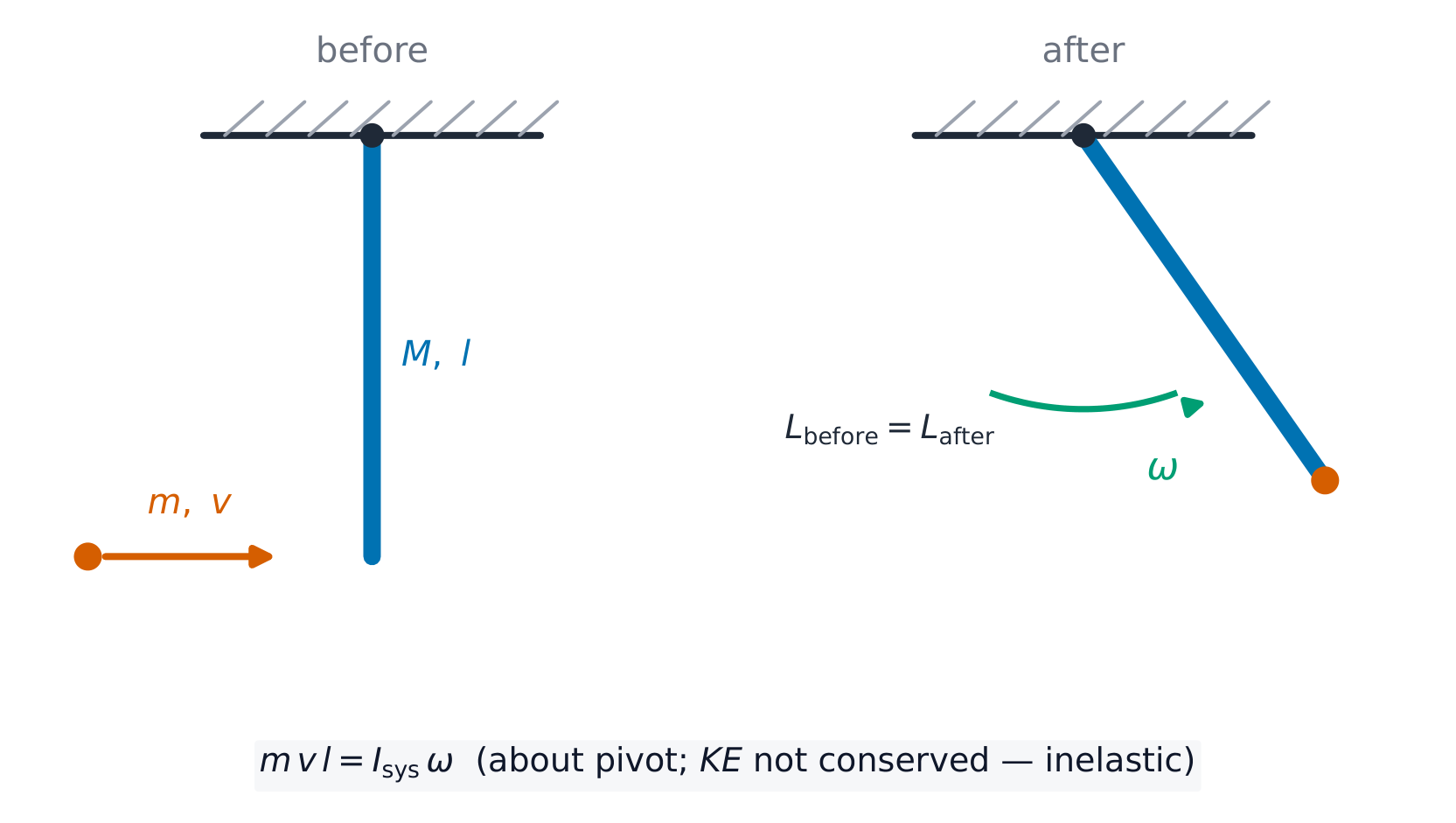
תנע זוויתי סביב הציר נשמר כשכדור הפותל נטמע במוט דוגמה פתורה (התנגשות סיבובית). כדור פותל בגודל $0.020\ \text{kg}$ במהירות $300\ \text{m/s}$ פוגע בקצה של מוט אחיד (מסה $M=1.5\ \text{kg}$, אורך $l=0.60\ \text{m}$) התלוי מציר, ונטמע בו. סביב הציר, כובד וכוח הציר אינם מפעילים מומנט במהלך ההתנגשות, ולכן $L$ נשמר: $L=mvl=0.020(300)(0.60)=3.6\ \text{kg}\cdot\text{m}^2/\text{s}$. לאחר מכן $I=\tfrac13Ml^2+ml^2=0.18+0.0072=0.187\ \text{kg}\cdot\text{m}^2$, ולכן $\omega=\dfrac{3.6}{0.187}\approx19\ \text{rad/s}$. (תנע ליניארי אינו נשמר כאן – הציר דוחק במוט – ואנרגיה קינטית בוודאי לא נשמרת: בדקו זאת לפני שאתם טוענים לכך).

מחלקת אמנות ותנע זוויתי: מחליקה שמכניסה את זרעותיה בזמן סיבוב מצמצמת את תנע המהירות הסיבובי שלה, ולכן מסתובבת מהיר יותר Vocabulary · מילון מונחים Train · אימוןEnglish עברית rotational kinetic energy/rəʊˈteɪʃənl kɪˈnetɪk ˈenədʒi/ אנרגיה קינטית סיבובית rotational inertia/rəʊˈteɪʃənl ɪˈnɜːʃə/ אינרציה סיבובית torque/tɔːk/ מומנט angular displacement/ˈæŋɡjʊlə dɪˈspleɪsmənt/ הזזה זוויתית Angular momentum/ˈæŋɡjʊlə məʊˈmentəm/ תנע זוויתי angular impulse/ˈæŋɡjʊlə ˈɪmpʌls/ אימפולס זוויתי conserved/kənˈsɜːvd/ שמור על ערכו 6.5
Rolling · גלילה
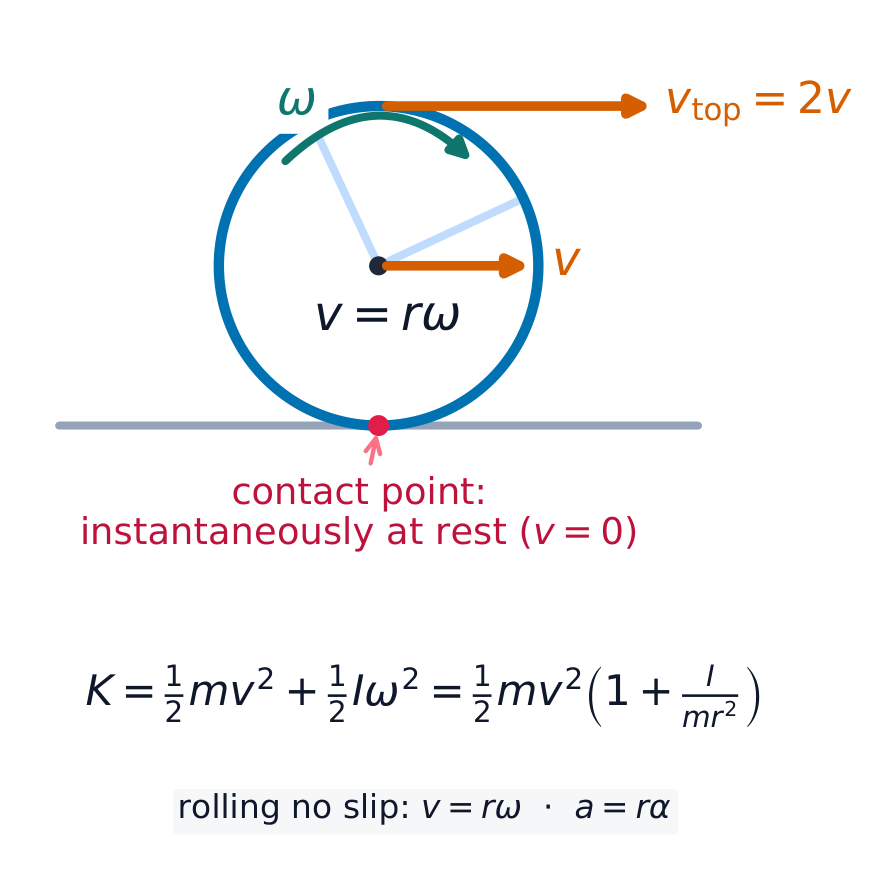
Syllabus · סיילבוס
EnglishLearning Objective 6.5.A: Describe the kinetic energy of a system that has translational and rotational motion.
- 6.5.A.1 The total kinetic energy of a system is the sum of the system's translational and rotational kinetic energies.
- Equation: $K_{\text{tot}} = K_{\text{trans}} + K_{\text{rot}}$
Learning Objective 6.5.B: Describe the motion of a system that is rolling without slipping.
- 6.5.B.1 While rolling without slipping, the translational motion of a system's center of mass is related to the rotational motion of the system itself with the following equations:
- Equation: $\Delta x_{\text{cm}} = r\Delta\theta$
- Equation: $v_{\text{cm}} = r\omega$
- Equation: $a_{\text{cm}} = r\alpha$
- 6.5.B.2 For ideal cases, rolling without slipping implies that the frictional force does not dissipate any energy from the rolling system.
Learning Objective 6.5.C: Describe the motion of a system that is rolling while slipping.
- 6.5.C.1 When slipping, the motion of a system's center of mass and the system's rotational motion cannot be directly related.
- 6.5.C.2 When a rotating system is slipping relative to another surface, the point of application of the force of kinetic friction exerted on the system moves with respect to the surface, so the force of kinetic friction will dissipate energy from the system.
Boundary statement: Rolling friction is beyond the scope of AP Physics C: Mechanics.
עבריתמטרות למידה 6.5.A: לתאר את האנרגיה הקינטית של מערכת שיש לה תנועה תרגומית וסיבובית.
- 6.5.A.1 האנרגיה הקינטית הכוללת של מערכת היא סכום האנרגיה הקינטית התנועתית והאנרגיה הקינטית הסיבובית של המערכת.
- משוואה: $K_{\text{tot}} = K_{\text{trans}} + K_{\text{rot}}$
מטרת למידה 6.5.B: לתאר את תנועת מערכת הנעה ללא החלקה.
- 6.5.B.1 בזמן גלילה ללא החלקה, התנועה התרגומית של מרכז המסה של מערכת קשורה לתנועה הסיבובית של המערכת עצמה באמצעות המשוואות הבאות:
- משוואה: $\Delta x_{\text{cm}} = r\Delta\theta$
- משוואה: $v_{\text{cm}} = r\omega$
- משוואה: $a_{\text{cm}} = r\alpha$
- 6.5.B.2 במקרים אידיאליים, הנעה ללא החלקה מציינת כי כוח החיכוך אינו מפזר אנרגיה מהמערכת הנעה.
מטרת למידה 6.5.C: לתאר את תנועת מערכת הנעה עם החלקה.
- 6.5.C.1 כאשר ישנה החלקה, לא ניתן לקשר ישירות בין תנועת מרכז הכובד של המערכת לבין התנועה הסיבובית שלה.
- 6.5.C.2 כאשר מערכת מסתובבת ומחליקה ביחס למשטח אחר, נקודת ההשפעה של כוח החיכוך הקינטי הפועל על המערכת נעה ביחס למשטח, ולכן כוח החיכוך הקינטי יפזר אנרגיה מהמערכת.
הצהרת גבול: חיכוך גלילה אינו נכלל בתחום הלימודים של AP Physics C: מכניקה.
Source: College Board AP Course and Exam Description · מקור: תיאור הקורס והמבחן של College Board AP
EnglishRolling without slipping Rolling without slipping 无滑滚动 ties translation to rotation: the contact point is momentarily at rest, so
$$\Delta x_{\text{cm}}=r\,\Delta\theta,\qquad v_{\text{cm}}=r\omega,\qquad a_{\text{cm}}=r\alpha.$$Static friction supplies the torque that keeps the spin matched to the motion, but at a point that is not sliding – so for pure rolling, friction does no work, and energy conservation is safe to use. (Rolling friction is beyond the AP course.)
Racing shapes down an incline shows the energy split. With $I=\beta mr^2$, energy conservation gives
$$a_{\text{cm}}=\frac{g\sin\theta}{1+\beta}:$$a sphere ($\beta=\tfrac25$) beats a disk 圆盘 ($\beta=\tfrac12$), which beats a hoop 圆环 ($\beta=1$) – mass and radius cancel completely. More of the hoop's energy is locked in rotation, so its center moves slower.
Worked example. A solid sphere rolls from rest down a $30^\circ$ incline: $a=\dfrac{g\sin30^\circ}{1+\tfrac25}=\dfrac{9.8(0.50)}{1.4}=3.5\ \text{m/s}^2$, versus $4.9\ \text{m/s}^2$ for a frictionless slider – rolling objects always lose the race against sliding ones.
עבריתגלגל ללא החלקה גלגל ללא החלקה מקשר תנועה תנועתית לסיבוב: נקודת המגע נמצאת רגעית במנוחה, ולכן
$$\Delta x_{\text{cm}}=r\,\Delta\theta,\qquad v_{\text{cm}}=r\omega,\qquad a_{\text{cm}}=r\alpha.$$בגלילה ללא החלקה נקודת המגע במנוחה, ולכן v = rω חיכוך סטטי מספק את המומנט שמחזיר את הסיבוב באיזון עם התנועה, אך בנקודה שאינה מחליקה – ולכן עבור גלגול טהור, חיכוך אינו מבצע עבודה, ושמירת אנרגיה יכולה לשמש בביטחון. (חיכוך גלגול אינו נדרש בקורס AP).
מרוץ צורות מגלגלות למטה על מדרון מדגים את חלוקת האנרגיה. עם $I=\beta mr^2$, שמירת אנרגיה נותנת
$$a_{\text{cm}}=\frac{g\sin\theta}{1+\beta}:$$כדור ($\beta=\tfrac25$) מנצח דיסק ($\beta=\tfrac12$), שמנצח טבעת ($\beta=1$) – המסה והרדיוס מתבטלים לחלוטין. כמות גדולה יותר מאנרגיית הסיבוב של הטבעת נעוצה בסיבוב, ולכן מרכז המסה שלה נע לאט יותר.
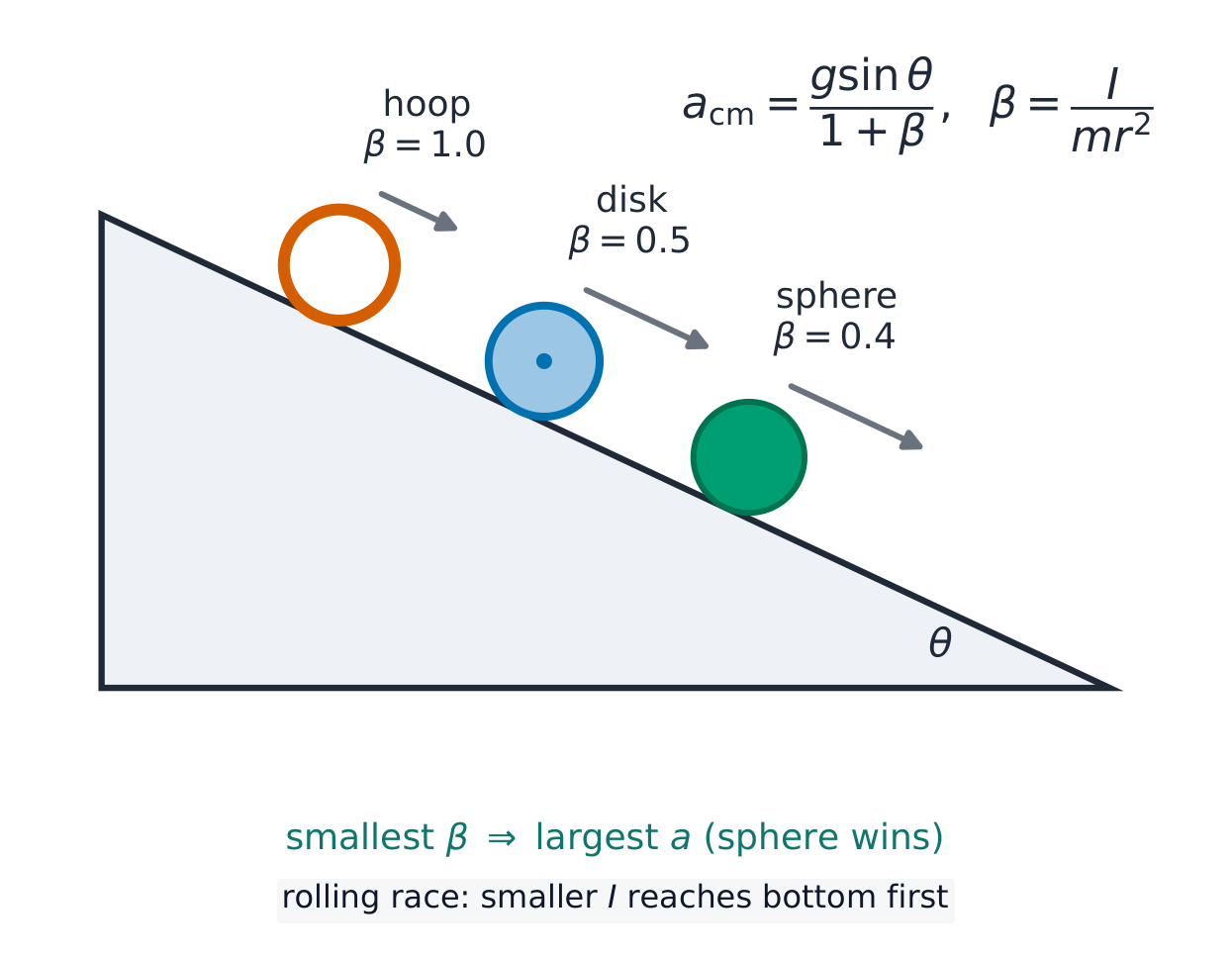
מירוץ גלילה: הצורה עם ה-I/mr² הקטן ביותר מגיעה לראשונה לתחתית דוגמה מופת. כדור מלא גולל ממנוחה למטה על משטח משופע $30^\circ$: $a=\dfrac{g\sin30^\circ}{1+\tfrac25}=\dfrac{9.8(0.50)}{1.4}=3.5\ \text{m/s}^2$, לעומת $4.9\ \text{m/s}^2$ עבור מחליק ללא חיכוך – גופים גוללים תמיד מפסידים במירוץ מול גופים החלקים.
Vocabulary · מילון מונחים Train · אימוןEnglish עברית Rolling without slipping/ˈrəʊlɪŋ wɪˈðaʊt ˈslɪpɪŋ/ גלילה ללא החלקה disk/dɪsk/ דיסק hoop/huːp/ טבעת centripetal force/senˈtrɪpɪtl fɔːs/ כוח צנטריפטלי satellite/ˈsætəlaɪt/ לוויין gravitational potential energy/ˌɡrævɪˈteɪʃənl pəˈtenʃl ˈenədʒi/ אנרגיה פוטנציאלית כבידתית total mechanical energy/ˈtəʊtl mɪˈkænɪkl ˈenədʒi/ אנרגיה מכנית כוללת escape velocity/eˈskeɪp vəˈlɒsɪti/ מהירות מנוסה elliptical orbit/ɪˈlɪptɪkl ˈɔːbɪt/ מסלול אלפטי Kepler's second law/ˈkepləz ˈsekənd lɔː/ חוק השני של קפלר 6.6
Motion of Orbiting Satellites · תנועת לוויינים במסלול
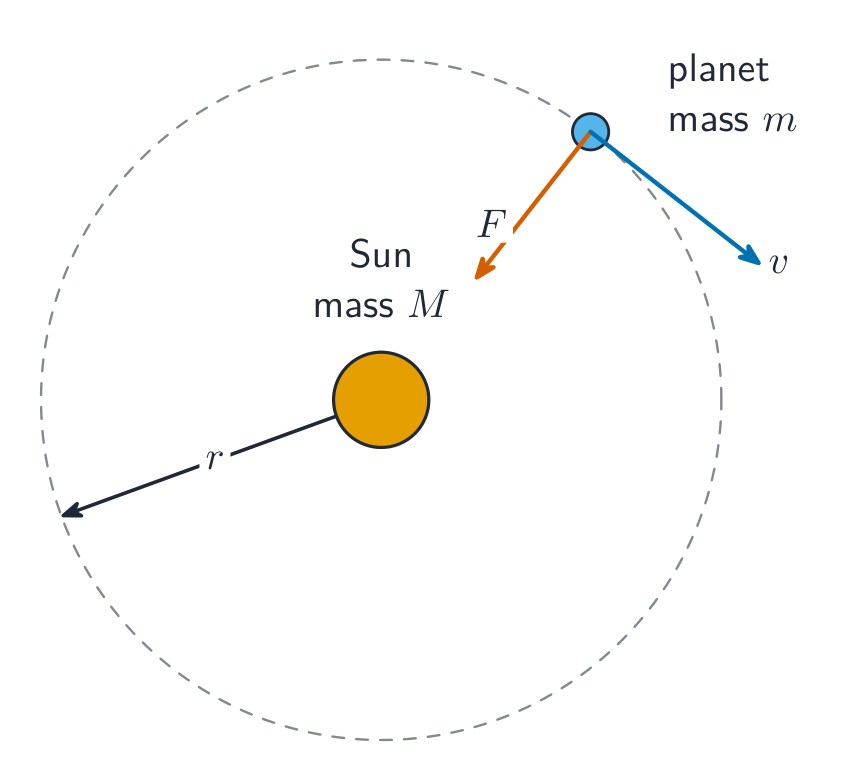
Syllabus · סיילבוס
EnglishLearning Objective 6.6.A: Describe the motions of a system consisting of two objects or systems interacting only via gravitational forces.
- 6.6.A.1 In a system consisting only of a massive central object and an orbiting satellite with mass that is negligible in comparison to the central object's mass, the motion of the central object itself is negligible.
- 6.6.A.2 The motion of satellites in orbits is constrained by conservation laws.
- 6.6.A.2.i In circular orbits, the system's total mechanical energy, the system's gravitational potential energy, and the satellite's angular momentum and kinetic energy are constant.
- 6.6.A.2.ii In elliptical orbits, the system's total mechanical energy and the satellite's angular momentum are constant, but the system's gravitational potential energy and the satellite's kinetic energy can each change.
- 6.6.A.2.iii The gravitational potential energy of a system consisting of a satellite and a massive central object is defined to be zero when the satellite is an infinite distance from the central object.
- Equation: $U_g = -G\dfrac{m_1 m_2}{r}$
- 6.6.A.3 The total energy of a system consisting of a satellite orbiting a central object in a circular path can be written in terms of the gravitational potential energy of that system or the kinetic energy of the satellite.
- Equation: $K = -\dfrac{1}{2}U$
- Equation: $E_{total} = \dfrac{1}{2}U = -\dfrac{GMm}{2r}$
- 6.6.A.4 The escape velocity of a satellite is the satellite's velocity such that the mechanical energy of the satellite–central-object system is equal to zero.
- 6.6.A.4.i When the only force exerted on a satellite is gravity from a central object, a satellite that reaches escape velocity will move away from the central body until its speed reaches zero at an infinite distance from the central body.
- 6.6.A.4.ii The escape velocity of a satellite from a central body of mass $M$ can be derived using conservation of energy laws.
- Equation: $v_{\text{esc}} = \sqrt{\dfrac{2GM}{r}}$
עבריתמטרות למידה 6.6.A: תאר את התנועה של מערכת המורכבת משני אובייקטים או מערכות המתאימות זו לזו רק באמצעות כוחות כבידה.
- 6.6.A.1 במערכת המורכבת רק מגוף מרכזי בעל מסה וגוף לוויני שמסתו זניחה לעומת מסת הגוף המרכזי, התנועה של הגוף המרכזי עצמו היא זניחה.
- 6.6.A.2 תנועת לווינים במסלולים מוגבלת על ידי חוקי שימור.
- 6.6.A.2.i במסלולים מעגליים, האנרגיה המכנית הכוללת של המערכת, האנרגיה הפוטנציאלית הכבידתית של המערכת, המומנט הזוויתי והאנרגיה הקינטית של הלווינה הם קבועים.
- 6.6.A.2.ii במסלולים אלפסיוئידים, האנרגיה המכנית הכוללת של המערכת והמומנט הזוויתי של הלווינה הם קבועים, אך האנרגיה הפוטנציאלית הכבידתית של המערכת והאנרגיה הקינטית של הלווינה עשויות להשתנות כל אחת בנפרד.
- 6.6.A.2.iii האנרגיה הפוטנציאלית הכבידתית של מערכת המורכבת מלווינה וגוף מרכזי בעל מסה מוגדרת כאפס כאשר הלווינה נמצאת במרחק אינסופי מהגוף המרכזי.
- משוואה: $U_g = -G\dfrac{m_1 m_2}{r}$
- 6.6.A.3 האנרגיה הכוללת של מערכת המורכבת מלוויין המקיף גוף מרכזי במסלול עגולנית ניתן לבטא באמצעות אנרגיה פוטנציאלית כבידתית של המערכת או באמצעות אנרגיה קינטית של הלוויין.
- משוואה: $K = -\dfrac{1}{2}U$
- משוואה: $E_{total} = \dfrac{1}{2}U = -\dfrac{GMm}{2r}$
- 6.6.A.4 מהירות הבריחה של לוויין היא המהירות שבה האנרגיה המכנית של מערכת הלוויין-הגוף המרכזי שווה לאפס.
- 6.6.A.4.i כאשר הכוח היחיד הפועל על לוויין הוא כוח הכבידה מגוף מרכזי, לוויין שיגיע למהירות הבריחה יתרחק מהגוף המרכזי עד שהמהירות שלו תגיע לאפס במרחק אינסופי מהגוף המרכזי.
- 6.6.A.4.ii את מהירות הבריחה של לוויין ממסה $M$ ניתן להסיק באמצעות חוקי השימור באנרגיה.
- משוואה: $v_{\text{esc}} = \sqrt{\dfrac{2GM}{r}}$
Source: College Board AP Course and Exam Description · מקור: תיאור הקורס והמבחן של College Board AP
EnglishOrbital motion (Kepler's 2nd law) Gravity supplies the centripetal force 向心力 for a satellite 卫星 in a circular orbit:
$$\frac{GMm}{r^2}=\frac{mv^2}{r}\quad\Rightarrow\quad v=\sqrt{\frac{GM}{r}}$$– larger orbits are slower. With gravitational potential energy 引力势能 $U_g=-\dfrac{GMm}{r}$, a circular orbit obeys $K=-\tfrac12U$, so the total mechanical energy 总机械能 is
$$E=K+U=\frac{U}{2}=-\frac{GMm}{2r},$$negative because the satellite is bound. To escape from radius $r$, total energy must reach zero, giving the escape velocity 逃逸速度
$$v_{\text{esc}}=\sqrt{\frac{2GM}{r}}.$$In an elliptical orbit 椭圆轨道, $E$ and $L$ are fixed: gravity points at the focus, so it exerts no torque about it. Conserved $L$ means the satellite sweeps equal areas in equal times – Kepler's second law 开普勒第二定律 – and therefore moves fastest at closest approach, slowest at the far point. Energy conservation connects speeds at the two ends.
Worked example. For a satellite at $r=7.0\times10^{6}\ \text{m}$ around Earth ($GM=4.0\times10^{14}\ \text{m}^3/\text{s}^2$): orbital speed $v=\sqrt{GM/r}=7.6\times10^{3}\ \text{m/s}$, while escaping from that radius needs $v_{\text{esc}}=\sqrt{2GM/r}=1.1\times10^{4}\ \text{m/s}$ – exactly $\sqrt2$ times the circular speed.
Exam skill. Orbit FRQs are energy-and-angular-momentum problems in disguise: write $E=\tfrac12mv^2-\dfrac{GMm}{r}$ and $L=mvr\sin\theta$ at the two points of interest and solve the pair – never assume the orbit formulae for circles apply to an ellipse.
עבריתתנועה אורביטלית (החוק ה-2 של קפלר) כוח הכבידה מספק את כוח המרכז עבור ** לוויין** במסלול מעגלי:
$$\frac{GMm}{r^2}=\frac{mv^2}{r}\quad\Rightarrow\quad v=\sqrt{\frac{GM}{r}}$$– מסילות גדולות יותר הן איטיות יותר. עם אנרגיה פוטנציאלית כבידתית $U_g=-\dfrac{GMm}{r}$, מסלול מעגלי עומד ב-$K=-\tfrac12U$, ולכן האנרגיה המכנית הכוללת היא
$$E=K+U=\frac{U}{2}=-\frac{GMm}{2r},$$שלילית מכיוון שהלוויין קשור. כדי להימלט ממרחק $r$, האנרגיה הכוללת חייבת להגיע לאפס, מה שנותן את מהירות ההימלט
$$v_{\text{esc}}=\sqrt{\frac{2GM}{r}}.$$כוח הכבידה מספק את כוח המרכז שמחזיק את הלוויין במסלול במסלול אליפטי, ⟨$E$⟩ ו$L$ הם קבועים: הכבידה מצביעה אל המיקוד, ולכן היא אינה מפעילה תרמו סביבו. שימור ⟨$L$⟩ משמעו שהלוויין סורק שטחים שווים בזמנים שווים – חוק השני של קפלר – ולכן נע מהר ביותר בקרבתו, האיטי ביותר בנקודה הרחוקה. שימור אנרגיה מקשר בין המהירויות בשני הקצוות.
דוגמה מופת. עבור לוויין ב-$r=7.0\times10^{6}\ \text{m}$ סביב כדור הארץ ($GM=4.0\times10^{14}\ \text{m}^3/\text{s}^2$): מהירות מסלולית $v=\sqrt{GM/r}=7.6\times10^{3}\ \text{m/s}$, בעוד שהימלט ממרחק זה דורש $v_{\text{esc}}=\sqrt{2GM/r}=1.1\times10^{4}\ \text{m/s}$ – בדיוק $\sqrt2$ פעמים מהירות מעגלית.
מיומנות לבחינה. שאלות FRQ על מסלולים הן למעשה בעיות אנרגיה ומומנט זוויתי: כתבו $E=\tfrac12mv^2-\dfrac{GMm}{r}$ ו-$L=mvr\sin\theta$ בשתי הנקודות הרלוונטיות ופתרו את המערכת – לעולם אל תניחו that מס jailed formulae for circles apply to an ellipse.
Explore · חקורCompare orbits at different radii · השווה מסלולים בקרני רדיוס שונות
An orbiting satellite is in free fall, gravity supplying the centripetal force. A larger orbit means a slower speed and longer period (Kepler's third law). · לוויין במסלול נמצא במערכות חופשיות, וכובד מספק את הכוח המרכזי. מסלול גדול יותר אומר מהירות נמוכה יותר ותקופה ארוכה יותר (חוק השלישי של קפלר).
6.6
Exam tips · טיפים לבחינות
English- Compute the moment of inertia $I=\int r^2\,dm$ and shift axes with the parallel-axis theorem $I=I_{cm}+Md^2$.
- Rotational kinetic energy is $\tfrac12 I\omega^2$; a rolling body has both translational and rotational KE.
- Conserve angular momentum $L=I\omega$ when net external torque is zero (a spinning skater pulling in).
- Use energy conservation for rolling-without-slipping problems ($v=r\omega$ ties the two motions).
- Know standard $I$ values (hoop, disk, rod, sphere) and where the axis is.
עברית- חשבו את מומנט האינרציה $I=\int r^2\,dm$ והזיזו צירים באמצעות משפט הציר המקביל $I=I_{cm}+Md^2$.
- אנרגיה קינטית סיבובית היא $\tfrac12 I\omega^2$; גוף גולל יש לו גם אנרגיה קינטית תרגולית וגם אנרגיה קינטית סיבובית.
- שמרו על מומנט זוויתי $L=I\omega$ כאשר המומנט החיצוני הכולל הוא אפס (מחליק מסתובב המכנס את ידיו).
- השתמשו בשימור אנרגיה לבעיות גלילה ללא החלקה ($v=r\omega$ מקשר בין שתי התנועות).
- הכירו ערכים סטנדרטיים ל-$I$ (טבעת, דיסק, מוט, כדור) ואين המוקד נמצא.
- 6.1.A.1 The rotational kinetic energy of an object or rigid system is related to the rotational inertia and angular velocity of the rigid system and is given by the equation $K_{\text{rot}} = \dfrac{1}{2} I \omega^2$.
-
7
Oscillations · תנודות
Watch lesson · צפה בשיעור7.1
Defining Simple Harmonic Motion · הגדרת תנועה הרמונית פשוטה
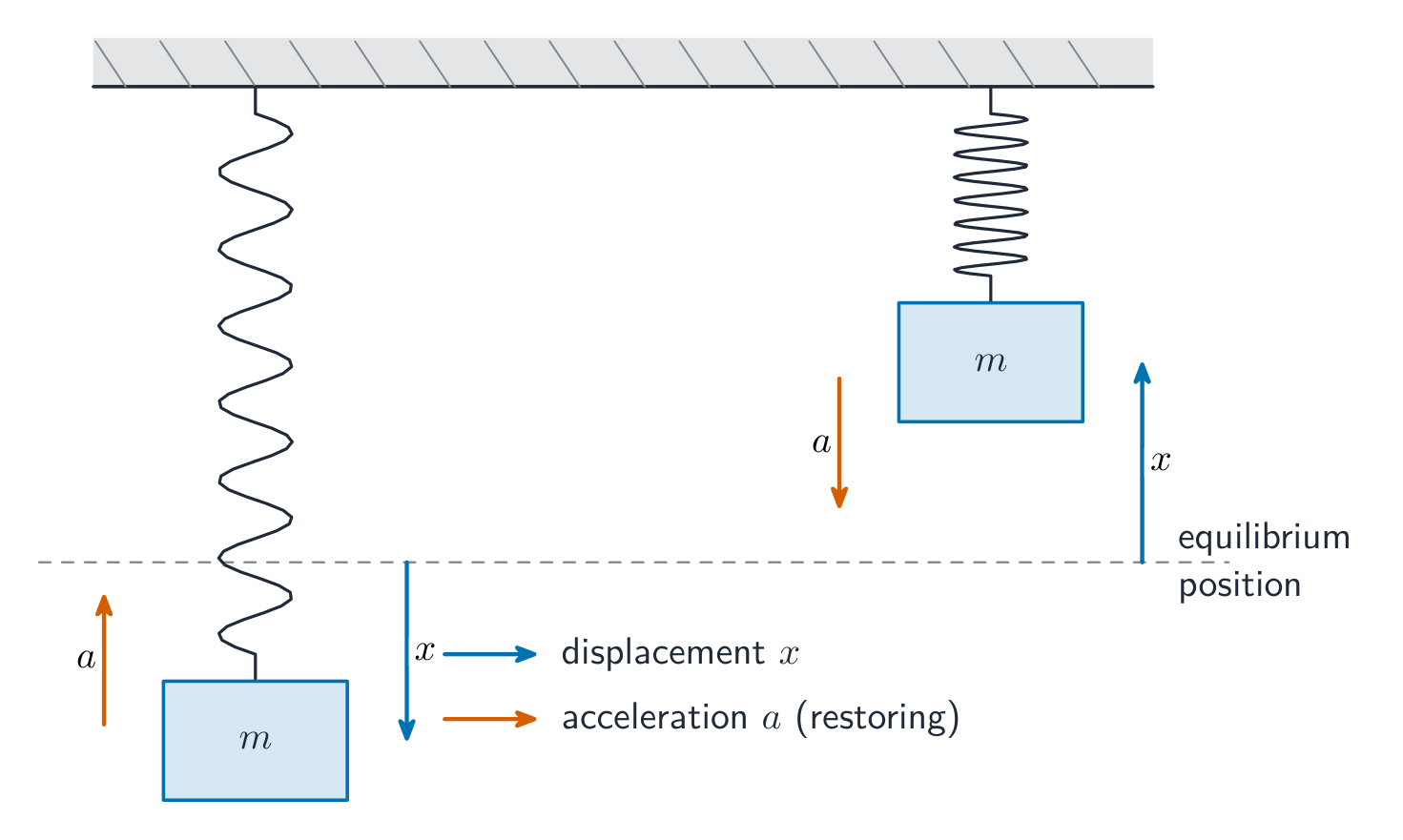
Syllabus · סיילבוס
EnglishLearning Objective 7.1.A: Describe simple harmonic motion.
- 7.1.A.1 Simple harmonic motion is a special case of periodic motion.
- 7.1.A.2 SHM results when the magnitude of the restoring force exerted on an object is proportional to that object's displacement from its equilibrium position.
- Derived equation: $ma_x = -k\Delta x$
- 7.1.A.2.i A restoring force is a force that is exerted in a direction opposite to the object's displacement from an equilibrium position.
- 7.1.A.2.ii An equilibrium position is a location at which the net force exerted on an object or system is zero.
עבריתמטרת למידה 7.1.A: לתאר תנועה הרמונית פשוטה.
- 7.1.A.1 תנועה הרמונית פשוטה היא מקרה מיוחד של תנועה מחזורית.
- 7.1.A.2 SHM נוצר כאשר גודל כוח ההשבה הפועל על גוף הוא פרופורציונלי להזזה של אותו גוף ממיקום האיזון שלו.
- משוואה גזורה: $ma_x = -k\Delta x$
- 7.1.A.2.i כוח השבה הוא כוח הפועל בכיוון הנגדי להזזה של הגוף ממיקום איזון.
- 7.1.A.2.ii מיקום איזון הוא מיקום שבו הכוח הכולל הפועל על גוף או מערכת הוא אפס.
Source: College Board AP Course and Exam Description · מקור: תיאור הקורס והמבחן של College Board AP
EnglishSimple harmonic motion Simple harmonic motion 简谐运动 (SHM) is a special case of periodic motion 周期运动. It appears whenever two things are true: there is an equilibrium 平衡位置 position where the net force is zero, and displacing the object produces a restoring force 回复力 – a force pointing back toward equilibrium – whose magnitude is proportional to the displacement:
$$F=-k\,\Delta x.$$Newton's second law then gives the defining differential equation 微分方程:
$$\frac{d^2x}{dt^2}=-\frac{k}{m}\,x=-\omega^2 x,\qquad \omega=\sqrt{\frac{k}{m}}.$$Its solution is sinusoidal, $x(t)=A\cos(\omega t+\phi)$. You do not need to prove this solution – you need to recognise the equation: any system whose motion obeys "$\ddot{x}=-\omega^2x$" is a simple harmonic oscillator, whatever it is made of. (A mass hanging on a vertical spring works the same way: gravity only shifts the equilibrium point; the oscillation about it is unchanged.)
עבריתתנועה הרמונית פשוטה תנועה הרמונית פשוטה (SHM) היא מקרה פרטי של תנועה מחזורית. היא מופיעה כאשר שני דברים מתקיימים בו-זמנית: קיים נקודת איזון בה הכוח הכולל הוא אפס, והזזה של הגוף מייצרת כוח מחזיר – כוח המצביע חזרה לכיוון נקודת האיזון – שגודלו פרופורציונלי להזזה:
$$F=-k\,\Delta x.$$חוק השני של ניוטון נותן אז את משוואת הפרדינגנל המגדירה:
$$\frac{d^2x}{dt^2}=-\frac{k}{m}\,x=-\omega^2 x,\qquad \omega=\sqrt{\frac{k}{m}}.$$הפתרון שלו הוא סינוסואידלי, $x(t)=A\cos(\omega t+\phi)$. אין צורך להוכיח פתרון זה – עליכם ל-זהות את המשוואה: כל מערכת שבה התנועה עומדת ב-"$\ddot{x}=-\omega^2x$" היא מתנד הרמוני פשוט, ללא קשר לחומר ממנו היא עשויה. (מסה תלויה על קפיץ אנכי עובדת באותו אופן: הכבידה רק מזיזה את נקודת האיזון; התנודה סביבה נשארת ללא שינוי.)
בתנועה הרמונית פשוטה האוצר תמיד מצביע חזרה לאיזון, הפוך להזזה 7.2
Frequency and Period of SHM · תדירות ותקופה של תנודות הרמוניות פשוטות
Syllabus · סיילבוס
EnglishLearning Objective 7.2.A: Describe the frequency and period of an object exhibiting SHM.
- 7.2.A.1 The period of SHM is related to the angular frequency, $\omega$, of the object's motion by the following equation:
- Equation: $T = \dfrac{2\pi}{\omega} = \dfrac{1}{f}$
- 7.2.A.1.i The period of an object–ideal-spring oscillator is given by the equation
- Equation: $T_s = 2\pi\sqrt{\dfrac{m}{k}}.$
- 7.2.A.1.ii The period of a simple pendulum displaced by a small angle is given by the equation
- Equation: $T_p = 2\pi\sqrt{\dfrac{l}{g}}.$
עבריתמטרת למידה 7.2.A: לתאר את התדירות והתקופה של גוף המציג SHM.
- 7.2.A.1 התקופה של תנודות הרמוניות (SHM) קשורה לתדר הזוויתי, $\omega$, של תנועת האובייקט באמצעות המשוואה הבאה:
- משוואה: $T = \dfrac{2\pi}{\omega} = \dfrac{1}{f}$
- 7.2.A.1.i תקופת רונדלר עם קפיץ אידיאלי נתונה על ידי המשוואה
- משוואה: $T_s = 2\pi\sqrt{\dfrac{m}{k}}.$
- 7.2.A.1.ii תקופת נדנד פשוט המוסח בזווית קטנה נתונה על ידי המשוואה
- משוואה: $T_p = 2\pi\sqrt{\dfrac{l}{g}}.$
Source: College Board AP Course and Exam Description · מקור: תיאור הקורס והמבחן של College Board AP
EnglishThe angular frequency 角频率 $\omega$ sets the period 周期 and frequency 频率:
$$T=\frac{2\pi}{\omega}=\frac{1}{f}.$$For the two standard systems:
$$T_{\text{spring}}=2\pi\sqrt{\frac{m}{k}},\qquad T_{\text{pendulum}}=2\pi\sqrt{\frac{\ell}{g}}.$$Two classic conceptual traps: the period of SHM never depends on the amplitude 振幅, and each system ignores one obvious variable – the pendulum's period does not involve its mass, and the spring's period does not involve $g$ (a spring–block oscillator keeps perfect time in orbit; a pendulum clock does not).
עבריתהתדר הזוויתי $\omega$ קובע את המחזור ואת התדר:
$$T=\frac{2\pi}{\omega}=\frac{1}{f}.$$עבור שתי המערכות הסטנדרטיות:
$$T_{\text{spring}}=2\pi\sqrt{\frac{m}{k}},\qquad T_{\text{pendulum}}=2\pi\sqrt{\frac{\ell}{g}}.$$שני כלי מלכודת קונספטואליים קלאסיים: התקופה של תנודות הרמוניות פשוטות (SHM) לעולם אינה תלויה במשרעת, וכל מערכת מתעלמת משתנה ברור אחד – תקופת המנדול אינה כוללת את מסתו, ותקופת הקפיץ אינה כוללת $g$ (מתנד קפיץ-גוף שומר על זמן מדויק באורביט; שעון מנדול לא עושה זאת).
Explore · חקורTime a pendulum's swing · מדוד זמן תנודת מתלה
A pendulum's period depends on its length and gravity, not its mass or (small) amplitude: $T=2\pi\sqrt{L/g}$. Lengthen it and each swing takes longer. · התקופה של מתלה תלויה באורכו ובכובד, ולא במסתו או במשרעתו (הקטנה): $T=2\pi\sqrt{L/g}$. אם מאריכים אותו, כל תנודה לוקחת יותר זמן.
7.3
Representing and Analyzing SHM · ייצוג וניתוח של תנודות הרמוניות פשוטות
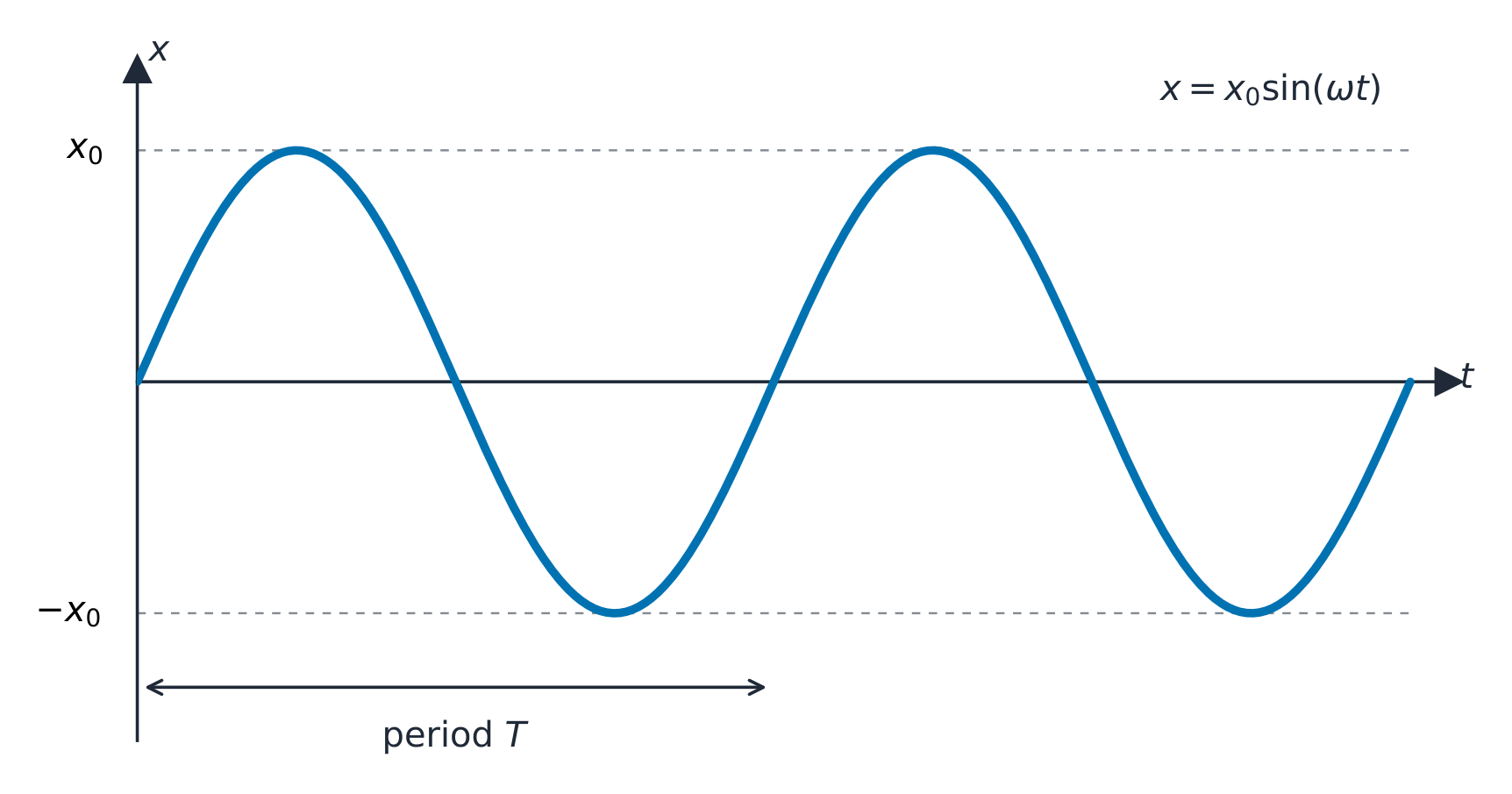
Syllabus · סיילבוס
EnglishLearning Objective 7.3.A: Describe the displacement, velocity, and acceleration of an object exhibiting SHM.
- 7.3.A.1 For an object exhibiting SHM, the displacement of that object measured from its equilibrium position can be represented by the equations $x = A\cos(2\pi ft)$ or $x = A\sin(2\pi ft)$.
- 7.3.A.1.i Minima, maxima, and zeros of displacement, velocity, and acceleration are features of harmonic motion.
- 7.3.A.1.ii Recognizing the positions or times at which the displacement, velocity, and acceleration for SHM have extrema or zeros can help in qualitatively describing the behavior of the motion.
- 7.3.A.2 The position as a function of time for an object exhibiting SHM is a solution of the second-order differential equation derived from the application of Newton's second law.
- Derived equation: $\dfrac{d^2 x}{dt^2} = -\omega^2 x$
- 7.3.A.3 Characteristics of SHM, such as velocity and acceleration, can be determined by or derived from the equation $x = A\cos(\omega t + \phi).$
- 7.3.A.3.i The acceleration of an object exhibiting SHM is related to the object's angular frequency and position.
- Derived equation: $a = -\omega^2 x$
- 7.3.A.3.ii It can be shown that the maximum velocity and acceleration of an object exhibiting SHM are related to the angular frequency of the object's motion.
- Derived equations: $v_{\max} = A\omega$
- $a_{\max} = A\omega^2$
- 7.3.A.3.i The acceleration of an object exhibiting SHM is related to the object's angular frequency and position.
- 7.3.A.4 In the presence of a sinusoidal external force, a system may exhibit resonance.
- 7.3.A.4.i Resonance occurs when an external force is exerted at the natural frequency of an oscillating system.
- 7.3.A.4.ii Resonance increases the amplitude of oscillating motion.
- 7.3.A.4.iii The natural frequency of a system is the frequency at which the system will oscillate when it is displaced from its equilibrium position.
- 7.3.A.5 Changing the amplitude of a system exhibiting SHM will not change its period.
- 7.3.A.6 Properties of SHM can be determined and analyzed using graphical representations.
Boundary statement: AP Physics C: Mechanics only expects students to know the solution to the second-order differential equation that describes SHM, as well as be able to identify SHM. AP Physics C: Mechanics does not expect students to mathematically prove that the solution is correct.
עבריתמטרת למידה 7.3.A: לתאר את ההזזה, המהירות והתאוצה של גוף המציג SHM.
- 7.3.A.1 עבור גוף המציג SHM, ההזזה של אותו גוף הנמדדת ממיקום האיזון שלו יכולה להיות מיוצגת על ידי המשוואות $x = A\cos(2\pi ft)$ או $x = A\sin(2\pi ft)$.
- 7.3.A.1.i מינימום, מקסימום ואפסים של הזזה, מהירות ותאוצה הם מאפיינים של תנועה הרמונית.
- 7.3.A.1.ii זיהוי המיקומים או הזמנים שבהם ההזזה, המהירות והתאוצה ל-SHM מגיעים לקיצונים או לאפסים יכול לעזור בתיאור איכותני של התנהגות התנועה.
- 7.3.A.2 המיקום כתלות בזמן עבור אובייקט המציג תנודות הרמוניות הוא פתרון למשוואה דיפרנציאלית מסדר שני הנגזרת מהיישום של החוק השני של ניוטון.
- משוואה גזורה: $\dfrac{d^2 x}{dt^2} = -\omega^2 x$
- 7.3.A.3 מאפיינים של תנודות הרמוניות, כגון מהירות ותאוצה, יכולים להיות נקבעים או מופקים מהמשוואה $x = A\cos(\omega t + \phi).$
- 7.3.A.3.i התאוצה של אובייקט המציג תנודות הרמוניות קשורה לתדר הזוויתי ולמיקום של האובייקט.
- משוואה נגזרת: $a = -\omega^2 x$
- 7.3.A.3.ii ניתן להראות שהמהירות והתאוצה המרביות של אובייקט המציג תנודות הרמוניות קשורות לתדר הזוויתי של תנועת האובייקט.
- משוואות מופקות: $v_{\max} = A\omega$
- $a_{\max} = A\omega^2$
- 7.3.A.3.i התאוצה של אובייקט המציג תנודות הרמוניות קשורה לתדר הזוויתי ולמיקום של האובייקט.
- 7.3.A.4 בנוכחות כוח חיצוני סינוסואידי, מערכת עשויה להציג תהודה (Resonance).
- 7.3.A.4.i תהודה מתרחשת כאשר כוח חיצוני מופעל בתדר הטבעי של מערכת רונדלרית.
- 7.3.A.4.ii תהודה מגבירה את המשרעת של תנועת הרונדלציה.
- 7.3.A.4.iii התדר הטבעי של מערכת הוא התדר בו תרונדלר המערכת כאשר היא מוסחת ממיקום האיזון שלה.
- 7.3.A.5 שינוי במשרעת של מערכת המציגה תנודות הרמוניות לא ישנה את התקופה שלה.
- 7.3.A.6 מאפיינים של תנודות הרמוניות יכולים לקבוע ולנתח באמצעות נציגות גרפית.
הצהרת גבול: AP Physics C: המכניקה מצפה רק שהתלמידים ידעו את הפתרון למשוואה הדיפרנציאלית מסדר שני המתארת תנודה הרמונית פשוטה (SHM), כמו גם להיות מסוגלים לזהות SHM. AP Physics C: המכניקה אינה מצפה מהתלמידים להוכיח מתמטית שהפתרון נכון.
Source: College Board AP Course and Exam Description · מקור: תיאור הקורס והמבחן של College Board AP
EnglishDifferentiate $x(t)=A\cos(\omega t+\phi)$ twice:
$$v=-A\omega\sin(\omega t+\phi),\qquad a=-A\omega^2\cos(\omega t+\phi)=-\omega^2x.$$So at the ends of the swing ($x=\pm A$) the speed is zero and the acceleration is largest; passing through equilibrium ($x=0$) the acceleration is zero and the speed is largest, $v_{\max}=A\omega$. The amplitude $A$ and the phase constant 相位常数 $\phi$ come from the initial conditions: where the object starts and how fast it is moving. Eliminating $t$ (or using energy, below) gives speed as a function of position:
$$v=\pm\,\omega\sqrt{A^2-x^2}.$$Worked example. A $0.50\ \text{kg}$ mass on a $k=200\ \text{N/m}$ spring: $\omega=\sqrt{k/m}=20\ \text{rad/s}$, $T=2\pi/\omega=0.31\ \text{s}$. With $A=0.10\ \text{m}$: $v_{\max}=A\omega=2.0\ \text{m/s}$ at equilibrium, and at $x=0.050\ \text{m}$ the speed is $v=\omega\sqrt{A^2-x^2}=20\sqrt{0.10^2-0.050^2}=1.7\ \text{m/s}$.
עבריתגזור את $x(t)=A\cos(\omega t+\phi)$ פעמיים:
$$v=-A\omega\sin(\omega t+\phi),\qquad a=-A\omega^2\cos(\omega t+\phi)=-\omega^2x.$$לכן בקצוות הנדודה ($x=\pm A$) המהירות היא אפס והאוצר הגדול ביותר; במעבר דרך נקודת האיזון ($x=0$) האוצר הוא אפס והמהירות הגדולה ביותר, $v_{\max}=A\omega$. המשרעת $A$ והקבוע הפאזה $\phi$ נובעים מתנאים ההתחלה: היכן שהגוף מתחיל וכמה מהיר הוא נע. הסרת $t$ (או שימוש באנרגיה, למטה) נותנת את המהירות כתלות במיקום:
$$v=\pm\,\omega\sqrt{A^2-x^2}.$$המיקום משתנה סינוסואידלית עם הזמן בתנועה פשוטה הרמונית דוגמה מופרדת. מסה $0.50\ \text{kg}$ על קפיץ $k=200\ \text{N/m}$: $\omega=\sqrt{k/m}=20\ \text{rad/s}$, $T=2\pi/\omega=0.31\ \text{s}$. עם $A=0.10\ \text{m}$: $v_{\max}=A\omega=2.0\ \text{m/s}$ באיזון, ובמיקום $x=0.050\ \text{m}$ המהירות היא $v=\omega\sqrt{A^2-x^2}=20\sqrt{0.10^2-0.050^2}=1.7\ \text{m/s}$.
7.4
Energy of Simple Harmonic Oscillators · אנרגיה של מתנדדים הרמוניים פשוטים
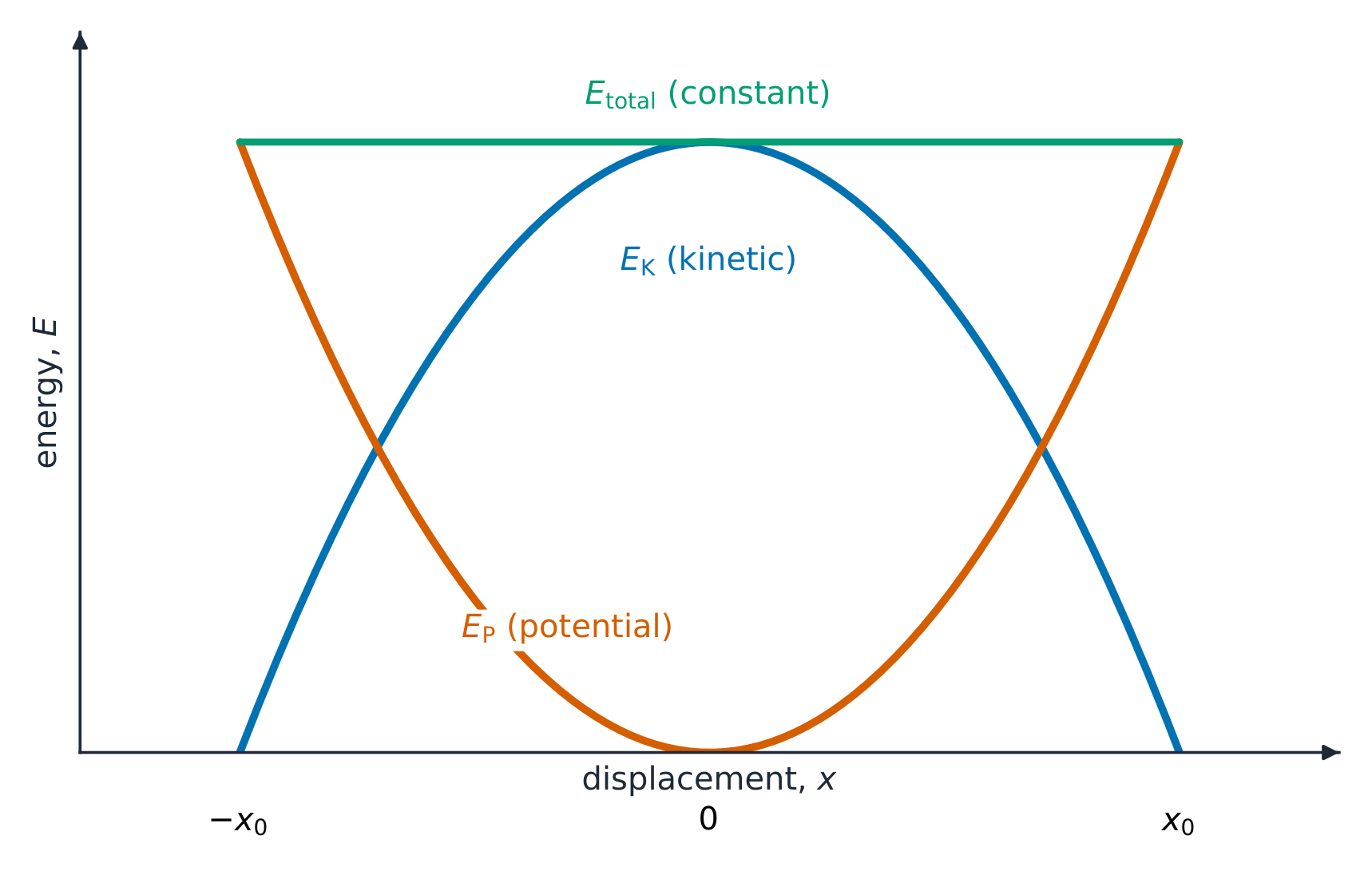
Syllabus · סיילבוס
Learning Objective Essential Knowledge 7.4.A
Describe the mechanical energy of a system exhibiting SHM.- 7.4.A.1 The total energy of a system exhibiting SHM is the sum of the system's kinetic and potential energies.
- Relevant equation: $E_{\text{total}} = U + K$
- 7.4.A.2 Conservation of energy indicates that the total energy of a system exhibiting SHM is constant.
- 7.4.A.3 The kinetic energy of a system exhibiting SHM is at a maximum when the system's potential energy is at a minimum.
- 7.4.A.4 The potential energy of a system exhibiting SHM is at a maximum when the system's kinetic energy is at a minimum.
- 7.4.A.4.i The minimum kinetic energy of a system exhibiting SHM is zero.
- 7.4.A.4.ii Changing the amplitude of a system exhibiting SHM will change the maximum potential energy of the system and, therefore, the total energy of the system.
- Relevant equation for a spring–object system: $E_{\text{total}} = \dfrac{1}{2}kA^2$
Source: College Board AP Course and Exam Description · מקור: תיאור הקורס והמבחן של College Board AP
EnglishThe total energy of the oscillator is the sum $E=U+K$, and with no friction it is constant – energy just trades back and forth between the spring's potential energy and the mass's kinetic energy:
$$E=\tfrac12kA^2=\tfrac12kx^2+\tfrac12mv^2.$$All potential at the ends (where $K=0$), all kinetic at equilibrium (where $U$ is minimum). Because $E\propto A^2$, doubling the amplitude quadruples the energy.
Worked example. Where is the energy split evenly? Set $\tfrac12kx^2=\tfrac12E=\tfrac14kA^2$, so $x=A/\sqrt2\approx0.71A$ – much closer to the end than to the middle. For the system above ($A=0.10\ \text{m}$): $x=0.071\ \text{m}$.
Left alone, a system oscillates at its own natural frequency 固有频率 (set by $k$ and $m$: $f_0=\frac{1}{2\pi}\sqrt{k/m}$). Drive it with a periodic force at that same frequency and the amplitude grows dramatically – resonance 共振. Each well-timed push adds energy faster than damping removes it, so the driven amplitude peaks sharply when the driving frequency matches $f_0$ (a swing pumped in time, a bridge shaken by wind).
עבריתהאנרגיה הכוללת של המתנד היא הסכום $E=U+K$, וללא חיכוך היא קבועה – האנרגיה פשוט משתנה חלופית בין האנרגיה הפוטנציאלית של הקפיץ לאנרגיה הקינטית של המסה:
$$E=\tfrac12kA^2=\tfrac12kx^2+\tfrac12mv^2.$$כל האנרגיה פוטנציאלית בקצוות (כאן $K=0$), כל האנרגיה קינטית באיזון (כאן $U$ מינימלי). מכיוון ש$E\propto A^2$, הכפלת המשרעת מארבעה את האנרגיה.
אנרגיה קינטית ופוטנציאלית מתחלפות במהלך מחזור בעוד שהאנרגיה הכוללת נשארת קבועה דוגמה מופרדת. היכן האנרגיה מחולקת באופן שווה? נציב $\tfrac12kx^2=\tfrac12E=\tfrac14kA^2$, ולכן $x=A/\sqrt2\approx0.71A$ – הרבה יותר קרוב לקצה מאשר למרכז. עבור המערכת הנ"ל ($A=0.10\ \text{m}$): $x=0.071\ \text{m}$.
כאשר מושארים לבדם, מערכת מתנדדת בתדר טבעי שלה (נקבע על ידי $k$ ו$m$: $f_0=\frac{1}{2\pi}\sqrt{k/m}$). אם גורמים לה בכוח מחזורי באותו תדר, המשרעת גדלה באופן דרמטי – תהודה. כל דחיפה בזמן הנכון מוסיפה אנרגיה מהר יותר מהשחיקה שהיא מסירה, כך שמשרעת הדרייב מקבלת שיא חד כאשר תדר ההנעה מתאים ל$f_0$ (מתנד שמתנדנד בזמן, גשר שנערעע על ידי רוח).
Explore · חקורTrade kinetic and potential energy in SHM · חילוף אנרגיה קינטית ופוטנציאלית בתנועה הרמונית פשוטה
In simple harmonic motion, energy sloshes between kinetic (fastest at the centre) and potential (greatest at the extremes) while the total stays constant. · בתנועה רמונית פשוטה, האנרגיה מתחלפת בין קינטית (מהירה ביותר במרכז) לפוטנציאלית (גבוהה ביותר בקצוות), בעוד שהסך הכל נשאר קבוע.
7.5
Simple and Physical Pendulums · מטוטלות פשוטות ומטוטלות פיזיקליות
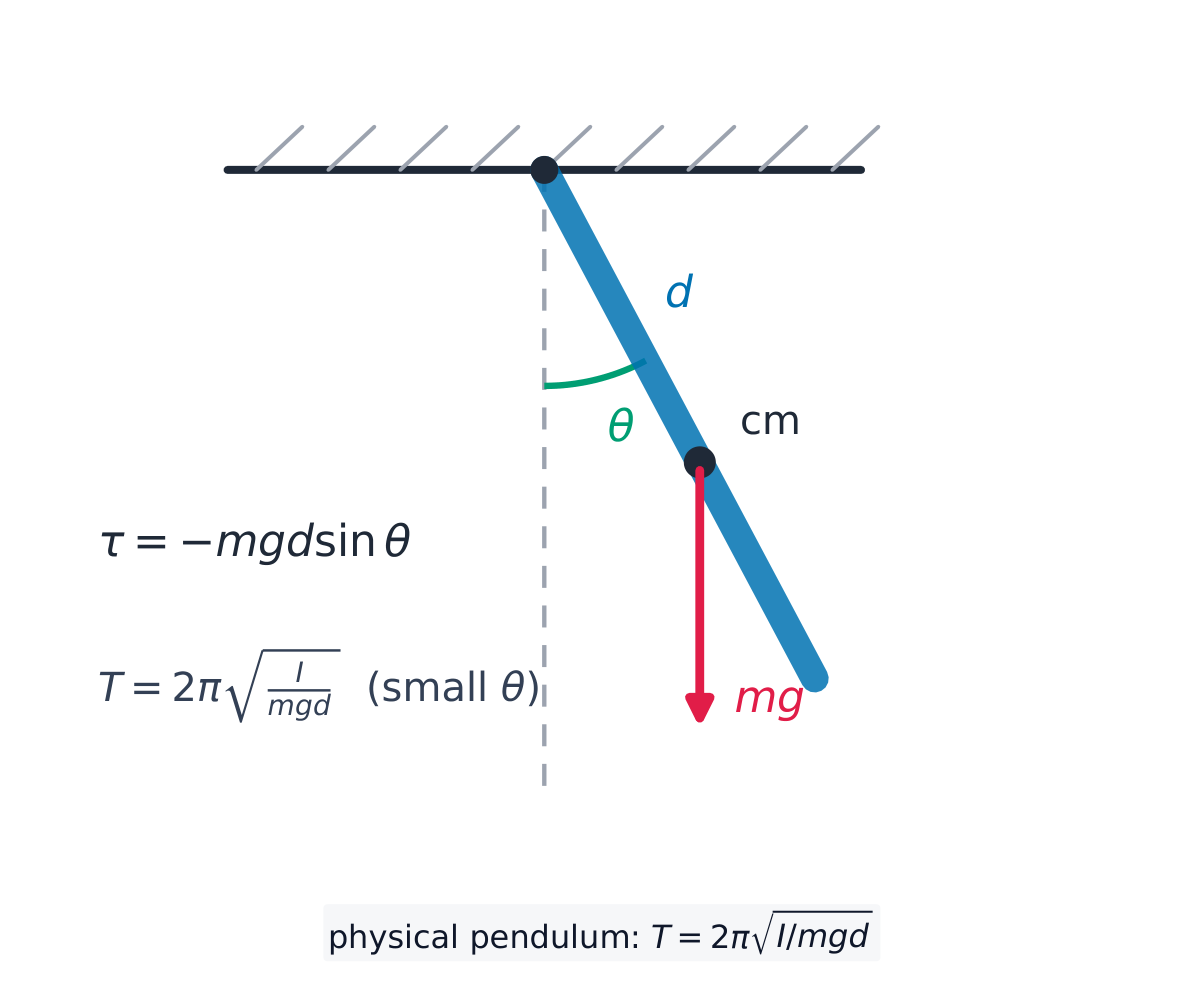
Syllabus · סיילבוס
Learning Objective Essential Knowledge 7.5.A
Describe the properties of a physical pendulum.- 7.5.A.1 A physical pendulum is a rigid body that undergoes oscillation about a fixed axis.
- 7.5.A.2 For small amplitudes of motion, the period of a physical pendulum is derived from the application of Newton's second law in rotational form.
- Relevant equation: $T_{\text{phys}} = 2\pi\sqrt{\dfrac{I}{mgd}}$
- 7.5.A.2.i When displaced from equilibrium, the gravitational force exerted on a physical pendulum's center of mass provides a restoring torque.
- Derived equation: $\tau = -mgd\sin\theta$
- 7.5.A.2.ii For small amplitudes of motion, the small-angle approximation can be applied to the restoring torque.
- Derived equation: $\sin\theta \approx \theta$
- $\tau = -mgd\theta = I\alpha$
- 7.5.A.2.iii The small-angle approximation and Newton's second law in rotational form yield a second-order differential equation that describes SHM:
- Equation: $\dfrac{d^2\theta}{dt^2} = -\omega^2\theta$
- 7.5.A.3 A simple pendulum is a special case of physical pendulums in which the hanging object can be modeled as a point mass at a distance, $l$, from the pivot point.
- Relevant equation: $T_p = 2\pi\sqrt{\dfrac{\ell}{g}}$
- 7.5.A.4 A torsion pendulum is a case of SHM where the restoring torque is proportional to the angular displacement of a rotating system. For example, a horizontal disk that is suspended from a wire attached to its center of mass may undergo rotational oscillations about the wire in the horizontal plane.
- Derived equation: $I\alpha = -k\Delta\theta$
Source: College Board AP Course and Exam Description · מקור: תיאור הקורס והמבחן של College Board AP
EnglishEnergy conservation: KE ⇄ PE A physical pendulum 物理摆 is any rigid body swinging about a fixed pivot. Displace it by an angle $\theta$ and gravity, acting at the center of mass a distance $d$ from the pivot, supplies a restoring torque
$$\tau=-mgd\sin\theta.$$For small angles, apply the small-angle approximation 小角度近似 $\sin\theta\approx\theta$ and Newton's second law in rotational form ($\tau=I\alpha$):
$$\frac{d^2\theta}{dt^2}=-\frac{mgd}{I}\,\theta=-\omega^2\theta\quad\Rightarrow\quad T_{\text{phys}}=2\pi\sqrt{\frac{I}{mgd}}.$$This is the same "$\ddot\theta=-\omega^2\theta$" pattern as before – recognising it is the derivation. A simple pendulum 单摆 is the special case of a point mass on a light string: $I=m\ell^2$ and $d=\ell$ give $T=2\pi\sqrt{\ell/g}$.
Worked example. A uniform rod (mass $M$, length $L$) swings from one end: $I=\tfrac13ML^2$, $d=\tfrac{L}{2}$, so
$$T=2\pi\sqrt{\frac{\tfrac13ML^2}{Mg\,\tfrac{L}{2}}}=2\pi\sqrt{\frac{2L}{3g}}$$– shorter than a simple pendulum of length $L$, because the rod's mass sits nearer the pivot.
A torsion pendulum 扭摆 – a disk hanging from a wire that twists – is SHM one more time: the wire's restoring torque is proportional to the twist angle, $I\alpha=-\kappa\,\Delta\theta$, giving $T=2\pi\sqrt{I/\kappa}$.
Exam skill. Every pendulum FRQ wants the same three steps: write the restoring torque about the pivot, apply the small-angle approximation, and match the result to $\ddot\theta=-\omega^2\theta$ to read off $\omega$. State the small-angle step explicitly – it is a scored point, and it is why large-amplitude swings are not simple harmonic.
עבריתשימור אנרגיה: KE ⇄ PE מטוטלה פיזיקלית היא כל גוף קשיח המתנדנד סביב ציר סיבוב קבוע. אם מסטים אותה בזווית $\theta$ והכובד, הפועל במרכז המסה במרחק $d$ מציר הסיבוב, מספק מומנט מחזיר
$$\tau=-mgd\sin\theta.$$עבור זוויות קטנות, נפעיל את הקרבת הזוויות הקטנות $\sin\theta\approx\theta$ ואת חוק牛顿 השני בצורה הסיבובית ($\tau=I\alpha$):
$$\frac{d^2\theta}{dt^2}=-\frac{mgd}{I}\,\theta=-\omega^2\theta\quad\Rightarrow\quad T_{\text{phys}}=2\pi\sqrt{\frac{I}{mgd}}.$$זו אותה דוגמה "$\ddot\theta=-\omega^2\theta$" כמו קודם – זיהוי שהוא המסלול של ההוכחה. מטוטלה פשוטה היא המקרה המיוחד של מסה נקודתית על חוט קל: $I=m\ell^2$ ו$d=\ell$ נותנים $T=2\pi\sqrt{\ell/g}$.
כוח הכובד הפועל במרכז המסה מספק את המומנט המחזיר של מטוטלה פיזיקלית דוגמה מופרדת. מוט אחיד (מסה $M$, אורך $L$) מתנדנד מקצה אחד: $I=\tfrac13ML^2$, $d=\tfrac{L}{2}$, ולכן
$$T=2\pi\sqrt{\frac{\tfrac13ML^2}{Mg\,\tfrac{L}{2}}}=2\pi\sqrt{\frac{2L}{3g}}$$– קצר יותר ממטוטלה פשוטה באורך $L$, מכיוון שמסת המוט נמצאת קרובה יותר לציר הסיבוב.
מטוטלת טורסיה – דיסק התלויה בחוט המסתובב – היא SHM עוד פעם: המומנט המחזיר של החוט פרופורציונלי לזווית הסיבוב, $I\alpha=-\kappa\,\Delta\theta$, ונותן $T=2\pi\sqrt{I/\kappa}$.
מיומנות מבחן. כל שאלת FRQ לגבי מטוטלה דורשת את אותו שלושה צעדים: לכתוב את המומנט המחזיר ביחס לציר הסיבוב, להפעיל את הקרבת הזוויות הקטנות, ולהתאים את התוצאה ל$\ddot\theta=-\omega^2\theta$ כדי לקרוא את $\omega$. יש לציין במפורש את שלב הקרבת הזוויות הקטנות – זה נקודת ציון, וזה הסיבה לכך ששאיפות בעלות משרעת גדולה אינן תנודה הרמונית פשוטה.
מטוטלת פואקו: מטוטלה ארוכה וכבדה שאיטיות התנדדותה חושפת את סיבוב כדור הארץ מתחתיה Vocabulary · מילון מונחים Train · אימוןEnglish עברית Simple harmonic motion/ˈsɪmpl hɑːˈmɒnɪk ˈməʊʃn/ תנועה הרמונית פשוטה periodic motion/ˌpɪərɪˈɒdɪk ˈməʊʃn/ תנועה מחזורית equilibrium/ˌiːkwɪˈlɪbrɪəm/ איזון restoring force/rɪˈstɔːrɪŋ fɔːs/ כוח משחזר differential equation/ˌdɪfəˈrenʃl ɪˈkweɪʒn/ משוואה דיפרנציאלית angular frequency/ˈæŋɡjʊlə ˈfriːkwənsi/ תדירות זוויתית period/ˈpɪərɪəd/ תקופה frequency/ˈfriːkwənsi/ תדר amplitude/ˈæmplɪtjuːd/ משרעת phase constant/feɪz ˈkɒnstənt/ קבוע פאזה natural frequency/ˈnætʃərəl ˈfriːkwənsi/ תדירות טבעית resonance/ˈrezənəns/ תהודה physical pendulum/ˈfɪzɪkl ˈpendjʊləm/ מדול פיזיקלי small-angle approximation/smɔːl ˈæŋɡl əˌprɒksɪˈmeɪʃn/ הנחת זוויות קטנות simple pendulum/ˈsɪmpl ˈpendjʊləm/ מדול פשוט torsion pendulum/ˈtɔːʃn ˈpendjʊləm/ מתלה טורסיוני 7.5
Exam tips · טיפים לבחינות
English- Identify SHM from a linear restoring force $F=-kx$, which gives $\tfrac{d^2x}{dt^2}=-\omega^2 x$ with $\omega=\sqrt{k/m}$.
- Write the solution $x=A\cos(\omega t+\phi)$ and get $v,a$ by differentiating; period $T=\tfrac{2\pi}{\omega}$ is amplitude-independent.
- Energy trades between $\tfrac12 kx^2$ and $\tfrac12 mv^2$, with total $\tfrac12 kA^2$.
- For a pendulum, use the small-angle approximation $\sin\theta\approx\theta$ to reach SHM.
- Match phase to the start: released from rest at maximum displacement uses cosine.
עברית- זיהוי תנועה פשוטה הרמונית (SHM) מתוך כוח שחזור ליניארי $F=-kx$, המעניק $\tfrac{d^2x}{dt^2}=-\omega^2 x$ עם $\omega=\sqrt{k/m}$.
- לכתוב את הפתרון $x=A\cos(\omega t+\phi)$ ולקבל $v,a$ על ידי גזירה; התקופה $T=\tfrac{2\pi}{\omega}$ אינה תלויה במשרעת.
- האנרגיה מחולקת בין $\tfrac12 kx^2$ ל$\tfrac12 mv^2$, עם סך כל $\tfrac12 kA^2$.
- עבור מנדול, השתמש בקירוב הזווית הקטנה $\sin\theta\approx\theta$ כדי להגיע לתנודות הרמוניות פשוטות.
- התאם את הפזה להתחלה: שחרור ממצב רכישה בתנוחה מקסימלית משתמש בפונקציית קוסינוס.