| Enduring Understanding | Learning Objective | Essential Knowledge |
|---|---|---|
CHA-3 | CHA-3.A |
|
Contextual Applications of Differentiation · יישומים בהקשר לגזירה
AP Calculus BC · קלקולוס BC - AP · Topic 4 · נושא 4
 8:26
8:26
פרשנות הנגזרת בהקשר
מיכל דורך. כוס קפה מתקררת. עיר גדלה. בכל אחת משפטות אלו טמון אותו ביטוי: הקצב שבו משהו משתנה. ו…
English narration · English + 中文 subtitles burned in · קריאת קול באנגלית · תרגום אנגלי + סינית שרוף בתוך הסרטון
4.1
Interpreting the Meaning of the Derivative in Context · פרשנות המשמעות של הנגזרת בהקשר
Syllabus · סיילבוס
Source: College Board AP Course and Exam Description · מקור: תיאור הקורס והמבחן של College Board AP
English
Once you can compute derivatives, you use them to describe the real world. The derivative $f'(x)$ is the instantaneous rate of change of $f$ with respect to its input. Reading and reporting this rate correctly is a graded skill.
Units matter. The unit of $f'(x)$ is the unit of $f$ divided by the unit of $x$. If $C(t)$ is a number of acres and $t$ is in weeks, then $C'(t)$ is in acres per week. On the exam, "Using correct units, interpret the meaning of $g'(140)$" wants a full sentence: the value, the quantity, the rate word "per", and the moment. For example: "$g'(140)=2.3$ means that at $x=140$, the quantity is increasing at about $2.3$ units per unit of $x$."
עברית
ברגע שתוכל לחשב נגזרות, תשתמש בהן כדי לתאר את העולם האמיתי. הנגזרת $f'(x)$ هي קצב השינוי המיידי של $f$ ביחס לקלט שלה. קריאה ודיווח על קצב זה בצורה נכונה הם מיומנות שמוקדמת עליהן נקודות.
היחידות חשובות. היחידה של $f'(x)$ היא יחידת ה-$f$ מחולקת ביחידת ה-$x$. אם $C(t)$ הוא מספר דונמים ו$t$ הוא בשבועות, אזי $C'(t)$ הוא בדונמים לשבוע. במבחן, "השתמש ביחידות נכונות, פרש את המשמעות של $g'(140)$" דורש משפט מלא: ה-ערך, ה-כמות, מילת הקצב לכל, וה-רגע. לדוגמה: "$g'(140)=2.3$ אומר שב-$x=140$, הכמות עולה בכ-$2.3$ יחידות לכל יחידת $x$."
4.2
Straight-Line Motion: Position, Velocity, and Acceleration · תנועה בקו ישר: מיקום, מהירות ואצה
Syllabus · סיילבוס
English
Enduring Understanding (CHA-3): Derivatives allow us to solve real-world problems involving rates of change.
Learning Objective CHA-3.B: Calculate rates of change in applied contexts.
- CHA-3.B.1 The derivative can be used to solve rectilinear motion problems involving position, speed, velocity, and acceleration.
עברית
הבנה נשארית (CHA-3): נגזרות מאפשרות לנו לפתור בעיות מהעולם האמיתי הקשורות לקצבי שינוי.
מטרות למידה CHA-3.B: חשבו קצבי שינוי בהקשרים אפליקטיביים.
- CHA-3.B.1 ניתן להשתמש בנגזרת כדי לפתור בעיות תנועה מלבנית הקשורות למיקום, מהירות, וקטור מהירות ותאוצה.
Source: College Board AP Course and Exam Description · מקור: תיאור הקורס והמבחן של College Board AP
English
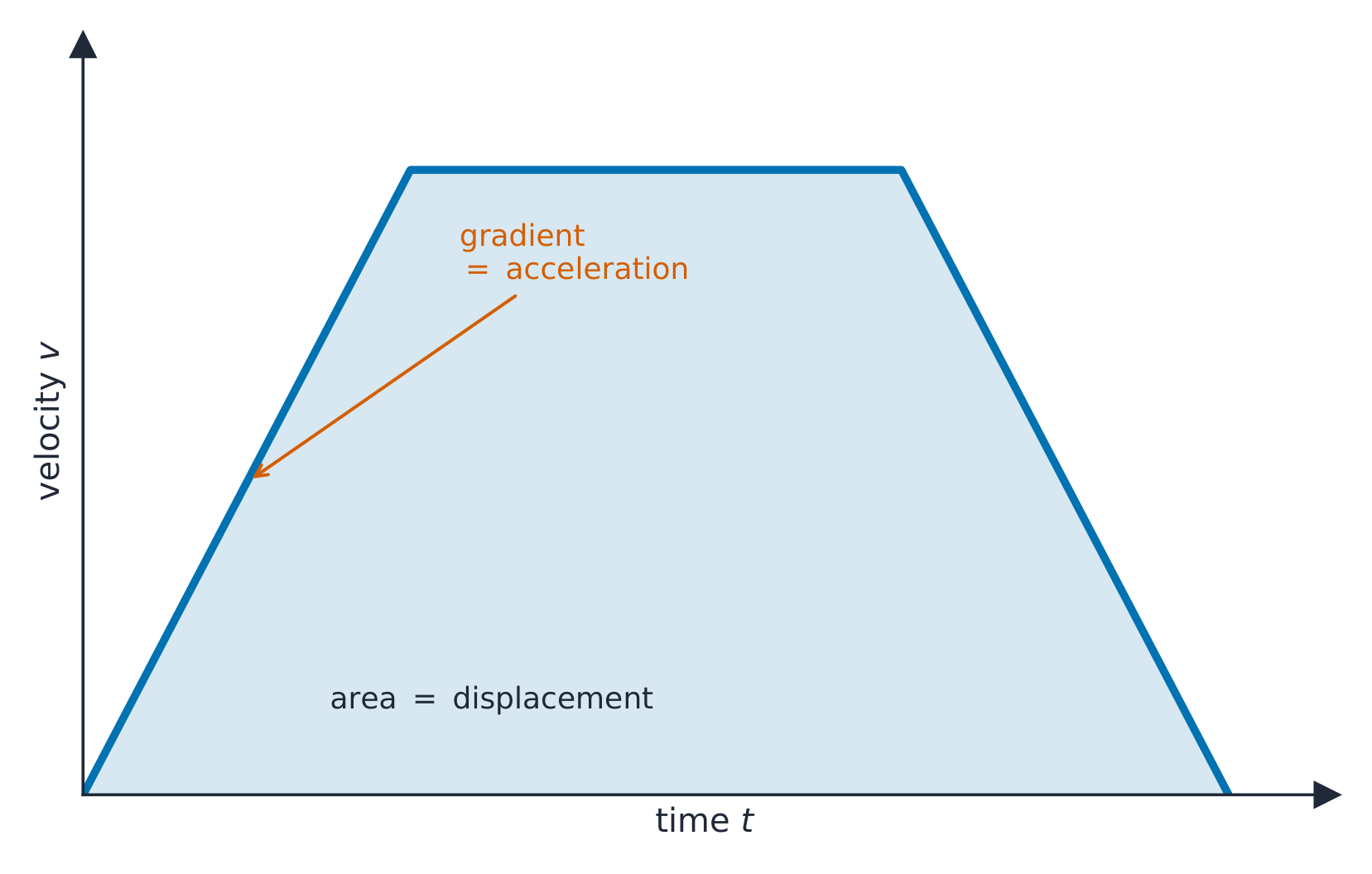
For a particle moving on a line, three functions of time are linked by differentiation:
- position 位置 $s(t)$;
- velocity 速度 $v(t)=s'(t)$ – signed; its sign gives direction;
- acceleration 加速度 $a(t)=v'(t)=s''(t)$.
Key readings (frequent exam parts):
- The particle is at rest 静止 when $v(t)=0$.
- It moves right/up when $v(t)>0$ and left/down when $v(t)<0$; it changes direction where $v$ changes sign.
- Speed 速率 is $|v(t)|$. Speed is increasing when $v$ and $a$ have the same sign (the particle is speeding up), and decreasing when they have opposite signs.
Distinguish carefully between velocity (has direction) and speed (does not) – the exam tests this exact difference.
Worked example. A particle moves with $s(t)=t^3-6t^2+9t$. Then $v(t)=3(t-1)(t-3)$, so it is at rest at $t=1$ and $t=3$ and changes direction at each. At $t=2$, $v=-3<0$ and $a(2)=6(2)-12=0$; just after, $a>0$ while $v<0$, so the particle is slowing down there.
עברית
לחלקיק הנע על קו, שלושה פונקציות של הזמן מקושרות על ידי נגזירה:
- מיקום $s(t)$;
- מהירות $v(t)=s'(t)$ – ממוספרת; הסימן שלה נותן כיוון;
- תאוצה $a(t)=v'(t)=s''(t)$.
קריאות עיקריות (חלקים נפוצים בשאלוני מבחן):
- החלקיק נמצא במצב רכינה כאשר $v(t)=0$.
- הוא נע ימינה/למעלה כאשר $v(t)>0$ ושמאלה/למטה כאשר $v(t)<0$; הוא משנה כיוון במקום שבו $v$ משנה סימן.
- מהירות קטנאה היא $|v(t)|$. המהירות הקטנאה גדלה כאשר $v$ ו$a$ הם בעלי סימן זהה (החלקיק מאיץ), וקטנה כאשר להם סימנים הפוכים.
הבדל היטב בין מהירות (יש לה כיוון) לבין קצב (אין לו כיוון) – המבחן בודק בדיוק הבדל זה.
דוגמה פתורה. חלקיק נע עם $s(t)=t^3-6t^2+9t$. אזי $v(t)=3(t-1)(t-3)$, ולכן הוא נמצא במנוחה ב$t=1$ וב$t=3$ ומשנה כיוון בכל אחת מהן. ב$t=2$, $v=-3<0$ ו$a(2)=6(2)-12=0$; מיד אחר כך, $a>0$ בעוד שה$v<0$, ולכן החלקיק מאיט שם.
Explore · חקור
Velocity is the slope of position · מהירות היא שיפוע המיקום
y = ax³ + bx² + cx + d
For straight-line motion, velocity is the derivative (slope) of position and acceleration the derivative of velocity. Slide the point to read the instantaneous velocity. · בתנועה בקו ישר, מהירות היא הנגזרת (השיפוע) של המיקום ותאוצה היא הנגזרת של המהירות. הזז את הנקודה כדי לקרוא את המהירות המיידית.
Vocabulary · מילון מונחים
Train · אימון
| English | עברית |
|---|---|
| position/pəˈzɪʃn/ | מיקום |
| velocity/vəˈlɒsɪti/ | מהירות וקטורית |
| acceleration/əkˌseləˈreɪʃn/ | תאוצה |
| at rest/æt rest/ | במצב רוגע |
| Speed/spiːd/ | מהירות |
4.3
Rates of Change in Applied Contexts Other Than Motion · קצבי שינוי בהקשרים יישומיים אחרים מניעה
Syllabus · סיילבוס
English
Enduring Understanding (CHA-3): Derivatives allow us to solve real-world problems involving rates of change.
Learning Objective CHA-3.C: Interpret rates of change in applied contexts.
- CHA-3.C.1 The derivative can be used to solve problems involving rates of change in applied contexts.
עברית
הבנה נשארית (CHA-3): נגזרות מאפשרות לנו לפתור בעיות מהעולם האמיתי הקשורות לקצבי שינוי.
מטרות למידה CHA-3.C: פרש קצבי שינוי בהקשרים יישומיים.
- CHA-3.C.1 הנגזרת יכולה לשמש לפתרון בעיות הקשורות בקצבי שינוי בהקשרים יישומיים.
Source: College Board AP Course and Exam Description · מקור: תיאור הקורס והמבחן של College Board AP
English
The same derivative idea models any changing quantity: a draining tank, a spreading population, a cooling cup. Whenever a problem says "the rate at which...", it is describing a derivative. Read the units to know which quantity's rate you have, then interpret in context.
עברית
אותו עיקרון של נגזרות מדגל כל כמות משתנה: מיכל שנשחק, אוכלוסייה שהתפשטת, כוס מתקררת. בכל פעם שהבעיה אומרת "הקצב שבו...", היא מתארת נגזרת. קראו את היחידות כדי לדעת האילו קצב יש לכם, ואז פרשו בהקשר.
4.4
Introduction to Related Rates · מבוא לקצבים מקושרים

Syllabus · סיילבוס
English
Enduring Understanding (CHA-3): Derivatives allow us to solve real-world problems involving rates of change.
Learning Objective CHA-3.D: Calculate related rates in applied contexts.
- CHA-3.D.1 The chain rule is the basis for differentiating variables in a related rates problem with respect to the same independent variable.
- CHA-3.D.2 Other differentiation rules, such as the product rule and the quotient rule, may also be necessary to differentiate all variables with respect to the same independent variable.
עברית
הבנה נשארית (CHA-3): נגזרות מאפשרות לנו לפתור בעיות מהעולם האמיתי הקשורות לקצבי שינוי.
מטרות למידה CHA-3.D: חשב קצבים תלויים בהקשרים יישומיים.
- CHA-3.D.1 כלל השרשרת הוא הבסיס לגזירה של משתנים בבעיה על קצבים תלויים ביחס למשתנה עצמאי זהה.
- CHA-3.D.2 כללי גזירה נוספים, כגון כלל המכפלה וכלל המנה, עשויים להיות נדרשים גם כדי לגזור את כל המשתנים ביחס למשתנה עצמאי זהה.
Source: College Board AP Course and Exam Description · מקור: תיאור הקורס והמבחן של College Board AP
English
In a related rates 相关变化率 problem, several quantities change together over time, and you know some rates but want another. The engine is the chain rule: differentiate a relationship with respect to time $t$. Every variable becomes a function of $t$, so each derivative picks up a "$\,/\,dt$" factor. Product and quotient rules may also be needed.
עברית
בבעיית קצבים מקושרים, כמה כמויות משתנות יחד לאורך זמן, ויש לכם קצבים מסוימים אך אתם רוצים קצב אחר. המנוע הוא כלל השרשרת: גזרו קשר לפי זמן $t$. כל משתנה הופך לפונקציה של $t$, ולכן כל נגזרת לוקחת פקטור "$\,/\,dt$". ייתכן שתצטרכו גם כללי מכפלה ומחלקה.

Vocabulary · מילון מונחים
Train · אימון
| English | עברית |
|---|---|
| related rates/rɪˈleɪtɪd reɪts/ | קצבים קשורים |
| local linearity/ˈləʊkl lɪˈnɪərɪti/ | ליניאריות מקומית |
| linear approximation/ˈlɪnɪə əˌprɒksɪˈmeɪʃn/ | הקרבה ליניארית |
| concavity/kənˈkævɪti/ | קעירות |
| underestimate/ˌʌndəˈrestɪmət/ | הערכת חסר |
| overestimate/ˌəʊvəˈrestɪmət/ | הערכת יתר |
| indeterminate form/ˌɪndɪˈtɜːmɪnət fɔːm/ | צורה לא מוגדרת |
| L'Hospital's Rule/ˈelhɒspɪtlz ruːl/ | כלל ל'ופיטל |
4.5
Solving Related Rates Problems · פתירת בעיות קצבים מקושרים
Syllabus · סיילבוס
English
Enduring Understanding (CHA-3): Derivatives allow us to solve real-world problems involving rates of change.
Learning Objective CHA-3.E: Interpret related rates in applied contexts.
- CHA-3.E.1 The derivative can be used to solve related rates problems; that is, finding a rate at which one quantity is changing by relating it to other quantities whose rates of change are known.
עברית
הבנה נשארית (CHA-3): נגזרות מאפשרות לנו לפתור בעיות מהעולם האמיתי הקשורות לקצבי שינוי.
מטרות למידה CHA-3.E: פרש קצבים תלויים בהקשרים יישומיים.
- CHA-3.E.1 הנגזרת יכולה לשמש לפתרון בעיות על קצבים תלויים, כלומר, מציאת קצב שבו כמות נתונה משתנה על ידי קישורה לכמויות אחרות whose קצבי השינוי שלהן ידועים.
Source: College Board AP Course and Exam Description · מקור: תיאור הקורס והמבחן של College Board AP
English
A reliable procedure – and a full-credit template on the exam:
- Name the variables and write down the given rates and the unknown rate (e.g. "$\dfrac{dh}{dt}=-2$ cm/day, find $\dfrac{dV}{dt}$").
- Write an equation relating the quantities (often a geometric or volume formula).
- Differentiate both sides with respect to $t$ (chain rule) – before substituting numbers.
- Substitute the known values at the instant of interest, and solve for the unknown rate.
- State the answer with units and the correct sign (a decreasing quantity has a negative rate).
Substituting numbers too early is the classic error: differentiate the general relationship first, then plug in.
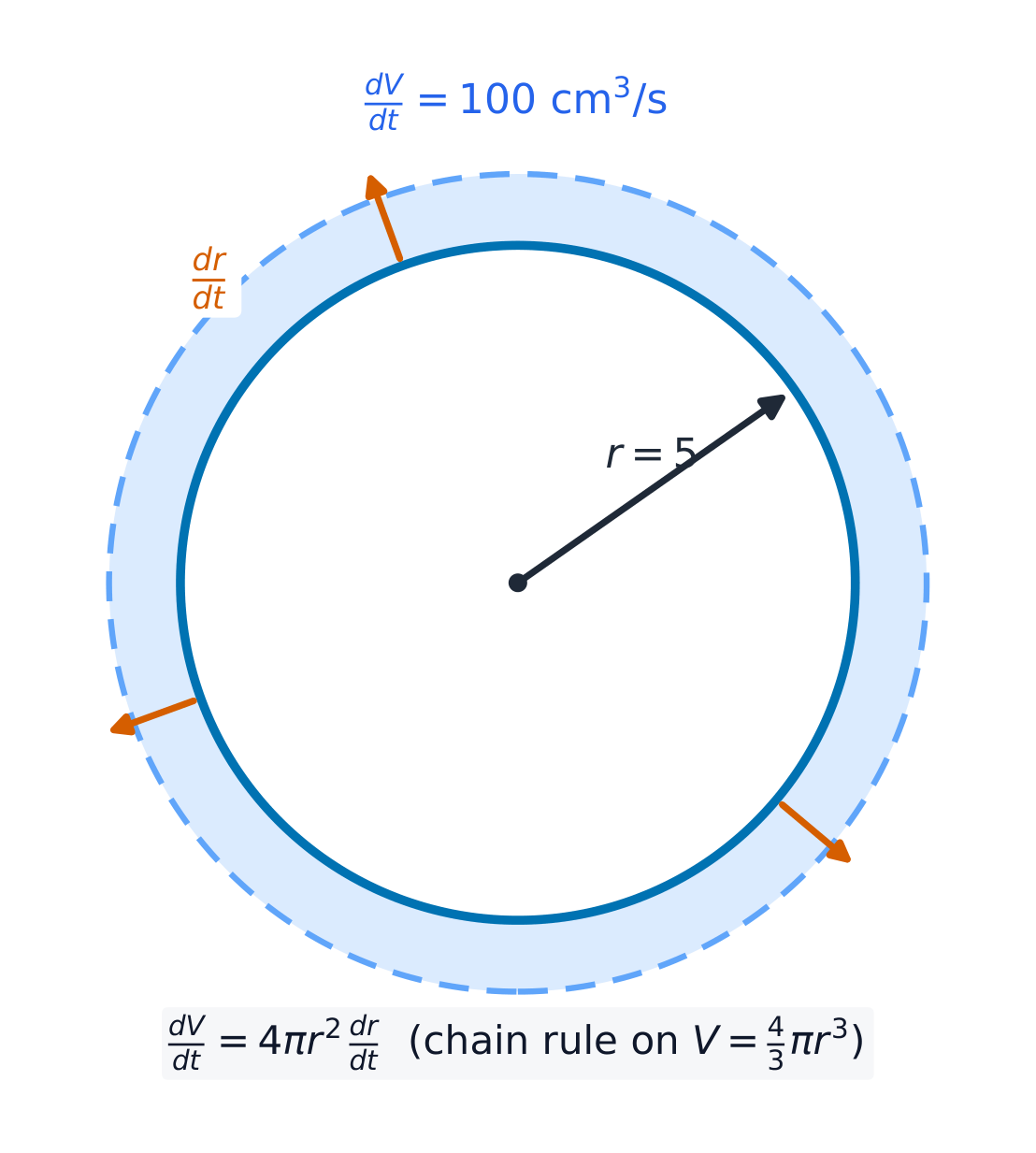
Worked example. A spherical balloon's volume grows at $\dfrac{dV}{dt}=100\ \text{cm}^3/\text{s}$. From $V=\tfrac43\pi r^3$, differentiate first: $\dfrac{dV}{dt}=4\pi r^2\dfrac{dr}{dt}$. At $r=5$, $100=4\pi(25)\dfrac{dr}{dt}$, so $\dfrac{dr}{dt}=\dfrac{1}{\pi}\approx0.32\ \text{cm/s}$.
עברית
procedure אמין – ותבנית מלאה לנקודות מלאות במבחן:
- הגדירו את המשתנים וכתבו את הקצבים הנתונים ואת הקצב המבוקש (למשל "$\dfrac{dh}{dt}=-2$ ס"מ/יום, מצאו $\dfrac{dV}{dt}$").
- כתוב משוואה המקשרת בין הכמויות (לרוב נוסחה גיאומטרית או לנופח).
- גזר שני האגפים לפי $t$ (כלל השרשרת) – לפני הצבת מספרים.
- הצב את הערכים הידועים ברגע הרלוונטי, ופתור עבור הקצב המבוקש.
- ציין תשובה עם יחידות מידה והסימן הנכון (כמות יורדת בעלת קצב שלילי).
הצבת מספרים מוקדמת מדי היא שגיאה קלאסית: נגזרו תחילה את הקשר הכללי, ואז הצביעו.
דוגמה מפורטת. נפח כדור האוויר גדל בקצב של $\dfrac{dV}{dt}=100\ \text{cm}^3/\text{s}$. מ$V=\tfrac43\pi r^3$, גזרו פעם אחת: $\dfrac{dV}{dt}=4\pi r^2\dfrac{dr}{dt}$. ב$r=5$, $100=4\pi(25)\dfrac{dr}{dt}$, ולכן $\dfrac{dr}{dt}=\dfrac{1}{\pi}\approx0.32\ \text{cm/s}$.
4.6
Approximating Values Using Local Linearity and Linearization · קירוב ערכים באמצעות ליניאריות מקומית וליניאריזציה
Syllabus · סיילבוס
English
Enduring Understanding (CHA-3): Derivatives allow us to solve real-world problems involving rates of change.
Learning Objective CHA-3.F: Approximate a value on a curve using the equation of a tangent line.
- CHA-3.F.1 The tangent line is the graph of a locally linear approximation of the function near the point of tangency.
- CHA-3.F.2 For a tangent line approximation, the function's behavior near the point of tangency may determine whether a tangent line value is an underestimate or an overestimate of the corresponding function value.
עברית
הבנה נשארית (CHA-3): נגזרות מאפשרות לנו לפתור בעיות מהעולם האמיתי הקשורות לקצבי שינוי.
מטרות למידה CHA-3.F: הערך ערך על גרף באמצעות משוואת המשיק.
- CHA-3.F.1 המשיק הוא הגרף של הערכה ליניארית מקומית של הפונקציה בסמוך לנקודת המשיק.
- CHA-3.F.2 עבור הערכה במשיק, התנהגות הפונקציה בסמוך לנקודת המשיק עשויה לקבוע האם ערך המשיק הוא הערכה תחתונה או עליונה לערך המתאים של הפונקציה.
Source: College Board AP Course and Exam Description · מקור: תיאור הקורס והמבחן של College Board AP
English
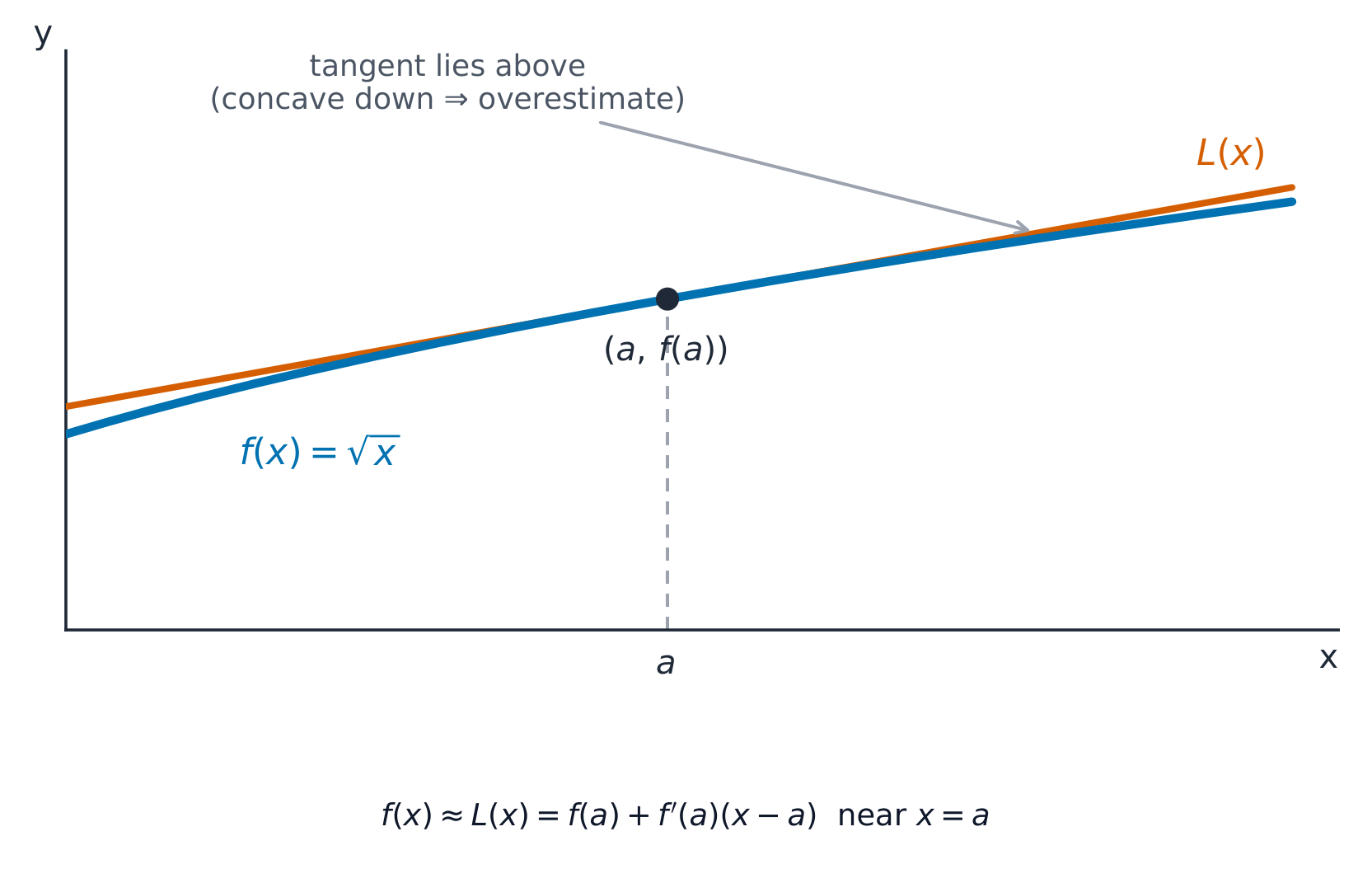
Near a point of tangency, a smooth curve looks like its tangent line – this is local linearity 局部线性. So the tangent line gives a linear approximation 线性近似 (linearization) of the function near that point:
$$f(x) \approx L(x) = f(a) + f'(a)(x-a).$$
Use it to estimate $f$ at an $x$ close to $a$.
Over- or underestimate? The answer follows from concavity 凹凸性. If the graph is concave up near $a$ (it curves above its tangent), the tangent-line value is an underestimate 低估. If it is concave down, the tangent line lies above the curve, giving an overestimate 高估. Exam parts test this reasoning, so justify with the sign of $f''$.
עברית
קרוב לנקודת מגע, עקום חלק נראה כמו המשיק שלו – זהו ליניאריות מקומית. לכן, המשיק מספק הערכת ליניארית (ליניאריזציה) של הפונקציה בסביבת נקודה זו:
$$f(x) \approx L(x) = f(a) + f'(a)(x-a).$$
השתמש בה כדי להעריך $f$ ב-$x$ קרוב ל-$a$.
הערכת יתר או הערכת חסר? התשובה נובעת מ-קמירות. אם הגרף קמור כלפי מעלה סמוך ל-$a$ (הוא מתכופף מעל המשיק), ערך המשיק הוא הערת חסר. אם הוא קמור כלפי מטה, המשיק נמצא מעל העקומה, ומספק הערת יתר. חלקי מבחן בודקים הסבר זה, ולכן יש להסביר באמצעות סימן ה-$f''$.
Explore · חקור
Approximate a curve with its tangent line · לקרב כיפה עם קו המשיק שלה
y = ax³ + bx² + cx + d
Local linearity: near a point a smooth curve looks like its tangent line, so the tangent gives a good linear approximation of nearby values. · ליניאריות מקומית: סמוך לנקודה, כיפה חלקה נראית כמו קו המשיק שלה, ולכן המשיק מספק קירוי ליניארי טוב לערכים סמוכים.
4.7
Using L'Hospital's Rule for Indeterminate Forms · שימוש בחוק ל'הופיטל לצורות לא מוגדרות
Syllabus · סיילבוס
| Enduring Understanding | Learning Objective | Essential Knowledge |
|---|---|---|
LIM-4 | LIM-4.A |
|
Source: College Board AP Course and Exam Description · מקור: תיאור הקורס והמבחן של College Board AP
English
When direct substitution in a quotient of limits gives the indeterminate form 未定式 $\dfrac{0}{0}$ or $\dfrac{\infty}{\infty}$, you may use L'Hospital's Rule 洛必达法则:
$$\lim_{x\to c}\frac{f(x)}{g(x)} = \lim_{x\to c}\frac{f'(x)}{g'(x)},$$
provided the right-hand limit exists. Differentiate the top and bottom separately (this is not the quotient rule), then try the limit again. First confirm the form really is $\tfrac{0}{0}$ or $\tfrac{\infty}{\infty}$ – applying the rule to any other form is a mistake.
Worked example. $\displaystyle\lim_{x\to0}\frac{\sin x}{x}$ gives $\tfrac00$, so differentiate top and bottom: $\displaystyle\lim_{x\to0}\frac{\cos x}{1}=1$. And $\displaystyle\lim_{x\to0}\frac{e^{2x}-1}{x}$ is also $\tfrac00$; it becomes $\displaystyle\lim_{x\to0}\frac{2e^{2x}}{1}=2$.
עברית
כשצבת ישירה במנה של גבולות נותנת את צורה לא מיודדת של $\dfrac{0}{0}$ או $\dfrac{\infty}{\infty}$, ניתן להשתמש ב-חוק לופיטל:
$$\lim_{x\to c}\frac{f(x)}{g(x)} = \lim_{x\to c}\frac{f'(x)}{g'(x)},$$
בתנאי שהגבול מצד ימין קיים. גזר את המונה והמכנה בנפרד (זו אינה כלל המנה), ולאחר מכן נסה לחשב את הגבול שוב. תחילה ודא שהצורה אכן היא $\tfrac{0}{0}$ או $\tfrac{\infty}{\infty}$ – יישום החוק לכל צורה אחרת הוא שגיאה.
דוגמה מוצגת. $\displaystyle\lim_{x\to0}\frac{\sin x}{x}$ נותן $\tfrac00$, ולכן נגזור את המונה והמכנה: $\displaystyle\lim_{x\to0}\frac{\cos x}{1}=1$. וגם $\displaystyle\lim_{x\to0}\frac{e^{2x}-1}{x}$ הוא גם כן $\tfrac00$; הוא הופך ל-$\displaystyle\lim_{x\to0}\frac{2e^{2x}}{1}=2$.
4.7
Exam tips · טיפים לבחינות
English
- In motion problems: velocity is the derivative of position, acceleration the derivative of velocity; speed increases when velocity and acceleration share a sign.
- For related rates, differentiate the relating equation with respect to time, then substitute the given values last.
- Use the tangent line for a linear approximation near a known point; it is accurate only close by.
- Read the sign of a rate: positive means the quantities move together, negative means opposite.
- Always state units and interpret the answer in context.
עברית
- בבעיות תנועה: מהירות היא הנגזרת של מיקום, תאוצה היא הנגזרת של המהירות; מהירות עולה כאשר למהירות ולתאוצה יש אותו סימן.
- עבור קצבים קשורים, נגזור את המשוואה המקשרת לפי זמן, ולאחר מכן נציב את הערכים הנתונים בסוף.
- השתמש בקו המשיק ל-הערכה ליניארית סמוך לנקודה ידועה; הוא מדויק רק בקרבתה.
- קרא את הסימן של הקצב: חיובי פירונו שהכמויות נעות בכיוון זהה, שלילי פירונו בכיוונים הפוכים.
- תמיד ציין יחידות ופרשן את התשובה בהקשר.
Interactive lessons on this topic · שיעורים אינטראקטיביים בנושא זה
Work through it step by step, with instant-check exercises. · לעבור על הדברים צעד אחר צעד, עם תרגילים לבדיקה מיידית.
- Interpreting the Meaning of the Derivative in Context · פרשנות המשמעות של הגזירה בהקשר
- Straight-Line Motion: Connecting Position, Velocity, and Acceleration · תנועה בקו ישר: קישור בין מיקום, מהירות ותאוצה
- Rates of Change in Applied Contexts Other Than Motion · קצבי שינוי בהקשרים יישומיים אחרים מעבר לתנועה
- Introduction to Related Rates · מבוא לקצבי שינוי מקשרים
- Solving Related Rates Problems · פתרון בעיות קצבים קשורים
- Approximating Values Using Local Linearity and Linearization · הערכת ערכים באמצעות קווייות מקומית וליניאריזציה
- Using L'Hospital's Rule for Determining Limits of Indeterminate Forms · שימוש בחוק לופיטל לקביעת גבולות של צורות לא מוגדרות
More topics in AP Calculus BC · קלקולוס BC - AP · נושאים נוספים בAP Calculus BC · קלקולוס BC - AP
- Limits and Continuity · גבולות רציפות
- Differentiation: Definition and Fundamental Properties · גזירה: הגדרה ומאפיינים בסיסיים
- Integration and Accumulation of Change · אינטגרציה ואגירת שינוי
- Differential Equations · משוואות דיפרנציאליות
- Applications of Integration · יישומי אינטגרציה
- Parametric Equations, Polar Coordinates, and Vector-Valued Functions · משוואות פרמטריות, קואורדינטות קוטביות ופונקציות בעלות ערך וקטורי