English
| Core | Supplement |
|---|---|
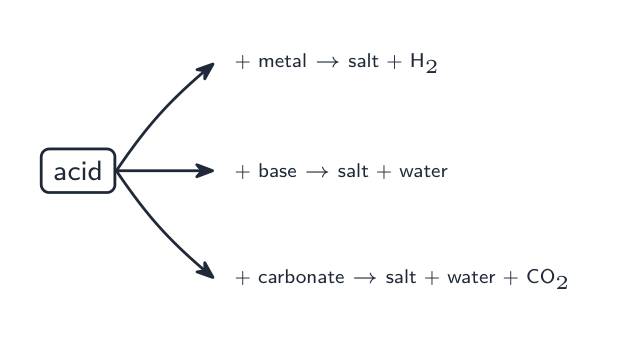
| 1 Describe the characteristic properties of acids in terms of their reactions with: (a) metals (b) bases (c) carbonates | |
| 2 Describe acids in terms of their effect on: (a) litmus (b) thymolphthalein (c) methyl orange | |
| 3 State that bases are oxides or hydroxides of metals and that alkalis are soluble bases | |
| 4 Describe the characteristic properties of bases in terms of their reactions with: (a) acids (b) ammonium salts | |
| 5 Describe alkalis in terms of their effect on: (a) litmus (b) thymolphthalein (c) methyl orange | |
| 6 State that aqueous solutions of acids contain $\text{H}^+$ ions and aqueous solutions of alkalis contain $\text{OH}^-$ ions | 9 Define acids as proton donors and bases as proton acceptors |
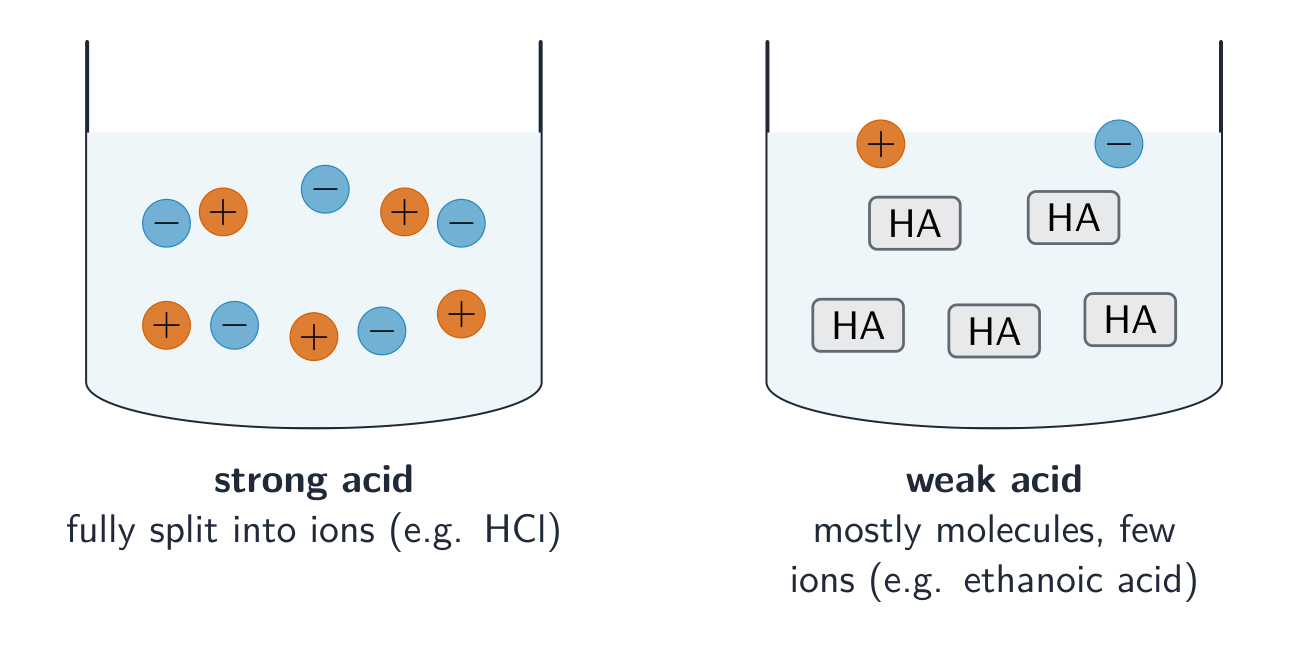
| 10 Define a strong acid as an acid that is completely dissociated in aqueous solution and a weak acid as an acid that is partially dissociated in aqueous solution | |
| 11 State that hydrochloric acid is a strong acid, as shown by the symbol equation, $\text{HCl}(\text{aq}) \rightarrow \text{H}^+(\text{aq}) + \text{Cl}^-(\text{aq})$ | |
| 12 State that ethanoic acid is a weak acid, as shown by the symbol equation, $\text{CH}_3\text{COOH}(\text{aq}) \rightleftharpoons \text{H}^+(\text{aq}) + \text{CH}_3\text{COO}^-(\text{aq})$ | |
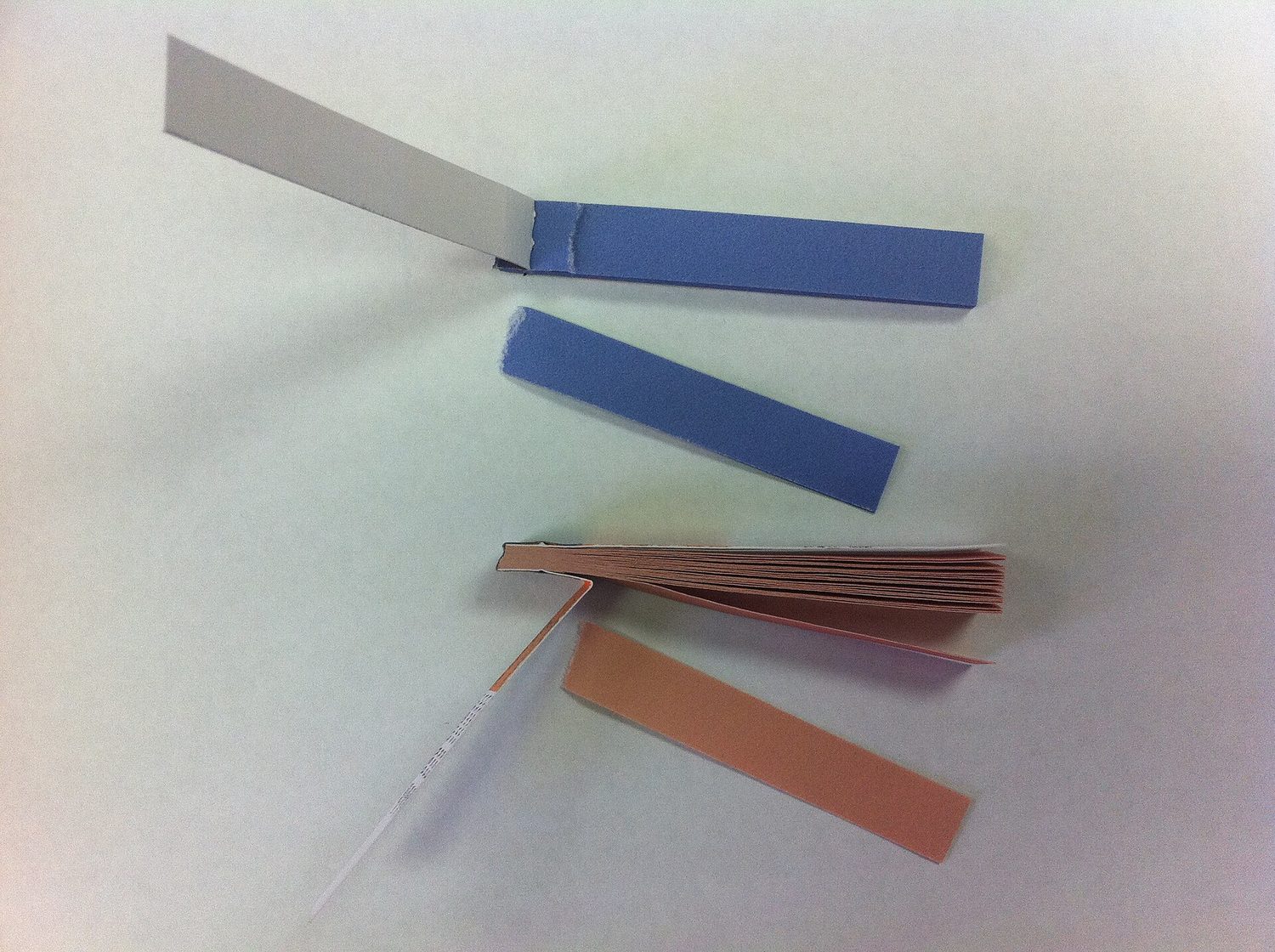
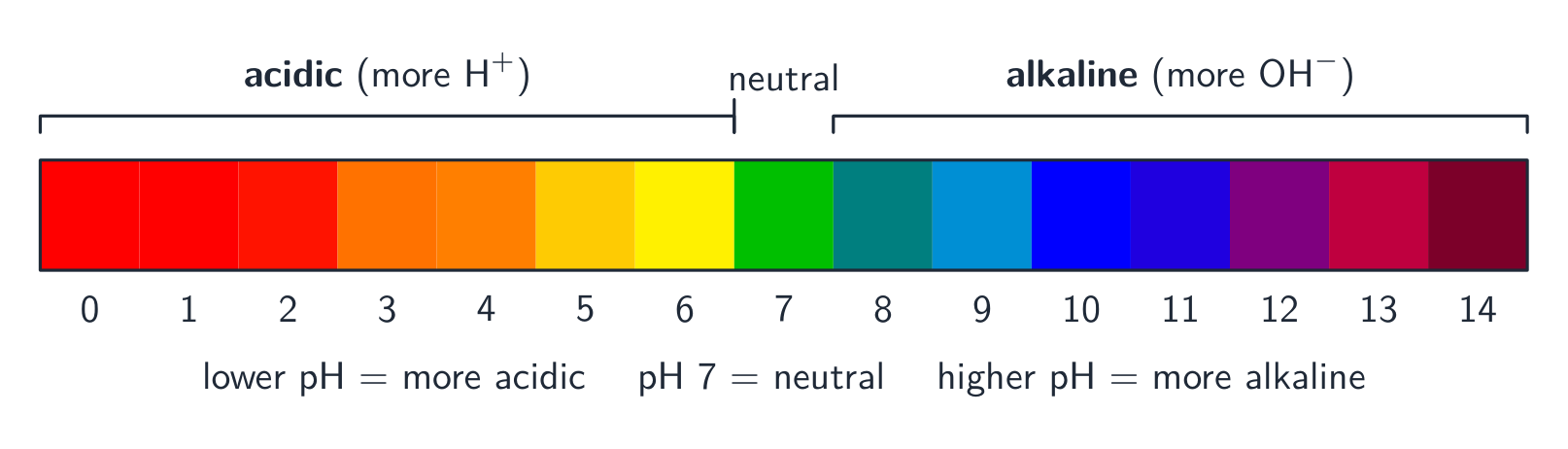
| 7 Describe how to compare hydrogen ion concentration, neutrality, relative acidity and relative alkalinity in terms of colour and pH using universal indicator paper | |
| 8 Describe the neutralisation reaction between an acid and an alkali to produce water, $\text{H}^+(\text{aq}) + \text{OH}^-(\text{aq}) \rightarrow \text{H}_2\text{O}(l)$ |
Español
| Núcleo | Suplemento |
|---|---|
| 1 Describir las propiedades características de los ácidos en términos de sus reacciones con: (a) metales (b) bases (c) carbonatos | |
| 2 Describir los ácidos en términos de su efecto sobre: (a) tornasol (b) timolftaleína (c) naranja de metilo | |
| 3 Indicar que las bases son óxidos o hidróxidos de metales y que los álcalis son bases solubles | |
| 4 Describir las propiedades características de las bases en términos de sus reacciones con: (a) ácidos (b) sales de amonio | |
| 5 Describir los álcalis en términos de su efecto sobre: (a) tornasol (b) timolftaleína (c) naranja de metilo | |
| 6 Indicar que las soluciones acuosas de ácidos contienen iones $\text{H}^+$ y que las soluciones acuosas de álcalis contienen iones $\text{OH}^-$ | 9 Definir los ácidos como donadores de protones y las bases como aceptores de protones |
| 10 Definir un ácido fuerte como un ácido que se disocia completamente en solución acuosa y un ácido débil como un ácido que se disocia parcialmente en solución acuosa | |
| 11 Indicar que el ácido clorhídrico es un ácido fuerte, como lo muestra la ecuación simbólica, $\text{HCl}(\text{aq}) \rightarrow \text{H}^+(\text{aq}) + \text{Cl}^-(\text{aq})$ | |
| 12 Indicar que el ácido etanoico es un ácido débil, como lo muestra la ecuación simbólica, $\text{CH}_3\text{COOH}(\text{aq}) \rightleftharpoons \text{H}^+(\text{aq}) + \text{CH}_3\text{COO}^-(\text{aq})$ | |
| 7 Describir cómo comparar la concentración de iones de hidrógeno, neutralidad, acidez relativa y alcalinidad relativa en términos de color y pH utilizando papel indicador universal | |
| 8 Describir la reacción de neutralización entre un ácido y un álcali para producir agua, $\text{H}^+(\text{aq}) + \text{OH}^-(\text{aq}) \rightarrow \text{H}_2\text{O}(l)$ |