English
| Core | Supplement |
|---|---|
| 1 Identify physical and chemical changes, and describe the differences between them |
Español
| Central | Suplementario |
|---|---|
| 1 Identificar cambios físicos y químicos, y describir las diferencias entre ellos |
IGCSE Química · Topic 6 · Tema 6
 15:53
15:53
Velocidad y equilibrio
La leche fuera de la nevera se estropea en un día. En la nevera, dura una semana. Es la misma leche, pero la reacción transcurre a diferente velocidad. Primero, una comprobación rápida: una reacción química…
English narration · English + 中文 subtitles burned in · Narración en inglés · Subtítulos en inglés + 中文 quemados en pantalla
| Core | Supplement |
|---|---|
| 1 Identify physical and chemical changes, and describe the differences between them |
| Central | Suplementario |
|---|---|
| 1 Identificar cambios físicos y químicos, y describir las diferencias entre ellos |
Source: Cambridge International syllabus · Fuente: Plan de estudios Cambridge International
A physical change 物理变化 does not make a new substance. The substance only changes its state or shape, and the change can usually be reversed. Melting ice and dissolving sugar are physical changes.
A chemical change 化学变化 (a chemical reaction) makes one or more new substances and is usually hard to reverse. Signs of a chemical change include a colour change, a gas being given off, an energy change, or a precipitate 沉淀 (a solid) forming.
| Physical change | Chemical change |
|---|---|
| no new substance made | new substance(s) made |
| easy to reverse | usually hard to reverse |
| e.g. melting, boiling, dissolving | e.g. burning, rusting |
Un cambio físico 物理变化 no produce una nueva sustancia. La sustancia solo cambia su estado o forma, y el cambio generalmente puede revertirse. El derretimiento del hielo y la disolución del azúcar son cambios físicos.
Un cambio químico 化学变化 (una reacción química) produce una o más nuevas sustancias y generalmente es difícil de revertir. Los signos de un cambio químico incluyen un cambio de color, la liberación de un gas, un cambio de energía o la formación de un precipitado 沉淀 (un sólido).
| Cambio físico | Cambio químico |
|---|---|
| no se forma nueva sustancia | se forma(n) nueva(s) sustancia(s) |
| fácil de revertir | generalmente difícil de revertir |
| ej. fusión, ebullición, disolución | ej. combustión, oxidación |
Repasa la diferencia. Un cambio físico no produce una nueva sustancia y suele ser fácil de revertir; un cambio químico produce una nueva sustancia y es difícil de deshacer.
| Core | Supplement |
|---|---|
| 5 Describe collision theory in terms of: (a) number of particles per unit volume (b) frequency of collisions between particles (c) kinetic energy of particles (d) activation energy, $E_a$ | |
| 1 Describe the effect on the rate of reaction of: (a) changing the concentration of solutions (b) changing the pressure of gases (c) changing the surface area of solids (d) changing the temperature (e) adding or removing a catalyst, including enzymes | 6 Describe and explain the effect on the rate of reaction of: (a) changing the concentration of solutions (b) changing the pressure of gases (c) changing the surface area of solids (d) changing the temperature (e) adding or removing a catalyst, including enzymes using collision theory |
| 2 State that a catalyst increases the rate of a reaction and is unchanged at the end of a reaction | 7 State that a catalyst decreases the activation energy, $E_a$, of a reaction |
| 3 Describe practical methods for investigating the rate of a reaction including change in mass of a reactant or a product and the formation of a gas | 8 Evaluate practical methods for investigating the rate of a reaction including change in mass of a reactant or a product and the formation of a gas |
| 4 Interpret data, including graphs, from rate of reaction experiments |
| Core | Supplemento |
|---|---|
| 5 Describir la teoría de colisiones en términos de: (a) número de partículas por unidad de volumen (b) frecuencia de colisiones entre partículas (c) energía cinética de las partículas (d) energía de activación, $E_a$ | |
| 1 Describir el efecto sobre la velocidad de reacción de: (a) cambiar la concentración de soluciones (b) cambiar la presión de gases (c) cambiar el área superficial de sólidos (d) cambiar la temperatura (e) añadir o eliminar un catalizador, incluyendo enzimas | 6 Describir y explicar el efecto sobre la velocidad de reacción de: (a) cambiar la concentración de soluciones (b) cambiar la presión de gases (c) cambiar el área superficial de sólidos (d) cambiar la temperatura (e) añadir o eliminar un catalizador, incluyendo enzimas, utilizando la teoría de colisiones |
| 2 Indicar que un catalizador aumenta la velocidad de una reacción y permanece sin cambios al final de la misma | 7 Indicar que un catalizador disminuye la energía de activación, $E_a$, de una reacción |
| 3 Describir métodos prácticos para investigar la velocidad de una reacción, incluido el cambio de masa de un reactivo o producto y la formación de un gas | 8 Evaluar métodos prácticos para investigar la velocidad de una reacción, incluido el cambio de masa de un reactivo o producto y la formación de un gas |
| 4 Interpretar datos, incluidos gráficos, procedentes de experimentos de velocidad de reacción |
Source: Cambridge International syllabus · Fuente: Plan de estudios Cambridge International
The rate of reaction 反应速率 tells you how fast the reactants 反应物 change into products 生成物.
Collision theory 碰撞理论 explains what controls the rate. For a reaction to happen, the particles 粒子 must collide 碰撞, and they must collide with enough energy. The least energy they need is the activation energy 活化能 ($E_a$). A faster rate happens when the particles have successful collisions more often.
| Change | Effect | Reason (collision theory) |
|---|---|---|
| increase concentration 浓度 of a solution | faster | more particles in the same volume, so collisions happen more often |
| increase pressure 压强 of gases | faster | particles are pushed closer, so collisions happen more often |
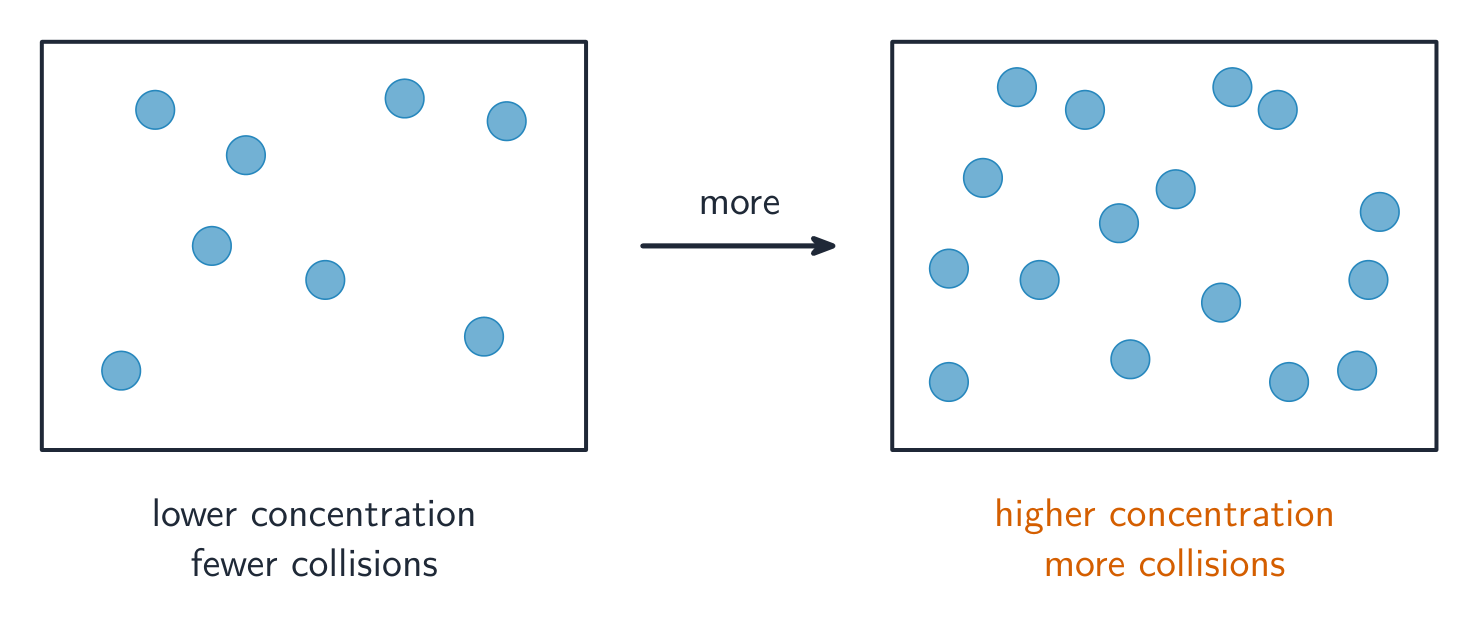
| increase surface area 表面积 of a solid | faster | more particles are exposed, so collisions happen more often |
| increase temperature | faster | particles gain kinetic energy 动能 and move faster, so collisions are more frequent and more of them have enough energy |
| add a catalyst 催化剂 | faster | the catalyst lowers the activation energy, so more collisions are successful |
A catalyst speeds up a reaction but is not used up — it is unchanged at the end. It works by lowering the activation energy. Enzymes 酶 are biological catalysts (catalysts that work in living things).
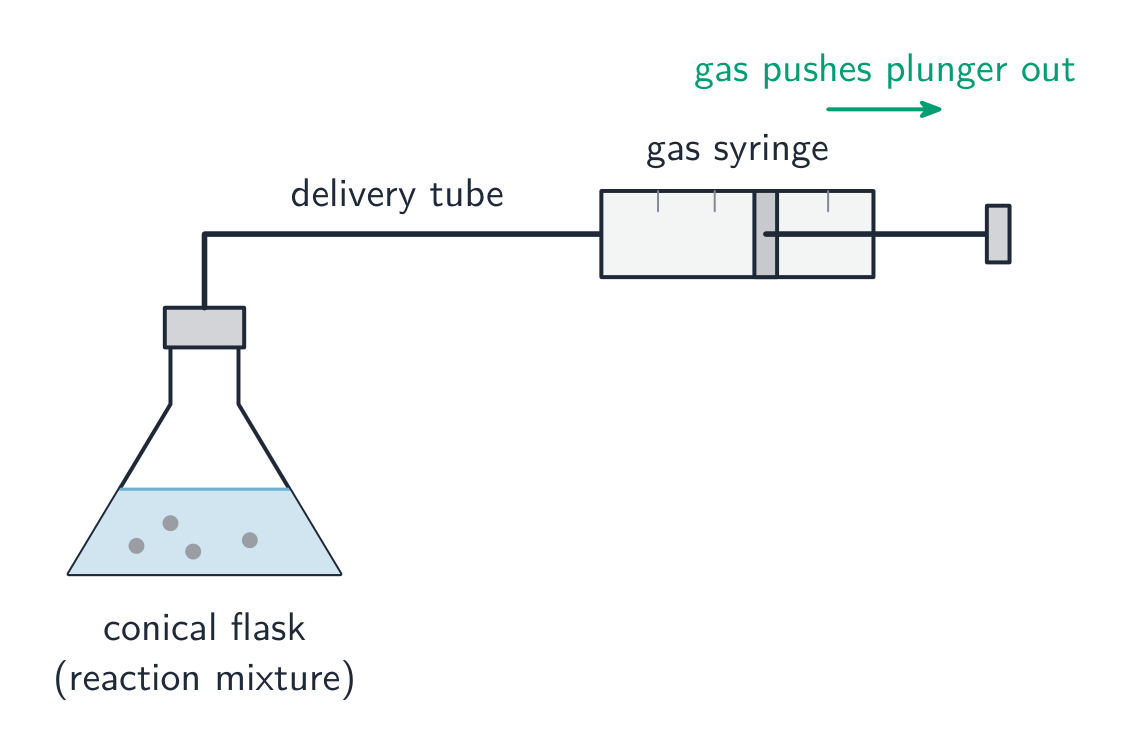
You can follow a reaction over time in these ways:
On a graph of product against time, the line is steepest at the start (fastest rate), becomes less steep as reactants are used up, and goes flat when the reaction has finished.
La velocidad de reacción 反应速率 te indica qué tan rápido los reactivos 反应物 cambian a productos 生成物.
La teoría de colisiones 碰撞理论 explica qué controla la velocidad. Para que ocurra una reacción, las partículas 粒子 deben colisionar 碰撞, y deben colisionar con suficiente energía. La menor cantidad de energía que necesitan es la energía de activación 活化能 ($E_a$). Una velocidad más rápida ocurre cuando las partículas tienen colisiones exitosas con mayor frecuencia.
| Cambio | Efecto | Razón (teoría de colisiones) |
|---|---|---|
| aumento de la concentración 浓度 de una solución | más rápida | más partículas en el mismo volumen, por lo que ocurren más colisiones |
| aumento de la presión 压强 de los gases | más rápida | las partículas se empujan más cerca, por lo que ocurren más colisiones |
| aumento de la área superficial 表面积 de un sólido | más rápida | más partículas están expuestas, por lo que ocurren más colisiones |
| aumento de temperatura | más rápida | las partículas ganan energía cinética 动能 y se mueven más rápido, por lo que las colisiones son más frecuentes y más de ellas tienen suficiente energía |
| añadir un catalizador 催化剂 | más rápida | el catalizador disminuye la energía de activación, por lo que más colisiones son exitosas |
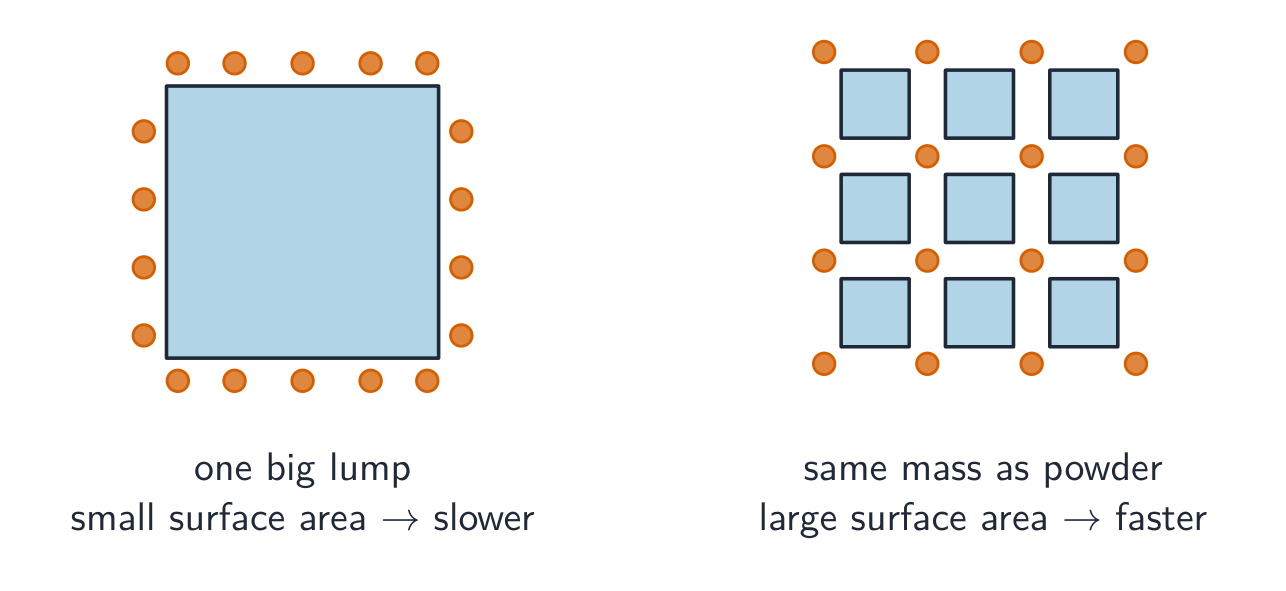
Un catalizador acelera una reacción pero no se consume; permanece sin cambios al final. Funciona disminuyendo la energía de activación. Las enzimas 酶 son catalizadores biológicos (catalizadores que funcionan en organismos vivos).
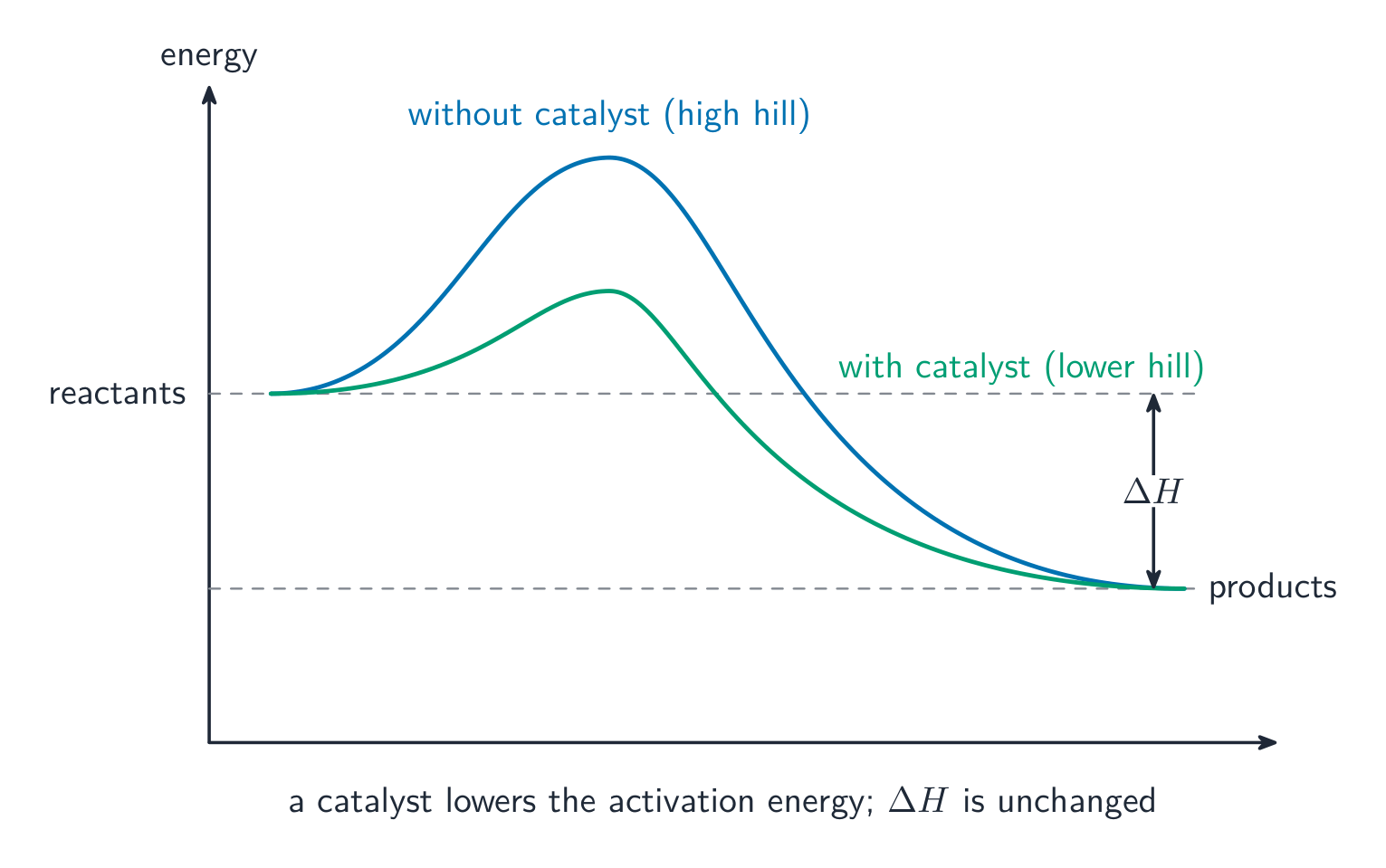
Puedes seguir una reacción a lo largo del tiempo de estas formas:
En una gráfica de producto contra tiempo, la línea es más empinada al inicio (velocidad más rápida), se vuelve menos empinada a medida que se consumen los reactivos, y se aplana cuando termina la reacción.
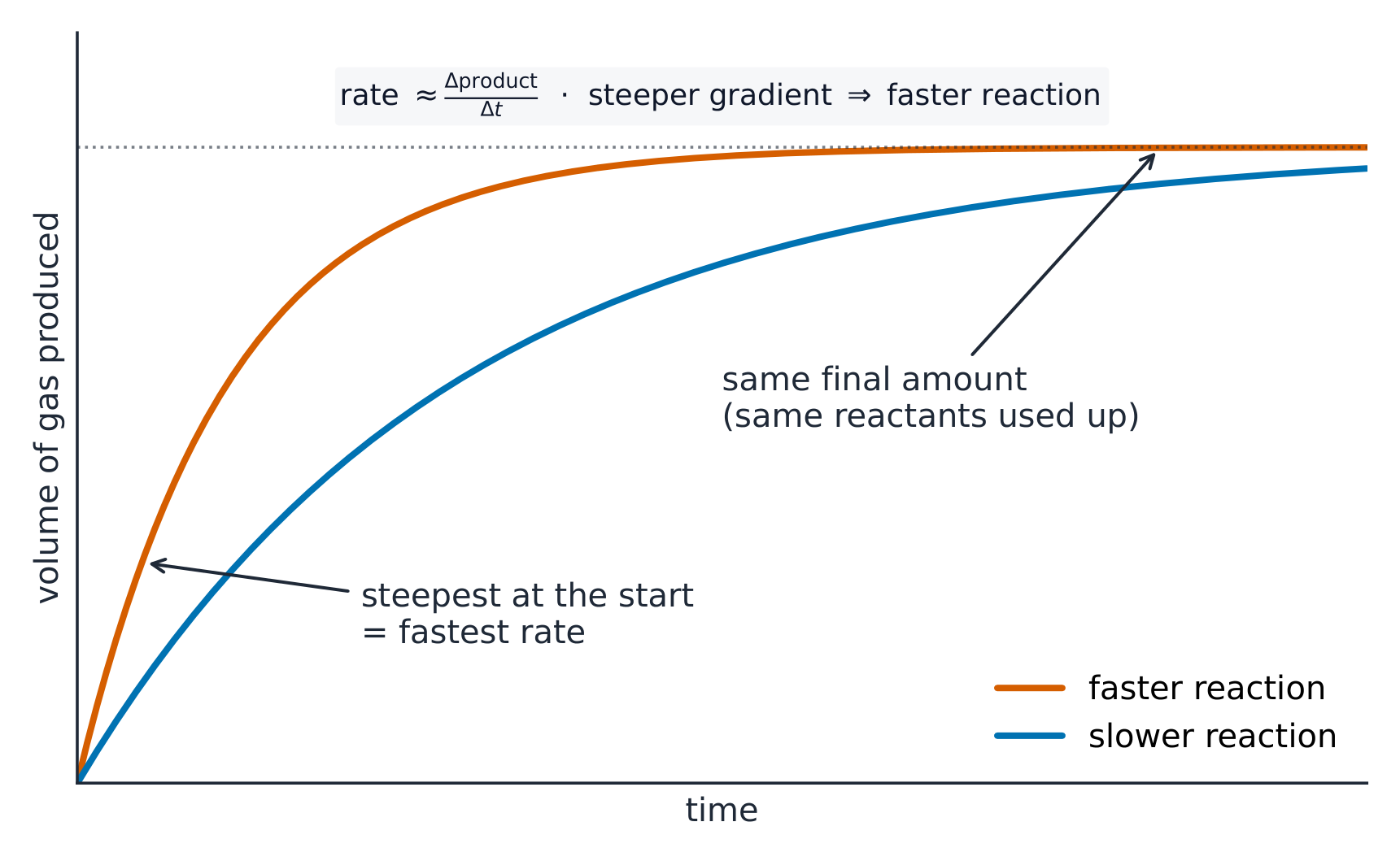
La pendiente de la curva de volumen–tiempo es la velocidad; es más pronunciada al inicio y se aplana a medida que se agotan los reactivos.
conc = c₀·bᵗ
La concentración disminuye con el tiempo — rápido al principio, luego más lento.
Observa las partículas chocar. El calor las acelera para que choquen con mayor frecuencia e intensidad; más partículas o un catalizador proporcionan más colisiones exitosas — la velocidad aumenta.
| English · Inglés | Chinese · Chino | Pinyin |
|---|---|---|
| physical change/ˈfɪzɪkl tʃeɪndʒ/ | 物理变化 | wù lǐ biàn huà |
| chemical change/ˈkemɪkl tʃeɪndʒ/ | 化学变化 | huà xué biàn huà |
| precipitate/prɪˈsɪpɪteɪt/ | 沉淀 | chén diàn |
| rate of reaction/reɪt ɒv rɪˈækʃn/ | 反应速率 | fǎn yìng sù lǜ |
| reactants/rɪˈæktənts/ | 反应物 | fǎn yìng wù |
| products/ˈprɒdʌkts/ | 生成物 | shēng chéng wù |
| collision theory/kəˈlɪʒn ˈθɪəri/ | 碰撞理论 | pèng zhuàng lǐ lùn |
| particles/ˈpɑːtɪklz/ | 粒子 | lì zi |
| collide/kəˈlaɪd/ | 碰撞 | pèng zhuàng |
| activation energy/ˌæktɪˈveɪʃn ˈenədʒi/ | 活化能 | huó huà néng |
| concentration/ˌkɒnsənˈtreɪʃn/ | 浓度 | nóng dù |
| pressure/ˈpreʃə/ | 压强 | yā qiáng |
| surface area/ˈsɜːfɪs ˈeərɪə/ | 表面积 | biǎo miàn jī |
| kinetic energy/kɪˈnetɪk ˈenədʒi/ | 动能 | dòng néng |
| catalyst/ˈkætəlɪst/ | 催化剂 | cuī huà jì |
| enzymes/ˈenzaɪmz/ | 酶 | méi |
| syringe/sɪˈrɪndʒ/ | 注射器 | zhù shè qì |
| reversible reaction/rɪˈvɜːsɪbl rɪˈækʃn/ | 可逆反应 | kě nì fǎn yìng |
| hydrated/haɪˈdreɪtɪd/ | 水合 | shuǐ hé |
| anhydrous/ænˈhaɪdrəs/ | 无水 | wú shuǐ |
| closed system/kləʊzd ˈsɪstəm/ | 密闭系统 | mì bì xì tǒng |
| Core | Supplement |
|---|---|
| 1 State that some chemical reactions are reversible as shown by the symbol $\rightleftharpoons$ | 3 State that a reversible reaction in a closed system is at equilibrium when: (a) the rate of the forward reaction is equal to the rate of the reverse reaction (b) the concentrations of reactants and products are no longer changing |
| 2 Describe how changing the conditions can change the direction of a reversible reaction for: (a) the effect of heat on hydrated compounds (b) the addition of water to anhydrous compounds limited to copper(II) sulfate and cobalt(II) chloride | 4 Predict and explain, for a reversible reaction, how the position of equilibrium is affected by: (a) changing temperature (b) changing pressure (c) changing concentration (d) using a catalyst using information provided |
| 5 State the symbol equation for the production of ammonia in the Haber process, $\text{N}_2\text{(g)} + 3\text{H}_2\text{(g)} \rightleftharpoons 2\text{NH}_3\text{(g)}$ | |
| 6 State the sources of the hydrogen (methane) and nitrogen (air) in the Haber process | |
| 7 State the typical conditions in the Haber process as $450\text{ }^{\circ}\text{C}$, $20\,000\text{ kPa}/200\text{ atm}$ and an iron catalyst | |
| 8 State the symbol equation for the conversion of sulfur dioxide to sulfur trioxide in the Contact process, $2\text{SO}_2\text{(g)} + \text{O}_2\text{(g)} \rightleftharpoons 2\text{SO}_3\text{(g)}$ | |
| 9 State the sources of the sulfur dioxide (burning sulfur or roasting sulfide ores) and oxygen (air) in the Contact process | |
| 10 State the typical conditions for the conversion of sulfur dioxide to sulfur trioxide in the Contact process as $450\text{ }^{\circ}\text{C}$, $200\text{ kPa}/2\text{ atm}$ and a vanadium(V) oxide catalyst | |
| 11 Explain, in terms of rate of reaction and position of equilibrium, why the typical conditions stated are used in the Haber process and in the Contact process, including safety considerations and economics |
| Fundamental | Complemento |
|---|---|
| 1 Indicar que algunas reacciones químicas son reversibles, como lo demuestra el símbolo $\rightleftharpoons$ | 3 Indicar que una reacción reversible en un sistema cerrado está en equilibrio cuando: (a) la velocidad de la reacción directa es igual a la velocidad de la reacción inversa (b) las concentraciones de reactivos y productos ya no cambian |
| 2 Describir cómo el cambio de condiciones puede alterar la dirección de una reacción reversible para: (a) el efecto del calor sobre compuestos hidratados (b) la adición de agua a compuestos anhidrosos limitado al sulfato de cobre(II) y al cloruro de cobalto(II) | 4 Predecir y explicar, para una reacción reversible, cómo se ve afectada la posición del equilibrio por: (a) cambios de temperatura (b) cambios de presión (c) cambios de concentración (d) el uso de un catalizador utilizando la información proporcionada |
| 5 Indicar la ecuación simbólica para la producción de amoníaco en el proceso Haber, $\text{N}_2\text{(g)} + 3\text{H}_2\text{(g)} \rightleftharpoons 2\text{NH}_3\text{(g)}$ | |
| 6 Indicar las fuentes del hidrógeno (metano) y nitrógeno (aire) en el proceso Haber | |
| 7 Indicar las condiciones típicas en el proceso Haber como $450\text{ }^{\circ}\text{C}$, $20\,000\text{ kPa}/200\text{ atm}$ y un catalizador de hierro | |
| 8 Indicar la ecuación simbólica para la conversión de dióxido de azufre a trióxido de azufre en el proceso Contact, $2\text{SO}_2\text{(g)} + \text{O}_2\text{(g)} \rightleftharpoons 2\text{SO}_3\text{(g)}$ | |
| 9 Indicar las fuentes del dióxido de azufre (combustión de azufre o tostado de minerales sulfurosos) y oxígeno (aire) en el proceso Contact | |
| 10 Indicar las condiciones típicas para la conversión de dióxido de azufre a trióxido de azufre en el proceso Contact como $450\text{ }^{\circ}\text{C}$, $200\text{ kPa}/2\text{ atm}$ y un catalizador de óxido de vanadio(V) | |
| 11 Explicar, en términos de velocidad de reacción y posición del equilibrio, por qué se utilizan las condiciones típicas indicadas en el proceso Haber y en el proceso Contact, incluidas consideraciones de seguridad y economía |
Source: Cambridge International syllabus · Fuente: Plan de estudios Cambridge International
Some reactions are reversible 可逆反应: the products can react to form the reactants again. We show this with the symbol $\rightleftharpoons$.
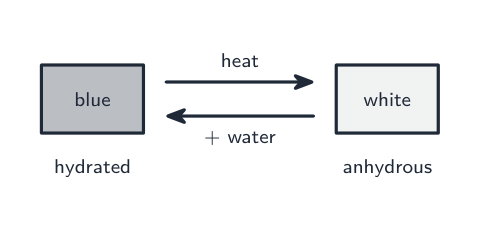
A clear example uses hydrated 水合 and anhydrous 无水 compounds:
Adding water to the anhydrous solid (and seeing the colour return) is used as a test for water.
In a closed system 密闭系统 (where nothing enters or leaves), a reversible reaction reaches equilibrium 平衡 when:
The position of equilibrium 平衡位置 tells you whether there are more reactants or more products. You can move it:
The Haber process 哈伯法 makes ammonia:
The Contact process 接触法 turns sulfur dioxide into sulfur trioxide:
The conditions are a compromise 折中:
Algunas reacciones son reversibles 可逆反应: los productos pueden reaccionar para formar nuevamente los reactivos. Esto se representa con el símbolo $\rightleftharpoons$.
Un ejemplo claro utiliza compuestos hidratados 水合 y anhidros 无水:
Añadir agua al sólido anhidro (y ver que regresa el color) se usa como prueba para detectar agua.
En un sistema cerrado 密闭系统 (donde nada entra ni sale), una reacción reversible alcanza el equilibrio 平衡 cuando:
La posición del equilibrio 平衡位置 te indica si hay más reactivos o más productos. Puedes moverla:
El proceso Haber 哈伯法 produce amoníaco:
El proceso Contact 接触法 convierte dióxido de azufre en trióxido de azufre:
Las condiciones son un compromiso 折中:
Cambie la temperatura, la presión o la concentración y observe cómo una reacción reversible se desplaza hacia un nuevo equilibrio.
| English · Inglés | Chinese · Chino | Pinyin |
|---|---|---|
| equilibrium/ˌiːkwɪˈlɪbrɪəm/ | 平衡 | píng héng |
| forward reaction/ˈfɔːwəd rɪˈækʃn/ | 正反应 | zhèng fǎn yìng |
| reverse reaction/rɪˈvɜːs rɪˈækʃn/ | 逆反应 | nì fǎn yìng |
| position of equilibrium/pəˈzɪʃn ɒv ˌiːkwɪˈlɪbrɪəm/ | 平衡位置 | píng héng wèi zhì |
| endothermic/ˌendəʊˈθɜːmɪk/ | 吸热反应 | xī rè fǎn yìng |
| exothermic/eɡzəˈðɜːmɪk/ | 放热反应 | fàng rè fǎn yìng |
| Haber process/ˈheɪbə ˈprəʊses/ | 哈伯法 | hā bó fǎ |
| hydrogen/ˈhaɪdrədʒn/ | 氢气 | qīng qì |
| methane/ˈmiːθeɪn/ | 甲烷 | jiǎ wán |
| nitrogen/ˈnaɪtrədʒn/ | 氮气 | dàn qì |
| iron/ˈaɪən/ | 铁 | tiě |
| Contact process/ˈkɒntækt ˈprəʊses/ | 接触法 | jiē chù fǎ |
| sulfur/ˈsʌlfɜː/ | 硫 | liú |
| oxygen/ˈɒksɪdʒn/ | 氧气 | yǎng qì |
| vanadium(V) oxide/væˈneɪdɪəm ˈɒksaɪd/ | 五氧化二钒 | wǔ yǎng huà èr fán |
| compromise/ˈkɒmprəmaɪz/ | 折中 | zhé zhōng |
| Core | Supplement |
|---|---|
| 1 Use a Roman numeral to indicate the oxidation number of an element in a compound | |
| 2 Define redox reactions as involving simultaneous oxidation and reduction | |
| 3 Define oxidation as gain of oxygen and reduction as loss of oxygen | 6 Define oxidation in terms of: (a) loss of electrons (b) an increase in oxidation number |
| 7 Define reduction in terms of: (a) gain of electrons (b) a decrease in oxidation number | |
| 4 Identify redox reactions as reactions involving gain and loss of oxygen | 8 Identify redox reactions as reactions involving gain and loss of electrons |
| 5 Identify oxidation and reduction in redox reactions | 9 Identify redox reactions by changes in oxidation number using: (a) the oxidation number of elements in their uncombined state is zero (b) the oxidation number of a monatomic ion is the same as the charge on the ion (c) the sum of the oxidation numbers in a compound is zero (d) the sum of the oxidation numbers in an ion is equal to the charge on the ion |
| 10 Identify redox reactions by the colour changes involved when using acidified aqueous potassium manganate(VII) or aqueous potassium iodide | |
| 11 Define an oxidising agent as a substance that oxidises another substance and is itself reduced | |
| 12 Define a reducing agent as a substance that reduces another substance and is itself oxidised | |
| 13 Identify oxidising agents and reducing agents in redox reactions |
| Core | Suplemento |
|---|---|
| 1 Use un número romano para indicar el número de oxidación de un elemento en un compuesto | |
| 2 Defina las reacciones redox como aquellas que implican simultáneamente oxidación y reducción | |
| 3 Defina la oxidación como ganancia de oxígeno y la reducción como pérdida de oxígeno | 6 Defina la oxidación en términos de: (a) pérdida de electrones (b) aumento del número de oxidación |
| 7 Defina la reducción en términos de: (a) ganancia de electrones (b) disminución del número de oxidación | |
| 4 Identifique las reacciones redox como aquellas que implican ganancia y pérdida de oxígeno | 8 Identifique las reacciones redox como aquellas que implican ganancia y pérdida de electrones |
| 5 Identifique la oxidación y la reducción en las reacciones redox | 9 Identifique las reacciones redox mediante los cambios en el número de oxidación utilizando: (a) el número de oxidación de los elementos en su estado no combinado es cero (b) el número de oxidación de un ion monoatómico es igual a la carga del ion (c) la suma de los números de oxidación en un compuesto es cero (d) la suma de los números de oxidación en un ion es igual a la carga del ion |
| 10 Identifique las reacciones redox por los cambios de color involucrados al usar permanganato de potasio(VII) acuoso acidificado o yoduro de potasio acuoso | |
| 11 Defina un agente oxidante como una sustancia que oxida a otra sustancia y se reduce a sí misma | |
| 12 Defina un agente reductor como una sustancia que reduce a otra sustancia y se oxida a sí misma | |
| 13 Identifique agentes oxidantes y reductores en las reacciones redox |
Source: Cambridge International syllabus · Fuente: Plan de estudios Cambridge International
Oxidation 氧化 and reduction 还原 always happen at the same time, in what is called a redox reaction 氧化还原反应. ('Redox' is short for reduction–oxidation.)
There are three ways to describe oxidation and reduction:
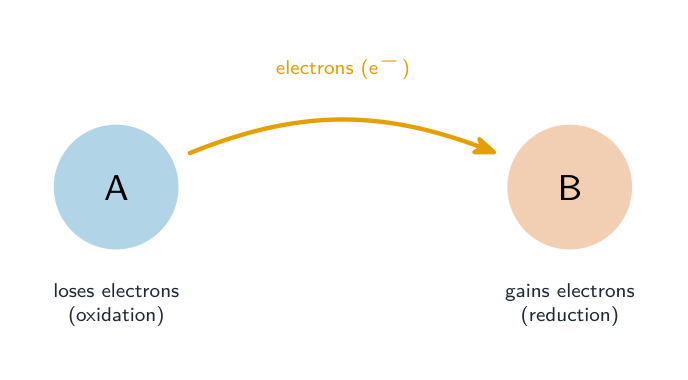
A useful memory aid is OIL RIG: Oxidation Is Loss, Reduction Is Gain — of electrons.
The oxidation number is shown by a Roman numeral, as in iron(II) and iron(III). The rules are:
Worked example. Find the oxidation number of manganese in the manganate(VII) ion, $\text{MnO}_4^{-}$. Each oxygen is $-2$, and there are four of them, giving $4 \times (-2) = -8$. The oxidation numbers in an ion must add up to the charge on the ion, which here is $-1$. So if manganese is $x$, then $x + (-8) = -1$, giving $x = +7$ - exactly what the (VII) in the name tells you. Set the total to the ion's charge, not to zero: zero is only for a neutral compound.
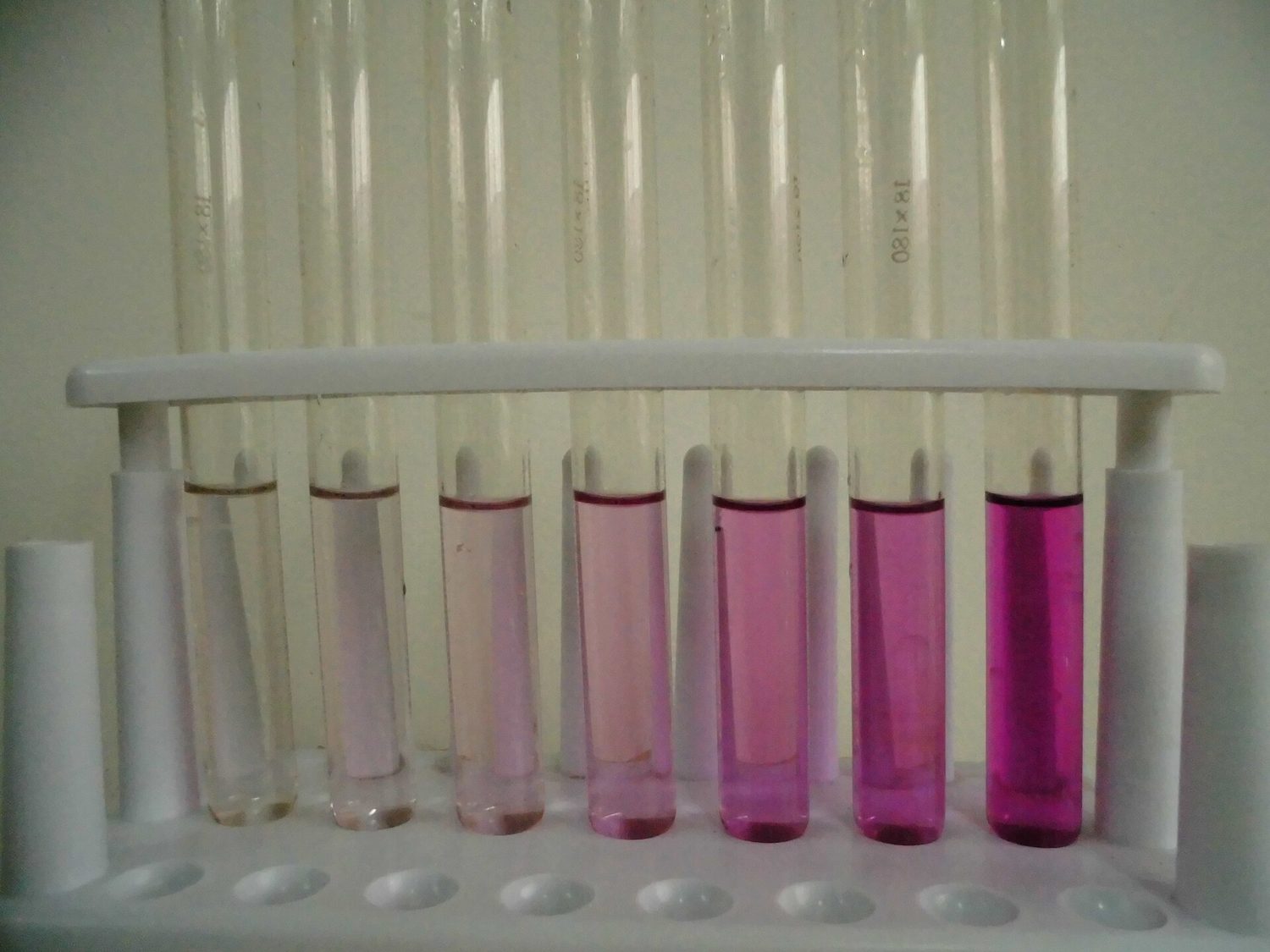
Some redox reactions show clear colour changes:
La oxidación 氧化 y la reducción 还原 siempre ocurren al mismo tiempo, en lo que se llama reacción redox 氧化还原反应. ('Redox' es abreviatura de reducción–oxidación).
Hay tres formas de describir la oxidación y la reducción:
Un útil recordatorio es OIL RIG: Oxidation Is Loss, Reduction Is Gain — de electrones.
El número de oxidación se indica con un numeral romano, como en hierro(II) y hierro(III). Las reglas son:
Ejemplo resuelto. Encuentra el número de oxidación del manganeso en el ion manganato(VII), $\text{MnO}_4^{-}$. Cada oxígeno es $-2$, y hay cuatro de ellos, dando $4 \times (-2) = -8$. Los números de oxidación en un ion deben sumar la carga del ion, que aquí es $-1$. Entonces, si el manganeso es $x$, entonces $x + (-8) = -1$, lo que da $x = +7$ — exactamente lo que el (VII) en el nombre te indica. Establece el total en la carga del ion, no en cero: cero es solo para un compuesto neutro.
Algunas reacciones redox muestran cambios de color claros:
Paso a paso en una reacción redox. Una sustancia pierde electrones mientras otra los gana; nunca puedes tener uno sin el otro.
| English · Inglés | Chinese · Chino | Pinyin |
|---|---|---|
| oxidation/ˌɒksɪˈdeɪʃn/ | 氧化 | yǎng huà |
| reduction/rɪˈdʌkʃn/ | 还原 | huán yuán |
| redox reaction/rɪˈdɒks rɪˈækʃn/ | 氧化还原反应 | yǎng huà huán yuán fǎn yìng |
| potassium manganate(VII)/pəˈtæsɪəm ˈmæŋɡəneɪt/ | 高锰酸钾 | gāo měng suān jiǎ |
| potassium iodide/pəˈtæsɪəm ˈaɪədaɪd/ | 碘化钾 | diǎn huà jiǎ |
| iodine/ˈaɪədiːn/ | 碘 | diǎn |
| English · Inglés | Chinese · Chino | Pinyin |
|---|---|---|
| electrons/ɪˈlektrɒnz/ | 电子 | diàn zi |
| oxidation number/ˌɒksɪˈdeɪʃn ˈnʌmbə/ | 氧化数 | yǎng huà shù |
| oxidising agent/ˈɒksɪdaɪzɪŋ ˈeɪdʒənt/ | 氧化剂 | yǎng huà jì |
| reducing agent/rɪˈdjuːsɪŋ ˈeɪdʒənt/ | 还原剂 | huán yuán jì |
Work through it step by step, with instant-check exercises. · Trátalo paso a paso, con ejercicios de verificación instantánea.
Past Papers · Exámenes Anteriores
Loading subjects… · Cargando asignaturas…