Aquí hay un problema del químico. Un átomo individual es demasiado pequeño para verlo, y hay miles de millones en la más pequeña mancha. Entonces, ¿cómo contarlos? Tú…
English narration · English + 中文 subtitles burned in · Narración en inglés · Subtítulos en inglés + 中文 quemados en pantalla
English
Stoichiometry 化学计量 is the study of the amounts of substances in a reaction — how much reacts and how much is made. This topic is mostly about counting atoms and doing calculations.
Español
Stoichiometry 化学计量 es el estudio de las cantidades de sustancias en una reacción: cuánto reacciona y cuánto se produce. Este tema trata principalmente de contar átomos y realizar cálculos.
3.1
Chemical formulae · Fórmulas químicas
Syllabus
English
Core
Supplement
1 State the formulae of the elements and compounds named in the subject content
2 Define the molecular formula of a compound as the number and type of different atoms in one molecule
5 Define the empirical formula of a compound as the simplest whole number ratio of the different atoms or ions in a compound
3 Deduce the formula of a simple compound from the relative numbers of atoms present in a model or a diagrammatic representation
6 Deduce the formula of an ionic compound from the relative numbers of the ions present in a model or a diagrammatic representation or from the charges on the ions
4 Construct word equations and symbol equations to show how reactants form products, including state symbols
7 Construct symbol equations with state symbols, including ionic equations
8 Deduce the symbol equation with state symbols for a chemical reaction, given relevant information
Español
Núcleo
Complemento
1 Enunciar las fórmulas de los elementos y compuestos mencionados en el contenido del programa
2 Definir la fórmula molecular de un compuesto como el número y tipo de átomos diferentes que hay en una molécula
5 Definir la fórmula empírica de un compuesto como la proporción más simple de números enteros de los diferentes átomos o iones presentes en un compuesto
3 Deducir la fórmula de un compuesto simple a partir de los números relativos de átomos presentes en un modelo o en una representación diagramática
6 Deducir la fórmula de un compuesto iónico a partir de los números relativos de los iones presentes en un modelo o en una representación diagramática, o a partir de las cargas de los iones
4 Construir ecuaciones con palabras y ecuaciones simbólicas para mostrar cómo los reactivos forman productos, incluyendo los símbolos de estado
7 Construir ecuaciones simbólicas con símbolos de estado, incluidas las ecuaciones iónicas
8 Deducir la ecuación simbólica con símbolos de estado para una reacción química, dada la información pertinente
Source: Cambridge International syllabus · Fuente: Plan de estudios Cambridge International
English
A formula 化学式 shows which atoms 原子 are in a substance, and how many of each. There are two kinds of formula you must know.
The molecular formula 分子式 is the actual number of each atom in one molecule 分子. For glucose it is $\text{C}_6\text{H}_{12}\text{O}_6$.
The empirical formula 实验式 is the simplest whole-number ratio 比例 of the atoms or ions 离子 in a compound 化合物. For glucose it is $\text{CH}_2\text{O}$.
Working out a formula
If you are given a model or diagram, just count the atoms of each element and write them as a formula.
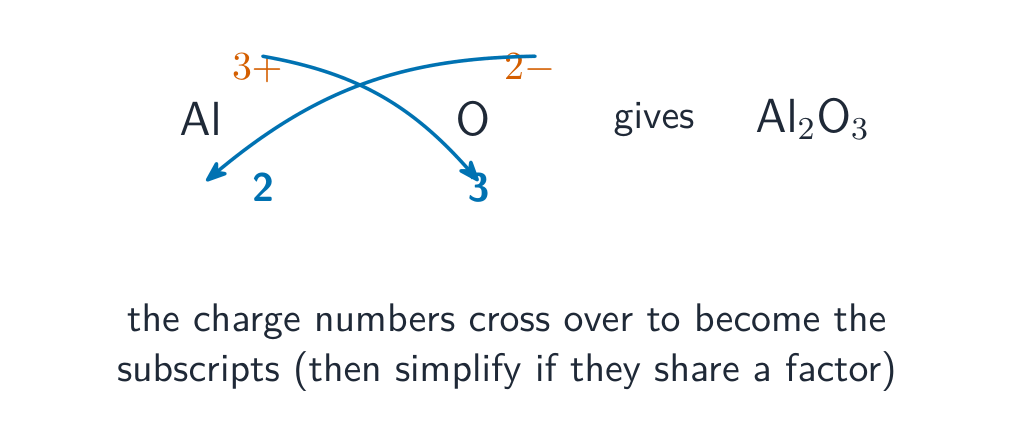
For an ionic compound 离子化合物 you can work out the formula from the charges on the ions. The total positive charge must balance the total negative charge, because the compound has no overall charge. Some common ions:
For example, $\text{Na}^{+}$ and $\text{O}^{2-}$: you need two $\text{Na}^{+}$ to balance one $\text{O}^{2-}$, so the formula is $\text{Na}_2\text{O}$.
Español
Una fórmula 化学式 muestra qué átomos 原子 hay en una sustancia y cuántos hay de cada uno. Hay dos tipos de fórmulas que debes conocer.
La fórmula molecular 分子式 es el número real de cada átomo en una molécula 分子. Para la glucosa, es $\text{C}_6\text{H}_{12}\text{O}_6$.
La fórmula empírica 实验式 es la proporción más simple de números enteros de los átomos 原子 o los iones 离子 en un compuesto 化合物. Para la glucosa, es $\text{CH}_2\text{O}$.
Determinar una fórmula
Si te dan un modelo o diagrama, simplemente cuenta los átomos de cada elemento y escríbelos como una fórmula.
Para un compuesto iónico 离子化合物, puedes deducir la fórmula a partir de las cargas de los iones. La carga positiva total debe equilibrar la carga negativa total, porque el compuesto no tiene carga neta. Algunos iones comunes:
Por ejemplo, para $\text{Na}^{+}$ y $\text{O}^{2-}$: necesitas dos $\text{Na}^{+}$ para equilibrar un $\text{O}^{2-}$, por lo tanto, la fórmula es $\text{Na}_2\text{O}$.
Para un compuesto iónico, las cargas de los iones se cruzan para obtener la fórmula (aquí $\text{Al}_2\text{O}_3$)
Explore · Explorar
Ruta para escribir fórmulas
Seguir las cargas o valencias para llegar a una fórmula química neutra.
You add state symbols 状态符号 in brackets to show the physical state: $(s)$ solid, $(l)$ liquid, $(g)$ gas, and $(aq)$ for aqueous 水溶液 (dissolved in water).
An ionic equation 离子方程式 shows only the ions that actually change. Ions that are the same on both sides are spectator ions 旁观离子 and are left out. For example, when an acid reacts with an alkali:
Una ecuación con símbolos balanceada tiene el mismo número de cada átomo en ambos lados
Añades símbolos de estado 状态符号 entre paréntesis para indicar el estado físico: $(s)$ sólido, $(l)$ líquido, $(g)$ gas, y $(aq)$ para acuoso 水溶液 (disuelto en agua).
Una ecuación iónica 离子方程式 muestra solo los iones que realmente cambian. Los iones que son iguales en ambos lados son iones espectadores 旁观 ion y se omiten. Por ejemplo, cuando un ácido reacciona con una base:
Ajusta los coeficientes hasta que cada elemento tenga el mismo número de átomos en ambos lados.
3.2
Relative masses · Masas relativas
Syllabus
English
Core
Supplement
1 Describe relative atomic mass, $A_r$, as the average mass of the isotopes of an element compared to 1/12th of the mass of an atom of $^{12}\text{C}$
2 Define relative molecular mass, $M_r$, as the sum of the relative atomic masses. Relative formula mass, $M_r$, will be used for ionic compounds
3 Calculate reacting masses in simple proportions. Calculations will not involve the mole concept
Español
Central
Complementario
1 Describir la masa atómica relativa, $A_r$, como la masa media de los isótopos de un elemento comparada con 1/12 de la masa de un átomo de $^{12}\text{C}$
2 Definir la masa molecular relativa, $M_r$, como la suma de las masas atómicas relativas. Se utilizará la masa fórmula relativa, $M_r$, para compuestos iónicos
3 Calcular las masas que reaccionan en proporciones simples. Los cálculos no involucrarán el concepto de mol
Source: Cambridge International syllabus · Fuente: Plan de estudios Cambridge International
English
The relative atomic mass 相对原子质量 ($A_r$) of an element 元素 is the average mass 质量 of its atoms compared to $\tfrac{1}{12}$ of the mass of one $^{12}\text{C}$ atom.
The relative molecular mass 相对分子质量 ($M_r$) is the sum of the relative atomic masses of all the atoms in the molecule. For ionic compounds we use the relative formula mass 相对式量, found the same way from the formula.
You can sometimes find a reacting mass without the mole. If 24 g of magnesium makes 40 g of magnesium oxide, then 12 g of magnesium (half as much) makes 20 g of magnesium oxide.
Español
Una balanza de laboratorio mide la masa — la base de los cálculos de moles.
La masa atómica relativa 相对原子质量 ($A_r$) de un elemento 元素 es la masa promedio 质量 de sus átomos en comparación con $\tfrac{1}{12}$ de la masa de un átomo de $^{12}\text{C}$.
La masa molecular relativa 相对分子质量 ($M_r$) es la suma de las masas atómicas relativas de todos los átomos en la molécula. Para compuestos iónicos usamos la masa fórmula relativa 相对式量, que se encuentra de la misma manera a partir de la fórmula.
A veces puedes encontrar una masa reactiva sin usar el mol. Si 24 g de magnesio producen 40 g de óxido de magnesio, entonces 12 g de magnesio (la mitad) producen 20 g de óxido de magnesio.
Explore · Explorar
Laboratorio de masa fórmula
masa = moles x Mr
Cambiar el número de unidades fórmula y ver la escala de masa total.
2 State that the mole, mol, is the unit of amount of substance and that one mole contains $6.02 \times 10^{23}$ particles, e.g. atoms, ions, molecules; this number is the Avogadro constant
3 Use the relationship $\text{amount of substance (mol)} = \frac{\text{mass (g)}}{\text{molar mass (g/mol)}}$ to calculate: (a) amount of substance (b) mass (c) molar mass (d) relative atomic mass or relative molecular/formula mass (e) number of particles, using the value of the Avogadro constant
4 Use the molar gas volume, taken as $24\text{ dm}^3$ at room temperature and pressure, r.t.p., in calculations involving gases
1 State that concentration can be measured in $\text{g/dm}^3$ or $\text{mol/dm}^3$
5 Calculate stoichiometric reacting masses, limiting reactants, volumes of gases at r.t.p., volumes of solutions and concentrations of solutions expressed in $\text{g/dm}^3$ and $\text{mol/dm}^3$, including conversion between $\text{cm}^3$ and $\text{dm}^3$
6 Use experimental data from a titration to calculate the moles of solute, or the concentration or volume of a solution
7 Calculate empirical formulae and molecular formulae, given appropriate data
8 Calculate percentage yield, percentage composition by mass and percentage purity, given appropriate data
Español
Núcleo
Complemento
2 Indicar que el mol, mol, es la unidad de cantidad de sustancia y que un mol contiene $6.02 \times 10^{23}$ partículas, por ejemplo, átomos, iones, moléculas; este número es la constante de Avogadro
3 Utilizar la relación $\text{amount of substance (mol)} = \frac{\text{mass (g)}}{\text{molar mass (g/mol)}}$ para calcular: (a) cantidad de sustancia (b) masa (c) masa molar (d) masa atómica relativa o masa molecular/fórmula relativa (e) número de partículas, utilizando el valor de la constante de Avogadro
4 Utilizar el volumen molar del gas, tomado como $24\text{ dm}^3$ a temperatura y presión ambiente (r.t.p.), en cálculos que involucren gases
1 Indicar que la concentración puede medirse en $\text{g/dm}^3$ o $\text{mol/dm}^3$
5 Calcular masas reactivas estequiométricas, reactivo limitante, volúmenes de gases a r.t.p., volúmenes de disoluciones y concentraciones de disoluciones expresadas en $\text{g/dm}^3$ y $\text{mol/dm}^3$, incluyendo la conversión entre $\text{cm}^3$ y $\text{dm}^3$
6 Utilizar datos experimentales procedentes de una titulación para calcular los moles de soluto, o la concentración o el volumen de una disolución
7 Calcular fórmulas empíricas y fórmulas moleculares, dados los datos apropiados
8 Calcular el rendimiento porcentual, la composición porcentual en masa y la pureza porcentual, dados los datos apropiados
Source: Cambridge International syllabus · Fuente: Plan de estudios Cambridge International
English
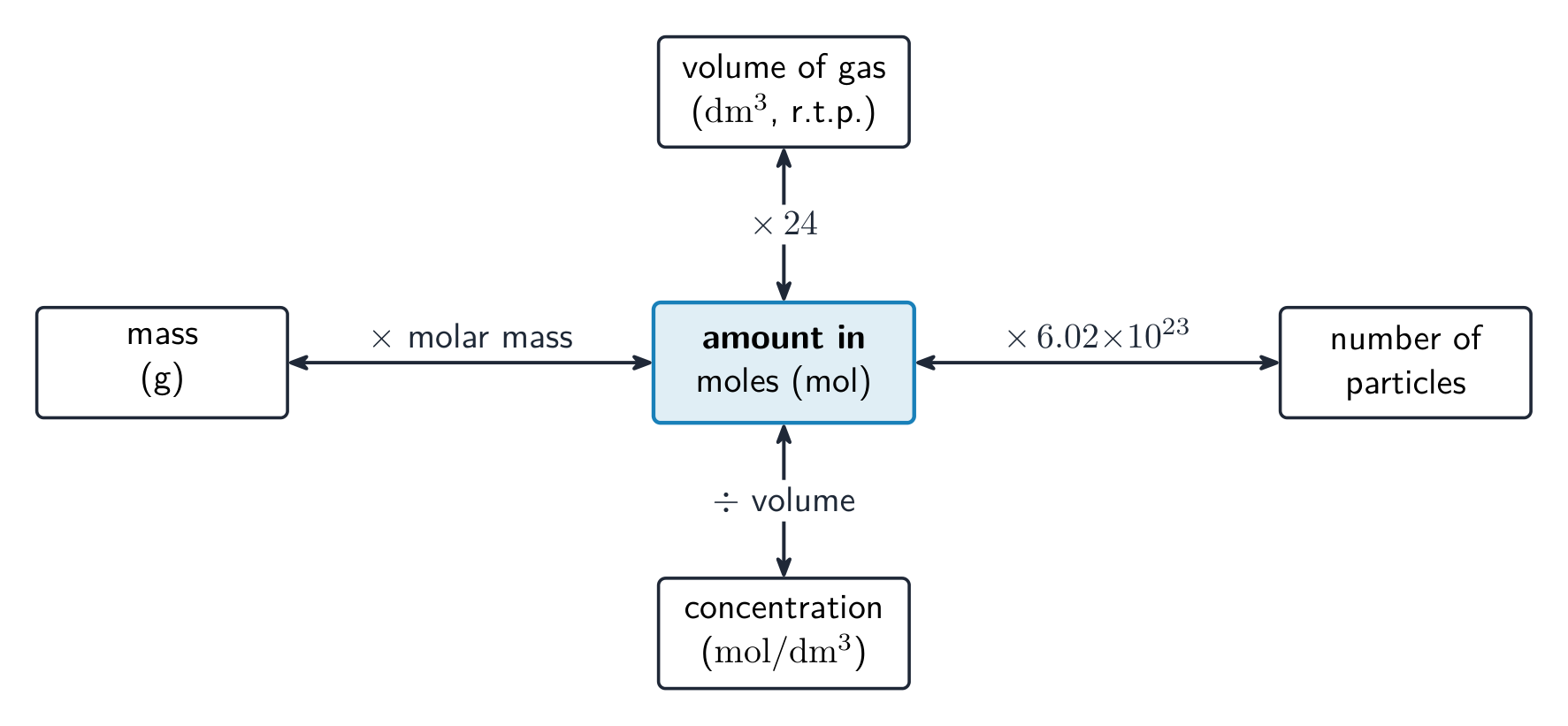
The mole 摩尔 (symbol mol) is the unit for the amount of substance 物质的量. One mole of any substance contains $6.02 \times 10^{23}$particles 粒子 (atoms, ions or molecules). This number is the Avogadro constant 阿伏伽德罗常数.
The molar mass 摩尔质量 is the mass of one mole, in grams per mole (g/mol). Its number is the same as the $A_r$ or $M_r$. The key relationship is:
$$\text{amount (mol)} = \frac{\text{mass (g)}}{\text{molar mass (g/mol)}}$$
Worked example. How many moles are in 36 g of water? Molar mass of water $= 18$ g/mol.
$$n = \frac{36}{18} = 2 \text{ mol}$$
To find the number of particles, multiply the moles by the Avogadro constant.
Volumes of gases
At room temperature and pressure (r.t.p.), one mole of any gas takes up the same volume 体积. This molar gas volume 摩尔气体体积 is $24 \text{ dm}^3$.
$$\text{volume of gas (dm}^3) = \text{amount (mol)} \times 24$$
Worked example. What volume does $0.25$ mol of carbon dioxide occupy at r.t.p.?
The concentration 浓度 of a solution 溶液 can be given in $\text{g/dm}^3$ or in $\text{mol/dm}^3$.
$$\text{concentration (mol/dm}^3) = \frac{\text{amount of solute (mol)}}{\text{volume (dm}^3)}$$
Remember to convert volume: $1 \text{ dm}^3 = 1000 \text{ cm}^3$, so divide a volume in $\text{cm}^3$ by 1000.
Español
El mol 摩尔 (símbolo mol) es la unidad para la cantidad de sustancia 物质的量. Un mol de cualquier sustancia contiene $6.02 \times 10^{23}$partículas 粒子 (átomos, iones o moléculas). Este número es la constante de Avogadro 阿伏伽德罗常数.
La masa molar 摩尔质量 es la masa de un mol, en gramos por mol (g/mol). Su valor numérico es el mismo que el $A_r$ o el $M_r$. La relación clave es:
$$\text{amount (mol)} = \frac{\text{mass (g)}}{\text{molar mass (g/mol)}}$$
Ejemplo resuelto. ¿Cuántos moles hay en 36 g de agua? Masa molar del agua $= 18$ g/mol.
$$n = \frac{36}{18} = 2 \text{ mol}$$
Para encontrar el número de partículas, multiplica los moles por la constante de Avogadro.
Volumes of gases
A temperatura y presión ambiente (r.t.p.), un mol de cualquier gas ocupa el mismo volumen 体积. Este volumen molar gaseoso 摩尔气体体积 es $24 \text{ dm}^3$.
Un mol de cualquier gas ocupa 24 decímetros cúbicos a temperatura y presión ambiente
$$\text{volume of gas (dm}^3) = \text{amount (mol)} \times 24$$
Ejemplo resuelto. ¿Qué volumen ocupa $0.25$ mol de dióxido de carbono a r.t.p.?
Doing reaction calculations · Realización de cálculos de reacción
English
Most calculations follow the same steps: change the known amount into moles, use the balanced equation to find the moles of what you want, then change back into mass, volume or concentration.
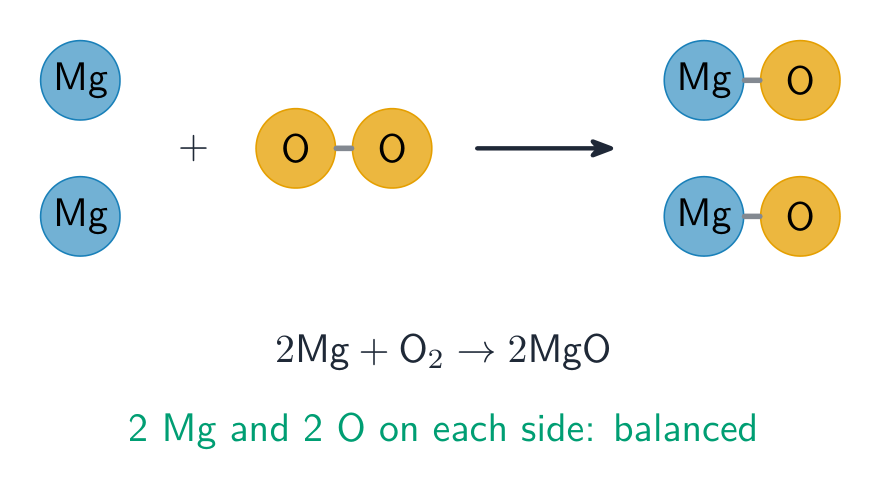
Worked example. What mass of magnesium oxide forms when 12 g of magnesium burns completely? $2\text{Mg} + \text{O}_2 \rightarrow 2\text{MgO}$. ($A_r$: Mg $= 24$, O $= 16$.)
Moles of Mg $= 12 / 24 = 0.5$ mol. The ratio Mg : MgO is $1 : 1$, so $0.5$ mol of MgO forms. Its molar mass is $24 + 16 = 40$ g/mol, so the mass is $0.5 \times 40 = 20$ g — the same answer as the simple-proportion method above.
Limiting reactant
When two reactants are mixed, often one runs out first. This is the limiting reactant 限量反应物. It decides how much product can form; any other reactant is in excess (left over).
Worked example. 8 g of hydrogen reacts with 8 g of oxygen: $2\text{H}_2 + \text{O}_2 \rightarrow 2\text{H}_2\text{O}$. Which is the limiting reactant, and what mass of water forms? ($A_r$: H $= 1$, O $= 16$.)
Moles of $\text{H}_2 = 8 / 2 = 4$ mol; moles of $\text{O}_2 = 8 / 32 = 0.25$ mol. The equation needs $2\text{H}_2$ for every one $\text{O}_2$, so $0.25$ mol of $\text{O}_2$ reacts with only $0.5$ mol of $\text{H}_2$. There is far more hydrogen than that, so oxygen is the limiting reactant and the hydrogen is in excess. The oxygen makes $2 \times 0.25 = 0.5$ mol of water, so the mass is $0.5 \times 18 = 9$ g. Always work in moles, not masses — the reactant with the smaller mass is not always the one that runs out.
Titration calculation
In a titration 滴定 you measure the volume of one solution that reacts with another. From the volume and concentration you find the moles of one solute 溶质, then use the equation ratio to find the moles, concentration or volume of the other.
Worked example.$25.0 \text{ cm}^3$ of sodium hydroxide solution is exactly neutralised by $20.0 \text{ cm}^3$ of $0.10 \text{ mol/dm}^3$ hydrochloric acid. $\text{NaOH} + \text{HCl} \rightarrow \text{NaCl} + \text{H}_2\text{O}$. Find the concentration of the sodium hydroxide.
Moles of HCl $= 0.10 \times \dfrac{20.0}{1000} = 0.0020$ mol. The ratio is $1 : 1$, so there are $0.0020$ mol of NaOH in $25.0 \text{ cm}^3$:
To find an empirical formula from masses or percentages:
Divide each element's mass (or %) by its $A_r$.
Divide all the answers by the smallest one to get the simplest ratio.
To find the molecular formula, compare the empirical formula mass with the real $M_r$ and multiply up.
Worked example. A compound contains $40\%$ calcium, $12\%$ carbon and $48\%$ oxygen by mass. Find its empirical formula. ($A_r$: Ca $= 40$, C $= 12$, O $= 16$.)
Divide each percentage by its $A_r$: Ca $= 40/40 = 1$, C $= 12/12 = 1$, O $= 48/16 = 3$. The ratio is $1 : 1 : 3$, so the empirical formula is $\text{CaCO}_3$.
Percentages
Percentage yield 产率 compares how much product you actually got with the most you could get: $\dfrac{\text{actual}}{\text{theoretical}} \times 100$.
Percentage composition by mass 质量分数 of an element $= \dfrac{\text{mass of the element}}{M_r} \times 100$.
Percentage purity 纯度$= \dfrac{\text{mass of pure substance}}{\text{mass of impure sample}} \times 100$.
Worked example. Find the percentage by mass of nitrogen in ammonium nitrate, $\text{NH}_4\text{NO}_3$. ($A_r$: N $= 14$, H $= 1$, O $= 16$.)
$M_r = (2 \times 14) + (4 \times 1) + (3 \times 16) = 80$. The mass of nitrogen is $2 \times 14 = 28$, so
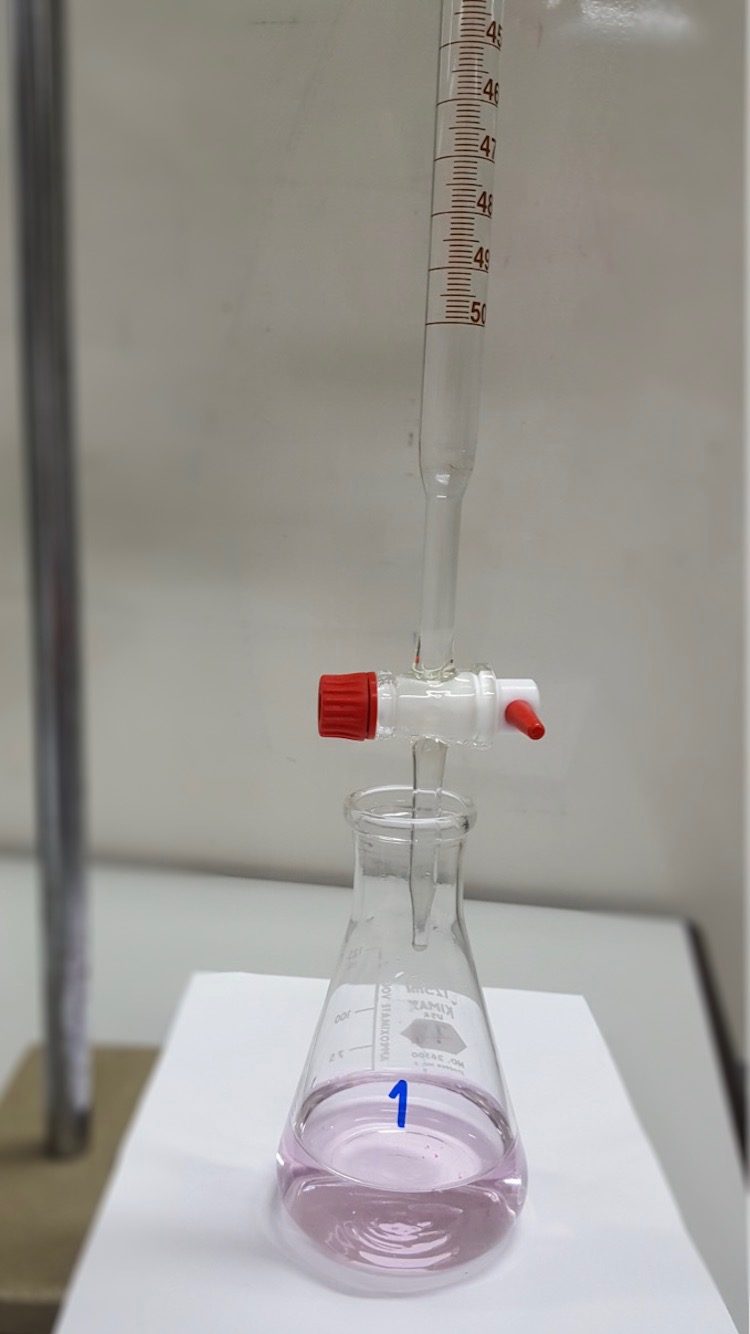
Una titulación mide exactamente cuánto ácido reacciona con una base.
La mayoría de los cálculos siguen los mismos pasos: convierte la cantidad conocida a moles, usa la ecuación balanceada para encontrar los moles de lo que deseas, luego vuelve a convertir a masa, volumen o concentración.
Ejemplo resuelto. ¿Qué masa de óxido de magnesio se forma cuando 12 g de magnesio arden completamente? $2\text{Mg} + \text{O}_2 \rightarrow 2\text{MgO}$. ($A_r$: Mg $= 24$, O $= 16$.)
Moles de Mg $= 12 / 24 = 0.5$ mol. La proporción Mg : MgO es $1 : 1$, por lo tanto se forman $0.5$ mol de MgO. Su masa molar es $24 + 16 = 40$ g/mol, así que la masa es $0.5 \times 40 = 20$ g — la misma respuesta que el método de proporción simple anterior.
Reactivo limitante
Cuando se mezclan dos reactivos, a menudo uno se agota primero. Este es el reactivo limitante 限量反应物. Decide cuánta producto puede formarse; cualquier otro reactivo está en exceso (sobra).
B se agota primero, por lo que es el reactivo limitante y determina cuánto producto se forma; el A sobrante queda en exceso
Ejemplo resuelto. 8 g de hidrógeno reaccionan con 8 g de oxígeno: $2\text{H}_2 + \text{O}_2 \rightarrow 2\text{H}_2\text{O}$. ¿Cuál es el reactivo limitante y qué masa de agua se forma? ($A_r$: H $= 1$, O $= 16$.)
Moles of $\text{H}_2 = 8 / 2 = 4$ mol; moles of $\text{O}_2 = 8 / 32 = 0.25$ mol. La ecuación necesita $2\text{H}_2$ por cada uno $\text{O}_2$, así que $0.25$ mol de $\text{O}_2$ reaccionan con solo $0.5$ mol de $\text{H}_2$. Hay mucho más hidrógeno que eso, así que el oxígeno es el reactivo limitante y el hidrógeno está en exceso. El oxígeno produce $2 \times 0.25 = 0.5$ mol de agua, así que la masa es $0.5 \times 18 = 9$ g. Siempre trabaje en moles, no en masas — el reactivo con menor masa no siempre es el que se agota.
Cálculo de titulación
En una titulación 滴定, se mide el volumen de una solución que reacciona con otra. A partir del volumen y la concentración, se calculan los moles de un soluto 溶质, y luego se usa la proporción estequiométrica de la ecuación para encontrar los moles, la concentración o el volumen de la otra sustancia.
Ejemplo resuelto.$25.0 \text{ cm}^3$ de solución de hidróxido de sodio son neutralizados exactamente por $20.0 \text{ cm}^3$ de ácido clorhídrico $0.10 \text{ mol/dm}^3$. $\text{NaOH} + \text{HCl} \rightarrow \text{NaCl} + \text{H}_2\text{O}$. Encuentre la concentración del hidróxido de sodio.
Moles de HCl $= 0.10 \times \dfrac{20.0}{1000} = 0.0020$ mol. La relación es $1 : 1$, por lo que hay $0.0020$ mol de NaOH en $25.0 \text{ cm}^3$:
El cálculo de la titulación: solución conocida a moles, relación y luego la concentración desconocida
Fórmulas empíricas y moleculares a partir de datos
Para encontrar una fórmula empírica a partir de masas o porcentajes:
Divide la masa (o %) de cada elemento por su $A_r$.
Divide todas las respuestas entre el más pequeño para obtener la relación más simple.
Para encontrar la fórmula molecular, compara la masa de la fórmula empírica con la $M_r$ real y multiplica.
Ejemplo resuelto. Un compuesto contiene $40\%$ calcio, $12\%$ carbono y $48\%$ oxígeno en masa. Encuentra su fórmula empírica. ($A_r$: Ca $= 40$, C $= 12$, O $= 16$.)
Divide cada porcentaje por su $A_r$: Ca $= 40/40 = 1$, C $= 12/12 = 1$, O $= 48/16 = 3$. La proporción es $1 : 1 : 3$, por lo que la fórmula empírica es $\text{CaCO}_3$.
Porcentajes
El rendimiento porcentual compara cuántos productos obtuviste realmente con la cantidad máxima que podrías haber obtenido: $\dfrac{\text{actual}}{\text{theoretical}} \times 100$.
Composición porcentual en masa 质量分数 de un elemento $= \dfrac{\text{mass of the element}}{M_r} \times 100$.
Pureza porcentual 纯度$= \dfrac{\text{mass of pure substance}}{\text{mass of impure sample}} \times 100$.
Ejemplo resuelto. Encuentre el porcentaje en masa de nitrógeno en el nitrato de amonio, $\text{NH}_4\text{NO}_3$. ($A_r$: N $= 14$, H $= 1$, O $= 16$.)
$M_r = (2 \times 14) + (4 \times 1) + (3 \times 16) = 80$. La masa del nitrógeno es $2 \times 14 = 28$, por lo tanto
Always turn masses, gas volumes and concentrations into moles first, use the balanced equation's ratio, then convert back. Never compare masses directly across an equation.
Key formulas: $n = \dfrac{\text{mass}}{M_r}$, gas volume $= n \times 24\ \text{dm}^3$ at r.t.p., and concentration $= \dfrac{n}{\text{volume in dm}^3}$. Change cm³ to dm³ by dividing by 1000.
To balance a symbol equation you may only change the big numbers in front of a formula, never the small subscripts inside it.
The limiting reactant is the one that runs out (fewest moles once you allow for the ratio); it sets how much product forms. The other reactant is in excess.
Percentage yield = actual ÷ theoretical × 100; percentage purity = mass of pure substance ÷ mass of sample × 100. Both are always 100% or less.
Español
Convierta siempre las masas, los volúmenes de gas y las concentraciones a moles primero, use la proporción de la ecuación balanceada y luego convierta de nuevo. Nunca compare masas directamente a través de una ecuación.
Fórmulas clave: $n = \dfrac{\text{mass}}{M_r}$, volumen de gas $= n \times 24\ \text{dm}^3$ a c.a.t., y concentración $= \dfrac{n}{\text{volume in dm}^3}$. Cambie cm³ a dm³ dividiendo entre 1000.
Para balancear una ecuación simbólica solo puede cambiar los números grandes delante de una fórmula, nunca los subíndices pequeños dentro de ella.
El reactivo limitante es el que se agota (menor número de moles una vez considerada la proporción); este determina cuánto producto se forma. El otro reactivo está en exceso.
Rendimiento porcentual = real ÷ teórico × 100; pureza porcentual = masa de sustancia pura ÷ masa de la muestra × 100. Ambos son siempre 100 % o menos.
Interactive lessons on this topic · Lecciones interactivas sobre este tema
Work through it step by step, with instant-check exercises. · Trátalo paso a paso, con ejercicios de verificación instantánea.
Pick one and the site follows you — notes, papers, videos and practice all open on it. · Selecciona uno y el sitio te sigue — notas, documentos, videos y práctica se abren en él.
Type to search notes, lessons, code, vocabulary and past-paper questions across every subject. · Escribe para buscar notas, lecciones, código, vocabulario y preguntas de exámenes anteriores en todas las materias.