The Haber and Contact processes
Introduced| English | Meaning |
|---|---|
| Contact process/ˈkɒntækt ˈprəʊses/ | An industrial process for making sulfuric acid through catalytic oxidation of sulfur dioxide to sulfur trioxide. |
| ammonia/æˈməʊnɪə/ | A pungent gas with formula NH₃, whose aqueous solution is alkaline. |
| sulfuric acid/sʌlˈfjʊərɪk ˈæsɪd/ | The acid H₂SO₄, which can donate two protons per molecule. |
| Haber process/ˈheɪbə ˈprəʊses/ | The industrial production of ammonia by reacting nitrogen with hydrogen under controlled temperature and pressure using a catalyst. |
| iron catalyst/ˈaɪən ˈkætəlɪst/ | iron catalyst |
| yield/jiːld/ | The amount of product obtained in a reaction, often expressed as a percentage of the theoretical amount. |
Equilibrium in industry
- Two of the world's most important industrial reactions are reversible.
- The Haber and Contact processes 接触法 make ammonia 氨气 and sulfuric acid 硫酸.
The Haber process makes:
Difficulty 1/5 · 100 coins + a small bonus on first completion today
N₂ + H₂ ⇌ NH₃ in the Haber process.
The catalyst used in the Haber process is:
Difficulty 1/5 · 100 coins + a small bonus on first completion today
Iron catalyses the Haber process.
The Haber process combines nitrogen and hydrogen to make ______.
Difficulty 1/5 · 100 coins + a small bonus on first completion today
Ammonia (NH₃) is used to make fertilisers.
The Haber process 哈伯法
- The Haber process makes ammonia (NH₃) from nitrogen + hydrogen (a reversible reaction).
- Conditions: about 450 °C, 200 atmospheres pressure, and an iron catalyst 铁催化剂.
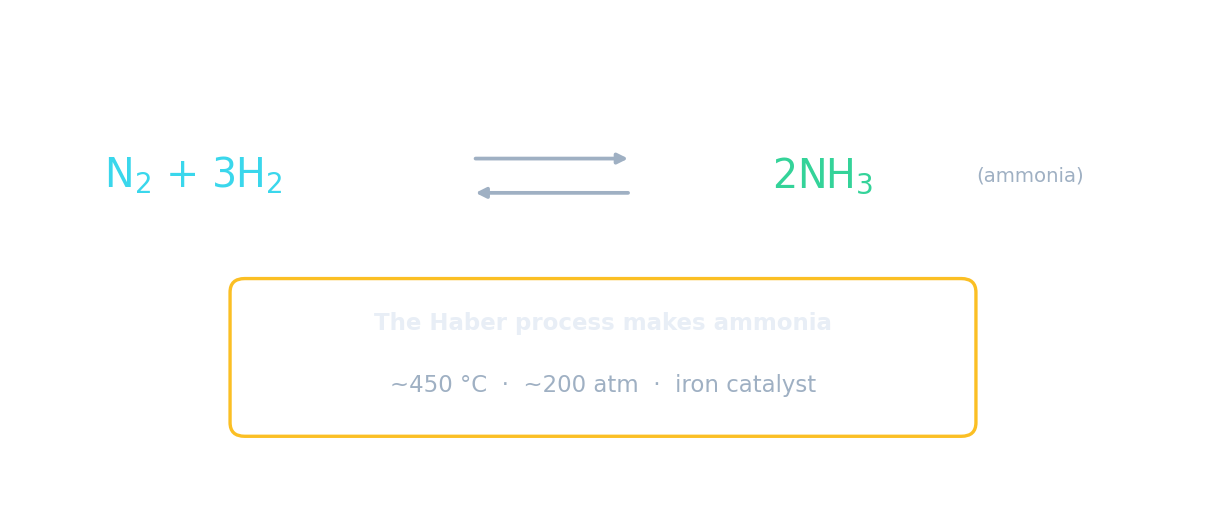
The Haber process makes ammonia: N₂ + 3H₂ ⇌ 2NH₃
The Haber & Contact processes
compromise: yield vs rate
Pressure raises yield; temperature is a compromise between yield and rate.
The Contact process is used to make:
Difficulty 1/5 · 100 coins + a small bonus on first completion today
The Contact process makes sulfuric acid.
The Contact process
- The Contact process makes sulfuric acid, via sulfur trioxide.
- A key reversible step uses a vanadium(V) oxide catalyst.
Industrial conditions are chosen as a compromise between yield, rate and cost.
Difficulty 1/5 · 100 coins + a small bonus on first completion today
No single condition is best for all three.
Choosing the conditions
- Conditions are a compromise: a good yield 产率 at a reasonable rate and cost.
- For example, higher pressure improves ammonia yield but is expensive and dangerous.
Worked example. In the Haber process, a lower temperature would give more ammonia (higher yield) but far too slowly. 450 °C is a compromise — a reasonable yield at a useful rate.
You've got it
- the Haber process makes ammonia from nitrogen + hydrogen (iron catalyst, ~450 °C, high pressure)
- the Contact process makes sulfuric acid (vanadium(V) oxide catalyst)
- conditions are a compromise between yield, rate and cost
Write from iron as the Haber catalyst
- Nitrogen and hydrogen are converted to ammonia.
- The temperature is a compromise near 450 degrees Celsius.
What is the catalyst, and why is the temperature not made very low?
The Haber catalyst is iron. Yield and rate pull the temperature in opposite directions.
What catalyses the Haber process?
Difficulty 1/5 · 100 coins + a small bonus on first completion today
Iron speeds the Haber reaction without being used up.