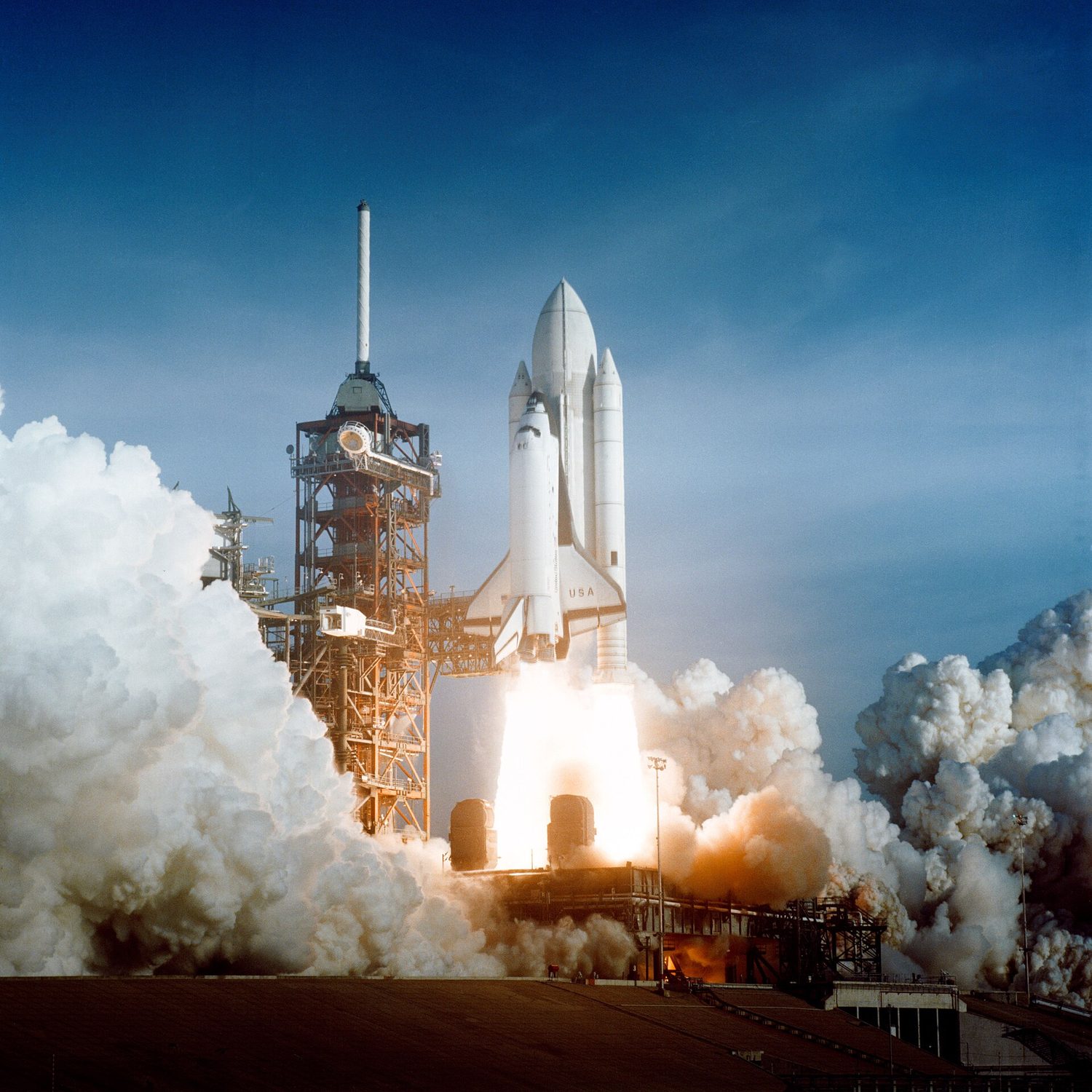
Learning Objective 2.1.A: Describe the properties and interactions of a system.
- 2.1.A.1 System properties are determined by the interactions between objects within the system.
- 2.1.A.2 If the properties or interactions of the constituent objects within a system are not important in modeling the behavior of the macroscopic system, the system can itself be treated as a single object.
- 2.1.A.3 Systems may allow interactions between constituent parts of the system and the environment, which may result in the transfer of energy or mass.
- 2.1.A.4 Individual objects within a chosen system may behave differently from each other as well as from the system as a whole.
- 2.1.A.5 The internal structure of a system affects the analysis of that system.
- 2.1.A.6 As variables external to a system are changed, the system's substructure may change.
Learning Objective 2.1.B: Describe the location of a system's center of mass with respect to the system's constituent parts.
- 2.1.B.1 For systems with symmetrical mass distributions, the center of mass is located on lines of symmetry.
- 2.1.B.2 The location of a system's center of mass along a given axis can be calculated using the equation
- Equation: $\vec{x}_{cm} = \dfrac{\sum m_i \vec{x}_i}{\sum m_i}$
- 2.1.B.3 A system can be modeled as a singular object that is located at the system's center of mass.
Boundary statement: AP Physics 1 only expects students to calculate the center of mass for systems of five or fewer particles arranged in a two-dimensional configuration or for systems that are highly symmetrical.
Objetivo de aprendizaje 2.1.A: Describir las propiedades e interacciones de un sistema.
- 2.1.A.1 Las propiedades de un sistema están determinadas por las interacciones entre los objetos dentro del mismo.
- 2.1.A.2 Si las propiedades o interacciones de los objetos constituyentes dentro de un sistema no son importantes al modelar el comportamiento macroscópico del sistema, este puede tratarse como un único objeto.
- 2.1.A.3 Los sistemas pueden permitir interacciones entre sus partes constituyentes y el entorno, lo cual puede resultar en la transferencia de energía o masa.
- 2.1.A.4 Los objetos individuales dentro de un sistema elegido pueden comportarse de manera diferente entre sí, así como respecto al sistema en su conjunto.
- 2.1.A.5 La estructura interna de un sistema afecta el análisis de dicho sistema.
- 2.1.A.6 Al cambiar variables externas a un sistema, su subestructura puede modificarse.
Objetivo de aprendizaje 2.1.B: Describir la ubicación del centro de masa de un sistema con respecto a sus partes constituyentes.
- 2.1.B.1 Para sistemas con distribuciones de masa simétricas, el centro de masa se encuentra sobre las líneas de simetría.
- 2.1.B.2 La ubicación del centro de masa de un sistema a lo largo de un eje dado se puede calcular mediante la ecuación
- Ecuación: $\vec{x}_{cm} = \dfrac{\sum m_i \vec{x}_i}{\sum m_i}$
- 2.1.B.3 Un sistema puede modelarse como un objeto singular ubicado en el centro de masa del sistema.
Declaración de límites: AP Physics 1 solo espera que los estudiantes calculen el centro de masa para sistemas de cinco o menos partículas dispuestas en una configuración bidimensional, o para sistemas altamente simétricos.