Aquí hay un acertijo que rompió la física clásica. Apunta la lámpara roja más brillante que encuentres hacia una placa de metal. Añade cada vez más luz. Y sin embargo —nada…
English narration · English + 中文 subtitles burned in · Narración en inglés · Subtítulos en inglés + 中文 quemados en pantalla
22.1
Photons: the particle nature of light · Fotones: la naturaleza corpuscular de la luz
Syllabus
English
understand that electromagnetic radiation has a particulate nature
understand that a photon is a quantum of electromagnetic energy
recall and use $E = hf$
use the electronvolt (eV) as a unit of energy
understand that a photon has momentum and that the momentum is given by $p = E/c$
Español
comprender que la radiación electromagnética tiene una naturaleza corpuscular
comprender que un fotón es un cuanto de energía electromagnética
recordar y utilizar $E = hf$
utilizar el electronvoltio (eV) como unidad de energía
comprender que un fotón posee momento y que este viene dado por $p = E/c$
Source: Cambridge International syllabus · Fuente: Plan de estudios Cambridge International
English
Electromagnetic radiation behaves like particles as well as like a wave. The particles of EM radiation are photons 光子 — small packets ("quanta" 量子) of EM energy that travel at the speed of light.
"State what is meant by a photon" (two marks).A photon is a quantum (a discrete packet) of energy of electromagnetic radiation. Both halves score: quantum or packet (or "discrete amount"), and of electromagnetic radiation (or "of light"). "A particle of light" alone is not enough. That radiation comes in such packets is what the syllabus calls its particulate nature 粒子性: energy is delivered in lumps of $hf$, never in smaller pieces.
Energy of a photon
A photon of frequency 频率$f$ has energy
$$E = h f,$$
where $h = 6.63 \times 10^{-34}\ \text{J s}$ is the Planck constant 普朗克常量. Using $c = f\lambda$:
$$E = \frac{h c}{\lambda}.$$
Worked example. Find the energy of a photon of green light of wavelength $500\ \text{nm}$. ($h = 6.63 \times 10^{-34}\ \text{J s}$, $c = 3.0 \times 10^{8}\ \text{m s}^{-1}$.)
It is the kinetic energy 动能 an electron 电子 gains moving through a potential difference 电势差 of 1 V. For example, a visible photon ($\lambda \approx 500\ \text{nm}$) has energy $\approx 2.5\ \text{eV}$. To go eV → J multiply by $1.60 \times 10^{-19}$; J → eV divide.
Using the electronvolt. Photon energies, work functions and energy levels are all a few eV, so the exam quotes them that way and expects you to move between units without fuss: a $2.0\ \text{eV}$ work function is $2.0 \times 1.60 \times 10^{-19} = 3.2 \times 10^{-19}\ \text{J}$; a photon of $4.0 \times 10^{-19}\ \text{J}$ is $2.5\ \text{eV}$. A useful shortcut for wavelengths: $hc = 1.99 \times 10^{-25}\ \text{J m} = 1240\ \text{eV nm}$, so a $2.0\ \text{eV}$ photon has $\lambda = 1240/2.0 = 620\ \text{nm}$ (red) and a $400\ \text{nm}$ photon carries $3.1\ \text{eV}$.
Momentum of a photon
A photon also carries momentum 动量:
$$p = \frac{E}{c} = \frac{h}{\lambda}.$$
It has zero rest mass but a non-zero momentum $E/c$. Radiation pressure (photons pushing on a surface) follows from this.
"Show that $p = h/\lambda$." Start from the two photon relations: $E = hf$ and $p = E/c$. Then $p = hf/c$, and since $c = f\lambda$, $f/c = 1/\lambda$, so $p = h/\lambda$. Give both starting equations and the wave equation; the mark is for the chain, not the result.
Worked example. A photon in free space has momentum $9.5 \times 10^{-28}\ \text{N s}$. Show that it is a photon of red light.
$\lambda = h/p = 6.63 \times 10^{-34}/9.5 \times 10^{-28} = 7.0 \times 10^{-7}\ \text{m} = 700\ \text{nm}$, which lies at the red end of the visible spectrum ($400$–$700\ \text{nm}$). The energy is $pc = 2.9 \times 10^{-19}\ \text{J} = 1.8\ \text{eV}$.
Radiation pressure 辐射压. A beam of intensity $I$ (power per unit area) falling on area $A$ delivers $IA/(hf)$ photons per second, each with momentum $h/\lambda$. Force is the rate of change of momentum. On a mirror each photon bounces back, so its momentum changes by $2p$ and the force is $F = 2IA/c$ (pressure $2I/c$); on a black surface each photon is absorbed, the change is $p$, and the pressure is $I/c$. Two things follow, and both are examined: the pressure depends on the intensity, not on the colour, because blue light of the same intensity has fewer photons per second but each carries proportionally more momentum; and even sunlight ($I \approx 1\ \text{kW m}^{-2}$) exerts only a few micropascals.
Worked example. Red light of intensity $160\ \text{W m}^{-2}$ falls normally on a plane mirror; each photon has momentum $9.5 \times 10^{-28}\ \text{N s}$. Find the number of photons hitting $1.0\ \text{m}^{2}$ of the mirror per second, and the pressure on it.
Photon energy $E = pc = (9.5 \times 10^{-28})(3.00 \times 10^{8}) = 2.85 \times 10^{-19}\ \text{J}$. Photons per second on $1.0\ \text{m}^{2}$: $160/2.85 \times 10^{-19} = 5.6 \times 10^{20}\ \text{s}^{-1}$. Each is reflected, so the force is $F = 5.6 \times 10^{20} \times 2 \times 9.5 \times 10^{-28} = 1.1 \times 10^{-6}\ \text{N}$ on $1.0\ \text{m}^{2}$: a pressure of $1.1 \times 10^{-6}\ \text{Pa}$ (check: $2I/c = 320/3.00 \times 10^{8} = 1.1 \times 10^{-6}\ \text{Pa}$). Replace the beam with blue light of the same intensity and the pressure is unchanged.
Worked example. A laser emits $2.0\ \text{mW}$ of light of wavelength $650\ \text{nm}$. Find the number of photons it emits per second, and the force on a surface that absorbs the beam completely.
$E = hc/\lambda = (6.63 \times 10^{-34})(3.00 \times 10^{8})/(650 \times 10^{-9}) = 3.06 \times 10^{-19}\ \text{J}$, so the rate is $P/E = 2.0 \times 10^{-3}/3.06 \times 10^{-19} = 6.5 \times 10^{15}\ \text{s}^{-1}$. The force is the momentum delivered per second: $F = P/c = 2.0 \times 10^{-3}/3.00 \times 10^{8} = 6.7 \times 10^{-12}\ \text{N}$ (or $6.5 \times 10^{15} \times h/\lambda$, the same thing).
Español
La radiación electromagnética se comporta tanto como partículas como una onda. Las partículas de la radiación EM son los fotones 光子 — pequeños paquetes ("cuantos" 量子) de energía EM que viajan a la velocidad de la luz.
"Explique lo que se entiende por un fotón" (dos puntos).Un fotón es un cuanto (un paquete discreto) de energía de la radiación electromagnética. Ambas mitades otorgan puntos: quanto o paquete (o "cantidad discreta"), y de radiación electromagnética (o "de luz"). "Una partícula de luz" por sí solo no es suficiente. El hecho de que la radiación venga en tales paquetes es lo que el programa denomina su naturaleza corpuscular 粒子性: la energía se entrega en trozos de $hf$, nunca en piezas más pequeñas.
Un fotón es un paquete de energía, E = hf
Energía de un fotón
Un fotón de frecuencia 频率$f$ tiene energía
$$E = h f,$$
donde $h = 6.63 \times 10^{-34}\ \text{J s}$ es la constante de Planck 普朗克常量. Usando $c = f\lambda$:
$$E = \frac{h c}{\lambda}.$$
Ejemplo resuelto. Calcule la energía de un fotón de luz verde con longitud de onda $500\ \text{nm}$. ($h = 6.63 \times 10^{-34}\ \text{J s}$, $c = 3.0 \times 10^{8}\ \text{m s}^{-1}$.)
Es la energía cinética 动能 que un electrón 电子 gana al moverse a través de una diferencia de potencial 电势差 de 1 V. Por ejemplo, un fotón visible ($\lambda \approx 500\ \text{nm}$) tiene energía $\approx 2.5\ \text{eV}$. Para ir de eV → J multiplique por $1.60 \times 10^{-19}$; de J → eV divida.
Uso del electrónvoltio. Las energías de los fotones, las funciones de trabajo y los niveles de energía son todos de unos pocos eV, así que los exámenes los citan de esa manera y esperan que usted convierta entre unidades sin complicaciones: una función de trabajo de $2.0\ \text{eV}$ es $2.0 \times 1.60 \times 10^{-19} = 3.2 \times 10^{-19}\ \text{J}$; un fotón de $4.0 \times 10^{-19}\ \text{J}$ es $2.5\ \text{eV}$. Un atajo útil para longitudes de onda: $hc = 1.99 \times 10^{-25}\ \text{J m} = 1240\ \text{eV nm}$, por lo que un fotón de $2.0\ \text{eV}$ tiene $\lambda = 1240/2.0 = 620\ \text{nm}$ (rojo) y un fotón de $400\ \text{nm}$ porta $3.1\ \text{eV}$.
Momento de un fotón
Un fotón también porta momento 动量:
$$p = \frac{E}{c} = \frac{h}{\lambda}.$$
Tiene masa en reposo cero pero momento no nulo $E/c$. La presión de radiación (fotones empujando sobre una superficie) se deriva de esto.
"Demuestre que $p = h/\lambda$." Parta de las dos relaciones del fotón: $E = hf$ y $p = E/c$. Luego $p = hf/c$, y dado que $c = f\lambda$, $f/c = 1/\lambda$, por lo tanto $p = h/\lambda$. Proporcione ambas ecuaciones de partida y la ecuación de onda; el punto es para la cadena, no para el resultado.
Ejemplo resuelto. Un fotón en el espacio libre tiene momento $9.5 \times 10^{-28}\ \text{N s}$. Demuestre que es un fotón de luz roja.
$\lambda = h/p = 6.63 \times 10^{-34}/9.5 \times 10^{-28} = 7.0 \times 10^{-7}\ \text{m} = 700\ \text{nm}$, que se encuentra en el extremo rojo del espectro visible ($400$–$700\ \text{nm}$). La energía es $pc = 2.9 \times 10^{-19}\ \text{J} = 1.8\ \text{eV}$.
Presión de radiación: la fuerza es igual al número de fotones que llegan por segundo multiplicado por el cambio en el momento de cada uno; un espejo duplica el cambio, mientras que un absorbedor no lo hace
Presión de radiación 辐射压. Un haz de intensidad $I$ (potencia por unidad de área) que incide sobre un área $A$ entrega $IA/(hf)$ fotones por segundo, cada uno con momento $h/\lambda$. La fuerza es la tasa de cambio del momento. En un espejo, cada fotón rebota hacia atrás, por lo que su momento cambia en $2p$ y la fuerza es $F = 2IA/c$ (presión $2I/c$); en una superficie negra, cada fotón es absorbido, el cambio es $p$, y la presión es $I/c$. De esto se deducen dos cosas, ambas examinadas: la presión depende de la intensidad, no del color, porque la luz azul de la misma intensidad tiene menos fotones por segundo, pero cada uno transporta proporcionalmente más momento; y incluso la luz solar ($I \approx 1\ \text{kW m}^{-2}$) ejerce solo unos pocos micropascales.
Ejercicio resuelto. Luz roja de intensidad $160\ \text{W m}^{-2}$ incide perpendicularmente sobre un espejo plano; cada fotón tiene momento $9.5 \times 10^{-28}\ \text{N s}$. Encuentre el número de fotones que golpean $1.0\ \text{m}^{2}$ del espejo por segundo, y la presión sobre él.
Energía del fotón $E = pc = (9.5 \times 10^{-28})(3.00 \times 10^{8}) = 2.85 \times 10^{-19}\ \text{J}$. Fotones por segundo sobre $1.0\ \text{m}^{2}$: $160/2.85 \times 10^{-19} = 5.6 \times 10^{20}\ \text{s}^{-1}$. Cada uno es reflejado, por lo que la fuerza es $F = 5.6 \times 10^{20} \times 2 \times 9.5 \times 10^{-28} = 1.1 \times 10^{-6}\ \text{N}$ sobre $1.0\ \text{m}^{2}$: una presión de $1.1 \times 10^{-6}\ \text{Pa}$ (compruebe: $2I/c = 320/3.00 \times 10^{8} = 1.1 \times 10^{-6}\ \text{Pa}$). Reemplace el haz con luz azul de la misma intensidad y la presión es invariable.
Ejercicio resuelto. Un láser emite $2.0\ \text{mW}$ de luz con longitud de onda $650\ \text{nm}$. Encuentre el número de fotones que emite por segundo, y la fuerza sobre una superficie que absorbe completamente el haz.
$E = hc/\lambda = (6.63 \times 10^{-34})(3.00 \times 10^{8})/(650 \times 10^{-9}) = 3.06 \times 10^{-19}\ \text{J}$, por lo tanto la tasa es $P/E = 2.0 \times 10^{-3}/3.06 \times 10^{-19} = 6.5 \times 10^{15}\ \text{s}^{-1}$. La fuerza es el momento entregado por segundo: $F = P/c = 2.0 \times 10^{-3}/3.00 \times 10^{8} = 6.7 \times 10^{-12}\ \text{N}$ (o $6.5 \times 10^{15} \times h/\lambda$, lo mismo).
Explore · Explorar
Energía de un fotón
E = h·f
La energía del fotón es proporcional a la frecuencia —la pendiente es la constante de Planck h.
understand that photoelectrons may be emitted from a metal surface when it is illuminated by electromagnetic radiation
understand and use the terms threshold frequency and threshold wavelength
explain photoelectric emission in terms of photon energy and work function energy
recall and use $hf = \Phi + \frac{1}{2}m{v_{\text{max}}}^2$
explain why the maximum kinetic energy of photoelectrons is independent of intensity, whereas the photoelectric current is proportional to intensity
Español
entender que los fotoelectrones pueden ser emitidos de la superficie de un metal cuando es iluminado por radiación electromagnética
comprender y utilizar los términos frecuencia umbral y longitud de onda umbral
explicar la emisión fotoeléctrica en términos de energía del fotón y energía de trabajo (función de trabajo)
recordar y utilizar $hf = \Phi + \frac{1}{2}m{v_{\text{max}}}^2$
explicar por qué la energía cinética máxima de los fotoelectrones es independiente de la intensidad, mientras que la corriente fotoeléctrica es proporcional a la intensidad
Source: Cambridge International syllabus · Fuente: Plan de estudios Cambridge International
English
The photoelectric effect, photon by photon
When EM radiation of high enough frequency hits a metal, electrons are emitted. These are photoelectrons 光电子, and the effect is the photoelectric effect 光电效应.
"State what is meant by the photoelectric effect."The emission of electrons from (the surface of) a metal when electromagnetic radiation of high enough frequency is incident on it. Two marks: emission of electrons and from a metal surface illuminated by electromagnetic radiation (or "when light is shone on it"). It is the syllabus's evidence for the particulate nature of radiation, because a wave could not explain what follows.
Threshold frequency and work function
Each metal has a lowest photon frequency, the threshold frequency 极限频率$f_{0}$, below which no electrons come out, however bright the light. The work function 逸出功$\Phi$ is the least energy needed to free an electron from the surface:
$$\Phi = h f_{0}.$$
Different metals have different work functions (about $2$–$5\ \text{eV}$).
The two-mark definitions.The work function energy of a metal is the minimum energy needed to remove an electron from the surface of the metal. Both "minimum" and "from the surface" carry marks: an electron deeper in the metal needs more, which is why the equation gives a maximum kinetic energy. The threshold frequency is the minimum frequency of radiation for which photoelectrons are emitted, and the threshold wavelength 极限波长$\lambda_{0} = c/f_{0} = hc/\Phi$ is the corresponding maximum wavelength: longer wavelengths do nothing.
Worked example. Light of wavelength $400\ \text{nm}$ falls on four metals whose work functions are: caesium $2.1\ \text{eV}$, sodium $2.3\ \text{eV}$, zinc $4.3\ \text{eV}$, platinum $5.6\ \text{eV}$. Which emit photoelectrons, and with what maximum kinetic energy?
The photon energy is $hc/\lambda = 1240/400 = 3.1\ \text{eV}$. Emission needs $hf \geq \Phi$, so caesium ($3.1 - 2.1 = 1.0\ \text{eV}$) and sodium ($0.8\ \text{eV}$) emit; zinc and platinum do not, however intense the light. To make zinc emit, the wavelength must fall below $\lambda_{0} = 1240/4.3 = 290\ \text{nm}$, in the ultraviolet, which is why the electroscope demonstration needs a UV lamp on zinc.
Worked example. A polished magnesium sheet in a vacuum emits electrons only when the ultraviolet frequency is at least $8.8 \times 10^{14}\ \text{Hz}$. It is illuminated at $1.2 \times 10^{15}\ \text{Hz}$. Find the work function and the maximum speed of the photoelectrons.
$\Phi = hf_{0} = (6.63 \times 10^{-34})(8.8 \times 10^{14}) = 5.8 \times 10^{-19}\ \text{J}$ ($3.6\ \text{eV}$). Then $\tfrac{1}{2}mv_{\text{max}}^{2} = h(f - f_{0}) = (6.63 \times 10^{-34})(1.2 \times 10^{15} - 8.8 \times 10^{14}) = 2.1 \times 10^{-19}\ \text{J}$, so $v_{\text{max}} = \sqrt{2 \times 2.1 \times 10^{-19}/9.11 \times 10^{-31}} = 6.8 \times 10^{5}\ \text{m s}^{-1}$. Subtract the frequencies before multiplying by $h$; rounding $hf$ and $\Phi$ separately loses a significant figure in the small difference.
Einstein's photoelectric equation
One photon gives all its energy to one electron. If the photon energy $hf$ is more than the work function, the electron escapes with kinetic energy up to a maximum:
$$h f = \Phi + \tfrac{1}{2} m v_{\text{max}}^{2}, \qquad\text{so}\qquad \tfrac{1}{2} m v_{\text{max}}^{2} = h(f - f_{0}).$$
Worked example. A metal has a work function of $2.0\ \text{eV}$. Light made of photons of energy $3.5\ \text{eV}$ shines on it. Find the maximum kinetic energy of the photoelectrons.
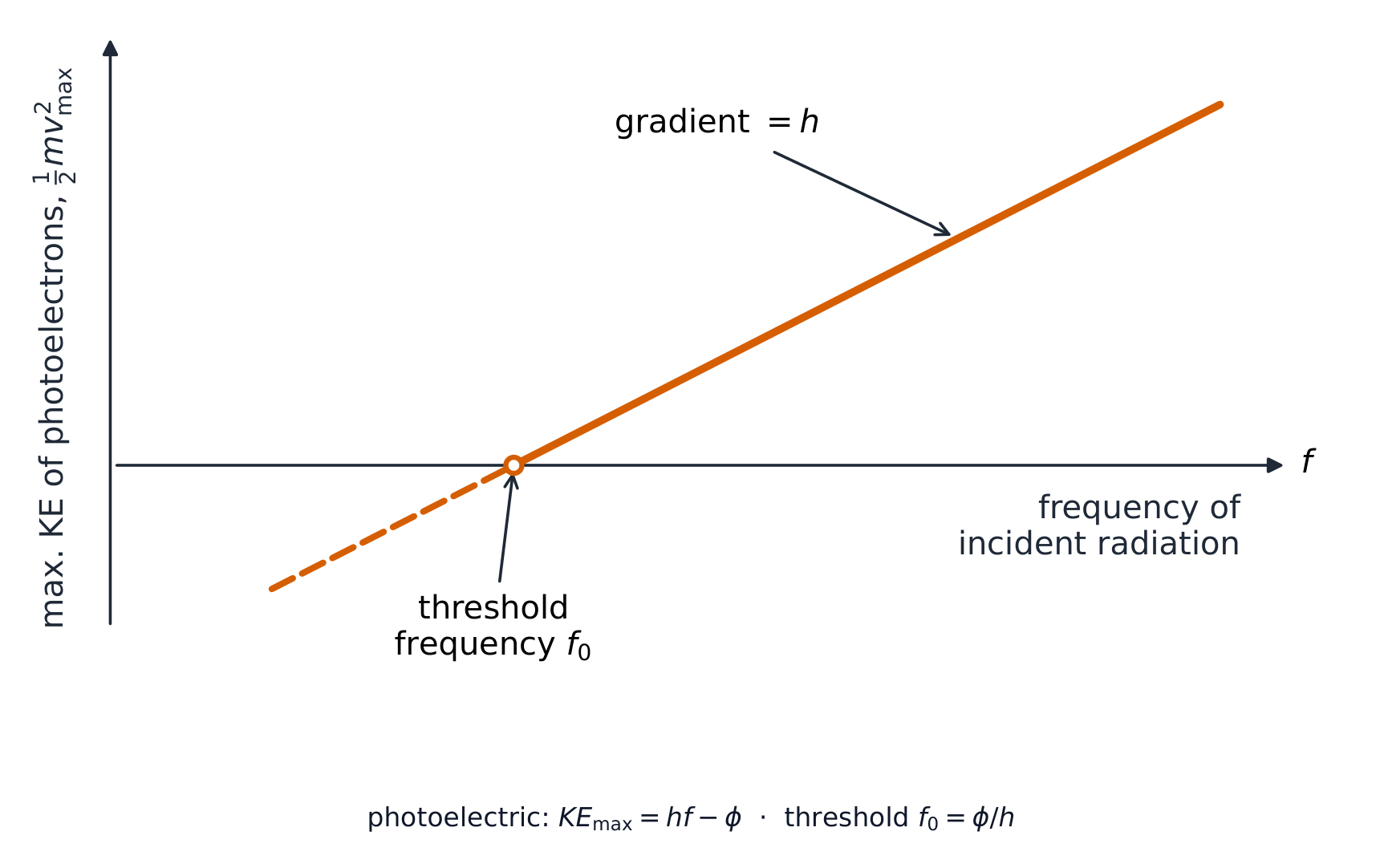
So the maximum KE of photoelectrons depends linearly on frequency, not on brightness.
Reading the graph. Write the equation as $E_{\text{K,max}} = hf - \Phi$: a straight line of gradient $h$, intercept $-\Phi$ on the energy axis and $f_{0} = \Phi/h$ on the frequency axis. So a graph for two metals shows two parallel lines (same gradient $h$ for every metal), the metal with the larger work function cutting the frequency axis further to the right; the intensity of the light moves neither line. This is how the Planck constant is measured, and "sketch the line for metal Y" is marked on exactly those two features.
Measuring the maximum kinetic energy. In a photocell the photoelectrons cross a vacuum to a collector and the current is a count of electrons per second. Make the collector negative and the electrons must climb a potential hill; raise the reverse p.d. until the current just reaches zero, the stopping potential 遏止电势$V_{\text{s}}$, and then $eV_{\text{s}} = E_{\text{K,max}}$. Two results, both examined: at fixed frequency, doubling the intensity doubles the current at low reverse p.d. but leaves $V_{\text{s}}$ unchanged; raising the frequency raises $V_{\text{s}}$ but, at fixed intensity, does not raise the current.
Why the wave model fails
A wave model predicts that brightness should set the electrons' kinetic energy, and that emission should happen at any frequency given enough time. But experiments show:
no emission below the threshold frequency, however bright.
immediate emission at or above the threshold, even when dim.
maximum KE depends on frequency, not brightness.
the number of photoelectrons (the current) depends on brightness.
The photon model explains this: light arrives as photons each of energy $hf$. One photon–electron interaction either has enough energy to free the electron ($hf \geq \Phi$) or it does not.
Why max KE is fixed but current grows with brightness
A brighter beam of the same frequency has more photons per second, but each still carries $hf$. So the maximum KE of any electron is $hf - \Phi$ (set by $f$ only), while the rate of emission (the current) grows with the number of photons, i.e. with brightness. Doubling the brightness doubles the current but does not change the maximum KE.
Writing the explanation (a standard three-marker). (1) Each photon interacts with, and gives all its energy to, one electron. (2) The photon energy $hf$ depends only on the frequency, so the maximum energy an electron can leave with, $hf - \Phi$, is fixed by the frequency. (3) Increasing the intensity at the same frequency increases the number of photons per second, so more electrons are emitted per second (a larger current), but each still receives the same energy. A wave, by contrast, would spread its energy over the surface, so a brighter wave should have given faster electrons and a dim one should have needed a delay to accumulate energy; neither happens.
Español
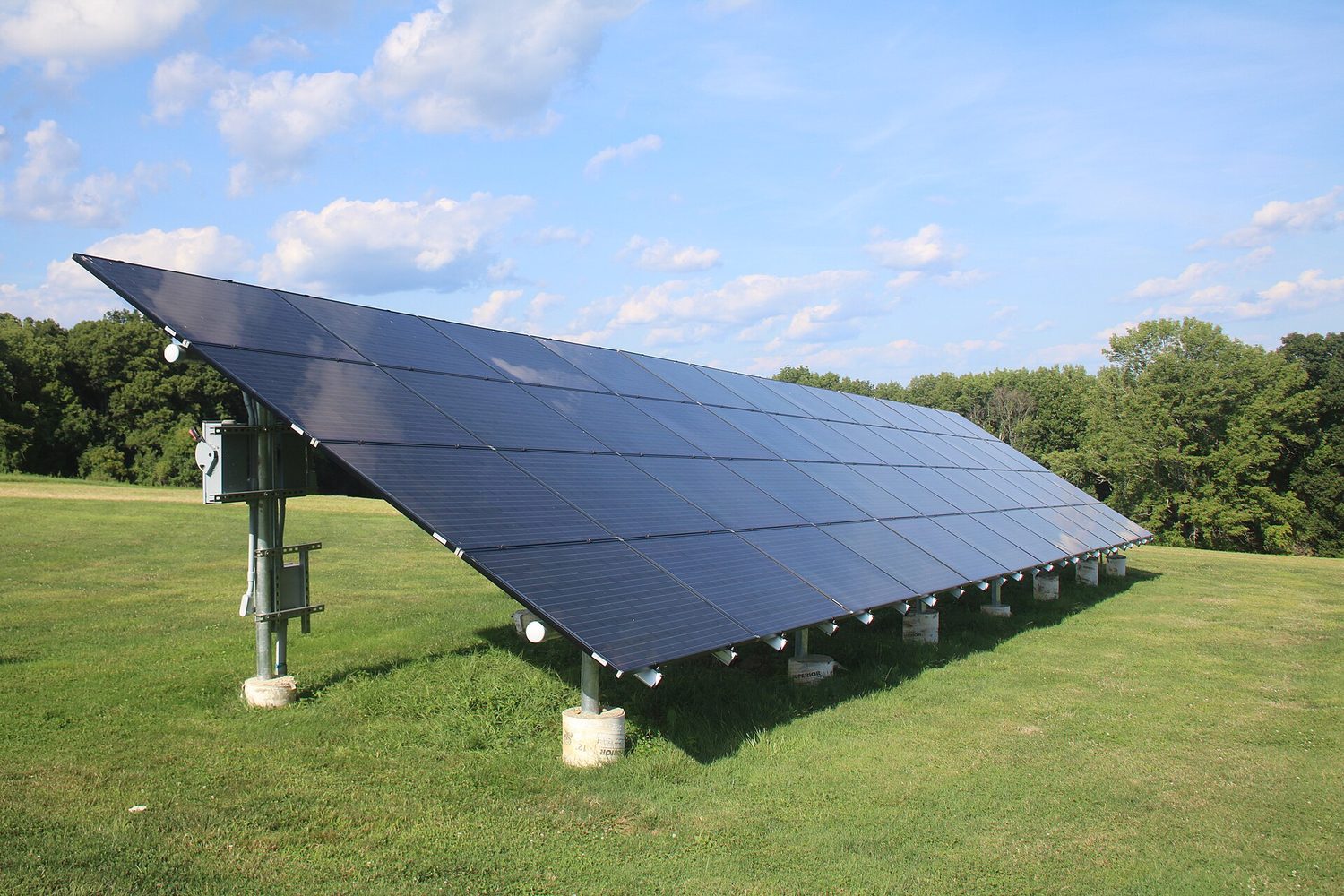
El efecto fotoeléctrico, fotón a fotónLas celdas solares utilizan el efecto fotoeléctrico para convertir la luz en electricidad.
Cuando la radiación electromagnética de frecuencia lo suficientemente alta incide sobre un metal, se emiten electrones. Estos son fotoelectrones 光电子, y el efecto es el efecto fotoeléctrico 光电效应.
"Explique qué se entiende por efecto fotoeléctrico."La emisión de electrones desde (la superficie de) un metal cuando incide sobre él radiación electromagnética de frecuencia lo suficientemente alta. Dos puntos: emisión de electrones y desde una superficie metálica iluminada por radiación electromagnética (o "cuando se ilumina con luz"). Es la evidencia del programa escolar sobre la naturaleza corpuscular de la radiación, porque una onda no podría explicar lo siguiente.
Un fotón transfiere su energía $hf$ a un solo electrón: parte lo libera (el trabajo de extracción $\Phi$), el resto es la energía cinética del electrónUna placa de zinc cargada pierde su carga —la lámina de oro cae— cuando incide luz ultravioleta sobre ella
Frecuencia umbral y trabajo de extracción
Cada metal tiene una frecuencia mínima de fotón, la frecuencia umbral 极限频率$f_{0}$, por debajo de la cual no salen electrones, sin importar cuán brillante sea la luz. El trabajo de extracción 逸出功$\Phi$ es la energía mínima necesaria para liberar un electrón de la superficie:
$$\Phi = h f_{0}.$$
Different metals have different work functions (about $2$–$5\ \text{eV}$).
Las definiciones de dos marcas.La energía del trabajo de salida de un metal es la energía mínima necesaria para extraer un electrón desde la superficie del metal. Tanto "mínima" como "desde la superficie" otorgan puntos: un electrón más profundo en el metal necesita más energía, por eso la ecuación da una energía cinética máxima. La frecuencia umbral es la frecuencia mínima de radiación para la cual se emiten fotoelectrones, y la longitud de onda umbral 极限波长$\lambda_{0} = c/f_{0} = hc/\Phi$ es la longitud de onda máxima correspondiente: longitudes de onda más largas no producen efecto.
Ejercicio resuelto. La luz de longitud de onda $400\ \text{nm}$ incide sobre cuatro metales cuyos trabajos de salida son: cesio $2.1\ \text{eV}$, sodio $2.3\ \text{eV}$, zinc $4.3\ \text{eV}$, platino $5.6\ \text{eV}$. ¿Cuáles emiten fotoelectrones y con qué energía cinética máxima?
La energía del fotón es $hc/\lambda = 1240/400 = 3.1\ \text{eV}$. La emisión requiere $hf \geq \Phi$, por lo tanto cesio ($3.1 - 2.1 = 1.0\ \text{eV}$) y sodio ($0.8\ \text{eV}$) emiten; el zinc y el platino no, sin importar la intensidad de la luz. Para que el zinc emita, la longitud de onda debe ser inferior a $\lambda_{0} = 1240/4.3 = 290\ \text{nm}$, en el ultravioleta, por eso la demostración con electroscope necesita una lámpara UV sobre el zinc.
Ejercicio resuelto. Una lámina pulida de magnesio en el vacío emite electrones solo cuando la frecuencia ultravioleta es al menos $8.8 \times 10^{14}\ \text{Hz}$. Es iluminada a $1.2 \times 10^{15}\ \text{Hz}$. Encuentre el trabajo de salida y la velocidad máxima de los fotoelectrones.
$\Phi = hf_{0} = (6.63 \times 10^{-34})(8.8 \times 10^{14}) = 5.8 \times 10^{-19}\ \text{J}$ ($3.6\ \text{eV}$). Entonces $\tfrac{1}{2}mv_{\text{max}}^{2} = h(f - f_{0}) = (6.63 \times 10^{-34})(1.2 \times 10^{15} - 8.8 \times 10^{14}) = 2.1 \times 10^{-19}\ \text{J}$, así que $v_{\text{max}} = \sqrt{2 \times 2.1 \times 10^{-19}/9.11 \times 10^{-31}} = 6.8 \times 10^{5}\ \text{m s}^{-1}$. Reste las frecuencias antes de multiplicar por $h$; redondear $hf$ y $\Phi$ por separado pierde una cifra significativa en la pequeña diferencia.
Ecuación fotoeléctrica de Einstein
Un fotón cede toda su energía a un electrón. Si la energía del fotón $hf$ es mayor que el trabajo de salida, el electrón escapa con energía cinética hasta un máximo:
$$h f = \Phi + \tfrac{1}{2} m v_{\text{max}}^{2}, \qquad\text{so}\qquad \tfrac{1}{2} m v_{\text{max}}^{2} = h(f - f_{0}).$$
Ejercicio resuelto. Un metal tiene un trabajo de salida de $2.0\ \text{eV}$. La luz compuesta por fotones de energía $3.5\ \text{eV}$ incide sobre él. Encuentre la energía cinética máxima de los fotoelectrones.
Por lo tanto, la CE máxima de los fotoelectrones depende linealmente de la frecuencia, no del brillo.
La energía cinética máxima de los fotoelectrones aumenta linealmente con la frecuencia, alcanzando cero en la frecuencia umbral $f_0$Dos metales en una misma gráfica: líneas paralelas (la pendiente es la constante de Planck para ambos), cada una cortando el eje de frecuencias en su propia umbral y el eje de energía en menos su propio trabajo de salida
Lectura de la gráfica. Reescriba la ecuación como $E_{\text{K,max}} = hf - \Phi$: una línea recta de pendiente $h$, intercepción $-\Phi$ en el eje de energía y $f_{0} = \Phi/h$ en el eje de frecuencias. Así, una gráfica para dos metales muestra dos líneas paralelas (misma pendiente $h$ para todo metal), el metal con mayor trabajo de salida corta el eje de frecuencias más a la derecha; la intensidad de la luz no mueve ninguna de las líneas. Esta es la forma de medir la constante de Planck, y "dibuje la línea para el metal Y" se evalúa basándose exactamente en esas dos características.
Investigando el efecto: la corriente mide la tasa de emisión, y el potencial diferencial inverso que detiene justo a los electrones más rápidos mide su energía cinética máxima
Medición de la energía cinética máxima. En una celda fotoeléctrica, los fotoelectrones cruzan el vacío hacia un colector y la corriente es un recuento de electrones por segundo. Se hace que el colector sea negativo y los electrones deben ascender una colina potencial; se aumenta el p.d. inverso hasta que la corriente llega a cero, el potencial de frenado 遏止电势$V_{\text{s}}$, y entonces $eV_{\text{s}} = E_{\text{K,max}}$. Dos resultados, ambos examinados: a frecuencia fija, duplicar la intensidad duplica la corriente a bajo p.d. inverso pero deja $V_{\text{s}}$ sin cambios; aumentar la frecuencia eleva $V_{\text{s}}$ pero, a intensidad fija, no aumenta la corriente.
Por qué falla el modelo de onda
Un modelo de onda predice que el brillo debería determinar la energía cinética de los electrones y que la emisión debería ocurrir a cualquier frecuencia dado suficiente tiempo. Pero los experimentos muestran:
ninguna emisión por debajo de la frecuencia umbral, sin importar cuán brillante sea.
emisión inmediata a o por encima del umbral, incluso cuando es tenue.
la KE máxima depende de la frecuencia, no del brillo.
el número de fotoelectrones (la corriente) depende del brillo.
El modelo fotónico lo explica: la luz llega en fotones, cada uno con energía $hf$. Una interacción fotón-electrón tiene suficiente energía para liberar al electrón ($hf \geq \Phi$) o no la tiene.
Por qué la KE máxima es fija pero la corriente crece con el brillo
Un haz más brillante de la misma frecuencia tiene más fotones por segundo, pero cada uno sigue transportando $hf$. Así que la KE máxima de cualquier electrón es $hf - \Phi$ (determinada solo por $f$), mientras que la tasa de emisión (la corriente) crece con el número de fotones, es decir, con el brillo. Duplicar el brillo duplica la corriente pero no cambia la KE máxima.
Redactar la explicación (un estándar de tres marcadores). (1) Cada fotón interactúa con, y transfiere toda su energía a, un electrón. (2) La energía del fotón $hf$ depende únicamente de la frecuencia, así que la energía máxima que puede llevarse un electrón, $hf - \Phi$, está fijada por la frecuencia. (3) Aumentar la intensidad a la misma frecuencia aumenta el número de fotones por segundo, por lo que se emiten más electrones por segundo (una mayor corriente), pero cada uno recibe la misma energía. Una onda, en cambio, dispersaría su energía sobre la superficie, así que una onda más brillante debería haber dado electrones más rápidos y una tenue debería haber necesitado un retraso para acumular energía; nada de esto ocurre.
Explore · Explorar
Efecto fotoeléctrico
EEmax = h·f − φ
La KE máxima es una línea recta en función de la frecuencia, con intercepto −φ (la función de trabajo).
understand that the photoelectric effect provides evidence for a particulate nature of electromagnetic radiation while phenomena such as interference and diffraction provide evidence for a wave nature
describe and interpret qualitatively the evidence provided by electron diffraction for the wave nature of particles
understand the de Broglie wavelength as the wavelength associated with a moving particle
recall and use $\lambda = h/p$
Español
entender que el efecto fotoeléctrico proporciona evidencia de la naturaleza corpuscular de la radiación electromagnética, mientras que fenómenos como la interferencia y la difracción proporcionan evidencia de su naturaleza ondulatoria.
describir e interpretar cualitativamente la evidencia proporcionada por la difracción de electrones sobre la naturaleza ondulatoria de las partículas.
comprender la longitud de onda de de Broglie como la longitud de onda asociada a una partícula en movimiento.
recordar y utilizar $\lambda = h/p$.
Source: Cambridge International syllabus · Fuente: Plan de estudios Cambridge International
English
The photoelectric effect is strong evidence for the particle nature of light. But interference 干涉 (Young's double slit, the diffraction grating 衍射光栅) and diffraction 衍射 show its wave nature. So light has both wave and particle sides — this is wave–particle duality 波粒二象性.
"Describe what is meant by wave–particle duality" (two marks).Electromagnetic radiation (and matter) can exhibit both wave properties, such as interference and diffraction, and particle properties, such as the photoelectric effect (or, for matter, discrete collisions). Asked for one piece of evidence for each nature of radiation, give: particulate, the photoelectric effect (the threshold frequency and the immediate emission); wave, diffraction or interference (Young's slits, a diffraction grating). For matter, the wave evidence is electron diffraction.
De Broglie hypothesis
If a wave can act like particles, perhaps particles can act like waves. De Broglie proposed that any moving particle has a de Broglie wavelength 德布罗意波长:
$$\lambda = \frac{h}{p},$$
where $p = mv$. Example: an electron at $v = 4.9 \times 10^{7}\ \text{m s}^{-1}$ has $p = 4.46 \times 10^{-23}\ \text{kg m s}^{-1}$, so $\lambda = 1.49 \times 10^{-11}\ \text{m} \approx 0.015\ \text{nm}$ — close to atomic spacings.
"State what is meant by the de Broglie wavelength."The wavelength associated with a moving particle, or the wavelength of the wave associated with a particle of momentum $p$, given by $\lambda = h/p$ where $h$ is the Planck constant. In "state the formula and the meaning of any other symbol", name $h$ as the Planck constant and $p$ as the momentum of the particle. The wavelength is small because $h$ is small: a $0.10\ \text{kg}$ ball at $10\ \text{m s}^{-1}$ has $\lambda = 6.6 \times 10^{-34}\ \text{m}$, far below any slit or lattice spacing, which is why everyday objects show no diffraction.
Electron diffraction
When electrons are fired at a crystal lattice 晶格 (e.g. thin graphite), they make a diffraction pattern of bright rings on a screen — exactly what waves of wavelength $\lambda = h/p$ would do. This is direct evidence for the wave nature of particles (electron diffraction 电子衍射): only waves diffract, yet electrons do.
A faster electron has more momentum, so a shorter de Broglie wavelength, which diffracts less — the rings move closer together. Slowing the electrons spreads the rings apart. To calculate: $p = \sqrt{2 m E_{\text{K}}}$, and for an electron accelerated through p.d. $V$, $E_{\text{K}} = eV$, so $\lambda = h/\sqrt{2m_{e} e V}$.
Worked example. An electron is accelerated from rest through a p.d. of $2500\ \text{V}$. Find its de Broglie wavelength. ($m_{e} = 9.11 \times 10^{-31}\ \text{kg}$, $e = 1.6 \times 10^{-19}\ \text{C}$, $h = 6.63 \times 10^{-34}\ \text{J s}$.)
Its kinetic energy is $E_{\text{K}} = eV$, so $\lambda = \dfrac{h}{\sqrt{2 m_{e} e V}}$:
This is close to the spacing between atoms in a crystal, which is why the electrons diffract off the graphite.
Deriving $\lambda$ for an accelerated electron. An electron of mass $m$ and charge $q$ accelerated from rest through a p.d. $V$ gains kinetic energy $qV = \tfrac{1}{2}mv^{2}$, so $v = \sqrt{2qV/m}$ and $p = mv = \sqrt{2mqV}$; hence $\lambda = h/\sqrt{2mqV}$. Two consequences the exam asks for: increasing$V$ increases the momentum and shortens the wavelength, so the diffraction rings shrink towards the centre; halving the wavelength needs four times the p.d.
Describing electron diffraction (four marks). (1) Electrons from a heated filament are accelerated through a high p.d. into a beam. (2) The beam meets a thin polycrystalline 多晶的 graphite film; the regular spacing of the carbon atoms, about $10^{-10}\ \text{m}$, acts as a diffraction grating. (3) On a fluorescent screen the electrons produce a bright central spot surrounded by concentric rings. (4) Rings are a diffraction pattern, and diffraction is a wave property, so the electrons are behaving as waves; the ring radii match a wavelength $h/p$, which confirms de Broglie's relation. Sketch the pattern as rings, not spots or a fringe pattern. A faster beam gives rings of smaller radius.
Español
El efecto fotoeléctrico es una fuerte evidencia de la naturaleza partícula de la luz. Pero la interferencia 干涉 (doble rendija de Young, la rejilla de difracción 衍射光栅) y la difracción 衍射 muestran su naturaleza onda. Así que la luz tiene ambas caras —onda y partícula—; esto es la dualidad onda-partícula 波粒二象性.
"Describa lo que se entiende por dualidad onda-partícula" (dos marcas).La radiación electromagnética (y la materia) puede exhibir tanto propiedades ondulatorias, como interferencia y difracción, como propiedades corpusculares, como el efecto fotoeléctrico (o, para la materia, colisiones discretas). Si se pide una pieza de evidencia para cada naturaleza de la radiación, dé: partícula, el efecto fotoeléctrico (la frecuencia umbral y la emisión inmediata); onda, difracción o interferencia (rendijas de Young, una rejilla de difracción). Para la materia, la evidencia ondulatoria es la difracción de electrones.
Hipótesis de De Broglie
Si una onda puede actuar como partículas, quizás las partículas puedan actuar como ondas. De Broglie propuso que cualquier partícula en movimiento tiene una longitud de onda de De Broglie 德布罗意波长:
$$\lambda = \frac{h}{p},$$
donde $p = mv$. Ejemplo: un electrón a $v = 4.9 \times 10^{7}\ \text{m s}^{-1}$ tiene $p = 4.46 \times 10^{-23}\ \text{kg m s}^{-1}$, por lo que $\lambda = 1.49 \times 10^{-11}\ \text{m} \approx 0.015\ \text{nm}$ —cercano a las separaciones atómicas.
"Enuncie lo que se entiende por longitud de onda de De Broglie."La longitud de onda asociada a una partícula en movimiento, o la longitud de onda de la onda asociada a una partícula con momento $p$, dada por $\lambda = h/p$ donde $h$ es la constante de Planck. En "enuncie la fórmula y el significado de cualquier otro símbolo", nome $h$ como la constante de Planck y $p$ como el momento de la partícula. La longitud de onda es pequeña porque $h$ es pequeña: una pelota $0.10\ \text{kg}$ a $10\ \text{m s}^{-1}$ tiene $\lambda = 6.6 \times 10^{-34}\ \text{m}$, muy por debajo de cualquier rendija o espaciado de red, lo cual explica por qué los objetos cotidianos no muestran difracción.
Difracción de electrones
Cuando los electrones se disparan contra una red cristalina 晶格 (p. ej., grafito fino), forman un patrón de difracción de anillos brillantes en una pantalla —exactamente lo que harían ondas de longitud de onda $\lambda = h/p$. Esta es una evidencia directa de la naturaleza ondulatoria de las partículas (difracción de electrones 电子衍acción): solo las ondas se difractan, pero los electrones sí lo hacen.
Un electrón más rápido tiene más momento, por lo que una longitud de onda de De Broglie más corta, que se difracta menos —los anillos se mueven más juntos. Al desacelerar los electrones, los anillos se separan. Para calcular: $p = \sqrt{2 m E_{\text{K}}}$, y para un electrón acelerado a través de un p.d. $V$, $E_{\text{K}} = eV$, por lo que $\lambda = h/\sqrt{2m_{e} e V}$.
Los electrones disparados contra el grafito forman un patrón de difracción en anillos —solo las ondas se difractan, así que los electrones se comportan como ondas
Ejercicio resuelto. Un electrón es acelerado desde el reposo a través de un p.d. de $2500\ \text{V}$. Calcule su longitud de onda de De Broglie. ($m_{e} = 9.11 \times 10^{-31}\ \text{kg}$, $e = 1.6 \times 10^{-19}\ \text{C}$, $h = 6.63 \times 10^{-34}\ \text{J s}$.)
Su energía cinética es $E_{\text{K}} = eV$, por lo que $\lambda = \dfrac{h}{\sqrt{2 m_{e} e V}}$:
Esto es cercano al espaciado entre átomos en un cristal, lo cual explica por qué los electrones se difractan en el grafito.
Derivación de $\lambda$ para un electrón acelerado. Un electrón de masa $m$ y carga $q$, acelerado desde el reposo a través de una p.d. $V$, gana energía cinética $qV = \tfrac{1}{2}mv^{2}$, por lo que $v = \sqrt{2qV/m}$ y $p = mv = \sqrt{2mqV}$; en consecuencia $\lambda = h/\sqrt{2mqV}$. Dos consecuencias que pide el examen: aumentar$V$ incrementa el momento y acorta la longitud de onda, haciendo que los anillos de difracción se encogerán hacia el centro; reducir la mitad la longitud de onda requiere cuatro veces la p.d.
Descripción de la difracción de electrones (cuatro puntos). (1) Los electrones procedentes de un filamento caliente son acelerados mediante una alta p.d. formando un haz. (2) El haz choca contra una película delgada de grafito policristalino 多晶的; el espaciado regular de los átomos de carbono, aproximadamente $10^{-10}\ \text{m}$, actúa como una red de difracción. (3) En una pantalla fluorescente, los electrones producen un punto brillante central rodeado de anillos concéntricos. (4) Los anillos constituyen un patrón de difracción, y la difracción es una propiedad ondulatoria, por lo que los electrones se comportan como ondas; los radios de los anillos corresponden a una longitud de onda $h/p$, lo que confirma la relación de de Broglie. Dibuje el patrón como anillos, no como puntos o un patrón de franjas. Un haz más rápido produce anillos de radio más pequeño.
Explore · Explorar
La longitud de onda de De Broglie
λ = h/p
La longitud de onda de una partícula es inversamente proporcional a su momento: partículas más rápidas y pesadas tienen ondas más cortas.
Energy levels in atoms · Niveles de energía en átomos
Syllabus
English
understand that there are discrete electron energy levels in isolated atoms (e.g. atomic hydrogen)
understand the appearance and formation of emission and absorption line spectra
recall and use $hf = E_1 - E_2$
Español
entender que existen niveles de energía electrónicos discretos en átomos aislados (p. ej., hidrógeno atómico)
comprender la apariencia y formación de los espectros de líneas de emisión y absorción
recordar y utilizar $hf = E_1 - E_2$
Source: Cambridge International syllabus · Fuente: Plan de estudios Cambridge International
English
In an isolated atom, electrons can only sit at certain discrete 分立energy levels 能级 — never in between. The lowest is the ground state 基态; the others are excited states 激发态.
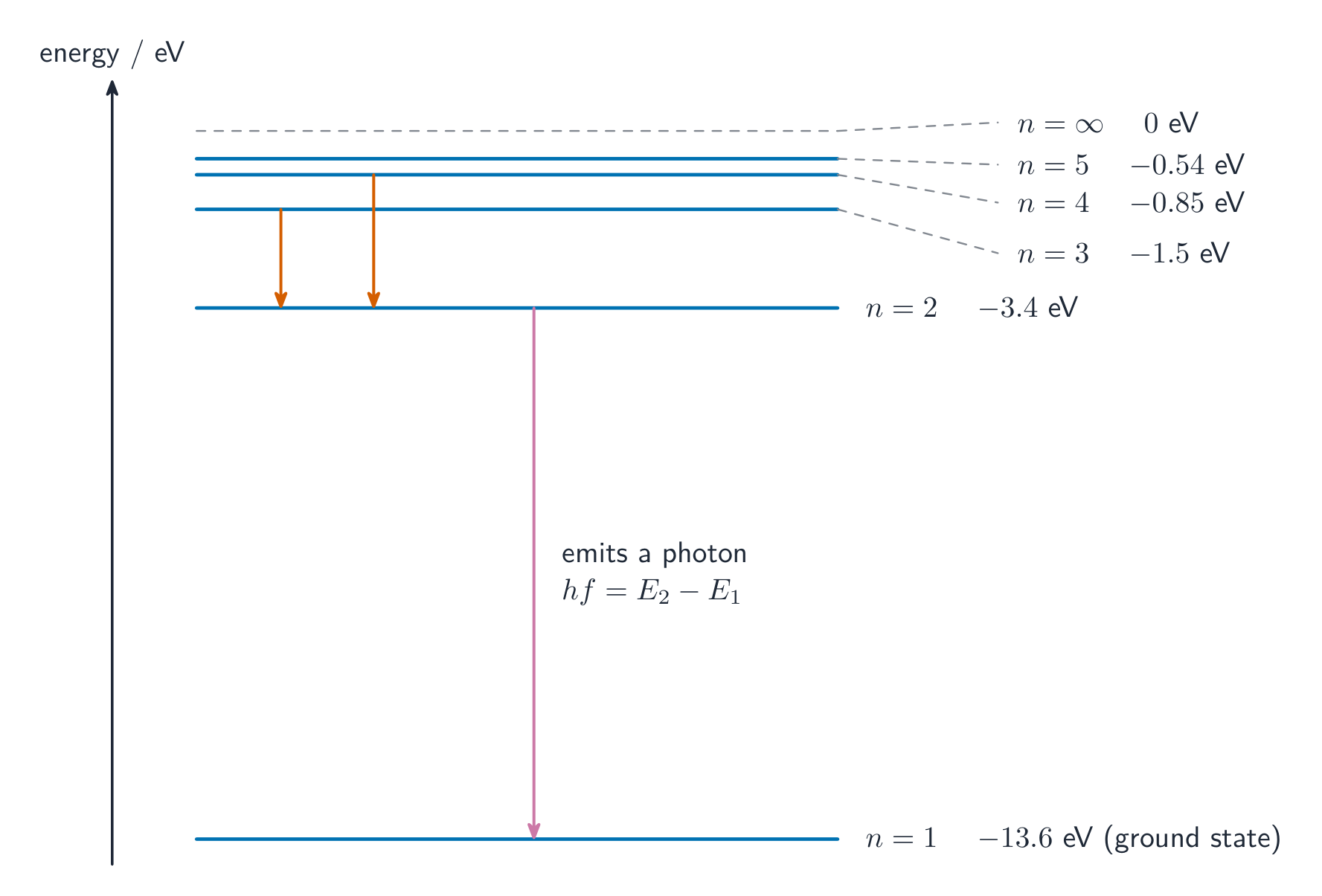
By convention, energies are written negative, with $E = 0$ for an electron just free of the atom. For hydrogen the ground state is $E_{1} = -13.6\ \text{eV}$; higher states approach zero.
Emission spectrum
When an electron drops from a higher level $E_{2}$ to a lower level $E_{1}$, it emits one photon of energy
$$h f = E_{2} - E_{1}.$$
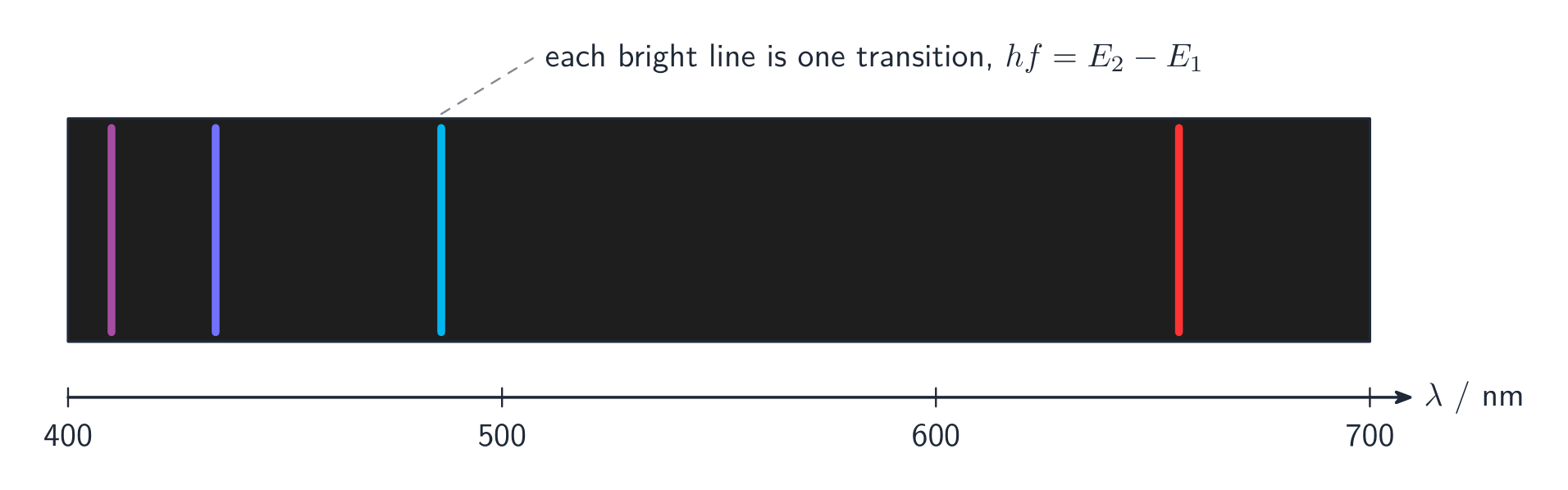
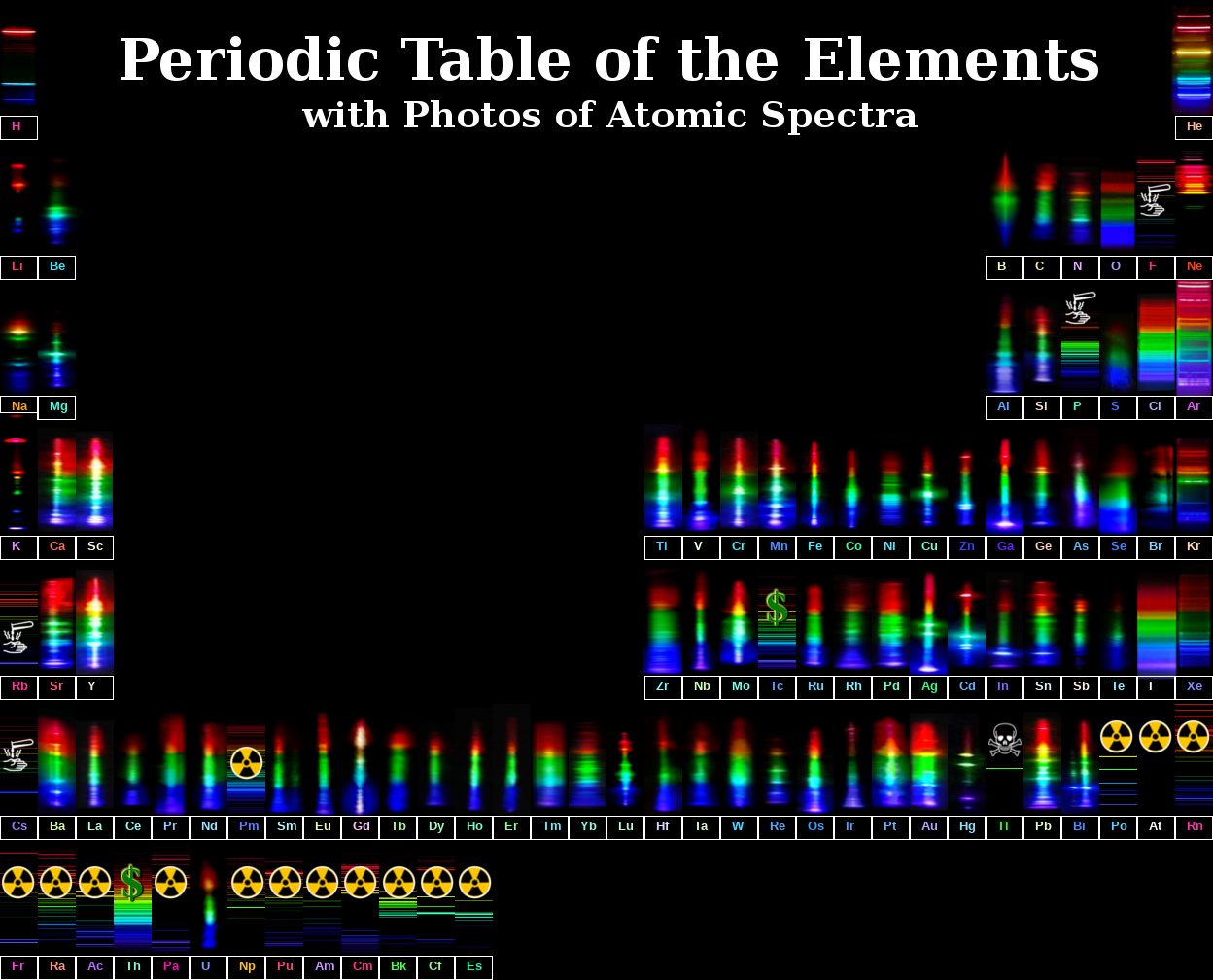
(Both energies are negative; their difference is positive.) Because the levels are discrete, only certain photon energies — and so certain wavelengths — come out. The emission spectrum 发射光谱 is a set of sharp bright lines on a dark background, one line per transition 跃迁. The pattern is a "fingerprint" of the element.
Explaining a line spectrum (the standard four-marker). (1) The electrons in an isolated atom can only occupy discrete energy levels. (2) An electron in an excited state falls to a lower level and the energy it loses is emitted as one photon. (3) The photon energy equals the difference between the two levels, $hf = E_{2} - E_{1}$, so only certain frequencies (wavelengths) are emitted. (4) Each possible transition gives one line; the same set of levels gives the same lines every time, which is why a spectrum identifies the element. Asked to match lines to transitions: the largest energy gap gives the line of highest frequency and shortest wavelength.
Absorption spectrum
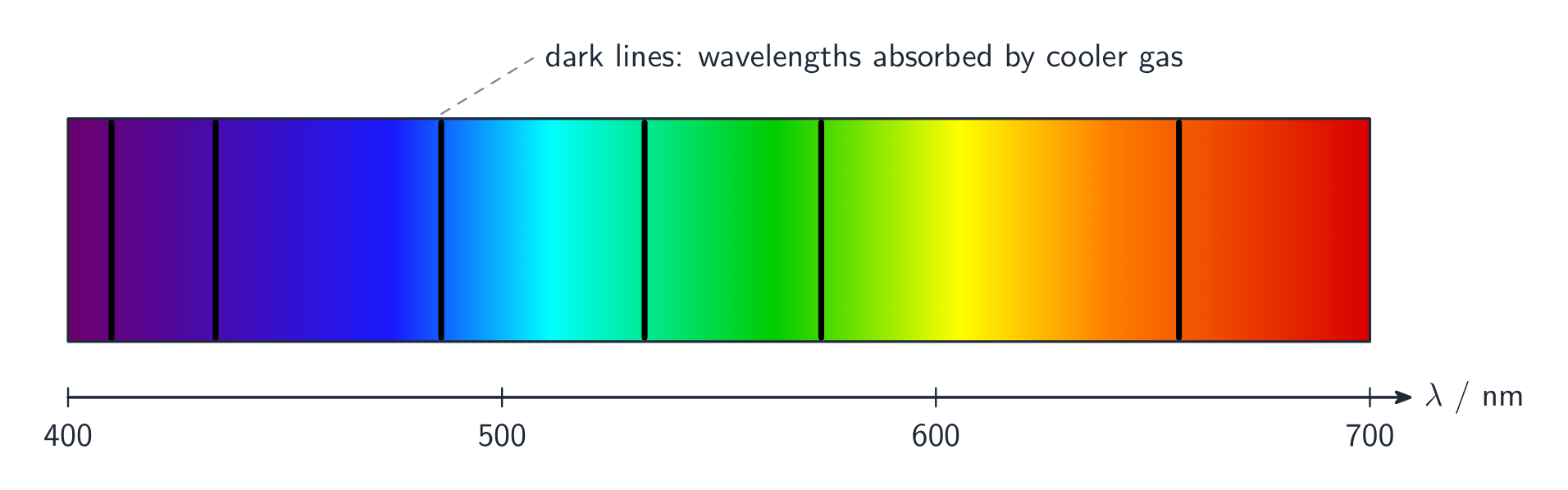
When white light passes through a cool gas, photons whose energy exactly matches an upward transition are absorbed. The light then shows dark lines on a bright background — the absorption spectrum 吸收光谱. The dark lines sit at the same wavelengths as the emission lines of the same gas.
Explaining the dark lines. Photons whose energy equals the difference between two levels are absorbed, raising an electron to the higher level; the excited electron soon falls back and re-emits a photon of the same energy, but in a random direction, so almost none of that light continues along the original path. The rest of the white light, whose photons match no gap, passes through unchanged. Hence dark lines at exactly the wavelengths the same gas would emit: the Sun's spectrum shows the absorption lines of the cooler gases in its outer layers.
Work in consistent units — convert eV to joules (× $1.60 \times 10^{-19}$) before finding $\lambda$ in metres, or use $hc \approx 1240\ \text{eV nm}$ for a quick estimate.
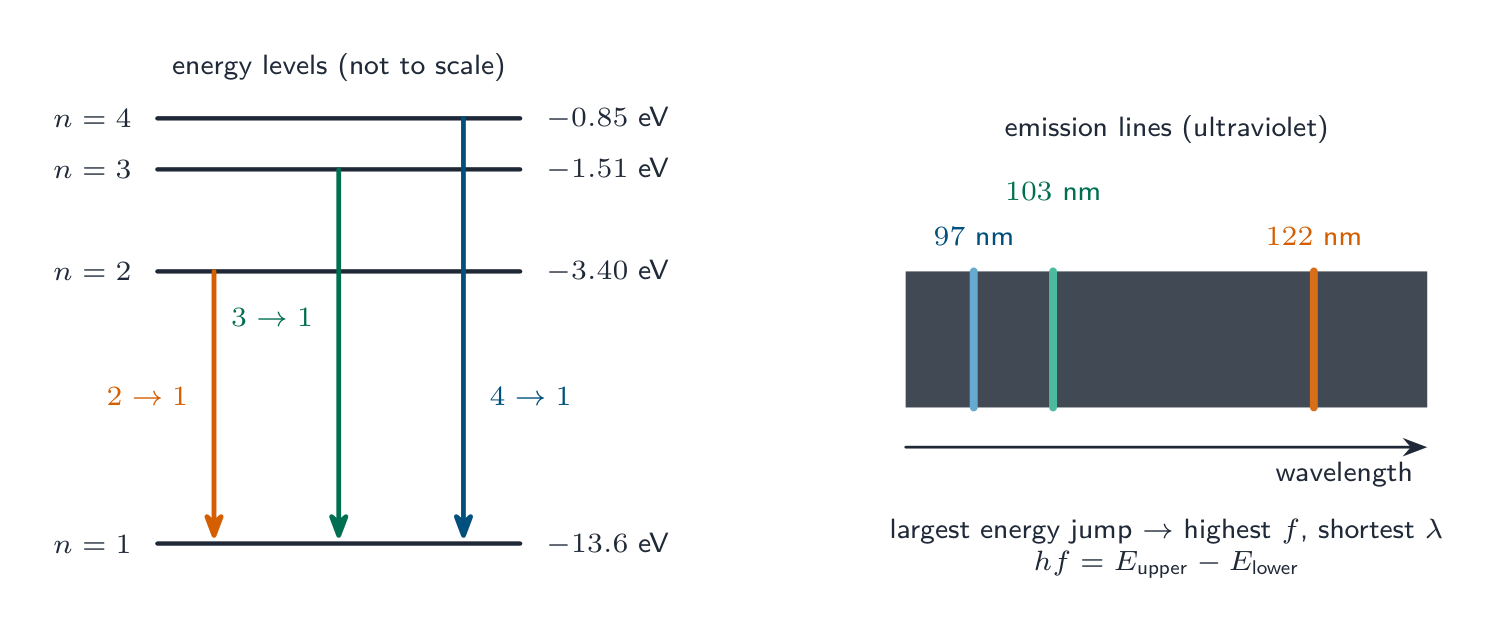
Worked example. The lowest four energy levels of hydrogen are $-13.6$, $-3.40$, $-1.51$ and $-0.85\ \text{eV}$. Find the wavelengths of the three lines produced by transitions to the ground state, and the number of lines these four levels can produce altogether.
Transition $2 \to 1$: $\Delta E = 13.6 - 3.40 = 10.2\ \text{eV}$, so $\lambda = 1240/10.2 = 122\ \text{nm}$. $3 \to 1$: $12.09\ \text{eV}$, $\lambda = 103\ \text{nm}$. $4 \to 1$: $12.75\ \text{eV}$, $\lambda = 97.3\ \text{nm}$: all ultraviolet, the largest jump giving the shortest wavelength. Four levels allow $4 \to 3$, $4 \to 2$, $4 \to 1$, $3 \to 2$, $3 \to 1$ and $2 \to 1$: six lines. The visible red line of hydrogen is $3 \to 2$: $1.89\ \text{eV}$, $656\ \text{nm}$. (Working in joules: $10.2\ \text{eV} = 1.63 \times 10^{-18}\ \text{J}$, $\lambda = hc/E = 1.99 \times 10^{-25}/1.63 \times 10^{-18} = 1.22 \times 10^{-7}\ \text{m}$.)
Worked example. A laser emits red light of wavelength $650\ \text{nm}$ when electrons drop from one level to another. Find the energy gap between the two levels.
$\Delta E = hc/\lambda = 1240/650 = 1.91\ \text{eV} = 3.1 \times 10^{-19}\ \text{J}$. The gap, not either level, fixes the colour: two atoms with different levels but the same gap emit the same line.
Worked example (annihilation). An electron and a positron, each moving slowly, meet and annihilate 湮灭, producing two identical photons. Find the wavelength of each photon. ($m_{\text{e}} = 9.11 \times 10^{-31}\ \text{kg}$.)
The rest energy of each particle is $E = mc^{2} = (9.11 \times 10^{-31})(3.00 \times 10^{8})^{2} = 8.2 \times 10^{-14}\ \text{J}$ ($0.51\ \text{MeV}$), and momentum conservation shares the energy between two photons moving in opposite directions, so each carries $8.2 \times 10^{-14}\ \text{J}$: $\lambda = hc/E = 1.99 \times 10^{-25}/8.2 \times 10^{-14} = 2.4 \times 10^{-12}\ \text{m}$, a gamma ray. (Any kinetic energy the pair had is added to the photon energies.)
Español
En un átomo aislado, los electrones solo pueden situarse en ciertos niveles de energía discretos 分立 —nunca entre ellos—. El más bajo es el estado fundamental 基态; los demás son estados excitados 激发态.
Por convención, las energías se escriben negativas, con $E = 0$ para un electrón libre del átomo. Para el hidrógeno, el estado fundamental es $E_{1} = -13.6\ \text{eV}$; los estados superiores se aproximan a cero.
Los niveles de energía del electrón del hidrógeno son discretos y negativos, con el estado fundamental en $-13.6\ \text{eV}$
Espectro de emisión
Cuando un electrón desciende de un nivel superior $E_{2}$ a un nivel inferior $E_{1}$, emite un fotón de energía
$$h f = E_{2} - E_{1}.$$
(Ambas energías son negativas; su diferencia es positiva.) Dado que los niveles son discretos, solo ciertas energías de fotones —y por tanto ciertas longitudes de onda— se emiten. El espectro de emisión 发射光谱 es un conjunto de líneas brillantes nítidas sobre un fondo oscuro, una línea por cada transición 跃迁. El patrón es una "huella digital" del elemento.
Explicación de un espectro de líneas (el marcador estándar de cuatro puntos). (1) Los electrones en un átomo aislado solo pueden ocupar niveles de energía discretos. (2) Un electrón en un estado excitado cae a un nivel inferior y la energía que pierde se emite como un fotón. (3) La energía del fotón es igual a la diferencia entre los dos niveles, $hf = E_{2} - E_{1}$, por lo que solo se emiten ciertas frecuencias (longitudes de onda). (4) Cada transición posible produce una línea; el mismo conjunto de niveles genera siempre las mismas líneas, razón por la cual un espectro identifica al elemento. Si se le pide relacionar líneas con transiciones: la mayor brecha energética da lugar a la línea de mayor frecuencia y menor longitud de onda.
El espectro de emisión del hidrógeno es un conjunto de líneas brillantes nítidas sobre un fondo oscuroEspectros de emisión reales de los elementos: cada uno es un conjunto único de líneas brillantes —una huella digital de ese elemento
Espectro de absorción
Cuando la luz blanca atraviesa un gas frío, los fotones cuya energía coincide exactamente con una transición ascendente son absorbidos. La luz resultante muestra líneas oscuras sobre un fondo brillante —el espectro de absorción 吸收光谱—. Las líneas oscuras se sitúan en las mismas longitudes de onda que las líneas de emisión del mismo gas.
Explicación de las líneas oscuras. Los fotones cuya energía es igual a la diferencia entre dos niveles son absorbidos, elevando un electrón al nivel superior; el electrón excitado pronto vuelve a caer y reemite un fotón de la misma energía, pero en dirección aleatoria, por lo que casi ninguna de esa luz continúa por el camino original. El resto de la luz blanca, cuyos fotones no coinciden con ninguna brecha, pasa sin cambios. De ahí las líneas oscuras exactamente en las longitudes de onda que el mismo gas emitiría: el espectro solar muestra las líneas de absorción de los gases más fríos en sus capas externas.
Líneas oscuras de absorción en el espectro del Sol marcan las longitudes de onda absorbidas por el gas más frío
Trabaje con unidades consistentes: convierta eV a julios (× $1.60 \times 10^{-19}$) antes de hallar $\lambda$ en metros, o utilice $hc \approx 1240\ \text{eV nm}$ para una estimación rápida.
De niveles a líneas: cada transición descendente hacia el estado fundamental produce una línea, y el salto más grande cae más hacia el extremo de menor longitud de onda
Ejemplo resuelto. Los cuatro niveles de energía más bajos del hidrógeno son $-13.6$, $-3.40$, $-1.51$ y $-0.85\ \text{eV}$. Encuentre las longitudes de onda de las tres líneas producidas por transiciones hacia el estado fundamental, y el número total de líneas que estos cuatro niveles pueden producir.
Transición $2 \to 1$: $\Delta E = 13.6 - 3.40 = 10.2\ \text{eV}$, por lo tanto $\lambda = 1240/10.2 = 122\ \text{nm}$. $3 \to 1$: $12.09\ \text{eV}$, $\lambda = 103\ \text{nm}$. $4 \to 1$: $12.75\ \text{eV}$, $\lambda = 97.3\ \text{nm}$: todos ultravioleta; el salto más grande produce la longitud de onda más corta. Cuatro niveles permiten $4 \to 3$, $4 \to 2$, $4 \to 1$, $3 \to 2$, $3 \to 1$ y $2 \to 1$: seis líneas. La línea roja visible del hidrógeno es $3 \to 2$: $1.89\ \text{eV}$, $656\ \text{nm}$. (Trabajando en julios: $10.2\ \text{eV} = 1.63 \times 10^{-18}\ \text{J}$, $\lambda = hc/E = 1.99 \times 10^{-25}/1.63 \times 10^{-18} = 1.22 \times 10^{-7}\ \text{m}$.)
Ejercicio resuelto. Un láser emite luz roja con una longitud de onda $650\ \text{nm}$ cuando los electrones descienden de un nivel a otro. Calcule la diferencia de energía entre los dos niveles.
$\Delta E = hc/\lambda = 1240/650 = 1.91\ \text{eV} = 3.1 \times 10^{-19}\ \text{J}$. Es la diferencia de energía, no cualquiera de los niveles individuales, la que determina el color: dos átomos con niveles diferentes pero la misma diferencia emitirán la misma línea.
Ejercicio resuelto (aniquilación). Un electrón y un positrón, cada uno moviéndose lentamente, se encuentran y se aniquilan 湮灭, produciendo dos fotones idénticos. Calcule la longitud de onda de cada fotón. ($m_{\text{e}} = 9.11 \times 10^{-31}\ \text{kg}$.)
La energía en reposo de cada partícula es $E = mc^{2} = (9.11 \times 10^{-31})(3.00 \times 10^{8})^{2} = 8.2 \times 10^{-14}\ \text{J}$ ($0.51\ \text{MeV}$), y la conservación del momento reparte la energía entre dos fotones que se mueven en direcciones opuestas, por lo que cada uno transporta $8.2 \times 10^{-14}\ \text{J}$: $\lambda = hc/E = 1.99 \times 10^{-25}/8.2 \times 10^{-14} = 2.4 \times 10^{-12}\ \text{m}$, un rayo gamma. (Cualquier energía cinética que tuviera el par se suma a las energías de los fotones.)
Explore · Explorar
Generar las líneas espectrales de un elemento
Un electrón que desciende entre niveles de energía fijos emite un fotón con exactamente la energía del salto — una longitud de onda y color fijos. Cada salto es una línea en el código de barras del elemento.
Photon: $E = hf = hc/\lambda$, $p = E/c = h/\lambda$. Use $hc = 1240\ \text{eV nm}$ to move between wavelength and energy in eV, then convert to joules only if the answer demands it.
Photoelectric equation $hf = \Phi + \tfrac{1}{2}mv_{\text{max}}^{2}$: maximum energy, one photon to one electron; the graph of $E_{\text{K,max}}$ against $f$ has gradient $h$ and intercepts $f_{0}$ and $-\Phi$.
Intensity changes the number of photons per second (the current); frequency changes the energy of each (the maximum kinetic energy). Keep those two sentences apart and every explanation writes itself.
Evidence: photoelectric effect for particles, diffraction and interference for waves; electron diffraction for the wave nature of matter, with $\lambda = h/p = h/\sqrt{2mqV}$.
Line spectra: discrete levels, one photon per transition, $hf = E_{2} - E_{1}$; the biggest gap gives the shortest wavelength; absorption lines sit where emission lines would, because the absorbed light is re-emitted in all directions.
Radiation pressure: force $=$ photons per second $\times$ momentum change per photon; $2p$ for a mirror, $p$ for an absorber; pressure depends on intensity, not colour.
Common mistakes
Defining a photon as "a particle of light" without "quantum/packet of energy", or the work function without "minimum" and "from the surface".
Saying brighter light gives faster photoelectrons, or that below the threshold frequency emission happens eventually.
Mixing eV and joules in one equation; forgetting to subtract the work function; using $\tfrac{1}{2}mv^{2}$ with the maximum kinetic energy in eV.
Writing the de Broglie wavelength for an accelerated electron as $h/(mv)$ with $v$ guessed, instead of $h/\sqrt{2mqV}$.
Describing electron diffraction as bright fringes or spots; the pattern is concentric rings, and a higher p.d. makes them smaller.
Getting the direction of a transition wrong: emission is a fall to a lower level, absorption a rise; the photon energy is the difference, never the energy of one level.
Claiming the largest energy gap gives the longest wavelength.
Forgetting that a reflected photon changes momentum by $2p$, or that the pressure of blue light of the same intensity is the same as red.
Español
Fotón: $E = hf = hc/\lambda$, $p = E/c = h/\lambda$. Utilice $hc = 1240\ \text{eV nm}$ para moverse entre longitud de onda y energía en eV; convierta a julios solo si la respuesta lo exige.
Ecuación fotoeléctrica $hf = \Phi + \tfrac{1}{2}mv_{\text{max}}^{2}$: energía máxima, un fotón por electrón; la gráfica de $E_{\text{K,max}}$ frente a $f$ tiene pendiente $h$ y interceptos $f_{0}$ y $-\Phi$.
La intensidad cambia el número de fotones por segundo (la corriente); la frecuencia cambia la energía de cada uno (la energía cinética máxima). Mantenga estas dos oraciones separadas y cada explicación se escribirá sola.
Evidencia: efecto fotoeléctrico para partículas, difracción e interferencia para ondas; difracción de electrones para la naturaleza ondulatoria de la materia, con $\lambda = h/p = h/\sqrt{2mqV}$.
Espectros de líneas: niveles discretos, un fotón por transición, $hf = E_{2} - E_{1}$; la brecha más grande da la longitud de onda más corta; las líneas de absorción aparecen donde estarían las de emisión, porque la luz absorbida se reemite en todas direcciones.
Presión de radiación: fuerza $=$ fotones por segundo $\times$ cambio de momento por fotón; $2p$ para un espejo, $p$ para un absorbedor; la presión depende de la intensidad, no del color.
Errores comunes
Definir un fotón como "una partícula de luz" sin "cuanto/paquete de energía", o la función de trabajo sin "mínimo" y "desde la superficie".
Decir que una luz más brillante produce fotoelectrones más rápidos, o que debajo de la frecuencia umbral la emisión ocurre eventualmente.
Mezclar eV y julios en una misma ecuación; olvidar restar la función de trabajo; usar $\tfrac{1}{2}mv^{2}$ con la energía cinética máxima en eV.
Escribir la longitud de onda de de Broglie para un electrón acelerado como $h/(mv)$ con $v$ adivinado, en lugar de $h/\sqrt{2mqV}$.
Describir la difracción de electrones como franjas brillantes o puntos; el patrón son anillos concéntricos, y un mayor potencial diferencial los hace más pequeños.
Obtener incorrectamente la dirección de una transición: la emisión es una caída a un nivel inferior, la absorción un ascenso; la energía del fotón es la diferencia, nunca la energía de un solo nivel.
Afirmar que la mayor brecha de energía da la longitud de onda más larga.
Olvidar que un fotón reflejado cambia su momento en $2p$, o que la presión de la luz azul de la misma intensidad es igual a la roja.
Interactive lessons on this topic · Lecciones interactivas sobre este tema
Work through it step by step, with instant-check exercises. · Trátalo paso a paso, con ejercicios de verificación instantánea.
Pick one and the site follows you — notes, papers, videos and practice all open on it. · Selecciona uno y el sitio te sigue — notas, documentos, videos y práctica se abren en él.
Type to search notes, lessons, code, vocabulary and past-paper questions across every subject. · Escribe para buscar notas, lecciones, código, vocabulario y preguntas de exámenes anteriores en todas las materias.