Observe un gran puente colgante. Su cable masivo no tiene forma aleatoria — cuelga en una parábola perfecta, una curva que puede escribirse con una sola ecuación. El…
English narration · English + 中文 subtitles burned in · Narración en inglés · Subtítulos en inglés + 中文 quemados en pantalla
English
This handout covers Topic 1: Pure Mathematics 纯数学 1. It is the algebra 代数 and calculus 微积分 core of the course. Each ## section is one syllabus subtopic.
Español
Este folleto cubre el Tema 1: Matemáticas Puras 纯数学 1. Es el núcleo de álgebra 代数 y cálculo 微积分 del curso. Cada ## sección es un subtema del plan de estudios.
1.1
Quadratics · Cuadráticas
Syllabus
English
Candidates should be able to:
Notes and examples
carry out the process of completing the square for a quadratic polynomial $ax^2 + bx + c$ and use a completed square form
e.g. to locate the vertex of the graph of $y = ax^2 + bx + c$ or to sketch the graph
find the discriminant of a quadratic polynomial $ax^2 + bx + c$ and use the discriminant
e.g. to determine the number of real roots of the equation $ax^2 + bx + c = 0$. Knowledge of the term ‘repeated root’ is included.
solve quadratic equations, and quadratic inequalities, in one unknown
By factorising, completing the square and using the formula.
solve by substitution a pair of simultaneous equations of which one is linear and one is quadratic
e.g. $x + y + 1 = 0$ and $x^2 + y^2 = 25$, $2x + 3y = 7$ and $3x^2 = 4 + 4xy$.
recognise and solve equations in $x$ which are quadratic in some function of $x$.
Source: Cambridge International syllabus · Fuente: Plan de estudios Cambridge International
English
Completing the square finds the vertex
A quadratic 二次式 is an expression of the form $ax^2 + bx + c$, where $a \neq 0$. The letters $a$, $b$, $c$ are the coefficients 系数 (the fixed numbers). Much of this section is about solving the equation$ax^2 + bx + c = 0$.
Completing the square
To complete the square 配方 means to write the quadratic in the form
$$a(x + p)^2 + q.$$
This form is useful: it shows the vertex 顶点 (turning point) of the curve at $(-p,\ q)$, and it gives a quick way to solve the equation.
Worked example. Write $9x^2 - 36x + 8$ in the form $p(x + q)^2 + r$.
Take the factor $9$ out of the first two terms, then complete the square inside:
Factorise: $(k - 4)(k - 16) > 0$, so $k < 4$ or $k > 16$. You also need $a \neq 0$, so $k \neq 0$.
Quadratic equations and inequalities
To solve a quadratic equation 二次方程, factorise, complete the square, or use the formula
$$x = \frac{-b \pm \sqrt{b^2 - 4ac}}{2a}.$$
To solve a quadratic inequality 二次不等式 such as $(k - 4)(k - 16) > 0$, find the two roots, then decide which side of each root makes the statement true. A sketch of the parabola 抛物线 helps: the curve is above the $x$-axis (positive) outside the roots and below it (negative) between them.
Simultaneous equations
To solve a pair of simultaneous equations 联立方程 where one is linear and one is quadratic, use substitution 代入: rearrange the linear equation for one letter, then put that into the quadratic. This gives a single quadratic to solve.
Equations that are quadratic in disguise
Some equations are quadratic in some function of$x$. For example $x^4 - 5x^2 + 4 = 0$ is quadratic in $x^2$: let $u = x^2$, solve $u^2 - 5u + 4 = 0$, then go back to $x$. You will use this idea again in trigonometry.
Español
Completar el cuadrado encuentra el vérticeUn puente colgante: el cable principal cuelga en una parábola.
Una cuadrática 二次式 es una expresión de la forma $ax^2 + bx + c$, donde $a \neq 0$. Las letras $a$, $b$, $c$ son los coeficientes 系数 (los números fijos). Gran parte de esta sección trata sobre resolver la ecuación$ax^2 + bx + c = 0$.
Completar el cuadrado
Completar el cuadrado 配方 significa escribir la cuadrática en la forma
$$a(x + p)^2 + q.$$
Esta forma es útil: muestra el vértice 顶点 (punto de giro) de la curva en $(-p,\ q)$, y proporciona una forma rápida de resolver la ecuación.
Ejemplo resuelto. Escribe $9x^2 - 36x + 8$ en la forma $p(x + q)^2 + r$.
Saca el factor $9$ de los dos primeros términos, luego completa el cuadrado dentro:
Factoriza: $(k - 4)(k - 16) > 0$, por lo tanto $k < 4$ o $k > 16$. También necesitas $a \neq 0$, así que $k \neq 0$.
Ecuaciones e inecuaciones cuadráticas
Para resolver una ecuación cuadrática 二次方程, factoriza, completa el cuadrado, o usa la fórmula
$$x = \frac{-b \pm \sqrt{b^2 - 4ac}}{2a}.$$
Para resolver una inecuación cuadrática 二次不等式 como $(k - 4)(k - 16) > 0$, encuentra las dos raíces, luego decide qué lado de cada raíz hace que la afirmación sea verdadera. Un bosquejo de la parábola 抛物线 ayuda: la curva está por encima del eje $x$ (positiva) fuera de las raíces y por debajo (negativa) entre ellas.
Ecuaciones simultáneas
Para resolver un par de ecuaciones simultáneas 联立方程 donde una es lineal y la otra cuadrática, usa sustitución 代入: reorganiza la ecuación lineal para una letra, luego sustituye eso en la cuadrática. Esto da una sola cuadrática para resolver.
Ecuaciones que son cuadráticas disfrazadas
Algunas ecuaciones son cuadráticas en alguna función de$x$. Por ejemplo, $x^4 - 5x^2 + 4 = 0$ es cuadrática en $x^2$: haga $u = x^2$, resuelva $u^2 - 5u + 4 = 0$, luego vuelva a $x$. Usará esta idea nuevamente en trigonometría.
Explore · Explorar
La forma de una cuadrática
y = ax² + bx + c
Arrastra a, b y c. Observa cómo se mueven el vértice, la línea de simetría y las raíces (donde corta al eje x) a medida que cambian los coeficientes.
understand the terms function, domain, range, one-one function, inverse function and composition of functions
identify the range of a given function in simple cases, and find the composition of two given functions
e.g. range of $f : x \mapsto \frac{1}{x}$ for $x \geqslant 1$ and range of $g : x \mapsto x^2 + 1$ for $x \in \mathbb{R}$. Including the condition that a composite function $gf$ can only be formed when the range of $f$ is within the domain of $g$.
determine whether or not a given function is one-one, and find the inverse of a one-one function in simple cases
e.g. finding the inverse of $h : x \mapsto (2x + 3)^2 - 4$ for $x < -\frac{3}{2}$.
illustrate in graphical terms the relation between a one-one function and its inverse
Sketches should include an indication of the mirror line $y = x$.
understand and use the transformations of the graph of $y = f(x)$ given by $y = f(x) + a$, $y = f(x + a)$, $y = af(x)$, $y = f(ax)$ and simple combinations of these.
Including use of the terms ‘translation’, ‘reflection’ and ‘stretch’ in describing transformations. Questions may involve algebraic or trigonometric functions, or other graphs with given features.
Español
Los candidatos deben ser capaces de:
Notas y ejemplos
comprender los términos función, dominio, imagen (o conjunto de valores), función inyectiva (uno a uno), función inversa y composición de funciones
identificar la imagen (conjunto de valores) de una función dada en casos simples, y hallar la composición de dos funciones dadas
p. ej., imagen de $f : x \mapsto \frac{1}{x}$ para $x \geqslant 1$ e imagen de $g : x \mapsto x^2 + 1$ para $x \in \mathbb{R}$. Incluyendo la condición de que una función compuesta $gf$ solo puede formarse cuando la imagen de $f$ está contenida en el dominio de $g$.
determinar si una función dada es inyectiva (uno a uno) o no, y hallar la inversa de una función inyectiva en casos simples
p. ej., encontrar la inversa de $h : x \mapsto (2x + 3)^2 - 4$ para $x < -\frac{3}{2}$.
ilustrar gráficamente la relación entre una función inyectiva (uno a uno) y su inversa
Los bocetos deben incluir una indicación de la recta reflejante $y = x$.
comprender y aplicar las transformaciones de la gráfica de $y = f(x)$ dadas por $y = f(x) + a$, $y = f(x + a)$, $y = af(x)$, $y = f(ax)$ y combinaciones sencillas de estas.
Incluyendo el uso de los términos ‘traslación’, ‘reflexión’ y ‘estiramiento’ para describir transformaciones. Las preguntas pueden implicar funciones algebraicas o trigonométricas, u otras gráficas con características dadas.
Source: Cambridge International syllabus · Fuente: Plan de estudios Cambridge International
English
Transforming graphs: shift and stretch
A function 函数 is a rule that sends each input to exactly one output. Write it as $f(x)$. The composition of functions 复合函数$fg(x)$ means apply $g$ first, then apply $f$ to the result.
The domain 定义域 is the set of allowed inputs $x$.
The range 值域 is the set of outputs the function actually produces.
A function is one-one 一一对应 if different inputs always give different outputs. (No output is repeated.) Only a one-one function has an inverse function 反函数$f^{-1}$, which reverses the rule.
The composition 复合 of two functions means doing one after the other. $fg(x)$ means "do $g$ first, then $f$": $fg(x) = f(g(x))$. The composite function $fg$ exists only when the range of $g$ lies inside the domain of $f$.
Finding an inverse
To find $f^{-1}$: write $y = f(x)$, make $x$ the subject, then swap letters.
Worked example. The function $f(x) = (x + 3)^2 - 12$ is defined for $x \geqslant 0$. Find $f^{-1}(x)$.
Write $y = (x + 3)^2 - 12$ and solve for $x$:
$$(x + 3)^2 = y + 12 \;\Rightarrow\; x + 3 = \sqrt{y + 12} \;\Rightarrow\; x = \sqrt{y + 12} - 3.$$
You take the positive square root because $x \geqslant 0$ means $x + 3 \geqslant 3 > 0$. So
$$f^{-1}(x) = \sqrt{x + 12} - 3.$$
Graphs of inverses and transformations
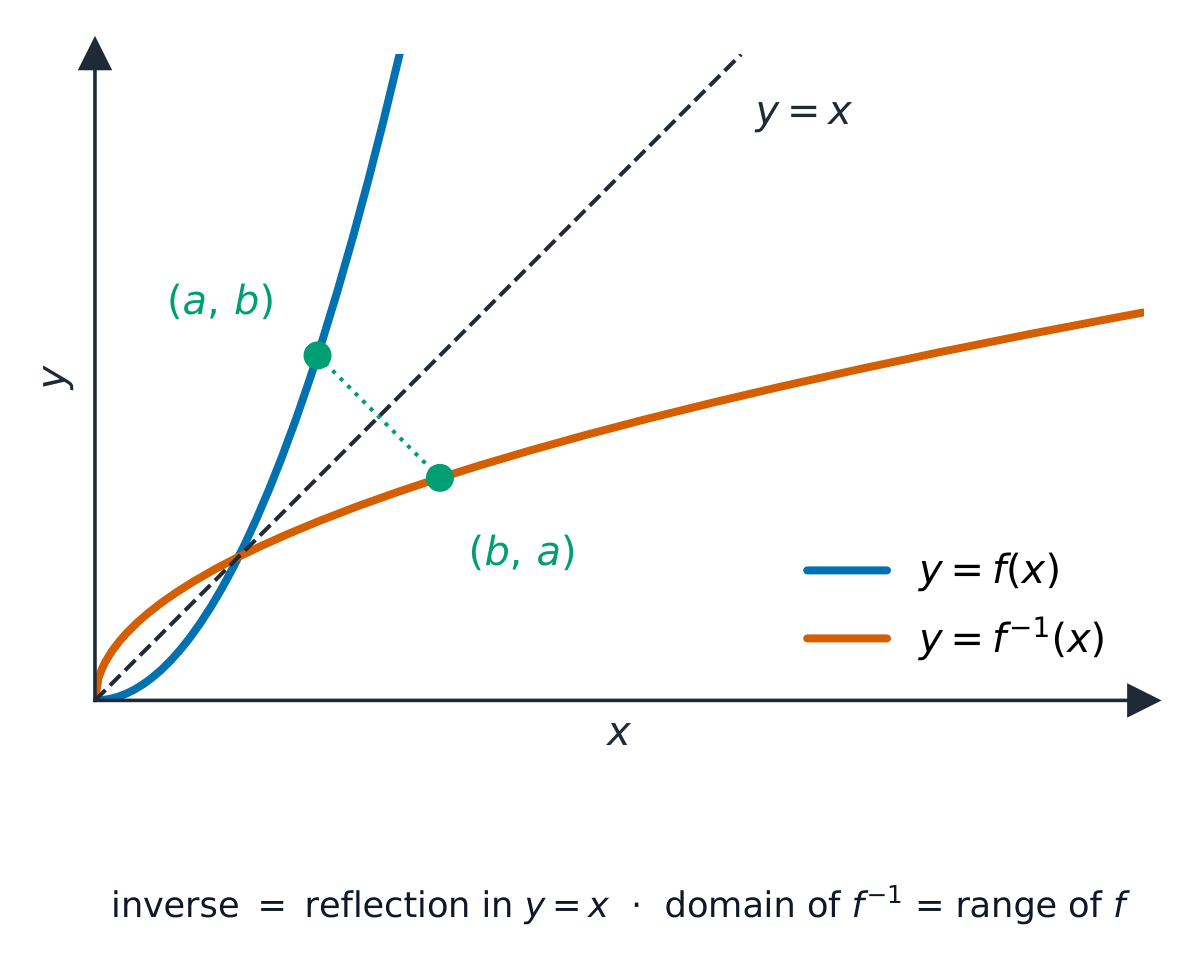
The graph of $y = f^{-1}(x)$ is the reflection 反射 of $y = f(x)$ in the line $y = x$.
You should know these transformations 变换 of $y = f(x)$:
New equation
Effect on the graph
$y = f(x) + a$
translation 平移 up by $a$
$y = f(x + a)$
translation left by $a$
$y = a\,f(x)$
stretch 伸缩 in the $y$-direction, scale factor $a$
$y = f(ax)$
stretch in the $x$-direction, scale factor $\tfrac{1}{a}$
When two transformations are combined, the order can matter. State each one fully (type, direction, and amount).
Español
Transformando gráficas: traslación y estiramiento
Una función 函数 es una regla que asigna cada entrada a exactamente una salida. Escríbala como $f(x)$. La composición de funciones 复合函数$fg(x)$ significa aplicar primero $g$ y luego aplicar $f$ al resultado.
El dominio 定义域 es el conjunto de entradas permitidas $x$.
El rango 值域 es el conjunto de salidas que la función produce realmente.
Una función es uno-a-uno 一一对应 si las entradas diferentes siempre producen salidas diferentes. (Ninguna salida se repite.) Solo una función uno-a-uno tiene una función inversa 反函数$f^{-1}$, que invierte la regla.
La composición 复合 de dos funciones significa hacer una después de la otra. $fg(x)$ significa "haga primero $g$, luego $f$": $fg(x) = f(g(x))$. La función compuesta $fg$ existe solo cuando el rango de $g$ está contenido dentro del dominio de $f$.
Encontrar una inversa
Para encontrar $f^{-1}$: escriba $y = f(x)$, despeje $x$, luego intercambie las letras.
Ejemplo resuelto. La función $f(x) = (x + 3)^2 - 12$ está definida para $x \geqslant 0$. Encuentre $f^{-1}(x)$.
Escriba $y = (x + 3)^2 - 12$ y resuelva para $x$:
$$(x + 3)^2 = y + 12 \;\Rightarrow\; x + 3 = \sqrt{y + 12} \;\Rightarrow\; x = \sqrt{y + 12} - 3.$$
Toma la raíz cuadrada positiva porque $x \geqslant 0$ significa $x + 3 \geqslant 3 > 0$. Así que
$$f^{-1}(x) = \sqrt{x + 12} - 3.$$
Gráficas de inversas y transformaciones
La gráfica de $y = f^{-1}(x)$ es la reflexión 反射 de $y = f(x)$ respecto a la recta $y = x$.
Reflejar $y=f(x)$ en la recta $y=x$ da su inversa; un punto $(a,b)$ se convierte en $(b,a)$.
Deberías conocer estas transformaciones 变换 de $y = f(x)$:
Nueva ecuación
Efecto en la gráfica
$y = f(x) + a$
traslación 平移 hacia arriba en $a$
$y = f(x + a)$
traslación hacia la izquierda en $a$
$y = a\,f(x)$
estiramiento 伸缩 en la dirección $y$, factor de escala $a$
$y = f(ax)$
estiramiento en la dirección $x$, factor de escala $\tfrac{1}{a}$
Cuando se combinan dos transformaciones, el orden puede importar. Enuncie cada una completamente (tipo, dirección y cantidad).
Sumar a la salida o a la entrada desliza la curva; un multiplicador la estira.
Explore · Explorar
Explorar una función
y = ax³ + bx² + cx + d
Una función convierte cada entrada en exactamente una salida — arrastra los coeficientes y observa dónde la curva sube y baja.
find the equation of a straight line given sufficient information
e.g. given two points, or one point and the gradient.
interpret and use any of the forms $y = mx + c$, $y - y_1 = m(x - x_1)$, $ax + by + c = 0$ in solving problems
Including calculations of distances, gradients, midpoints, points of intersection and use of the relationship between the gradients of parallel and perpendicular lines.
understand that the equation $(x - a)^2 + (y - b)^2 = r^2$ represents the circle with centre $(a, b)$ and radius $r$
Including use of the expanded form $x^2 + y^2 + 2gx + 2fy + c = 0$.
use algebraic methods to solve problems involving lines and circles
Including use of elementary geometrical properties of circles, e.g. tangent perpendicular to radius, angle in a semicircle, symmetry. Implicit differentiation is not included.
understand the relationship between a graph and its associated algebraic equation, and use the relationship between points of intersection of graphs and solutions of equations.
e.g. to determine the set of values of $k$ for which the line $y = x + k$ intersects, touches or does not meet a quadratic curve.
Español
Los candidatos deben ser capaces de:
Notas y ejemplos
encontrar la ecuación de una recta dados datos suficientes
p. ej., dados dos puntos, o un punto y la pendiente.
interpretar y utilizar cualquiera de las formas $y = mx + c$, $y - y_1 = m(x - x_1)$, $ax + by + c = 0$ para resolver problemas
Incluyendo cálculos de distancias, pendientes, puntos medios, puntos de intersección y uso de la relación entre las pendientes de rectas paralelas y perpendiculares.
comprender que la ecuación $(x - a)^2 + (y - b)^2 = r^2$ representa una circunferencia con centro $(a, b)$ y radio $r$
Incluyendo el uso de la forma desarrollada $x^2 + y^2 + 2gx + 2fy + c = 0$.
usar métodos algebraicos para resolver problemas con rectas y circunferencias
Incluyendo el uso de propiedades geométricas elementales de las circunferencias, p. ej., tangente perpendicular al radio, ángulo en una semicircunferencia, simetría. La derivación implícita no está incluida.
comprender la relación entre una gráfica y su ecuación algebraica asociada, y usar la relación entre los puntos de intersección de gráficas y las soluciones de ecuaciones.
p. ej., para determinar el conjunto de valores de $k$ para los cuales la recta $y = x + k$ intersecta, toca o no se encuentra con una curva cuadrática.
Source: Cambridge International syllabus · Fuente: Plan de estudios Cambridge International
English
Coordinate geometry 坐标几何 studies lines and circles using their equations.
Straight lines
The gradient 斜率 (steepness) of the line joining $(x_1, y_1)$ and $(x_2, y_2)$ is
$$m = \frac{y_2 - y_1}{x_2 - x_1}.$$
You can write the equation of a straight line 直线方程 in any of these forms:
$$y = mx + c, \qquad y - y_1 = m(x - x_1), \qquad ax + by + c = 0.$$
Two lines are parallel 平行 when their gradients are equal, and perpendicular 垂直 (at right angles) when the product of their gradients is $-1$.
Circles
The circle 圆 with centre 圆心$(a, b)$ and radius 半径$r$ has equation
$$(x - a)^2 + (y - b)^2 = r^2.$$
An expanded form like $x^2 + y^2 - 6x + 10y - 27 = 0$ is the same circle: complete the square in $x$ and in $y$ to find the centre and radius.
A tangent 切线 to a circle touches it at one point and is perpendicular to the radius at that point. This right-angle fact solves most circle problems.
Worked example. The points $P(1, 1)$ and $Q(7, 11)$ are the ends of a diameter 直径 of a circle. Find the equation of the circle.
Geometría analítica 坐标几何 estudia líneas y círculos mediante sus ecuaciones.
Rectas
La pendiente 斜率 (inclinación) de la recta que une $(x_1, y_1)$ y $(x_2, y_2)$ es
$$m = \frac{y_2 - y_1}{x_2 - x_1}.$$
Puede escribir la ecuación de una recta 直线方程 en cualquiera de estas formas:
$$y = mx + c, \qquad y - y_1 = m(x - x_1), \qquad ax + by + c = 0.$$
Dos rectas son paralelas 平行 cuando sus pendientes son iguales, y perpendiculares 垂直 (en ángulo recto) cuando el producto de sus pendientes es $-1$.
Círculos
El círculo 圆 con centro 圆心$(a, b)$ y radio 半径$r$ tiene ecuación
$$(x - a)^2 + (y - b)^2 = r^2.$$
Una forma desarrollada como $x^2 + y^2 - 6x + 10y - 27 = 0$ representa el mismo círculo: complete el cuadrado en $x$ y en $y$ para encontrar el centro y el radio.
Una tangente 切线 a un círculo lo toca en un solo punto y es perpendicular al radio en ese punto. Este hecho del ángulo recto resuelve la mayoría de los problemas sobre círculos.
Una tangente toca el círculo una vez y se encuentra con el radio en un ángulo recto.
Ejemplo resuelto. Los puntos $P(1, 1)$ y $Q(7, 11)$ son los extremos de un diámetro 直径 de un círculo. Encuentre la ecuación del círculo.
understand the definition of a radian, and use the relationship between radians and degrees
use the formulae $s = r\theta$ and $A = \frac{1}{2}r^2\theta$ in solving problems concerning the arc length and sector area of a circle.
Including calculation of lengths and angles in triangles and areas of triangles.
Español
Los candidatos deben ser capaces de:
Notas y ejemplos
comprender la definición de un radián, y utilizar la relación entre radianes y grados
usar las fórmulas $s = r\theta$ y $A = \frac{1}{2}r^2\theta$ para resolver problemas relacionados con la longitud de arco y el área de un sector de un círculo.
Incluye el cálculo de longitudes y ángulos en triángulos, así como áreas de triángulos.
Source: Cambridge International syllabus · Fuente: Plan de estudios Cambridge International
English
What is a radian?
Radians
A radian 弧度 is another way to measure angles. One radian is the angle at the centre of a circle that cuts off an arc 弧 equal in length to the radius. The link between radians and degrees 度 is
$$\pi \text{ radians} = 180^\circ.$$
So to change degrees to radians, multiply by $\dfrac{\pi}{180}$; to change radians to degrees, multiply by $\dfrac{180}{\pi}$.
Arc length and sector area
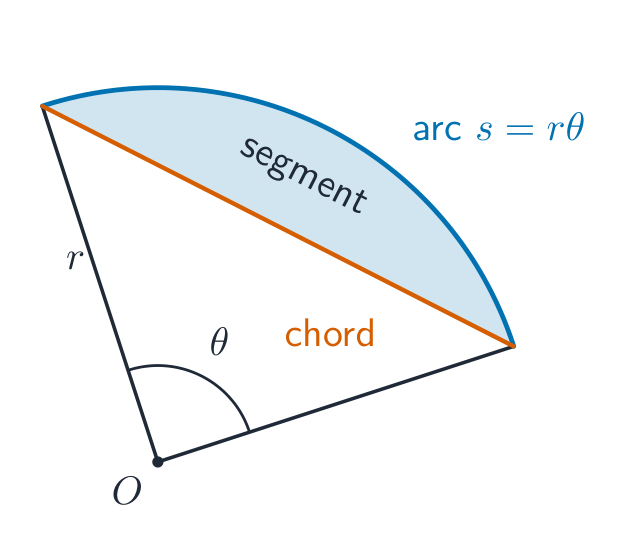
For a sector 扇形 with radius $r$ and angle $\theta$in radians:
$$\text{arc length} = s = r\theta, \qquad \text{sector area} = A = \tfrac12 r^2 \theta.$$
A chord 弦 cuts the sector into a triangle and a segment 弓形. The segment area is the sector minus the triangle:
Worked example. A sector has centre $O$ and the angle at $O$ is $\tfrac{2}{3}\pi$ radians. Show that the segment cut off by the chord has area about $0.614 r^2$.
Un radián 弧度 es otra manera de medir ángulos. Un radián es el ángulo en el centro de un círculo que subtiende un arco 弧 cuya longitud es igual al radio. El vínculo entre radianes y grados 度 es
$$\pi \text{ radians} = 180^\circ.$$
Así que para cambiar grados a radianes, multiplique por $\dfrac{\pi}{180}$; para cambiar radianes a grados, multiplique por $\dfrac{180}{\pi}$.
Un radián: el ángulo cuyo arco es igual al radio
Longitud de arco y área de sector
Para un sector 扇形 con radio $r$ y ángulo $\theta$en radianes:
$$\text{arc length} = s = r\theta, \qquad \text{sector area} = A = \tfrac12 r^2 \theta.$$
Una cuerda 弦 divide el sector en un triángulo y un segmento 弓形. El área del segmento es el área del sector menos el área del triángulo:
El segmento sombreado es la parte del sector comprendida entre la cuerda y el arco.
Ejemplo resuelto. Un sector tiene su centro en $O$ y el ángulo en $O$ es $\tfrac{2}{3}\pi$ radianes. Demuestre que el área del segmento recortado por la cuerda es aproximadamente $0.614 r^2$.
utilizar los valores exactos del seno, coseno y tangente de $30^\circ$, $45^\circ$, $60^\circ$ y ángulos relacionados
p. ej. $\cos 150^\circ = -\frac{1}{2}\sqrt{3}$, $\sin \frac{3}{4}\pi = \frac{1}{\sqrt{2}}$.
utilizar las notaciones $\sin^{-1} x$, $\cos^{-1} x$, $\tan^{-1} x$ para denotar los valores principales de las relaciones trigonométricas inversas
No se requiere conocimiento especializado de estas funciones, pero sí se espera que comprendan su naturaleza como ejemplos de funciones inversas.
utilizar las identidades $\frac{\sin \theta}{\cos \theta} \equiv \tan \theta$ y $\sin^2 \theta + \cos^2 \theta \equiv 1$
p. ej. en la demostración de identidades, simplificación de expresiones y resolución de ecuaciones.
encontrar todas las soluciones de ecuaciones trigonométricas simples dentro de un intervalo especificado (las formas generales de solución no están incluidas).
p. ej. resolver $3 \sin 2x + 1 = 0$ para $-\pi < x < \pi$, $3 \sin^2 \theta - 5 \cos \theta - 1 = 0$ para $0^\circ \leqslant \theta \leqslant 360^\circ$.
Source: Cambridge International syllabus · Fuente: Plan de estudios Cambridge International
English
Amplitude, period and midline of a sine curveThe unit circle draws the sine curve
Graphs and exact values
You must know the shape of the graphs of the sine 正弦, cosine 余弦 and tangent function 正切 (written $\sin$, $\cos$, $\tan$). The sine and cosine graphs wave between $-1$ and $1$ and repeat every $360^\circ$ ($2\pi$). Learn these exact values:
$\theta$
$30^\circ$
$45^\circ$
$60^\circ$
$\sin\theta$
$\tfrac12$
$\tfrac{1}{\sqrt2}$
$\tfrac{\sqrt3}{2}$
$\cos\theta$
$\tfrac{\sqrt3}{2}$
$\tfrac{1}{\sqrt2}$
$\tfrac12$
$\tan\theta$
$\tfrac{1}{\sqrt3}$
$1$
$\sqrt3$
The notations $\sin^{-1}x$, $\cos^{-1}x$, $\tan^{-1}x$ mean the inverse angle (the principal value 主值).
Identities
An identity 恒等式 is true for every value of the angle. The two you must know are
$\sin\theta = -\tfrac12$: $\theta = -30^\circ$ or $\theta = -150^\circ$.
The four solutions are $\theta = -150^\circ,\ -30^\circ,\ 41.8^\circ,\ 138.2^\circ$.
Español
Amplitud, período y línea media de una curva senoidalEl círculo unitario dibuja la curva senoidalUna rueda de la fortuna: un punto en el borde sube y baja como una curva senoidal.
Gráficas y valores exactos
Debes conocer la forma de las gráficas de las funciones seno 正弦, coseno 余弦 y tangente 正切 (escritas $\sin$, $\cos$, $\tan$). Las gráficas del seno y el coseno oscilan entre $-1$ y $1$ y se repiten cada $360^\circ$ ($2\pi$). Aprende estos valores exactos:
$\theta$
$30^\circ$
$45^\circ$
$60^\circ$
$\sin\theta$
$\tfrac12$
$\tfrac{1}{\sqrt2}$
$\tfrac{\sqrt3}{2}$
$\cos\theta$
$\tfrac{\sqrt3}{2}$
$\tfrac{1}{\sqrt2}$
$\tfrac12$
$\tan\theta$
$\tfrac{1}{\sqrt3}$
$1$
$\sqrt3$
En una vuelta completa $\sin$ y $\cos$ permanecen entre $-1$ y $1$; $\tan$ tiende a infinito en $90^\circ$ y $270^\circ$.
Las notaciones $\sin^{-1}x$, $\cos^{-1}x$, $\tan^{-1}x$ significan el ángulo inverso (el valor principal 主值).
Identidades
Una identidad 恒等式 es verdadera para todo valor del ángulo. Las dos que debes conocer son
use the expansion of $(a + b)^n$, where $n$ is a positive integer
Including the notations $\begin{pmatrix} n \\ r \end{pmatrix}$ and $n!$ Knowledge of the greatest term and properties of the coefficients are not required.
recognise arithmetic and geometric progressions
use the formulae for the $n$th term and for the sum of the first $n$ terms to solve problems involving arithmetic or geometric progressions
Including knowledge that numbers $a$, $b$, $c$ are 'in arithmetic progression' if $2b = a + c$ (or equivalent) and are 'in geometric progression' if $b^2 = ac$ (or equivalent). Questions may involve more than one progression.
use the condition for the convergence of a geometric progression, and the formula for the sum to infinity of a convergent geometric progression.
Español
Los candidatos deben ser capaces de:
Notas y ejemplos
utilizar la expansión de $(a + b)^n$, donde $n$ es un entero positivo
Incluye las notaciones $\begin{pmatrix} n \\ r \end{pmatrix}$ y $n!$. No se requiere conocimiento del término mayor ni de las propiedades de los coeficientes.
reconocer progresiones aritméticas y geométricas
usar las fórmulas para el término $n$-ésimo y para la suma de los primeros $n$ términos para resolver problemas que involucren progresiones aritméticas o geométricas
Incluye el conocimiento de que los números $a$, $b$, $c$ están en progresión aritmética si $2b = a + c$ (o equivalente) y están en progresión geométrica si $b^2 = ac$ (o equivalente). Las preguntas pueden involucrar más de una progresión.
usar la condición de convergencia de una progresión geométrica, y la fórmula para la suma al infinito de una progresión geométrica convergente.
Source: Cambridge International syllabus · Fuente: Plan de estudios Cambridge International
English
Pascal's triangle gives the coefficientsSum to infinity fills the square
The binomial expansion
For a positive integer $n$, the binomial expansion 二项展开式 is
A progression 数列 (sequence) is a list of terms following a rule.
An arithmetic progression 等差数列 (AP) adds a fixed common difference 公差$d$ each step. The $n$th term 项 is $u_n = a + (n - 1)d$, and the sum of the first $n$ terms is $S_n = \tfrac{n}{2}\big(2a + (n - 1)d\big)$.
A geometric progression 等比数列 (GP) multiplies by a fixed common ratio 公比$r$ each step. The $n$th term is $u_n = ar^{\,n-1}$, and $S_n = \dfrac{a(1 - r^n)}{1 - r}$.
A GP is convergent — it converges 收敛 (settles to a limit) — when $|r| < 1$. Then it has a sum to infinity 无穷和
$$S_\infty = \frac{a}{1 - r}.$$
Worked example. The third term of a GP is $18$ and the sum of the first three terms is $26$. The common ratio is negative. Find the sum to infinity.
From $ar^2 = 18$ you get $a = \dfrac{18}{r^2}$. Put this into $a(1 + r + r^2) = 26$:
Una progresión es una lista de términos que siguen una regla.
Una progresión aritmética (PA) suma una diferencia común fija $d$ en cada paso. El $n$mo término es $u_n = a + (n - 1)d$, y la suma de los primeros $n$ términos es $S_n = \tfrac{n}{2}\big(2a + (n - 1)d\big)$.
Una progresión geométrica (PG) multiplica por una razón común fija $r$ en cada paso. El $n$mo término es $u_n = ar^{\,n-1}$, y $S_n = \dfrac{a(1 - r^n)}{1 - r}$.
Una PA sube en pasos iguales; los pasos de una PG crecen por la misma razón
Una PG es convergente — converge (se asienta en un límite) — cuando $|r| < 1$. Entonces tiene una suma al infinito
$$S_\infty = \frac{a}{1 - r}.$$
Ejemplo resuelto. El tercer término de una PG es $18$ y la suma de los primeros tres términos es $26$. La razón común es negativa. Encuentre la suma al infinito.
De $ar^2 = 18$ se obtiene $a = \dfrac{18}{r^2}$. Sustituyendo esto en $a(1 + r + r^2) = 26$:
understand the gradient of a curve at a point as the limit of the gradients of a suitable sequence of chords, and use the notations $f'(x)$, $f''(x)$, $\frac{\text{d}y}{\text{d}x}$, and $\frac{\text{d}^2y}{\text{d}x^2}$ for first and second derivatives
Only an informal understanding of the idea of a limit is expected. e.g. includes consideration of the gradient of the chord joining the points with $x$ coordinates $2$ and $(2 + h)$ on the curve $y = x^3$. Formal use of the general method of differentiation from first principles is not required.
use the derivative of $x^n$ (for any rational $n$), together with constant multiples, sums and differences of functions, and of composite functions using the chain rule
e.g. find $\frac{\text{d}y}{\text{d}x}$, given $y = \sqrt{2x^3 + 5}$.
apply differentiation to gradients, tangents and normals, increasing and decreasing functions and rates of change
Including connected rates of change, e.g. given the rate of increase of the radius of a circle, find the rate of increase of the area for a specific value of one of the variables.
locate stationary points and determine their nature, and use information about stationary points in sketching graphs.
Including use of the second derivative for identifying maxima and minima; alternatives may be used in questions where no method is specified. Knowledge of points of inflexion is not included.
Español
Los candidatos deben ser capaces de:
Notas y ejemplos
comprender la pendiente de una curva en un punto como el límite de las pendientes de una secuencia adecuada de cuerdas, y utilizar las notaciones $f'(x)$, $f''(x)$, $\frac{\text{d}y}{\text{d}x}$ y $\frac{\text{d}^2y}{\text{d}x^2}$ para las primeras y segundas derivadas
Solo se espera una comprensión informal de la idea de límite. p. ej., incluye la consideración de la pendiente de la cuerda que une los puntos con coordenadas $x$ de $2$ y $(2 + h)$ en la curva $y = x^3$. No se requiere el uso formal del método general de diferenciación desde primeros principios.
usar la derivada de $x^n$ (para cualquier racional $n$), junto con multiplicadores constantes, sumas y restas de funciones, y de funciones compuestas utilizando la regla de la cadena
p. ej., encontrar $\frac{\text{d}y}{\text{d}x}$, dado $y = \sqrt{2x^3 + 5}$.
aplicar la diferenciación a pendientes, tangentes y normales, funciones crecientes y decrecientes y tasas de cambio
Incluyendo tasas de cambio conectadas, p. ej., dado la tasa de aumento del radio de un círculo, encontrar la tasa de aumento del área para un valor específico de una de las variables.
localizar puntos estacionarios y determinar su naturaleza, y utilizar información sobre puntos estacionarios al esbozar gráficas.
Incluye el uso de la segunda derivada para identificar máximos y mínimos; pueden usarse alternativas en preguntas donde no se especifica un método. El conocimiento de puntos de inflexión no está incluido.
Source: Cambridge International syllabus · Fuente: Plan de estudios Cambridge International
English
Differentiation from first principles
Differentiation 微分 finds the gradient of a curve 曲线斜率 at each point. The gradient is the limit 极限 of the gradients of shorter and shorter chords, called the derivative 导数.
The rules
Write the derivative as $f'(x)$ or $\dfrac{dy}{dx}$. The basic rule is
$$\frac{d}{dx}\left(x^n\right) = n x^{n-1} \quad \text{for any rational } n.$$
Differentiate sums term by term, and use the chain rule 链式法则 for a function inside a function:
$$\frac{d}{dx}\,f(g(x)) = f'(g(x)) \cdot g'(x).$$
Differentiating again gives the second derivative 二阶导数$f''(x)$ or $\dfrac{d^2y}{dx^2}$.
Using the derivative
Tangent and normal. The gradient of the curve at a point is the gradient of the tangent there. The normal 法线 is perpendicular to the tangent, so its gradient is $-\dfrac{1}{\text{(tangent gradient)}}$.
Increasing or decreasing. The function is an increasing function 增函数 where $\dfrac{dy}{dx} > 0$, and a decreasing function 减函数 where $\dfrac{dy}{dx} < 0$.
Rate of change. A derivative is a rate of change 变化率. Linked rates use the chain rule, e.g. $\dfrac{dy}{dt} = \dfrac{dy}{dx}\cdot\dfrac{dx}{dt}$.
Stationary points
A stationary point 驻点 is where $\dfrac{dy}{dx} = 0$. Test its nature with the second derivative: $f''(x) > 0$ gives a minimum point 极小值点, and $f''(x) < 0$ gives a maximum point 极大值点. When $f''(x) = 0$ the test is inconclusive: the point may be a point of inflexion 拐点, where the curve changes concavity (the way it bends) – check the sign of $\dfrac{dy}{dx}$ just before and after to decide.
Worked example. The curve $y = 4x^{1/2} - x$ has a maximum point at $x = a$. Find $a$.
Diferenciación encuentra la pendiente de una curva en cada punto. La pendiente es el límite de las pendientes de cuerdas cada vez más cortas, llamado derivada.
Las reglas
Escribe la derivada como $f'(x)$ o $\dfrac{dy}{dx}$. La regla básica es
$$\frac{d}{dx}\left(x^n\right) = n x^{n-1} \quad \text{for any rational } n.$$
Deriva sumas término a término, y usa la regla de la cadena 链式法则 para una función dentro de otra:
$$\frac{d}{dx}\,f(g(x)) = f'(g(x)) \cdot g'(x).$$
Derivar nuevamente da la segunda derivada 二阶导数$f''(x)$ o $\dfrac{d^2y}{dx^2}$.
Usando la derivada
Tangente y normal. La pendiente de la curva en un punto es la pendiente de la tangente allí. La normal 法线 es perpendicular a la tangente, por lo que su pendiente es $-\dfrac{1}{\text{(tangent gradient)}}$.
Creciente o decreciente. La función es una función creciente 增函数 donde $\dfrac{dy}{dx} > 0$, y una función decreciente 减函数 donde $\dfrac{dy}{dx} < 0$.
Tasa de cambio. Una derivada es una tasa de cambio 变化率. Las tasas relacionadas usan la regla de la cadena, p. ej., $\dfrac{dy}{dt} = \dfrac{dy}{dx}\cdot\dfrac{dx}{dt}$.
Puntos estacionarios
Un punto estacionario 驻点 es donde $\dfrac{dy}{dx} = 0$. Prueba su naturaleza con la segunda derivada: $f''(x) > 0$ da un punto mínimo 极小值点, y $f''(x) < 0$ da un punto máximo 极大值点. Cuando $f''(x) = 0$ la prueba es inconclusa: el punto puede ser un punto de inflexión 拐点, donde la curva cambia de concavidad (la forma en que se curva) – verifica el signo de $\dfrac{dy}{dx}$ justo antes y después para decidir.
En un máximo o un mínimo la tangente es horizontal, así que $\frac{dy}{dx}=0$.
Ejemplo resuelto. La curva $y = 4x^{1/2} - x$ tiene un punto máximo en $x = a$. Encuentra $a$.
equation of a straight line/ɪˈkweɪʒn əvə streɪt laɪn/
直线方程
zhí xiàn fāng chéng
parallel/ˈpærəlel/
平行
píng xíng
Differentiation/ˌdɪfəˌrenʃɪˈeɪʃn/
微分
wēi fēn
gradient of a curve/ˈɡreɪdɪənt əvə kɜːv/
曲线斜率
qū xiàn xié lǜ
limit/ˈlɪmɪt/
极限
jí xiàn
derivative/dɪˈrɪvətɪv/
导数
dǎo shù
chain rule/tʃeɪn ruːl/
链式法则
liàn shì fǎ zé
second derivative/ˈsekənd dɪˈrɪvətɪv/
二阶导数
èr jiē dǎo shù
normal/ˈnɔːml/
法线
fǎ xiàn
increasing function/ɪnˈkriːsɪŋ ˈfʌŋkʃn/
增函数
zēng hán shù
decreasing function/ˈdiːkriːsɪŋ ˈfʌŋkʃn/
减函数
jiǎn hán shù
rate of change/reɪt ɒv tʃeɪndʒ/
变化率
biàn huà lǜ
stationary point/ˈsteɪʃənəri pɔɪnt/
驻点
zhù diǎn
minimum point/ˈmɪnɪməm pɔɪnt/
极小值点
jí xiǎo zhí diǎn
maximum point/ˈmæksɪməm pɔɪnt/
极大值点
jí dà zhí diǎn
point of inflexion/pɔɪnt ɒv ɪnˈflekʃn/
拐点
guǎi diǎn
1.8
Integration · Integración
Syllabus
English
Candidates should be able to:
Notes and examples
understand integration as the reverse process of differentiation, and integrate $(ax + b)^n$ (for any rational $n$ except $-1$), together with constant multiples, sums and differences
solve problems involving the evaluation of a constant of integration
e.g. to find the equation of the curve through $(1, -2)$ for which $\frac{\text{d}y}{\text{d}x} = \sqrt{2x + 1}$.
evaluate definite integrals
Including simple cases of 'improper' integrals, such as $\int_{0}^{1} x^{-\frac{1}{2}} \text{d}x$ and $\int_{1}^{\infty} x^{-2} \text{d}x$.
use definite integration to find: - the area of a region bounded by a curve and lines parallel to the axes, or between a curve and a line or between two curves - a volume of revolution about one of the axes.
A volume of revolution may involve a region not bounded by the axis of rotation, e.g. the region between $y = 9 - x^2$ and $y = 5$ rotated about the $x$-axis.
Español
Los candidatos deben ser capaces de:
Notas y ejemplos
comprender la integración como el proceso inverso a la diferenciación, e integrar $(ax + b)^n$ (para cualquier racional $n$ excepto $-1$), junto con multiplicadores constantes, sumas y diferencias
resolver problemas que impliquen la evaluación de una constante de integración
ej. para encontrar la ecuación de la curva que pasa por $(1, -2)$ para la cual $\frac{\text{d}y}{\text{d}x} = \sqrt{2x + 1}$.
evaluar integrales definidas
Incluyendo casos simples de integrales 'impropias', tales como $\int_{0}^{1} x^{-\frac{1}{2}} \text{d}x$ y $\int_{1}^{\infty} x^{-2} \text{d}x$.
usar la integración definida para encontrar: - el área de una región acotada por una curva y líneas paralelas a los ejes, o entre una curva y una línea, o entre dos curvas - un volumen de revolución respecto a uno de los ejes.
Un volumen de revolución puede implicar una región no acotada por el eje de rotación, ej. la región entre $y = 9 - x^2$ y $y = 5$ rotada alrededor del eje $x$.
Source: Cambridge International syllabus · Fuente: Plan de estudios Cambridge International
English
Integration as area: Riemann rectangles
Integration 积分 is the reverse of differentiation. Reversing the power rule gives
The area of the region 区域 between a curve and the $x$-axis, from $x = p$ to $x = q$, is $\displaystyle\int_p^q y \, dx$. For the area between two curves, integrate (top curve $-$ bottom curve).
Worked example. The curve $y = 4x^{1/2} - x$ meets the $x$-axis again at $x = 16$. Find the area between the curve and the $x$-axis from $x = 0$ to $x = 4$.
and $\displaystyle\int_0^{1}x^{-1/2}\, dx=\left[2x^{1/2}\right]_0^{1}=2$, which is finite even though the integrand blows up at $x=0$.
Volume of revolution
When a region is turned all the way around an axis it sweeps out a solid. The volume of revolution 旋转体体积 about the $x$-axis is
$$V = \pi \int_p^q y^2 \, dx,$$
and about the $y$-axis it is $V = \pi \displaystyle\int x^2 \, dy$. For example, the region under $y = \sqrt{x}$ from $x = 0$ to $x = 4$, turned about the $x$-axis, has volume $\pi\displaystyle\int_0^4 x\, dx = \pi\big[\tfrac{x^2}{2}\big]_0^4 = 8\pi$.
Español
Integración como área: rectángulos de Riemann
La integración 积分 es lo opuesto a la derivación. Invertir la regla de la potencia da
El área de la región 区域 entre una curva y el eje $x$, desde $x = p$ hasta $x = q$, es $\displaystyle\int_p^q y \, dx$. Para el área entre dos curvas, integra (curva superior $-$ curva inferior).
La integral definida $\int_0^4 y\,dx$ es el área sombreada bajo la curva.
Ejemplo resuelto. La curva $y = 4x^{1/2} - x$ corta nuevamente al eje $x$ en $x = 16$. Encuentre el área entre la curva y el eje $x$ desde $x = 0$ hasta $x = 4$.
y $\displaystyle\int_0^{1}x^{-1/2}\, dx=\left[2x^{1/2}\right]_0^{1}=2$, que es finita a pesar de que el integrando tiende a infinito en $x=0$.
Volumen de revolución
Cuando una región gira completamente alrededor de un eje, genera un sólido. El volumen de revolución (旋转体体积) respecto al eje $x$ es
$$V = \pi \int_p^q y^2 \, dx,$$
y respecto al eje $y$ es $V = \pi \displaystyle\int x^2 \, dy$. Por ejemplo, la región bajo $y = \sqrt{x}$ desde $x = 0$ hasta $x = 4$, girada alrededor del eje $x$, tiene volumen $\pi\displaystyle\int_0^4 x\, dx = \pi\big[\tfrac{x^2}{2}\big]_0^4 = 8\pi$.
Al rotar la región bajo una curva alrededor del eje $x$ se genera un sólido; cada rebanada delgada es un disco de área $\pi y^2$, por lo tanto $V = \pi\int y^2\,dx$
Explore · Explorar
Área bajo una curva
y = ax³ + bx² + cx + d
Arrastra los límites. La integral definida es el área sombreada entre la curva y el eje x.
constant of integration/ˈkɒnstənt ɒv ˌɪntɪˈɡreɪʃn/
积分常数
jī fēn cháng shù
definite integral/ˈdefɪnət ˈɪntɪɡrəl/
定积分
dìng jī fēn
region/ˈriːdʒn/
区域
qū yù
improper integral/ɪmˈprɒpə ˈɪntɪɡrəl/
广义积分
guǎng yì jī fēn
volume of revolution/ˈvɒljuːm ɒv ˌrevəˈluːʃn/
旋转体体积
xuán zhuǎn tǐ tǐ jī
algebra/ˈældʒɪbrə/
代数
dài shù
calculus/ˈkælkjʊləs/
微积分
wēi jī fēn
1.8
Exam tips · Consejos para el examen
English
Show every line of algebra — method marks are lost by jumping steps; use the discriminant$b^2 - 4ac$ to decide the number of real roots.
Work in radians for circular measure (arc $= r\theta$, sector area $= \frac{1}{2}r^2\theta$) and for calculus of trig functions.
For differentiation, set $\frac{dy}{dx} = 0$ for stationary points and use the second derivative to classify them.
For integration, add $+ c$ to an indefinite integral and use limits for area; an area below the axis gives a negative integral.
Español
Muestre cada línea de álgebra: los puntos del método se pierden al omitir pasos; use el discriminante$b^2 - 4ac$ para determinar el número de raíces reales.
Trabaje en radianes para medidas circulares (arco $= r\theta$, área de sector $= \frac{1}{2}r^2\theta$) y para el cálculo de funciones trigonométricas.
Para la derivación, iguale $\frac{dy}{dx} = 0$ para encontrar puntos estacionarios y utilice la segunda derivada para clasificarlos.
Para la integración, añada $+ c$ a una integral indefinida y use límites para calcular áreas; un área debajo del eje produce una integral negativa.
Pick one and the site follows you — notes, papers, videos and practice all open on it. · Selecciona uno y el sitio te sigue — notas, documentos, videos y práctica se abren en él.
Type to search notes, lessons, code, vocabulary and past-paper questions across every subject. · Escribe para buscar notas, lecciones, código, vocabulario y preguntas de exámenes anteriores en todas las materias.