يغطي الرياضيات IGCSE (0580) الأعداد، الجبر والرسوم البيانية، الهندسة الإحداثية، الهندسة، القياسات، مثلثات، التحويلات والمتجهات، الاحتمالات والإحصاء.
تنقسم التسجيلات بين أساسي ومتقدم، ويصل المستوى المتقدم إلى مسافات أبعد بشكل ملحوظ في الجبر والمثلثات — أكد مستوى مستواك قبل اختيار ما ستتدرب عليه.
تُمنح درجات الطريقة للعمل المكتوب. يمكن لإجابة خاطئة عددياً أن تحصل على معظم الدرجات إذا كانت خطوات الحل مرئية، وإجابة صحيحة بدون خطوات قد تحصل على درجات أقل. كتابة كل سطر ليس مجرد ترتيب — بل هو درجات.
This handout covers Topic 1, Number. Cambridge Maths has two levels: Core and Extended. Parts marked (Extended) are only tested on the Extended papers; everything else is for both levels.
العربية
تغطي هذه الورقة الموضوع 1، العدد. الرياضيات كامبريدج لها مستويان: الأساسي والممتد. الأجزاء المحددة (ممتد) تُختبر فقط في أوراق الامتحان الممتدة؛ كل ما هو آخر مخصص للمستويين معًا.
1.1
Types of number · أنواع الأعداد
Syllabus · المنهج
English
Subject content
Notes and examples
Identify and use: • natural numbers • integers (positive, zero and negative) • prime numbers • square numbers • cube numbers • common factors • common multiples • rational and irrational numbers • reciprocals.
Example tasks include: • convert between numbers and words, e.g. six billion is 6000000000 10007 is ten thousand and seven • express 72 as a product of its prime factors • find the highest common factor (HCF) of two numbers • find the lowest common multiple (LCM) of two numbers.
تشمل المهام الأمثلة: • التحويل بين الأعداد والكلمات، مثل: ستة مليار هي 6000000000 و10007 هي عشرة آلاف وسبعة • التعبير عن 72 كحاصل ضرب عواملها الأولية • إيجاد القاسم المشترك الأكبر (HCF) لعددين • إيجاد المضاعف المشترك الأصغر (LCM) لعددين.
Source: Cambridge International syllabus · المصدر: منهج كامبريدج الدولي
English
You must know the words for the different kinds of number. Examiners give marks for using them correctly.
A factor 因数 of a number divides into it exactly, leaving no remainder 余数. The factors of $18$ are $1, 2, 3, 6, 9, 18$.
A multiple 倍数 of a number is that number times an integer. Multiples of $6$ are $6, 12, 18, 24, \dots$
A common factor 公因数 of two numbers is a factor of both.
A common multiple 公倍数 of two numbers is a multiple of both.
Prime, square and cube numbers
A prime number 质数 has exactly two factors: $1$ and itself. The first primes are $2, 3, 5, 7, 11, 13, \dots$ Note that $1$ is not prime.
A square number 平方数 is a whole number times itself: $1, 4, 9, 16, 25, \dots$
A cube number 立方数 uses a whole number three times: $1, 8, 27, 64, \dots$
Rational, irrational and reciprocal
A rational number 有理数 can be written as a fraction 分数$\frac{a}{b}$ of two integers. Examples: $\frac{3}{4}$, $5$, $0.7$.
An irrational number 无理数 cannot be written this way. Examples: $\pi$ and $\sqrt{2}$.
The reciprocal 倒数 of a number is $1$ divided by that number. The reciprocal of $4$ is $\frac{1}{4}$; the reciprocal of $0.25$ is $4$; the reciprocal of $\frac{2}{3}$ is $\frac{3}{2}$.
Prime factors, HCF and LCM
Every integer above $1$ is prime, or can be written as a product 乘积 of prime numbers. To write a number as a product of its prime factors 质因数, keep dividing by the smallest prime that fits.
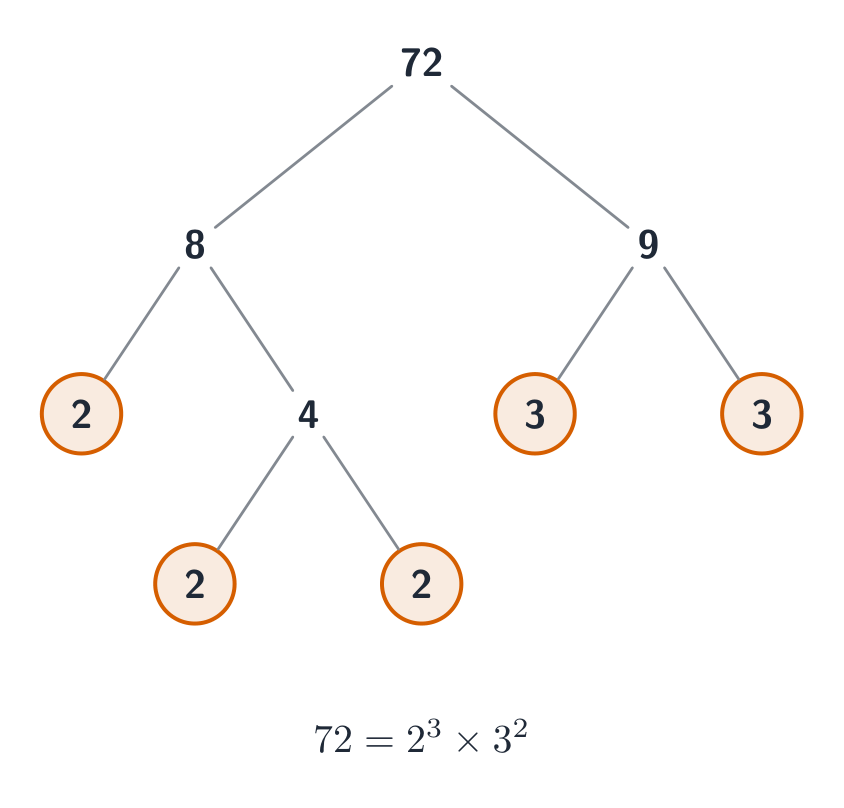
Worked example. Write $72$ as a product of its prime factors.
The highest common factor (HCF) 最大公因数 of two numbers is the largest factor they share. The lowest common multiple (LCM) 最小公倍数 is the smallest multiple they share. Prime factors give a quick method.
Worked example. Find the HCF and LCM of $72$ and $120$.
HCF: take the lowest power of each prime that appears in both: $2^{3} \times 3 = 24$.
LCM: take the highest power of every prime that appears: $2^{3} \times 3^{2} \times 5 = 360$.
العربية
يجب أن تعرف كلمات الأنواع المختلفة للأعداد. يعطي المصححون علامات لاستخدامها بشكل صحيح.
كل مجموعة تقع داخل المجموعة التالية: كل عدد طبيعي هو عدد صحيح، وكل عدد صحيح هو عدد نسبي، وكل عدد نسبي هو حقيقي. الأعداد غير النسبية هي أعداد حقيقية وليست نسبية.
أعداد العد والأعداد الصحيحة
الأعداد الطبيعية — أعداد العد $1, 2, 3, 4, \dots$
الأعداد الصحيحة — أعداد صحيحة موجبة أو سالبة أو صفر: $\dots, -2, -1, 0, 1, 2, \dots$
القواسم والمضاعفات
القاسم لعدد ما يقسم إليه بالضبط دون ترك أي باقي. قواسم $18$ هي $1, 2, 3, 6, 9, 18$.
المضاعف لعدد ما هو ذلك العدد مضروبًا في عدد صحيح. مضاعفات $6$ هي $6, 12, 18, 24, \dots$
القاسم المشترك لعددين هو قاسم لكلاهما.
المضاعف المشترك لعددين هو مضاعف لكلاهما.
الأعداد الأولية والمربعة والمكعبة
العدد الأولي له قاسمان فقط: $1$ ونفسه. الأعداد الأولية الأولى هي $2, 3, 5, 7, 11, 13, \dots$. لاحظ أن $1$ليس أوليًا.
العدد المربع هو عدد صحيح مضروب في نفسه: $1, 4, 9, 16, 25, \dots$
العدد المكعب يستخدم عدداً صحيحاً ثلاث مرات: $1, 8, 27, 64, \dots$
الأعداد النسبية وغير النسبية والمقلوب
العدد النسبي يمكن كتابته على شكل كسر$\frac{a}{b}$ من عددين صحيحين. أمثلة: $\frac{3}{4}$، $5$، $0.7$.
العدد غير النسبي لا يمكن كتابته بهذه الطريقة. أمثلة: $\pi$ و$\sqrt{2}$.
المقلوب لعدد ما هو $1$ مقسوماً على ذلك العدد. مقلوب $4$ هو $\frac{1}{4}$؛ مقلوب $0.25$ هو $4$؛ مقلوب $\frac{2}{3}$ هو $\frac{3}{2}$.
القواسم الأولية، أعلى قاسم مشترك وأصغر مضاعف مشترك
كل عدد صحيح فوق $1$ هو أولي، أو يمكن كتابته كـ حاصل ضرب لأعداد أولية. لكتابة عدد ما كحاصل ضرب قواسمه الأولية، استمر في القسمة على أصغر عدد أولي يناسب.
HCF: خذ أصغر أس لكل عدد أولي يظهر في كلاهما: $2^{3} \times 3 = 24$.
LCM: خذ أعلى أس لـ كل عدد أولي يظهر: $2^{3} \times 3^{2} \times 5 = 360$.
Explore · استكشف
Sets of numbers · مجموعات الأعداد
Every counting number is also an integer, every integer a rational — see how the number sets nest, and how union and intersection combine them. · كل عدد عددي هو أيضاً عدد صحيح، وكل عدد صحيح هو نسبي - انظر كيف تتداخل مجموعات الأعداد، وكيف تدمج الاتحاد والتقاطع بينها.
Understand and use set language, notation and Venn diagrams to describe sets.
Venn diagrams are limited to two sets. The following set notation will be used: • $n(A)$ Number of elements in set $A$ • $A'$ Complement of set $A$ • $\mathscr{E}$ Universal set • $A \cup B$ Union of $A$ and $B$ • $A \cap B$ Intersection of $A$ and $B$. Example definition of sets: $A = \{x : x \text{ is a natural number}\}$$B = \{a, b, c, \dots\}$$C = \{x : a \leqslant x \leqslant b\}$.
العربية
محتوى المادة
ملاحظات وأمثلة
فهم واستخدام لغة المجموعات والرموز ومخططات فن لتوصيف المجموعات.
مخططات فن محدودة بمجموعتين. سيتم استخدام رموز المجموعات التالية: • $n(A)$ عدد العناصر في المجموعة $A$ • $A'$ متممة المجموعة $A$ • $\mathscr{E}$ المجموعة الشاملة • $A \cup B$ اتحاد $A$ و$B$ • $A \cap B$ تقاطع $A$ و$B$. مثال على تعريف المجموعات: $A = \{x : x \text{ is a natural number}\}$$B = \{a, b, c, \dots\}$$C = \{x : a \leqslant x \leqslant b\}$.
Subject content
Notes and examples
Understand and use set language, notation and Venn diagrams to describe sets and represent relationships between sets.
Venn diagrams are limited to two or three sets. The following set notation will be used: • $n(A)$ Number of elements in set $A$ • $\in$ "... is an element of ..." • $\notin$ "... is not an element of ..." • $A'$ Complement of set $A$ • $\varnothing$ The empty set • $\mathscr{E}$ Universal set • $A \subseteq B$$A$ is a subset of $B$ • $A \nsubseteq B$$A$ is not a subset of $B$ • $A \cup B$ Union of $A$ and $B$ • $A \cap B$ Intersection of $A$ and $B$. Example definition of sets: $A = \{x : x \text{ is a natural number}\}$$B = \{(x, y) : y = mx + c\}$$C = \{x : a \leqslant x \leqslant b\}$$D = \{a, b, c, \dots\}$.
Source: Cambridge International syllabus · المصدر: منهج كامبريدج الدولي
English
A set 集合 is a collection of objects. Each object in the set is an element 元素 of the set. You should know this notation:
Symbol
Meaning
$n(A)$
the number of elements in set $A$
$x \in A$
$x$ is an element of $A$
$x \notin A$
$x$ is not an element of $A$
$\mathscr{E}$
the universal set 全集 — everything being talked about
$A'$
the complement 补集 of $A$ — everything not in $A$
$\varnothing$
the empty set 空集 — a set with no elements
$A \subseteq B$
$A$ is a subset 子集 of $B$ — every element of $A$ is also in $B$
$A \cup B$
the union 并集 — elements in $A$ or $B$ or both
$A \cap B$
the intersection 交集 — elements in both $A$ and $B$
A Venn diagram 维恩图 draws each set as a circle inside a rectangle (the universal set). Core uses two sets; Extended may use three.
Worked example.$\mathscr{E} = \{1,2,3,4,5,6,7,8,9,10\}$, $A = \{\text{even numbers}\}$, $B = \{\text{multiples of } 3\}$.
$A = \{2,4,6,8,10\}$ and $B = \{3,6,9\}$.
$A \cap B = \{6\}$ — the only number in both.
$A \cup B = \{2,3,4,6,8,9,10\}$ — the numbers in either set.
$n(A \cup B) = 7$.
You may also see a set written as a rule, e.g. $C = \{x : 1 \leqslant x \leqslant 5\}$ means "all values $x$ such that $1 \leqslant x \leqslant 5$".
العربية
المجموعة هي تجمع للأشياء. كل عنصر في المجموعة هو عنصر للمجموعة. يجب أن تعرف هذا الرمز:
الرمز
المعنى
$n(A)$
عدد العناصر في المجموعة $A$
$x \in A$
$x$ هو عنصر في $A$
$x \notin A$
$x$ ليس عنصراً في $A$
$\mathscr{E}$
المجموعة الشاملة — كل ما يتم التحدث عنه
$A'$
متممة$A$ — كل ما ليس في $A$
$\varnothing$
المجموعة الخالية — مجموعة بدون عناصر
$A \subseteq B$
$A$ هي مجموعة جزئية من $B$ — كل عنصر من $A$ موجود أيضاً في $B$
$A \cup B$
الاتحاد — العناصر في $A$ أو $B$ أو كليهما
$A \cap B$
التقاطع — العناصر في كل من $A$ و$B$
مخطط فين يرسم كل مجموعة كدائرة داخل مستطيل (المجموعة الشاملة). المستوى الأساسي يستخدم مجموعتين؛ المستوى الممتد قد يستخدم ثلاث.
مثال محلول.$\mathscr{E} = \{1,2,3,4,5,6,7,8,9,10\}$، $A = \{\text{even numbers}\}$، $B = \{\text{multiples of } 3\}$.
$A = \{2,4,6,8,10\}$ و$B = \{3,6,9\}$.
$A \cap B = \{6\}$ — الرقم الوحيد في المجموعتين معاً.
$A \cup B = \{2,3,4,6,8,9,10\}$ — الأرقام الموجودة في أي من المجموعتين.
$n(A \cup B) = 7$.
$A \cap B = \{6\}$ هو الرقم الوحيد في كلتا الدائرتين؛ $A \cup B$ يشمل كل ما بداخل أي من الدائرتين.
قد ترى أيضاً مجموعة مكتوبة بقاعدة، مثل: $C = \{x : 1 \leqslant x \leqslant 5\}$ تعني "جميع القيم $x$ بحيث $1 \leqslant x \leqslant 5$".
Explore · استكشف
Venn diagrams · مخططات فون
Tap the regions to see union, intersection and complement — the language of sets. · اضغط على المناطق لرؤية الاتحاد، التقاطع والمكملة — لغة المجموعات.
Calculate with the following: • squares • square roots • cubes • cube roots • other powers and roots of numbers.
Includes recall of squares and their corresponding roots from 1 to 15, and recall of cubes and their corresponding roots of 1, 2, 3, 4, 5 and 10, e.g.: • Write down the value of $\sqrt{169}$ . • Work out $5^2 \times \sqrt[3]{8}$ .
العربية
محتوى المادة
ملاحظات وأمثلة
احسب باستخدام ما يلي: • المربعات • الجذور التربيعية • المكعبات • الجذور التكعيبية • أسس وجذور أخرى للأعداد.
يشمل استرجاع المربعات وجذورها المقابلة من 1 إلى 15، واسترجاع المكعبات وجذورها المقابلة لـ 1، 2، 3، 4، 5 و 10، على سبيل المثال: • اكتب قيمة $\sqrt{169}$ . • احسب $5^2 \times \sqrt[3]{8}$ .
English
Subject content
Notes and examples
Calculate with the following: • squares • square roots • cubes • cube roots • other powers and roots of numbers.
Includes recall of squares and their corresponding roots from 1 to 15, and recall of cubes and their corresponding roots of 1, 2, 3, 4, 5 and 10, e.g.: • Write down the value of $\sqrt{169}$. • Work out $5^2 \times \sqrt[3]{8}$.
العربية
محتوى المادة
ملاحظات وأمثلة
إجراء الحسابات بالمتغيرات التالية: • المربعات • الجذور التربيعية • المكعبات • الجذور التكعيبية • قوى وجذور أخرى للأعداد.
يشمل استرجاع المربعات وجذورها المقابلة من 1 إلى 15، واسترجاع المكعبات وجذورها المقابلة لـ 1، 2، 3، 4، 5 و 10، مثال: • كتابة قيمة $\sqrt{169}$. • حساب $5^2 \times \sqrt[3]{8}$.
Source: Cambridge International syllabus · المصدر: منهج كامبريدج الدولي
English
A power 幂 (also called an index 指数, plural indices) shows how many times to multiply a number by itself: $2^{5} = 2 \times 2 \times 2 \times 2 \times 2 = 32$.
A square root 平方根 of a number gives that number when squared: $\sqrt{169} = 13$ because $13^{2} = 169$.
A cube root 立方根 works the same way for cubes: $\sqrt[3]{8} = 2$ because $2^{3} = 8$.
You should be able to recall the squares from $1^2$ to $15^2$ (and their roots), and the cubes of $1, 2, 3, 4, 5$ and $10$.
Worked example. Work out $5^{2} \times \sqrt[3]{8}$.
$$5^{2} \times \sqrt[3]{8} = 25 \times 2 = 50.$$
العربية
الأس (يُسمى أيضاً المؤشر، جمع مؤشرات) يوضح عدد مرات ضرب عدد في نفسه: $2^{5} = 2 \times 2 \times 2 \times 2 \times 2 = 32$.
الجذر التربيعي لعدد يعطي ذلك العدد عند تربيعه: $\sqrt{169} = 13$ لأن $13^{2} = 169$.
الجذر التكعيبي يعمل بنفس الطريقة للأعداد المكعبة: $\sqrt[3]{8} = 2$ لأن $2^{3} = 8$.
يجب أن تكون قادراً على استرجاع مربعات الأعداد من $1^2$ إلى $15^2$ (وجذورها)، ومكعبات الأعداد $1, 2, 3, 4, 5$ و$10$.
مثال محلول. احسب $5^{2} \times \sqrt[3]{8}$.
$$5^{2} \times \sqrt[3]{8} = 25 \times 2 = 50.$$
Explore · استكشف
Powers and roots lab · معمل الأسس والجذور
square = x^2 · مربع = x^2
Change the base and see powers grow while roots undo powers. · غيّر الأساس وانظر كيف تنمو الأسس بينما تلغي الجذور الأسس.
1.7
The laws of indices · قوانين المؤشرات
Syllabus · المنهج
English
Subject content
Notes and examples
1 Understand and use indices (positive, zero and negative integers).
e.g. find the value of $7^{-2}$.
2 Understand and use the rules of indices.
e.g. find the value of $2^{-3} \times 2^4$, $(2^3)^2$, $2^3 \div 2^4$.
1 Use the standard form $A \times 10^n$ where $n$ is a positive or negative integer and $1 \leqslant A < 10$.
2 Convert numbers into and out of standard form.
3 Calculate with values in standard form.
Core candidates are expected to calculate with standard form only on Paper 3.
العربية
محتوى المادة
ملاحظات وأمثلة
1 استخدم الصيغة القياسية $A \times 10^n$ حيث $n$ عدد صحيح موجب أو سالب و $1 \leqslant A < 10$.
2 حوّل الأعداد إلى وإلى خارج الصيغة القياسية.
3 احسب بالقيم بالصيغة القياسية.
من المتوقع أن يحسب المرشحون الأساسيون بالصيغة القياسية فقط في ورقة 3.
English
Subject content
Notes and examples
1 Use the standard form $A \times 10^n$ where $n$ is a positive or negative integer and $1 \leqslant A < 10$.
2 Convert numbers into and out of standard form.
3 Calculate with values in standard form.
العربية
محتوى المادة
ملاحظات وأمثلة
1 استخدم الصيغة القياسية $A \times 10^n$ حيث $n$ عدد صحيح موجب أو سالب و $1 \leqslant A < 10$.
2 حوّل الأعداد إلى وإلى خارج الصيغة القياسية.
3 إجراء الحسابات بالقيم بصيغة قياسية.
Source: Cambridge International syllabus · المصدر: منهج كامبريدج الدولي
English
Standard form 科学记数法 writes a number as $A \times 10^{n}$, where $1 \leqslant A < 10$ and $n$ is an integer. It is used for very large or very small numbers.
To convert, count how many places the decimal point moves:
$4\,500\,000 = 4.5 \times 10^{6}$ — the point moves $6$ places left, so the power is positive.
$0.00072 = 7.2 \times 10^{-4}$ — the point moves $4$ places right, so the power is negative.
Worked example. Work out $(3 \times 10^{5}) \times (2 \times 10^{-2})$.
Multiply the front numbers and add the powers:
$$3 \times 2 = 6, \qquad 10^{5} \times 10^{-2} = 10^{3}, \qquad \text{so the answer is } 6 \times 10^{3}.$$
العربية
مجرة: المسافات الهائلة تُكتب بصيغة مختصرة باستخدام الصيغة القياسية.
الصيغة القياسية تكتب العدد على صورة $A \times 10^{n}$، حيث $1 \leqslant A < 10$ و$n$ عدد صحيح. تُستخدم للأعداد الكبيرة جداً أو الصغيرة جداً.
للتحويل، عَد كم مرة انتقلت الفاصلة العشرية:
$4\,500\,000 = 4.5 \times 10^{6}$ — النقطة تتحرك $6$ خانة إلى اليسار، لذا القوة موجبة.
$0.00072 = 7.2 \times 10^{-4}$ — النقطة تتحرك $4$ خانة إلى اليمين، لذا القوة سالبة.
مثال محلول. احسب $(3 \times 10^{5}) \times (2 \times 10^{-2})$.
اضرب الأمامي وأضف القوى:
$$3 \times 2 = 6, \qquad 10^{5} \times 10^{-2} = 10^{3}, \qquad \text{so the answer is } 6 \times 10^{3}.$$
الصيغة القياسية: عدد يُكتب على صورة a × 10^n حيث 1 ≤ a < 10
Explore · استكشف
Standard form route · طريق الصيغة القياسية
Follow a large or small number into a x 10^n form. · اتبع رقماً كبيراً أو صغيراً لتحويله إلى شكل a x 10^n.
To rationalise the denominator 分母有理化 means to remove a surd from the bottom of a fraction (the denominator 分母). Multiply the top and bottom by a value that clears the surd.
Worked example. Rationalise $\dfrac{10}{\sqrt{5}}$ and $\dfrac{1}{-1+\sqrt{3}}$.
rationalise the denominator/ˈræʃənəlaɪz ðə dɪˈnɒmɪneɪtə/
تنظيف المقام
denominator/dɪˈnɒmɪneɪtə/
المقام
numerator/ˈnjuːməreɪtə/
البسط
proper fraction/ˈprɒpə ˈfrækʃn/
كسر بسيط
improper fraction/ɪmˈprɒpə ˈfrækʃn/
كسر غير بسيط
mixed number/mɪkst ˈnʌmbə/
عدد كسري
1.4
Fractions, decimals and percentages · الكسور والأعداد العشرية والنسب المئوية
Syllabus · المنهج
English
Subject content
Notes and examples
1 Use the language and notation of the following in appropriate contexts: • proper fractions • improper fractions • mixed numbers • decimals • percentages.
Candidates are expected to be able to write fractions in their simplest form. Candidates are not expected to use recurring decimal notation.
2 Recognise equivalence and convert between these forms.
Candidates are not expected to demonstrate the conversion of a recurring decimal to a fraction and vice versa.
العربية
محتوى المادة
ملاحظات وأمثلة
1 استخدم لغة ورموز ما يلي في السياقات المناسبة: • الكسور البسيطة • الكسور غير الصحيحة • الأعداد المختلطة • العشرية • النسب المئوية.
يُتوقع من المرشحين أن يكونوا قادرين على كتابة الكسور بأبسط صورة. لا يُتوقع من المرشحين استخدام رموز الكسور العشرية الدورية.
2 اعرف التكافؤ وحول بين هذه الأشكال.
لا يُتوقع من المرشحين إظهار تحويل كسر عشري دوري إلى كسر والعكس.
English
Subject content
Notes and examples
1 Use the language and notation of the following in appropriate contexts: • proper fractions • improper fractions • mixed numbers • decimals • percentages.
Candidates are expected to be able to write fractions in their simplest form. Recurring decimal notation is required, e.g. • $0.1\dot{7} = 0.1777...$ • $0.1\dot{2}\dot{3} = 0.1232323...$ • $0.\dot{1}2\dot{3} = 0.123123...$
2 Recognise equivalence and convert between these forms.
Includes converting between recurring decimals and fractions and vice versa, e.g. write $0.1\dot{7}$ as a fraction.
العربية
محتوى المادة
ملاحظات وأمثلة
1 استخدام لغة ورموز المتغيرات التالية في سياقات مناسبة: • الكسور البسيطة • الكسور غير الصحيحة • الأعداد المختلطة • الأعداد العشرية • النسب المئوية.
يُتوقع من المرشحين أن يتمكنوا من كتابة الكسور أبسط صورة. يُشترط استخدام رموز العدد العشري الدوار، مثال: • $0.1\dot{7} = 0.1777...$ • $0.1\dot{2}\dot{3} = 0.1232323...$ • $0.\dot{1}2\dot{3} = 0.123123...$
2 التعرف على التكافؤ والتحويل بين هذه الأشكال.
يشمل التحويل بين الأعداد العشرية الدورية والكسور والعكس، مثال: اكتب $0.1\dot{7}$ ككسر.
Source: Cambridge International syllabus · المصدر: منهج كامبريدج الدولي
English
A fraction has a numerator 分子 (the top) and a denominator (the bottom).
proper fraction 真分数: numerator smaller than denominator, e.g. $\frac{3}{4}$.
improper fraction 假分数: numerator the same or larger, e.g. $\frac{7}{4}$.
mixed number 带分数: a whole number plus a fraction, e.g. $1\frac{3}{4}$.
Change between improper and mixed: $\frac{7}{4} = 1\frac{3}{4}$ because $7 \div 4 = 1$ remainder $3$.
A decimal 小数 uses place value after a point. A percentage 百分比 means "out of $100$", so $37\% = \frac{37}{100} = 0.37$.
Converting between forms
To change
Method
Example
fraction → decimal
divide top by bottom
$\frac{3}{8} = 3 \div 8 = 0.375$
decimal → percentage
multiply by $100$
$0.07 = 7\%$
percentage → fraction
put over $100$, then simplify
$7\% = \frac{7}{100}$
percentage → decimal
divide by $100$
$34\% = 0.34$
Write a fraction in its simplest form 最简形式 by dividing the top and bottom by their HCF: $\frac{18}{24} = \frac{3}{4}$ (both divided by $6$).
Recurring decimals (Extended)
A recurring decimal 循环小数 repeats the same digits forever. Dots mark the repeating part: $0.1\dot{7} = 0.1777\ldots$ and $0.\dot{1}2\dot{3} = 0.123123\ldots$
To turn a recurring decimal into a fraction, multiply so the repeating parts line up, then subtract.
Worked example. Write $0.1\dot{7}$ as a fraction.
Let $x = 0.1777\ldots$ Only the $7$ repeats, so use $10x$ and $100x$:
Use the four operations for calculations with integers, fractions and decimals, including correct ordering of operations and use of brackets.
Includes: • negative numbers • improper fractions • mixed numbers • practical situations, e.g. temperature changes.
العربية
محتوى المادة
ملاحظات وأمثلة
استخدم العمليات الأربع للحساب مع الأعداد الصحيحة والكسور والعشرية، بما في ذلك الترتيب الصحيح للعمليات واستخدام الأقواس.
يشمل: • الأعداد السالبة • الكسور غير الصحيحة • الأعداد المختلطة • مواقف عملية، مثل تغيرات درجة الحرارة.
Source: Cambridge International syllabus · المصدر: منهج كامبريدج الدولي
English
Order of operations
Work in this order — the order of operations 运算顺序: brackets first, then indices (powers and roots), then multiply and divide (left to right), then add and subtract (left to right).
Worked example. Work out $-6 \times -3 + 7 \times 2$.
Do the multiplications first: $-6 \times -3 = 18$ and $7 \times 2 = 14$. Then add: $18 + 14 = 32$.
Negative numbers
Adding a negative: $5 + (-3) = 5 - 3 = 2$.
Subtracting a negative: $5 - (-3) = 5 + 3 = 8$.
Multiplying or dividing: same signs give a positive; different signs give a negative. So $-6 \times -3 = 18$ but $-12 \div 4 = -3$.
A change in temperature from $-5\,{}^{\circ}\text{C}$ to $3\,{}^{\circ}\text{C}$ is a rise of $8\,{}^{\circ}\text{C}$.
Calculating with fractions
Multiply: multiply the tops, multiply the bottoms: $\frac{2}{3} \times \frac{4}{5} = \frac{8}{15}$.
Divide: multiply by the reciprocal of the second fraction: $\frac{2}{3} \div \frac{4}{5} = \frac{2}{3} \times \frac{5}{4} = \frac{10}{12} = \frac{5}{6}$.
Add or subtract: use a common denominator (the LCM of the bottoms).
Worked example. Work out $1\frac{7}{15} - \frac{4}{5}$, giving the answer in its simplest form.
Change the mixed number to an improper fraction, then use denominator $15$:
اعمل بالترتيب التالي — ترتيب العمليات: الأقواس أولاً، ثم المؤشرات (الأسس والجذور)، ثم الضرب والقسمة (من اليسار لليمين)، ثم الجمع والطرح (من اليسار لليمين).
2 Express one quantity as a percentage of another.
3 Calculate percentage increase or decrease.
4 Calculate with simple and compound interest.
Formulas are not given. Percentage calculations may include: • deposit • discount • profit and loss (as an amount or a percentage) • earnings • percentages over 100%.
العربية
محتوى المادة
ملاحظات وأمثلة
1 حساب نسبة مئوية معينة من كمية.
2 التعبير عن كمية كنسبة مئوية من أخرى.
3 حساب الزيادة أو النقصان المئوي.
4 الحساب بفوائد بسيطة ومتراكمة.
لن تُعطى القوانين. قد تتضمن حسابات النسب المئوية: • الإيداع • الخصم • الربح والخسارة (كمبلغ أو كنسبة مئوية) • الأرباح • النسب المئوية التي تتجاوز 100%.
English
Subject content
Notes and examples
1 Calculate a given percentage of a quantity.
2 Express one quantity as a percentage of another.
3 Calculate percentage increase or decrease.
4 Calculate with simple and compound interest.
Problems may include repeated percentage change. Formulas are not given.
5 Calculate using reverse percentages.
e.g. find the cost price given the selling price and the percentage profit. Percentage calculations may include: • deposit • discount • profit and loss (as an amount or a percentage) • earnings • percentages over 100%.
العربية
محتوى المادة
ملاحظات وأمثلة
1 حساب نسبة مئوية معينة من كمية.
2 التعبير عن كمية كنسبة مئوية من أخرى.
3 حساب الزيادة أو النقصان المئوي.
4 إجراء الحسابات بفوائد بسيطة ومركبة.
قد تتضمن المسائل تغييراً مئوياً متكرراً. لن يتم تقديم الصيغ.
5 إجراء الحسابات باستخدام نسب مئوية عكسية.
مثال: إيجاد سعر التكلفة بمعلومية سعر البيع ونسبة الربح. قد تشمل الحسابات المئوية: • الإيداع • الخصم • الربح والخسارة (كمبلغ أو كنسبة) • الأرباح • النسب المئوية التي تتجاوز 100%.
Source: Cambridge International syllabus · المصدر: منهج كامبريدج الدولي
English
Find a percentage of an amount.$15\%$ of $\$80 = 0.15 \times 80 = \$12$.
Write one amount as a percentage of another. A score of $18$ out of $25$ is $\frac{18}{25} \times 100\% = 72\%$.
A reverse percentage 逆百分比 problem gives the amount after a change and asks for the original. To solve it, divide by the multiplier — do not just take the percentage off.
Worked example. A coat costs $\$60$ after a $20\%$ increase. Find the original price.
$\$60$ is $120\%$ of the original, so the original price is $60 \div 1.2 = \$50$.
العربية
تستخدم المتاجر النسب المئوية للخصومات وضريبة المبيعات وهوامش الربح.
إيجاد نسبة مئوية من مقدار.$15\%$ من $\$80 = 0.15 × 80 = \$12$.
كتابة مقدار كنسبة مئوية من آخر. درجة $18$ من $25$ هي $\frac{18}{25} \times 100\% = 72\%$.
e.g. depreciation, population change. Knowledge of e is not required.
العربية
محتوى المادة
ملاحظات وأمثلة
استخدام النمو والتحلل الأسّي.
مثال: الانخلاق في القيمة، تغير عدد السكان. لا يُشترط معرفة e.
Source: Cambridge International syllabus · المصدر: منهج كامبريدج الدولي
English
When a quantity changes by the same percentage in each time period, it shows exponential growth 指数增长 (it gets bigger) or exponential decay 指数衰减 (it gets smaller). Use the compound formula. Depreciation 折旧, where something like a car loses value each year, is decay.
Worked example. A car worth $\$20\,000$ loses $15\%$ of its value each year. Find its value after $4$ years.
عندما يتغير مقدار بنسبة ثابتة في كل فترة زمنية، فإنه يُظهر نموًا أسيًا (يتزايد) أو تناقصًا أسيًا (يتناقص). استخدم الصيغة المركبة. الاهتلاك، حيث تفقد شيء مثل السيارة قيمتها كل عام، هو تناقص.
مثال محلول. سيارة قيمتها $\$20\,000$ loses $15\%$ of its value each year. Find its value after $4$ سنوات.
التناقص الأسي: تفقد السيارة 15% من قيمتها الحالية كل عام
Explore · استكشف
Compound interest · فائدة مركبة
Money grows by (1 + r) every year, so compound interest curves above simple interest. Drag the rate and the number of years. · ينمو المال بمقدار (1 + r) كل عام، لذا منحنيات الفائدة المركبة فوق الفائدة البسيطة. اسحب المعدل وعدد السنوات.
Change the base b: b > 1 grows, 0 < b < 1 decays — useful for interest and populations. · غيّر القاعدة b: b > 1 ينمو، 0 < b < 1 يتناقص — مفيد للفائدة والسكان.
• use proportional reasoning and ratios in context.
e.g. adapt recipes; use map scales; determine best value.
العربية
محتوى المادة
ملاحظات وأمثلة
فهم واستخدام التناسب والمقياس في:
• تقديم نسب بأبسط صورة
مثال: 20:30:40 بأبسط صورة هي 2:3:4.
• تقسيم كمية بنسبة معينة
• استخدام الاستدلال النسبي والنسب في سياق عملي.
مثال: تعديل الوصفات؛ استخدام مقياس الخريطة؛ تحديد أفضل قيمة.
Source: Cambridge International syllabus · المصدر: منهج كامبريدج الدولي
English
A ratio 比 compares quantities, written like $a:b$. Simplify it like a fraction by dividing by the HCF: $20:30:40 = 2:3:4$.
Dividing in a ratio. Share $\$48$ in the ratio $3:5$.
The total number of parts is $3 + 5 = 8$. One part is $48 \div 8 = \$6$. So the shares are $3 \times 6 = \$18$ and $5 \times 6 = \$30$.
Proportion 比例 means two ratios are equal. Use it for recipes, map scales 比例尺 and finding best value.
Worked example.$3$ pens cost $\$1.80$. Find the cost of $7$ pens.
One pen costs $1.80 \div 3 = \$0.60$. So $7$ pens cost $7 \times 0.60 = \$4.20$.
العربية
المقياس يقارن كميات، يُكتب مثل $a:b$. بسّطه كالكسر بقسمة القاسم المشترك الأكبر: $20:30:40 = 2:3:4$.
التقسيم according to a ratio. قسّم $\$48$ in the ratio $3:5$.
إجمالي عدد الأجزاء هو $3 + 5 = 8$. الجزء الواحد هو $48 \div 8 = \$6$. So the shares are $3 × 6 = \$18$ و$5 \times 6 = \$30$.
نموذج العمود لتقسيم 48 دولارًا按比例 3 إلى 5
التناسب يعني أن مقياسين متساويان. استخدمه في الوصفات ومقاييس الخرائط وإيجاد أفضل قيمة.
مثال محلول.$3$ أقلام تكلف $\$1.80$. Find the cost of $7$ للأقلام.
السعر للقلم الواحد هو $1.80 \div 3 = \$0.60$. So $7$ pens cost $7 × 0.60 = \$4.20$.
Explore · استكشف
Direct proportion · التناسب الطردي
y = ax
Direct proportion is a straight line through the origin — double x and you double y. · التناسب الطردي هو خط مستقيم يمر بنقطة الأصل — ضاعف x وضاعف y.
1.12
Rates and average speed · المعدلات والسرعة المتوسطة
Syllabus · المنهج
English
Subject content
Notes and examples
1 Use common measures of rate.
e.g. calculate with: • hourly rates of pay • exchange rates between currencies • flow rates • fuel consumption.
2 Apply other measures of rate.
e.g. calculate with: • pressure • density • population density. Required formulas will be given in the question.
3 Solve problems involving average speed.
Knowledge of speed/distance/time formula is required. e.g. A cyclist travels 45 km in 3 hours 45 minutes. What is their average speed? Notation used will be, e.g. m/s (metres per second), $\text{g/cm}^3$ (grams per cubic centimetre).
مثال: الحساب بـ: • الضغط • الكثافة • الكثافة السكانية. سيتم إعطاء القوانين المطلوبة في السؤال.
3 حل المسائل المتعلقة بالسرعة المتوسطة.
مطلوب معرفة قانون السرعة/المسافة/الزمن. مثال: راكب دراجة يقطع مسافة 45 كم في 3 ساعات و45 دقيقة. ما هي سرعته المتوسطة؟ الرموز المستخدمة ستكون، على سبيل المثال: m/s (متر في الثانية)، $\text{g/cm}^3$ (غرام لكل سنتيمتر مكعب).
English
Subject content
Notes and examples
1 Use common measures of rate.
e.g. calculate with: • hourly rates of pay • exchange rates between currencies • flow rates • fuel consumption.
2 Apply other measures of rate.
e.g. calculate with: • pressure • density • population density. Required formulas will be given in the question.
3 Solve problems involving average speed.
Knowledge of speed/distance/time formula is required. e.g. A cyclist travels 45 km in 3 hours 45 minutes. What is their average speed? Notation used will be, e.g. m/s (metres per second), g/cm$^{3}$ (grams per cubic centimetre).
مثال: الحساب بـ: • الضغط • الكثافة • الكثافة السكانية. سيتم إعطاء القوانين المطلوبة في السؤال.
3 حل المسائل المتعلقة بالسرعة المتوسطة.
يتطلب الأمر معرفة صيغة السرعة/المسافة/الزمن. مثال: راكب دراجة يقطع مسافة 45 كم في 3 ساعات و 45 دقيقة. ما هي سرعته المتوسطة؟ الرمز المستخدم سيكون، مثل m/s (متر لكل ثانية)، g/cm$^{3}$ (غرام لكل سنتيمتر مكعب).
Source: Cambridge International syllabus · المصدر: منهج كامبريدج الدولي
English
A rate 比率 compares two quantities measured in different units, such as price per kilogram, or distance per hour.
Other examples are flow rate, fuel consumption and population density 人口密度. If a rate needs a special formula (such as pressure 压强), the question will give it to you.
العربية
المعدل يقارن كميتين مقاستين بوحدات مختلفة، مثل السعر لكل كيلوجرام أو المسافة لكل ساعة.
Classify numbers by the decision needed for accuracy. · صنّف الأرقام حسب القرار المطلوب للدقة.
1.10
Limits of accuracy · حدود الدقة
Syllabus · المنهج
English
Subject content
Notes and examples
Give upper and lower bounds for data rounded to a specified accuracy.
e.g. write down the upper bound of a length measured correct to the nearest metre. Candidates are not expected to find the bounds of the results of calculations which have used data rounded to a specified accuracy.
العربية
محتوى المادة
ملاحظات وأمثلة
إعطاء الحدود العليا والسفلية للبيانات المدورة بدقة محددة.
مثال: اكتب الحد الأعلى لطول مقاس بدقة nearest metre. لا يُتوقع من المرشحين إيجاد حدود نتائج العمليات الحسابية التي استخدمت بيانات مدورة بدقة محددة.
English
Subject content
Notes and examples
1 Give upper and lower bounds for data rounded to a specified accuracy.
e.g. write down the upper bound of a length measured correct to the nearest metre.
2 Find upper and lower bounds of the results of calculations which have used data rounded to a specified accuracy.
Example calculations include: • calculate the upper bound of the perimeter or the area of a rectangle given dimensions measured to the nearest centimetre • find the lower bound of the speed given rounded values of distance and time.
العربية
محتوى المادة
ملاحظات وأمثلة
1 إعطاء الحدود العليا والسفلية للبيانات المدورة إلى دقة محددة.
مثال: كتابة الحد الأعلى لطول تم قياسه بدقة لأقرب متر.
2 أوجد الحدود العليا والسفلى لنتائج الحسابات التي استخدمت بيانات مقربة إلى دقة محددة.
تشمل أمثلة الحسابات: • حساب الحد العلوي للمحيط أو مساحة مستطيل بعد أبعاده مقاسة لأقرب سنتيمتر • إيجاد الحد السفلي للسرعة بعد قيم مقربة للمسافة والزمن.
Source: Cambridge International syllabus · المصدر: منهج كامبريدج الدولي
English
A rounded value could really be anything that rounds to it. The smallest possible value is the lower bound 下界; the largest is the upper bound 上界. For a value rounded to the nearest unit, the bounds lie half a unit on each side.
Worked example. A height $h$ is $635\text{ m}$, correct to the nearest metre. Give the bounds.
$$634.5 \leqslant h < 635.5.$$
So the lower bound is $634.5\text{ m}$ and the upper bound is $635.5\text{ m}$.
Bounds in calculations (Extended)
Combine the bounds to get the bound you want.
Worked example. A rectangle is $8\text{ cm}$ by $5\text{ cm}$, each side to the nearest cm. Find the largest possible area 面积.
Use the upper bounds of both sides: $8.5 \times 5.5 = 46.75\text{ cm}^{2}$. (The smallest area uses the lower bounds: $7.5 \times 4.5 = 33.75\text{ cm}^{2}$.)
For a divided quantity such as $\text{speed} = \dfrac{\text{distance}}{\text{time}}$, the largest speed comes from the largest distance divided by the smallest time.
العربية
القيمة المقربة قد تكون فعلياً أي شيء يقرب إليها. أصغر قيمة ممكنة هي الحد الأدنى؛ والأكبر هو الحد الأعلى. بالنسبة لقيمة مقربة لأقرب وحدة، تقع الحدود بمقدار نصف وحدة على كل جانب.
مثال محلول. طول $h$ هو $635\text{ m}$، صحيح إلى أقرب متر. حدد الحدود.
$$634.5 \leqslant h < 635.5.$$
كل ما في المنطقة يقرب إلى 635: الحد الأدنى مشمول، والحد الأعلى غير مشمول
لذا الحد الأدنى هو $634.5\text{ m}$ والحد الأعلى هو $635.5\text{ m}$.
الحدود في الحسابات (متقدم)
اجمع الحدود للحصول على الحد المطلوب.
مثال محلول. مستطيل أبعاده $8\text{ cm}$ بـ $5\text{ cm}$، كل ضلع إلى أقرب سم. أوجد أكبر مساحة ممكنة.
استخدم الحدود العليا لكلا الضلعين: $8.5 \times 5.5 = 46.75\text{ cm}^{2}$. (أصغر مساحة تستخدم الحدود الدنيا: $7.5 \times 4.5 = 33.75\text{ cm}^{2}$.)
بالنسبة لكمية مقسمة مثل $\text{speed} = \dfrac{\text{distance}}{\text{time}}$، تأتي السرعة الأكبر من المسافة الأكبر مقسومة على الزمن الأصغر.
1.15
Time · الوقت
Syllabus · المنهج
English
Subject content
Notes and examples
1 Calculate with time: seconds (s), minutes (min), hours (h), days, weeks, months, years, including the relationship between units.
1 year = 365 days.
2 Calculate times in terms of the 24-hour and 12-hour clock.
In the 24-hour clock, for example, 3.15 a.m. will be denoted by 03 15 and 3.15 p.m. by 15 15.
3 Read clocks and timetables.
Includes problems involving time zones, local times and time differences.
العربية
محتوى المادة
ملاحظات وأمثلة
1 احسب بالوقت: الثواني (s)، والدقائق (min)، والساعات (h)، والأيام، والأسابيع، والأشهر، والسنوات، بما في ذلك العلاقة بين الوحدات.
1 سنة = 365 يوم.
2 حساب الأوقات بنظام الساعة 24 نظام الساعة 12.
في نظام الساعة 24، على سبيل المثال، 3.15 صباحًا يُرمز له بـ 03 15 و3.15 مساءً بـ 15 15.
3 قراءة الساعات والجداول الزمنية.
يشمل مسائل تتعلق بمنطقة زمنية، أوقات محلية وفروقات زمنية.
English
Subject content
Notes and examples
1 Calculate with time: seconds (s), minutes (min), hours (h), days, weeks, months, years, including the relationship between units.
1 year = 365 days.
2 Calculate times in terms of the 24-hour and 12-hour clock.
In the 24-hour clock, for example, 3.15 a.m. will be denoted by 0315 and 3.15 p.m. by 1515.
3 Read clocks and timetables.
Includes problems involving time zones, local times and time differences.
العربية
محتوى المادة
ملاحظات وأمثلة
1 احسب بالوقت: الثواني (s)، والدقائق (min)، والساعات (h)، والأيام، والأسابيع، والأشهر، والسنوات، بما في ذلك العلاقة بين الوحدات.
1 سنة = 365 يوم.
2 حساب الأوقات بدلالة نظام الساعة 24-ساعة ونظام الساعة 12-ساعة.
في نظام الساعة 24-ساعة، على سبيل المثال، سيتم تمثيل 3.15 صباحاً بـ 0315 و 3.15 مساءً بـ 1515.
3 قراءة الساعات والجداول الزمنية.
يشمل مسائل تتعلق بمنطقة زمنية، أوقات محلية وفروقات زمنية.
Source: Cambridge International syllabus · المصدر: منهج كامبريدج الدولي
e.g. know not to round values within a calculation and to only round the final answer.
2 Enter values appropriately on a calculator.
e.g. enter 2 hours 30 minutes as 2.5 hours or 2° 30’ 0’’.
3 Interpret the calculator display appropriately.
e.g. in money 4.8 means $4.80; in time 3.25 means 3 hours 15 minutes.
العربية
محتوى المادة
ملاحظات وأمثلة
1 استخدام الآلة الحاسبة بكفاءة.
مثال: عدم تقريب القيم أثناء الحساب بل تقريب الإجابة النهائية فقط.
2 أدخل القيم بشكل مناسب على الآلة الحاسبة.
مثال: أدخل 2 ساعة 30 دقيقة على شكل 2.5 ساعات أو 2° 30’ 0’’.
3 فسر عرض الآلة الحاسبة بشكل مناسب.
مثال: في المال 4.8 تعني $4.80؛ في الوقت 3.25 تعني 3 ساعات 15 دقائق.
English
Subject content
Notes and examples
1 Use a calculator efficiently.
e.g. know not to round values within a calculation and to only round the final answer.
2 Enter values appropriately on a calculator.
e.g. enter 2 hours 30 minutes as 2.5 hours or 2° 30' 0''.
3 Interpret the calculator display appropriately.
e.g. in money 4.8 means $4.80; in time 3.25 means 3 hours 15 minutes.
العربية
محتوى المادة
ملاحظات وأمثلة
1 استخدام الآلة الحاسبة بكفاءة.
مثال: عدم تقريب القيم أثناء الحساب بل تقريب الإجابة النهائية فقط.
2 إدخال القيم بشكل مناسب على الآلة الحاسبة.
مثال: إدخال 2 ساعة و 30 دقيقة كـ 2.5 ساعة أو 2° 30' 0''.
3 فسر عرض الآلة الحاسبة بشكل مناسب.
مثال: في المال 4.8 تعني $4.80؛ في الوقت 3.25 تعني 3 ساعات 15 دقائق.
Source: Cambridge International syllabus · المصدر: منهج كامبريدج الدولي
English
Do not round part-way through a calculation. Keep the full value and round only the final answer.
Enter time as a decimal of an hour: $2$ hours $30$ minutes is $2.5$ hours, not $2.30$.
Read the display in context: in money, $4.8$ means $\$4.80$; in time, $3.25$ hours means $3$ hours $15$ minutes.
العربية
لا تقرب جزئياً أثناء الحساب. احتفظ بالقيمة الكاملة وقرب فقط الإجابة النهائية.
أدخل الوقت ككسر عشري من الساعة: $2$ ساعات $30$ دقائق هي $2.5$ ساعات، وليست $2.30$.
اقرأ العرض في سياقه: في kontekst المال، $4.8$ تعني $\$4.80$; in time, $3.25$ hours means $3$ hours $15$ دقائق.
1.14
Exam tips · نصائح للامتحان
English
Follow BIDMAS (brackets, indices, division/multiplication, addition/subtraction) in order, and remember a negative times a negative is positive.
In standard form the number in front is between 1 and 10; a small number (like $0.0004$) has a negative power of 10.
A percentage change is worked out on the original amount. For a reverse percentage, divide by the multiplier (e.g. $\div 1.2$ undoes a $20\%$ rise).
Do not round part-way through — keep the full value and round only at the end, to the accuracy the question asks for (decimal places or significant figures).
For limits of accuracy, a value rounded to the nearest whole number can be up to $0.5$ either side (so $8$ means $7.5 \le x < 8.5$).
العربية
اتبع ترتيب العمليات (أقواس، أسس، قسمة/ضرب، جمع/طرح) بالتسلسل، وتذكر أن سالب × سالب = موجب.
في الصيغة القياسية، يكون الرقم الموجود أمام علامة الأس بين 1 و10؛ العدد الصغير (مثل $0.0004$) له أس سالب من 10.
نسبة التغير تُحسب على المبلغ الأصلي. بالنسبة للنسبة المئوية العكسية، اقسم على المعامل (مثلاً $\div 1.2$ يلغي ارتفاعاً قدره $20\%$).
لا تقرب جزئياً — احتفظ بالقيمة الكاملة وقرب فقط في النهاية، بدقة تطلبها المسألة (خانات عشرية أو أرقام ذات دلالة).
بالنسبة لـحدود الدقة، القيمة المقربة لأقرب عدد صحيحة يمكن أن تتفاوت حتى $0.5$ على كل جانب (لذلك $8$ تعني $7.5 \le x < 8.5$).
This handout covers Topic 2, Algebra and graphs. Parts marked (Extended) are only tested on the Extended papers; everything else is for both levels.
2.1
Working with algebra
Syllabus · المنهج
English
Subject content
Notes and examples
1 Know that letters can be used to represent generalised numbers.
2 Substitute numbers into expressions and formulas.
العربية
محتوى المادة
ملاحظات وأمثلة
1 تعرف أن الأحرف يمكن استخدامها لتمثيل أعداد عامة.
2 عوض بالأعداد في التعبيرات والمعادلات.
Source: Cambridge International syllabus · المصدر: منهج كامبريدج الدولي
In algebra 代数 we use letters to stand for numbers. A letter whose value can change is a variable 变量. To substitute 代入 means to put a number in place of a letter.
Worked example. Find the value of $3x^{2} - 2y$ when $x = 4$ and $y = 5$.
5 إكمال المربع للتعبيرات على الصيغة $ax^2 + bx + c$.
Source: Cambridge International syllabus · المصدر: منهج كامبريدج الدولي
A term 项 is a single part of an expression 表达式, such as $5a$ or $-9b$. Like terms 同类项 have exactly the same letters; you may add or subtract them. The number in front of the letter is the coefficient 系数.
Expanding a bracket with an area modelCollecting like terms: add terms with the same letter
Collect like terms: $2a^{2} + 5a^{2} = 7a^{2}$, $3ab - 9ab = -6ab$, $-1 + 4 = 3$. So the answer is
$$7a^{2} - 6ab + 3.$$
To expand 展开 means to multiply out brackets 括号. Multiply every term inside by the term outside; for two brackets, multiply every term in the first by every term in the second.
Source: Cambridge International syllabus · المصدر: منهج كامبريدج الدولي
An algebraic fraction 分式 has algebra on the top or bottom. Add and subtract using a common denominator; multiply and divide as with ordinary fractions.
1 Understand and use indices (positive, zero and negative).
e.g. $2^x = 32$. Find the value of $x$.
2 Understand and use the rules of indices.
e.g. simplify: • $(5x^3)^2$ • $12a^5 \div 3a^{-2}$ • $6x^7y^4 \times 5x^{-5}y$. Knowledge of logarithms is not required.
العربية
محتوى المادة
ملاحظات وأمثلة
1 افهم واستخدم المؤشرات (الموجبة، صفر، والسالبة).
على سبيل المثال $2^x = 32$. أوجد قيمة $x$.
2 افهم واستخدم قواعد المؤشرات.
على سبيل المثال، بسّغ: • $(5x^3)^2$ • $12a^5 \div 3a^{-2}$ • $6x^7y^4 \times 5x^{-5}y$. لا يُطلب معرفة اللوغاريتمات.
English
Subject content
Notes and examples
1 Understand and use indices (positive, zero, negative and fractional).
e.g. solve: • $32^x = 2$ • $5^{x+1} = 25^x$.
2 Understand and use the rules of indices.
e.g. simplify: • $3x^{-4} \times \frac{2}{3}x^{\frac{1}{2}}$ • $\frac{2}{5}x^{\frac{1}{2}} \div 2x^{-2}$ • $\left(\frac{2x^5}{3}\right)^3$. Knowledge of logarithms is not required.
العربية
محتوى المادة
ملاحظات وأمثلة
1 فهم واستخدام الأسس (الموجبة، والصفرية، والسالبة والكسرية).
مثل: حل: • $32^x = 2$ • $5^{x+1} = 25^x$.
2 افهم واستخدم قواعد المؤشرات.
على سبيل المثال، بسّغ: • $3x^{-4} \times \frac{2}{3}x^{\frac{1}{2}}$ • $\frac{2}{5}x^{\frac{1}{2}} \div 2x^{-2}$ • $\left(\frac{2x^5}{3}\right)^3$. لا يُطلب معرفة اللوغاريتمات.
Source: Cambridge International syllabus · المصدر: منهج كامبريدج الدولي
The laws of indices 指数 work with letters too: $a^{m} \times a^{n} = a^{m+n}$, $a^{m} \div a^{n} = a^{m-n}$, and $(a^{m})^{n} = a^{mn}$.
4 Solve simultaneous linear equations in two unknowns.
5 Solve simultaneous equations, involving one linear and one non-linear.
With powers no higher than two.
6 Solve quadratic equations by factorisation, completing the square and by use of the quadratic formula.
Includes writing a quadratic expression in completed square form. Candidates may be expected to give solutions in surd form. The quadratic formula is given in the List of formulas.
7 Change the subject of formulas.
e.g. change the subject of a formula where: • the subject appears twice • there is a power or root of the subject.
العربية
محتوى المادة
ملاحظات وأمثلة
1 بناء تعابير ومعادلات وقوانين.
مثل: كتابة تعبير لحاصل ضرب عددين زوجيين متتاليين. يشمل بناء معادلات متزامنة.
Represent and interpret inequalities, including on a number line.
When representing and interpreting inequalities on a number line: • open circles should be used to represent strict inequalities (<, >) • closed circles should be used to represent inclusive inequalities ($\leqslant$, $\geqslant$) e.g. $-3 \leqslant x < 1$
العربية
محتوى المادة
ملاحظات وأمثلة
مثّل وتفسير المتباينات، بما في ذلك على خط الأعداد.
عند تمثيل وتفسير المتباينات على خط الأعداد: • يجب استخدام دوائر مفتوحة لتمثيل المتباينات الصارمة (<, >) • يجب استخدام دوائر مغلقة لتمثيل المتباينات الشاملة ($\leqslant$، $\geqslant$) على سبيل المثال $-3 \leqslant x < 1$
English
Subject content
Notes and examples
1 Represent and interpret inequalities, including on a number line.
When representing and interpreting inequalities on a number line: • open circles should be used to represent strict inequalities (<, >) • closed circles should be used to represent inclusive inequalities ($\leqslant$, $\geqslant$). e.g. $-3 \leqslant x < 1$
2 Construct, solve and interpret linear inequalities.
3 Represent and interpret linear inequalities in two variables graphically.
The following conventions should be used: • broken lines should be used to represent strict inequalities (<, >) • solid lines should be used to represent inclusive inequalities ($\leqslant$, $\geqslant$) • shading should be used to represent unwanted regions (unless otherwise directed in the question). e.g. graphs of $x < 1$ and $y \geqslant 1$
4 List inequalities that define a given region.
Linear programming problems are not included.
العربية
محتوى المادة
ملاحظات وأمثلة
1 تمثيل وتفسير المتباينات، بما في ذلك على خط الأعداد.
عند تمثيل وتفسير المتباينات على خط الأعداد: • تُستخدم الدوائر المفتوحة لتمثيل المتباينات الحادة (<, >) • تُستخدم الدوائر المغلقة لتمثيل المتباينات الشاملة ($\leqslant$، $\geqslant$). مثل: $-3 \leqslant x < 1$
3 تمثيل وتفسير المتباينات الخطية في متغيرين بيانياً.
يجب استخدام الترتيبات التالية: • يجب استخدام خطوط متقطعة لتمثيل المتباينات الصارمة (<, >) • يجب استخدام خطوط متصلة لتمثيل المتباينات الشاملة ($\leqslant$، $\geqslant$) • يجب تظليل المناطق غير المرغوب فيها (إلا إذا تم توجيه ذلك بشكل مختلف في السؤال). مثال: رسوم بيانية لـ $x < 1$ و $y \geqslant 1$
4 سرد المتباينات التي تحدد منطقة معينة.
لا تشمل مسائل البرمجة الخطية.
Source: Cambridge International syllabus · المصدر: منهج كامبريدج الدولي
An inequality 不等式 uses $<$, $>$, $\leqslant$ or $\geqslant$. Solve it like an equation, but reverse the sign if you multiply or divide by a negative number.
On a number line 数轴, use an open circle for $<$ or $>$ (value not included) and a closed circle for $\leqslant$ or $\geqslant$ (value included).
$-\tfrac{1}{3} \leqslant x < 3$: a closed circle includes the end value, an open circle excludes it.
Regions (Extended)
An inequality in two letters describes a region 区域 of the graph. Draw the boundary line (broken for $<$ or $>$, solid for $\leqslant$ or $\geqslant$) and shade the unwanted side. You may also be asked to list the inequalities that define a given region.
Explore · استكشف
Inequalities · المتباينات
y = ax + b
An inequality asks where the line is above or below a value. · تسأل المتباينة أين يكون الخط فوق أو تحت قيمة معينة.
e.g. write the next two terms in this sequence: 1, 3, 6, 10, 15, ... , ...
2 Recognise patterns in sequences, including the term-to-term rule, and relationships between different sequences.
3 Find and use the $n$th term of the following sequences: (a) linear (b) simple quadratic (c) simple cubic.
e.g. find the $n$th term of 2, 5, 10, 17
العربية
محتوى المادة
ملاحظات وأمثلة
1 أكمل متتالية عددية أو نمطاً معطى.
على سبيل المثال، اكتب الحدين التاليين في هذه المتتالية: 1، 3، 6، 10، 15، ... ، ...
2 اعرف الأنماط في المتتاليات، بما في ذلك قاعدة الحد إلى الحد، والعلاقات بين متتاليات مختلفة.
3 أوجد واستخدم الحد $n$th من المتتاليات التالية: (أ) الخطية (ب) التربيعية البسيطة (ج) التكعيبية البسيطة.
على سبيل المثال، أوجد الحد $n$th من 2، 5، 10، 17
English
Subject content
Notes and examples
1 Continue a given number sequence or pattern.
Subscript notation may be used, e.g. $T_n$ is the $n$th term of sequence $T$.
2 Recognise patterns in sequences, including the term-to-term rule, and relationships between different sequences.
Includes linear, quadratic, cubic and exponential sequences and simple combinations of these.
3 Find and use the $n$th term of sequences.
العربية
محتوى المادة
ملاحظات وأمثلة
1 إكمال تسلسل عددي أو نمط معطى.
قد تُستخدم صيغة الفهرسة، على سبيل المثال: $T_n$ هو الحد $n$ من التسلسل $T$.
2 التعرف على الأنماط في المتتاليات، بما في ذلك قاعدة الحد إلى الحد والعلاقات بين متتاليات مختلفة.
يشمل المتتاليات الخطية والتربيعية والتكعيبية والأسية والتركيبات البسيطة منها.
3 إيجاد واستخدام الحد رقم $n$ للمتتاليات.
Source: Cambridge International syllabus · المصدر: منهج كامبريدج الدولي
Romanesco broccoli: self-similar spirals form a natural number pattern.
A sequence 数列 is a list of numbers that follow a rule. The term-to-term rule 递推规则 tells you how to get the next term from the one before.
To find the rule for the term in position $n$ (the $n$th term), look at how the terms change.
Linear sequence (the terms go up by the same amount each time). The difference is the multiple of $n$.
Worked example. Find the $n$th term of $2, 5, 8, 11, \dots$
The terms go up by $3$, so start with $3n$. Since $3 \times 1 = 3$ but the first term is $2$, subtract $1$: the $n$th term is $3n - 1$.
Quadratic sequence (the differences themselves change by the same amount). The second difference equals $2 \times$ the coefficient of $n^{2}$.
Worked example. Find the $n$th term of $2, 5, 10, 17, \dots$
First differences are $3, 5, 7$; the second difference is $2$, so the $n^{2}$ part is $1n^{2}$. Subtracting $n^{2}$ ($1, 4, 9, 16$) from the sequence leaves $1, 1, 1, 1$. So the $n$th term is $n^{2} + 1$.
A cubic 三次 sequence such as $1, 8, 27, 64, \dots$ has $n$th term $n^{3}$. An exponential sequence 指数数列 such as $2, 6, 18, 54, \dots$ multiplies by a fixed number each time; here the $n$th term is $2 \times 3^{\,n-1}$.
Explore · استكشف
Number sequences · متتاليات الأعداد
Build an arithmetic (add d) or geometric (times r) sequence term by term. · بنِ متتالية حسابية (بجمع d) أو هندسية (بالضرب في r) حدًا تلو الآخر.
Express direct and inverse proportion in algebraic terms and use this form of expression to find unknown quantities.
Includes linear, square, square root, cube and cube root proportion. Knowledge of proportional symbol ($\propto$) is required.
العربية
محتوى المادة
ملاحظات وأمثلة
التعبير عن التناسب الطردي والعكسي بالمصطلحات الجبرية واستخدام هذه الصيغة لإيجاد الكميات المجهولة.
يشمل التناسب الخطي والمربع وجذر التربيعي والتكعيبي وجذر التكعيب. مطلوب معرفة الرمز التناسبي ($\propto$).
Source: Cambridge International syllabus · المصدر: منهج كامبريدج الدولي
Two quantities are in direct proportion 正比例 if one is always a fixed multiple of the other: $y \propto x$ means $y = kx$, where $k$ is a constant 常数. They are in inverse proportion 反比例 if one rises as the other falls: $y \propto \dfrac{1}{x}$ means $y = \dfrac{k}{x}$. The symbol $\propto$ is read "is proportional to". You can also have proportion to a square, square root, cube or cube root.
Worked example.$y$ is in direct proportion to $x$, and $y = 12$ when $x = 3$. Find $y$ when $x = 7$.
First find $k$: $12 = k \times 3$, so $k = 4$ and $y = 4x$. Then $y = 4 \times 7 = 28$.
Explore · استكشف
Inverse proportion · التناسب المقلوب
y = a/x
Inverse proportion: as x doubles, y halves — a reciprocal curve with two asymptotes. · التناسب المقلوب: عندما يتضاعف x، ينخفض y إلى النصف — منحنى مقلوب له مقاربان.
1 Use and interpret graphs in practical situations including travel graphs and conversion graphs.
e.g. interpret the gradient of a straight-line graph as a rate of change.
2 Draw graphs from given data.
e.g. draw a distance–time graph to represent a journey.
العربية
محتوى المادة
ملاحظات وأمثلة
1 استخدم وتفسير البيانيات في مواقف عملية بما في ذلك بيانيات السفر وبيانيات التحويل.
على سبيل المثال، تفسر ميل بياني خط مستقيم كمعدل تغير.
2 ارسم بيانيات من بيانات معطاة.
على سبيل المثال، ارسم بياني مسافة–زمن لتمثيل رحلة.
English
Subject content
Notes and examples
1 Use and interpret graphs in practical situations including travel graphs and conversion graphs.
Includes estimation and interpretation of the gradient of a tangent at a point.
2 Draw graphs from given data.
3 Apply the idea of rate of change to simple kinematics involving distance–time and speed–time graphs, acceleration and deceleration.
4 Calculate distance travelled as area under a speed–time graph.
Areas will involve linear sections of the graph only.
العربية
محتوى المادة
ملاحظات وأمثلة
1 استخدام وتفسير الرسوم البيانية في المواقف العملية بما في ذلك رسوم الحركة ورسوم التحويل.
يشمل التقدير وتفسير ميل المماس عند نقطة.
2 رسم الرسوم البيانية من بيانات معطاة.
3 تطبيق فكرة معدل التغير على حركة بسيطة تتضمن رسوم المسافة–الزمن وسرعة–الزمن، والتسارع والتباطؤ.
4 حساب المسافة المقطوعة كمساحة تحت رسم سرعة–الزمن.
ستشملAreas أقساماً خطية من الرسم فقط.
Source: Cambridge International syllabus · المصدر: منهج كامبريدج الدولي
Speed-time graphs: gradient and area
The gradient 斜率 (steepness) of a graph shows a rate of change 变化率.
A travel graph 行程图 (distance–time graph) has gradient equal to speed; a flat part means the object is not moving.
A conversion graph 换算图 is a straight line used to change between two units (for example, miles and kilometres).
On a distance–time graph the gradient is the speed; a flat section means the object has stopped.
Speed–time graphs (Extended)
On a speed–time graph the gradient is the acceleration 加速度 (or deceleration 减速度 if the speed falls), and the area 面积 under the graph is the distance 距离 travelled.
Worked example. A car speeds up from rest to $20\text{ m/s}$ in $8\text{ s}$, then stays at $20\text{ m/s}$ for $12\text{ s}$. Find the acceleration and the total distance.
Acceleration $= \dfrac{20}{8} = 2.5\text{ m/s}^{2}$. The distance is the area: a triangle plus a rectangle,
1 Construct tables of values, and draw, recognise and interpret graphs for functions of the following forms: • $ax + b$ • $\pm x^2 + ax + b$ • $\frac{a}{x} \ (x \neq 0)$ where $a$ and $b$ are integer constants.
2 Solve associated equations graphically, including finding and interpreting roots by graphical methods.
e.g. find the intersection of a line and a curve.
العربية
محتوى المادة
ملاحظات وأمثلة
1 قم بإنشاء جداول قيم، وارسم واعرف وتفسير بيانيات للدوال من الأشكال التالية: • $ax + b$ • $\pm x^2 + ax + b$ • $\frac{a}{x} \ (x \neq 0)$ حيث $a$ و $b$ ثوابت صحيحة.
2 حل المعادلات ذات الصلة بيانياً، بما في ذلك إيجاد وتفسير الجذور بطرق بيانية.
على سبيل المثال، أوجد نقطة تقاطع خط ومنحنى.
English
Subject content
Notes and examples
1 Construct tables of values, and draw, recognise and interpret graphs for functions of the following forms: • $a x^n$ (includes sums of no more than three of these) • $a b^x + c$ where $n = -2, -1, -\frac{1}{2}, 0, \frac{1}{2}, 1, 2, 3$; $a$ and $c$ are rational numbers; and $b$ is a positive integer.
2 Solve associated equations graphically, including finding and interpreting roots by graphical methods.
e.g. finding the intersection of a line and a curve.
3 Draw and interpret graphs representing exponential growth and decay problems.
العربية
محتوى المادة
ملاحظات وأمثلة
1 إنشاء جداول للقيم، ورسم، والتعرف على وتفسير الرسوم البيانية لدوال من الأشكال التالية: • $a x^n$ (يشمل مجاميع لا تزيد عن ثلاثة منها) • $a b^x + c$ حيث $n = -2, -1, -\frac{1}{2}, 0, \frac{1}{2}, 1, 2, 3$؛ $a$ و $c$ أعداد نسبية؛ و $b$ عدد صحيح موجب.
2 حل المعادلات المرتبطة بيانياً، بما في ذلك إيجاد وتفسير الجذور بالطرق البيانية.
مثال: إيجاد نقطة تقاطع خط ومنحنى.
3 رسم وتفسير الرسوم البيانية التي تمثل مسائل النمو والتحلل الأسّي.
Source: Cambridge International syllabus · المصدر: منهج كامبريدج الدولي
To draw a graph, make a table of values 数值表: choose values of $x$, work out $y$, then plot the coordinates 坐标 and join them with a smooth curve.
The points where a graph crosses the $x$-axis (the horizontal axis 坐标轴) are the roots 根 — the solutions of $y = 0$.
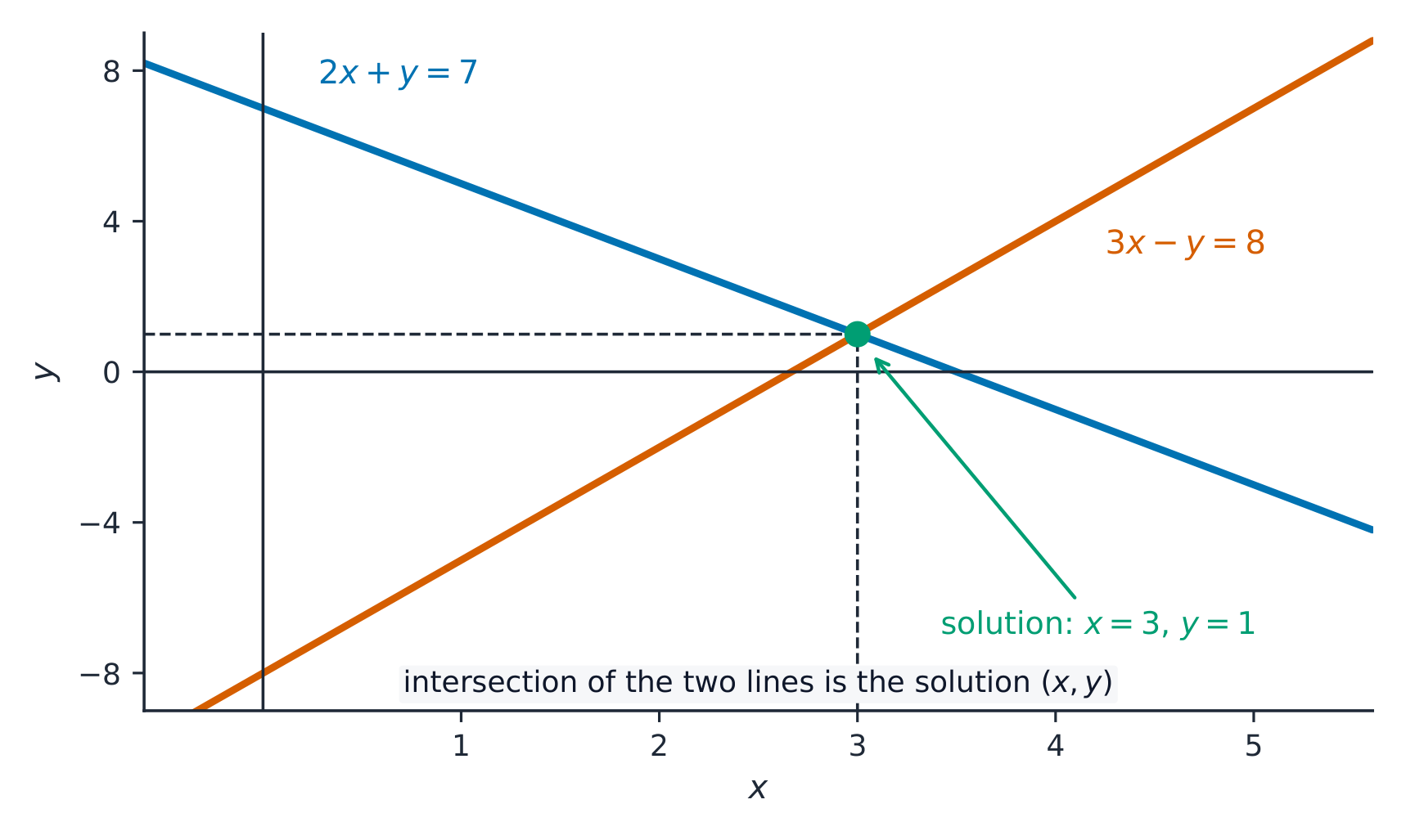
You can solve an equation by reading a graph. The intersection point 交点 of a line and a curve gives the solution of the two equations together.
For exponential growth 指数增长 and exponential decay 指数衰减, the graph of $y = a\,b^{x} + c$ rises (or falls) faster and faster and flattens towards a horizontal line.
Explore · استكشف
Graphing a quadratic · تمثيل دالة تربيعية بيانياً
y = ax² + bx + c
Drag a, b and c and watch the parabola move — its turning point and where it crosses the axes. · اسحب a و b و c وشاهد القطع المكافئ يتحرك — نقطة انعطافه وأين يقطع المحاور.
مطلوب معرفة التماثل والجذور. معرفة نقاط الانعطاف ليست مطلوبة.
English
Subject content
Notes and examples
Recognise, sketch and interpret graphs of the following functions: (a) linear (b) quadratic (c) cubic (d) reciprocal (e) exponential.
Functions will be equivalent to: • $ax + by = c$ • $y = ax^2 + bx + c$ • $y = ax^3 + b$ • $y = ax^3 + bx^2 + cx$ • $y = \frac{a}{x} + b$ • $y = ar^x + b$ where $a$, $b$ and $c$ are rational numbers and $r$ is a rational, positive number. Knowledge of turning points, roots and symmetry is required. Knowledge of vertical and horizontal asymptotes is required. Finding turning points of quadratics by completing the square is required.
ستكون الدوال مكافئة لـ: • $ax + by = c$ • $y = ax^2 + bx + c$ • $y = ax^3 + b$ • $y = ax^3 + bx^2 + cx$ • $y = \frac{a}{x} + b$ • $y = ar^x + b$ حيث $a$، $b$ و $c$ أعداد نسبية و $r$ عدد نسبي موجب. يُشترط معرفة النقاط الحرجة، الجذور، والتناظر. يُشترط معرفة المقاربات الرأسية والأفقية. إيجاد النقاط الحرجة للتربيعية بإكمال المربع مطلوب.
Source: Cambridge International syllabus · المصدر: منهج كامبريدج الدولي
A quick sketch should show the right shape and the key features: where it crosses the axes, any symmetry 对称, and any line the curve gets close to.
Function
Shape
linear, $y = mx + c$
straight line; gradient $m$, $y$-intercept 截距$c$
quadratic, $y = ax^{2} + bx + c$
a parabola 抛物线 (U-shape if $a>0$, $\cap$-shape if $a<0$)
cubic, $y = ax^{3} + bx + c$
an S-shaped curve
reciprocal, $y = \dfrac{a}{x} + b$
two separate curves
exponential, $y = a\,r^{x} + b$
fast growth or decay
The basic graph shapes; knowing each shape lets you sketch quickly from the equation.
For a parabola, completing the square gives the turning point 转折点 (the lowest or highest point). For example $y = (x + 3)^{2} - 8$ has its turning point at $(-3, -8)$.
Completing the square, $y=(x+3)^2-8$, shows the turning point $(-3,-8)$ and the line of symmetry $x=-3$.
An asymptote 渐近线 is a line that the curve gets closer and closer to but never touches — for example, the $x$-axis for $y = \dfrac{a}{x}$, or the line $y = b$ for $y = a\,r^{x} + b$.
1 Estimate gradients of curves by drawing tangents.
2 Use the derivatives of functions of the form $ax^n$, where $a$ is a rational constant and $n$ is a positive integer or zero, and simple sums of not more than three of these.
$\frac{\mathrm{d}y}{\mathrm{d}x}$ notation will be expected.
3 Apply differentiation to gradients and stationary points (turning points).
4 Discriminate between maxima and minima by any method.
Maximum and minimum points may be identified by: • an accurate sketch • use of the second differential • inspecting the gradient either side of a turning point. Candidates are not expected to identify points of inflection.
العربية
محتوى المادة
ملاحظات وأمثلة
1 تقدير ميل المنحنيات برسم المماسات.
2 استخدام مشتقات الدوال من الشكل $ax^n$، حيث $a$ ثابت نسبي و $n$ عدد صحيح موجب أو صفر، ومجاميع بسيطة لا تزيد عن ثلاثة منها.
سيُتوقع استخدام رمز $\frac{\mathrm{d}y}{\mathrm{d}x}$.
3 تطبيق الاشتقاق على الميل والنقاط الثابتة (النقاط الحرجة).
4 التمييز بين النقاط العظمى والصغرى بأي طريقة.
يمكن تحديد النقاط العظمى والصغرى بواسطة: • رسم تقريبي دقيق • استخدام المشتقة الثانية • فحص الميل من كلا جانبين للنقطة الحرجة. لا يُتوقع من المرشحين تحديد نقاط الانعطاف.
Source: Cambridge International syllabus · المصدر: منهج كامبريدج الدولي
Differentiation 微分 finds the gradient of a curve at any point. You can estimate it by drawing a tangent 切线 (a line that just touches the curve) and measuring its gradient.
The gradient of a curve at a point equals the gradient of the tangent there — what differentiation finds.
The exact rule: if $y = ax^{n}$, then the derivative 导数 is
The turning point is $(3, -4)$. To decide whether a turning point is a maximum 最大值 or a minimum 最小值, check the sign of the gradient on each side, or use the second derivative (positive means a minimum).
Explore · استكشف
Gradient of a curve · ميل المنحنى
y = ax³ + bx² + cx + d
Move the point: the tangent shows the gradient there, which is what differentiation finds. · حرك النقطة: المماس يظهر الميل عند تلك النقطة، وهو ما تجده المشتقة.
2 Understand and find inverse functions $f^{-1}(x)$.
3 Form composite functions as defined by $gf(x) = g(f(x))$.
e.g. $f(x) = \frac{3}{x + 2}$ and $g(x) = (3x + 5)^2$. Find $fg(x)$. Give your answer as a fraction in its simplest form. Candidates are not expected to find the domains and ranges of composite functions. This topic may include mapping diagrams.
العربية
محتوى المادة
ملاحظات وأمثلة
1 فهم الدوال، والمجال والمدى واستخدام رموز الدوال.
3 تكوين دوال مركبة كما هو معرّف بواسطة $gf(x) = g(f(x))$.
مثل: $f(x) = \frac{3}{x + 2}$ و$g(x) = (3x + 5)^2$. أوجد $fg(x)$. قدّم إجابتك ككسر في أبسط صورة. لا يُتوقع من المرشحين إيجاد مجالات ومدى الدوال المركبة. قد يتضمن هذا الموضوع مخططات التحويل.
Source: Cambridge International syllabus · المصدر: منهج كامبريدج الدولي
A function 函数 turns each input into one output. We write $f(x)$, for example $f(x) = 3x - 5$, so $f(2) = 1$. The set of allowed inputs is the domain 定义域; the set of possible outputs is the range 值域.
The inverse function 反函数$f^{-1}(x)$ undoes the function. To find it, write $y = f(x)$, swap the roles, and make $x$ the subject.
Worked example. Find the inverse of $f(x) = 3x - 5$.
This handout covers Topic 3, Coordinate geometry. Parts marked (Extended) are only tested on the Extended papers; everything else is for both levels.
العربية
تغطي هذه الورقة الموضوع 3، هندسة الإحداثيات. الأجزاء المحددة (متقدمة) يتم اختبارها فقط في أوراق المستوى المتقدم؛ والباقي لكلا المستويين.
3.1
Coordinates · الإحداثيات
Syllabus · المنهج
English
Subject content
Notes and examples
Use and interpret Cartesian coordinates in two dimensions.
العربية
محتوى المادة
ملاحظات وأمثلة
استخدم وتفسير إحداثيات ديكارتية في بعدين.
Source: Cambridge International syllabus · المصدر: منهج كامبريدج الدولي
English
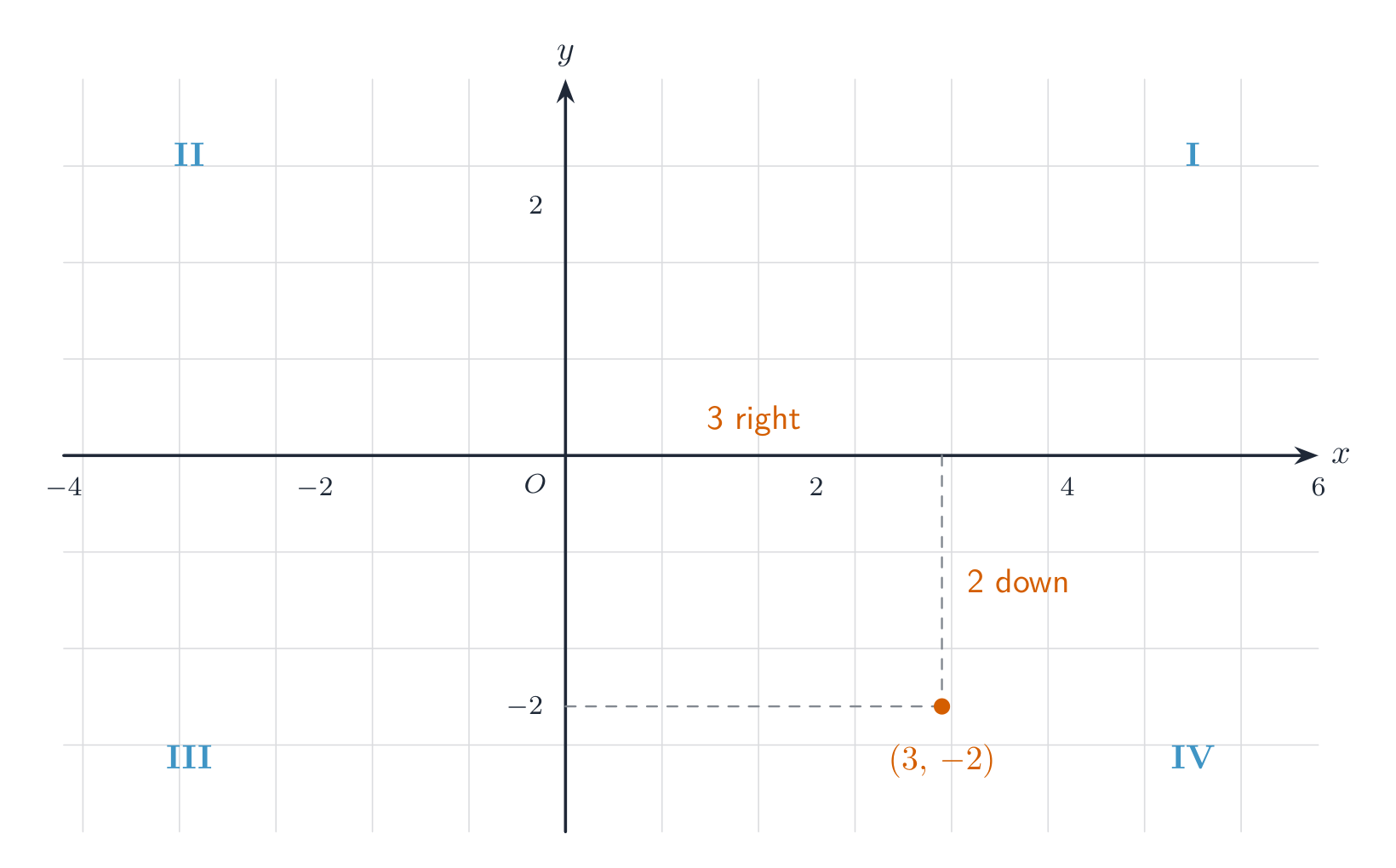
A point on a graph is described by its coordinates 坐标, sometimes called Cartesian coordinates, written $(x, y)$. The first number is the across value and the second is the up value.
The two number lines are the axes 坐标轴: the horizontal 水平$x$-axis and the vertical 竖直$y$-axis.
They cross at the origin 原点, the point $(0, 0)$.
The axes split the grid into four quadrants 象限.
So the point $(3, -2)$ is found by going $3$ to the right and $2$ down.
العربية
شبكة شوارع مدينة: كل مكان ثابت بإحداثياته.
يتم وصف نقطة على الرسم البياني بواسطة إحداثياتها، وتُسمى أحياناً إحداثيات ديكارتية، تُكتب $(x, y)$. الرقم الأول هو القيمة الأفقية والثاني هو القيمة العمودية.
الخطين العدديين هما المحاور: محور $x$الأفقي ومحور $y$العمودي.
يتقاطعان في نقطة الأصل، النقطة $(0, 0)$.
تقسم المحاور الشبكة إلى أربعة أرباع.
لذلك، يُوجد النقطة $(3, -2)$ عن طريق التحرك $3$ إلى اليمين و$2$ للأسفل.
تلتقي المحاور عند نقطة الأصل $O$ وتقسّم المستوى إلى أربعة أرباع؛ $(3,-2)$ تعني 3 إلى اليمين ثم 2 للأسفل.
Explore · استكشف
The coordinate plane · مستوى الإحداثيات
y = mx + c
Every point has an (x, y) coordinate. A straight line is the set of points where y depends on x in a fixed way. · كل نقطة لها إحداثيات (x, y). الخط المستقيم هو مجموعة النقاط التي تعتمد فيها y على x بطريقة ثابتة.
The equation of a straight line · معادلة الخط المستقيم
Syllabus · المنهج
English
Subject content
Notes and examples
Interpret and obtain the equation of a straight-line graph in the form $y = mx + c$.
Questions may: • use and request lines in the forms $y = mx + c$, $x = k$ • involve finding the equation when the graph is given • ask for the gradient or $y$-intercept of a graph from an equation, e.g. find the gradient and $y$-intercept of the graph with the equation $y = 6x + 3$. Candidates are expected to give equations of a line in a fully simplified form.
العربية
محتوى المادة
ملاحظات وأمثلة
فسر واحصل على معادلة بيانات مستقيم بصيغة $y = mx + c$.
قد تشمل الأسئلة: • استخدام وطلب خطوط بصيغتي $y = mx + c$، $x = k$ • تتضمن إيجاد المعادلة عندما تُعطى البيانات • تطلب إيجاد الميل أو تقاطع $y$-محور لبيانات من معادلة، مثلاً أوجد الميل وتقاطع $y$-محور للبيانات التي معادلتها $y = 6x + 3$. يُتوقع من المرشحين تقديم معادلات بخط مبسط تماماً.
English
Subject content
Notes and examples
Interpret and obtain the equation of a straight-line graph.
Questions may: • use and request lines in different forms, e.g. $ax + by = c$, $y = mx + c$, $x = k$ • involve finding the equation when the graph is given • ask for the gradient or $y$-intercept of a graph from an equation, e.g. find the gradient and $y$-intercept of the graph with equation $5x + 4y = 8$. Candidates are expected to give equations of a line in a fully simplified form.
العربية
محتوى المادة
ملاحظات وأمثلة
تفسير وحصول على معادلة الرسم البياني للخط المستقيم.
قد تتضمن الأسئلة: • استخدام وطلب الخطوط بصيغ مختلفة، مثل: $ax + by = c$، $y = mx + c$، $x = k$ • تتضمن إيجاد المعادلة عندما يُعطى الرسم البياني • تطلب ميل أو التقاطع $y$-محور للرسم البياني من معادلة، مثلاً: أوجد الميل والتقاطع $y$-محور للرسم البياني الذي معادلته $5x + 4y = 8$. يتوقع من المترشحين تقديم معادلات خط بصيغة مبسطة بالكامل.
Source: Cambridge International syllabus · المصدر: منهج كامبريدج الدولي
English
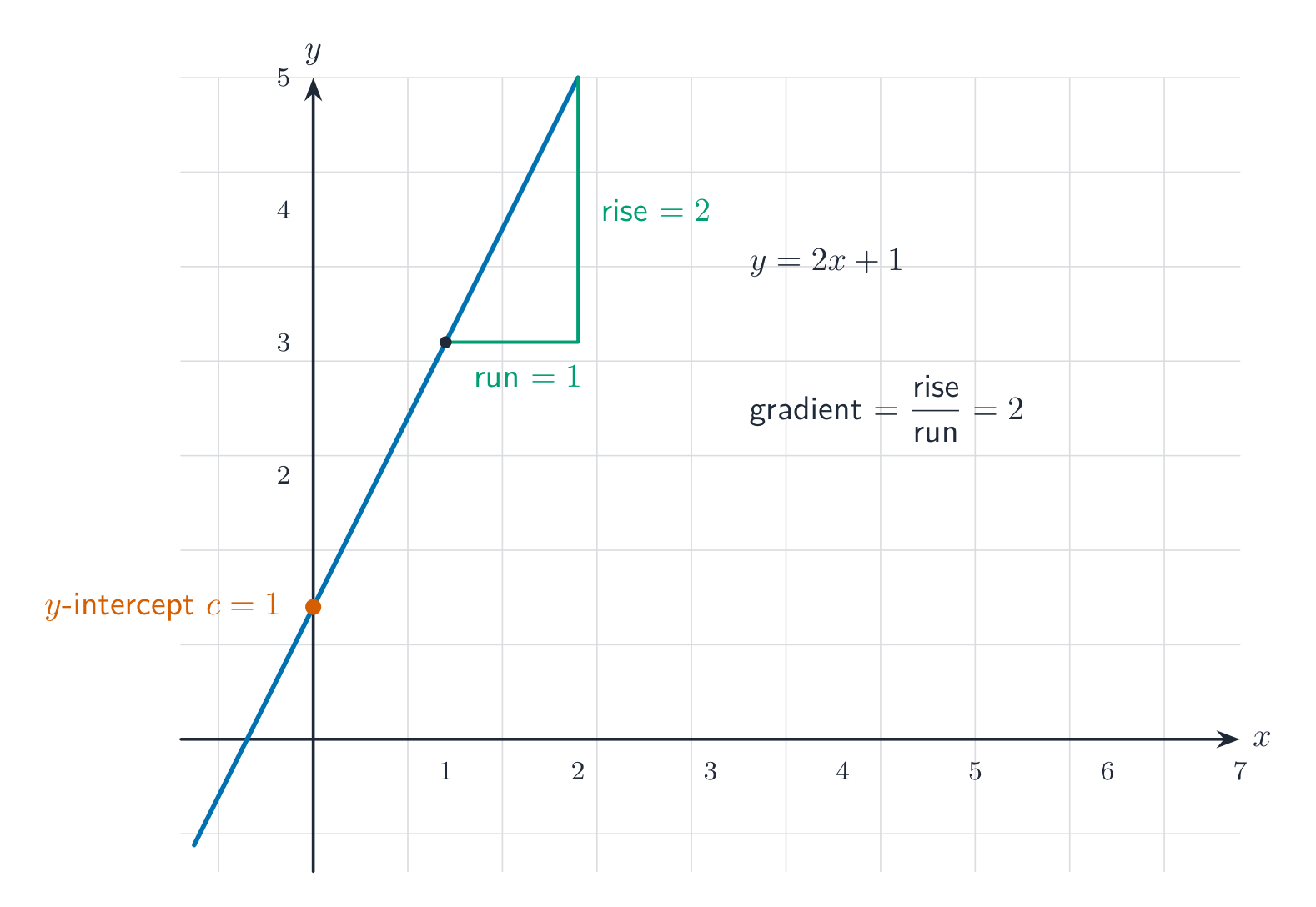
Most straight lines can be written as
$$y = mx + c,$$
where $m$ is the gradient 斜率 (steepness) and $c$ is the intercept 截距 — the $y$-value where the line crosses the $y$-axis.
A line like $x = k$ (for example $x = 3$) is vertical.
A line like $y = k$ (for example $y = 3$) is horizontal.
A line may also be given as $ax + by = c$. Rearrange it into $y = mx + c$ to read off the gradient and intercept.
Worked example. Find the gradient and $y$-intercept of $5x + 4y = 8$.
Drag the gradient and the intercept. a is the gradient (steepness) and b is where the line crosses the y-axis. · اسحب الميل والقطاع. a هو الميل (الانحدار) وb هو المكان الذي تقطع فيه الخط محور y.
3.3
Gradient · الميل
Syllabus · المنهج
English
Subject content
Notes and examples
Find the gradient of a straight line.
From a grid only.
العربية
محتوى المادة
ملاحظات وأمثلة
أوجد ميل مستقيم.
من شبكة الإحداثيات فقط.
English
Subject content
Notes and examples
1 Find the gradient of a straight line.
2 Calculate the gradient of a straight line from the coordinates of two points on it.
العربية
محتوى المادة
ملاحظات وأمثلة
1 إيجاد ميل خط مستقيم.
2 حساب ميل خط مستقيم من إحداثيات نقطتين عليه.
Source: Cambridge International syllabus · المصدر: منهج كامبريدج الدولي
English
y = mx + c: gradient and intercept, live
The gradient measures how steep a line is:
$$m = \frac{\text{change in } y}{\text{change in } x} = \frac{\text{rise}}{\text{run}}.$$
A positive gradient goes up to the right; a negative gradient goes down to the right.
Worked example. Find the gradient of the line through $(1, 2)$ and $(4, 11)$.
$$m = \frac{11 - 2}{4 - 1} = \frac{9}{3} = 3.$$
العربية
y = mx + c: الميل والمقطع، مباشرطريق جبلي حاد: يقيس الميل الانحدار كارتفاع مقسوماً على مسافة أفقية.
يقيس الميل مدى انحدار الخط:
$$m = \frac{\text{change in } y}{\text{change in } x} = \frac{\text{rise}}{\text{run}}.$$
الميل الموجب يتجه للأعلى نحو اليمين؛ الميل السالب يتجه للأسفل نحو اليمين.
مثال محلول. أوجد ميل الخط المار بالنقطتين $(1, 2)$ و$(4, 11)$.
$$m = \frac{11 - 2}{4 - 1} = \frac{9}{3} = 3.$$
بالنسبة لـ $y=mx+c$، يعبر الخط محور $y$ عند $c$ ويكون الميل $m$ هو الارتفاع مقسوماً على المسافة الأفقية.
Explore · استكشف
Gradient · الميل
y = ax + b
The gradient a measures steepness — rise over run. · الميل a يقيس الانحدار — الصعود مقابل الأفقي.
Source: Cambridge International syllabus · المصدر: منهج كامبريدج الدولي
English
To draw $y = mx + c$, the quickest way is:
Mark the intercept $c$ on the $y$-axis.
Use the gradient to step to more points (for $m = 3$, go $1$ right and $3$ up).
Join the points with a straight line.
You can also make a small table of values 数值表: choose two or three $x$-values, work out $y$, and plot the points.
العربية
لرسم $y = mx + c$، الطريقة الأسرع هي:
عيّن المقطع $c$ على محور $y$.
استخدم الميل للانتقال إلى نقاط أكثر (بالنسبة لـ $m = 3$، تحرك $1$ يميناً و$3$ لأعلى).
صل النقاط بخط مستقيم.
يمكنك أيضاً إنشاء جدول قيم صغير: اختر قيمتي أو ثلاث قيم لـ $x$، احسب $y$، ثم ارسم النقاط.
رسم خط بسرعة: عيّن المقطع، ثم استخدم الميل للانتقال إلى نقاط جديدة
3.5
Finding the equation of a line · إيجاد معادلة خط
Syllabus · المنهج
English
Subject content
Notes and examples
Interpret and obtain the equation of a straight-line graph in the form $y = mx + c$.
Questions may: • use and request lines in the forms $y = mx + c$, $x = k$ • involve finding the equation when the graph is given • ask for the gradient or $y$-intercept of a graph from an equation, e.g. find the gradient and $y$-intercept of the graph with the equation $y = 6x + 3$. Candidates are expected to give equations of a line in a fully simplified form.
العربية
محتوى المادة
ملاحظات وأمثلة
فسر واحصل على معادلة بيانات مستقيم بصيغة $y = mx + c$.
قد تشمل الأسئلة: • استخدام وطلب خطوط بصيغتي $y = mx + c$، $x = k$ • تتضمن إيجاد المعادلة عندما تُعطى البيانات • تطلب إيجاد الميل أو تقاطع $y$-محور لبيانات من معادلة، مثلاً أوجد الميل وتقاطع $y$-محور للبيانات التي معادلتها $y = 6x + 3$. يُتوقع من المرشحين تقديم معادلات بخط مبسط تماماً.
English
Subject content
Notes and examples
Interpret and obtain the equation of a straight-line graph.
Questions may: • use and request lines in different forms, e.g. $ax + by = c$, $y = mx + c$, $x = k$ • involve finding the equation when the graph is given • ask for the gradient or $y$-intercept of a graph from an equation, e.g. find the gradient and $y$-intercept of the graph with equation $5x + 4y = 8$. Candidates are expected to give equations of a line in a fully simplified form.
العربية
محتوى المادة
ملاحظات وأمثلة
تفسير وحصول على معادلة الرسم البياني للخط المستقيم.
قد تتضمن الأسئلة: • استخدام وطلب الخطوط بصيغ مختلفة، مثل: $ax + by = c$، $y = mx + c$، $x = k$ • تتضمن إيجاد المعادلة عندما يُعطى الرسم البياني • تطلب ميل أو التقاطع $y$-محور للرسم البياني من معادلة، مثلاً: أوجد الميل والتقاطع $y$-محور للرسم البياني الذي معادلته $5x + 4y = 8$. يتوقع من المترشحين تقديم معادلات خط بصيغة مبسطة بالكامل.
Source: Cambridge International syllabus · المصدر: منهج كامبريدج الدولي
English
If you know the gradient $m$ and one point on the line, put the point into $y = mx + c$ to find $c$.
Worked example. A line has gradient $3$ and passes through $(1, 2)$. Find its equation.
Find the gradient and equation of a straight line perpendicular to a given line.
Examples include: • find the gradient of a line perpendicular to $2y = 3x + 1$ • find the equation of the perpendicular bisector of the line joining the points $(-3, 8)$ and $(9, -2)$.
العربية
محتوى المادة
ملاحظات وأمثلة
إيجاد الميل ومعادلة خط مستقيم عمودي على خط معطى.
تشمل الأمثلة: • إيجاد ميل خط عمودي على $2y = 3x + 1$ • إيجاد معادلة المنصف العمودي للخط الواصل بين النقطتين $(-3, 8)$ و$(9, -2)$.
Source: Cambridge International syllabus · المصدر: منهج كامبريدج الدولي
English
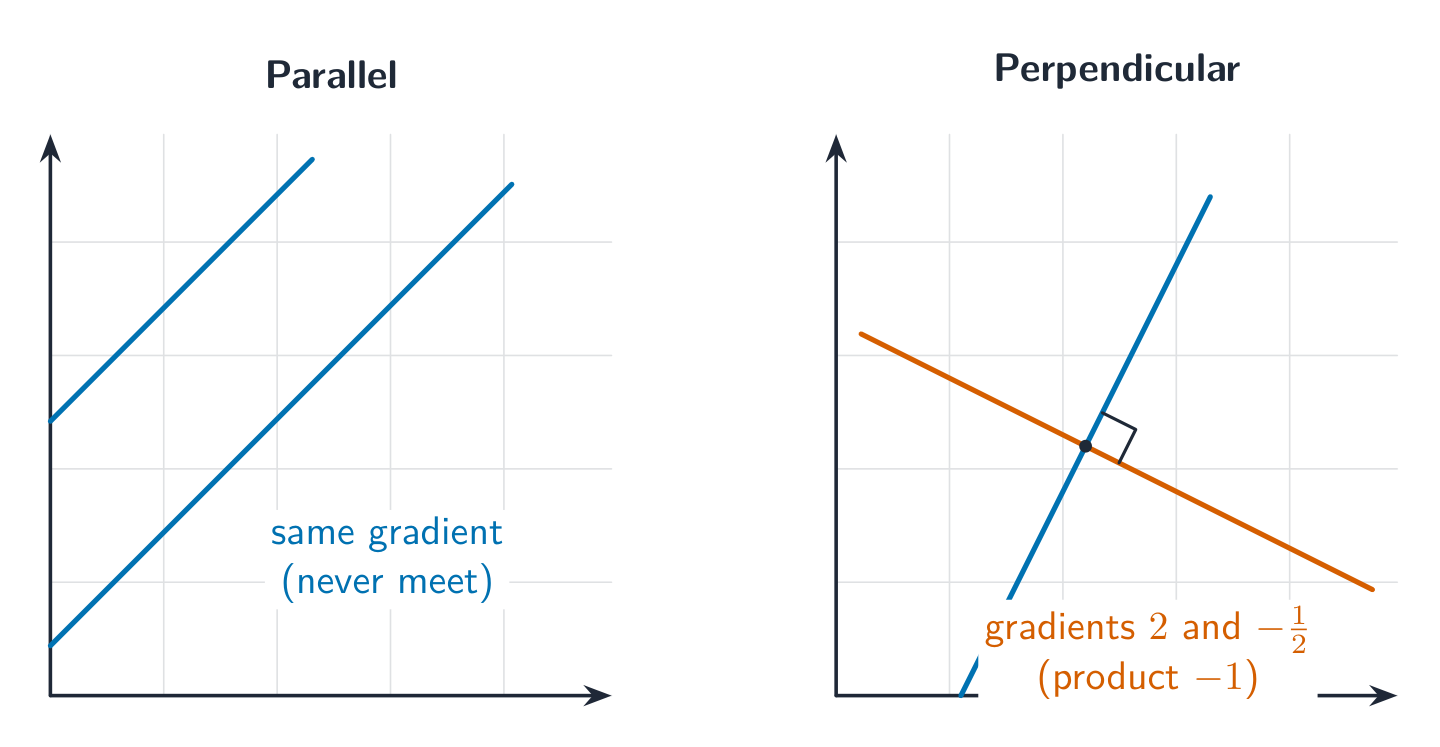
Two lines are perpendicular 垂直 if they meet at a right angle 直角. Their gradients multiply to $-1$:
Worked example. Find the gradient of a line perpendicular to $2y = 3x + 1$.
Rearrange: $y = \tfrac{3}{2}x + \tfrac{1}{2}$, so the gradient is $\tfrac{3}{2}$. The perpendicular gradient is $-\tfrac{2}{3}$.
Perpendicular bisector
The perpendicular bisector 垂直平分线 of a segment cuts it in half at a right angle. To find its equation: get the midpoint, then use the perpendicular gradient through that midpoint.
Worked example. Find the perpendicular bisector of the segment joining $(-3, 8)$ and $(9, -2)$.
This handout covers Topic 4, Geometry. Parts marked (Extended) are only tested on the Extended papers; everything else is for both levels. In the exam you must give reasons using the correct names below, not just the numbers.
العربية
تغطي هذه الورقة الموضوع 4، الهندسة. الأجزاء المؤشر عليها بـ (متقدمة) تُختبر فقط في أوراق الامتحان المتقدمة؛ ما عدا ذلك مخصص للمستويين. في الامتحان يجب عليك تقديم أسباب باستخدام الأسماء الصحيحة أدناه، وليس الأرقام فقط.
4.1
Lines and angles · الخطوط والزوايا
Syllabus · المنهج
English
Subject content
Notes and examples
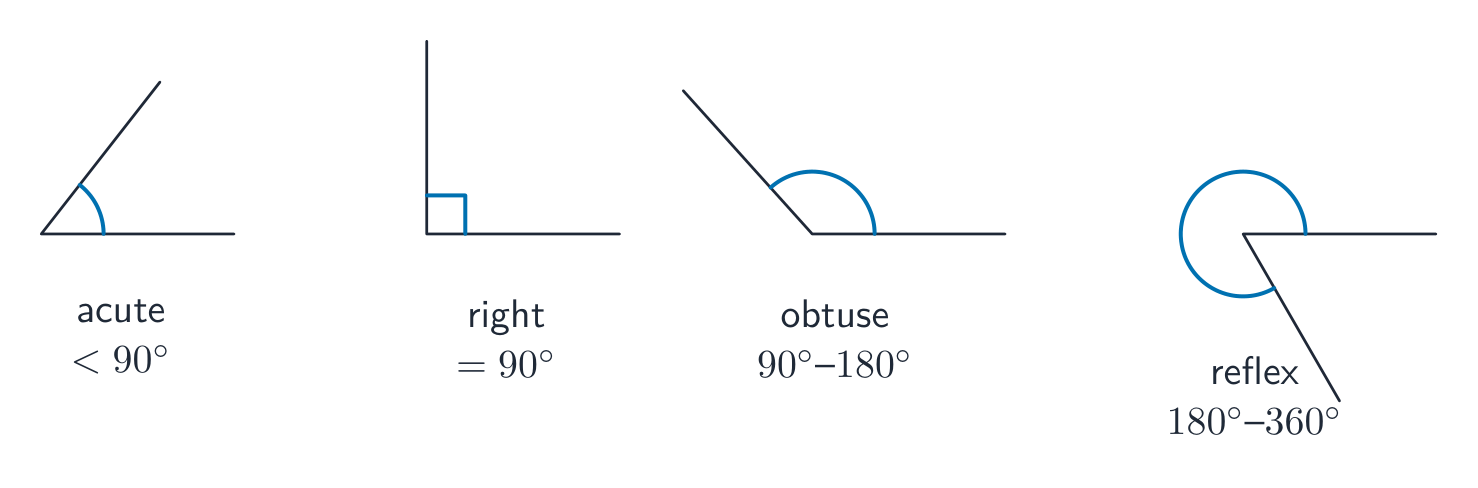
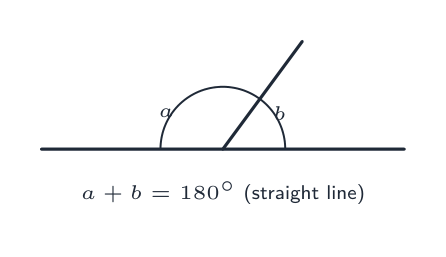
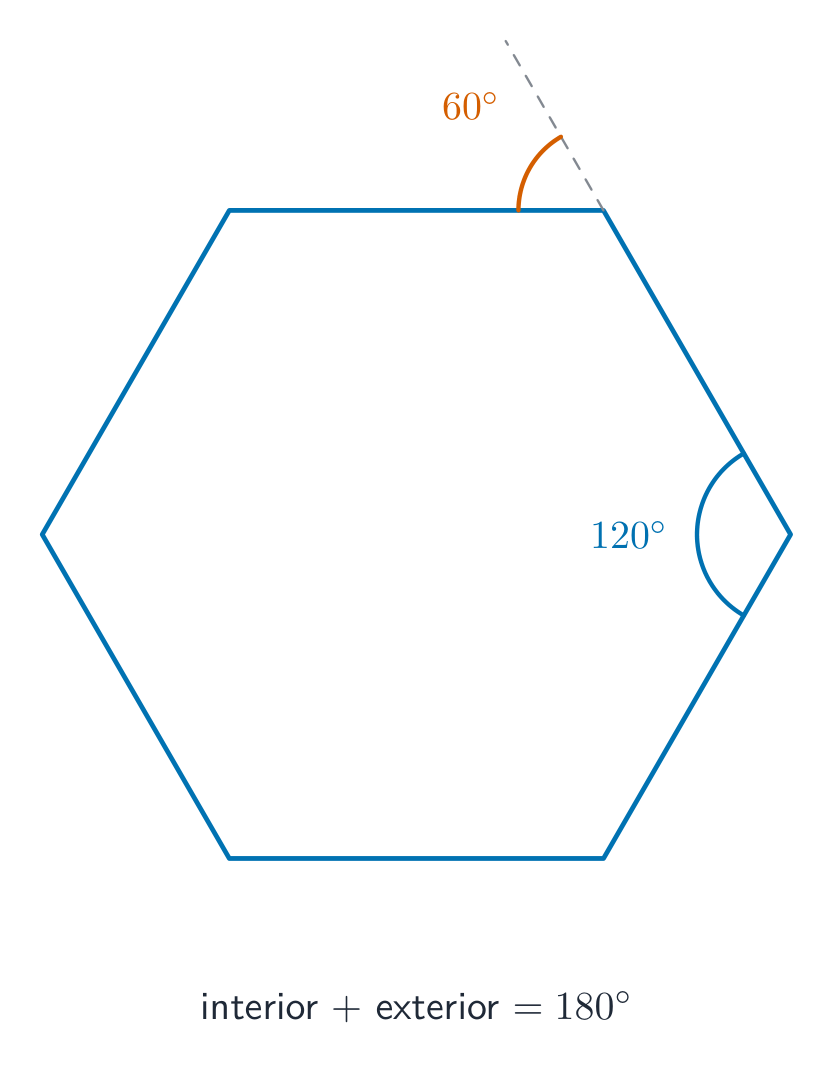
1 Use and interpret the following geometrical terms: • point • vertex • line • parallel • perpendicular • bearing • right angle • acute, obtuse and reflex angles • interior and exterior angles • similar • congruent • scale factor.
Candidates are not expected to show that two shapes are congruent.
2 Use and interpret the vocabulary of: • triangles • special quadrilaterals • polygons • nets • simple solids.
Includes the following terms: Triangles: • equilateral • isosceles • scalene • right-angled. Quadrilaterals: • square • rectangle • kite • rhombus • parallelogram • trapezium. Polygons: • regular and irregular polygons • pentagon • hexagon • octagon • decagon.
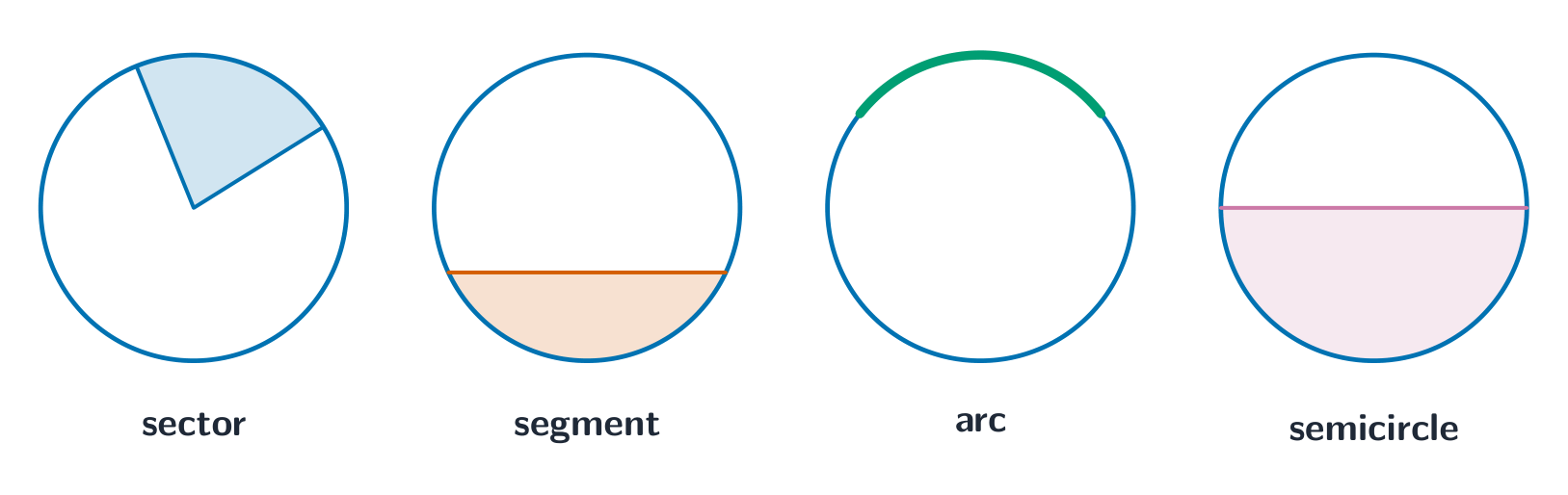
Includes the following terms: • centre • radius (plural radii) • diameter • circumference • semicircle • chord • tangent • arc • sector • segment.
العربية
محتوى المادة
ملاحظات وأمثلة
1 استخدم وفسر المصطلحات الهندسية التالية: • نقطة • رأس • خط • توازٍ • تعامد • اتجاه • زاوية قائمة • زوايا حادة ومنفرجة وممتدة • زوايا داخلية وخارجية • تشابه • تطابق • معامل مقياس.
لا يُتوقع من المرشحين إثبات تطابق شكلين.
2 استخدم وفسر مفردات: • المثلثات • الأشكال الرباعية الخاصة • المضلعات • الشبكات • الأجسام البسيطة.
يتضمن المصطلحات التالية: المثلثات: • متساوي الأضلاع • متساوي الساقين • مختلف الأضلاع • قائم الزاوية. الأشكال الرباعية: • مربع • مستطيل • طائر • معين • متوازي الأضلاع • شبه منحرف. المضلعات: • مضلعات منتظمة وغير منتظمة • خماسي • سداسي • ثماني • عشاري.
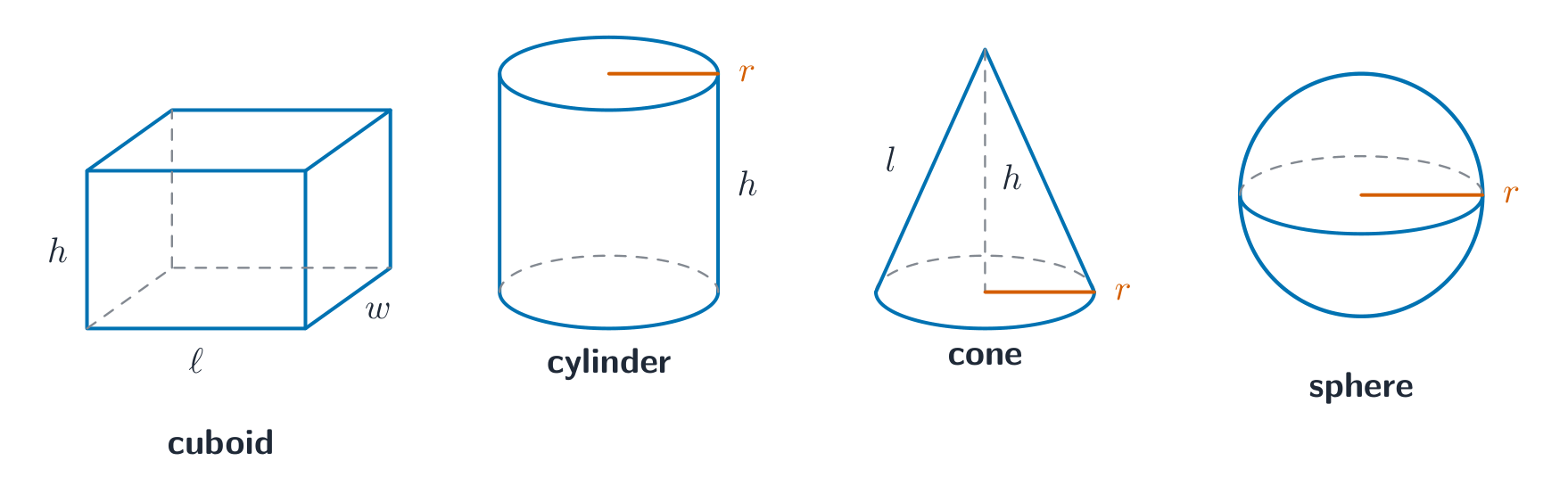
الأجسام البسيطة: • مكعب • متوازي مستطيلات • منشور • أسطوانة • هرم • مخروط • كرة (لا يُشترط استخدام مصطلح 'نصف كرة') • وجه • سطح • حافة.
3 استخدم وفسر مفردات الدائرة.
يتضمن المصطلحات التالية: • مركز • نصف قطر (جمع: أنصاف أقطار) • قطر • محيط • نصف دائرة • وتر • مماس • قوس • قطاع • جزء دائري.
English
Subject content
Notes and examples
1 Use and interpret the following geometrical terms: • point • vertex • line • plane • parallel • perpendicular • perpendicular bisector • bearing • right angle • acute, obtuse and reflex angles • interior and exterior angles • similar • congruent • scale factor.
Candidates are not expected to show that two shapes are congruent.
2 Use and interpret the vocabulary of: • triangles • special quadrilaterals • polygons • nets • solids.
Includes the following terms. Triangles: • equilateral • isosceles • scalene • right-angled. Quadrilaterals: • square • rectangle • kite • rhombus • parallelogram • trapezium.
Includes the following terms: • centre • radius (plural radii) • diameter • circumference • semicircle • chord • tangent • major and minor arc • sector • segment.
العربية
محتوى المادة
ملاحظات وأمثلة
1 استخدام وتفسير المصطلحات الهندسية التالية: • نقطة • رأس • خط • مستوى • متوازي • عمودي • منصف عمودي • اتجاه (حامل) • زاوية قائمة • زوايا حادة ومنفرجة ومرتدة • زوايا داخلية وخارجية • متشابه • متطابق • معامل مقياس.
لا يُتوقع من المرشحين إثبات تطابق شكلين.
2 استخدام وتفسير مفردات: • مثلثات • رباعيات الأضلاع الخاصة • مضلعات • شبكات • أجسام صلبة.
يشمل المصطلحات التالية. المثلثات: • متساوي الأضلاع • متساوي الساقين • مختلف الأضلاع • قائم الزاوية. الرباعيات: • مربع • مستطيل • طير • متوازي الأضلاع • متوازي الأضلاع • شبه منحرف.
المضلعات: • مضلعات منتظمة وغير منتظمة • خماسي • سداسي • ثماني • عشاري. الأجسام الصلبة: • مكعب • متوازي مستطيلات • منشور • أسطوانة • هرم • مخروط • كرة • نصف كرة • قاطع مخروطي • وجه • سطح • ضلع.
3 استخدام وتفسير مفردات الدائرة.
يشمل المصطلحات التالية: • مركز • نصف قطر (جمع: أنصاف أقطار) • قطر • محيط • نصف دائرة • وتر • مماس • قوس كبير وقوس صغير • قطاع • قطعة دائرية.
Source: Cambridge International syllabus · المصدر: منهج كامبريدج الدولي
English
A corner where two lines meet is a vertex 顶点. Two lines are parallel 平行 if they never meet, and perpendicular 垂直 if they meet at a right angle. Angles are named by their size:
Name
Size
acute angle 锐角
less than $90^{\circ}$
right angle 直角
exactly $90^{\circ}$
obtuse angle 钝角
between $90^{\circ}$ and $180^{\circ}$
reflex angle 优角
between $180^{\circ}$ and $360^{\circ}$
We name an angle with three letters, e.g. angle $ABC$ is the angle at $B$.
العربية
الزاوية التي يلتقي فيها خطان تسمى رأس. يكون خطان متوازيين إذا لم يلتقيا أبدًا، ومتعامدين إذا التقيا بزاوية قائمة. تُمىَّز الزوايا حسب قياسها:
الاسم
الحجم
زاوية حادة
أقل من $90^{\circ}$
زاوية قائمة
تساوي تمامًا $90^{\circ}$
زاوية منفرجة
بين $90^{\circ}$ و$180^{\circ}$
زاوية مرجعية
بين $180^{\circ}$ و$360^{\circ}$
زوايا حسب الحجم: حادة (أقل من $90^\circ$)، قائمة ($90^\circ$، مُوضَّحة بمربع)، منفرجة ($90^\circ$–$180^\circ$) ومرجعية ($180^\circ$–$360^\circ$).
نُسمي الزاوية بثلاث أحرف، مثال: الزاوية $ABC$ هي الزاوية عند $B$.
Explore · استكشف
Shape and angle lab · مختبر الشكل والزاوية
Classify angle facts by the diagram feature that creates them. · صنّف حقائق الزوايا حسب السمة الهندسية التي تولدها.
4.6
Angle facts · حقائق الزوايا
Syllabus · المنهج
English
Subject content
Notes and examples
1 Calculate unknown angles and give simple explanations using the following geometrical properties: • sum of angles at a point = 360° • sum of angles at a point on a straight line = 180° • vertically opposite angles are equal • angle sum of a triangle = 180° and angle sum of a quadrilateral = 360°.
Knowledge of three-letter notation for angles is required, e.g. angle $ABC$. Candidates are expected to use the correct geometrical terminology when giving reasons for answers.
2 Calculate unknown angles and give geometric explanations for angles formed within parallel lines: • corresponding angles are equal • alternate angles are equal • co-interior angles sum to 180° (supplementary).
3 Know and use angle properties of regular polygons.
Includes exterior and interior angles, and angle sum.
العربية
محتوى المادة
ملاحظات وأمثلة
1 احسب الزوايا المجهولة وقدم的解释ات بسيطة باستخدام الخصائص الهندسية التالية: • مجموع الزوايا حول نقطة = 360° • مجموع الزوايا حول نقطة على خط مستقيم = 180° • الزوايا المتقابلة بالرأس متساوية • مجموع زوايا المثلث = 180° ومجموع زوايا الشكل الرباعي = 360°.
يُشترط معرفة التدوين ثلاثي الحروف للزوايا، مثل الزاوية $ABC$. يُتوقع من المرشحين استخدام المصطلحات الهندسية الصحيحة عند تقديم الأسباب للإجابات.
2 احسب الزوايا المجهولة وقدم的解释ات هندسية للزوايا المتشكلة داخل خطوط متوازية: • الزوايا المتناظرة متساوية • الزوايا المتبادلة متساوية • مجموع الزوايا الداخلية المتقابلة = 180° (متكاملتان).
3 اعرف واستخدم خصائص زوايا المضلعات المنتظمة.
يشمل الزوايا الخارجية والداخلية ومجموع الزوايا.
English
Subject content
Notes and examples
1 Calculate unknown angles and give simple explanations using the following geometrical properties: • sum of angles at a point = 360° • sum of angles at a point on a straight line = 180° • vertically opposite angles are equal • angle sum of a triangle = 180° and angle sum of a quadrilateral = 360°.
Knowledge of 3-letter notation for angles is required, e.g. angle $ABC$. Candidates are expected to use the correct geometrical terminology when giving reasons for answers.
2 Calculate unknown angles and give geometric explanations for angles formed within parallel lines: • corresponding angles are equal • alternate angles are equal • co-interior angles sum to 180° (supplementary).
3 Know and use angle properties of regular and irregular polygons.
Includes exterior and interior angles, and angle sum.
العربية
محتوى المادة
ملاحظات وأمثلة
1 احسب الزوايا المجهولةقدم تفسيرات بسيطة باستخدام الخصائص الهندسية التالية: • مجموع الزوايا حول نقطة = 360° • مجموع الزوايا حول نقطة على خط مستقيم = 180° • زوايا متقابلة بالرأس متساوية • مجموع زوايا المثلث = 180° ومجموع زوايا الرباعي = 360°.
مطلوب معرفة 3-حرفي لرمز الزوايا، مثل زاوية $ABC$. من المتوقع من المرشحين استخدام المصطلحات الهندسية الصحيحة عند تقديم أسباب للإجابات.
2 احسب الزوايا المجهولة وقدم的解释ات هندسية للزوايا المتشكلة داخل خطوط متوازية: • الزوايا المتناظرة متساوية • الزوايا المتبادلة متساوية • مجموع الزوايا الداخلية المتقابلة = 180° (متكاملتان).
3 معرفة واستخدام خصائص الزوايا للمضلعات المنتظمة وغير المنتظمة.
يشمل الزوايا الداخلية والخارجية ومجموع الزوايا.
Source: Cambridge International syllabus · المصدر: منهج كامبريدج الدولي
English
Learn these basic facts. Each one is a valid reason in the exam.
Angles at a point add up to $360^{\circ}$.
Angles on a straight line add up to $180^{\circ}$.
Vertically opposite angles 对顶角 (made by two crossing lines) are equal.
Worked example. Three angles on a straight line are $x$, $50^{\circ}$ and $70^{\circ}$. Find $x$.
Parallel line and polygon lab · مختبر المستقيم المتوازي والمضلع
Pick the angle rule that unlocks each diagram. · اختر قاعدة الزاوية التي تفتح كل مخطط.
4.6
Angles in parallel lines · الزوايا في الخطوط المتوازية
Syllabus · المنهج
English
Subject content
Notes and examples
1 Calculate unknown angles and give simple explanations using the following geometrical properties: • sum of angles at a point = 360° • sum of angles at a point on a straight line = 180° • vertically opposite angles are equal • angle sum of a triangle = 180° and angle sum of a quadrilateral = 360°.
Knowledge of three-letter notation for angles is required, e.g. angle $ABC$. Candidates are expected to use the correct geometrical terminology when giving reasons for answers.
2 Calculate unknown angles and give geometric explanations for angles formed within parallel lines: • corresponding angles are equal • alternate angles are equal • co-interior angles sum to 180° (supplementary).
3 Know and use angle properties of regular polygons.
Includes exterior and interior angles, and angle sum.
العربية
محتوى المادة
ملاحظات وأمثلة
1 احسب الزوايا المجهولة وقدم的解释ات بسيطة باستخدام الخصائص الهندسية التالية: • مجموع الزوايا حول نقطة = 360° • مجموع الزوايا حول نقطة على خط مستقيم = 180° • الزوايا المتقابلة بالرأس متساوية • مجموع زوايا المثلث = 180° ومجموع زوايا الشكل الرباعي = 360°.
يُشترط معرفة التدوين ثلاثي الحروف للزوايا، مثل الزاوية $ABC$. يُتوقع من المرشحين استخدام المصطلحات الهندسية الصحيحة عند تقديم الأسباب للإجابات.
2 احسب الزوايا المجهولة وقدم的解释ات هندسية للزوايا المتشكلة داخل خطوط متوازية: • الزوايا المتناظرة متساوية • الزوايا المتبادلة متساوية • مجموع الزوايا الداخلية المتقابلة = 180° (متكاملتان).
3 اعرف واستخدم خصائص زوايا المضلعات المنتظمة.
يشمل الزوايا الخارجية والداخلية ومجموع الزوايا.
English
Subject content
Notes and examples
1 Calculate unknown angles and give simple explanations using the following geometrical properties: • sum of angles at a point = 360° • sum of angles at a point on a straight line = 180° • vertically opposite angles are equal • angle sum of a triangle = 180° and angle sum of a quadrilateral = 360°.
Knowledge of 3-letter notation for angles is required, e.g. angle $ABC$. Candidates are expected to use the correct geometrical terminology when giving reasons for answers.
2 Calculate unknown angles and give geometric explanations for angles formed within parallel lines: • corresponding angles are equal • alternate angles are equal • co-interior angles sum to 180° (supplementary).
3 Know and use angle properties of regular and irregular polygons.
Includes exterior and interior angles, and angle sum.
العربية
محتوى المادة
ملاحظات وأمثلة
1 احسب الزوايا المجهولةقدم تفسيرات بسيطة باستخدام الخصائص الهندسية التالية: • مجموع الزوايا حول نقطة = 360° • مجموع الزوايا حول نقطة على خط مستقيم = 180° • زوايا متقابلة بالرأس متساوية • مجموع زوايا المثلث = 180° ومجموع زوايا الرباعي = 360°.
مطلوب معرفة 3-حرفي لرمز الزوايا، مثل زاوية $ABC$. من المتوقع من المرشحين استخدام المصطلحات الهندسية الصحيحة عند تقديم أسباب للإجابات.
2 احسب الزوايا المجهولة وقدم的解释ات هندسية للزوايا المتشكلة داخل خطوط متوازية: • الزوايا المتناظرة متساوية • الزوايا المتبادلة متساوية • مجموع الزوايا الداخلية المتقابلة = 180° (متكاملتان).
3 معرفة واستخدام خصائص الزوايا للمضلعات المنتظمة وغير المنتظمة.
يشمل الزوايا الداخلية والخارجية ومجموع الزوايا.
Source: Cambridge International syllabus · المصدر: منهج كامبريدج الدولي
English
When a line crosses two parallel lines:
Corresponding angles 同位角 (in matching positions, an "F" shape) are equal.
Alternate angles 内错角 (opposite sides of the crossing line, a "Z" shape) are equal.
Co-interior angles 同旁内角 (a "C" shape) add up to $180^{\circ}$; we say they are supplementary 互补.
Worked example. A straight line crosses two parallel lines. One angle is $110^{\circ}$. The co-interior angle $y$ satisfies $110 + y = 180$, so $y = 70^{\circ}$.
العربية
عندما يعبر خط عبر خطين متوازيين:
الزوايا المتناظرة (في مواقع مطابقة، بشكل "F") متساوية.
الزوايا البديلة (على جانبي خط التقاطع، بشكل "Z") متساوية.
الزوايا الداخلية المشتركة (شكل "C") مجموعها $180^{\circ}$؛ ونقول إنها متكاملة.
مثال محلول. خط مستقيم يعبر خطين متوازيين. إحدى الزوايا تساوي $110^{\circ}$. الزاوية الداخلية المشتركة $y$ تحقق $110 + y = 180$، وبالتالي $y = 70^{\circ}$.
1 Use and interpret the following geometrical terms: • point • vertex • line • parallel • perpendicular • bearing • right angle • acute, obtuse and reflex angles • interior and exterior angles • similar • congruent • scale factor.
Candidates are not expected to show that two shapes are congruent.
2 Use and interpret the vocabulary of: • triangles • special quadrilaterals • polygons • nets • simple solids.
Includes the following terms: Triangles: • equilateral • isosceles • scalene • right-angled. Quadrilaterals: • square • rectangle • kite • rhombus • parallelogram • trapezium. Polygons: • regular and irregular polygons • pentagon • hexagon • octagon • decagon.
Includes the following terms: • centre • radius (plural radii) • diameter • circumference • semicircle • chord • tangent • arc • sector • segment.
العربية
محتوى المادة
ملاحظات وأمثلة
1 استخدم وفسر المصطلحات الهندسية التالية: • نقطة • رأس • خط • توازٍ • تعامد • اتجاه • زاوية قائمة • زوايا حادة ومنفرجة وممتدة • زوايا داخلية وخارجية • تشابه • تطابق • معامل مقياس.
لا يُتوقع من المرشحين إثبات تطابق شكلين.
2 استخدم وفسر مفردات: • المثلثات • الأشكال الرباعية الخاصة • المضلعات • الشبكات • الأجسام البسيطة.
يتضمن المصطلحات التالية: المثلثات: • متساوي الأضلاع • متساوي الساقين • مختلف الأضلاع • قائم الزاوية. الأشكال الرباعية: • مربع • مستطيل • طائر • معين • متوازي الأضلاع • شبه منحرف. المضلعات: • مضلعات منتظمة وغير منتظمة • خماسي • سداسي • ثماني • عشاري.
الأجسام البسيطة: • مكعب • متوازي مستطيلات • منشور • أسطوانة • هرم • مخروط • كرة (لا يُشترط استخدام مصطلح 'نصف كرة') • وجه • سطح • حافة.
3 استخدم وفسر مفردات الدائرة.
يتضمن المصطلحات التالية: • مركز • نصف قطر (جمع: أنصاف أقطار) • قطر • محيط • نصف دائرة • وتر • مماس • قوس • قطاع • جزء دائري.
English
Subject content
Notes and examples
1 Use and interpret the following geometrical terms: • point • vertex • line • plane • parallel • perpendicular • perpendicular bisector • bearing • right angle • acute, obtuse and reflex angles • interior and exterior angles • similar • congruent • scale factor.
Candidates are not expected to show that two shapes are congruent.
2 Use and interpret the vocabulary of: • triangles • special quadrilaterals • polygons • nets • solids.
Includes the following terms. Triangles: • equilateral • isosceles • scalene • right-angled. Quadrilaterals: • square • rectangle • kite • rhombus • parallelogram • trapezium.
Includes the following terms: • centre • radius (plural radii) • diameter • circumference • semicircle • chord • tangent • major and minor arc • sector • segment.
العربية
محتوى المادة
ملاحظات وأمثلة
1 استخدام وتفسير المصطلحات الهندسية التالية: • نقطة • رأس • خط • مستوى • متوازي • عمودي • منصف عمودي • اتجاه (حامل) • زاوية قائمة • زوايا حادة ومنفرجة ومرتدة • زوايا داخلية وخارجية • متشابه • متطابق • معامل مقياس.
لا يُتوقع من المرشحين إثبات تطابق شكلين.
2 استخدام وتفسير مفردات: • مثلثات • رباعيات الأضلاع الخاصة • مضلعات • شبكات • أجسام صلبة.
يشمل المصطلحات التالية. المثلثات: • متساوي الأضلاع • متساوي الساقين • مختلف الأضلاع • قائم الزاوية. الرباعيات: • مربع • مستطيل • طير • متوازي الأضلاع • متوازي الأضلاع • شبه منحرف.
المضلعات: • مضلعات منتظمة وغير منتظمة • خماسي • سداسي • ثماني • عشاري. الأجسام الصلبة: • مكعب • متوازي مستطيلات • منشور • أسطوانة • هرم • مخروط • كرة • نصف كرة • قاطع مخروطي • وجه • سطح • ضلع.
3 استخدام وتفسير مفردات الدائرة.
يشمل المصطلحات التالية: • مركز • نصف قطر (جمع: أنصاف أقطار) • قطر • محيط • نصف دائرة • وتر • مماس • قوس كبير وقوس صغير • قطاع • قطعة دائرية.
Source: Cambridge International syllabus · المصدر: منهج كامبريدج الدولي
English
A triangle 三角形 has three sides and angles that add up to $180^{\circ}$.
Type
Property
equilateral 等边
all sides equal, all angles $60^{\circ}$
isosceles 等腰
two sides equal, two angles equal
scalene 不等边
all sides and angles different
right-angled
has one right angle
Worked example. A triangle has angles $x$, $2x$ and $90^{\circ}$. Find $x$.
1 Use and interpret the following geometrical terms: • point • vertex • line • parallel • perpendicular • bearing • right angle • acute, obtuse and reflex angles • interior and exterior angles • similar • congruent • scale factor.
Candidates are not expected to show that two shapes are congruent.
2 Use and interpret the vocabulary of: • triangles • special quadrilaterals • polygons • nets • simple solids.
Includes the following terms: Triangles: • equilateral • isosceles • scalene • right-angled. Quadrilaterals: • square • rectangle • kite • rhombus • parallelogram • trapezium. Polygons: • regular and irregular polygons • pentagon • hexagon • octagon • decagon.
Includes the following terms: • centre • radius (plural radii) • diameter • circumference • semicircle • chord • tangent • arc • sector • segment.
العربية
محتوى المادة
ملاحظات وأمثلة
1 استخدم وفسر المصطلحات الهندسية التالية: • نقطة • رأس • خط • توازٍ • تعامد • اتجاه • زاوية قائمة • زوايا حادة ومنفرجة وممتدة • زوايا داخلية وخارجية • تشابه • تطابق • معامل مقياس.
لا يُتوقع من المرشحين إثبات تطابق شكلين.
2 استخدم وفسر مفردات: • المثلثات • الأشكال الرباعية الخاصة • المضلعات • الشبكات • الأجسام البسيطة.
يتضمن المصطلحات التالية: المثلثات: • متساوي الأضلاع • متساوي الساقين • مختلف الأضلاع • قائم الزاوية. الأشكال الرباعية: • مربع • مستطيل • طائر • معين • متوازي الأضلاع • شبه منحرف. المضلعات: • مضلعات منتظمة وغير منتظمة • خماسي • سداسي • ثماني • عشاري.
الأجسام البسيطة: • مكعب • متوازي مستطيلات • منشور • أسطوانة • هرم • مخروط • كرة (لا يُشترط استخدام مصطلح 'نصف كرة') • وجه • سطح • حافة.
3 استخدم وفسر مفردات الدائرة.
يتضمن المصطلحات التالية: • مركز • نصف قطر (جمع: أنصاف أقطار) • قطر • محيط • نصف دائرة • وتر • مماس • قوس • قطاع • جزء دائري.
English
Subject content
Notes and examples
1 Use and interpret the following geometrical terms: • point • vertex • line • plane • parallel • perpendicular • perpendicular bisector • bearing • right angle • acute, obtuse and reflex angles • interior and exterior angles • similar • congruent • scale factor.
Candidates are not expected to show that two shapes are congruent.
2 Use and interpret the vocabulary of: • triangles • special quadrilaterals • polygons • nets • solids.
Includes the following terms. Triangles: • equilateral • isosceles • scalene • right-angled. Quadrilaterals: • square • rectangle • kite • rhombus • parallelogram • trapezium.
Includes the following terms: • centre • radius (plural radii) • diameter • circumference • semicircle • chord • tangent • major and minor arc • sector • segment.
العربية
محتوى المادة
ملاحظات وأمثلة
1 استخدام وتفسير المصطلحات الهندسية التالية: • نقطة • رأس • خط • مستوى • متوازي • عمودي • منصف عمودي • اتجاه (حامل) • زاوية قائمة • زوايا حادة ومنفرجة ومرتدة • زوايا داخلية وخارجية • متشابه • متطابق • معامل مقياس.
لا يُتوقع من المرشحين إثبات تطابق شكلين.
2 استخدام وتفسير مفردات: • مثلثات • رباعيات الأضلاع الخاصة • مضلعات • شبكات • أجسام صلبة.
يشمل المصطلحات التالية. المثلثات: • متساوي الأضلاع • متساوي الساقين • مختلف الأضلاع • قائم الزاوية. الرباعيات: • مربع • مستطيل • طير • متوازي الأضلاع • متوازي الأضلاع • شبه منحرف.
المضلعات: • مضلعات منتظمة وغير منتظمة • خماسي • سداسي • ثماني • عشاري. الأجسام الصلبة: • مكعب • متوازي مستطيلات • منشور • أسطوانة • هرم • مخروط • كرة • نصف كرة • قاطع مخروطي • وجه • سطح • ضلع.
3 استخدام وتفسير مفردات الدائرة.
يشمل المصطلحات التالية: • مركز • نصف قطر (جمع: أنصاف أقطار) • قطر • محيط • نصف دائرة • وتر • مماس • قوس كبير وقوس صغير • قطاع • قطعة دائرية.
Source: Cambridge International syllabus · المصدر: منهج كامبريدج الدولي
English
A quadrilateral 四边形 has four sides and angles that add up to $360^{\circ}$.
Shape
Property
square 正方形
four equal sides, four right angles
rectangle 矩形
opposite sides equal, four right angles
parallelogram 平行四边形
opposite sides parallel and equal
rhombus 菱形
four equal sides, opposite sides parallel
kite 鸢形
two pairs of equal sides next to each other
trapezium 梯形
one pair of parallel sides
العربية
الـرباعي له أربعة أضلاع وزوايا مجموعها $360^{\circ}$.
الشكل
الخاصية
المربع
أربعة أضلاع متساوية، أربع زوايا قائمة
المستطيل
أضلاع متقابلة متساوية، أربع زوايا قائمة
متوازي الأضلاع
أضلاع متقابلة متوازية ومتساوية
المنشور (الزهرية)
أربعة أضلاع متساوية، أضلاع متقابلة متوازية
الدرع (الكيت)
زوجان من الأضلاع المتساوية مجاوران لبعضهما
الشكل شبه المنحرف
زوج واحد من الأضلاع المتوازية
4.6
Polygons · المضلعات
Syllabus · المنهج
English
Subject content
Notes and examples
1 Calculate unknown angles and give simple explanations using the following geometrical properties: • sum of angles at a point = 360° • sum of angles at a point on a straight line = 180° • vertically opposite angles are equal • angle sum of a triangle = 180° and angle sum of a quadrilateral = 360°.
Knowledge of three-letter notation for angles is required, e.g. angle $ABC$. Candidates are expected to use the correct geometrical terminology when giving reasons for answers.
2 Calculate unknown angles and give geometric explanations for angles formed within parallel lines: • corresponding angles are equal • alternate angles are equal • co-interior angles sum to 180° (supplementary).
3 Know and use angle properties of regular polygons.
Includes exterior and interior angles, and angle sum.
العربية
محتوى المادة
ملاحظات وأمثلة
1 احسب الزوايا المجهولة وقدم的解释ات بسيطة باستخدام الخصائص الهندسية التالية: • مجموع الزوايا حول نقطة = 360° • مجموع الزوايا حول نقطة على خط مستقيم = 180° • الزوايا المتقابلة بالرأس متساوية • مجموع زوايا المثلث = 180° ومجموع زوايا الشكل الرباعي = 360°.
يُشترط معرفة التدوين ثلاثي الحروف للزوايا، مثل الزاوية $ABC$. يُتوقع من المرشحين استخدام المصطلحات الهندسية الصحيحة عند تقديم الأسباب للإجابات.
2 احسب الزوايا المجهولة وقدم的解释ات هندسية للزوايا المتشكلة داخل خطوط متوازية: • الزوايا المتناظرة متساوية • الزوايا المتبادلة متساوية • مجموع الزوايا الداخلية المتقابلة = 180° (متكاملتان).
3 اعرف واستخدم خصائص زوايا المضلعات المنتظمة.
يشمل الزوايا الخارجية والداخلية ومجموع الزوايا.
English
Subject content
Notes and examples
1 Calculate unknown angles and give simple explanations using the following geometrical properties: • sum of angles at a point = 360° • sum of angles at a point on a straight line = 180° • vertically opposite angles are equal • angle sum of a triangle = 180° and angle sum of a quadrilateral = 360°.
Knowledge of 3-letter notation for angles is required, e.g. angle $ABC$. Candidates are expected to use the correct geometrical terminology when giving reasons for answers.
2 Calculate unknown angles and give geometric explanations for angles formed within parallel lines: • corresponding angles are equal • alternate angles are equal • co-interior angles sum to 180° (supplementary).
3 Know and use angle properties of regular and irregular polygons.
Includes exterior and interior angles, and angle sum.
العربية
محتوى المادة
ملاحظات وأمثلة
1 احسب الزوايا المجهولةقدم تفسيرات بسيطة باستخدام الخصائص الهندسية التالية: • مجموع الزوايا حول نقطة = 360° • مجموع الزوايا حول نقطة على خط مستقيم = 180° • زوايا متقابلة بالرأس متساوية • مجموع زوايا المثلث = 180° ومجموع زوايا الرباعي = 360°.
مطلوب معرفة 3-حرفي لرمز الزوايا، مثل زاوية $ABC$. من المتوقع من المرشحين استخدام المصطلحات الهندسية الصحيحة عند تقديم أسباب للإجابات.
2 احسب الزوايا المجهولة وقدم的解释ات هندسية للزوايا المتشكلة داخل خطوط متوازية: • الزوايا المتناظرة متساوية • الزوايا المتبادلة متساوية • مجموع الزوايا الداخلية المتقابلة = 180° (متكاملتان).
3 معرفة واستخدام خصائص الزوايا للمضلعات المنتظمة وغير المنتظمة.
يشمل الزوايا الداخلية والخارجية ومجموع الزوايا.
Source: Cambridge International syllabus · المصدر: منهج كامبريدج الدولي
English
A polygon 多边形 is a shape with straight sides. A regular polygon 正多边形 has all sides and all angles equal.
Sides
Name
5
pentagon 五边形
6
hexagon 六边形
8
octagon 八边形
10
decagon 十边形
For a polygon with $n$ sides:
$$\text{sum of interior angles} = (n - 2) \times 180^{\circ}, \qquad \text{sum of exterior angles} = 360^{\circ}.$$
The interior angle 内角 and the exterior angle 外角 at each corner add up to $180^{\circ}$.
Worked example. Find each interior angle of a regular hexagon.
The exterior angle is $\dfrac{360^{\circ}}{6} = 60^{\circ}$, so each interior angle is $180^{\circ} - 60^{\circ} = 120^{\circ}$.
العربية
تُغطّي خلية النحل المستوى بسداسيات منتظمة.
الـمضلع هو شكل له أضلاع مستقيمة. الـمضلع المنتظم له جميع الأضلاع والزوايا متساوية.
عدد الأضلاع
الاسم
5
خماسي الأضلاع
6
سداسي الأضلاع
8
ثماني الأضلاع
10
عشرية الأضلاع
لشبه مضلع له $n$ أضلاع:
$$\text{sum of interior angles} = (n - 2) \times 180^{\circ}, \qquad \text{sum of exterior angles} = 360^{\circ}.$$
يُجمَع الزاوية الداخلية والزاوية الخارجية عند كل زاوية من زواياه لتساوي $180^{\circ}$.
مثال محلول. أوجد كل زاوية داخلية لمضلع منتظم سداسي.
الزاوية الخارجية هي $\dfrac{360^{\circ}}{6} = 60^{\circ}$، لذا فإن كل زاوية داخلية تساوي $180^{\circ} - 60^{\circ} = 120^{\circ}$.
عند كل زاوية، يُجمَع الزاوية الداخلية والخارجية لتساوي $180^\circ$؛ والمضلع المنتظم السداسي له $60^\circ$ زوايا خارجية و$120^\circ$ زوايا داخلية.
Recognise line symmetry and order of rotational symmetry in two dimensions.
Includes properties of triangles, quadrilaterals and polygons directly related to their symmetries.
العربية
محتوى المادة
ملاحظات وأمثلة
اعرف التناظر الخطي وترتيب التناظر الدوراني في بعدين.
يتضمن خصائص المثلثات والأرباع المضلعات والمضلعات المرتبطة مباشرة بتناظراتها.
English
Subject content
Notes and examples
1 Recognise line symmetry and order of rotational symmetry in two dimensions.
Includes properties of triangles, quadrilaterals and polygons directly related to their symmetries.
2 Recognise symmetry properties of prisms, cylinders, pyramids and cones.
e.g. identify planes and axes of symmetry.
العربية
محتوى المادة
ملاحظات وأمثلة
1 التعرف على تماثل المحاور ودرجة التماثل الدوراني في بعدين.
يشمل خصائص المثلثات والرباعيات والمضلعات المتعلقة مباشرة بتماثلاتها.
2 التعرف على خصائص التماثل للمنشورات والأسطوانات والأهرام والمخاريط.
مثال: تحديد مستويات ومحاور التماثل.
Source: Cambridge International syllabus · المصدر: منهج كامبريدج الدولي
English
A shape has line symmetry 轴对称 if a mirror line splits it into two matching halves.
A shape has rotational symmetry 旋转对称 if it fits onto itself as you turn it. The order is how many times it fits in one full turn.
For solids (Extended), a flat slice that splits the solid into mirror halves is a plane of symmetry 对称面, and a line you can spin it around is an axis of symmetry 对称轴.
العربية
للتاج خط تماثل واضح يمر في مركزه.
الشكل يمتلك تماثلًا خطيًا إذا قسمه خط مرآة إلى نصفين متطابقين.
الشكل يمتلك تماثلًا دورانيًا إذا تطابق مع نفسه أثناء تدويره. والرتبة هي عدد مرات تطابقه في دورة كاملة واحدة.
بالنسبة للأجسام الصلبة (متقدمة)، الشريحة المسطحة التي تقسم الجسم إلى نصفي مرآة تُسمى مستوى تماثل، والخط الذي يمكن تدويره حوله يُسمى محور تماثل.
Explore · استكشف
Symmetry as a reflection · التناظر كمرآة
A shape has line symmetry if reflecting it leaves it unchanged. Reflect the shape and watch what is preserved. · الشكل له تناظر خطي إذا تركه الانعكاس كما هو. قم بالانعكاس ولاحظ ما يبقى ثابتاً.
4.1
Circles: the parts · الدوائر: الأجزاء
Syllabus · المنهج
English
Subject content
Notes and examples
1 Use and interpret the following geometrical terms: • point • vertex • line • parallel • perpendicular • bearing • right angle • acute, obtuse and reflex angles • interior and exterior angles • similar • congruent • scale factor.
Candidates are not expected to show that two shapes are congruent.
2 Use and interpret the vocabulary of: • triangles • special quadrilaterals • polygons • nets • simple solids.
Includes the following terms: Triangles: • equilateral • isosceles • scalene • right-angled. Quadrilaterals: • square • rectangle • kite • rhombus • parallelogram • trapezium. Polygons: • regular and irregular polygons • pentagon • hexagon • octagon • decagon.
Includes the following terms: • centre • radius (plural radii) • diameter • circumference • semicircle • chord • tangent • arc • sector • segment.
العربية
محتوى المادة
ملاحظات وأمثلة
1 استخدم وفسر المصطلحات الهندسية التالية: • نقطة • رأس • خط • توازٍ • تعامد • اتجاه • زاوية قائمة • زوايا حادة ومنفرجة وممتدة • زوايا داخلية وخارجية • تشابه • تطابق • معامل مقياس.
لا يُتوقع من المرشحين إثبات تطابق شكلين.
2 استخدم وفسر مفردات: • المثلثات • الأشكال الرباعية الخاصة • المضلعات • الشبكات • الأجسام البسيطة.
يتضمن المصطلحات التالية: المثلثات: • متساوي الأضلاع • متساوي الساقين • مختلف الأضلاع • قائم الزاوية. الأشكال الرباعية: • مربع • مستطيل • طائر • معين • متوازي الأضلاع • شبه منحرف. المضلعات: • مضلعات منتظمة وغير منتظمة • خماسي • سداسي • ثماني • عشاري.
الأجسام البسيطة: • مكعب • متوازي مستطيلات • منشور • أسطوانة • هرم • مخروط • كرة (لا يُشترط استخدام مصطلح 'نصف كرة') • وجه • سطح • حافة.
3 استخدم وفسر مفردات الدائرة.
يتضمن المصطلحات التالية: • مركز • نصف قطر (جمع: أنصاف أقطار) • قطر • محيط • نصف دائرة • وتر • مماس • قوس • قطاع • جزء دائري.
English
Subject content
Notes and examples
1 Use and interpret the following geometrical terms: • point • vertex • line • plane • parallel • perpendicular • perpendicular bisector • bearing • right angle • acute, obtuse and reflex angles • interior and exterior angles • similar • congruent • scale factor.
Candidates are not expected to show that two shapes are congruent.
2 Use and interpret the vocabulary of: • triangles • special quadrilaterals • polygons • nets • solids.
Includes the following terms. Triangles: • equilateral • isosceles • scalene • right-angled. Quadrilaterals: • square • rectangle • kite • rhombus • parallelogram • trapezium.
Includes the following terms: • centre • radius (plural radii) • diameter • circumference • semicircle • chord • tangent • major and minor arc • sector • segment.
العربية
محتوى المادة
ملاحظات وأمثلة
1 استخدام وتفسير المصطلحات الهندسية التالية: • نقطة • رأس • خط • مستوى • متوازي • عمودي • منصف عمودي • اتجاه (حامل) • زاوية قائمة • زوايا حادة ومنفرجة ومرتدة • زوايا داخلية وخارجية • متشابه • متطابق • معامل مقياس.
لا يُتوقع من المرشحين إثبات تطابق شكلين.
2 استخدام وتفسير مفردات: • مثلثات • رباعيات الأضلاع الخاصة • مضلعات • شبكات • أجسام صلبة.
يشمل المصطلحات التالية. المثلثات: • متساوي الأضلاع • متساوي الساقين • مختلف الأضلاع • قائم الزاوية. الرباعيات: • مربع • مستطيل • طير • متوازي الأضلاع • متوازي الأضلاع • شبه منحرف.
المضلعات: • مضلعات منتظمة وغير منتظمة • خماسي • سداسي • ثماني • عشاري. الأجسام الصلبة: • مكعب • متوازي مستطيلات • منشور • أسطوانة • هرم • مخروط • كرة • نصف كرة • قاطع مخروطي • وجه • سطح • ضلع.
3 استخدام وتفسير مفردات الدائرة.
يشمل المصطلحات التالية: • مركز • نصف قطر (جمع: أنصاف أقطار) • قطر • محيط • نصف دائرة • وتر • مماس • قوس كبير وقوس صغير • قطاع • قطعة دائرية.
Source: Cambridge International syllabus · المصدر: منهج كامبريدج الدولي
English
Term
Meaning
circle 圆
all points the same distance from a centre
centre 圆心
the middle point
radius 半径
centre to edge (plural radii)
diameter 直径
right across through the centre ($= 2 \times$ radius)
circumference 圆周
the distance all the way round
chord 弦
a straight line joining two points on the circle
arc 弧
part of the circumference
sector 扇形
a "pizza slice" between two radii
segment 弓形
the region cut off by a chord
semicircle 半圆
half a circle
tangent 切线
a line that touches the circle at one point
العربية
المصطلح
المعنى
دائرة
جميع النقاط على مسافة متساوية من مركز
مركز
النقطة الوسطى
نصف قطر
من المركز إلى الحافة (جمع أقطار)
قطر
مستقيم عبر المركز بالكامل ($= 2 \times$ ضعف نصف القطر)
محيط
المسافة حول الدائرة بالكامل
وتر
خط مستقيم يربط نقطتين على الدائرة
arc
جزء من المحيط
sector
شكل "شريحة بيتزا" محصور بين نصفي قطر
segment
المنطقة المحصورة بين وتر ودائرة
semicircle
نصف دائرة
tangent
مستقيم يلمس الدائرة عند نقطة واحدة فقط
الأجزاء الرئيسية للدائرة: الوتر يربط نقطتين، بينما المماس يمس الدائرة في نقطة واحدة فقط.القطاع هو قطعة بين نصفي قطر، والقطعة المستديرة محصورة بوتر، والقوس جزء من المحيط، ونصف الدائرة هي نصف الدائرة.
Explore · استكشف
Arc and sector · القوس والقطاع
Drag the angle and radius to see the arc (part of the circumference) and the sector (pie slice) it cuts off. · اسحب الزاوية ونصف القطر لرؤية القوس (جزء من المحيط) والقطاع (شكل قطعة الكعكة) الذي يقطعانه.
Calculate unknown angles and give explanations using the following geometrical properties of circles: • angle in a semicircle = 90° • angle between tangent and radius = 90°.
Candidates will be expected to use the geometrical properties listed in the syllabus when giving reasons for answers.
العربية
محتوى المادة
ملاحظات وأمثلة
احسب الزوايا المجهولة وقدم的解释ات باستخدام الخصائص الهندسية التالية للدوائر: • الزاوية في نصف الدائرة = 90° • الزاوية بين المماس ونصف القطر = 90°.
سيُتوقع من المرشحين استخدام الخصائص الهندسية المذكورة في المنهج عند تقديم أسباب الإجابات.
English
Subject content
Notes and examples
Calculate unknown angles and give explanations using the following geometrical properties of circles: • angle in a semicircle = 90° • angle between tangent and radius = 90° • angle at the centre is twice the angle at the circumference • angles in the same segment are equal • opposite angles of a cyclic quadrilateral sum to 180° (supplementary) • alternate segment theorem.
Candidates are expected to use the geometrical properties listed in the syllabus when giving reasons for answers.
العربية
محتوى المادة
ملاحظات وأمثلة
حساب الزوايا المجهولة وتقديم تفسيرات باستخدام الخصائص الهندسية التالية للدوائر: • الزاوية في نصف الدائرة = 90° • الزاوية بين المماس ونصف القطر = 90° • الزاوية عند المركز ضعف الزاوية عند المحيط • الزوايا في نفس المقطع متساوية • مجموع الزوايا المتقابلة في الرباعي الدائري يساوي 180° (متكاملتان) • نظرية المقطع البديل.
يتوقع من المرشحين استخدام الخصائص الهندسية المدرجة في المنهج عند تقديم أسباب للإجابات.
English
Subject content
Notes and examples
Use the following symmetry properties of circles: • equal chords are equidistant from the centre • the perpendicular bisector of a chord passes through the centre • tangents from an external point are equal in length.
Candidates are expected to use the geometrical properties listed in the syllabus when giving reasons for answers.
العربية
محتوى المادة
ملاحظات وأمثلة
استخدام خصائص التماثل التالية للدوائر: • الأوتار المتساوية تبعد مسافات متساوية عن المركز • منصف العمودي للوتر يمر بالمركز • المماسات من نقطة خارجية متساوية الطول.
يتوقع من المرشحين استخدام الخصائص الهندسية المدرجة في المنهج عند تقديم أسباب للإجابات.
Source: Cambridge International syllabus · المصدر: منهج كامبريدج الدولي
English
Angle in a semicircle: always 90 degreesAngle at the centre: always double
Use these to find unknown angles, always giving the reason.
For both levels:
The angle in a semicircle is $90^{\circ}$.
The angle between a tangent and a radius is $90^{\circ}$.
Extended (theorems I):
The angle at the centre is twice the angle at the circumference (standing on the same arc).
Angles in the same segment are equal.
Opposite angles of a cyclic quadrilateral 圆内接四边形 add up to $180^{\circ}$.
The alternate segment theorem 弦切角定理: the angle between a tangent and a chord equals the angle in the other segment.
Extended (theorems II): equal chords are the same distance from the centre; the perpendicular bisector of a chord passes through the centre; two tangents from the same outside point are equal in length.
Worked example. A, B, C are on a circle. The angle at the circumference $ABC$ is $40^{\circ}$. Find the angle $AOC$ at the centre $O$.
The angle at the centre is twice the angle at the circumference: $2 \times 40^{\circ} = 80^{\circ}$.
العربية
الزاوية في نصف الدائرة: دائماً 90 درجةالزاوية عند المركز: دائماً ضعفها
استخدم هذه لإيجاد الزوايا المجهولة، مع ذكر السبب دائماً.
لكلا المستويين:
الزاوية في نصف الدائرة هي $90^{\circ}$.
الزاوية بين المماس ونصف القطر هي $90^{\circ}$.
نظريتان لكل المستويين: الزاوية في نصف الدائرة هي $90^\circ$، والمماس يلتقي بنصف قطر بـ $90^\circ$.
ممتد (النظريات I):
الزاوية عند المركز تساضع الزاوية عند الحافة (على نفس القوس).
الزوايا في نفس القطعة المستديرة متساوية.
زوايا رباعي دائري متقابل مجموعها $180^{\circ}$.
نظرية القطعة البديلة: الزاوية بين المماس والوتر تساوي الزاوية في القطعة المستديرة الأخرى.
ممتد (النظريات II): الأوتار المتساوية تبعد مسافة متساوية عن المركز؛ المنصف العمودي للوتر يمر بالمركز؛ المماسان اللذان ينطلقان من نفس النقطة الخارجية لهما طول متساوٍ.
مثال محلول. A و B و C تقع على دائرة. الزاوية عند الحافة $ABC$ هي $40^{\circ}$. أوجد الزاوية $AOC$ عند المركز $O$.
الزاوية عند المركز تساضع الزاوية عند الحافة: $2 \times 40^{\circ} = 80^{\circ}$.
الزاوية عند المركز ($80^\circ$) تساضع الزاوية عند الحافة ($40^\circ$) على نفس القوس.
2 Use the relationships between lengths and areas of similar shapes and lengths, surface areas and volumes of similar solids.
Includes use of scale factor, e.g.
$$\frac{\text{Volume of } A}{\text{Volume of } B} = \frac{(\text{Length of } A)^3}{(\text{Length of } B)^3}$$
3 Solve problems and give simple explanations involving similarity.
Includes showing that two triangles are similar using geometric reasons.
العربية
محتوى المادة
ملاحظات وأمثلة
1 حساب أطوال الأشكال المتشابهة.
2 استخدام العلاقات بين الأطوال والمساحات للأشكال المتشابهة والأطوال ومساحات الأسطح والحجوم للأجسام الصلبة المتشابهة.
يشمل استخدام معامل المقياس، مثال:
$$\frac{\text{Volume of } A}{\text{Volume of } B} = \frac{(\text{Length of } A)^3}{(\text{Length of } B)^3}$$
3 حل المسائل وتقديم تفسيرات بسيطة تتعلق بالتشابه.
يشمل إظهار تطابق مثلثين باستخدام أسباب هندسية.
Source: Cambridge International syllabus · المصدر: منهج كامبريدج الدولي
English
Two shapes are similar 相似 if one is an enlargement of the other: same angles, and all sides multiplied by the same scale factor 比例因子$k$. (Shapes that are exactly the same size and shape are congruent 全等.)
For similar shapes and solids:
$$\frac{\text{area of } A}{\text{area of } B} = k^{2}, \qquad \frac{\text{volume of } A}{\text{volume of } B} = k^{3}.$$
Worked example. Two similar solids have lengths in the ratio $2 : 3$. The smaller has volume $40\text{ cm}^{3}$. Find the volume of the larger.
The volume ratio is $2^{3} : 3^{3} = 8 : 27$. So the larger volume is $40 \times \dfrac{27}{8} = 135\text{ cm}^{3}$.
العربية
الشكلان متشابهان إذا كان أحدهما تكبيراً للآخر: زوايا متساوية، وأضلاع مضروبة في نفس معامل التحويل$k$. (الأشكال التي تتطابق تماماً في الحجم والشكل تسمى متطابقة.)
الدمى الروسية المتداخلة أشكال متشابهة: كل واحدة لها نفس شكل الأخرى، فقط مضروبة في معامل تحويل
بالنسبة للأشكال والأجسام المتشابهة:
$$\frac{\text{area of } A}{\text{area of } B} = k^{2}, \qquad \frac{\text{volume of } A}{\text{volume of } B} = k^{3}.$$
مثال محلول. جسمان متشابهان أطوالهما في النسبة $2 : 3$. الأصغر حجمه $40\text{ cm}^{3}$. أوجد حجم الأكبر.
نسبة الأحجام هي $2^{3} : 3^{3} = 8 : 27$. إذن الحجم الأكبر هو $40 \times \dfrac{27}{8} = 135\text{ cm}^{3}$.
Explore · استكشف
Similar shapes — enlargement · الأشكال المشابهة — التكبير
Similar shapes are the same shape but a different size. An enlargement scales every length by the same factor; angles stay the same. · الأشكال المشابهة لها نفس الشكل ولكن بحجم مختلف. التكبير يضرب كل طول في نفس العامل؛ وتبقى الزوايا كما هي.
1 Calculate unknown angles and give simple explanations using the following geometrical properties: • sum of angles at a point = 360° • sum of angles at a point on a straight line = 180° • vertically opposite angles are equal • angle sum of a triangle = 180° and angle sum of a quadrilateral = 360°.
Knowledge of three-letter notation for angles is required, e.g. angle $ABC$. Candidates are expected to use the correct geometrical terminology when giving reasons for answers.
2 Calculate unknown angles and give geometric explanations for angles formed within parallel lines: • corresponding angles are equal • alternate angles are equal • co-interior angles sum to 180° (supplementary).
3 Know and use angle properties of regular polygons.
Includes exterior and interior angles, and angle sum.
العربية
محتوى المادة
ملاحظات وأمثلة
1 احسب الزوايا المجهولة وقدم的解释ات بسيطة باستخدام الخصائص الهندسية التالية: • مجموع الزوايا حول نقطة = 360° • مجموع الزوايا حول نقطة على خط مستقيم = 180° • الزوايا المتقابلة بالرأس متساوية • مجموع زوايا المثلث = 180° ومجموع زوايا الشكل الرباعي = 360°.
يُشترط معرفة التدوين ثلاثي الحروف للزوايا، مثل الزاوية $ABC$. يُتوقع من المرشحين استخدام المصطلحات الهندسية الصحيحة عند تقديم الأسباب للإجابات.
2 احسب الزوايا المجهولة وقدم的解释ات هندسية للزوايا المتشكلة داخل خطوط متوازية: • الزوايا المتناظرة متساوية • الزوايا المتبادلة متساوية • مجموع الزوايا الداخلية المتقابلة = 180° (متكاملتان).
3 اعرف واستخدم خصائص زوايا المضلعات المنتظمة.
يشمل الزوايا الخارجية والداخلية ومجموع الزوايا.
English
Subject content
Notes and examples
1 Calculate unknown angles and give simple explanations using the following geometrical properties: • sum of angles at a point = 360° • sum of angles at a point on a straight line = 180° • vertically opposite angles are equal • angle sum of a triangle = 180° and angle sum of a quadrilateral = 360°.
Knowledge of 3-letter notation for angles is required, e.g. angle $ABC$. Candidates are expected to use the correct geometrical terminology when giving reasons for answers.
2 Calculate unknown angles and give geometric explanations for angles formed within parallel lines: • corresponding angles are equal • alternate angles are equal • co-interior angles sum to 180° (supplementary).
3 Know and use angle properties of regular and irregular polygons.
Includes exterior and interior angles, and angle sum.
العربية
محتوى المادة
ملاحظات وأمثلة
1 احسب الزوايا المجهولةقدم تفسيرات بسيطة باستخدام الخصائص الهندسية التالية: • مجموع الزوايا حول نقطة = 360° • مجموع الزوايا حول نقطة على خط مستقيم = 180° • زوايا متقابلة بالرأس متساوية • مجموع زوايا المثلث = 180° ومجموع زوايا الرباعي = 360°.
مطلوب معرفة 3-حرفي لرمز الزوايا، مثل زاوية $ABC$. من المتوقع من المرشحين استخدام المصطلحات الهندسية الصحيحة عند تقديم أسباب للإجابات.
2 احسب الزوايا المجهولة وقدم的解释ات هندسية للزوايا المتشكلة داخل خطوط متوازية: • الزوايا المتناظرة متساوية • الزوايا المتبادلة متساوية • مجموع الزوايا الداخلية المتقابلة = 180° (متكاملتان).
3 معرفة واستخدام خصائص الزوايا للمضلعات المنتظمة وغير المنتظمة.
يشمل الزوايا الداخلية والخارجية ومجموع الزوايا.
Source: Cambridge International syllabus · المصدر: منهج كامبريدج الدولي
English
A bearing 方位角 gives a direction as a three-figure angle, measured clockwise 顺时针 from north, from $000^{\circ}$ to $360^{\circ}$. So due east is $090^{\circ}$ and due south is $180^{\circ}$.
Worked example. The bearing of $B$ from $A$ is $025^{\circ}$. Find the bearing of $A$ from $B$.
The return (back) bearing differs by $180^{\circ}$: $025^{\circ} + 180^{\circ} = 205^{\circ}$.
العربية
الاتجاه الجغرافي يعطي اتجاهاً كزاوية ثلاثية الأرقام، تُقاس باتجاه عقارب الساعة من الشمال، من $000^{\circ}$ إلى $360^{\circ}$. لذا فإن الشرق المباشر هو $090^{\circ}$ والجنوب المباشر هو $180^{\circ}$.
مثال محلول. الاتجاه الجغرافي لـ $B$ من $A$ هو $025^{\circ}$. أوجد الاتجاه الجغرافي لـ $A$ من $B$.
Constructions, nets and solids · الإنشاءات والمخططات والأجسام الصلبة
Syllabus · المنهج
English
Subject content
Notes and examples
1 Measure and draw lines and angles.
A ruler should be used for all straight edges. Constructions of perpendicular bisectors and angle bisectors are not required.
2 Construct a triangle, given the lengths of all sides, using a ruler and pair of compasses only.
e.g. construct a rhombus by drawing two triangles. Construction arcs must be shown.
3 Draw, use and interpret nets.
Examples include: • draw nets of cubes, cuboids, prisms and pyramids • use measurements from nets to calculate volumes and surface areas.
العربية
محتوى المادة
ملاحظات وأمثلة
1 قِس وارسم خطوطاً وزوايا.
يجب استخدام المسطرة لجميع الحواف المستقيمة. لا يُشترط بناء عمود مناصف ومناصفات زوايا.
2 بِن مثلثاً بمعلومية أطوال أضلاعه جميعاً باستخدام المسطرة والمفتاحة فقط.
مثل: بِن معيناً برسم مثلثين. يجب إظهار أقواس البناء.
3 ارسم واستخدم وفسر الشبكات.
أمثلة شاملة: • رسم شبكات المكعبات ومتوازيات المستطيلات والمنشورات والأهرامات • استخدام قياسات من الشبكات لحساب الأحجام والمساحات السطحية.
English
Subject content
Notes and examples
1 Draw and interpret scale drawings.
A ruler must be used for all straight edges.
2 Use and interpret three-figure bearings.
Bearings are measured clockwise from north (000° to 360°). e.g. find the bearing of A from B if the bearing of B from A is 025°.
Includes an understanding of the terms north, east, south and west. e.g. point D is due east of point C.
العربية
محتوى المادة
ملاحظات وأمثلة
1 ارسم وفسر الرسومات المقياسية.
يجب استخدام المسطرة لجميع الحواف المستقيمة.
2 استخدم وفسر الاتجاهات الثلاثية الأرقام.
تُقاس الاتجاهات في اتجاه عقارب الساعة من الشمال (من 000° إلى 360°). مثل: أوجد الاتجاه من B إلى A إذا كان الاتجاه من A إلى B هو 025°.
يشمل فهم المصطلحات شمال وشرق وجنوب وغرب. مثل: النقطة D تقع شرقاً مباشرة للنقطة C.
English
Subject content
Notes and examples
1 Draw and interpret scale drawings.
A ruler must be used for all straight edges.
2 Use and interpret three-figure bearings.
Bearings are measured clockwise from north ($000^{\circ}$ to $360^{\circ}$). e.g. find the bearing of $A$ from $B$ if the bearing of $B$ from $A$ is $025^{\circ}$. Includes an understanding of the terms north, east, south and west. e.g. point $D$ is due east of point $C$.
العربية
محتوى المادة
ملاحظات وأمثلة
1 ارسم وفسر الرسومات المقياسية.
يجب استخدام المسطرة لجميع الحواف المستقيمة.
2 استخدام وتفسير الاتجاهات ثلاثية الأرقام.
تُقاس الاتجاهات في اتجاه عقارب الساعة من الشمال ($000^{\circ}$ إلى $360^{\circ}$). مثال: أوجد الاتجاه من $A$ إلى $B$ إذا كان الاتجاه من $B$ إلى $A$ هو $025^{\circ}$. يشمل فهم المصطلحات شمال، شرق، جنوب وغرب. مثال: النقطة $D$ تقع تماماً شرق النقطة $C$.
Source: Cambridge International syllabus · المصدر: منهج كامبريدج الدولي
English
To construct 作图 a triangle from three given sides, draw the base with a ruler, then use a pair of compasses 圆规 to mark each other side as an arc. Leave the construction arcs showing.
A net 展开图 is a flat shape that folds up into a solid. You can use a net to work out surface areas.
A scale drawing 比例图 shows a real object smaller (or larger) by a fixed scale, such as $1\text{ cm}$ to $5\text{ m}$.
Common solids 几何体 and their parts:
Solid
Note
cube 立方体 / cuboid 长方体
box shapes
prism 棱柱
the same shape all along its length
cylinder 圆柱
a circular prism
pyramid 棱锥 / cone 圆锥
come to a point
sphere 球 / hemisphere 半球
a ball / half a ball
frustum 平截头体
a cone or pyramid with the top cut off
A flat side of a solid is a face 面, two faces meet at an edge 棱, and the whole outside is its surface 表面.
العربية
لـ إنشاء مثلث من ثلاثة أضلاع معطاة، ارسم القاعدة بالمسطرة، ثم استخدم زوجاً من الفراغات لتحديد الضلع الآخر بقوس. اترك أقواس الإنشاء ظاهرة.
المخطط هو شكل مسطح يُطوى ليصبح جسماً صلباً. يمكنك استخدام المخطط لحساب المساحات السطحية.
الرسم المقياسي يظهر جسماً حقيقياً أصغر (أو أكبر) بمقياس ثابت، مثل $1\text{ cm}$ إلى $5\text{ m}$.
فك طي الجسم الصلب يعطي مخططه. اجمع مساحات الأجزاء للحصول على المساحة السطحية: الأسطوانة هي $2\pi r^{2} + 2\pi r h$.
الأجسام الصلبة الشائعة وأجزاؤها:
جسم صلب
ملاحظة
مكعب / صندوق
أشكال صندوقية
هرم قاعده مستقيم
نفس الشكل على طول طوله
أسطوانة
هرم قاعده مستقيم دائري
هرم / مخروط
تنتهي بنقطة
كرة / نصف كرة
كرة / نصف كرة
قطع مخروطي
مخروط أو هرم تم قطع قمته
الوجه المسطح للجسم الصلب هو وجه، والتقاء وجهين يكون حافة، والسطح الخارجي كله هو سطحه.
Explore · استكشف
Construction and solid lab · إنشاء والجسم الصلب المعمل
Classify geometry tasks by the tool or representation needed. · صنّف مهام الهندسة حسب الأداة أو التمثيل المطلوب.
Angles on a straight line add to $180°$, around a point to $360°$, and in a triangle to $180°$. Give a reason for every step of an angle question.
Learn the circle theorems: the angle at the centre is twice the angle at the circumference; the angle in a semicircle is $90°$; angles in the same segment are equal; opposite angles of a cyclic quadrilateral add to $180°$.
The exterior angles of any polygon add to $360°$, and each interior angle + its exterior angle = $180°$.
Bearings are measured clockwise from north and always written with three figures (e.g. $072°$).
العربية
الزوايا على خط مستقيم مجموعها $180°$، وحول نقطة $360°$، وفي المثلث $180°$. قدّم سبباً لكل خطوة في مسألة زاوية.
احفظ نظريات الدائرة: الزاوية عند المركز ضعف الزاوية عند الحافة؛ الزاوية في نصف الدائرة هي $90°$؛ الزوايا في نفس القطعة المستديرة متساوية؛ زوايا الرباعي الدائري المتقابل مجموعها $180°$.
زوايا الضلع الخارجي لأي مضلع مجموعها $360°$، وكل زاوية داخلية + زاوية ضلع خارجية = $180°$.
الاتجاهات الجغرافية تقاس باتجاه عقارب الساعة من الشمال وتُكتب دائماً بأرقام ثلاثة (مثل $072°$).
This handout covers Topic 5, Mensuration (measuring length, area and volume). The Core and Extended content here is almost the same. In the exam, some formulas are given in the List of formulas, but you should still learn them all.
العربية
تغطي هذه الورقة الموضوع 5، الحسابات الهندسية (قياس الطول والمساحة والحجم). المحتوى الأساسي والممتد هنا متشابه تقريباً. في الامتحان، يتم إعطاء بعض القوانين في قائمة القوانين، ولكن يجب عليك حفظها جميعاً.
5.1
Units of measure · وحدات القياس
Syllabus · المنهج
English
Subject content
Notes and examples
Use metric units of mass, length, area, volume and capacity in practical situations and convert quantities into larger or smaller units.
Units include: • mm, cm, m, km • $\text{mm}^2$, $\text{cm}^2$, $\text{m}^2$, $\text{km}^2$ • $\text{mm}^3$, $\text{cm}^3$, $\text{m}^3$ • ml, l • g, kg. Conversion between units includes: • between different units of area, e.g. $\text{cm}^2 \leftrightarrow \text{m}^2$ • between units of volume and capacity, e.g. $\text{m}^3 \leftrightarrow \text{litres}$.
العربية
محتوى المادة
ملاحظات وأمثلة
استخدم الوحدات المترية للكتلة والطول والمساحة والحجم والسعة في مواقف عملية وحوّل الكميات إلى وحدات أكبر أو أصغر.
تشمل الوحدات: • مم، سم، م، كم • $\text{mm}^2$، $\text{cm}^2$، $\text{m}^2$، $\text{km}^2$ • $\text{mm}^3$، $\text{cm}^3$، $\text{m}^3$ • مل، لتر • غ، كجم. يشمل التحويل بين الوحدات: • بين وحدات مختلفة للمساحة، مثل $\text{cm}^2 \leftrightarrow \text{m}^2$ • بين وحدات الحجم والسعة، مثل $\text{m}^3 \leftrightarrow \text{litres}$.
Source: Cambridge International syllabus · المصدر: منهج كامبريدج الدولي
English
We use metric 公制 units for mass 质量 (g, kg), length 长度 (mm, cm, m, km), area 面积, volume 体积 and capacity 容量 (ml, litres — the space inside a container).
To change units, be careful with squares and cubes:
Source: Cambridge International syllabus · المصدر: منهج كامبريدج الدولي
English
The perimeter 周长 is the distance all the way round a shape. The area is the amount of flat space inside it. Here $b$ is the base 底 and $h$ is the perpendicular height 高.
Shape
Area
rectangle 矩形
$\text{length} \times \text{width}$
triangle 三角形
$\tfrac{1}{2} \times b \times h$
parallelogram 平行四边形
$b \times h$
trapezium 梯形
$\tfrac{1}{2}(a + b)h$, where $a$ and $b$ are the two parallel sides
Worked example. A trapezium has parallel sides $6\text{ cm}$ and $10\text{ cm}$, and height $4\text{ cm}$. Find its area.
1 Carry out calculations involving the circumference and area of a circle.
Answers may be asked for in terms of $\pi$.
2 Carry out calculations involving arc length and sector area as fractions of the circumference and area of a circle, where the sector angle is a factor of $360^\circ$.
Formulas are given in the List of formulas.
العربية
محتوى المادة
ملاحظات وأمثلة
1 أجرِ حسابات تتعلق بمحيط الدائرة ومساحتها.
قد يُطلب الإجابة بدلالة $\pi$.
2 أجرِ حسابات تتعلق بطول القوس ومساحة الجزء الدائري كنسبة من محيط الدائرة ومساحتها، حيث يكون زاوية الجزء عاملاً من عوامل $360^\circ$.
تُعطى الصيغ في قائمة الصيغ.
English
Subject content
Notes and examples
1 Carry out calculations involving the circumference and area of a circle.
Answers may be asked for in terms of $\pi$. Formulas are given in the List of formulas.
2 Carry out calculations involving arc length and sector area as fractions of the circumference and area of a circle.
Includes minor and major sectors.
العربية
محتوى المادة
ملاحظات وأمثلة
1 إجراء حسابات تتعلق بمحيط ومساحة الدائرة.
قد يُطلب الإجابة بدلالة $\pi$. القوانين معطاة في قائمة القوانين.
2 إجراء حسابات تتعلق بطول القوس ومساحة القطاع ككسور من محيط ومساحة الدائرة.
يشمل الأقطاع الصغيرة والكبيرة.
Source: Cambridge International syllabus · المصدر: منهج كامبريدج الدولي
English
For a circle 圆 with radius 半径$r$ (and diameter 直径$d = 2r$):
1 Carry out calculations involving the circumference and area of a circle.
Answers may be asked for in terms of $\pi$.
2 Carry out calculations involving arc length and sector area as fractions of the circumference and area of a circle, where the sector angle is a factor of $360^\circ$.
Formulas are given in the List of formulas.
العربية
محتوى المادة
ملاحظات وأمثلة
1 أجرِ حسابات تتعلق بمحيط الدائرة ومساحتها.
قد يُطلب الإجابة بدلالة $\pi$.
2 أجرِ حسابات تتعلق بطول القوس ومساحة الجزء الدائري كنسبة من محيط الدائرة ومساحتها، حيث يكون زاوية الجزء عاملاً من عوامل $360^\circ$.
تُعطى الصيغ في قائمة الصيغ.
English
Subject content
Notes and examples
1 Carry out calculations involving the circumference and area of a circle.
Answers may be asked for in terms of $\pi$. Formulas are given in the List of formulas.
2 Carry out calculations involving arc length and sector area as fractions of the circumference and area of a circle.
Includes minor and major sectors.
العربية
محتوى المادة
ملاحظات وأمثلة
1 إجراء حسابات تتعلق بمحيط ومساحة الدائرة.
قد يُطلب الإجابة بدلالة $\pi$. القوانين معطاة في قائمة القوانين.
2 إجراء حسابات تتعلق بطول القوس ومساحة القطاع ككسور من محيط ومساحة الدائرة.
يشمل الأقطاع الصغيرة والكبيرة.
Source: Cambridge International syllabus · المصدر: منهج كامبريدج الدولي
English
An arc 弧 is part of the circumference. A sector 扇形 is a "pizza slice" between two radii. If the sector angle is $\theta$, the arc and sector are that fraction $\dfrac{\theta}{360}$ of the whole circle:
القوس هو جزء من المحيط. الجزء (أو القطاع) هو "قطعة بيتزا" بين نصفَي قطر. إذا كانت زاوية الجزء $\theta$، فإن القوس والجزء يمثلان تلك الكسر $\dfrac{\theta}{360}$ من الدائرة الكاملة:
A bigger angle or radius means a longer arc and larger sector area. · كلما كان الزاوية أو نصف القطر أكبر، كان الـ arc أطول ومساحة الـ sector أكبر.
Explore · استكشف
Arc length and sector area · طول القوس ومساحة القطاع
Change the angle and radius and read off the arc length and sector area — a fraction of the whole circle. · غيّر الزاوية ونصف القطر واقرأ طول القوس ومساحة القطاع — ككسر من الدائرة الكاملة.
Surface area and volume of solids · مساحة السطح وحجم المجسمات
Syllabus · المنهج
English
Subject content
Notes and examples
Carry out calculations and solve problems involving the surface area and volume of a: • cuboid • prism • cylinder • sphere • pyramid • cone.
Answers may be asked for in terms of $\pi$. The following formulas are given in the List of formulas: • curved surface area of a cylinder • curved surface area of a cone • surface area of a sphere • volume of a prism • volume of a pyramid • volume of a cylinder • volume of a cone • volume of a sphere. The term prism refers to any solid with a uniform cross-section, e.g. a cylindrical sector.
العربية
محتوى المادة
ملاحظات وأمثلة
إجراء الحسابات وحل المسائل المتعلقة بالمساحة السطحية والحجم لـ: • متوازي مستطيلات • منشور • أسطوانة • كرة • هرم • مخروط.
قد يُطلب الإجابة بدلالة $\pi$. المعادلات التالية معطاة في قائمة المعادلات: • المساحة الجانبية للأسطوانة • المساحة الجانبية للمخروط • المساحة السطحية للكرة • حجم المنشور • حجم الهرم • حجم الأسطوانة • حجم المخروط • حجم الكرة. يشير مصطلح "منشور" إلى أي جسم صلب له مقطع عرضي منتظم، مثل القطاع الأسطواني.
Source: Cambridge International syllabus · المصدر: منهج كامبريدج الدولي
English
The surface area 表面积 is the total area of all the outside faces. The volume is the space inside. For these solids ($r$ = radius, $h$ = height):
This handout covers Topic 6, Trigonometry. Parts marked (Extended) are only tested on the Extended papers; everything else is for both levels. Give angle answers to one decimal place.
6.1
Pythagoras' theorem
Syllabus · المنهج
English
Subject content
Notes and examples
Know and use Pythagoras’ theorem.
العربية
محتوى المادة
ملاحظات وأمثلة
معرفة واستخدام نظرية فيثاغورس.
Source: Cambridge International syllabus · المصدر: منهج كامبريدج الدولي
Pythagoras: the rearrangement proof
Pythagoras' theorem 勾股定理 links the three sides of a right-angled triangle 直角三角形 (a triangle 三角形 with one $90^{\circ}$ angle). If the longest side (the hypotenuse 斜边, opposite the right angle) is $c$, then
$$a^{2} + b^{2} = c^{2}.$$
Use it to find a missing side.
Pythagoras as areas: the squares on the two shorter sides ($9+16$) add up to the square on the hypotenuse ($25$).
Worked example. A right-angled triangle has a hypotenuse of $13\text{ cm}$ and one short side of $5\text{ cm}$. Find the other short side.
Change the two short sides and see $a^2 + b^2 = c^2$ — the squares on the sides really do add up. · غيّر الضلعين القصيرين وشاهد $a^2 + b^2 = c^2$ — المربعات المبنية على الأضلاع حقًا تجمع معًا.
ستُعطى الزوايا بالدرجات ويجب كتابة الإجابات بالدرجات، مع دقة decimals حتى منزلة عشرية واحدة.
2 حل المسائل ثنائية الأبعاد باستخدام نظرية فيثاغورس والمثلثيات.
قد يكون معرفة الاتجاهات مطلوبة.
3 معرفة أن المسافة العمودية من نقطة إلى خط هي أقصر مسافة إلى ذلك الخط.
4 إجراء حسابات تتعلق بزوايا الارتفاع والانخفاض.
Source: Cambridge International syllabus · المصدر: منهج كامبريدج الدولي
SOH CAH TOA: the ratio belongs to the angle
Label the sides from the angle you are using: the opposite 对边 (across from the angle), the adjacent 邻边 (next to the angle), and the hypotenuse. The three ratios are the sine 正弦, cosine 余弦 and tangent ratio 正切 (sin, cos, tan):
Remember them as SOH-CAH-TOA. To find an angle, use the inverse ($\sin^{-1}$, $\cos^{-1}$, $\tan^{-1}$).
Name the sides from the angle $\theta$: the opposite is across from it, the adjacent next to it, and the hypotenuse opposite the right angle (SOH-CAH-TOA).
Worked example (find a side). In a right-angled triangle the hypotenuse is $10\text{ cm}$ and the angle is $30^{\circ}$. Find the opposite side.
ستُعطى الزوايا بالدرجات ويجب كتابة الإجابات بالدرجات، مع دقة decimals حتى منزلة عشرية واحدة.
2 حل المسائل ثنائية الأبعاد باستخدام نظرية فيثاغورس والمثلثيات.
قد يكون معرفة الاتجاهات مطلوبة.
3 معرفة أن المسافة العمودية من نقطة إلى خط هي أقصر مسافة إلى ذلك الخط.
4 إجراء حسابات تتعلق بزوايا الارتفاع والانخفاض.
Source: Cambridge International syllabus · المصدر: منهج كامبريدج الدولي
Looking up at a tower involves an angle of elevation.
The angle of elevation 仰角 is the angle up from the horizontal to an object above you. The angle of depression 俯角 is the angle down from the horizontal to an object below you. The shortest distance from a point to a line is the perpendicular 垂直 distance.
The angle of elevation looks up from the horizontal; the angle of depression looks down.
Worked example. From a point $50\text{ m}$ from the foot of a tower, the angle of elevation to the top is $40^{\circ}$. Find the height of the tower.
Know the exact values of: 1 $\sin x$ and $\cos x$ for $x = 0^\circ, 30^\circ, 45^\circ, 60^\circ$ and $90^\circ$. 2 $\tan x$ for $x = 0^\circ, 30^\circ, 45^\circ$ and $60^\circ$.
العربية
محتوى المادة
ملاحظات وأمثلة
معرفة القيم الدقيقة لـ: 1 $\sin x$ و$\cos x$ من أجل $x = 0^\circ, 30^\circ, 45^\circ, 60^\circ$ و$90^\circ$. 2 $\tan x$ من أجل $x = 0^\circ, 30^\circ, 45^\circ$ و$60^\circ$.
Source: Cambridge International syllabus · المصدر: منهج كامبريدج الدولي
You must know these exact values without a calculator.
$x$
$0^{\circ}$
$30^{\circ}$
$45^{\circ}$
$60^{\circ}$
$90^{\circ}$
$\sin x$
$0$
$\tfrac{1}{2}$
$\tfrac{\sqrt{2}}{2}$
$\tfrac{\sqrt{3}}{2}$
$1$
$\cos x$
$1$
$\tfrac{\sqrt{3}}{2}$
$\tfrac{\sqrt{2}}{2}$
$\tfrac{1}{2}$
$0$
$\tan x$
$0$
$\tfrac{1}{\sqrt{3}}$
$1$
$\sqrt{3}$
—
These two special triangles are where the exact values come from — worth memorising.
6.4
Graphs and trigonometric equations (Extended)
Syllabus · المنهج
English
Subject content
Notes and examples
1 Recognise, sketch and interpret the following graphs for $0^\circ \leqslant x \leqslant 360^\circ$: • $y = \sin x$ • $y = \cos x$ • $y = \tan x$.
2 Solve trigonometric equations involving $\sin x$, $\cos x$ or $\tan x$, for $0^\circ \leqslant x \leqslant 360^\circ$.
e.g. solve: • $\sin x = \frac{\sqrt{3}}{2}$ for $0^\circ \leqslant x \leqslant 360^\circ$ • $2 \cos x + 1 = 0$ for $0^\circ \leqslant x \leqslant 360^\circ$.
العربية
محتوى المادة
ملاحظات وأمثلة
1 التعرف ورسم وتفسير الرسوم البيانية التالية من أجل $0^\circ \leqslant x \leqslant 360^\circ$: • $y = \sin x$ • $y = \cos x$ • $y = \tan x$.
2 حل المعادلات المثلثية التي تتضمن $\sin x$ أو $\cos x$ أو $\tan x$، من أجل $0^\circ \leqslant x \leqslant 360^\circ$.
مثال: حل: • $\sin x = \frac{\sqrt{3}}{2}$ من أجل $0^\circ \leqslant x \leqslant 360^\circ$ • $2 \cos x + 1 = 0$ من أجل $0^\circ \leqslant x \leqslant 360^\circ$.
Source: Cambridge International syllabus · المصدر: منهج كامبريدج الدولي
A Ferris wheel: a point on the rim traces a sine curve as it turns.
For $0^{\circ} \leqslant x \leqslant 360^{\circ}$:
$y = \sin x$ is a wave starting at $0$, peaking at $90^{\circ}$, back to $0$ at $180^{\circ}$, down to $-1$ at $270^{\circ}$.
$y = \cos x$ is the same wave but starting at $1$.
$y = \tan x$ rises steeply and repeats every $180^{\circ}$.
$y=\sin x$ and $y=\cos x$ are smooth waves between $-1$ and $1$; cosine is sine shifted left by $90^\circ$.
A trigonometric equation 三角方程 often has more than one answer in this range. Use the graph (or the symmetry of the wave) to find them all.
Worked example. Solve $\sin x = \tfrac{\sqrt{3}}{2}$ for $0^{\circ} \leqslant x \leqslant 360^{\circ}$.
One answer is $x = 60^{\circ}$. The sine wave is also $\tfrac{\sqrt{3}}{2}$ at $180^{\circ} - 60^{\circ} = 120^{\circ}$. So $x = 60^{\circ}$ or $120^{\circ}$.
Worked example. Solve $2\cos x + 1 = 0$ for $0^{\circ} \leqslant x \leqslant 360^{\circ}$.
$$\cos x = -\tfrac{1}{2} \;\Rightarrow\; x = 120^{\circ} \text{ or } 240^{\circ}.$$
In any triangle, sides $a$, $b$, $c$ lie opposite the angles $A$, $B$, $C$ of the same letter.
Use the sine rule 正弦定理 when you have a side and its opposite angle. Use the cosine rule 余弦定理 when you have two sides and the angle between them, or all three sides. With the sine rule, watch for the ambiguous case 两解情况, where an angle could be acute or obtuse.
The area of any triangle is
$$\text{area} = \tfrac{1}{2}ab\sin C.$$
Worked example. A triangle has $b = 7\text{ cm}$, $c = 8\text{ cm}$ and the angle between them $A = 40^{\circ}$. Find side $a$.
Two sides and the angle between them fix the triangle: the cosine rule finds the third side, the sine rule the other angles. · ضلعان والزاوية بينهما يحددان المثلث: قانون جيب التمام يجد الضلع الثالث، وقانون الجيب يحدد الزوايا الأخرى.
Explore · استكشف
What sin and cos mean · ماذا يعني الجيب وجيب التمام
Spin the angle on the unit circle: the horizontal leg is cos θ and the vertical leg is sin θ — the same ratios the sine and cosine rules use. · أدر الزاوية على دائرة الوحدة: الضلع الأفقي هو cos θ والضلع الرأسي هو sin θ — نفس النسب التي تستخدمها قوانين الجيب وجيب التمام.
Carry out calculations and solve problems in three dimensions using Pythagoras' theorem and trigonometry, including calculating the angle between a line and a plane.
العربية
محتوى المادة
ملاحظات وأمثلة
قم بإجراء العمليات الحسابية وحل المسائل في ثلاثة أبعاد باستخدام نظرية فيثاغورس والمثلثات، بما في ذلك حساب الزاوية بين خط ومستوى.
Source: Cambridge International syllabus · المصدر: منهج كامبريدج الدولي
In three dimensions, find a right-angled triangle inside the solid, then use Pythagoras or trigonometry on it. A common task is the angle between a line and a flat surface (a plane 平面).
Worked example. A box has a base $6\text{ cm}$ by $8\text{ cm}$ and height $5\text{ cm}$. Find the angle between a space diagonal and the base.
First the base diagonal: $\sqrt{6^{2} + 8^{2}} = \sqrt{100} = 10\text{ cm}$. This diagonal and the height form a right-angled triangle, so the angle $\theta$ with the base is
This handout covers Topic 7, Transformations and vectors. Parts marked (Extended) are only tested on the Extended papers; everything else is for both levels. Vectors as a whole topic are Extended.
العربية
تغطي هذه الورقة الموضوع 7، التحويلات والمتجهات. الأجزاء المحددة بـ (متقدم) تُختبر فقط في أوراق المستوى المتقدم؛ الباقي لكلا المستويين. المتجهات كموضوع كامل هي متقدمة.
7.1
Transformations · التحويلات
Syllabus · المنهج
English
Subject content
Notes and examples
Recognise, describe and draw the following transformations:
Questions will not involve combinations of transformations. A ruler must be used for all straight edges.
1 Reflection of a shape in a vertical or horizontal line.
2 Rotation of a shape about the origin, vertices or midpoints of edges of the shape, through multiples of 90°.
3 Enlargement of a shape from a centre by a scale factor.
Positive and fractional scale factors only.
4 Translation of a shape by a vector $\begin{pmatrix} x \\ y \end{pmatrix}$.
العربية
محتوى المادة
ملاحظات وأمثلة
التعرف على ووصف ورسم التحويلات الهندسية التالية:
لن تتضمن الأسئلة تركيبات من التحويلات. يجب استخدام مسطرة لجميع الحواف المستقيمة.
1 انعكاس شكل في خط رأسي أو أفقي.
2 دوران شكل حول نقطة الأصل، أو الرؤوس، أو منتصف حواف الشكل، بزوايا مضاعفات 90°.
3 تكبير شكل من مركز بعامل مقياس.
عوامل مقياس موجبة وكسرية فقط.
4 إزاحة شكل بمقدار متجه $\begin{pmatrix} x \\ y \end{pmatrix}$.
English
Transformations
Notes and examples
Recognise, describe and draw the following transformations:
Questions may involve combinations of transformations. A ruler must be used for all straight edges.
1 Reflection of a shape in a straight line.
2 Rotation of a shape about a centre through multiples of 90°.
3 Enlargement of a shape from a centre by a scale factor.
Positive, fractional and negative scale factors may be used.
4 Translation of a shape by a vector $\begin{pmatrix} x \\ y \end{pmatrix}$.
العربية
التحويلات الهندسية
ملاحظات وأمثلة
تعرف على الوصف ورسم التحويلات الهندسية التالية:
قد تتضمن الأسئلة مزيجًا من التحويلات الهندسية. يجب استخدام المسطرة لجميع الحواف المستقيمة.
1 الانعكاس (التناظر) لشكل عبر خط مستقيم.
2 دوران شكل حول مركز بزاويات مضاعفات 90°.
3 تكبير (تضخيم) شكل من مركز بمعامل مقياس.
يمكن استخدام معاملات مقياس موجبة وكسرية وسالبة.
4 إزاحة شكل بمقدار متجه $\begin{pmatrix} x \\ y \end{pmatrix}$.
Source: Cambridge International syllabus · المصدر: منهج كامبريدج الدولي
English
Translate, reflect, rotate, enlarge
A transformation 变换 changes the position or size of a shape. The original is the object and the result is the image. There are four types. When asked to describe one, you must name the type and give all the details below.
Reflection
A reflection 反射 flips the shape over a mirror line 对称轴. Each image point is the same distance from the line as the object point, on the other side.
To describe it, give the equation of the mirror line (for Core, a horizontal or vertical line; Extended allows any line such as $y = x$).
Worked example. Reflect the point $(3, 2)$ in the $y$-axis. Only the sign of $x$ changes: the image is $(-3, 2)$. (In the $x$-axis it would be $(3, -2)$.)
Rotation
A rotation 旋转 turns the shape about a fixed point, the centre 中心 of rotation, through multiples of $90^{\circ}$.
To describe it, give the centre, the angle, and the direction (clockwise or anticlockwise).
Worked example. Rotate $(3, 1)$ by $90^{\circ}$ anticlockwise about the origin. The rule is $(x, y) \to (-y, x)$, so the image is $(-1, 3)$.
Enlargement
An enlargement 放大 changes the size by a scale factor 比例因子$k$, measured from a fixed centre. Each distance from the centre is multiplied by $k$.
To describe it, give the centre and the scale factor. A fractional scale factor (between 0 and 1) makes the shape smaller. For Extended, $k$ may also be negative (the image appears on the other side of the centre).
Worked example. Enlarge $(1, 2)$ from the origin by scale factor $2$. Multiply both coordinates: the image is $(2, 4)$.
Translation
A translation 平移 slides the shape with no turning, by a vector 向量 written as a column vector 列向量$\begin{pmatrix} x \\ y \end{pmatrix}$ ($x$ across, $y$ up).
Worked example. Translate $(5, 3)$ by $\begin{pmatrix} -2 \\ 4 \end{pmatrix}$: move $2$ left and $4$ up to get $(3, 7)$.
(Extended: a question may ask you to combine two transformations and describe the single transformation that has the same effect.)
العربية
ترجمة، انعكاس، دوران، تكبيرالبلاط الهندسي يُبنى عن طريق عكس وتدوير وترجمة الأشكال.
التحويل يغير موضع أو حجم الشكل. الأصل هو الشكل والنتيجة هي الصورة. هناك أربعة أنواع. عند طلب وصف أحدها، يجب عليك تسمية النوع وتقديم جميع التفاصيل أدناه.
الانعكاس
الانعكاس يعكس الشكل عبر خط مرآة. كل نقطة صورة تبعد نفس المسافة عن الخط كنقطة الأصل، من الجانب الآخر.
لوصفها، قدّم معادلة خط المرآة (بالنسبة للمنهج الأساسي، خط أفقي أو عمودي؛ يسمح المنهج المتقدم بأي خط مثل $y = x$).
مثال محلّل. عكّ النقطة $(3, 2)$ عبر محور $y$. يتغيّر فقط إشارة $x$: الصورة هي $(-3, 2)$. (على محور $x$ ستكون $(3, -2)$.)
انعكاس يعكس الشكل عبر خط مرآة (هنا محور $y$)؛ كل نقطة وصورة مرآتها تبعدان نفس المسافة عن الخط.
الدوران
الدوران يدور الشكل حول نقطة ثابتة تُسمى مركز الدوران، بزوايا مضاعفات $90^{\circ}$.
لوصفه، قدّم المركز، والزاوية، والاتجاه (مع عقارب الساعة أو ضدها).
مثال محلّل. دوّر $(3, 1)$ بزاوية $90^{\circ}$ عكس اتجاه عقارب الساعة حول نقطة الأصل. القاعدة هي $(x, y) \to (-y, x)$، لذا فإن الصورة هي $(-1, 3)$.
الدوران يدور الشكل حول مركز ثابت — هنا $90^\circ$ عكس اتجاه عقارب الساعة حول نقطة الأصل.
التكبير
التكبير يغير الحجم بمعامل مقياس $k$، يُقاس من مركز ثابت. تُضرب كل مسافة من المركز في $k$.
لوصفه، قدّم المركز ومعامل المقياس. معامل المقياس الكسري (بين 0 و 1) يجعل الشكل أصغر. بالنسبة للمنهج المتقدم، قد يكون $k$ أيضاً سالباً (تظهر الصورة على الجانب الآخر من المركز).
مثال محلّل. كبر $(1, 2)$ من نقطة الأصل بمعامل مقياس $2$. اضرب الإحداثيين: الصورة هي $(2, 4)$.
التكبير يضرب كل مسافة من المركز بمعامل المقياس (هنا $2$).
الانسحاب
الانسحاب ينزلق بالشكل دون دوران، بواسطة متجه يُكتب كـ متجه عمودي$\begin{pmatrix} x \\ y \end{pmatrix}$ ($x$ أفقياً، $y$ رأسياً).
مثال محلّل. انزعج $(5, 3)$ بواسطة $\begin{pmatrix} -2 \\ 4 \end{pmatrix}$: حرك $2$ يساراً و$4$ للأعلى للحصول على $(3, 7)$.
الانسحاب ينزلق بكل نقطة بنفس المتجه العمودي، دون دوران.
(المنهج المتقدم: قد يطلب منك سؤال دمج تحويلين ووصف التحويل الفردي الذي له نفس التأثير.)
Explore · استكشف
Transforming a shape · تحويل الشكل
Translate, reflect, rotate or enlarge the shape and watch where it lands. · انسَ، عكس، دور أو كبِّر الشكل وشاهد أين يستقر.
Magnitude of a vector (Extended) · مقدار المتجه (المنهج المتقدم)
Syllabus · المنهج
English
Magnitude of a vector
Notes and examples
Calculate the magnitude of a vector $\begin{pmatrix} x \\ y \end{pmatrix}$ as $\sqrt{x^2 + y^2}$.
The magnitudes of vectors will be denoted by modulus signs, e.g. • $|\mathbf{a}|$ is the magnitude of $\mathbf{a}$ • $|\overrightarrow{AB}|$ is the magnitude of $\overrightarrow{AB}$.
العربية
مقدار المتجه
ملاحظات وأمثلة
حساب مقدار المتجه $\begin{pmatrix} x \\ y \end{pmatrix}$ كـ $\sqrt{x^2 + y^2}$.
سيُشار إلى مقادير المتجهات بعلامات القيمة المطلقة، على سبيل المثال: • $|\mathbf{a}|$ هو مقدار $\mathbf{a}$ • $|\overrightarrow{AB}|$ هو مقدار $\overrightarrow{AB}$.
Source: Cambridge International syllabus · المصدر: منهج كامبريدج الدولي
English
The magnitude 模 (length) of a vector is found with Pythagoras. For $\begin{pmatrix} x \\ y \end{pmatrix}$,
$$\left| \begin{pmatrix} x \\ y \end{pmatrix} \right| = \sqrt{x^{2} + y^{2}}.$$
Worked example. The magnitude of $\begin{pmatrix} 3 \\ 4 \end{pmatrix}$ is $\sqrt{3^{2} + 4^{2}} = \sqrt{25} = 5$.
العربية
يُحسب المقدار (الطول) للمتجه باستخدام نظرية فيثاغورس. بالنسبة لـ $\begin{pmatrix} x \\ y \end{pmatrix}$،
$$\left| \begin{pmatrix} x \\ y \end{pmatrix} \right| = \sqrt{x^{2} + y^{2}}.$$
مثال محلّل. مقدار $\begin{pmatrix} 3 \\ 4 \end{pmatrix}$ هو $\sqrt{3^{2} + 4^{2}} = \sqrt{25} = 5$.
يأتي مقدار $\begin{pmatrix}3\\4\end{pmatrix}$ من تطبيق فيثاغورس على مركباته الأفقية والرأسية.
where $\mathbf{a}$ and $\mathbf{b}$ are the position vectors of $A$ and $B$.
Two vectors are parallel 平行 if one is a scalar multiple of the other (for example $\overrightarrow{AB} = 2\,\overrightarrow{CD}$). Three points are collinear 共线 (in a straight line) if the vectors between them are parallel and share a point. You can express any vector in terms of two coplanar 共面 vectors.
Worked example.$O$ is the origin, with $\overrightarrow{OA} = \mathbf{a}$ and $\overrightarrow{OB} = \mathbf{b}$. $M$ is the midpoint of $AB$. Find $\overrightarrow{OM}$ in terms of $\mathbf{a}$ and $\mathbf{b}$.
حيث $\mathbf{a}$ و$\mathbf{b}$ هما المتجهان الموضعيتان لـ $A$ و$B$.
للانتقال من $A$ إلى $B$، تحرك للخلف على طول $\mathbf{a}$ نحو $O$ ثم للأمام على طول $\mathbf{b}$: إذن $\overrightarrow{AB} = \mathbf{b} - \mathbf{a}$.
يُعتبر متجهان متوازيَين إذا كان أحدهما مضاعفاً عددياً للآخر (على سبيل المثال $\overrightarrow{AB} = 2\,\overrightarrow{CD}$). تكون ثلاث نقاط متطابقة (في خط مستقيم) إذا كانت المتجهات بينها متوازية وتشترك في نقطة. يمكن التعبير عن أي متجه بدلالة متجهين مستويَين.
مثال محلّل.$O$ هي نقطة الأصل، مع $\overrightarrow{OA} = \mathbf{a}$ و$\overrightarrow{OB} = \mathbf{b}$. $M$ هي منتصف $AB$. أوجد $\overrightarrow{OM}$ بدلالة $\mathbf{a}$ و$\mathbf{b}$.
Combine vectors to reach a point — the resultant is the direct route. · اجمع المتجهات للوصول إلى نقطة — المحصلة هي المسار المباشر.
7.4
Exam tips · نصائح للامتحان
English
Fully describe each transformation: a translation (a vector), a reflection (the mirror line), a rotation (centre, angle and direction), an enlargement (centre and scale factor).
A negative scale factor turns the image upside down through the centre; a fractional one (between 0 and 1) makes it smaller.
Add vectors tip-to-tail — add the top numbers, then the bottom numbers. The magnitude of a vector comes from Pythagoras on its components.
$\overrightarrow{AB} = \mathbf{b} - \mathbf{a}$ (end minus start). Two vectors are parallel if one is a scalar multiple of the other.
العربية
صف كل تحويل بشكل كامل: انسحاب (متجه)، انعكاس (خط المرآة)، دوران (مركز، زاوية واتجاه)، تكبير (مركز ومعامل مقياس).
معامل المقياس السالب يقلب الصورة رأساً على عقب عبر المركز؛ الكسري (بين 0 و 1) يجعله أصغر.
أضف المتجهات طرفاً لطرف — اجمع الأرقام العلوية، ثم السفلية. يأتي مقدار المتجه من تطبيق فيثاغورس على مركباته.
$\overrightarrow{AB} = \mathbf{b} - \mathbf{a}$ (النهاية ناقص البداية). متجهان متوازيان إذا كان أحدهما مضروباً قياسياً للآخر.
This handout covers Topic 8, Probability. Parts marked (Extended) are only tested on the Extended papers; everything else is for both levels.
8.1
The probability scale
Syllabus · المنهج
English
Subject content
Notes and examples
1 Understand and use the probability scale from 0 to 1.
Probability notation is not required. Probabilities should be given as a fraction, decimal or percentage. Problems may require using information from tables, graphs or Venn diagrams (limited to two sets).
2 Calculate the probability of a single event.
3 Understand that the probability of an event not occurring = 1 – the probability of the event occurring.
e.g. The probability that a counter is blue is 0.8. What is the probability that it is not blue?
العربية
محتوى المادة
ملاحظات وأمثلة
1 فهم واستخدام مقياس الاحتمال من 0 إلى 1.
لا يلزم استخدام رموز الاحتمالات. يجب تقديم الاحتمالكسوراً أو أعشاراً أو نسب مئوية. قد تتطلب المسائل استخدام معلومات من جداول أو رسوم بيانية أو مخططات فن (محدود بمجموعتين).
2 حساب احتمال حدث مفرد.
3 فهم أن احتمال عدم حدوث حدث = 1 – احتمال حدوث الحدث.
مثال: احتمال أن تكون ficha زرقاء هو 0.8. ما هو احتمال ألا تكون زرقاء؟
English
Subject content
Notes and examples
1 Understand and use the probability scale from 0 to 1.
$\text{P}(A)$ is the probability of $A$
2 Understand and use probability notation.
$\text{P}(A')$ is the probability of not $A$
3 Calculate the probability of a single event.
Probabilities should be given as a fraction, decimal or percentage. Problems may require using information from tables, graphs or Venn diagrams.
4 Understand that the probability of an event not occurring = 1 – the probability of the event occurring.
e.g. $\text{P}(B) = 0.8$, find $\text{P}(B')$
العربية
محتوى المادة
ملاحظات وأمثلة
1 افهم واستخدم مقياس الاحتمال من 0 إلى 1.
$\text{P}(A)$ هو احتمال $A$
2 افهم واستخدم رمز الاحتمالات.
$\text{P}(A')$ هو احتمال عدم $A$
3 احسب احتمال حدث مفرد.
يجب إعطاء الاحتمالات ككسر أو عشري أو نسبة مئوية. قد تتطلب المسائل استخدام معلومات من جداول أو رسوم بيانية أو مخططات فون.
4 افهم أن احتمال عدم وقوع حدث = 1 – احتمال وقوع الحدث.
مثال: $\text{P}(B) = 0.8$، أوجد $\text{P}(B')$
Source: Cambridge International syllabus · المصدر: منهج كامبريدج الدولي
Dice: the probability scale runs from impossible (0) to certain (1).
Probability 概率 measures how likely an event 事件 is. It runs on a scale from $0$ (impossible) to $1$ (certain), and can be written as a fraction, decimal or percentage. We write $\text{P}(A)$ for the probability of event $A$.
Probability runs from $0$ (impossible) to $1$ (certain), with $\tfrac12$ an even chance.
For equally likely outcomes 结果,
$$\text{P}(\text{event}) = \frac{\text{number of favourable outcomes}}{\text{total number of outcomes}}.$$
A roulette wheel: because every pocket is the same size, the outcomes are equally likely and the probability is just a count
The probability that an event does not happen is
$$\text{P}(A') = 1 - \text{P}(A).$$
Worked example. A bag has $3$ red and $5$ blue counters. Find the probability of not drawing red.
Slide the marker from 0 (impossible) to 1 (certain) to place an event on the probability scale. · اسحب المؤشر من 0 (مستحيل) إلى 1 (مؤكد) لوضع حدث على مقياس الاحتمال.
1 Understand relative frequency as an estimate of probability.
e.g. use results of experiments with a spinner to estimate the probability of a given outcome.
2 Calculate expected frequencies.
e.g. use probability to estimate an expected value from a population. Includes understanding what is meant by fair, bias and random.
العربية
محتوى المادة
ملاحظات وأمثلة
1 فهم التواتر النسبي كتقدير للاحتمال.
مثال: استخدام نتائج تجارب دوارة لتقدير احتمال نتيجة معينة.
2 حساب التواترات المتوقعة.
مثال: استخدام الاحتمال لتقدير قيمة متوقعة من مجتمع إحصائي. يشمل فهم المقصود بالتساوي، التحيز والعشوائية.
English
Subject content
Notes and examples
1 Understand relative frequency as an estimate of probability.
e.g. use results of experiments with a spinner to estimate the probability of a given outcome.
2 Calculate expected frequencies.
e.g. use probability to estimate an expected value from a population.
Includes understanding what is meant by fair, bias and random.
العربية
محتوى المادة
ملاحظات وأمثلة
1 فهم التواتر النسبي كتقدير للاحتمال.
مثال: استخدام نتائج تجارب دوارة لتقدير احتمال نتيجة معينة.
2 احسب التواترات المتوقعة.
مثال: استخدم الاحتمالات لتقدير قيمة متوقعة من مجتمع إحصائي.
يشمل فهم ما يعنيه العادل، التحيز والعشوائي.
Source: Cambridge International syllabus · المصدر: منهج كامبريدج الدولي
When outcomes are not equally likely, do an experiment. The relative frequency 相对频率 estimates the probability:
$$\text{relative frequency} = \frac{\text{number of times it happened}}{\text{total number of trials}}.$$
The more trials you do, the better the estimate. A fair 公平 object gives equal chances; one with bias 偏倚 does not; random 随机 means each outcome happens by chance.
The expected frequency 期望频数 is how many times you expect an event in $n$ trials:
Worked example. The probability of rolling a six is $\tfrac{1}{6}$. How many sixes are expected in $300$ rolls?
$$\frac{1}{6} \times 300 = 50.$$
Explore · استكشف
Two-dice probability · احتمالية رمي حجرين
Roll the two dice many times: the bars start jumpy but settle into the theoretical triangle peaking at 7 — experimental probability closing in on theory. · ارمي الحجرين مرات عديدة: تبدأ الأشرطة بالتذبذب ثم تستقر في المثلث النظري الذي يتوج عند 7 — احتمالية تجريبية تقترب من النظرية.
Calculate the probability of combined events using, where appropriate: • sample space diagrams • Venn diagrams • tree diagrams.
Combined events will only be with replacement.
Venn diagrams will be limited to two sets.
In tree diagrams, outcomes will be written at the end of the branches and probabilities by the side of the branches.
العربية
محتوى المادة
ملاحظات وأمثلة
حساب احتمال الأحداث المركبة باستخدام، عند الاقتضاء: • مخططات الفضاء العيني • مخططات فن • مخططات الشجرة.
ستكون الأحداث المركبة مع الإرجاع فقط.
ستقتصر مخططات فن على مجموعتين.
في مخططات الشجرة، تُكتب النتائج في نهاية الفروع والاحتمالات بجانب الفروع.
English
Subject content
Notes and examples
Calculate the probability of combined events using, where appropriate: • sample space diagrams • Venn diagrams
Combined events could be with or without replacement.
The notation $\text{P}(A \cap B)$ and $\text{P}(A \cup B)$ may be used in the context of Venn diagrams.
• tree diagrams.
On tree diagrams outcomes will be written at the end of branches and probabilities by the side of the branches.
العربية
محتوى المادة
ملاحظات وأمثلة
احسب احتمال الأحداث المشتركة باستخدام، حيثما يتناسب: • مخططات فضاء العينة • مخططات فون
الأحداث المشتركة قد تكون مع الاستبدال أو بدون استبدال.
يمكن استخدام الرمز $\text{P}(A \cap B)$ و $\text{P}(A \cup B)$ في سياق مخططات فون.
• مخططات الأشجار.
في مخططات الأشجار تُكتب النتائج عند نهاية الفروع والاحتمالات بجانب الفروع.
Source: Cambridge International syllabus · المصدر: منهج كامبريدج الدولي
A fair spinner: eight identical sectors, so each number is an equally likely outcome.
For two or more events together (combined events 组合事件), two rules help:
AND (both happen): multiply the probabilities — when the events are independent 独立事件 (one does not affect the other).
OR (either happens): add the probabilities — when the events are mutually exclusive 互斥 (they cannot both happen).
Three pictures help you organise the work.
Sample space diagrams
A sample space diagram 样本空间图 is a table or grid listing every possible outcome — useful for two dice or two spinners. Count the outcomes you want out of the total.
A sample space diagram lists every outcome; for the total of two dice there are $36$ equally likely cells.
Venn diagrams
A Venn diagram 维恩图 sorts outcomes into overlapping sets. From it you can read $\text{P}(A \cap B)$ (in both) and $\text{P}(A \cup B)$ (in either).
The overlap is $\text{P}(A\cap B)=0.2$; everything inside either circle is $\text{P}(A\cup B)=0.6$; outside both is $0.4$.
Tree diagrams
A tree diagram 树状图 shows each stage as a set of branches. Write the probability on each branch and the outcome at the end. Multiply along the branches, then add the paths you want.
Worked example (with replacement). From the bag ($3$ red, $5$ blue), a counter is drawn, replaced, then a second is drawn. This is with replacement 有放回, so the chances do not change. Find the probability of two reds.
On a tree diagram, multiply the probabilities along the branches; the four outcomes' probabilities add to $1$.
Worked example (without replacement, Extended). Now the first counter is not replaced — drawing without replacement 无放回. After one red is taken, $2$ reds remain out of $7$:
Multiply the probabilities along each branch; the four outcomes always add up to 1. · اضرب الاحتمالات على طول كل فرع؛ دائماً ما تُجمّع النتائج الأربعة لتعطي 1.
Explore · استكشف
Combined events · أحداث مركبة
P(A ∩ B) = P(A)·P(B|A)
Combine two events: the area model shows AND (overlap) versus OR (union). · اجمع حدثين: نموذج المساحة يُظهر AND (تقاطع) مقابل OR (اتحاد).
Calculate conditional probability using Venn diagrams, tree diagrams and tables.
Knowledge of notation, $\text{P}(A|B)$, and formulas relating to conditional probability is not required.
العربية
محتوى المادة
ملاحظات وأمثلة
احسب الاحتمال الشرطي باستخدام مخططات فون ومخططات الأشجار والجداول.
لا يُطلب معرفة الرمز $\text{P}(A|B)$ والصيغ المتعلقة بالاحتمال الشرطي.
Source: Cambridge International syllabus · المصدر: منهج كامبريدج الدولي
Conditional probability 条件概率 is the probability of one event given that another has already happened. Read it from a Venn diagram, two-way table or tree diagram by looking only at the part that matches the condition.
Worked example. In a class of $30$, $18$ study French and, of those, $7$ also study German. A French student is picked. Find the probability they also study German.
Change the branch probabilities and read combined and conditional probabilities off the tree. · غيّر احتمالات الفروع واقرأ الاحتمالات المشتركة والشروطية من الشجرة.
Calculate the mean, median, mode and range for individual data and distinguish between the purposes for which these are used.
Data may be in a list or frequency table, but will not be grouped.
العربية
محتوى المادة
ملاحظات وأمثلة
حساب المتوسط، الوسيط، المنوال والمدى للبيانات الفردية والتمييز بين الأغراض التي تُستخدم فيها هذه المقاييس.
قد تكون البيانات في قائمة أو جدول تكراري، لكن لن تكون مجتمعة.
English
Subject content
Notes and examples
1 Calculate the mean, median, mode, quartiles, range and interquartile range for individual data and distinguish between the purposes for which these are used.
2 Calculate an estimate of the mean for grouped discrete or grouped continuous data.
3 Identify the modal class from a grouped frequency distribution.
العربية
محتوى المادة
ملاحظات وأمثلة
1 احسب الوسط الحسابي، الوسيط، المنوال، الربيعيات، المدى والفارق الربيعي للبيانات الفردية وميز الغرض الذي تُستخدم فيه هذه المقاييس.
Calculate the mean, median, mode and range for individual data and distinguish between the purposes for which these are used.
Data may be in a list or frequency table, but will not be grouped.
العربية
محتوى المادة
ملاحظات وأمثلة
حساب المتوسط، الوسيط، المنوال والمدى للبيانات الفردية والتمييز بين الأغراض التي تُستخدم فيها هذه المقاييس.
قد تكون البيانات في قائمة أو جدول تكراري، لكن لن تكون مجتمعة.
English
Subject content
Notes and examples
1 Calculate the mean, median, mode, quartiles, range and interquartile range for individual data and distinguish between the purposes for which these are used.
2 Calculate an estimate of the mean for grouped discrete or grouped continuous data.
3 Identify the modal class from a grouped frequency distribution.
العربية
محتوى المادة
ملاحظات وأمثلة
1 احسب الوسط الحسابي، الوسيط، المنوال، الربيعيات، المدى والفارق الربيعي للبيانات الفردية وميز الغرض الذي تُستخدم فيه هذه المقاييس.
For grouped data 分组数据, you cannot find the exact mean, so estimate it using the midpoint of each group as the value. The modal class 众数组 is simply the group with the highest frequency.
1 Calculate the mean, median, mode, quartiles, range and interquartile range for individual data and distinguish between the purposes for which these are used.
2 Calculate an estimate of the mean for grouped discrete or grouped continuous data.
3 Identify the modal class from a grouped frequency distribution.
العربية
محتوى المادة
ملاحظات وأمثلة
1 احسب الوسط الحسابي، الوسيط، المنوال، الربيعيات، المدى والفارق الربيعي للبيانات الفردية وميز الغرض الذي تُستخدم فيه هذه المقاييس.
Source: Cambridge International syllabus · المصدر: منهج كامبريدج الدولي
When data is in order, the quartiles 四分位数 cut it into four equal parts. The lower quartile (LQ) is one quarter of the way up; the upper quartile (UQ) is three quarters of the way up. The interquartile range 四分位距 measures the spread of the middle half:
Build a box plot from the five-number summary: the box is the middle 50% (the interquartile range) and the median's position shows the skew. · بني رسم صندوق من ملخص الخمس قيم: الصندوق يمثل الـ 50% الوسطى (مدى الربيع) وموضع الوسيط يشير إلى الانحراف.
Draw and interpret: (a) bar charts (b) pie charts (c) pictograms (d) stem-and-leaf diagrams (e) simple frequency distributions.
Includes composite (stacked) and dual (side-by-side) bar charts. Stem-and-leaf diagrams should have ordered data with a key.
العربية
محتوى المادة
ملاحظات وأمثلة
رسم وتفسير: (أ) الرسوم البيانية الشريطية (ب) الدوائر البيانية (ج) الصور الرمزية (د) مخططات الجذير والورقة (هـ) التوزيعات التكرارية البسيطة.
يشمل الرسوم البيانية الشريطية المركبة (المكدسة) والمزدوجة (بجوار بعضها البعض). يجب أن تحتوي مخططات الجذير والورقة على بيانات مرتبة مع مفتاح.
Source: Cambridge International syllabus · المصدر: منهج كامبريدج الدولي
A Galton board shows how data piles up into a distribution.A pictogram uses a symbol to stand for a number of itemsA bar chart shows the frequency of each group
Chart
What it shows
bar chart 条形图
a bar for each category; height is the frequency
pie chart 饼图
a circle split into slices, each a fraction of $360^{\circ}$
pictogram 象形图
uses a symbol to stand for a number of items
stem-and-leaf diagram 茎叶图
keeps the digits of ordered data, with a key
frequency distribution 频数分布
a table of values and their frequencies
Worked example (pie chart). Out of $120$ people, $30$ chose tea. Find the angle of the tea slice.
Each slice is its fraction of $360^\circ$; tea is $\tfrac{30}{120}\times360^\circ=90^\circ$.
Explore · استكشف
Pie-chart angles · زوايا الرسم الدائري
Each slice's angle is its share of the whole turned into degrees — frequency ÷ total × 360 — and the slices always add to 360°. · زاوية كل قطعة هي حصتها من الكل محولة إلى درجات — التكرار ÷ المجموع الكلي × 360 — والقطع دائماً تجمع 360°.
Explore · استكشف
Chart choice lab · مختار نوع المخطط
Choose the chart that fits the kind of data. · اختر المخطط المناسب لنوع البيانات.
frequency distribution/ˈfriːkwənsi ˌdɪstrɪˈbjuːʃn/
توزيع التواتر
9.5
Scatter diagrams and correlation
Syllabus · المنهج
English
Subject content
Notes and examples
1 Draw and interpret scatter diagrams.
Plotted points should be clearly marked, for example as small crosses (×).
2 Understand what is meant by positive, negative and zero correlation.
3 Draw by eye, interpret and use a straight line of best fit.
A line of best fit: • should be a single ruled line drawn by inspection • should extend across the full data set • does not need to coincide exactly with any of the points but there should be a roughly even distribution of points either side of the line over its entire length.
العربية
محتوى المادة
ملاحظات وأمثلة
1 رسم وتفسير مخططات التشتت.
يجب تحديد النقاط المرسومة بوضوح، على سبيل المثال كعلامات x صغيرة.
2 فهم المقصود بالارتباط الموجب والسالب والصفر.
3 رسم بخط اليد وتفسير واستخدام خط أفضل انحدار.
خط أفضل انحدار: • يجب أن يكون خطاً مستقيماً واحداً مرسوماً بالفحص البصري • يجب أن يمتد عبر مجموعة البيانات بالكامل • لا يحتاج إلى التطابق تماماً مع أي من النقاط ولكن يجب أن يكون هناك توزيع متوازن تقريباً للنقاط على جانبي الخط على طول كامله.
English
Subject content
Notes and examples
1 Draw and interpret scatter diagrams.
Plotted points should be clearly marked, for example as small crosses (x).
2 Understand what is meant by positive, negative and zero correlation.
3 Draw by eye, interpret and use a straight line of best fit.
A line of best fit: • should be a single ruled line drawn by inspection • should extend across the full data set • does not need to coincide exactly with any of the points but there should be a roughly even distribution of points either side of the line over its entire length.
العربية
محتوى المادة
ملاحظات وأمثلة
1 ارسم وتفسر مخططات التبعثر.
يجب تحديد النقاط المرسومة بوضوح، على سبيل المثال كعلامات x صغيرة.
2 فهم المقصود بالارتباط الموجب والسالب والصفر.
3 رسم بخط اليد وتفسير واستخدام خط أفضل انحدار.
خط أفضل انحدار: • يجب أن يكون خطاً مستقيماً واحداً مرسوماً بالفحص البصري • يجب أن يمتد عبر مجموعة البيانات بالكامل • لا يحتاج إلى التطابق تماماً مع أي من النقاط ولكن يجب أن يكون هناك توزيع متوازن تقريباً للنقاط على جانبي الخط على طول كامله.
Source: Cambridge International syllabus · المصدر: منهج كامبريدج الدولي
A scatter diagram 散点图 plots pairs of values as points to show whether two things are linked. The link is the correlation 相关性:
positive correlation 正相关 — as one goes up, the other goes up.
negative correlation 负相关 — as one goes up, the other goes down.
zero correlation 零相关 — no clear link.
Positive correlation rises together; negative falls as the other rises; zero shows no clear link.
If there is correlation, draw a line of best fit 最佳拟合线: one straight ruled line through the middle of the points, with about the same number of points on each side. Use it to predict values.
A line of best fit is one straight ruled line through the middle of the points; use it to predict.
Explore · استكشف
Scatter and correlation · مخطط التشتت والارتباط
Change the strength of the relationship and add a line of best fit to spot the trend. · غيّر قوة العلاقة وأضف خط أفضل ملاءمة لملاحظة الاتجاه.
Source: Cambridge International syllabus · المصدر: منهج كامبريدج الدولي
The cumulative frequency 累积频数 is a running total of the frequencies. Plot it against the upper end of each class and join the points with a smooth curve.
From the curve you can read the median (at half the total), the quartiles (at one quarter and three quarters), and any percentile 百分位数 (for example, the $90$th percentile is at $90\%$ of the total).
Read the median at half the total, and the quartiles at one quarter and three quarters: across to the curve, then down.
Explore · استكشف
Cumulative frequency route · مسار التكرار التراكمي
Follow raw data into a cumulative frequency curve and percentile reading. · اتبع البيانات الخام إلى منحنى التكرار التراكمي وقراءة百分يل (المئوي).
On histograms, the vertical axis is labelled 'Frequency density'.
2 Calculate with frequency density.
Frequency density is defined as $\text{frequency density} = \text{frequency} \div \text{class width}$.
العربية
محتوى المادة
ملاحظات وأمثلة
1 ارسم وتفسر المدرجات التكرارية.
في المدرجات التكرارية، يكون المحور الرأسي مُسمى "كثافة التواتر".
2 احسب باستخدام كثافة التواتر.
تُعرف كثافة التواتر بأنها $\text{frequency density} = \text{frequency} \div \text{class width}$.
Source: Cambridge International syllabus · المصدر: منهج كامبريدج الدولي
A histogram 直方图 looks like a bar chart, but the bars can have different widths and the area of each bar (not its height) shows the frequency. The vertical axis is the frequency density 频数密度:
With unequal class widths the bar height is frequency density, so the area (not the height) represents the frequency. · مع عدم تساوي أعرض الفئات، تكون ارتفاع العمود كثافة التكرار، لذا فإن المساحة (وليس الارتفاع) تمثل التكرار.
Pick one and the site follows you — notes, papers, videos and practice all open on it. · اختر واحدًا وسيتبعك الموقع — الملاحظات، الأوراق، الفيديوهات والتدريب جميعها تفتح عليه.
Type to search notes, lessons, code, vocabulary and past-paper questions across every subject. · اكتب للبحث عن ملاحظات، دروس، أكواد، مفردات وأسئلة امتحانات سابقة عبر جميع المواد.