Skip to content · ⁨الانتقال إلى المحتوى⁩

Production, Cost, and the Perfect Competition Model · ⁨الإنتاج والتكلفة ونموذج المنافسة الكاملة⁩

AP Microeconomics · ⁨الاقتصاد الجزئي (AP)⁩ · Topic 3 · ⁨الموضوع 3⁩

Video lesson for this topic · ⁨درس فيديو لهذا الموضوع⁩ Open the video page · ⁨افتح صفحة الفيديو⁩
8:56

الإنتاج، التكلفة والمنافسة المثالية

تخيل خبازة صغيرة بمطبخ واحد وفرن واحد. إذا وظفت خبازاً أولياً، ستحصل على ثلاثين رغيفاً إضافياً يومياً. وظّف ثانياً وستحصل على ستة وعشرين رغيفاً أكثر. A…

English narration · English + 中文 subtitles burned in · ⁨سرد باللغة الإنجليزية · ترجمة مدمجة بالإنجليزية + الصينية⁩

3.1

The Production Function · ⁨دالة الإنتاج⁩

Syllabus · ⁨المنهج⁩
English

Enduring Understanding (PRD-1): Firms' production and cost constraints over different input and output levels shape optimal decisions in the short run and long run.

Learning Objective PRD-1.A: a. Define (using graphs where appropriate) key terms and concepts relating to production and cost. b. Explain (using graphs where appropriate) how production and cost are related in the short run and long run. c. Calculate (using data from a graph or table as appropriate) the various measures of productivity and short-run and long-run costs.

  • PRD-1.A.1 The production function explains the relationship between inputs and outputs both in the short run and the long run.
  • PRD-1.A.2 Marginal product and average product change as input usage changes, and hence, total product changes.
  • PRD-1.A.3 Diminishing marginal returns occur as the firm employs more of one input, holding other inputs constant, to produce a product (output) in the short run.
العربية

الفهم الدائم (PRD-1): قيود الإنتاج والتكاليف للشركات عند مستويات مختلفة من المدخلات والمخرجات تشكل القرارات المثلى على المدى القصير والطويل.

هدف التعلم PRD-1.A: أ. عرّف (باستخدام الرسوم البيانية حيثما كان ذلك مناسباً) المصطلحات والمفاهيم الرئيسية المتعلقة بالإنتاج والتكاليف. ب. اشرح (باستخدام الرسوم البيانية حيثما كان ذلك مناسباً) العلاقة بين الإنتاج والتكاليف على المدى القصير والطويل. ج. احسب (باستخدام بيانات من رسم بياني أو جدول حسب المناسبة) مقاييس الإنتاجية المختلفة وتكاليف المدى القصير والطويل.

  • PRD-1.A.1 دالة الإنتاج تشرح العلاقة بين المدخلات والمخرجات على المدى القصير والطويل.
  • PRD-1.A.2 المنتج الحدي والمتوسط يتغيران مع تغير استخدام المدخلات، وبالتالي يتغير إجمالي المنتج.
  • PRD-1.A.3 تتحقق العوائد الحدية المتناقصة عندما تستخدم الشركة المزيد من مدخل واحد، مع ثبات المدخلات الأخرى، لإنتاج منتج (مخرج) على المدى القصير.

Source: College Board AP Course and Exam Description · ⁨المصدر: وصف دورة وامتحان College Board AP⁩

English

The production function 生产函数 links inputs to output. In the short run 短期 at least one input (usually capital) is fixed 固定; in the long run 长期 all inputs vary.

  • Total product 总产量 is the total output.
  • Marginal product 边际产量 (MP) is the extra output from one more unit of a variable input (usually labor): $MP=\dfrac{\Delta\ \text{output}}{\Delta\ \text{labor}}$.
  • Average product 平均产量 is output per worker.

As you add workers to fixed capital, MP eventually falls – the law of diminishing marginal returns 边际收益递减法则. This shape of MP is what drives the shape of the cost curves below.

العربية
مصنع للصلب: دوال الإنتاج والتكاليف تشكل كيفية إمداد الشركات للبضائع

تربط دالة الإنتاج المدخلات بالإنتاج. في القصير، يكون على الأقل مدخل واحد (عادةً رأس المال) ثابتاً؛ في الطويل، تتغير جميع المدخلات.

  • الإجمالي هو الإنتاج الكلي.
  • الإ边际 (MP) هو الإنتاج الإضافي من وحدة إضافية من مدخل متغير (عادةً العمل): $MP=\dfrac{\Delta\ \text{output}}{\Delta\ \text{labor}}$.
  • المتوسط هو الإنتاج لكل عامل.

عند إضافة عمال إلى رأس المال الثابت، ينخفض MP أخيراً – قانون العوائد الهامشية المتناقصة. هذا الشكل لـ MP هو ما يقود شكل منحنيات التكلفة أدناه.

ذراع روبوت تعمل على خط إنتاج في مصنع
تحوّل دالة الإنتاج المدخلات — مثل العمالة ورأس المال كهذا الروبوت — إلى ناتج
3.2

Short-Run Production Costs · ⁨تكاليف الإنتاج في المدى القصير⁩

Syllabus · ⁨المنهج⁩
English

Enduring Understanding (PRD-1): Firms' production and cost constraints over different input and output levels shape optimal decisions in the short run and long run.

Learning Objective PRD-1.A: a. Define (using graphs where appropriate) key terms and concepts relating to production and cost. b. Explain (using graphs where appropriate) how production and cost are related in the short run and long run. c. Calculate (using data from a graph or table as appropriate) the various measures of productivity and short-run and long-run costs.

  • PRD-1.A.4 Fixed costs and variable costs determine the total cost.
  • PRD-1.A.5 Marginal cost, average (fixed, variable, and total) cost, total cost, and total variable cost change as total output changes, but total fixed cost remains constant at all output levels, including zero output.
  • PRD-1.A.6 Production functions with diminishing marginal returns yield an upward-sloping marginal cost curve.
  • PRD-1.A.7 Specialization and the division of labor reduce marginal costs for firms.
  • PRD-1.A.8 Cost curves can shift in response to changes in input costs and productivity.
العربية

الفهم الدائم (PRD-1): قيود الإنتاج والتكاليف للشركات عند مستويات مختلفة من المدخلات والمخرجات تشكل القرارات المثلى على المدى القصير والطويل.

هدف التعلم PRD-1.A: أ. عرّف (باستخدام الرسوم البيانية حيثما كان ذلك مناسباً) المصطلحات والمفاهيم الرئيسية المتعلقة بالإنتاج والتكاليف. ب. اشرح (باستخدام الرسوم البيانية حيثما كان ذلك مناسباً) العلاقة بين الإنتاج والتكاليف على المدى القصير والطويل. ج. احسب (باستخدام بيانات من رسم بياني أو جدول حسب المناسبة) مقاييس الإنتاجية المختلفة وتكاليف المدى القصير والطويل.

  • PRD-1.A.4 التكاليف الثابتة والمتغيرة تحدد إجمالي التكلفة.
  • PRD-1.A.5 التكلفة الحدية والمتوسطة (الثابتة، والمتغيرة، وإجمالي التكلفة)، وإجمالي التكلفة، وإجمالي التكلفة المتغيرة تتغير مع تغير إجمالي الإنتاج، لكن إجمالي التكلفة الثابتة يبقى ثابتاً عند جميع مستويات الإنتاج، بما في ذلك صفر إنتاج.
  • PRD-1.A.6 دوال الإنتاج ذات العوائد الحدية المتناقصة تنتج منحنى تكلفة حدية متجه للأعلى.
  • PRD-1.A.7 التخصص وتقسيم العمل يقللان من التكاليف الحدية للشركات.
  • PRD-1.A.8 منحنيات التكلفة يمكن أن تنزاح استجابةً لتغيرات في تكاليف المدخلات والإنتاجية.

Source: College Board AP Course and Exam Description · ⁨المصدر: وصف دورة وامتحان College Board AP⁩

English
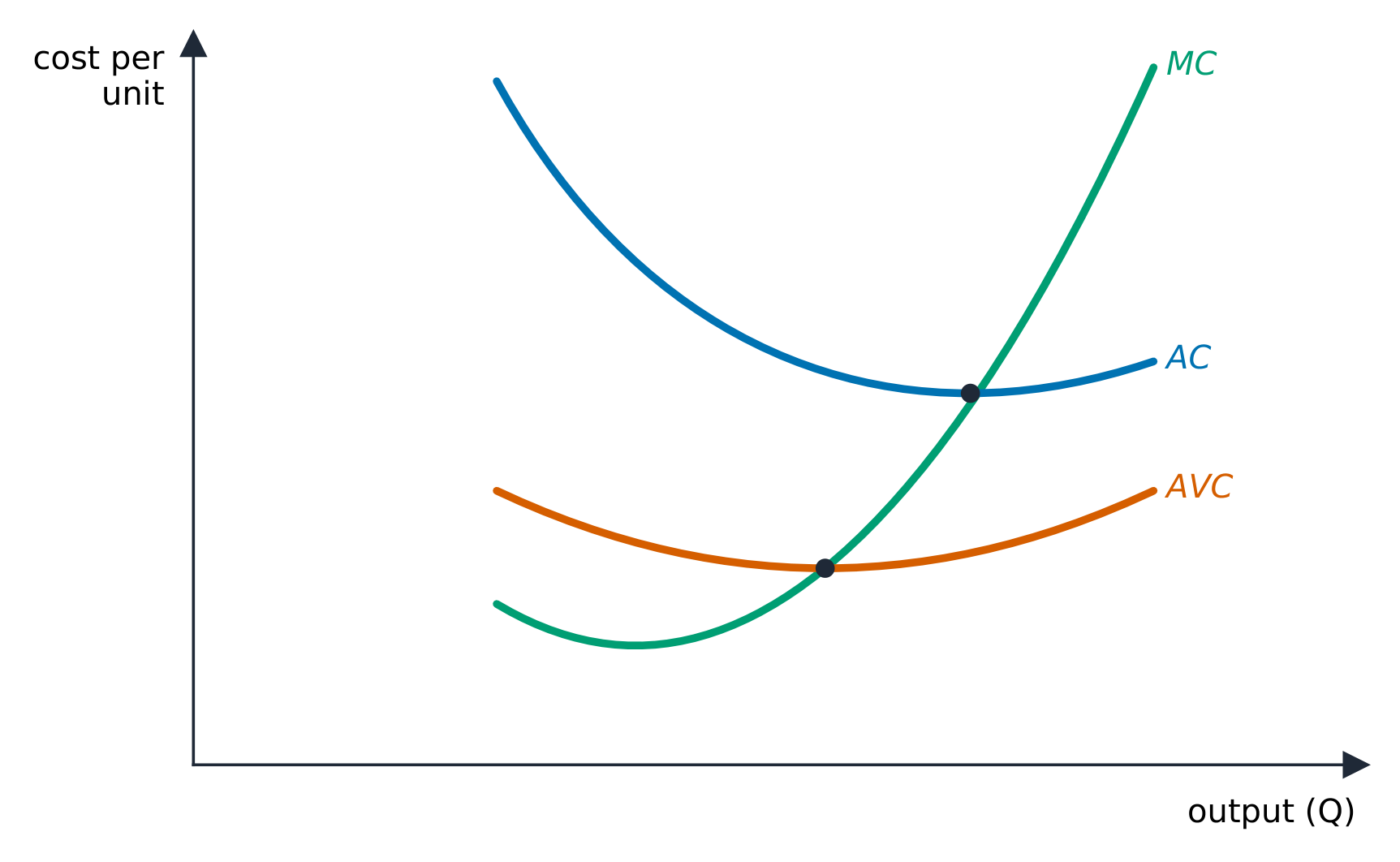
Short-run cost curves (MC, ATC, AVC)

Costs split into fixed and variable:

  • Fixed cost 固定成本 (FC) does not change with output (rent on the factory).
  • Variable cost 可变成本 (VC) rises with output (materials, labor).
  • Total cost 总成本 $TC=FC+VC$.

The per-unit costs matter most:

  • Average fixed cost $AFC=FC/Q$ falls continuously (spreading fixed cost).
  • Average variable cost $AVC=VC/Q$ and average total cost $ATC=TC/Q$ are U-shaped.
  • Marginal cost 边际成本 $MC=\dfrac{\Delta TC}{\Delta Q}$ is the cost of one more unit.

Two key facts: MC is the mirror image of MP (when MP rises, MC falls, and vice versa), and MC cuts both AVC and ATC at their minimum points (when marginal is below average, the average falls; when above, it rises).

Worked example. A firm has fixed cost $FC=\$100$. At $Q=10$ its total cost is $\$300$, so variable cost is $\$200$: then $ATC=\tfrac{300}{10}=\$30$, $AVC=\tfrac{200}{10}=\$20$, and $AFC=\tfrac{100}{10}=\$10$ (note $AFC+AVC=ATC$). If raising output to $Q=11$ pushes total cost to $\$325$, the marginal cost of that $11$th unit is $\dfrac{\Delta TC}{\Delta Q}=\dfrac{325-300}{1}=\$25$.

العربية
منحنيات التكلفة في الأجل القصير (التكلفة الحدية، متوسط إجمالي التكلفة، متوسط التكلفة المتغيرة)

تنقسم التكاليف إلى ثابتة ومتغيرة:

منحنيات التكلفة الحدية والمتوسطة ومتغيرة التكلفة في المدى القصير
  • التكلفة الثابتة (FC) لا تتغير مع الناتج (إيجار المصنع).
  • التكلفة المتغيرة (VC) ترتفع مع الناتج (مواد خام، عمالة).
  • التكلفة الكلية $TC=FC+VC$.

تُعدّ التكاليف لكل وحدة هي الأهم:

  • التكلفة الثابتة المتوسطة $AFC=FC/Q$ تنخفض باستمرار (بسبب توزيع التكلفة الثابتة على وحدات أكثر).
  • التكلفة المتغيرة المتوسطة $AVC=VC/Q$ والتكلفة الكلية المتوسطة $ATC=TC/Q$ تكونا على شكل حرف U.
  • التكلفة الحدية $MC=\dfrac{\Delta TC}{\Delta Q}$ هي تكلفة إضافة وحدة واحدة إضافية.

حقيقتان أساسيتان: التكلفة الحدية هي الصورة العكسية للإنتاجية الحدية (عندما ترتفع الإنتاجية الحدية، تنخفض التكلفة الحدية والعكس صحيح)، والتكلفة الحدية تقطع كلًا من متوسط التكلفة المتغيرة ومتوسط التكلفة الكلية عند أدنى نقطتين لهما (عندما تكون الحدية أقل من المتوسطة، ينخفض المتوسط؛ وعندما تكون أعلى، يرتفع).

مثال محلول. تملك شركة تكلفة ثابتة $FC=\$100$. At $Q=10$ its total cost is $\$300$، لذا فإن التكلفة المتغيرة هي $\$200$: then $ATC=\tfrac{300}{10}=\$30$، $AVC=\tfrac{200}{10}=\$20$, and $AFC=\tfrac{100}{10}=\$10$ (لاحظ $AFC+AVC=ATC$). إذا أدى رفع الإنتاج إلى $Q=11$ إلى رفع التكلفة الكلية إلى $\$325$, the marginal cost of that $11$th unit is $\dfrac{\Delta TC}{\Delta Q}=\dfrac{325-300}{1}=\$25$.

Explore · ⁨استكشف⁩

Explore the U-shaped cost curves · ⁨استكشف منحنيات التكاليف على شكل حرف U⁩

As output rises, marginal cost eventually climbs (diminishing returns) and cuts through the U-shaped average cost at its minimum — the most efficient scale. · ⁨مع ارتفاع الإنتاج، يرتفع التكلفة الحدية في النهاية (بسبب تناقص العوائد) لتقطع منحنى التكلفة المتوسطة على شكل U عند أدنى نقطة له — وهو الحجم الأمثل الأكثر كفاءة.⁩

Vocabulary · ⁨مفردات⁩ Train · ⁨تدريب⁩
English العربية
production function/prəˈdʌkʃn ˈfʌŋkʃn/ دالة الإنتاج
short run/ʃɔːt rʌn/ قصير الأجل
fixed/fɪkst/ ثابت
long run/lɒŋ rʌn/ طويل الأجل
Total product/ˈtəʊtl ˈprɒdʌkt/ إجمالي الإنتاج
Marginal product/ˈmɑːdʒɪnl ˈprɒdʌkt/ الإنتاج الهامشي
Average product/ˈævrɪdʒ ˈprɒdʌkt/ الإنتاج المتوسط
law of diminishing marginal returns/lɔː ɒv dɪˈmɪnɪʃɪŋ ˈmɑːdʒɪnl rɪˈtɜːnz/ قانون تناقص العوائد الحدية
Fixed cost/fɪkst kɒst/ التكلفة الثابتة
Variable cost/ˈveərɪəbl kɒst/ التكلفة المتغيرة
Total cost/ˈtəʊtl kɒst/ إجمالي التكلفة
Marginal cost/ˈmɑːdʒɪnl kɒst/ ملاحظة
3.3

Long-Run Production Costs · ⁨تكاليف الإنتاج في المدى الطويل⁩

Syllabus · ⁨المنهج⁩
English

Enduring Understanding (PRD-1): Firms' production and cost constraints over different input and output levels shape optimal decisions in the short run and long run.

Learning Objective PRD-1.A: a. Define (using graphs where appropriate) key terms and concepts relating to production and cost. b. Explain (using graphs where appropriate) how production and cost are related in the short run and long run. c. Calculate (using data from a graph or table as appropriate) the various measures of productivity and short-run and long-run costs.

  • PRD-1.A.9 In the long run, firms can adjust all their inputs, and as a result, all costs become variable.
  • PRD-1.A.10 The relationship between inputs and outputs in the long run is described by the scale of production—increasing, decreasing, or constant returns to scale.
  • PRD-1.A.11 The long-run average total cost is characterized by economies of scale, diseconomies of scale, or constant returns to scale (efficient scale).
  • PRD-1.A.12 The minimum efficient scale plays a role in determining the concentration of firms in a market and the market structure.
العربية

الفهم الدائم (PRD-1): قيود الإنتاج والتكاليف للشركات عند مستويات مختلفة من المدخلات والمخرجات تشكل القرارات المثلى على المدى القصير والطويل.

هدف التعلم PRD-1.A: أ. عرّف (باستخدام الرسوم البيانية حيثما كان ذلك مناسباً) المصطلحات والمفاهيم الرئيسية المتعلقة بالإنتاج والتكاليف. ب. اشرح (باستخدام الرسوم البيانية حيثما كان ذلك مناسباً) العلاقة بين الإنتاج والتكاليف على المدى القصير والطويل. ج. احسب (باستخدام بيانات من رسم بياني أو جدول حسب المناسبة) مقاييس الإنتاجية المختلفة وتكاليف المدى القصير والطويل.

  • PRD-1.A.9 على المدى الطويل، يمكن للشركات تعديل جميع مدخلاتها، ونتيجة لذلك، تصبح جميع التكاليف متغيرة.
  • PRD-1.A.10 العلاقة بين المدخلات والمخرجات على المدى الطويل تصفها مقياس الإنتاج—العائد المتزايد، أو المتناقص، أو الثابت على مقياس الإنتاج.
  • PRD-1.A.11 تتميز متوسط التكلفة الإجمالية على المدى الطويل باقتصاديات الحجم، أو عدم اقتصاديات الحجم، أو العائد الثابت على مقياس الإنتاج (المقياس الكفء).
  • PRD-1.A.12 يلعب المقياس الأدنى للكفاءة دوراً في تحديد تركيز الشركات في السوق والهيكل السوقي.

Source: College Board AP Course and Exam Description · ⁨المصدر: وصف دورة وامتحان College Board AP⁩

English

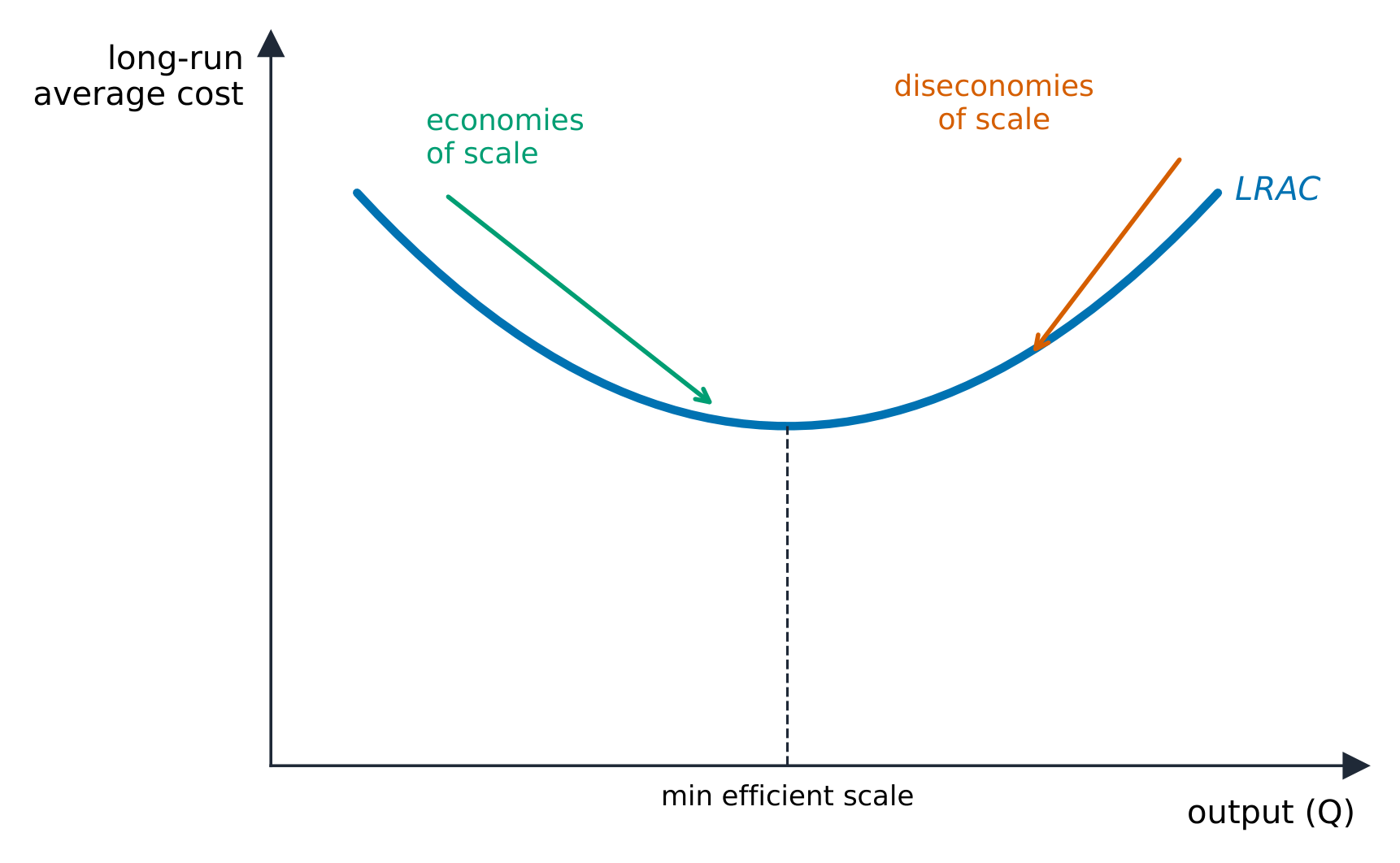
In the long run all inputs – including plant size – can change, so only the long-run average total cost (LRATC) curve matters. Its shape shows returns to scale:

  • Economies of scale 规模经济: LRATC falls as output grows (bulk buying, specialization).
  • Constant returns to scale: LRATC flat.
  • Diseconomies of scale 规模不经济: LRATC rises (a firm too big to manage well).

Exam skill: know that "diminishing returns" is a short-run idea (one fixed input) while "economies of scale" is a long-run idea (all inputs vary) – examiners test the distinction.

العربية

في المدى الطويل يمكن تغيير جميع المدخلات — بما في ذلك حجم المنشأة — لذا فإن منحنى التكلفة الكلية المتوسطة في المدى الطويل (LRATC) هو المهم وحده. يعكس شكله عوائد الحجم: *

مدخرات وتكاليف عدم الكفاءة بسبب الحجم على منحنى التكلفة المتوسطة في المدى الطويل
  • مدخرات الحجم: تنخفض LRATC مع نمو الناتج (الشراء بالجملة، التخصص).
  • عوائد حجم ثابتة: LRATC أفقية.
  • تكاليف عدم الكفاءة بسبب الحجم: ترتفع LRATC (شركة كبيرة جدًا يصعب إدارتها جيدًا).

مهارة الامتحان: يجب أن تعرف أن "العائد المتناقص" مفهوم قصير المدى (مدخل واحد ثابت) بينما "مدخرات الحجم" مفهوم طويل المدى (جميع المدخلات متغيرة) — ويختبر المصححون هذا التمييز.

Vocabulary · ⁨مفردات⁩ Train · ⁨تدريب⁩
English العربية
Economies of scale/ɪˈkɒnəmiz ɒv skeɪl/ اقتصاديات الحجم
Diseconomies of scale/ˌdɪsɪˈkɒnəmiz ɒv skeɪl/ عيوب الحجم
Explicit costs/ekˈsplɪsɪt kɒsts/ التكاليف الصريحة
implicit costs/ɪmˈplɪsɪt kɒsts/ التكاليف الضمنية
Accounting profit/əˈkaʊntɪŋ ˈprɒfɪt/ الربح المحاسبي
Economic profit/ˌiːkəˈnɒmɪk ˈprɒfɪt/ الربح الاقتصادي
normal profit/ˈnɔːml ˈprɒfɪt/ ربحًا طبيعيًا
entry/ˈentri/ الدخول
exit/ˈeɡzɪt/ الخروج
perfectly competitive/ˈpɜːfektlɪ kəmˈpetɪtɪv/ تنافس مثالي
price taker/praɪs ˈteɪkə/ قاصر السعر
allocatively efficient/ˈæləkətɪvli ɪˈfɪʃənt/ فعالي تخصيصياً
productively efficient/prəˈdʌktɪvli ɪˈfɪʃənt/ كفاءة إنتاجية
3.4

Types of Profit · ⁨أنواع الربح⁩

Syllabus · ⁨المنهج⁩
English

Enduring Understanding (CBA-2): To determine the optimal level at which to pursue an activity whose total benefits exceed total cost, rational economic agents compare marginal benefits and marginal costs.

Learning Objective CBA-2.C: a. Define the different types of profit. b. Explain how firms respond to profit opportunities. c. Calculate a firm's profit or loss.

  • CBA-2.C.1 Firms respond to economic profit (loss) rather than accounting profit.
  • CBA-2.C.2 Accounting profit fails to account for implicit costs (such as cost of financial capital, compensation for risk, or an entrepreneur's time), which, if fully compensated, result in normal profit.
العربية

الفهم الدائم (CBA-2): لتحديد المستوى الأمثل لممارسة نشاط تتجاوز فيه المنافع الإجمالية التكاليف الإجمالية، يقارن الوكلاء العقلانيون المنافع الحدية بالتكاليف الحدية.

هدف التعلم CBA-2.C: أ. عرّف أنواع الربح المختلفة. ب. اشرح كيف تستجيب الشركات لفرص الربح. ج. احسب ربح أو خسارة الشركة.

  • CBA-2.C.1 تستجيب الشركات للربح الاقتصادي (الخسارة) بدلاً من الربح المحاسبي.
  • CBA-2.C.2 يفشل الربح المحاسبي في احتساب التكاليف الضمنية (مثل تكلفة رأس المال المالي، والتعويض عن المخاطر، أو وقت رائد الأعمال)، والتي إذا تم تعويضها بالكامل تؤدي إلى ربح طبيعي.

Source: College Board AP Course and Exam Description · ⁨المصدر: وصف دورة وامتحان College Board AP⁩

English

Economists count all opportunity costs, including the owner's:

  • Explicit costs 显性成本 are out-of-pocket payments; implicit costs 隐性成本 are the opportunity costs of owner-supplied resources (forgone salary, forgone interest).
  • Accounting profit 会计利润 $=$ revenue $-$ explicit costs.
  • Economic profit 经济利润 $=$ revenue $-$ explicit $-$ implicit costs.

Because economic profit subtracts more, it is smaller. Zero economic profit (a normal profit 正常利润) still means the owner is earning exactly the opportunity cost of their resources – a perfectly acceptable outcome.

Worked example. A shopkeeper takes in $\$200{,}000$ of revenue and pays $\$120{,}000$ in explicit costs, so accounting profit is $\$80{,}000$. But she gave up a $\$70{,}000$ salary elsewhere and $\$5{,}000$ of interest on the savings she invested – $\$75{,}000$ of implicit costs. Her economic profit is $80{,}000-75{,}000=\$5{,}000$: still positive, so staying in business genuinely beats her next-best alternative.

العربية

يحسب الاقتصاديون كل فرص التكلفة، بما في ذلك فرص-owner's:

  • التكاليف الصريحة هي مدفوعات نقدية مباشرة؛ التكاليف الضمنية هي فرص التكلفة للموارد التي يوفرها المالك (الراتب المنقوص، الفائدة المنقوصة).
  • الربح المحاسبي $=$ الإيرادات $-$ التكاليف الصريحة.
  • الربح الاقتصادي $=$ الإيرادات $-$ التكاليف الصريحة $-$ التكاليف الضمنية.

لأن الربح الاقتصادي يطرح المزيد منه، فهو أصغر. الربح الاقتصادي الصفري (الربح الطبيعي) يعني لا يزال المالك يكتسب بالضبط فرصة تكلفة موارده — وهو نتيجة مقبولة تمامًا.

مثال محلول. يتقاضى بائع متجر $\$200{,}000$ of revenue and pays $\$120{,}000$ في التكاليف الصريحة، لذا فإن الربح المحاسبي هو $\$80{,}000$. But she gave up a $\$70{,}000$ الراتب في مكان آخر و$\$5{,}000$ of interest on the savings she invested – $\$75{,}000$ من التكاليف الضمنية. ربحه الاقتصادي هو $80{,}000-75{,}000=\$5{,}000$: لا يزال إيجابيًا، لذا فإن البقاء في العمل يتفوق حقًا على بديله الأفضل التالي.

3.5

Profit Maximization · ⁨تعظيم الربح⁩

Syllabus · ⁨المنهج⁩
English

Enduring Understanding (CBA-2): To determine the optimal level at which to pursue an activity whose total benefits exceed total cost, rational economic agents compare marginal benefits and marginal costs.

Learning Objective CBA-2.D: a. Define (using graphs or data as appropriate) the profit-maximizing rule. b. Explain (using a graph or data as appropriate) the profit-maximizing level of production.

  • CBA-2.D.1 Firms are assumed to produce output to maximize their profits by comparing marginal revenue and marginal cost.
العربية

الفهم الدائم (CBA-2): لتحديد المستوى الأمثل لممارسة نشاط تتجاوز فيه المنافع الإجمالية التكاليف الإجمالية، يقارن الوكلاء العقلانيون المنافع الحدية بالتكاليف الحدية.

هدف التعلم CBA-2.D: أ. عرّف (باستخدام الرسوم البيانية أو البيانات حسب المناسبة) قاعدة تعظيم الربح. ب. اشرح (باستخدام رسم بياني أو بيانات حسب المناسبة) مستوى الإنتاج الذي يعظم الربح.

  • CBA-2.D.1 يُفترض أن الشركات تنتج المخرجات لتعظيم أرباحها من خلال مقارنة الإيراد الحدي والتكلفة الحدية.

Source: College Board AP Course and Exam Description · ⁨المصدر: وصف دورة وامتحان College Board AP⁩

English

Every firm, in every market structure, maximizes profit at the quantity where marginal revenue equals marginal cost:

$$MR=MC.$$
Produce each unit whose MR exceeds its MC; stop when they are equal. Producing less leaves profitable units unmade; producing more adds units that cost more than they earn.

العربية

كل شركة، في أي هيكل سوق، تُعظم ربحها عند الكمية التي يتساوى فيها الإيراد الحدي مع التكلفة الحدية:

$$MR=MC.$$
أنتِج كل وحدة يكون فيها إيرادها الحدي أكبر من تكلفتها الحدية؛ توقف عندما يتساويان. الإنتاج الأقل يترك وحدات مربحة دون إنتاج؛ الإنتاج الأعلى يضيف وحدات تكلفها أكثر مما تجنيه.

3.6

Deciding to Produce, Enter, or Exit · ⁨اتخاذ قرار الإنتاج أو الدخول أو الخروج⁩

Syllabus · ⁨المنهج⁩
English

Enduring Understanding (PRD-2): Firms' short-run decisions to produce output, and long-run decisions to enter or exit a market, are based on profitability.

Learning Objective PRD-2.A: Explain (using graphs or data where appropriate) firms' short-run decisions to produce positive output levels, or long-run decisions to enter or exit a market in response to profit-making opportunities.

  • PRD-2.A.1 In the short run, firms decide to operate (i.e., produce positive output) or shut down (i.e., produce zero output) by comparing total revenue to total variable cost or price to average variable cost (AVC).
  • PRD-2.A.2 In the absence of barriers to entry or exit, in the long run (i.e., once factors that are fixed in the short run become variable), firms enter a market in which there are profit-making opportunities and exit a market when they anticipate economic losses.
العربية

الفهم الدائم (PRD-2): قرارات الشركات على المدى القصير لإنتاج المخرجات، وقراراتها على المدى الطويل للدخول أو الخروج من السوق، تعتمد على الربحية.

هدف التعلم PRD-2.A: اشرح (باستخدام الرسوم البيانية أو البيانات حسب المناسبة) قرارات الشركات على المدى القصير لإنتاج مستويات إيجابية من الإنتاج، أو قراراتها على المدى الطويل للدخول أو الخروج من السوق استجابةً لفرص تحقيق الربح.

  • PRD-2.A.1 على المدى القصير، تقرر الشركات التشغيل (أي إنتاج كمية إيجابية) أو الإغلاق (أي إنتاج صفر) من خلال مقارنة الإيرادات الكلية بالتكاليف المتغيرة أو السعر بمتوسط التكلفة المتغيرة (AVC).
  • PRD-2.A.2 في غياب حواجز الدخول أو الخروج، على المدى الطويل (أي بعد أن تصبح العوامل الثابتة على المدى القصير متغيرة)، تدخل الشركات سوقاً توجد فيه فرص ربحية وتغادره عندما تتوقع خسائر اقتصادية.

Source: College Board AP Course and Exam Description · ⁨المصدر: وصف دورة وامتحان College Board AP⁩

English

Even at $MR=MC$, a firm must check whether to operate:

  • Short run – the shutdown rule: keep producing only if price covers average variable cost ($P\geq AVC$). If $P, shut down and lose only fixed cost. So the firm's short-run supply curve is its MC curve above minimum AVC.
  • Profit check: compare $P$ to $ATC$ at the profit-maximizing quantity – $P>ATC$ means economic profit, $P means a loss, $P=ATC$ means break-even.
  • Long run – entry and exit: economic profits attract entry 进入; losses cause exit 退出. This continues until economic profit is zero.
العربية

حتى عند $MR=MC$، يجب على الشركة التحقق مما إذا كانت ستعمل:

  • المدى القصير – قاعدة الإغلاق: استمر في الإنتاج فقط إذا كان السعر يغطي متوسط التكلفة المتغيرة ($P\geq AVC$). إذا $P، أغلق وخسر فقط التكلفة الثابتة. لذلك منحنى العرض قصير المدى للشركة هو منحنى التكلفة الحدية فوق أدنى نقطة لـ AVC.
  • تحقق الربح: قارن $P$ بـ $ATC$ عند كمية تعظيم الربح – $P>ATC$ يعني ربحًا اقتصاديًا، $P يعني خسارة، $P=ATC$ يعني التعادل.
  • المدى الطويل – الدخول والخروج: تجذب الأرباح الاقتصادية الدخول; الخسائر تسبب الخروج. يستمر هذا حتى يصبح الربح الاقتصادي صفراً.
3.7

Perfect Competition · ⁨المنافسة المثالية⁩

Syllabus · ⁨المنهج⁩
English

Enduring Understanding (PRD-3): Even with a common goal of profit-maximization, market structure constrains and influences prices, output, and efficiency.

Learning Objective PRD-3.A: a. Define (using graphs as appropriate) the characteristics of perfectly competitive markets and efficiency. b. Explain (using graphs where appropriate) equilibrium and firm decision making in perfectly competitive markets and how prices in perfectly competitive markets lead to efficient outcomes. c. Calculate (using data from a graph or table as appropriate) economic profit (loss) in perfectly competitive markets.

  • PRD-3.A.1 A perfectly competitive market is efficient. Firms in perfectly competitive markets face no barriers to entry and have no market power.
  • PRD-3.A.2 In perfectly competitive markets, prices communicate to consumers and producers the magnitude of others' marginal costs of production and marginal benefits of consumption and provide incentives to act on that information (i.e., price equals marginal cost in an efficient market).
  • PRD-3.A.3 In perfectly competitive markets, firms can sell all their outputs at a constant price determined by the market.
  • PRD-3.A.4 At a competitive market equilibrium, firms are price takers and select output to maximize profit by producing the level of output where the marginal cost equals marginal revenue (at the price).
  • PRD-3.A.5 At a competitive market equilibrium, the price of a product equals both the private marginal benefit received by the last unit consumed and the private marginal cost incurred to produce the last unit, thus achieving allocative efficiency.
  • PRD-3.A.6 In a short-run competitive equilibrium, price can either be above or below its long-run competitive level resulting in profits or losses, motivating entry or exit of firms and moving prices and quantities toward long-run equilibrium.
  • PRD-3.A.7 In a long-run perfectly competitive equilibrium, productive efficiency implies all operating firms produce at efficient scale, price equals marginal cost and minimum average total cost, and firms earn zero economic profit.
  • PRD-3.A.8 Firms may be in a constant cost, increasing cost, or decreasing cost industry. Long-run prices depend on the portion of the long-run cost curves on which firms operate.
  • PRD-3.A.9 A perfectly competitive market in long-run equilibrium is allocatively and productively efficient.
العربية

الفهم الدائم (PRD-3): حتى مع هدف مشترك وهو تعظيم الربح، يحد الهيكل السوقي ويؤثر على الأسعار والإنتاج والكفاءة.

هدف التعلم PRD-3.A: أ. عرّف (باستخدام الرسوم البيانية حسب المناسبة) خصائص الأسواق التنافسية الكاملة والكفاءة. ب. اشرح (باستخدام الرسوم البيانية حسب المناسبة) التوازن واتخاذ القرار من قبل الشركات في الأسواق التنافسية الكاملة وكيف تؤدي الأسعار في هذه الأسواق إلى نتائج كفاءة. ج. احسب (باستخدام بيانات من رسم بياني أو جدول حسب المناسبة) الربح (أو الخسارة) الاقتصادي في الأسواق التنافسية الكاملة.

  • PRD-3.A.1 السوق التنافسي الكامل هو سوق كفء. لا تواجه الشركات في الأسواق التنافسية الكاملة حواجز دخول ولا تمتلك قوة سوقية.
  • PRD-3.A.2 في الأسواق التنافسية الكاملة، تواصل الأسعار للمستهلكين والمنتجين مقدار تكاليف الإنتاج الحدية والفوائد الحدية للاستهلاك لدى الآخرين، وتوفر حوافز للتصرف بناءً على تلك المعلومات (أي أن السعر يساوي التكلفة الحدية في السوق الكفء).
  • PRD-3.A.3 في الأسواق التنافسية الكاملة، يمكن للشركات بيع جميع مخرجاتها بسعر ثابت تحدده السوق.
  • PRD-3.A.4 عند توازن السوق التنافسي، تكون الشركات تأخذ للأسعار وتختار المخرجات لتعظيم الربح من خلال إنتاج مستوى المخرجات حيث تتساوى التكلفة الحدية مع الإيراد الحدي (عند السعر).
  • PRD-3.A.5 عند التوازن في سوق تنافسي، يساوي سعر المنتج المنفعة الحدية الخاصة التي يحصل عليها المستهلك للوحدة الأخيرة المستهلكة والتكلفة الحدية الخاصة المتكبدة لإنتاج الوحدة الأخيرة، مما يحقق الكفاءة التخصيصية.
  • PRD-3.A.6 في التوازن التنافسي قصير الأجل، يمكن أن يكون السعر أعلى أو أقل من مستواه التنافسي طويل الأجل، مما يؤدي إلى أرباح أو خسائر، ويحفز دخول أو خروج الشركات، ويدفع الأسعار والكميات نحو التوازن طويل الأجل.
  • PRD-3.A.7 في التوازن المثالي التنافسي طويل الأجل، تعني الكفاءة الإنتاجية أن جميع الشركات العاملة تنتج على نطاق فعال، وأن السعر يساوي التكلفة الحدية وأقل تكلفة كلية متوسطة، وتكسب الشركات صفر ربح اقتصادي.
  • PRD-3.A.8 قد تكون الصناعات ذات تكاليف ثابتة، أو تكاليف متزايدة، أو تكاليف متناقصة. تعتمد الأسعار طويلة الأجل على الجزء من منحنيات التكاليف طويلة الأجل الذي تعمل عليه الشركات.
  • PRD-3.A.9 السوق المثالي التنافسي في التوازن طويل الأجل هو كافي من حيث الكفاءة التخصيصية والإنتاجية.

Source: College Board AP Course and Exam Description · ⁨المصدر: وصف دورة وامتحان College Board AP⁩

English

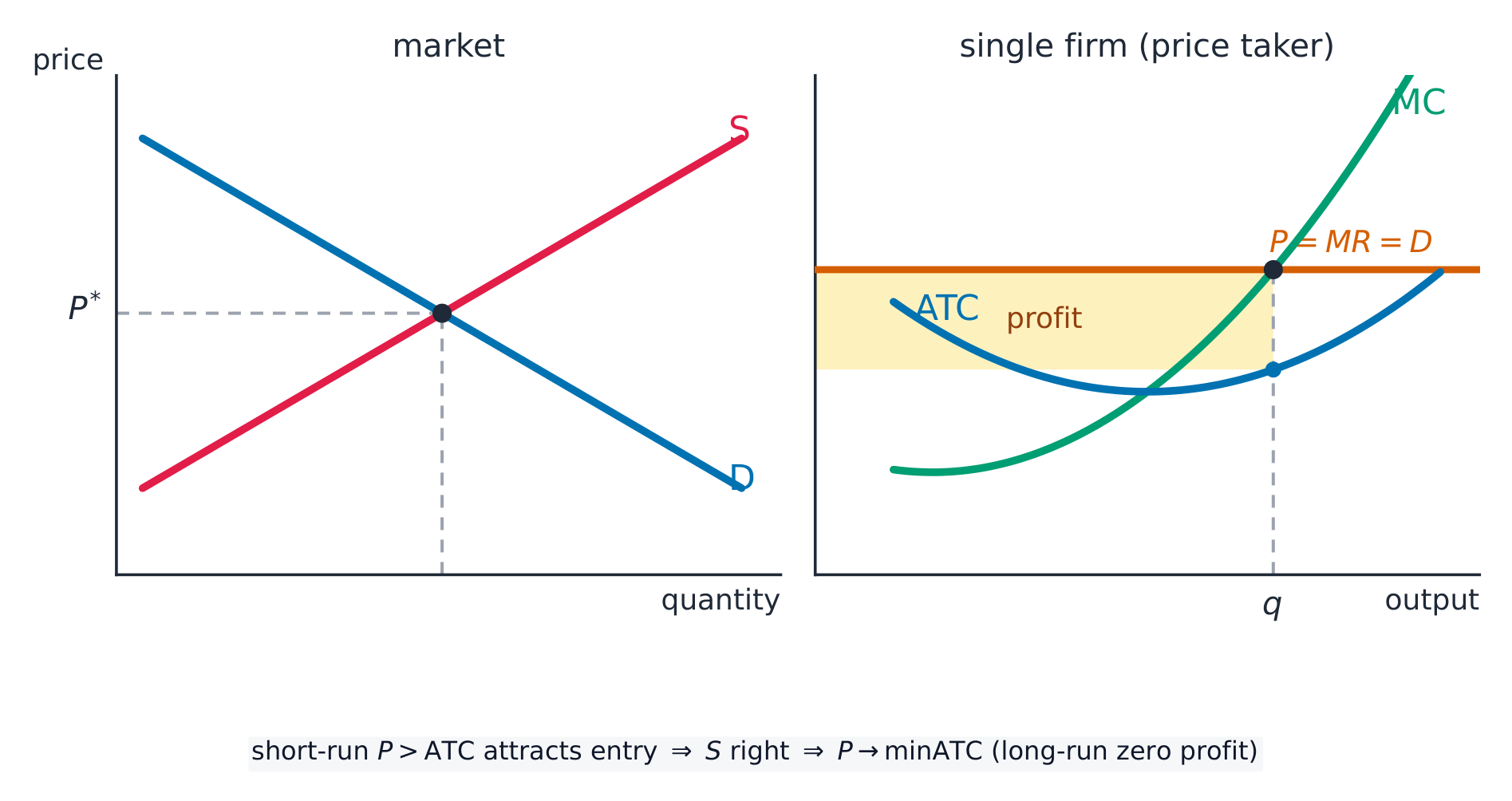
A perfectly competitive 完全竞争 market has many small firms, an identical (homogeneous) product, free entry and exit, and perfect information. Each firm is a price taker 价格接受者 – too small to affect the price – so it faces a horizontal demand curve at the market price, and price = marginal revenue = average revenue ($P=MR=AR$).

This is why economists prize perfect competition. In long-run equilibrium it is both allocatively efficient 配置效率 and productively efficient 生产效率. Allocative efficiency holds because the firm produces where $P = MC$: the price (society's marginal benefit from the last unit) equals its marginal cost, so exactly the right amount is made. Productive efficiency holds because free entry drives price down to the minimum of average total cost, so goods are made as cheaply as possible. The market price is itself a signal that communicates everyone's marginal costs and benefits.

The side-by-side panel is the graph the exam wants: the market (left) fixes the price $P^{*}$; the firm (right) takes it as a horizontal line and produces where $MC=P$. When $P>ATC$ there is a short-run profit (the shaded box); that profit attracts entry, which shifts market supply right and pushes the price down.

  • Short run: the firm can earn profit, break even, or take a loss, producing where $P=MC$.
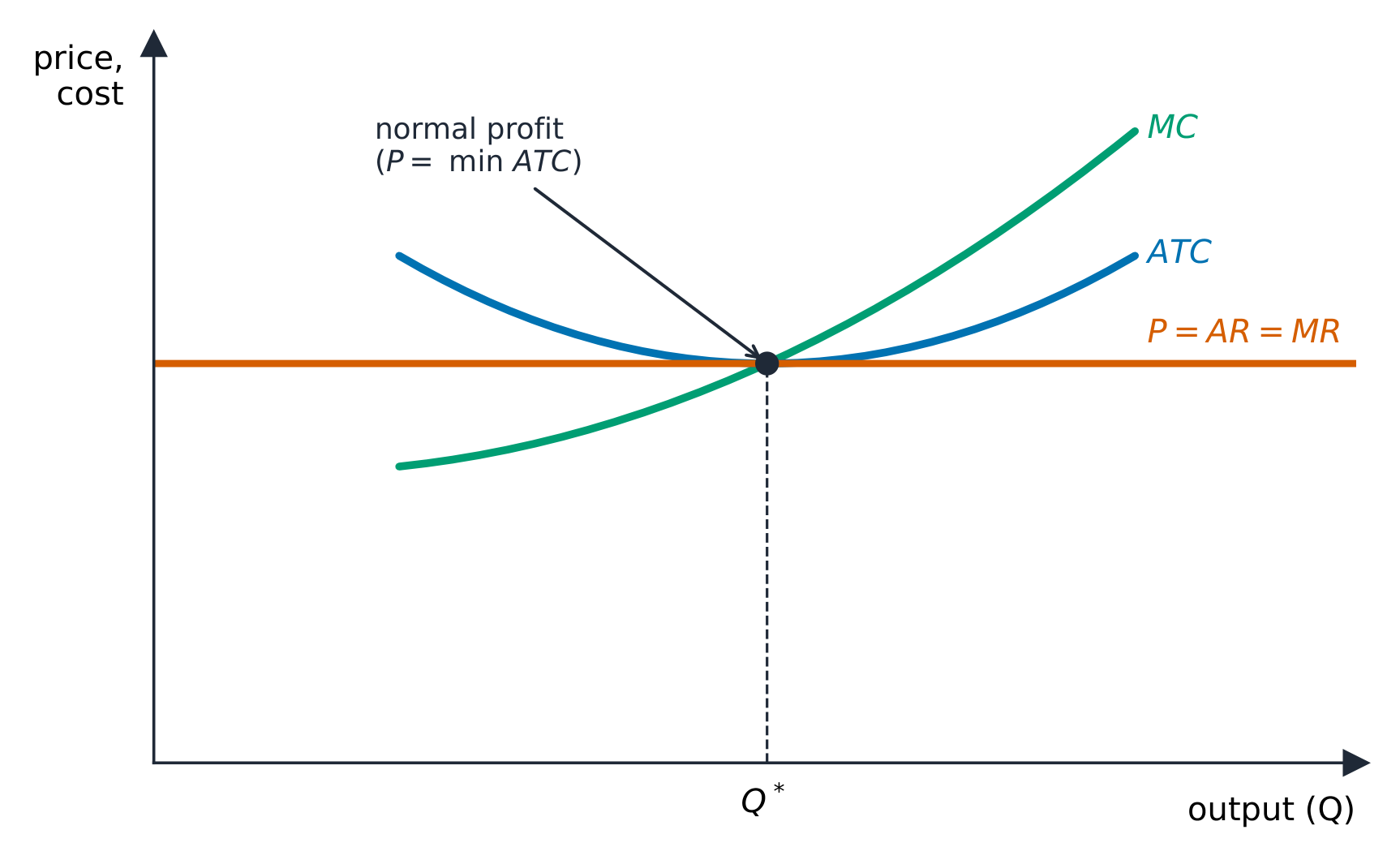
  • Long run: entry and exit drive the firm to zero economic profit, producing where $P=MC=ATC$ at minimum ATC. This double efficiency – productive efficiency (lowest-cost output) and allocative efficiency ($P=MC$, so the last unit's value equals its cost) – is the benchmark against which every other market structure is judged.

Exam skill: be able to draw the side-by-side market and single-firm graphs, show a short-run profit or loss, then show how entry/exit restores long-run equilibrium at minimum ATC.

العربية

السوق المثالي التنافسي له العديد من الشركات الصغيرة، منتج موحد (متطابق)، دخول وخروج حر، ومعلومات مثالية. كل شركة هي مستقبل سعر – صغيرة جدًا لتؤثر على السعر – لذا تواجه منحنى طلب أفقي عند سعر السوق، والسعر = الإيراد الحدي = الإيراد المتوسط ($P=MR=AR$).

ولهذا السبب يقدّر الاقتصاديون المنافسة المثالية. في التوازن طويل المدى، فهي كفاءة تخصيصية وكفاءة إنتاجية معًا. تتحقق الكفاءة التخصيصية لأن الشركة تنتج حيث $P = MC$: السعر (الفائدة الحدية للمجتمع من الوحدة الأخيرة) يساوي تكلفتها الحدية، sehingga يتم إنتاج الكمية الصحيحة تمامًا. تتحقق الكفاءة الإنتاجية لأن الدخول الحر يدفع السعر إلى أدنى نقطة لمتوسط التكلفة الكلية، thereby يتم إنتاج السلع بأرخص تكلفة ممكنة. سعر السوق نفسه هو إشارة تواصل تكاليف وفوائد الحدية للجميع.

يحدد السوق السعر؛ تنتج الشركة المستقبلة السعر حيث MC = P، هنا مع ربح قصير المدى

لوحة الجراف الموضوعة جنبًا إلى جنب هي الرسم البياني الذي يطلبه الامتحان: السوق (يسار) يثبت السعر $P^{*}$؛ الشركة (يمين) تأخذه كخط أفقي وتنتج حيث $MC=P$. عندما $P>ATC$ يوجد ربح قصير المدى (الصندوق المظلل)؛ يجذب هذا الربح الدخول، which يحرك عرض السوق لليمين ويدفع السعر للأسفل.

شركة منافسة مثالية تحقق ربحًا طبيعيًا فقط في المدى الطويل
الشركة في السوق التنافسي المثالي تحقق ربحاً طبيعياً فقط على المدى الطويل
  • على المدى القصير: يمكن للشركة تحقيق ربح، أو التعادل، أو خسارة، حيث تنتج عند $P=MC$.
  • على المدى الطويل: يؤدي الدخول والخروج إلى أن تصبح الشركة بالتساوي الربح الاقتصادي (صفر)، وتنتج عند $P=MC=ATC$ عند أدنى متوسط التكلفة الكلية. هذا الكفاءة المزدوجة – الكفاءة الإنتاجية (أقل تكلفة للإنتاج) والكفاءة التخصيصية ($P=MC$، أي أن قيمة الوحدة الأخيرة تساوت تكلفتها) – هو المعيار الذي تُقاس عليه كل هياكل سوق أخرى.

مهارة الامتحان: القدرة على رسم مخطط السوق والمخطط الخاص بالشركة الواحدة جنباً إلى جنب، وإظهار ربح أو خسارة على المدى القصير، ثم توضيح كيف يعيد الدخول/الخود التوازن على المدى الطويل عند أدنى متوسط تكلفة كلية.

Explore · ⁨استكشف⁩

A price-taking firm in a competitive market · ⁨شركة تأخذ السعر في سوق تنافسي⁩

In perfect competition the market sets the price and each firm is a price-taker. It produces where price equals marginal cost, earning zero economic profit in the long run. · ⁨في المنافسة المثلى يحدد السوق السعر وتكون كل شركة آخذة للسعر. تنتج الشركة عند نقطة تساوي فيها السعر مع التكلفة الحدية، وتحقق ربحاً اقتصادياً صفراً على المدى الطويل.⁩

3.7

Exam tips · ⁨نصائح للامتحان⁩

English
  • Know the cost curves: AFC falls, ATC/AVC are U-shaped, and MC cuts ATC and AVC at their minimums.
  • Every firm maximises profit at MR = MC; check the shutdown rule ($P \ge AVC$ in the short run).
  • Distinguish accounting profit (revenue − explicit costs) from economic profit (also minus implicit/opportunity costs); zero economic profit is normal.
  • "Diminishing returns" is short-run (one fixed input); "economies of scale" is long-run (all inputs vary).
  • In perfect competition $P=MR=AR$; entry/exit drive long-run economic profit to zero at minimum ATC.
العربية
  • معرفة منحنيات التكلفة: ينخفض متوسط التكلفة الثابتة، ومتوسط التكلفة الكلية/متوسط التكلفة المتغيرة على شكل U، ويقطع التكلفة الحدية متوسط التكلفة الكلية ومتوسط التكلفة المتغيرة عند أدنيهما.
  • كل شركة تعظم أرباحها عند الإيراد الحدي = التكلفة الحدية؛ تحقق من قاعدة الإيقاف ($P \ge AVC$ على المدى القصير).
  • فرّق بين الربح المحاسبي (الإيرادات − التكاليف الصريحة) والربح الاقتصادي (يخصم أيضاً التكاليف الضمنية/فرص البديل)؛ الربح الاقتصادي الصفري هو الطبيعي.
  • "الحدود العائدة المتناقصة" هي على المدى القصير (مدخل ثابت واحد)؛ "اقتصاديات الحجم" هي على المدى الطويل (تتغير جميع المدخلات).
  • في المنافسة المثالية $P=MR=AR$؛ يؤدي الدخول/الخروج إلى جعل الربح الاقتصادي صفرياً على المدى الطويل عند أدنى متوسط تكلفة كلية.

Interactive lessons on this topic · ⁨دروس تفاعلية حول هذا الموضوع⁩

Work through it step by step, with instant-check exercises. · ⁨ا-working عليه خطوة بخطوة، مع تمارين تحقق فوري.⁩

Past Papers · ⁨أوراق الامتحانات السابقة⁩

More topics in AP Microeconomics · ⁨الاقتصاد الجزئي (AP)⁩ · ⁨المزيد من المواضيع في AP Microeconomics · ⁨الاقتصاد الجزئي (AP)⁩⁩

Log in or create account · ⁨تسجيل الدخول أو إنشاء حساب⁩

IGCSE, A-Level & AP