Perfect Competition
Introduced| English | Meaning |
|---|---|
| perfect competition/ˈpɜːfekt ˌkɒmpəˈtɪʃn/ | A market with many firms selling identical products and free entry, so each is a price-taker. |
| free entry and exit/friː ˈentri ænd ˈeɡzɪt/ | The ability of firms to enter or leave a market without significant barriers; this does not mean starting a business has no cost. |
| price taker/praɪs ˈteɪkə/ | A producer or consumer that must accept the prevailing market price because its own actions cannot materially influence it. |
| profit/ˈprɒfɪt/ | Total revenue minus total cost. |
| loss/lɒs/ | The amount by which total cost exceeds total revenue over the period being measured. |
| productive efficiency/prəˈdʌktɪv ɪˈfɪʃənsi/ | Production at the lowest attainable average total cost for the relevant technology and scale. |
| allocative efficiency/ˈæləkətɪv ɪˈfɪʃənsi/ | An allocation of resources that maximises total net benefit; at the efficient output, marginal social benefit equals marginal social cost. |
When no one can set the price
- Picture a thousand wheat farms selling exactly the same grain.
- No single farm is big enough to nudge the market price.
- Each must simply accept whatever price the market gives.
- This extreme case, perfect competition 完全竞争, is the benchmark for every other market.
The features of perfect competition
- Many tiny firms, selling identical products, with free entry and exit 自由进出 and perfect information.
- Because each firm is tiny and its product identical, it is a price taker 价格接受者 — it cannot set its own price.
- So the demand curve it faces is horizontal, and $P = AR = MR$.
A perfectly competitive firm is a price taker, which means it:
Difficulty 1/5 · 100 coins + a small bonus on first completion today
It is too small to influence the price, so it takes the market price as given.
For a competitive firm, price equals average revenue and also equals ______ revenue.
Difficulty 1/5 · 100 coins + a small bonus on first completion today
Because every unit sells at the same price, P = AR = MR.
Select all features of a perfectly competitive market.
Difficulty 2/5 · 140 coins + a small bonus on first completion today
Many firms, identical products, and free entry/exit define perfect competition; one controlling firm is a monopoly.
Short-run equilibrium
- The firm still produces where $MR = MC$; since $P = MR$, it produces where $P = MC$.
- Compare price with ATC at that quantity:
- $P > ATC$ → a profit 利润; $P = ATC$ → break-even; $P < ATC$ (but $\geq AVC$) → a loss 亏损, still producing.
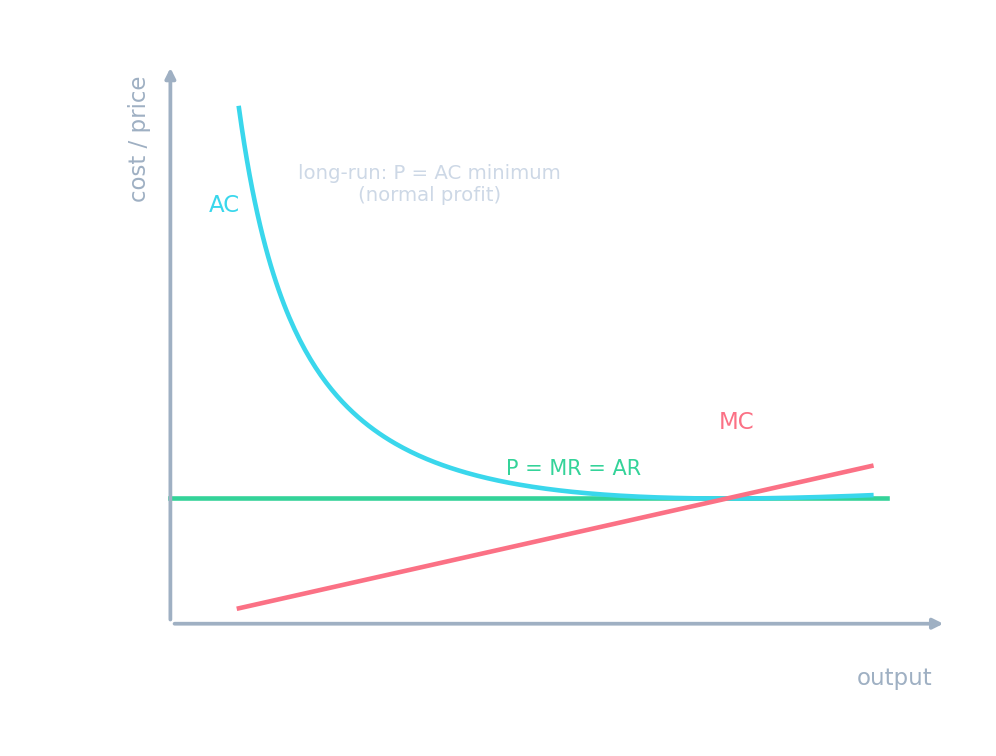
The competitive firm
A price-taking firm faces a horizontal demand at the market price and produces where P = MC. In the long run, entry and exit push it to P = minimum ATC.
A wheat farm sells at P = 5, produces Q = 1000 where MC = 5, and has ATC = 4. What is its short-run economic profit?
Difficulty 2/5 · 140 coins + a small bonus on first completion today
Profit = (P − ATC) × Q = (5 − 4) × 1000 = 1000. That profit attracts new farms to enter.
Long-run efficiency
- Free entry and exit erase any profit or loss, so the long run settles at $P = MC = \text{minimum } ATC$.
- Productive efficiency 生产效率: output is made at the lowest possible cost ($P = \text{minimum } ATC$).
- Allocative efficiency 配置效率: the right amount is made ($P = MC$).
- Achieving both at once is why perfect competition is the efficiency benchmark.
In long-run equilibrium, a perfectly competitive firm produces where:
Difficulty 1/5 · 100 coins + a small bonus on first completion today
Entry and exit drive economic profit to zero at P = MC = minimum ATC.
Match each type of efficiency to its condition.
Difficulty 2/5 · 140 coins + a small bonus on first completion today
Perfect competition achieves both at once in the long run.
Worked examples
1. Firms sell at 30 and the typical firm, producing where $MR = MC$ at $Q = 40$, has $ATC = 25$. Economic profit $= (30 - 25) \times 40 = 200$ per firm.
2. Profit attracts entry, so market supply shifts right and the price falls until $P = \min ATC$. In long-run equilibrium economic profit is zero.
A competitive firm sells at price 8, produces 200 units where marginal cost is 8, and has average total cost 8. What is its economic profit?
8 minus 8 is 0, and 0 times 200 is 0.
What is the economic profit?
Difficulty 1/5 · 100 coins + a small bonus on first completion today
The price gap is 0, so profit is 0. Other options — 1000 (the lesson wheat profit); 200 (the quantity used as the profit).
A perfectly competitive firm is a price taker with $P = AR = MR$. It produces where $P = MC$, earning a profit, break-even, or loss short-run. Free entry and exit drive the long run to $P = MC = \text{minimum } ATC$ — both productive and allocative efficiency.
Write from an economic profit of 0
- Price is 8, quantity is 200 and average total cost is 8.
- Marginal cost is also 8. Find short-run economic profit.