Profit Maximization
Introduced| English | Meaning |
|---|---|
| total revenue/ˈtəʊtl ˈrevənjuː/ | The total income received from selling goods or services before costs are deducted. |
| average revenue/ˈævrɪdʒ ˈrevənjuː/ | Total revenue divided by quantity sold; when each unit sells at the same price, it equals that price. |
| marginal revenue/ˈmɑːdʒɪnl ˈrevənjuː/ | The additional total revenue obtained from selling one extra unit of output. |
| profit-maximizing rule/ˈprɒfɪt ˈmæksɪmaɪzɪŋ ruːl/ | Choose the feasible output giving the greatest difference between total revenue and total cost; an interior operating optimum ordinarily has marginal revenue equal to marginal cost. |
The one rule every firm follows
- Make too little and you leave easy money on the table.
- Make too much and the last units cost more than they earn.
- Somewhere in between sits the quantity with the biggest profit.
- One simple rule finds it every time.
Three revenue ideas
- Total revenue 总收入 (TR) is all the money from sales: $TR = P \times Q$.
- Average revenue 平均收入 (AR) is revenue per unit: $AR = \tfrac{TR}{Q}$ — this always equals the price.
- Marginal revenue 边际收入 (MR) is the extra revenue from one more unit: $MR = \tfrac{\Delta TR}{\Delta Q}$.
Marginal revenue is:
Difficulty 1/5 · 100 coins + a small bonus on first completion today
MR = ΔTR/ΔQ — the change in total revenue from one more unit sold.
Average revenue always equals the price of the good.
Difficulty 1/5 · 100 coins + a small bonus on first completion today
AR = TR/Q = (P × Q)/Q = P.
Produce where MR = MC
- The profit-maximizing rule 利润最大化法则: make the quantity where marginal revenue equals marginal cost.
- If $MR > MC$, the next unit earns more than it costs — keep going.
- If $MR < MC$, the next unit costs more than it earns — make less.
- Only at $MR = MC$ can profit no longer improve.
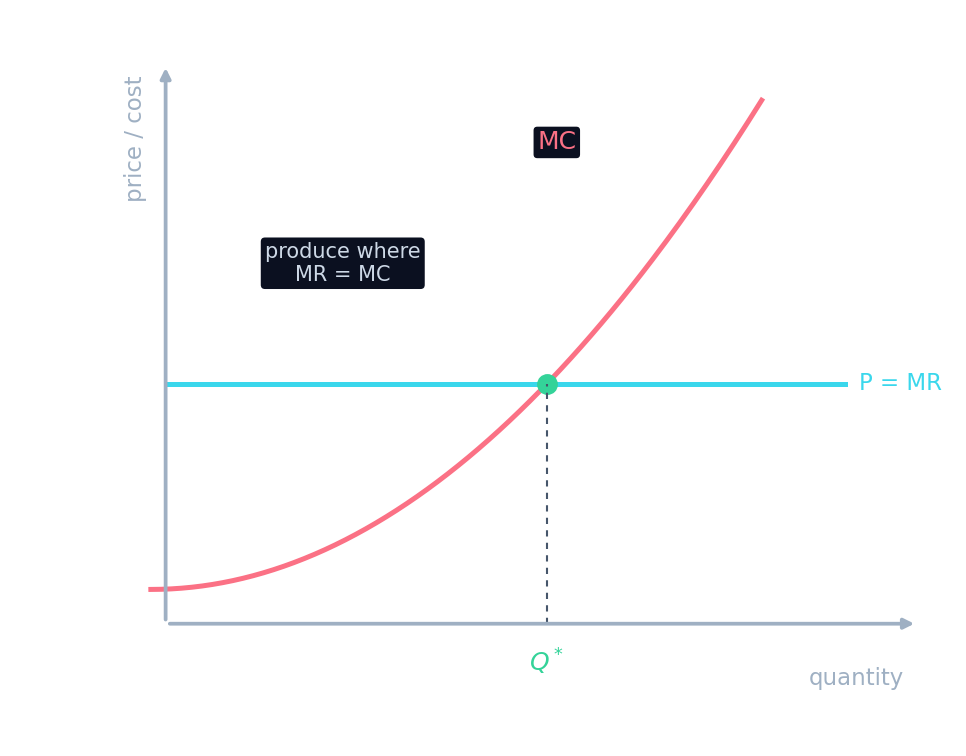
Cost curves and the best quantity
A firm maximises profit where marginal revenue meets marginal cost. Explore how the marginal-cost curve sets that best quantity.
A firm maximises profit by producing the quantity where:
Difficulty 1/5 · 100 coins + a small bonus on first completion today
At MR = MC profit can no longer improve — the profit-maximizing rule.
At the current output, MR is greater than MC. The firm should:
Difficulty 1/5 · 100 coins + a small bonus on first completion today
MR > MC means the next unit adds to profit, so keep producing until MR = MC.
Measure the profit
- Once you know the best quantity, measure profit with price and average total cost:
- Economic profit $= (P - ATC) \times Q$.
- If $P > ATC$ there is a profit; if $P = ATC$ the firm breaks even; if $P < ATC$ it makes a loss.
- $MR = MC$ finds the best quantity whether the firm is making a profit or the smallest possible loss.
At its best quantity a firm makes Q = 50 units, with price P = 12 and average total cost ATC = 9. What is its economic profit?
Difficulty 2/5 · 140 coins + a small bonus on first completion today
Economic profit = (P − ATC) × Q = (12 − 9) × 50 = 150.
Economic profit at the best quantity equals (P − ______) × Q.
Difficulty 1/5 · 100 coins + a small bonus on first completion today
Per-unit profit is P − ATC; multiply by Q for total economic profit.
Worked examples
1. A perfectly competitive firm sells at a price of 20, so $MR = 20$. Marginal cost is 18 for the 4th unit, 20 for the 5th and 24 for the 6th. Produce 5 units, where $MR = MC$; the 6th unit would add 24 to cost but only 20 to revenue.
2. If $ATC = 16$ at $Q = 5$, profit $= (P - ATC) \times Q = (20 - 16) \times 5 = 20$.
A firm produces 20 units at price 15 with average total cost 11. What is its economic profit?
4 times 20 is 80.
What is the economic profit?
Difficulty 1/5 · 100 coins + a small bonus on first completion today
The gap of 4 times the quantity 20 is 80. Other options — 150 (the lesson profit); 4 (the gap per unit left unmultiplied).
Revenue: TR = P × Q, AR = P, and MR is the extra from one more unit. The profit-maximizing rule is MR = MC. Then measure profit as (P − ATC) × Q — positive if P > ATC, break-even if equal, a loss if below.
Write from an economic profit of 80
- The best output is 20 units. Price is 15 and average total cost is 11.
- Find economic profit.