Deciding to Produce, Enter, or Exit
Introduced| English | Meaning |
|---|---|
| shut-down rule/ʃʌt daʊn ruːl/ | In the short run, stop producing when revenue cannot cover variable costs; for a price-taking firm, this occurs below minimum average variable cost. |
| average variable cost/ˈævrɪdʒ ˈveərɪəbl kɒst/ | Total variable cost divided by the quantity of output. |
| exit/ˈeɡzɪt/ | A firm's decision to leave a market and cease production there, freeing inputs that can be changed in the long run. |
| break-even price/breɪk ˈiːvən praɪs/ | A price equal to average total cost at the chosen output, yielding zero economic profit. |
Losing money — stay open or close?
- A firm is making a loss. Should it keep producing, or shut its doors?
- The surprising answer: sometimes losing money and staying open is the smart move.
- It all depends on how the price compares with two kinds of cost.
- And whether we are asking about the short run or the long run.
The short-run shut-down rule
- In the short run, fixed costs must be paid even at zero output.
- The shut-down rule 停产法则: keep producing only if price covers the average variable cost 平均可变成本.
- If $P \geq AVC$: keep going — each sale covers its variable cost and chips away at the fixed cost.
- If $P < AVC$: shut down — producing only makes the loss worse.
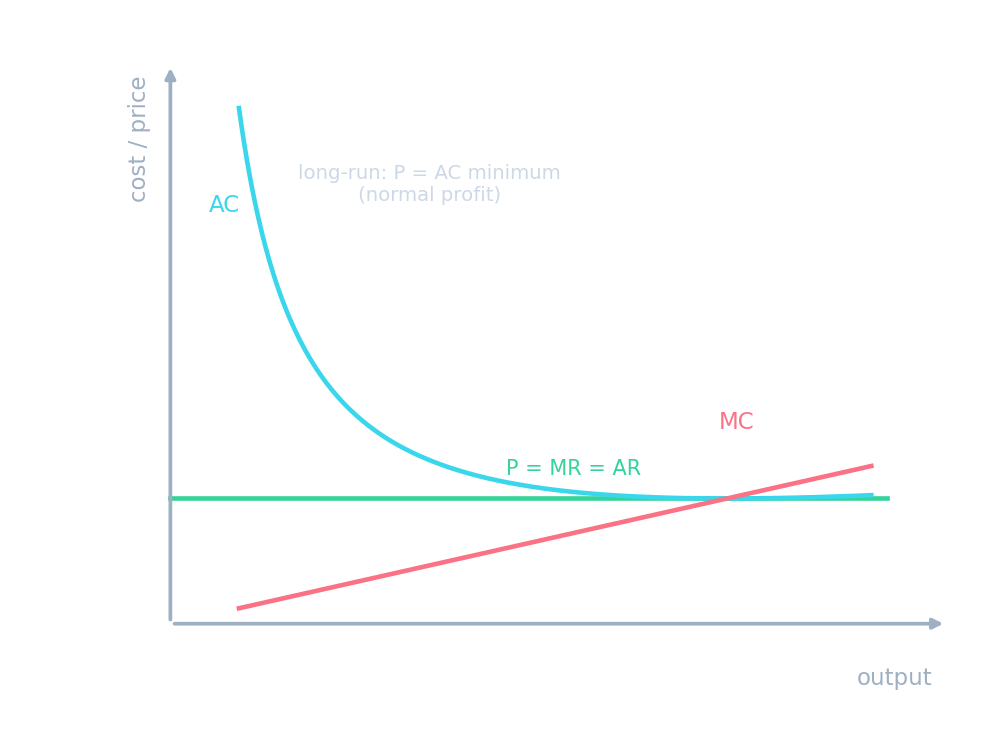
Profit, loss, and break-even
A competitive firm produces where price meets marginal cost. Compare the price with average cost to see profit, break-even, or a loss.
In the short run, a loss-making firm should keep producing as long as:
Difficulty 1/5 · 100 coins + a small bonus on first completion today
If P ≥ AVC, staying open loses less than shutting down (which loses all the fixed cost).
A firm faces P = 7, with AVC = 6 and ATC = 9. In the short run it should:
Difficulty 1/5 · 100 coins + a small bonus on first completion today
P = 7 is above AVC = 6, so producing covers variable cost and part of fixed cost — a smaller loss than shutting down.
In the short run, fixed costs must be paid even if the firm produces nothing.
Difficulty 1/5 · 100 coins + a small bonus on first completion today
That is exactly why the short-run test uses AVC, not ATC.
Enter and exit in the long run
- In the long run there are no fixed costs, so the test is tougher: compare price with average total cost.
- If $P < ATC$: the firm cannot cover all its costs, so it will exit 退出.
- If $P > ATC$ (a positive economic profit): new firms are attracted to enter.
Match each long-run price condition to what firms do.
Difficulty 2/5 · 140 coins + a small bonus on first completion today
Profit attracts entry; loss forces exit; break-even means normal profit.
In the long run, a firm will exit the market if:
Difficulty 1/5 · 100 coins + a small bonus on first completion today
If P < ATC in the long run, the firm cannot cover all costs and exits.
The break-even price
- Entry and exit stop where economic profit is exactly zero — at the bottom of the ATC curve.
- The break-even price 盈亏平衡价格 is $P = \text{minimum } ATC$.
- At that price the firm earns normal profit: no reason to enter, no reason to exit.
The break-even price equals the minimum of the ______ cost curve.
Difficulty 1/5 · 100 coins + a small bonus on first completion today
At P = minimum ATC economic profit is exactly zero — normal profit.
Worked examples
1. At $Q = 100$, a firm's $ATC = 15$ and $AVC = 10$, and the price is 12. Producing loses $(15 - 12) \times 100 = 300$. Shutting down loses the whole fixed cost, $(15 - 10) \times 100 = 500$. Keep producing in the short run.
2. Shut down if the price falls below minimum AVC (here 10): then each unit sold does not even cover its variable cost.
A firm faces price 4, average variable cost 5 and average total cost 8. What should it do in the short run?
4 is below 5, so each unit adds to the loss.
What should the firm do in the short run?
Difficulty 1/5 · 100 coins + a small bonus on first completion today
Price is below average variable cost, so the short-run choice is to shut down.
Short run: the shut-down rule — keep producing if $P \geq AVC$, else shut down. Long run: exit if $P < ATC$, enter if $P > ATC$. The break-even price is $P = \text{minimum } ATC$, where economic profit is zero.
Write from a short-run shutdown
- Price is 4. Average variable cost is 5. Average total cost is 8.
- Decide the short-run choice.