| Learning Objective | Essential Knowledge |
|---|---|
10.1.A |
|
Conductors and Capacitors · ตัวนำและตัวเก็บประจุ
AP Physics C: Electricity and Magnetism · Topic 10 · หัวข้อ 10
 8:28
8:28
ตัวนำและตัวเก็บประจุ
เครื่องบินถูกฟ้าผ่าประมาณปีละครั้ง และคนภายในรู้สึกแทบไม่ได้อะเลย รถในพายุฝนฟ้าคะนองเป็นสถานที่ที่ปลอดภัยที่สุดแห่งหนึ่ง ทำไม?... ¿
English narration · English + 中文 subtitles burned in · การบรรยายภาษาอังกฤษ · คำบรรยายภาษาอังกฤษ + 中文 ลอยตัวบนภาพ
10.1
Electrostatics with Conductors · ไฟฟ้าสถิตกับตัวนำ
Syllabus · หลักสูตร
Source: College Board AP Course and Exam Description · แหล่งที่มา: คำอธิบายหลักสูตรและข้อสอบ College Board AP
English
In an ideal conductor 导体, electrons move freely. Put extra charge on one and the charges repel each other until, almost instantly, they settle into electrostatic equilibrium 静电平衡. In that state the conductor has four properties you must be able to state and use:
- The electric field inside the conductor is zero. If it were not, free electrons would still be moving.
- All excess charge sits on the surface. (Negative net charge = extra electrons on the surface; positive = a shortage of electrons there.)
- The field just outside is perpendicular 垂直 to the surface, with magnitude $E=\sigma/\varepsilon_0$. Any parallel component would push charge sideways along the surface.
- The whole conductor is one equipotential surface 等势面: every point, inside and on the surface, is at the same potential.
Charge density is largest where the surface curves sharply – at points and edges – so the outside field is strongest there. In an external field a conductor polarizes: charge shifts on its surface so that the interior stays field-free and the body stays an equipotential. Surrounding a region with a closed conducting shell keeps outside fields out entirely – electrostatic shielding 静电屏蔽, the idea behind the Faraday cage 法拉第笼.
ไทย
ในตัวนำในทางทฤษฎี conductor อิเล็กตรอนจะเคลื่อนที่ได้อย่างอิสระ เมื่อเพิ่มประจุเข้าไปด้านหนึ่ง ประจุเหล่านั้นจะผลักกันจนเกือบจะทันทีที่จะเข้าสู่สภาวะ electrostatic equilibrium ในสถานะนี้ตัวนำจะมีคุณสมบัติสี่ประการที่คุณต้องสามารถระบุและนำไปใช้ได้:
- สนามไฟฟ้า ภายใน ตัวนำมีค่าเป็นศูนย์ หากไม่เป็นเช่นนั้น อิเล็กตรอนอิสระก็จะยังคงเคลื่อนที่อยู่
- ประจุส่วนเกินทั้งหมดจะอยู่ที่ บนพื้นผิว (ประจุสุทธิติดลบ = อิเล็กตรอนส่วนเกินอยู่บนพื้นผิว; บวก = ขาดแคลนอิเล็กตรอนบริเวณนั้น)
- สนามไฟฟ้าด้านนอกใกล้ๆ จะ ตั้งฉาก กับพื้นผิว โดยมีขนาด $E=\sigma/\varepsilon_0$ ส่วนประกอบแบบขนานใด ๆ จะผลักประจุไปข้างเคียงตามพื้นผิว
- ตัวนำทั้งชิ้นเป็น ** equipotential surface** เดียว: ทุกจุด ทั้งภายในและบนพื้นผิว มีศักย์ไฟฟ้าเท่ากัน
ความหนาแน่นของประจุจะมากที่สุดในบริเวณที่พื้นผิวโค้งชัน – ที่จุดยอดและขอบ – ดังนั้นสนามภายนอกจึงแรงที่สุดบริเวณนั้น ในสนามภายนอก ตัวนำจะเกิด polarization: ประจุจะเคลื่อนที่บนพื้นผิวเพื่อให้ภายในไม่มีสนามและร่างกายคงเป็น equipotential การล้อมรอบพื้นที่ด้วยเปลือกตัวนำปิดจะช่วยป้องกันสนามภายนอกไม่ให้เข้าได้เลย – electrostatic shielding ซึ่งเป็นแนวคิดพื้นฐานของ Faraday cage
Vocabulary · คำศัพท์
Train · ฝึกฝน
| English | ไทย |
|---|---|
| conductor/kənˈdʌktə/ | ตัวนำ |
| electrostatic equilibrium/ɪˌlektrəʊˈstætɪk ˌiːkwɪˈlɪbrɪəm/ | สมดุลไฟฟ้าสถิต |
| perpendicular/ˌpɜːpənˈdɪkjʊlə/ | ตั้งฉาก |
| equipotential surface/ˌiːkwɪpəˈtenʃl ˈsɜːfɪs/ | พื้นผิว equipotential surface |
| electrostatic shielding/ɪˌlektrəʊˈstætɪk ˈʃiːldɪŋ/ | การป้องกันไฟฟ้าสถิต |
| Faraday cage/ˈfærədeɪ keɪdʒ/ | กรงฟาราเดย์ |
10.2
Redistribution of Charge Between Conductors · การกระจายตัวของประจุระหว่างตัวนำ
Syllabus · หลักสูตร
English
Learning Objective 10.2.A: Describe the movement of charge and the resulting interactions when conductors physically contact each other.
- 10.2.A.1 When conductors are in electrical contact, charges will be redistributed such that the surfaces of each conductor are at the same electric potential.
- 10.2.A.2 Ground is an idealized reference point that has zero electric potential and can absorb or provide an infinite amount of charge without changing its electric potential.
- 10.2.A.3 Charge can be induced on a conductor by grounding the conductor in the presence of an external electric field.
ไทย
วัตถุประสงค์การเรียนรู้ 10.2.A: อธิบายการเคลื่อนที่ของประจุและการเกิดปฏิสัมพันธ์ที่เกิดขึ้นเมื่อตัวนำสัมผัสกันโดยตรง
- 10.2.A.1 เมื่อตัวนำมีการเชื่อมต่อทางไฟฟ้า ประจุจะถูกจัดเรียงใหม่เพื่อให้พื้นผิวของแต่ละตัวนำมีศักย์ไฟฟ้าเท่ากัน
- 10.2.A.2 ดิน (ground) เป็นจุดอ้างอิงในทางอุดมคติที่มีศักย์ไฟฟ้าเป็นศูนย์ และสามารถดูดซับหรือจ่ายประจุได้ไม่จำกัดโดยไม่เปลี่ยนศักย์ไฟฟ้าของตน
- 10.2.A.3 สามารถเหนี่ยวนำให้เกิดขึ้นซึ่งประจุไฟฟ้าบนตัวนำได้โดยการต่อดินตัวนำในขณะที่มีสนามไฟฟ้าภายนอก
Source: College Board AP Course and Exam Description · แหล่งที่มา: คำอธิบายหลักสูตรและข้อสอบ College Board AP
English
When two conductors touch (or are wired together), charge flows between them until both surfaces reach the same potential – that is the stopping condition, not "equal charges". A larger sphere holds more charge at the same potential ($V=kQ/R$), so it takes the larger share.
Worked example. A small sphere of radius $R$ carrying $+6.0\ \mu\text{C}$ touches a distant sphere of radius $2R$, then they separate. Equal potentials require $\dfrac{kq_1}{R}=\dfrac{kq_2}{2R}$, so $q_2=2q_1$. With $q_1+q_2=6.0\ \mu\text{C}$: $q_1=2.0\ \mu\text{C}$ and $q_2=4.0\ \mu\text{C}$.
Ground 接地 is an idealized reference at zero potential that can absorb or supply any amount of charge. Grounding a conductor while an external charge is nearby leaves the conductor with a net induced charge 感应电荷: the external field pushes charge of one sign to ground, and cutting the ground wire before removing the external charge traps the rest.
ไทย
เมื่อตัวนำสองชิ้นสัมผัสกัน (หรือต่อด้วยสาย) ประจุจะไหลระหว่างกันจนทั้งสองพื้นผิวมี ศักย์ไฟฟ้าเท่ากัน นั่นคือเงื่อนไขการหยุดนิ่ง ไม่ใช่ "ประจุเท่ากัน" spheres ขนาดใหญ่กว่าจะเก็บประจุได้มากกว่าที่ศักย์เดียวกัน ($V=kQ/R$) จึงได้รับสัดส่วนที่ใหญ่กว่า
ตัวอย่างวิธีทำ. Sphere เล็กที่มีรัศมี $R$ Mangsten $+6.0\ \mu\text{C}$ สัมผัสกับ sphere อื่นที่มีรัศมี $2R$ จากนั้นแยกออกจากกัน ศักย์เท่ากันต้องการ $\dfrac{kq_1}{R}=\dfrac{kq_2}{2R}$ ดังนั้น $q_2=2q_1$ ด้วย $q_1+q_2=6.0\ \mu\text{C}$: $q_1=2.0\ \mu\text{C}$ และ $q_2=4.0\ \mu\text{C}$.
Ground เป็น مرج/reference ที่สมมติไว้ที่ศูนย์ศักย์ที่สามารถดูดซับหรือจ่ายประจุได้ปริมาณwhatever Grounding ตัวนำในขณะที่มีประจุภายนอกอยู่ใกล้จะทำให้ตัวนำมีประจุ induced charge สุทธิ: สนามภายนอกผลักประจุเครื่องหมายหนึ่งไปยัง ground และการตัดสาย ground ก่อนเอาประจุภายนอกออกจะกักเก็บส่วนที่เหลือไว้
Vocabulary · คำศัพท์
Train · ฝึกฝน
| English | ไทย |
|---|---|
| ground/ɡraʊnd/ | กราวด์ (ดิน) |
| induced charge/ɪnˈdjuːst tʃɑːdʒ/ | ประจุเหนี่ยวนำ |
10.3
Capacitors · ตัวเก็บประจุ

Syllabus · หลักสูตร
English
Learning Objective 10.3.A: Describe the physical properties of a parallel-plate capacitor.
- 10.3.A.1 A parallel-plate capacitor consists of two separated parallel conducting surfaces that can hold equal amounts of charge with opposite signs.
- 10.3.A.2 Capacitance relates the magnitude of the charge stored on each plate to the electric potential difference created by the separation of those charges.
- Equation: $C = \dfrac{Q}{\Delta V}$
- 10.3.A.2.i The capacitance of a capacitor depends only on the physical properties of the capacitor, such as the capacitor's shape and the material used to separate the plates.
- 10.3.A.2.ii The capacitance of a parallel-plate capacitor is proportional to the area of one of its plates and inversely proportional to the distance between its plates. The constant of proportionality is the product of the dielectric constant, $\kappa$, of the material between the plates and the electric permittivity of free space, $\varepsilon_0$.
- Equation: $C = \dfrac{\kappa \varepsilon_0 A}{d}$
- 10.3.A.3 The electric field between two charged parallel plates with uniformly distributed electric charge, such as in a parallel-plate capacitor, is constant in both magnitude and direction, except near the edges of the plates.
- 10.3.A.3.i The magnitude of the electric field between two charged parallel plates, where the plate separation is much smaller than the dimensions of the plates, can be determined by applying Gauss's law and the principle of superposition.
- Equation: $E = \dfrac{Q}{\varepsilon_0 A}$
- 10.3.A.3.ii The electric field is proportional to the surface charge density on either plate of the capacitor.
- 10.3.A.3.iii A charged particle between two oppositely charged parallel plates undergoes constant acceleration, and therefore its motion shares characteristics with the projectile motion of an object with mass in the gravitational field near Earth's surface.
- 10.3.A.3.i The magnitude of the electric field between two charged parallel plates, where the plate separation is much smaller than the dimensions of the plates, can be determined by applying Gauss's law and the principle of superposition.
- 10.3.A.4 The electric potential energy stored in a capacitor is equal to the work done by an external force to separate that amount of charge on the capacitor.
- 10.3.A.5 The electric potential energy stored in a capacitor is described by the equation $U_C = \dfrac{1}{2} Q \Delta V$.
Boundary statement: While other shapes are also able to separate charges, AP Physics C: Electricity & Magnetism only expects the quantitative analysis and description of parallel-plate capacitors, concentric spherical capacitors, and coaxial cylindrical capacitors.
ไทย
วัตถุประสงค์การเรียนรู้ 10.3.A: อธิบายคุณสมบัติทางกายภาพของตัวเก็บประจุแบบแผ่นขนาน
- 10.3.A.1 ตัวเก็บประจุแบบแผ่นขนานประกอบด้วยพื้นผิวนำไฟฟ้าแบบขนานสองแผ่นที่แยกออกจากกันและสามารถกักเก็บประจุปริมาณเท่ากันแต่มีสัญญาณตรงข้ามกันได้
- 10.3.A.2 ความจุไฟฟ้ามีความสัมพันธ์กับขนาดของประจุที่เก็บไว้บนแต่ละแผ่นกับผลต่างศักย์ไฟฟ้าที่เกิดจากการแยกประจุเหล่านั้นออก
- สมการ: $C = \dfrac{Q}{\Delta V}$
- 10.3.A.2.i ความจุไฟฟ้าของตัวเก็บประจุขึ้นอยู่กับคุณสมบัติทางกายภาพของตัวเก็บประจุเท่านั้น เช่น รูปร่างของตัวเก็บประจุและวัสดุที่ใช้แยกแผ่นทั้งสอง
- 10.3.A.2.ii ความจุไฟฟ้าของตัวเก็บประจุแบบแผ่นขนานแปรผันตรงกับพื้นที่ของแผ่นหนึ่งๆ และแปรผกผันกับระยะห่างระหว่างแผ่น ค่าคงที่แปรผันคือผลคูณของความไดอิเล็กทริกคอนสแตนต์, $\kappa$ ของวัสดุระหว่างแผ่น กับความอ่อนตัวทางไฟฟ้าของสุญญากาศ, $\varepsilon_0$
- สมการ: $C = \dfrac{\kappa \varepsilon_0 A}{d}$
- 10.3.A.3 สนามไฟฟ้าระหว่างแผ่นนำไฟฟ้าสองแผ่นที่มีประจุไฟฟ้ากระจายตัวอย่างสม่ำเสมอ (เช่น ในตัวเก็บประจุแบบแผ่นขนาน) มีทั้งขนาดและทิศทางคงที่ ยกเว้นใกล้ขอบของแผ่น
- 10.3.A.3.i ขนาดของสนามไฟฟ้าระหว่างแผ่นนำไฟฟ้าสองแผ่นที่มีประจุ โดยที่ระยะห่างระหว่างแผ่นน้อยกว่าขนาดของแผ่นอย่างมาก สามารถหาได้โดยการใช้กฎของเกาส์และหลักการซ้อนทับ
- สมการ: $E = \dfrac{Q}{\varepsilon_0 A}$
- 10.3.A.3.ii สนามไฟฟ้าแปรผันกับความหนาแน่นของประจุบนพื้นผิวของแผ่นใดแผ่นหนึ่งของตัวเก็บประจุ
- 10.3.A.3.iiiอนุภาคที่มีประจุที่อยู่ระหว่างแผ่นนำไฟฟ้าสองแผ่นที่มีประจุตรงข้ามกัน จะเกิดการเร่งความเร็วอย่างสม่ำเสมอ ดังนั้นการเคลื่อนที่ของมันจึงมีลักษณะคล้ายกับการเคลื่อนที่ของวัตถุที่มีมวลในสนามโน้มถ่วงใกล้พื้นผิวโลก
- 10.3.A.3.i ขนาดของสนามไฟฟ้าระหว่างแผ่นนำไฟฟ้าสองแผ่นที่มีประจุ โดยที่ระยะห่างระหว่างแผ่นน้อยกว่าขนาดของแผ่นอย่างมาก สามารถหาได้โดยการใช้กฎของเกาส์และหลักการซ้อนทับ
- 10.3.A.4 พลังงานศักย์ไฟฟ้าที่สะสมอยู่ในตัวเก็บประจุเท่ากับงานที่ทำโดยแรงภายนอกในการแยกประจุจำนวนนั้นออกจากกันบนตัวเก็บประจุ
- 10.3.A.5 พลังงานศักย์ไฟฟ้าที่สะสมอยู่ในตัวเก็บประจุอธิบายได้ด้วยสมการ $U_C = \dfrac{1}{2} Q \Delta V$
คำชี้แจงขอบเขต: แม้รูปทรงอื่นจะสามารถแยกประจุได้เช่นกัน แต่ AP Physics C: Electricity & Magnetism ต้องการเพียงการวิเคราะห์เชิงปริมาณและการอธิบายของตัวเก็บประจุแบบแผ่นขนาน ตัวเก็บประจุทรงกลมแบบรวมศูนย์ และตัวเก็บประจุทรงกระบอกแบบ coaxial เท่านั้น
Source: College Board AP Course and Exam Description · แหล่งที่มา: คำอธิบายหลักสูตรและข้อสอบ College Board AP
English
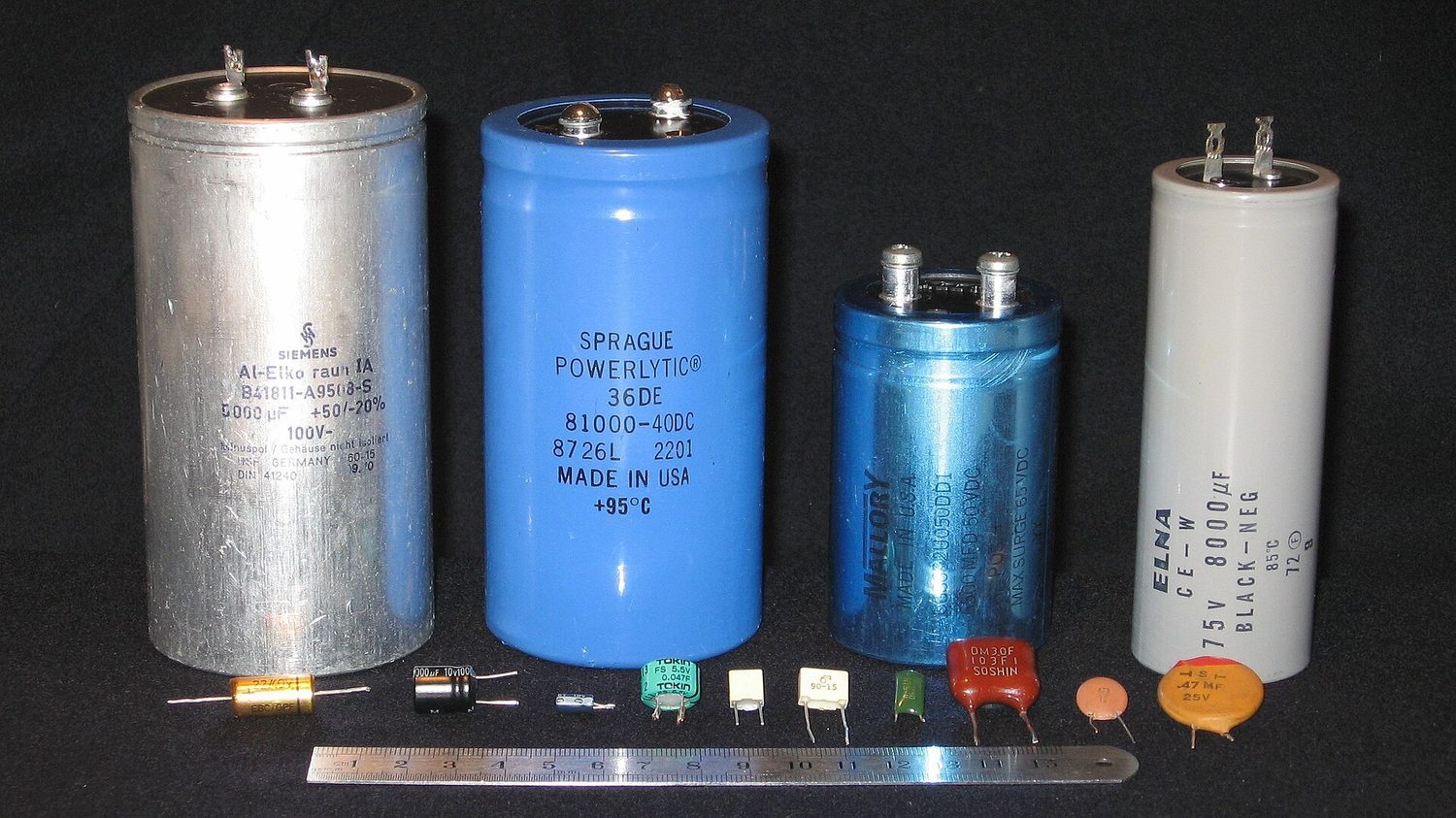
A capacitor 电容器 stores charge on two conductors separated by a gap: $+Q$ on one plate, $-Q$ on the other. Its capacitance 电容 relates the stored charge to the potential difference between the plates:
$$C=\frac{Q}{\Delta V}.$$
Capacitance depends only on geometry and the material in the gap – never on $Q$ or $\Delta V$ themselves.
Worked derivation (parallel plates). For a parallel-plate capacitor 平行板电容器 with plate area $A$ and small gap $d$: Gauss's law plus superposition 叠加 gives a uniform 均匀 field between the plates, $E=\dfrac{\sigma}{\varepsilon_0}=\dfrac{Q}{\varepsilon_0 A}$ (each plate alone contributes $\sigma/2\varepsilon_0$; between the plates the two add, outside they cancel). A uniform field means $\Delta V=Ed=\dfrac{Qd}{\varepsilon_0 A}$, so
$$C=\frac{Q}{\Delta V}=\frac{\varepsilon_0 A}{d}.$$
This $E\to\Delta V\to C$ chain is a standard FRQ derivation – learn it as three steps, and quote each one. The same method handles the other two shapes AP expects: concentric spheres ($C=4\pi\varepsilon_0\dfrac{ab}{b-a}$) and a coaxial cylinder of length $L$, where $E=\dfrac{\lambda}{2\pi\varepsilon_0 r}$ gives $\Delta V=\dfrac{\lambda}{2\pi\varepsilon_0}\ln\dfrac{b}{a}$ and so $C=\dfrac{2\pi\varepsilon_0 L}{\ln(b/a)}$.
Worked example. Plates of area $A=0.020\ \text{m}^2$ and gap $d=1.0\ \text{mm}$: $C=\dfrac{8.85\times10^{-12}(0.020)}{1.0\times10^{-3}}=1.8\times10^{-10}\ \text{F}$. Charged to $100\ \text{V}$ it holds $Q=CV=1.8\times10^{-8}\ \text{C}$.
Because the field between the plates is uniform, a charged particle there feels a constant force, so it moves with constant acceleration – exactly like projectile motion 抛体运动 in gravity: constant speed across, uniform acceleration towards a plate.
Worked example. An electron enters midway between plates at $v_0=2.0\times10^{7}\ \text{m/s}$, parallel to them. The field is $E=1.0\times10^{3}\ \text{N/C}$ and the plates are $4.0\ \text{cm}$ long. Acceleration: $a=\dfrac{eE}{m}=\dfrac{(1.6\times10^{-19})(1.0\times10^{3})}{9.11\times10^{-31}}=1.8\times10^{14}\ \text{m/s}^2$. Time between the plates: $t=\dfrac{0.040}{2.0\times10^{7}}=2.0\times10^{-9}\ \text{s}$. Deflection: $y=\tfrac12at^{2}=\tfrac12(1.8\times10^{14})(2.0\times10^{-9})^{2}\approx3.5\times10^{-4}\ \text{m}$ – about $0.35\ \text{mm}$ towards the positive plate.
Storing charge takes work 功: an external force must move each bit of charge against the field of the charge already there. The total work ends up as stored potential energy,
$$U_C=\tfrac12\,Q\,\Delta V=\tfrac12 C(\Delta V)^2=\frac{Q^2}{2C}.$$
The factor $\tfrac12$ is the area of the triangle under the $Q$–$\Delta V$ line: the first charge moved across costs almost nothing, the last costs the full $\Delta V$.
Capacitors combine oppositely to resistors: in parallel 并联 the capacitances add ($C_{\text{eq}}=C_1+C_2$, same $\Delta V$, charges add), while in series 串联 the reciprocals add ($\tfrac{1}{C_{\text{eq}}}=\tfrac{1}{C_1}+\tfrac{1}{C_2}$, same $Q$, voltages add).
Worked example. A $2\ \mu\text{F}$ and a $4\ \mu\text{F}$ capacitor in series: $\tfrac{1}{C}=\tfrac12+\tfrac14$, so $C=\tfrac43\ \mu\text{F}$. The same pair in parallel: $6\ \mu\text{F}$.
ไทย
Capacitor เก็บประจุบนตัวนำสองชิ้นที่แยกด้วยช่องว่าง: $+Q$ บนแผ่นหนึ่ง, $-Q$ อีกแผ่นหนึ่ง Capacitance ของมันเชื่อมโยงประจุที่เก็บไว้กับความต่างศักย์ระหว่างแผ่น:
$$C=\frac{Q}{\Delta V}.$$
Capacitance ขึ้นอยู่กับเรขาคณิตและวัสดุในช่องว่างเท่านั้น – ไม่เคยขึ้นอยู่กับ $Q$ หรือ $\Delta V$ เอง
ตัวอย่างวิธีทำ (แผ่นขนาน). สำหรับ parallel-plate capacitor ที่มีพื้นที่แผ่น $A$ และช่องว่างเล็ก $d$: กฎของ Gauss บวกกับ superposition ให้ uniform field ระหว่างแผ่น, $E=\dfrac{\sigma}{\varepsilon_0}=\dfrac{Q}{\varepsilon_0 A}$ (แต่ละแผ่นให้ $\sigma/2\varepsilon_0$; ระหว่างแผ่นทั้งสองบวกกัน, ด้านนอกหักล้างกัน) สนามสม่ำเสมอหมายถึง $\Delta V=Ed=\dfrac{Qd}{\varepsilon_0 A}$ ดังนั้น
$$C=\frac{Q}{\Delta V}=\frac{\varepsilon_0 A}{d}.$$
อนุกรม $E\to\Delta V\to C$ นี้เป็นการหาคำตอบแบบ FRQ มาตรฐาน – ให้เรียนรู้โดยแบ่งเป็นสามขั้นตอน และยกคำอธิบายแต่ละข้อออกมาใช้ วิธีเดียวกันนี้ยังใช้กับอีกสองรูปทรงที่ AP คาดหวังได้ ได้แก่ สpheres ลอยซ้อนกัน ($C=4\pi\varepsilon_0\dfrac{ab}{b-a}$) และกระบอกสูบแบบ coaxial ที่มีความยาว $L$ โดยที่ $E=\dfrac{\lambda}{2\pi\varepsilon_0 r}$ จะให้ $\Delta V=\dfrac{\lambda}{2\pi\varepsilon_0}\ln\dfrac{b}{a}$ และ以此类推 $C=\dfrac{2\pi\varepsilon_0 L}{\ln(b/a)}$
ตัวอย่างวิธีทำ แผ่นมีพื้นที่ $A=0.020\ \text{m}^2$ และช่องว่าง $d=1.0\ \text{mm}$: $C=\dfrac{8.85\times10^{-12}(0.020)}{1.0\times10^{-3}}=1.8\times10^{-10}\ \text{F}$. ชาร์จด้วยแรงดัน $100\ \text{V}$ จะเก็บประจุได้ $Q=CV=1.8\times10^{-8}\ \text{C}$.
เนื่องจากสนามไฟฟ้าระหว่างแผ่นมีความสม่ำเสมออนุภาคที่มีประจุจะ受到的แรงคงที่ ทำให้เคลื่อนที่ด้วยความเร่งคงที่ – เหมือนกับการเคลื่อนที่แบบ โปรเจกไทล์ ในสนามโน้มถ่วง: ความเร็วในแนวนอนคงที่ และความเร่งในแนวตั้งคงที่เข้าหาแผ่นหนึ่ง
ตัวอย่างวิธีทำ อิเล็กตรอนเข้าสู่กลางระหว่างแผ่นที่ความเร็ว $v_0=2.0\times10^{7}\ \text{m/s}$, ขนานกับแผ่น สนามไฟฟ้าคือ $E=1.0\times10^{3}\ \text{N/C}$ และแผ่นยาว $4.0\ \text{cm}$. ความเร่ง: $a=\dfrac{eE}{m}=\dfrac{(1.6\times10^{-19})(1.0\times10^{3})}{9.11\times10^{-31}}=1.8\times10^{14}\ \text{m/s}^2$. เวลาที่ผ่านระหว่างแผ่น: $t=\dfrac{0.040}{2.0\times10^{7}}=2.0\times10^{-9}\ \text{s}$. การเบี่ยงเบน: $y=\tfrac12at^{2}=\tfrac12(1.8\times10^{14})(2.0\times10^{-9})^{2}\approx3.5\times10^{-4}\ \text{m}$ – ประมาณ $0.35\ \text{mm}$ เข้าหาแผ่นบวก
การเก็บประจุต้องใช้เวลา ทำงาน: แรงภายนอกต้องเคลื่อนย้ายแต่ละหน่วยของประจุข้ามสนามของประจุที่มีอยู่แล้ว งานทั้งหมดจะกลายเป็นพลังงานศักย์ที่เก็บไว้,
$$U_C=\tfrac12\,Q\,\Delta V=\tfrac12 C(\Delta V)^2=\frac{Q^2}{2C}.$$
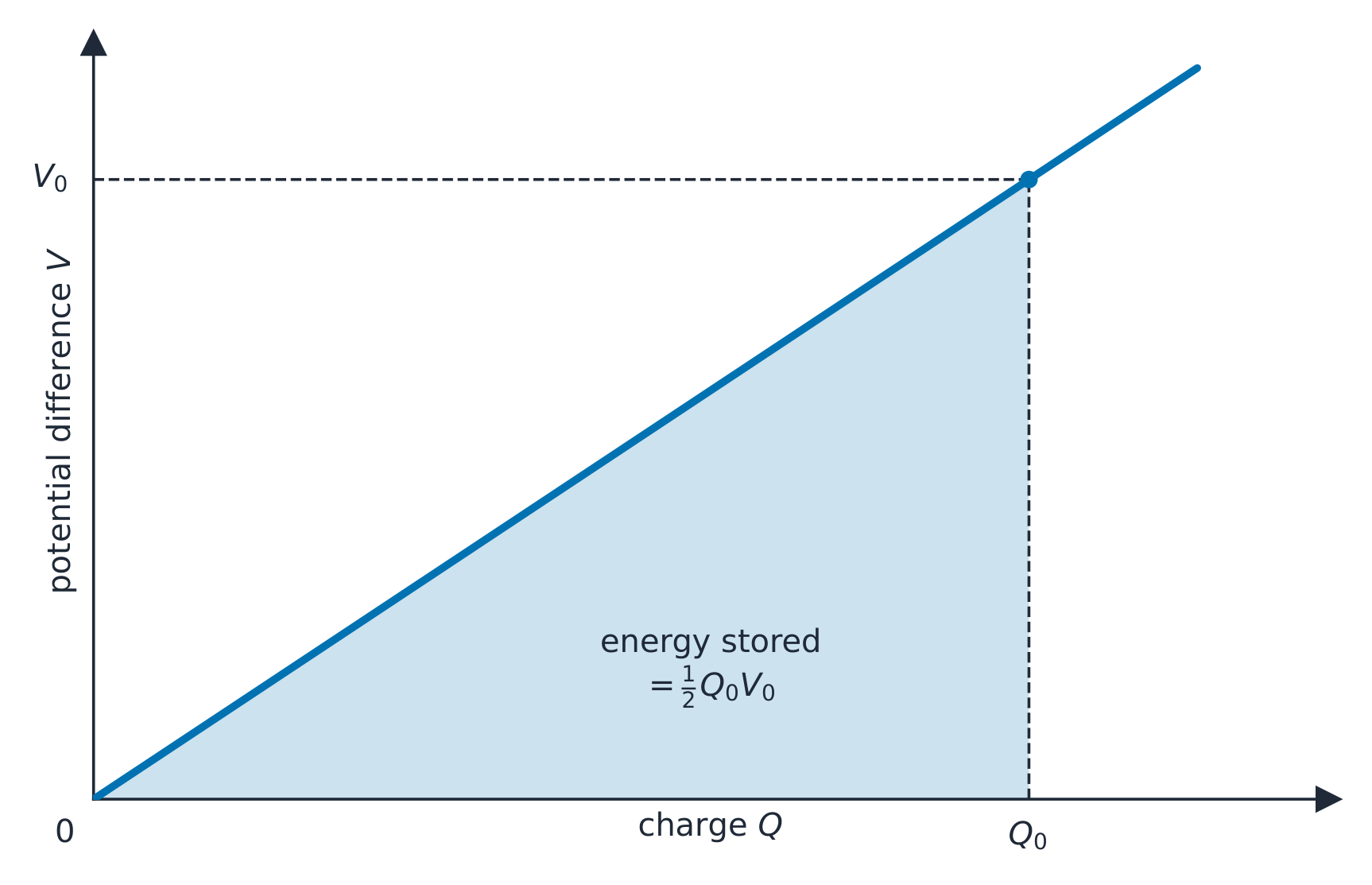
ค่าสัมประสิทธิ์ $\tfrac12$ คือพื้นที่ของสามเหลี่ยมใต้เส้น $Q$–$\Delta V$: หน่วยประจุแรกที่ใช้เคลื่อนย้ายแทบไม่เสียค่าใช้สอย ส่วนสุดท้ายเสียค่าเต็ม $\Delta V$
ตัวเก็บประจุรวมกันตรงข้ามกับตัวต้านทาน: ใน ขนาน ค่าความจุรวมกัน ($C_{\text{eq}}=C_1+C_2$, แรงดัน $\Delta V$ เท่ากัน, ประจุรวม), ในขณะที่ใน อนุกรม ค่าผกผันรวมกัน ($\tfrac{1}{C_{\text{eq}}}=\tfrac{1}{C_1}+\tfrac{1}{C_2}$, ประจุ $Q$ เท่ากัน, แรงดันรวม).
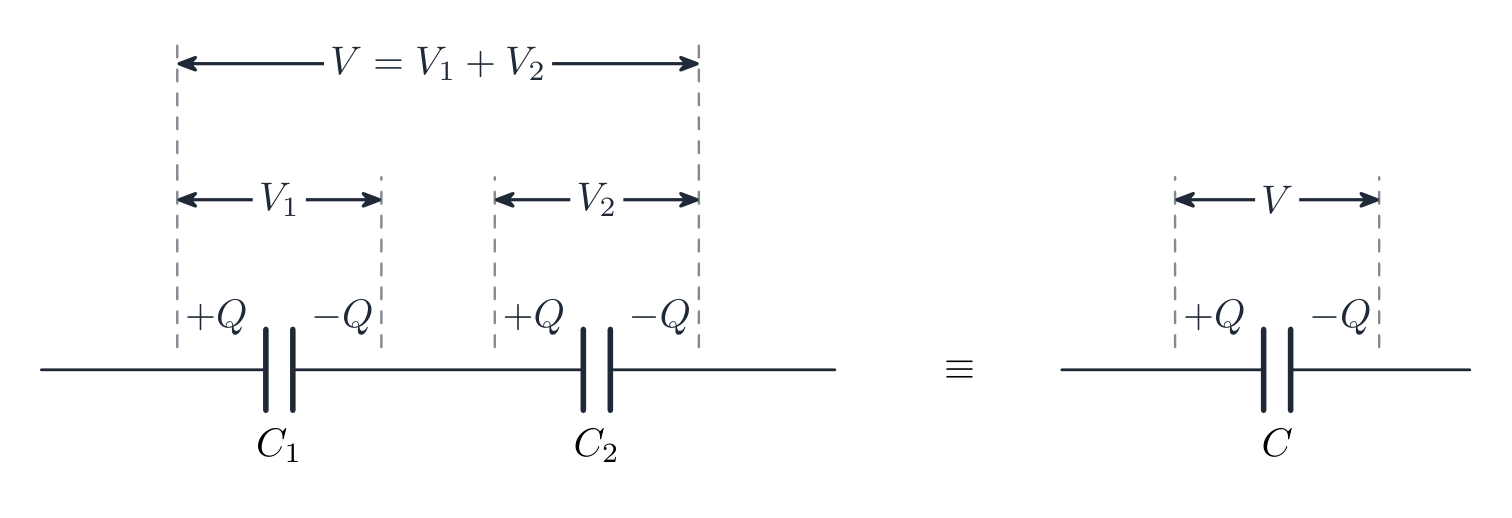
ตัวอย่างวิธีทำ ตัวเก็บประจุ $2\ \mu\text{F}$ และ $4\ \mu\text{F}$ แบบอนุกรม: $\tfrac{1}{C}=\tfrac12+\tfrac14$, ดังนั้น $C=\tfrac43\ \mu\text{F}$. คู่เดียวกันนี้แบบขนาน: $6\ \mu\text{F}$.
Explore · สำรวจ
Charge and discharge a capacitor · ชาร์จและคายประจุตัวเก็บประจุ
A capacitor stores charge on two plates, filling and emptying exponentially with time constant $\tau=RC$. Bigger $R$ or $C$ slows it down. · ตัวเก็บประจุ เก็บประจุบนแผ่นทั้งสอง โดยเติมและปล่อยประจุแบบเอกซ์โพเนนเชียลด้วยค่าคงที่เวลา $\tau=RC$ ค่า $R$ หรือ $C$ ที่ใหญ่กว่าจะทำให้ช้าลง
Vocabulary · คำศัพท์
Train · ฝึกฝน
| English | ไทย |
|---|---|
| capacitor/kəˈpæsɪtə/ | ตัวเก็บประจุ |
| capacitance/kəˈpæsɪtəns/ | ความจุไฟฟ้า |
| parallel-plate capacitor/ˈpærəlel pleɪt kəˈpæsɪtə/ | ตัวเก็บประจุแผ่นขนาน |
| superposition/ˌsuːpəpəˈzɪʃn/ | การ叠加 (email: superposition) |
| uniform/ˈjuːnɪfɔːm/ | สม่ำเสมอ |
| projectile motion/prəˈdʒektaɪl ˈməʊʃn/ | การเคลื่อนที่ของโปรเจกไทล์ |
| work/wɜːk/ | งาน |
| parallel/ˈpærəlel/ | 并联电路中 |
| series/ˈsɪəriːz/ | 串联电路中 |
10.4
Dielectrics · ไดอิเลคทริก

Syllabus · หลักสูตร
English
Learning Objective 10.4.A: Describe how a dielectric inserted between the plates of a capacitor changes the properties of the capacitor.
- 10.4.A.1 In a dielectric material, electric charges are not as free to move as they are in a conductor. Instead, the material becomes polarized in the presence of an external electric field.
- 10.4.A.2 The dielectric constant of a material relates the electric permittivity of that material to the permittivity of free space.
- Equation: $\kappa = \dfrac{\varepsilon}{\varepsilon_0}$
- 10.4.A.3 The electric field created by a polarized dielectric is opposite in direction to the external field.
- 10.4.A.4 The electric field between the plates of an isolated parallel-plate capacitor decreases when a dielectric is placed between the plates.
- Equation: $\kappa = \dfrac{E_0}{E}$
- 10.4.A.5 The insertion of a dielectric into a capacitor may change the capacitance of the capacitor.
- Equation: $C = \kappa C_0$
ไทย
วัตถุประสงค์การเรียนรู้ 10.4.A: อธิบายว่าไดอิเล็กทริกที่ใส่ระหว่างแผ่นของตัวเก็บประจุจะเปลี่ยนแปลงคุณสมบัติของตัวเก็บประจุอย่างไร
- 10.4.A.1 ในวัสดุไดอิเล็กทริก ประจุไฟฟ้าจะไม่อิสระในการเคลื่อนที่เท่าที่มันทำได้ในตัวนำ แทนที่จะเป็นแบบนั้น วัสดุนี้จะถูกทำให้เกิดขั้วไฟฟ้าเมื่ออยู่ในสนามไฟฟ้าภายนอก
- 10.4.A.2 ค่าความไดอิเล็กทริกคอนสแตนต์ของวัสดุมีความสัมพันธ์กับความอ่อนตัวทางไฟฟ้าของวัสดุนั้นกับความอ่อนตัวทางไฟฟ้าของสุญญากาศ
- สมการ: $\kappa = \dfrac{\varepsilon}{\varepsilon_0}$
- 10.4.A.3 สนามไฟฟ้าที่เกิดจากไดอิเล็กทริกที่ถูกทำให้เกิดขั้วไฟฟ้าจะมีทิศทางตรงข้ามกับสนามไฟฟ้าภายนอก
- 10.4.A.4 สนามไฟฟ้าระหว่างแผ่นของตัวเก็บประจุแบบแผ่นขนานแบบ isolated จะลดลงเมื่อใส่ไดอิเล็กทริกเข้าระหว่างแผ่น
- สมการ: $\kappa = \dfrac{E_0}{E}$
- 10.4.A.5 การใส่ไดอิเล็กทริกเข้าไปในตัวเก็บประจุอาจทำให้ความจุไฟฟ้าของตัวเก็บประจุเปลี่ยนแปลงได้
- สมการ: $C = \kappa C_0$
Source: College Board AP Course and Exam Description · แหล่งที่มา: คำอธิบายหลักสูตรและข้อสอบ College Board AP
English
A dielectric 电介质 is an insulating material. Its charges cannot travel, but in an external field each molecule stretches or turns slightly – the material becomes polarized 极化. The lined-up molecules create their own small field opposite to the applied one, so the net field inside the material drops:
$$E=\frac{E_0}{\kappa},\qquad \kappa=\frac{\varepsilon}{\varepsilon_0}\ \ (\kappa>1),$$
where $\kappa$ is the dielectric constant 介电常数, the ratio of the material's permittivity to the permittivity of free space 真空介电常数.
Filling a capacitor with dielectric multiplies its capacitance:
$$C=\kappa\,C_0\qquad\left(\text{parallel plates: } C=\frac{\kappa\varepsilon_0 A}{d}\right).$$
What happens next depends on what stays fixed – a favourite exam trap:
| battery stays connected ($\Delta V$ fixed) | battery removed first ($Q$ fixed) | |
|---|---|---|
| charge $Q$ | rises to $\kappa Q_0$ | unchanged |
| voltage $\Delta V$ | unchanged | drops to $\Delta V_0/\kappa$ |
| field $E$ | unchanged | drops to $E_0/\kappa$ |
| energy $U$ | rises to $\kappa U_0$ | drops to $U_0/\kappa$ |
Worked example. A $100\ \text{pF}$ capacitor is charged to $12\ \text{V}$, disconnected, then filled with a $\kappa=3$ dielectric. $Q$ is trapped, so $\Delta V$ falls to $4\ \text{V}$ and the stored energy falls to one-third – the missing energy went into pulling the dielectric in. Reconnected to the $12\ \text{V}$ battery instead, the capacitor would hold three times the charge and three times the energy.
Exam skill. Always begin dielectric questions by writing down which quantity is held fixed ($Q$ or $\Delta V$), then let $C=\kappa C_0$ drive everything else through $Q=C\Delta V$ and $U=\tfrac12 C(\Delta V)^2$.
ไทย
ไดอิเลคทริก คือวัสดุฉนวนประจุไม่สามารถเคลื่อนที่ได้ แต่ภายใต้สนามภายนอกโมเลกุลแต่ละตัวจะยืดออกหรือหมุนเล็กน้อย – วัสดุนั้นจะเกิด โพลาไรเซชัน โมเลกุลที่เรียงตัวกันสร้างสนามขนาดเล็ก สวนทาง กับสนามที่ใส่เข้าไป ทำให้สนามสุทธิภายในวัสดุลดลง:
$$E=\frac{E_0}{\kappa},\qquad \kappa=\frac{\varepsilon}{\varepsilon_0}\ \ (\kappa>1),$$
โดยที่ $\kappa$ คือ ค่าคงที่ไดอิเลคทริก, อัตราส่วนของความอ่อนต่อสนามไฟฟ้าของวัสดุต่อ ความอ่อนต่อสนามไฟฟ้าของสุญญากาศ.
การเติมไดอิเลคทริกลงในตัวเก็บประจุจะทำให้ความจุเพิ่มขึ้น:
$$C=\kappa\,C_0\qquad\left(\text{parallel plates: } C=\frac{\kappa\varepsilon_0 A}{d}\right).$$
สิ่งที่เกิดขึ้นต่อไปขึ้นอยู่กับสิ่งใดถูกคงที่ – ซึ่งเป็นกับดักที่มักออกสอบ:
| เชื่อมแบตเตอรี่ไว้ ($\Delta V$ คงที่) | ถอดแบตเตอรี่ออกก่อน ($Q$ คงที่) | |
|---|---|---|
| ประจุ $Q$ | เพิ่มเป็น $\kappa Q_0$ | ไม่เปลี่ยน |
| แรงดัน $\Delta V$ | ไม่เปลี่ยน | ลดลงเหลือ $\Delta V_0/\kappa$ |
| สนาม $E$ | ไม่เปลี่ยน | ลดลงเหลือ $E_0/\kappa$ |
| พลังงาน $U$ | เพิ่มเป็น $\kappa U_0$ | ลดลงเหลือ $U_0/\kappa$ |
ตัวอย่างวิธีทำ ตัวเก็บประจุ $100\ \text{pF}$ ชาร์จด้วยแรงดัน $12\ \text{V}$, ถอดสายออก, แล้วเติมไดอิเลคทริก $\kappa=3$. $Q$ ถูกกักไว้, ดังนั้น $\Delta V$ ลดลงเหลือ $4\ \text{V}$ และพลังงานที่เก็บไว้ลดลงเหลือหนึ่งในสาม – พลังงานที่หายไปใช้ในการดึงไดอิเลคทริกเข้าไปใหม่ หากเชื่อมกลับเข้ากับแบตเตอรี่ $12\ \text{V}$ แทน ตัวเก็บประจุจะเก็บประจุได้สามเท่าและพลังงานสามเท่า
ทักษะการสอบ ต้องเริ่มตอบคำถามเกี่ยวกับไดอิเลคทริกด้วยการระบุก่อนว่าปริมาณใดถูกคงที่ ($Q$ หรือ $\Delta V$), จากนั้นให้ $C=\kappa C_0$ นำพาทุกอย่างไปตาม $Q=C\Delta V$ และ $U=\tfrac12 C(\Delta V)^2$
Explore · สำรวจ
Add a dielectric · เพิ่ม dielectric
A dielectric between the plates raises the capacitance, so the capacitor holds more charge at the same voltage. Watch the charge build faster. · ไดอิเล็กทริก ระหว่างแผ่นทำให้ความจุเพิ่มขึ้น ตัวเก็บประจุจึงเก็บประจุได้มากกว่าเดิมที่แรงดันเท่ากัน สังเกตการสะสมประจุเร็วขึ้น
Vocabulary · คำศัพท์
Train · ฝึกฝน
| English | ไทย |
|---|---|
| dielectric/ˌdaɪɪˈlektrɪk/ | ไดอิเล็กทริก |
| polarized/ˈpəʊləraɪzd/ | โพลาไรซ์ polarized |
| dielectric constant/ˌdaɪɪˈlektrɪk ˈkɒnstənt/ | ค่าคงที่ไดอิเล็กทริก |
| permittivity of free space/ˌpɜːmɪˈtɪvəti ɒv friː speɪs/ | ค่าความยอมให้ของสุญญากาศ |
10.4
Exam tips · ข้อแนะนำสำหรับการสอบ
English
- In electrostatic equilibrium a conductor has $\vec E=0$ inside and all excess charge on the surface.
- Apply Gauss's law $\oint \vec E\cdot d\vec A=\tfrac{q_{enc}}{\varepsilon_0}$ with a symmetry-matched Gaussian surface (sphere, cylinder, pillbox).
- The whole conductor is one equipotential, and the surface field is perpendicular to it.
- For a capacitor use $C=\tfrac{Q}{V}$, energy $U=\tfrac12 CV^2$, and how a dielectric raises $C$.
- Pick the Gaussian surface so $\vec E$ is constant and parallel (or zero) on each part.
ไทย
- ในสภาวะสมดุลทางสถิตตัวนำจะมี $\vec E=0$ ภายใน และประจุส่วนเกินทั้งหมดอยู่ที่ พื้นผิว
- ใช้ กฎของเกาส์ $\oint \vec E\cdot d\vec A=\tfrac{q_{enc}}{\varepsilon_0}$ พร้อมพื้นผิวเกาส์ที่สอดคล้องกับความสมมาตร (ทรงกลม, กระบอก, กล่องทรงสูง)
- ตัวนำทั้งชิ้นเป็น ** equipotential** เดียวกัน และสนามที่พื้นผิวตั้งฉากกับมัน
- สำหรับตัวเก็บประจุใช้ $C=\tfrac{Q}{V}$, พลังงาน $U=\tfrac12 CV^2$, และการเพิ่ม $C$ ของ ไดอิเลคทริก
- เลือกพื้นผิวเกาส์ให้ $\vec E$ มีค่าคงที่และขนาน (หรือเป็นศูนย์) บนแต่ละส่วน
Interactive lessons on this topic · บทเรียนเชิงโต้ตอบสำหรับหัวข้อนี้
Work through it step by step, with instant-check exercises. · ทำทีละขั้นตอน พร้อมแบบฝึกหัดตรวจสอบผลทันที
Past Papers · ข้อสอบย้อนหลัง