Skip to content · ⁨ข้ามไปยังเนื้อหา⁩

Market Failure and the Role of Government · ⁨ความล้มเหลวของตลาดและบทบาทของรัฐบาล⁩

AP Microeconomics · ⁨AP เศรษฐศาสตร์จุลภาค⁩ · Topic 6 · ⁨หัวข้อ 6⁩

Video lesson for this topic · ⁨บทเรียนวิดีโอสำหรับหัวข้อนี้⁩ Open the video page · ⁨เปิดหน้าวิดีโอ⁩
8:21

ความล้มเหลวของตลาดและบทบาทของรัฐบาล

ดูโรงงานนี้ มีใครบางคนซื้อสิ่งที่มันผลิต และมีใครบางคนได้รับค่าจ้างเพื่อผลิตมัน ทั้งสองฝ่ายพอใจกับราคา แต่ควันไม่ได้รวมอยู่ในราคานี้…

English narration · English + 中文 subtitles burned in · ⁨การบรรยายภาษาอังกฤษ · คำบรรยายภาษาอังกฤษ + 中文 ลอยตัวบนภาพ⁩

6.1

Socially Efficient and Inefficient Market Outcomes · ⁨ผลลัพธ์ทางเศรษฐกิจที่มีประสิทธิภาพและไม่มีประสิทธิภาพทางสังคม⁩

Syllabus · ⁨หลักสูตร⁩
English

Enduring Understanding (POL-2): Perfectly competitive markets allocate resources efficiently, but imperfect competition often results in market inefficiencies.

Learning Objective POL-2.A: a. Define social efficiency. b. Explain (using graphs where appropriate) why resource allocation in perfectly competitive markets is socially efficient.

  • POL-2.A.1 The optimal quantity of a good occurs where the marginal benefit of consuming the last unit equals the marginal cost of producing that last unit, thus maximizing total economic surplus.
  • POL-2.A.2 The market equilibrium quantity is equal to the socially optimal quantity only when all social benefits and costs are internalized by individuals in the market. Total economic surplus is maximized at that quantity. [See also PRD-3 and POL-3.]

Learning Objective POL-2.B: Explain (using graphs where appropriate) how private incentives can lead to actions by rational agents that are socially undesirable (inefficient) market outcomes.

  • POL-2.B.1 Rational agents can pursue private actions to exploit or exercise market characteristics known as market power.
  • POL-2.B.2 Rational agents make optimal decisions by equating private marginal benefits and private marginal costs that can result in market inefficiencies.
  • POL-2.B.3 Policymakers use cost-benefit analysis to evaluate different actions to reduce or eliminate market inefficiencies.
  • POL-2.B.4 Market inefficiencies can be eliminated by designing policies that equate marginal social benefit with marginal social cost.

Learning Objective POL-2.C: a. Explain equilibrium allocations in imperfect markets relative to efficient allocations (using graphs where appropriate) and why these markets are inefficient. b. Calculate (using graphs where appropriate) the deadweight loss resulting from the production of a non-efficient quantity.

  • POL-2.C.1 Equilibrium allocations can deviate from efficient allocations due to situations such as monopoly; oligopoly; monopolistic competition; negative and positive externalities in production or consumption; asymmetric information; and insufficient production of public goods.
  • POL-2.C.2 Producing any non-efficient quantity results in deadweight loss.
ไทย

ความเข้าใจที่ยั่งยืน (POL-2): ตลาดแข่งขันสมบูรณ์จัดสรรทรัพยากรอย่างมีประสิทธิภาพ แต่การแข่งขันที่ไม่สมบูรณ์มักนำไปสู่ความไม่มีประสิทธิภาพของตลาด

วัตถุประสงค์การเรียนรู้ POL-2.A: ก. นิยามประสิทธิภาพทางสังคม ข. อธิบาย (ใช้กราฟเมื่อเหมาะสม) เหตุผลที่การจัดสรรทรัพยากรในตลาดแข่งขันสมบูรณ์มีประสิทธิภาพในทางสังคม

  • POL-2.A.1 ปริมาณที่เหมาะสมของสินค้าเกิดขึ้นเมื่อผลประโยชน์รายเพิ่มของการบริโภคหน่วยสุดท้ายเท่ากับต้นทุนรายเพิ่มของการผลิตหน่วยสุดท้าย ซึ่งทำให้ส่วนเกินทางเศรษฐกิจรวมสูงสุด
  • POL-2.A.2 ปริมาณสมดุลของตลาดจะเท่ากับปริมาณที่เหมาะสมในทางสังคมก็ต่อเมื่อผลประโยชน์และต้นทุนทางสังคมทั้งหมดถูกนำมารวมไว้ในพฤติกรรมของบุคคลในตลาด ส่วนเกินทางเศรษฐกิจรวมจะสูงสุดที่ปริมาณนี้ [ดูHEADER: PRD-3 และ POL-3]

วัตถุประสงค์การเรียนรู้ POL-2.B: อธิบาย (ใช้กราฟเมื่อเหมาะสม) แรงจูงใจส่วนตัวสามารถนำไปสู่การกระทำของ agen ที่มีความเหตุผลซึ่งส่งผลต่อผลลัพธ์ตลาดที่ไม่พึงประสงค์ (ไม่มีประสิทธิภาพ) ในทางสังคมได้อย่างไร

  • POL-2.B.1 Agen ที่มีความเหตุผลอาจดำเนินการส่วนตัวเพื่อแสวงหาประโยชน์หรือใช้คุณสมบัติของตลาดที่เรียกว่าอำนาจตลาด
  • POL-2.B.2 ตัวแทนที่มีเหตุผลตัดสินใจอย่างเหมาะสมโดยเทียบเท่าผลประโยชน์ส่วนเพิ่มส่วนบุคคลและต้นทุนส่วนเพิ่มส่วนบุคคล ซึ่งอาจนำไปสู่ความไม่ประสิทธิภาพของตลาด
  • POL-2.B.3 ผู้กำหนดนโยบายใช้การวิเคราะห์ต้นทุนและผลประโยชน์เพื่อประเมินทางเลือกต่างๆ ในการลดหรือขจัดความไม่ประสิทธิภาพของตลาด
  • POL-2.B.4 ความไม่ประสิทธิภาพของตลาดสามารถถูกขจัดได้โดยการออกแบบนโยบายที่เทียบเท่าผลประโยชน์ส่วนเพิ่มทางสังคมกับต้นทุนส่วนเพิ่มทางสังคม

จุดประสงค์การเรียนรู้ POL-2.C: a. อธิบายการจัดสรรสมดุลในตลาดที่ไม่สมบูรณ์เมื่อเทียบกับการจัดสรรที่มีประสิทธิภาพ (โดยใช้กราฟเมื่อเหมาะสม) และทำไมตลาดเหล่านี้จึงไม่มีประสิทธิภาพ b. คำนวณ (โดยใช้กราฟเมื่อเหมาะสม) ความสูญเสียทางเศรษฐกิจจากการผลิตปริมาณที่ไม่มีประสิทธิภาพ

  • POL-2.C.1 การจัดสรรสมดุลอาจเบี่ยงเบนไปจากการจัดสรรที่มีประสิทธิภาพเนื่องจากสถานการณ์เช่น มอนوپولی; ออลิโกปอลี่; การแข่งขันแบบมอนوپoliko; ผลภายนอกเชิงลบและบวกในการผลิตหรือการบริโภค; ข้อมูลที่ไม่สมมาตร; และการผลิตสาธารณูปโภคที่ไม่เพียงพอ
  • POL-2.C.2 การผลิตปริมาณที่ไม่ประสิทธิภาพใดๆ ล้วนก่อให้เกิดความสูญเสียทางเศรษฐกิจ

Source: College Board AP Course and Exam Description · ⁨แหล่งที่มา: คำอธิบายหลักสูตรและข้อสอบ College Board AP⁩

English

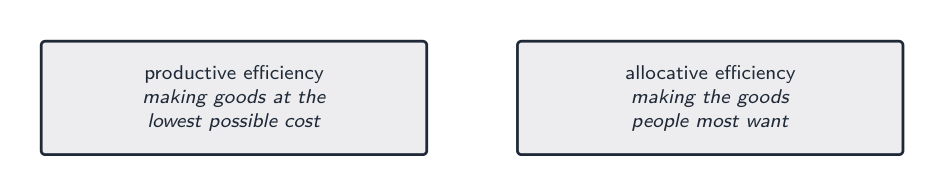
A market outcome is socially efficient 社会有效率 when it maximizes total surplus – when the marginal social benefit equals the marginal social cost of the last unit. Perfect competition reaches this on its own. But sometimes markets fail to, producing too much or too little. This is market failure 市场失灵, and it is the main economic justification for government action.

ไทย

ผลลัพธ์ทางตลาดจะ มีประสิทธิภาพทางสังคม เมื่อเพิ่มส่วนเกินรวมสูงสุด – เมื่อ ประโยชน์ทางสังคมผลเพิ่ม เท่ากับ ต้นทุนทางสังคมผลเพิ่ม ของหน่วยสุดท้าย การแข่งขันที่สมบูรณ์ถึงจุดนี้ได้โดยธรรมชาติ แต่บางครั้งตลาดล้มเหลวที่จะทำ如此会产生过多หรือ过少的产品。นี่คือ ความล้มเหลวของตลาด และเป็นเหตุผลหลักทางเศรษฐศาสตร์สำหรับการแทรกแซงของรัฐบาล

ประสิทธิภาพในการผลิตคือต้นทุนต่ำสุด; ประสิทธิภาพในการจัดสรรคือการผลิตสิ่งที่ผู้คนต้องการ
6.2

Externalities · ⁨ภายนอกities⁩

Syllabus · ⁨หลักสูตร⁩
English

Enduring Understanding (POL-3): Private incentives can fail to account for all socially relevant considerations.

Learning Objective POL-3.A: a. Define externalities. b. Explain (using graphs where appropriate) how in the presence of externalities, private markets do not take into consideration social costs or social benefits.

  • POL-3.A.1 The socially optimal quantity of a good occurs where the marginal social benefit of consuming the last unit equals the marginal social cost of producing that last unit, thus maximizing total economic surplus.
  • POL-3.A.2 Externalities are either positive or negative and arise from lack of well-defined property rights and/or high transaction costs.
  • POL-3.A.3 In the presence of externalities, rational agents respond to private costs and benefits and not to external costs and benefits.
  • POL-3.A.4 Rational agents have the incentive to free ride when a good is non-excludable.

Learning Objective POL-3.B: Explain (using graphs where appropriate) how public policies address positive or negative externalities.

  • POL-3.B.1 Policies that address positive or negative externalities include taxes/subsidies, environmental regulation, public provision, the assignment of property rights, and the reassignment of property rights through private transactions.
ไทย

ความเข้าใจที่ยั่งยืน (POL-3): แรงจูงใจส่วนบุคคลอาจไม่ได้พิจารณาข้อพิจารณาที่เกี่ยวข้องต่อสังคมทั้งหมด

วัตถุประสงค์การเรียนรู้ POL-3.A: a. นิยามผลภายนอก b. อธิบาย (โดยใช้กราฟเมื่อเหมาะสม) ว่าภายใต้สภาวะที่มีผลภายนอก ตลาดส่วนบุคคลไม่ได้คำนึงถึงต้นทุนทางสังคมหรือผลประโยชน์ทางสังคม

  • POL-3.A.1 ปริมาณที่เหมาะสมทางสังคมเกิดขึ้นเมื่อผลประโยชน์ส่วนเพิ่มจากการบริโภคหน่วยสุดท้ายเท่ากับต้นทุนส่วนเพิ่มจากการผลิตหน่วยสุดท้าย thereby สูงสุดรวมความ surplus ทางเศรษฐกิจ
  • POL-3.A.2 ผลภายนอกมีทั้งเชิงบวกและเชิงลบ เกิดขึ้นจากความขาดแคลนสิทธิในทรัพย์สินที่กำหนดไว้ชัดเจนและ/หรือต้นทุนการทำธุรกรรมที่สูง
  • POL-3.A.3 ภายใต้สภาวะที่มีผลภายนอก ตัวแทนที่มีเหตุผลตอบสนองต่อต้นทุนและผลประโยชน์ส่วนบุคคล ไม่ใช่ต่อต้นทุนและผลประโยชน์ภายนอก
  • POL-3.A.4 ตัวแทนที่มีเหตุผลมีแรงจูงใจที่จะใช้ประโยชน์จากบริการสาธารณะโดยไม่จ่าย (free ride) เมื่อสินค้ามีลักษณะไม่สามารถกีดกันการเข้าถึงได้

จุดประสงค์การเรียนรู้ POL-3.B: อธิบาย (โดยใช้กราฟเมื่อเหมาะสม) ว่านโยบายสาธารณะ如何解决ผลภายนอกเชิงบวกหรือเชิงลบ

  • POL-3.B.1 นโยบายที่จัดการกับผลภายนอกเชิงบวกหรือเชิงลบ ได้แก่ ภาษี/เงินอุดหนุน, กฎระเบียบด้านสิ่งแวดล้อม, การให้บริการสาธารณะ, การมอบสิทธิในทรัพย์สิน, และการโอนย้ายสิทธิในทรัพย์สินผ่านธุรกรรมส่วนตัว

Source: College Board AP Course and Exam Description · ⁨แหล่งที่มา: คำอธิบายหลักสูตรและข้อสอบ College Board AP⁩

English
Negative externalities

An externality 外部性 is a cost or benefit that falls on a third party not involved in the transaction – so the private decision-makers ignore it.

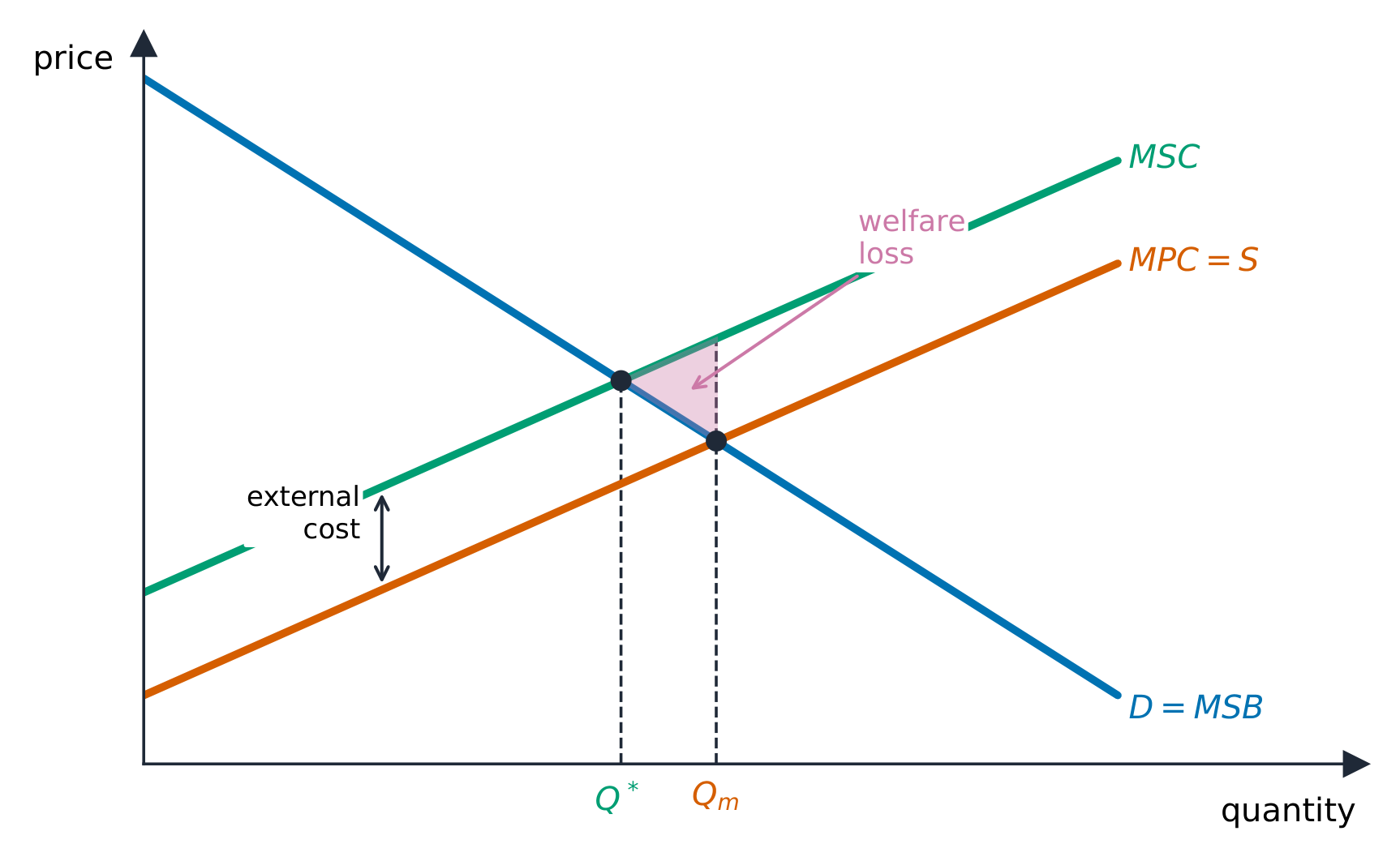
  • A negative externality 负外部性 (pollution) means marginal social cost > marginal private cost. The market over-produces; the deadweight loss is a triangle. Fixes: a Pigovian tax 庇古税 or regulation to make producers "internalize" the cost (shifting private cost up to social cost).
  • A positive externality 正外部性 (vaccination, education) means marginal social benefit > marginal private benefit. The market under-produces. Fixes: a subsidy to consumers or producers.
  • Coase theorem 科斯定理: if property rights are clear and bargaining is costless, private parties can solve an externality themselves – but that is rare with many people involved.

Worked example. A factory's private marginal cost of a chemical is $\$8$ per unit, but each unit also dumps $\$3$ of pollution on neighbors, so the marginal social cost is $\$11$. Ignoring the $\$3$, the market over-produces. A Pigovian tax of exactly $\$3$ per unit raises the firm's private cost to $\$11$ – now equal to the social cost – so the firm cuts output to the efficient quantity and the externality is "internalized."

Exam skill: identify whether an externality is positive or negative, show on a graph that private and social curves diverge, mark the deadweight loss, and name the correcting tax or subsidy.

ไทย
บุหรี่: Externalities หมายความว่าตลาดเอกชนอาจไม่สามารถถึงผลลัพธ์ที่มีประสิทธิภาพทางสังคม
Externalities แบบลบ

Externalities คือต้นทุนหรือประโยชน์ที่ตกอยู่กับ บุคคลที่สาม ที่ไม่เกี่ยวข้องกับการซื้อขาย – ดังนั้นผู้ตัดสินใจด้านเอกชนจึงเพิกเฉยต่อมัน

Externalities แบบลบ: ตลาดผลิตมากเกินไป ส่งผลให้เกิดความสูญเสียสวัสดิการ
  • Externalities แบบลบ (มลพิษ) หมายความว่า ต้นทุนทางสังคมผลเพิ่ม > ต้นทุนภาคเอกชนผลเพิ่ม ตลาด ผลิตมากเกินไป ส่วนที่เสียไป (deadweight loss) เป็นรูปสามเหลี่ยม วิธีแก้ไข: ภาษี Pigovian หรือกฎระเบียบเพื่อให้ผู้ผลิต "รับต้นทุนมาไว้ในตัว" (ย้ายต้นทุนภาคเอกชนขึ้นสู่ต้นทุนทางสังคม)
  • Externalities แบบบวก (วัคซีน, การศึกษา) หมายความว่า ประโยชน์ทางสังคมผลเพิ่ม > ประโยชน์ภาคเอกชนผลเพิ่ม ตลาด ผลิตน้อยเกินไป วิธีแก้ไข: เงินอุดหนุน แก่ผู้บริโภคหรือผู้ผลิต
  • ทฤษฎี Coase: หากสิทธิในทรัพย์สินชัดเจนและการเจรจาไม่มีค่าใช้จ่าย ฝ่ายเอกชนสามารถแก้ปัญหา Externalities ได้เอง –แต่นั้นหายากเมื่อมีผู้มีส่วนร่วมจำนวนมาก
ถนนในเมืองติดขัดแน่นไปด้วยรถยนต์จนหยุดนิ่ง
ความติดขัดเป็น Externalities แบบลบ: แต่ละคนขับรถสร้างต้นทุนให้กับทุกคนที่ขับรถคนอื่นโดยไม่มีราคาใดเก็บค่า tersebut

ตัวอย่างวิธีทำ. ต้นทุนผลเพิ่มภาคเอกชนของโรงงานสำหรับสารเคมีหนึ่งคือ $\$8$ per unit, but each unit also dumps $\$3$ จากมลพิษต่อเพื่อนบ้าน ดังนั้นต้นทุน ทางสังคม ผลเพิ่มคือ $\$11$. Ignoring the $\$3$ ตลาดผลิตมากเกินไป ภาษี Pigovian ที่เท่ากับ $\$3$ per unit raises the firm's private cost to $\$11$ พอดี** – ตอนนี้เท่ากับต้นทุนทางสังคม – เพื่อให้บริษัทตัดกำลังการผลิตลงสู่ปริมาณที่มีประสิทธิภาพและ Externalities ถูก "รับเข้ามาภายใน"

ทักษะการสอบ: ระบุว่าเป็น Externalities แบบบวกหรือลบ แสดงบนกราฟว่าเส้นภาคเอกชนและทางสังคมแยกออกจากกัน标记 deadweight loss และชื่อภาษีหรือเงินอุดหนุนที่ใช้แก้ไข

มลพิษทางอุตสาหกรรม: ภายนอกเชิงลบที่ต้นทุนทางสังคมสูงกว่าต้นทุนส่วนตัว
มลพิษอุตสาหกรรม: negative externality ที่ social cost สูงกว่า private cost
Explore · ⁨สำรวจ⁩

A market with an externality · ⁨ตลาดที่มี externalities⁩

An externality makes private cost differ from social cost, so the free-market quantity is inefficient. See the deadweight loss and how a tax or subsidy corrects it. · ⁨Externality ทำให้ต้นทุนส่วนตัวต่างจากต้นทุนสังคม ดังนั้นปริมาณในตลาดเสรีจึงไม่มีประสิทธิภาพ เห็นการสูญเสียdeadweight และวิธีที่ภาษีหรือเงินอุดหนุนแก้ไขปัญหานี้⁩

Vocabulary · ⁨คำศัพท์⁩ Train · ⁨ฝึกฝน⁩
English ไทย
socially efficient/ˈsəʊʃəli ɪˈfɪʃənt/ มีประสิทธิภาพทางสังคม
market failure/ˈmɑːkɪt ˈfeɪlɪə/ ความล้มเหลวของตลาด
externality/ekˈstɜːnælɪti/ externality (ผลกระทบภายนอก)
negative externality/ˈneɡətɪv ekˈstɜːnælɪti/ ผลภายนอกเชิงลบ
Pigovian tax/pɪˈɡəʊvɪən tæks/ ภาษี Pigovian
positive externality/ˈpɒzɪtɪv ekˈstɜːnælɪti/ ผลภายนอกเชิงบวก
Coase theorem/kəʊs ˈθɪərəm/ ทฤษฎี Coase
rivalry/ˈraɪvəlri/ การแข่งขัน
excludability/eksˌkluːdəˈbɪlɪti/ ความเป็นข้อยกเว้น
private good/ˈpraɪvət ɡʊd/ สินค้าเอกชน
public good/ˈpʌblɪk ɡʊd/ สินค้าสาธารณะ
free-ride/friː raɪd/ การ游离 free-ride
Common resources/ˈkɒmən rɪˈzɔːsɪz/ ทรัพยากรร่วม
6.3

Public and Private Goods · ⁨สินค้าสาธารณะและสินค้าเอกชน⁩

Syllabus · ⁨หลักสูตร⁩
English
Enduring UnderstandingLearning ObjectiveEssential Knowledge

POL-3
Private incentives can fail to account for all socially relevant considerations.

POL-3.C
a. Define whether goods are rival and/or excludable.
b. Explain how the nature of rival and/or excludable goods influences the behavior of individuals and groups.

  • POL-3.C.1 Private goods are rival and excludable, and public goods are non-rival and non-excludable.
  • POL-3.C.2 Due to the free rider problem, private individuals usually lack the incentive to produce public goods, leaving government as the only producer.
  • POL-3.C.3 Governments sometimes choose to produce private goods, such as educational services, and to allow free access to them.
  • POL-3.C.4 Some natural resources are, by their nature, non-excludable and rival and therefore open access. Private individuals inefficiently overconsume such resources.
ไทย

ความเข้าใจที่ยั่งยืน (POL-3): แรงจูงใจส่วนบุคคลอาจไม่ได้พิจารณาข้อพิจารณาที่เกี่ยวข้องต่อสังคมทั้งหมด

Learning ObjectiveEssential Knowledge

POL-3.C
a. นิยามว่าสินค้าเป็นแบบใช้ร่วมกัน (rival) และ/หรือ สามารถกีดกันการเข้าถึงได้หรือไม่ (excludable)
b. อธิบายว่าลักษณะของสินค้าที่เป็นแบบใช้ร่วมกันและ/หรือ กีดกันการเข้าถึงได้ส่งผลต่อพฤติกรรมของบุคคลและกลุ่มอย่างไร

  • POL-3.C.1 สินค้าส่วนบุคคลเป็นแบบใช้ร่วมกันและกีดกันการเข้าถึงได้ ส่วนสาธารณูปโภคเป็นแบบไม่ใช่ใช้ร่วมกันและไม่กีดกันการเข้าถึงได้
  • POL-3.C.2 เนื่องจากปัญหาการใช้ประโยชน์จากบริการสาธารณะโดยไม่จ่าย บุคคลทั่วไปมักขาดแรงจูงใจในการผลิตสาธารณูปโภค ทำให้รัฐบาลเป็นผู้ผลิตเพียงรายเดียว
  • POL-3.C.3 รัฐบาลบางครั้งเลือกที่จะผลิตสินค้าส่วนบุคคล เช่น บริการการศึกษา และอนุญาตให้เข้าถึงได้อย่างอิสระ
  • POL-3.C.4 ทรัพยากรธรรมชาติบางชนิดตามธรรมชาติแล้วไม่กีดกันการเข้าถึงและใช้ร่วมกันได้ จึงเป็นทรัพยากรเปิด (open access) บุคคลทั่วไปใช้ทรัพยากรเหล่านี้เกินความจำเป็นอย่างไม่มีประสิทธิภาพ

Source: College Board AP Course and Exam Description · ⁨แหล่งที่มา: คำอธิบายหลักสูตรและข้อสอบ College Board AP⁩

English

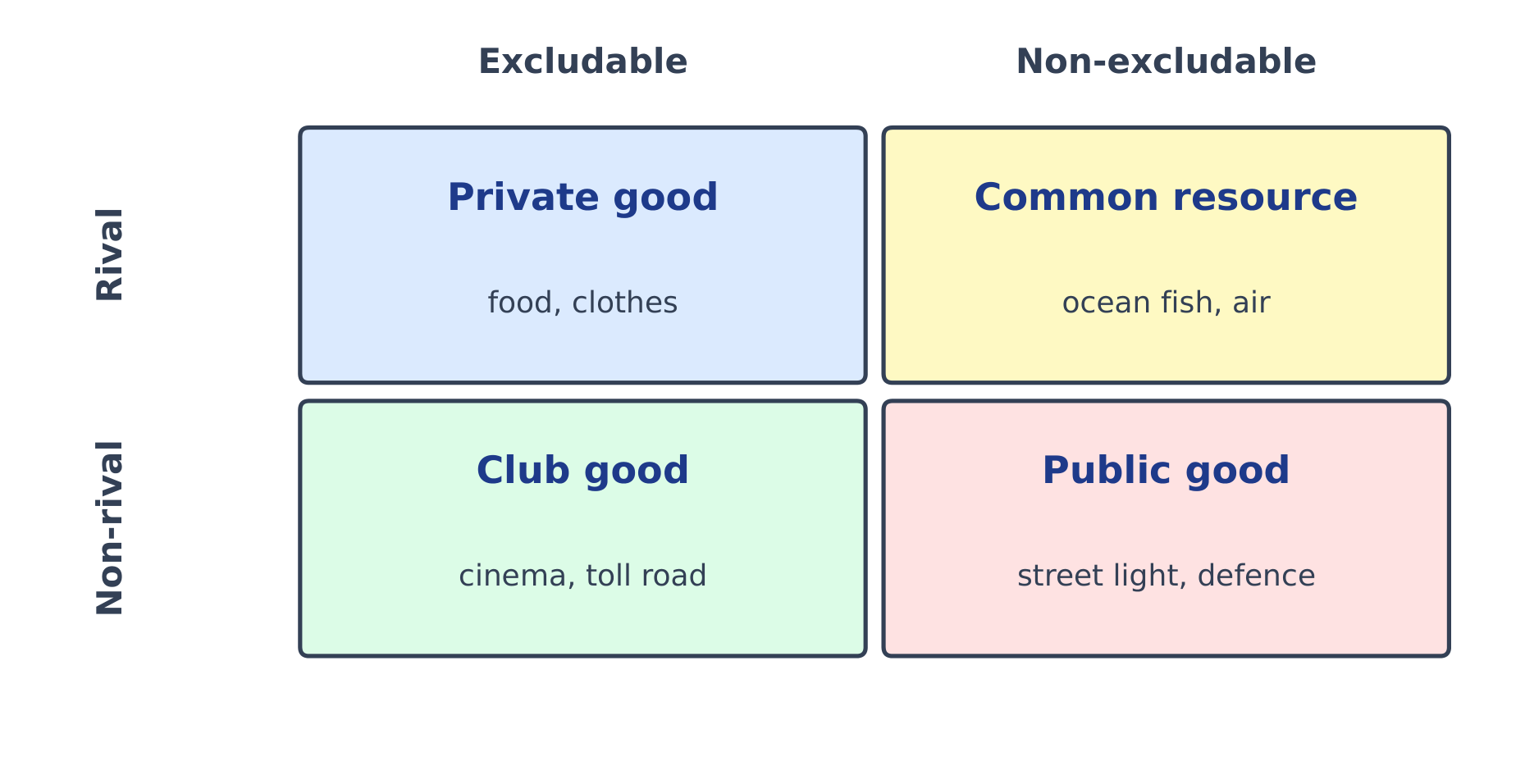
Goods differ along two traits: rivalry 竞争性 (does one person's use reduce another's?) and excludability 排他性 (can non-payers be kept out?).

  • A private good 私人物品 is rival and excludable (a sandwich) – markets handle these well.
  • A public good 公共物品 is non-rival and non-excludable (national defense, a lighthouse). Because non-payers cannot be excluded, people free-ride 搭便车 – enjoy it without paying – so markets under-provide it, and government usually supplies it.
  • Common resources 公共资源 are rival but non-excludable (ocean fish); over-use ruins them – the tragedy of the commons 公地悲剧.
ไทย

สินค้าแตกต่างกันตามสองลักษณะ: ความเป็นคู่แข่ง (การใช้ของคนหนึ่งลดการใช้อีกคนหรือไม่?) และ ความสามารถในการกีดกัน (สามารถกัน人不จ่ายออกได้หรือไม่?)

จำแนกสินค้าตามความเป็นคู่แข่งและความสามารถในการกีดกัน
  • สินค้าเอกชน เป็นทั้งคู่แข่งและกีดกันได้ (แซนด์วิช) – ตลาดจัดการสิ่งเหล่านี้ได้ดี
  • สินค้าสาธารณะ เป็น ไม่คู่แข่งและไม่กีดกันได้ (การป้องกันประเทศ, เสาไฟ) เนื่องจากไม่จ่ายไม่สามารถถูกกีดกันได้ ผู้คนจึง ขี่ฟรี – ใช้โดยไม่จ่าย – ดังนั้นตลาดจึง จัดหาน้อยเกินไป และรัฐบาลมักเป็นผู้จัดหา
  • ทรัพยากรสาธารณะ เป็นคู่แข่งแต่ไม่กีดกันได้ (ปลาในทะเล); การใช้มากเกินไปทำลายมัน – โศกนาฏกรรมของทรัพยากรสาธารณะ
6.4

The Effects of Government Intervention in Different Market Structures · ⁨ผลกระทบของการแทรกแซงของรัฐบาลในโครงสร้างตลาดต่างๆ⁩

Syllabus · ⁨หลักสูตร⁩
English
Enduring UnderstandingLearning ObjectiveEssential Knowledge

POL-4
In imperfect markets, well-designed government policy can reduce waste.

POL-4.A
a. Define government policy interventions in imperfect markets.
b. Explain (using graphs where appropriate) how government policies can alter market outcomes in perfectly and imperfectly competitive markets.
c. Calculate (using data from a graph or table as appropriate) changes in market outcomes resulting from government policies in perfectly competitive and imperfectly competitive markets.

  • POL-4.A.1 Per-unit taxes and subsidies affect the total price consumers pay, net price firms receive, equilibrium quantity, consumer and producer surpluses, deadweight loss, and government revenue or cost. The impact of change depends on the price elasticity of demand and supply.
  • POL-4.A.2 Lump-sum taxes and lump-sum subsidies do not change either marginal cost or marginal benefit; only fixed costs will be affected.
  • POL-4.A.3 Binding price ceilings and floors affect prices and quantities differently depending on the market structures (perfect competition, monopoly, monopolistic competition, and monopsony) and the price elasticities of supply and demand.
  • POL-4.A.4 Government intervention in imperfect markets can increase efficiency if the policy correctly addresses the incentives that led to the market failure.
  • POL-4.A.5 Government can use price regulation to address inefficiency due to monopoly.
  • POL-4.A.6 A natural monopoly will require a lump-sum subsidy to produce at the allocatively efficient quantity.
  • POL-4.A.7 Governments use antitrust policy in an attempt to make markets more competitive.
    • Exclusion statement: A graph of inefficiency and policy due to collusion is beyond the scope of the course and the AP Exam.
ไทย

ความเข้าใจที่ยั่งยืน (POL-4): ในตลาดที่ไม่สมบูรณ์ นโยบายรัฐบาลที่ออกแบบอย่างดีสามารถลดการสิ้นเปลืองได้

Learning ObjectiveEssential Knowledge

POL-4.A
a. นิยามการแทรกแซงนโยบายรัฐบาลในตลาดที่ไม่สมบูรณ์
b. อธิบาย (โดยใช้กราฟเมื่อเหมาะสม) ว่านโยบายรัฐบาลสามารถเปลี่ยนแปลงผลลัพธ์ในตลาดที่แข่งขันสมบูรณ์และไม่สมบูรณ์ได้อย่างไร
c. คำนวณ (โดยใช้ข้อมูลจากกราฟหรือตารางเมื่อเหมาะสม) การเปลี่ยนแปลงของผลลัพธ์ตลาดอันเกิดจากนโยบาย政府在ตลาดที่แข่งขันสมบูรณ์และไม่สมบูรณ์

  • POL-4.A.1 ภาษีและเงินอุดหนุนต่อหน่วยส่งผลต่อราคาทั้งหมดที่ผู้บริโภคจ่าย, ราคาสุทธิที่ผู้ผลิตได้รับ, ปริมาณสมดุล, ความ surplus ของผู้บริโภคและผู้ผลิต, ความสูญเสียทางเศรษฐกิจ, และรายได้หรือค่าใช้จ่ายของรัฐบาล ผลกระทบของการเปลี่ยนแปลงขึ้นอยู่กับความยืดหยุ่นของราคาของความต้องการและอุปทาน
  • POL-4.A.2 ภาษีและเงินอุดหนุนแบบก้อนรวม (lump-sum) ไม่เปลี่ยนแปลงต้นทุนส่วนเพิ่มหรือผลประโยชน์ส่วนเพิ่ม; เพียงแต่ต้นทุนคงที่เท่านั้นที่จะได้รับผลกระทบ
  • POL-4.A.3 การกำหนดเพดานและเพดานราคาที่มีผลบังคับใช้ส่งผลต่อราคาและปริมาณแตกต่างกันไปตามโครงสร้างตลาด (การแข่งขันสมบูรณ์, มอนوپولی, การแข่งขันแบบมอนوپólico, และ monopsony) และความยืดหยุ่นของราคาของอุปทานและ Demand
  • POL-4.A.4 การแทรกแซงของรัฐบาลในตลาดที่ไม่สมบูรณ์สามารถเพิ่มประสิทธิภาพได้หากนโยบายแก้ไขแรงจูงใจที่นำไปสู่ความล้มเหลวของตลาดได้อย่างถูกต้อง
  • POL-4.A.5 รัฐบาลสามารถใช้การควบคุมราคาเพื่อแก้ไขความไม่ประสิทธิภาพจากมอנוโพลี
  • POL-4.A.6 มอโนโพลีธรรมชาติจะต้องการเงินอุดหนุนแบบก้อนรวมเพื่อผลิตที่ปริมาณที่มีประสิทธิภาพในการจัดสรร
  • POL-4.A.7 รัฐบาลใช้นโยบาย反垄断 (antitrust policy) เพื่อพยายามทำให้ตลาดมีการแข่งขันมากขึ้น
    • คำ声明: กราฟของความไม่ประสิทธิภาพและนโยบายจากการร่วมมือกัน (collusion) อยู่นอกขอบเขตของหลักสูตรและการสอบ AP

Source: College Board AP Course and Exam Description · ⁨แหล่งที่มา: คำอธิบายหลักสูตรและข้อสอบ College Board AP⁩

English

Government tools change outcomes differently by structure:

  • Regulating a monopoly's price toward $P=MC$ can increase efficiency (unlike a price control in a competitive market, which creates shortage/surplus).
  • Antitrust laws 反垄断法 break up or block anti-competitive mergers and collusion.
  • Taxes and subsidies shift output toward the socially efficient quantity when externalities are present.

The key insight: the same policy can help or hurt efficiency depending on whether the market was already efficient (competitive) or already failing (monopoly, externality).

Per-unit vs lump-sum. A per-unit tax 从量税 adds to marginal cost, so it shifts supply up, raises price, cuts quantity, and creates deadweight loss. A lump-sum tax 定额税 (a fixed charge like a licence fee) does not change marginal cost or marginal benefit, so in the short run the profit-maximising price and quantity are unchanged – only the firm's profit falls; in the long run it changes entry and exit. For a natural monopoly, regulating price down to $P=MC$ (allocatively efficient) forces a loss, so a lump-sum subsidy 定额补贴 is needed to keep it producing that efficient quantity.

ไทย

เครื่องมือของรัฐบาลเปลี่ยนแปลงผลลัพธ์ต่างกันตามโครงสร้าง:

  • การควบคุมราคาคู่моноปولی เข้าใกล้ $P=MC$ สามารถ เพิ่ม ประสิทธิภาพ (ต่างจากการควบคุมราคาในตลาดแบบแข่งขันซึ่งทำให้เกิดการขาดแคลน/ส่วนเกิน)
  • กฎหมาย反垄断 ย่อยสลายหรือ阻止การควบรวมที่ไม่แข่งขันและการ collusion
  • ภาษีและเงินอุดหนุน ย้ายกำลังการผลิตไปสู่ปริมาณที่มีประสิทธิภาพทางสังคมเมื่อมี Externalities

ข้อคิดสำคัญ: นโยบายเดียวกัน สามารถช่วยหรือทำลายประสิทธิภาพขึ้นอยู่กับว่าตลาดนั้นมีประสิทธิภาพอยู่แล้ว (แบบแข่งขัน) หรือล้มเหลวอยู่แล้ว (คู่ моноปولی, Externalities)

ภาษีต่อหน่วย vs ภาษีรวมก้อน ภาษีต่อหน่วยเพิ่มต้นทุนส่วนเพิ่ม ทำให้เส้นอุปทานเลื่อนขึ้น ราคาสูงขึ้น ปริมาณลดลง และเกิดการสูญเสียประสิทธิภาพ (deadweight loss) ภาษีรวมก้อน (เช่น ค่าใบอนุญาต) ไม่ เปลี่ยนต้นทุนส่วนเพิ่มหรือประโยชน์ส่วนเพิ่ม ดังนั้นใน ระยะสั้น ราคาและปริมาณที่สูงสุดกำไรจะ คงเดิม – เฉพาะกำไรของกิจการลดลง; ในระยะยาวจะมีผลต่อการเข้าและออกจากการตลาด สำหรับ ธรรมชาติมโนโพลี การควบคุมราคาลงสู่ $P=MC$ (มีประสิทธิภาพเชิงจัดสรร) ทำให้ขาดทุน จึงจำเป็นต้องใช้ เงินอุดหนุนแบบรวมก้อน เพื่อให้ผลิต在那个ปริมาณที่มีประสิทธิภาพนั้นต่อไป

6.5

Inequality · ⁨ความเหลื่อมล้ำ⁩

Syllabus · ⁨หลักสูตร⁩
English

Enduring Understanding (POL-5): Market outcomes can result in income inequality.

Learning Objective POL-5.A: Define measures of economic inequality in income and wealth.

  • POL-5.A.1 Income levels and poverty rates vary greatly both across and within groups (e.g., age, gender, race) and countries.
  • POL-5.A.2 The Lorenz curve and Gini coefficient are used to represent the degree of inequality in distributions and to compare distributions across different countries, policies, or time periods.
    • Exclusion statement: Drawing the Lorenz curve and calculating Gini coefficients are beyond the scope of the course and the AP Exam.

Learning Objective POL-5.B: Explain sources of income and wealth inequality.

  • POL-5.B.1 Each factor of production receives the value of its marginal product, which can contribute to income inequality.
  • POL-5.B.2 Sources of income and wealth inequality include differences in tax structures (progressive and regressive tax structures), human capital, social capital, inheritance, effects of discrimination, access to financial markets, mobility, and bargaining power within economic and social units (firms, labor unions, and families).
ไทย

ความเข้าใจที่ยั่งยืน (POL-5): ผลลัพธ์ของตลาดอาจนำไปสู่ความไม่เท่าเทียมทางรายได้

จุดประสงค์การเรียนรู้ POL-5.A: นิยามมาตรการวัดความไม่เท่าเทียมทางเศรษฐกิจในด้านรายได้และทรัพย์สิน

  • POL-5.A.1 ระดับรายได้และอัตราความยากจนมีความแตกต่างกันอย่างมากทั้งระหว่างกลุ่มและภายในกลุ่ม (เช่น อายุ เพศ เชื้อชาติ) และประเทศต่างๆ
  • POL-5.A.2 โค้ฟโลเรนซ์และสัมประสิทธิ์จินี่ใช้เพื่อแสดงความระดับความไม่เท่าเทียมในการกระจายตัวและเปรียบเทียบการกระจายตัวระหว่างประเทศ นโยบาย หรือช่วงเวลาต่างๆ
    • ข้อจำกัด: การวาดกราฟโลเรนซ์และการคำนวณสัมประสิทธิ์จินีอยู่นอกขอบเขตของหลักสูตรและข้อสอบ AP

วัตถุประสงค์การเรียนรู้ POL-5.B: อธิบายแหล่งที่มาของความไม่เท่าเทียมกันด้านรายได้และทรัพย์สิน

  • POL-5.B.1 ปัจจัยการผลิตแต่ละอย่างได้รับมูลค่าตามผลผลิตส่วนเพิ่ม (marginal product) ของมันเอง ซึ่งสามารถนำไปสู่ความไม่เท่าเทียมกันด้านรายได้ได้
  • POL-5.B.2 แหล่งที่มาของความไม่เท่าเทียมกันด้านรายได้และทรัพย์สิน ได้แก่ ความแตกต่างของโครงสร้างภาษี (โครงสร้างภาษีแบบก้าวหน้าและแบบถอยหลัง), ทุนมนุษย์, ทุนทางสังคม, มรดก, ผลกระทบของการเลือกปฏิบัติ, การเข้าถึงตลาดการเงิน, ความคล่องตัว, และอำนาจในการต่อรองภายในหน่วยเศรษฐกิจและสังคม (บริษัท, สหภาพแรงงาน, และครอบครัว)

Source: College Board AP Course and Exam Description · ⁨แหล่งที่มา: คำอธิบายหลักสูตรและข้อสอบ College Board AP⁩

English

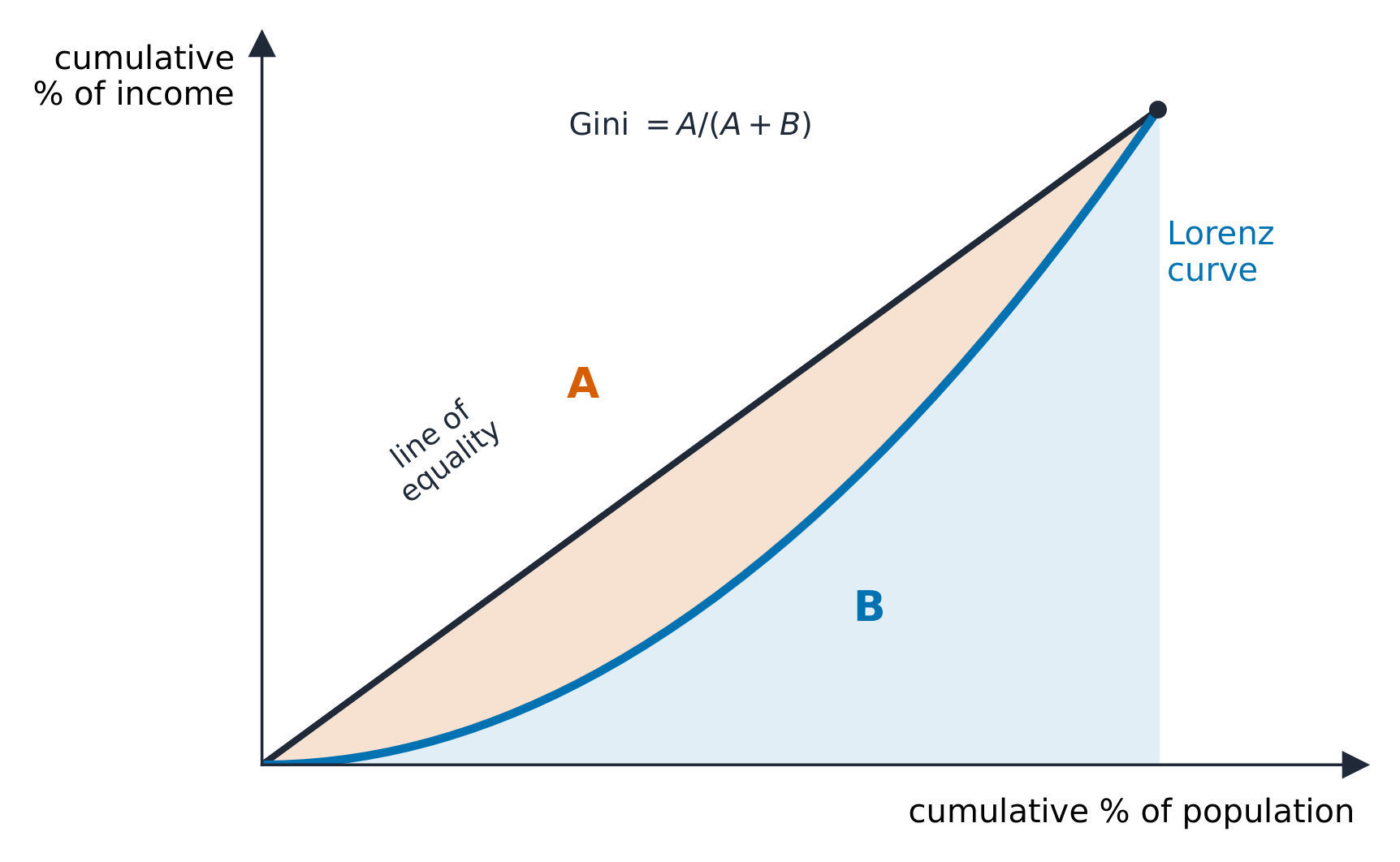
Markets reward productivity, but the resulting income distribution 收入分配 can be very unequal. Economists measure it with the Lorenz curve 洛伦兹曲线 (share of income against share of population; the further it bows from the 45° line, the more unequal) and the Gini coefficient 基尼系数 (0 = perfect equality, 1 = perfect inequality).

Worked example. Suppose the poorest $20\%$ of households earn just $5\%$ of income, while the richest $20\%$ earn $50\%$. Under perfect equality each $20\%$ would earn exactly $20\%$, so the Lorenz curve would be the $45°$ line. Because the bottom fifth is well below $20\%$ and the top fifth well above, the curve bows far beneath the diagonal – a large gap that means a high Gini coefficient and substantial inequality.

Sources of inequality include differences in human capital 人力资本 (skills, education), inheritance, and discrimination. Governments redistribute through progressive taxes 累进税 (higher rates on higher incomes) and transfer payments 转移支付 (welfare, subsidies). There is a debated efficiency–equity trade-off 效率与公平权衡: redistribution can reduce work incentives, so societies balance fairness against the size of the total pie.

ไทย

ตลาดให้รางวัลตามผลผลิต แต่ การกระจายรายได้ ที่เกิดขึ้นอาจมีความเหลื่อมล้ำอย่างมาก นักเศรษฐศาสตร์วัดค่านี้ด้วย กราฟลอเรนซ์ (สัดส่วนรายได้เทียบกับสัดส่วนประชากร; ยิ่งโค้งห่างจากเส้น 45° มากเท่าไร ก็ยิ่งไม่เท่าเทียมมากเท่านั้น) และ สัมประสิทธิ์จินี่ (0 = เท่าเทียมสมบูรณ์, 1 = ไม่เท่าเทียมสมบูรณ์)

กราฟลอเรนซ์และสัมประสิทธิ์จินี่วัดความเหลื่อมล้ำ

ตัวอย่างวิธีทำ. สมมติว่า households ที่ยากจนที่สุด $20\%$ มีรายได้เพียง $5\%$ ในขณะที่ households ที่รวยที่สุด $20\%$ มีรายได้ $50\%$. ภายใต้ความเท่าเทียมกันอย่างสมบูรณ์แต่ละ $20\%$ จะมีรายได้เท่ากับ $20\%$ พอดี ดังนั้น Lorenz curve จะเป็นเส้น $45°$. เนื่องจากกลุ่มล่างสุดอยู่ต่ำกว่า $20\%$ มาก และกลุ่มบนสุดสูงกว่า ทำให้curve โอบอ้อมใต้เส้นทแยงมุมอย่างมาก – ช่องว่างที่ใหญ่บ่งชี้ถึง Gini coefficient สูง และความไม่เสมอภาคอย่างมีนัยสำคัญ

แหล่งที่มาของความเหลื่อมล้ำรวมถึงความแตกต่างของ ทุนมนุษย์ (ทักษะ, การศึกษา), มรดก และการเลือกปฏิบัติ รัฐบาลดำเนินการจัดสรรใหม่ผ่าน ภาษีขั้นบันได (อัตราภาษีสูงขึ้นเมื่อรายได้สูงขึ้น) และ การชำระเงินโอน (สวัสดิการ, เงินอุดหนุน)仍存在有关于 Trade-off ระหว่างประสิทธิภาพและความเสมอภาค ที่ถกเถียงกัน: การจัดสรรใหม่อาจลดแรงจูงใจในการทำงาน ดังนั้นสังคมจึงต้องสมดุลระหว่างความยุติธรรมกับขนาดของ torta รวม

มรดกและความยากจนอยู่คู่กัน: ตลาดเพียงอย่างเดียวอาจไม่แก้ปัญหาความเหลื่อมล้ำด้านรายได้ขนาดใหญ่
Explore · ⁨สำรวจ⁩

Measure inequality with a Lorenz curve · ⁨วัดความเหลื่อมล้ำด้วยเส้นโลเรนซ์⁩

A Lorenz curve plots cumulative income against cumulative population; the further it bows from the diagonal, the more unequal — summarised by the Gini coefficient. · ⁨เส้นโลเรนซ์ แสดงรายได้สะสมเทียบกับประชากรสะสม; ยิ่งโค้งห่างจากเส้นทแยงมุมมากยิ่งมีความเหลื่อมล้ำสูง — สรุปโดย สัมประสิทธิ์จินี่⁩

Vocabulary · ⁨คำศัพท์⁩ Train · ⁨ฝึกฝน⁩
English ไทย
Lorenz curve/ˈlɒrənts kɜːv/ เส้นโค้งโลเรนซ์
Gini coefficient/ˈdʒiːni ˌkəʊɪˈfɪʃənt/ สัมประสิทธิ์ Gini
human capital/ˈhjuːmən ˈkæpɪtl/ ทุนมนุษย์
progressive taxes/prəˈɡresɪv ˈtæksɪz/ ภาษีแบบ прогрессिव
transfer payments/ˈtrænsfɜː ˈpeɪmənts/ การโอนเงิน
efficiency–equity trade-off/ɪˈfɪʃənsi ˈekwɪti treɪd ɒf/ การแลกเปลี่ยนระหว่างประสิทธิภาพและความเสมอภาค
6.5

Exam tips · ⁨ข้อแนะนำสำหรับการสอบ⁩

English
  • A negative externality makes the market over-produce; correct with a Pigovian tax equal to the external cost. A positive externality under-produces; correct with a subsidy.
  • A public good is non-rival and non-excludable, so free-riding leads markets to under-provide it.
  • Classify goods by rivalry and excludability; common resources (rival, non-excludable) suffer the tragedy of the commons.
  • The same policy can help or hurt efficiency depending on whether the market was already efficient or failing.
  • Measure inequality with the Lorenz curve and Gini coefficient (0 = equality, 1 = inequality).
ไทย
  • ** externality แบบลบ** ทำให้การผลิตในตลาดมากเกินไป แก้ไขได้โดย ภาษีพิโกเวียน เท่ากับต้นทุนภายนอก ผลบวก会产生 overproduction; แก้ไขได้ bằng subsidy.
  • สินค้าสาธารณะ เป็นสินค้าที่ไม่มีการแข่งขันและไม่กีดกัน การใช้บริการฟรี (free-riding) ทำให้ตลาดจัดหาน้อยเกินไป
  • จัดประเภทสินค้าตามลักษณะการแข่งขันและการกีดกัน: ทรัพยากรร่วม (rival, non-excludable) suffers the tragedy of the commons.
  • นโยบายเดียวกันสามารถช่วยหรือทำลายประสิทธิภาพขึ้นอยู่กับว่าตลาดมีประสิทธิภาพอยู่แล้วหรือไม่หรือล้มเหลว
  • วัดความเหลื่อมล้ำด้วย กราฟลอเรนซ์ และ สัมประสิทธิ์จินี่ (0 = เท่าเทียม, 1 = ไม่เท่าเทียม)
Vocabulary · ⁨คำศัพท์⁩ Train · ⁨ฝึกฝน⁩
English ไทย
tragedy of the commons/ˈtrædʒədi ɒvðə ˈkɒmənz/ โศกนาฏกรรมของสาธารณะ (tragedy of the commons)
Antitrust laws/ˌæntɪˈtrʌst lɔːz/ กฎหมายต่อต้านการผูกขาด
per-unit tax/pɜː ˈjuːnɪt tæks/ ภาษีต่อหน่วย
lump-sum tax/lʌmp sʌm tæks/ ภาษี lump-sum
lump-sum subsidy/lʌmp sʌm ˈsʌbsɪdi/ เงินอุดหนุน lump-sum
income distribution/ˈɪŋkʌm ˌdɪstrɪˈbjuːʃn/ การกระจายรายได้

Interactive lessons on this topic · ⁨บทเรียนเชิงโต้ตอบสำหรับหัวข้อนี้⁩

Work through it step by step, with instant-check exercises. · ⁨ทำทีละขั้นตอน พร้อมแบบฝึกหัดตรวจสอบผลทันที⁩

Past Papers · ⁨ข้อสอบย้อนหลัง⁩

More topics in AP Microeconomics · ⁨AP เศรษฐศาสตร์จุลภาค⁩ · ⁨หัวข้อเพิ่มเติมใน AP Microeconomics · ⁨AP เศรษฐศาสตร์จุลภาค⁩⁩

Log in or create account · ⁨เข้าสู่ระบบหรือสร้างบัญชี⁩

IGCSE, A-Level & AP