ตัวอย่างที่คำนวณแล้ว. GDP นามนัยคือ $\$22$ trillion and the GDP deflator is $110$. Real GDP is $\dfrac{22}{110}\times100=\$20$ trillion. ส่วนเพิ่ม $\$2$万亿ของ GDP นามนัยเป็นการขึ้นราคาล้วนๆ ไม่ใช่ผลผลิตจริง – นั่นคือเหตุผลที่การเติบโตต้องวัดด้วย GDP จริง เสมอ
ตัวอย่างฝึกฝน. ถ้า $MPC=0.8$, ตัวคูณการใช้จ่ายคือ $\dfrac{1}{1-0.8}=5$, ดังนั้นการลดภาษี $\$10$ billion rise in government spending lifts real GDP by $5\times\$10=\$50$ billion. The tax multiplier is $-\dfrac{0.8}{0.2}=-4$, so a $\$10$ พันล้านดอลลาร์สหรัฐ จะเพิ่ม GDP เพียง $\$40$ พันล้านดอลลาร์สหรัฐ – มีผลอ่อนกว่า เพราะบางส่วนของการลดภาษีถูกเก็บออมไว้.
เทคนิคการสอบ: คำนวณตัวคูณทั้งสองจาก MPC และหาการเปลี่ยนแปลงของ GDP จริง – เป็นการคำนวณที่แทบจะแน่นอนที่จะออกสอบ.
จุดประสงค์การเรียนรู้ POL-1.A:
a. นิยามนโยบายการคลังและคำศัพท์ที่เกี่ยวข้อง
b. อธิบาย (โดยใช้กราฟเมื่อจำเป็น) ผลกระทบระยะสั้นของการดำเนินการนโยบายการคลัง
c. คำนวณผลกระทบระยะสั้นของการดำเนินการนโยบายการคลัง
ตัวอย่างที่คำนวณแล้ว. เศรษฐกิจมี $\$100$ billion recessionary gap and $MPC=0.75$ (spending multiplier $=\dfrac{1}{0.25}=4$). To close it, the government must raise spending by $\dfrac{\$100\text{ billion}}{4}=\$25$ billion. Using a tax cut instead (tax multiplier $-3$) would require a larger $\dfrac{100}{3}\approx\$33$ พันล้านลดลง
จุดประสงค์การเรียนรู้ MEA-3.A:
a. นิยามคุณสมบัติหลัก—สภาพคล่อง อัตราผลตอบแทน และความเสี่ยง—ที่เกี่ยวข้องกับกลุ่มสินทรัพย์ทางการเงินต่างๆ รวมถึงเงิน
b. อธิบายความสัมพันธ์ระหว่างราคาพันธบัตรที่ออกมาก่อนหน้าและอัตราดอกเบี้ย
จุดประสงค์การเรียนรู้ MEA-3.B:
a. นิยามอัตราดอกเบี้ยnominalและreal
b. อธิบายความสัมพันธ์ระหว่างการเปลี่ยนแปลงอัตราดอกเบี้ยnominal,的预期 inflation และอัตราดอกเบี้ยreal
c. คำนวณอัตราดอกเบี้ยnominalและreal
ตัวอย่างที่คำนวณแล้ว. กู้ยืมมีอัตรานามธรรมอยู่ที่ $6\%$ mientras la inflación corre al $2\%$. The real rate is $6\%-2\%=4\%$, so the lender's purchasing power grows by $4\%$. If inflation instead jumped to $7\%$, the real rate would be $-1\%$ – the lender would actually lose purchasing power.
MEA-3.C.4 Monetary base (มักเรียกว่า M0 หรือ MB) รวม currency in circulation และbank reserves
แหล่งที่มา: คำอธิบายหลักสูตรและข้อสอบ College Board AP
เงิน คือสิ่งanything accepted in exchange. Three functions: a medium of exchange (หลีกเลี่ยงการแลกเปลี่ยนของใช้), a unit of account (มาตรฐานวัดมูลค่าร่วมกัน), and a store of value (รักษามูลค่าไว้ตามเวลา). เงินสมัยใหม่คือ fiat money – มีคุณค่าเพราะรัฐบาลประกาศให้เป็นชำระหนี้ قانون и люди trust it, not because it is backed by gold.
หน้าที่ของเงิน – การสอบ AP ทดสอบสามข้อแรก (medium of exchange, unit of account, store of value); standard of deferred payment อยู่เหนือ CED
แหล่งที่มา: คำอธิบายหลักสูตรและข้อสอบ College Board AP
ธนาคารทำงานด้วยระบบ fractional reserve:他们将一部分存款作为reserves保留,其余部分用于贷款。他们必须保留的比例称为required reserve ratio (rr)。贷款创造新的存款,这些新存款又被存入并再次贷出,通过money multiplier扩大货币供应量:
$$\text{money multiplier}=\frac{1}{rr}.$$
一个新的$1000 deposit with$rr=0.1$leaves$$900$in excess reserves, so the banking system can expand the money supply by up to$900\times\frac{1}{0.1}=9,000$. Use a bank's T-account (assets = reserves + loans; liabilities = deposits) to track required reserves and excess reserves (the amount available to lend).
ตัวอย่างที่คำนวณแล้ว. A bank receives a $\$1000$ deposit with $rr=0.20$. It must hold $0.20\times1000=\$200$ as required reserves, leaving $\$800$ of excess reserves to lend. With a money multiplier of $\dfrac{1}{0.20}=5$, that $\$800$ ของ new lending สามารถขยายอุปทานเงินได้สูงสุดถึง $800\times5=\$4000$ across the banking system.
แหล่งที่มา: คำอธิบายหลักสูตรและข้อสอบ College Board AP
*The money market sets the interest rate
The market determine the nominal interest rate:
The interest rate is set by the demand for and supply of money
Money demand slopes downward against the interest rate – the rate is the opportunity cost of holding money instead of interest-bearing assets. It shifts right with a higher price level or more real GDP.
Money supply is vertical – set by the central bank, independent of the interest rate.
ความเข้าใจที่ยั่งยืน (MKT-4): การมีปฏิสัมพันธ์ระหว่างผู้กู้ which ต้องการเงินกู้ยืมได้และผู้ออม which จ่ายเงินกู้ยืมได้ จะกำหนดอัตราดอกเบี้ยจริงที่สมดุล
แหล่งที่มา: คำอธิบายหลักสูตรและข้อสอบ College Board AP
In the long run, inflation is a monetary phenomenon. The quantity theory of money states $M\times V = P\times Y$ (money supply $\times$ velocity $=$ price level $\times$ real output). With velocity $V$ and real output $Y$ roughly stable in the long run, growth in the money supply translates almost one-for-one into inflation. Printing money faster than the economy grows raises the price level, not real output – the root of high inflation and, in the extreme, hyperinflation.
POL-3.B
ก. นิยาม政府 budget surplus (deficit) และ national debt
ข. อธิบายปัญหาที่เกี่ยวข้องกับภาระของ national debt
POL-3.B.1 Government budget surplus (deficit) คือความแตกต่างระหว่าง tax revenues กับ government purchases plus transfer payments ใน某一 year
POL-3.B.2 Government จะเพิ่ม national debt เมื่อมี budget deficit
POL-3.B.3 Government ต้องจ่ายดอกเบี้ยบน accumulated debt ของตนเอง ซึ่งทำให้ national debt เพิ่มขึ้นและ increasingly forgoing using those funds for alternative uses. [ดูHEADER LO POL-3.C เรื่อง crowding out]
แหล่งที่มา: คำอธิบายหลักสูตรและข้อสอบ College Board AP
POL-3.C.2 Loanable funds market model สามารถใช้เพื่อแสดง effect ของ government borrowing ต่อ equilibrium real interest rate และ resulting crowding out of private investment. [ดูHEADER MKT-4]
POL-3.C.3 Crowding out หมายถึง adverse effect ของ increased government borrowing ซึ่งนำไปสู่ decreased levels of interest-sensitive private sector spending ในระยะสั้น
POL-3.C.4 Potential long-run impact ของ crowding out คือ lower rate of physical capital accumulation และ less economic growth เป็นผลมา
แหล่งที่มา: คำอธิบายหลักสูตรและข้อสอบ College Board AP
ตัวอย่างการคำนวณ รัฐบาลกู้ยืม $\$500$ billion to finance a deficit. On the loanable funds market this shifts the demand for funds right, pushing the real interest rate up (say from $3%$ to $4%$). At the higher rate firms scale back investment – perhaps by $\$150$ พันล้านดอลลาร์ – ดังนั้นการกระตุ้น AD สุทธิจึงน้อยกว่า $\$500$ พันล้านดอลลาร์ และการสูญเสียการลงทุนจะทำให้การเติบโตระยะยาวชะลอตัวลง
MEA-2.B.1 Economic growth สามารถวัดได้ bằng growth rate of real GDP per capita over time
MEA-2.B.2 Aggregate employment และaggregate output มีความสัมพันธ์โดยตรงเพราะ firms ต้อง employ workers มากขึ้นเพื่อ produce output มากขึ้น โดยคง other factors ไว้ This is captured by the aggregate production function
MEA-2.B.3 Output per employed worker เป็น measure ของ average labor productivity
MEA-2.B.4 Productivity ถูกกำหนดโดยระดับ technology และ physical และ human capital ต่อ worker
MEA-2.B.5 Aggregate production function แสดงว่า output per capita มีความสัมพันธ์เชิงบวกทั้ง physical และ human capital per capita
แหล่งที่มา: คำอธิบายหลักสูตรและข้อสอบ College Board AP
MEA-4.A
ก. นิยามcurrent account (CA), capital and financial account (CFA) และbalance of payments (BOP)
ข. อธิบายว่าการเปลี่ยนแปลงใน components ของ CA และ CFA会影响一个国家's BOP อย่างไร
ค. คำนวณ CA, CFA และBOP
MEA-4.A.1 Current account (CA) บันทึก net exports, net income จากต่างประเทศ และnet unilateral transfers
MEA-4.A.2 CA ไม่ได้สมดุลเสมอไป; อาจแสดง surplus หรือdeficit Balance of trade ของประเทศ (即 net exports) เป็นส่วนหนึ่งของ current account และอาจแสดง surplus หรือdeficit เช่นกัน
MEA-4.A.3 Capital and financial account (CFA) บันทึก financial capital transfers และpurchases และsales ของ assets ระหว่างประเทศ
MEA-4.A.4 CFA ไม่ได้สมดุลเสมอไป; อาจแสดง surplus (financial capital inflow) หรือdeficit (financial capital outflow)
MEA-4.A.5 Balance of payments (BOP) เป็นaccounting system ที่บันทึกinternational transactions ของประเทศในช่วงเวลาหนึ่ง particular time period ประกอบด้วย CA และCFA
MEA-4.A.6 Any transaction causing money flow into a country เป็นcredit to its BOP account และany transaction causing money flow out เป็นdebit ผลรวมของ credit entries ทั้งหมดควรเท่ากับผลรวมของ debit entries ทั้งหมด ($CA + CFA = 0$)
แหล่งที่มา: คำอธิบายหลักสูตรและข้อสอบ College Board AP
ตัวอย่างวิธีทำ. สมมติ $\$1=\text{€}0.90$, so $\text{€}1=\dfrac{1}{0.90}\approx\$1.11$. หาก afterward ดอลลาร์มีค่าขึ้นเป็น $\$1=\text{€}1.00$, each dollar now buys more euros, while the euro has depreciated – it now buys only $\$1.00$ แทนที่จะเป็น $\$1.11$. เหตุการณ์เดียวนี้คือการมีค่าขึ้นของดอลลาร์ และ การมีค่าลงของยูโร
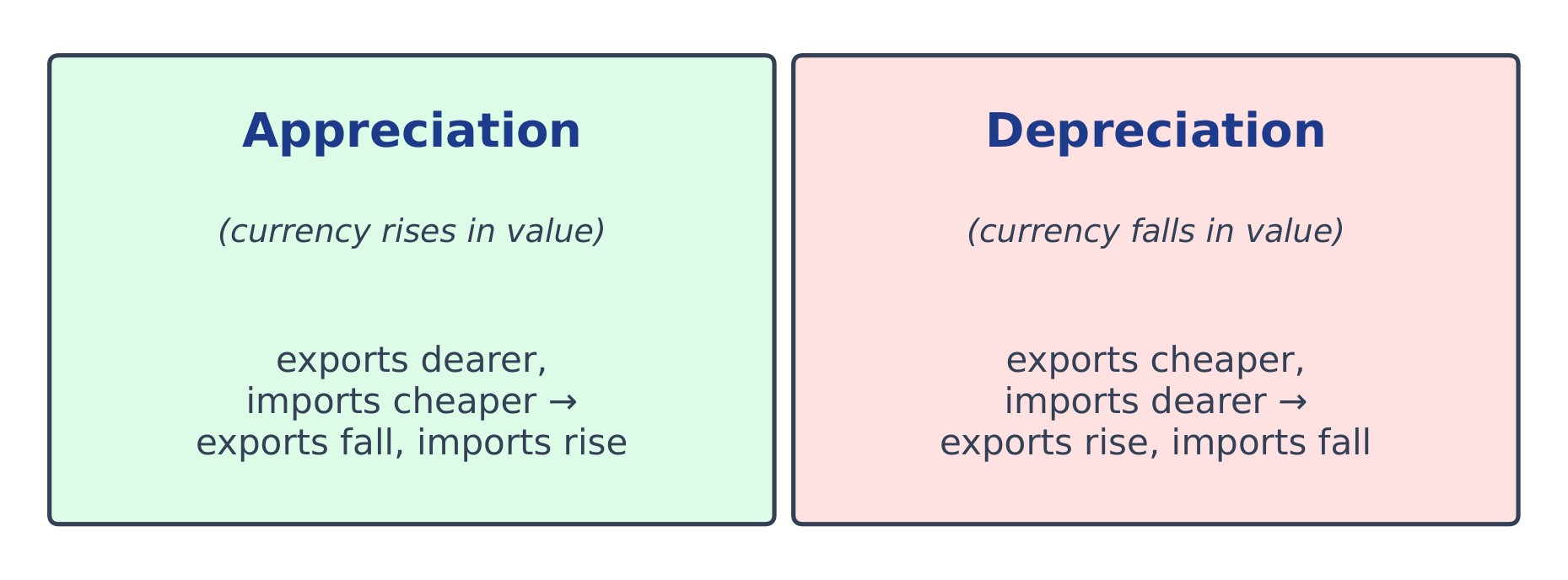
การมีค่าลง ทำให้ส่งออกถูกลงสำหรับชาวต่างชาติและนำเข้าแพงขึ้น ดังนั้น Net Exports จะเพิ่มขึ้น และ AD เลื่อนไปทางขวา
การมีค่าขึ้น ทำให้ส่งออกแพงขึ้นและนำเข้าถูกลง ดังนั้น Net Exports จะลดลง และ AD เลื่อนไปทางซ้าย
ตัวอย่างวิธีทำ. รถยนต์สหรัฐฯ ราคา $\$30{,}000$ costs a European buyer $\text{€}27{,}000$ when $\$1=\text{€}0.90$. หากดอลลาร์ มีค่าลง เป็น $\$1=\text{€}0.80$, the same car now costs only $\text{€}24{,}000$ – ถูกสำหรับชาวต่างชาติ ดังนั้นการส่งออกของสหรัฐฯ เพิ่มขึ้น ในขณะที่การนำเข้า (ซึ่งตอนนี้แพงขึ้นเมื่อแปลงเป็นดอลลาร์) ลดลง ช่วยเพิ่ม Net Exports และเลื่อน AD ไปทางขวา