Skip to content · ⁨ข้ามไปยังเนื้อหา⁩

Refining Qualified Arguments · ⁨การปรับปรุงข้อโต้แย้งที่มีเงื่อนไข⁩

AP English Language and Composition · ⁨AP ภาษาอังกฤษเพื่อการสื่อสารและการเขียน⁩ · Topic 9 · ⁨หัวข้อ 9⁩

Video lesson for this topic · ⁨บทเรียนวิดีโอสำหรับหัวข้อนี้⁩ Open the video page · ⁨เปิดหน้าวิดีโอ⁩
4:51

หน่วยที่ 9: การปรับปรุงข้อโต้แย้งที่มีการให้เงื่อนไข

หน่วยที่ 9 มีสั้นลง และเป็นการเคลื่อนไหวสุดท้ายของหลักสูตร: วิธีจัดการกับข้อโต้แย้งที่ขัดแย้งกับของคุณ ทุกสิ่งในที่นี้ได้รับการตอบรับโดยตรงในการสอบ และ...

English narration · English + 中文 subtitles burned in · ⁨การบรรยายภาษาอังกฤษ · คำบรรยายภาษาอังกฤษ + 中文 ลอยตัวบนภาพ⁩

9.1

How Claims Are Qualified · ⁨วิธีการจำกัดขอบเขตข้ออ้าง⁩

Syllabus · ⁨หลักสูตร⁩
English

Enduring Understanding (CLE-1): Writers make claims about subjects, rely on evidence that supports the reasoning that justifies the claim, and often acknowledge or respond to other, possibly opposing, arguments.

Learning Objective 3.C: Reading – Explain ways claims are qualified through modifiers, counterarguments, and alternative perspectives.

  • CLE-1.AA Writers enhance their credibility when they refute, rebut, or concede opposing arguments and contradictory evidence.
  • CLE-1.AB When writers concede, they accept all or a portion of a competing position or claim as correct, agree that the competing position or claim is correct under a different set of circumstances, or acknowledge the limitations of their own argument.
  • CLE-1.AC When writers rebut, they offer a contrasting perspective on an argument and its evidence or provide alternative evidence to propose that all or a portion of a competing position or claim is invalid.
  • CLE-1.AD When writers refute, they demonstrate, using evidence, that all or a portion of a competing position or claim is invalid.
  • CLE-1.AE Transitions may be used to introduce counterarguments.
  • CLE-1.AF Not all arguments explicitly address a counterargument.
  • CLE-1.Y Effectively entering into an ongoing conversation about a subject means engaging the positions that have already been considered and argued about.
  • CLE-1.Z Evidence and sources will either support, complement, or contradict a writer’s thesis.
ไทย

ความเข้าใจที่ยั่งยืน (CLE-1): นักเขียนทำข้ออ้างเกี่ยวกับหัวข้อ อิงกับหลักฐานที่สนับสนุนเหตุผลที่ใช้เพื่อพิสูจน์ข้ออ้าง tersebut และมักยอมรับหรือตอบโต้ข้อโต้แย้งอื่น ๆ ซึ่งอาจเป็นฝ่ายตรงข้าม

จุดประสงค์การเรียนรู้ 3.C: การอ่าน – อธิบายวิธีการปรับลดข้ออ้างโดยใช้คำขยาย ข้อโต้แย้งทางเลือก และมุมมองทางเลือก

  • CLE-1.AA นักเขียนเพิ่ม credibility เมื่อพวกเขา反驳,反驳,หรือยอมรับข้อโต้แย้งและหลักฐานที่ขัดแย้งกัน
  • CLE-1.AB เมื่อนักเขียนยอมรับ (concede) พวกเขาจะยอมรับทั้งหมด或部分ของมุมมองหรือข้อโต้แย้งที่แข่งขันกันว่าเป็นจริง ยอมรับว่ามุมมองหรือข้อโต้แย้งที่แข่งขันกันนั้นเป็นจริงภายใต้สถานการณ์อื่น หรือรับทราบข้อจำกัดของข้อโต้แย้งของตนเอง
  • CLE-1.AC เมื่อนักเขียน反驳 (rebut) พวกเขาเสนอมุมมองที่ตรงข้ามต่อข้อโต้แย้งและหลักฐาน หรือเสนอหลักฐานทางเลือกเพื่อชี้ให้เห็นว่าทั้งหมด或部分ของมุมมองหรือข้อโต้แย้งที่แข่งขันกันนั้นไม่ถูกต้อง
  • CLE-1.AD เมื่อนักเขียน反驳 (refute) พวกเขาแสดงด้วยหลักฐานว่าทั้งหมด或部分ของมุมมองหรือข้อโต้แย้งที่แข่งขันกันนั้นไม่ถูกต้อง
  • CLE-1.AE คำเชื่อมสามารถ Used เพื่อแนะนำข้อโต้แย้งที่ countered
  • CLE-1.AF ไม่ใช่ทุกข้อโต้แย้งจะ addressing ข้อโต้แย้งที่ countered อย่างชัดเจน
  • CLE-1.Y การเข้าร่วมในการสนทนาเกี่ยวกับหัวข้ออย่างต่อเนื่องอย่างมีประสิทธิภาพหมายถึงการ engaging กับตำแหน่งที่已经被考虑และถกเถียงแล้ว
  • CLE-1.Z หลักฐานและแหล่งที่มาจะ either supporting, complementing, หรือ contradicting thesis ของนักเขียน
Source: College Board AP Course and Exam Description · ⁨แหล่งที่มา: คำอธิบายหลักสูตรและข้อสอบ College Board AP⁩

English

Unit 9 is short and it is the course's final move: how to handle the arguments that oppose yours. Everything here is directly rewarded on the exam, and the three key verbs are constantly confused.

The framing first:

  • Effectively entering an ongoing conversation about a subject means engaging the positions that have already been taken. An argument that ignores them is not participating in the discussion, only announcing into it.
  • Evidence and sources will either support, complement, or contradict 支持、补充或反驳 a writer's thesis. All three are usable - contradicting evidence is not a problem to be hidden but material to be handled.
  • Writers enhance their credibility when they refute, rebut, or concede opposing arguments and contradictory evidence.

The three moves, in the CED's own definitions:

  • Concede 让步: writers accept all or a portion of a competing position or claim as correct, and agree that the opposing point has merit.
  • Rebut 反驳: writers offer a contrasting perspective on an argument and its evidence, or provide an alternative interpretation.
  • Refute 驳倒: writers demonstrate, using evidence, that all or a portion of a competing position or claim is incorrect.

The distinction is what your evidence lets you do. Refuting requires evidence of error; if you do not have it, refuting is bluffing and a reader will see it. Rebutting requires only an alternative reading of the same facts, which is far more often available. Conceding requires honesty, and it costs nothing - the CED says explicitly that it enhances credibility.

Two further points:

  • Transitions may be used to introduce counterarguments - and, as in Unit 5, the transition should signal the relationship. Critics argue announces one; the strongest objection to this is announces one and ranks it.
  • Not all arguments explicitly address a counterargument. True of texts you read, and worth noting when analysing - an argument that engages no opposition has told you something about its intended audience.
ไทย

หน่วยที่ 9 สั้นๆ และเป็นขั้นตอนสุดท้ายของหลักสูตร: วิธีการจัดการกับข้อโต้แย้งที่ opposing กับคุณ ทุกสิ่งในที่นี้ถูกให้คะแนนโดยตรงในข้อสอบ และสามกริยาหลักมักถูกสับสนเสมอ

กรอบแนวคิดเริ่มต้นดังนี้:

  • เข้าสู่บทสนทนา关于เรื่องใดเรื่องหนึ่งอย่างมีประสิทธิภาพ หมายถึง การมีส่วนร่วมในตำแหน่งทางความคิดที่已经被提出来了 ข้อโต้แย้งที่ ignore它们ไม่ได้มีบทบาทในการถกเถียง มีแต่การประกาศเสียงเข้าไปในบทสนทนาเท่านั้น
  • หลักฐานและแหล่งข้อมูลจะ either support, complement, or contradict thesis ของผู้เขียน ทั้งสามรูปแบบสามารถใช้ได้ - หลักฐานที่ขัดแย้งกันไม่ใช่ปัญหาที่ต้องซ่อนเร้น แต่เป็นวัสดุที่ต้องจัดการ
  • ผู้เขียนเพิ่ม credibility เมื่อ反驳, ตอบโต้, หรือยอม承认 ข้อโต้แย้งและหลักฐานที่ขัดแย้งกัน
สามท่าทางที่แตกต่างกัน, การยอมรับที่แตกต่างกันสามแบบ - และนักเรียนมักสับสน将它们
Concede ยอมรับ, Rebut ตอบโต้, Refute ปฏิเสธให้พิสูจน์ เลือกคำที่หลักฐานของคุณสามารถ support จริงๆ

สามท่าทางนี้ ตามนิยามของ CED เอง:

  • Concede (ยอม承认): ผู้เขียน accept ทั้งหมดหรือบางส่วน ofresources competing position หรือ claim ว่าถูกต้อง และยินยอมว่า观点 opposite มีคุณค่า
  • Rebut (反驳): ผู้เขียน เสนอมุมมองที่แตกต่าง sobre一个argument และหลักฐานของมัน, หรือให้ interpretation แบบอื่น
  • Refute (驳倒): ผู้เขียน demonstrate, โดยใช้หลักฐาน, ว่าทั้งหมด或部分 ofresources competing position หรือ claim ไม่ถูกต้อง

ความแตกต่างอยู่ที่ว่าหลักฐานของคุณทำให้คุณทำได้อะไร Refuting ต้องใช้หลักฐาน that proves error; ถ้าไม่มี Refuting ก็เป็นการ bluffing และผู้อ่านจะมองเห็น Rebutting ต้องการแค่ alternative reading ของ facts เดียวกัน ซึ่งหาได้ง่ายกว่ามาก Conceding ต้องการความซื่อสัตย์, และไม่เสียค่าใช้จ่ายใดๆ - CED บอก explicitly ว่ามัน enhances credibility

สองประเด็นเพิ่มเติม:

  • Transitions อาจใช้เพื่อ introduce counterarguments - และ какในหน่วยที่ 5, transition ควร signal ความสัมพันธ์ นักวิจารณ์ argue ประกาศหนึ่ง; ข้อ反对ที่แข็งแกร่งที่สุดต่อสิ่งนี้ ประกาศหนึ่งและจัดอันดับมัน
  • ไม่ใช่ทุกข้อโต้แย้งที่ addressing a counterargument อย่างชัดเจน เป็นจริงสำหรับ texts ที่คุณอ่าน, และมีประโยชน์เมื่อ analyzing - an argument ที่ไม่ engage任何 opposition บอกให้คุณทราบบางอย่างเกี่ยวกับ intended audience ของมัน
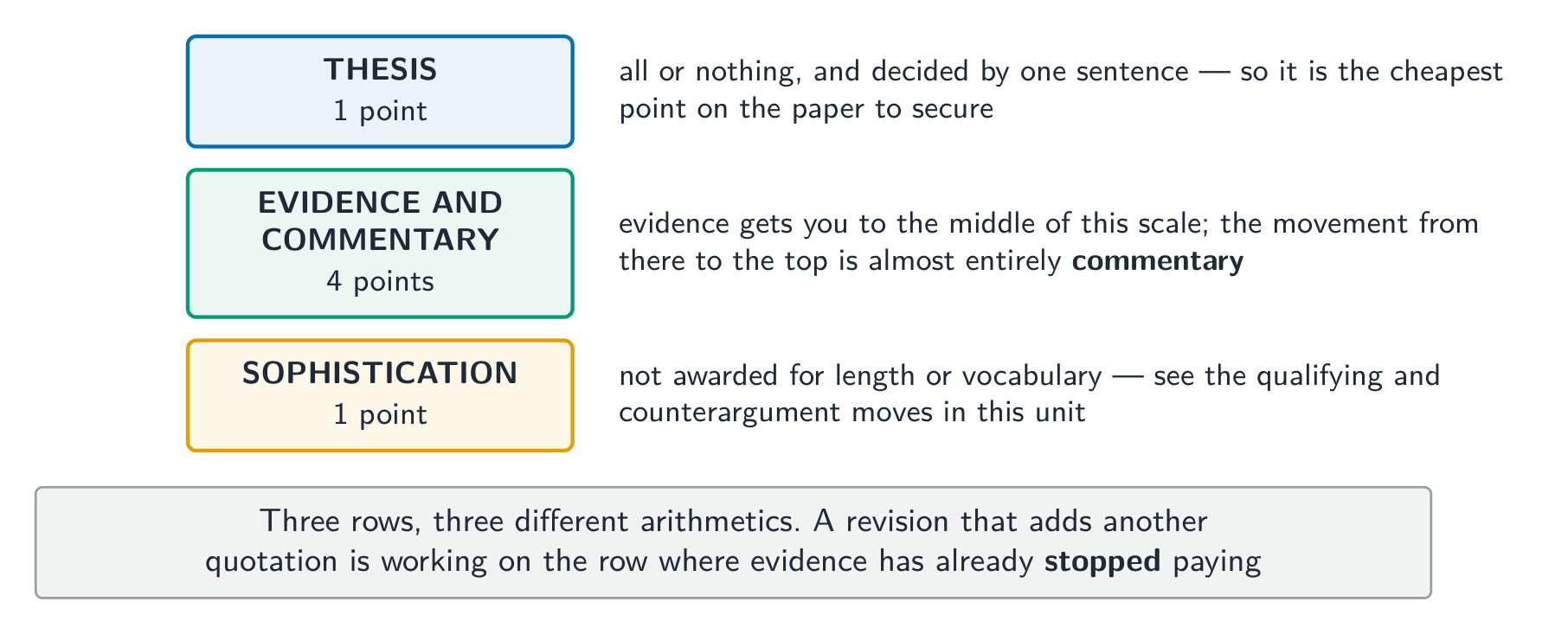
สามแถว, คณิตศาสตร์ที่แตกต่างกันสามแบบ - ทบทวนแบบที่ยังคงให้คะแนน
Explore · ⁨สำรวจ⁩

Place the counterargument, and say what it signals

Position carries meaning: early it frames the essay, late it can read as a box being ticked.

Vocabulary · ⁨คำศัพท์⁩ Train · ⁨ฝึกฝน⁩
English ไทย
support, complement, or contradict/səˈpɔːt ˈkɒmplɪmənt ɔː ˌkɒntrəˈdɪkt/ สนับสนุน เสริม หรือขัดแย้ง
Concede/kənˈsiːd/ ยอมรับ
Rebut/rɪˈbʌt/ ยืนยัน
Refute/rɪˈfjuːt/ ปฏิเสธ
9.2

Qualifying a Claim · ⁨การกำหนดขอบเขตข้ออ้าง⁩

Syllabus · ⁨หลักสูตร⁩
English

Enduring Understanding (CLE-1): Writers make claims about subjects, rely on evidence that supports the reasoning that justifies the claim, and often acknowledge or respond to other, possibly opposing, arguments.

Learning Objective 4.C: Writing – Qualify a claim using modifiers, counterarguments, or alternative perspectives.

  • CLE-1.AA Writers enhance their credibility when they refute, rebut, or concede opposing arguments and contradictory evidence.
  • CLE-1.AB When writers concede, they accept all or a portion of a competing position or claim as correct, agree that the competing position or claim is correct under a different set of circumstances, or acknowledge the limitations of their own argument.
  • CLE-1.AC When writers rebut, they offer a contrasting perspective on an argument and its evidence or provide alternative evidence to propose that all or a portion of a competing position or claim is invalid.
  • CLE-1.AD When writers refute, they demonstrate, using evidence, that all or a portion of a competing position or claim is invalid.
  • CLE-1.AE Transitions may be used to introduce counterarguments.
  • CLE-1.AF Not all arguments explicitly address a counterargument.
  • CLE-1.Y Effectively entering into an ongoing conversation about a subject means engaging the positions that have already been considered and argued about.
  • CLE-1.Z Evidence and sources will either support, complement, or contradict a writer’s thesis.
ไทย

ความเข้าใจที่ยั่งยืน (CLE-1): นักเขียนทำข้ออ้างเกี่ยวกับหัวข้อ อิงกับหลักฐานที่สนับสนุนเหตุผลที่ใช้เพื่อพิสูจน์ข้ออ้าง tersebut และมักยอมรับหรือตอบโต้ข้อโต้แย้งอื่น ๆ ซึ่งอาจเป็นฝ่ายตรงข้าม

จุดประสงค์การเรียนรู้ 4.C: การเขียน – ปรับลดข้ออ้างโดยใช้คำขยาย ข้อโต้แย้งทางเลือก หรือมุมมองทางเลือก

  • CLE-1.AA นักเขียนเพิ่ม credibility เมื่อพวกเขา反驳,反驳,หรือยอมรับข้อโต้แย้งและหลักฐานที่ขัดแย้งกัน
  • CLE-1.AB เมื่อนักเขียนยอมรับ (concede) พวกเขาจะยอมรับทั้งหมด或部分ของมุมมองหรือข้อโต้แย้งที่แข่งขันกันว่าเป็นจริง ยอมรับว่ามุมมองหรือข้อโต้แย้งที่แข่งขันกันนั้นเป็นจริงภายใต้สถานการณ์อื่น หรือรับทราบข้อจำกัดของข้อโต้แย้งของตนเอง
  • CLE-1.AC เมื่อนักเขียน反驳 (rebut) พวกเขาเสนอมุมมองที่ตรงข้ามต่อข้อโต้แย้งและหลักฐาน หรือเสนอหลักฐานทางเลือกเพื่อชี้ให้เห็นว่าทั้งหมด或部分ของมุมมองหรือข้อโต้แย้งที่แข่งขันกันนั้นไม่ถูกต้อง
  • CLE-1.AD เมื่อนักเขียน反驳 (refute) พวกเขาแสดงด้วยหลักฐานว่าทั้งหมด或部分ของมุมมองหรือข้อโต้แย้งที่แข่งขันกันนั้นไม่ถูกต้อง
  • CLE-1.AE คำเชื่อมสามารถ Used เพื่อแนะนำข้อโต้แย้งที่ countered
  • CLE-1.AF ไม่ใช่ทุกข้อโต้แย้งจะ addressing ข้อโต้แย้งที่ countered อย่างชัดเจน
  • CLE-1.Y การเข้าร่วมในการสนทนาเกี่ยวกับหัวข้ออย่างต่อเนื่องอย่างมีประสิทธิภาพหมายถึงการ engaging กับตำแหน่งที่已经被考虑และถกเถียงแล้ว
  • CLE-1.Z หลักฐานและแหล่งที่มาจะ either supporting, complementing, หรือ contradicting thesis ของนักเขียน
Source: College Board AP Course and Exam Description · ⁨แหล่งที่มา: คำอธิบายหลักสูตรและข้อสอบ College Board AP⁩

English

For your own writing, the strongest and most reliable shape on Question 3 is:

  1. State your position, qualified to the ground your evidence covers.
  2. Concede the part of the opposing position that is genuinely correct.
  3. Rebut or refute the rest - rebut if you have an alternative reading, refute only if you have evidence of error.
  4. Show why your position survives the concession.

Step 4 is the one most students omit, and it is where the sophistication point lives. Conceding and then not returning to your own argument reads as having changed your mind.

Worked example (a real AP exam question). On a Question 3 argument prompt, compare two treatments of the same objection. Weak: "Some people disagree, but they are wrong." That names an opposing position without engaging it - it is neither concession, rebuttal, nor refutation. Strong: "The objection that the policy is too costly is correct as far as it goes: the direct expenditure is higher than any alternative considered. But cost is only decisive if the alternatives achieve the same result, and the same report shows they do not - so the comparison the objection depends on is not available." That paragraph concedes the cost, refutes the comparison with evidence, and returns to the writer's own position. Three moves, and every one of them is on the rubric.

ไทย

สำหรับการเขียนของคุณเอง, รูปแบบที่แข็งแรงและเชื่อถือได้ที่สุดใน Question 3 คือ:

  1. ระบุตำแหน่งของคุณ, qualified ให้ตรงกับพื้นที่ที่หลักฐานของคุณครอบคลุม
  2. Concede ส่วน ofresources competing position ที่ถูกต้องจริง
  3. Rebut หรือ Refute ส่วนที่เหลือ - rebut ถ้าคุณมี alternative reading, refute เฉพาะถ้าคุณมีหลักฐาน of error
  4. แสดงว่าทำไมตำแหน่งของคุณ survive การ承认นั้น

ขั้นตอนที่ 4 เป็นสิ่งที่นักเรียนส่วนใหญ่ omit, และนั่นคือจุดที่มี sophistication Conceding แล้วไม่กลับคืนสู่ arguments ของตัวเอง อ่านเหมือนเปลี่ยนใจ

ตัวอย่างที่แสดงวิธีทำ (โจทย์จริงจากข้อสอบ AP). ใน Question 3 argument prompt, เปรียบเทียบ two treatments ของ objection เดียวกัน. อ่อน: "บางคนไม่เห็นด้วย,但他们错了." That naming一个opposing positionโดยไม่ engaging与之 - It neither concession, rebuttal, nor refutation. แข็งแรง: *"ข้อ反对ว่านโยบายมีค่าใช้จ่ายสูงเกินไปถูกต้องใน extent ที่มันไปถึง: ค่าใช้จ่ายโดยตรงสูงกว่า any alternative ที่考虑过. แต่ค่าใช้จ่ายจะ decisive ก็ต่อเมื่อ alternatives บรรลุ results เดียวกัน, และรายงานเดียวกันแสดงว่าพวกเขาไม่ได้ - ดังนั้นการเปรียบเทียบที่ objection ขึ้นอยู่กับ it ไม่ได้รับอนุญาต"*ย่อหน้านี้ concede ค่าใช้จ่าย, refute การ comparing with หลักฐาน, และกลับคืนสู่ตำแหน่ง of the writer. สามท่าทาง, และแต่ละอย่าง on rubric

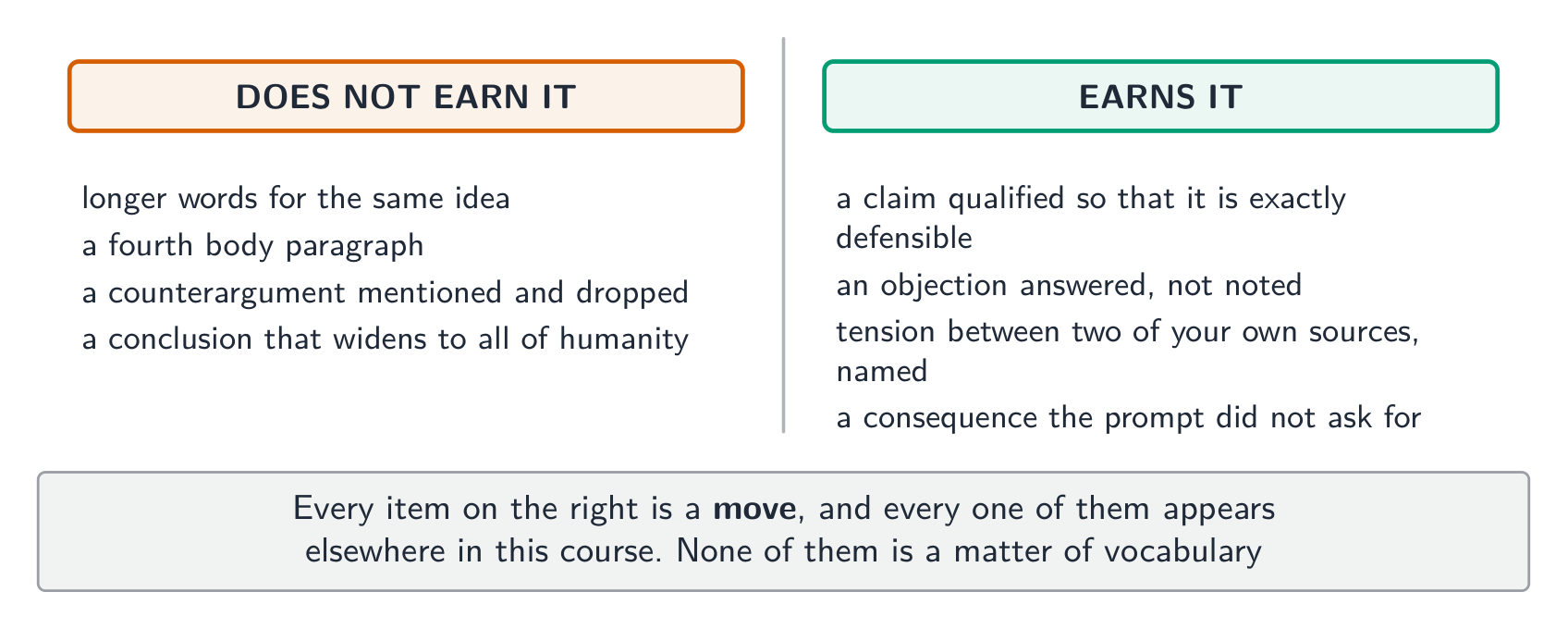
Position เป็น rhetorical choice, ไม่ใช่ template slot
Items ทั้งหมด on right เป็น moves taught elsewhere ใน course นี้
Explore · ⁨สำรวจ⁩

Sort what earns the sophistication point

It rewards a specific set of moves, all taught elsewhere in this course. None of them is a matter of vocabulary.

9.2

Exam tips · ⁨ข้อแนะนำสำหรับการสอบ⁩

English
  • Concede, rebut, refute are three different claims. Do not use the words interchangeably.
  • Refute only with evidence of error. Without it, rebut instead - an alternative interpretation is almost always available.
  • Conceding raises credibility, by the CED's own statement. It is not a weakness.
  • After conceding, come back. An unreturned concession reads as agreement with the other side.
  • Use a transition that ranks the counterargument: the strongest objection to this is beats some people say.
  • When analysing a text, notice when it addresses no counterargument. That absence tells you who it was written for.
ไทย
  • Concede, rebut, refute เป็น claims ที่แตกต่างกันสามแบบ อย่าใช้คำเหล่านี้แทนกันได้
  • Refute ด้วยหลักฐาน of error เท่านั้น โดยไม่มีมัน, use rebut แทน - alternative interpretation มักจะมีอยู่เกือบเสมอ
  • Conceding เพิ่ม credibility, ตาม statement ของ CED เอง มันไม่ใช่จุดอ่อน
  • หลัง conceding, กลับมา การ承认ที่ไม่ return อ่านเหมือน agrees withอีกฝ่าย
  • ใช้การเชื่อมโยงที่ จัดอันดับ ข้อโต้แย้ง: ข้อโต้แย้งที่แข็งแกร่งที่สุดต่อเรื่องนี้คือ ดีกว่า บางคนกล่าวว่า
  • เมื่อวิเคราะห์ข้อความ ให้สังเกตว่าเมื่อใดที่มันไม่ได้กล่าวถึง ข้อโต้แย้ง ความขาดหายไปนี้บ่งบอกถึงกลุ่มเป้าหมายที่เขียนไว้

Interactive lessons on this topic · ⁨บทเรียนเชิงโต้ตอบสำหรับหัวข้อนี้⁩

Work through it step by step, with instant-check exercises. · ⁨ทำทีละขั้นตอน พร้อมแบบฝึกหัดตรวจสอบผลทันที⁩

Past Papers · ⁨ข้อสอบย้อนหลัง⁩

More topics in AP English Language and Composition · ⁨AP ภาษาอังกฤษเพื่อการสื่อสารและการเขียน⁩ · ⁨หัวข้อเพิ่มเติมใน AP English Language and Composition · ⁨AP ภาษาอังกฤษเพื่อการสื่อสารและการเขียน⁩⁩

Log in or create account · ⁨เข้าสู่ระบบหรือสร้างบัญชี⁩

IGCSE, A-Level & AP