| Enduring Understanding | Learning Objective | Essential Knowledge |
|---|---|---|
RHS-1 | 1.A |
|
Introductions, Conclusions, and Development
AP English Language and Composition · Topic 4
 5:18
Unit 4: Introductions, Conclusions, and Development
Unit 4 covers the two positions in a text where a writer's choices are most visible — the beginning and the end. And it comes with a warning about your own…
English narration · English + 中文 subtitles burned in
4.1
Introductions and Conclusions in a Text

Syllabus
Source: College Board AP Course and Exam Description
In December 1776 the American army had lost battle after battle, and many soldiers were about to go home. Thomas Paine published a short paper, The American Crisis, which began: "These are the times that try men's souls. The summer soldier and the sunshine patriot will, in this crisis, shrink from the service of their country; but he that stands by it now, deserves the love and thanks of man and woman." On George Washington's orders it was read aloud to his soldiers. In two sentences the introduction names the moment, divides the readers into two kinds, and invites each reader to choose the better one. Openings and endings are where a writer's choices show most clearly.
Unit 4 covers the two positions in a text where a writer's choices are most visible - the beginning and the end - and completes the CED's list of methods of development.
- The introduction 引言 of an argument introduces the subject and/or the writer to the audience. It may orient the reader, establish the exigence and context, and gain attention.
- The conclusion 结论 brings the argument to a unified end. It may present the argument's thesis, explain its significance, or situate the argument in a broader context.
Note the verb in the second: unified. A conclusion is not a summary; it is the point at which the parts are shown to have been one argument.
Vocabulary
Train
| English |
|---|
| introduction/ˌɪntrəˈdʌkʃn/ |
| conclusion/kənˈkluːʒn/ |
4.2
Writing Introductions and Conclusions
Syllabus
| Enduring Understanding | Learning Objective | Essential Knowledge |
|---|---|---|
RHS-1 | 2.A |
|
Source: College Board AP Course and Exam Description
On the exam, both are worth writing well but neither is worth writing long. A useful discipline:
- An introduction that positions the subject and states a defensible thesis in two or three sentences is complete. Everything else in a timed essay is better spent on evidence and commentary.
- A conclusion that says what follows from the argument - its significance, or its wider implication 含义 - does more than one that restates 重述 the paragraphs.
The weakest conclusion is the one that re-lists what the essay already said. The reader has just read it. Say instead what it means, or what it obliges.
Worked example: two introductions. The prompt asks whether schools should ban phones during the school day.
Weak: "In today's modern society, phones are everywhere. Some people think they should be banned in schools and some people think they should not. This essay will discuss both sides."
Strong: "A phone in a pocket costs a student nothing; a phone on the desk costs every lesson a little attention. Schools should keep phones locked away during lessons but allow them at break, because the harm comes from interruption, not from the device itself."
The weak version spends three sentences saying nothing a reader could disagree with: "phones are everywhere" is not a claim, and "discuss both sides" is not a position. The strong version opens with a concrete contrast, takes a position a reasonable person could dispute, and its because clause tells the reader what the body paragraphs 主体段 will have to prove.
Two conclusions for the same essay. Weak: "In conclusion, phones should be limited in schools because they distract students, as this essay has shown." Strong: "If interruption is the problem, the same logic reaches beyond phones: laptops and smartwatches belong in the same locked box. The rule worth writing is about attention, not about one device." The strong conclusion does not repeat the essay; it says what follows from it.
Vocabulary
Train
| English |
|---|
| implication/ˌɪmplɪˈkeɪʃn/ |
| restate |
| body paragraph |
4.3
Identifying the Overarching Thesis
Syllabus
| Enduring Understanding | Learning Objective | Essential Knowledge |
|---|---|---|
CLE-1 | 3.B |
|
Source: College Board AP Course and Exam Description
The CED adds a precise refinement here: a thesis statement may preview the line of reasoning of an argument - and then, immediately, this is not to say that a thesis statement must list the reasons.
That double statement is worth holding, because both errors are common. A thesis that previews nothing leaves the essay shapeless. A thesis mechanically listing three reasons is not required and often produces a rigid essay that cannot develop.
4.4
Writing a Thesis Statement
Syllabus
| Enduring Understanding | Learning Objective | Essential Knowledge |
|---|---|---|
CLE-1 | 4.B |
|
Source: College Board AP Course and Exam Description
For your own writing, the practical version:
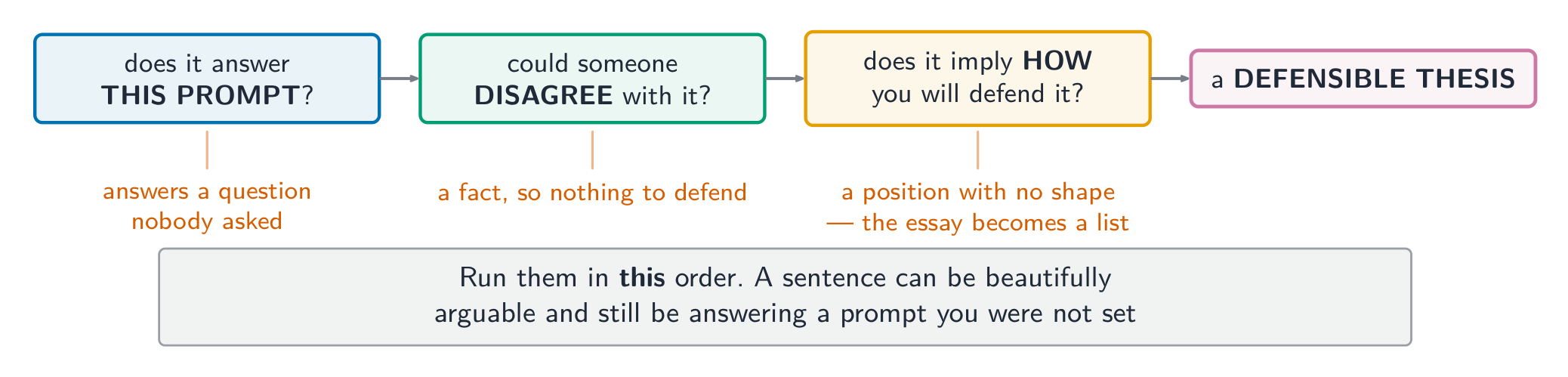
- The thesis must be defensible. Non-negotiable, and it is the whole of the thesis point.
- It may indicate the shape of the reasoning. Do it when the shape is genuinely load-bearing; do not do it as a formula.
- It should be specific enough to constrain what follows. A thesis so broad that any paragraph could belong under it is not directing the essay.
Worked example: an introduction that meets resistance first. Paine's earlier pamphlet Common Sense (January 1776) opened by admitting that its ideas were unpopular: "Perhaps the sentiments contained in the following pages, are not yet sufficiently fashionable to procure them general favour; a long habit of not thinking a thing wrong, gives it a superficial appearance of being right." Paine knew most colonists still felt loyal to the king. Instead of attacking them, the introduction explains why they feel that way (habit), so the reader can change their mind without feeling foolish.
Explore
Run the three thesis gates in order
A sentence can be beautifully arguable and still answer a prompt you were not set — which is why the order matters.
4.5
Recognizing Methods of Development
Syllabus
| Enduring Understanding | Learning Objective | Essential Knowledge |
|---|---|---|
REO-1 | 5.C |
|
Source: College Board AP Course and Exam Description
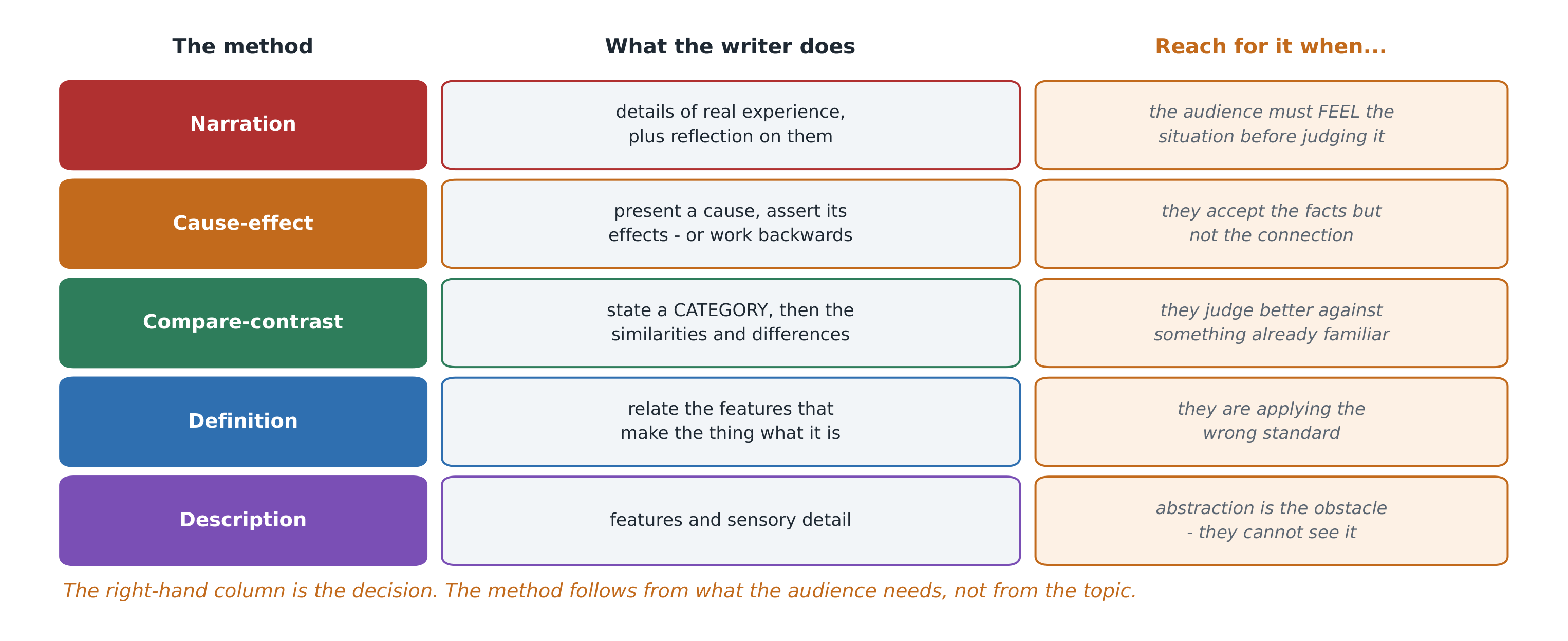
Unit 3 covered narration and cause-effect. Unit 4 adds the rest:
- Developing through comparison-contrast 比较对照: writers present a category of comparison 比较类别 and then examine similarities 相似之处 and differences within it. The category is the part students omit - a comparison without a stated basis is two descriptions side by side.
- Developing through definition 定义 or description 描写: writers relate the characteristics 特征, features, or sensory details 感官细节 of a subject.
Definition is more powerful than it looks. An argument that turns on what a word means - what counts as success, as fairness, as progress - is an argument that has moved to the ground where it can actually be won.
Vocabulary
Train
| English |
|---|
| comparison-contrast/kəmˈpærɪsn ˈkɒntræst/ |
| category of comparison |
| similarity/ˌsɪmɪˈlærɪti/ |
| definition/ˌdefɪˈnɪʃn/ |
| description/dɪˈskrɪpʃn/ |
| characteristic/ˌkærɪktəˈrɪstɪk/ |
| sensory detail |
4.6
Using Methods of Development
Syllabus
| Enduring Understanding | Learning Objective | Essential Knowledge |
|---|---|---|
REO-1 | 6.C |
|
Source: College Board AP Course and Exam Description
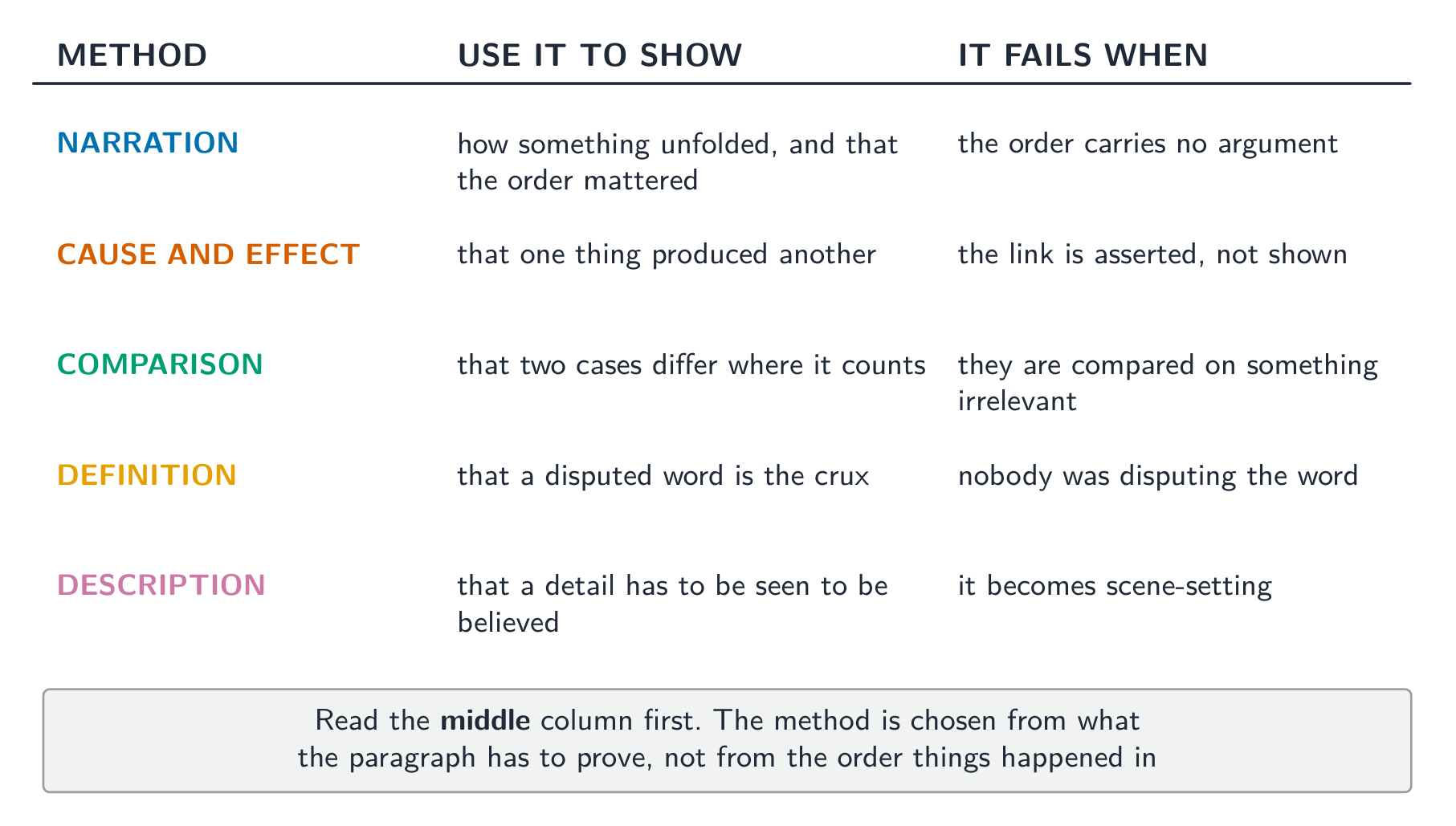
The choice is rhetorical. Ask what the audience needs before they will accept your claim:
- They need to see it, and abstraction 抽象 is the obstacle: description.
- They accept the facts but not the connection: cause-effect.
- They are applying the wrong standard 标准: definition.
- They will judge better against something familiar: comparison-contrast.
- They need to feel the situation: narration.
Worked example (a real AP exam task). A Question 3 argument prompt asks you to take a position on whether a common practice is beneficial. A student who reaches for description writes a vivid 生动的 paragraph nobody disputes. A student who reaches for definition writes: "Whether the practice is beneficial depends on what we count as benefit. If benefit means measurable short-term gain, the practice succeeds; if it means durable capability, the same evidence shows it failing." That paragraph has relocated the argument onto ground where the evidence actually decides something - which is the kind of move the sophistication point exists to reward.
Explore
Choose the method from the job
The method follows from what the paragraph has to prove, not from the order things happened in.
Vocabulary
Train
| English |
|---|
| abstraction/əbˈstrækʃn/ |
| standard/ˈstændəd/ |
| vivid |
4.6
Practice
Answer each before reading the model answers below.
- Rewrite this thesis so it is defensible: "Social media has both advantages and disadvantages."
- A writer argues that a city's "success" should be judged by how its poorest residents live, not by its average income. Which method of development is this, and why is it powerful here?
- An audience already accepts that a river is polluted but not that a factory caused it. Which method of development do they need?
- Write one sentence that could open an essay arguing that homework should be limited in primary school.
- A student's conclusion lists the three body paragraphs again. Explain what is missing.
4.6
Model answers
- For example: "Schools should teach students to use social media critically rather than ban it, because the skills transfer to every platform they will use." A defensible thesis takes a side someone could reasonably dispute.
- Definition. Changing what counts as "success" moves the argument to ground where the writer can win: on average income the city looks good, but on the new standard it does not.
- Cause-effect: they accept the facts, but not the connection.
- For example: "A seven-year-old who spends two evening hours on worksheets has learned one lesson well: that school never ends." A good opening is concrete and points toward the claim.
- It repeats instead of concluding. A conclusion should say what follows from the argument (its significance, implication or wider application); the reader has just read the paragraphs.
4.6
Exam tips
- Introductions should be short and load-bearing: position the subject, state a defensible thesis, move on.
- A conclusion that restates earns least. Say what the argument means or obliges.
- A thesis may preview the reasoning; it is not required to list reasons. Both errors are common.
- Comparison needs a stated category. Without one you have written two descriptions, not a comparison.
- Definition is the strongest move available in an argument essay whose terms are contestable 有争议的.
- Pick a method of development from what the audience needs, not from what the topic suggests.
Vocabulary card meanings
comparison-contrast: Setting two things beside each other to show likeness and difference. definition: Explaining exactly what a word or idea means. description: Showing how something looks, sounds or feels.
Vocabulary
Train
| English |
|---|
| contestable |
Interactive lessons on this topic
Work through it step by step, with instant-check exercises.