| Enduring Understanding | Learning Objective | Essential Knowledge |
|---|---|---|
CLE-1 | 3.A |
|
Line of Reasoning and Methods of Development
AP English Language and Composition · Topic 3
 5:57
Unit 3: Line of Reasoning and Methods of Development
Unit 3 is where the course stops being about parts and starts being about structure, and here is the test that tells you whether you have any. Take your essay…
English narration · English + 中文 subtitles burned in
3.1
Identifying Claims and Evidence
Syllabus
Source: College Board AP Course and Exam Description
Unit 3 is where the course stops being about parts and starts being about structure. Its subject is the line of reasoning 推理线索 - the path an argument takes from where it starts to what it proves.
First, four claims about how evidence gets into an argument properly:
- Effective use of evidence uses commentary 评述 to establish a logical relationship between the evidence and the claim.
- Writers introduce source material using commentary to integrate it into their line of reasoning - so commentary comes before as well as after.
- Synthesis 综合 requires consideration, explanation, and integration 整合 of others' arguments into one's own. That is the exact skill Question 1 tests, and the word integration rules out a paragraph that simply summarises each source in turn.
- Writers must acknowledge the words, ideas, images, and texts of others through attribution 注明出处 and citation 引用.
Vocabulary
Train
| English |
|---|
| line of reasoning/laɪn ɒv ˈriːzənɪŋ/ |
| commentary/ˈkɒməntri/ |
| synthesis/ˈsɪnθəsɪs/ |
| integration/ˌɪntɪˈɡreɪʃn/ |
| attribution/ətrɪˈbjuːʃn/ |
| citation/saɪˈteɪʃn/ |
3.2
Developing a Paragraph with Claim and Evidence

Syllabus
| Enduring Understanding | Learning Objective | Essential Knowledge |
|---|---|---|
CLE-1 | 4.A |
|
Source: College Board AP Course and Exam Description
Applied to your own writing, the change from Unit 2 is that commentary now has two jobs, not one: it introduces the evidence into the reasoning, and it explains the relationship afterwards.
A paragraph that does both reads: claim - a sentence positioning the evidence - the evidence, embedded - commentary establishing the logical relationship - the link onward. The sentence before the quotation is doing as much work as the one after it, and most students write neither.
Explore
Diagnose the evidence problem
Relevant and sufficient are two different failures with two opposite fixes.
3.3
Describing the Line of Reasoning

Syllabus
| Enduring Understanding | Learning Objective | Essential Knowledge |
|---|---|---|
REO-1 | 5.A |
|
Source: College Board AP Course and Exam Description
A line of reasoning you already know. The US Declaration of Independence (1776) is built like a proof. First come the general truths: all men are created equal, they have rights to "Life, Liberty and the pursuit of Happiness", governments exist to protect those rights, and when a government destroys them the people may change or end it. Then comes a long list of evidence, about 27 complaints against the British king, each beginning "He has ...". Last comes the conclusion: the colonies "are, and of Right ought to be Free and Independent States". Principle, evidence, conclusion: every part leads into the next, and the reader who accepts the first part is pushed towards the last.
The CED allows two arrangements, and both are valid:
- Writers may lead readers through a line of reasoning and then arrive at a thesis - the argument builds to its claim.
- Writers may express a claim and then develop a line of reasoning to justify it - the argument declares and then defends.
Whichever order is used, the same requirements hold:
- Writers explain their reasoning through commentary that connects chosen evidence to a claim.
- Commentary explains the significance 意义 and relevance 相关性 of evidence in relation to the line of reasoning.
- The sequence of paragraphs in a text reveals the argument's line of reasoning - which is the practical tool for reading. To find a writer's reasoning, write one sentence per paragraph and read the list.
- Flaws 漏洞 in a line of reasoning may render an argument specious 似是而非的 or illogical 不合逻辑的.
Vocabulary
Train
| English |
|---|
| significance/sɪɡˈnɪfɪkəns/ |
| relevance/ˈrelɪvəns/ |
| flaw |
| specious/ˈspiːʃəs/ |
| illogical |
3.4
Developing a Line of Reasoning and Commentary

Syllabus
| Enduring Understanding | Learning Objective | Essential Knowledge |
|---|---|---|
REO-1 | 6.A |
|
Source: College Board AP Course and Exam Description
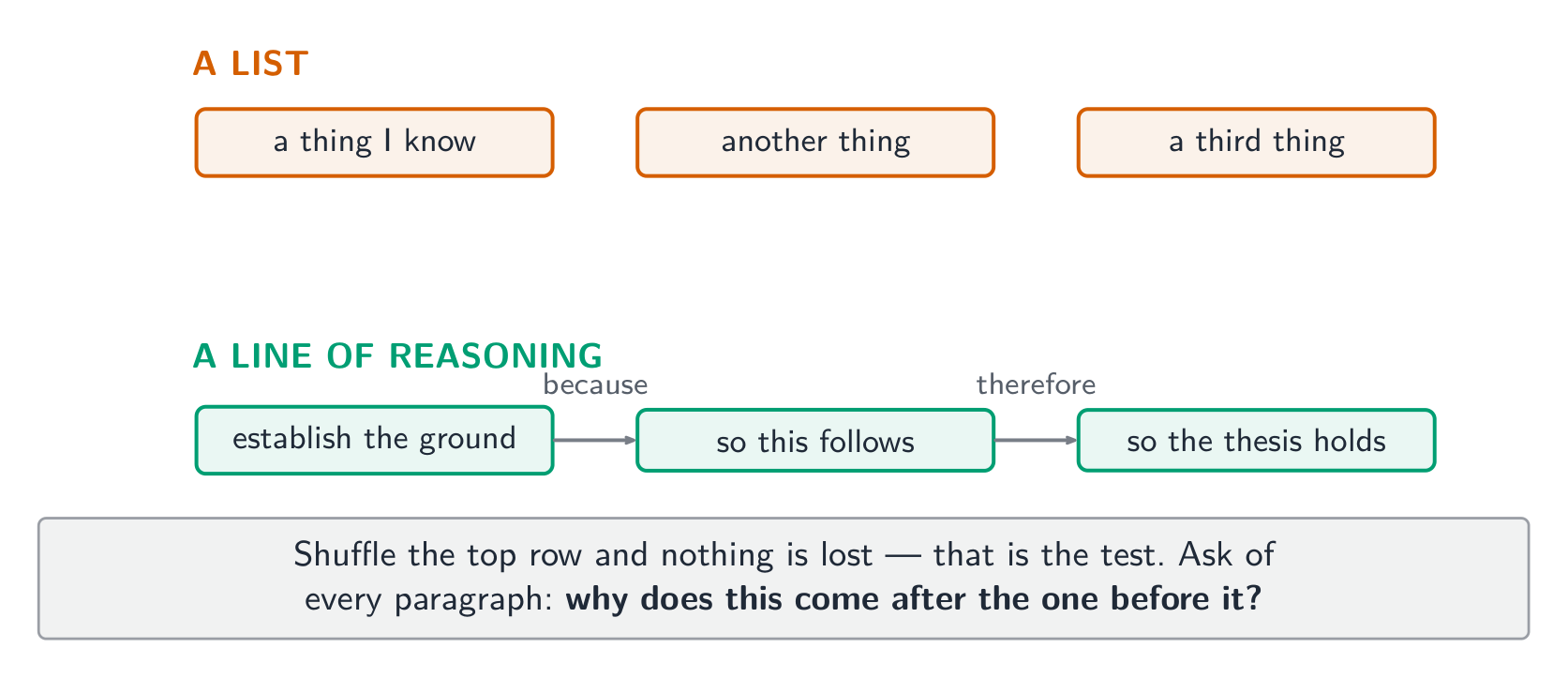
For your own essays, the useful discipline is to decide the order of your claims before writing any of them. An essay whose paragraphs could be shuffled without loss has no line of reasoning - it has a list.
Test a draft by asking of each paragraph: why does this come after the one before it? If the only answer is "it is another thing I know about the topic", the structure is a list and the reasoning point is at risk.
Explore
Climb the four rungs of commentary
'Explain your evidence' is unusable. Four questions, each answerable in a sentence, make it a procedure.
3.5
Recognizing Methods of Development
Syllabus
| Enduring Understanding | Learning Objective | Essential Knowledge |
|---|---|---|
REO-1 | 5.C |
|
Source: College Board AP Course and Exam Description
Methods of development 展开方法 are common approaches writers use to develop and organise the reasoning of an argument. The CED's list: narration, cause-effect, comparison-contrast, definition, and description. This unit treats the first two.
- Developing through narration 叙述: writers offer details about real-life experiences and reflections 反思 on them. The reflection is what makes narration an argument rather than a story - an anecdote with no reflection has supplied no reasoning.
- Developing through cause-effect 因果: writers present a cause, then assert the effects or consequences 后果 of that cause - or begin from an effect and trace it back.
Vocabulary
Train
| English |
|---|
| narration/nəˈreɪʃn/ |
| reflection/rɪˈflekʃn/ |
| cause-effect/kɔːz ɪˈfekt/ |
| consequence/ˈkɒnsɪkwəns/ |
3.6
Using Methods of Development
Syllabus
| Enduring Understanding | Learning Objective | Essential Knowledge |
|---|---|---|
REO-1 | 6.C |
|
Source: College Board AP Course and Exam Description
Choosing a method is a rhetorical decision, not a stylistic one. Narration works when the audience needs to feel the situation before they will accept a claim about it. Cause-effect works when the audience already accepts the facts but not the connection between them.
Worked example (a real AP exam task). On a Question 1 synthesis prompt, compare two paragraphs using the same two sources. The weak version: "Source A says X. Source C says Y. Both discuss the issue." That is summary 概述 in sequence - no claim, no integration, no reasoning. The strong version: "The strongest objection to the proposal is not that it fails but that it succeeds too narrowly: Source A's data show the intended outcome improving, while Source C's account of the same programme records the second-order costs that the measurement in Source A was never designed to capture." Here the sources are integrated into the writer's own claim, and the commentary establishes the logical relationship - which is what the four evidence-and-commentary points are awarded for.
Vocabulary
Train
| English |
|---|
| summary/ˈsʌməri/ |
3.6
Practice
Answer each before reading the model answers below.
- Put these in a logical line of reasoning: (a) so the ban should be partial; (b) phones distract during lessons; (c) phones help in emergencies.
- Which method of development suits proving that a new bus route caused fewer car journeys?
- Write commentary for: "Car journeys fell 15% in the year after the route opened."
- What does a "line of reasoning" mean?
- A student says: "More evidence always makes an argument stronger." Correct the student.
Vocabulary
Train
| English |
|---|
| method of development |
3.6
Model answers
- (b) then (c) then (a): state the problem, acknowledge the competing need, then reach the conclusion that balances them.
- Cause-effect: the argument must connect the route to the change, not just report the change.
- For example: "The fall began only after the route opened and was largest in the districts it serves, which points to the buses, not chance, as the cause."
- The sequence of claims that work together to defend the thesis, each building on the last.
- Evidence helps only when it is relevant and explained. Piling up unexplained examples weakens the line of reasoning, because the reader cannot see how each one supports the claim.
3.6
Exam tips
- Commentary has two jobs: introducing evidence into the reasoning, and explaining the relationship afterwards. Write both sentences.
- Synthesis means integration, not summary in sequence. A paragraph per source is the classic low-scoring shape.
- To find a writer's line of reasoning, summarise each paragraph in one sentence and read the list.
- Ask of your own paragraphs: why does this one follow that one? No answer means no line of reasoning.
- Narration needs reflection. An anecdote without it has told a story, not made an argument.
- Choose a method of development for a rhetorical reason and be able to say what it is.
Vocabulary card meanings
line of reasoning: The path of claims and support that runs through an argument. commentary: The writer's explanation of how evidence supports a claim. attribution: Naming who said or wrote something. citation: Saying exactly where a quoted idea was found. method of development: A way of building an argument, such as story, cause, or comparison. narration: Telling events in an order the reader can follow. cause-effect: Showing what led to what.
Interactive lessons on this topic
Work through it step by step, with instant-check exercises.