Skip to content · ⁨ข้ามไปยังเนื้อหา⁩

Evidence, Thesis, and Stylistic Choices · ⁨หลักฐาน Thesis และการเลือกด้านสไตล์⁩

AP English Language and Composition · ⁨AP ภาษาอังกฤษเพื่อการสื่อสารและการเขียน⁩ · Topic 6 · ⁨หัวข้อ 6⁩

Video lesson for this topic · ⁨บทเรียนวิดีโอสำหรับหัวข้อนี้⁩ Open the video page · ⁨เปิดหน้าวิดีโอ⁩
5:21

หน่วยที่ 6: หลักฐาน Thesis และตัวเลือกด้านสไตล์

หน่วยที่ 6 เป็นหน่วยสังเคราะห์ และมีข้อแตกต่างที่ชัดเจนที่สุดของหลักสูตร ทิศทางและมุมมองนั้นแตกต่างกัน แหล่งข้อมูลอาจมี...

English narration · English + 中文 subtitles burned in · ⁨การบรรยายภาษาอังกฤษ · คำบรรยายภาษาอังกฤษ + 中文 ลอยตัวบนภาพ⁩

6.1

Identifying Claims and Evidence · ⁨การระบุข้ออ้างและหลักฐาน⁩

Syllabus · ⁨หลักสูตร⁩
English

Enduring Understanding (CLE-1): Writers make claims about subjects, rely on evidence that supports the reasoning that justifies the claim, and often acknowledge or respond to other, possibly opposing, arguments.

Learning Objective 3.A: Reading – Identify and explain claims and evidence within an argument.

  • CLE-1.P When synthesizing, writers draw upon arguments from multiple sources, strategically select the most relevant information, and combine apt and specific source material as part of their own argument.
  • CLE-1.Q A source provides information for an argument, and some sources are more reliable or credible than others.
  • CLE-1.R A position and a perspective are different. Sources may have the same position on a subject, yet each comes from a different perspective based on their background, interests, and expertise.
  • CLE-1.S When incorporating evidence or sources into an argument, the strongest arguments recognize and acknowledge the biases and limitations of the material and account for those limitations in their reasoning.
  • CLE-1.T The degree to which a source does or does not consider other positions reflects the degree to which that source is biased.
ไทย

ความเข้าใจที่ยั่งยืน (CLE-1): นักเขียนทำข้ออ้างเกี่ยวกับหัวข้อ อิงกับหลักฐานที่สนับสนุนเหตุผลที่ใช้เพื่อพิสูจน์ข้ออ้าง tersebut และมักยอมรับหรือตอบโต้ข้อโต้แย้งอื่น ๆ ซึ่งอาจเป็นฝ่ายตรงข้าม

เป้าหมายการเรียนรู้ 3.A: การอ่าน – ระบุและอธิบายข้ออ้างและหลักฐานภายในข้อโต้แย้ง

  • CLE-1.P เมื่อสังเคราะห์ ผู้เขียนจะอ้างอิงจากข้อโต้แย้งจากแหล่งข้อมูลหลายแห่ง เลือกข้อมูลที่เกี่ยวข้องที่สุดอย่างมีกลยุทธ์ และรวมวัสดุจากแหล่งข้อมูลที่เหมาะสมและเฉพาะเจาะจงเข้าเป็นส่วนหนึ่งของข้อโต้แย้งของตนเอง
  • CLE-1.Q แหล่งข้อมูลให้ข้อมูลสำหรับข้อโต้แย้ง และบางแหล่งมีความน่าเชื่อถือมากกว่าแหล่งอื่น
  • CLE-1.R ตำแหน่งและมุมมองแตกต่างกัน แหล่งข้อมูลอาจมีตำแหน่งเดียวกันในประเด็นหนึ่ง แต่แต่ละแหล่งมาจากมุมมองที่แตกต่างกันโดยอิงตามพื้นฐาน ความสนใจ และความเชี่ยวชาญของตน
  • CLE-1.S เมื่อนำหลักฐานหรือแหล่งข้อมูลมาใช้ในข้อโต้แย้ง ข้อโต้แย้งที่แข็งแกร่งที่สุดจะตระหนักถึงและยอมรับความลำเอียงและข้อจำกัดของวัสดุนั้นๆ และคำนึงถึงข้อจำกัดเหล่านั้นในการใช้เหตุผล
  • CLE-1.T ระดับที่แหล่งข้อมูลพิจารณาหรือไม่พิจารณามุมมองอื่นๆ สะท้อนถึงระดับของความลำเอียงของแหล่งข้อมูลนั้น
Source: College Board AP Course and Exam Description · ⁨แหล่งที่มา: คำอธิบายหลักสูตรและข้อสอบ College Board AP⁩

English

Unit 6 is the synthesis unit, and it contains the single sharpest distinction in the course.

  • When synthesising, writers draw on arguments from multiple sources, strategically select the most relevant information, and integrate it into their own argument.
  • A source provides information for an argument, and some sources are more reliable or credible than others.
  • A position and a perspective are different. Sources may hold the same position on a subject and yet each come from a different perspective.
  • The strongest arguments recognise and acknowledge the other positions that exist.
  • The degree to which a source considers other positions reflects the degree to which that source is credible - a test you can apply to any source on the exam.
ไทย

หน่วยที่ 6 เป็นหน่วยการสังเคราะห์ และมีข้อแตกต่างที่คมชัดที่สุดในหลักสูตร

  • เมื่อ สังเคราะห์, นักเขียน ดึง arguments จากแหล่งข้อมูลหลายแหล่ง, เลือกข้อมูลที่เกี่ยวข้องมากที่สุดอย่างมีกลยุทธ์ และบูรณาการมันเข้าไปใน论点ของตนเอง
  • แหล่งข้อมูล ให้ข้อมูล สำหรับข้อโต้แย้ง และ บางแหล่งเชื่อถือได้หรือมีความน่าเชื่อถือสูงกว่าแหล่งอื่น
  • ตำแหน่งและมุมมองแตกต่างกัน แหล่งข้อมูลอาจมี ตำแหน่งเดียวกัน ต่อเรื่องหนึ่งแต่ยังคงมาจาก มุมมองที่แตกต่างกัน
  • Arguments ที่แข็งแกร่งที่สุด ตระหนักและยอมรับตำแหน่งอื่น ๆ ที่มีอยู่
  • ระดับที่แหล่งข้อมูลพิจารณาตำแหน่งอื่น ๆ สะท้อนถึงระดับที่แหล่งข้อมูลนั้นเชื่อถือได้ - ซึ่งเป็นทดสอบที่คุณสามารถนำไปใช้กับแหล่งข้อมูลใด ๆ ในข้อสอบ
ความแตกต่างที่คำถามสังเคราะห์สร้างขึ้น
สองแหล่งข้อมูลอาจเห็นด้วยกันและยังทำงาน完全不同的 dalam论点ของคุณ
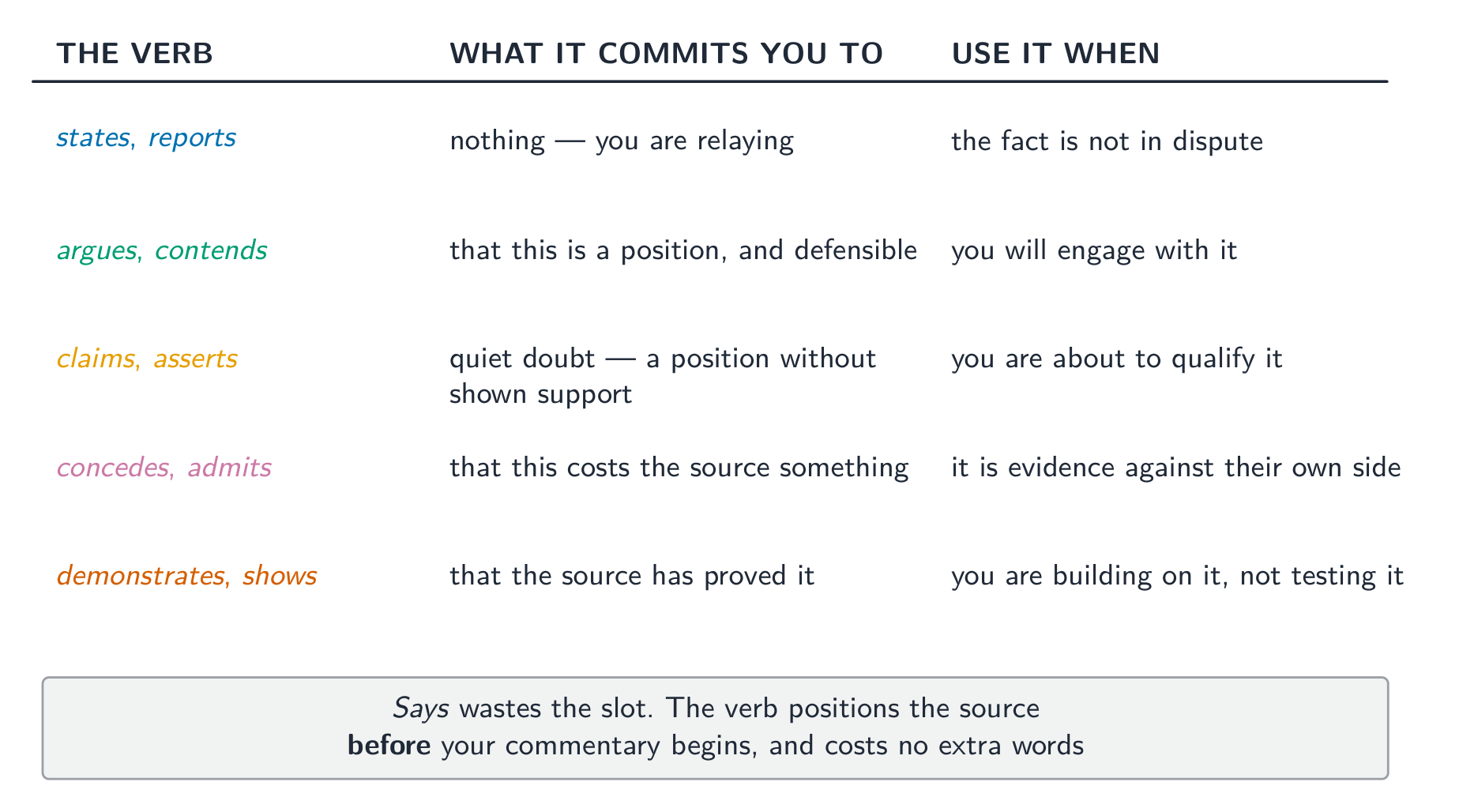
กริยาจัดตำแหน่งแหล่งข้อมูลไว้ก่อนการแสดงความคิดเห็นของคุณเริ่มต้น
Explore · ⁨สำรวจ⁩

Choose the attribution verb that positions the source · ⁨เลือกกริยาที่อ้างอิงเพื่อวางตำแหน่งแหล่งข้อมูล⁩

The verb commits you to something about the source's status, before your commentary starts, and costs no extra words. · ⁨กริยานี้ผูกมัดคุณเกี่ยวกับสถานะของแหล่งข้อมูล ก่อนความคิดเห็นของคุณเริ่มต้น และไม่เสียคำเพิ่ม⁩

6.2

Developing a Paragraph with Claim and Evidence · ⁨การพัฒนาย่อหน้าด้วยข้ออ้างและหลักฐาน⁩

Syllabus · ⁨หลักสูตร⁩
English

Enduring Understanding (CLE-1): Writers make claims about subjects, rely on evidence that supports the reasoning that justifies the claim, and often acknowledge or respond to other, possibly opposing, arguments.

Learning Objective 4.A: Writing – Develop a paragraph that includes a claim and evidence supporting the claim.

  • CLE-1.P When synthesizing, writers draw upon arguments from multiple sources, strategically select the most relevant information, and combine apt and specific source material as part of their own argument.
  • CLE-1.Q A source provides information for an argument, and some sources are more reliable or credible than others.
  • CLE-1.R A position and a perspective are different. Sources may have the same position on a subject, yet each comes from a different perspective based on their background, interests, and expertise.
  • CLE-1.S When incorporating evidence or sources into an argument, the strongest arguments recognize and acknowledge the biases and limitations of the material and account for those limitations in their reasoning.
  • CLE-1.T The degree to which a source does or does not consider other positions reflects the degree to which that source is biased.
ไทย

ความเข้าใจที่ยั่งยืน (CLE-1): นักเขียนทำข้ออ้างเกี่ยวกับหัวข้อ อิงกับหลักฐานที่สนับสนุนเหตุผลที่ใช้เพื่อพิสูจน์ข้ออ้าง tersebut และมักยอมรับหรือตอบโต้ข้อโต้แย้งอื่น ๆ ซึ่งอาจเป็นฝ่ายตรงข้าม

เป้าหมายการเรียนรู้ 4.A: การเขียน – พัฒนาย่อหน้าที่ประกอบด้วยข้ออ้างและหลักฐานที่สนับสนุนข้ออ้างนั้น

  • CLE-1.P เมื่อสังเคราะห์ ผู้เขียนจะอ้างอิงจากข้อโต้แย้งจากแหล่งข้อมูลหลายแห่ง เลือกข้อมูลที่เกี่ยวข้องที่สุดอย่างมีกลยุทธ์ และรวมวัสดุจากแหล่งข้อมูลที่เหมาะสมและเฉพาะเจาะจงเข้าเป็นส่วนหนึ่งของข้อโต้แย้งของตนเอง
  • CLE-1.Q แหล่งข้อมูลให้ข้อมูลสำหรับข้อโต้แย้ง และบางแหล่งมีความน่าเชื่อถือมากกว่าแหล่งอื่น
  • CLE-1.R ตำแหน่งและมุมมองแตกต่างกัน แหล่งข้อมูลอาจมีตำแหน่งเดียวกันในประเด็นหนึ่ง แต่แต่ละแหล่งมาจากมุมมองที่แตกต่างกันโดยอิงตามพื้นฐาน ความสนใจ และความเชี่ยวชาญของตน
  • CLE-1.S เมื่อนำหลักฐานหรือแหล่งข้อมูลมาใช้ในข้อโต้แย้ง ข้อโต้แย้งที่แข็งแกร่งที่สุดจะตระหนักถึงและยอมรับความลำเอียงและข้อจำกัดของวัสดุนั้นๆ และคำนึงถึงข้อจำกัดเหล่านั้นในการใช้เหตุผล
  • CLE-1.T ระดับที่แหล่งข้อมูลพิจารณาหรือไม่พิจารณามุมมองอื่นๆ สะท้อนถึงระดับของความลำเอียงของแหล่งข้อมูลนั้น

Source: College Board AP Course and Exam Description · ⁨แหล่งที่มา: คำอธิบายหลักสูตรและข้อสอบ College Board AP⁩

English

The position-and-perspective distinction is what makes synthesis possible. If you sort the sources only by position, you get two piles - for and against - and a paragraph per pile. If you sort them by perspective, you can say things like:

Both the economist and the teacher support the measure, but they support it for reasons that do not survive together: one values the measurable gain, the other the change in what students attempt.

That sentence is synthesis. It uses two sources, is grounded in what each actually says, and produces a claim neither source makes.

Also examinable: use the credibility test. A source that never acknowledges any other position is, by the CED's own standard, less credible - and saying so about a source is legitimate evidence in your essay.

ไทย

ความแตกต่างระหว่างตำแหน่งและมุมมองคือสิ่งที่ทำให้การสังเคราะห์เป็นไปได้ หากคุณเรียงแหล่งข้อมูลโดยตำแหน่งเท่านั้น คุณจะได้สองกอง - สำหรับและต่อต้าน - และย่อหน้าต่อกอง หากคุณเรียงตาม มุมมอง คุณสามารถพูดสิ่งต่าง ๆ ได้เช่น:

ทั้งเศรษฐศาสตร์และครูสนับสนุนมาตรการนี้ แต่พวกเขาสบับสนุน它以不同的理由: คนหนึ่งให้ความสำคัญกับการเพิ่มขึ้นที่วัดได้ อีกคนให้ความสำคัญกับการเปลี่ยนแปลงในสิ่งที่นักเรียนพยายามทำ

ประโยคนี้คือการสังเคราะห์ มันใช้แหล่งข้อมูลสองแหล่ง มีรากฐานในสิ่งที่แต่ละแหล่งพูดจริง และสร้างข้ออ้างที่แหล่งข้อมูลใดไม่กล่าวถึง

สิ่งที่ข้อสอบประเมินได้เพิ่มเติม: ใช้การทดสอบความน่าเชื่อถือ แหล่งข้อมูลที่ไม่เคยยอมรับตำแหน่งอื่นเลย ตามมาตรฐานของ CED เอง มีความน่า信ห menos - และการกล่าวถึงสิ่งนี้เกี่ยวกับแหล่งข้อมูลเป็นหลักฐานที่ถูกต้องในบทความของคุณ

สามขั้นตอนเปลี่ยนแหล่งข้อมูลให้เป็นหลักฐาน - ขั้นตอนที่สามคือจุดที่การสังเคราะห์เกิดขึ้น
Explore · ⁨สำรวจ⁩

Turn a source into evidence in three moves · ⁨แปลง Source เป็นหลักฐานในสามขั้นตอน⁩

A synthesis essay is not a tour of the sources. The third move is where the synthesis happens, and it is the one most often missing. · ⁨บทเรียงความสังเคราะห์ไม่ใช่การนำเที่ยวแหล่งข้อมูล การเคลื่อนไหวที่สามคือจุดที่สังเคราะห์เกิดขึ้น และนี่คือส่วนที่ขาดหายมากที่สุด⁩

6.3

Identifying the Overarching Thesis · ⁨การระบุข้อโต้แย้งหลัก⁩

Syllabus · ⁨หลักสูตร⁩
English

Enduring Understanding (CLE-1): Writers make claims about subjects, rely on evidence that supports the reasoning that justifies the claim, and often acknowledge or respond to other, possibly opposing, arguments.

Learning Objective 3.B: Reading – Identify and describe the overarching thesis of an argument, and any indication it provides of the argument’s structure.

  • CLE-1.U Consideration and use of new evidence may require revision of the thesis statement and/or changes to the line of reasoning.
ไทย

ความเข้าใจที่ยั่งยืน (CLE-1): นักเขียนทำข้ออ้างเกี่ยวกับหัวข้อ อิงกับหลักฐานที่สนับสนุนเหตุผลที่ใช้เพื่อพิสูจน์ข้ออ้าง tersebut และมักยอมรับหรือตอบโต้ข้อโต้แย้งอื่น ๆ ซึ่งอาจเป็นฝ่ายตรงข้าม

เป้าหมายการเรียนรู้ 3.B: การอ่าน – ระบุและอธิบาย论点หลักของข้อโต้แย้ง และบ่งชี้โครงสร้างของข้อโต้แย้งใดๆ ที่论点หลักนั้นให้ไว้

  • CLE-1.U การพิจารณาและการใช้หลักฐานใหม่อาจต้องมีการปรับปรุงประโยคบทสรุปหลักและ/หรือการเปลี่ยนแปลงเส้นทางการใช้เหตุผล

Source: College Board AP Course and Exam Description · ⁨แหล่งที่มา: คำอธิบายหลักสูตรและข้อสอบ College Board AP⁩

English

A short but load-bearing point: consideration and use of new evidence may require revision of the thesis statement and/or changes to the line of reasoning.

Reading a text, this means a writer's thesis may be responsive - shaped by the evidence rather than imposed on it. Look for where an argument turns.

ไทย

จุดสั้นแต่สำคัญ: การพิจารณาและการใช้หลักฐานใหม่อาจต้องมีการทบทวน statement thesis และ/หรือการเปลี่ยนแปลงในเส้นทางการคิด

ในการอ่านข้อความ สิ่งนี้หมายความว่า论点ของนักเขียนอาจเป็น responsive - ถูก shaped โดยหลักฐานแทนที่จะถูก imposed ลงบนมัน มองหาจุดที่argument เปลี่ยนแปลง

6.4

Writing a Thesis Statement · ⁨การเขียนประโยคข้อโต้แย้ง⁩

Syllabus · ⁨หลักสูตร⁩
English

Enduring Understanding (CLE-1): Writers make claims about subjects, rely on evidence that supports the reasoning that justifies the claim, and often acknowledge or respond to other, possibly opposing, arguments.

Learning Objective 4.B: Writing – Write a thesis statement that requires proof or defense and that may preview the structure of the argument.

  • CLE-1.U Consideration and use of new evidence may require revision of the thesis statement and/or changes to the line of reasoning.
ไทย

ความเข้าใจที่ยั่งยืน (CLE-1): นักเขียนทำข้ออ้างเกี่ยวกับหัวข้อ อิงกับหลักฐานที่สนับสนุนเหตุผลที่ใช้เพื่อพิสูจน์ข้ออ้าง tersebut และมักยอมรับหรือตอบโต้ข้อโต้แย้งอื่น ๆ ซึ่งอาจเป็นฝ่ายตรงข้าม

เป้าหมายการเรียนรู้ 4.B: การเขียน – เขียน论点 statement ที่ต้องการการพิสูจน์หรือปกป้อง และอาจแนะนำโครงสร้างของข้อโต้แย้ง

  • CLE-1.U การพิจารณาและการใช้หลักฐานใหม่อาจต้องมีการปรับปรุงประโยคบทสรุปหลักและ/หรือการเปลี่ยนแปลงเส้นทางการใช้เหตุผล

Source: College Board AP Course and Exam Description · ⁨แหล่งที่มา: คำอธิบายหลักสูตรและข้อสอบ College Board AP⁩

English

Writing under time pressure, this is permission you should use. If, while drafting, you find the evidence does not support the thesis you began with, change the thesis, not the evidence. Examiners reward an argument that fits its evidence; there are no marks for having predicted your own conclusion.

In practice, spend the first minutes reading sources and sketching claims before fixing the thesis. A thesis written after the evidence is nearly always better than one written before it.

ไทย

ในการเขียนภายใต้แรงกดดันด้านเวลา สิ่งนี้คืออนุญาตที่คุณควรใช้ หากคุณ mientras draft พบว่าหลักฐานไม่ supporting论点ที่คุณเริ่มต้นด้วย เปลี่ยน论点, ไม่ใช่หลักฐาน ผู้สอบจะให้คะแนน Argument ที่ fits กับหลักฐาน; ไม่มีคะแนนสำหรับการ predicted ข้อสรุปของคุณเอง

ในทางปฏิบัติ ใช้ช่วงเวลาแรกในการอ่านแหล่งข้อมูลและร่าง claims ก่อน will fixing论点论点ที่เขียนหลังหลักฐานมักดีกว่า论点ที่เขียนก่อนหลักฐานเสมอ

6.5

Word Choice, Comparisons, and Syntax

Syllabus · ⁨หลักสูตร⁩
English

Enduring Understanding (STL-1): The rhetorical situation informs the strategic stylistic choices that writers make.

Learning Objective 7.A: Reading – Explain how word choice, comparisons, and syntax contribute to the specific tone or style of a text.

  • STL-1.D A writer’s tone is the writer’s attitude or feeling about a subject, conveyed through word choice and writing style.
  • STL-1.E Readers infer a writer’s tone from the writer’s word choice, and especially the positive, negative, or other connotations of those words.
  • STL-1.F A writer’s shifts in tone from one part of a text to another may suggest the writer’s qualification, refinement, or reconsideration of their perspective on a subject.
ไทย

ความเข้าใจที่ยั่งยืน (STL-1): สถานการณ์ทาง retorics informing การเลือก stylistic แบบกลยุทธ์ที่นักเขียนทำ

วัตถุประสงค์การเรียนรู้ 7.A: การอ่าน – อธิบายว่าการเลือกคำ, การเปรียบเทียบ, และไวยากรณ์มีผลต่อ tone หรือ style เฉพาะของข้อความอย่างไร

  • STL-1.D อารมณ์ของผู้เขียนคือทัศนคติหรือความรู้สึกของผู้เขียนต่อเรื่องหนึ่ง ซึ่งสื่อผ่านการใช้คำและสไตล์การเขียน
  • STL-1.E ผู้อ่านอนุมานอารมณ์ของผู้เขียนจากการใช้คำของผู้เขียน โดยเฉพาะนัยเชิงบวก นัยเชิงลบ หรือนัยอื่นๆ ของคำเหล่านั้น
  • STL-1.F การเปลี่ยนอารมณ์ของผู้เขียนจากส่วนหนึ่งของข้อความไปยังอีกส่วนหนึ่งอาจบ่งบอกถึงการปรับลด การปรับปรุง หรือการทบทวนมุมมองของผู้เขียนเกี่ยวกับเรื่องหนึ่ง

Source: College Board AP Course and Exam Description · ⁨แหล่งที่มา: คำอธิบายหลักสูตรและข้อสอบ College Board AP⁩

English
  • A writer's tone 语调 is the writer's attitude or feeling about a subject, conveyed through word choice and writing style.
  • Readers infer tone from word choice - especially from the positive, negative, or otherwise charged associations of the words chosen.
  • A writer's shifts in tone 语调转变 from one part of a text to another may suggest qualification, refinement, or a change in perspective.

The third is the analytical gold. A tone shift is a visible event in a text: something changed at that point, and explaining what the writer wanted the reader to do differently after it is exactly the kind of answer that scores.

ไทย
  • tone ของนักเขียน 语调是作者对主题的态度或感受, 通过词选择和写作风格传达。
  • ผู้ đọc infer tone จากคำเลือก - โดยเฉพาะจาก positive, negative, หรือ otherwise charged associations ของคำที่เลือก
  • shifts in tone ของนักwriter 语调转变 from one part of a text to another อาจsuggest qualification, refinement, หรือa change in perspective

ข้อที่สามคือทองคำแห่งการวิเคราะห์ Tone shift เป็นเหตุการณ์ที่มองเห็นได้ในข้อความ: บางสิ่งเปลี่ยนไปที่จุดนั้น และการอธิบายว่านักwriter ต้องการให้ผู้读做什么 differently afterwards คือ exactly the kind of answer that scores

Same denotation, five judgements - which word was chosen is the analysis
Vocabulary · ⁨คำศัพท์⁩ Train · ⁨ฝึกฝน⁩
English ไทย
tone/təʊn/ น้ำเสียง
shifts in tone/ʃɪfts ɪn təʊn/ การเปลี่ยนแปลงโทนเสียง
6.6

Using Words and Syntax for Tone and Style · ⁨การใช้คำและไวยากรณ์เพื่อสร้างอารมณ์และสไตล์⁩

Syllabus · ⁨หลักสูตร⁩
English

Enduring Understanding (STL-1): The rhetorical situation informs the strategic stylistic choices that writers make.

Learning Objective 8.A: Writing – Strategically use words, comparisons, and syntax to convey a specific tone or style in an argument.

  • STL-1.D A writer’s tone is the writer’s attitude or feeling about a subject, conveyed through word choice and writing style.
  • STL-1.E Readers infer a writer’s tone from the writer’s word choice, and especially the positive, negative, or other connotations of those words.
  • STL-1.F A writer’s shifts in tone from one part of a text to another may suggest the writer’s qualification, refinement, or reconsideration of their perspective on a subject.
ไทย

ความเข้าใจที่ยั่งยืน (STL-1): สถานการณ์ทาง retorics informing การเลือก stylistic แบบกลยุทธ์ที่นักเขียนทำ

จุดประสงค์การเรียนรู้ 8.A: การเขียน – ใช้คำ เปรียบเทียบ และโครงสร้างประโยคอย่างมีกลยุทธ์เพื่อบอกอารมณ์หรือสไตล์เฉพาะในบทวิพากษ์วิจารณ์

  • STL-1.D อารมณ์ของผู้เขียนคือทัศนคติหรือความรู้สึกของผู้เขียนต่อเรื่องหนึ่ง ซึ่งสื่อผ่านการใช้คำและสไตล์การเขียน
  • STL-1.E ผู้อ่านอนุมานอารมณ์ของผู้เขียนจากการใช้คำของผู้เขียน โดยเฉพาะนัยเชิงบวก นัยเชิงลบ หรือนัยอื่นๆ ของคำเหล่านั้น
  • STL-1.F การเปลี่ยนอารมณ์ของผู้เขียนจากส่วนหนึ่งของข้อความไปยังอีกส่วนหนึ่งอาจบ่งบอกถึงการปรับลด การปรับปรุง หรือการทบทวนมุมมองของผู้เขียนเกี่ยวกับเรื่องหนึ่ง

Source: College Board AP Course and Exam Description · ⁨แหล่งที่มา: คำอธิบายหลักสูตรและข้อสอบ College Board AP⁩

English

In your own writing, tone should be consistent and controlled, and deliberately shifted only where the argument turns - for example when moving from stating your position to conceding part of an opposing one.

Worked example (a real AP exam task). On a synthesis prompt, compare two uses of the same two sources. Weak: "Source B agrees with Source D that the policy should continue." That is position-sorting, and it produces nothing. Strong: "Sources B and D both defend the policy, but B defends it as an administrator measuring compliance while D defends it as a participant describing what it made possible - so the agreement is thinner than it appears, and the case rests on whether we are measuring the policy's operation or its effect." Same two sources, but the perspectives are doing the work, and the claim belongs to the writer.

ไทย

ในการเขียนของคุณเอง, tone ควร consistent and controlled, และ deliberately shifted เฉพาะเมื่อargument เปลี่ยนแปลง - เช่นเมื่อ moving from stating your position to conceding part of an opposing one

ตัวอย่างการวิเคราะห์ (โจทย์จริงจากข้อสอบ AP). ในโจทย์สังเคราะห์ ให้เปรียบเทียบการใช้แหล่งข้อมูลสองชุดเดียวกันในสองบริบท: แบบอ่อน: “แหล่ง B ยอมรับกับแหล่ง D ว่านโยบายควรดำเนินต่อไป” นี่คือการจัดเรียงตามตำแหน่ง ซึ่งไม่สร้างข้อโต้แย้งใดๆ แบบแข็ง: “แหล่ง B และ D ทั้งคู่สนับสนุนนโยบาย แต่ B สนับสนุนในฐานะผู้บริหารที่วัดความสอดคล้อง ในขณะที่ D สนับสนุนในฐานะผู้มีส่วนร่วมที่อธิบายว่านโยบายนี้เปิดทางให้อะไรได้ — ดังนั้นความเห็นตรงกันจึงบางกว่าที่เห็นชัดเจน และประเด็นขึ้นอยู่กับว่าเรากำลังวัดการดำเนินงานของนโยบายหรือผลกระทบของมัน” ใช้แหล่งข้อมูลเดิมสองชุดแต่ มุมมอง ที่ทำหน้าที่หลัก และข้ออ้างเป็นของผู้เขียน

6.6

Exam tips · ⁨ข้อแนะนำสำหรับการสอบ⁩

English
  • Position and perspective are different. This one distinction lifts most synthesis essays out of the middle band.
  • Sort sources by perspective, not by side. Sorting by side produces a paragraph per pile and no argument.
  • Use the CED's credibility test: a source that ignores all other positions is weaker, and you may say so.
  • If the evidence does not fit the thesis, change the thesis. There are no marks for consistency with your first idea.
  • A tone shift is a visible event. Say what changed and what the reader was meant to do after it.
  • Keep your own tone controlled. Shift it only where the argument genuinely turns.
ไทย
  • ตำแหน่งและมุมมองต่างกัน ความแตกต่างเพียงอย่างเดียวนี้ยกessayสังเคราะห์ส่วนใหญ่ออกจากกลุ่มกลาง
  • จัดแหล่งข้อมูลตาม มุมมอง ไม่ใช่ตามฝ่าย การจัดตามฝ่ายจะทำให้เกิดย่อหน้าต่อกองข้อมูลโดยไม่มีการArgument
  • ใช้ การทดสอบความน่าเชื่อถือ ของ CED: แหล่งข้อมูลที่เพิกเฉยต่อทุกมุมมองอื่นจะอ่อนแอกว่า และคุณสามารถระบุสิ่งนี้ได้
  • หากหลักฐานไม่ตรงกับ论点 เปลี่ยน论点 ไม่มีคะแนนสำหรับการยึดติดกับไอเดียแรกของคุณ
  • การเปลี่ยนแปลงน้ำเสียง เป็นเหตุการณ์ที่สังเกตได้ บอกว่าอะไรเปลี่ยนไปและผู้อ่านควรทำอะไรหลังจากนั้น
  • รักษาน้ำเสียงของคุณให้ควบคุมอยู่ เปลี่ยนเฉพาะเมื่อ Argument REALLY เปลี่ยนแปลง

Interactive lessons on this topic · ⁨บทเรียนเชิงโต้ตอบสำหรับหัวข้อนี้⁩

Work through it step by step, with instant-check exercises. · ⁨ทำทีละขั้นตอน พร้อมแบบฝึกหัดตรวจสอบผลทันที⁩

Past Papers · ⁨ข้อสอบย้อนหลัง⁩

More topics in AP English Language and Composition · ⁨AP ภาษาอังกฤษเพื่อการสื่อสารและการเขียน⁩ · ⁨หัวข้อเพิ่มเติมใน AP English Language and Composition · ⁨AP ภาษาอังกฤษเพื่อการสื่อสารและการเขียน⁩⁩

Log in or create account · ⁨เข้าสู่ระบบหรือสร้างบัญชี⁩

IGCSE, A-Level & AP