Skip to content · ⁨ข้ามไปยังเนื้อหา⁩

Analytical Applications of Differentiation · ⁨การใช้งานเชิงวิเคราะห์ของดิฟเฟอเรนเชียชัน⁩

AP Calculus BC · Topic 5 · ⁨หัวข้อ 5⁩

Video lesson for this topic · ⁨บทเรียนวิดีโอสำหรับหัวข้อนี้⁩ Open the video page · ⁨เปิดหน้าวิดีโอ⁩
9:33

โดยใช้ทฤษฎีบทค่ากลาง

คุณขับรถ 200 กิโลเมตร在规定时间内สอง ชั่วโมง ความเร็วเฉลี่ยของคุณคือ 100 กิโลเมตรต่อชั่วโมง ตอนนี้มีข้ออ้างว่า ในช่วงเวลาใดเวลาหนึ่งของการขับขี่นั้น…

English narration · English + 中文 subtitles burned in · ⁨การบรรยายภาษาอังกฤษ · คำบรรยายภาษาอังกฤษ + 中文 ลอยตัวบนภาพ⁩

5.1

Using the Mean Value Theorem · ⁨การใช้ทฤษฎีบทค่าเฉลี่ย⁩

Syllabus · ⁨หลักสูตร⁩
English

Enduring Understanding (FUN-1): Existence theorems allow us to draw conclusions about a function's behavior on an interval without precisely locating that behavior.

Learning Objective FUN-1.B: Justify conclusions about functions by applying the Mean Value Theorem over an interval.

  • FUN-1.B.1 If a function $f$ is continuous over the interval $[a, b]$ and differentiable over the interval $(a, b)$, then the Mean Value Theorem guarantees a point within that open interval where the instantaneous rate of change equals the average rate of change over the interval.
ไทย

ความเข้าใจที่ยั่งยืน (FUN-1): ทฤษฎีบทการมีอยู่ช่วยให้เราสรุปพฤติกรรมของฟังก์ชันบนช่วงหนึ่งโดยไม่ต้องระบุตำแหน่งพฤติกรรมนั้นอย่างแม่นยำ

วัตถุประสงค์การเรียนรู้ FUN-1.B: อธิบายเหตุผลเกี่ยวกับพฤติกรรมของฟังก์ชันโดยใช้ทฤษฎีบทค่าเฉลี่ยในช่วงหนึ่ง

  • FUN-1.B.1 หากฟังก์ชัน $f$ ต่อเนื่องบนช่วง $[a, b]$ และมีความต่อเนื่องเชิงอนุพันธ์บนช่วง $(a, b)$ แล้ว ทฤษฎีบทค่าเฉลี่ยจะรับประกันว่ามีจุดหนึ่งในช่วงเปิดนั้นซึ่งอัตราการเปลี่ยนแปลงทันทีเท่ากับอัตราการเปลี่ยนแปลงเฉลี่ยตลอดช่วงนั้น

Source: College Board AP Course and Exam Description · ⁨แหล่งที่มา: คำอธิบายหลักสูตรและข้อสอบ College Board AP⁩

English
The Mean Value Theorem

The Mean Value Theorem 中值定理 (MVT) links the average rate of change to an instantaneous one:

If $f$ is continuous on $[a,b]$ and differentiable on $(a,b)$, then there is at least one point $c$ in $(a,b)$ where

$$f'(c) = \frac{f(b)-f(a)}{b-a}.$$

In words: somewhere inside the interval, the instantaneous rate equals the average rate. Geometrically, some tangent line is parallel to the line joining the endpoints.

Exam skill. Like the IVT, the MVT is an existence theorem, and questions ask you to justify. Full credit needs: (1) state $f$ is continuous on $[a,b]$ and differentiable on $(a,b)$; (2) compute the average rate $\frac{f(b)-f(a)}{b-a}$; (3) conclude "by the MVT there is a $c$ in $(a,b)$ with $f'(c)$ equal to that value." Both hypotheses must be named.

Worked example. For $f(x)=x^2$ on $[1,3]$ the average rate is $\dfrac{9-1}{2}=4$; setting $f'(c)=2c=4$ gives $c=2$, which lies in $(1,3)$ – the guaranteed point.

ไทย
ทฤษฎีบทค่ากลาง

ทฤษฎีบทค่ากลาง (MVT) เชื่อมโยงอัตราการเปลี่ยนแปลงเฉลี่ยกับอัตราทันที:

ถ้า $f$ ต่อเนื่อง บน $[a,b]$ และ หาอนุพันธ์ได้ บน $(a,b)$,则有至少一个点 $c$ ใน $(a,b)$ ที่

$$f'(c) = \frac{f(b)-f(a)}{b-a}.$$

พูดเป็นภาษา: ที่某個位置ภายในช่วง, อัตราทันทีเท่ากับอัตราเฉลี่ย ในเชิงเรขาคณิต, เส้นสัมผัส某一条 مواบกับเส้นที่เชื่อมปลายช่วง

ทฤษฎีบทค่ากลาง: เส้นสัมผัส某一条 مواบกับเส้นตัดในช่วง

ทักษะการสอบ. เหมือน IVT, MVT เป็นทฤษฎีบท关于 existence, และคำถาม ask ให้ justify. คะแนนเต็มต้องการ: (1) ระบุว่า $f$ ต่อเนื่องบน $[a,b]$ และหา derivative ได้บน $(a,b)$; (2) คำนวณอัตราการเปลี่ยนแปลงเฉลี่ย $\frac{f(b)-f(a)}{b-a}$; (3) สรุป "โดย MVT มี $c$ ใน $(a,b)$ ที่มี $f'(c)$ เท่ากับค่านั้น." สมมติฐานทั้งสองต้องถูกระบุชื่อ.

ตัวอย่างวิธีทำ. สำหรับ $f(x)=x^2$ บน $[1,3]$ อัตราเฉลี่ยคือ $\dfrac{9-1}{2}=4$; ตั้ง $f'(c)=2c=4$ จะได้ $c=2$, ซึ่งอยู่ใน $(1,3)$ – จุดที่รับประกันได้

Explore · ⁨สำรวจ⁩

The Mean Value Theorem in action · ⁨ทฤษฎีบทค่าเฉลี่ยในrgorgorgorgorgorgorgorgorgorgorgorgorgorgorgorgorgorgorgorgorgorgorgorgorgorgorgorgorgorgorgorgorgorgorgorgorgorgorgorgorgorgorgorgorgorgorgorgorgorgorgorgorgorgorgorgorgorgorgorgorgorgorgorgorgorgorgorgorgorgorgorgorgorgorgorgorgorgorgorgorgorgorgorgorgorgorgorgorgorgorgorgorgorgorgorgorgorgorgoorgo⁩

y = ax³ + bx² + cx + d

The Mean Value Theorem guarantees a point where the tangent is parallel to the secant across an interval — the instantaneous rate equals the average rate somewhere inside. · ⁨ทฤษฎีบทค่าเฉลี่ย รับประกันจุดที่ เส้นสัมผัสขนานกับ เส้นตัดตลอดช่วง — อัตราชั่วขณะเท่ากับอัตราเฉลี่ย在某处ภายใน⁩

Vocabulary · ⁨คำศัพท์⁩ Train · ⁨ฝึกฝน⁩
English ไทย
Mean Value Theorem/miːn ˈvæljuː ˈθɪərəm/ ทฤษฎีบทค่ากลาง
Extreme Value Theorem/ekˈstriːm ˈvæljuː ˈθɪərəm/ ทฤษฎีบทค่าสุดขั้ว
critical point/ˈkrɪtɪkl pɔɪnt/ จุดวิกฤต
local (relative) extrema/ˈləʊkl ekˈstremə/ จุดยอดเฉพาะ (สัมพัทธ์)
increasing/ɪnˈkriːsɪŋ/ เพิ่มขึ้น
decreasing/ˈdiːkriːsɪŋ/ ลดลง
5.2

Extreme Values, Global vs Local Extrema, and Critical Points · ⁨ค่าสูงสุด/ต่ำสุด, Extrema โลก vs ท้องถิ่น, และจุดวิกฤต (Critical Points)⁩

Syllabus · ⁨หลักสูตร⁩
English

Enduring Understanding (FUN-1): Existence theorems allow us to draw conclusions about a function's behavior on an interval without precisely locating that behavior.

Learning Objective FUN-1.C: Justify conclusions about functions by applying the Extreme Value Theorem.

  • FUN-1.C.1 If a function $f$ is continuous over the interval $(a, b)$, then the Extreme Value Theorem guarantees that $f$ has at least one minimum value and at least one maximum value on $[a, b]$.
  • FUN-1.C.2 A point on a function where the first derivative equals zero or fails to exist is a critical point of the function.
  • FUN-1.C.3 All local (relative) extrema occur at critical points of a function, though not all critical points are local extrema.
ไทย

ความเข้าใจที่ยั่งยืน (FUN-1): ทฤษฎีบทการมีอยู่ช่วยให้เราสรุปพฤติกรรมของฟังก์ชันบนช่วงหนึ่งโดยไม่ต้องระบุตำแหน่งพฤติกรรมนั้นอย่างแม่นยำ

วัตถุประสงค์การเรียนรู้ FUN-1.C: อธิบายเหตุผลเกี่ยวกับพฤติกรรมของฟังก์ชันโดยใช้ทฤษฎีบทค่าสุดขั้ว

  • FUN-1.C.1 หากฟังก์ชัน $f$ ต่อเนื่องบนช่วง $(a, b)$ แล้ว ทฤษฎีบทค่าสุดขั้วจะรับประกันว่า $f$ จะมีค่าต่ำสุดอย่างน้อยหนึ่งค่าและค่าสูงสุดอย่างน้อยหนึ่งค่าบน $[a, b]$
  • FUN-1.C.2 จุดบนฟังก์ชันที่อนุพันธ์อันดับแรกเท่ากับศูนย์หรือไม่มีอยู่เป็นจุดวิกฤตของฟังก์ชัน
  • FUN-1.C.3 ค่าสุดขั้วทั้งหมด (สัมพัทธ์) เกิดขึ้นที่จุดวิกฤตของฟังก์ชัน although not all critical points are local extrema.

Source: College Board AP Course and Exam Description · ⁨แหล่งที่มา: คำอธิบายหลักสูตรและข้อสอบ College Board AP⁩

English

The Extreme Value Theorem 极值定理 (EVT) guarantees extremes exist: a function continuous on a closed interval $[a,b]$ attains both an absolute maximum and an absolute minimum on it.

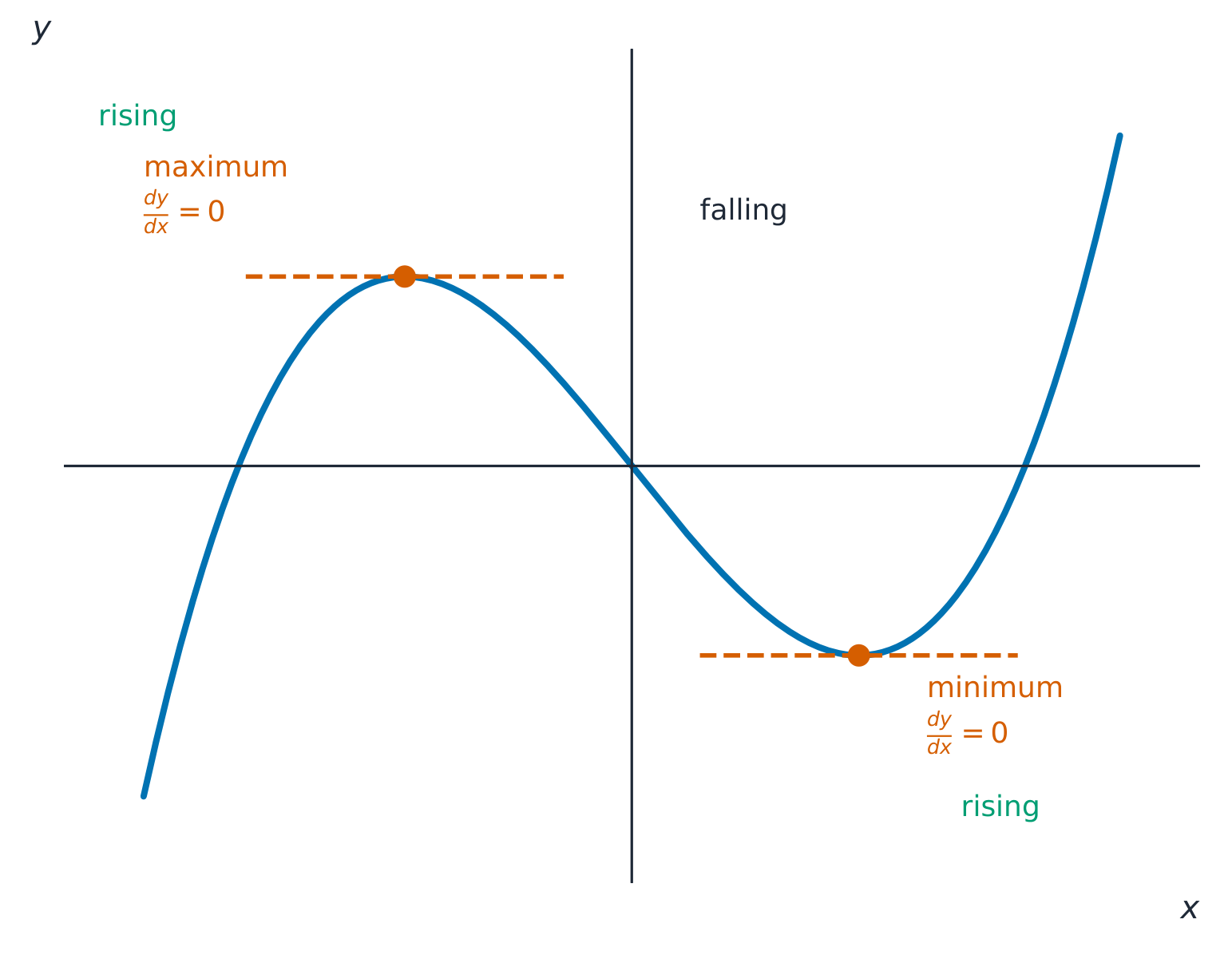
A critical point 临界点 is an interior point where $f'(x)=0$ or $f'(x)$ does not exist. All local (relative) extrema 局部极值 occur at critical points – but not every critical point is an extremum. So critical points are the candidates; you must test each.

ไทย
ยอดเขา: Extrema และจุดวิกฤตบ่งบอกค่าสูงสุดและต่ำสุด

ทฤษฎีบทค่าสูงสุด/ต่ำสุด (EVT) รับประกันว่าค่าสุดจะมีอยู่: ฟังก์ชัน ต่อเนื่อง บนช่วงปิด $[a,b]$ จะรับค่า ทั้ง สูงสุดสัมบูรณ์และต่ำสุดสัมบูรณ์บนช่วงนั้น

ที่จุดสูงสุดหรือจุดต่ำสุด derivative จะเป็นศูนย์
ที่จุดสูงสุดหรือต่ำสุด ความอนุพันธ์จะเป็นศูนย์

จุดวิกฤต คือจุดภายในที่ $f'(x)=0$ หรือ $f'(x)$ ไม่สามารถหาความแตกต่างได้ ทุก ค่าสุดเฉพาะที่ (สัมพัทธ์) เกิดขึ้นที่จุดวิกฤต – แต่ ไม่ใช่ทุกจุดวิกฤตจะเป็นค่าสุด ดังนั้นจุดวิกฤตจึงเป็น ผู้เข้าชิง; คุณต้องทดสอบแต่ละจุด

5.3

Where a Function Increases or Decreases · ⁨เมื่อฟังก์ชันเพิ่มขึ้นหรือลดลง⁩

Syllabus · ⁨หลักสูตร⁩
English

Enduring Understanding (FUN-4): A function's derivative can be used to understand some behaviors of the function.

Learning Objective FUN-4.A: Justify conclusions about the behavior of a function based on the behavior of its derivatives.

  • FUN-4.A.1 The first derivative of a function can provide information about the function and its graph, including intervals where the function is increasing or decreasing.
ไทย

ความเข้าใจที่ยั่งยืน (FUN-4): อนุพันธ์ของฟังก์ชันสามารถใช้เพื่อทำความเข้าใจพฤติกรรมบางอย่างของฟังก์ชันได้

วัตถุประสงค์การเรียนรู้ FUN-4.A: อธิบายเหตุผลเกี่ยวกับพฤติกรรมของฟังก์ชันโดยอ้างอิงจากพฤติกรรมของอนุพันธ์ของมัน

  • FUN-4.A.1 อนุพันธ์อันดับแรกของฟังก์ชันสามารถให้ข้อมูลเกี่ยวกับฟังก์ชันและกราฟของมัน รวมถึงช่วงที่ฟังก์ชันเพิ่มขึ้นหรือลดลง

Source: College Board AP Course and Exam Description · ⁨แหล่งที่มา: คำอธิบายหลักสูตรและข้อสอบ College Board AP⁩

English

The first derivative tells you where $f$ rises or falls:

  • $f'(x) > 0$ on an interval $\Rightarrow$ $f$ is increasing 递增 there;
  • $f'(x) < 0$ $\Rightarrow$ $f$ is decreasing 递减.

On the exam, "find the intervals where $f$ is increasing" means: find the critical points, then test the sign of $f'$ between them, and justify with the sign of $f'$ (a stated reason, not just an interval).

ไทย

อนุพันธ์อันดับหนึ่ง บอกตำแหน่งที่ $f$ เพิ่มขึ้นหรือลดลง:

  • $f'(x) > 0$ บนช่วง $\Rightarrow$ $f$ คือ เพิ่มขึ้น ที่นั่น;
  • $f'(x) < 0$ เมื่อ $\Rightarrow$ $f$ เป็น ลดลง.

ในการสอบ คำว่า "จงหาช่วงที่ $f$ เพิ่มขึ้น" หมายความว่า: จงหาจุดวิกฤต แล้วทดสอบเครื่องหมายของ $f'$ ระหว่างจุดเหล่านั้น และ ให้เหตุผลด้วยเครื่องหมายของ $f'$ (เหตุผลที่ระบุชัดเจน ไม่ใช่แค่ช่วง)

5.4

The First Derivative Test for Local Extrema · ⁨การทดสอบอนุพันธ์อันดับหนึ่งสำหรับ Extrema ท้องถิ่น⁩

Syllabus · ⁨หลักสูตร⁩
English

Enduring Understanding (FUN-4): A function's derivative can be used to understand some behaviors of the function.

Learning Objective FUN-4.A: Justify conclusions about the behavior of a function based on the behavior of its derivatives.

  • FUN-4.A.2 The first derivative of a function can determine the location of relative (local) extrema of the function.
ไทย

ความเข้าใจที่ยั่งยืน (FUN-4): อนุพันธ์ของฟังก์ชันสามารถใช้เพื่อทำความเข้าใจพฤติกรรมบางอย่างของฟังก์ชันได้

วัตถุประสงค์การเรียนรู้ FUN-4.A: อธิบายเหตุผลเกี่ยวกับพฤติกรรมของฟังก์ชันโดยอ้างอิงจากพฤติกรรมของอนุพันธ์ของมัน

  • FUN-4.A.2 อนุพันธ์อันดับแรกของฟังก์ชันสามารถระบุตำแหน่งของค่าสุดขั้วท้องถิ่น (สัมพัทธ์) ของฟังก์ชันได้

Source: College Board AP Course and Exam Description · ⁨แหล่งที่มา: คำอธิบายหลักสูตรและข้อสอบ College Board AP⁩

English

To classify a critical point $x=c$ as a local max, local min, or neither, check how $f'$ changes sign there:

  • $f'$ changes $+$ to $-$ at $c$ $\Rightarrow$ local maximum 极大值;
  • $f'$ changes $-$ to $+$ at $c$ $\Rightarrow$ local minimum 极小值;
  • $f'$ does not change sign $\Rightarrow$ neither.

Always state the sign change as your justification.

Worked example. For $f(x)=x^3-3x^2$, $f'(x)=3x(x-2)$ is zero at $x=0,2$. Signs give $+,-,+$, so $x=0$ is a local maximum ($f=0$) and $x=2$ a local minimum ($f=-4$).

ไทย

เพื่อจำแนกจุดวิกฤต $x=c$ ว่าค่าสูงสุดเฉพาะที่, ค่าต่ำสุดเฉพาะที่ หรือไม่มีเลย ให้ตรวจสอบว่า $f'$ เปลี่ยนเครื่องหมายอย่างไรที่จุดนั้น:

  • $f'$ เปลี่ยนจาก $+$ เป็น $-$ ที่ $c$ $\Rightarrow$ ค่าสูงสุดเฉพาะที่;
  • $f'$ เปลี่ยนจาก $-$ เป็น $+$ ที่ $c$ $\Rightarrow$ ค่าต่ำสุดเฉพาะที่;
  • $f'$ ไม่ เปลี่ยนเครื่องหมาย $\Rightarrow$ ไม่มีอะไร

ควรระบุการเปลี่ยนเครื่องหมายเสมอในฐานะเหตุผลประกอบของคุณ

ตัวอย่างวิธีทำ. สำหรับ $f(x)=x^3-3x^2$, $f'(x)=3x(x-2)$ เป็นศูนย์ที่ $x=0,2$. สัญญาณให้ $+,-,+$, ดังนั้น $x=0$ เป็น local maximum ($f=0$) และ $x=2$ เป็น local minimum ($f=-4$).

สัญญาณของ f-prime กำหนดตำแหน่งที่ฟังก์ชันเพิ่มขึ้นหรือลดลง และระบุจุดสูงสุด/ต่ำสุดเฉพาะที่
เมื่อ $f' > 0$ กราฟจะขึ้นและเมื่อ $f' < 0$ กราฟจะลง; ค่าสูงสุดเฉพาะที่จะอยู่ที่ที่ $f'$ เปลี่ยนจาก $+$ เป็น $-$, ค่าต่ำสุดเฉพาะที่จะอยู่ที่ที่มันเปลี่ยนจาก $-$ เป็น $+$.
Vocabulary · ⁨คำศัพท์⁩ Train · ⁨ฝึกฝน⁩
English ไทย
local maximum/ˈləʊkl ˈmæksɪməm/ ค่าสูงสุดท้องถิ่น
local minimum/ˈləʊkl ˈmɪnɪməm/ ค่าต่ำสุดท้องถิ่น
concave up/kɒnˈkeɪv ʌp/ เว้าขึ้น
concave down/kɒnˈkeɪv daʊn/ โค้งลง
point of inflection/pɔɪnt ɒv ɪnˈflekʃn/ จุดเปลี่ยนเว้า
5.5

The Candidates Test for Absolute Extrema · ⁨การทดสอบผู้เข้าชิงสำหรับค่าสุดสัมบูรณ์⁩

Syllabus · ⁨หลักสูตร⁩
English

Enduring Understanding (FUN-4): A function's derivative can be used to understand some behaviors of the function.

Learning Objective FUN-4.A: Justify conclusions about the behavior of a function based on the behavior of its derivatives.

  • FUN-4.A.3 Absolute (global) extrema of a function on a closed interval can only occur at critical points or at endpoints.
ไทย

ความเข้าใจที่ยั่งยืน (FUN-4): อนุพันธ์ของฟังก์ชันสามารถใช้เพื่อทำความเข้าใจพฤติกรรมบางอย่างของฟังก์ชันได้

วัตถุประสงค์การเรียนรู้ FUN-4.A: อธิบายเหตุผลเกี่ยวกับพฤติกรรมของฟังก์ชันโดยอ้างอิงจากพฤติกรรมของอนุพันธ์ของมัน

  • FUN-4.A.3 ค่าสุดขั้วสัมบูรณ์ (ทั้งระบบ) ของฟังก์ชันบนช่วงปิดสามารถเกิดขึ้นได้เฉพาะที่จุดวิกฤตหรือที่จุดปลายเท่านั้น

Source: College Board AP Course and Exam Description · ⁨แหล่งที่มา: คำอธิบายหลักสูตรและข้อสอบ College Board AP⁩

English

On a closed interval, absolute (global) extrema occur only at critical points or endpoints. The candidates test:

  1. List all critical points in $[a,b]$ and the two endpoints.
  2. Evaluate $f$ at each candidate.
  3. The largest output is the absolute maximum; the smallest is the absolute minimum.

Show the table of values – the comparison is the argument.

ไทย

บน ช่วงปิด ค่าสุดสัมบูรณ์ (ระดับสากล) จะเกิดขึ้นที่ จุดวิกฤตหรือจุดปลายช่วง เท่านั้น การทดสอบผู้เข้าชิง:

  1. รายการจุดวิกฤตทั้งหมดใน $[a,b]$ และ จุดปลายช่วงทั้งสอง
  2. คำนวณค่า $f$ ที่ผู้เข้าชิงแต่ละตัว
  3. ค่าผลลัพธ์ที่ใหญ่ที่สุดคือค่าสูงสุดสัมบูรณ์; ค่าเล็กที่สุดคือค่าต่ำสุดสัมบูรณ์

แสดงตารางค่า – การเปรียบเทียบคือข้อโต้แย้ง

5.6

Concavity and Points of Inflection · ⁨ความโค้งและจุดเปลี่ยนความโค้ง⁩

Syllabus · ⁨หลักสูตร⁩
English

Enduring Understanding (FUN-4): A function's derivative can be used to understand some behaviors of the function.

Learning Objective FUN-4.A: Justify conclusions about the behavior of a function based on the behavior of its derivatives.

  • FUN-4.A.4 The graph of a function is concave up (down) on an open interval if the function's derivative is increasing (decreasing) on that interval.
  • FUN-4.A.5 The second derivative of a function provides information about the function and its graph, including intervals of upward or downward concavity.
  • FUN-4.A.6 The second derivative of a function may be used to locate points of inflection for the graph of the original function.
ไทย

ความเข้าใจที่ยั่งยืน (FUN-4): อนุพันธ์ของฟังก์ชันสามารถใช้เพื่อทำความเข้าใจพฤติกรรมบางอย่างของฟังก์ชันได้

วัตถุประสงค์การเรียนรู้ FUN-4.A: อธิบายเหตุผลเกี่ยวกับพฤติกรรมของฟังก์ชันโดยอ้างอิงจากพฤติกรรมของอนุพันธ์ของมัน

  • FUN-4.A.4 กราฟของฟังก์ชันจะเว้าขึ้น (ลง) บนช่วงเปิดถ้าอนุพันธ์อันดับหนึ่งของฟังก์ชันเพิ่มขึ้น (ลดลง) ในช่วงนั้น
  • FUN-4.A.5 อนุพันธ์อันดับสองของฟังก์ชันให้ข้อมูลเกี่ยวกับฟังก์ชันและกราฟของมัน รวมถึงช่วงที่มีความเว้าขึ้นหรือลง
  • FUN-4.A.6 อนุพันธ์อันดับสองของฟังก์ชันสามารถใช้ระบุจุดเปลี่ยนเว้าของกราฟฟังก์ชันเดิมได้

Source: College Board AP Course and Exam Description · ⁨แหล่งที่มา: คำอธิบายหลักสูตรและข้อสอบ College Board AP⁩

English

The second derivative describes bending:

  • $f'' > 0$ $\Rightarrow$ $f$ is concave up 上凹 (curving like a cup; $f'$ is increasing);
  • $f'' < 0$ $\Rightarrow$ $f$ is concave down 下凹 ($f'$ is decreasing).

A point of inflection 拐点 is where concavity changes, i.e. where $f''$ changes sign (not merely where $f''=0$). Report its $x$-coordinate and justify with the sign change of $f''$.

ไทย

อนุพันธ์อันดับสอง อธิบายการโค้งงอ:

  • $f'' > 0$ เมื่อ $\Rightarrow$ $f$ เป็น เว้าขึ้น (โค้งเหมือนถ้วย; $f'$ เพิ่ม);
  • $f'' < 0$ เมื่อ $\Rightarrow$ $f$ เป็น เว้าลง ($f'$ ลด)

จุดเปลี่ยนความโค้ง คือจุดที่ความโค้ง เปลี่ยน นั่นคือที่ $f''$ เปลี่ยนเครื่องหมาย (ไม่ใช่เพียงที่ $f''=0$) รายงาน $x$-คอร์ดิเนตของมันและให้เหตุผลด้วยการเปลี่ยนเครื่องหมายของ $f''$

ความโค้งเกิดจากเครื่องหมายของอนุพันธ์อันดับสอง;它会เปลี่ยนที่จุดกลับตัว
ความโค้งมาจากเครื่องหมายของอนุพันธ์อันดับสอง; มันจะพลิกกลับที่จุดเปลี่ยนความโค้ง
Explore · ⁨สำรวจ⁩

Find where concavity flips · ⁨หาจุดที่ความเว้าเปลี่ยน⁩

y = ax³ + bx² + cx + d

Concavity is the sign of the second derivative: concave up where the curve holds water, concave down where it spills. A point of inflection is where it switches. · ⁨ความเว้าคือเครื่องหมายของอนุพันธ์อันดับสอง: เว้าขึ้นเมื่อเส้นโค้งเก็บน้ำ เว้าลงเมื่อมันไหลออก จุดกลับด้านคือจุดที่มันเปลี่ยน⁩

5.7

The Second Derivative Test for Extrema · ⁨การทดสอบอนุพันธ์อันดับสองสำหรับ Extrema⁩

Syllabus · ⁨หลักสูตร⁩
English

Enduring Understanding (FUN-4): A function's derivative can be used to understand some behaviors of the function.

Learning Objective FUN-4.A: Justify conclusions about the behavior of a function based on the behavior of its derivatives.

  • FUN-4.A.7 The second derivative of a function may determine whether a critical point is the location of a relative (local) maximum or minimum.
  • FUN-4.A.8 When a continuous function has only one critical point on an interval on its domain and the critical point corresponds to a relative (local) extremum of the function on the interval, then that critical point also corresponds to the absolute (global) extremum of the function on the interval.
ไทย

ความเข้าใจที่ยั่งยืน (FUN-4): อนุพันธ์ของฟังก์ชันสามารถใช้เพื่อทำความเข้าใจพฤติกรรมบางอย่างของฟังก์ชันได้

วัตถุประสงค์การเรียนรู้ FUN-4.A: อธิบายเหตุผลเกี่ยวกับพฤติกรรมของฟังก์ชันโดยอ้างอิงจากพฤติกรรมของอนุพันธ์ของมัน

  • FUN-4.A.7 อนุพันธ์อันดับสองของฟังก์ชันสามารถบ่งชี้ได้ว่าจุดวิกฤตนั้นเป็นตำแหน่งของค่าสุดขั้วท้องถิ่น (สัมพัทธ์) สูงสุดหรือต่ำสุด
  • FUN-4.A.8 เมื่อฟังก์ชันต่อเนื่องมีเพียงจุดวิกฤตเดียวบนช่วงของโดเมนและจุดวิกฤตนั้นสอดคล้องกับค่าสุดขั้วท้องถิ่น (สัมพัทธ์) ของฟังก์ชันบนช่วงนั้น จุดวิกฤตนั้นจะสอดคล้องกับค่าสุดขั้วสัมบูรณ์ (ทั้งระบบ) ของฟังก์ชันบนช่วงนั้นเช่นกัน

Source: College Board AP Course and Exam Description · ⁨แหล่งที่มา: คำอธิบายหลักสูตรและข้อสอบ College Board AP⁩

English

An alternative way to classify a critical point $c$ where $f'(c)=0$:

  • $f''(c) > 0$ $\Rightarrow$ concave up $\Rightarrow$ local minimum;
  • $f''(c) < 0$ $\Rightarrow$ concave down $\Rightarrow$ local maximum;
  • $f''(c) = 0$ $\Rightarrow$ the test is inconclusive – fall back on the first derivative test.

Special case: if a continuous function has only one critical point on an interval and it is a local extremum, that point is also the absolute extremum there.

ไทย

วิธีอื่นในการจำแนกจุดวิกฤต $c$ ที่ $f'(c)=0$:

  • $f''(c) > 0$ เมื่อ $\Rightarrow$ เว้าขึ้น $\Rightarrow$ ค่าต่ำสุดเฉพาะที่;
  • $f''(c) < 0$ $\Rightarrow$ โค้งลง $\Rightarrow$ จุดสูงสุดสัมพัทธ์;
  • $f''(c) = 0$ เมื่อ $\Rightarrow$ การทดสอบ ไม่สามารถสรุปได้ – ให้ใช้การทดสอบอนุพันธ์อันดับหนึ่งแทน

กรณีพิเศษ: หากฟังก์ชันต่อเนื่องมี จุดวิกฤตเพียงจุดเดียว บนช่วงและเป็นค่าสุดเฉพาะที่ จุดนั้นจะเป็น ค่าสุดสัมบูรณ์ ที่นั่นด้วย

5.8

Sketching a Function and Its Derivative · ⁨การวาดกราฟฟังก์ชันและอนุพันธ์ของมัน⁩

Syllabus · ⁨หลักสูตร⁩
English

Enduring Understanding (FUN-4): A function's derivative can be used to understand some behaviors of the function.

Learning Objective FUN-4.A: Justify conclusions about the behavior of a function based on the behavior of its derivatives.

  • FUN-4.A.9 Key features of functions and their derivatives can be identified and related to their graphical, numerical, and analytical representations.
  • FUN-4.A.10 Graphical, numerical, and analytical information from $f'$ and $f''$ can be used to predict and explain the behavior of $f$.
ไทย

ความเข้าใจที่ยั่งยืน (FUN-4): อนุพันธ์ของฟังก์ชันสามารถใช้เพื่อทำความเข้าใจพฤติกรรมบางอย่างของฟังก์ชันได้

วัตถุประสงค์การเรียนรู้ FUN-4.A: อธิบายเหตุผลเกี่ยวกับพฤติกรรมของฟังก์ชันโดยอ้างอิงจากพฤติกรรมของอนุพันธ์ของมัน

  • FUN-4.A.9 คุณสมบัติสำคัญของฟังก์ชันและอนุพันธ์ของมันสามารถระบุและเชื่อมโยงกับการแสดงออกในรูปแบบกราฟ จำนวน และการวิเคราะห์ได้
  • FUN-4.A.10 ข้อมูลจาก $f'$ และ $f''$ ทั้งในรูปแบบกราฟ จำนวน และการวิเคราะห์ สามารถใช้เพื่อทำนายและอธิบายพฤติกรรมของ $f$

Source: College Board AP Course and Exam Description · ⁨แหล่งที่มา: คำอธิบายหลักสูตรและข้อสอบ College Board AP⁩

English

Key features of $f$, $f'$, and $f''$ mirror each other. To sketch or read graphs:

  • $f$ increasing $\Leftrightarrow$ $f'$ above the axis; $f$ has a local max $\Leftrightarrow$ $f'$ crosses from $+$ to $-$.
  • $f$ concave up $\Leftrightarrow$ $f'$ increasing $\Leftrightarrow$ $f''$ above the axis; $f$ has an inflection point $\Leftrightarrow$ $f'$ has a local extremum $\Leftrightarrow$ $f''$ crosses zero.
ไทย

คุณสมบัติหลักของ $f$, $f'$ และ $f''$ สะท้อนกันเอง ในการวาดหรืออ่านกราฟ:

  • $f$ เพิ่มขึ้น $\Leftrightarrow$ $f'$ อยู่เหนือแกน; $f$ มีค่าสูงสุดเฉพาะที่ $\Leftrightarrow$ $f'$ ข้ามจาก $+$ เป็น $-$
  • $f$ เว้าขึ้น $\Leftrightarrow$ $f'$ เพิ่มขึ้น $\Leftrightarrow$ $f''$ อยู่เหนือแกน; $f$ มีจุดเปลี่ยนความโค้ง $\Leftrightarrow$ $f'$ มีค่าสุดเฉพาะที่ $\Leftrightarrow$ $f''$ ข้ามศูนย์
5.9

Connecting $f$, $f'$, and $f''$ · ⁨การเชื่อมโยง $f$, $f'$, และ $f''$⁩

Syllabus · ⁨หลักสูตร⁩
English

Enduring Understanding (FUN-4): A function's derivative can be used to understand some behaviors of the function.

Learning Objective FUN-4.A: Justify conclusions about the behavior of a function based on the behavior of its derivatives.

  • FUN-4.A.11 Key features of the graphs of $f$, $f'$, and $f''$ are related to one another.
ไทย

ความเข้าใจที่ยั่งยืน (FUN-4): อนุพันธ์ของฟังก์ชันสามารถใช้เพื่อทำความเข้าใจพฤติกรรมบางอย่างของฟังก์ชันได้

วัตถุประสงค์การเรียนรู้ FUN-4.A: อธิบายเหตุผลเกี่ยวกับพฤติกรรมของฟังก์ชันโดยอ้างอิงจากพฤติกรรมของอนุพันธ์ของมัน

  • FUN-4.A.11 คุณสมบัติสำคัญของกราฟของ $f$, $f'$, และ $f''$ ล้วนสัมพันธ์กัน

Source: College Board AP Course and Exam Description · ⁨แหล่งที่มา: คำอธิบายหลักสูตรและข้อสอบ College Board AP⁩

English

This is the skill of reading one graph to describe another. A very common exam setup gives the graph of $f'$ and asks about $f$: where is $f$ increasing (where $f'>0$), where are $f$'s extrema (where $f'$ crosses zero, with a sign change), where is $f$ concave up (where $f'$ is increasing). Answer questions about $f$ using the height and slope of the $f'$ graph.

ไทย

นี่คือทักษะการอ่านกราฟหนึ่งเพื่ออธิบายอีกกราฟหนึ่ง การตั้งค่าการสอบที่พบบ่อยมากที่สุดคือการให้กราฟของ $f'$ และถามเกี่ยวกับ $f$: ที่ไหน $f$ กำลังเพิ่มขึ้น (ที่ $f'>0$), ที่ไหน $f$ มีค่าสุด (ที่ $f'$ ข้ามศูนย์ พร้อมการเปลี่ยนเครื่องหมาย), ที่ไหน $f$ เว้าขึ้น (ที่ $f'$ เพิ่มขึ้น) ตอบคำถามเกี่ยวกับ $f$ โดยใช้ ความสูงและความชัน ของกราฟ $f'$

Explore · ⁨สำรวจ⁩

Read slope and bend off the graph · ⁨อ่านความชันและการงอจากกราฟ⁩

y = ax³ + bx² + cx + d

Where $f'>0$ the function rises; where $f''>0$ it bends upward. Slide the tangent to connect the shape of $f$ to the signs of its first and second derivatives. · ⁨ที่何处 $f'>0$ ฟังก์ชันเพิ่มขึ้น; ที่何处 $f''>0$ มันงอขึ้น เลื่อนเส้นสัมผัสเพื่อเชื่อมโยงรูปร่างของ $f$ กับเครื่องหมายของอนุพันธ์อันดับหนึ่งและอันดับสอง⁩

5.10

Introduction to Optimization Problems · ⁨บทนำสู่ปัญหาการเพิ่มประสิทธิภาพ (Optimization Problems)⁩

Syllabus · ⁨หลักสูตร⁩
English

Enduring Understanding (FUN-4): A function's derivative can be used to understand some behaviors of the function.

Learning Objective FUN-4.B: Calculate minimum and maximum values in applied contexts or analysis of functions.

  • FUN-4.B.1 The derivative can be used to solve optimization problems; that is, finding a minimum or maximum value of a function on a given interval.
ไทย

ความเข้าใจที่ยั่งยืน (FUN-4): อนุพันธ์ของฟังก์ชันสามารถใช้เพื่อทำความเข้าใจพฤติกรรมบางอย่างของฟังก์ชันได้

วัตถุประสงค์การเรียนรู้ FUN-4.B: คำนวณค่าต่ำสุดและค่าสูงสุดในบริบทของการใช้งานหรือการวิเคราะห์ฟังก์ชัน

  • FUN-4.B.1 อนุพันธ์สามารถใช้ในการแก้ปัญหาการเพิ่มประสิทธิภาพ นั่นคือการหาค่าต่ำสุดหรือค่าสูงสุดของฟังก์ชันในช่วงที่กำหนด

Source: College Board AP Course and Exam Description · ⁨แหล่งที่มา: คำอธิบายหลักสูตรและข้อสอบ College Board AP⁩

English
Optimisation: the best box

Optimization 最优化 uses the derivative to find the largest or smallest value of a quantity on an interval. It is the candidates/derivative-test machinery applied to a real goal.

ไทย
การปรับแต่ง: กล่องที่ดีที่สุด

การปรับแต่ง ใช้ความอนุพันธ์เพื่อหาค่าที่ใหญ่ที่สุดหรือน้อยที่สุดของปริมาณหนึ่งบนช่วง เป็นการประยุกต์ใช้กลไกการทดสอบผู้เข้าชิง/การทดสอบความอนุพันธ์กับเป้าหมายจริง

พื้นที่ปิดด้วยรั้ว: การหาค่าสูงสุด-ต่ำสุดหาขนาดที่เพิ่มพื้นที่ให้มากที่สุดสำหรับความยาวรั้วที่กำหนด
Vocabulary · ⁨คำศัพท์⁩ Train · ⁨ฝึกฝน⁩
English ไทย
Optimization/ˌɒptɪmaɪˈzeɪʃn/ การหาค่าเหมาะสมที่สุด (Optimization)
5.11

Solving Optimization Problems · ⁨การแก้ปัญหาการหาค่าสูงสุด-ต่ำสุด⁩

Syllabus · ⁨หลักสูตร⁩
English

Enduring Understanding (FUN-4): A function's derivative can be used to understand some behaviors of the function.

Learning Objective FUN-4.C: Interpret minimum and maximum values calculated in applied contexts.

  • FUN-4.C.1 Minimum and maximum values of a function take on specific meanings in applied contexts.
ไทย

ความเข้าใจที่ยั่งยืน (FUN-4): อนุพันธ์ของฟังก์ชันสามารถใช้เพื่อทำความเข้าใจพฤติกรรมบางอย่างของฟังก์ชันได้

วัตถุประสงค์การเรียนรู้ FUN-4.C: ตีความค่าต่ำสุดและค่าสูงสุดที่คำนวณได้ในบริบทการใช้งาน

  • FUN-4.C.1 ค่าต่ำสุดและค่าสูงสุดของฟังก์ชันจะมีความหมายเฉพาะเจาะจงในบริบทการใช้งาน

Source: College Board AP Course and Exam Description · ⁨แหล่งที่มา: คำอธิบายหลักสูตรและข้อสอบ College Board AP⁩

English

A dependable procedure:

  1. Write the quantity to optimize as a function of one variable (use a constraint equation to eliminate extras).
  2. State the interval of allowed inputs.
  3. Find critical points ($f'=0$ or undefined) and test them (first- or second-derivative test, or candidates test if the interval is closed).
  4. Answer the question asked, with units and interpretation in context – the maximum area, the minimum cost, etc.

Worked example. With $100\ \text{m}$ of fence for a rectangular pen against a wall (only three sides fenced), let the ends be $x$ and the far side $y=100-2x$. The area $A(x)=x(100-2x)=100x-2x^2$ has $A'(x)=100-4x=0$ at $x=25$; since $A''=-4<0$ this is the maximum, giving $y=50$ and $A=1250\ \text{m}^2$.

ไทย

ขั้นตอนที่เชื่อถือได้:

  1. เขียนปริมาณที่ต้องการหาค่าสูงสุด-ต่ำสุดในรูปฟังก์ชันของ ตัวแปรเดียว (ใช้สมการข้อจำกัดเพื่อตัดตัวแปรออก).
  2. ระบุช่วงของค่าเข้าที่ยอมรับได้.
  3. หาจุดวิกฤต ($f'=0$ หรือหาไม่เจอ) และทดสอบจุดเหล่านั้น (ทดสอบอนุพันธ์อันดับหนึ่งหรืออันดับสอง, หรือทดสอบค่าถ้าช่วงเป็นแบบปิด).
  4. ตอบคำถามที่ถามมา, พร้อมหน่วยและการตีความ ในบริบท – เช่น พื้นที่ สูงสุด, ต้นทุน ต่ำสุด, เป็นต้น.

ตัวอย่างทำพร้อมกัน. ด้วย $100\ \text{m}$ ของรั้วสำหรับคอกสี่เหลี่ยมผืนผ้าติดกำแพง (只对สามด้าน), ให้ด้านข้างเป็น $x$ และด้านไกลสุดเป็น $y=100-2x$. พื้นที่ $A(x)=x(100-2x)=100x-2x^2$ มี $A'(x)=100-4x=0$ ที่ $x=25$; เนื่องจาก $A''=-4<0$ นี่คือค่าสูงสุด, ให้ $y=50$ และ $A=1250\ \text{m}^2$.

5.12

Exploring Behaviors of Implicit Relations · ⁨การสำรวจพฤติกรรมของความสัมพันธ์แบบนัยยะ (Implicit Relations)⁩

Syllabus · ⁨หลักสูตร⁩
English

Enduring Understanding (FUN-4): A function's derivative can be used to understand some behaviors of the function.

Learning Objective FUN-4.D: Determine critical points of implicit relations.

  • FUN-4.D.1 A point on an implicit relation where the first derivative equals zero or does not exist is a critical point of the function.

Learning Objective FUN-4.E: Justify conclusions about the behavior of an implicitly defined function based on evidence from its derivatives.

  • FUN-4.E.1 Applications of derivatives can be extended to implicitly defined functions.
  • FUN-4.E.2 Second derivatives involving implicit differentiation may be relations of $x$, $y$, and $\dfrac{dy}{dx}$.
ไทย

ความเข้าใจที่ยั่งยืน (FUN-4): อนุพันธ์ของฟังก์ชันสามารถใช้เพื่อทำความเข้าใจพฤติกรรมบางอย่างของฟังก์ชันได้

วัตถุประสงค์การเรียนรู้ FUN-4.D: หาจุดวิกฤตของความสัมพันธ์แบบนัยยะ

  • FUN-4.D.1 จุดบนความสัมพันธ์แบบนัยยะที่อนุพันธ์อันดับแรกเท่ากับศูนย์หรือไม่มีอยู่เป็นจุดวิกฤตของฟังก์ชัน

วัตถุประสงค์การเรียนรู้ FUN-4.E: อธิบายเหตุผลเกี่ยวกับพฤติกรรมของฟังก์ชันที่นิยามแบบนัยยะโดยอ้างอิงจากหลักฐานจากอนุพันธ์ของมัน

  • FUN-4.E.1 การประยุกต์ใช้อนุพันธ์สามารถขยายไปยังฟังก์ชันที่นิยามแบบนัยยะได้
  • FUN-4.E.2 อนุพันธ์อันดับสองที่เกี่ยวข้องกับการหาอนุพันธ์แบบนัยยะอาจเป็นความสัมพันธ์ของ $x$, $y$ และ $\dfrac{dy}{dx}$

Source: College Board AP Course and Exam Description · ⁨แหล่งที่มา: คำอธิบายหลักสูตรและข้อสอบ College Board AP⁩

English

All of this extends to implicitly defined relations. A critical point of an implicit relation is where $\dfrac{dy}{dx}=0$ (horizontal tangent) or is undefined (vertical tangent). Because $\dfrac{dy}{dx}$ is usually a relation in $x$ and $y$, and the second derivative involves $x$, $y$, and $\dfrac{dy}{dx}$, substitute your first-derivative expression back in when finding $\dfrac{d^2y}{dx^2}$, then reason about concavity from its sign.

ไทย

ทั้งหมดนี้ขยายไปยัง ความสัมพันธ์ที่นิยามโดยนัย จุดวิกฤตของความสัมพันธ์แบบนิยามโดยนัยคือตำแหน่งที่ $\dfrac{dy}{dx}=0$ (สัมผัสแนวนอน) หรือหาไม่เจอ (สัมผัสแนวตั้ง) เนื่องจาก $\dfrac{dy}{dx}$ โดยทั่วไปเป็นความสัมพันธ์ใน $x$ และ $y$, และอนุพันธ์อันดับสองเกี่ยวข้องกับ $x$, $y$, และ $\dfrac{dy}{dx}$, แทนค่า-expression ของอนุพันธ์อันดับหนึ่งกลับเข้าไปเมื่อหาค่า $\dfrac{d^2y}{dx^2}$, จากนั้นวิเคราะห์ความเว้าจากเครื่องหมายของมัน.

5.12

Exam tips · ⁨ข้อแนะนำสำหรับการสอบ⁩

English
  • $f'>0$ means increasing, $f'<0$ decreasing; candidates for extrema are where $f'=0$ or is undefined.
  • Classify a critical point with the first-derivative sign change or the second-derivative test ($f''>0$ minimum, $f''<0$ maximum).
  • $f''>0$ is concave up, $f''<0$ concave down; a point of inflection is where concavity changes ($f''$ changes sign).
  • For an absolute extremum on a closed interval, also check the endpoints.
  • Justify every conclusion by citing the sign of $f'$ or $f''$ — the exam demands the reasoning, not just the answer.
ไทย
  • $f'>0$ หมายถึงเพิ่มขึ้น, $f'<0$ ลดลง; ค่าที่เป็นไปได้สำหรับ จุดยอด คือตำแหน่งที่ $f'=0$ หรือหาไม่เจอ.
  • จำแนกประเภทจุดวิกฤตด้วยการ เปลี่ยนเครื่องหมายของอนุพันธ์อันดับหนึ่ง หรือ ทดสอบอนุพันธ์อันดับสอง ($f''>0$ เป็นค่าต่ำสุด, $f''<0$ เป็นค่าสูงสุด).
  • $f''>0$ มีความเว้าขึ้น, $f''<0$ มีความเว้าลง; จุดเปลี่ยนเว้า คือตำแหน่งที่ความเว้าเปลี่ยน ($f''$ เปลี่ยนเครื่องหมาย).
  • สำหรับ จุดยอดสัมบูรณ์ ในช่วงปิด, ตรวจสอบจุดขอบเขตเพิ่มเติมด้วย.
  • อธิบายเหตุผลทุกข้อสรุปโดยอ้างอิงถึงเครื่องหมายของ $f'$ หรือ $f''$ – การสอบต้องการเหตุผล ไม่ใช่แค่คำตอบ.

Interactive lessons on this topic · ⁨บทเรียนเชิงโต้ตอบสำหรับหัวข้อนี้⁩

Work through it step by step, with instant-check exercises. · ⁨ทำทีละขั้นตอน พร้อมแบบฝึกหัดตรวจสอบผลทันที⁩

Past Papers · ⁨ข้อสอบย้อนหลัง⁩

More topics in AP Calculus BC · ⁨หัวข้อเพิ่มเติมใน AP Calculus BC⁩

Log in or create account · ⁨เข้าสู่ระบบหรือสร้างบัญชี⁩

IGCSE, A-Level & AP