AP Calculus AB covers limits and continuity, differentiation and its applications, integration and accumulation of change, differential equations, and applications of integration including areas and volumes. It is roughly one semester of university calculus.
The exam is about meaning as much as method. You will be asked what a derivative means in context — with units — and to justify a maximum or a point of inflection by the sign of a derivative, not by inspection of a graph.
The Fundamental Theorem of Calculus is the spine of the course. Understanding it as "the integral of a rate gives the total change" is what makes accumulation questions readable.
Notes take each unit in order, with the theorems stated the way the exam expects them to be cited. Past FRQs with scoring guidelines are in the library — AB marks often go to the justification in words, so the worked solutions write the reasoning out instead of stopping at the answer.
Introducing Calculus: Can Change Occur at an Instant? · แนะนำแคลคูลัส: การเปลี่ยนแปลงสามารถเกิดขึ้นได้ในเสี้ยววินาทีหรือไม่?
Syllabus · หลักสูตร
English
Enduring Understanding (CHA-1): Calculus allows us to generalize knowledge about motion to diverse problems involving change.
Learning Objective CHA-1.A: Interpret the rate of change at an instant in terms of average rates of change over intervals containing that instant.
CHA-1.A.1 Calculus uses limits to understand and model dynamic change.
CHA-1.A.2 Because an average rate of change divides the change in one variable by the change in another, the average rate of change is undefined at a point where the change in the independent variable would be zero.
CHA-1.A.3 The limit concept allows us to define instantaneous rate of change in terms of average rates of change.
Source: College Board AP Course and Exam Description · แหล่งที่มา: คำอธิบายหลักสูตรและข้อสอบ College Board AP
English
Calculus is the mathematics of change 变化 and of accumulation 累积. It answers two big questions: how fast is something changing right now, and how much has piled up so far? Unit 1 builds the one tool both questions rest on – the limit 极限.
Start with a puzzle. A car's speedometer reads $60$ km/h. What does that mean at a single instant 瞬间? Speed is distance over time. But at one instant no time passes and no distance is covered, so the fraction looks like $\tfrac{0}{0}$ – undefined.
The average rate of change 平均变化率 uses a whole interval 区间: the change in one quantity divided by the change in another. It divides by zero, and so is undefined, when the change in the input would be zero.
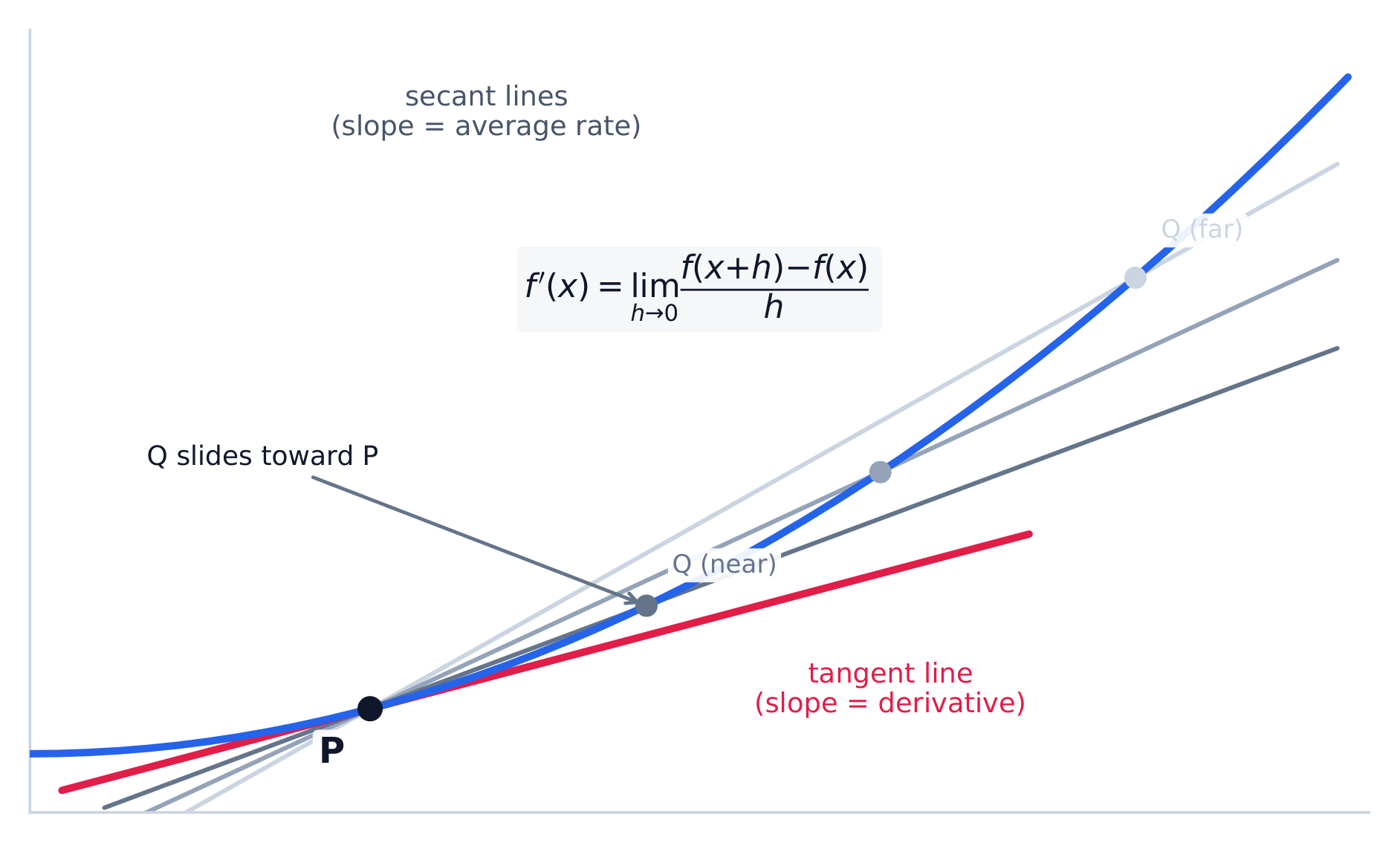
The instantaneous rate of change 瞬时变化率 is what we want at a point. It is the value the average rate approaches 趋近 as the interval shrinks toward zero length.
The clever move is not to plug in zero (undefined), but to watch what the average rate approaches as the interval gets smaller and smaller. That approaching value is a limit. So calculus lets us describe change at an instant – as a limit of average rates over ever-shorter intervals. This one idea powers the derivative 导数 (Unit 2) and, run in reverse, the integral 积分 (Unit 6). Everything else in this unit defines limits carefully and computes them reliably.
Slide the point along the curve. The tangent line is the limit of ever-shorter average rates — its slope is the instantaneous rate of change$\frac{dy}{dx}$ at that point. · 沿曲线滑动该点。切线是不断缩短的平均变化率的极限——其斜率是该点的瞬时变化率$\frac{dy}{dx}$。
1.2
Defining Limits and Using Limit Notation · นิยามลิมิตและการใช้สัญลักษณ์ลิมิต
Syllabus · หลักสูตร
English
Enduring Understanding (LIM-1): Reasoning with definitions, theorems, and properties can be used to justify claims about limits.
Learning Objective LIM-1.A: Represent limits analytically using correct notation.
LIM-1.A.1 Given a function $f$, the limit of $f(x)$ as $x$ approaches $c$ is a real number $R$ if $f(x)$ can be made arbitrarily close to $R$ by taking $x$ sufficiently close to $c$ (but not equal to $c$). If the limit exists and is a real number, then the common notation is $\lim_{x \to c} f(x) = R$.
Exclusion statement: The epsilon-delta definition of a limit is not assessed on the AP Calculus AB or BC Exam. However, teachers may include this topic in the course if time permits.
Learning Objective LIM-1.B: Interpret limits expressed in analytic notation.
LIM-1.B.1 A limit can be expressed in multiple ways, including graphically, numerically, and analytically.
ข้อความยกเว้น: คำนิยาม epsilon-delta ของลิมิตไม่ได้ถูกทดสอบในการสอบ AP Calculus AB หรือ BC อย่างไรก็ตาม ครูอาจรวมหัวข้อนี้ไว้ในหลักสูตรหากมีเวลาเพียงพอ
Source: College Board AP Course and Exam Description · แหล่งที่มา: คำอธิบายหลักสูตรและข้อสอบ College Board AP
English
Given a function $f$, the limit of $f(x)$ as $x$ approaches $c$ is a real number $R$ if $f(x)$ can be made arbitrarily 任意地 close to $R$ by taking $x$sufficiently 足够 close to $c$ – but not equal to$c$. We write
$$\lim_{x \to c} f(x) = R$$
and read it: "the limit of $f(x)$, as $x$ approaches $c$, equals $R$."
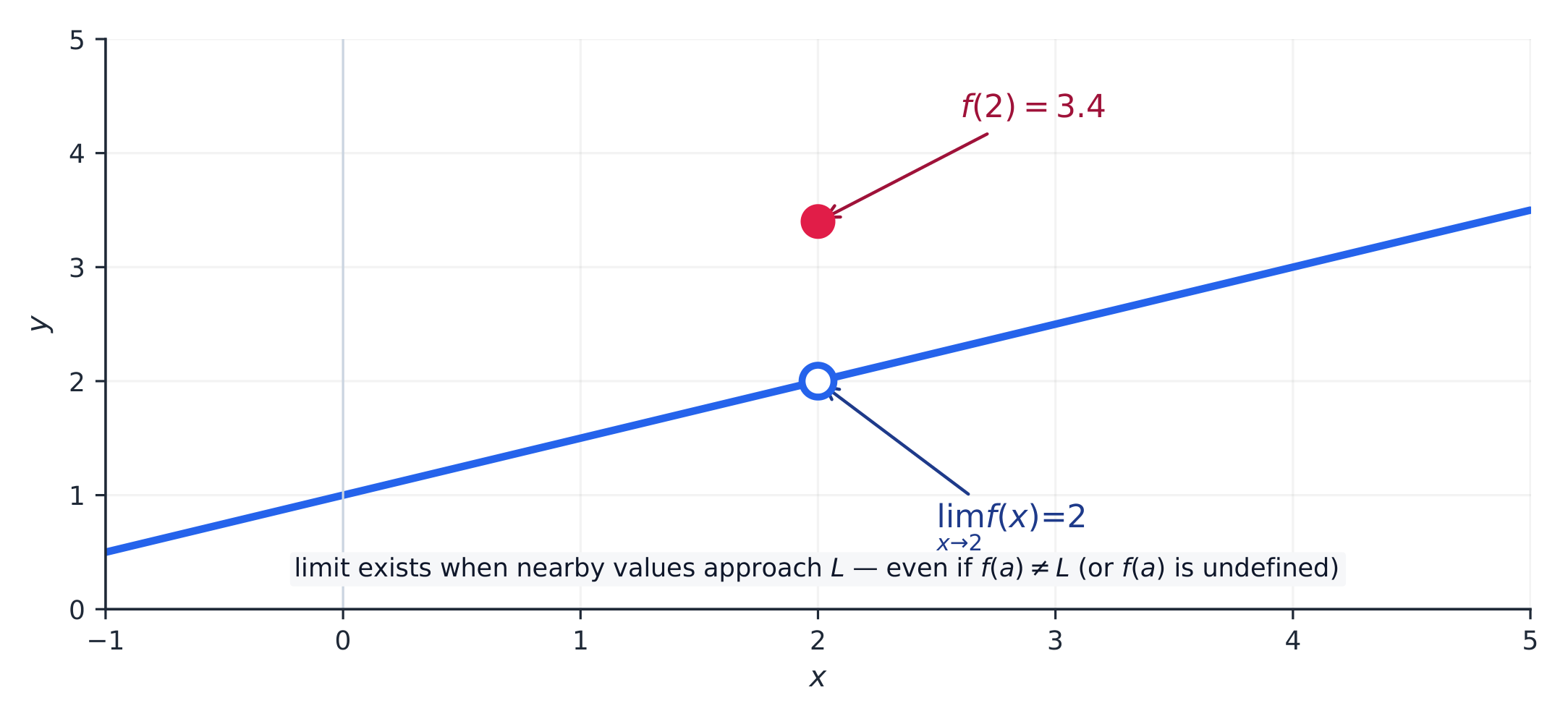
The last words are the heart of a limit: it describes the behavior 行为 of $f$near$c$, not the value at$c$. The function may be undefined at $c$, or defined but equal to something else – the limit does not care.
A limit can be shown in three ways: graphically 用图象, numerically 用数值 (a table), and analytically 用解析式 (algebra). Learning to move between these representations is a core skill.
(Note: the epsilon-delta definition of a limit is not tested on the AP Exam, so this handout does not use it.)
instantaneous rate of change/ˌɪnstənˈteɪnɪəs reɪt ɒv tʃeɪndʒ/
อัตราการเปลี่ยนแปลงในทันที
approaches/əˈprəʊtʃɪz/
แนวทาง
derivative/dɪˈrɪvətɪv/
อนุพันธ์เชิงซ้อน (ดีริวทีฟ)
integral/ˈɪntɪɡrəl/
อินทิกรัล
arbitrarily/ˌɑːbɪˈtrerɪli/
ตามใจ
sufficiently/səˈfɪʃəntli/
เพียงพอ
behavior/bɪˈheɪvjə/
พฤติกรรม
graphically/ˈɡræfɪkli/
โดยกราฟิก
numerically/njuːˈmerɪkli/
โดยตัวเลข
analytically/ˌænəˈlɪtɪkli/
โดยวิธีวิเคราะห์
left-hand limit/left hænd ˈlɪmɪt/
ลิมิตด้านซ้าย
right-hand limit/raɪt hænd ˈlɪmɪt/
ลิมิตด้านขวา
one-sided limits/wʌn ˈsaɪdɪd ˈlɪmɪts/
ลิมิตด้านเดียว
open circle/ˈəʊpən ˈsɜːkl/
วงกลมโปร่ง (เปิด)
1.3
Estimating Limit Values from Graphs · ประมาณค่าลิมิตจากกราฟ
Syllabus · หลักสูตร
English
Enduring Understanding (LIM-1): Reasoning with definitions, theorems, and properties can be used to justify claims about limits.
Learning Objective LIM-1.C: Estimate limits of functions.
LIM-1.C.1 The concept of a limit includes one sided limits.
LIM-1.C.2 Graphical information about a function can be used to estimate limits.
LIM-1.C.3 Because of issues of scale, graphical representations of functions may miss important function behavior.
LIM-1.C.4 A limit might not exist for some functions at particular values of $x$. Some ways that the limit might not exist are if the function is unbounded, if the function is oscillating near this value, or if the limit from the left does not equal the limit from the right.
Illustrative examples for LIM-1.C.4:
$\lim_{x \to 0} \dfrac{1}{x^2} = \infty$
$\lim_{x \to 0} \dfrac{|x|}{x}$ does not exist.
$\lim_{x \to 0} \sin\left(\dfrac{1}{x}\right)$ does not exist.
Source: College Board AP Course and Exam Description · แหล่งที่มา: คำอธิบายหลักสูตรและข้อสอบ College Board AP
English
A graph is often the fastest way to read a limit. To find $\displaystyle \lim_{x \to c} f(x)$, run your finger along the curve toward $x = c$ from each side and ask: what height is the curve heading for?
Trace from the left (inputs smaller than $c$): this gives the left-hand limit 左极限, $\displaystyle \lim_{x \to c^-} f(x)$.
Trace from the right (inputs larger than $c$): this gives the right-hand limit 右极限, $\displaystyle \lim_{x \to c^+} f(x)$.
These are the one-sided limits 单侧极限. If both head to the same height $R$, then the two-sided limit exists and $\displaystyle \lim_{x \to c} f(x) = R$.
Crucially, ignore the point itself. Graphs mark the difference between the limit and the value:
An open circle 空心圆 marks a height the curve approaches but does not reach – a "hole" 空洞.
A closed circle 实心圆 marks the actual value $f(c)$.
So a curve may approach $R = 3$ from both sides (limit is $3$) while a filled dot sits at height $5$ (value $f(c) = 5$). The limit is $3$; the two need not match.
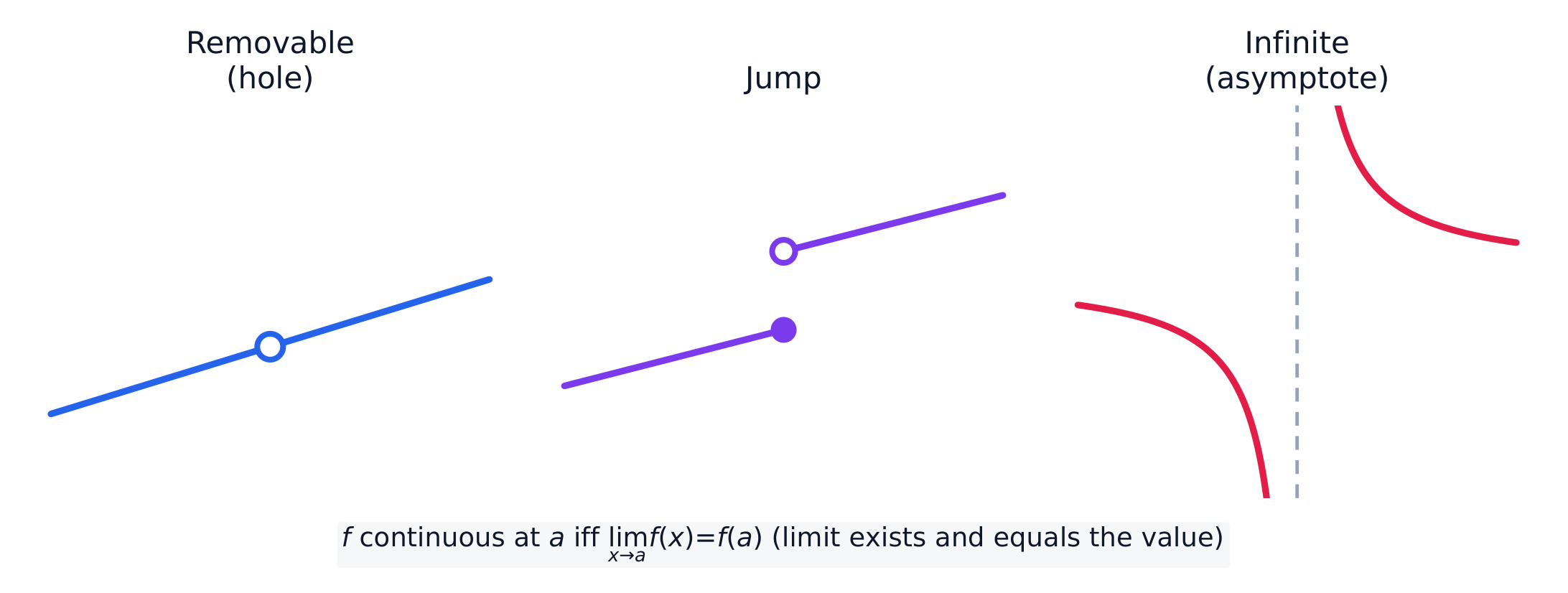
A limit does not exist (often written DNE) when the two sides disagree (a jump 跳跃), when the function is unbounded 无界 (grows without limit), or when it oscillates 振荡 forever near $c$. For example:
The limit as $x\to c$ is the height the curve heads toward from both sides — it is about where the function is going, not its value at $c$. Follow the curve toward an $x$ and read the $y$ it approaches. · 当$x\to c$时的极限是曲线从两侧趋近的高度——它关乎函数去往何处,而非其在$c$处的值。跟随曲线趋向$x$并读取其趋近的$y$。
Source: College Board AP Course and Exam Description · แหล่งที่มา: คำอธิบายหลักสูตรและข้อสอบ College Board AP
English
When you have data or a formula but no picture, a table 表格 of values estimates a limit numerically. Choose inputs that creep toward $c$ from both sides and watch the outputs.
For example, to estimate $\displaystyle \lim_{x \to 2} \frac{x^2 - 4}{x - 2}$ (which is $\tfrac{0}{0}$ at $x=2$):
$x$
$1.9$
$1.99$
$1.999$
$\to 2 \leftarrow$
$2.001$
$2.01$
$2.1$
$f(x)$
$3.9$
$3.99$
$3.999$
?
$4.001$
$4.01$
$4.1$
Both sides march toward $4$, so we estimate the limit is $4$. A table only suggests a value – it is a numerical estimate, not a proof.
Source: College Board AP Course and Exam Description · แหล่งที่มา: คำอธิบายหลักสูตรและข้อสอบ College Board AP
English
Most limits are found analytically using limit theorems 极限定理. If $\lim_{x\to c} f(x)$ and $\lim_{x\to c} g(x)$ both exist, the limit of a combination is the same combination of the limits:
Quotient:$\displaystyle \lim_{x\to c}\frac{f(x)}{g(x)} = \frac{\lim_{x\to c}f(x)}{\lim_{x\to c}g(x)}$, provided the bottom limit is not $0$.
Composite 复合函数: if $g$ is continuous at $\lim_{x\to c} f(x)$, then $\displaystyle \lim_{x\to c} g\big(f(x)\big) = g\!\left(\lim_{x\to c} f(x)\right)$.
The practical rule: for a function built from polynomials, roots, and the like, first try direct substitution 直接代入 – put $x = c$ in. If you get a real number, that is the limit. One-sided limits obey the same theorems, read from one direction only.
Source: College Board AP Course and Exam Description · แหล่งที่มา: คำอธิบายหลักสูตรและข้อสอบ College Board AP
English
Direct substitution sometimes gives the indeterminate form 未定式$\tfrac{0}{0}$. This does not mean the limit fails – it means you must rewrite the function into an equivalent form 等价形式 that removes the trouble, then substitute. Three standard moves:
Factor and cancel 因式分解并约分 a rational function 有理函数. Example: $\displaystyle \lim_{x\to 2}\frac{x^2-4}{x-2} = \lim_{x\to 2}\frac{(x-2)(x+2)}{x-2} = \lim_{x\to 2}(x+2) = 4$.
Multiply by the conjugate 共轭 to simplify a radical 根式. Example: $\displaystyle \lim_{x\to 0}\frac{\sqrt{x+1}-1}{x} = \lim_{x\to 0}\frac{x}{x\big(\sqrt{x+1}+1\big)} = \frac{1}{2}$.
Use alternate forms of trigonometric functions (identities) to simplify.
The cancelled factor is why the original graph had a hole: the two functions agree everywhere except at $x=c$, so they share the same limit there.
Selecting Procedures for Determining Limits · การเลือกขั้นตอนในการหาลิมิต
Syllabus · หลักสูตร
English
This topic is intended to focus on the skill of selecting an appropriate procedure for determining limits. Students should be given opportunities to practice when and how to apply all learning objectives relating to determining limits.
Determining Limits Using the Squeeze Theorem · การหาลิมิตโดยใช้ทฤษฎีบท挤压 (Squeeze Theorem)
Syllabus · หลักสูตร
English
Enduring Understanding (LIM-1): Reasoning with definitions, theorems, and properties can be used to justify claims about limits.
Learning Objective LIM-1.E: Determine the limits of functions using equivalent expressions for the function or the squeeze theorem.
LIM-1.E.2 The limit of a function may be found by using the squeeze theorem.
Illustrative examples for LIM-1.E.2: The squeeze theorem can be used to show $\lim_{x \to 0} \dfrac{\sin x}{x} = 1$ and $\lim_{x \to 0} \dfrac{1 - \cos x}{x} = 0$.
Source: College Board AP Course and Exam Description · แหล่งที่มา: คำอธิบายหลักสูตรและข้อสอบ College Board AP
English
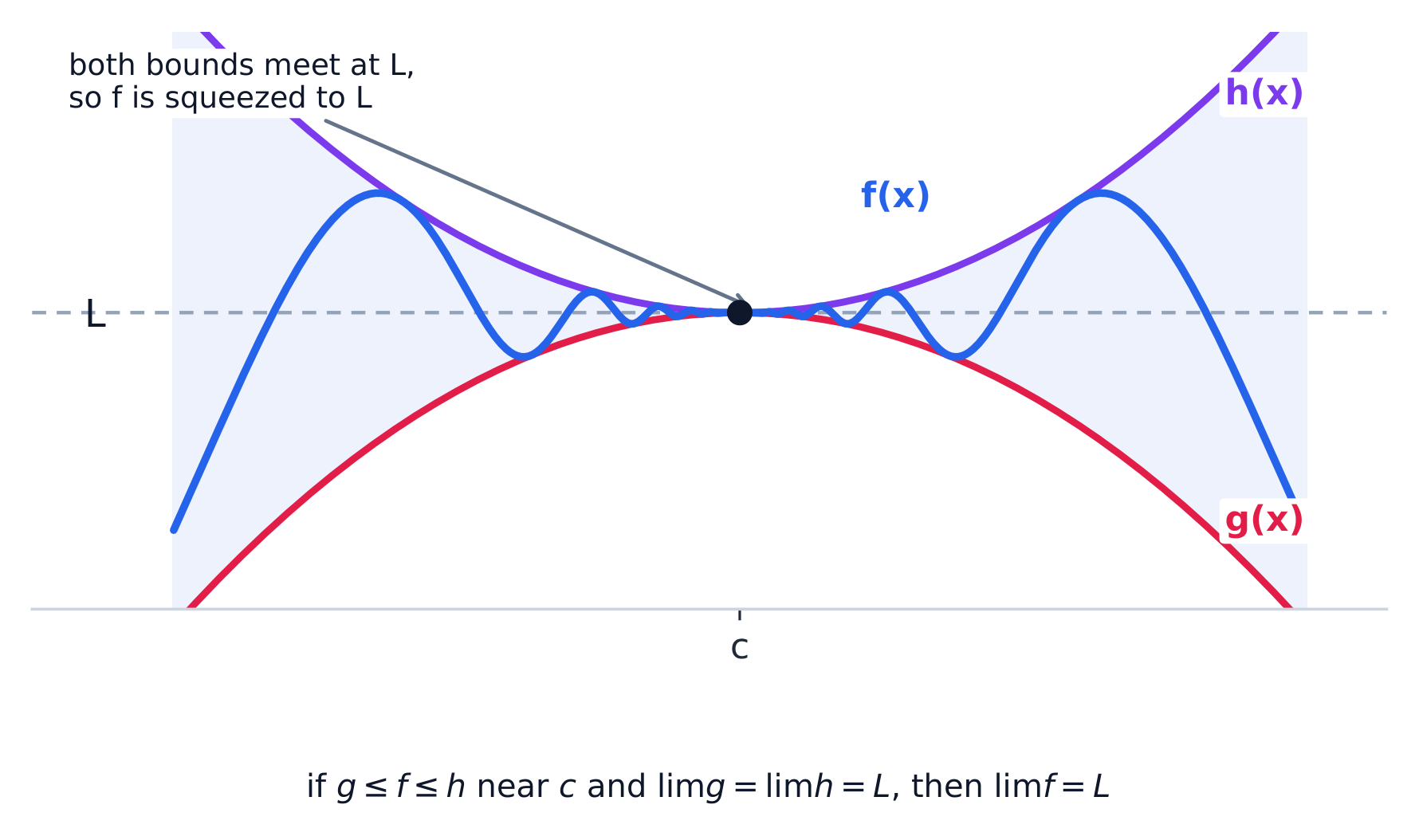
The squeeze theorem 夹逼定理 (also called the sandwich theorem) finds a limit by trapping the function between two others. If $g(x) \le f(x) \le h(x)$ near $c$, and
$$\lim_{x\to c} g(x) = \lim_{x\to c} h(x) = L,$$
then $f$ is squeezed to the same place: $\displaystyle \lim_{x\to c} f(x) = L$.
The two famous results proved this way, both used throughout calculus, are:
Connecting Multiple Representations of Limits · การเชื่อมโยงการแสดงลิมิตหลายรูปแบบ
Syllabus · หลักสูตร
English
This topic is intended to focus on connecting representations. Students should be given opportunities to practice when and how to apply all learning objectives relating to limits and translating mathematical information from a single representation or across multiple representations.
Source: College Board AP Course and Exam Description · แหล่งที่มา: คำอธิบายหลักสูตรและข้อสอบ College Board AP
English
Another skill topic: the same limit lives in a graph, a table, and an algebraic form, and you should be able to translate between them. A graph shows the shape and any holes or jumps; a table gives numerical evidence; algebra gives an exact value and a reason. Strong answers use one representation to confirm another.
In words: the point is there, the limit is there, and the two agree. If any one fails, $f$ is discontinuous at $c$. This test is the backbone of nearly every continuity question, so learn it as a checklist.
Source: College Board AP Course and Exam Description · แหล่งที่มา: คำอธิบายหลักสูตรและข้อสอบ College Board AP
English
A function is continuous on an interval 在区间上连续 if it is continuous at every point of that interval. You rarely check point by point, because whole families are continuous on their domains:
Polynomial, rational, power, exponential 指数, logarithmic 对数, and trigonometric 三角 functions are continuous at every point of their domains.
So a rational function is continuous everywhere except where its denominator is zero; $\ln x$ is continuous for $x>0$; and so on. Knowing this lets you declare continuity quickly and correctly.
Enduring Understanding (LIM-2): Reasoning with definitions, theorems, and properties can be used to justify claims about continuity.
Learning Objective LIM-2.C: Determine values of $x$ or solve for parameters that make discontinuous functions continuous, if possible.
LIM-2.C.1 If the limit of a function exists at a discontinuity in its graph, then it is possible to remove the discontinuity by defining or redefining the value of the function at that point, so it equals the value of the limit of the function as $x$ approaches that point.
LIM-2.C.2 In order for a piecewise-defined function to be continuous at a boundary to the partition of its domain, the value of the expression defining the function on one side of the boundary must equal the value of the expression defining the other side of the boundary, as well as the value of the function at the boundary.
Source: College Board AP Course and Exam Description · แหล่งที่มา: คำอธิบายหลักสูตรและข้อสอบ College Board AP
English
If the limit exists at a hole, the discontinuity is removable: redefine the function at that one point to equal the limit, and the graph is repaired. Formally, set the missing value to $\displaystyle \lim_{x\to c} f(x)$.
For a piecewise-defined function 分段函数, continuity at a boundary $x=c$ needs the two pieces to meet: the left piece's value, the right piece's value, and $f(c)$ must all be equal. This is a common exam setup – you solve for a parameter 参数 (an unknown constant) that makes the pieces match:
ถ้า ลิมิตมีอยู่ ที่รูพรุน ความไม่ต่อเนื่องนั้น กำจัดได้: กำหนดนิยามฟังก์ชันใหม่ที่จุดนั้นเพียงจุดเดียวให้มีค่าเท่ากับลิมิต และกราฟจะถูกซ่อมแซม secara_formally, set the missing value to $\displaystyle \lim_{x\to c} f(x)$.
Source: College Board AP Course and Exam Description · แหล่งที่มา: คำอธิบายหลักสูตรและข้อสอบ College Board AP
English
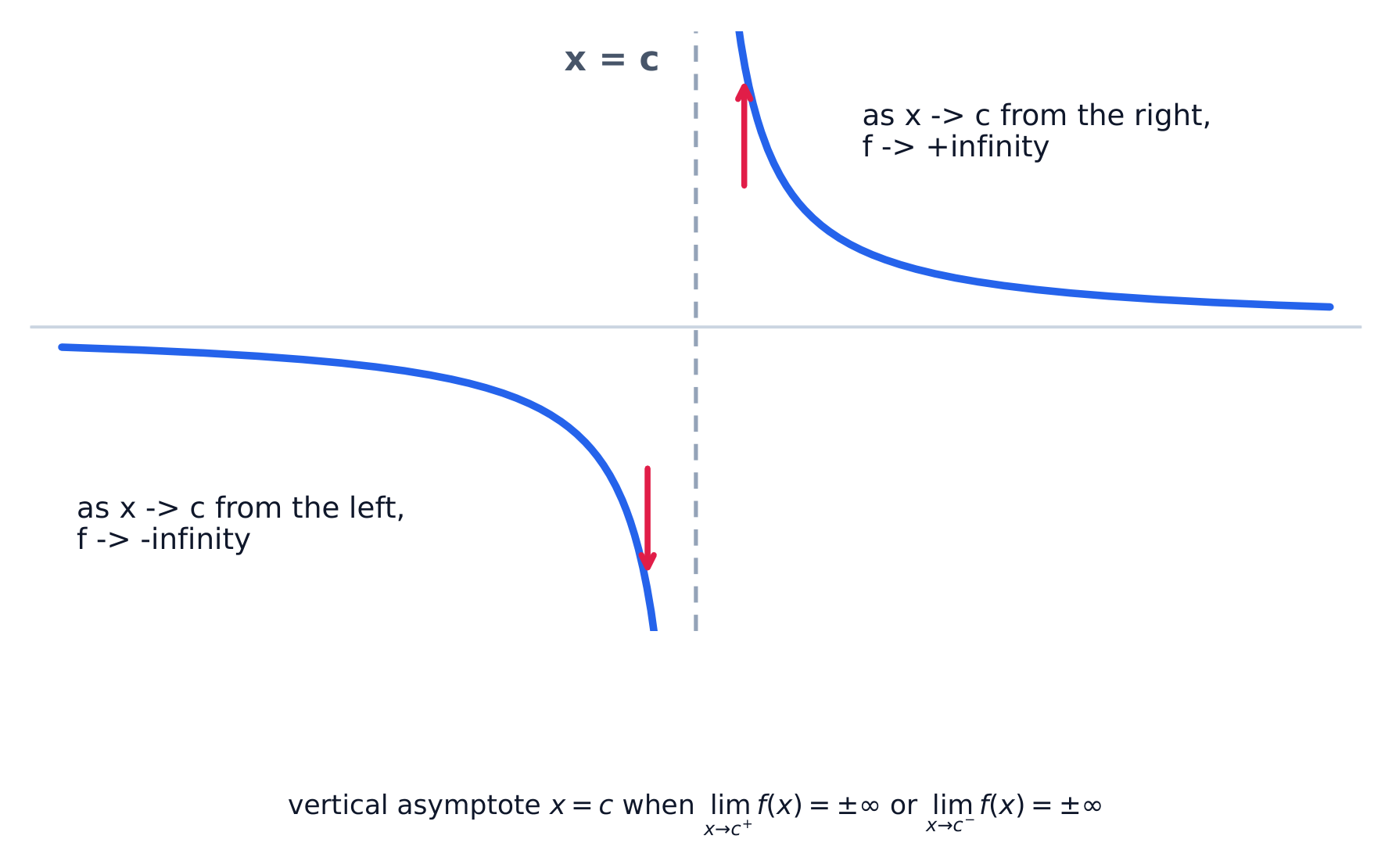
The idea of a limit extends to infinite limits 无穷极限. When a function grows without bound near $x=c$, we write $\lim_{x\to c} f(x) = \pm\infty$. This describes a vertical asymptote at $x=c$: the graph hugs the vertical line $x=c$ and shoots off toward $\pm\infty$.
This happens where a non-zero number is divided by something approaching $0$, such as at a zero of a denominator that does not cancel. Always check each side separately – the two sides can shoot opposite ways (one to $+\infty$, one to $-\infty$).
Explore infinite limits and vertical asymptotes · 探索无穷极限和垂直渐近线
y = a/(x − b) + c
With $y=\dfrac{a}{x-b}+c$, watch the curve blow up to $\pm\infty$ near $x=b$. The vertical asymptote is the line $x=b$ where the infinite limit lives — the two sides can shoot opposite ways. · เมื่อใช้ $y=\dfrac{a}{x-b}+c$ จะเห็นกราฟพุ่งขึ้นสูงถึง $\pm\infty$ ใกล้กับ $x=b$เส้นประจันตั้ง คือเส้น $x=b$ ที่ ลิมิตอนันต์ อยู่ — ทั้งสองด้านอาจพุ่งไปในทิศทางตรงกันข้ามได้
Source: College Board AP Course and Exam Description · แหล่งที่มา: คำอธิบายหลักสูตรและข้อสอบ College Board AP
English
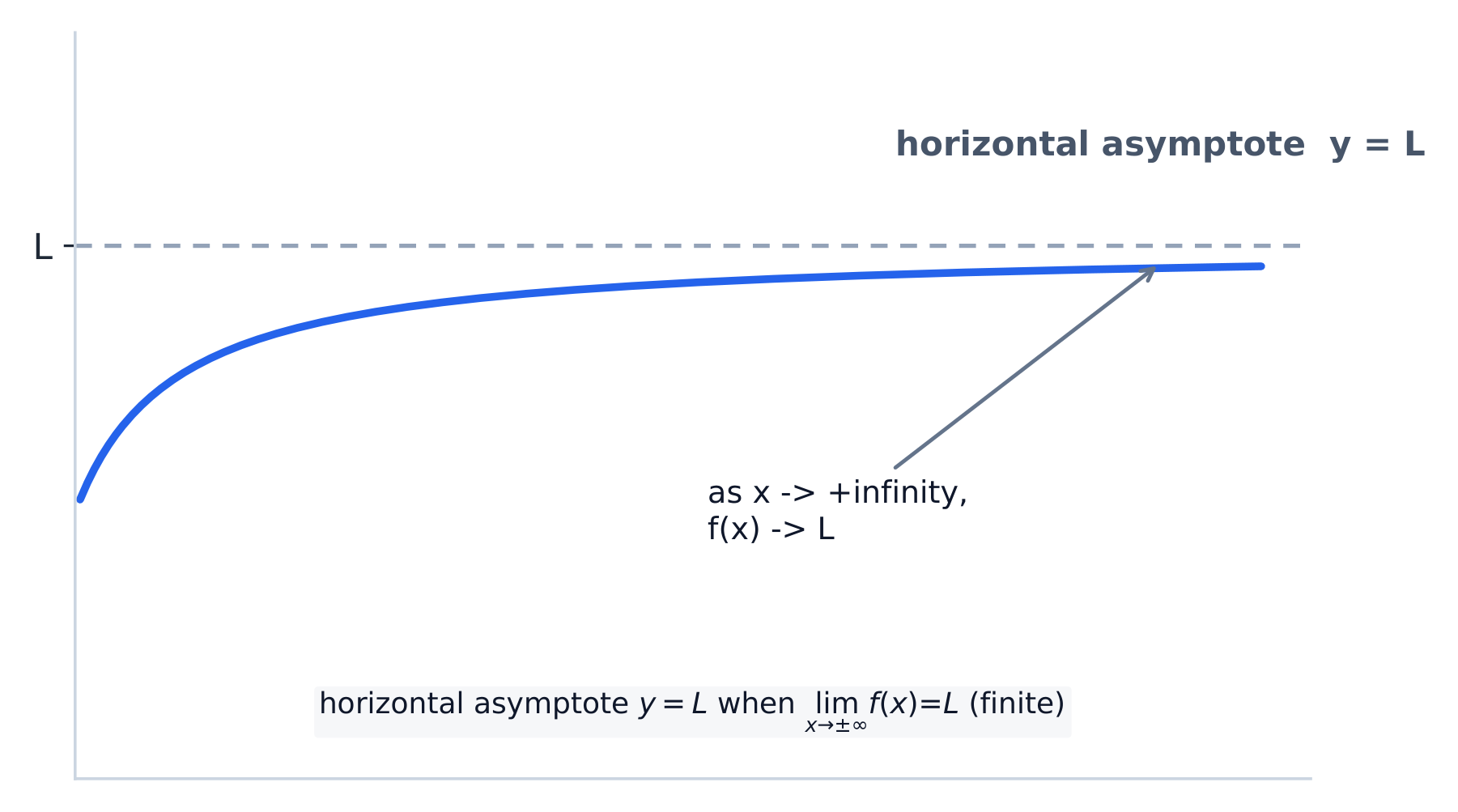
We can also let the input grow: limits at infinity 无穷远处的极限 describe the end behavior 末端行为 of a function as $x\to\pm\infty$. If the outputs settle toward a finite value $L$, then $y=L$ is a horizontal asymptote 水平渐近线.
For a rational function, compare the degrees 次数 of the top and bottom:
top degree < bottom degree $\Rightarrow$ limit is $0$ (asymptote $y=0$);
top degree = bottom degree $\Rightarrow$ limit is the ratio of the leading coefficients 首项系数之比;
top degree > bottom degree $\Rightarrow$ the function is unbounded (no horizontal asymptote).
More generally, we compare the relative magnitudes 相对大小 (relative growth rates) of functions: far out, an exponential beats any polynomial, and a polynomial beats any logarithm. On the exam, "as $t\to\infty$, which quantity is larger/where does the rate settle?" is answered with a limit at infinity.
ไทย
เรายังสามารถทำให้ อินพุต มีค่าเพิ่มขึ้น: ลิมิตที่อนันต์ อธิบาย พฤติกรรมปลายสุด ของฟังก์ชันเมื่อ $x\to\pm\infty$. หากผลลัพธ์เริ่มนิ่งเข้าสู่ค่า有限的$L$, then $y=L$ is a horizontal asymptote.
Explore limits at infinity and horizontal asymptotes · 探索无穷远处的极限和水平渐近线
y = a/(x − b) + c
Follow the curve far out to the right and left. As $x\to\pm\infty$ the outputs settle toward $c$, so $y=c$ is a horizontal asymptote — the finite value of the limit at infinity. · 跟随曲线向右和向左延伸至远处。当$x\to\pm\infty$时,输出值趋于$c$,因此$y=c$是水平渐近线——即无穷远处的极限的有限值。
ratio of the leading coefficients/ˈreɪʃɪəʊ ɒvðə ˈliːdɪŋ ˌkəʊɪˈfɪʃənts/
อัตราส่วนของสัมประสิทธิ์นำ
relative magnitudes/ˈrelətɪv ˈmæɡnɪtjuːdz/
ขนาดสัมพัทธ์
1.16
Working with the Intermediate Value Theorem (IVT) · การทำงานกับทฤษฎีบทค่ากลาง (IVT)
Syllabus · หลักสูตร
English
Enduring Understanding (FUN-1): Existence theorems allow us to draw conclusions about a function's behavior on an interval without precisely locating that behavior.
Learning Objective FUN-1.A: Explain the behavior of a function on an interval using the Intermediate Value Theorem.
FUN-1.A.1 If $f$ is a continuous function on the closed interval $[a, b]$ and $d$ is a number between $f(a)$ and $f(b)$, then the Intermediate Value Theorem guarantees that there is at least one number $c$ between $a$ and $b$, such that $f(c) = d$.
Source: College Board AP Course and Exam Description · แหล่งที่มา: คำอธิบายหลักสูตรและข้อสอบ College Board AP
English
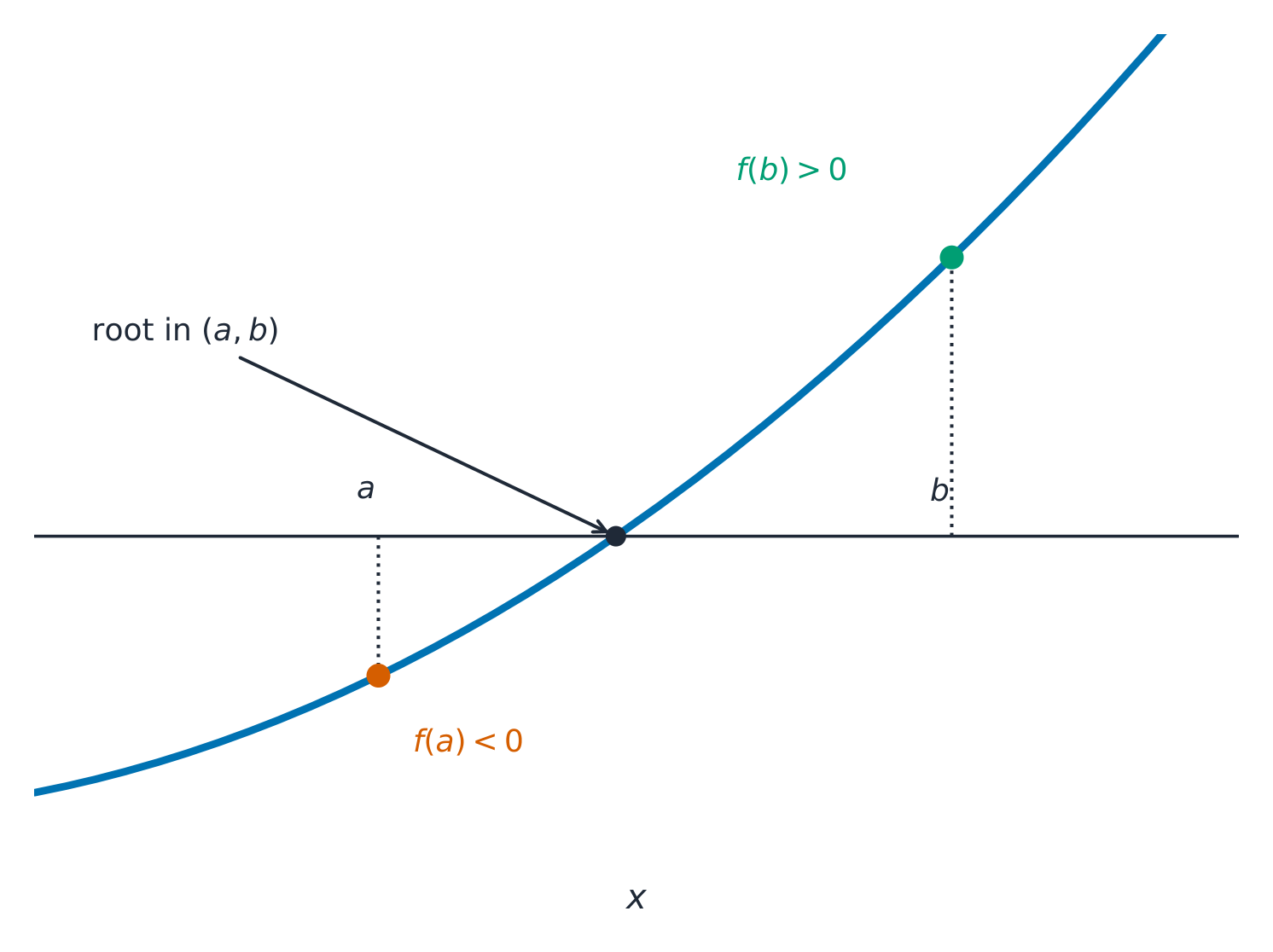
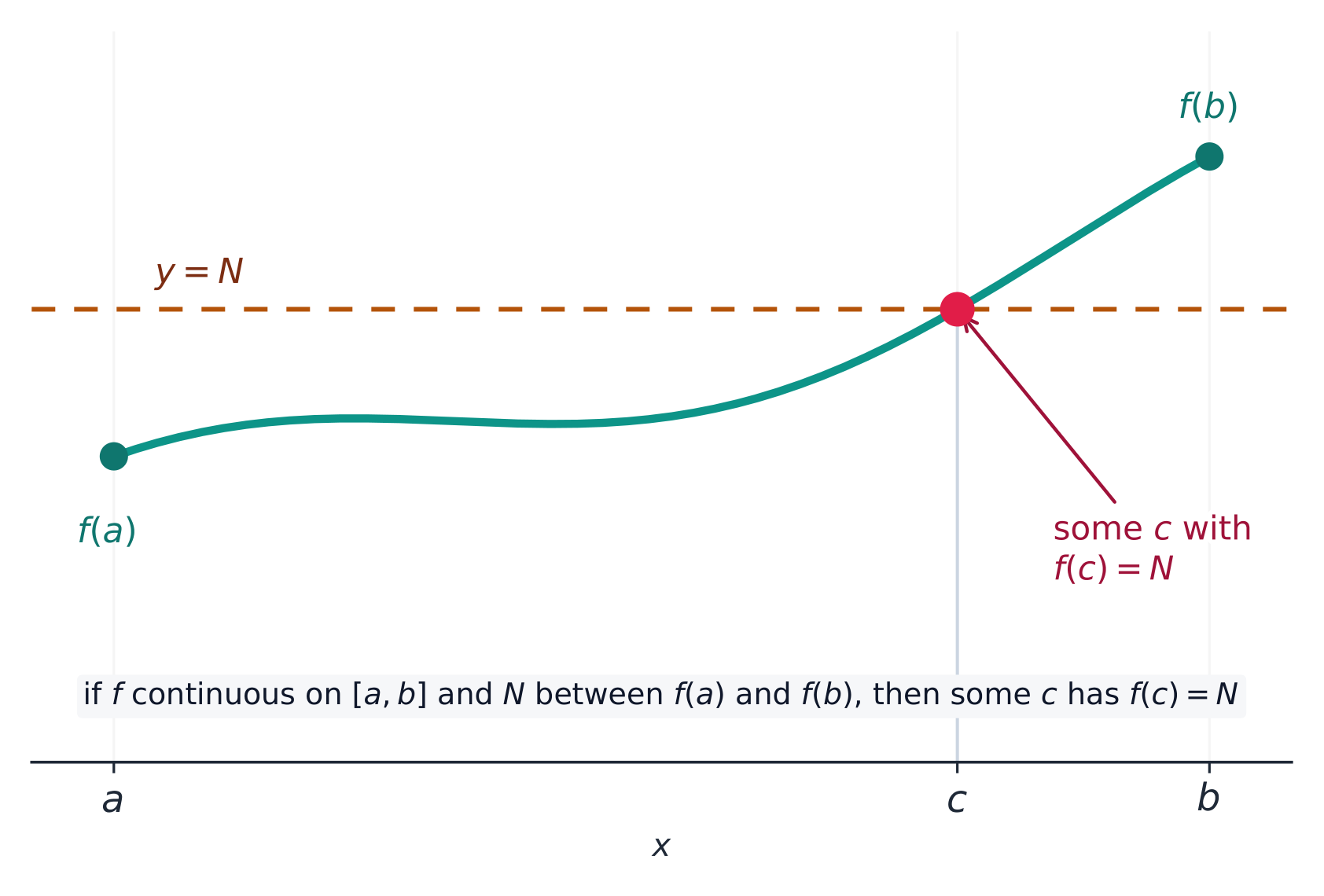
The Intermediate Value Theorem 介值定理 is an existence theorem 存在性定理 – it guarantees a value exists without telling you where:
If $f$ is continuous on the closed interval $[a,b]$, and $d$ is any number between$f(a)$ and $f(b)$, then there is at least one number $c$ in $(a,b)$ with $f(c)=d$.
An unbroken curve cannot skip a height between its endpoints – it must pass through every one.
Exam skill – how to justify with the IVT. These questions appear almost every year (for example, "Must there be a value $c$ with $R(c)=155$?" or "Is there a time when $r'(t)=-6$?"). A full-credit justification has three moves:
State continuity. Say the function is continuous on $[a,b]$ (often because it is differentiable, or given continuous).
Show $d$ is trapped. Compute the two endpoint values and show the target $d$ lies between them, e.g. $f(a) < d < f(b)$.
Conclude by name. "By the Intermediate Value Theorem, there is a $c$ in $(a,b)$ with $f(c)=d$."
Skipping the continuity statement, or not showing $d$ is between the endpoints, loses the point – the theorem requires both conditions.
Worked example. Evaluate $\lim_{x\to 3}\dfrac{x^2-9}{x-3}$. Direct substitution gives $\tfrac{0}{0}$ (indeterminate), so factor: $\dfrac{(x-3)(x+3)}{x-3}=x+3$ for $x\ne 3$. Then $\lim_{x\to 3}(x+3)=6$. The graph has a removable discontinuity (a hole) at $x=3$ — the limit exists even though the function is undefined there.
Why a continuous curve can't skip a value · 连续曲线为何不能跳过某个值
y = ax³ + bx² + cx + d
The Intermediate Value Theorem: a function continuous on $[a,b]$ takes every $y$ between $f(a)$ and $f(b)$ at some point inside. An unbroken curve cannot leap over a height — it must pass through it. · Intermediate Value Theorem: ฟังก์ชันที่ ต่อเนื่อง บนช่วง $[a,b]$ จะรับค่าทุก $y$ ระหว่าง $f(a)$ และ $f(b)$ ที่จุดใดจุดหนึ่งในช่วงนั้น กราฟที่ไม่ขาดตอนไม่สามารถกระโดดข้ามระดับความสูงได้ — มันต้องผ่านจุดนั้น
Average and Instantaneous Rates of Change · อัตราการเปลี่ยนแปลงเฉลี่ยและอัตราการเปลี่ยนแปลงทันที
Syllabus · หลักสูตร
English
Enduring Understanding (CHA-2): Derivatives allow us to determine rates of change at an instant by applying limits to knowledge about rates of change over intervals.
Learning Objective CHA-2.A: Determine average rates of change using difference quotients.
CHA-2.A.1 The difference quotients $\dfrac{f(a+h)-f(a)}{h}$ and $\dfrac{f(x)-f(a)}{x-a}$ express the average rate of change of a function over an interval.
Learning Objective CHA-2.B: Represent the derivative of a function as the limit of a difference quotient.
CHA-2.B.1 The instantaneous rate of change of a function at $x=a$ can be expressed by $\lim\limits_{h\to 0}\dfrac{f(a+h)-f(a)}{h}$ or $\lim\limits_{x\to a}\dfrac{f(x)-f(a)}{x-a}$, provided the limit exists. These are equivalent forms of the definition of the derivative and are denoted $f'(a)$.
The first uses a step of size $h$ from $a$; the second uses two points $x$ and $a$. Both compute $\dfrac{\text{change in output}}{\text{change in input}}$ over the interval.
The instantaneous 瞬时 rate of change at $x=a$ is what the difference quotient approaches as the interval shrinks to zero. This limit is the derivative at $a$, written $f'(a)$:
From average rate to instantaneous rate · 从平均变化率到瞬时变化率
y = ax³ + bx² + cx + d
Slide the point: the secant through two nearby points tips toward the tangent as they merge. The tangent's slope is the derivative — the instantaneous rate of change. · 滑动该点:穿过两个邻近点的割线在两点合并时趋向切线。切线的斜率是导数——即瞬时变化率。
Defining the Derivative and Its Notation · นิยามอนุพันธ์และสัญลักษณ์
Syllabus · หลักสูตร
English
Enduring Understanding (CHA-2): Derivatives allow us to determine rates of change at an instant by applying limits to knowledge about rates of change over intervals.
Learning Objective CHA-2.B: Represent the derivative of a function as the limit of a difference quotient.
CHA-2.B.2 The derivative of $f$ is the function whose value at $x$ is $\lim\limits_{h\to 0}\dfrac{f(x+h)-f(x)}{h}$, provided this limit exists.
CHA-2.B.3 For $y=f(x)$, notations for the derivative include $\dfrac{dy}{dx}$, $f'(x)$, and $y'$.
CHA-2.B.4 The derivative can be represented graphically, numerically, analytically, and verbally.
Learning Objective CHA-2.C: Determine the equation of a line tangent to a curve at a given point.
CHA-2.C.1 The derivative of a function at a point is the slope of the line tangent to a graph of the function at that point.
Source: College Board AP Course and Exam Description · แหล่งที่มา: คำอธิบายหลักสูตรและข้อสอบ College Board AP
English
Let the point $a$ vary and the derivative becomes a new function:
$$f'(x) = \lim_{h\to 0}\frac{f(x+h)-f(x)}{h}.$$
This is the definition of the derivative (sometimes called differentiating "by first principles" 用定义求导). Its value at each $x$ is the instantaneous rate of change there.
Common notations 记号 for the derivative of $y=f(x)$ are:
$$\frac{dy}{dx}, \qquad f'(x), \qquad y'.$$
The derivative can be represented graphically, numerically, analytically, and verbally – be ready to move between them.
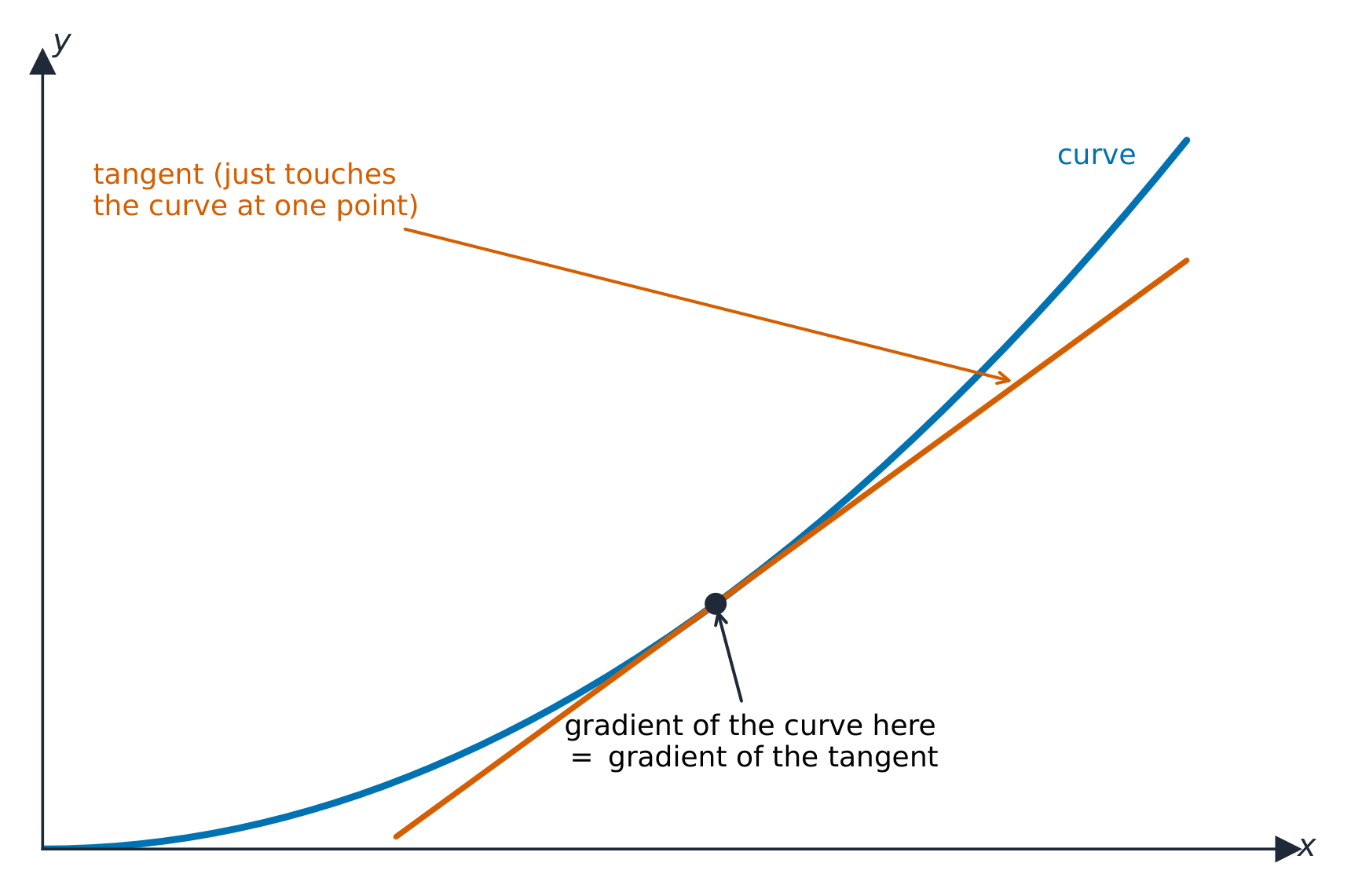
Geometric meaning. The derivative at a point is the slope 斜率 of the tangent line 切线 to the graph there. So the tangent line at $x=a$ passes through $\big(a, f(a)\big)$ with slope $f'(a)$:
$$y - f(a) = f'(a)\,(x-a).$$
Writing this line is a routine exam task, so keep the point-slope form ready.
Estimating a Derivative at a Point · การประมาณค่าอนุพันธ์ ณ จุดหนึ่ง
Syllabus · หลักสูตร
English
Enduring Understanding (CHA-2): Derivatives allow us to determine rates of change at an instant by applying limits to knowledge about rates of change over intervals.
Learning Objective CHA-2.D: Estimate derivatives.
CHA-2.D.1 The derivative at a point can be estimated from information given in tables or graphs.
CHA-2.D.2 Technology can be used to calculate or estimate the value of a derivative of a function at a point.
Source: College Board AP Course and Exam Description · แหล่งที่มา: คำอธิบายหลักสูตรและข้อสอบ College Board AP
English
You do not always have a formula. When a function is given by a table 表格 or a graph, estimate the derivative $f'(a)$ with a difference quotient over a small interval around $a$. A table with values on both sides of $a$ gives the best estimate:
$$f'(a) \approx \frac{f(b)-f(c)}{b-c},\qquad \text{where } c < a < b \text{ are the closest table inputs}.$$
Technology (a calculator) can also estimate a derivative at a point.
Exam skill (appears almost every year). Questions such as "Approximate $M'(7.5)$ using the average rate of change of $M$ over the interval $5 \le t \le 10$" ask for exactly this difference quotient. Show the setup:
$$M'(7.5) \approx \frac{M(10)-M(5)}{10-5}.$$
Full credit needs the numbers plugged in and the correct units 单位 (output units per input unit), since these come from real-world models.
When Does a Derivative Exist? · เมื่อใดที่อนุพันธ์จะเกิดขึ้น?
Syllabus · หลักสูตร
English
Enduring Understanding (FUN-2): Recognizing that a function's derivative may also be a function allows us to develop knowledge about the related behaviors of both.
Learning Objective FUN-2.A: Explain the relationship between differentiability and continuity.
FUN-2.A.1 If a function is differentiable at a point, then it is continuous at that point. In particular, if a point is not in the domain of $f$, then it is not in the domain of $f'$.
FUN-2.A.2 A continuous function may fail to be differentiable at a point in its domain.
Illustrative examples for FUN-2.A.2:
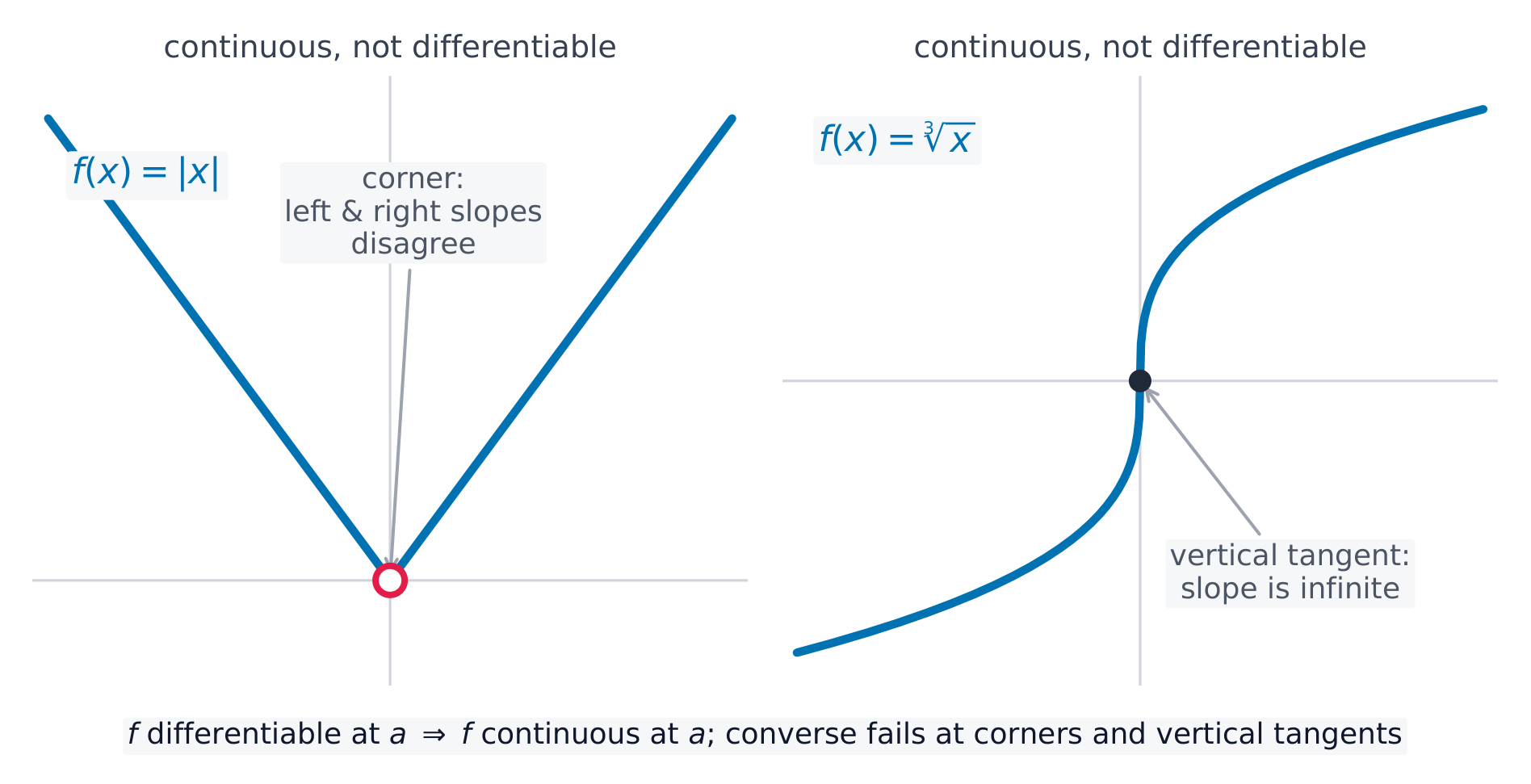
The left hand and right hand limits of the difference quotient are not equal, as in $f(x)=|x|$ at $x=0$.
The tangent line is vertical and has no slope, as in $f(x)=\sqrt[3]{x}$ at $x=0$.
Source: College Board AP Course and Exam Description · แหล่งที่มา: คำอธิบายหลักสูตรและข้อสอบ College Board AP
English
Differentiability is stronger than continuity. The key relationship:
If $f$ is differentiable 可导 at a point, then $f$ is continuous 连续 there.
So differentiability implies continuity. The reverse is false: a continuous function can fail to be differentiable. Two ways this happens:
A corner 尖点: the left and right difference-quotient limits disagree, as with $f(x)=|x|$ at $x=0$.
A vertical tangent 垂直切线: the slope is infinite (no real number), as with $f(x)=\sqrt[3]{x}$ at $x=0$.
Also, a point outside the domain of $f$ cannot be in the domain of $f'$. Use the contrapositive on the exam: if $f$ is not continuous at $a$, then $f$ is not differentiable at $a$.
Enduring Understanding (FUN-3): Recognizing opportunities to apply derivative rules can simplify differentiation.
Learning Objective FUN-3.A: Calculate derivatives of familiar functions.
FUN-3.A.1 Direct application of the definition of the derivative and specific rules can be used to calculate the derivative for functions of the form $f(x)=x^{r}$.
Source: College Board AP Course and Exam Description · แหล่งที่มา: คำอธิบายหลักสูตรและข้อสอบ College Board AP
English
From here we use rules instead of the limit definition each time. The power rule 幂法则 handles any power of $x$:
$$\frac{d}{dx}\,x^{r} = r\,x^{\,r-1}\qquad\text{for any real } r.$$
It works for whole-number powers, negative powers ($\tfrac{1}{x}=x^{-1}$), and roots ($\sqrt{x}=x^{1/2}$) – rewrite as a power first, then apply the rule.
A power function and its steepening slope · ฟังก์ชันกำลังและความชันที่เพิ่มขึ้น
y = ax³ + bx² + cx + d
The power rule$\frac{d}{dx}x^n = nx^{n-1}$ drops the exponent as a factor. For $x^3$ the slope grows quickly as $x$ moves from 0 — the curve steepens. · กฎกำลัง $\frac{d}{dx}x^n = nx^{n-1}$ ลดเลขชี้กำลังลงมาเป็นตัวคูณ สำหรับ $x^3$ ความชันจะเพิ่มขึ้นอย่างรวดเร็วเมื่อ $x$ ย้ายออกจาก 0 — เส้นโค้งจะชันขึ้น
Derivatives of sin x, cos x, e^x, and ln x · อนุพันธ์ของ sin x, cos x, e^x และ ln x
Syllabus · หลักสูตร
English
Enduring Understanding (FUN-3): Recognizing opportunities to apply derivative rules can simplify differentiation.
Learning Objective FUN-3.A: Calculate derivatives of familiar functions.
FUN-3.A.4 Specific rules can be used to find the derivatives for sine, cosine, exponential, and logarithmic functions.
Enduring Understanding (LIM-3): Reasoning with definitions, theorems, and properties can be used to determine a limit.
Learning Objective LIM-3.A: Interpret a limit as a definition of a derivative.
LIM-3.A.1 In some cases, recognizing an expression for the definition of the derivative of a function whose derivative is known offers a strategy for determining a limit.
Source: College Board AP Course and Exam Description · แหล่งที่มา: คำอธิบายหลักสูตรและข้อสอบ College Board AP
English
Learn these four building-block derivatives by heart:
$$\frac{d}{dx}\sin x = \cos x, \qquad \frac{d}{dx}\cos x = -\sin x,$$
$$\frac{d}{dx}e^{x} = e^{x}, \qquad \frac{d}{dx}\ln x = \frac{1}{x}\ \ (x>0).$$
Note the minus sign on the derivative of cosine, and that $e^{x}$ is its own derivative.
A limit that is really a derivative (LIM-3.A.1). Sometimes a limit is secretly the definition of a known derivative. If you recognize
$$\lim_{h\to 0}\frac{f(a+h)-f(a)}{h}$$
for a function $f$ whose derivative you know, just evaluate $f'(a)$. For example, $\displaystyle \lim_{h\to 0}\frac{\sin\!\big(\tfrac{\pi}{2}+h\big)-1}{h} = \left.\frac{d}{dx}\sin x\right|_{x=\pi/2} = \cos\tfrac{\pi}{2} = 0$.
ไทย
จำอนุพันธ์พื้นฐานสี่ตัวนี้ให้ได้:
$$\frac{d}{dx}\sin x = \cos x, \qquad \frac{d}{dx}\cos x = -\sin x,$$
$$\frac{d}{dx}e^{x} = e^{x}, \qquad \frac{d}{dx}\ln x = \frac{1}{x}\ \ (x>0).$$
สังเกตเครื่องหมายลบในอนุพันธ์ของโคไซน์ และ اینکه $e^{x}$ เป็นอนุพันธ์ของตัวเอง
The shape of sin x (whose slope is cos x) · sin x的形状(其斜率为cos x)
y = asin(bx + c) + d
The derivative of $\sin x$ is $\cos x$: the slope of the sine curve is largest where sine crosses zero and zero at its peaks. Watch the curve to feel where its slope is steep or flat. · อนุพันธ์ของ $\sin x$ คือ $\cos x$: ความชันของเส้นโค้งไซน์มีค่ามากสุดเมื่อ سینัสตัดแกนศูนย์ และมีค่าเป็นศูนย์ที่จุดยอด ดูเส้นโค้งเพื่อสัมผัสว่าความชันตรงไหนชันหรือแบน
Exam questions often build a new function from given pieces, e.g. $k'(x) = \big(f(x)\big)^2 g(x)$, and ask you to combine rules while reading values from a table.
"Bottom times derivative of top, minus top times derivative of bottom, all over bottom squared." The order matters because of the minus sign, so write the numerator carefully. Example:
$$\frac{d}{dx}\!\left(\frac{x}{\cos x}\right) = \frac{1\cdot\cos x - x\cdot(-\sin x)}{\cos^2 x} = \frac{\cos x + x\sin x}{\cos^2 x}.$$
Source: College Board AP Course and Exam Description · แหล่งที่มา: คำอธิบายหลักสูตรและข้อสอบ College Board AP
English
The quotient rule: differentiating a fraction
The remaining trigonometric derivatives are not memorized separately – you rewrite them with identities 恒等式 and apply the quotient (or product) rule. For instance, $\tan x = \dfrac{\sin x}{\cos x}$, so the quotient rule gives
$$\frac{d}{dx}\tan x = \frac{\cos x\cos x - \sin x(-\sin x)}{\cos^2 x} = \frac{1}{\cos^2 x} = \sec^2 x.$$
The same method (writing $\cot x=\tfrac{\cos x}{\sin x}$, $\sec x=\tfrac{1}{\cos x}$, $\csc x=\tfrac{1}{\sin x}$) gives $-\csc^2 x$, $\sec x\tan x$, and $-\csc x\cot x$.
Higher-order derivatives. Differentiating $f'$ again gives the second derivative 二阶导数$f''(x)$ (or $\tfrac{d^2y}{dx^2}$) – the rate of change of the rate of change. An exam part like "Find $k''(3)$" just means differentiate twice, then substitute. You can also estimate a second derivative from a table by applying the average-rate-of-change method to the $f'$ values.
Worked example. Differentiate $f(x)=x^2\sin x$ with the product rule$(uv)'=u'v+uv'$: take $u=x^2$ ($u'=2x$) and $v=\sin x$ ($v'=\cos x$), giving $f'(x)=2x\sin x+x^2\cos x$. Always read the structure first — a product needs the product rule, not the power rule applied to each factor separately.
Source: College Board AP Course and Exam Description · แหล่งที่มา: คำอธิบายหลักสูตรและข้อสอบ College Board AP
English
The chain rule
Unit 2 differentiated single functions. Unit 3 differentiates functions built inside other functions. The chain rule 链式法则 differentiates a composite function 复合函数$f\big(g(x)\big)$:
"Derivative of the outer function (leaving the inside alone), times the derivative of the inside." The inner derivative $g'(x)$ is the piece students forget, so always ask "what is the inside, and what is its derivative?" Example:
$$\frac{d}{dx}\sin(x^2) = \cos(x^2)\cdot 2x.$$
In Leibniz notation, with $y=f(u)$ and $u=g(x)$, the rule reads $\dfrac{dy}{dx}=\dfrac{dy}{du}\cdot\dfrac{du}{dx}$ – the intermediate $du$ appears to "cancel." Exam questions often give a table for $f$, $g$, $f'$, $g'$ and ask for $h'(a)$ where $h(x)=f\big(g(x)\big)$; evaluate $f'\big(g(a)\big)\cdot g'(a)$ by reading values.
Worked example. Differentiate $h(x)=(2x^2+1)^5$. The outer function is "(something)$^5$", the inner is $2x^2+1$:
Source: College Board AP Course and Exam Description · แหล่งที่มา: คำอธิบายหลักสูตรและข้อสอบ College Board AP
English
Some curves are defined implicitly – by an equation in $x$ and $y$ that is not solved for $y$, such as $x^2+y^2=25$. Implicit differentiation 隐函数求导 finds $\dfrac{dy}{dx}$ without solving for $y$ first. It is just the chain rule, treating $y$ as a function of $x$.
The method: differentiate both sides with respect to $x$; every time you differentiate a $y$-term, multiply by $\dfrac{dy}{dx}$ (the chain rule); then solve algebraically for $\dfrac{dy}{dx}$. For $x^2+y^2=25$:
Worked example. Find the tangent line to the circle $x^2+y^2=25$ at the point $(3,4)$. From above $\dfrac{dy}{dx}=-\dfrac{x}{y}=-\dfrac{3}{4}$ there, so the tangent is
$$y-4=-\tfrac{3}{4}(x-3).$$
Notice the tangent is perpendicular to the radius, as geometry promises – a good sanity check.
Exam skill – "Show that $\dfrac{dy}{dx}=\ldots$". This exact prompt appears most years (e.g. "Show that $\dfrac{dy}{dx}=\dfrac{2y}{y^2-2x}$"). Because the target is given, you must show every algebra step cleanly: differentiate both sides, use the product/chain rules on mixed $xy$ terms, collect all $\dfrac{dy}{dx}$ terms on one side, factor, and divide. A correct final line that skips the algebra earns little. Follow-up parts then ask for a tangent line, or where the tangent is horizontal ($\tfrac{dy}{dx}=0$, so the numerator is $0$) or vertical (the denominator is $0$).
Enduring Understanding (FUN-3): Recognizing opportunities to apply derivative rules can simplify differentiation.
Learning Objective FUN-3.E: Calculate derivatives of inverse and inverse trigonometric functions.
FUN-3.E.1 The chain rule and definition of an inverse function can be used to find the derivative of an inverse function, provided the derivative exists.
In words: the derivative of the inverse at a point is the reciprocal 倒数 of the derivative of the original function at the matching point. A common exam setup gives a table and a point $(a,b)$ on $f$ (so $(b,a)$ is on $g$), then asks for $g'(b)=\dfrac{1}{f'(a)}$.
Worked example. Suppose $f(2)=5$ and $f'(2)=3$, and $g$ is the inverse of $f$. Because $(2,5)$ lies on $f$, the point $(5,2)$ lies on $g$, and
$$g'(5)=\frac{1}{f'(2)}=\frac{1}{3}.$$
The graphs of $f$ and $g$ are mirror images across $y=x$, so their slopes at matching points are reciprocals.
An exponential and its inverse the logarithm · ฟังก์ชันเอกซ์โพเนนเชียลและฟังก์ชันผกผันคือลอการิทึม
y = a·e^(bx) + c
Inverse functions are mirror images across $y=x$, and their slopes are reciprocals: $\frac{d}{dx}[f^{-1}(x)] = \dfrac{1}{f'(f^{-1}(x))}$. Where one is steep, its inverse is shallow. · ฟังก์ชันผกผันเป็นภาพสะท้อนกันผ่าน $y=x$ และความชันของพวกมันเป็นผล역กัน: $\frac{d}{dx}[f^{-1}(x)] = \dfrac{1}{f'(f^{-1}(x))}$. ที่ใดหนึ่งชัน ฟังก์ชันผกผันของมันจะแบน
Enduring Understanding (FUN-3): Recognizing opportunities to apply derivative rules can simplify differentiation.
Learning Objective FUN-3.E: Calculate derivatives of inverse and inverse trigonometric functions.
FUN-3.E.2 The chain rule applied with the definition of an inverse function, or the formula for the derivative of an inverse function, can be used to find the derivatives of inverse trigonometric functions.
Selecting Procedures for Calculating Derivatives · การเลือกขั้นตอนสำหรับการหาอนุพันธ์
Syllabus · หลักสูตร
English
This topic is intended to focus on the skill of selecting an appropriate procedure for calculating derivatives. Students should be given opportunities to practice when and how to apply all learning objectives relating to calculating derivatives.
Enduring Understanding (FUN-3): Recognizing opportunities to apply derivative rules can simplify differentiation.
Learning Objective FUN-3.F: Determine higher order derivatives of a function.
FUN-3.F.1 Differentiating $f'$ produces the second derivative $f''$, provided the derivative of $f'$ exists; repeating this process produces higher-order derivatives of $f$.
FUN-3.F.2 Higher-order derivatives are represented with a variety of notations. For $y = f(x)$, notations for the second derivative include $\dfrac{d^2 y}{dx^2}$, $f''(x)$, and $y''$. Higher-order derivatives can be denoted $\dfrac{d^n y}{dx^n}$ or $f^{(n)}(x)$.
Source: College Board AP Course and Exam Description · แหล่งที่มา: คำอธิบายหลักสูตรและข้อสอบ College Board AP
English
Differentiating $f'$ produces the second derivative 二阶导数$f''$; repeating gives higher-order derivatives. The notations:
$$f''(x)=\frac{d^2y}{dx^2}=y'', \qquad\text{and in general}\qquad f^{(n)}(x)=\frac{d^n y}{dx^n}.$$
The second derivative measures how the slope is changing; it drives concavity 凹凸性 and acceleration in later units. To find $f''$ implicitly, differentiate the expression for $\dfrac{dy}{dx}$ again (with the quotient and chain rules), then substitute $\dfrac{dy}{dx}$ back in.
Slope of the slope: the second derivative · ความชันของความชัน: อนุพันธ์อันดับสอง
y = ax³ + bx² + cx + d
Differentiating again gives the second derivative — the rate at which the slope changes. Where the tangent's slope is itself increasing, the curve bends upward (concave up). · หาอนุพันธ์อีกครั้งจะได้ อนุพันธ์อันดับสอง — อัตราการเปลี่ยนแปลงของความชัน ที่何处ความชันของเส้นสัมผัสเองก็เพิ่มขึ้น เส้นโค้งจะงอขึ้น (เว้าขึ้น)
Source: College Board AP Course and Exam Description · แหล่งที่มา: คำอธิบายหลักสูตรและข้อสอบ College Board AP
English
Once you can compute derivatives, you use them to describe the real world. The derivative $f'(x)$is the instantaneous rate of change of $f$ with respect to its input. Reading and reporting this rate correctly is a graded skill.
Units matter. The unit of $f'(x)$ is the unit of $f$ divided by the unit of $x$. If $C(t)$ is a number of acres and $t$ is in weeks, then $C'(t)$ is in acres per week. On the exam, "Using correct units, interpret the meaning of $g'(140)$" wants a full sentence: the value, the quantity, the rate word "per", and the moment. For example: "$g'(140)=2.3$ means that at $x=140$, the quantity is increasing at about $2.3$ units per unit of $x$."
Source: College Board AP Course and Exam Description · แหล่งที่มา: คำอธิบายหลักสูตรและข้อสอบ College Board AP
English
For a particle moving on a line, three functions of time are linked by differentiation:
position 位置$s(t)$;
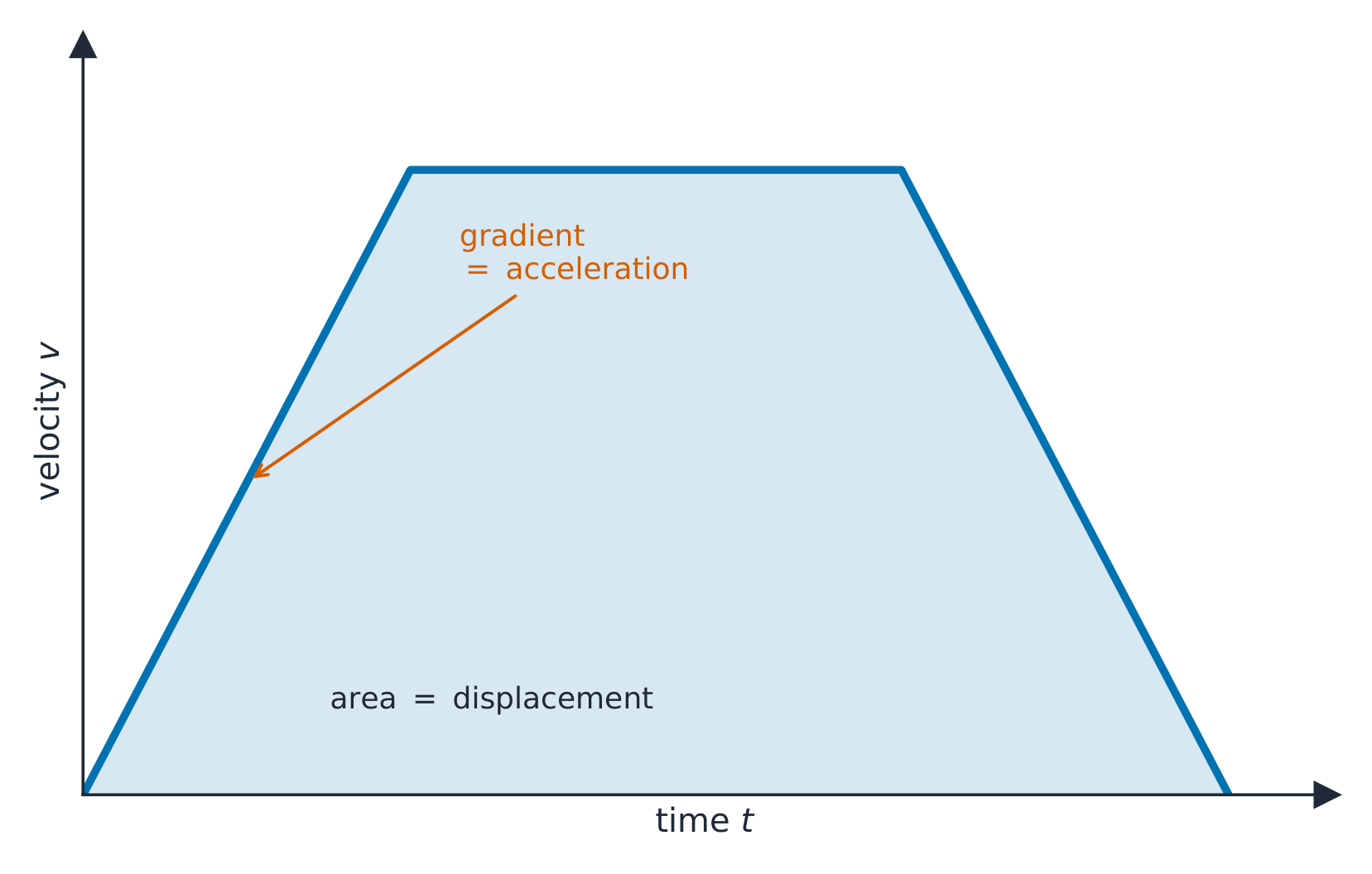
velocity 速度$v(t)=s'(t)$ – signed; its sign gives direction;
acceleration 加速度$a(t)=v'(t)=s''(t)$.
Key readings (frequent exam parts):
The particle is at rest 静止 when $v(t)=0$.
It moves right/up when $v(t)>0$ and left/down when $v(t)<0$; it changes direction where $v$ changes sign.
Speed 速率 is $|v(t)|$. Speed is increasing when $v$ and $a$ have the same sign (the particle is speeding up), and decreasing when they have opposite signs.
Worked example. A particle moves with $s(t)=t^3-6t^2+9t$. Then $v(t)=3t^2-12t+9=3(t-1)(t-3)$, so it is at rest at $t=1$ and $t=3$, and changes direction at each. At $t=2$, $v(2)=3(1)(-1)=-3<0$ (moving left) and $a(2)=6(2)-12=0$; just after, $a>0$ while $v<0$, so it is slowing down there. Distinguish carefully between velocity (has direction) and speed (does not) – the exam tests this exact difference.
Velocity is the slope of position · ความเร็วคือความชันของตำแหน่ง
y = ax³ + bx² + cx + d
For straight-line motion, velocity is the derivative (slope) of position and acceleration the derivative of velocity. Slide the point to read the instantaneous velocity. · สำหรับการเคลื่อนที่แบบเส้นตรง ความเร็ว คืออนุพันธ์ (ความชัน) ของตำแหน่ง และ ความเร่ง คืออนุพันธ์ของความเร็ว เลื่อนจุดเพื่ออ่านความเร็วชั่วขณะ
Source: College Board AP Course and Exam Description · แหล่งที่มา: คำอธิบายหลักสูตรและข้อสอบ College Board AP
English
The same derivative idea models any changing quantity: a draining tank, a spreading population, a cooling cup. Whenever a problem says "the rate at which...", it is describing a derivative. Read the units to know which quantity's rate you have, then interpret in context.
Introduction to Related Rates · บทนำเรื่องอัตราที่เกี่ยวข้องกัน
Syllabus · หลักสูตร
English
Enduring Understanding (CHA-3): Derivatives allow us to solve real-world problems involving rates of change.
Learning Objective CHA-3.D: Calculate related rates in applied contexts.
CHA-3.D.1 The chain rule is the basis for differentiating variables in a related rates problem with respect to the same independent variable.
CHA-3.D.2 Other differentiation rules, such as the product rule and the quotient rule, may also be necessary to differentiate all variables with respect to the same independent variable.
Source: College Board AP Course and Exam Description · แหล่งที่มา: คำอธิบายหลักสูตรและข้อสอบ College Board AP
English
Related rates: a sliding ladder
In a related rates 相关变化率 problem, several quantities change together over time, and you know some rates but want another. The engine is the chain rule: differentiate a relationship with respect to time $t$. Every variable becomes a function of $t$, so each derivative picks up a "$\,/\,dt$" factor. Product and quotient rules may also be needed.
Solving Related Rates Problems · วิธีแก้โจทย์อัตราที่เกี่ยวข้องกัน
Syllabus · หลักสูตร
English
Enduring Understanding (CHA-3): Derivatives allow us to solve real-world problems involving rates of change.
Learning Objective CHA-3.E: Interpret related rates in applied contexts.
CHA-3.E.1 The derivative can be used to solve related rates problems; that is, finding a rate at which one quantity is changing by relating it to other quantities whose rates of change are known.
CHA-3.E.1 อนุพันธ์สามารถใช้แก้ปัญหาระดับอัตราการเปลี่ยนแปลงที่เกี่ยวข้อง นั่นคือการหาอัตราที่ปริมาณหนึ่งมีการเปลี่ยนแปลงโดยการเชื่อมโยง它与ปริมาณอื่นwhose rates of change are known
Source: College Board AP Course and Exam Description · แหล่งที่มา: คำอธิบายหลักสูตรและข้อสอบ College Board AP
English
A reliable procedure – and a full-credit template on the exam:
Name the variables and write down the given rates and the unknown rate (e.g. "$\dfrac{dh}{dt}=-2$ cm/day, find $\dfrac{dV}{dt}$").
Write an equation relating the quantities (often a geometric or volume formula).
Differentiate both sides with respect to $t$ (chain rule) – before substituting numbers.
Substitute the known values at the instant of interest, and solve for the unknown rate.
State the answer with units and the correct sign (a decreasing quantity has a negative rate).
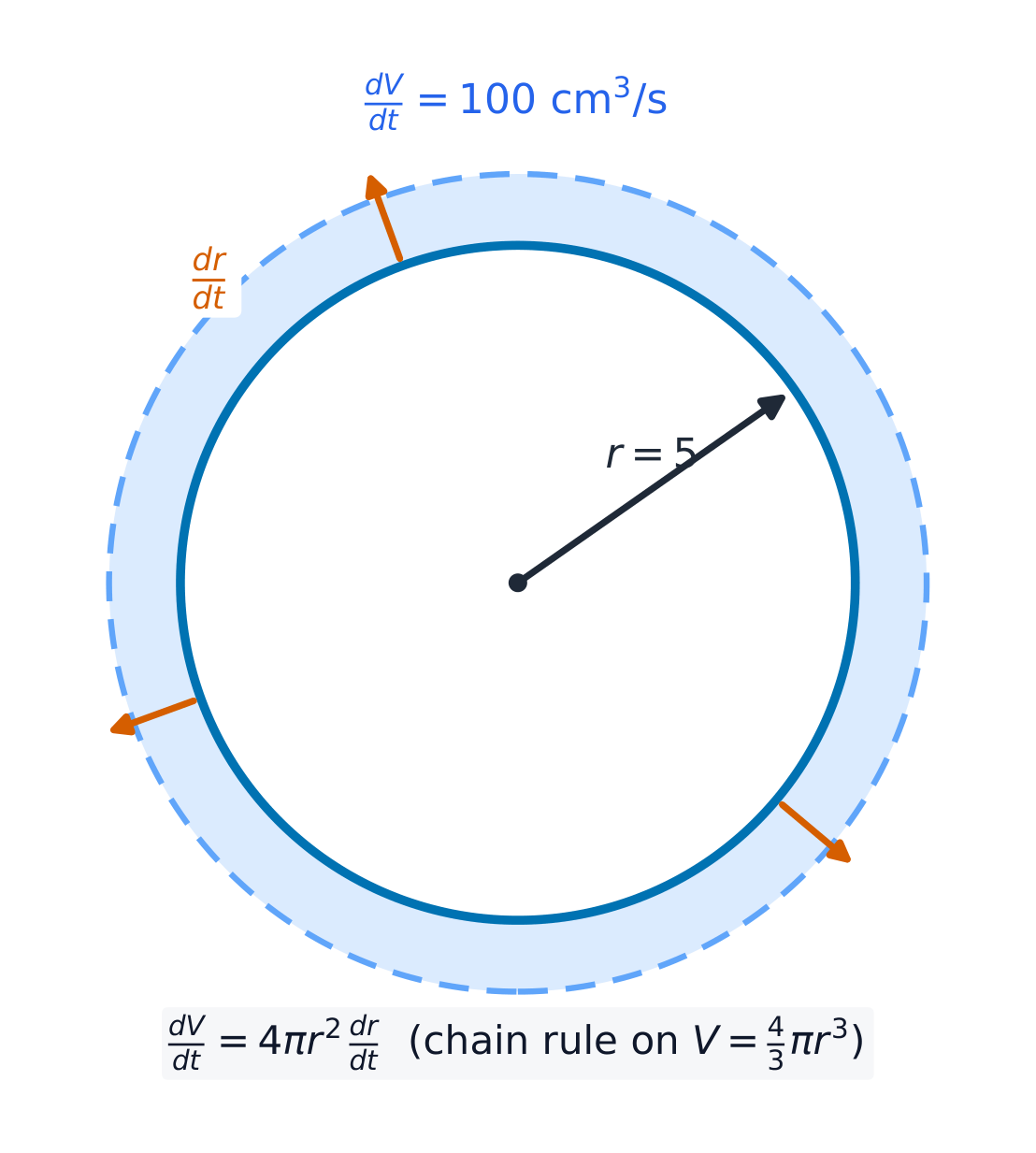
Worked example. Air is pumped into a spherical balloon so its volume grows at $\dfrac{dV}{dt}=100\ \text{cm}^3/\text{s}$. How fast is the radius growing when $r=5\ \text{cm}$? Start from $V=\tfrac43\pi r^3$ and differentiate with respect to $t$first:
Local Linearity and Linearization · ความเป็นเส้นตรงในท้องถิ่นและการประมาณเส้นตรง
Syllabus · หลักสูตร
English
Enduring Understanding (CHA-3): Derivatives allow us to solve real-world problems involving rates of change.
Learning Objective CHA-3.F: Approximate a value on a curve using the equation of a tangent line.
CHA-3.F.1 The tangent line is the graph of a locally linear approximation of the function near the point of tangency.
CHA-3.F.2 For a tangent line approximation, the function's behavior near the point of tangency may determine whether a tangent line value is an underestimate or an overestimate of the corresponding function value.
Source: College Board AP Course and Exam Description · แหล่งที่มา: คำอธิบายหลักสูตรและข้อสอบ College Board AP
English
Local linearity and linearisation
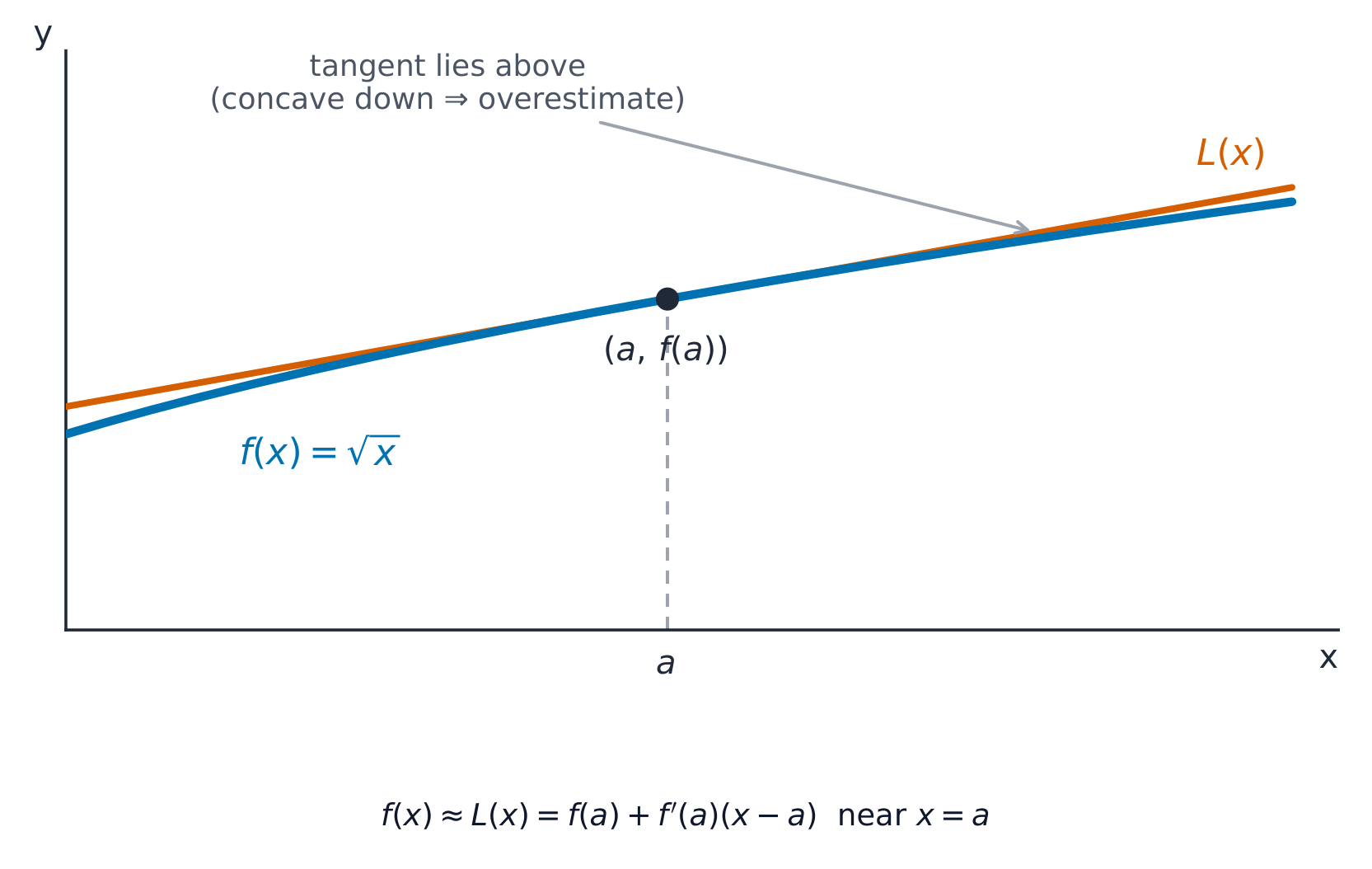
Near a point of tangency, a smooth curve looks like its tangent line – this is local linearity 局部线性. So the tangent line gives a linear approximation 线性近似 (linearization) of the function near that point:
$$f(x) \approx L(x) = f(a) + f'(a)(x-a).$$
Use it to estimate $f$ at an $x$ close to $a$.
Worked example. Estimate $\sqrt{4.1}$. Take $f(x)=\sqrt{x}$ and $a=4$: $f(4)=2$ and $f'(x)=\dfrac{1}{2\sqrt{x}}$ so $f'(4)=\dfrac14$. Then $L(4.1)=2+\tfrac14(4.1-4)=2.025$ (the true value is $2.0248\ldots$). Because $\sqrt{x}$ is concave down, the tangent lies above the curve, so this is a slight overestimate 高估 – justify over/under with the sign of $f''$.
Approximate a curve with its tangent line · ประมาณเส้นโค้งด้วยเส้นสัมผัส
y = ax³ + bx² + cx + d
Local linearity: near a point a smooth curve looks like its tangent line, so the tangent gives a good linear approximation of nearby values. · ความเป็นเส้นตรงในท้องถิ่น: ใกล้จุดหนึ่ง เส้นโค้งเรียบดูเหมือน เส้นสัมผัส ของมัน ดังนั้นเส้นสัมผัสจึงเป็นการประมาณเชิงเส้นที่ดีสำหรับค่าใกล้เคียง
4.7
L'Hospital's Rule for Indeterminate Forms · กฎของ L'Hospital สำหรับรูปไม่กำหนดได้
Syllabus · หลักสูตร
English
Enduring Understanding (LIM-4): L'Hospital's Rule allows us to determine the limits of some indeterminate forms.
Learning Objective LIM-4.A: Determine limits of functions that result in indeterminate forms.
LIM-4.A.1 When the ratio of two functions tends to $\dfrac{0}{0}$ or $\dfrac{\infty}{\infty}$ in the limit, such forms are said to be indeterminate.
Exclusion statement: There are many other indeterminate forms, such as $\infty - \infty$, for example, but these will not be assessed on either the AP Calculus AB or BC Exam. However, teachers may include these topics, if time permits.
LIM-4.A.2 Limits of the indeterminate forms $\dfrac{0}{0}$ or $\dfrac{\infty}{\infty}$ may be evaluated using L'Hospital's Rule.
ข้อจำกัด: มีรูปไม่确定的อีกมากมาย เช่น $\infty - \infty$ เป็นต้น แต่จะไม่มีการทดสอบในสอบ AP Calculus AB หรือ BC อย่างไรก็ตาม ครูผู้สอนอาจรวมหัวข้อเหล่านี้ไว้หากมีเวลาเพียงพอ
Source: College Board AP Course and Exam Description · แหล่งที่มา: คำอธิบายหลักสูตรและข้อสอบ College Board AP
English
When direct substitution in a quotient of limits gives the indeterminate form 未定式$\dfrac{0}{0}$ or $\dfrac{\infty}{\infty}$, you may use L'Hospital's Rule 洛必达法则:
provided the right-hand limit exists. Differentiate the top and bottom separately (this is not the quotient rule), then try the limit again. First confirm the form really is $\tfrac{0}{0}$ or $\tfrac{\infty}{\infty}$ – applying the rule to any other form is a mistake.
Worked example. Evaluate $\displaystyle\lim_{x\to 0}\frac{\sin x}{x}$. Substituting gives $\tfrac00$, so differentiate top and bottom: $\displaystyle\lim_{x\to 0}\frac{\cos x}{1}=\cos 0=1$ – confirming the famous limit from Unit 1.
In motion problems: velocity is the derivative of position, acceleration the derivative of velocity; speed increases when velocity and acceleration share a sign.
For related rates, differentiate the relating equation with respect to time, then substitute the given values last.
Use the tangent line for a linear approximation near a known point; it is accurate only close by.
Read the sign of a rate: positive means the quantities move together, negative means opposite.
Always state units and interpret the answer in context.
Enduring Understanding (FUN-1): Existence theorems allow us to draw conclusions about a function's behavior on an interval without precisely locating that behavior.
Learning Objective FUN-1.B: Justify conclusions about functions by applying the Mean Value Theorem over an interval.
FUN-1.B.1 If a function $f$ is continuous over the interval $[a, b]$ and differentiable over the interval $(a, b)$, then the Mean Value Theorem guarantees a point within that open interval where the instantaneous rate of change equals the average rate of change over the interval.
Source: College Board AP Course and Exam Description · แหล่งที่มา: คำอธิบายหลักสูตรและข้อสอบ College Board AP
English
The Mean Value Theorem
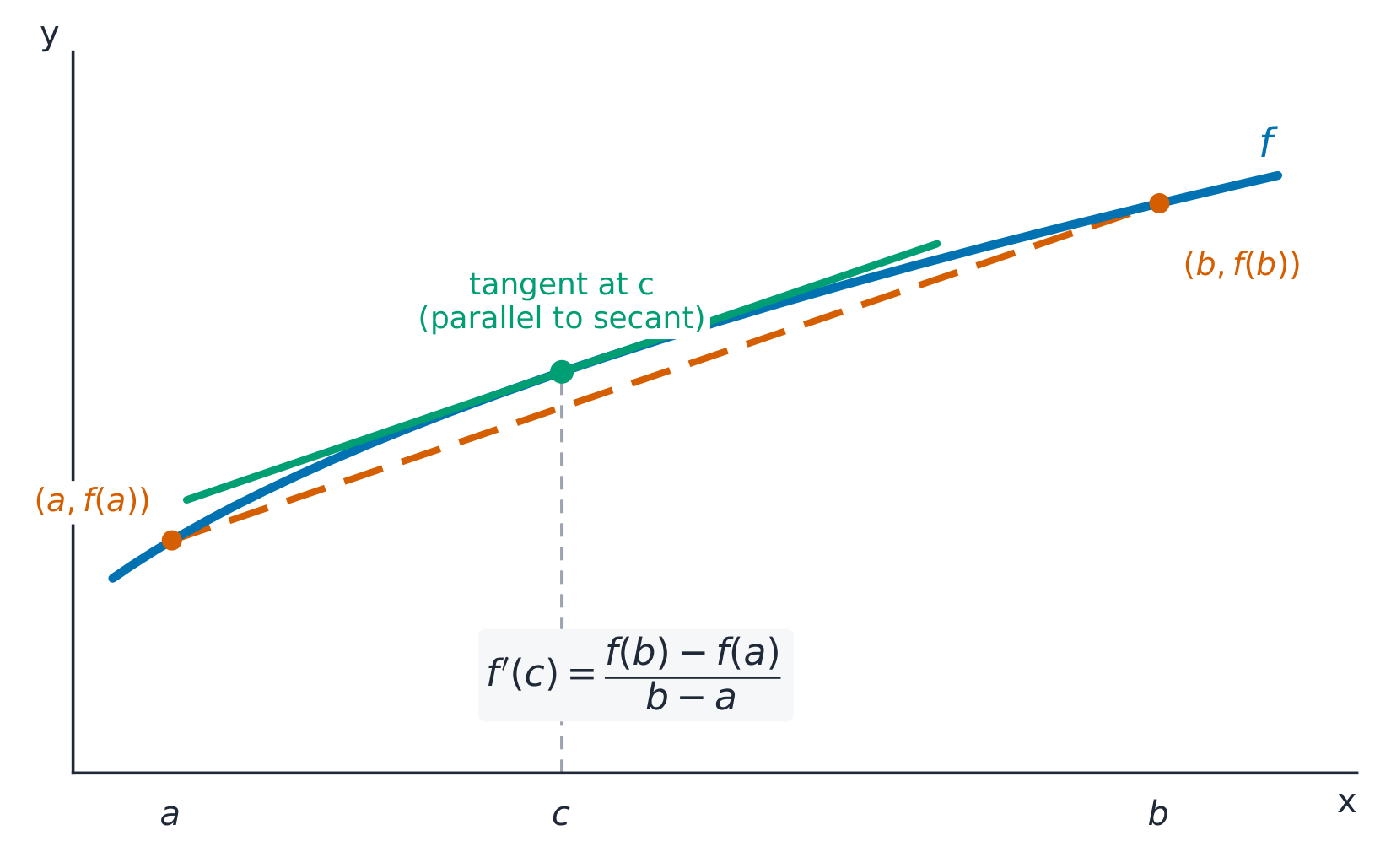
The Mean Value Theorem 中值定理 (MVT) links the average rate of change to an instantaneous one:
If $f$ is continuous on $[a,b]$ and differentiable on $(a,b)$, then there is at least one point $c$ in $(a,b)$ where
$$f'(c) = \frac{f(b)-f(a)}{b-a}.$$
In words: somewhere inside the interval, the instantaneous rate equals the average rate. Geometrically, some tangent line is parallel to the line joining the endpoints.
Exam skill. Like the IVT, the MVT is an existence theorem, and questions ask you to justify. Full credit needs: (1) state $f$ is continuous on $[a,b]$ and differentiable on $(a,b)$; (2) compute the average rate $\frac{f(b)-f(a)}{b-a}$; (3) conclude "by the MVT there is a $c$ in $(a,b)$ with $f'(c)$ equal to that value." Both hypotheses must be named.
Worked example. Verify the MVT for $f(x)=x^2$ on $[1,3]$. It is a polynomial, so continuous and differentiable everywhere. The average rate is $\dfrac{f(3)-f(1)}{3-1}=\dfrac{9-1}{2}=4$. Setting $f'(c)=2c=4$ gives $c=2$, which does lie in $(1,3)$ – the guaranteed point.
The MVT guarantees a point where the tangent is parallel to the secant — the instantaneous rate equals the average rate somewhere inside the interval. · MVT รับประกันจุดที่ เส้นสัมผัสขนานกับ เส้นตัด — อัตราชั่วขณะเท่ากับอัตราเฉลี่ย在某处ภายในช่วง
Extreme Values and Critical Points · ค่าสูงสุด/ต่ำสุดและจุดวิกฤต
Syllabus · หลักสูตร
English
Enduring Understanding (FUN-1): Existence theorems allow us to draw conclusions about a function's behavior on an interval without precisely locating that behavior.
Learning Objective FUN-1.C: Justify conclusions about functions by applying the Extreme Value Theorem.
FUN-1.C.1 If a function $f$ is continuous over the interval $(a, b)$, then the Extreme Value Theorem guarantees that $f$ has at least one minimum value and at least one maximum value on $[a, b]$.
FUN-1.C.2 A point on a function where the first derivative equals zero or fails to exist is a critical point of the function.
FUN-1.C.3 All local (relative) extrema occur at critical points of a function, though not all critical points are local extrema.
FUN-1.C.3 ค่าสุดขั้วทั้งหมด (สัมพัทธ์) เกิดขึ้นที่จุดวิกฤตของฟังก์ชัน although not all critical points are local extrema.
Source: College Board AP Course and Exam Description · แหล่งที่มา: คำอธิบายหลักสูตรและข้อสอบ College Board AP
English
The Extreme Value Theorem 极值定理 (EVT) guarantees extremes exist: a function continuous on a closed interval $[a,b]$ attains both an absolute maximum and an absolute minimum on it.
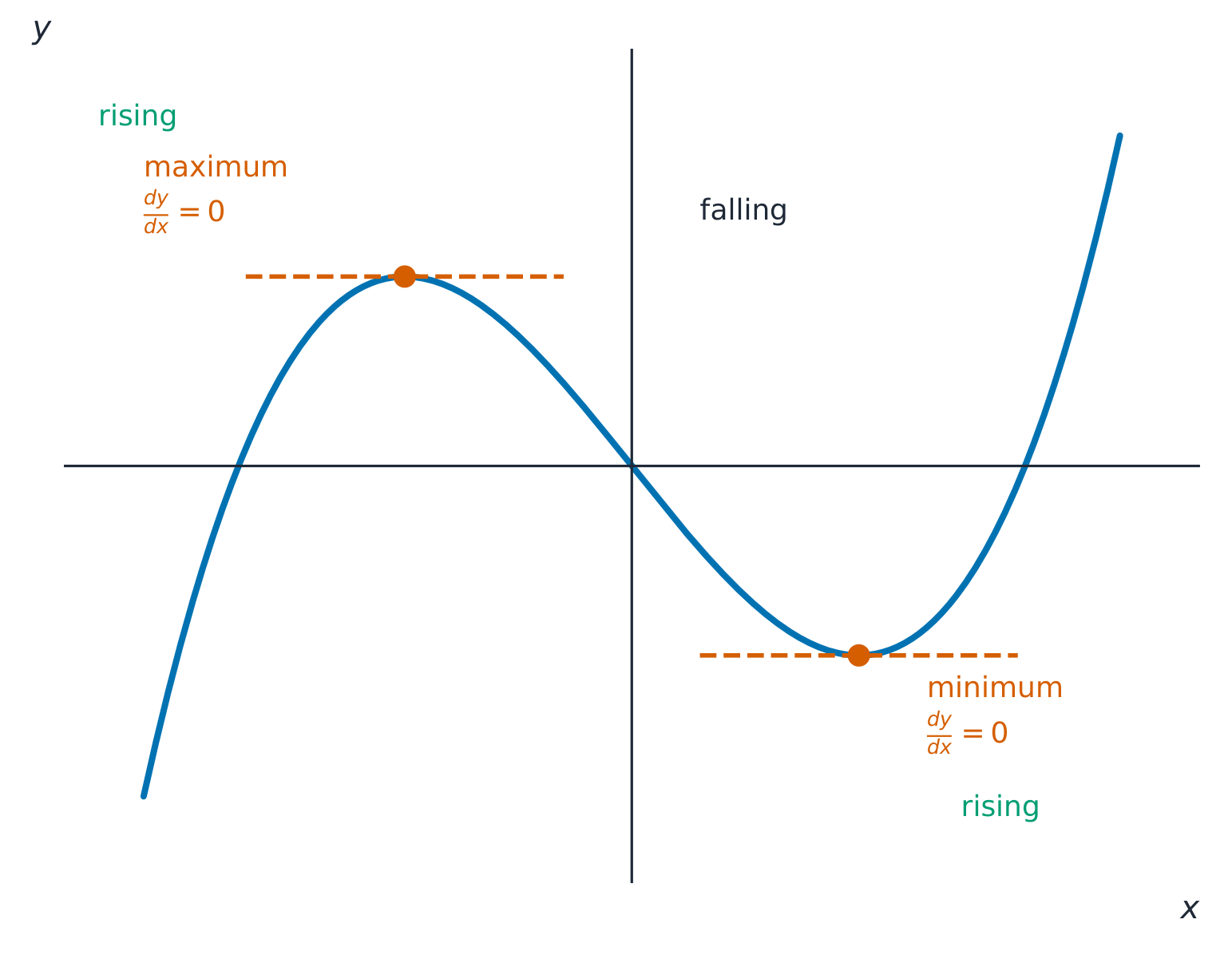
A critical point 临界点 is an interior point where $f'(x)=0$or$f'(x)$ does not exist. All local (relative) extrema 局部极值 occur at critical points – but not every critical point is an extremum. So critical points are the candidates; you must test each.
Increasing and Decreasing Intervals · ช่วงที่เพิ่มขึ้นและลดลง
Syllabus · หลักสูตร
English
Enduring Understanding (FUN-4): A function's derivative can be used to understand some behaviors of the function.
Learning Objective FUN-4.A: Justify conclusions about the behavior of a function based on the behavior of its derivatives.
FUN-4.A.1 The first derivative of a function can provide information about the function and its graph, including intervals where the function is increasing or decreasing.
Source: College Board AP Course and Exam Description · แหล่งที่มา: คำอธิบายหลักสูตรและข้อสอบ College Board AP
English
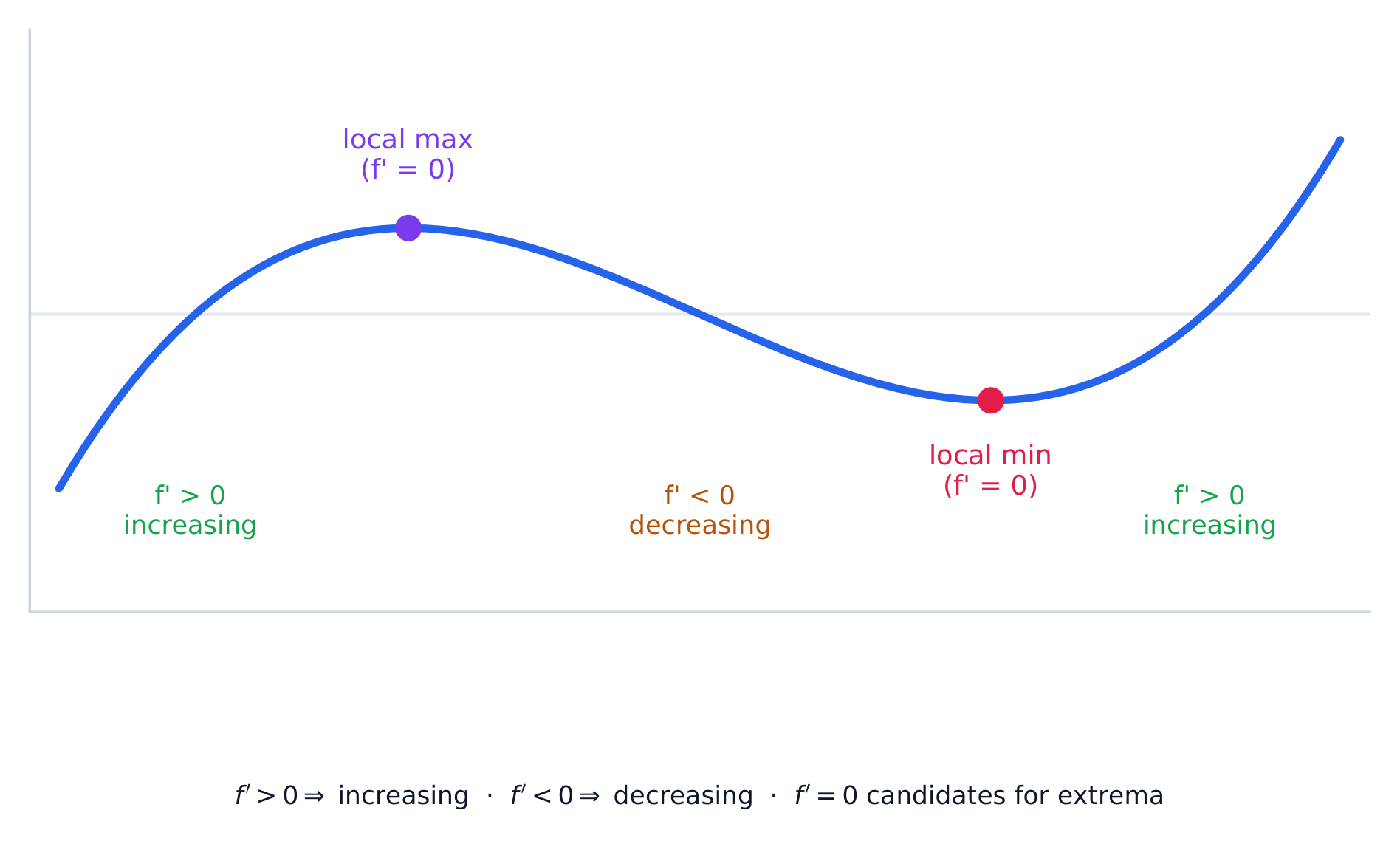
The first derivative tells you where $f$ rises or falls:
$f'(x) > 0$ on an interval $\Rightarrow$$f$ is increasing 递增 there;
$f'(x) < 0$$\Rightarrow$$f$ is decreasing 递减.
On the exam, "find the intervals where $f$ is increasing" means: find the critical points, then test the sign of $f'$ between them, and justify with the sign of $f'$ (a stated reason, not just an interval).
Source: College Board AP Course and Exam Description · แหล่งที่มา: คำอธิบายหลักสูตรและข้อสอบ College Board AP
English
To classify a critical point $x=c$ as a local max, local min, or neither, check how $f'$ changes sign there:
$f'$ changes $+$ to $-$ at $c$$\Rightarrow$local maximum 极大值;
$f'$ changes $-$ to $+$ at $c$$\Rightarrow$local minimum 极小值;
$f'$ does not change sign $\Rightarrow$ neither.
Always state the sign change as your justification.
Worked example. Classify the critical points of $f(x)=x^3-3x^2$. Here $f'(x)=3x^2-6x=3x(x-2)$, zero at $x=0$ and $x=2$. Testing signs: $f'>0$ for $x<0$, $f'<0$ on $(0,2)$, and $f'>0$ for $x>2$. So $f'$ turns $+\to-$ at $x=0$ (a local maximum, $f(0)=0$) and $-\to+$ at $x=2$ (a local minimum, $f(2)=-4$).
Concavity and Points of Inflection · ความโค้งและจุดเปลี่ยนความโค้ง
Syllabus · หลักสูตร
English
Enduring Understanding (FUN-4): A function's derivative can be used to understand some behaviors of the function.
Learning Objective FUN-4.A: Justify conclusions about the behavior of a function based on the behavior of its derivatives.
FUN-4.A.4 The graph of a function is concave up (down) on an open interval if the function's derivative is increasing (decreasing) on that interval.
FUN-4.A.5 The second derivative of a function provides information about the function and its graph, including intervals of upward or downward concavity.
FUN-4.A.6 The second derivative of a function may be used to locate points of inflection for the graph of the original function.
Source: College Board AP Course and Exam Description · แหล่งที่มา: คำอธิบายหลักสูตรและข้อสอบ College Board AP
English
The second derivative describes bending:
$f'' > 0$$\Rightarrow$$f$ is concave up 上凹 (curving like a cup; $f'$ is increasing);
$f'' < 0$$\Rightarrow$$f$ is concave down 下凹 ($f'$ is decreasing).
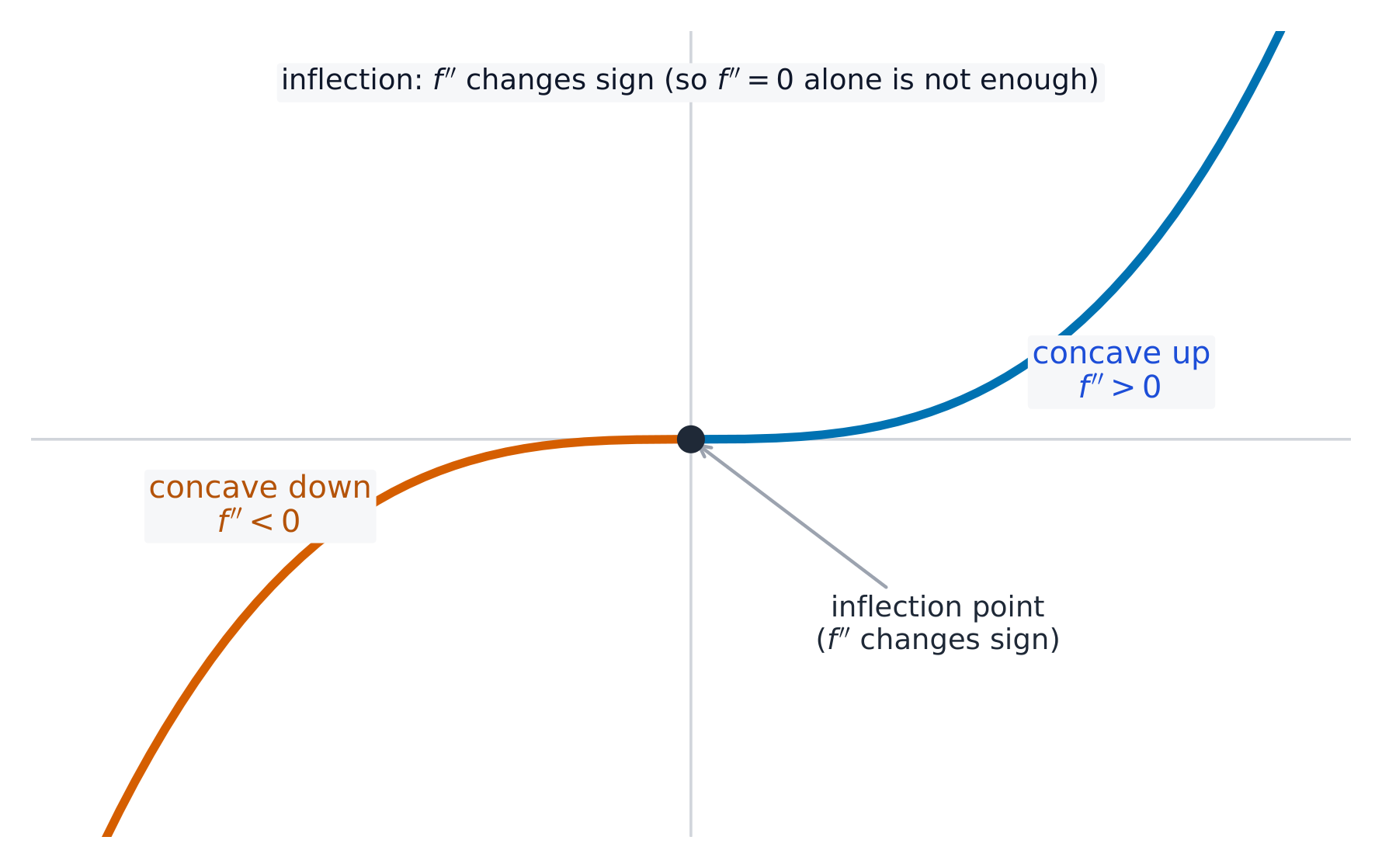
A point of inflection 拐点 is where concavity changes, i.e. where $f''$ changes sign (not merely where $f''=0$). Report its $x$-coordinate and justify with the sign change of $f''$.
Concavity is the sign of $f''$: concave up holds water, concave down spills it. A point of inflection is where it switches. · ความเว้าคือเครื่องหมายของ $f''$: เว้าขึ้นเก็บน้ำได้ เว้าลงน้ำจะไหลออก จุดกลับด้านคือจุดที่มันเปลี่ยน
5.7
The Second Derivative Test · การทดสอบอนุพันธ์อันดับสอง
Syllabus · หลักสูตร
English
Enduring Understanding (FUN-4): A function's derivative can be used to understand some behaviors of the function.
Learning Objective FUN-4.A: Justify conclusions about the behavior of a function based on the behavior of its derivatives.
FUN-4.A.7 The second derivative of a function may determine whether a critical point is the location of a relative (local) maximum or minimum.
FUN-4.A.8 When a continuous function has only one critical point on an interval on its domain and the critical point corresponds to a relative (local) extremum of the function on the interval, then that critical point also corresponds to the absolute (global) extremum of the function on the interval.
Source: College Board AP Course and Exam Description · แหล่งที่มา: คำอธิบายหลักสูตรและข้อสอบ College Board AP
English
An alternative way to classify a critical point $c$ where $f'(c)=0$:
$f''(c) > 0$$\Rightarrow$ concave up $\Rightarrow$local minimum;
$f''(c) < 0$$\Rightarrow$ concave down $\Rightarrow$local maximum;
$f''(c) = 0$$\Rightarrow$ the test is inconclusive – fall back on the first derivative test.
Special case: if a continuous function has only one critical point on an interval and it is a local extremum, that point is also the absolute extremum there.
Source: College Board AP Course and Exam Description · แหล่งที่มา: คำอธิบายหลักสูตรและข้อสอบ College Board AP
English
Key features of $f$, $f'$, and $f''$ mirror each other. To sketch or read graphs:
$f$ increasing $\Leftrightarrow$$f'$ above the axis; $f$ has a local max $\Leftrightarrow$$f'$ crosses from $+$ to $-$.
$f$ concave up $\Leftrightarrow$$f'$ increasing $\Leftrightarrow$$f''$ above the axis; $f$ has an inflection point $\Leftrightarrow$$f'$ has a local extremum $\Leftrightarrow$$f''$ crosses zero.
Source: College Board AP Course and Exam Description · แหล่งที่มา: คำอธิบายหลักสูตรและข้อสอบ College Board AP
English
This is the skill of reading one graph to describe another. A very common exam setup gives the graph of $f'$ and asks about $f$: where is $f$ increasing (where $f'>0$), where are $f$'s extrema (where $f'$ crosses zero, with a sign change), where is $f$ concave up (where $f'$ is increasing). Answer questions about $f$ using the height and slope of the $f'$ graph.
Slope and bend from the graph · ความชันและการงอจากกราฟ
y = ax³ + bx² + cx + d
Where $f'>0$ the function rises; where $f''>0$ it bends up. Slide the tangent to link the shape of $f$ to the signs of its derivatives. · ที่何处$f'>0$ ฟังก์ชันเพิ่มขึ้น; ที่何处$f''>0$ มันงอขึ้น เลื่อนเส้นสัมผัสเพื่อเชื่อมโยงรูปร่างของ $f$ กับเครื่องหมายของอนุพันธ์ของมัน
5.10
Introduction to Optimization · บทนำเรื่องการปรับแต่ง
Syllabus · หลักสูตร
English
Enduring Understanding (FUN-4): A function's derivative can be used to understand some behaviors of the function.
Learning Objective FUN-4.B: Calculate minimum and maximum values in applied contexts or analysis of functions.
FUN-4.B.1 The derivative can be used to solve optimization problems; that is, finding a minimum or maximum value of a function on a given interval.
Source: College Board AP Course and Exam Description · แหล่งที่มา: คำอธิบายหลักสูตรและข้อสอบ College Board AP
English
Optimisation: the best box
Optimization 最优化 uses the derivative to find the largest or smallest value of a quantity on an interval. It is the candidates/derivative-test machinery applied to a real goal.
Source: College Board AP Course and Exam Description · แหล่งที่มา: คำอธิบายหลักสูตรและข้อสอบ College Board AP
English
A dependable procedure:
Write the quantity to optimize as a function of one variable (use a constraint equation to eliminate extras).
State the interval of allowed inputs.
Find critical points ($f'=0$ or undefined) and test them (first- or second-derivative test, or candidates test if the interval is closed).
Answer the question asked, with units and interpretation in context – the maximum area, the minimum cost, etc.
Worked example. A farmer has $100\ \text{m}$ of fence for a rectangular pen against a wall, so only three sides need fencing. Maximize the area. Let the two ends be $x$ and the side parallel to the wall be $y$; the constraint is $2x+y=100$, so $y=100-2x$. The area is
Source: College Board AP Course and Exam Description · แหล่งที่มา: คำอธิบายหลักสูตรและข้อสอบ College Board AP
English
All of this extends to implicitly defined relations. A critical point of an implicit relation is where $\dfrac{dy}{dx}=0$ (horizontal tangent) or is undefined (vertical tangent). Because $\dfrac{dy}{dx}$ is usually a relation in $x$and$y$, and the second derivative involves $x$, $y$, and $\dfrac{dy}{dx}$, substitute your first-derivative expression back in when finding $\dfrac{d^2y}{dx^2}$, then reason about concavity from its sign.
Exploring Accumulations of Change · การสำรวจผลรวมของการเปลี่ยนแปลง
Syllabus · หลักสูตร
English
Enduring Understanding (CHA-4): Definite integrals allow us to solve problems involving the accumulation of change over an interval.
Learning Objective CHA-4.A: Interpret the meaning of areas associated with the graph of a rate of change in context.
CHA-4.A.1 The area of the region between the graph of a rate of change function and the $x$ axis gives the accumulation of change.
CHA-4.A.2 In some cases, accumulation of change can be evaluated by using geometry.
CHA-4.A.3 If a rate of change is positive (negative) over an interval, then the accumulated change is positive (negative).
CHA-4.A.4 The unit for the area of a region defined by rate of change is the unit for the rate of change multiplied by the unit for the independent variable.
Source: College Board AP Course and Exam Description · แหล่งที่มา: คำอธิบายหลักสูตรและข้อสอบ College Board AP
English
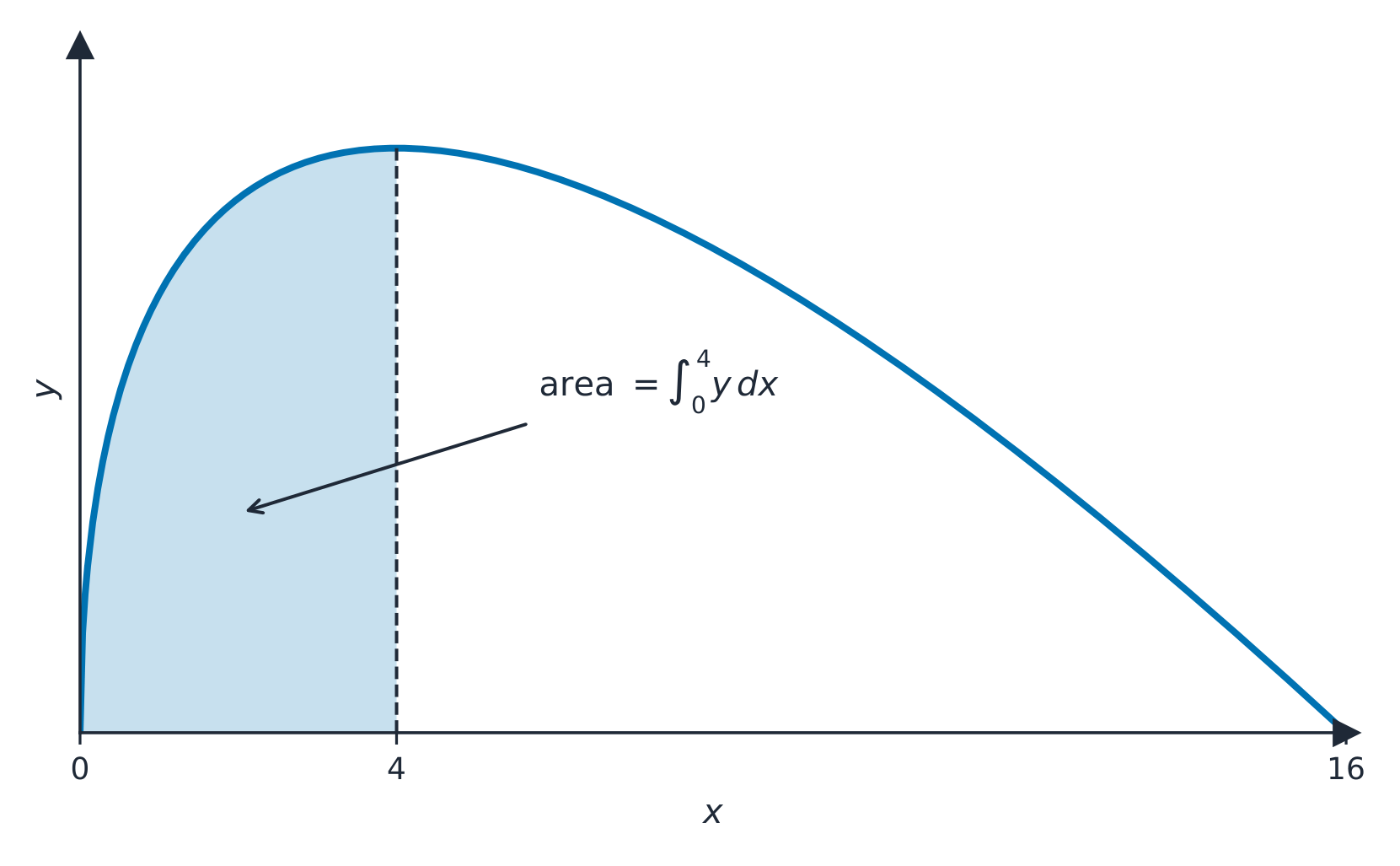
Differentiation found rates. Integration runs the idea in reverse: given a rate of change, it finds the accumulated change 累积变化. The key picture: the area between the graph of a rate function and the $x$-axis gives the total accumulation.
If the rate is positive over an interval, the accumulated change is positive; if negative, negative. Area below the axis counts as negative.
Simple regions (triangles, rectangles) can be found with geometry 几何.
Units: the area's unit is the rate's unit times the input's unit. A rate in vehicles-per-hour times hours gives vehicles.
Approximating Areas with Riemann Sums · การประมาณพื้นที่ด้วยผลรวมรีมันน์
Syllabus · หลักสูตร
English
Enduring Understanding (LIM-5): Definite integrals can be approximated using geometric and numerical methods.
Learning Objective LIM-5.A: Approximate a definite integral using geometric and numerical methods.
LIM-5.A.1 Definite integrals can be approximated for functions that are represented graphically, numerically, analytically, and verbally.
LIM-5.A.2 Definite integrals can be approximated using a left Riemann sum, a right Riemann sum, a midpoint Riemann sum, or a trapezoidal sum; approximations can be computed using either uniform or nonuniform partitions.
LIM-5.A.3 Definite integrals can be approximated using numerical methods, with or without technology.
LIM-5.A.4 Depending on the behavior of a function, it may be possible to determine whether an approximation for a definite integral is an underestimate or overestimate for the value of the definite integral.
Source: College Board AP Course and Exam Description · แหล่งที่มา: คำอธิบายหลักสูตรและข้อสอบ College Board AP
English
The integral as area (Riemann sums)Trapezoidal sums approximate area
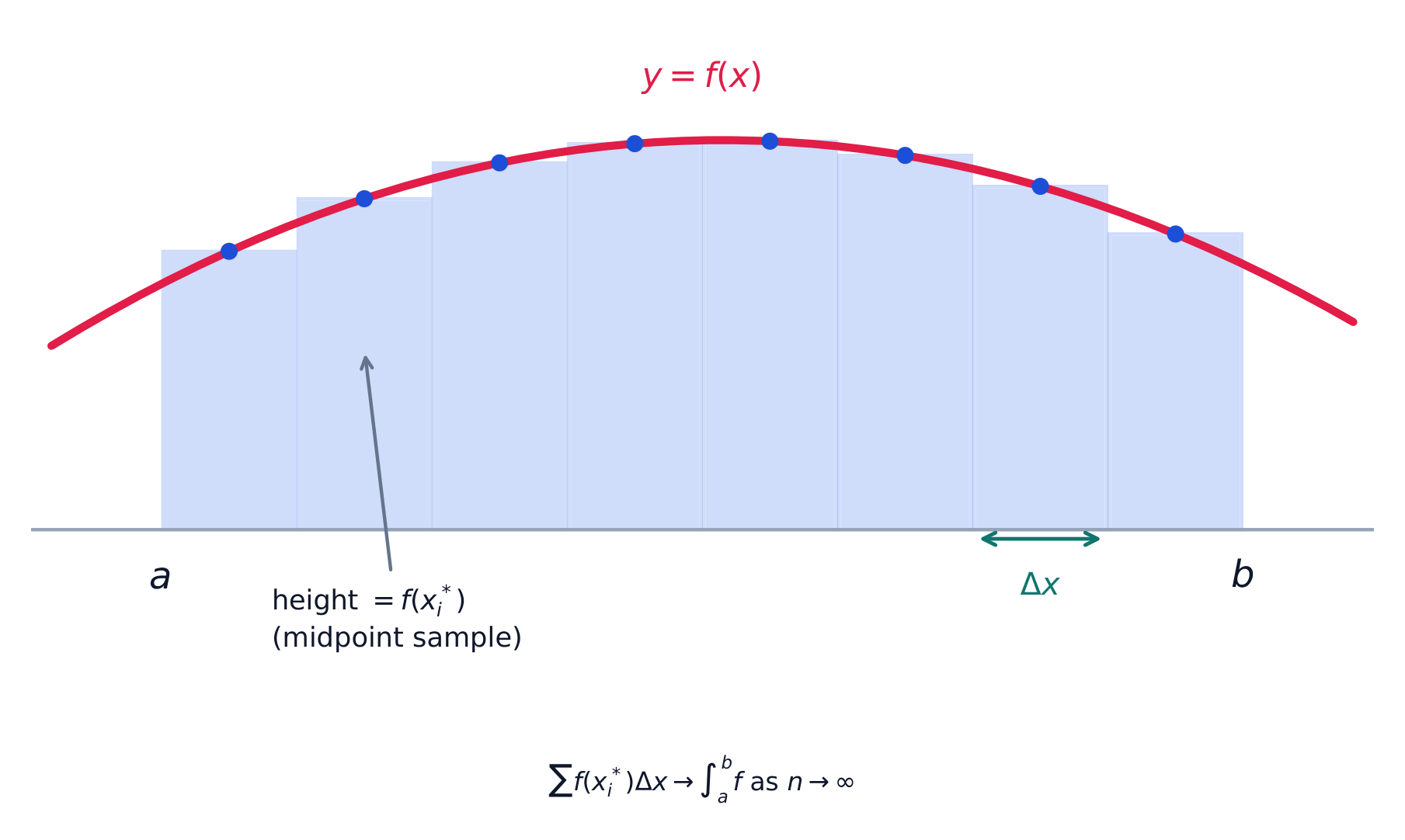
When exact area is hard, approximate it with a Riemann sum 黎曼和 – split the interval into subintervals and add up rectangle (or trapezoid) areas. The four standard estimates:
Left Riemann sum – rectangle height from the left endpoint of each subinterval.
Right Riemann sum – height from the right endpoint.
Midpoint Riemann sum – height from the midpoint 中点.
Trapezoidal sum 梯形法 – average the two endpoint heights (a trapezoid).
Subintervals may be uniform (equal width) or nonuniform – read widths from the table.
Over- or underestimate? Judge from the behavior of the function: for an increasing function, a left sum underestimates and a right sum overestimates; a trapezoidal sum overestimates when the function is concave up and underestimates when concave down. Exam parts ask you to state which and why.
Worked example. A table gives $f(0)=3$, $f(2)=5$, $f(4)=8$, $f(6)=9$. Estimate $\int_0^6 f(x)\,dx$ with a right Riemann sum of three equal subintervals ($\Delta x=2$). Use the right endpoint of each strip:
$$2\big(f(2)+f(4)+f(6)\big)=2(5+8+9)=44.$$
Since $f$ is increasing, this right sum is an overestimate; the left sum $2(3+5+8)=32$ would be an underestimate.
ประเมินเกินหรือต่ำกว่า? พิจารณาจากพฤติกรรมของฟังก์ชัน: สำหรับฟังก์ชัน เพิ่มขึ้น, Left sum จะประเมินต่ำกว่าและ Right sum จะประเมินเกิน; Trapezoidal sum จะประเมินเกินเมื่อฟังก์ชันมีความเว้าขึ้นและประเมินต่ำกว่าเมื่อมีความเว้าลง ส่วนข้อสอบถามให้คุณระบุชนิดและเหตุผล.
ตัวอย่างวิธีทำ. ตารางให้ $f(0)=3$, $f(2)=5$, $f(4)=8$, $f(6)=9$. ประมาณ $\int_0^6 f(x)\,dx$ ด้วย Right Riemann sum ของสามช่วงย่อยเท่ากัน ($\Delta x=2$). ใช้จุดสิ้นสุดขวาของแต่ละแถบ:
$$2\big(f(2)+f(4)+f(6)\big)=2(5+8+9)=44.$$
เนื่องจาก $f$ เพิ่มขึ้น, Right sum นี้เป็นการประเมิน เกิน; Left sum $2(3+5+8)=32$ จะเป็นการประเมินต่ำกว่า.
Explore · สำรวจ
Approximate area with rectangles · ประมาณพื้นที่ด้วยสี่เหลี่ยมผืนผ้า
y = ax³ + bx² + cx + d
A Riemann sum approximates the area under a curve with rectangles. Add more, thinner rectangles and the estimate converges to the exact definite integral. · ผลรวมรีมานประมาณพื้นที่ใต้เส้นโค้งด้วยสี่เหลี่ยมผืนผ้า เพิ่มจำนวนและทำให้บางลง การประมาณจะลู่เข้าสู่ อินทิกรัลจำกัดที่แท้จริง
Riemann Sums and Integral Notation · ผลรวมรีมันน์และสัญลักษณ์อินทิกรัล
Syllabus · หลักสูตร
English
Enduring Understanding (LIM-5): Definite integrals can be approximated using geometric and numerical methods.
Learning Objective LIM-5.B: Interpret the limiting case of the Riemann sum as a definite integral.
LIM-5.B.1 The limit of an approximating Riemann sum can be interpreted as a definite integral.
LIM-5.B.2 A Riemann sum, which requires a partition of an interval $I$, is the sum of products, each of which is the value of the function at a point in a subinterval multiplied by the length of that subinterval of the partition.
Learning Objective LIM-5.C: Represent the limiting case of the Riemann sum as a definite integral.
LIM-5.C.1 The definite integral of a continuous function $f$ over the interval $[a, b]$, denoted by $\int_{a}^{b} f(x)\,dx$, is the limit of Riemann sums as the widths of the subintervals approach 0. That is, $\int_{a}^{b} f(x)\,dx = \lim_{\max \Delta x_i \to 0} \sum_{i=1}^{n} f(x_i^{*})\Delta x_i$, where $n$ is the number of subintervals, $\Delta x_i$ is the width of the $i$th subinterval, and $x_i^{*}$ is a value in the $i$th subinterval.
LIM-5.C.2 A definite integral can be translated into the limit of a related Riemann sum, and the limit of a Riemann sum can be written as a definite integral.
Here $\Delta x_i$ is the width of the $i$th subinterval and $x_i^{*}$ a point inside it. So a definite integral is the limit of a Riemann sum, and you should be able to translate each into the other.
The Fundamental Theorem of Calculus and Accumulation Functions · ทฤษฎีบทพื้นฐานของแคลคูลัสและฟังก์ชันสะสม
Syllabus · หลักสูตร
English
Enduring Understanding (FUN-5): The Fundamental Theorem of Calculus connects differentiation and integration.
Learning Objective FUN-5.A: Represent accumulation functions using definite integrals.
FUN-5.A.1 The definite integral can be used to define new functions.
Illustrative examples for FUN-5.A.1:$f(x) = \int_{0}^{x} e^{-t^2}\,dt$.
FUN-5.A.2 If $f$ is a continuous function on an interval containing $a$, then $\dfrac{d}{dx}\left( \int_{a}^{x} f(t)\,dt \right) = f(x)$, where $x$ is in the interval.
Source: College Board AP Course and Exam Description · แหล่งที่มา: คำอธิบายหลักสูตรและข้อสอบ College Board AP
English
The Fundamental Theorem of Calculus
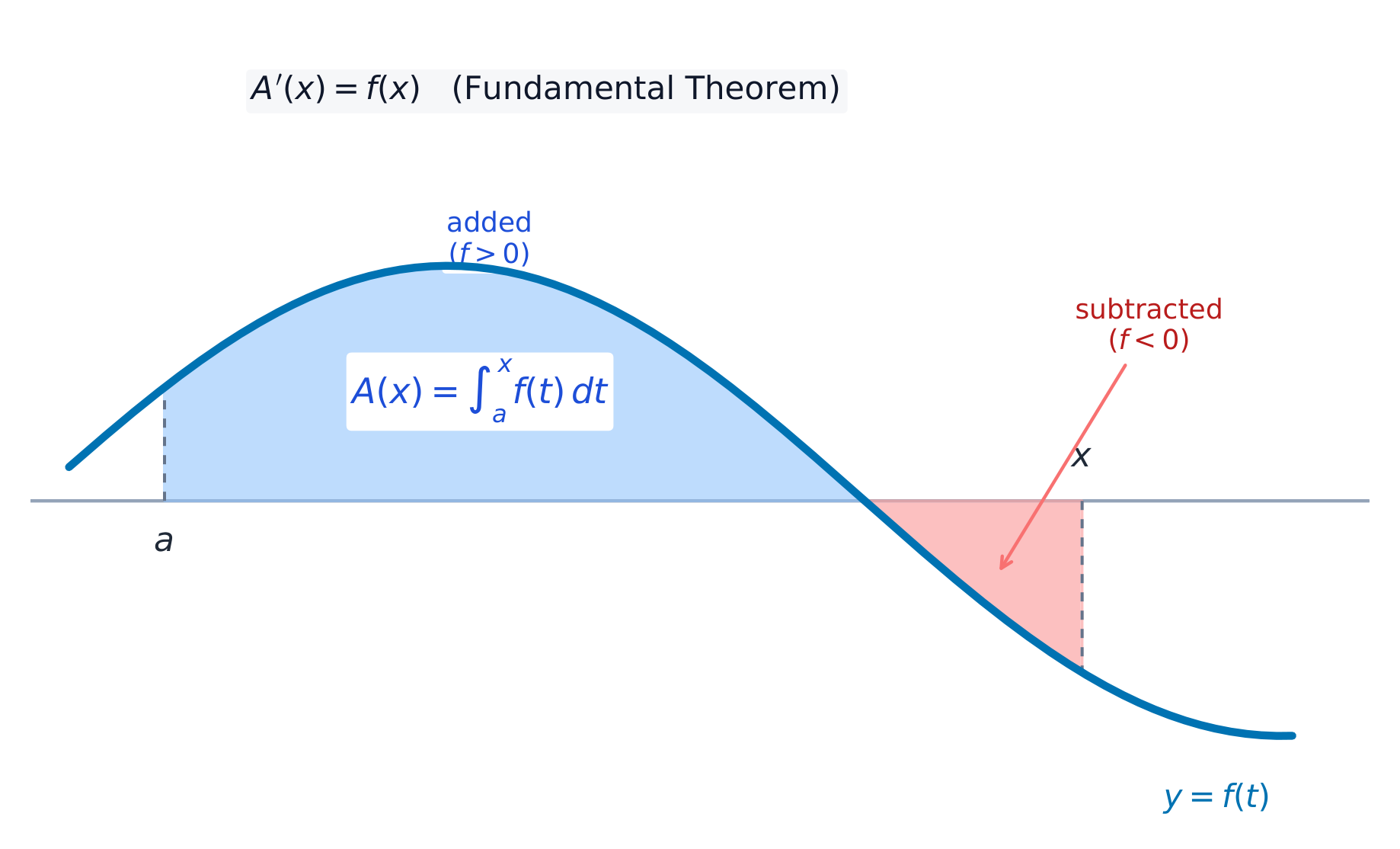
A definite integral with a variable upper limit defines a new accumulation function 累积函数. The Fundamental Theorem of Calculus 微积分基本定理 (first part) says differentiation undoes this accumulation: if $f$ is continuous, then
$$\frac{d}{dx}\int_a^x f(t)\,dt = f(x).$$
So if $g(x)=\int_a^x f(t)\,dt$, then $g'(x)=f(x)$ and $g''(x)=f'(x)$. This is the engine behind the very common "let $g(x)=\int_a^x f(t)\,dt$" questions.
Accumulate area as an integral · สะสมพื้นที่เป็นอินทิกรัล
y = ax³ + bx² + cx + d
An accumulation function$\int_a^x f(t)\,dt$ builds up signed area as $x$ moves. The Fundamental Theorem says its derivative is just $f(x)$. · ฟังก์ชันการสะสม$\int_a^x f(t)\,dt$ สร้างพื้นที่ที่มีเครื่องหมายเมื่อ $x$ ย้าย ทฤษฎีบทพื้นฐานบอกว่าอนุพันธ์ของมันคือเพียง $f(x)$
Fundamental Theorem of Calculus/ˌfʌndəˈmentl ˈθɪərəm ɒv ˈkælkjʊləs/
ทฤษฎีบทหลักของแคลคูลัส
antiderivative/ˌæntɪdɪˈrɪvətɪv/
ฟังก์ชันต้นแบบ (antiderivative)
indefinite integral/ɪnˈdefɪnət ˈɪntɪɡrəl/
อินทิกรัลไม่จำกัด
constant of integration/ˈkɒnstənt ɒv ˌɪntɪˈɡreɪʃn/
ค่าคงที่ของการอินทิเกรต
u-substitution/juː ˌsʌbstɪˈtjuːʃn/
การแทนตัวแปร u
polynomial long division/ˌpɒlɪˈnəʊmɪəl lɒŋ dɪˈvɪʒn/
การหารยาวพหุนาม
completing the square/kəmˈpliːtɪŋ ðə skweə/
การเติมกำลังสองสมบูรณ์
6.5
Behavior of Accumulation Functions · พฤติกรรมของฟังก์ชันสะสม
Syllabus · หลักสูตร
English
Enduring Understanding (FUN-5): The Fundamental Theorem of Calculus connects differentiation and integration.
Learning Objective FUN-5.A: Represent accumulation functions using definite integrals.
FUN-5.A.3 Graphical, numerical, analytical, and verbal representations of a function $f$ provide information about the function $g$ defined as $g(x) = \int_{a}^{x} f(t)\,dt$.
Properties of Definite Integrals · คุณสมบัติของอินทิกรัลจำกัดเขต
Syllabus · หลักสูตร
English
Enduring Understanding (FUN-6): Recognizing opportunities to apply knowledge of geometry and mathematical rules can simplify integration.
Learning Objective FUN-6.A: Calculate a definite integral using areas and properties of definite integrals.
FUN-6.A.1 In some cases, a definite integral can be evaluated by using geometry and the connection between the definite integral and area.
FUN-6.A.2 Properties of definite integrals include the integral of a constant times a function, the integral of the sum of two functions, reversal of limits of integration, and the integral of a function over adjacent intervals.
FUN-6.A.3 The definition of the definite integral may be extended to functions with removable or jump discontinuities.
The Fundamental Theorem and Evaluating Integrals · ทฤษฎีบทพื้นฐานและการหาค่าอินทิกรัล
Syllabus · หลักสูตร
English
Enduring Understanding (FUN-6): Recognizing opportunities to apply knowledge of geometry and mathematical rules can simplify integration.
Learning Objective FUN-6.B: Evaluate definite integrals analytically using the Fundamental Theorem of Calculus.
FUN-6.B.1 An antiderivative of a function $f$ is a function $g$ whose derivative is $f$.
FUN-6.B.2 If a function $f$ is continuous on an interval containing $a$, the function defined by $F(x) = \int_{a}^{x} f(t)\,dt$ is an antiderivative of $f$ for $x$ in the interval.
FUN-6.B.3 If $f$ is continuous on the interval $[a, b]$ and $F$ is an antiderivative of $f$, then $\int_{a}^{b} f(x)\,dx = F(b) - F(a)$.
Source: College Board AP Course and Exam Description · แหล่งที่มา: คำอธิบายหลักสูตรและข้อสอบ College Board AP
English
The second part of the Fundamental Theorem evaluates a definite integral using an antiderivative 原函数. If $F'=f$, then
$$\int_a^b f(x)\,dx = F(b)-F(a).$$
So: find any antiderivative $F$, then subtract its values at the two limits. This is how most exact integrals are computed. It also gives the net change view: $\int_a^b g'(t)\,dt = g(b)-g(a)$, so a starting value plus accumulated change gives a later value, e.g. $g(5)=g(0)+\int_0^5 g'(t)\,dt$.
Worked example. Evaluate $\int_1^3 (2x+1)\,dx$. An antiderivative is $F(x)=x^2+x$, so
Antiderivatives and Indefinite Integrals · อินทิกรัลไม่จำกัดเขตต้นแบบและอินทิกรัลไม่จำกัดเขต
Syllabus · หลักสูตร
English
Enduring Understanding (FUN-6): Recognizing opportunities to apply knowledge of geometry and mathematical rules can simplify integration.
Learning Objective FUN-6.C: Determine antiderivatives of functions and indefinite integrals, using knowledge of derivatives.
FUN-6.C.1$\int f(x)\,dx$ is an indefinite integral of the function $f$ and can be expressed as $\int f(x)\,dx = F(x) + C$, where $F'(x) = f(x)$ and $C$ is any constant.
FUN-6.C.2 Differentiation rules provide the foundation for finding antiderivatives.
FUN-6.C.3 Many functions do not have closed-form antiderivatives.
Look for a function and its derivative both present. For a definite integral, either change the limits to $u$-values or convert back to $x$ before substituting the original limits.
Worked example. Evaluate $\int 2x\cos(x^2)\,dx$. The inside function is $u=x^2$, whose derivative $2x\,dx=du$ is present, so
$$\int 2x\cos(x^2)\,dx=\int \cos u\,du=\sin u + C=\sin(x^2)+C.$$
Spotting that $2x$ is exactly $\dfrac{du}{dx}$ is the whole trick.
ไทย
การแทนตัวแปร $u$ กลับด้านกฎลูกโซ่ เลือกฟังก์ชันภายใน $u=g(x)$, sehingga $du=g'(x)\,dx$, และเขียนอินทิกรัลใหม่ทั้งหมดใน $u$:
มองหาฟังก์ชัน และอนุพันธ์ของมัน ที่มีอยู่ทั้งสอง สำหรับ อินทิกรัลจำกัดเขต Either change the limits to $u$-values or convert back to $x$ before substituting the original limits.
Long Division and Completing the Square · การหารยาวและการเติมกำลังสองสมบูรณ์
Syllabus · หลักสูตร
Enduring Understanding
Learning Objective
Essential Knowledge
FUN-6
Recognizing opportunities to apply knowledge of geometry and mathematical rules can simplify integration.
FUN-6.D
For integrands requiring substitution or rearrangements into equivalent forms: (a) Determine indefinite integrals. (b) Evaluate definite integrals.
FUN-6.D.3 Techniques for finding antiderivatives include rearrangements into equivalent forms, such as long division and completing the square.
Source: College Board AP Course and Exam Description · แหล่งที่มา: คำอธิบายหลักสูตรและข้อสอบ College Board AP
English
Two algebraic set-up moves let more integrals fit the basic forms: polynomial long division 多项式长除法 when the top degree is $\ge$ the bottom degree of a rational function, and completing the square 配方法 to turn a quadratic denominator into a form that integrates to an arctangent or logarithm.
Selecting Techniques for Antidifferentiation · การเลือกเทคนิคสำหรับการหาอินทิกรัลไม่จำกัดเขตต้นแบบ
Syllabus · หลักสูตร
English
This topic is intended to focus on the skill of selecting an appropriate procedure for antidifferentiation. Students should be given opportunities to practice when and how to apply all learning objectives relating to antidifferentiation.
Source: College Board AP Course and Exam Description · แหล่งที่มา: คำอธิบายหลักสูตรและข้อสอบ College Board AP
English
A skill topic: match the integral to a method. Try a basic antiderivative first; look for a $u$-substitution (an inside function whose derivative is also present); use algebra (division, completing the square, splitting a fraction) to reshape the integrand into a standard form. Naming the structure first prevents wasted effort.
Source: College Board AP Course and Exam Description · แหล่งที่มา: คำอธิบายหลักสูตรและข้อสอบ College Board AP
English
A differential equation 微分方程 is an equation that relates a function to its own derivatives. It describes a situation by its rate of change. For example, "the rate of change of a quantity is proportional to its size" becomes
$$\frac{dy}{dt} = ky.$$
Learning to translate a sentence about a rate into a differential equation is the first skill of this unit.
Source: College Board AP Course and Exam Description · แหล่งที่มา: คำอธิบายหลักสูตรและข้อสอบ College Board AP
English
A solution 解 of a differential equation is a function that makes it true. You can verify a proposed solution by differentiating it and substituting into the equation: if both sides match, it is a solution. Note a differential equation usually has infinitely many solutions – a whole family – differing by a constant.
Source: College Board AP Course and Exam Description · แหล่งที่มา: คำอธิบายหลักสูตรและข้อสอบ College Board AP
English
Slope fields & solution curves
A slope field 斜率场 draws the differential equation as a grid of short segments: at each point $(x,y)$ the segment has slope $\dfrac{dy}{dx}$ evaluated there. To sketch one, plug several points into the right-hand side and draw a small segment with that slope at each. The picture shows the shape of the solution curves without solving.
Exam skill. A common part gives a portion of a slope field and asks you to sketch the particular solution through a given point – start at the point and follow the segments, staying tangent to them.
แต่ละส่วนของเส้นตรงสั้นมีความชัน $\dfrac{dy}{dx}$ ที่จุดนั้น; เส้นโค้งคำตอบ threading through, staying tangent to the field.
ทักษะการสอบ ส่วนที่พบบ่อยให้ส่วนหนึ่งของสนามความชันและถามให้วาดคำตอบเฉพาะที่ผ่านจุดที่กำหนด – เริ่มที่จุดและ-following the segments, staying tangent to them.
Explore · สำรวจ
Read a differential equation as a slope field · อ่านสมการเชิงอนุพันธ์เป็นสนามความชัน
A slope field draws the slope $dy/dx$ at each point. A solution curve threads through, always tangent to the little segments — you can sketch it by following the flow. · สนามความชันวาดความชัน $dy/dx$ ที่แต่ละจุด เส้นโซลูชันทะลุผ่าน เสมอสัมผัสกับส่วนย่อยเล็ก ๆ — คุณสามารถวาดโดยติดตามการไหล
Source: College Board AP Course and Exam Description · แหล่งที่มา: คำอธิบายหลักสูตรและข้อสอบ College Board AP
English
Solutions to a differential equation are functions or families of functions. Read a slope field to reason about behavior: where the segments are flat ($\tfrac{dy}{dx}=0$) the solution is momentarily level; where they steepen the solution rises or falls faster; horizontal rows of equal slope suggest the rate depends only on $y$ (or only on $x$).
Source: College Board AP Course and Exam Description · แหล่งที่มา: คำอธิบายหลักสูตรและข้อสอบ College Board AP
English
Many exam differential equations are solved by separation of variables 分离变量法. If $\dfrac{dy}{dx}$ factors into a function of $x$ times a function of $y$, move all $y$'s to one side and all $x$'s to the other, then integrate both sides:
Finding Particular Solutions Using Initial Conditions and Separation of Variables · การหาคำตอบเฉพาะโดยใช้เงื่อนไขเริ่มต้นและการแยกตัวแปร
Syllabus · หลักสูตร
English
Enduring Understanding (FUN-7): Solving differential equations allows us to determine functions and develop models.
Learning Objective FUN-7.E: Determine particular solutions to differential equations.
FUN-7.E.1 A general solution may describe infinitely many solutions to a differential equation. There is only one particular solution passing through a given point.
FUN-7.E.2 The function $F$ defined by $F(x) = y_0 + \int_a^x f(t)\,dt$ is a particular solution to the differential equation $\dfrac{dy}{dx} = f(x)$, satisfying $F(a) = y_0$.
FUN-7.E.3 Solutions to differential equations may be subject to domain restrictions.
Source: College Board AP Course and Exam Description · แหล่งที่มา: คำอธิบายหลักสูตรและข้อสอบ College Board AP
English
An initial condition 初始条件 – a known point $(x_0,y_0)$ – pins down one curve from the family. Substitute it to solve for the constant $C$; the result is the particular solution 特解. There is exactly one solution through a given point. Watch for domain restrictions 定义域限制: keep the branch that contains the initial point (for example, the correct sign of a square root).
Exponential Models with Differential Equations · โมเดลเอ็กซ์โพเนนเชียลด้วยสมการเชิงอนุพันธ์
Syllabus · หลักสูตร
English
Enduring Understanding (FUN-7): Solving differential equations allows us to determine functions and develop models.
Learning Objective FUN-7.F: Interpret the meaning of a differential equation and its variables in context.
FUN-7.F.1 Specific applications of finding general and particular solutions to differential equations include motion along a line and exponential growth and decay.
FUN-7.F.2 The model for exponential growth and decay that arises from the statement "The rate of change of a quantity is proportional to the size of the quantity" is $\dfrac{dy}{dt} = ky$.
Learning Objective FUN-7.G: Determine general and particular solutions for problems involving differential equations in context.
FUN-7.G.1 The exponential growth and decay model, $\dfrac{dy}{dt} = ky$, with initial condition $y = y_0$ when $t = 0$, has solutions of the form $y = y_0 e^{kt}$.
Source: College Board AP Course and Exam Description · แหล่งที่มา: คำอธิบายหลักสูตรและข้อสอบ College Board AP
English
The most important model is exponential growth and decay 指数增长与衰减. The equation $\dfrac{dy}{dt}=ky$ (rate proportional to size) has the solution:
$$y = y_0\,e^{kt},$$
where $y_0$ is the value at $t=0$. Here $k>0$ gives growth and $k<0$ gives decay. You can derive this by separation of variables ($\int \tfrac{dy}{y} = \int k\,dt$), and it models processes like population growth, radioactive decay, and Newton's law of cooling. A follow-up part may ask for $\dfrac{d^2y}{dt^2}$: differentiate $\dfrac{dy}{dt}=ky$ again (using $\dfrac{dy}{dt}=ky$) to express it in terms of $y$.
Worked example. A sample decays by $\dfrac{dy}{dt}=-0.10\,y$ (in years) from $y_0=50\ \text{g}$. The solution is $y=50e^{-0.10t}$, so after $10$ years $y=50e^{-1}=18.4\ \text{g}$. Its half-life solves $25=50e^{-0.10t}$, i.e. $e^{-0.10t}=\tfrac12$, giving $t=\dfrac{\ln 2}{0.10}=6.9\ \text{years}$ – independent of the starting amount.
ไทย
E. coli ภายใต้กล้องจุลทรรศน์: สมการเชิงอนุพันธ์จำลองการเติบโตแบบเอ็กซ์โพเนนเชียลของประชากร
An exponential growth/decay model · โมเดลการเติบโต/การสลายตัวแบบเอกซ์โพเนนเชียล
y = a·e^(bx) + c
The equation $dy/dt=ky$ has exponential solutions: quantity changes at a rate proportional to itself, giving unbounded growth ($k>0$) or decay to zero ($k<0$). · สมการ $dy/dt=ky$ มี เอกซ์โพเนนเชียล โซลูชัน: ปริมาณเปลี่ยนแปลงด้วยอัตราที่เป็นสัดส่วนกับตัวเอง ให้การเติบโตที่ไม่จำกัด ($k>0$) หรือการสลายตัวสู่ศูนย์ ($k<0$)
7.8
Exam tips · ข้อแนะนำสำหรับการสอบ
English
Solve a separable equation by getting all $y$ on one side and all $x$ on the other, then integrating both sides (add $+C$ once).
Use the initial condition to find $C$ (a particular solution).
Sketch or read a slope field: the little segments show $\tfrac{dy}{dx}$ at each point, and a solution curve follows them.
It is the constant height of a rectangle on $[a,b]$ with the same area as under $f$. Do not confuse it with the average rate of change (which divides change in $f$ by the interval), or with a Riemann-sum average of a few values – the exam distinguishes these carefully. Report units in context (e.g. the average rate "in vehicles per hour").
Worked example. The average value of $f(x)=x^2$ on $[0,3]$ is
The average value of a function · ค่าเฉลี่ยของฟังก์ชัน
y = ax³ + bx² + cx + d
The average value of $f$ on $[a,b]$ is its integral divided by the width — the constant height whose rectangle has the same area as under the curve. · ค่าเฉลี่ยของ $f$ บน $[a,b]$ คืออินทิกรัลหารด้วยความกว้าง — ส่วนสูงคงที่ซึ่งสี่เหลี่ยมผืนผ้ามีพื้นที่เท่ากันใต้เส้นโค้ง
8.2
Position, Velocity, and Acceleration Using Integrals · ตำแหน่ง ความเร็ว และความเร่ง bằngการใช้อินทิกรัล
Syllabus · หลักสูตร
English
Enduring Understanding (CHA-4): Definite integrals allow us to solve problems involving the accumulation of change over an interval.
Learning Objective CHA-4.C: Determine values for positions and rates of change using definite integrals in problems involving rectilinear motion.
CHA-4.C.1 For a particle in rectilinear motion over an interval of time, the definite integral of velocity represents the particle's displacement over the interval of time, and the definite integral of speed represents the particle's total distance traveled over the interval of time.
Source: College Board AP Course and Exam Description · แหล่งที่มา: คำอธิบายหลักสูตรและข้อสอบ College Board AP
English
A function defined as an integral accumulates a rate of change. The net change 净变化 theorem is the everyday tool: the definite integral of a rate over an interval gives the net change of the quantity:
So "how much water is in the tank at $t=5$" = starting amount + $\int_0^5(\text{inflow}-\text{outflow})\,dt$. Watch signs (in minus out) and units. Many multi-part FRQs are built entirely on this idea – often paired with "write, but do not evaluate, an integral expression that gives the total...".
Area Between Curves With More Than Two Intersections · พื้นที่ระหว่างเส้นโค้งที่มีจุดตัดมากกว่าสองจุด
Syllabus · หลักสูตร
English
Enduring Understanding (CHA-5): Definite integrals allow us to solve problems involving the accumulation of change in area or volume over an interval.
Learning Objective CHA-5.A: Calculate areas in the plane using the definite integral.
CHA-5.A.3 Areas of certain regions in the plane may be calculated using a sum of two or more definite integrals or by evaluating a definite integral of the absolute value of the difference of two functions.
Source: College Board AP Course and Exam Description · แหล่งที่มา: คำอธิบายหลักสูตรและข้อสอบ College Board AP
English
If the curves cross more than twice, one function is on top for part of the region and the other on top elsewhere. Split into a sum of integrals at each crossing, or integrate the absolute value of the difference:
$$A = \int_a^b \big|f(x)-g(x)\big|\,dx.$$
Determine which curve is higher on each subinterval before writing the integrals.
Source: College Board AP Course and Exam Description · แหล่งที่มา: คำอธิบายหลักสูตรและข้อสอบ College Board AP
English
If a solid has a known cross section 横截面 perpendicular to an axis, its volume is the integral of the cross-sectional area:
$$V = \int_a^b A(x)\,dx.$$
For square cross sections with side equal to the region's height $s(x)=f(x)-g(x)$, use $A(x)=[s(x)]^2$; for a rectangle of height $k\cdot s(x)$, use $A(x)=k\,[s(x)]^2$. The exam phrase "the base of a solid... cross sections are squares/rectangles" signals exactly this.
Volumes with Cross Sections: Triangles and Semicircles · ปริมาตรด้วยส่วนตัด: สามเหลี่ยมและครึ่งวงกลม
Syllabus · หลักสูตร
English
Enduring Understanding (CHA-5): Definite integrals allow us to solve problems involving the accumulation of change in area or volume over an interval.
Learning Objective CHA-5.B: Calculate volumes of solids with known cross sections using definite integrals.
CHA-5.B.2 Volumes of solids with triangular cross sections can be found using definite integrals and the area formulas for these shapes.
CHA-5.B.3 Volumes of solids with semicircular and other geometrically defined cross sections can be found using definite integrals and the area formulas for these shapes.
Illustrative examples for CHA-5.B.3:
The volume of a funnel whose cross sections are circles can be found using the area formula for a circle and definite integrals (see 2016 AB Exam FRQ #5(b)).
The volume of a solid whose cross sectional area is defined using a function can be found using the known area function and a definite integral (see 2009 AB Exam FRQ #4(c)).
ปริมาตรของกรวยwhose cross sections are circles can be found using the area formula for a circle and definite integrals (see 2016 AB Exam FRQ #5(b)).
ปริมาตรของวัตถุแข็งทอน whose cross sectional area is defined using a function can be found using the known area function and a definite integral (see 2009 AB Exam FRQ #4(c)).
Source: College Board AP Course and Exam Description · แหล่งที่มา: คำอธิบายหลักสูตรและข้อสอบ College Board AP
English
Same method, different area formula: for an equilateral triangle 三角形 of side $s$, $A=\tfrac{\sqrt{3}}{4}s^2$; for a semicircle 半圆 of diameter $s$, $A=\tfrac{\pi}{8}s^2$. Set the shape's key length equal to the region's slice length $s(x)$, then integrate $A(x)$.
Source: College Board AP Course and Exam Description · แหล่งที่มา: คำอธิบายหลักสูตรและข้อสอบ College Board AP
English
Solids of revolution: the disc method
Revolving a region around an axis makes a solid of revolution 旋转体. If the region touches the axis, each slice is a disc 圆盘 of radius $r$ = the function value:
$$V = \pi\int_a^b [r(x)]^2\,dx.$$
Around the $x$-axis, $r=f(x)$ and integrate in $x$; around the $y$-axis, express $x$ as a function of $y$ and integrate in $y$.
Worked example. Revolve the region under $y=\sqrt{x}$ from $x=0$ to $x=4$ about the $x$-axis. Each disc has radius $r=\sqrt{x}$, so
Volume with the Disc Method (About Other Axes) · ปริมาตรด้วยวิธีดิสก์ (รอบแกนอื่น)
Syllabus · หลักสูตร
English
Enduring Understanding (CHA-5): Definite integrals allow us to solve problems involving the accumulation of change in area or volume over an interval.
Learning Objective CHA-5.C: Calculate volumes of solids of revolution using definite integrals.
CHA-5.C.2 Volumes of solids of revolution around any horizontal or vertical line in the plane may be found by using definite integrals with the disc method.
Source: College Board AP Course and Exam Description · แหล่งที่มา: คำอธิบายหลักสูตรและข้อสอบ College Board AP
English
Around any horizontal or vertical line $y=k$ or $x=k$, the radius is the distance from the curve to that line, e.g. $r(x)=|f(x)-k|$. Set up the radius carefully, then use $V=\pi\int r^2$.
Volume with the Washer Method · ปริมาตรด้วยวิธีวอชเชอร์ (Washer Method)
Syllabus · หลักสูตร
English
Enduring Understanding (CHA-5): Definite integrals allow us to solve problems involving the accumulation of change in area or volume over an interval.
Learning Objective CHA-5.C: Calculate volumes of solids of revolution using definite integrals.
CHA-5.C.3 Volumes of solids of revolution around the $x$- or $y$-axis whose cross sections are ring shaped may be found using definite integrals with the washer method.
Enduring Understanding (CHA-5): Definite integrals allow us to solve problems involving the accumulation of change in area or volume over an interval.
Learning Objective CHA-5.C: Calculate volumes of solids of revolution using definite integrals.
CHA-5.C.4 Volumes of solids of revolution around any horizontal or vertical line whose cross sections are ring shaped may be found using definite integrals with the washer method.
Source: College Board AP Course and Exam Description · แหล่งที่มา: คำอธิบายหลักสูตรและข้อสอบ College Board AP
English
Volume by the washer method
When the region does not touch the axis, each slice is a washer 垫圈 (a ring) with an outer radius $R$ and inner radius $r$:
$$V = \pi\int_a^b \Big([R]^2 - [r]^2\Big)\,dx.$$
$R$ is the distance from the axis to the farther boundary and $r$ to the nearer one. Around a line other than an axis, both radii are measured as distances to that line – a very common exam variation (e.g. revolving about $y=-2$).
Pick one and the site follows you — notes, papers, videos and practice all open on it. · เลือกหนึ่งตัว และเว็บจะติดตามคุณ — หมายเหตุ, ใบงาน, วิดีโอ และการฝึกฝนจะเปิดอยู่ที่นั้น
Type to search notes, lessons, code, vocabulary and past-paper questions across every subject. · พิมพ์เพื่อค้นหาบันทึก, บทเรียน, โค้ด, คำศัพท์ และคำถามข้อสอบเก่าในทุกวิชา