Skip to content · ⁨ข้ามไปยังเนื้อหา⁩

Halogen compounds · ⁨สารประกอบฮาโลเจน⁩

A-Level Chemistry · ⁨Chemistry A-Level⁩ · Topic 31 · ⁨หัวข้อ 31⁩

Video lesson for this topic · ⁨บทเรียนวิดีโอสำหรับหัวข้อนี้⁩ Open the video page · ⁨เปิดหน้าวิดีโอ⁩
7:56

สารประกอบฮาโลเจน (A2)

เกษตรกรพ่นสนาม许多农药和除草剂在这个罐子里是卤代芳烃:一个氯原子直接连接到苯环上。现在看…

English narration · English + 中文 subtitles burned in · ⁨การบรรยายภาษาอังกฤษ · คำบรรยายภาษาอังกฤษ + 中文 ลอยตัวบนภาพ⁩

31.1

Making halogenoarenes · ⁨การสร้างฮาโลเจนอารีน⁩

Syllabus · ⁨หลักสูตร⁩
English
  1. recall the reactions by which halogenoarenes can be produced: substitution of an arene with $\text{Cl}_2$ or $\text{Br}_2$ in the presence of a catalyst, $\text{AlCl}_3$ or $\text{AlBr}_3$ to form a halogenoarene, exemplified by benzene to form chlorobenzene and methylbenzene to form 2-chloromethylbenzene and 4-chloromethylbenzene
  2. explain the difference in reactivity between a halogenoalkane and a halogenoarene as exemplified by chloroethane and chlorobenzene
ไทย
  1. จำปฏิกิริยาที่ใช้ผลิต halogenoarenes: การแทนที่อารีนด้วย $\text{Cl}_2$ หรือ $\text{Br}_2$ ใน presence of catalyst, $\text{AlCl}_3$ หรือ $\text{AlBr}_3$ เพื่อสร้าง halogenoarene, ตัวอย่างเช่น เบนซีนไปเป็น chlorobenzene และメチルベンゼنไปเป็น 2-chloromethylbenzene และ 4-chloromethylbenzene
  2. อธิบายความแตกต่างของปฏิกิริยาระหว่าง halogenoalkane กับ halogenoarene โดยอ้างอิงจาก chloroethane และ chlorobenzene
Source: Cambridge International syllabus · ⁨แหล่งที่มา: หลักสูตร Cambridge International⁩

English

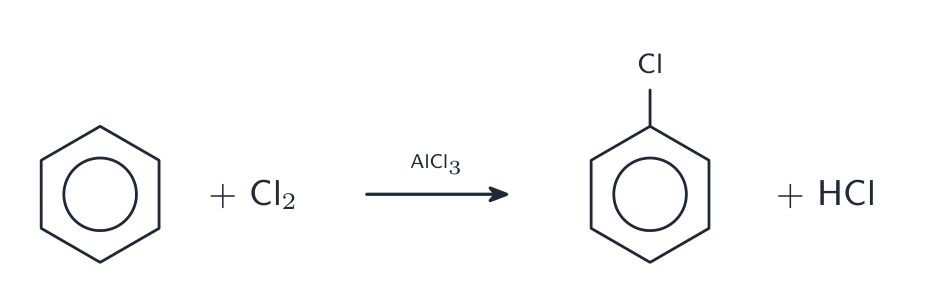
A halogenoarene 卤代芳烃 (also called an aryl halide) is formed when an arene 芳烃 reacts with $\text{Cl}_2$ or $\text{Br}_2$, using $\text{AlCl}_3$ or $\text{AlBr}_3$ as a catalyst 催化剂. This is the electrophilic substitution from the arenes topic — the halogen replaces a hydrogen on the ring.

  • benzene gives chlorobenzene.
  • methylbenzene gives 1-chloro-2-methylbenzene and 1-chloro-4-methylbenzene (the methyl group directs the chlorine to positions 2 and 4).
ไทย

ฮาโลเจนอารีน (หรือเรียกอีกอย่างว่าอะริลฮาไลด์) เกิดขึ้นเมื่อ อารีน ทำปฏิกิริยากับ $\text{Cl}_2$ หรือ $\text{Br}_2$, ใช้ $\text{AlCl}_3$ หรือ $\text{AlBr}_3$ เป็น ตัวเร่งปฏิกิริยา นี่คือelectrophilic substitution จากหัวข้ออารีน - ฮาโลเจนแทนที่ไฮโดรเจนบนวงแหวน

  • เบนซีนให้คลอโรเบนซีน
  • เมทิลเบนซีนให้ 1-คลอโร-2-เมทิลเบนซีน และ 1-คลอโร-4-เมทิลเบนซีน (หมู่เมทิลชี้ทิศคลอโรไปที่ตำแหน่ง 2 และ 4)
เบนซีนทำปฏิกิริยากับคลอรีน, ใช้อะลูมิเนียมคลอไรด์เป็นตัวเร่งปฏิกิริยา, เพื่อให้เกิดคลอโรเบนซีนและไฮโดรเจนคลอไรด์ — คลอโรแทนที่ไฮโดรเจนบนวงแหวน
การสร้างฮาโลเจนอารีนด้วยการแทนที่แบบอิเล็กโทรฟิลิก: ด้วยตัวเร่งปฏิกิริยา AlCl₃, คลอโรแทนที่ไฮโดรเจนบนวงแหวน (ให้HCl)

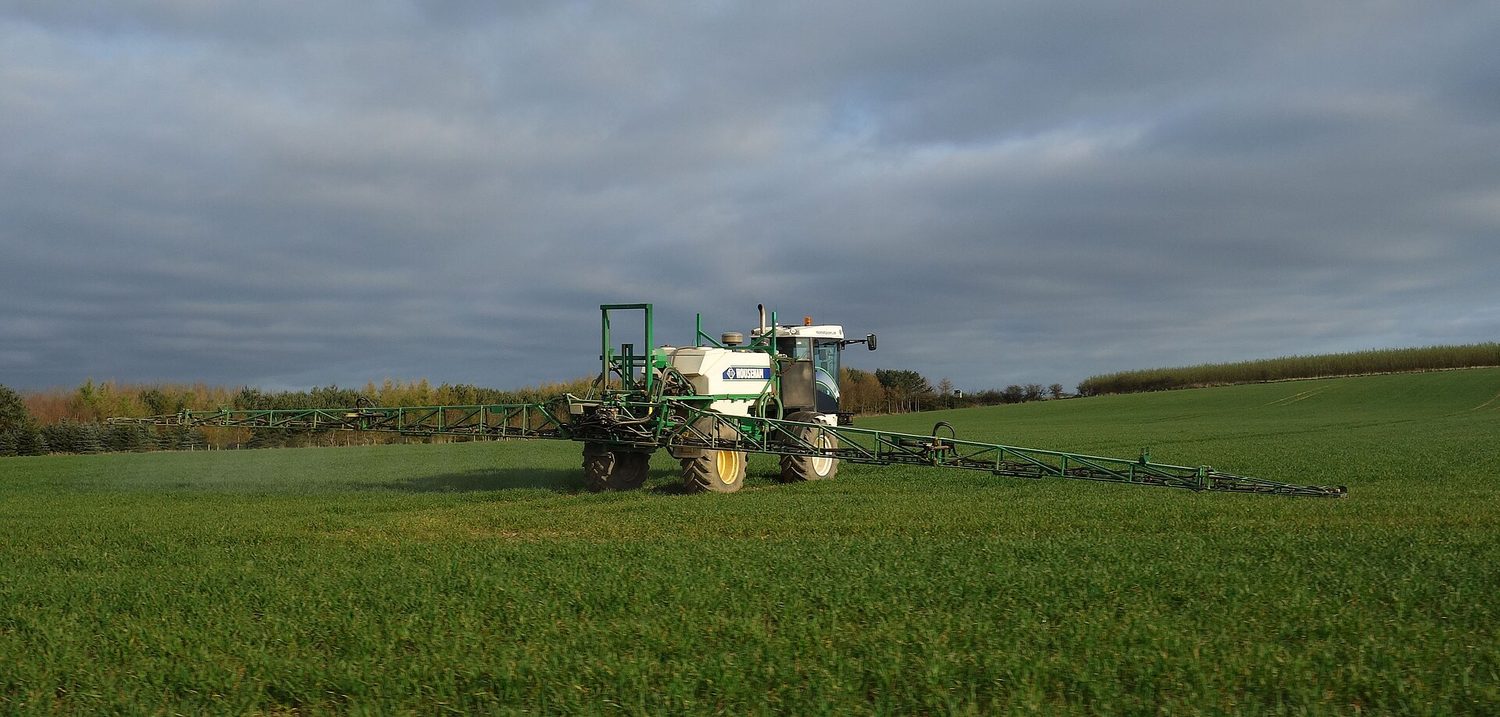
รถแทรกเตอร์พ่นสารเคมีในทุ่งนา *ยาฆ่าแมลงและ herbicides หลายชนิดเป็นฮาโลเจนอารีน — อะตอมคลอโรที่เชื่อมต่อกับวงแหวนเบนซีน
Explore · ⁨สำรวจ⁩

Halogenoarene lab · ⁨ห้องปฏิบัติการฮาโลเจนอารีน⁩

Compare halogenoarenes with halogenoalkanes. · ⁨เปรียบเทียบฮาโลเจนอารีนกับฮาโลเจนอัลเคน⁩

Vocabulary · ⁨คำศัพท์⁩ Train · ⁨ฝึกฝน⁩
English ไทย
halogenoarene/ˈheɪləʊdʒnɔːren/ ฮาโลเจนอารีน
arene/ˈæren/ อารีน
catalyst/ˈkætəlɪst/ ตัวเร่งปฏิกิริยา
31.1

Why a halogenoarene is less reactive than a halogenoalkane · ⁨ทำไมฮาโลเจนอารีนจึงมีความไวต่อปฏิกิริยาน้อยกว่าฮาโลเจนอัลเคน⁩

English

Compare chloroethane (a halogenoalkane 卤代烷) with chlorobenzene (a halogenoarene).

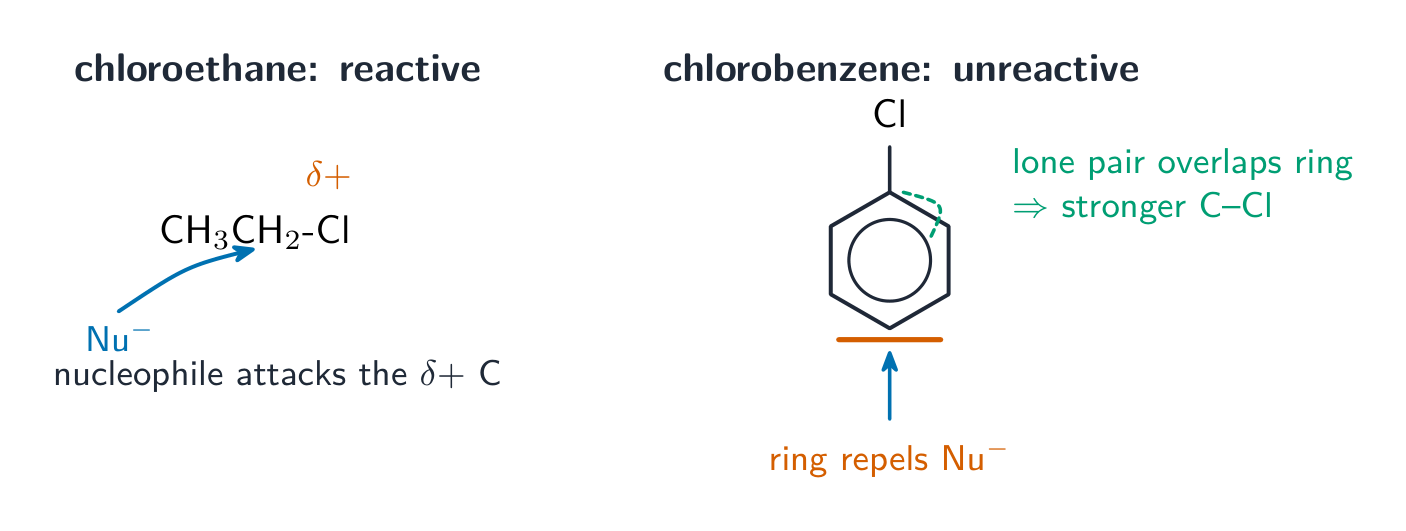
A halogenoalkane reacts easily by nucleophilic substitution 亲核取代: its C–Cl bond is polar, so a nucleophile can attack the slightly positive carbon and push the halogen out.

A halogenoarene is very unreactive towards nucleophilic substitution. There are two reasons:

  • a lone pair 孤对电子 on the chlorine overlaps sideways with the delocalised 离域 ring of electrons. This gives the C–Cl bond partial double-bond character, making it shorter and stronger, so it is much harder to break.
  • the electron-rich ring repels an approaching nucleophile 亲核试剂.

So chlorobenzene does not react with nucleophiles such as $\text{OH}^-$ under normal conditions, while chloroethane does.

ไทย

เปรียบเทียบคลอโรเอเทน (ฮาโลเจนอัลเคน) กับคลอโรเบนซีน (哈洛jenอารีน)

哈洛jenอัลเคนทำปฏิกิริยาง่ายโดย nucleophilic substitution: C–Cl bond ของ它有polar, ดังนั้นnucleophileสามารถโจมตีคาร์บอนที่มีประจุบวกเล็กน้อยและดัน哈洛jenออก

哈洛jenอารีน มีความไวต่อปฏิกิริยาน้อยมาก ต่อ nucleophilic substitution มีสองเหตุผล:

  • คู่อิเล็กตรอนอิสระ ของคลอรีนซ้อนทับด้านข้างกับวงแหวนอิเล็กตรอนแบบ ดีโลคาไลซ์ สิ่งนี้ทำให้พันธะ C–Cl มีลักษณะเป็นพันธะคู่บางส่วน ทำให้สั้นและแข็งแรงขึ้น ดังนั้นจึงแตกหักได้ยากมาก
  • วงแหวนที่มีอิเล็กตรอนหนาจะผลัก นิวคลีโอไฟล์ ที่เข้ามาใกล้

ดังนั้น chlorobenzene จึง ไม่ ทำปฏิกิริยากับนิวคลีโอไฟล์เช่น $\text{OH}^-$ ภายใต้สภาวะปกติ ในขณะที่ chloroethane ทำ

Chloroethane ที่มีนิวคลีโอไฟล์โจมตีคาร์บอนที่มีประจุบวกเล็กน้อย ข้างเคียงกับ chlorobenzene ที่คู่อิเล็กตรอนอิสระของคลอรีนซ้อนทับวงแหวนและวงแหวนผลักนิวคลีโอไฟล์
Chloroethane ทำปฏิกิริยา (นิวคลีโอไฟล์โจมตีคาร์บอน $\delta+$) แต่ chlorobenzene ไม่ทำ: คู่อิเล็กตรอนอิสระของ Cl เสริมความแข็งแรงให้พันธะ C–Cl และวงแหวนผลักนิวคลีโอไฟล์
Vocabulary · ⁨คำศัพท์⁩ Train · ⁨ฝึกฝน⁩
English ไทย
nucleophilic substitution/ˌnjuːklɪəˈfɪlɪk ˌsʌbstɪˈtjuːʃn/ การแทนที่แบบนิวคลีโอ菲尔ิก
lone pair/ləʊn peə/ อิเล็กตรอนคู่โดดเดี่ยว
delocalised/dɪˈlɒkəlaɪzd/ เดโลคาไลซ์
nucleophile/ˈnjuːklɪɒfaɪl/ nucleophile
31.1

Exam tips · ⁨ข้อแนะนำสำหรับการสอบ⁩

English
  • A halogenoarene is less reactive than a halogenoalkane: the lone pair delocalises into the ring, giving the $\text{C-X}$ bond partial double-bond character.
  • Distinguish a halogen on the ring (needs a catalyst, unreactive to substitution) from one on a side chain (reacts like a halogenoalkane).
ไทย
  • _halogenoarene มีปฏิกิริยามากน้อยลง กว่า halogenoalkane: คู่อิเล็กตรอนอิสระดีโลคาไลซ์เข้าสู่วงแหวน ทำให้เกิดพันธะ $\text{C-X}$ มีลักษณะเป็นพันธะคู่บางส่วน
  • แยกแยะ halogen บนวงแหวน (ต้องใช้ตัวเร่งปฏิกิริยา, ไม่ทำปฏิกิริยาแทนที่) จากหนึ่งบน สายโซ่ข้าง (ทำปฏิกิริยาเหมือน halogenoalkane)
Vocabulary · ⁨คำศัพท์⁩ Train · ⁨ฝึกฝน⁩
English ไทย
halogenoalkane/ˈheɪləʊdʒnəʊlkeɪn/ ฮาโลเจนอัลเคน

Interactive lessons on this topic · ⁨บทเรียนเชิงโต้ตอบสำหรับหัวข้อนี้⁩

Work through it step by step, with instant-check exercises. · ⁨ทำทีละขั้นตอน พร้อมแบบฝึกหัดตรวจสอบผลทันที⁩

Past Papers · ⁨ข้อสอบย้อนหลัง⁩

More topics in A-Level Chemistry · ⁨Chemistry A-Level⁩ · ⁨หัวข้อเพิ่มเติมใน A-Level Chemistry · ⁨Chemistry A-Level⁩⁩

Log in or create account · ⁨เข้าสู่ระบบหรือสร้างบัญชี⁩

IGCSE, A-Level & AP