- understand that chemical reactions are accompanied by enthalpy changes and these changes can be exothermic ($\Delta H$ is negative) or endothermic ($\Delta H$ is positive)
- construct and interpret a reaction pathway diagram, in terms of the enthalpy change of the reaction and of the activation energy
- define and use the terms: (a) standard conditions (this syllabus assumes that these are $298\text{ K}$ and $101\text{ kPa}$) shown by $^{\ominus}$. (b) enthalpy change with particular reference to: reaction, $\Delta H_r$, formation, $\Delta H_f$, combustion, $\Delta H_c$, neutralisation, $\Delta H_{\text{neut}}$
- understand that energy transfers occur during chemical reactions because of the breaking and making of chemical bonds
- use bond energies ($\Delta H$ positive, i.e. bond breaking) to calculate enthalpy change of reaction, $\Delta H_r$
- understand that some bond energies are exact and some bond energies are averages
- calculate enthalpy changes from appropriate experimental results, including the use of the relationships $q = mc\Delta T$ and $\Delta H = -mc\Delta T/n$
Chemical energetics
A-Level Chemistry · Topic 5
 8:21
Chemical Energetics
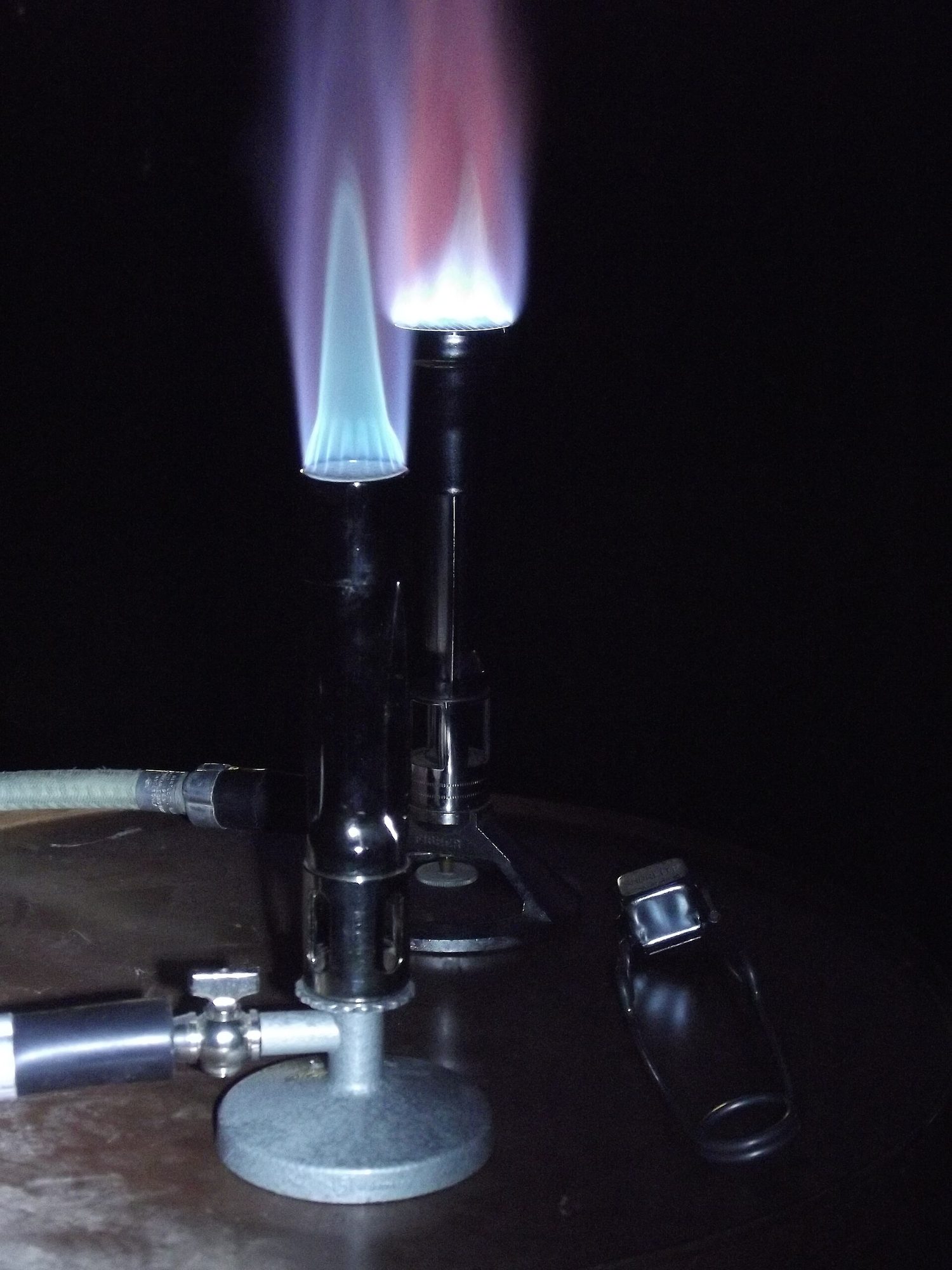
A Bunsen burner gets hot enough to soften glass. An instant cold pack, squeezed once, drops close to freezing. Both are just chemical reactions — one in a…
English narration · English + 中文 subtitles burned in
5.1
Enthalpy change, ΔH
Syllabus
Source: Cambridge International syllabus

Every chemical reaction takes in or gives out energy. This energy change, measured at constant pressure, is the enthalpy change 焓变, with symbol $\Delta H$.
- in an exothermic 放热 reaction the system gives out heat, so the products have less energy than the reactants and $\Delta H$ is negative.
- in an endothermic 吸热 reaction the system takes in heat, so the products have more energy than the reactants and $\Delta H$ is positive.
Reaction pathway diagrams
A reaction pathway diagram 反应路径图 shows the energy of the reactants and products, and the energy "hill" between them. The height of the hill is the activation energy 活化能 — the least energy the particles need before they can react.
- exothermic: products sit lower than reactants ($\Delta H < 0$).
- endothermic: products sit higher than reactants ($\Delta H > 0$).

Standard conditions and types of enthalpy change
Energy values are compared under standard conditions 标准条件: $298\ \text{K}$ and $101\ \text{kPa}$, shown by the symbol $^{\ominus}$. Each substance is in its normal physical state at those conditions.
| Symbol | Name | Definition (per mole, under standard conditions) |
|---|---|---|
| $\Delta H_r^{\ominus}$ | enthalpy change of reaction 反应焓变 | for the amounts shown in the equation |
| $\Delta H_f^{\ominus}$ | enthalpy change of formation 生成焓变 | one mole of a compound forms from its elements |
| $\Delta H_c^{\ominus}$ | enthalpy change of combustion 燃烧焓变 | one mole of a substance burns completely in oxygen |
| $\Delta H_{\text{neut}}^{\ominus}$ | enthalpy change of neutralisation 中和焓变 | one mole of water forms from an acid and an alkali |

Energy from breaking and making bonds
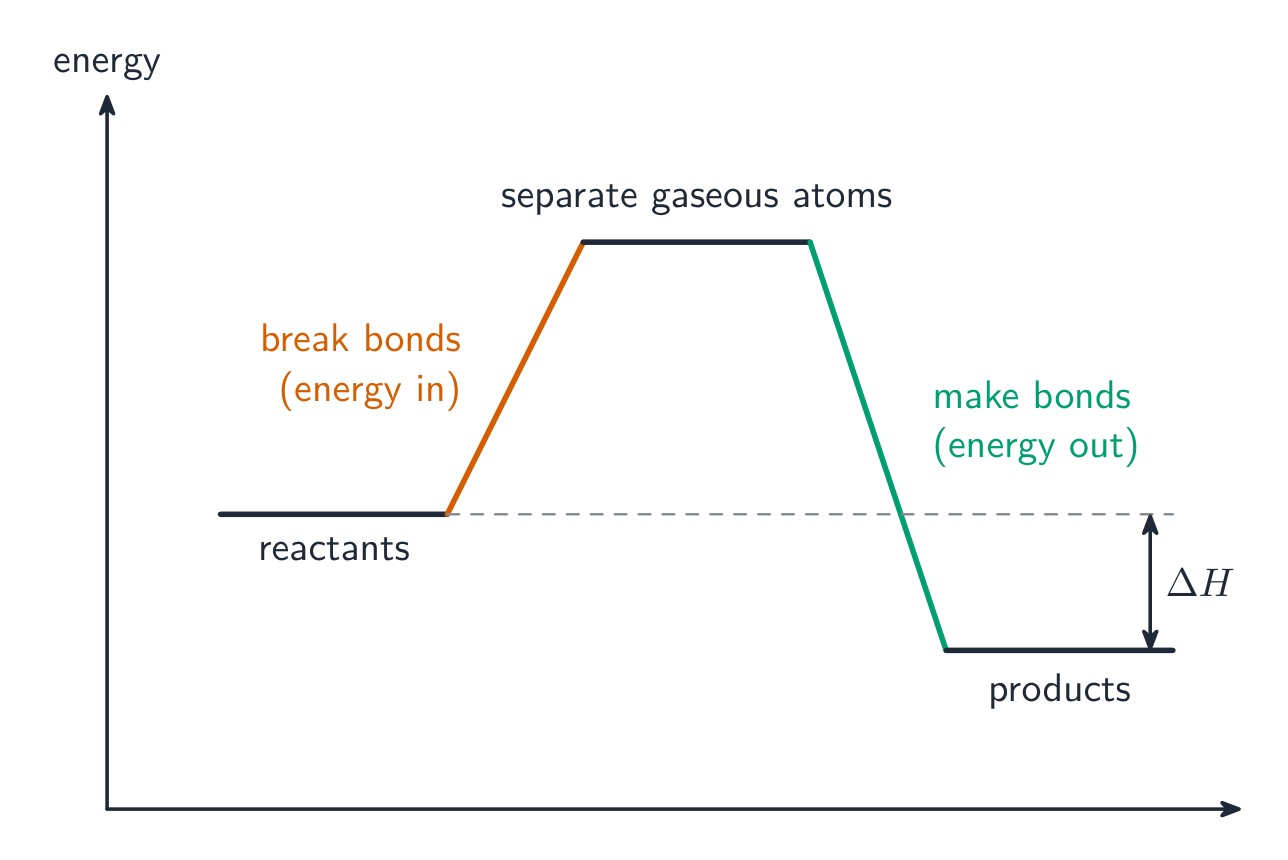
During a reaction, old bonds break and new bonds form. Breaking a bond needs energy (endothermic); making a bond releases energy (exothermic). The enthalpy change of the reaction is the difference between the two:
$$\Delta H_r = \sum (\text{bond energies broken}) - \sum (\text{bond energies made})$$
The bond energy 键能 is the energy needed to break one mole of a particular bond in the gas state, so it is always positive. Some bond energies are exact (for one specific molecule); others are averages taken over many different molecules, so calculations using them are only approximate.
Worked example. Use bond energies to find $\Delta H$ for $\text{H}_2 + \text{Cl}_2 \rightarrow 2\text{HCl}$. Bond energies (kJ mol⁻¹): H–H $= 436$, Cl–Cl $= 242$, H–Cl $= 431$.
$$\Delta H = \sum(\text{broken}) - \sum(\text{made}) = (436 + 242) - (2 \times 431) = 678 - 862 = -184\ \text{kJ mol}^{-1}.$$
Measuring enthalpy change in the lab
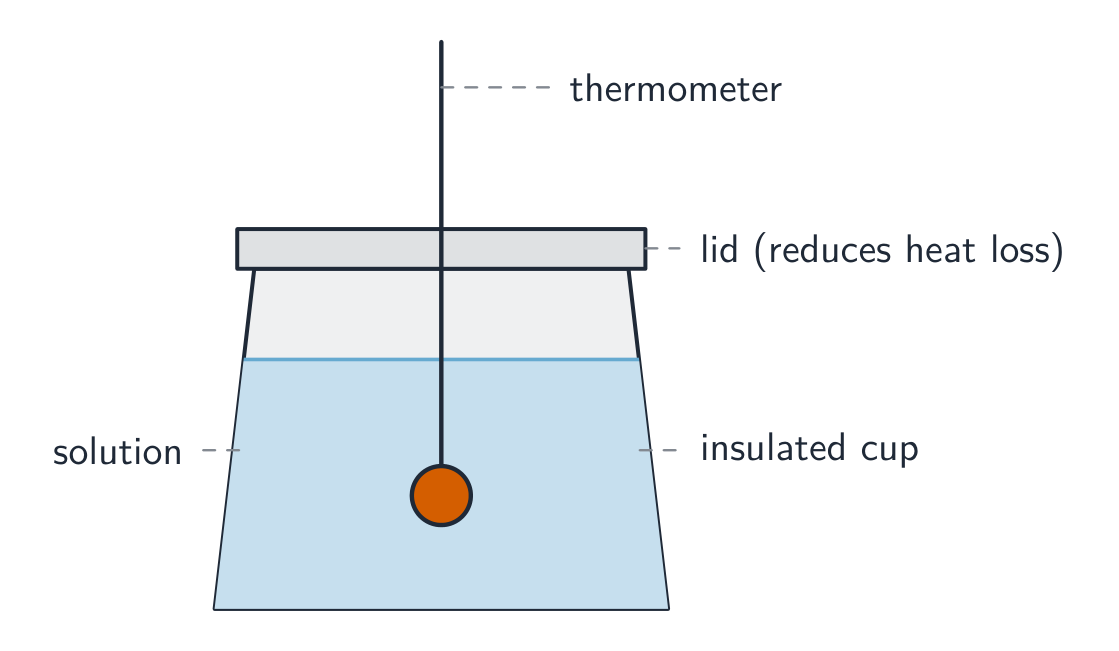
When a reaction heats up (or cools down) a known mass of water or solution, the heat transferred is:
$$q = mc\Delta T$$
where $m$ is the mass, $c$ is the specific heat capacity 比热容 (how much energy raises 1 g by 1 K), and $\Delta T$ is the temperature change. The enthalpy change per mole is then:
$$\Delta H = -\frac{mc\Delta T}{n}$$
The minus sign makes $\Delta H$ negative when the temperature rises (an exothermic reaction).
Worked example. Burning $0.50\ \text{g}$ of methanol ($M_r = 32$) raises the temperature of $100\ \text{g}$ of water by $18\ ^{\circ}\text{C}$. Find the enthalpy change of combustion per mole. ($c = 4.18\ \text{J g}^{-1}\,\text{K}^{-1}$.)
The heat released is $q = mc\Delta T = 100 \times 4.18 \times 18 = 7520\ \text{J}$. The amount burnt is $n = 0.50/32 = 0.0156\ \text{mol}$, so
$$\Delta H_c = -\frac{q}{n} = -\frac{7520}{0.0156} \approx -480\ \text{kJ mol}^{-1}.$$
Explore
Exothermic and endothermic reactions
Drag ΔH. An exothermic reaction releases energy (products lower); an endothermic one takes it in (products higher).
Vocabulary
Train
| English |
|---|
| enthalpy change/enˈθælpi tʃeɪndʒ/ |
| exothermic/eɡzəˈðɜːmɪk/ |
| endothermic/ˌendəʊˈθɜːmɪk/ |
| reaction pathway diagram/rɪˈækʃn ˈpæθweɪ ˈdaɪəɡræm/ |
| activation energy/ˌæktɪˈveɪʃn ˈenədʒi/ |
| standard conditions/ˈstændəd kənˈdɪʃnz/ |
| enthalpy change of reaction/enˈθælpi tʃeɪndʒ ɒv rɪˈækʃn/ |
| enthalpy change of formation/enˈθælpi tʃeɪndʒ ɒv fɔːˈmeɪʃn/ |
| enthalpy change of combustion/enˈθælpi tʃeɪndʒ ɒv kəmˈbʌstʃn/ |
| enthalpy change of neutralisation/enˈθælpi tʃeɪndʒ ɒv ˌnjuːtrəlaɪˈzeɪʃn/ |
| bond energy/bɒnd ˈenədʒi/ |
| specific heat capacity/spəˈsɪfɪk hiːt kəˈpæsɪti/ |
5.2
Hess's law
Syllabus
- apply Hess’s law to construct simple energy cycles
- carry out calculations using cycles and relevant energy terms, including: (a) determining enthalpy changes that cannot be found by direct experiment (b) use of bond energy data
Source: Cambridge International syllabus
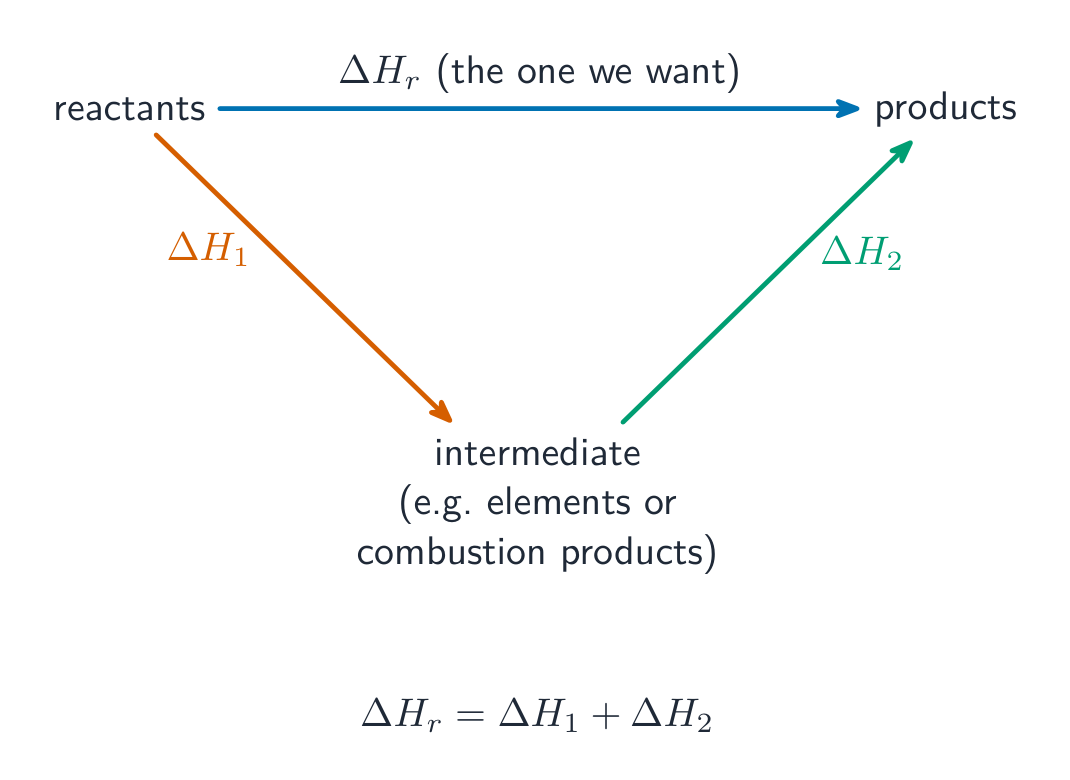
Hess's law 盖斯定律 says that the total enthalpy change for a reaction is the same, no matter which route you take from reactants to products. This is because energy is conserved.
This lets you draw an energy cycle 能量循环: link the reactants and products by a direct step and by an indirect route, then add the steps so that both routes give the same total.
Hess's law is useful in two ways:
- it lets you find an enthalpy change that you cannot measure directly (for example, the formation of a compound that forms slowly or with side reactions).
- it lets you calculate $\Delta H_r$ from bond energy data, or from formation or combustion data given in the question.
Worked example. Carbon, hydrogen and methane can all be burnt, but carbon and hydrogen will not react to make methane, so $\Delta H_f(\text{CH}_4)$ cannot be measured directly. Find it from these enthalpy changes of combustion (kJ mol⁻¹): C $= -394$, $\text{H}_2 = -286$, $\text{CH}_4 = -890$.
- Write the reaction you want across the top: $\text{C(s)} + 2\text{H}_2\text{(g)} \rightarrow \text{CH}_4\text{(g)}$.
- Both sides burn to the same products, $\text{CO}_2 + 2\text{H}_2\text{O}$, so draw that at the bottom of the cycle. Burning the elements goes down from the left; burning methane goes down from the right.
- The two routes from the elements to $\text{CO}_2 + 2\text{H}_2\text{O}$ must have the same total:
$$\Delta H_f(\text{CH}_4) + (-890) = -394 + 2(-286),$$
$$\Delta H_f(\text{CH}_4) = -394 - 572 + 890 = -76\ \text{kJ mol}^{-1}.$$
The two short rules that come from these cycles are:
$$\Delta H_r = \sum \Delta H_f(\text{products}) - \sum \Delta H_f(\text{reactants}), \qquad \Delta H_r = \sum \Delta H_c(\text{reactants}) - \sum \Delta H_c(\text{products}).$$
Common mistakes.
- Swapping the two rules: formation data is products minus reactants, combustion data is reactants minus products. If unsure, draw the cycle.
- Forgetting to multiply by the number in the equation. Above, there are two moles of $\text{H}_2$, so $\Delta H_c(\text{H}_2)$ is counted twice.
- Giving an element a non-zero enthalpy of formation. $\Delta H_f$ of an element in its standard state, such as $\text{O}_2\text{(g)}$, is zero.
- In $q = mc\Delta T$, using the mass of the fuel or of the solid added. $m$ is the mass of the water or solution that is heated.
- Forgetting that $q$ is in joules. Divide by 1000 to get kJ before dividing by moles.
- Expecting a bond-energy answer to match the data book exactly. Bond energies are average values over many compounds, so the answer is only approximate.
Explore
Hess's law cycle
Enthalpy change is the same whichever route you take — so an unknown ΔH can be found by an alternative path.
Vocabulary
Train
| English |
|---|
| Hess's law/ˈhesɪz lɔː/ |
| energy cycle/ˈenədʒi ˈsaɪkl/ |
5.2
Exam tips
- Define each enthalpy change with its exact standard conditions (e.g. combustion = one mole burned completely in excess oxygen).
- Use $\Delta H = \sum(\text{bonds broken}) - \sum(\text{bonds made})$; breaking is endothermic ($+$), making is exothermic ($-$) — getting the sign the wrong way round is the classic error.
- In $q = mc\Delta T$ use the mass of the water/solution, then divide by moles and add the minus sign for an exothermic reaction.
- Draw Hess cycles with arrows the same way round, follow the alternative route, and always give $\Delta H$ a sign and units ($\text{kJ mol}^{-1}$).
Interactive lessons on this topic
Work through it step by step, with instant-check exercises.