- describe the reaction with acyl chlorides to form esters using ethyl ethanoate
Hydroxy compounds
A-Level Chemistry · Topic 32
 8:38
Hydroxy compounds (A2): phenol
In the eighteen sixties, surgery was terrifying. The cutting could be survived; the infection that followed often could not. After an amputation, almost half…
English narration · English + 中文 subtitles burned in
32.1
Alcohols with acyl chlorides

Syllabus
Source: Cambridge International syllabus
At A Level you meet one more reaction of an alcohol 醇: it reacts with an acyl chloride 酰氯 to make an ester 酯. This works faster and more completely than using a carboxylic acid 羧酸. For example, ethanol and ethanoyl chloride 乙酰氯 give ethyl ethanoate 乙酸乙酯, plus fumes 烟雾 of $\text{HCl}$.
Explore
Acyl chloride with alcohol route
Follow nucleophilic acyl substitution to an ester.
Vocabulary
Train
| English |
|---|
| alcohol/ˈælkəhɒl/ |
| acyl chloride/əˈkɪl ˈklɔːraɪd/ |
| ester/ˈestə/ |
| carboxylic acid/ˌkɑːbəkˈsɪlɪk ˈæsɪd/ |
| ethanoyl chloride |
| ethyl ethanoate/ˈiːθaɪl ˈeθənəʊt/ |
| fumes |
32.2
Phenol
Syllabus
- recall the reactions (reagents and conditions) by which phenol can be produced: (a) reaction of phenylamine with $\text{HNO}_2$ or $\text{NaNO}_2$ and dilute acid below $10\text{ }^\circ\text{C}$ to produce the diazonium salt; further warming of the diazonium salt with $\text{H}_2\text{O}$ to give phenol
- recall the chemistry of phenol, as exemplified by the following reactions: (a) with bases, for example $\text{NaOH(aq)}$ to produce sodium phenoxide (b) with $\text{Na(s)}$ to produce sodium phenoxide and $\text{H}_2\text{(g)}$ (c) in $\text{NaOH(aq)}$ with diazonium salts, to give azo compounds (d) nitration of the aromatic ring with dilute $\text{HNO}_3\text{(aq)}$ at room temperature to give a mixture of 2-nitrophenol and 4-nitrophenol (e) bromination of the aromatic ring with $\text{Br}_2\text{(aq)}$ to form 2,4,6-tribromophenol
- explain the acidity of phenol
- describe and explain the relative acidities of water, phenol and ethanol
- explain why the reagents and conditions for the nitration and bromination of phenol are different from those for benzene
- recall that the hydroxyl group of a phenol directs to the 2-, 4- and 6-positions
- apply knowledge of the reactions of phenol to those of other phenolic compounds, e.g. naphthol
Source: Cambridge International syllabus
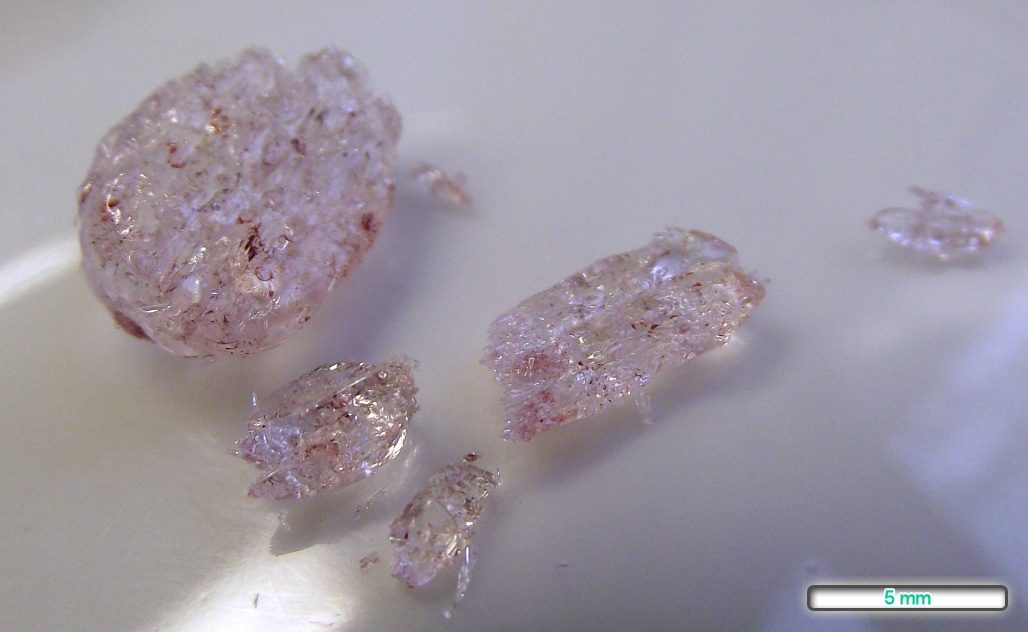
Phenol 苯酚 has an $\text{–OH}$ group joined directly to a benzene 苯 ring. This changes the chemistry of both the $\text{–OH}$ group and the ring.
Making phenol
Cool phenylamine 苯胺 with $\text{NaNO}_2$ and dilute acid below $10\,°\text{C}$ to make a diazonium salt 重氮盐. Warming this salt with water then gives phenol (and nitrogen gas 氮气).
Reactions of phenol
- with a base such as $\text{NaOH(aq)}$: phenol reacts to give sodium phenoxide 苯酚钠 and water. (Ordinary alcohols do not react with $\text{NaOH}$ — this shows phenol is more acidic 酸性的.)
- with sodium metal: gives sodium phenoxide and hydrogen.
- with a diazonium salt in $\text{NaOH(aq)}$: forms a coloured azo compound 偶氮化合物 (used in dyes 染料).
- nitration 硝化 with dilute $\text{HNO}_3$ at room temperature: gives a mixture of 2-nitrophenol and 4-nitrophenol.
- bromination 溴化 with bromine water at room temperature (no catalyst): gives a white precipitate 沉淀 of 2,4,6-tribromophenol.
Acidity of phenol
Phenol loses its $\text{H}^+$ to form a phenoxide ion 苯氧负离子. This ion is stabilised 被稳定 because its negative charge is spread (delocalised) into the ring. So phenol's acidity 酸性 is higher than that of water or ethanol:
$$\text{ethanol} < \text{water} < \text{phenol}$$
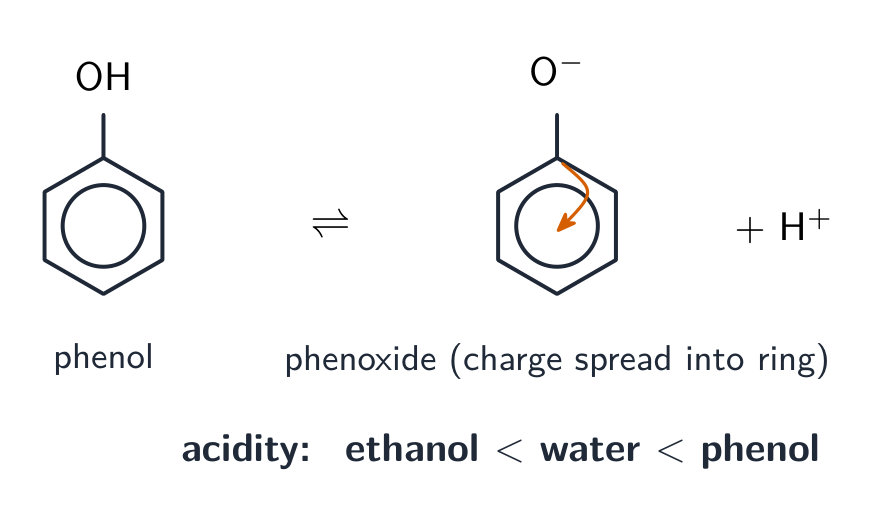
(Phenol is still a weak acid 弱酸 — weaker than a carboxylic acid.)
Why the conditions are milder than for benzene
A lone pair on the phenol oxygen is partly delocalised 离域 into the ring. This makes the ring more electron-rich, so it attracts electrophiles 亲电试剂 more strongly. Phenol therefore reacts faster and under much milder conditions than benzene — no catalyst 催化剂 is needed, and dilute reagents 试剂 work at room temperature.
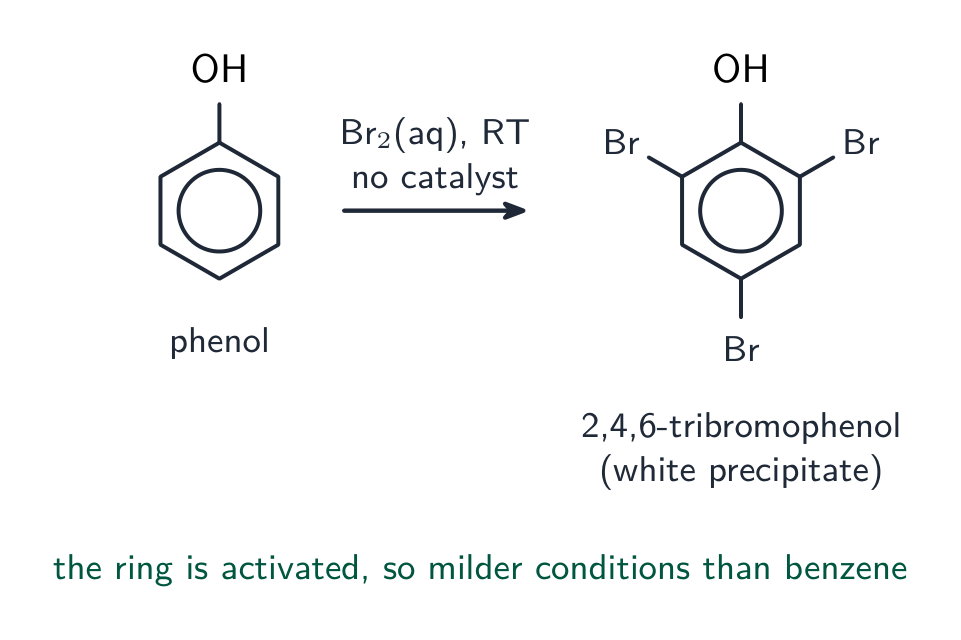
The $\text{–OH}$ group directs new substituents 取代基 to the 2-, 4- and 6-positions. The same ideas apply to other phenolic compounds, such as naphthol 萘酚.
Worked example. Phenol, ethanol and ethanoic acid are each shaken with aqueous $\text{NaOH}$ and then with aqueous $\text{Na}_2\text{CO}_3$. Predict what happens, and order the three by acidity. Acidity depends on how well the anion left behind is stabilised. Ethanol's ethoxide keeps its charge stuck on one oxygen, so ethanol is weakest and reacts with neither. Phenol's phenoxide spreads the charge into the ring, making phenol acidic enough to react with the strong base $\text{NaOH}$ but not with the weaker $\text{Na}_2\text{CO}_3$ - so no fizzing. Ethanoate spreads the charge over two oxygens, the most effective of the three, so ethanoic acid reacts with both and fizzes with the carbonate. Order: ethanol < phenol < ethanoic acid. The carbonate is the discriminating test - only a carboxylic acid fizzes, which is exactly how you tell phenol from an acid.
Common mistakes.
- Saying phenol reacts with $\text{Na}_2\text{CO}_3$ to give carbon dioxide. Phenol is too weak an acid: it reacts with $\text{NaOH}$ but gives no fizzing with carbonates. Only carboxylic acids do.
- Explaining phenol's acidity by the O–H bond being "weaker". The key is the anion: the negative charge of the phenoxide ion is delocalised into the ring, so the ion is stabilised.
- Brominating phenol with $\text{FeBr}_3$, or getting a single substitution. Phenol needs no catalyst, and bromine water gives 2,4,6-tribromophenol at once.
- Nitrating phenol with concentrated acids. Dilute $\text{HNO}_3$ at room temperature is enough and gives 2- and 4-nitrophenol; concentrated acid gives multiple substitution and oxidation.
- Making a phenyl ester from phenol and a carboxylic acid. Phenol reacts too slowly with carboxylic acids; use an acyl chloride.
- Saying the –OH group activates the ring by withdrawing electrons. A lone pair on oxygen is donated into the ring, making it more electron-rich and more attractive to electrophiles.
Explore
Phenol reaction lab
Classify phenol reactions by the role of the aromatic OH group.
Vocabulary
Train
| English |
|---|
| Phenol/ˈfenɒl/ |
| benzene/ˈbenziːn/ |
| phenylamine/ˌfiːˈnaɪləmiːn/ |
| diazonium salt/ˌdaɪəˈzəʊnɪəm sɒlt/ |
| nitrogen gas |
| sodium phenoxide |
| acidic/əˈsɪdɪk/ |
| azo compound/ˈɑːzəʊ ˈkɒmpaʊnd/ |
| dyes |
| nitration/naɪˈtreɪʃn/ |
| bromination/ˌbrəʊmɪˈneɪʃn/ |
| precipitate/prɪˈsɪpɪteɪt/ |
| phenoxide ion |
| stabilised |
| acidity/æˈsɪdɪti/ |
| weak acid/wiːk ˈæsɪd/ |
| delocalised/dɪˈlɒkəlaɪzd/ |
| electrophiles |
| catalyst/ˈkætəlɪst/ |
| reagents |
| substituents |
| naphthol |
32.2
Exam tips
- Phenol is a stronger acid than alcohols (its anion is stabilised by delocalisation) but weaker than carboxylic acids — it does not react with carbonates 碳酸盐.
- Phenol decolourises 使褪色 bromine water 溴水 and gives a white precipitate without a catalyst (the ring is activated 活化 by oxygen).
- Acyl chlorides react with alcohols/phenols to give esters readily (better than the reversible 可逆的 acid route); misty HCl fumes are the observation 现象.
Vocabulary
Train
| English |
|---|
| carbonates/ˈkɑːbəneɪts/ |
| decolourises |
| bromine water/ˈbrəʊmaɪn ˈwɔːtə/ |
| activated/ˈæktɪveɪtɪd/ |
| reversible/rɪˈvɜːsɪbl/ |
| observation/ɒbzəˈveɪʃn/ |
Interactive lessons on this topic
Work through it step by step, with instant-check exercises.