- describe the chemistry of arenes as exemplified by the following reactions of benzene and methylbenzene: (a) substitution reactions with $\text{Cl}_2$ and with $\text{Br}_2$ in the presence of a catalyst, $\text{AlCl}_3$ or $\text{AlBr}_3$, to form halogenoarenes (aryl halides) (b) nitration with a mixture of concentrated $\text{HNO}_3$ and concentrated $\text{H}_2\text{SO}_4$ at a temperature between $25\text{ }^{\circ}\text{C}$ and $60\text{ }^{\circ}\text{C}$ (c) Friedel–Crafts alkylation by $\text{CH}_3\text{Cl}$ and $\text{AlCl}_3$ and heat (d) Friedel–Crafts acylation by $\text{CH}_3\text{COCl}$ and $\text{AlCl}_3$ and heat (e) complete oxidation of the side-chain using hot alkaline $\text{KMnO}_4$ and then dilute acid to give a benzoic acid (f) hydrogenation of the benzene ring using $\text{H}_2$ and $\text{Pt/Ni}$ catalyst and heat to form a cyclohexane ring
- describe the mechanism of electrophilic substitution in arenes: (a) as exemplified by the formation of nitrobenzene and bromobenzene (b) with regards to the effect of delocalisation (aromatic stabilisation) of electrons in arenes to explain the predomination of substitution over addition
- predict whether halogenation will occur in the side-chain or in the aromatic ring in arenes depending on reaction conditions
- describe that in the electrophilic substitution of arenes, different substituents direct to different ring positions (limited to the directing effects of $-\text{NH}_2$, $-\text{OH}$, $-\text{R}$, $-\text{NO}_2$, $-\text{COOH}$ and $-\text{COR}$)
Hydrocarbons
A-Level Chemistry · Topic 30
 7:42
Hydrocarbons (A2): arenes
Orange bromine water is the classic test for a double bond. Shake it with an alkene, and the orange colour vanishes at once. Now shake the very same bromine…
English narration · English + 中文 subtitles burned in
30.1
Arenes
Syllabus
Source: Cambridge International syllabus
Arenes 芳烃 are aromatic hydrocarbons, built on the benzene 苯 ring. The delocalised ring of electrons is stable and electron-rich, so benzene mostly reacts by electrophilic substitution 亲电取代 — keeping the ring — rather than by addition.
Reactions of benzene and methylbenzene
| Reaction | Reagents and conditions | Product |
|---|---|---|
| halogenation | $\text{Cl}_2$ or $\text{Br}_2$, with $\text{AlCl}_3$ or $\text{AlBr}_3$ as a catalyst 催化剂 | a halogenoarene 卤代芳烃 (aryl halide) |
| nitration 硝化 | concentrated $\text{HNO}_3$ + concentrated $\text{H}_2\text{SO}_4$, $25$–$60\,°\text{C}$ | nitrobenzene |
| Friedel–Crafts alkylation 傅克烷基化 | $\text{CH}_3\text{Cl}$ + $\text{AlCl}_3$, heat | methylbenzene (adds an alkyl group) |
| Friedel–Crafts acylation 傅克酰基化 | $\text{CH}_3\text{COCl}$ + $\text{AlCl}_3$, heat | a phenyl ketone (adds an acyl group) |
| side-chain oxidation | hot alkaline $\text{KMnO}_4$, then dilute acid | benzoic acid 苯甲酸 |
| hydrogenation 氢化 | $\text{H}_2$, $\text{Pt/Ni}$ catalyst, heat | cyclohexane |

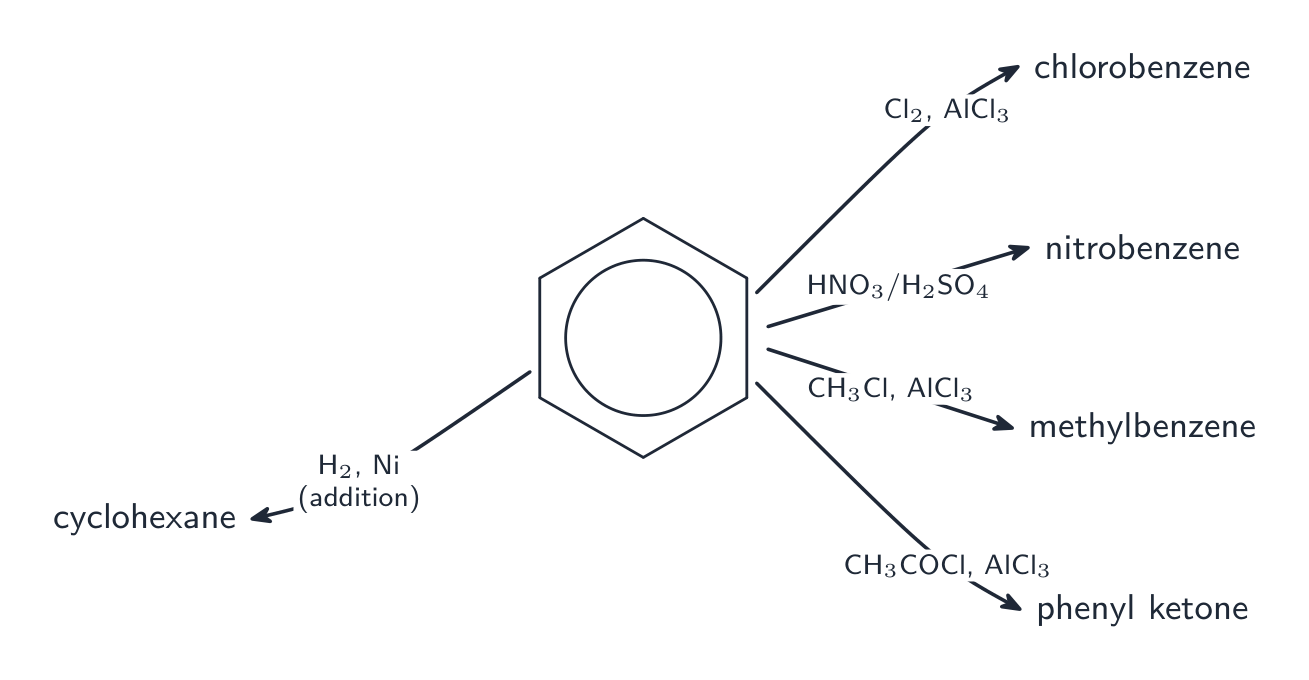
In the side-chain oxidation, the whole side-chain 侧链 (such as the $\text{–CH}_3$ on methylbenzene) is turned into a $\text{–COOH}$ group, giving benzoic acid. In the hydrogenation, three molecules of $\text{H}_2$ add to the benzene ring 苯环 to make a saturated cyclohexane ring.
The mechanism: electrophilic substitution
The ring is rich in electrons, but it is also very stable, so it needs a strong electrophile. A catalyst makes one first:
- nitration: $\text{HNO}_3 + 2\text{H}_2\text{SO}_4 \rightarrow \text{NO}_2^{\,+} + 2\text{HSO}_4^{\,-} + \text{H}_3\text{O}^+$. The electrophile is the nitronium ion 硝鎓离子, $\text{NO}_2^{\,+}$.
- bromination: $\text{Br}_2 + \text{AlBr}_3 \rightarrow \text{Br}^+ + \text{AlBr}_4^{\,-}$. The halogen carrier 卤素载体 $\text{AlBr}_3$ pulls a $\text{Br}^-$ away and leaves $\text{Br}^+$.
Then the same two steps happen with either electrophile:
- a pair of the delocalised electrons forms a bond to the electrophile. The intermediate has a $+$ charge spread over five carbons, and the ring's delocalisation is partly lost.
- the C–H bond on the carbon that gained the electrophile breaks, and its electron pair goes back into the ring. An $\text{H}^+$ leaves and the stable ring is restored.
In bromination the $\text{H}^+$ meets $\text{AlBr}_4^{\,-}$: $\text{H}^+ + \text{AlBr}_4^{\,-} \rightarrow \text{HBr} + \text{AlBr}_3$. So the $\text{AlBr}_3$ is given back, which shows it is a catalyst.

Substitution wins over addition because the delocalisation 离域 (aromatic stabilisation) of the ring is kept. Addition would destroy this stable system, so it is not favoured.
Drawing it for full marks.
- the equation that makes the electrophile ($\text{NO}_2^{\,+}$ or $\text{Br}^+$).
- a curly arrow from inside the ring (the circle) to the electrophile.
- the intermediate: a horseshoe 马蹄形 that is open at the carbon carrying H and the new group, with $+$ inside it. The horseshoe covers five carbons, not six.
- a curly arrow from the C–H bond back into the ring, and the products, including $\text{H}^+$.
Common mistakes.
- Drawing a full circle in the intermediate. The top carbon has four single bonds, so it is not part of the delocalised system.
- Starting the first arrow at a single carbon atom or from outside the ring.
- Giving $\text{NO}_2$ (no charge) or $\text{HNO}_3$ as the electrophile.
- Thinking benzene decolourises bromine water like an alkene. It does not: without a halogen carrier, $\text{Br}_2$ is not a strong enough electrophile to react with the ring.
Side-chain or ring?
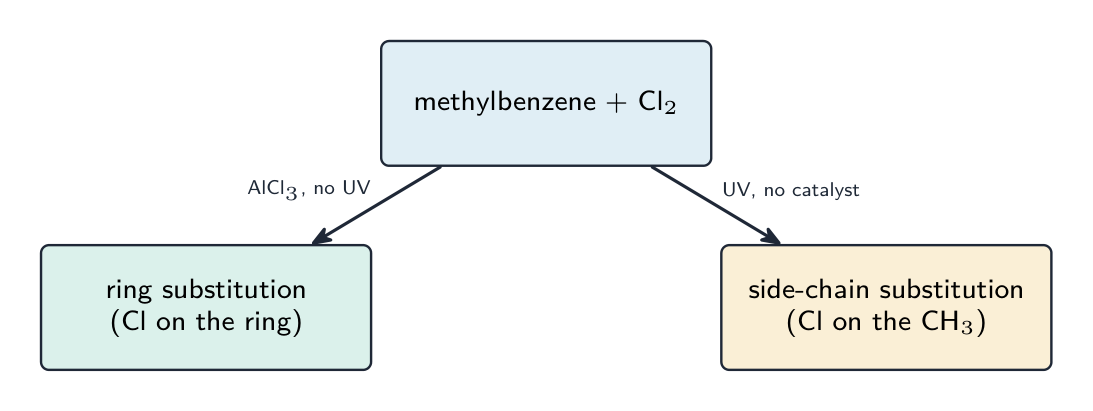
Where a halogen reacts depends on the conditions:
- with a halogen-carrier catalyst (such as $\text{AlCl}_3$) and no UV light → substitution in the ring.
- with UV light and no catalyst → free-radical substitution in the side-chain.
Directing effects
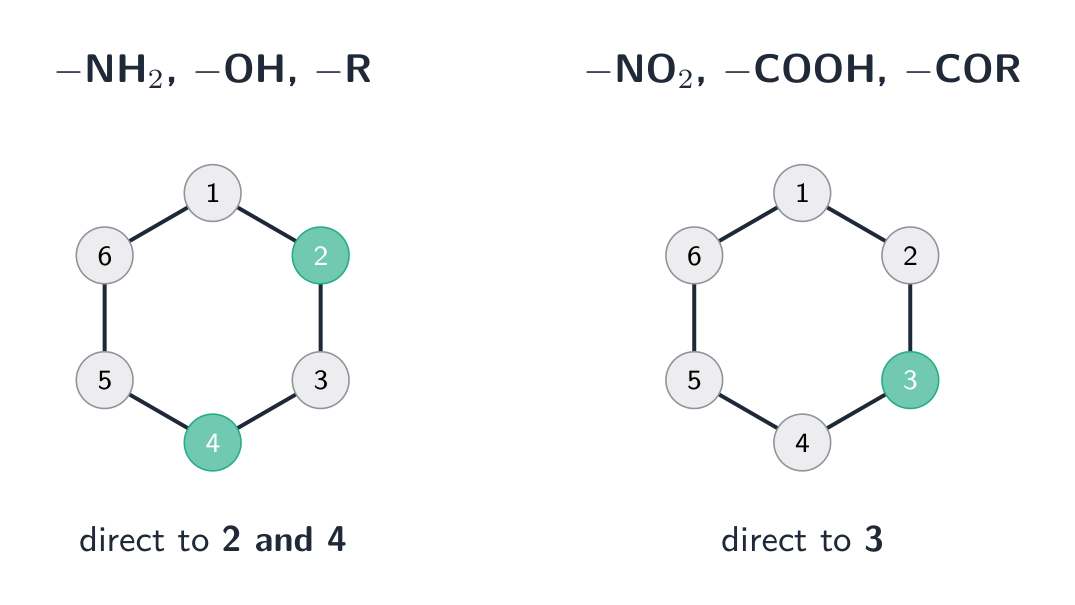
A group already on the ring decides where the next group goes — its directing effect 定位效应:
| Group already present | Directs the new group to |
|---|---|
| $\text{–NH}_2$, $\text{–OH}$, $\text{–R}$ | positions 2 and 4 |
| $\text{–NO}_2$, $\text{–COOH}$, $\text{–COR}$ | position 3 |
Worked example. Methylbenzene and nitrobenzene are each nitrated. Predict where the new $\text{NO}_2$ group goes, and which compound reacts faster. Look at the group already on the ring. In methylbenzene the $\text{–CH}_3$ is an alkyl group: it directs the new group to positions 2 and 4, and it releases electrons into the ring, making the ring more attractive to an electrophile - so methylbenzene nitrates faster than benzene. In nitrobenzene the $\text{–NO}_2$ directs to position 3, and it withdraws electrons from the ring - so nitrobenzene nitrates more slowly than benzene. The group already present controls both the position and the rate, and the two always travel together: 2,4-directors activate the ring, 3-directors deactivate it.
Explore
Arene substitution route
Follow electrophilic substitution on benzene.
Explore
Directing effects lab
Classify substituents by how they affect the benzene ring.
Vocabulary
Train
| English |
|---|
| arene/ˈæren/ |
| benzene/ˈbenziːn/ |
| electrophilic substitution/ɪˌlektrəʊˈfɪlɪk ˌsʌbstɪˈtjuːʃn/ |
| catalyst/ˈkætəlɪst/ |
| halogenoarene/ˈheɪləʊdʒnɔːren/ |
| nitration/naɪˈtreɪʃn/ |
| Friedel–Crafts alkylation/ˈfriːdl kræfts ˌælkɪˈleɪʃn/ |
| Friedel–Crafts acylation/ˈfriːdl kræfts əkɪˈleɪʃn/ |
| benzoic acid/benˈzəʊɪk ˈæsɪd/ |
| hydrogenation/haɪˈdrɒdʒəneɪʃn/ |
| side-chain/saɪd tʃeɪn/ |
| benzene ring/ˈbenziːn rɪŋ/ |
| nitronium ion |
| halogen carrier |
| delocalisation/dɪˌlɒkəlaɪˈzeɪʃn/ |
| horseshoe |
| directing effect/daɪˈrektɪŋ ɪˈfekt/ |
30.1
Exam tips
- Benzene undergoes electrophilic substitution, not addition, because addition would destroy the stable delocalised ring.
- Learn nitration (concentrated $\text{HNO}_3$/$\text{H}_2\text{SO}_4$, $25$–$60\,°\text{C}$; hotter gives more than one $\text{NO}_2$ group) and halogenation (halogen + $\text{AlCl}_3$) with the electrophile-generating step.
- Compare reactivity: benzene resists addition far more than an alkene because of delocalisation.
Interactive lessons on this topic
Work through it step by step, with instant-check exercises.