| Enduring Understanding | Learning Objective | Essential Knowledge |
|---|---|---|
RHS-1 | 1.A |
|
Introductions, Conclusions, and Development
AP English Language and Composition · Topic 4
 5:18
5:18
Unit 4: Introductions, Conclusions, and Development
Unit 4 covers the two positions in a text where a writer's choices are most visible — the beginning and the end. And it comes with a warning about your own…
English narration · English + 中文 subtitles burned in
4.1
Introductions and Conclusions in a Text

Syllabus
Source: College Board AP Course and Exam Description
Unit 4 covers the two positions in a text where a writer's choices are most visible - the beginning and the end - and completes the CED's list of methods of development.
- The introduction 引言 of an argument introduces the subject and/or the writer to the audience. It may orient the reader, establish the exigence and context, and gain attention.
- The conclusion 结论 brings the argument to a unified end. It may present the argument's thesis, explain its significance, or situate the argument in a broader context.
Note the verb in the second: unified. A conclusion is not a summary; it is the point at which the parts are shown to have been one argument.
Vocabulary
Train
| English | Chinese | Pinyin |
|---|---|---|
| introduction | 引言 | yǐn yán |
| conclusion | 结论 | jié lùn |
4.2
Writing Introductions and Conclusions
Syllabus
| Enduring Understanding | Learning Objective | Essential Knowledge |
|---|---|---|
RHS-1 | 2.A |
|
Source: College Board AP Course and Exam Description
On the exam, both are worth writing well but neither is worth writing long. A useful discipline:
- An introduction that positions the subject and states a defensible thesis in two or three sentences is complete. Everything else in a timed essay is better spent on evidence and commentary.
- A conclusion that says what follows from the argument - its significance, or its wider implication - does more than one that restates the paragraphs.
The weakest conclusion is the one that re-lists what the essay already said. The reader has just read it. Say instead what it means, or what it obliges.
4.3
Identifying the Overarching Thesis
Syllabus
| Enduring Understanding | Learning Objective | Essential Knowledge |
|---|---|---|
CLE-1 | 3.B |
|
Source: College Board AP Course and Exam Description
The CED adds a precise refinement here: a thesis statement may preview the line of reasoning of an argument - and then, immediately, this is not to say that a thesis statement must list the reasons.
That double statement is worth holding, because both errors are common. A thesis that previews nothing leaves the essay shapeless. A thesis mechanically listing three reasons is not required and often produces a rigid essay that cannot develop.
4.4
Writing a Thesis Statement
Syllabus
| Enduring Understanding | Learning Objective | Essential Knowledge |
|---|---|---|
CLE-1 | 4.B |
|
Source: College Board AP Course and Exam Description
For your own writing, the practical version:
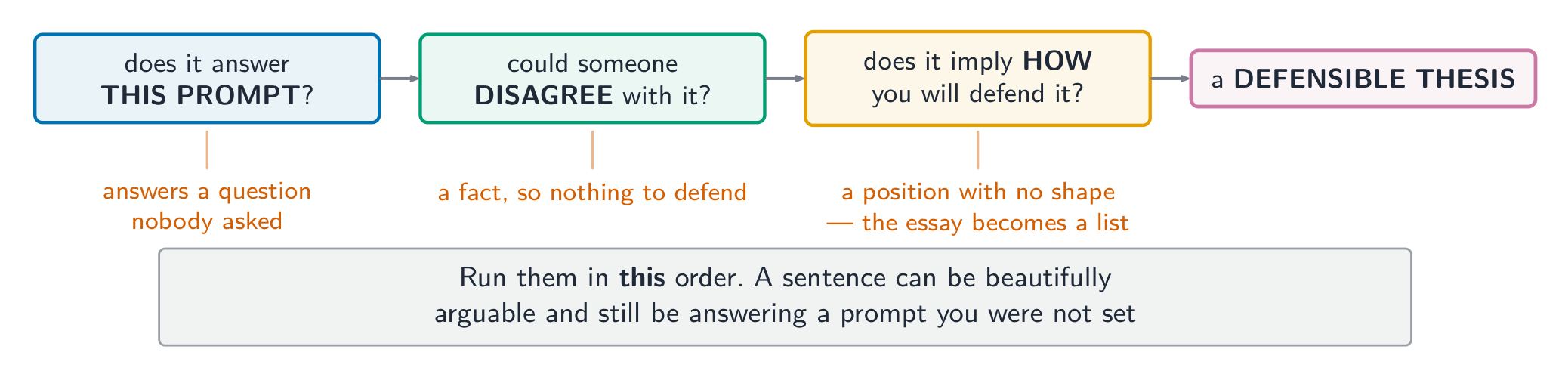
- The thesis must be defensible. Non-negotiable, and it is the whole of the thesis point.
- It may indicate the shape of the reasoning. Do it when the shape is genuinely load-bearing; do not do it as a formula.
- It should be specific enough to constrain what follows. A thesis so broad that any paragraph could belong under it is not directing the essay.
Explore
Run the three thesis gates in order
A sentence can be beautifully arguable and still answer a prompt you were not set — which is why the order matters.
4.5
Recognizing Methods of Development
Syllabus
| Enduring Understanding | Learning Objective | Essential Knowledge |
|---|---|---|
REO-1 | 5.C |
|
Source: College Board AP Course and Exam Description
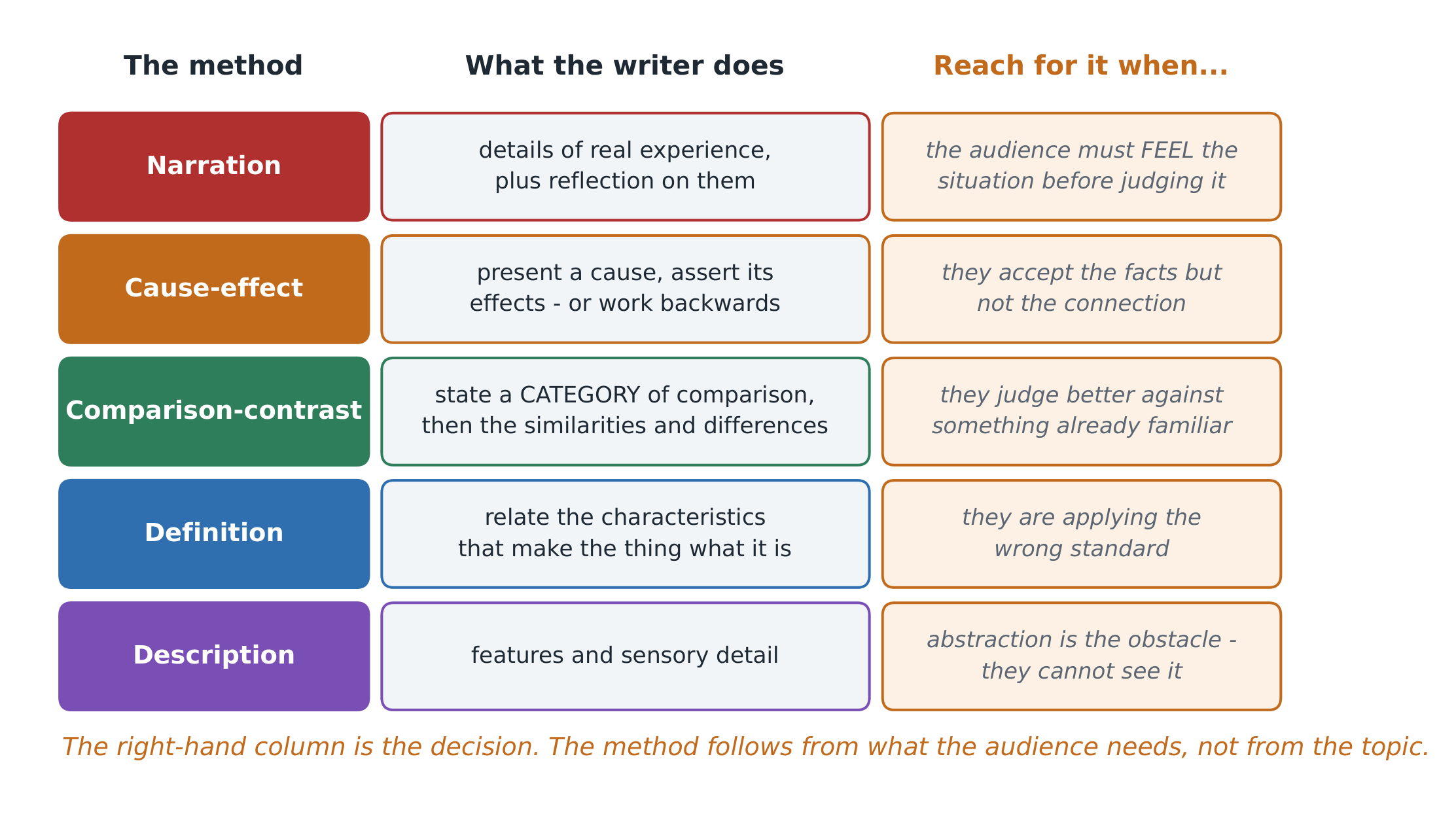
Unit 3 covered narration and cause-effect. Unit 4 adds the rest:
- Developing through comparison-contrast 比较对照: writers present a category of comparison and then examine similarities and differences within it. The category is the part students omit - a comparison without a stated basis is two descriptions side by side.
- Developing through definition or description 定义与描写: writers relate the characteristics, features, or sensory details 特征与感官细节 of a subject.
Definition is more powerful than it looks. An argument that turns on what a word means - what counts as success, as fairness, as progress - is an argument that has moved to the ground where it can actually be won.
Vocabulary
Train
| English | Chinese | Pinyin |
|---|---|---|
| comparison-contrast | 比较对照 | bǐ jiào duì zhào |
| definition or description | 定义与描写 | dìng yì yǔ miáo xiě |
| characteristics, features, or sensory details | 特征与感官细节 | tè zhēng yǔ gǎn guān xì jié |
4.6
Using Methods of Development
Syllabus
| Enduring Understanding | Learning Objective | Essential Knowledge |
|---|---|---|
REO-1 | 6.C |
|
Source: College Board AP Course and Exam Description
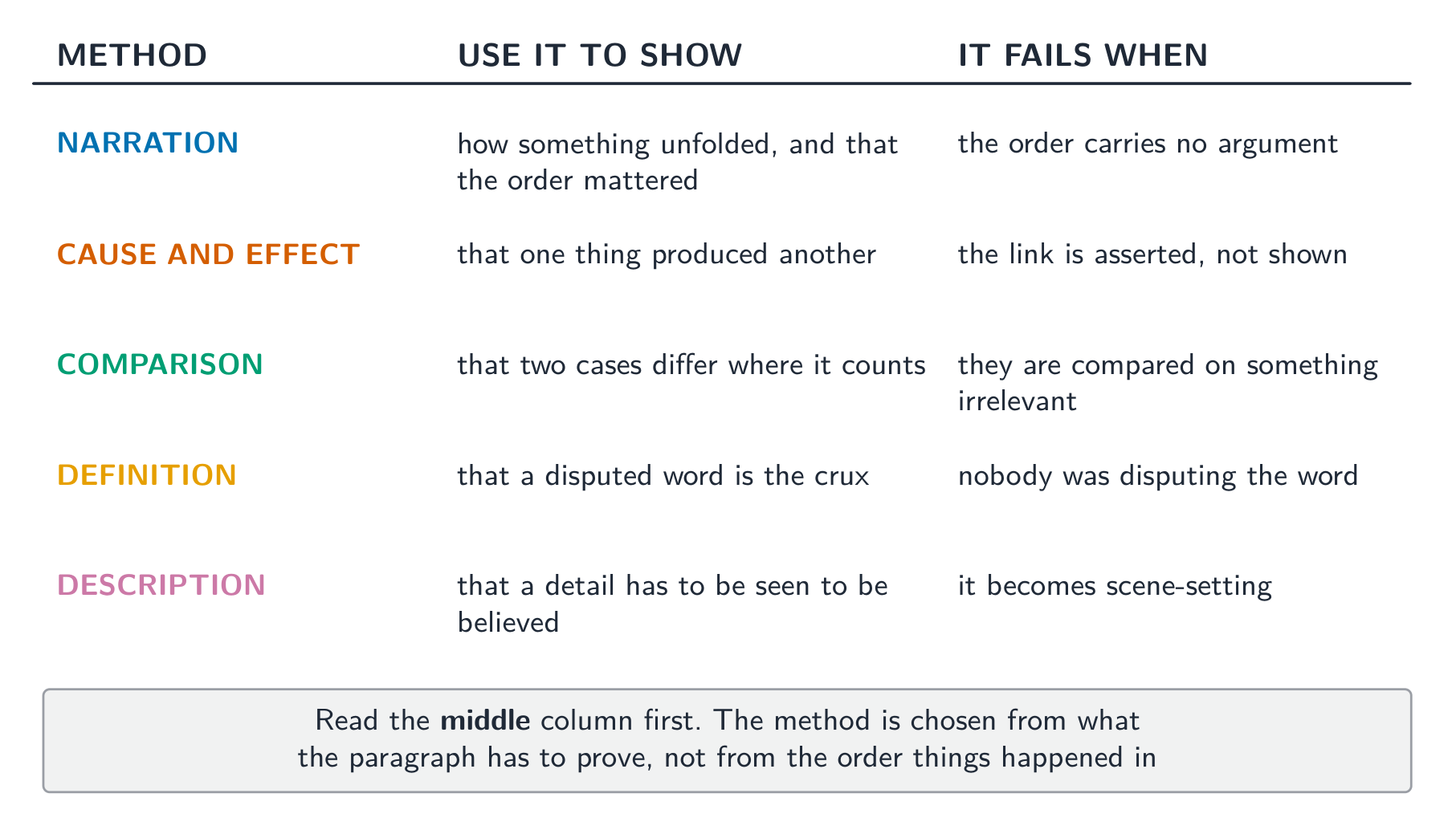
The choice is rhetorical. Ask what the audience needs before they will accept your claim:
- They need to see it, and abstraction is the obstacle: description.
- They accept the facts but not the connection: cause-effect.
- They are applying the wrong standard: definition.
- They will judge better against something familiar: comparison-contrast.
- They need to feel the situation: narration.
Worked example (a real AP exam task). A Question 3 argument prompt asks you to take a position on whether a common practice is beneficial. A student who reaches for description writes a vivid paragraph nobody disputes. A student who reaches for definition writes: "Whether the practice is beneficial depends on what we count as benefit. If benefit means measurable short-term gain, the practice succeeds; if it means durable capability, the same evidence shows it failing." That paragraph has relocated the argument onto ground where the evidence actually decides something - which is the kind of move the sophistication point exists to reward.
Explore
Choose the method from the job
The method follows from what the paragraph has to prove, not from the order things happened in.
4.6
Exam tips
- Introductions should be short and load-bearing: position the subject, state a defensible thesis, move on.
- A conclusion that restates earns least. Say what the argument means or obliges.
- A thesis may preview the reasoning; it is not required to list reasons. Both errors are common.
- Comparison needs a stated category. Without one you have written two descriptions, not a comparison.
- Definition is the strongest move available in an argument essay whose terms are contestable.
- Pick a method of development from what the audience needs, not from what the topic suggests.
Interactive lessons on this topic
Work through it step by step, with instant-check exercises.
AP English Language and Composition Past Papers