Skip to content · ⁨Перейти к содержанию⁩
Subjects · ⁨Предметы⁩

AP Calculus AB

Tips · ⁨Советы⁩

AP Calculus AB covers limits and continuity, differentiation and its applications, integration and accumulation of change, differential equations, and applications of integration including areas and volumes. It is roughly one semester of university calculus.

The exam is about meaning as much as method. You will be asked what a derivative means in context — with units — and to justify a maximum or a point of inflection by the sign of a derivative, not by inspection of a graph.

The Fundamental Theorem of Calculus is the spine of the course. Understanding it as "the integral of a rate gives the total change" is what makes accumulation questions readable.

Notes take each unit in order, with the theorems stated the way the exam expects them to be cited. Past FRQs with scoring guidelines are in the library — AB marks often go to the justification in words, so the worked solutions write the reasoning out instead of stopping at the answer.

  • 1

    Limits and Continuity · ⁨Пределы и непрерывность⁩

    Watch lesson · ⁨Смотреть урок⁩
    1.1

    Introducing Calculus: Can Change Occur at an Instant? · ⁨Введение в математический анализ: может ли изменение происходить в один мгновенный момент?⁩

    Syllabus · ⁨Программа⁩
    English

    Enduring Understanding (CHA-1): Calculus allows us to generalize knowledge about motion to diverse problems involving change.

    Learning Objective CHA-1.A: Interpret the rate of change at an instant in terms of average rates of change over intervals containing that instant.

    • CHA-1.A.1 Calculus uses limits to understand and model dynamic change.
    • CHA-1.A.2 Because an average rate of change divides the change in one variable by the change in another, the average rate of change is undefined at a point where the change in the independent variable would be zero.
    • CHA-1.A.3 The limit concept allows us to define instantaneous rate of change in terms of average rates of change.
    Русский

    Принцип (CHA-1): Математический анализ позволяет обобщить знания о движении для решения разнообразных задач, связанных с изменениями.

    Цель обучения CHA-1.A: Интерпретировать скорость изменения в конкретный момент времени через средние скорости изменения на интервалах, содержащих этот момент.

    • CHA-1.A.1 Математический анализ использует пределы для понимания и моделирования динамических изменений.
    • CHA-1.A.2 Поскольку средняя скорость изменения представляет собой отношение изменения одной переменной к изменению другой, средняя скорость изменения не определена в точке, где изменение независимой переменной равно нулю.
    • CHA-1.A.3 Понятие предела позволяет определить мгновенную скорость изменения через средние скорости изменения.

    Source: College Board AP Course and Exam Description · ⁨Источник: Описание курса и экзамена College Board AP⁩

    English

    Calculus is the mathematics of change 变化 and of accumulation 累积. It answers two big questions: how fast is something changing right now, and how much has piled up so far? Unit 1 builds the one tool both questions rest on – the limit 极限.

    Start with a puzzle. A car's speedometer reads $60$ km/h. What does that mean at a single instant 瞬间? Speed is distance over time. But at one instant no time passes and no distance is covered, so the fraction looks like $\tfrac{0}{0}$ – undefined.

    • The average rate of change 平均变化率 uses a whole interval 区间: the change in one quantity divided by the change in another. It divides by zero, and so is undefined, when the change in the input would be zero.
    • The instantaneous rate of change 瞬时变化率 is what we want at a point. It is the value the average rate approaches 趋近 as the interval shrinks toward zero length.

    The clever move is not to plug in zero (undefined), but to watch what the average rate approaches as the interval gets smaller and smaller. That approaching value is a limit. So calculus lets us describe change at an instant – as a limit of average rates over ever-shorter intervals. This one idea powers the derivative 导数 (Unit 2) and, run in reverse, the integral 积分 (Unit 6). Everything else in this unit defines limits carefully and computes them reliably.

    Русский

    Математический анализ — это математика изменений и накопления. Он отвечает на два главных вопроса: как быстро что-то меняется прямо сейчас и сколько накопилось к данному моменту? Раздел 1 строит тот самый инструмент, на котором основаны оба этих вопроса, — предел.

    Начните с задачи. Спидометр автомобиля показывает $60$ км/ч. Что это означает в один конкретный миг? Скорость — это расстояние, деленное на время. Но за один миг не проходит времени и не проходится расстояния, поэтому дробь выглядит как $\tfrac{0}{0}$ – неопределенность.

    • Средняя скорость изменения используется для всего интервала: это изменение одной величины, деленное на изменение другой. Она не определена, так как деление на ноль, когда изменение входной величины равно нулю.
    • Мгновенная скорость изменения — это то, что нам нужно в точке. Это значение, к которому стремится средняя скорость, по мере того как интервал сокращается до нуля.

    Хитрость состоит не в подстановке нуля (что дает неопределенность), а в наблюдении за тем, к чему стремится средняя скорость, по мере того как интервал становится все меньше и меньше. Это приближающееся значение и есть предел. Таким образом, математический анализ позволяет описать изменение в один мгновенный момент — как предел средних скоростей на все более коротких интервалах. Одна эта идея порождает производную (Раздел 2) и, если двигаться в обратном направлении, интеграл (Раздел 6). Все остальное в этом разделе определяет пределы аккуратно и вычисляет их надежно.

    Explore · ⁨Исследовать⁩

    Explore rate of change at an instant · ⁨Исследуйте мгновенную скорость изменения⁩

    y = ax³ + bx² + cx + d

    Slide the point along the curve. The tangent line is the limit of ever-shorter average rates — its slope is the instantaneous rate of change $\frac{dy}{dx}$ at that point. · ⁨Перетащите точку вдоль кривой. Касательная линия представляет собой предел все более коротких средних скоростей — её наклон является мгновенной скоростью изменения $\frac{dy}{dx}$ в этой точке.⁩

    1.2

    Defining Limits and Using Limit Notation · ⁨Определение пределов и использование нотации пределов⁩

    Syllabus · ⁨Программа⁩
    Enduring UnderstandingLearning ObjectiveEssential Knowledge

    LIM-1
    Reasoning with definitions, theorems, and properties can be used to justify claims about limits.

    LIM-1.A
    Represent limits analytically using correct notation.

    • LIM-1.A.1 Given a function $f$, the limit of $f(x)$ as $x$ approaches $c$ is a real number $R$ if $f(x)$ can be made arbitrarily close to $R$ by taking $x$ sufficiently close to $c$ (but not equal to $c$). If the limit exists and is a real number, then the common notation is $\lim_{x \to c} f(x) = R$.
      • Exclusion statement: The epsilon-delta definition of a limit is not assessed on the AP Calculus AB or BC Exam. However, teachers may include this topic in the course if time permits.

    LIM-1.B
    Interpret limits expressed in analytic notation.

    • LIM-1.B.1 A limit can be expressed in multiple ways, including graphically, numerically, and analytically.

    Source: College Board AP Course and Exam Description · ⁨Источник: Описание курса и экзамена College Board AP⁩

    English

    Given a function $f$, the limit of $f(x)$ as $x$ approaches $c$ is a real number $R$ if $f(x)$ can be made arbitrarily 任意地 close to $R$ by taking $x$ sufficiently 足够 close to $c$ – but not equal to $c$. We write

    $$\lim_{x \to c} f(x) = R$$
    and read it: "the limit of $f(x)$, as $x$ approaches $c$, equals $R$."

    The last words are the heart of a limit: it describes the behavior 行为 of $f$ near $c$, not the value at $c$. The function may be undefined at $c$, or defined but equal to something else – the limit does not care.

    A limit can be shown in three ways: graphically 用图象, numerically 用数值 (a table), and analytically 用解析式 (algebra). Learning to move between these representations is a core skill.

    (Note: the epsilon-delta definition of a limit is not tested on the AP Exam, so this handout does not use it.)

    Русский
    Плавный мостик: пределы описывают значение, к которому приближается график при увеличении
    Плавный мостик: пределы описывают значение, к которому приближается график при увеличении

    Для функции $f$ предел $f(x)$ при $x$, стремящемся к $c$, является действительным числом $R$, если $f(x)$ может быть сделано произвольно близким к $R$ путем выбора $x$ достаточно близким к $c$ – но не равным $c$. Записываем:

    $$\lim_{x \to c} f(x) = R$$
    и читаем: "предел $f(x)$, при $x$, стремящемся к $c$, равен $R$."

    Последние слова суть сердца определения предела: он описывает поведение $f$ рядом с $c$, а не значение в $c$. Функция может быть не определена в $c$ или определена, но равна чему-то другому — пределу без разницы.

    Предел можно показать тремя способами: графически, численно (таблица) и аналитически (алгебра). Навык переключения между этими представлениями является основным.

    (Примечание: определение предела через эпсилон-дельту не проверяется на экзамене AP, поэтому данный материал его не использует.)

    Vocabulary · ⁨Словарь⁩ Train · ⁨Тренировать⁩
    English Русский
    limit/ˈlɪmɪt/ предел
    at a single instant/ætə ˈsɪŋɡl ˈɪnstənt/ в один момент времени
    average rate of change/ˈævrɪdʒ reɪt ɒv tʃeɪndʒ/ средняя скорость изменения
    interval/ˈɪntəvl/ интервал
    instantaneous rate of change/ˌɪnstənˈteɪnɪəs reɪt ɒv tʃeɪndʒ/ мгновенную скорость изменения
    approaches/əˈprəʊtʃɪz/ подходы
    derivative/dɪˈrɪvətɪv/ производной
    integral/ˈɪntɪɡrəl/ интеграла
    arbitrarily/ˌɑːbɪˈtrerɪli/ произвольно
    sufficiently/səˈfɪʃəntli/ достаточно
    behavior/bɪˈheɪvjə/ поведение
    graphically/ˈɡræfɪkli/ графически
    numerically/njuːˈmerɪkli/ численно
    analytically/ˌænəˈlɪtɪkli/ аналитически
    left-hand limit/left hænd ˈlɪmɪt/ левосторонний предел
    right-hand limit/raɪt hænd ˈlɪmɪt/ правосторонний предел
    one-sided limits/wʌn ˈsaɪdɪd ˈlɪmɪts/ одно-sided пределы (пределы слева/справа)
    open circle/ˈəʊpən ˈsɜːkl/ незакрашенной (открытой) точки
    1.3

    Estimating Limit Values from Graphs · ⁨Оценка значений пределов по графикам⁩

    Syllabus · ⁨Программа⁩
    English

    Enduring Understanding (LIM-1): Reasoning with definitions, theorems, and properties can be used to justify claims about limits.

    Learning Objective LIM-1.C: Estimate limits of functions.

    • LIM-1.C.1 The concept of a limit includes one sided limits.
    • LIM-1.C.2 Graphical information about a function can be used to estimate limits.
    • LIM-1.C.3 Because of issues of scale, graphical representations of functions may miss important function behavior.
    • LIM-1.C.4 A limit might not exist for some functions at particular values of $x$. Some ways that the limit might not exist are if the function is unbounded, if the function is oscillating near this value, or if the limit from the left does not equal the limit from the right.
      • Illustrative examples for LIM-1.C.4:
        • $\lim_{x \to 0} \dfrac{1}{x^2} = \infty$
        • $\lim_{x \to 0} \dfrac{|x|}{x}$ does not exist.
        • $\lim_{x \to 0} \sin\left(\dfrac{1}{x}\right)$ does not exist.
        • $\lim_{x \to 0} \dfrac{1}{x}$ does not exist.
    Русский

    Принцип (LIM-1): С помощью рассуждений, основанных на определениях, теоремах и свойствах, можно обосновывать утверждения о пределах.

    Цель обучения LIM-1.C: Оценивать пределы функций.

    • LIM-1.C.1 Понятие предела включает односторонние пределы.
    • LIM-1.C.2 Графическую информацию о функции можно использовать для оценки пределов.
    • LIM-1.C.3 Из-за проблем с масштабом графические представления функций могут упускать важное поведение функции.
    • LIM-1.C.4 Предел может не существовать для некоторых функций при определенных значениях $x$. Некоторые случаи, когда предел не существует, включают: если функция не ограничена, если функция колеблется вблизи этого значения или если предел слева не равен пределу справа.
      • Иллюстративные примеры для LIM-1.C.4:
        • $\lim_{x \to 0} \dfrac{1}{x^2} = \infty$
        • $\lim_{x \to 0} \dfrac{|x|}{x}$ не существует.
        • $\lim_{x \to 0} \sin\left(\dfrac{1}{x}\right)$ не существует.
        • $\lim_{x \to 0} \dfrac{1}{x}$ не существует.

    Source: College Board AP Course and Exam Description · ⁨Источник: Описание курса и экзамена College Board AP⁩

    English

    A graph is often the fastest way to read a limit. To find $\displaystyle \lim_{x \to c} f(x)$, run your finger along the curve toward $x = c$ from each side and ask: what height is the curve heading for?

    • Trace from the left (inputs smaller than $c$): this gives the left-hand limit 左极限, $\displaystyle \lim_{x \to c^-} f(x)$.
    • Trace from the right (inputs larger than $c$): this gives the right-hand limit 右极限, $\displaystyle \lim_{x \to c^+} f(x)$.
    • These are the one-sided limits 单侧极限. If both head to the same height $R$, then the two-sided limit exists and $\displaystyle \lim_{x \to c} f(x) = R$.

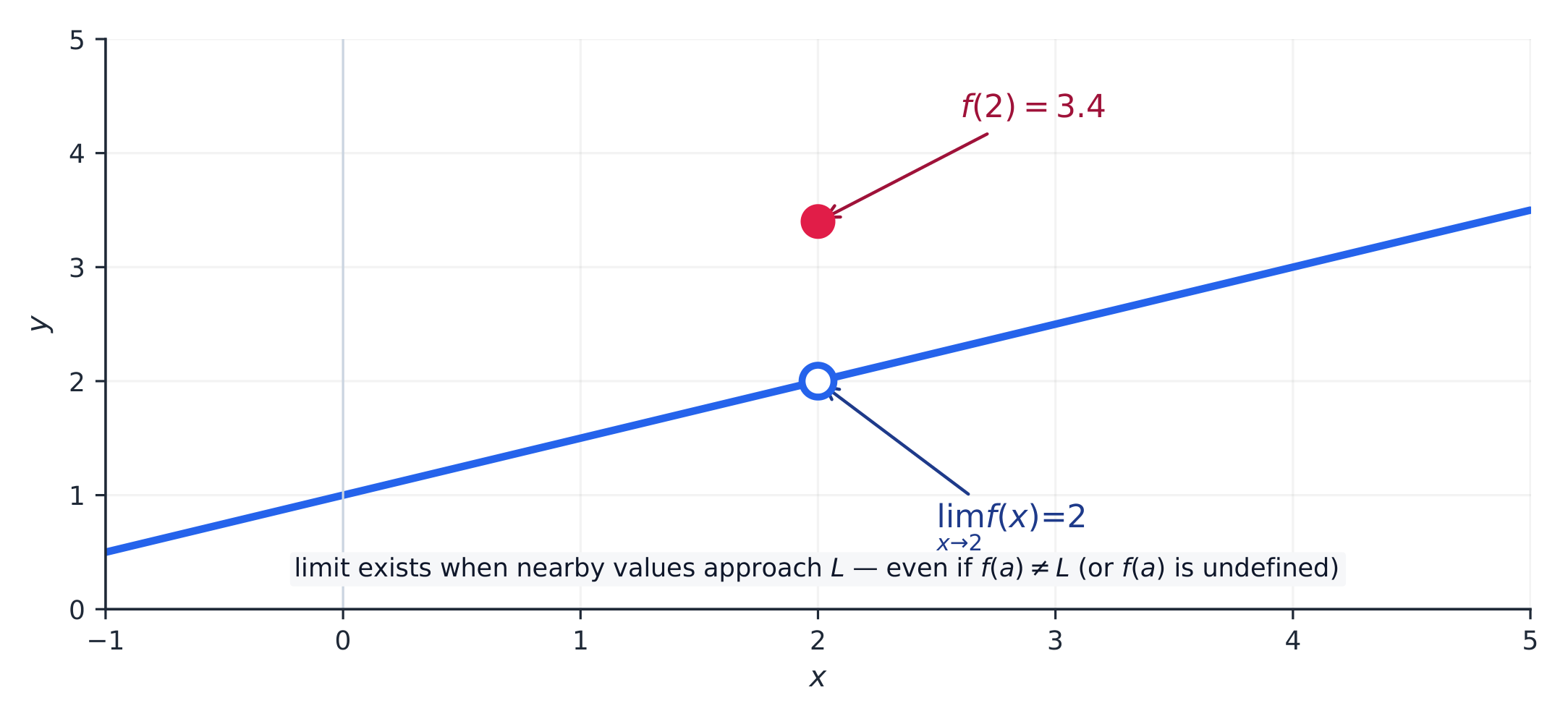
    Crucially, ignore the point itself. Graphs mark the difference between the limit and the value:

    • An open circle 空心圆 marks a height the curve approaches but does not reach – a "hole" 空洞.
    • A closed circle 实心圆 marks the actual value $f(c)$.

    So a curve may approach $R = 3$ from both sides (limit is $3$) while a filled dot sits at height $5$ (value $f(c) = 5$). The limit is $3$; the two need not match.

    A limit does not exist (often written DNE) when the two sides disagree (a jump 跳跃), when the function is unbounded 无界 (grows without limit), or when it oscillates 振荡 forever near $c$. For example:

    $$\lim_{x \to 0} \frac{1}{x^2} = \infty, \qquad \lim_{x \to 0} \frac{|x|}{x}\ \text{DNE}, \qquad \lim_{x \to 0} \sin\!\left(\frac{1}{x}\right)\ \text{DNE}.$$

    Watch the scale 比例 of a graph: a zoomed-out picture can hide important behavior near a point, so confirm with algebra when you can.

    Русский

    График часто является самым быстрым способом прочитать предел. Чтобы найти $\displaystyle \lim_{x \to c} f(x)$, проведите пальцем вдоль кривой к $x = c$ с каждой стороны и спросите: к какой высоте стремится кривая?

    • Следите слева (входные значения меньше $c$): это даст предел слева, $\displaystyle \lim_{x \to c^-} f(x)$.
    • Следуйте справа (входные значения больше $c$): это даст предел справа, $\displaystyle \lim_{x \to c^+} f(x)$.
    • Это односторонние пределы. Если оба они стремятся к той же высоте $R$, то двусторонний предел существует и $\displaystyle \lim_{x \to c} f(x) = R$.

    Ключевой момент: игнорируйте саму точку. Графики показывают различие между пределом и значением:

    • Открытый кружок обозначает высоту, к которой кривая стремится, но не достигает – «дырку».
    • Закрашенный кружок обозначает фактическое значение $f(c)$.

    Так кривая может стремиться к $R = 3$ с обеих сторон (предел равен $3$), в то время как закрашенная точка находится на высоте $5$ (значение $f(c) = 5$). Предел равен $3$; они не обязаны совпадать.

    Предел существует при x=2, хотя значение функции f(2) отличается
    Открытый кружок — это высота, к которой стремится кривая (предел); закрашенная точка — это фактическое значение $f(2)$ – они не обязательно совпадают.

    Предел не существует (часто обозначается DNE), когда левая и правая стороны расходятся (скачок), функция неограничена (растет без предела) или она колеблется бесконечно вблизи $c$. Например:

    $$\lim_{x \to 0} \frac{1}{x^2} = \infty, \qquad \lim_{x \to 0} \frac{|x|}{x}\ \text{DNE}, \qquad \lim_{x \to 0} \sin\!\left(\frac{1}{x}\right)\ \text{DNE}.$$

    Следите за шкалой графика: вид, уменьшенный в масштабе, может скрыть важное поведение рядом с точкой, поэтому подтверждайте алгебраически, если возможно.

    Explore · ⁨Исследовать⁩

    Read a limit off the graph · ⁨Определите предел по графику⁩

    y = ax² + bx + c

    The limit as $x\to c$ is the height the curve heads toward from both sides — it is about where the function is going, not its value at $c$. Follow the curve toward an $x$ and read the $y$ it approaches. · ⁨Предел при $x\to c$ — это высота, к которой стремится кривая с обеих сторон; речь идет о том, куда функция движется, а не о её значении в $c$. Следите за кривой, приближающейся к $x$, и определите $y$, к которому она приближается.⁩

    Vocabulary · ⁨Словарь⁩ Train · ⁨Тренировать⁩
    English Русский
    hole/həʊl/ "дырой"
    closed circle/kləʊzd ˈsɜːkl/ замкнутая точка
    jump/dʒʌmp/ скачок
    unbounded/ʌnˈbaʊndɪd/ неограниченно
    oscillates/ˈɒsɪleɪts/ колеблется
    scale/skeɪl/ масштаб
    table/ˈteɪbl/ таблица
    limit theorems/ˈlɪmɪt ˈθɪərəmz/ теоремы о пределах
    Composite/ˈkɒmpəzɪt/ составная функция
    direct substitution/daɪˈrekt ˌsʌbstɪˈtjuːʃn/ прямая подстановка
    indeterminate form/ˌɪndɪˈtɜːmɪnət fɔːm/ неопределенная форма
    equivalent form/ɪˈkwɪvələnt fɔːm/ эквивалентная форма
    Factor and cancel/ˈfæktə ænd ˈkænsl/ факторизовать и сократить
    rational function/ˈræʃənl ˈfʌŋkʃn/ рациональная функция
    conjugate/ˈkɒndʒuːɡeɪt/ сопряженный
    radical/ˈrædɪkl/ радикальный
    dominant/ˈdɒmɪnənt/ доминирующей
    1.4

    Estimating Limit Values from Tables · ⁨Оценка значений пределов по таблицам⁩

    Syllabus · ⁨Программа⁩
    English

    Enduring Understanding (LIM-1): Reasoning with definitions, theorems, and properties can be used to justify claims about limits.

    Learning Objective LIM-1.C: Estimate limits of functions.

    • LIM-1.C.5 Numerical information can be used to estimate limits.
    Русский

    Принцип (LIM-1): С помощью рассуждений, основанных на определениях, теоремах и свойствах, можно обосновывать утверждения о пределах.

    Цель обучения LIM-1.C: Оценивать пределы функций.

    • LIM-1.C.5 Числовая информация может использоваться для оценки пределов.

    Source: College Board AP Course and Exam Description · ⁨Источник: Описание курса и экзамена College Board AP⁩

    English

    When you have data or a formula but no picture, a table 表格 of values estimates a limit numerically. Choose inputs that creep toward $c$ from both sides and watch the outputs.

    For example, to estimate $\displaystyle \lim_{x \to 2} \frac{x^2 - 4}{x - 2}$ (which is $\tfrac{0}{0}$ at $x=2$):

    $x$ $1.9$ $1.99$ $1.999$ $\to 2 \leftarrow$ $2.001$ $2.01$ $2.1$
    $f(x)$ $3.9$ $3.99$ $3.999$ ? $4.001$ $4.01$ $4.1$

    Both sides march toward $4$, so we estimate the limit is $4$. A table only suggests a value – it is a numerical estimate, not a proof.

    Русский

    Когда у вас есть данные или формула, но нет картинки, таблица значений оценивает предел численно. Выберите входные значения, которые медленно приближаются к $c$ с обеих сторон, и следите за выходами.

    Например, для оценки $\displaystyle \lim_{x \to 2} \frac{x^2 - 4}{x - 2}$ (которое равно $\tfrac{0}{0}$ при $x=2$):

    $x$ $1.9$ $1.99$ $1.999$ $\to 2 \leftarrow$ $2.001$ $2.01$ $2.1$
    $f(x)$ $3.9$ $3.99$ $3.999$ ? $4.001$ $4.01$ $4.1$

    Обе стороны движутся к $4$, поэтому мы оцениваем, что предел равен $4$. Таблица лишь предполагает значение — это численная оценка, а не доказательство.

    1.5

    Determining Limits Using Algebraic Properties of Limits · ⁨Вычисление пределов с использованием алгебраических свойств пределов⁩

    Syllabus · ⁨Программа⁩
    English

    Enduring Understanding (LIM-1): Reasoning with definitions, theorems, and properties can be used to justify claims about limits.

    Learning Objective LIM-1.D: Determine the limits of functions using limit theorems.

    • LIM-1.D.1 One-sided limits can be determined analytically or graphically.
    • LIM-1.D.2 Limits of sums, differences, products, quotients, and composite functions can be found using limit theorems.
    Русский

    Принцип (LIM-1): С помощью рассуждений, основанных на определениях, теоремах и свойствах, можно обосновывать утверждения о пределах.

    Цель обучения LIM-1.D: Определять пределы функций, используя теоремы о пределах.

    • LIM-1.D.1 Односторонние пределы могут быть определены аналитически или графически.
    • LIM-1.D.2 Пределы сумм, разностей, произведений, отношений и составных функций можно найти с помощью теорем о пределах.

    Source: College Board AP Course and Exam Description · ⁨Источник: Описание курса и экзамена College Board AP⁩

    English

    Most limits are found analytically using limit theorems 极限定理. If $\lim_{x\to c} f(x)$ and $\lim_{x\to c} g(x)$ both exist, the limit of a combination is the same combination of the limits:

    • Sum / difference: $\displaystyle \lim_{x\to c}\big[f(x)\pm g(x)\big] = \lim_{x\to c}f(x) \pm \lim_{x\to c}g(x)$
    • Product: $\displaystyle \lim_{x\to c}\big[f(x)\,g(x)\big] = \lim_{x\to c}f(x)\cdot\lim_{x\to c}g(x)$
    • Quotient: $\displaystyle \lim_{x\to c}\frac{f(x)}{g(x)} = \frac{\lim_{x\to c}f(x)}{\lim_{x\to c}g(x)}$, provided the bottom limit is not $0$.
    • Composite 复合函数: if $g$ is continuous at $\lim_{x\to c} f(x)$, then $\displaystyle \lim_{x\to c} g\big(f(x)\big) = g\!\left(\lim_{x\to c} f(x)\right)$.

    The practical rule: for a function built from polynomials, roots, and the like, first try direct substitution 直接代入 – put $x = c$ in. If you get a real number, that is the limit. One-sided limits obey the same theorems, read from one direction only.

    Русский

    Большинство пределов находятся аналитически с помощью теорем о пределах. Если $\lim_{x\to c} f(x)$ и $\lim_{x\to c} g(x)$ существуют, то предел комбинации равен той же комбинации пределов:

    • Сумма / разность: $\displaystyle \lim_{x\to c}\big[f(x)\pm g(x)\big] = \lim_{x\to c}f(x) \pm \lim_{x\to c}g(x)$
    • Произведение: $\displaystyle \lim_{x\to c}\big[f(x)\,g(x)\big] = \lim_{x\to c}f(x)\cdot\lim_{x\to c}g(x)$
    • Частное: $\displaystyle \lim_{x\to c}\frac{f(x)}{g(x)} = \frac{\lim_{x\to c}f(x)}{\lim_{x\to c}g(x)}$, при условии, что нижний предел не равен $0$.
    • Композиция: если $g$ непрерывна в точке $\lim_{x\to c} f(x)$, тогда $\displaystyle \lim_{x\to c} g\big(f(x)\big) = g\!\left(\lim_{x\to c} f(x)\right)$.

    Практическое правило: для функции, составленной из многочленов, корней и тому подобных, сначала попробуйте прямую подстановку — подставьте $x = c$. Если вы получаете действительное число, это и есть предел. Односторонние пределы подчиняются тем же теоремам, но рассматриваются только с одной стороны.

    1.6

    Determining Limits Using Algebraic Manipulation · ⁨Вычисление пределов с использованием алгебраических преобразований⁩

    Syllabus · ⁨Программа⁩
    English

    Enduring Understanding (LIM-1): Reasoning with definitions, theorems, and properties can be used to justify claims about limits.

    Learning Objective LIM-1.E: Determine the limits of functions using equivalent expressions for the function or the squeeze theorem.

    • LIM-1.E.1 It may be necessary or helpful to rearrange expressions into equivalent forms before evaluating limits.
      • Illustrative examples for LIM-1.E.1:
        • Factoring and dividing common factors of rational functions
        • Multiplying by an expression involving the conjugate of a sum or difference in order to simplify functions involving radicals
        • Using alternate forms of trigonometric functions
    Русский

    Принцип (LIM-1): С помощью рассуждений, основанных на определениях, теоремах и свойствах, можно обосновывать утверждения о пределах.

    Цель обучения LIM-1.E: Определять пределы функций, используя эквивалентные выражения для функции или теорему о двух милиционерах (теорему о зажатой функции).

    • LIM-1.E.1 Может потребоваться или оказаться полезным переписать выражения в эквивалентную форму перед вычислением пределов.
      • Иллюстративные примеры для LIM-1.E.1:
        • Разложение на множители и деление общих множителей рациональных функций
        • Умножение на выражение, содержащее сопряженное суммы или разности, для упрощения функций, содержащих корни
        • Использование альтернативных форм тригонометрических функций

    Source: College Board AP Course and Exam Description · ⁨Источник: Описание курса и экзамена College Board AP⁩

    English

    Direct substitution sometimes gives the indeterminate form 未定式 $\tfrac{0}{0}$. This does not mean the limit fails – it means you must rewrite the function into an equivalent form 等价形式 that removes the trouble, then substitute. Three standard moves:

    • Factor and cancel 因式分解并约分 a rational function 有理函数. Example: $\displaystyle \lim_{x\to 2}\frac{x^2-4}{x-2} = \lim_{x\to 2}\frac{(x-2)(x+2)}{x-2} = \lim_{x\to 2}(x+2) = 4$.
    • Multiply by the conjugate 共轭 to simplify a radical 根式. Example: $\displaystyle \lim_{x\to 0}\frac{\sqrt{x+1}-1}{x} = \lim_{x\to 0}\frac{x}{x\big(\sqrt{x+1}+1\big)} = \frac{1}{2}$.
    • Use alternate forms of trigonometric functions (identities) to simplify.

    The cancelled factor is why the original graph had a hole: the two functions agree everywhere except at $x=c$, so they share the same limit there.

    Русский

    Прямая подстановка иногда дает неопределенную форму $\tfrac{0}{0}$. Это не означает, что предел не существует – это значит, что нужно переписать функцию в эквивалентную форму, устраняющую проблему, а затем выполнить подстановку. Три стандартных приема:

    • Разложить на множители и сократить рациональную функцию. Пример: $\displaystyle \lim_{x\to 2}\frac{x^2-4}{x-2} = \lim_{x\to 2}\frac{(x-2)(x+2)}{x-2} = \lim_{x\to 2}(x+2) = 4$.
    • Умножить на сопряженное выражение, чтобы упростить иррациональное выражение. Пример: $\displaystyle \lim_{x\to 0}\frac{\sqrt{x+1}-1}{x} = \lim_{x\to 0}\frac{x}{x\big(\sqrt{x+1}+1\big)} = \frac{1}{2}$.
    • Использовать альтернативные формы тригонометрических функций (тождества) для упрощения.

    Сокращенный множитель объясняет наличие выколотой точки на исходном графике: две функции совпадают везде, кроме точки $x=c$, поэтому имеют одинаковый предел там.

    1.7

    Selecting Procedures for Determining Limits · ⁨Выбор методов нахождения пределов⁩

    Syllabus · ⁨Программа⁩
    English

    This topic is intended to focus on the skill of selecting an appropriate procedure for determining limits. Students should be given opportunities to practice when and how to apply all learning objectives relating to determining limits.

    Русский

    Эта тема предназначена для сосредоточения на навыке выбора соответствующего метода определения пределов. Студентам следует предоставить возможность потренироваться, когда и как применять все цели обучения, связанные с определением пределов.

    Source: College Board AP Course and Exam Description · ⁨Источник: Описание курса и экзамена College Board AP⁩

    English

    This is a skill topic, not new content: choose the right tool for the limit in front of you.

    1. Try direct substitution first. A real answer means you are done.
    2. Getting $\tfrac{0}{0}$? Rewrite – factor and cancel, or use the conjugate, or a trig identity – then substitute.
    3. A non-zero number over $0$ (like $\tfrac{5}{0}$)? The limit is infinite or DNE – check the sign from each side (see vertical asymptotes below).
    4. As $x\to\pm\infty$? Compare the dominant 主导 terms (see limits at infinity).
    5. Trapped between two functions? The squeeze theorem may apply.
    Русский

    Это тема навыков, а не нового материала: выберите подходящий инструмент для конкретного предела.

    1. Сначала попробуйте прямую подстановку. Если получен реальный ответ, задача решена.
    2. Получили $\tfrac{0}{0}$? Перепишите выражение — разложите на множители и сократите, или используйте сопряженное, или тригонометрическое тождество — затем выполните подстановку.
    3. Неzero число делится на $0$ (как $\tfrac{5}{0}$)? Предел равен бесконечности или не существует — проверьте знак с каждой стороны (см. вертикальные асимптоты ниже).
    4. При $x\to\pm\infty$? Сравните старшие члены (см. пределы при бесконечности).
    5. Функция заперта между двумя другими? Возможно применение теоремы о двух милиционерах (теоремы о зажатой функции).
    1.8

    Determining Limits Using the Squeeze Theorem · ⁨Нахождение пределов с помощью теоремы о двух милиционерах⁩

    Syllabus · ⁨Программа⁩
    English

    Enduring Understanding (LIM-1): Reasoning with definitions, theorems, and properties can be used to justify claims about limits.

    Learning Objective LIM-1.E: Determine the limits of functions using equivalent expressions for the function or the squeeze theorem.

    • LIM-1.E.2 The limit of a function may be found by using the squeeze theorem.
      • Illustrative examples for LIM-1.E.2: The squeeze theorem can be used to show $\lim_{x \to 0} \dfrac{\sin x}{x} = 1$ and $\lim_{x \to 0} \dfrac{1 - \cos x}{x} = 0$.
    Русский

    Принцип (LIM-1): С помощью рассуждений, основанных на определениях, теоремах и свойствах, можно обосновывать утверждения о пределах.

    Цель обучения LIM-1.E: Определять пределы функций, используя эквивалентные выражения для функции или теорему о двух милиционерах (теорему о зажатой функции).

    • LIM-1.E.2 Предел функции может быть найден с использованием теоремы о двух милиционерах.
      • Иллюстративные примеры для LIM-1.E.2: Теорема о двух милиционерах может быть использована для доказательства существования $\lim_{x \to 0} \dfrac{\sin x}{x} = 1$ и $\lim_{x \to 0} \dfrac{1 - \cos x}{x} = 0$.

    Source: College Board AP Course and Exam Description · ⁨Источник: Описание курса и экзамена College Board AP⁩

    English

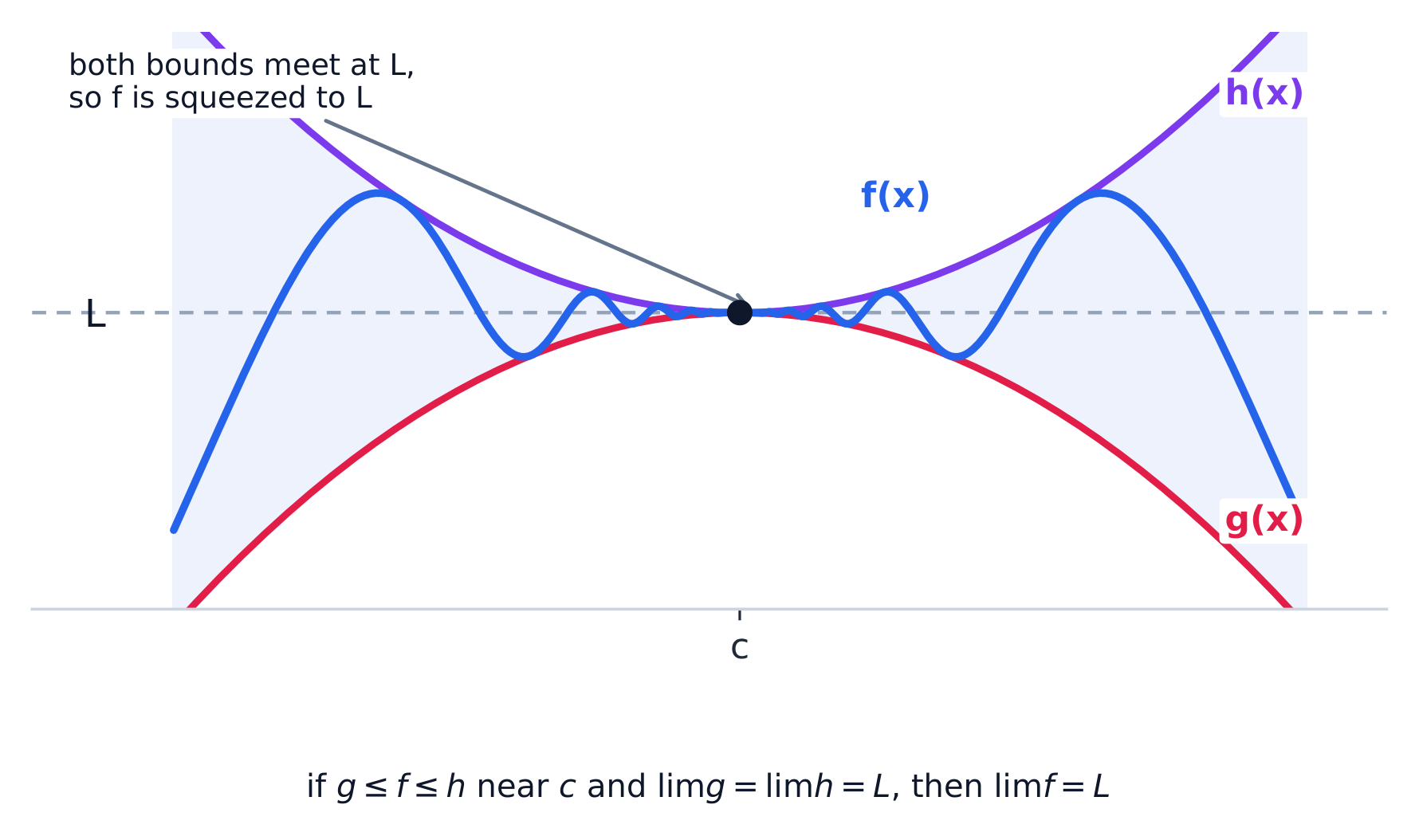
    The squeeze theorem 夹逼定理 (also called the sandwich theorem) finds a limit by trapping the function between two others. If $g(x) \le f(x) \le h(x)$ near $c$, and

    $$\lim_{x\to c} g(x) = \lim_{x\to c} h(x) = L,$$
    then $f$ is squeezed to the same place: $\displaystyle \lim_{x\to c} f(x) = L$.

    The two famous results proved this way, both used throughout calculus, are:

    $$\lim_{x\to 0}\frac{\sin x}{x} = 1 \qquad\text{and}\qquad \lim_{x\to 0}\frac{1-\cos x}{x} = 0.$$

    Русский

    Теорема о двух милиционерах (также известная как теорема о сэндвиче) находит предел, «зажимая» функцию между двумя другими. Если $g(x) \le f(x) \le h(x)$ близки к $c$, и

    $$\lim_{x\to c} g(x) = \lim_{x\to c} h(x) = L,$$
    то $f$ «зажата» в том же месте: $\displaystyle \lim_{x\to c} f(x) = L$.

    Два знаменитых результата, доказанных таким образом и используемых во всем математическом анализе, это:

    $$\lim_{x\to 0}\frac{\sin x}{x} = 1 \qquad\text{and}\qquad \lim_{x\to 0}\frac{1-\cos x}{x} = 0.$$

    Теорема о двух милиционерах: если g и h оба стремятся к L в точке c, зажатая функция f вынуждена стремиться к L
    Кривая $f$ зажата между $g$ и $h$. Поскольку обе границы сходятся в точке $L$, у $f$ нет другого пути, кроме как стремится к $L$.
    Vocabulary · ⁨Словарь⁩ Train · ⁨Тренировать⁩
    English Русский
    squeeze theorem/skwiːz ˈθɪərəm/ теорема о двух милиционерах (теорема о зажатой функции)
    discontinuous/dɪskənˈtɪnjuːəs/ разрывной
    Removable discontinuity/rɪˈmuːvəbl dɪskɒntɪˈnjuːɪti/ устраняемая точка разрыва
    Jump discontinuity/dʒʌmp dɪskɒntɪˈnjuːɪti/ скачок (точка разрыва первого рода)
    Infinite discontinuity/ˈɪnfɪnət dɪskɒntɪˈnjuːɪti/ бесконечная точка разрыва
    1.9

    Connecting Multiple Representations of Limits · ⁨Связь различных представлений пределов⁩

    Syllabus · ⁨Программа⁩
    English

    This topic is intended to focus on connecting representations. Students should be given opportunities to practice when and how to apply all learning objectives relating to limits and translating mathematical information from a single representation or across multiple representations.

    Русский

    Эта тема предназначена для сосредоточения на связи представлений. Студентам следует предоставить возможность потренироваться, когда и как применять все цели обучения, связанные с пределами, а также переводить математическую информацию из одного представления в другое или между несколькими представлениями.

    Source: College Board AP Course and Exam Description · ⁨Источник: Описание курса и экзамена College Board AP⁩

    English

    Another skill topic: the same limit lives in a graph, a table, and an algebraic form, and you should be able to translate between them. A graph shows the shape and any holes or jumps; a table gives numerical evidence; algebra gives an exact value and a reason. Strong answers use one representation to confirm another.

    Русский

    Еще одна тема навыков: один и тот же предел отражен на графике, в таблице и в алгебраической форме, и вы должны уметь переводить информацию из одной формы в другую. График показывает форму и любые выколотые точки или разрывы; таблица дает численные данные; алгебра дает точное значение и обоснование. Сильные ответы используют одно представление для подтверждения другого.

    1.10

    Exploring Types of Discontinuities · ⁨Исследование типов разрывов⁩

    Syllabus · ⁨Программа⁩
    English

    Enduring Understanding (LIM-2): Reasoning with definitions, theorems, and properties can be used to justify claims about continuity.

    Learning Objective LIM-2.A: Justify conclusions about continuity at a point using the definition.

    • LIM-2.A.1 Types of discontinuities include removable discontinuities, jump discontinuities, and discontinuities due to vertical asymptotes.
    Русский

    Принцип (LIM-2): С помощью рассуждений, основанных на определениях, теоремах и свойствах, можно обосновывать утверждения о непрерывности.

    Цель обучения LIM-2.A: Обосновывать выводы о непрерывности функции в точке, используя определение.

    • LIM-2.A.1 Типы разрывов включают устранимые разрывы, скачки разрыва и разрывы, вызванные вертикальными асимптотами.

    Source: College Board AP Course and Exam Description · ⁨Источник: Описание курса и экзамена College Board AP⁩

    English

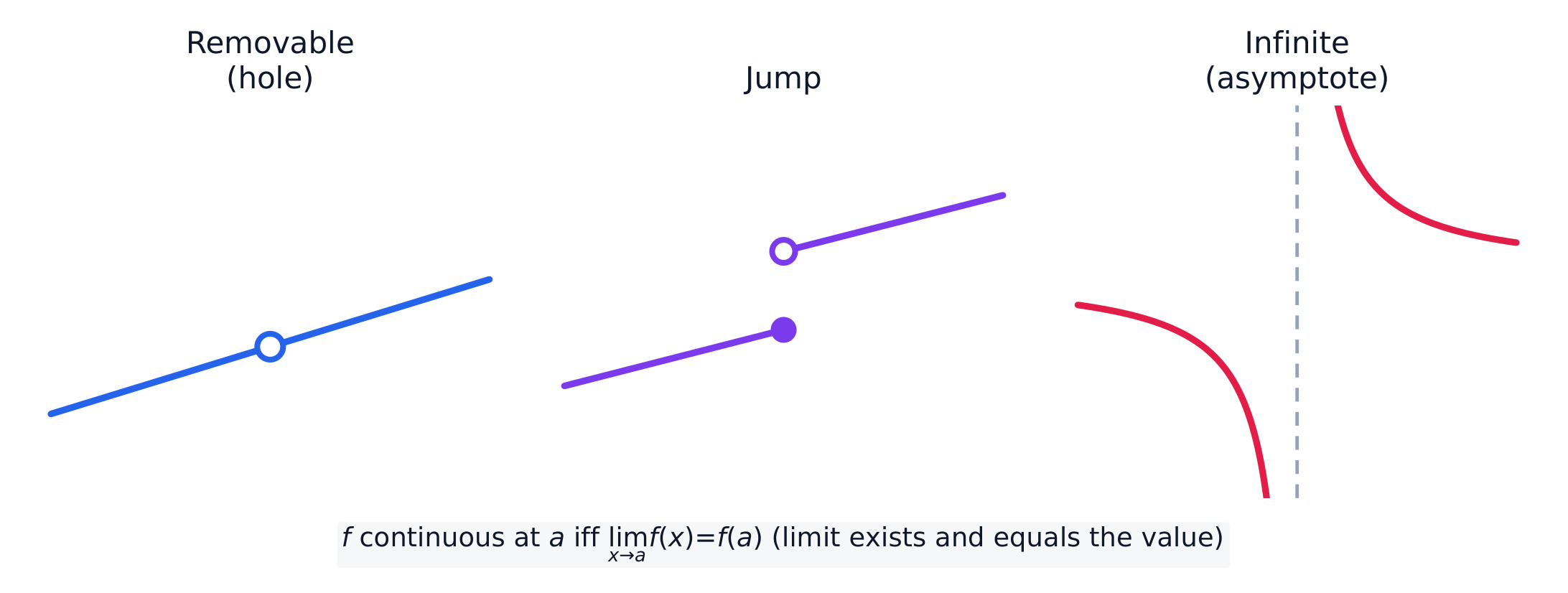
    A function is discontinuous 间断 at $c$ when its graph "breaks" there. There are three types:

    • Removable discontinuity 可去间断 – a single hole. The two-sided limit exists, but the point is missing or misplaced.
    • Jump discontinuity 跳跃间断 – the two one-sided limits exist but disagree, so the curve jumps.
    • Infinite discontinuity 无穷间断 – the function blows up to $\pm\infty$ at a vertical asymptote 垂直渐近线.
    Русский

    Функция является непрерывной при $c$, если её график «разрывается» в этой точке. Существует три типа:

    • Устранимый разрыв – одна выколотая точка. Двусторонний предел существует, но сама точка отсутствует или задана неверно.
    • Разрыв первого рода (скачок) – существуют односторонние пределы, но они не совпадают, поэтому кривая совершает скачок.
    • Бесконечный разрыв – функция уходит в бесконечность к $\pm\infty$ в точке вертикальной асимптоты.
    Три типа разрывов: устранимая выколотая точка, скачок и бесконечный
    Три способа, которыми может сломаться график: устранимая выколотая точка, скачок и бесконечный (асимптотический) разрыв.
    1.11

    Defining Continuity at a Point · ⁨Определение непрерывности в точке⁩

    Syllabus · ⁨Программа⁩
    English

    Enduring Understanding (LIM-2): Reasoning with definitions, theorems, and properties can be used to justify claims about continuity.

    Learning Objective LIM-2.A: Justify conclusions about continuity at a point using the definition.

    • LIM-2.A.2 A function $f$ is continuous at $x = c$ provided that $f(c)$ exists, $\lim_{x \to c} f(x)$ exists, and $\lim_{x \to c} f(x) = f(c)$.
    Русский

    Принцип (LIM-2): С помощью рассуждений, основанных на определениях, теоремах и свойствах, можно обосновывать утверждения о непрерывности.

    Цель обучения LIM-2.A: Обосновывать выводы о непрерывности функции в точке, используя определение.

    • LIM-2.A.2 Функция $f$ является непрерывной в точке $x = c$, если существует предел $f(c)$, значение функции $\lim_{x \to c} f(x)$ совпадает с этим пределом, и выполняется условие $\lim_{x \to c} f(x) = f(c)$.

    Source: College Board AP Course and Exam Description · ⁨Источник: Описание курса и экзамена College Board AP⁩

    English

    Continuity is defined by a three-part test. A function $f$ is continuous 连续 at $x=c$ exactly when all three hold:

    $$\boxed{\;f(c)\text{ exists}\quad\text{and}\quad \lim_{x\to c} f(x)\text{ exists}\quad\text{and}\quad \lim_{x\to c} f(x) = f(c)\;}$$

    In words: the point is there, the limit is there, and the two agree. If any one fails, $f$ is discontinuous at $c$. This test is the backbone of nearly every continuity question, so learn it as a checklist.

    Русский

    Непрерывность определяется трехчастичной проверкой. Функция $f$ непрерывна в точке $x=c$ тогда и только тогда, когда выполняются все три условия:

    $$\boxed{\;f(c)\text{ exists}\quad\text{and}\quad \lim_{x\to c} f(x)\text{ exists}\quad\text{and}\quad \lim_{x\to c} f(x) = f(c)\;}$$

    Простыми словами: точка существует, предел существует, и они совпадают. Если хотя бы одно условие нарушено, $f$ имеет разрыв в точке $c$. Эта проверка является основой почти каждого вопроса о непрерывности, поэтому запомните её как чек-лист.

    1.12

    Confirming Continuity over an Interval · ⁨Подтверждение непрерывности на интервале⁩

    Syllabus · ⁨Программа⁩
    English

    Enduring Understanding (LIM-2): Reasoning with definitions, theorems, and properties can be used to justify claims about continuity.

    Learning Objective LIM-2.B: Determine intervals over which a function is continuous.

    • LIM-2.B.1 A function is continuous on an interval if the function is continuous at each point in the interval.
    • LIM-2.B.2 Polynomial, rational, power, exponential, logarithmic, and trigonometric functions are continuous on all points in their domains.
    Русский

    Принцип (LIM-2): С помощью рассуждений, основанных на определениях, теоремах и свойствах, можно обосновывать утверждения о непрерывности.

    Цель обучения LIM-2.B: Определять интервалы, на которых функция является непрерывной.

    • LIM-2.B.1 Функция непрерывна на интервале, если она непрерывна в каждой точке этого интервала.
    • LIM-2.B.2 Полиномиальные, рациональные, степенные, показательные, логарифмические и тригонометрические функции являются непрерывными во всех точках своих областей определения.

    Source: College Board AP Course and Exam Description · ⁨Источник: Описание курса и экзамена College Board AP⁩

    English

    A function is continuous on an interval 在区间上连续 if it is continuous at every point of that interval. You rarely check point by point, because whole families are continuous on their domains:

    Polynomial, rational, power, exponential 指数, logarithmic 对数, and trigonometric 三角 functions are continuous at every point of their domains.

    So a rational function is continuous everywhere except where its denominator is zero; $\ln x$ is continuous for $x>0$; and so on. Knowing this lets you declare continuity quickly and correctly.

    Русский

    Функция непрерывна на интервале, если она непрерывна в каждой точке этого интервала. Обычно мы не проверяем непрерывность по точкам, так как целые классы функций непрерывны на своих областях определения:

    Полиномиальные, рациональные, степенные, показательные, логарифмические и тригонометрические функции непрерывны в каждой точке своей области определения.

    Таким образом, рациональная функция непрерывна везде кроме точек, где знаменатель равен нулю; $\ln x$ непрерывна для всех $x>0$; и так далее. Знание этого позволяет быстро и правильно утверждать о непрерывности.

    1.13

    Removing Discontinuities · ⁨Устранение разрывов⁩

    Syllabus · ⁨Программа⁩
    English

    Enduring Understanding (LIM-2): Reasoning with definitions, theorems, and properties can be used to justify claims about continuity.

    Learning Objective LIM-2.C: Determine values of $x$ or solve for parameters that make discontinuous functions continuous, if possible.

    • LIM-2.C.1 If the limit of a function exists at a discontinuity in its graph, then it is possible to remove the discontinuity by defining or redefining the value of the function at that point, so it equals the value of the limit of the function as $x$ approaches that point.
    • LIM-2.C.2 In order for a piecewise-defined function to be continuous at a boundary to the partition of its domain, the value of the expression defining the function on one side of the boundary must equal the value of the expression defining the other side of the boundary, as well as the value of the function at the boundary.
    Русский

    Принцип (LIM-2): С помощью рассуждений, основанных на определениях, теоремах и свойствах, можно обосновывать утверждения о непрерывности.

    Цель обучения LIM-2.C: Определять значения $x$ или находить параметры, при которых разрывные функции становятся непрерывными, если это возможно.

    • LIM-2.C.1 Если предел функции существует в точке разрыва её графика, то разрыв можно устранить, определив или пересмотрев значение функции в этой точке так, чтобы оно равнялось значению предела функции при приближении $x$ к этой точке.
    • LIM-2.C.2 Чтобы кусочно-заданная функция была непрерывной на границе раздела области её определения, значение выражения, определяющего функцию с одной стороны границы, должно быть равно значению выражения, определяющего функцию с другой стороны границы, а также значению самой функции в этой границе.

    Source: College Board AP Course and Exam Description · ⁨Источник: Описание курса и экзамена College Board AP⁩

    English

    If the limit exists at a hole, the discontinuity is removable: redefine the function at that one point to equal the limit, and the graph is repaired. Formally, set the missing value to $\displaystyle \lim_{x\to c} f(x)$.

    For a piecewise-defined function 分段函数, continuity at a boundary $x=c$ needs the two pieces to meet: the left piece's value, the right piece's value, and $f(c)$ must all be equal. This is a common exam setup – you solve for a parameter 参数 (an unknown constant) that makes the pieces match:

    $$\lim_{x\to c^-} f(x) = \lim_{x\to c^+} f(x) = f(c).$$

    Русский

    Если предел существует в точке «дыры», разрыв устраняем: переопределите функцию в этой единственной точке, присвоив ей значение предела, и график будет исправлен. Формально, задайте недостающее значение равным $\displaystyle \lim_{x\to c} f(x)$.

    Для кусочно-заданной функции непрерывность на границе $x=c$ требует, чтобы две части стыковались: значение левой части, значение правой части и $f(c)$ должны быть равны. Это типичная задача экзамена – найдите параметр (неизвестную константу), который обеспечит совпадение частей:

    $$\lim_{x\to c^-} f(x) = \lim_{x\to c^+} f(x) = f(c).$$

    1.14

    Connecting Infinite Limits and Vertical Asymptotes · ⁨Связь бесконечных пределов и вертикальных асимптот⁩

    Syllabus · ⁨Программа⁩
    English

    Enduring Understanding (LIM-2): Reasoning with definitions, theorems, and properties can be used to justify claims about continuity.

    Learning Objective LIM-2.D: Interpret the behavior of functions using limits involving infinity.

    • LIM-2.D.1 The concept of a limit can be extended to include infinite limits.
    • LIM-2.D.2 Asymptotic and unbounded behavior of functions can be described and explained using limits.
    Русский

    Принцип (LIM-2): С помощью рассуждений, основанных на определениях, теоремах и свойствах, можно обосновывать утверждения о непрерывности.

    Цель обучения LIM-2.D: Интерпретировать поведение функций, используя пределы со бесконечностью.

    • LIM-2.D.1 Понятие предела может быть расширено до бесконечных пределов.
    • LIM-2.D.2 Асимптотическое и неограниченное поведение функций можно описать и объяснить с помощью пределов.

    Source: College Board AP Course and Exam Description · ⁨Источник: Описание курса и экзамена College Board AP⁩

    English

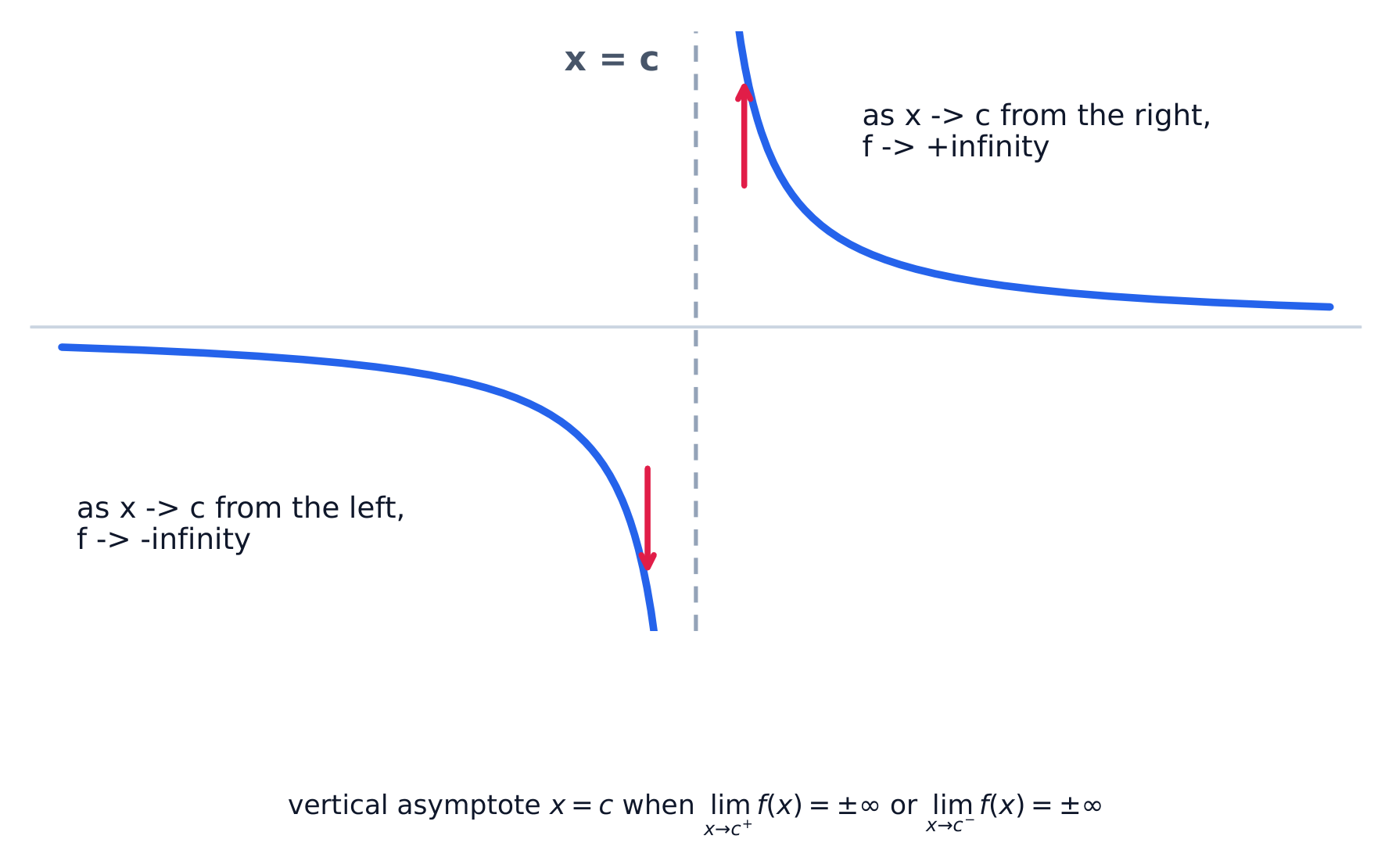
    The idea of a limit extends to infinite limits 无穷极限. When a function grows without bound near $x=c$, we write $\lim_{x\to c} f(x) = \pm\infty$. This describes a vertical asymptote at $x=c$: the graph hugs the vertical line $x=c$ and shoots off toward $\pm\infty$.

    This happens where a non-zero number is divided by something approaching $0$, such as at a zero of a denominator that does not cancel. Always check each side separately – the two sides can shoot opposite ways (one to $+\infty$, one to $-\infty$).

    Русский

    Идея предела распространяется на бесконечные пределы. Когда функция растет без ограничения вблизи $x=c$, мы записываем $\lim_{x\to c} f(x) = \pm\infty$. Это описывает вертикальную асимптоту в точке $x=c$: график приближается к вертикальной линии $x=c$ и уходит в бесконечность к $\pm\infty$.

    Это происходит, когда ненулевое число делится на величину, стремящуюся к $0$*, например, в нуле знаменателя, который не сокращается. Всегда проверяйте каждую сторону отдельно – стороны могут уходить в противоположные направления (одна к $+\infty$, другая к $-\infty$).

    Бесконечный предел на вертикальной асимптоте x = c, где стороны уходят в противоположные бесконечности
    Вблизи вертикальной асимптоты график приближается к линии $x=c$. Здесь левая часть уходит вниз к $-\infty$, а правая поднимается вверх к $+\infty$, поэтому двусторонний предел не существует.
    Explore · ⁨Исследовать⁩

    Explore infinite limits and vertical asymptotes · ⁨Исследуйте бесконечные пределы и вертикальные асимптоты⁩

    y = a/(x − b) + c

    With $y=\dfrac{a}{x-b}+c$, watch the curve blow up to $\pm\infty$ near $x=b$. The vertical asymptote is the line $x=b$ where the infinite limit lives — the two sides can shoot opposite ways. · ⁨При $y=\dfrac{a}{x-b}+c$ наблюдайте, как кривая уходит в бесконечность к $\pm\infty$ вблизи $x=b$. Вертикальная асимптота — это прямая $x=b$, где находится бесконечный предел — стороны могут уходить в противоположных направлениях.⁩

    Vocabulary · ⁨Словарь⁩ Train · ⁨Тренировать⁩
    English Русский
    vertical asymptote/ˈvɜːtɪkl ˈæsɪmptəʊt/ вертикальной асимптотой
    continuous/kənˈtɪnjuːəs/ непрерывными
    continuous on an interval/kənˈtɪnjuːəs ɒn ən ˈɪntəvl/ непрерывна на промежутке
    exponential/ˌekspəˈnenʃl/ экспоненциальная
    logarithmic/ˌlɒɡəˈrɪθmɪk/ логарифмической
    trigonometric/ˌtrɪɡənəʊˈmetrɪk/ тригонометрический
    piecewise-defined function/ˈpiːswaɪz dɪˈfaɪnd ˈfʌŋkʃn/ функция, заданная кусочно
    parameter/pəˈræmɪtə/ параметром
    infinite limits/ˈɪnfɪnət ˈlɪmɪts/ бесконечные пределы
    limits at infinity/ˈlɪmɪts æt ɪnˈfɪnɪti/ пределы на бесконечности
    end behavior/end bɪˈheɪvjə/ поведение на бесконечности
    1.15

    Connecting Limits at Infinity and Horizontal Asymptotes · ⁨Связь пределов при бесконечности и горизонтальных асимптот⁩

    Syllabus · ⁨Программа⁩
    English

    Enduring Understanding (LIM-2): Reasoning with definitions, theorems, and properties can be used to justify claims about continuity.

    Learning Objective LIM-2.D: Interpret the behavior of functions using limits involving infinity.

    • LIM-2.D.3 The concept of a limit can be extended to include limits at infinity.
    • LIM-2.D.4 Limits at infinity describe end behavior.
    • LIM-2.D.5 Relative magnitudes of functions and their rates of change can be compared using limits.
    Русский

    Принцип (LIM-2): С помощью рассуждений, основанных на определениях, теоремах и свойствах, можно обосновывать утверждения о непрерывности.

    Цель обучения LIM-2.D: Интерпретировать поведение функций, используя пределы со бесконечностью.

    • LIM-2.D.3 Понятие предела может быть расширено до пределов на бесконечности.
    • LIM-2.D.4 Пределы на бесконечности описывают поведение функции на концах интервала.
    • LIM-2.D.5 Относительные величины функций и их скоростей изменения можно сравнивать с помощью пределов.

    Source: College Board AP Course and Exam Description · ⁨Источник: Описание курса и экзамена College Board AP⁩

    English

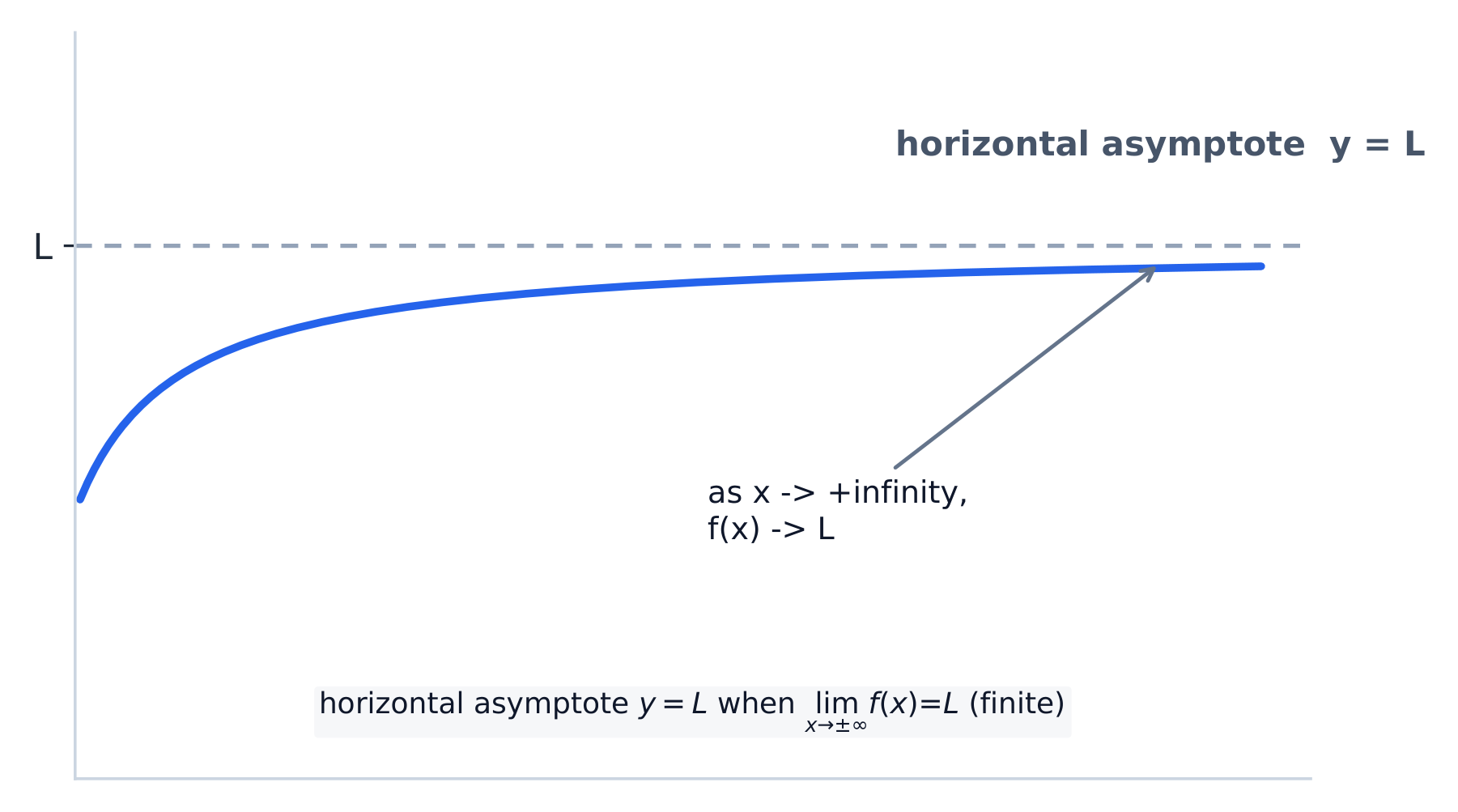
    We can also let the input grow: limits at infinity 无穷远处的极限 describe the end behavior 末端行为 of a function as $x\to\pm\infty$. If the outputs settle toward a finite value $L$, then $y=L$ is a horizontal asymptote 水平渐近线.

    For a rational function, compare the degrees 次数 of the top and bottom:

    • top degree < bottom degree $\Rightarrow$ limit is $0$ (asymptote $y=0$);
    • top degree = bottom degree $\Rightarrow$ limit is the ratio of the leading coefficients 首项系数之比;
    • top degree > bottom degree $\Rightarrow$ the function is unbounded (no horizontal asymptote).

    More generally, we compare the relative magnitudes 相对大小 (relative growth rates) of functions: far out, an exponential beats any polynomial, and a polynomial beats any logarithm. On the exam, "as $t\to\infty$, which quantity is larger/where does the rate settle?" is answered with a limit at infinity.

    Русский

    Мы также можем позволить аргументу расти: пределы на бесконечности описывают поведение на конце функции при $x\to\pm\infty$. Если значения выхода стабилизируются вблизи конечного числа $L$, то $y=L$ является горизонтальной асимптотой.

    Предел при бесконечности: по мере роста x значения стабилизируются вокруг горизонтальной асимптоты y = L
    При $x\to+\infty$ кривая выравнивается, приближаясь к линии $y=L$. Горизонтальная асимптота фиксирует это поведение на конце.

    Для рациональной функции сравните степени числителя и знаменателя:

    • степень числителя < степени знаменателя $\Rightarrow$ предел равен $0$ (горизонтальная асимптота $y=0$);
    • степень числителя = степени знаменателя $\Rightarrow$ предел равен отношению старших коэффициентов;
    • степень числителя > степени знаменателя $\Rightarrow$ функция не ограничена (нет горизонтальной асимптоты).

    В более общем случае мы сравниваем относительные величины (относительные скорости роста): на бесконечности экспонента превосходит любой многочлен, а многочлен превосходит любую логарифмическую функцию. На экзамене вопрос «при $t\to\infty$, какая величина больше/к какому значению сходится скорость?» решается с помощью предела на бесконечности.

    Explore · ⁨Исследовать⁩

    Explore limits at infinity and horizontal asymptotes · ⁨Исследуйте пределы на бесконечности и горизонтальные асимптоты⁩

    y = a/(x − b) + c

    Follow the curve far out to the right and left. As $x\to\pm\infty$ the outputs settle toward $c$, so $y=c$ is a horizontal asymptote — the finite value of the limit at infinity. · ⁨Следите за кривой далеко справа и слева. Когда $x\to\pm\infty$ значения стремятся к $c$, значит $y=c$ является горизонтальной асимптотой — конечным значением предела на бесконечности.⁩

    Vocabulary · ⁨Словарь⁩ Train · ⁨Тренировать⁩
    English Русский
    horizontal asymptote/ˌhɒrɪˈzɒntl ˈæsɪmptəʊt/ горизонтальной асимптотой
    degrees/dɪˈɡriːz/ градусах
    ratio of the leading coefficients/ˈreɪʃɪəʊ ɒvðə ˈliːdɪŋ ˌkəʊɪˈfɪʃənts/ отношение старших коэффициентов
    relative magnitudes/ˈrelətɪv ˈmæɡnɪtjuːdz/ относительные величины
    Intermediate Value Theorem/ˌɪntəˈmiːdɪət ˈvæljuː ˈθɪərəm/ Теорема о промежуточных значениях
    existence theorem/eɡˈzɪstəns ˈθɪərəm/ теорема существования
    1.16

    Working with the Intermediate Value Theorem (IVT) · ⁨Работа со средней теоремой о промежуточных значениях (IVT)⁩

    Syllabus · ⁨Программа⁩
    Enduring UnderstandingLearning ObjectiveEssential Knowledge

    FUN-1
    Existence theorems allow us to draw conclusions about a function's behavior on an interval without precisely locating that behavior.

    FUN-1.A
    Explain the behavior of a function on an interval using the Intermediate Value Theorem.

    • FUN-1.A.1 If $f$ is a continuous function on the closed interval $[a, b]$ and $d$ is a number between $f(a)$ and $f(b)$, then the Intermediate Value Theorem guarantees that there is at least one number $c$ between $a$ and $b$, such that $f(c) = d$.

    Source: College Board AP Course and Exam Description · ⁨Источник: Описание курса и экзамена College Board AP⁩

    English

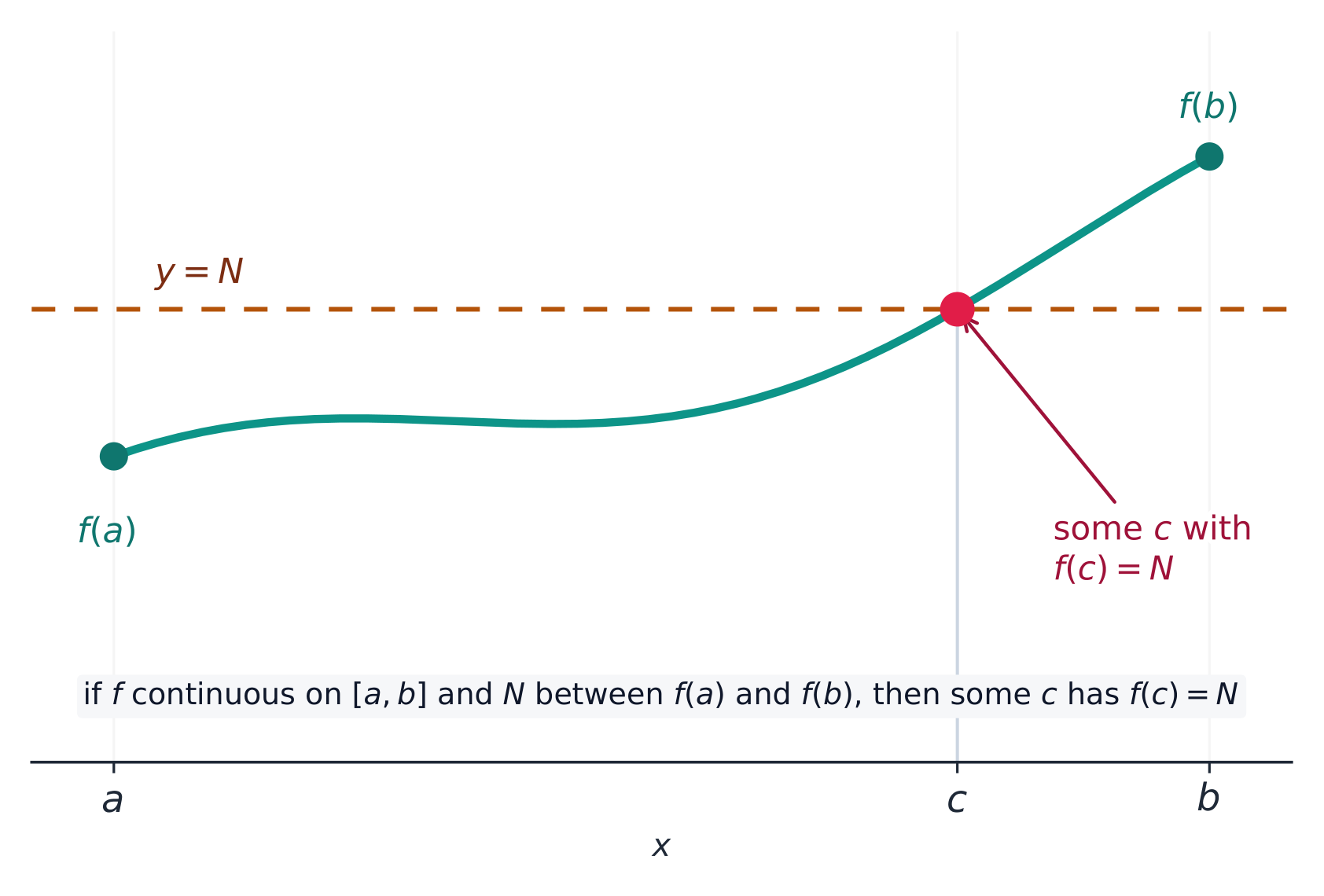
    The Intermediate Value Theorem 介值定理 is an existence theorem 存在性定理 – it guarantees a value exists without telling you where:

    If $f$ is continuous on the closed interval $[a,b]$, and $d$ is any number between $f(a)$ and $f(b)$, then there is at least one number $c$ in $(a,b)$ with $f(c)=d$.

    An unbroken curve cannot skip a height between its endpoints – it must pass through every one.

    Exam skill – how to justify with the IVT. These questions appear almost every year (for example, "Must there be a value $c$ with $R(c)=155$?" or "Is there a time when $r'(t)=-6$?"). A full-credit justification has three moves:

    1. State continuity. Say the function is continuous on $[a,b]$ (often because it is differentiable, or given continuous).
    2. Show $d$ is trapped. Compute the two endpoint values and show the target $d$ lies between them, e.g. $f(a) < d < f(b)$.
    3. Conclude by name. "By the Intermediate Value Theorem, there is a $c$ in $(a,b)$ with $f(c)=d$."

    Skipping the continuity statement, or not showing $d$ is between the endpoints, loses the point – the theorem requires both conditions.

    Worked example. Evaluate $\lim_{x\to 3}\dfrac{x^2-9}{x-3}$. Direct substitution gives $\tfrac{0}{0}$ (indeterminate), so factor: $\dfrac{(x-3)(x+3)}{x-3}=x+3$ for $x\ne 3$. Then $\lim_{x\to 3}(x+3)=6$. The graph has a removable discontinuity (a hole) at $x=3$ — the limit exists even though the function is undefined there.

    Русский

    Теорема о промежуточных значениях — это теорема существования: она гарантирует наличие значения, но не указывает, где именно оно находится:

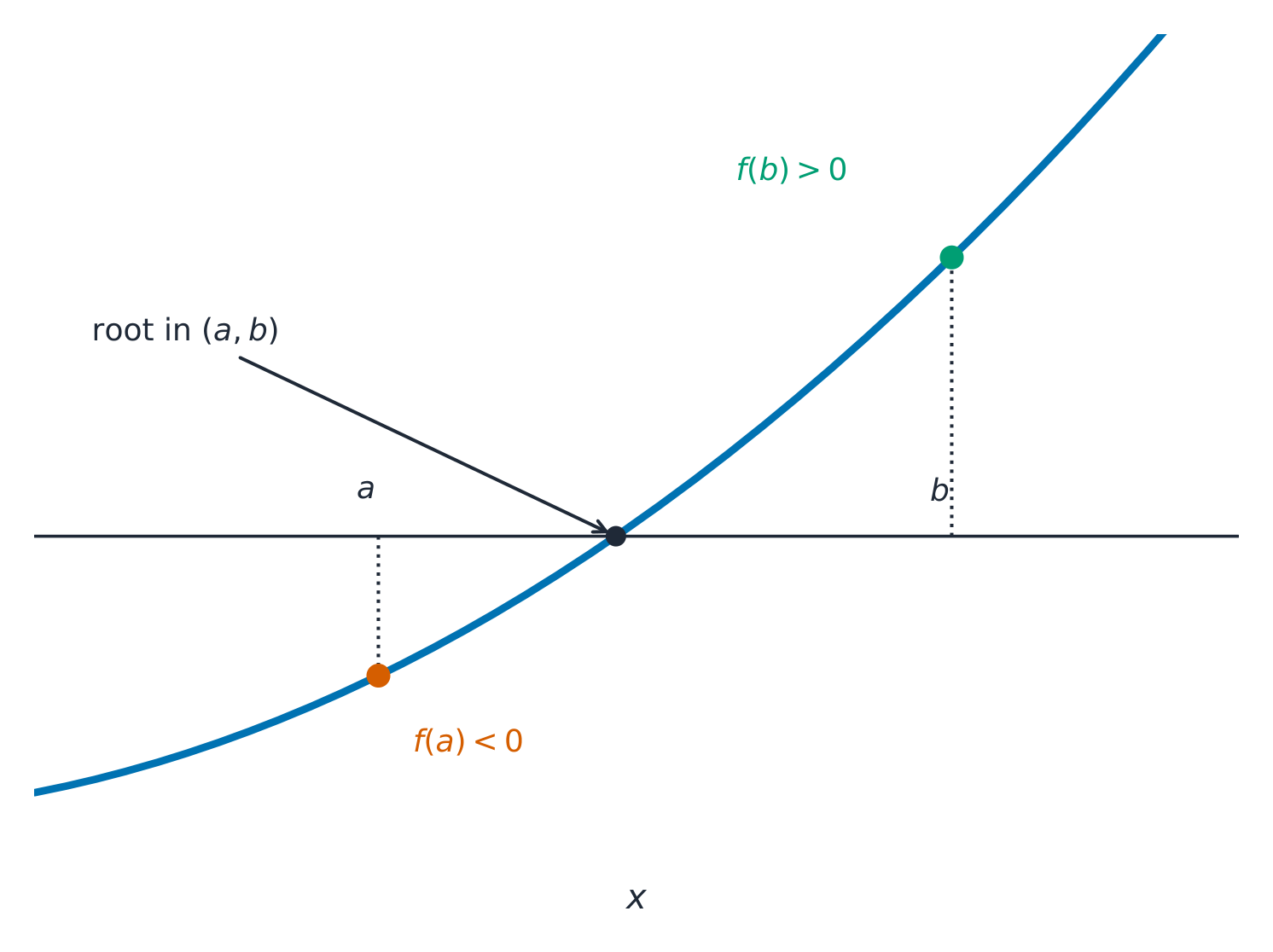
    Противоположные знаки f(a) и f(b) указывают на наличие корня между a и b
    Противоположные знаки f(a) и f(b) указывают на наличие корня между a и b

    Если $f$ непрерывна на отрезке $[a,b]$, и $d$ — любое число, лежащее между $f(a)$ и $f(b)$, то существует как минимум одно число $c$ в $(a,b)$, для которого выполняется $f(c)=d$.

    Непрерывная кривая не может пропустить высоту между своими концами — она должна пройти через каждую из них.

    Теорема о промежуточных значениях: непрерывная кривая проходит через каждую высоту между f(a) и f(b)
    Непрерывная кривая от $(a,f(a))$ до $(b,f(b))$ должна пересечь каждую высоту $d$, лежащую между ними, как минимум один раз.

    Навык для экзамена – как обосновать применение IVT. Такие вопросы встречаются почти каждый год (например, «Должно ли существовать значение $c$, при котором $R(c)=155$?» или «Есть ли момент времени, когда $r'(t)=-6$?»). Полное обоснование требует трёх шагов:

    1. Указать на непрерывность. Сказать, что функция непрерывна на $[a,b]$ (часто потому, что она дифференцируема, или это дано по условию).
    2. Показать, что $d$ находится между значениями на концах. Вычислить значения функции на двух концах интервала и показать, что целевое значение $d$ лежит между ними, например: $f(a) < d < f(b)$.
    3. Сделать вывод по названию. «Согласно теореме о промежуточных значениях, существует значение $c$ в $(a,b)$, при котором выполняется $f(c)=d$».

    Пропуск утверждения о непрерывности или отсутствие доказательства того, что $d$ находится между значениями на концах, приведёт к потере балла – теорема требует выполнения обоих условий.

    Разобранный пример. Найти предел $\lim_{x\to 3}\dfrac{x^2-9}{x-3}$. Прямая подстановка даёт $\tfrac{0}{0}$ (неопределённость), поэтому выносим общий множитель за скобки: $\dfrac{(x-3)(x+3)}{x-3}=x+3$ для $x\ne 3$. Затем $\lim_{x\to 3}(x+3)=6$. График имеет устранимый разрыв (дырку) в точке $x=3$ — предел существует, хотя функция в этой точке не определена.

    Explore · ⁨Исследовать⁩

    Why a continuous curve can't skip a value · ⁨Почему непрерывная кривая не может пропустить значение⁩

    y = ax³ + bx² + cx + d

    The Intermediate Value Theorem: a function continuous on $[a,b]$ takes every $y$ between $f(a)$ and $f(b)$ at some point inside. An unbroken curve cannot leap over a height — it must pass through it. · ⁨Теорема о промежуточном значении: функция, непрерывная на $[a,b]$, принимает любое $y$ между $f(a)$ и $f(b)$ в какой-то точке внутри. Непрерывная кривая не может перепрыгнуть через высоту — она должна пройти сквозь неё.⁩

    Vocabulary · ⁨Словарь⁩ Train · ⁨Тренировать⁩
    English Русский
    change/tʃeɪndʒ/ изменению
    accumulation/əˌkjuːmjʊˈleɪʃn/ накопления
    1.16

    Exam tips · ⁨Советы для экзамена⁩

    English
    • A limit describes what $f(x)$ approaches, which need not equal $f(a)$ — the two-sided limit exists only if both sides agree.
    • Try direct substitution first; for a $\tfrac00$ form, factor and cancel or rationalise before substituting.
    • A function is continuous at $a$ when the limit exists, $f(a)$ is defined, and they are equal.
    • Use the Intermediate Value Theorem to guarantee a root: a continuous function that changes sign on $[a,b]$ takes every value between.
    • Read horizontal asymptotes from end behaviour (limits at $\pm\infty$) and vertical asymptotes where the denominator (not the numerator) is zero.
    Русский
    • Предел описывает, чему $f(x)$ стремится, что не обязательно равно значению $f(a)$ — двусторонний предел существует только если обе стороны совпадают.
    • Сначала попробуйте прямую подстановку; для неопределённости вида $\tfrac00$ разложите на множители и сократите или избавьтесь от иррациональности перед подстановкой.
    • Функция непрерывна в точке $a$, если существует предел, значение $f(a)$ определено, и они равны.
    • Используйте теорему о промежуточных значениях для гарантии наличия корня: непрерывная функция, меняющая знак на $[a,b]$, принимает все значения между ними.
    • Горизонтальные асимптоты определяются по поведению на конце (пределы при $\pm\infty$), а вертикальные асимптоты — там, где знаменатель (а не числитель) обращается в ноль.
  • 2

    Differentiation: Definition and Fundamental Properties · ⁨Дифференцирование: Определение и фундаментальные свойства⁩

    Watch lesson · ⁨Смотреть урок⁩
    2.1

    Average and Instantaneous Rates of Change · ⁨Средняя и мгновенная скорости изменения⁩

    Syllabus · ⁨Программа⁩
    English

    Enduring Understanding (CHA-2): Derivatives allow us to determine rates of change at an instant by applying limits to knowledge about rates of change over intervals.

    Learning Objective CHA-2.A: Determine average rates of change using difference quotients.

    • CHA-2.A.1 The difference quotients $\dfrac{f(a+h)-f(a)}{h}$ and $\dfrac{f(x)-f(a)}{x-a}$ express the average rate of change of a function over an interval.

    Learning Objective CHA-2.B: Represent the derivative of a function as the limit of a difference quotient.

    • CHA-2.B.1 The instantaneous rate of change of a function at $x=a$ can be expressed by $\lim\limits_{h\to 0}\dfrac{f(a+h)-f(a)}{h}$ or $\lim\limits_{x\to a}\dfrac{f(x)-f(a)}{x-a}$, provided the limit exists. These are equivalent forms of the definition of the derivative and are denoted $f'(a)$.
    Русский

    Принцип (CHA-2): Производные позволяют определять скорости изменения в конкретный момент времени, применяя пределы к знаниям о скоростях изменения на интервалах.

    Цель обучения CHA-2.A: Определять средние скорости изменения с использованием разностных отношений.

    • CHA-2.A.1 Разностные отношения $\dfrac{f(a+h)-f(a)}{h}$ и $\dfrac{f(x)-f(a)}{x-a}$ выражают среднюю скорость изменения функции на интервале.

    Цель обучения CHA-2.B: Представить производную функции как предел разностного отношения.

    • CHA-2.B.1 Мгновенная скорость изменения функции в точке $x=a$ может быть выражена через $\lim\limits_{h\to 0}\dfrac{f(a+h)-f(a)}{h}$ или $\lim\limits_{x\to a}\dfrac{f(x)-f(a)}{x-a}$, при условии существования предела. Это эквивалентные формы определения производной и обозначаются как $f'(a)$.

    Source: College Board AP Course and Exam Description · ⁨Источник: Описание курса и экзамена College Board AP⁩

    English
    The derivative from first principles

    Unit 1 built the limit. Unit 2 uses it to define the derivative 导数 – the exact rate of change at a point.

    Over an interval, the average rate of change is a difference quotient 差商. Two equivalent forms appear:

    $$\frac{f(a+h)-f(a)}{h} \qquad\text{and}\qquad \frac{f(x)-f(a)}{x-a}.$$
    The first uses a step of size $h$ from $a$; the second uses two points $x$ and $a$. Both compute $\dfrac{\text{change in output}}{\text{change in input}}$ over the interval.

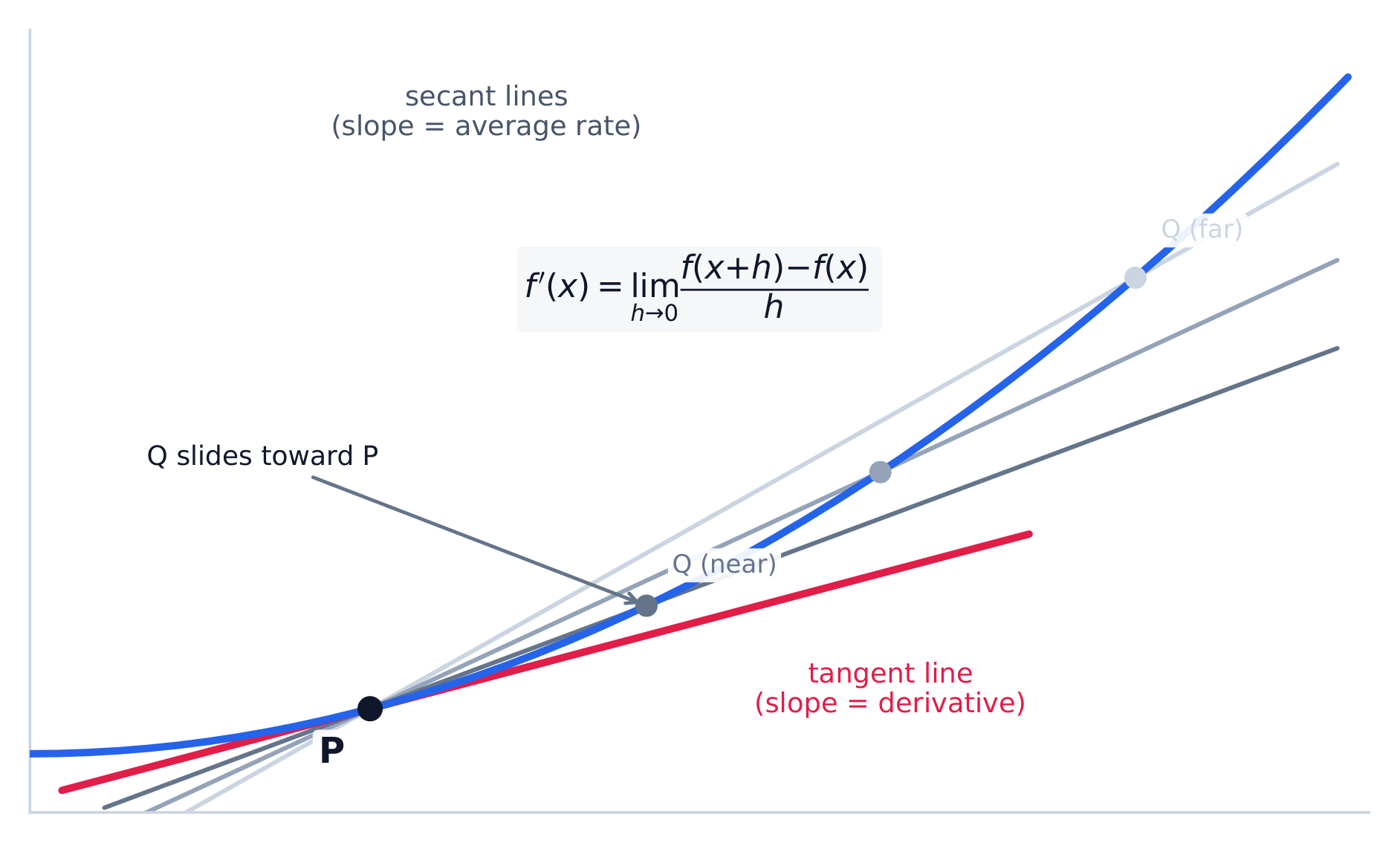
    The instantaneous 瞬时 rate of change at $x=a$ is what the difference quotient approaches as the interval shrinks to zero. This limit is the derivative at $a$, written $f'(a)$:

    $$f'(a) = \lim_{h\to 0}\frac{f(a+h)-f(a)}{h} = \lim_{x\to a}\frac{f(x)-f(a)}{x-a},$$
    provided the limit exists.

    Русский
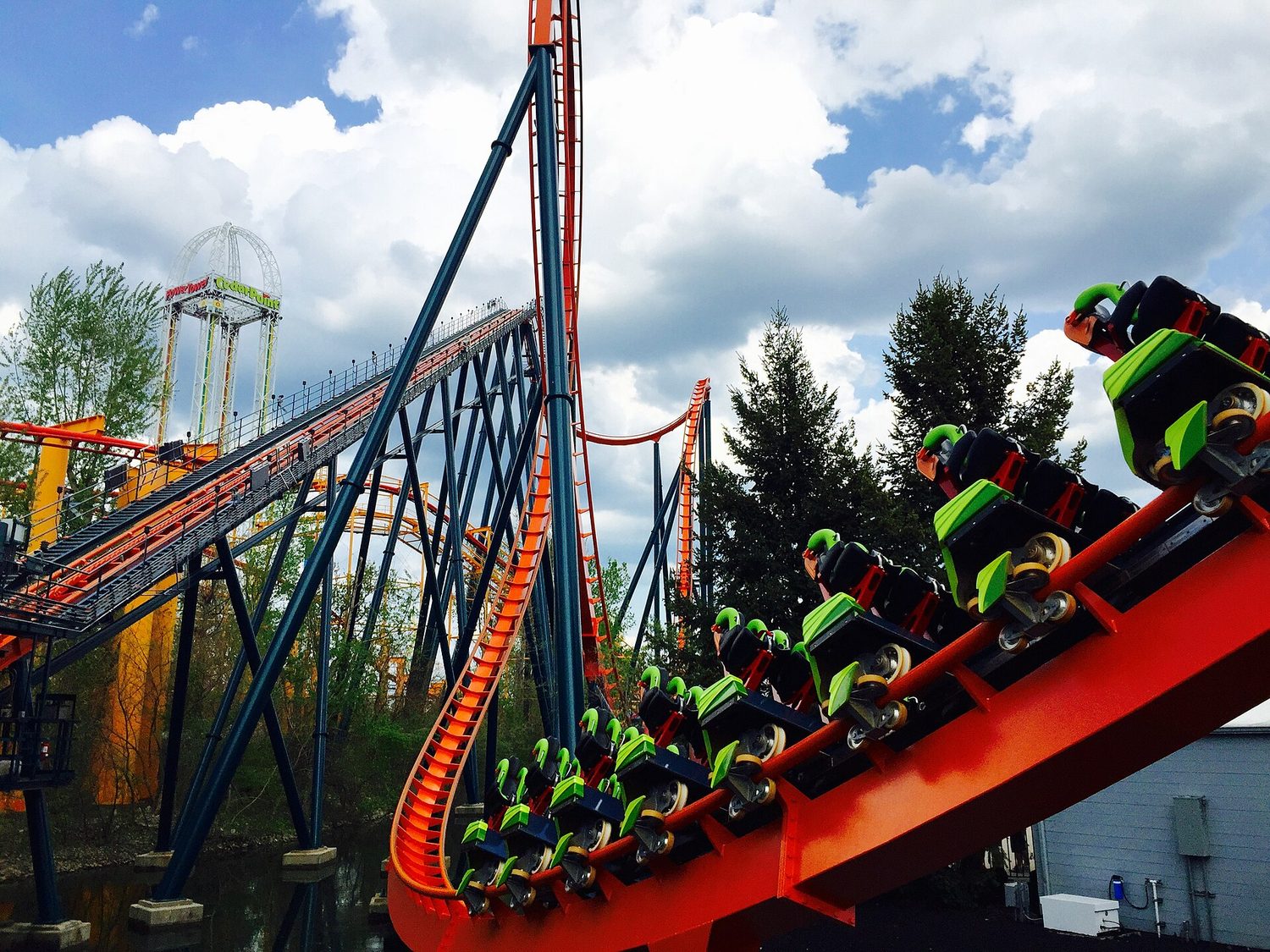
    Американские горки на подъёмнике: производная измеряет мгновенную скорость изменения положения
    Американские горки на подъёмнике: производная измеряет мгновенную скорость изменения положения
    Производная по определению

    Единица 1 построила понятие предела. Единица 2 использует его для определения производной — точной скорости изменения в точке.

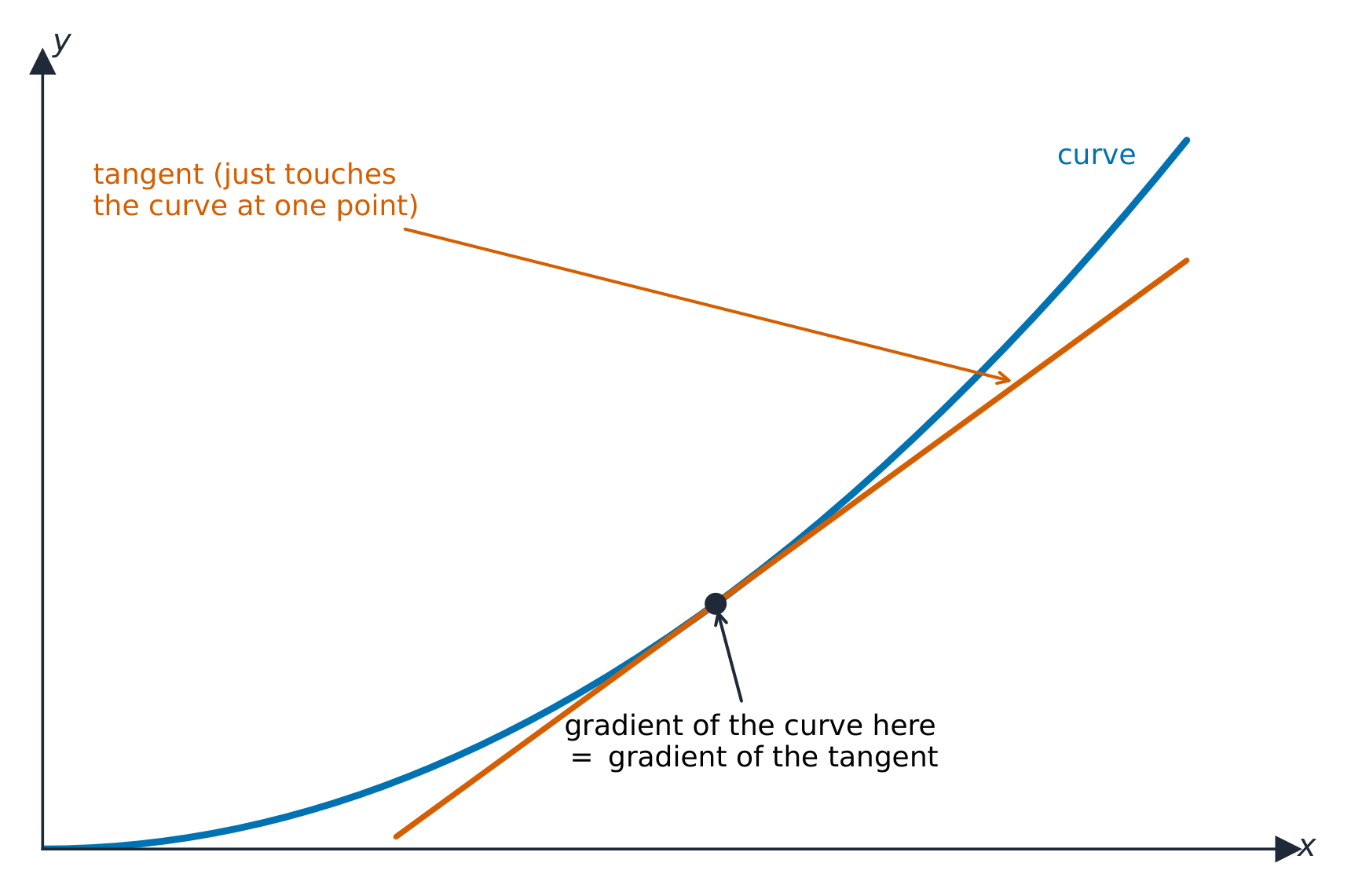
    Мгновенная скорость изменения — это угловой коэффициент касательной в точке
    Мгновенная скорость изменения — это угловой коэффициент касательной в точке

    На интервале средняя скорость изменения представляет собой разностное отношение. Приводятся две эквивалентные формы:

    $$\frac{f(a+h)-f(a)}{h} \qquad\text{and}\qquad \frac{f(x)-f(a)}{x-a}.$$
    Первое использует шаг размера $h$ от $a$; второе использует две точки $x$ и $a$. Оба вычисляют $\dfrac{\text{change in output}}{\text{change in input}}$ на интервале.

    Мгновенная скорость изменения в точке $x=a$ — это то, к чему стремится разностное отношение при уменьшении интервала до нуля. Этот предел и есть производная в точке $a$, которая записывается как $f'(a)$:

    $$f'(a) = \lim_{h\to 0}\frac{f(a+h)-f(a)}{h} = \lim_{x\to a}\frac{f(x)-f(a)}{x-a},$$
    при условии существования этого предела.

    Explore · ⁨Исследовать⁩

    From average rate to instantaneous rate · ⁨От средней скорости к мгновенной⁩

    y = ax³ + bx² + cx + d

    Slide the point: the secant through two nearby points tips toward the tangent as they merge. The tangent's slope is the derivative — the instantaneous rate of change. · ⁨Перетащите точку: секущая, проходящая через две близкие точки, приближается к касательной при их слиянии. Наклон касательной равен производной — мгновенной скорости изменения.⁩

    Vocabulary · ⁨Словарь⁩ Train · ⁨Тренировать⁩
    English Русский
    derivative/dɪˈrɪvətɪv/ производной
    difference quotient/ˈdɪfrəns ˈkwəʊʃənt/ разностное отношение
    instantaneous/ˌɪnstənˈteɪnɪəs/ мгновенная
    first principles/fɜːst ˈprɪnsɪplz/ первоначальные принципы
    notations/nəʊˈteɪʃnz/ обозначения
    slope/sləʊp/ наклоне графика
    tangent line/ˈtændʒənt laɪn/ касательная прямая
    2.2

    Defining the Derivative and Its Notation · ⁨Определение производной и её обозначения⁩

    Syllabus · ⁨Программа⁩
    Enduring UnderstandingLearning ObjectiveEssential Knowledge

    CHA-2
    Derivatives allow us to determine rates of change at an instant by applying limits to knowledge about rates of change over intervals.

    CHA-2.B
    Represent the derivative of a function as the limit of a difference quotient.

    • CHA-2.B.2 The derivative of $f$ is the function whose value at $x$ is $\lim\limits_{h\to 0}\dfrac{f(x+h)-f(x)}{h}$, provided this limit exists.
    • CHA-2.B.3 For $y=f(x)$, notations for the derivative include $\dfrac{dy}{dx}$, $f'(x)$, and $y'$.
    • CHA-2.B.4 The derivative can be represented graphically, numerically, analytically, and verbally.

    CHA-2.C
    Determine the equation of a line tangent to a curve at a given point.

    • CHA-2.C.1 The derivative of a function at a point is the slope of the line tangent to a graph of the function at that point.

    Source: College Board AP Course and Exam Description · ⁨Источник: Описание курса и экзамена College Board AP⁩

    English

    Let the point $a$ vary and the derivative becomes a new function:

    $$f'(x) = \lim_{h\to 0}\frac{f(x+h)-f(x)}{h}.$$
    This is the definition of the derivative (sometimes called differentiating "by first principles" 用定义求导). Its value at each $x$ is the instantaneous rate of change there.

    Common notations 记号 for the derivative of $y=f(x)$ are:

    $$\frac{dy}{dx}, \qquad f'(x), \qquad y'.$$
    The derivative can be represented graphically, numerically, analytically, and verbally – be ready to move between them.

    Geometric meaning. The derivative at a point is the slope 斜率 of the tangent line 切线 to the graph there. So the tangent line at $x=a$ passes through $\big(a, f(a)\big)$ with slope $f'(a)$:

    $$y - f(a) = f'(a)\,(x-a).$$
    Writing this line is a routine exam task, so keep the point-slope form ready.

    Русский

    Пусть точка $a$ изменяется, тогда производная становится новой функцией:

    $$f'(x) = \lim_{h\to 0}\frac{f(x+h)-f(x)}{h}.$$
    Это определение производной (иногда называют дифференцированием «по определению»). Её значение в каждой точке $x$ является мгновенной скоростью изменения в этой точке.

    Распространённые обозначения для производной функции $y=f(x)$:

    $$\frac{dy}{dx}, \qquad f'(x), \qquad y'.$$
    Производную можно представлять графически, численно, аналитически и вербально — будьте готовы переходить между этими формами.

    Геометрический смысл. Производная в точке — это угловой коэффициент касательной к графику в этой точке. Таким образом, касательная в точке $x=a$ проходит через точку $\big(a, f(a)\big)$ с угловым коэффициентом $f'(a)$:

    $$y - f(a) = f'(a)\,(x-a).$$
    Запись уравнения этой прямой — стандартная задача на экзамене, поэтому держите формулу прямой с заданным угловым коэффициентом под рукой.

    Угловые коэффициенты хорд стремятся к угловому коэффициенту касательной: производная — это предел средних скоростей
    При приближении точки $Q$ к точке $P$ угловой коэффициент каждой хорды (средней скорости) стремится к угловому коэффициенту касательной — производной $f'(a)$.
    2.3

    Estimating a Derivative at a Point · ⁨Оценка производной в точке⁩

    Syllabus · ⁨Программа⁩
    English

    Enduring Understanding (CHA-2): Derivatives allow us to determine rates of change at an instant by applying limits to knowledge about rates of change over intervals.

    Learning Objective CHA-2.D: Estimate derivatives.

    • CHA-2.D.1 The derivative at a point can be estimated from information given in tables or graphs.
    • CHA-2.D.2 Technology can be used to calculate or estimate the value of a derivative of a function at a point.
    Русский

    Принцип (CHA-2): Производные позволяют определять скорости изменения в конкретный момент времени, применяя пределы к знаниям о скоростях изменения на интервалах.

    Цель обучения CHA-2.D: Оценивать производные.

    • CHA-2.D.1 Производную в точке можно оценить на основе информации, представленной в таблицах или графиках.
    • CHA-2.D.2 Технологии могут использоваться для вычисления или оценки значения производной функции в точке.

    Source: College Board AP Course and Exam Description · ⁨Источник: Описание курса и экзамена College Board AP⁩

    English

    You do not always have a formula. When a function is given by a table 表格 or a graph, estimate the derivative $f'(a)$ with a difference quotient over a small interval around $a$. A table with values on both sides of $a$ gives the best estimate:

    $$f'(a) \approx \frac{f(b)-f(c)}{b-c},\qquad \text{where } c < a < b \text{ are the closest table inputs}.$$
    Technology (a calculator) can also estimate a derivative at a point.

    Exam skill (appears almost every year). Questions such as "Approximate $M'(7.5)$ using the average rate of change of $M$ over the interval $5 \le t \le 10$" ask for exactly this difference quotient. Show the setup:

    $$M'(7.5) \approx \frac{M(10)-M(5)}{10-5}.$$
    Full credit needs the numbers plugged in and the correct units 单位 (output units per input unit), since these come from real-world models.

    Русский

    Не всегда доступна формула функции. Когда функция задана таблицей или графиком, оцените производную $f'(a)$ с помощью разностного отношения на малом интервале вокруг точки $a$. Таблица со значениями по обе стороны от $a$ даёт наилучшую оценку:

    $$f'(a) \approx \frac{f(b)-f(c)}{b-c},\qquad \text{where } c < a < b \text{ are the closest table inputs}.$$
    Технологии (калькулятор) также могут оценить производную в точке.

    Навык для экзамена (встречается почти каждый год). Вопросы типа «Оцените $M'(7.5)$, используя среднюю скорость изменения функции $M$ на интервале $5 \le t \le 10$» требуют именно этого разностного отношения. Покажите настройку:

    $$M'(7.5) \approx \frac{M(10)-M(5)}{10-5}.$$
    Полный балл требуется подставить числа и указать правильные единицы измерения (выходная единица на входную единицу), так как они берутся из реальных моделей.

    Vocabulary · ⁨Словарь⁩ Train · ⁨Тренировать⁩
    English Русский
    table/ˈteɪbl/ таблица
    units/ˈjuːnɪts/ единиц
    differentiable/ˈdɪfərenʃɪəbl/ дифференцируема
    continuous/kənˈtɪnjuːəs/ непрерывными
    corner/ˈkɔːnə/ угол
    vertical tangent/ˈvɜːtɪkl ˈtændʒənt/ вертикальная касательная
    power rule/ˈpaʊə ruːl/ правило степени
    Constant multiple/ˈkɒnstənt ˈmʌltɪpl/ постоянный множитель
    polynomial/ˌpɒlɪˈnəʊmɪəl/ полиномом
    2.4

    When Does a Derivative Exist? · ⁨Когда существует производная?⁩

    Syllabus · ⁨Программа⁩
    English

    Enduring Understanding (FUN-2): Recognizing that a function's derivative may also be a function allows us to develop knowledge about the related behaviors of both.

    Learning Objective FUN-2.A: Explain the relationship between differentiability and continuity.

    • FUN-2.A.1 If a function is differentiable at a point, then it is continuous at that point. In particular, if a point is not in the domain of $f$, then it is not in the domain of $f'$.
    • FUN-2.A.2 A continuous function may fail to be differentiable at a point in its domain.
      • Illustrative examples for FUN-2.A.2:
        • The left hand and right hand limits of the difference quotient are not equal, as in $f(x)=|x|$ at $x=0$.
        • The tangent line is vertical and has no slope, as in $f(x)=\sqrt[3]{x}$ at $x=0$.
    Русский

    Принцип (FUN-2): Осознание того, что производная функции также является функцией, позволяет нам развивать знания о связанных свойствах обеих величин.

    Цель обучения FUN-2.A: Объяснить связь между дифференцируемостью и непрерывностью.

    • FUN-2.A.1 Если функция дифференцируема в точке, то она непрерывна в этой точке. В частности, если точка не принадлежит области определения $f$, то она не принадлежит и области определения $f'$.
    • FUN-2.A.2 Непрерывная функция может не быть дифференцируемой в некоторой точке своей области определения.
      • Иллюстративные примеры для FUN-2.A.2:
        • Левосторонний и правосторонний пределы разностного отношения не равны, как в случае $f(x)=|x|$ в точке $x=0$.
        • Касательная вертикальна и не имеет наклона, как в случае $f(x)=\sqrt[3]{x}$ в точке $x=0$.

    Source: College Board AP Course and Exam Description · ⁨Источник: Описание курса и экзамена College Board AP⁩

    English

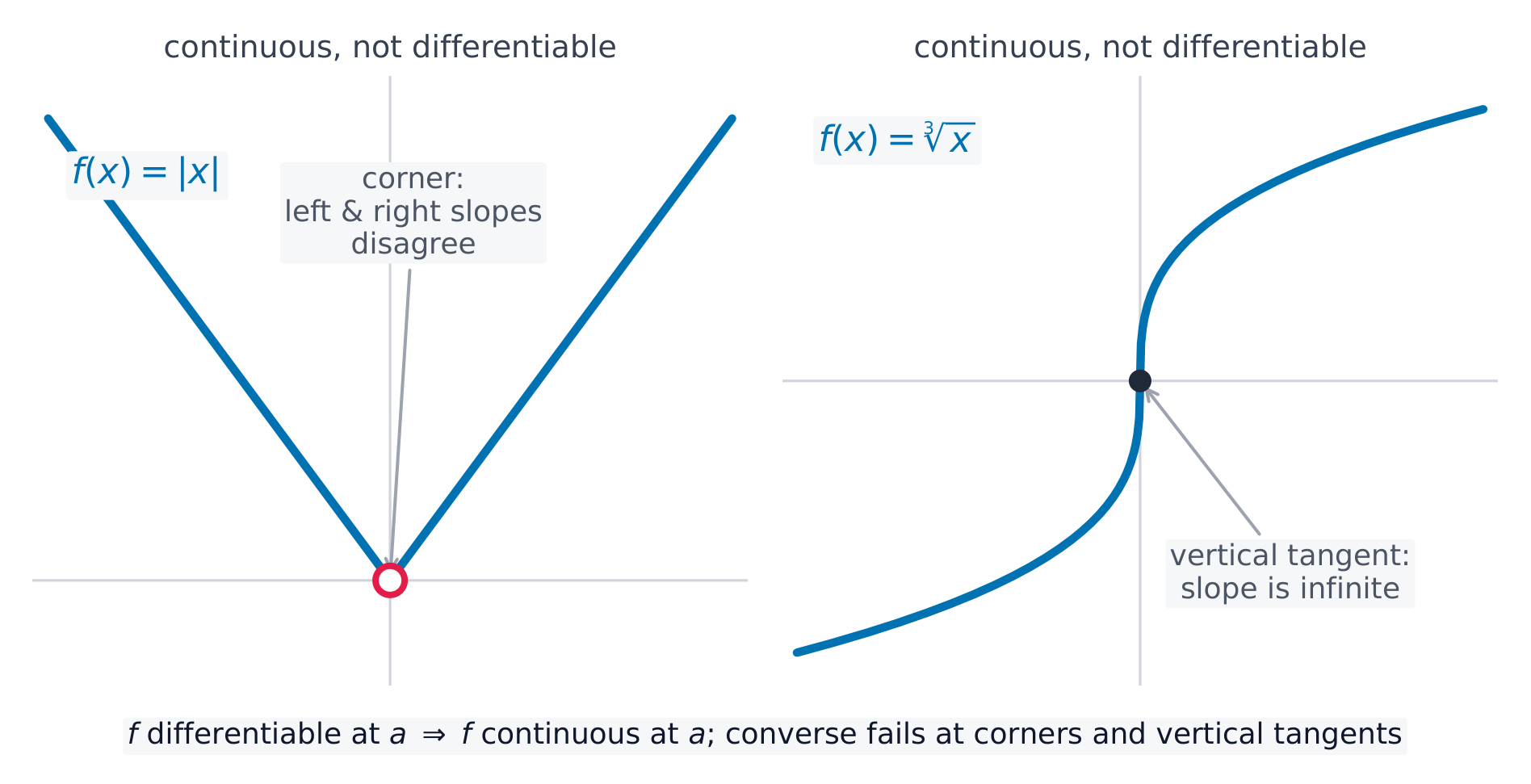
    Differentiability is stronger than continuity. The key relationship:

    If $f$ is differentiable 可导 at a point, then $f$ is continuous 连续 there.

    So differentiability implies continuity. The reverse is false: a continuous function can fail to be differentiable. Two ways this happens:

    • A corner 尖点: the left and right difference-quotient limits disagree, as with $f(x)=|x|$ at $x=0$.
    • A vertical tangent 垂直切线: the slope is infinite (no real number), as with $f(x)=\sqrt[3]{x}$ at $x=0$.

    Also, a point outside the domain of $f$ cannot be in the domain of $f'$. Use the contrapositive on the exam: if $f$ is not continuous at $a$, then $f$ is not differentiable at $a$.

    Русский

    Дифференцируемость сильнее, чем непрерывность. Ключевая связь:

    Если $f$ дифференцируема в точке, то $f$ непрерывна в этой точке.

    Таким образом, дифференцируемость влечет непрерывность. Обратное неверно: непрерывная функция может не быть дифференцируемой. Два способа, когда это происходит:

    • Угол: пределы левосторонней и правосторонней разностных отношений расходятся, как у $f(x)=|x|$ в $x=0$.
    • Вертикальная касательная: наклон бесконечен (нет действительного числа), как у $f(x)=\sqrt[3]{x}$ в $x=0$.
    Два способа, по которым непрерывная функция не является дифференцируемой: угол и вертикальная касательная
    Два способа, по которым непрерывная функция не является дифференцируемой: угол и вертикальная касательная

    Кроме того, точка вне области определения $f$ не может находиться в области определения $f'$. Используйте contrapositive на экзамене: если $f$ не непрерывна в $a$, то $f$ не дифференцируема в $a$.

    2.5

    The Power Rule · ⁨Правило степени⁩

    Syllabus · ⁨Программа⁩
    English

    Enduring Understanding (FUN-3): Recognizing opportunities to apply derivative rules can simplify differentiation.

    Learning Objective FUN-3.A: Calculate derivatives of familiar functions.

    • FUN-3.A.1 Direct application of the definition of the derivative and specific rules can be used to calculate the derivative for functions of the form $f(x)=x^{r}$.
    Русский

    Принцип (FUN-3): Осознание возможностей применения правил дифференцирования может упростить процесс нахождения производных.

    Цель обучения FUN-3.A: Вычислять производные известных функций.

    • FUN-3.A.1 Прямое применение определения производной и конкретных правил может быть использовано для вычисления производной функций вида $f(x)=x^{r}$.

    Source: College Board AP Course and Exam Description · ⁨Источник: Описание курса и экзамена College Board AP⁩

    English

    From here we use rules instead of the limit definition each time. The power rule 幂法则 handles any power of $x$:

    $$\frac{d}{dx}\,x^{r} = r\,x^{\,r-1}\qquad\text{for any real } r.$$
    It works for whole-number powers, negative powers ($\tfrac{1}{x}=x^{-1}$), and roots ($\sqrt{x}=x^{1/2}$) – rewrite as a power first, then apply the rule.

    Русский

    Отныне мы используем правила вместо определения через предел каждый раз. Правило степени обрабатывает любую степень $x$:

    $$\frac{d}{dx}\,x^{r} = r\,x^{\,r-1}\qquad\text{for any real } r.$$
    Оно работает для целочисленных степеней, отрицательных степеней ($\tfrac{1}{x}=x^{-1}$) и корней ($\sqrt{x}=x^{1/2}$) — сначала перепишите как степень, затем примените правило.

    Explore · ⁨Исследовать⁩

    A power function and its steepening slope · ⁨Степенная функция и нарастающий наклон⁩

    y = ax³ + bx² + cx + d

    The power rule $\frac{d}{dx}x^n = nx^{n-1}$ drops the exponent as a factor. For $x^3$ the slope grows quickly as $x$ moves from 0 — the curve steepens. · ⁨Правило дифференцирования степени $\frac{d}{dx}x^n = nx^{n-1}$ выносит показатель степени как множитель. Для $x^3$ наклон быстро растет при движении $x$ от 0 — кривая становится круче.⁩

    2.6

    Constant, Sum, Difference, and Constant Multiple Rules · ⁨Правила константы, суммы, разности и константного множителя⁩

    Syllabus · ⁨Программа⁩
    English

    Enduring Understanding (FUN-3): Recognizing opportunities to apply derivative rules can simplify differentiation.

    Learning Objective FUN-3.A: Calculate derivatives of familiar functions.

    • FUN-3.A.2 Sums, differences, and constant multiples of functions can be differentiated using derivative rules.
    • FUN-3.A.3 The power rule combined with sum, difference, and constant multiple properties can be used to find the derivatives for polynomial functions.
    Русский

    Принцип (FUN-3): Осознание возможностей применения правил дифференцирования может упростить процесс нахождения производных.

    Цель обучения FUN-3.A: Вычислять производные известных функций.

    • FUN-3.A.2 Суммы, разности и константные множители функций могут быть продифференцированы с использованием правил дифференцирования.
    • FUN-3.A.3 Правило степени в сочетании со свойствами суммы, разности и константного множителя может быть использовано для нахождения производных полиномиальных функций.

    Source: College Board AP Course and Exam Description · ⁨Источник: Описание курса и экзамена College Board AP⁩

    English

    These rules let you differentiate term by term:

    • Constant: $\dfrac{d}{dx}\,k = 0$ (a constant does not change).
    • Constant multiple 常数倍: $\dfrac{d}{dx}\big[k\,f(x)\big] = k\,f'(x)$.
    • Sum / difference: $\dfrac{d}{dx}\big[f(x)\pm g(x)\big] = f'(x)\pm g'(x)$.

    Combined with the power rule, they differentiate any polynomial 多项式 term by term. Example:

    $$\frac{d}{dx}\big(4x^3 - 5x + 7\big) = 12x^2 - 5.$$

    Русский

    Эти правила позволяют дифференцировать почленно:

    • Константа: $\dfrac{d}{dx}\,k = 0$ (константа не меняется).
    • Константный множитель: $\dfrac{d}{dx}\big[k\,f(x)\big] = k\,f'(x)$.
    • Сумма / разность: $\dfrac{d}{dx}\big[f(x)\pm g(x)\big] = f'(x)\pm g'(x)$.

    В сочетании с правилом степени они дифференцируют любой полином почленно. Пример:

    $$\frac{d}{dx}\big(4x^3 - 5x + 7\big) = 12x^2 - 5.$$

    2.7

    Derivatives of sin x, cos x, e^x, and ln x · ⁨Производные sin x, cos x, e^x и ln x⁩

    Syllabus · ⁨Программа⁩
    English

    Enduring Understanding (FUN-3): Recognizing opportunities to apply derivative rules can simplify differentiation.

    Learning Objective FUN-3.A: Calculate derivatives of familiar functions.

    • FUN-3.A.4 Specific rules can be used to find the derivatives for sine, cosine, exponential, and logarithmic functions.

    Enduring Understanding (LIM-3): Reasoning with definitions, theorems, and properties can be used to determine a limit.

    Learning Objective LIM-3.A: Interpret a limit as a definition of a derivative.

    • LIM-3.A.1 In some cases, recognizing an expression for the definition of the derivative of a function whose derivative is known offers a strategy for determining a limit.
    Русский

    Принцип (FUN-3): Осознание возможностей применения правил дифференцирования может упростить процесс нахождения производных.

    Цель обучения FUN-3.A: Вычислять производные известных функций.

    • FUN-3.A.4 Конкретные правила могут быть использованы для нахождения производных синуса, косинуса, показательных и логарифмических функций.

    Долгосрочное понимание (LIM-3): Логическое рассуждение с использованием определений, теорем и свойств позволяет определить предел.

    Цель обучения LIM-3.A: Интерпретировать предел как определение производной.

    • LIM-3.A.1 В некоторых случаях распознавание выражения, соответствующего определению производной функции, производная которой известна, предлагает стратегию для определения предела.

    Source: College Board AP Course and Exam Description · ⁨Источник: Описание курса и экзамена College Board AP⁩

    English

    Learn these four building-block derivatives by heart:

    $$\frac{d}{dx}\sin x = \cos x, \qquad \frac{d}{dx}\cos x = -\sin x,$$
    $$\frac{d}{dx}e^{x} = e^{x}, \qquad \frac{d}{dx}\ln x = \frac{1}{x}\ \ (x>0).$$
    Note the minus sign on the derivative of cosine, and that $e^{x}$ is its own derivative.

    A limit that is really a derivative (LIM-3.A.1). Sometimes a limit is secretly the definition of a known derivative. If you recognize

    $$\lim_{h\to 0}\frac{f(a+h)-f(a)}{h}$$
    for a function $f$ whose derivative you know, just evaluate $f'(a)$. For example, $\displaystyle \lim_{h\to 0}\frac{\sin\!\big(\tfrac{\pi}{2}+h\big)-1}{h} = \left.\frac{d}{dx}\sin x\right|_{x=\pi/2} = \cos\tfrac{\pi}{2} = 0$.

    Русский

    Выучите эти четыре базовых производных наизусть:

    $$\frac{d}{dx}\sin x = \cos x, \qquad \frac{d}{dx}\cos x = -\sin x,$$
    $$\frac{d}{dx}e^{x} = e^{x}, \qquad \frac{d}{dx}\ln x = \frac{1}{x}\ \ (x>0).$$
    Обратите внимание на знак минус при производной косинуса и на то, что $e^{x}$ является своей собственной производной.

    Предел, который на самом деле является производной (LIM-3.A.1). Иногда предел тайно является определением известной производной. Если вы распознаете

    $$\lim_{h\to 0}\frac{f(a+h)-f(a)}{h}$$
    для функции $f$, производную которой вы знаете, просто вычислите $f'(a)$. Например, $\displaystyle \lim_{h\to 0}\frac{\sin\!\big(\tfrac{\pi}{2}+h\big)-1}{h} = \left.\frac{d}{dx}\sin x\right|_{x=\pi/2} = \cos\tfrac{\pi}{2} = 0$.

    Explore · ⁨Исследовать⁩

    The shape of sin x (whose slope is cos x) · ⁨Форма sin x (производная которой равна cos x)⁩

    y = asin(bx + c) + d

    The derivative of $\sin x$ is $\cos x$: the slope of the sine curve is largest where sine crosses zero and zero at its peaks. Watch the curve to feel where its slope is steep or flat. · ⁨Производная $\sin x$ равна $\cos x$: наклон кривой синуса максимален в точках пересечения с нулем и равен нулю в вершинах. Наблюдайте за кривой, чтобы ощутить, где её наклон крутой или пологий.⁩

    2.8

    The Product Rule · ⁨Правило произведения⁩

    Syllabus · ⁨Программа⁩
    English

    Enduring Understanding (FUN-3): Recognizing opportunities to apply derivative rules can simplify differentiation.

    Learning Objective FUN-3.B: Calculate derivatives of products and quotients of differentiable functions.

    • FUN-3.B.1 Derivatives of products of differentiable functions can be found using the product rule.
    Русский

    Принцип (FUN-3): Осознание возможностей применения правил дифференцирования может упростить процесс нахождения производных.

    Цель обучения FUN-3.B: Вычислять производные произведений и отношений дифференцируемых функций.

    • FUN-3.B.1 Производные произведений дифференцируемых функций можно найти с использованием правила произведения.

    Source: College Board AP Course and Exam Description · ⁨Источник: Описание курса и экзамена College Board AP⁩

    English
    The product rule as a growing rectangle

    A product of two functions is not differentiated by multiplying the derivatives. Use the product rule 乘积法则:

    $$\frac{d}{dx}\big[u\,v\big] = u'v + uv'.$$
    "Derivative of the first times the second, plus the first times the derivative of the second." Example:
    $$\frac{d}{dx}\big(x^2 e^{x}\big) = 2x\,e^{x} + x^2 e^{x}.$$
    Exam questions often build a new function from given pieces, e.g. $k'(x) = \big(f(x)\big)^2 g(x)$, and ask you to combine rules while reading values from a table.

    Русский
    Правило произведения как растущий прямоугольник

    Произведение двух функций не дифференцируется путем умножения их производных. Используйте правило произведения:

    $$\frac{d}{dx}\big[u\,v\big] = u'v + uv'.$$
    "Производная первого умножается на второе плюс первое умножается на производную второго." Пример:
    $$\frac{d}{dx}\big(x^2 e^{x}\big) = 2x\,e^{x} + x^2 e^{x}.$$
    Экзаменационные вопросы часто создают новую функцию из заданных частей, например $k'(x) = \big(f(x)\big)^2 g(x)$, и просят объединить правила, считывая значения из таблицы.

    Vocabulary · ⁨Словарь⁩ Train · ⁨Тренировать⁩
    English Русский
    product rule/ˈprɒdʌkt ruːl/ правило произведения
    2.9

    The Quotient Rule · ⁨Правило частного⁩

    Syllabus · ⁨Программа⁩
    English

    Enduring Understanding (FUN-3): Recognizing opportunities to apply derivative rules can simplify differentiation.

    Learning Objective FUN-3.B: Calculate derivatives of products and quotients of differentiable functions.

    • FUN-3.B.2 Derivatives of quotients of differentiable functions can be found using the quotient rule.
    Русский

    Принцип (FUN-3): Осознание возможностей применения правил дифференцирования может упростить процесс нахождения производных.

    Цель обучения FUN-3.B: Вычислять производные произведений и отношений дифференцируемых функций.

    • FUN-3.B.2 Производные частных дифференцируемых функций можно найти с использованием правила частного.

    Source: College Board AP Course and Exam Description · ⁨Источник: Описание курса и экзамена College Board AP⁩

    English

    For a quotient, use the quotient rule 商法则:

    $$\frac{d}{dx}\!\left[\frac{u}{v}\right] = \frac{u'v - uv'}{v^{2}}.$$
    "Bottom times derivative of top, minus top times derivative of bottom, all over bottom squared." The order matters because of the minus sign, so write the numerator carefully. Example:
    $$\frac{d}{dx}\!\left(\frac{x}{\cos x}\right) = \frac{1\cdot\cos x - x\cdot(-\sin x)}{\cos^2 x} = \frac{\cos x + x\sin x}{\cos^2 x}.$$

    Русский

    Для частного используйте правило частного:

    $$\frac{d}{dx}\!\left[\frac{u}{v}\right] = \frac{u'v - uv'}{v^{2}}.$$
    "Нижнее умножить на производную верхнего, минус верхнее умножить на производную нижнего, все делить на квадрат нижнего." Порядок важен из-за знака минус, поэтому пишите числитель внимательно. Пример:
    $$\frac{d}{dx}\!\left(\frac{x}{\cos x}\right) = \frac{1\cdot\cos x - x\cdot(-\sin x)}{\cos^2 x} = \frac{\cos x + x\sin x}{\cos^2 x}.$$

    2.10

    Derivatives of tan x, cot x, sec x, and csc x · ⁨Производные tan x, cot x, sec x и csc x⁩

    Syllabus · ⁨Программа⁩
    English

    Enduring Understanding (FUN-3): Recognizing opportunities to apply derivative rules can simplify differentiation.

    Learning Objective FUN-3.B: Calculate derivatives of products and quotients of differentiable functions.

    • FUN-3.B.3 Rearranging tangent, cotangent, secant, and cosecant functions using identities allows differentiation using derivative rules.
    Русский

    Принцип (FUN-3): Осознание возможностей применения правил дифференцирования может упростить процесс нахождения производных.

    Цель обучения FUN-3.B: Вычислять производные произведений и отношений дифференцируемых функций.

    • FUN-3.B.3 Преобразование тангенса, котангенса, секанса и косеканса с использованием тождеств позволяет дифференцировать их, применяя правила производных.

    Source: College Board AP Course and Exam Description · ⁨Источник: Описание курса и экзамена College Board AP⁩

    English
    The quotient rule: differentiating a fraction

    The remaining trigonometric derivatives are not memorized separately – you rewrite them with identities 恒等式 and apply the quotient (or product) rule. For instance, $\tan x = \dfrac{\sin x}{\cos x}$, so the quotient rule gives

    $$\frac{d}{dx}\tan x = \frac{\cos x\cos x - \sin x(-\sin x)}{\cos^2 x} = \frac{1}{\cos^2 x} = \sec^2 x.$$
    The same method (writing $\cot x=\tfrac{\cos x}{\sin x}$, $\sec x=\tfrac{1}{\cos x}$, $\csc x=\tfrac{1}{\sin x}$) gives $-\csc^2 x$, $\sec x\tan x$, and $-\csc x\cot x$.

    Higher-order derivatives. Differentiating $f'$ again gives the second derivative 二阶导数 $f''(x)$ (or $\tfrac{d^2y}{dx^2}$) – the rate of change of the rate of change. An exam part like "Find $k''(3)$" just means differentiate twice, then substitute. You can also estimate a second derivative from a table by applying the average-rate-of-change method to the $f'$ values.

    Worked example. Differentiate $f(x)=x^2\sin x$ with the product rule $(uv)'=u'v+uv'$: take $u=x^2$ ($u'=2x$) and $v=\sin x$ ($v'=\cos x$), giving $f'(x)=2x\sin x+x^2\cos x$. Always read the structure first — a product needs the product rule, not the power rule applied to each factor separately.

    Русский
    Правило частного: дифференцирование дроби

    Остальные тригонометрические производные не нужно запоминать отдельно — вы переписываете их с помощью тождеств и применяете правило частного (или произведения). Например, $\tan x = \dfrac{\sin x}{\cos x}$, поэтому правило частного дает

    $$\frac{d}{dx}\tan x = \frac{\cos x\cos x - \sin x(-\sin x)}{\cos^2 x} = \frac{1}{\cos^2 x} = \sec^2 x.$$
    Тот же метод (переписывание $\cot x=\tfrac{\cos x}{\sin x}$, $\sec x=\tfrac{1}{\cos x}$, $\csc x=\tfrac{1}{\sin x}$) дает $-\csc^2 x$, $\sec x\tan x$ и $-\csc x\cot x$.

    Производные высших порядков. Повторное дифференцирование $f'$ дает вторую производную $f''(x)$ (или $\tfrac{d^2y}{dx^2}$) — скорость изменения скорости изменения. Часть экзамена вроде «Найдите $k''(3)$» означает просто продифференцировать дважды, а затем подставить. Вы также можете оценить вторую производную по таблице, применив метод средней скорости изменения к значениям $f'$.

    Разобранный пример. Продифференцируйте $f(x)=x^2\sin x$ с помощью правила произведения $(uv)'=u'v+uv'$: возьмите $u=x^2$ ($u'=2x$) и $v=\sin x$ ($v'=\cos x$), получив $f'(x)=2x\sin x+x^2\cos x$. Всегда сначала читайте структуру — произведение требует правила произведения, а не правила степени, примененного к каждому множителю отдельно.

    Vocabulary · ⁨Словарь⁩ Train · ⁨Тренировать⁩
    English Русский
    quotient rule/ˈkwəʊʃənt ruːl/ правило частного
    identities/aɪˈdentɪtiz/ тождества
    second derivative/ˈsekənd dɪˈrɪvətɪv/ вторую производную
    2.10

    Exam tips · ⁨Советы для экзамена⁩

    English
    • The derivative is the slope of the tangent — the limit of the secant slope $\tfrac{f(x+h)-f(x)}{h}$ as $h\to0$.
    • Memorise the rules: power, product, quotient, and the derivatives of $\sin$, $\cos$, $e^x$, and $\ln x$.
    • Differentiability implies continuity, but not the reverse (a corner or cusp is continuous yet not differentiable).
    • Distinguish average rate of change (secant slope over an interval) from instantaneous rate (the derivative at a point).
    • Give a tangent-line equation as $y-f(a)=f'(a)(x-a)$.
    Русский
    • Производная — это наклон касательной — предел наклона секущей $\tfrac{f(x+h)-f(x)}{h}$ при $h\to0$.
    • Запомните правила: степени, произведения, частного, а также производные от $\sin$, $\cos$, $e^x$ и $\ln x$.
    • Дифференцируемость влечет непрерывность, но не наоборот (угол или острая вершина непрерывны, но не дифференцируемы).
    • Различайте среднюю скорость изменения (наклон секучей на интервале) и мгновенную скорость (производную в точке).
    • Уравнение касательной записывайте в виде $y-f(a)=f'(a)(x-a)$.
  • 3

    Differentiation: Composite, Implicit, and Inverse Functions · ⁨Дифференцирование сложных, неявных и обратных функций⁩

    Watch lesson · ⁨Смотреть урок⁩
    3.1

    The Chain Rule · ⁨Правило сложной функции⁩

    Syllabus · ⁨Программа⁩
    English

    Enduring Understanding (FUN-3): Recognizing opportunities to apply derivative rules can simplify differentiation.

    Learning Objective FUN-3.C: Calculate derivatives of compositions of differentiable functions.

    • FUN-3.C.1 The chain rule provides a way to differentiate composite functions.
    Русский

    Принцип (FUN-3): Осознание возможностей применения правил дифференцирования может упростить процесс нахождения производных.

    Цель обучения FUN-3.C: Вычислять производные композиций дифференцируемых функций.

    • FUN-3.C.1 Цепное правило предоставляет способ дифференцирования сложных функций.

    Source: College Board AP Course and Exam Description · ⁨Источник: Описание курса и экзамена College Board AP⁩

    English
    The chain rule

    Unit 2 differentiated single functions. Unit 3 differentiates functions built inside other functions. The chain rule 链式法则 differentiates a composite function 复合函数 $f\big(g(x)\big)$:

    $$\frac{d}{dx}\,f\big(g(x)\big) = f'\big(g(x)\big)\cdot g'(x).$$
    "Derivative of the outer function (leaving the inside alone), times the derivative of the inside." The inner derivative $g'(x)$ is the piece students forget, so always ask "what is the inside, and what is its derivative?" Example:
    $$\frac{d}{dx}\sin(x^2) = \cos(x^2)\cdot 2x.$$

    In Leibniz notation, with $y=f(u)$ and $u=g(x)$, the rule reads $\dfrac{dy}{dx}=\dfrac{dy}{du}\cdot\dfrac{du}{dx}$ – the intermediate $du$ appears to "cancel." Exam questions often give a table for $f$, $g$, $f'$, $g'$ and ask for $h'(a)$ where $h(x)=f\big(g(x)\big)$; evaluate $f'\big(g(a)\big)\cdot g'(a)$ by reading values.

    Worked example. Differentiate $h(x)=(2x^2+1)^5$. The outer function is "(something)$^5$", the inner is $2x^2+1$:

    $$h'(x)=5(2x^2+1)^4\cdot\frac{d}{dx}(2x^2+1)=5(2x^2+1)^4\cdot 4x=20x(2x^2+1)^4.$$

    Русский
    Правило сложной функции

    Единица 2 дифференцировала одиночные функции. Единица 3 дифференцирует функции, встроенные внутрь других функций. Правило сложной функции дифференцирует составную функцию $f\big(g(x)\big)$:

    $$\frac{d}{dx}\,f\big(g(x)\big) = f'\big(g(x)\big)\cdot g'(x).$$
    "Производная внешней функции (оставляя внутреннюю нетронутой), умноженная на производную внутренней." Внутренняя производная $g'(x)$ — та часть, которую студенты забывают, поэтому всегда спрашивайте «что внутри и какова его производная?» Пример:
    $$\frac{d}{dx}\sin(x^2) = \cos(x^2)\cdot 2x.$$

    В нотации Лейбница, с $y=f(u)$ и $u=g(x)$, правило читается как $\dfrac{dy}{dx}=\dfrac{dy}{du}\cdot\dfrac{du}{dx}$ — промежуточный $du$ seemingly «сокращается». Экзаменационные вопросы часто дают таблицу для $f$, $g$, $f'$, $g'$ и просят найти $h'(a)$, где $h(x)=f\big(g(x)\big)$; вычислите $f'\big(g(a)\big)\cdot g'(a)$, считывая значения.

    Разобранный пример. Продифференцируйте $h(x)=(2x^2+1)^5$. Внешняя функция — «(что-то)$^5$», внутренняя — $2x^2+1$:

    $$h'(x)=5(2x^2+1)^4\cdot\frac{d}{dx}(2x^2+1)=5(2x^2+1)^4\cdot 4x=20x(2x^2+1)^4.$$

    Матрешка: правило сложной функции дифференцирует вложенные функции слой за слоем — сначала внешнее, затем следующее внутреннее
    Матрешка: правило сложной функции дифференцирует вложенные функции слой за слоем — сначала внешнее, затем следующее внутреннее
    Vocabulary · ⁨Словарь⁩ Train · ⁨Тренировать⁩
    English Русский
    chain rule/tʃeɪn ruːl/ цепное правило
    composite function/ˈkɒmpəzɪt ˈfʌŋkʃn/ составная функция
    Implicit differentiation/ɪmˈplɪsɪt ˌdɪfəˌrenʃɪˈeɪʃn/ Неявное дифференцирование
    inverse function/ɪnˈvɜːs ˈfʌŋkʃn/ обратная функция
    reciprocal/rɪˈsɪprəkl/ обратной величиной
    inverse trigonometric functions/ɪnˈvɜːs ˌtrɪɡənəʊˈmetrɪk ˈfʌŋkʃnz/ обратные тригонометрические функции
    second derivative/ˈsekənd dɪˈrɪvətɪv/ вторую производную
    concavity/kənˈkævɪti/ выпуклости
    3.2

    Implicit Differentiation · ⁨Неполное дифференцирование⁩

    Syllabus · ⁨Программа⁩
    English

    Enduring Understanding (FUN-3): Recognizing opportunities to apply derivative rules can simplify differentiation.

    Learning Objective FUN-3.D: Calculate derivatives of implicitly defined functions.

    • FUN-3.D.1 The chain rule is the basis for implicit differentiation.
    Русский

    Принцип (FUN-3): Осознание возможностей применения правил дифференцирования может упростить процесс нахождения производных.

    Цель обучения FUN-3.D: Вычислять производные неявно заданных функций.

    • FUN-3.D.1 Цепное правило является основой неявного дифференцирования.

    Source: College Board AP Course and Exam Description · ⁨Источник: Описание курса и экзамена College Board AP⁩

    English

    Some curves are defined implicitly – by an equation in $x$ and $y$ that is not solved for $y$, such as $x^2+y^2=25$. Implicit differentiation 隐函数求导 finds $\dfrac{dy}{dx}$ without solving for $y$ first. It is just the chain rule, treating $y$ as a function of $x$.

    The method: differentiate both sides with respect to $x$; every time you differentiate a $y$-term, multiply by $\dfrac{dy}{dx}$ (the chain rule); then solve algebraically for $\dfrac{dy}{dx}$. For $x^2+y^2=25$:

    $$2x + 2y\frac{dy}{dx}=0 \;\Longrightarrow\; \frac{dy}{dx} = -\frac{x}{y}.$$

    Worked example. Find the tangent line to the circle $x^2+y^2=25$ at the point $(3,4)$. From above $\dfrac{dy}{dx}=-\dfrac{x}{y}=-\dfrac{3}{4}$ there, so the tangent is

    $$y-4=-\tfrac{3}{4}(x-3).$$
    Notice the tangent is perpendicular to the radius, as geometry promises – a good sanity check.

    Exam skill – "Show that $\dfrac{dy}{dx}=\ldots$". This exact prompt appears most years (e.g. "Show that $\dfrac{dy}{dx}=\dfrac{2y}{y^2-2x}$"). Because the target is given, you must show every algebra step cleanly: differentiate both sides, use the product/chain rules on mixed $xy$ terms, collect all $\dfrac{dy}{dx}$ terms on one side, factor, and divide. A correct final line that skips the algebra earns little. Follow-up parts then ask for a tangent line, or where the tangent is horizontal ($\tfrac{dy}{dx}=0$, so the numerator is $0$) or vertical (the denominator is $0$).

    Русский

    Некоторые кривые определены неявно — уравнением от $x$ и $y$, которое не разрешено относительно $y$, например $x^2+y^2=25$. Неявное дифференцирование находит $\dfrac{dy}{dx}$ без предварительного решения относительно $y$. Это просто правило сложной функции, рассматривающее $y$ как функцию от $x$.

    Метод: продифференцируйте обе части по $x$; каждый раз, когда вы дифференцируете член с $y$, умножайте на $\dfrac{dy}{dx}$ (правило сложной функции); затем алгебраически решите относительно $\dfrac{dy}{dx}$. Для $x^2+y^2=25$:

    $$2x + 2y\frac{dy}{dx}=0 \;\Longrightarrow\; \frac{dy}{dx} = -\frac{x}{y}.$$

    Разбор примера. Найдите касательную к окружности $x^2+y^2=25$ в точке $(3,4)$. Из вышеизложенного следует, что там $\dfrac{dy}{dx}=-\dfrac{x}{y}=-\dfrac{3}{4}$, поэтому касательная имеет вид

    $$y-4=-\tfrac{3}{4}(x-3).$$
    Заметьте, что касательная перпендикулярна радиусу, как и обещает геометрия — это хорошая проверка на здравый смысл.

    Неявное дифференцирование дает касательную к окружности, перпендикулярную радиусу
    Неявное дифференцирование дает касательную к окружности, перпендикулярную радиусу

    Экзаменационный навык – «Докажите, что $\dfrac{dy}{dx}=\ldots$».» Этот точный запрос встречается каждый год (например, «Докажите, что $\dfrac{dy}{dx}=\dfrac{2y}{y^2-2x}$»). Поскольку целевое выражение задано, необходимо показать каждый алгебраический шаг четко: продифференцировать обе стороны, применить правила произведения/цепного правила для смешанных $xy$ членов, собрать все $\dfrac{dy}{dx}$ члены с одной стороны, вынести за скобки и разделить. Правильная финальная строка, пропускающая алгебру, получает мало баллов. В последующих частях просят найти касательную или место, где касательная горизонтальна ($\tfrac{dy}{dx}=0$, поэтому числитель равен $0$) или вертикальна (знаменатель равен $0$).

    3.3

    Differentiating Inverse Functions · ⁨Дифференцирование обратных функций⁩

    Syllabus · ⁨Программа⁩
    English

    Enduring Understanding (FUN-3): Recognizing opportunities to apply derivative rules can simplify differentiation.

    Learning Objective FUN-3.E: Calculate derivatives of inverse and inverse trigonometric functions.

    • FUN-3.E.1 The chain rule and definition of an inverse function can be used to find the derivative of an inverse function, provided the derivative exists.
    Русский

    Принцип (FUN-3): Осознание возможностей применения правил дифференцирования может упростить процесс нахождения производных.

    Цель обучения FUN-3.E: Вычислять производные обратных и обратных тригонометрических функций.

    • FUN-3.E.1 Цепное правило и определение обратной функции могут быть использованы для нахождения производной обратной функции, при условии существования её производной.

    Source: College Board AP Course and Exam Description · ⁨Источник: Описание курса и экзамена College Board AP⁩

    English

    If $g$ is the inverse function 反函数 of $f$ (so $f(g(x))=x$), the chain rule links their derivatives:

    $$g'(x) = \frac{1}{f'\big(g(x)\big)},\qquad\text{provided } f'\big(g(x)\big)\neq 0.$$
    In words: the derivative of the inverse at a point is the reciprocal 倒数 of the derivative of the original function at the matching point. A common exam setup gives a table and a point $(a,b)$ on $f$ (so $(b,a)$ is on $g$), then asks for $g'(b)=\dfrac{1}{f'(a)}$.

    Worked example. Suppose $f(2)=5$ and $f'(2)=3$, and $g$ is the inverse of $f$. Because $(2,5)$ lies on $f$, the point $(5,2)$ lies on $g$, and

    $$g'(5)=\frac{1}{f'(2)}=\frac{1}{3}.$$
    The graphs of $f$ and $g$ are mirror images across $y=x$, so their slopes at matching points are reciprocals.

    Русский

    Если $g$ является обратной функцией для $f$ (так что $f(g(x))=x$), правило цепочки связывает их производные:

    $$g'(x) = \frac{1}{f'\big(g(x)\big)},\qquad\text{provided } f'\big(g(x)\big)\neq 0.$$
    Простыми словами: производная обратной функции в точке равна обратной величине производной исходной функции в соответствующей точке. Типичный экзаменационный вариант представляет таблицу и точку $(a,b)$ на графике $f$ (таким образом, точка $(b,a)$ находится на графике $g$), а затем просит найти $g'(b)=\dfrac{1}{f'(a)}$.

    Обратная функция является зеркальным отражением функции относительно прямой y = x
    Обратная функция является зеркальным отражением функции относительно прямой y = x

    Разбор примера. Предположим, что $f(2)=5$ и $f'(2)=3$, а $g$ является обратной функцией для $f$. Поскольку точка $(2,5)$ лежит на графике $f$, точка $(5,2)$ лежит на графике $g$, и

    $$g'(5)=\frac{1}{f'(2)}=\frac{1}{3}.$$
    Графики $f$ и $g$ являются зеркальным отражением друг друга относительно $y=x$, поэтому их угловые коэффициенты в соответствующих точках являются взаимно обратными величинами.

    Explore · ⁨Исследовать⁩

    An exponential and its inverse the logarithm · ⁨Экспонента и обратная ей логарифмическая функция⁩

    y = a·e^(bx) + c

    Inverse functions are mirror images across $y=x$, and their slopes are reciprocals: $\frac{d}{dx}[f^{-1}(x)] = \dfrac{1}{f'(f^{-1}(x))}$. Where one is steep, its inverse is shallow. · ⁨Обратные функции являются зеркальными отражениями относительно $y=x$, а их наклоны взаимно обратны: $\frac{d}{dx}[f^{-1}(x)] = \dfrac{1}{f'(f^{-1}(x))}$. Там, где одна функция крутая, обратная ей — пологая.⁩

    3.4

    Differentiating Inverse Trigonometric Functions · ⁨Дифференцирование обратных тригонометрических функций⁩

    Syllabus · ⁨Программа⁩
    English

    Enduring Understanding (FUN-3): Recognizing opportunities to apply derivative rules can simplify differentiation.

    Learning Objective FUN-3.E: Calculate derivatives of inverse and inverse trigonometric functions.

    • FUN-3.E.2 The chain rule applied with the definition of an inverse function, or the formula for the derivative of an inverse function, can be used to find the derivatives of inverse trigonometric functions.
    Русский

    Принцип (FUN-3): Осознание возможностей применения правил дифференцирования может упростить процесс нахождения производных.

    Цель обучения FUN-3.E: Вычислять производные обратных и обратных тригонометрических функций.

    • FUN-3.E.2 Применение цепного правила вместе с определением обратной функции или формулы производной обратной функции может быть использовано для нахождения производных обратных тригонометрических функций.

    Source: College Board AP Course and Exam Description · ⁨Источник: Описание курса и экзамена College Board AP⁩

    English

    The same idea gives the derivatives of the inverse trigonometric functions 反三角函数. The three you should know:

    $$\frac{d}{dx}\arcsin x = \frac{1}{\sqrt{1-x^2}}, \quad \frac{d}{dx}\arctan x = \frac{1}{1+x^2}, \quad \frac{d}{dx}\text{arcsec}\,x = \frac{1}{|x|\sqrt{x^2-1}}.$$
    Combine these with the chain rule when the input is itself a function, e.g. $\dfrac{d}{dx}\arctan(3x)=\dfrac{3}{1+9x^2}$.

    Русский

    Та же идея приводит к формулам производных для обратных тригонометрических функций. Три из них, которые нужно знать:

    $$\frac{d}{dx}\arcsin x = \frac{1}{\sqrt{1-x^2}}, \quad \frac{d}{dx}\arctan x = \frac{1}{1+x^2}, \quad \frac{d}{dx}\text{arcsec}\,x = \frac{1}{|x|\sqrt{x^2-1}}.$$
    Комбинируйте их с правилом сложной функции, если аргументом является сама функция, например $\dfrac{d}{dx}\arctan(3x)=\dfrac{3}{1+9x^2}$.

    3.5

    Selecting Procedures for Calculating Derivatives · ⁨Выбор методов вычисления производных⁩

    Syllabus · ⁨Программа⁩
    English

    This topic is intended to focus on the skill of selecting an appropriate procedure for calculating derivatives. Students should be given opportunities to practice when and how to apply all learning objectives relating to calculating derivatives.

    Русский

    Эта тема предназначена для сосредоточения на навыке выбора подходящей процедуры для вычисления производных. Студентам следует предоставить возможность практиковать, когда и как применять все цели обучения, связанные с вычислением производных.

    Source: College Board AP Course and Exam Description · ⁨Источник: Описание курса и экзамена College Board AP⁩

    English

    A skill topic: real derivatives mix several rules, so read the structure of the expression first, from the outside in.

    • Is it a sum? Differentiate term by term.
    • A product or quotient? Apply that rule, and expect to use the chain rule inside.
    • A composite (something inside something)? Chain rule.
    • Given implicitly? Implicit differentiation.

    Name the outermost operation, apply its rule, and recurse inward. Neatness prevents the sign and bookkeeping errors that cost marks.

    Русский

    Тема навыков: реальные производные сочетают несколько правил, поэтому сначала прочитайте структуру выражения, двигаясь от внешнего к внутреннему.

    • Это сумма? Продифференцируйте каждое слагаемое по отдельности.
    • Произведение или частное? Примените соответствующее правило и ожидайте использования правила сложной функции внутри.
    • Это композитная (что-то внутри чего-то)? Правило сложной функции.
    • Задана неявно? Неявное дифференцирование.

    Назовите внешнюю операцию, примените к ней правило и рекурсивно переходите внутрь. Аккуратность предотвращает ошибки со знаками и счетом, за которые снижают баллы.

    3.6

    Calculating Higher-Order Derivatives · ⁨Вычисление производных высших порядков⁩

    Syllabus · ⁨Программа⁩
    English

    Enduring Understanding (FUN-3): Recognizing opportunities to apply derivative rules can simplify differentiation.

    Learning Objective FUN-3.F: Determine higher order derivatives of a function.

    • FUN-3.F.1 Differentiating $f'$ produces the second derivative $f''$, provided the derivative of $f'$ exists; repeating this process produces higher-order derivatives of $f$.
    • FUN-3.F.2 Higher-order derivatives are represented with a variety of notations. For $y = f(x)$, notations for the second derivative include $\dfrac{d^2 y}{dx^2}$, $f''(x)$, and $y''$. Higher-order derivatives can be denoted $\dfrac{d^n y}{dx^n}$ or $f^{(n)}(x)$.
    Русский

    Принцип (FUN-3): Осознание возможностей применения правил дифференцирования может упростить процесс нахождения производных.

    Цель обучения FUN-3.F: Определять производные более высокого порядка функции.

    • FUN-3.F.1 Дифференцирование $f'$ дает вторую производную $f''$, при условии существования производной от $f'$; повторение этого процесса порождает производные более высокого порядка от $f$.
    • FUN-3.F.2 Производные более высокого порядка представляются с помощью различных обозначений. Для $y = f(x)$ обозначения второй производной включают $\dfrac{d^2 y}{dx^2}$, $f''(x)$ и $y''$. Производные более высокого порядка могут обозначаться как $\dfrac{d^n y}{dx^n}$ или $f^{(n)}(x)$.

    Source: College Board AP Course and Exam Description · ⁨Источник: Описание курса и экзамена College Board AP⁩

    English

    Differentiating $f'$ produces the second derivative 二阶导数 $f''$; repeating gives higher-order derivatives. The notations:

    $$f''(x)=\frac{d^2y}{dx^2}=y'', \qquad\text{and in general}\qquad f^{(n)}(x)=\frac{d^n y}{dx^n}.$$
    The second derivative measures how the slope is changing; it drives concavity 凹凸性 and acceleration in later units. To find $f''$ implicitly, differentiate the expression for $\dfrac{dy}{dx}$ again (with the quotient and chain rules), then substitute $\dfrac{dy}{dx}$ back in.

    Русский

    Дифференцирование $f'$ дает вторую производную $f''$; повторение процесса порождает производные более высоких порядков. Обозначения:

    $$f''(x)=\frac{d^2y}{dx^2}=y'', \qquad\text{and in general}\qquad f^{(n)}(x)=\frac{d^n y}{dx^n}.$$
    Вторая производная измеряет скорость изменения углового коэффициента; она определяет выпуклость (вогнутость) и ускорение в последующих разделах. Чтобы найти $f''$ неявно, продифференцируйте выражение для $\dfrac{dy}{dx}$ еще раз (используя правила частного и сложной функции), а затем подставьте обратно $\dfrac{dy}{dx}$.

    Explore · ⁨Исследовать⁩

    Slope of the slope: the second derivative · ⁨Наклон наклона: вторая производная⁩

    y = ax³ + bx² + cx + d

    Differentiating again gives the second derivative — the rate at which the slope changes. Where the tangent's slope is itself increasing, the curve bends upward (concave up). · ⁨Дальнейшее дифференцирование дает вторую производную — скорость изменения наклона. Если наклон касательной сам увеличивается, кривая изгибается вверх (выпуклость вниз).⁩

    3.6

    Exam tips · ⁨Советы для экзамена⁩

    English
    • Use the chain rule for composite functions — differentiate the outside, then multiply by the derivative of the inside (the most-forgotten factor).
    • For implicit differentiation, differentiate both sides with respect to $x$ and attach $\tfrac{dy}{dx}$ each time $y$ is differentiated, then solve.
    • Get the second derivative by differentiating twice (velocity → acceleration).
    • Combine rules carefully in layered expressions (chain inside product, etc.).
    • The inverse function's graph is the reflection in $y=x$; its slope is the reciprocal of the original's at the matching point.
    Русский
    • Используйте правило сложной функции для композитных функций — дифференцируйте внешнюю часть, затем умножьте на производную внутренней (самый часто забываемый множитель).
    • Для неявного дифференцирования продифференцируйте обе части по переменной $x$ и присоедините $\tfrac{dy}{dx}$ каждый раз, когда дифференцируется $y$, затем решите полученное уравнение.
    • Получите вторую производную, продифференцировав дважды (скорость → ускорение).
    • Тщательно комбинируйте правила во вложенных выражениях (сложная функция внутри произведения и т.д.).
    • График обратной функции представляет собой отражение графика исходной функции относительно прямой $y=x$; его угловой коэффициент в соответствующей точке является взаимно обратной величиной к угловому коэффициенту исходной функции.
  • 4

    Contextual Applications of Differentiation · ⁨Контекстные применения дифференцирования⁩

    Watch lesson · ⁨Смотреть урок⁩
    4.1

    Interpreting the Derivative in Context · ⁨Интерпретация производной в контексте⁩

    Syllabus · ⁨Программа⁩
    English

    Enduring Understanding (CHA-3): Derivatives allow us to solve real-world problems involving rates of change.

    Learning Objective CHA-3.A: Interpret the meaning of a derivative in context.

    • CHA-3.A.1 The derivative of a function can be interpreted as the instantaneous rate of change with respect to its independent variable.
    • CHA-3.A.2 The derivative can be used to express information about rates of change in applied contexts.
    • CHA-3.A.3 The unit for $f'(x)$ is the unit for $f$ divided by the unit for $x$.
    Русский

    Долгосрочное понимание (CHA-3): Производные позволяют решать реальные задачи, связанные со скоростями изменения.

    Цель обучения CHA-3.A: Интерпретировать смысл производной в контексте.

    • CHA-3.A.1 Производную функции можно интерпретировать как мгновенную скорость изменения по отношению к её независимой переменной.
    • CHA-3.A.2 Производную можно использовать для выражения информации о скоростях изменения в прикладных контекстах.
    • CHA-3.A.3 Единицей измерения для $f'(x)$ является единица измерения для $f$, деленная на единицу измерения для $x$.

    Source: College Board AP Course and Exam Description · ⁨Источник: Описание курса и экзамена College Board AP⁩

    English

    Once you can compute derivatives, you use them to describe the real world. The derivative $f'(x)$ is the instantaneous rate of change of $f$ with respect to its input. Reading and reporting this rate correctly is a graded skill.

    Units matter. The unit of $f'(x)$ is the unit of $f$ divided by the unit of $x$. If $C(t)$ is a number of acres and $t$ is in weeks, then $C'(t)$ is in acres per week. On the exam, "Using correct units, interpret the meaning of $g'(140)$" wants a full sentence: the value, the quantity, the rate word "per", and the moment. For example: "$g'(140)=2.3$ means that at $x=140$, the quantity is increasing at about $2.3$ units per unit of $x$."

    Русский

    Как только вы научитесь вычислять производные, вы сможете использовать их для описания реального мира. Производная $f'(x)$ является мгновенной скоростью изменения величины $f$ по отношению к её аргументу. Правильное чтение и формулировка этой скорости — оцениваемый навык.

    Единицы измерения имеют значение. Единица измерения $f'(x)$ равна единице измерения $f$, деленной на единицу измерения $x$. Если $C(t)$ — это количество акров, а $t$ — недели, то $C'(t)$ выражается в акрах в неделю. На экзамене задание «Используя правильные единицы измерения, интерпретируйте смысл $g'(140)$» требует полного предложения: значение, величину, слово скорости per («в») и момент времени. Например: «$g'(140)=2.3$ означает, что в момент времени $x=140$ величина увеличивается примерно на $2.3$ единиц в единицу $x$.»

    4.2

    Straight-Line Motion: Position, Velocity, and Acceleration · ⁨Прямолинейное движение: положение, скорость и ускорение⁩

    Syllabus · ⁨Программа⁩
    English

    Enduring Understanding (CHA-3): Derivatives allow us to solve real-world problems involving rates of change.

    Learning Objective CHA-3.B: Calculate rates of change in applied contexts.

    • CHA-3.B.1 The derivative can be used to solve rectilinear motion problems involving position, speed, velocity, and acceleration.
    Русский

    Долгосрочное понимание (CHA-3): Производные позволяют решать реальные задачи, связанные со скоростями изменения.

    Цель обучения CHA-3.B: Вычислять скорости изменения в прикладных контекстах.

    • CHA-3.B.1 Производную можно использовать для решения задач прямолинейного движения, связанных с положением, скоростью, вектором скорости и ускорением.

    Source: College Board AP Course and Exam Description · ⁨Источник: Описание курса и экзамена College Board AP⁩

    English

    For a particle moving on a line, three functions of time are linked by differentiation:

    • position 位置 $s(t)$;
    • velocity 速度 $v(t)=s'(t)$ – signed; its sign gives direction;
    • acceleration 加速度 $a(t)=v'(t)=s''(t)$.

    Key readings (frequent exam parts):

    • The particle is at rest 静止 when $v(t)=0$.
    • It moves right/up when $v(t)>0$ and left/down when $v(t)<0$; it changes direction where $v$ changes sign.
    • Speed 速率 is $|v(t)|$. Speed is increasing when $v$ and $a$ have the same sign (the particle is speeding up), and decreasing when they have opposite signs.

    Worked example. A particle moves with $s(t)=t^3-6t^2+9t$. Then $v(t)=3t^2-12t+9=3(t-1)(t-3)$, so it is at rest at $t=1$ and $t=3$, and changes direction at each. At $t=2$, $v(2)=3(1)(-1)=-3<0$ (moving left) and $a(2)=6(2)-12=0$; just after, $a>0$ while $v<0$, so it is slowing down there. Distinguish carefully between velocity (has direction) and speed (does not) – the exam tests this exact difference.

    Русский

    Для частицы, движущейся по прямой, три функции времени связаны через дифференцирование:

    На графике зависимости скорости от времени площадь равна перемещению, а наклон — ускорению
    На графике зависимости скорости от времени площадь равна перемещению, а наклон — ускорению
    • положение $s(t)$;
    • скорость $v(t)=s'(t)$ – со знаком; знак указывает направление движения;
    • ускорение $a(t)=v'(t)=s''(t)$.

    Ключевые показания (частые части экзаменационных заданий):

    • Частица покоится, когда $v(t)=0$.
    • Она движется вправо/вверх, когда $v(t)>0$, и влево/вниз, когда $v(t)<0$; меняет направление в точках, где $v$ меняет знак.
    • Скорость — это $|v(t)|$. Скорость увеличивается, когда $v$ и $a$ имеют одинаковый знак (частица ускоряется), и уменьшается, когда они имеют разные знаки.

    Разобранное решение. Частица движется со $s(t)=t^3-6t^2+9t$. Тогда $v(t)=3t^2-12t+9=3(t-1)(t-3)$, поэтому она находится в покое при $t=1$ и $t=3$, меняя направление на каждом из этих точек. При $t=2$ $v(2)=3(1)(-1)=-3<0$ (движение влево) и $a(2)=6(2)-12=0$; сразу после этого $a>0$, пока $v<0$, так что там она замедляется. Внимательно различайте скорость (имеет направление) и модуль скорости (не имеет) — экзамен проверяет именно эту разницу.

    Автомобиль на американских горках с петлей
    Американские горки — это производная, которую можно почувствовать: скорость есть производная от положения, а ускорение — производная от скорости
    Explore · ⁨Исследовать⁩

    Velocity is the slope of position · ⁨Скорость — это наклон графика положения⁩

    y = ax³ + bx² + cx + d

    For straight-line motion, velocity is the derivative (slope) of position and acceleration the derivative of velocity. Slide the point to read the instantaneous velocity. · ⁨При прямолинейном движении скорость является производной (наклоном) координаты, а ускорение — производной скорости. Переместите точку, чтобы считать мгновенную скорость.⁩

    Vocabulary · ⁨Словарь⁩ Train · ⁨Тренировать⁩
    English Русский
    position/pəˈzɪʃn/ положения
    velocity/vəˈlɒsɪti/ скорость
    acceleration/əkˌseləˈreɪʃn/ ускорения
    at rest/æt rest/ покоится
    Speed/spiːd/ Скорость
    4.3

    Rates of Change Beyond Motion · ⁨Скорости изменения за пределами движения⁩

    Syllabus · ⁨Программа⁩
    English

    Enduring Understanding (CHA-3): Derivatives allow us to solve real-world problems involving rates of change.

    Learning Objective CHA-3.C: Interpret rates of change in applied contexts.

    • CHA-3.C.1 The derivative can be used to solve problems involving rates of change in applied contexts.
    Русский

    Долгосрочное понимание (CHA-3): Производные позволяют решать реальные задачи, связанные со скоростями изменения.

    Цель обучения CHA-3.C: Интерпретировать скорости изменения в прикладных контекстах.

    • CHA-3.C.1 Производную можно использовать для решения задач, связанных со скоростями изменения в прикладных контекстах.

    Source: College Board AP Course and Exam Description · ⁨Источник: Описание курса и экзамена College Board AP⁩

    English

    The same derivative idea models any changing quantity: a draining tank, a spreading population, a cooling cup. Whenever a problem says "the rate at which...", it is describing a derivative. Read the units to know which quantity's rate you have, then interpret in context.

    Русский

    Та же идея производной моделирует любую изменяющуюся величину: опустошающийся резервуар, растущую популяцию, остывающую чашку. Когда задача содержит фразу «скорость изменения...», это означает производную. Ознакомьтесь с единицами измерения, чтобы понять, скорость какой именно величины указана, и интерпретируйте результат в контексте задачи.

    4.4

    Introduction to Related Rates · ⁨Введение в связанные скорости⁩

    Syllabus · ⁨Программа⁩
    English

    Enduring Understanding (CHA-3): Derivatives allow us to solve real-world problems involving rates of change.

    Learning Objective CHA-3.D: Calculate related rates in applied contexts.

    • CHA-3.D.1 The chain rule is the basis for differentiating variables in a related rates problem with respect to the same independent variable.
    • CHA-3.D.2 Other differentiation rules, such as the product rule and the quotient rule, may also be necessary to differentiate all variables with respect to the same independent variable.
    Русский

    Долгосрочное понимание (CHA-3): Производные позволяют решать реальные задачи, связанные со скоростями изменения.

    Цель обучения CHA-3.D: Вычислять связанные скорости в прикладных контекстах.

    • CHA-3.D.1 Цепное правило является основой дифференцирования переменных в задаче о связанных скоростях по той же независимой переменной.
    • CHA-3.D.2 Другие правила дифференцирования, такие как правило произведения и правило частного, также могут потребоваться для дифференцирования всех переменных по той же независимой переменной.

    Source: College Board AP Course and Exam Description · ⁨Источник: Описание курса и экзамена College Board AP⁩

    English
    Related rates: a sliding ladder

    In a related rates 相关变化率 problem, several quantities change together over time, and you know some rates but want another. The engine is the chain rule: differentiate a relationship with respect to time $t$. Every variable becomes a function of $t$, so each derivative picks up a "$\,/\,dt$" factor. Product and quotient rules may also be needed.

    Русский
    Связанные скорости: скользящая лестница

    В задаче о связанных скоростях несколько величин изменяются вместе со временем, вам известны некоторые скорости, но нужно найти другую. Двигатель этой задачи — правило цепочки: дифференцируйте связь по времени $t$. Каждая переменная становится функцией $t$, поэтому каждая производная получает множитель «$\,/\,dt$». Также могут потребоваться правила произведения и частного.

    Поднимающийся шарик: связанные скорости связывают, как быстро изменяются радиус, объем и высота
    Поднимающийся шарик: связанные скорости связывают, как быстро изменяются радиус, объем и высота
    Vocabulary · ⁨Словарь⁩ Train · ⁨Тренировать⁩
    English Русский
    related rates/rɪˈleɪtɪd reɪts/ связанные скорости
    local linearity/ˈləʊkl lɪˈnɪərɪti/ локальная линейность
    linear approximation/ˈlɪnɪə əˌprɒksɪˈmeɪʃn/ линейное приближение
    overestimate/ˌəʊvəˈrestɪmət/ переоценкой
    indeterminate form/ˌɪndɪˈtɜːmɪnət fɔːm/ неопределенная форма
    L'Hospital's Rule/ˈelhɒspɪtlz ruːl/ Правило Лопиталя
    4.5

    Solving Related Rates Problems · ⁨Решение задач о связанных скоростях⁩

    Syllabus · ⁨Программа⁩
    English

    Enduring Understanding (CHA-3): Derivatives allow us to solve real-world problems involving rates of change.

    Learning Objective CHA-3.E: Interpret related rates in applied contexts.

    • CHA-3.E.1 The derivative can be used to solve related rates problems; that is, finding a rate at which one quantity is changing by relating it to other quantities whose rates of change are known.
    Русский

    Долгосрочное понимание (CHA-3): Производные позволяют решать реальные задачи, связанные со скоростями изменения.

    Цель обучения CHA-3.E: Интерпретировать связанные скорости в прикладных контекстах.

    • CHA-3.E.1 Производную можно использовать для решения задач о связанных скоростях, то есть нахождения скорости изменения одной величины путем установления связи с другими величинами, скорости изменения которых известны.

    Source: College Board AP Course and Exam Description · ⁨Источник: Описание курса и экзамена College Board AP⁩

    English

    A reliable procedure – and a full-credit template on the exam:

    1. Name the variables and write down the given rates and the unknown rate (e.g. "$\dfrac{dh}{dt}=-2$ cm/day, find $\dfrac{dV}{dt}$").
    2. Write an equation relating the quantities (often a geometric or volume formula).
    3. Differentiate both sides with respect to $t$ (chain rule) – before substituting numbers.
    4. Substitute the known values at the instant of interest, and solve for the unknown rate.
    5. State the answer with units and the correct sign (a decreasing quantity has a negative rate).

    Worked example. Air is pumped into a spherical balloon so its volume grows at $\dfrac{dV}{dt}=100\ \text{cm}^3/\text{s}$. How fast is the radius growing when $r=5\ \text{cm}$? Start from $V=\tfrac43\pi r^3$ and differentiate with respect to $t$ first:

    $$\frac{dV}{dt}=4\pi r^2\frac{dr}{dt}\;\Rightarrow\;100=4\pi(5)^2\frac{dr}{dt}\;\Rightarrow\;\frac{dr}{dt}=\frac{100}{100\pi}=\frac{1}{\pi}\approx 0.32\ \text{cm/s}.$$
    Substituting $r=5$ too early is the classic error – differentiate the general relationship, then plug in.

    Русский

    Надежная процедура — и шаблон для получения полного балла на экзамене:

    1. Обозначьте переменные и запишите известные скорости и неизвестную скорость (например, «$\dfrac{dh}{dt}=-2$ см/день, найдите $\dfrac{dV}{dt}$»).
    2. Запишите уравнение, связывающее величины (часто геометрическая или формула объема).
    3. Дифференцируйте обе части по $t$ (правило цепочки) — до подстановки чисел.
    4. Подставьте известные значения в интересующий момент и решите относительно неизвестной скорости.
    5. Укажите ответ с единицами измерения и правильным знаком (у убывающей величины скорость отрицательна).

    Разбор примера. Воздух накачивается в сферический шарик, так что его объем увеличивается со скоростью $\dfrac{dV}{dt}=100\ \text{cm}^3/\text{s}$. С какой скоростью увеличивается радиус, когда $r=5\ \text{cm}$? Начните с формулы $V=\tfrac43\pi r^3$ и продифференцируйте её по переменной $t$ сначала:

    $$\frac{dV}{dt}=4\pi r^2\frac{dr}{dt}\;\Rightarrow\;100=4\pi(5)^2\frac{dr}{dt}\;\Rightarrow\;\frac{dr}{dt}=\frac{100}{100\pi}=\frac{1}{\pi}\approx 0.32\ \text{cm/s}.$$
    Подстановка значения $r=5$ слишком рано — классическая ошибка: сначала продифференцируйте общую зависимость, а затем подставьте значение.

    Надувающийся шарик связывает dV/dt и dr/dt через правило цепочки
    Надувающийся шарик связывает dV/dt и dr/dt через правило цепочки
    4.6

    Local Linearity and Linearization · ⁨Локальная линейность и линеаризация⁩

    Syllabus · ⁨Программа⁩
    English

    Enduring Understanding (CHA-3): Derivatives allow us to solve real-world problems involving rates of change.

    Learning Objective CHA-3.F: Approximate a value on a curve using the equation of a tangent line.

    • CHA-3.F.1 The tangent line is the graph of a locally linear approximation of the function near the point of tangency.
    • CHA-3.F.2 For a tangent line approximation, the function's behavior near the point of tangency may determine whether a tangent line value is an underestimate or an overestimate of the corresponding function value.
    Русский

    Долгосрочное понимание (CHA-3): Производные позволяют решать реальные задачи, связанные со скоростями изменения.

    Цель обучения CHA-3.F: Приближенно вычислить значение на кривой с использованием уравнения касательной линии.

    • CHA-3.F.1 Касательная линия представляет собой график локального линейного приближения функции вблизи точки касания.
    • CHA-3.F.2 Для приближения касательной поведение функции вблизи точки касания может определить, является ли значение касательной заниженной или завышенной оценкой соответствующего значения функции.

    Source: College Board AP Course and Exam Description · ⁨Источник: Описание курса и экзамена College Board AP⁩

    English
    Local linearity and linearisation

    Near a point of tangency, a smooth curve looks like its tangent line – this is local linearity 局部线性. So the tangent line gives a linear approximation 线性近似 (linearization) of the function near that point:

    $$f(x) \approx L(x) = f(a) + f'(a)(x-a).$$
    Use it to estimate $f$ at an $x$ close to $a$.

    Worked example. Estimate $\sqrt{4.1}$. Take $f(x)=\sqrt{x}$ and $a=4$: $f(4)=2$ and $f'(x)=\dfrac{1}{2\sqrt{x}}$ so $f'(4)=\dfrac14$. Then $L(4.1)=2+\tfrac14(4.1-4)=2.025$ (the true value is $2.0248\ldots$). Because $\sqrt{x}$ is concave down, the tangent lies above the curve, so this is a slight overestimate 高估 – justify over/under with the sign of $f''$.

    Русский
    Локальная линейность и линеаризация

    Рядом с точкой касания гладкая кривая выглядит как касательная прямая — это локальная линейность. Так что касательная дает линейное приближение (линеаризацию) функции вблизи этой точки:

    $$f(x) \approx L(x) = f(a) + f'(a)(x-a).$$
    Используйте её для оценки значения $f$ в точке $x$, близкой к $a$.

    Касательная линия — это наилучшая линейная аппроксимация кривой в окрестности точки касания
    Касательная прямая — лучшее линейное приближение к кривой вблизи точки касания

    Разбор примера. Оцените значение $\sqrt{4.1}$. Возьмите точку $f(x)=\sqrt{x}$ и значение функции $a=4$: получаем $f(4)=2$ и производную $f'(x)=\dfrac{1}{2\sqrt{x}}$, значит $f'(4)=\dfrac14$. Затем вычисляем приближенное значение $L(4.1)=2+\tfrac14(4.1-4)=2.025$ (истинное значение составляет $2.0248\ldots$). Поскольку график функции $\sqrt{x}$ выпуклый вверх, касательная проходит выше кривой, поэтому это несколько завышенная оценка — обоснуйте завышение или занижение, используя знак второй производной $f''$.

    Explore · ⁨Исследовать⁩

    Approximate a curve with its tangent line · ⁨Аппроксимация кривой касательной прямой⁩

    y = ax³ + bx² + cx + d

    Local linearity: near a point a smooth curve looks like its tangent line, so the tangent gives a good linear approximation of nearby values. · ⁨Локальная линейность: вблизи точки гладкая кривая выглядит как её касательная, поэтому касательная дает хорошее линейное приближение соседних значений.⁩

    4.7

    L'Hospital's Rule for Indeterminate Forms · ⁨Правило Лопиталя для неопределенностей⁩

    Syllabus · ⁨Программа⁩
    English

    Enduring Understanding (LIM-4): L'Hospital's Rule allows us to determine the limits of some indeterminate forms.

    Learning Objective LIM-4.A: Determine limits of functions that result in indeterminate forms.

    • LIM-4.A.1 When the ratio of two functions tends to $\dfrac{0}{0}$ or $\dfrac{\infty}{\infty}$ in the limit, such forms are said to be indeterminate.
      • Exclusion statement: There are many other indeterminate forms, such as $\infty - \infty$, for example, but these will not be assessed on either the AP Calculus AB or BC Exam. However, teachers may include these topics, if time permits.
    • LIM-4.A.2 Limits of the indeterminate forms $\dfrac{0}{0}$ or $\dfrac{\infty}{\infty}$ may be evaluated using L'Hospital's Rule.
    Русский

    Принцип (LIM-4): Правило Лопиталя позволяет нам определять пределы некоторых неопределенных форм.

    Цель обучения LIM-4.A: Определять пределы функций, приводящие к неопределенным формам.

    • LIM-4.A.1 Когда отношение двух функций стремится к $\dfrac{0}{0}$ или $\dfrac{\infty}{\infty}$ в пределе, такие формы называются неопределенными.
      • Заявление об исключении: Существует множество других неопределенных форм, таких как $\infty - \infty$, например, но они не будут оцениваться ни на экзамене AP Calculus AB, ни на экзамене BC. Однако учителя могут включить эти темы, если позволяет время.
    • LIM-4.A.2 Пределы неопределенных форм $\dfrac{0}{0}$ или $\dfrac{\infty}{\infty}$ могут быть вычислены с использованием правила Лопиталя.

    Source: College Board AP Course and Exam Description · ⁨Источник: Описание курса и экзамена College Board AP⁩

    English

    When direct substitution in a quotient of limits gives the indeterminate form 未定式 $\dfrac{0}{0}$ or $\dfrac{\infty}{\infty}$, you may use L'Hospital's Rule 洛必达法则:

    $$\lim_{x\to c}\frac{f(x)}{g(x)} = \lim_{x\to c}\frac{f'(x)}{g'(x)},$$
    provided the right-hand limit exists. Differentiate the top and bottom separately (this is not the quotient rule), then try the limit again. First confirm the form really is $\tfrac{0}{0}$ or $\tfrac{\infty}{\infty}$ – applying the rule to any other form is a mistake.

    Worked example. Evaluate $\displaystyle\lim_{x\to 0}\frac{\sin x}{x}$. Substituting gives $\tfrac00$, so differentiate top and bottom: $\displaystyle\lim_{x\to 0}\frac{\cos x}{1}=\cos 0=1$ – confirming the famous limit from Unit 1.

    Русский

    Когда прямая подстановка в частное пределов дает неопределенную форму $\dfrac{0}{0}$ или $\dfrac{\infty}{\infty}$, можно воспользоваться правилом Лопиталя:

    $$\lim_{x\to c}\frac{f(x)}{g(x)} = \lim_{x\to c}\frac{f'(x)}{g'(x)},$$
    при условии существования правостороннего предела. Продифференцируйте числитель и знаменатель отдельно (это не правило частного), затем снова попробуйте вычислить предел. Сначала убедитесь, что форма действительно является $\tfrac{0}{0}$ или $\tfrac{\infty}{\infty}$ — применение правила к любой другой форме является ошибкой.

    Разбор примера. Вычислите предел $\displaystyle\lim_{x\to 0}\frac{\sin x}{x}$. Подстановка дает $\tfrac00$, поэтому продифференцируем числитель и знаменатель: получаем $\displaystyle\lim_{x\to 0}\frac{\cos x}{1}=\cos 0=1$ – подтверждая знаменитый предел из раздела 1.

    4.7

    Exam tips · ⁨Советы для экзамена⁩

    English
    • In motion problems: velocity is the derivative of position, acceleration the derivative of velocity; speed increases when velocity and acceleration share a sign.
    • For related rates, differentiate the relating equation with respect to time, then substitute the given values last.
    • Use the tangent line for a linear approximation near a known point; it is accurate only close by.
    • Read the sign of a rate: positive means the quantities move together, negative means opposite.
    • Always state units and interpret the answer in context.
    Русский
    • В задачах движения: скорость есть производная от положения, ускорение — производная от скорости; скорость увеличивается, когда скорость и ускорение имеют одинаковый знак.
    • Для связанных скоростей продифференцируйте связывающее уравнение по времени, затем подставьте данные значения последними.
    • Используйте касательную прямую для линейного приближения рядом с известной точкой; она точна только в непосредственной близости.
    • Чтение знака скорости: положительный означает, что величины изменяются в одном направлении, отрицательный — в противоположном.
    • Всегда указывайте единицы измерения и интерпретируйте ответ в контексте.
  • 5

    Analytical Applications of Differentiation · ⁨Аналитические приложения дифференцирования⁩

    Watch lesson · ⁨Смотреть урок⁩
    5.1

    The Mean Value Theorem

    Syllabus · ⁨Программа⁩
    English

    Enduring Understanding (FUN-1): Existence theorems allow us to draw conclusions about a function's behavior on an interval without precisely locating that behavior.

    Learning Objective FUN-1.B: Justify conclusions about functions by applying the Mean Value Theorem over an interval.

    • FUN-1.B.1 If a function $f$ is continuous over the interval $[a, b]$ and differentiable over the interval $(a, b)$, then the Mean Value Theorem guarantees a point within that open interval where the instantaneous rate of change equals the average rate of change over the interval.
    Русский

    Принцип (FUN-1): Теоремы существования позволяют делать выводы о поведении функции на интервале без точного локализации этого поведения.

    Цель обучения FUN-1.B: Обосновывать выводы о функциях, применяя теорему Лагранжа на интервале.

    • FUN-1.B.1 Если функция $f$ непрерывна на отрезке $[a, b]$ и дифференцируема на интервале $(a, b)$, то теорема Лагранжа гарантирует наличие точки внутри этого открытого интервала, где мгновенная скорость изменения равна средней скорости изменения на этом интервале.

    Source: College Board AP Course and Exam Description · ⁨Источник: Описание курса и экзамена College Board AP⁩

    The Mean Value Theorem

    The Mean Value Theorem 中值定理 (MVT) links the average rate of change to an instantaneous one:

    If $f$ is continuous on $[a,b]$ and differentiable on $(a,b)$, then there is at least one point $c$ in $(a,b)$ where

    $$f'(c) = \frac{f(b)-f(a)}{b-a}.$$

    In words: somewhere inside the interval, the instantaneous rate equals the average rate. Geometrically, some tangent line is parallel to the line joining the endpoints.

    The Mean Value Theorem: some tangent is parallel to the secant over the interval
    The Mean Value Theorem: some tangent is parallel to the secant over the interval

    Exam skill. Like the IVT, the MVT is an existence theorem, and questions ask you to justify. Full credit needs: (1) state $f$ is continuous on $[a,b]$ and differentiable on $(a,b)$; (2) compute the average rate $\frac{f(b)-f(a)}{b-a}$; (3) conclude "by the MVT there is a $c$ in $(a,b)$ with $f'(c)$ equal to that value." Both hypotheses must be named.

    Worked example. Verify the MVT for $f(x)=x^2$ on $[1,3]$. It is a polynomial, so continuous and differentiable everywhere. The average rate is $\dfrac{f(3)-f(1)}{3-1}=\dfrac{9-1}{2}=4$. Setting $f'(c)=2c=4$ gives $c=2$, which does lie in $(1,3)$ – the guaranteed point.

    Explore · ⁨Исследовать⁩

    The Mean Value Theorem · ⁨Теорема Лагранжа о среднем значении⁩

    y = ax³ + bx² + cx + d

    The MVT guarantees a point where the tangent is parallel to the secant — the instantaneous rate equals the average rate somewhere inside the interval. · ⁨ТМЗ гарантирует наличие точки, в которой касательная параллельна секущей — мгновенная скорость совпадает со средней скоростью внутри интервала.⁩

    Vocabulary · ⁨Словарь⁩ Train · ⁨Тренировать⁩
    English Русский
    Mean Value Theorem/miːn ˈvæljuː ˈθɪərəm/ Теорема Лагранжа о среднем значении
    5.2

    Extreme Values and Critical Points

    Syllabus · ⁨Программа⁩
    English

    Enduring Understanding (FUN-1): Existence theorems allow us to draw conclusions about a function's behavior on an interval without precisely locating that behavior.

    Learning Objective FUN-1.C: Justify conclusions about functions by applying the Extreme Value Theorem.

    • FUN-1.C.1 If a function $f$ is continuous over the interval $(a, b)$, then the Extreme Value Theorem guarantees that $f$ has at least one minimum value and at least one maximum value on $[a, b]$.
    • FUN-1.C.2 A point on a function where the first derivative equals zero or fails to exist is a critical point of the function.
    • FUN-1.C.3 All local (relative) extrema occur at critical points of a function, though not all critical points are local extrema.
    Русский

    Принцип (FUN-1): Теоремы существования позволяют делать выводы о поведении функции на интервале без точного локализации этого поведения.

    Цель обучения FUN-1.C: Обосновывать выводы о функциях, применяя теорему Вейерштрасса.

    • FUN-1.C.1 Если функция $f$ непрерывна на отрезке $(a, b)$, то теорема Вейерштрасса гарантирует, что $f$ имеет как минимум одно минимальное значение и как минимум одно максимальное значение на $[a, b]$.
    • FUN-1.C.2 Точка на функции, где первая производная равна нулю или не существует, является критической точкой функции.
    • FUN-1.C.3 Все локальные (относительные) экстремумы возникают в критических точках функции, хотя не все критические точки являются локальными экстремумами.

    Source: College Board AP Course and Exam Description · ⁨Источник: Описание курса и экзамена College Board AP⁩

    A mountain peak reflected in a lake: extrema and critical points mark highest and lowest values
    A mountain peak reflected in a lake: extrema and critical points mark highest and lowest values

    The Extreme Value Theorem 极值定理 (EVT) guarantees extremes exist: a function continuous on a closed interval $[a,b]$ attains both an absolute maximum and an absolute minimum on it.

    At a maximum or minimum the derivative is zero
    At a maximum or minimum the derivative is zero

    A critical point 临界点 is an interior point where $f'(x)=0$ or $f'(x)$ does not exist. All local (relative) extrema 局部极值 occur at critical points – but not every critical point is an extremum. So critical points are the candidates; you must test each.

    Vocabulary · ⁨Словарь⁩ Train · ⁨Тренировать⁩
    English Русский
    Extreme Value Theorem/ekˈstriːm ˈvæljuː ˈθɪərəm/ Теорема Вейерштрасса о достижении экстремума
    critical point/ˈkrɪtɪkl pɔɪnt/ критическая точка
    local (relative) extrema/ˈləʊkl ekˈstremə/ локальные (относительные) экстремумы
    5.3

    Increasing and Decreasing Intervals

    Syllabus · ⁨Программа⁩
    English

    Enduring Understanding (FUN-4): A function's derivative can be used to understand some behaviors of the function.

    Learning Objective FUN-4.A: Justify conclusions about the behavior of a function based on the behavior of its derivatives.

    • FUN-4.A.1 The first derivative of a function can provide information about the function and its graph, including intervals where the function is increasing or decreasing.
    Русский

    Принцип (FUN-4): Производную функции можно использовать для понимания некоторых её свойств.

    Цель обучения FUN-4.A: Обосновывать выводы о поведении функции на основе поведения её производных.

    • FUN-4.A.1 Первая производная функции может предоставлять информацию о функции и её графике, включая промежутки, на которых функция возрастает или убывает.

    Source: College Board AP Course and Exam Description · ⁨Источник: Описание курса и экзамена College Board AP⁩

    The first derivative tells you where $f$ rises or falls:

    • $f'(x) > 0$ on an interval $\Rightarrow$ $f$ is increasing 递增 there;
    • $f'(x) < 0$ $\Rightarrow$ $f$ is decreasing 递减.

    On the exam, "find the intervals where $f$ is increasing" means: find the critical points, then test the sign of $f'$ between them, and justify with the sign of $f'$ (a stated reason, not just an interval).

    Vocabulary · ⁨Словарь⁩ Train · ⁨Тренировать⁩
    English Русский
    increasing/ɪnˈkriːsɪŋ/ увеличивается
    decreasing/ˈdiːkriːsɪŋ/ уменьшается
    5.4

    The First Derivative Test

    Syllabus · ⁨Программа⁩
    English

    Enduring Understanding (FUN-4): A function's derivative can be used to understand some behaviors of the function.

    Learning Objective FUN-4.A: Justify conclusions about the behavior of a function based on the behavior of its derivatives.

    • FUN-4.A.2 The first derivative of a function can determine the location of relative (local) extrema of the function.
    Русский

    Принцип (FUN-4): Производную функции можно использовать для понимания некоторых её свойств.

    Цель обучения FUN-4.A: Обосновывать выводы о поведении функции на основе поведения её производных.

    • FUN-4.A.2 Первая производная функции может определить местонахождение относительных (локальных) экстремумов функции.

    Source: College Board AP Course and Exam Description · ⁨Источник: Описание курса и экзамена College Board AP⁩

    To classify a critical point $x=c$ as a local max, local min, or neither, check how $f'$ changes sign there:

    • $f'$ changes $+$ to $-$ at $c$ $\Rightarrow$ local maximum 极大值;
    • $f'$ changes $-$ to $+$ at $c$ $\Rightarrow$ local minimum 极小值;
    • $f'$ does not change sign $\Rightarrow$ neither.

    Always state the sign change as your justification.

    Worked example. Classify the critical points of $f(x)=x^3-3x^2$. Here $f'(x)=3x^2-6x=3x(x-2)$, zero at $x=0$ and $x=2$. Testing signs: $f'>0$ for $x<0$, $f'<0$ on $(0,2)$, and $f'>0$ for $x>2$. So $f'$ turns $+\to-$ at $x=0$ (a local maximum, $f(0)=0$) and $-\to+$ at $x=2$ (a local minimum, $f(2)=-4$).

    The sign of f-prime sets where a function increases or decreases and locates its local extrema
    Where $f' > 0$ the graph rises and where $f' < 0$ it falls; a local max sits where $f'$ turns $+$ to $-$, a local min where it turns $-$ to $+$.
    Vocabulary · ⁨Словарь⁩ Train · ⁨Тренировать⁩
    English Русский
    local maximum/ˈləʊkl ˈmæksɪməm/ локальный максимум
    local minimum/ˈləʊkl ˈmɪnɪməm/ локальный минимум
    5.5

    The Candidates Test for Absolute Extrema

    Syllabus · ⁨Программа⁩
    English

    Enduring Understanding (FUN-4): A function's derivative can be used to understand some behaviors of the function.

    Learning Objective FUN-4.A: Justify conclusions about the behavior of a function based on the behavior of its derivatives.

    • FUN-4.A.3 Absolute (global) extrema of a function on a closed interval can only occur at critical points or at endpoints.
    Русский

    Принцип (FUN-4): Производную функции можно использовать для понимания некоторых её свойств.

    Цель обучения FUN-4.A: Обосновывать выводы о поведении функции на основе поведения её производных.

    • FUN-4.A.3 Абсолютные (глобальные) экстремумы функции на замкнутом интервале могут возникать только в критических точках или на концах интервала.

    Source: College Board AP Course and Exam Description · ⁨Источник: Описание курса и экзамена College Board AP⁩

    On a closed interval, absolute (global) extrema occur only at critical points or endpoints. The candidates test:

    1. List all critical points in $[a,b]$ and the two endpoints.
    2. Evaluate $f$ at each candidate.
    3. The largest output is the absolute maximum; the smallest is the absolute minimum.

    Show the table of values – the comparison is the argument.

    5.6

    Concavity and Points of Inflection

    Syllabus · ⁨Программа⁩
    English

    Enduring Understanding (FUN-4): A function's derivative can be used to understand some behaviors of the function.

    Learning Objective FUN-4.A: Justify conclusions about the behavior of a function based on the behavior of its derivatives.

    • FUN-4.A.4 The graph of a function is concave up (down) on an open interval if the function's derivative is increasing (decreasing) on that interval.
    • FUN-4.A.5 The second derivative of a function provides information about the function and its graph, including intervals of upward or downward concavity.
    • FUN-4.A.6 The second derivative of a function may be used to locate points of inflection for the graph of the original function.
    Русский

    Принцип (FUN-4): Производную функции можно использовать для понимания некоторых её свойств.

    Цель обучения FUN-4.A: Обосновывать выводы о поведении функции на основе поведения её производных.

    • FUN-4.A.4 График функции является выпуклым вниз (вверх) на открытом интервале, если производная функции возрастает (убывает) на этом интервале.
    • FUN-4.A.5 Вторая производная функции предоставляет информацию о функции и её графике, включая промежутки выпуклости вверх или вниз.
    • FUN-4.A.6 Вторая производная функции может использоваться для нахождения точек перегиба графика исходной функции.

    Source: College Board AP Course and Exam Description · ⁨Источник: Описание курса и экзамена College Board AP⁩

    The second derivative describes bending:

    • $f'' > 0$ $\Rightarrow$ $f$ is concave up 上凹 (curving like a cup; $f'$ is increasing);
    • $f'' < 0$ $\Rightarrow$ $f$ is concave down 下凹 ($f'$ is decreasing).

    A point of inflection 拐点 is where concavity changes, i.e. where $f''$ changes sign (not merely where $f''=0$). Report its $x$-coordinate and justify with the sign change of $f''$.

    Concavity comes from the sign of the second derivative; it flips at an inflection point
    Concavity comes from the sign of the second derivative; it flips at an inflection point
    Explore · ⁨Исследовать⁩

    Where concavity flips · ⁨Точка смены выпуклости⁩

    y = ax³ + bx² + cx + d

    Concavity is the sign of $f''$: concave up holds water, concave down spills it. A point of inflection is where it switches. · ⁨Выпуклость определяется знаком $f''$: выпуклость вниз удерживает воду, выпуклость вверх проливает её. Точка перегиба — место, где происходит смена.⁩

    Vocabulary · ⁨Словарь⁩ Train · ⁨Тренировать⁩
    English Русский
    concave up/kɒnˈkeɪv ʌp/ выпуклость вверх
    concave down/kɒnˈkeɪv daʊn/ вогнутость вниз
    point of inflection/pɔɪnt ɒv ɪnˈflekʃn/ точка перегиба
    5.7

    The Second Derivative Test

    Syllabus · ⁨Программа⁩
    English

    Enduring Understanding (FUN-4): A function's derivative can be used to understand some behaviors of the function.

    Learning Objective FUN-4.A: Justify conclusions about the behavior of a function based on the behavior of its derivatives.

    • FUN-4.A.7 The second derivative of a function may determine whether a critical point is the location of a relative (local) maximum or minimum.
    • FUN-4.A.8 When a continuous function has only one critical point on an interval on its domain and the critical point corresponds to a relative (local) extremum of the function on the interval, then that critical point also corresponds to the absolute (global) extremum of the function on the interval.
    Русский

    Принцип (FUN-4): Производную функции можно использовать для понимания некоторых её свойств.

    Цель обучения FUN-4.A: Обосновывать выводы о поведении функции на основе поведения её производных.

    • FUN-4.A.7 Вторая производная функции может определить, является ли критическая точка местонахождением относительного (локального) максимума или минимума.
    • FUN-4.A.8 Если непрерывная функция имеет на интервале области определения только одну критическую точку, и эта точка соответствует относительному (локальному) экстремуму функции на этом интервале, то эта критическая точка также соответствует абсолютному (глобальному) экстремуму функции на этом интервале.

    Source: College Board AP Course and Exam Description · ⁨Источник: Описание курса и экзамена College Board AP⁩

    An alternative way to classify a critical point $c$ where $f'(c)=0$:

    • $f''(c) > 0$ $\Rightarrow$ concave up $\Rightarrow$ local minimum;
    • $f''(c) < 0$ $\Rightarrow$ concave down $\Rightarrow$ local maximum;
    • $f''(c) = 0$ $\Rightarrow$ the test is inconclusive – fall back on the first derivative test.

    Special case: if a continuous function has only one critical point on an interval and it is a local extremum, that point is also the absolute extremum there.

    5.8

    Sketching a Function and Its Derivatives

    Syllabus · ⁨Программа⁩
    English

    Enduring Understanding (FUN-4): A function's derivative can be used to understand some behaviors of the function.

    Learning Objective FUN-4.A: Justify conclusions about the behavior of a function based on the behavior of its derivatives.

    • FUN-4.A.9 Key features of functions and their derivatives can be identified and related to their graphical, numerical, and analytical representations.
    • FUN-4.A.10 Graphical, numerical, and analytical information from $f'$ and $f''$ can be used to predict and explain the behavior of $f$.
    Русский

    Принцип (FUN-4): Производную функции можно использовать для понимания некоторых её свойств.

    Цель обучения FUN-4.A: Обосновывать выводы о поведении функции на основе поведения её производных.

    • FUN-4.A.9 Ключевые особенности функций и их производных могут быть выявлены и связаны с их графическими, числовыми и аналитическими представлениями.
    • FUN-4.A.10 Графическую, числовую и аналитическую информацию из $f'$ и $f''$ можно использовать для прогнозирования и объяснения поведения $f$.

    Source: College Board AP Course and Exam Description · ⁨Источник: Описание курса и экзамена College Board AP⁩

    Key features of $f$, $f'$, and $f''$ mirror each other. To sketch or read graphs:

    • $f$ increasing $\Leftrightarrow$ $f'$ above the axis; $f$ has a local max $\Leftrightarrow$ $f'$ crosses from $+$ to $-$.
    • $f$ concave up $\Leftrightarrow$ $f'$ increasing $\Leftrightarrow$ $f''$ above the axis; $f$ has an inflection point $\Leftrightarrow$ $f'$ has a local extremum $\Leftrightarrow$ $f''$ crosses zero.
    5.9

    Connecting f, f-prime, and f-double-prime

    Syllabus · ⁨Программа⁩
    English

    Enduring Understanding (FUN-4): A function's derivative can be used to understand some behaviors of the function.

    Learning Objective FUN-4.A: Justify conclusions about the behavior of a function based on the behavior of its derivatives.

    • FUN-4.A.11 Key features of the graphs of $f$, $f'$, and $f''$ are related to one another.
    Русский

    Принцип (FUN-4): Производную функции можно использовать для понимания некоторых её свойств.

    Цель обучения FUN-4.A: Обосновывать выводы о поведении функции на основе поведения её производных.

    • FUN-4.A.11 Ключевые особенности графиков $f$, $f'$ и $f''$ взаимосвязаны.

    Source: College Board AP Course and Exam Description · ⁨Источник: Описание курса и экзамена College Board AP⁩

    This is the skill of reading one graph to describe another. A very common exam setup gives the graph of $f'$ and asks about $f$: where is $f$ increasing (where $f'>0$), where are $f$'s extrema (where $f'$ crosses zero, with a sign change), where is $f$ concave up (where $f'$ is increasing). Answer questions about $f$ using the height and slope of the $f'$ graph.

    Explore · ⁨Исследовать⁩

    Slope and bend from the graph · ⁨Наклон и изгиб по графику⁩

    y = ax³ + bx² + cx + d

    Where $f'>0$ the function rises; where $f''>0$ it bends up. Slide the tangent to link the shape of $f$ to the signs of its derivatives. · ⁨Там, где $f'>0$, функция возрастает; там, где $f''>0$, она изгибается вверх. Передвигайте касательную, чтобы связать форму $f$ со знаками её производных.⁩

    5.10

    Introduction to Optimization

    Syllabus · ⁨Программа⁩
    English

    Enduring Understanding (FUN-4): A function's derivative can be used to understand some behaviors of the function.

    Learning Objective FUN-4.B: Calculate minimum and maximum values in applied contexts or analysis of functions.

    • FUN-4.B.1 The derivative can be used to solve optimization problems; that is, finding a minimum or maximum value of a function on a given interval.
    Русский

    Принцип (FUN-4): Производную функции можно использовать для понимания некоторых её свойств.

    Цель обучения FUN-4.B: Вычислять минимальные и максимальные значения в прикладных контекстах или при анализе функций.

    • FUN-4.B.1 Производную можно использовать для решения задач оптимизации; то есть для нахождения минимального или максимального значения функции на заданном интервале.

    Source: College Board AP Course and Exam Description · ⁨Источник: Описание курса и экзамена College Board AP⁩

    Optimisation: the best box

    Optimization 最优化 uses the derivative to find the largest or smallest value of a quantity on an interval. It is the candidates/derivative-test machinery applied to a real goal.

    Fenced enclosures: optimization finds the dimensions that maximise area for a fixed fence length
    Fenced enclosures: optimization finds the dimensions that maximise area for a fixed fence length
    Vocabulary · ⁨Словарь⁩ Train · ⁨Тренировать⁩
    English Русский
    Optimization/ˌɒptɪmaɪˈzeɪʃn/ Оптимизация
    5.11

    Solving Optimization Problems

    Syllabus · ⁨Программа⁩
    English

    Enduring Understanding (FUN-4): A function's derivative can be used to understand some behaviors of the function.

    Learning Objective FUN-4.C: Interpret minimum and maximum values calculated in applied contexts.

    • FUN-4.C.1 Minimum and maximum values of a function take on specific meanings in applied contexts.
    Русский

    Принцип (FUN-4): Производную функции можно использовать для понимания некоторых её свойств.

    Цель обучения FUN-4.C: Интерпретировать минимальные и максимальные значения, вычисленные в прикладных контекстах.

    • FUN-4.C.1 Минимальные и максимальные значения функции приобретают конкретное значение в прикладных контекстах.

    Source: College Board AP Course and Exam Description · ⁨Источник: Описание курса и экзамена College Board AP⁩

    A dependable procedure:

    1. Write the quantity to optimize as a function of one variable (use a constraint equation to eliminate extras).
    2. State the interval of allowed inputs.
    3. Find critical points ($f'=0$ or undefined) and test them (first- or second-derivative test, or candidates test if the interval is closed).
    4. Answer the question asked, with units and interpretation in context – the maximum area, the minimum cost, etc.

    Worked example. A farmer has $100\ \text{m}$ of fence for a rectangular pen against a wall, so only three sides need fencing. Maximize the area. Let the two ends be $x$ and the side parallel to the wall be $y$; the constraint is $2x+y=100$, so $y=100-2x$. The area is

    $$A(x)=x(100-2x)=100x-2x^2,\qquad A'(x)=100-4x=0\;\Rightarrow\;x=25.$$
    Since $A''=-4<0$ this is a maximum, giving $y=50$ and $A=25\times50=1250\ \text{m}^2$.

    5.12

    Behaviors of Implicit Relations

    Syllabus · ⁨Программа⁩
    English

    Enduring Understanding (FUN-4): A function's derivative can be used to understand some behaviors of the function.

    Learning Objective FUN-4.D: Determine critical points of implicit relations.

    • FUN-4.D.1 A point on an implicit relation where the first derivative equals zero or does not exist is a critical point of the function.

    Learning Objective FUN-4.E: Justify conclusions about the behavior of an implicitly defined function based on evidence from its derivatives.

    • FUN-4.E.1 Applications of derivatives can be extended to implicitly defined functions.
    • FUN-4.E.2 Second derivatives involving implicit differentiation may be relations of $x$, $y$, and $\dfrac{dy}{dx}$.
    Русский

    Принцип (FUN-4): Производную функции можно использовать для понимания некоторых её свойств.

    Цель обучения FUN-4.D: Определять критические точки неявных соотношений.

    • FUN-4.D.1 Точка на неявном соотношении, где первая производная равна нулю или не существует, является критической точкой функции.

    Цель обучения FUN-4.E: Обосновывать выводы о поведении неявно определенной функции на основе данных, полученных из её производных.

    • FUN-4.E.1 Применения производных могут быть распространены на неявно определенные функции.
    • FUN-4.E.2 Вторые производные, полученные с помощью неявного дифференцирования, могут быть соотношениями $x$, $y$ и $\dfrac{dy}{dx}$.

    Source: College Board AP Course and Exam Description · ⁨Источник: Описание курса и экзамена College Board AP⁩

    All of this extends to implicitly defined relations. A critical point of an implicit relation is where $\dfrac{dy}{dx}=0$ (horizontal tangent) or is undefined (vertical tangent). Because $\dfrac{dy}{dx}$ is usually a relation in $x$ and $y$, and the second derivative involves $x$, $y$, and $\dfrac{dy}{dx}$, substitute your first-derivative expression back in when finding $\dfrac{d^2y}{dx^2}$, then reason about concavity from its sign.

    5.12

    Exam tips

    • $f'>0$ means increasing, $f'<0$ decreasing; candidates for extrema are where $f'=0$ or is undefined.
    • Classify a critical point with the first-derivative sign change or the second-derivative test ($f''>0$ minimum, $f''<0$ maximum).
    • $f''>0$ is concave up, $f''<0$ concave down; a point of inflection is where concavity changes ($f''$ changes sign).
    • For an absolute extremum on a closed interval, also check the endpoints.
    • Justify every conclusion by citing the sign of $f'$ or $f''$ — the exam demands the reasoning, not just the answer.
  • 6

    Integration and Accumulation of Change · ⁨Интегрирование и накопление изменений⁩

    Watch lesson · ⁨Смотреть урок⁩
    6.1

    Exploring Accumulations of Change · ⁨Исследование накопления изменений⁩

    Syllabus · ⁨Программа⁩
    English

    Enduring Understanding (CHA-4): Definite integrals allow us to solve problems involving the accumulation of change over an interval.

    Learning Objective CHA-4.A: Interpret the meaning of areas associated with the graph of a rate of change in context.

    • CHA-4.A.1 The area of the region between the graph of a rate of change function and the $x$ axis gives the accumulation of change.
    • CHA-4.A.2 In some cases, accumulation of change can be evaluated by using geometry.
    • CHA-4.A.3 If a rate of change is positive (negative) over an interval, then the accumulated change is positive (negative).
    • CHA-4.A.4 The unit for the area of a region defined by rate of change is the unit for the rate of change multiplied by the unit for the independent variable.
    Русский

    Принцип (CHA-4): Определённые интегралы позволяют решать задачи, связанные с накоплением изменений на интервале.

    Цель обучения CHA-4.A: Интерпретировать смысл площадей, связанных с графиком скорости изменения в контексте задачи.

    • CHA-4.A.1 Площадь области между графиком функции скорости изменения и осью $x$ равна величине накопленного изменения.
    • CHA-4.A.2 В некоторых случаях накопление изменений можно вычислить с использованием геометрии.
    • CHA-4.A.3 Если скорость изменения положительна (отрицательна) на интервале, то накопленное изменение также положительно (отрицательно).
    • CHA-4.A.4 Единицей измерения площади области, ограниченной функцией скорости изменения, является произведение единицы скорости изменения на единицу независимой переменной.

    Source: College Board AP Course and Exam Description · ⁨Источник: Описание курса и экзамена College Board AP⁩

    English

    Differentiation found rates. Integration runs the idea in reverse: given a rate of change, it finds the accumulated change 累积变化. The key picture: the area between the graph of a rate function and the $x$-axis gives the total accumulation.

    • If the rate is positive over an interval, the accumulated change is positive; if negative, negative. Area below the axis counts as negative.
    • Simple regions (triangles, rectangles) can be found with geometry 几何.
    • Units: the area's unit is the rate's unit times the input's unit. A rate in vehicles-per-hour times hours gives vehicles.
    Русский
    Водонапорный бак: интеграл накапливает изменение — общий объем из скорости потока
    Водонапорный бак: интеграл накапливает изменение — общий объем из скорости потока

    Дифференцирование находило скорости. Интегрирование выполняет обратную операцию: зная скорость изменения, оно находит накопленное изменение. Ключевая идея: площадь между графиком функции скорости и осью $x$ дает суммарное накопление.

    • Если скорость положительна на интервале, накопленное изменение положительно; если отрицательна — отрицательно. Площадь ниже оси считается отрицательной.
    • Простые фигуры (треугольники, прямоугольники) можно найти с помощью геометрии.
    • Единицы измерения: единица площади равна единице скорости, умноженной на единицу аргумента. Скорость в машинах/час, умноженная на часы, дает машины.
    6.2

    Approximating Areas with Riemann Sums · ⁨Приближенное вычисление площадей с помощью сумм Римана⁩

    Syllabus · ⁨Программа⁩
    English

    Enduring Understanding (LIM-5): Definite integrals can be approximated using geometric and numerical methods.

    Learning Objective LIM-5.A: Approximate a definite integral using geometric and numerical methods.

    • LIM-5.A.1 Definite integrals can be approximated for functions that are represented graphically, numerically, analytically, and verbally.
    • LIM-5.A.2 Definite integrals can be approximated using a left Riemann sum, a right Riemann sum, a midpoint Riemann sum, or a trapezoidal sum; approximations can be computed using either uniform or nonuniform partitions.
    • LIM-5.A.3 Definite integrals can be approximated using numerical methods, with or without technology.
    • LIM-5.A.4 Depending on the behavior of a function, it may be possible to determine whether an approximation for a definite integral is an underestimate or overestimate for the value of the definite integral.
    Русский

    Принцип (LIM-5): Определённые интегралы могут быть приближенно вычислены с использованием геометрических и числовых методов.

    Цель обучения LIM-5.A: Приближённо вычислить определённый интеграл с использованием геометрических и числовых методов.

    • LIM-5.A.1 Определённые интегралы могут быть приближенно вычислены для функций, заданных графически, численно, аналитически и словесно.
    • LIM-5.A.2 Определённые интегралы могут быть приближенно вычислены с помощью левой суммы Римана, правой суммы Римана, суммы Римана со средними точками или трапециевидной суммы; вычисления могут выполняться с использованием равномерного или неравномерного разбиения.
    • LIM-5.A.3 Определённые интегралы могут быть приближенно вычислены с использованием числовых методов, с применением технических средств или без них.
    • LIM-5.A.4 В зависимости от поведения функции возможно определить, является ли приближение определённого интеграла заниженной или завышенной оценкой его значения.

    Source: College Board AP Course and Exam Description · ⁨Источник: Описание курса и экзамена College Board AP⁩

    English
    The integral as area (Riemann sums)
    Trapezoidal sums approximate area

    When exact area is hard, approximate it with a Riemann sum 黎曼和 – split the interval into subintervals and add up rectangle (or trapezoid) areas. The four standard estimates:

    • Left Riemann sum – rectangle height from the left endpoint of each subinterval.
    • Right Riemann sum – height from the right endpoint.
    • Midpoint Riemann sum – height from the midpoint 中点.
    • Trapezoidal sum 梯形法 – average the two endpoint heights (a trapezoid).

    Subintervals may be uniform (equal width) or nonuniform – read widths from the table.

    Over- or underestimate? Judge from the behavior of the function: for an increasing function, a left sum underestimates and a right sum overestimates; a trapezoidal sum overestimates when the function is concave up and underestimates when concave down. Exam parts ask you to state which and why.

    Worked example. A table gives $f(0)=3$, $f(2)=5$, $f(4)=8$, $f(6)=9$. Estimate $\int_0^6 f(x)\,dx$ with a right Riemann sum of three equal subintervals ($\Delta x=2$). Use the right endpoint of each strip:

    $$2\big(f(2)+f(4)+f(6)\big)=2(5+8+9)=44.$$
    Since $f$ is increasing, this right sum is an overestimate; the left sum $2(3+5+8)=32$ would be an underestimate.

    Русский
    Интеграл как площадь (суммы Римана)
    Трапециевидные суммы приближают площадь

    Когда точная площадь难求, приблизьте её с помощью суммы Римана — разбейте интервал на подсегменты и сложите площади прямоугольников (или трапеций). Четыре стандартных оценки:

    Сумма Римана: прямоугольники шириной dx приближают площадь под кривой
    Площадь каждого прямоугольника равна $f(x)\,\Delta x$; их сумма оценивает площадь, а при сужении полос сумма стремится к определенному интегралу.
    • Левая сумма Римана — высота прямоугольника берется по левому концу каждого подсегмента.
    • Правая сумма Римана — высота по правому концу.
    • Средняя сумма Римана — высота по середине отрезка.
    • Трапециевидная сумма — среднее двух высот на концах (образует трапецию).

    Подсегменты могут быть равными (одинаковая ширина) или неравными — ширину считывайте из таблицы.

    Занижение или завышение? Оцените по поведению функции: для возрастающей функции левая сумма дает занижение, а правая — завышение; трапециевидная сумма дает завышение при выпуклости вниз и занижение при выпуклости вверх. В заданиях экзамена требуется указать, какая оценка используется и почему.

    Разбор примера. Таблица содержит значения $f(0)=3$, $f(2)=5$, $f(4)=8$, $f(6)=9$. Оцените $\int_0^6 f(x)\,dx$ с помощью правой суммы Римана из трех равных подсегментов ($\Delta x=2$). Используйте правый конец каждой полосы:

    $$2\big(f(2)+f(4)+f(6)\big)=2(5+8+9)=44.$$
    Так как $f$ возрастает, эта правая сумма является завышением; левая сумма $2(3+5+8)=32$ была бы занижением.

    Explore · ⁨Исследовать⁩

    Approximate area with rectangles · ⁨Аппроксимация площади прямоугольниками⁩

    y = ax³ + bx² + cx + d

    A Riemann sum approximates the area under a curve with rectangles. Add more, thinner rectangles and the estimate converges to the exact definite integral. · ⁨Сумма Римана аппроксимирует площадь под кривой прямоугольниками. Увеличивая количество прямоугольников и уменьшая их ширину, оценка сходится к точному определенному интегралу.⁩

    Vocabulary · ⁨Словарь⁩ Train · ⁨Тренировать⁩
    English Русский
    accumulated change/əˈkjuːmjʊleɪtɪd tʃeɪndʒ/ накопленное изменение
    geometry/dʒiˈɒmətri/ геометрия
    Riemann sum/ˈriːmən sʌm/ сумма Римана
    midpoint/ˈmɪdpɔɪnt/ середина
    Trapezoidal sum/ˈtræpɪzɔɪdl sʌm/ трапециевидная сумма
    definite integral/ˈdefɪnət ˈɪntɪɡrəl/ определенный интеграл
    6.3

    Riemann Sums and Integral Notation · ⁨Суммы Римана и обозначения интеграла⁩

    Syllabus · ⁨Программа⁩
    Enduring UnderstandingLearning ObjectiveEssential Knowledge

    LIM-5
    Definite integrals can be approximated using geometric and numerical methods.

    LIM-5.B
    Interpret the limiting case of the Riemann sum as a definite integral.

    • LIM-5.B.1 The limit of an approximating Riemann sum can be interpreted as a definite integral.
    • LIM-5.B.2 A Riemann sum, which requires a partition of an interval $I$, is the sum of products, each of which is the value of the function at a point in a subinterval multiplied by the length of that subinterval of the partition.

    LIM-5.C
    Represent the limiting case of the Riemann sum as a definite integral.

    • LIM-5.C.1 The definite integral of a continuous function $f$ over the interval $[a, b]$, denoted by $\int_{a}^{b} f(x)\,dx$, is the limit of Riemann sums as the widths of the subintervals approach 0. That is, $\int_{a}^{b} f(x)\,dx = \lim_{\max \Delta x_i \to 0} \sum_{i=1}^{n} f(x_i^{*})\Delta x_i$, where $n$ is the number of subintervals, $\Delta x_i$ is the width of the $i$th subinterval, and $x_i^{*}$ is a value in the $i$th subinterval.
    • LIM-5.C.2 A definite integral can be translated into the limit of a related Riemann sum, and the limit of a Riemann sum can be written as a definite integral.

    Source: College Board AP Course and Exam Description · ⁨Источник: Описание курса и экзамена College Board AP⁩

    English

    As the subinterval widths shrink to zero, the Riemann sum approaches an exact value – the definite integral 定积分:

    $$\int_a^b f(x)\,dx = \lim_{\max \Delta x_i \to 0}\sum_{i=1}^{n} f(x_i^{*})\,\Delta x_i.$$
    Here $\Delta x_i$ is the width of the $i$th subinterval and $x_i^{*}$ a point inside it. So a definite integral is the limit of a Riemann sum, and you should be able to translate each into the other.

    Русский

    По мере того как ширины подсегментов стремятся к нулю, сумма Римана стремится к точному значению — определенному интегралу:

    $$\int_a^b f(x)\,dx = \lim_{\max \Delta x_i \to 0}\sum_{i=1}^{n} f(x_i^{*})\,\Delta x_i.$$
    Здесь $\Delta x_i$ — ширина $i$-го подсегмента, а $x_i^{*}$ — произвольная точка внутри него. Таким образом, определенный интеграл есть предел суммы Римана, и вы должны уметь переводить одно в другое.

    6.4

    The Fundamental Theorem of Calculus and Accumulation Functions · ⁨Фундаментальная теорема исчисления и функции накопления⁩

    Syllabus · ⁨Программа⁩
    English

    Enduring Understanding (FUN-5): The Fundamental Theorem of Calculus connects differentiation and integration.

    Learning Objective FUN-5.A: Represent accumulation functions using definite integrals.

    • FUN-5.A.1 The definite integral can be used to define new functions.
      • Illustrative examples for FUN-5.A.1: $f(x) = \int_{0}^{x} e^{-t^2}\,dt$.
    • FUN-5.A.2 If $f$ is a continuous function on an interval containing $a$, then $\dfrac{d}{dx}\left( \int_{a}^{x} f(t)\,dt \right) = f(x)$, where $x$ is in the interval.
    Русский

    Принцип (FUN-5): Фундаментальная теорема исчисления связывает дифференцирование и интегрирование.

    Цель обучения FUN-5.A: Представлять функции накопления с помощью определённых интегралов.

    • FUN-5.A.1 Определённый интеграл может использоваться для определения новых функций.
      • Иллюстративные примеры для FUN-5.A.1: $f(x) = \int_{0}^{x} e^{-t^2}\,dt$.
    • FUN-5.A.2 Если $f$ — непрерывная функция на интервале, содержащем $a$, тогда $\dfrac{d}{dx}\left( \int_{a}^{x} f(t)\,dt \right) = f(x)$, где $x$ принадлежит этому интервалу.

    Source: College Board AP Course and Exam Description · ⁨Источник: Описание курса и экзамена College Board AP⁩

    English
    The Fundamental Theorem of Calculus

    A definite integral with a variable upper limit defines a new accumulation function 累积函数. The Fundamental Theorem of Calculus 微积分基本定理 (first part) says differentiation undoes this accumulation: if $f$ is continuous, then

    $$\frac{d}{dx}\int_a^x f(t)\,dt = f(x).$$
    So if $g(x)=\int_a^x f(t)\,dt$, then $g'(x)=f(x)$ and $g''(x)=f'(x)$. This is the engine behind the very common "let $g(x)=\int_a^x f(t)\,dt$" questions.

    Русский
    Основная теорема математического анализа

    Определенный интеграл с переменным верхним пределом определяет новую функцию накопления. Фундаментальная теорема исчисления (первая часть) гласит, что дифференцирование отменяет этот процесс накопления: если $f$ непрерывна, то

    $$\frac{d}{dx}\int_a^x f(t)\,dt = f(x).$$
    Таким образом, если $g(x)=\int_a^x f(t)\,dt$, то $g'(x)=f(x)$ и $g''(x)=f'(x)$. Это основа очень распространенного типа вопросов «пусть $g(x)=\int_a^x f(t)\,dt$».

    Функция накопления добавляет знакочисловую площадь; ФТИ утверждает, что её производная равна f
    Функция накопления добавляет знакочисловую площадь; ФТИ утверждает, что её производная равна f
    Explore · ⁨Исследовать⁩

    Accumulate area as an integral · ⁨Накопление площади через интеграл⁩

    y = ax³ + bx² + cx + d

    An accumulation function $\int_a^x f(t)\,dt$ builds up signed area as $x$ moves. The Fundamental Theorem says its derivative is just $f(x)$. · ⁨Функция накопления $\int_a^x f(t)\,dt$ накапливает алгебраическую площадь при движении $x$. Основная теорема гласит, что её производная равна просто $f(x)$.⁩

    Vocabulary · ⁨Словарь⁩ Train · ⁨Тренировать⁩
    English Русский
    accumulation function/əˌkjuːmjʊˈleɪʃn ˈfʌŋkʃn/ функция накопления
    Fundamental Theorem of Calculus/ˌfʌndəˈmentl ˈθɪərəm ɒv ˈkælkjʊləs/ Основная теорема математического анализа
    antiderivative/ˌæntɪdɪˈrɪvətɪv/ первообразная
    indefinite integral/ɪnˈdefɪnət ˈɪntɪɡrəl/ неопределенный интеграл
    constant of integration/ˈkɒnstənt ɒv ˌɪntɪˈɡreɪʃn/ постоянная интегрирования
    u-substitution/juː ˌsʌbstɪˈtjuːʃn/ замена переменной u
    polynomial long division/ˌpɒlɪˈnəʊmɪəl lɒŋ dɪˈvɪʒn/ деление многочлена столбиком
    completing the square/kəmˈpliːtɪŋ ðə skweə/ выделение полного квадрата
    6.5

    Behavior of Accumulation Functions · ⁨Поведение функций накопления⁩

    Syllabus · ⁨Программа⁩
    English

    Enduring Understanding (FUN-5): The Fundamental Theorem of Calculus connects differentiation and integration.

    Learning Objective FUN-5.A: Represent accumulation functions using definite integrals.

    • FUN-5.A.3 Graphical, numerical, analytical, and verbal representations of a function $f$ provide information about the function $g$ defined as $g(x) = \int_{a}^{x} f(t)\,dt$.
    Русский

    Принцип (FUN-5): Фундаментальная теорема исчисления связывает дифференцирование и интегрирование.

    Цель обучения FUN-5.A: Представлять функции накопления с помощью определённых интегралов.

    • FUN-5.A.3 Графические, числовые, аналитические и словесные представления функции $f$ дают информацию о функции $g$, определённой как $g(x) = \int_{a}^{x} f(t)\,dt$.

    Source: College Board AP Course and Exam Description · ⁨Источник: Описание курса и экзамена College Board AP⁩

    English

    Because $g'(x)=f(x)$, everything from Unit 5 applies to an accumulation function using the graph of $f$:

    • $g$ is increasing where $f>0$ and decreasing where $f<0$;
    • $g$ has a local extremum where $f$ crosses zero (with a sign change);
    • $g$ is concave up where $f$ is increasing; inflection points of $g$ occur where $f$ has a local extremum.

    To get a value of $g$, compute the signed area: $g(x)=\int_a^x f(t)\,dt$, adding areas above the axis and subtracting areas below.

    Русский

    Поскольку $g'(x)=f(x)$, всё из Модуля 5 применимо к функции накопления, построенной на основе графика $f$:

    • $g$ возрастает там, где $f>0$, и убывает там, где $f<0$;
    • $g$ имеет локальный экстремум там, где $f$ пересекает ноль (с изменением знака);
    • $g$ выпукло вниз (вогнуто вверх) там, где $f$ возрастает; точки перегиба $g$ возникают там, где $f$ имеет локальный экстремум.

    Чтобы получить значение $g$, вычислите алгебраическую площадь: $g(x)=\int_a^x f(t)\,dt$, прибавляя площади над осью и вычитая площади под ней.

    6.6

    Properties of Definite Integrals · ⁨Свойства определенного интеграла⁩

    Syllabus · ⁨Программа⁩
    English

    Enduring Understanding (FUN-6): Recognizing opportunities to apply knowledge of geometry and mathematical rules can simplify integration.

    Learning Objective FUN-6.A: Calculate a definite integral using areas and properties of definite integrals.

    • FUN-6.A.1 In some cases, a definite integral can be evaluated by using geometry and the connection between the definite integral and area.
    • FUN-6.A.2 Properties of definite integrals include the integral of a constant times a function, the integral of the sum of two functions, reversal of limits of integration, and the integral of a function over adjacent intervals.
    • FUN-6.A.3 The definition of the definite integral may be extended to functions with removable or jump discontinuities.
    Русский

    Принцип (FUN-6): Выявление возможностей применения знаний по геометрии и математическим правилам может упростить процесс интегрирования.

    Цель обучения FUN-6.A: Вычислять определённый интеграл, используя площади и свойства определённых интегралов.

    • FUN-6.A.1 В некоторых случаях определённый интеграл можно вычислить, используя геометрию и связь между определённым интегралом и площадью.
    • FUN-6.A.2 Свойства определённых интегралов включают интеграл от произведения константы на функцию, интеграл от суммы двух функций, изменение пределов интегрирования и интеграл от функции на смежных интервалах.
    • FUN-6.A.3 Определение определённого интеграла может быть обобщено на функции с устранимыми или скачкообразными разрывами.

    Source: College Board AP Course and Exam Description · ⁨Источник: Описание курса и экзамена College Board AP⁩

    English

    These properties simplify computation and appear constantly:

    $$\int_a^a f = 0,\qquad \int_b^a f = -\int_a^b f,\qquad \int_a^b \big(f\pm g\big) = \int_a^b f \pm \int_a^b g,$$
    $$\int_a^b k\,f = k\int_a^b f,\qquad \int_a^c f + \int_c^b f = \int_a^b f.$$
    The last (splitting at an interior point $c$) lets you build a total integral from pieces read off a graph.

    Русский

    Эти свойства упрощают вычисления и встречаются постоянно:

    $$\int_a^a f = 0,\qquad \int_b^a f = -\int_a^b f,\qquad \int_a^b \big(f\pm g\big) = \int_a^b f \pm \int_a^b g,$$
    $$\int_a^b k\,f = k\int_a^b f,\qquad \int_a^c f + \int_c^b f = \int_a^b f.$$
    Последнее (разбиение в произвольной точке $c$) позволяет собрать полный интеграл из кусков, считанных с графика.

    6.7

    The Fundamental Theorem and Evaluating Integrals · ⁨Основная теорема и вычисление интегралов⁩

    Syllabus · ⁨Программа⁩
    English

    Enduring Understanding (FUN-6): Recognizing opportunities to apply knowledge of geometry and mathematical rules can simplify integration.

    Learning Objective FUN-6.B: Evaluate definite integrals analytically using the Fundamental Theorem of Calculus.

    • FUN-6.B.1 An antiderivative of a function $f$ is a function $g$ whose derivative is $f$.
    • FUN-6.B.2 If a function $f$ is continuous on an interval containing $a$, the function defined by $F(x) = \int_{a}^{x} f(t)\,dt$ is an antiderivative of $f$ for $x$ in the interval.
    • FUN-6.B.3 If $f$ is continuous on the interval $[a, b]$ and $F$ is an antiderivative of $f$, then $\int_{a}^{b} f(x)\,dx = F(b) - F(a)$.
    Русский

    Принцип (FUN-6): Выявление возможностей применения знаний по геометрии и математическим правилам может упростить процесс интегрирования.

    Цель обучения FUN-6.B: Вычислять определённые интегралы аналитически, используя Фундаментальную теорему исчисления.

    • FUN-6.B.1 Первообразная функции $f$ — это функция $g$, производная которой равна $f$.
    • FUN-6.B.2 Если функция $f$ непрерывна на интервале, содержащем $a$, то функция, заданная выражением $F(x) = \int_{a}^{x} f(t)\,dt$, является первообразной для $f$ при всех $x$ из этого интервала.
    • FUN-6.B.3 Если $f$ непрерывна на интервале $[a, b]$ и $F$ — первообразная для $f$, то $\int_{a}^{b} f(x)\,dx = F(b) - F(a)$.

    Source: College Board AP Course and Exam Description · ⁨Источник: Описание курса и экзамена College Board AP⁩

    English

    The second part of the Fundamental Theorem evaluates a definite integral using an antiderivative 原函数. If $F'=f$, then

    $$\int_a^b f(x)\,dx = F(b)-F(a).$$
    So: find any antiderivative $F$, then subtract its values at the two limits. This is how most exact integrals are computed. It also gives the net change view: $\int_a^b g'(t)\,dt = g(b)-g(a)$, so a starting value plus accumulated change gives a later value, e.g. $g(5)=g(0)+\int_0^5 g'(t)\,dt$.

    Worked example. Evaluate $\int_1^3 (2x+1)\,dx$. An antiderivative is $F(x)=x^2+x$, so

    $$\int_1^3(2x+1)\,dx=F(3)-F(1)=(9+3)-(1+1)=12-2=10.$$

    Русский

    Вторая часть Основной теоремы вычисляет определенный интеграл с помощью первообразной. Если $F'=f$, то

    $$\int_a^b f(x)\,dx = F(b)-F(a).$$
    Таким образом: найдите любую первообразную $F$, затем вычтите её значения на двух границах. Именно так вычисляется большинство точных интегралов. Это также дает интерпретацию полного прироста: $\int_a^b g'(t)\,dt = g(b)-g(a)$, поэтому начальное значение плюс накопленное изменение дают более позднее значение, например, $g(5)=g(0)+\int_0^5 g'(t)\,dt$.

    Разбор примера. Вычислить $\int_1^3 (2x+1)\,dx$. Первообразная равна $F(x)=x^2+x$, поэтому

    $$\int_1^3(2x+1)\,dx=F(3)-F(1)=(9+3)-(1+1)=12-2=10.$$

    Определенный интеграл — это алгебраическая площадь между кривой и осью x
    Определенный интеграл — это алгебраическая площадь между кривой и осью x
    6.8

    Antiderivatives and Indefinite Integrals · ⁨Первообразные и неопределенные интегралы⁩

    Syllabus · ⁨Программа⁩
    English

    Enduring Understanding (FUN-6): Recognizing opportunities to apply knowledge of geometry and mathematical rules can simplify integration.

    Learning Objective FUN-6.C: Determine antiderivatives of functions and indefinite integrals, using knowledge of derivatives.

    • FUN-6.C.1 $\int f(x)\,dx$ is an indefinite integral of the function $f$ and can be expressed as $\int f(x)\,dx = F(x) + C$, where $F'(x) = f(x)$ and $C$ is any constant.
    • FUN-6.C.2 Differentiation rules provide the foundation for finding antiderivatives.
    • FUN-6.C.3 Many functions do not have closed-form antiderivatives.
    Русский

    Принцип (FUN-6): Выявление возможностей применения знаний по геометрии и математическим правилам может упростить процесс интегрирования.

    Цель обучения FUN-6.C: Определять первообразные функций и неопределенные интегралы, используя знания о производных.

    • FUN-6.C.1 $\int f(x)\,dx$ — неопределенный интеграл функции $f$ и может быть записан в виде $\int f(x)\,dx = F(x) + C$, где $F'(x) = f(x)$ и $C$ — любая постоянная величина.
    • FUN-6.C.2 Правила дифференцирования лежат в основе нахождения первообразных.
    • FUN-6.C.3 Многие функции не имеют первообразных, выражаемых через элементарные функции (в замкнутой форме).

    Source: College Board AP Course and Exam Description · ⁨Источник: Описание курса и экзамена College Board AP⁩

    English

    An indefinite integral 不定积分 is the family of all antiderivatives, written with a constant of integration 积分常数:

    $$\int f(x)\,dx = F(x)+C.$$
    Reverse each derivative rule to build the basic antiderivatives:
    $$\int x^n\,dx = \frac{x^{n+1}}{n+1}+C\ (n\neq -1),\quad \int \frac{1}{x}\,dx = \ln|x|+C,\quad \int e^x\,dx = e^x+C,$$
    $$\int \cos x\,dx = \sin x + C,\quad \int \sin x\,dx = -\cos x + C.$$

    Русский

    Неопределенный интеграл — это семейство всех первообразных, записываемое с константой интегрирования:

    $$\int f(x)\,dx = F(x)+C.$$
    Инвертируйте каждое правило дифференцирования, чтобы построить базовые первообразные:
    $$\int x^n\,dx = \frac{x^{n+1}}{n+1}+C\ (n\neq -1),\quad \int \frac{1}{x}\,dx = \ln|x|+C,\quad \int e^x\,dx = e^x+C,$$
    $$\int \cos x\,dx = \sin x + C,\quad \int \sin x\,dx = -\cos x + C.$$

    6.9

    Integrating Using Substitution · ⁨Интегрирование методом замены переменной⁩

    Syllabus · ⁨Программа⁩
    English

    Enduring Understanding (FUN-6): Recognizing opportunities to apply knowledge of geometry and mathematical rules can simplify integration.

    Learning Objective FUN-6.D: For integrands requiring substitution or rearrangements into equivalent forms: (a) Determine indefinite integrals. (b) Evaluate definite integrals.

    • FUN-6.D.1 Substitution of variables is a technique for finding antiderivatives.
    • FUN-6.D.2 For a definite integral, substitution of variables requires corresponding changes to the limits of integration.
    Русский

    Принцип (FUN-6): Выявление возможностей применения знаний по геометрии и математическим правилам может упростить процесс интегрирования.

    Цель обучения FUN-6.D: Для подынтегральных выражений, требующих замены или преобразования к эквивалентным формам: (a) Найти неопределённые интегралы. (b) Вычислить определённые интегралы.

    • FUN-6.D.1 Метод замены переменной — это техника нахождения первообразных.
    • FUN-6.D.2 Для определенного интеграла замена переменной требует соответствующей замены пределов интегрирования.

    Source: College Board AP Course and Exam Description · ⁨Источник: Описание курса и экзамена College Board AP⁩

    English

    $u$-substitution 换元积分法 reverses the chain rule. Choose an inside function $u=g(x)$, so $du=g'(x)\,dx$, and rewrite the integral entirely in $u$:

    $$\int f\big(g(x)\big)g'(x)\,dx = \int f(u)\,du.$$
    Look for a function and its derivative both present. For a definite integral, either change the limits to $u$-values or convert back to $x$ before substituting the original limits.

    Worked example. Evaluate $\int 2x\cos(x^2)\,dx$. The inside function is $u=x^2$, whose derivative $2x\,dx=du$ is present, so

    $$\int 2x\cos(x^2)\,dx=\int \cos u\,du=\sin u + C=\sin(x^2)+C.$$
    Spotting that $2x$ is exactly $\dfrac{du}{dx}$ is the whole trick.

    Русский

    Замена $u$ инвертирует правило сложной функции. Выберите внутреннюю функцию $u=g(x)$, так что $du=g'(x)\,dx$, и перепишите интеграл полностью через $u$:

    $$\int f\big(g(x)\big)g'(x)\,dx = \int f(u)\,du.$$
    Ищите функцию и её производную, присутствующие одновременно. Для определенного интеграла либо измените пределы интегрирования на значения $u$, либо вернитесь к $x$ перед подстановкой исходных пределов.

    Разбор примера. Вычислить $\int 2x\cos(x^2)\,dx$. Внутренняя функция равна $u=x^2$, чья производная $2x\,dx=du$ присутствует, поэтому

    $$\int 2x\cos(x^2)\,dx=\int \cos u\,du=\sin u + C=\sin(x^2)+C.$$
    Заметить, что $2x$ в точности равно $\dfrac{du}{dx}$, — это весь секрет приема.

    6.10

    Long Division and Completing the Square · ⁨Деление уголком и выделение полного квадрата⁩

    Syllabus · ⁨Программа⁩
    English

    Enduring Understanding (FUN-6): Recognizing opportunities to apply knowledge of geometry and mathematical rules can simplify integration.

    Learning Objective FUN-6.D: For integrands requiring substitution or rearrangements into equivalent forms: (a) Determine indefinite integrals. (b) Evaluate definite integrals.

    • FUN-6.D.3 Techniques for finding antiderivatives include rearrangements into equivalent forms, such as long division and completing the square.
    Русский

    Принцип (FUN-6): Выявление возможностей применения знаний по геометрии и математическим правилам может упростить процесс интегрирования.

    Цель обучения FUN-6.D: Для подынтегральных выражений, требующих замены или преобразования к эквивалентным формам: (a) Найти неопределённые интегралы. (b) Вычислить определённые интегралы.

    • FUN-6.D.3 Методы нахождения первообразных включают преобразование к эквивалентным формам, такие как деление уголком и выделение полного квадрата.

    Source: College Board AP Course and Exam Description · ⁨Источник: Описание курса и экзамена College Board AP⁩

    English

    Two algebraic set-up moves let more integrals fit the basic forms: polynomial long division 多项式长除法 when the top degree is $\ge$ the bottom degree of a rational function, and completing the square 配方法 to turn a quadratic denominator into a form that integrates to an arctangent or logarithm.

    Русский

    Два алгебраических преобразования позволяют включить больше интегралов в базовые формы: деление уголком, когда степень числителя $\ge$ степени знаменателя рациональной дроби, и выделение полного квадрата, чтобы превратить квадратичный знаменатель в форму, интегрируемую как арктангенс или логарифм.

    6.14

    Selecting Techniques for Antidifferentiation · ⁨Выбор методов антидифференцирования⁩

    Syllabus · ⁨Программа⁩
    English

    This topic is intended to focus on the skill of selecting an appropriate procedure for antidifferentiation. Students should be given opportunities to practice when and how to apply all learning objectives relating to antidifferentiation.

    Русский

    Эта тема посвящена отработке навыка выбора подходящей процедуры для антидифференцирования. Ученикам следует предоставить возможность практиковаться в том, когда и как применять все цели обучения, связанные с антидифференцированием.

    Source: College Board AP Course and Exam Description · ⁨Источник: Описание курса и экзамена College Board AP⁩

    English

    A skill topic: match the integral to a method. Try a basic antiderivative first; look for a $u$-substitution (an inside function whose derivative is also present); use algebra (division, completing the square, splitting a fraction) to reshape the integrand into a standard form. Naming the structure first prevents wasted effort.

    Русский

    Навык по теме: сопоставьте интеграл с методом. Сначала попробуйте базовую первообразную; поищите замену $u$ (внутреннюю функцию, чья производная также присутствует); используйте алгебру (деление, выделение полного квадрата, разложение дроби), чтобы привести подынтегральное выражение к стандартному виду. Название структуры сначала предотвращает напрасные усилия.

    6.14

    Exam tips · ⁨Советы для экзамена⁩

    English
    • Integration is antidifferentiation; use the power rule $\int x^n\,dx=\tfrac{x^{n+1}}{n+1}+C$ and don't forget the $+C$.
    • The Fundamental Theorem links the two: $\int_a^b f'(x)\,dx=f(b)-f(a)$, and $\tfrac{d}{dx}\int_a^x f(t)\,dt=f(x)$.
    • Approximate a definite integral with Riemann sums or the trapezoidal rule from a table of values.
    • A definite integral is a signed area (below the axis counts negative); split at sign changes for total area.
    • Use u-substitution and remember to change the limits (or back-substitute) accordingly.
    Русский
    • Интегрирование — это антидифференцирование; используйте правило степени $\int x^n\,dx=\tfrac{x^{n+1}}{n+1}+C$ и не забудьте про $+C$.
    • Основная теорема связывает их: $\int_a^b f'(x)\,dx=f(b)-f(a)$, а также $\tfrac{d}{dx}\int_a^x f(t)\,dt=f(x)$.
    • Приближенно вычислите определенный интеграл с помощью сумм Римана или правила трапеций по таблице значений.
    • Определенный интеграл — это алгебраическая площадь (под осью считается отрицательной); разбивайте на участках смены знака для получения полной площади.
    • Используйте замену u и помните об изменении пределов (или обратном переходе) соответствующим образом.
  • 7

    Differential Equations · ⁨Дифференциальные уравнения⁩

    Watch lesson · ⁨Смотреть урок⁩
    7.1

    Modeling Situations with Differential Equations · ⁨Моделирование ситуаций с помощью дифференциальных уравнений⁩

    Syllabus · ⁨Программа⁩
    English

    Enduring Understanding (FUN-7): Solving differential equations allows us to determine functions and develop models.

    Learning Objective FUN-7.A: Interpret verbal statements of problems as differential equations involving a derivative expression.

    • FUN-7.A.1 Differential equations relate a function of an independent variable and the function's derivatives.
    Русский

    Принцип устойчивости (FUN-7): Решение дифференциальных уравнений позволяет определять функции и создавать модели.

    Цель обучения FUN-7.A: Интерпретировать словесные формулировки задач как дифференциальные уравнения, содержащие выражение производной.

    • FUN-7.A.1 Дифференциальные уравнения связывают функцию независимой переменной и производные этой функции.

    Source: College Board AP Course and Exam Description · ⁨Источник: Описание курса и экзамена College Board AP⁩

    English

    A differential equation 微分方程 is an equation that relates a function to its own derivatives. It describes a situation by its rate of change. For example, "the rate of change of a quantity is proportional to its size" becomes

    $$\frac{dy}{dt} = ky.$$
    Learning to translate a sentence about a rate into a differential equation is the first skill of this unit.

    Русский

    Дифференциальное уравнение — это уравнение, связывающее функцию с её собственными производными. Оно описывает ситуацию через её скорость изменения. Например, «скорость изменения величины пропорциональна её размеру» преобразуется в

    $$\frac{dy}{dt} = ky.$$
    Умение переводить предложение о скорости в дифференциальное уравнение — первый навык этого раздела.

    7.2

    Verifying Solutions for Differential Equations · ⁨Проверка решений дифференциальных уравнений⁩

    Syllabus · ⁨Программа⁩
    English

    Enduring Understanding (FUN-7): Solving differential equations allows us to determine functions and develop models.

    Learning Objective FUN-7.B: Verify solutions to differential equations.

    • FUN-7.B.1 Derivatives can be used to verify that a function is a solution to a given differential equation.
    • FUN-7.B.2 There may be infinitely many general solutions to a differential equation.
    Русский

    Принцип устойчивости (FUN-7): Решение дифференциальных уравнений позволяет определять функции и создавать модели.

    Цель обучения FUN-7.B: Проверять решения дифференциальных уравнений.

    • FUN-7.B.1 Производные могут использоваться для проверки того, что функция является решением данного дифференциального уравнения.
    • FUN-7.B.2 У дифференциального уравнения может быть бесконечно много общих решений.

    Source: College Board AP Course and Exam Description · ⁨Источник: Описание курса и экзамена College Board AP⁩

    English

    A solution 解 of a differential equation is a function that makes it true. You can verify a proposed solution by differentiating it and substituting into the equation: if both sides match, it is a solution. Note a differential equation usually has infinitely many solutions – a whole family – differing by a constant.

    Русский

    Решение дифференциального уравнения — это функция, которая делает его верным. Вы можете проверить предполагаемое решение, продифференцировав его и подставив в уравнение: если обе части совпадают, это решение. Обратите внимание, что дифференциальное уравнение обычно имеет бесконечно много решений – целое семейство –, отличающихся константой.

    7.3

    Sketching Slope Fields · ⁨Построение полей направлений⁩

    Syllabus · ⁨Программа⁩
    English

    Enduring Understanding (FUN-7): Solving differential equations allows us to determine functions and develop models.

    Learning Objective FUN-7.C: Estimate solutions to differential equations.

    • FUN-7.C.1 A slope field is a graphical representation of a differential equation on a finite set of points in the plane.
    • FUN-7.C.2 Slope fields provide information about the behavior of solutions to first-order differential equations.
    Русский

    Принцип устойчивости (FUN-7): Решение дифференциальных уравнений позволяет определять функции и создавать модели.

    Цель обучения FUN-7.C: Оценивать решения дифференциальных уравнений.

    • FUN-7.C.1 Поле направлений — это графическое представление дифференциального уравнения на конечном множестве точек плоскости.
    • FUN-7.C.2 Поля направлений дают информацию о поведении решений дифференциальных уравнений первого порядка.

    Source: College Board AP Course and Exam Description · ⁨Источник: Описание курса и экзамена College Board AP⁩

    English
    Slope fields & solution curves

    A slope field 斜率场 draws the differential equation as a grid of short segments: at each point $(x,y)$ the segment has slope $\dfrac{dy}{dx}$ evaluated there. To sketch one, plug several points into the right-hand side and draw a small segment with that slope at each. The picture shows the shape of the solution curves without solving.

    Exam skill. A common part gives a portion of a slope field and asks you to sketch the particular solution through a given point – start at the point and follow the segments, staying tangent to them.

    Русский
    Поля направлений и кривые решений

    Поле направлений представляет дифференциальное уравнение в виде сетки коротких отрезков: в каждой точке $(x,y)$ отрезок имеет наклон $\dfrac{dy}{dx}$, вычисленный в этой точке. Чтобы нарисовать такое поле, подставьте несколько точек в правую часть и нарисуйте маленький отрезок с этим наклоном в каждой. На рисунке показана форма кривых решения без явного нахождения.

    Поле направлений показывает dy/dx в каждой точке; кривая решения следует за отрезками
    Каждый короткий отрезок имеет наклон $\dfrac{dy}{dx}$ в данной точке; кривая решения проходит сквозь них, оставаясь касательной к полю.

    Экзаменационный навык. Типовая задача дает часть поля направлений и просит нарисовать частное решение, проходящее через заданную точку – начните с точки и следуйте отрезкам, оставаясь касательной к ним.

    Explore · ⁨Исследовать⁩

    Read a differential equation as a slope field · ⁨Чтение дифференциального уравнения как поля направлений⁩

    A slope field draws the slope $dy/dx$ at each point. A solution curve threads through, always tangent to the little segments — you can sketch it by following the flow. · ⁨Поле направлений отображает наклон $dy/dx$ в каждой точке. Кривая решения проходит сквозь него, оставаясь касательной к маленьким сегментам — можно нарисовать её, следуя потоку.⁩

    Vocabulary · ⁨Словарь⁩ Train · ⁨Тренировать⁩
    English Русский
    slope field/sləʊp fiːld/ поле направлений
    separation of variables/ˌsepəˈreɪʃn ɒv ˈveərɪəblz/ разделение переменных
    general solution/ˈdʒenərəl səˈluːʃn/ общее решение
    initial condition/ɪˈnɪʃl kənˈdɪʃn/ начальное условие
    particular solution/pəˈtɪkjʊlə səˈluːʃn/ частное решение
    domain restrictions/dəˈmeɪn rɪˈstrɪkʃnz/ ограничения области определения
    exponential growth and decay/ˌekspəˈnenʃl ɡrəʊθ ænd dɪˈkeɪ/ экспоненциальный рост и спад
    7.4

    Reasoning Using Slope Fields · ⁨Анализ с использованием полей направлений⁩

    Syllabus · ⁨Программа⁩
    English

    Enduring Understanding (FUN-7): Solving differential equations allows us to determine functions and develop models.

    Learning Objective FUN-7.C: Estimate solutions to differential equations.

    • FUN-7.C.3 Solutions to differential equations are functions or families of functions.
    Русский

    Принцип устойчивости (FUN-7): Решение дифференциальных уравнений позволяет определять функции и создавать модели.

    Цель обучения FUN-7.C: Оценивать решения дифференциальных уравнений.

    • FUN-7.C.3 Решения дифференциальных уравнений представляют собой функции или семейства функций.

    Source: College Board AP Course and Exam Description · ⁨Источник: Описание курса и экзамена College Board AP⁩

    English

    Solutions to a differential equation are functions or families of functions. Read a slope field to reason about behavior: where the segments are flat ($\tfrac{dy}{dx}=0$) the solution is momentarily level; where they steepen the solution rises or falls faster; horizontal rows of equal slope suggest the rate depends only on $y$ (or only on $x$).

    Русский

    Решения дифференциального уравнения являются функциями или семействами функций. Читая поле направлений, можно судить о поведении: там, где отрезки горизонтальны ($\tfrac{dy}{dx}=0$), решение временно становится плоским; там, где они круче, решение растет или падает быстрее; горизонтальные ряды одинакового наклона указывают, что скорость зависит только от $y$ (или только от $x$).

    7.6

    Finding General Solutions Using Separation of Variables · ⁨Нахождение общих решений методом разделения переменных⁩

    Syllabus · ⁨Программа⁩
    English

    Enduring Understanding (FUN-7): Solving differential equations allows us to determine functions and develop models.

    Learning Objective FUN-7.D: Determine general solutions to differential equations.

    • FUN-7.D.1 Some differential equations can be solved by separation of variables.
    • FUN-7.D.2 Antidifferentiation can be used to find general solutions to differential equations.
    Русский

    Принцип устойчивости (FUN-7): Решение дифференциальных уравнений позволяет определять функции и создавать модели.

    Цель обучения FUN-7.D: Определять общие решения дифференциальных уравнений.

    • FUN-7.D.1 Некоторые дифференциальные уравнения можно решить методом разделения переменных.
    • FUN-7.D.2 Нахождение первообразных (интегрирование) может использоваться для поиска общих решений дифференциальных уравнений.

    Source: College Board AP Course and Exam Description · ⁨Источник: Описание курса и экзамена College Board AP⁩

    English

    Many exam differential equations are solved by separation of variables 分离变量法. If $\dfrac{dy}{dx}$ factors into a function of $x$ times a function of $y$, move all $y$'s to one side and all $x$'s to the other, then integrate both sides:

    $$\frac{dy}{dx}=g(x)h(y)\;\Longrightarrow\;\int \frac{dy}{h(y)} = \int g(x)\,dx.$$
    Add the constant of integration once (on the $x$-side). This gives the general solution 通解.

    Worked example. Solve $\dfrac{dy}{dx}=xy$ with the initial condition $y(0)=2$. Separate and integrate:

    $$\int\frac{dy}{y}=\int x\,dx\;\Rightarrow\;\ln|y|=\frac{x^2}{2}+C\;\Rightarrow\;y=Ae^{x^2/2}.$$
    Applying $y(0)=2$ gives $A=2$, so the particular solution is $y=2e^{x^2/2}$.

    Русский

    Многие дифференциальные уравнения на экзаменах решаются методом разделения переменных. Если $\dfrac{dy}{dx}$ можно разложить на произведение функции от $x$ на функцию от $y$, перенесите все $y$ в одну сторону, а все $x$ — в другую, затем проинтегрируйте обе части:

    $$\frac{dy}{dx}=g(x)h(y)\;\Longrightarrow\;\int \frac{dy}{h(y)} = \int g(x)\,dx.$$
    Добавьте константу интегрирования один раз (со стороны $x$). Это дает общее решение.

    Разобранное решение. Решите $\dfrac{dy}{dx}=xy$ с начальным условием $y(0)=2$. Разделите переменные и проинтегрируйте:

    $$\int\frac{dy}{y}=\int x\,dx\;\Rightarrow\;\ln|y|=\frac{x^2}{2}+C\;\Rightarrow\;y=Ae^{x^2/2}.$$
    Подстановка $y(0)=2$ даёт $A=2$, поэтому частное решение имеет вид $y=2e^{x^2/2}$.

    7.7

    Finding Particular Solutions Using Initial Conditions and Separation of Variables · ⁨Нахождение частных решений с помощью начальных условий и разделения переменных⁩

    Syllabus · ⁨Программа⁩
    English

    Enduring Understanding (FUN-7): Solving differential equations allows us to determine functions and develop models.

    Learning Objective FUN-7.E: Determine particular solutions to differential equations.

    • FUN-7.E.1 A general solution may describe infinitely many solutions to a differential equation. There is only one particular solution passing through a given point.
    • FUN-7.E.2 The function $F$ defined by $F(x) = y_0 + \int_a^x f(t)\,dt$ is a particular solution to the differential equation $\dfrac{dy}{dx} = f(x)$, satisfying $F(a) = y_0$.
    • FUN-7.E.3 Solutions to differential equations may be subject to domain restrictions.
    Русский

    Принцип устойчивости (FUN-7): Решение дифференциальных уравнений позволяет определять функции и создавать модели.

    Цель обучения FUN-7.E: Определять частные решения дифференциальных уравнений.

    • FUN-7.E.1 Общее решение может описывать бесконечно много решений дифференциального уравнения. Через заданную точку проходит только одно частное решение.
    • FUN-7.E.2 Функция $F$, заданная формулой $F(x) = y_0 + \int_a^x f(t)\,dt$, является частным решением дифференциального уравнения $\dfrac{dy}{dx} = f(x)$, удовлетворяющим условию $F(a) = y_0$.
    • FUN-7.E.3 Решения дифференциальных уравнений могут иметь ограничения области определения.

    Source: College Board AP Course and Exam Description · ⁨Источник: Описание курса и экзамена College Board AP⁩

    English

    An initial condition 初始条件 – a known point $(x_0,y_0)$ – pins down one curve from the family. Substitute it to solve for the constant $C$; the result is the particular solution 特解. There is exactly one solution through a given point. Watch for domain restrictions 定义域限制: keep the branch that contains the initial point (for example, the correct sign of a square root).

    Русский

    Начальное условие — известная точка $(x_0,y_0)$ — определяет одну кривую из семейства. Подставьте её, чтобы найти константу $C$; результат является частным решением. Через заданную точку проходит ровно одно решение. Следите за ограничениями области определения: выбирайте ту ветвь, которая содержит начальную точку (например, правильный знак квадратного корня).

    Константа порождает семейство кривых; начальное условие выбирает одну конкретную
    Константа порождает семейство кривых; начальное условие выбирает одну конкретную
    Vocabulary · ⁨Словарь⁩ Train · ⁨Тренировать⁩
    English Русский
    differential equation/ˌdɪfəˈrenʃl ɪˈkweɪʒn/ дифференциальное уравнение
    solution/səˈluːʃn/ раствором
    7.8

    Exponential Models with Differential Equations · ⁨Экспоненциальные модели с дифференциальными уравнениями⁩

    Syllabus · ⁨Программа⁩
    English

    Enduring Understanding (FUN-7): Solving differential equations allows us to determine functions and develop models.

    Learning Objective FUN-7.F: Interpret the meaning of a differential equation and its variables in context.

    • FUN-7.F.1 Specific applications of finding general and particular solutions to differential equations include motion along a line and exponential growth and decay.
    • FUN-7.F.2 The model for exponential growth and decay that arises from the statement "The rate of change of a quantity is proportional to the size of the quantity" is $\dfrac{dy}{dt} = ky$.

    Learning Objective FUN-7.G: Determine general and particular solutions for problems involving differential equations in context.

    • FUN-7.G.1 The exponential growth and decay model, $\dfrac{dy}{dt} = ky$, with initial condition $y = y_0$ when $t = 0$, has solutions of the form $y = y_0 e^{kt}$.
    Русский

    Принцип устойчивости (FUN-7): Решение дифференциальных уравнений позволяет определять функции и создавать модели.

    Цель обучения FUN-7.F: Интерпретировать смысл дифференциального уравнения и его переменных в контексте задачи.

    • FUN-7.F.1 Конкретные приложения нахождения общих и частных решений дифференциальных уравнений включают движение вдоль прямой и экспоненциальный рост и убывание.
    • FUN-7.F.2 Модель экспоненциального роста и убывания, вытекающая из утверждения «Скорость изменения величины пропорциональна ее размеру», имеет вид $\dfrac{dy}{dt} = ky$.

    Цель обучения FUN-7.G: Определять общие и частные решения для задач, связанных с дифференциальными уравнениями в контексте.

    • FUN-7.G.1 Модель экспоненциального роста и убывания $\dfrac{dy}{dt} = ky$ с начальным условием $y = y_0$ при $t = 0$ имеет решения вида $y = y_0 e^{kt}$.

    Source: College Board AP Course and Exam Description · ⁨Источник: Описание курса и экзамена College Board AP⁩

    English

    The most important model is exponential growth and decay 指数增长与衰减. The equation $\dfrac{dy}{dt}=ky$ (rate proportional to size) has the solution:

    $$y = y_0\,e^{kt},$$
    where $y_0$ is the value at $t=0$. Here $k>0$ gives growth and $k<0$ gives decay. You can derive this by separation of variables ($\int \tfrac{dy}{y} = \int k\,dt$), and it models processes like population growth, radioactive decay, and Newton's law of cooling. A follow-up part may ask for $\dfrac{d^2y}{dt^2}$: differentiate $\dfrac{dy}{dt}=ky$ again (using $\dfrac{dy}{dt}=ky$) to express it in terms of $y$.

    Worked example. A sample decays by $\dfrac{dy}{dt}=-0.10\,y$ (in years) from $y_0=50\ \text{g}$. The solution is $y=50e^{-0.10t}$, so after $10$ years $y=50e^{-1}=18.4\ \text{g}$. Its half-life solves $25=50e^{-0.10t}$, i.e. $e^{-0.10t}=\tfrac12$, giving $t=\dfrac{\ln 2}{0.10}=6.9\ \text{years}$ – independent of the starting amount.

    Русский
    E. coli под микроскопом: дифференциальные уравнения моделируют экспоненциальный рост популяций
    E. coli под микроскопом: дифференциальные уравнения моделируют экспоненциальный рост популяций

    Самая важная модель — экспоненциальный рост и убывание. Уравнение $\dfrac{dy}{dt}=ky$ (скорость пропорциональна размеру) имеет решение:

    $$y = y_0\,e^{kt},$$
    где $y_0$ — значение в момент $t=0$. Здесь $k>0$ соответствует росту, а $k<0$ — убыванию. Это можно вывести методом разделения переменных ($\int \tfrac{dy}{y} = \int k\,dt$), и оно моделирует процессы, такие как рост популяции, радиоактивный распад и закон охлаждения Ньютона. Во второй части задания может потребоваться найти $\dfrac{d^2y}{dt^2}$: продифференцируйте $\dfrac{dy}{dt}=ky$ ещё раз (используя $\dfrac{dy}{dt}=ky$), чтобы выразить его через $y$.

    Разобранное решение. Образец распадается на $\dfrac{dy}{dt}=-0.10\,y$ (в годах) от начального значения $y_0=50\ \text{g}$. Решение имеет вид $y=50e^{-0.10t}$, поэтому через $10$ лет остаётся $y=50e^{-1}=18.4\ \text{g}$. Его период полураспада находится из уравнения $25=50e^{-0.10t}$, то есть $e^{-0.10t}=\tfrac12$, что даёт $t=\dfrac{\ln 2}{0.10}=6.9\ \text{years}$ — величину, не зависящую от начального количества.

    Остывающая чашка кофе: закон Ньютона охлаждения — классическая модель дифференциальных уравнений
    Остывающая чашка кофе: закон охлаждения Ньютона — классическая модель дифференциальных уравнений
    Explore · ⁨Исследовать⁩

    An exponential growth/decay model · ⁨Модель экспоненциального роста/спада⁩

    y = a·e^(bx) + c

    The equation $dy/dt=ky$ has exponential solutions: quantity changes at a rate proportional to itself, giving unbounded growth ($k>0$) or decay to zero ($k<0$). · ⁨Уравнение $dy/dt=ky$ имеет экспоненциальные решения: величина изменяется со скоростью, пропорциональной самому себе, что дает неограниченный рост ($k>0$) или спад к нулю ($k<0$).⁩

    7.8

    Exam tips · ⁨Советы для экзамена⁩

    English
    • Solve a separable equation by getting all $y$ on one side and all $x$ on the other, then integrating both sides (add $+C$ once).
    • Use the initial condition to find $C$ (a particular solution).
    • Sketch or read a slope field: the little segments show $\tfrac{dy}{dx}$ at each point, and a solution curve follows them.
    • Recognise exponential models $\tfrac{dy}{dt}=ky\Rightarrow y=Ce^{kt}$ (growth/decay).
    • A differential equation gives the slope — you must integrate to recover the function.
    Русский
    • Решите разделимое уравнение, перенеся все $y$ в одну сторону, а все $x$ — в другую, затем проинтегрировав обе части (добавьте константу $+C$ один раз).
    • Используйте начальное условие, чтобы найти конкретное решение ($C$).
    • Нарисуйте или прочитайте поле направлений: маленькие отрезки показывают значение $\tfrac{dy}{dx}$ в каждой точке, а кривая решения следует им.
    • Распознавайте экспоненциальные модели $\tfrac{dy}{dt}=ky\Rightarrow y=Ce^{kt}$ (рост/убывание).
    • Дифференциальное уравнение дает наклон — вам нужно проинтегрировать, чтобы восстановить функцию.
  • 8

    Applications of Integration · ⁨Приложения интегрирования⁩

    Watch lesson · ⁨Смотреть урок⁩
    8.1

    Average Value of a Function · ⁨Среднее значение функции⁩

    Syllabus · ⁨Программа⁩
    English

    Enduring Understanding (CHA-4): Definite integrals allow us to solve problems involving the accumulation of change over an interval.

    Learning Objective CHA-4.B: Determine the average value of a function using definite integrals.

    • CHA-4.B.1 The average value of a continuous function $f$ over an interval $[a, b]$ is $\dfrac{1}{b-a}\int_{a}^{b} f(x)\,dx$.
    Русский

    Принцип (CHA-4): Определённые интегралы позволяют решать задачи, связанные с накоплением изменений на интервале.

    Цель обучения CHA-4.B: Определять среднее значение функции с помощью определенных интегралов.

    • CHA-4.B.1 Среднее значение непрерывной функции $f$ на интервале $[a, b]$ равно $\dfrac{1}{b-a}\int_{a}^{b} f(x)\,dx$.

    Source: College Board AP Course and Exam Description · ⁨Источник: Описание курса и экзамена College Board AP⁩

    English

    The average value 平均值 of a continuous function $f$ over $[a,b]$ is the integral divided by the interval length:

    $$f_{\text{avg}} = \frac{1}{b-a}\int_a^b f(x)\,dx.$$
    It is the constant height of a rectangle on $[a,b]$ with the same area as under $f$. Do not confuse it with the average rate of change (which divides change in $f$ by the interval), or with a Riemann-sum average of a few values – the exam distinguishes these carefully. Report units in context (e.g. the average rate "in vehicles per hour").

    Worked example. The average value of $f(x)=x^2$ on $[0,3]$ is

    $$f_{\text{avg}}=\frac{1}{3-0}\int_0^3 x^2\,dx=\frac{1}{3}\left[\frac{x^3}{3}\right]_0^3=\frac{1}{3}(9)=3.$$

    Русский

    Среднее значение непрерывной функции $f$ на интервале $[a,b]$ равно интегралу, деленному на длину интервала:

    $$f_{\text{avg}} = \frac{1}{b-a}\int_a^b f(x)\,dx.$$
    Это постоянная высота прямоугольника на $[a,b]$ с той же площадью, что и под кривой $f$. Не путайте это со средней скоростью изменения (которая делит изменение $f$ на интервал) или со средним значением суммы Римана нескольких значений — экзамен строго различает эти понятия. Указывайте единицы измерения в контексте (например, средняя скорость «в автомобилях в час»).

    Разобранное решение. Среднее значение функции $f(x)=x^2$ на интервале $[0,3]$ равно

    $$f_{\text{avg}}=\frac{1}{3-0}\int_0^3 x^2\,dx=\frac{1}{3}\left[\frac{x^3}{3}\right]_0^3=\frac{1}{3}(9)=3.$$

    Explore · ⁨Исследовать⁩

    The average value of a function · ⁨Среднее значение функции⁩

    y = ax³ + bx² + cx + d

    The average value of $f$ on $[a,b]$ is its integral divided by the width — the constant height whose rectangle has the same area as under the curve. · ⁨Среднее значение $f$ на $[a,b]$ равно её интегралу, деленному на ширину — это постоянная высота прямоугольника, площадь которого равна площади под кривой.⁩

    8.2

    Position, Velocity, and Acceleration Using Integrals · ⁨Положение, скорость и ускорение с использованием интегралов⁩

    Syllabus · ⁨Программа⁩
    English

    Enduring Understanding (CHA-4): Definite integrals allow us to solve problems involving the accumulation of change over an interval.

    Learning Objective CHA-4.C: Determine values for positions and rates of change using definite integrals in problems involving rectilinear motion.

    • CHA-4.C.1 For a particle in rectilinear motion over an interval of time, the definite integral of velocity represents the particle's displacement over the interval of time, and the definite integral of speed represents the particle's total distance traveled over the interval of time.
    Русский

    Принцип (CHA-4): Определённые интегралы позволяют решать задачи, связанные с накоплением изменений на интервале.

    Цель обучения CHA-4.C: Определять значения положения и скорости изменения, используя определенные интегралы в задачах на прямолинейное движение.

    • CHA-4.C.1 Для частицы, движущейся прямолинейно на промежутке времени, определенный интеграл от скорости представляет собой перемещение частицы за этот промежуток времени, а определенный интеграл от модуля скорости (скорости) представляет собой полный путь, пройденный частицей за этот промежуток времени.

    Source: College Board AP Course and Exam Description · ⁨Источник: Описание курса и экзамена College Board AP⁩

    English

    Integration reverses the motion links of Unit 4. For a particle in straight-line motion over $[t_1,t_2]$:

    • Displacement 位移 (net change in position) $= \displaystyle\int_{t_1}^{t_2} v(t)\,dt$.
    • Total distance travelled 总路程 $= \displaystyle\int_{t_1}^{t_2} |v(t)|\,dt$ – integrate speed, so direction changes add up instead of cancelling.
    • Position at a later time $= x(t_1) + \displaystyle\int_{t_1}^{t} v(s)\,ds$; velocity from acceleration $= v(t_1)+\int a$.

    The displacement-versus-distance distinction (with the absolute value) is a classic graded point.

    Русский

    Интегрирование обратимо связям движения из Модуля 4. Для частицы, движущейся прямолинейно на интервале $[t_1,t_2]$:

    • Перемещение (чистое изменение положения) $= \displaystyle\int_{t_1}^{t_2} v(t)\,dt$.
    • Полный пройденный путь $= \displaystyle\int_{t_1}^{t_2} |v(t)|\,dt$ — интегрируйте скорость, чтобы изменения направления складывались, а не сокращались.
    • Положение в более поздний момент времени $= x(t_1) + \displaystyle\int_{t_1}^{t} v(s)\,ds$; скорость из ускорения $= v(t_1)+\int a$.

    Различие между перемещением и путем (с использованием модуля) — это классический пункт для оценки.

    8.3

    Accumulation Functions and Definite Integrals in Applied Contexts · ⁨Функции накопления и определенные интегралы в прикладных контекстах⁩

    Syllabus · ⁨Программа⁩
    English

    Enduring Understanding (CHA-4): Definite integrals allow us to solve problems involving the accumulation of change over an interval.

    Learning Objective CHA-4.D: Interpret the meaning of a definite integral in accumulation problems.

    • CHA-4.D.1 A function defined as an integral represents an accumulation of a rate of change.
    • CHA-4.D.2 The definite integral of the rate of change of a quantity over an interval gives the net change of that quantity over that interval.

    Learning Objective CHA-4.E: Determine net change using definite integrals in applied contexts.

    • CHA-4.E.1 The definite integral can be used to express information about accumulation and net change in many applied contexts.
    Русский

    Принцип (CHA-4): Определённые интегралы позволяют решать задачи, связанные с накоплением изменений на интервале.

    Цель обучения CHA-4.D: Интерпретировать смысл определенного интеграла в задачах на накопление.

    • CHA-4.D.1 Функция, определенная как интеграл, представляет собой накопление скорости изменения.
    • CHA-4.D.2 Определенный интеграл от скорости изменения величины на промежутке дает чистое изменение этой величины на этом промежутке.

    Цель обучения CHA-4.E: Определять чистое изменение с помощью определенных интегралов в прикладных контекстах.

    • CHA-4.E.1 Определенный интеграл может использоваться для выражения информации о накоплении и чистом изменении во многих прикладных контекстах.

    Source: College Board AP Course and Exam Description · ⁨Источник: Описание курса и экзамена College Board AP⁩

    English

    A function defined as an integral accumulates a rate of change. The net change 净变化 theorem is the everyday tool: the definite integral of a rate over an interval gives the net change of the quantity:

    $$\text{(final)} = \text{(initial)} + \int_a^b (\text{rate})\,dt.$$
    So "how much water is in the tank at $t=5$" = starting amount + $\int_0^5(\text{inflow}-\text{outflow})\,dt$. Watch signs (in minus out) and units. Many multi-part FRQs are built entirely on this idea – often paired with "write, but do not evaluate, an integral expression that gives the total...".

    Русский

    Функция, определенная как интеграл, накапливает скорость изменения. Теорема о чистом изменении — это everyday инструмент: определенный интеграл скорости за интервал дает чистое изменение величины:
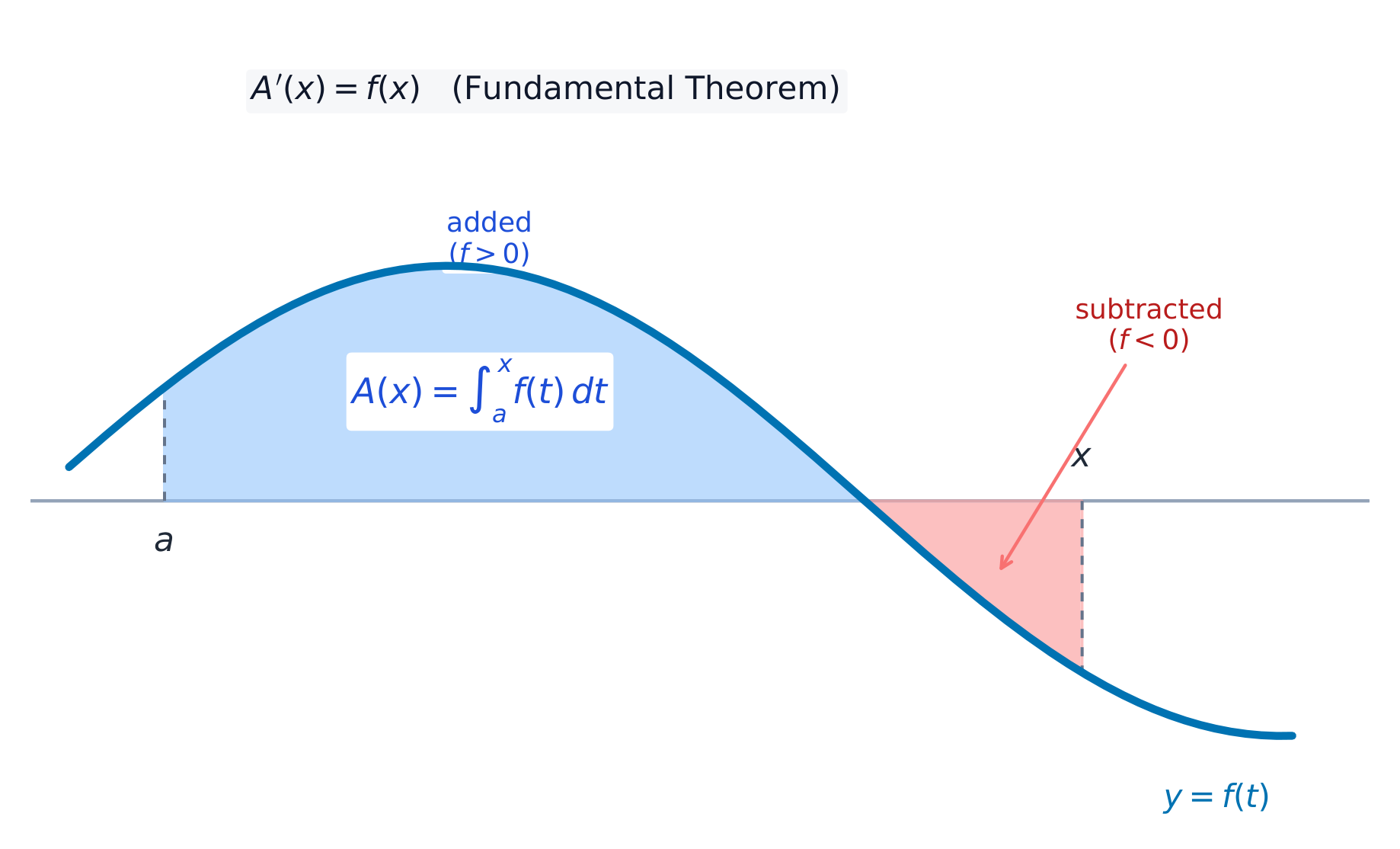
    $$\text{(final)} = \text{(initial)} + \int_a^b (\text{rate})\,dt.$$
    Таким образом, «сколько воды в резервуаре в момент $t=5$» = начальное количество + $\int_0^5(\text{inflow}-\text{outflow})\,dt$. Следите за знаками (пришло минус ушло) и единицами измерения. Многие многоэтапные задания свободного ответа (FRQ) построены целиком на этой идее — часто в паре с формулировкой «запишите, но не вычисляйте, выражение для определенного интеграла, которое дает общее...».
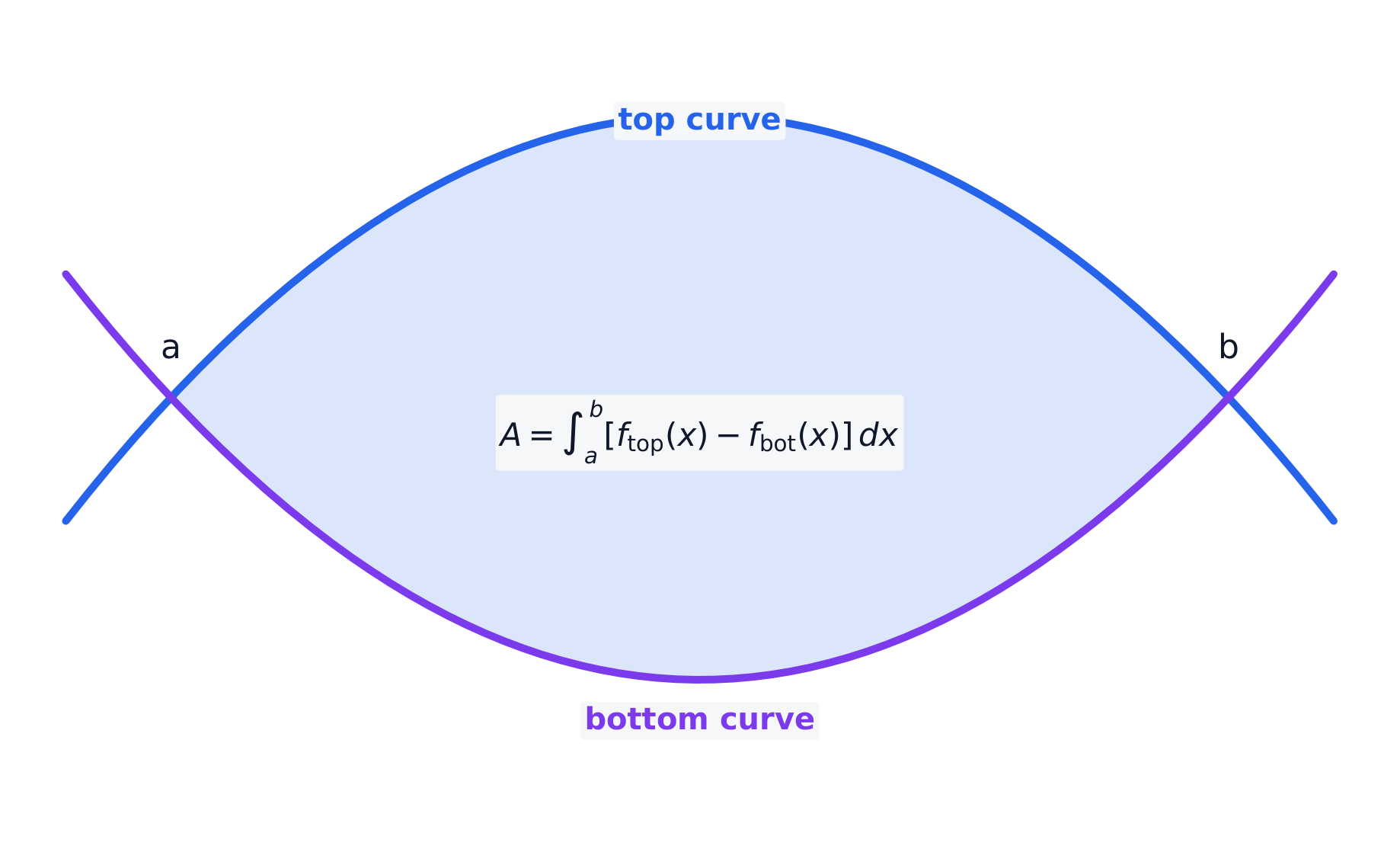
    8.4

    Finding the Area Between Curves (Functions of x) · ⁨Нахождение площади между кривыми (функции от x)⁩

    Syllabus · ⁨Программа⁩
    English

    Enduring Understanding (CHA-5): Definite integrals allow us to solve problems involving the accumulation of change in area or volume over an interval.

    Learning Objective CHA-5.A: Calculate areas in the plane using the definite integral.

    • CHA-5.A.1 Areas of regions in the plane can be calculated with definite integrals.
    Русский

    Принцип устойчивости (CHA-5): Определенные интегралы позволяют решать задачи, связанные с накоплением изменений площади или объема на интервале.

    Цель обучения CHA-5.A: Вычислять площади в плоскости с помощью определенного интеграла.

    • CHA-5.A.1 Площади областей в плоскости могут быть вычислены с помощью определенных интегралов.

    Source: College Board AP Course and Exam Description · ⁨Источник: Описание курса и экзамена College Board AP⁩

    English

    The area between two curves $y=f(x)$ (top) and $y=g(x)$ (bottom) on $[a,b]$ is:

    $$A = \int_a^b \big[f(x)-g(x)\big]\,dx = \int_a^b (\text{top} - \text{bottom})\,dx.$$
    Find the intersection points first to set the limits, and always subtract bottom from top.

    Worked example. Find the area between $y=x$ and $y=x^2$. They cross at $x=0$ and $x=1$, and on $(0,1)$ the line $y=x$ is on top, so

    $$A=\int_0^1 (x-x^2)\,dx=\left[\frac{x^2}{2}-\frac{x^3}{3}\right]_0^1=\frac12-\frac13=\frac16.$$

    Русский

    Площадь между двумя кривыми $y=f(x)$ (верхняя) и $y=g(x)$ (нижняя) на интервале $[a,b]$ равна:

    $$A = \int_a^b \big[f(x)-g(x)\big]\,dx = \int_a^b (\text{top} - \text{bottom})\,dx.$$
    Сначала найдите точки пересечения, чтобы установить пределы, и всегда вычитайте нижнюю кривую из верхней.

    Разобранный пример. Найдите площадь фигуры между кривой $y=x$ и прямой $y=x^2$. Они пересекаются в точках $x=0$ и $x=1$, и на $(0,1)$ прямая $y=x$ расположена выше, поэтому

    $$A=\int_0^1 (x-x^2)\,dx=\left[\frac{x^2}{2}-\frac{x^3}{3}\right]_0^1=\frac12-\frac13=\frac16.$$

    Площадь между двумя кривыми равна интегралу от верхней функции минус нижняя
    Заштрихованная область простирается от одной точки пересечения $a$ до следующей $b$; ее площадь равна $\int_a^b(\text{top}-\text{bottom})\,dx$.
    8.5

    Finding the Area Between Curves (Functions of y) · ⁨Нахождение площади между кривыми (функции от y)⁩

    Syllabus · ⁨Программа⁩
    English

    Enduring Understanding (CHA-5): Definite integrals allow us to solve problems involving the accumulation of change in area or volume over an interval.

    Learning Objective CHA-5.A: Calculate areas in the plane using the definite integral.

    • CHA-5.A.2 Areas of regions in the plane can be calculated using functions of either $x$ or $y$.
    Русский

    Принцип устойчивости (CHA-5): Определенные интегралы позволяют решать задачи, связанные с накоплением изменений площади или объема на интервале.

    Цель обучения CHA-5.A: Вычислять площади в плоскости с помощью определенного интеграла.

    • CHA-5.A.2 Площади областей в плоскости могут быть вычислены с использованием функций либо $x$, либо $y$.

    Source: College Board AP Course and Exam Description · ⁨Источник: Описание курса и экзамена College Board AP⁩

    English

    Some regions are easier described with horizontal slices – integrate with respect to $y$:

    $$A = \int_c^d \big[x_{\text{right}}(y) - x_{\text{left}}(y)\big]\,dy = \int_c^d (\text{right}-\text{left})\,dy.$$
    Choose $x$- or $y$-slices to keep a single top/bottom (or right/left) pair over the whole region.

    Русский

    Некоторые области проще описать с помощью горизонтальных срезов — интегрируйте по переменной $y$:

    $$A = \int_c^d \big[x_{\text{right}}(y) - x_{\text{left}}(y)\big]\,dy = \int_c^d (\text{right}-\text{left})\,dy.$$
    Выберите $x$- или $y$-срезы, чтобы сохранить единую пару «верх/низ» (или «право/лево») на всей области.

    8.6

    Area Between Curves With More Than Two Intersections · ⁨Площадь между кривыми с более чем двумя точками пересечения⁩

    Syllabus · ⁨Программа⁩
    English

    Enduring Understanding (CHA-5): Definite integrals allow us to solve problems involving the accumulation of change in area or volume over an interval.

    Learning Objective CHA-5.A: Calculate areas in the plane using the definite integral.

    • CHA-5.A.3 Areas of certain regions in the plane may be calculated using a sum of two or more definite integrals or by evaluating a definite integral of the absolute value of the difference of two functions.
    Русский

    Принцип устойчивости (CHA-5): Определенные интегралы позволяют решать задачи, связанные с накоплением изменений площади или объема на интервале.

    Цель обучения CHA-5.A: Вычислять площади в плоскости с помощью определенного интеграла.

    • CHA-5.A.3 Площади некоторых областей в плоскости могут быть вычислены с помощью суммы двух или более определенных интегралов или путем вычисления определенного интеграла от абсолютной величины разности двух функций.

    Source: College Board AP Course and Exam Description · ⁨Источник: Описание курса и экзамена College Board AP⁩

    English

    If the curves cross more than twice, one function is on top for part of the region and the other on top elsewhere. Split into a sum of integrals at each crossing, or integrate the absolute value of the difference:

    $$A = \int_a^b \big|f(x)-g(x)\big|\,dx.$$
    Determine which curve is higher on each subinterval before writing the integrals.

    Русский

    Если кривые пересекаются более двух раз, одна функция оказывается сверху на части области, а другая — на остальной. Разбейте на сумму интегралов в каждой точке пересечения или проинтегрируйте модуль разности:

    $$A = \int_a^b \big|f(x)-g(x)\big|\,dx.$$
    Определите, какая кривая выше на каждом подынтервале, прежде чем записывать интегралы.

    8.7

    Volumes with Cross Sections: Squares and Rectangles · ⁨Объемы с поперечными сечениями: квадраты и прямоугольники⁩

    Syllabus · ⁨Программа⁩
    English

    Enduring Understanding (CHA-5): Definite integrals allow us to solve problems involving the accumulation of change in area or volume over an interval.

    Learning Objective CHA-5.B: Calculate volumes of solids with known cross sections using definite integrals.

    • CHA-5.B.1 Volumes of solids with square and rectangular cross sections can be found using definite integrals and the area formulas for these shapes.
    Русский

    Принцип устойчивости (CHA-5): Определенные интегралы позволяют решать задачи, связанные с накоплением изменений площади или объема на интервале.

    Цель обучения CHA-5.B: Вычислять объемы тел с известными поперечными сечениями с помощью определенных интегралов.

    • CHA-5.B.1 Объемы тел с квадратными и прямоугольными поперечными сечениями можно найти с помощью определенных интегралов и формул площадей этих фигур.

    Source: College Board AP Course and Exam Description · ⁨Источник: Описание курса и экзамена College Board AP⁩

    English

    If a solid has a known cross section 横截面 perpendicular to an axis, its volume is the integral of the cross-sectional area:

    $$V = \int_a^b A(x)\,dx.$$
    For square cross sections with side equal to the region's height $s(x)=f(x)-g(x)$, use $A(x)=[s(x)]^2$; for a rectangle of height $k\cdot s(x)$, use $A(x)=k\,[s(x)]^2$. The exam phrase "the base of a solid... cross sections are squares/rectangles" signals exactly this.

    Русский
    Гончар лепит сосуд: тела вращения — это объемы, образованные вращением плоской области
    Гончар формует сосуд: тела вращения образуются вращением плоской фигуры

    Если тело имеет известное поперечное сечение, перпендикулярное оси, его объем равен интегралу от площади поперечного сечения:

    $$V = \int_a^b A(x)\,dx.$$
    Для квадратных поперечных сечений со стороной, равной высоте области $s(x)=f(x)-g(x)$, используйте $A(x)=[s(x)]^2$; для прямоугольника высотой $k\cdot s(x)$ используйте $A(x)=k\,[s(x)]^2$. Фраза из экзамена «основанием твердого тела... являются квадратные/прямоугольные поперечные сечения» указывает именно на это.

    8.8

    Volumes with Cross Sections: Triangles and Semicircles · ⁨Объёмы с поперечными сечениями: Треугольники и полукруги⁩

    Syllabus · ⁨Программа⁩
    English

    Enduring Understanding (CHA-5): Definite integrals allow us to solve problems involving the accumulation of change in area or volume over an interval.

    Learning Objective CHA-5.B: Calculate volumes of solids with known cross sections using definite integrals.

    • CHA-5.B.2 Volumes of solids with triangular cross sections can be found using definite integrals and the area formulas for these shapes.
    • CHA-5.B.3 Volumes of solids with semicircular and other geometrically defined cross sections can be found using definite integrals and the area formulas for these shapes.
      • Illustrative examples for CHA-5.B.3:
        • The volume of a funnel whose cross sections are circles can be found using the area formula for a circle and definite integrals (see 2016 AB Exam FRQ #5(b)).
        • The volume of a solid whose cross sectional area is defined using a function can be found using the known area function and a definite integral (see 2009 AB Exam FRQ #4(c)).
    Русский

    Принцип устойчивости (CHA-5): Определенные интегралы позволяют решать задачи, связанные с накоплением изменений площади или объема на интервале.

    Цель обучения CHA-5.B: Вычислять объемы тел с известными поперечными сечениями с помощью определенных интегралов.

    • CHA-5.B.2 Объемы тел с треугольными поперечными сечениями можно найти с помощью определенных интегралов и формул площадей этих фигур.
    • CHA-5.B.3 Объемы тел с полукруглыми и другими геометрически определенными поперечными сечениями можно найти с помощью определенных интегралов и формул площадей этих фигур.
      • Иллюстративные примеры для CHA-5.B.3:
        • Объём воронки, поперечные сечения которой являются окружностями, можно вычислить, используя формулу площади круга и определённый интеграл (см. 2016 AB Exam FRQ #5(b)).
        • Объём тела, площадь поперечного сечения которого задана функцией, можно найти, используя известную функцию площади и определённый интеграл (см. 2009 AB Exam FRQ #4(c)).

    Source: College Board AP Course and Exam Description · ⁨Источник: Описание курса и экзамена College Board AP⁩

    English

    Same method, different area formula: for an equilateral triangle 三角形 of side $s$, $A=\tfrac{\sqrt{3}}{4}s^2$; for a semicircle 半圆 of diameter $s$, $A=\tfrac{\pi}{8}s^2$. Set the shape's key length equal to the region's slice length $s(x)$, then integrate $A(x)$.

    Русский

    Тот же метод, другая формула площади: для равностороннего треугольника со стороной $s$, $A=\tfrac{\sqrt{3}}{4}s^2$; для полукруга с диаметром $s$, $A=\tfrac{\pi}{8}s^2$. Приравняйте ключевую длину фигуры к длине среза области $s(x)$, затем проинтегрируйте $A(x)$.

    8.9

    Volume with the Disc Method (About the x- or y-Axis) · ⁨Объём методом дисков (вокруг оси x или y)⁩

    Syllabus · ⁨Программа⁩
    English

    Enduring Understanding (CHA-5): Definite integrals allow us to solve problems involving the accumulation of change in area or volume over an interval.

    Learning Objective CHA-5.C: Calculate volumes of solids of revolution using definite integrals.

    • CHA-5.C.1 Volumes of solids of revolution around the $x$- or $y$-axis may be found by using definite integrals with the disc method.
    Русский

    Принцип устойчивости (CHA-5): Определенные интегралы позволяют решать задачи, связанные с накоплением изменений площади или объема на интервале.

    Цель обучения CHA-5.C: Вычислять объемы тел вращения с помощью определенных интегралов.

    • CHA-5.C.1 Объемы тел вращения вокруг оси $x$ или оси $y$ можно найти, используя определенные интегралы с применением метода дисков.

    Source: College Board AP Course and Exam Description · ⁨Источник: Описание курса и экзамена College Board AP⁩

    English
    Solids of revolution: the disc method

    Revolving a region around an axis makes a solid of revolution 旋转体. If the region touches the axis, each slice is a disc 圆盘 of radius $r$ = the function value:

    $$V = \pi\int_a^b [r(x)]^2\,dx.$$
    Around the $x$-axis, $r=f(x)$ and integrate in $x$; around the $y$-axis, express $x$ as a function of $y$ and integrate in $y$.

    Worked example. Revolve the region under $y=\sqrt{x}$ from $x=0$ to $x=4$ about the $x$-axis. Each disc has radius $r=\sqrt{x}$, so

    $$V=\pi\int_0^4 (\sqrt{x})^2\,dx=\pi\int_0^4 x\,dx=\pi\left[\frac{x^2}{2}\right]_0^4=8\pi.$$

    Русский
    Тела вращения: метод дисков

    Вращение области вокруг оси образует тело вращения. Если область касается оси, каждый срез представляет собой диск радиуса $r$ = значение функции:

    $$V = \pi\int_a^b [r(x)]^2\,dx.$$
    Вокруг оси $x$, $r=f(x)$ и интегрируйте по $x$; вокруг оси $y$, выразите $x$ как функцию от $y$ и интегрируйте по $y$.

    Метод дисков: вращение y=f(x) вокруг оси образует диски радиуса f(x)
    Метод дисков: вращение y=f(x) вокруг оси образует диски радиуса f(x)

    Разбор примера. Вращаем область под $y=\sqrt{x}$ от $x=0$ до $x=4$ вокруг оси $x$. Каждый диск имеет радиус $r=\sqrt{x}$, поэтому

    $$V=\pi\int_0^4 (\sqrt{x})^2\,dx=\pi\int_0^4 x\,dx=\pi\left[\frac{x^2}{2}\right]_0^4=8\pi.$$

    Вращение области вокруг оси образует тело вращения
    Вращение области вокруг оси образует тело вращения
    Vocabulary · ⁨Словарь⁩ Train · ⁨Тренировать⁩
    English Русский
    average value/ˈævrɪdʒ ˈvæljuː/ среднего значения
    Displacement/dɪˈspleɪsmənt/ Вытеснение
    Total distance travelled/ˈtəʊtl ˈdɪstəns ˈtrævld/ полный пройденный путь
    net change/net tʃeɪndʒ/ чистое изменение
    cross section/krɒs ˈsekʃn/ поперечное сечение
    triangle/ˈtraɪæŋɡl/ треугольник
    semicircle/ˈsemɪsɜːkl/ полуокружность
    solid of revolution/ˈsɒlɪd ɒv ˌrevəˈluːʃn/ тело вращения
    disc/dɪsk/ диск
    8.10

    Volume with the Disc Method (About Other Axes) · ⁨Объём методом дисков (вокруг других осей)⁩

    Syllabus · ⁨Программа⁩
    English

    Enduring Understanding (CHA-5): Definite integrals allow us to solve problems involving the accumulation of change in area or volume over an interval.

    Learning Objective CHA-5.C: Calculate volumes of solids of revolution using definite integrals.

    • CHA-5.C.2 Volumes of solids of revolution around any horizontal or vertical line in the plane may be found by using definite integrals with the disc method.
    Русский

    Принцип устойчивости (CHA-5): Определенные интегралы позволяют решать задачи, связанные с накоплением изменений площади или объема на интервале.

    Цель обучения CHA-5.C: Вычислять объемы тел вращения с помощью определенных интегралов.

    • CHA-5.C.2 Объемы тел вращения вокруг любой горизонтальной или вертикальной линии в плоскости могут быть найдены с помощью определенных интегралов методом дисков.

    Source: College Board AP Course and Exam Description · ⁨Источник: Описание курса и экзамена College Board AP⁩

    English

    Around any horizontal or vertical line $y=k$ or $x=k$, the radius is the distance from the curve to that line, e.g. $r(x)=|f(x)-k|$. Set up the radius carefully, then use $V=\pi\int r^2$.

    Русский

    Вокруг любой горизонтальной или вертикальной линии $y=k$ или $x=k$ радиусом является расстояние от кривой до этой линии, например, $r(x)=|f(x)-k|$. Аккуратно задайте радиус, а затем используйте $V=\pi\int r^2$.

    8.11 8.12

    Volume with the Washer Method · ⁨Объём методом колец⁩

    Syllabus · ⁨Программа⁩
    English

    Enduring Understanding (CHA-5): Definite integrals allow us to solve problems involving the accumulation of change in area or volume over an interval.

    Learning Objective CHA-5.C: Calculate volumes of solids of revolution using definite integrals.

    • CHA-5.C.3 Volumes of solids of revolution around the $x$- or $y$-axis whose cross sections are ring shaped may be found using definite integrals with the washer method.
    Русский

    Принцип устойчивости (CHA-5): Определенные интегралы позволяют решать задачи, связанные с накоплением изменений площади или объема на интервале.

    Цель обучения CHA-5.C: Вычислять объемы тел вращения с помощью определенных интегралов.

    • CHA-5.C.3 Объемы тел вращения вокруг оси $x$ или оси $y$, поперечные сечения которых имеют кольцевую форму, могут быть найдены с помощью определенных интегралов методом колец.
    English

    Enduring Understanding (CHA-5): Definite integrals allow us to solve problems involving the accumulation of change in area or volume over an interval.

    Learning Objective CHA-5.C: Calculate volumes of solids of revolution using definite integrals.

    • CHA-5.C.4 Volumes of solids of revolution around any horizontal or vertical line whose cross sections are ring shaped may be found using definite integrals with the washer method.
    Русский

    Принцип устойчивости (CHA-5): Определенные интегралы позволяют решать задачи, связанные с накоплением изменений площади или объема на интервале.

    Цель обучения CHA-5.C: Вычислять объемы тел вращения с помощью определенных интегралов.

    • CHA-5.C.4 Объемы тел вращения вокруг любой горизонтальной или вертикальной линии, поперечные сечения которых имеют кольцевую форму, могут быть найдены с помощью определенных интегралов методом колец.

    Source: College Board AP Course and Exam Description · ⁨Источник: Описание курса и экзамена College Board AP⁩

    English
    Volume by the washer method

    When the region does not touch the axis, each slice is a washer 垫圈 (a ring) with an outer radius $R$ and inner radius $r$:

    $$V = \pi\int_a^b \Big([R]^2 - [r]^2\Big)\,dx.$$
    $R$ is the distance from the axis to the farther boundary and $r$ to the nearer one. Around a line other than an axis, both radii are measured as distances to that line – a very common exam variation (e.g. revolving about $y=-2$).

    Русский
    Объём методом колец

    Когда область не касается оси, каждый срез представляет собой кольцо (обруч) с внешним радиусом $R$ и внутренним радиусом $r$:

    $$V = \pi\int_a^b \Big([R]^2 - [r]^2\Big)\,dx.$$
    $R$ — расстояние от оси до дальней границы, а $r$ — до ближней. Вокруг линии, отличной от оси, оба радиуса измеряются как расстояния до этой линии — очень частый вариант экзаменационного задания (например, вращение вокруг $y=-2$).

    Vocabulary · ⁨Словарь⁩ Train · ⁨Тренировать⁩
    English Русский
    washer/ˈwɒʃə/ кольцо (шайба)
    8.11 8.12

    Exam tips · ⁨Советы для экзамена⁩

    English
    • Area between curves is $\int(\text{top}-\text{bottom})\,dx$ — find the intersection points for the limits and keep top minus bottom.
    • For a volume of revolution, add up disc/washer cross-sections of area $\pi r^2$ (or $\pi(R^2-r^2)$).
    • The average value of $f$ on $[a,b]$ is $\tfrac{1}{b-a}\int_a^b f\,dx$.
    • Accumulated change is $\int$ of a rate: total = initial value $+\int_a^b(\text{rate})\,dt$.
    • Integration means "adding up infinitely many tiny pieces" — set up the integrand as one thin slice.
    Русский
    • Площадь между кривыми равна $\int(\text{top}-\text{bottom})\,dx$ — найдите точки пересечения для пределов интегрирования и сохраняйте верхнее минус нижнее.
    • Для тела вращения сложите поперечные сечения-диски/кольца площадью $\pi r^2$ (или $\pi(R^2-r^2)$).
    • Среднее значение $f$ на отрезке $[a,b]$ равно $\tfrac{1}{b-a}\int_a^b f\,dx$.
    • Накопленное изменение равно $\int$ скорости: итог = начальное значение $+\int_a^b(\text{rate})\,dt$.
    • Интегрирование означает «сложение бесконечно малого количества крошечных частей» — составьте подынтегральное выражение как один тонкий срез.

Log in or create account · ⁨Войти или создать аккаунт⁩

IGCSE, A-Level & AP