Conditional probability · Probabilidade condicional
| English | Português |
|---|---|
| conditional probability/kənˈdɪʃənl ˌprɒbəˈbɪlɪti/ | probabilidade condicional |
| two-way table/tuː weɪ ˈteɪbl/ | tabela de contingência |
| dependent/dɪˈpendənt/ | dependente |
The detective's question
- You know someone studies French. What's the chance they also study German?
- This isn't the same as "what's the chance someone studies both?" — you've narrowed the group to just the French students.
- That's conditional probability 条件概率: the chance of $B$ given that $A$ has already happened.
A pergunta do detetive
- Você sabe que alguém estuda francês. Qual a chance de também estudar alemão?
- Isso não é o mesmo que "qual a chance de alguém estudar ambos?" — você restringiu o grupo aos apenas alunos de francês.
- Isso é probabilidade condicional: a chance de $B$ dado que $A$ já ocorreu.
How to read it
- $\text{P}(B \mid A)$ means "the probability of $B$ given $A$".
- Look only at the part that matches the condition — on a Venn diagram, two-way table 双向表, or tree.
In a class of $30$, $18$ study French. Of those $18$, $7$ also study German. $\text{P}(\text{German} \mid \text{French}) = \dfrac{7}{18}$.
On a tree diagram, multiply probabilities along the branches; here two reds give $\tfrac38\times\tfrac38=\tfrac{9}{64}$
Como ler
- $\text{P}(B \mid A)$ significa "a probabilidade de $B$ dado $A$".
- Olhe apenas para a parte que atende à condição — em um diagrama de Venn, tabela de contingência ou árvore de probabilidade.
Em uma turma de $30$, $18$ estudam francês. Destes $18$, $7$ também estudam alemão. $\text{P}(\text{German} \mid \text{French}) = \dfrac{7}{18}$.

Num diagrama de árvore, multiplique as probabilidades ao longo dos ramos; aqui dois vermelhos dão $\tfrac38\times\tfrac38=\tfrac{9}{64}$
Conditional probability · Probabilidade condicional
P(A | B) = P(A ∩ B) ÷ P(B)
When one event affects another, conditional probabilities change — and Bayes reverses them. · Quando um evento afeta outro, as probabilidades condicionais mudam — e Bayes as inverte.
Of 18 French students, 7 also study German. P(German | French) = 7/a. What is a? · De 18 alunos de francês, 7 também estudam alemão. P(alemão | francês) = 7/a. Qual é a?
Given they are French, the total to divide by is the 18 French students. · Dado que são franceses, o total a dividir é os 18 alunos de francês.
Conditional probability is the probability of an event: · Probabilidade condicional é a probabilidade de um evento:
It is the probability of B given that A has occurred. · É a probabilidade de B dado que A ocorreu.
Of 100 people, 40 are female; of those, 10 are left-handed. P(left-handed | female) as a decimal is? · De 100 pessoas, 40 são mulheres; dessas, 10 são canhotas. P(cano-left-handed | feminino) em decimal é?
10/40 = 0.25.
The formula (Extended)
The denominator changes. In conditional probability, the total you divide by is only the group that meets the condition — not the whole population. This is the most common error.
A fórmula (Estendida)
O denominador muda. Na probabilidade condicional, o total pelo qual divide é apenas o grupo que atende à condição — não a população inteira. Este é o erro mais comum.
P(B | A) = P(A and B) / P(). · P(B | A) = P(A e B) / P().
P(B|A) = P(A ∩ B) / P(A). The denominator is the probability of the condition. · P(B|A) = P(A ∩ B) / P(A). O denominador é a probabilidade da condição.
On a two-way table
- To find $\text{P}(B \mid A)$: look at the row (or column) for $A$, and find the fraction that is also $B$.
- The row total is the denominator, not the grand total.
Numa tabela bidirecional
- Para encontrar $\text{P}(B \mid A)$: olhe a linha (ou coluna) de $A$ e encontre a fração que também é $B$.
- O total da linha é o denominador, não o total geral.
Of 20 students, 12 like tea; of those, 3 also like coffee. P(coffee | tea) = 3/a. What is a? · De 20 alunos, 12 gostam de chá; desses, 3 também gostam de café. P(café | chá) = 3/a. Qual é a?
Condition on the 12 tea-drinkers, so a = 12. · Condicionando nos 12 bebedores de chá, então a = 12.
Independent vs dependent 相依的
- If $\text{P}(B \mid A) = \text{P}(B)$, the events are independent — knowing $A$ happened doesn't change the chance of $B$.
- If they differ, the events are dependent.
Conditional probability restricts attention to the group matching the condition — like looking only inside one region of a Venn diagram.
Independentes vs dependentes
- Se $\text{P}(B \mid A) = \text{P}(B)$, os eventos são independentes — saber que $A$ ocorreu não muda a chance de $B$.
- Se diferirem, os eventos são dependentes.
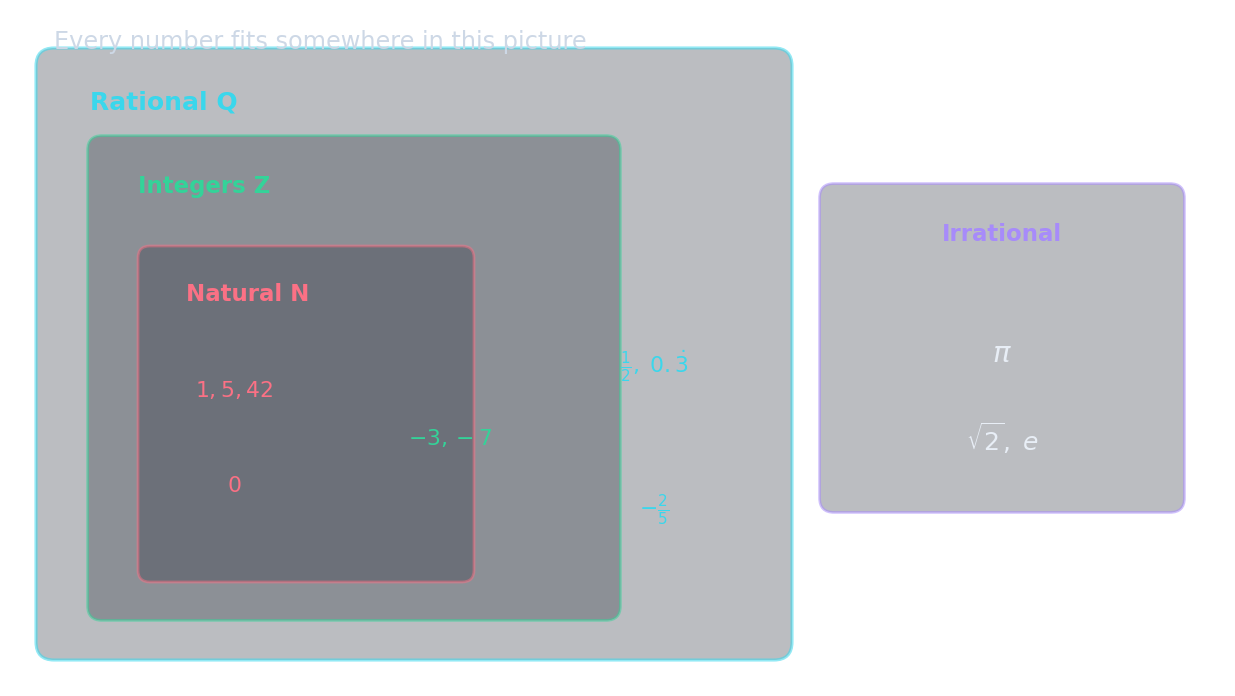
Probabilidade condicional restringe a atenção ao grupo que atende à condição — como olhar apenas dentro de uma região de um diagrama de Venn.
If P(B | A) = P(B), then events A and B are independent. · Se P(B | A) = P(B), então os eventos A e B são independentes.
Independence means knowing A happened does not change the probability of B. · Independência significa saber que A aconteceu não muda a probabilidade de B.
Condition on the smaller group
- Of 30 students, 18 study French and 7 of these study German. Given French, use $p=7/18$, not $7/30$; the condition selects only 18 students.
- Suppose 12 students in the full class study German. Then $P(G)=12/30=0.4$ differs from $P(G\mid F)=7/18$. The two events are not independent for these data.
Condição no grupo menor
- De 30 alunos, 18 estudam francês e 7 desses estudam alemão. Dado o francês, use $p=7/18$, não $7/30$; a condição seleciona apenas 18 alunos.
- Suponha que 12 alunos na turma inteira estudem alemão. Então $P(G)=12/30=0.4$ difere de $P(G\mid F)=7/18$. Os dois eventos não são independentes para esses dados.
Among 18 French students, 9 also study German. Find P(German | French). · Entre 18 alunos franceses, 9 também estudam alemão. Encontre P(Alemão | Francês).
Restrict the denominator to French students: 9/18 = 0.5. · Restrinja o denominador aos alunos franceses: 9/18 = 0.5.
You've got it
- conditional probability $=$ chance of $B$ given $A$ already happened
- restrict your attention to just the group that meets the condition
- $\text{P}(\text{German} \mid \text{French}) = \dfrac{7}{18}$ (out of the French students only)
Entendeu?
- probabilidade condicional $=$ chance de $B$ dado $A$ já ocorreu
- restrinja sua atenção apenas ao grupo que atende à condição
- $\text{P}(\text{German} \mid \text{French}) = \dfrac{7}{18}$ (apenas entre os alunos de francês)