Price elasticity of demand (PED) · Elasticidade-preço da demanda (EPD)
| English | Português |
|---|---|
| price elasticity of demand/praɪs ɪlæˈstɪsɪti ɒv dɪˈmænd/ | elasticidade-preço da demanda |
| elastic/ɪˈlæstɪk/ | elástica |
| inelastic/ɪnɪˈlæstɪk/ | inelástica |
| luxuries/ˈlʌkʃəriz/ | luxos |
| substitutes/ˈsʌbstɪtjuːts/ | substitutos |
| necessities/nəˈsesɪtiz/ | necessidades |
| revenue/ˈrevənjuː/ | receita |
How much does price really matter?
- Cut the price of salt by half and you won't buy much more — you only need so much. Cut the price of one airline's seats and bookings soar.
- Price elasticity of demand 需求价格弹性 measures exactly how sensitive buyers are.
O quanto o preço realmente importa?
- Reduza o preço do sal pela metade e você não comprará muito mais — você só precisa de tanto. Reduza o preço dos assentos de uma companhia aérea e as reservas disparam.
- Elasticidade-preço da demanda 需求价格弹性 mede exatamente quão sensíveis são os compradores.
Price rises 10% and quantity demanded falls 30%. What is the size of PED? · O preço sobe 10% e a quantidade demandada cai 30%. Qual é o tamanho da EPD?
PED = 30% / 10% = 3 (ignoring the sign) — elastic. · EPD = 30% / 10% = 3 (ignorando o sinal) — elástica.
Defining PED
- PED = how much quantity demanded responds to a price change.
- $\text{PED} = \dfrac{\%\ \text{change in quantity demanded}}{\%\ \text{change in price}}$ — usually negative, so we read the size.
Worked example. Price rises 10% and quantity demanded falls 20%. $\text{PED} = \dfrac{-20\%}{+10\%} = -2$. Demand is elastic 富有弹性 (responsive).
Definindo PED
- PED = o quanto a quantidade demandada responde a uma mudança no preço.
- $\text{PED} = \dfrac{\%\ \text{change in quantity demanded}}{\%\ \text{change in price}}$ — geralmente negativo, então leemos o valor absoluto.
Exemplo resolvido. O preço aumenta 10% e a quantidade demandada cai 20%. $\text{PED} = \dfrac{-20\%}{+10\%} = -2$. A demanda é elástica 富有弹性 (responsiva).
Elasticity & total revenue · Elasticidade & receita total
PED is the % change in quantity over the % change in price; whether it is above or below 1 decides how total revenue moves. · A EPD é a % de variação na quantidade sobre a % de variação no preço; se for acima ou abaixo de 1 determina como a receita total se move.
Demand & supply · Demande & offre
Elasticity of demand is the steepness of the curve. · Elasticidade da demanda é a inclinação da curva.
Demand is elastic when: · A demanda é elástica quando:
Elastic demand (PED > 1) responds strongly to price. · Demanda elástica (EPD > 1) responde fortemente ao preço.
Necessities such as salt tend to have inelastic demand. · Necessidades como sal tendem a ter demanda inelástica.
Few substitutes and a small budget share make necessities inelastic. · Poucos substitutos e pequena parcela do orçamento tornam necessidades inelásticas.
A good with many close substitutes tends to have ______ demand. · Um bem com muitos substitutos próximos tende a ter demanda ______.
Substitutes let buyers switch easily, so demand is price-responsive. · Substitutos permitem que compradores troquem facilmente, tornando a demanda sensível ao preço.
Elastic vs inelastic 缺乏弹性
- Elastic (PED > 1): quantity changes a lot — luxuries 奢侈品, goods with close substitutes 替代品.
- Inelastic (PED < 1): quantity barely changes — necessities 必需品, addictive goods.
Steep = inelastic (quantity barely moves); shallow = elastic (quantity moves a lot).
Elástica vs inelástica 缺乏弹性
- Elástica (PED > 1): a quantidade muda muito — bens de luxo 奢侈品, bens com substitutos próximos 替代品.
- Inelástica (PED < 1): a quantidade mal muda — necessidades 必需品, bens viciantes.

Íngreme = inelástica (quantidade mal se move); suave = elástica (quantidade se move muito).
If demand is inelastic, raising the price will: · Se a demanda for inelástica, aumentar o preço vai:
With inelastic demand, quantity falls little, so revenue rises. · Com demanda inelástica, a quantidade cai pouco, então a receita sobe.
Why firms care: revenue 收益
- If demand is inelastic, raising price raises total revenue (buyers can't avoid it).
- If demand is elastic, raising price lowers total revenue (buyers desert the good).
Ignore the minus sign when judging size. PED is normally negative; a PED of $-2$ is "more elastic" than $-0.5$. Compare the magnitude (2 vs 0.5), not the sign.
Inelastic vs elastic demand
Por que as empresas se importam: receita 收益
- Se a demanda é inelástica, aumentar o preço aumenta a receita total (os compradores não conseguem evitar a compra).
- Se a demanda é elástica, aumentar o preço diminui a receita total (os compradores abandonam o bem).
Ignore o sinal de menos ao avaliar a magnitude. O PED é normalmente negativo; um PED de $-2$ é "mais elástico" do que $-0.5$. Compare a magnitude (2 vs 0.5), não o sinal.
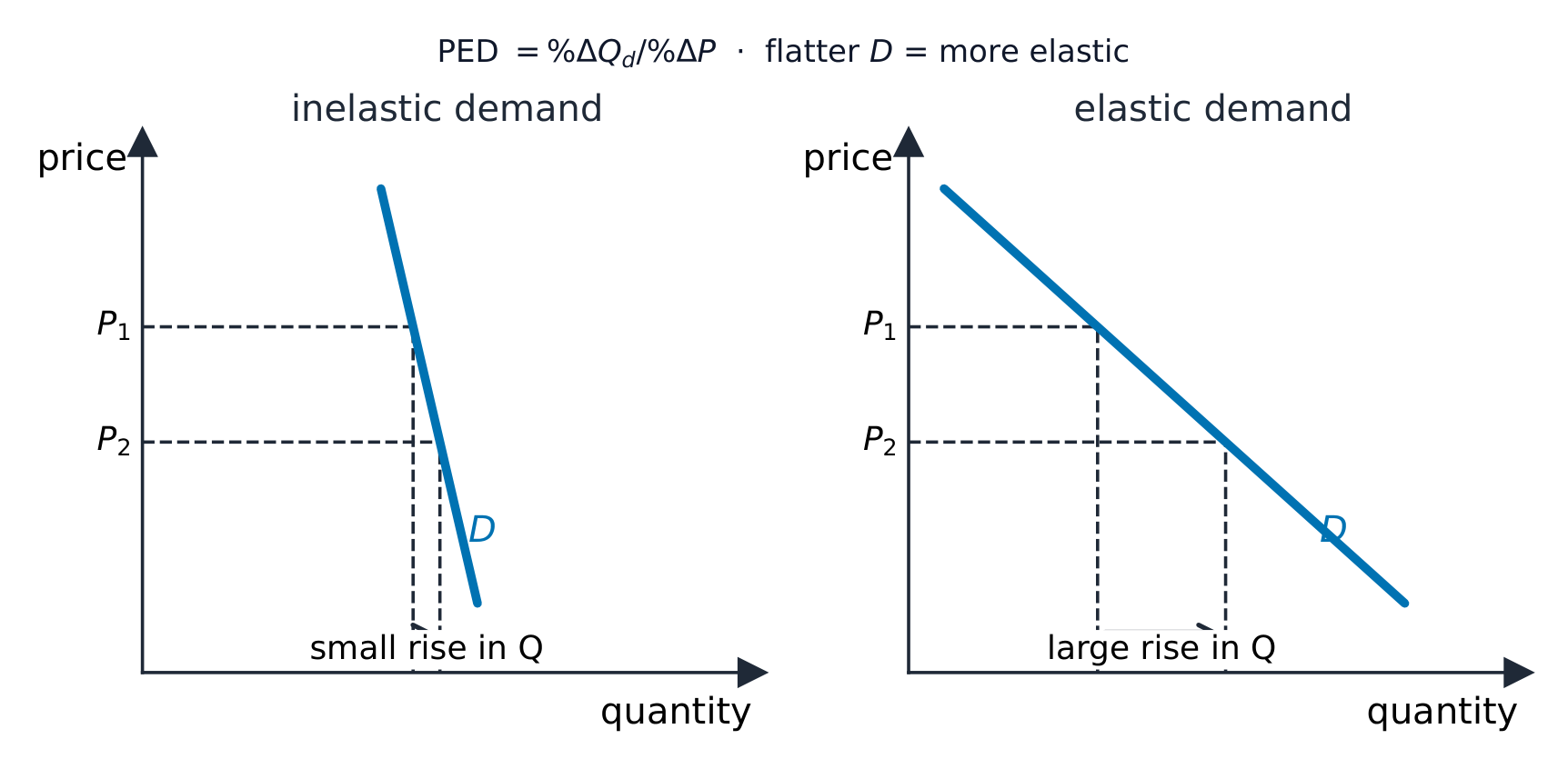
Demanda inelástica vs elástica
You've got it
- $\text{PED} = \dfrac{\%\Delta Q_d}{\%\Delta P}$ — its size measures responsiveness
- elastic (>1) = responsive (luxuries); inelastic (<1) = unresponsive (necessities)
- inelastic → raise price to raise revenue; elastic → the opposite
Entendeu?
- $\text{PED} = \dfrac{\%\Delta Q_d}{\%\Delta P}$ — seu valor mede a sensibilidade
- elástica (>1) = responsiva (luxos); inelástica (<1) = pouco responsiva (necessidades)
- inelástico → aumentar preço para aumentar a receita; elástico → o oposto