Active transport · Transporte ativo
| English | Português |
|---|---|
| active transport/ˈæktɪv ˈtrænspɔːt/ | transporte ativo |
| passive/ˈpæsɪv/ | passiva |
Moving things the "wrong" way
- Sometimes a cell needs to take in a substance even when there's already more inside than outside.
- That means moving against the gradient — which needs energy. This is active transport 主动运输.
Movendo coisas do "jeito errado"
- Às vezes, uma célula precisa absorver uma substância mesmo quando já há mais dentro do que fora.
- Isso significa mover contra o gradiente — o que precisa de energia. Isso é transporte ativo 主动运输.
Active transport moves particles: · O transporte ativo move partículas:
Active transport goes against the gradient and needs energy. · O transporte ativo vai contra o gradiente e precisa de energia.
The energy for active transport comes from: · A energia para o transporte ativo vem de:
Respiration releases the energy used. · A respiração libera a energia usada.
Active transport moves substances ______ the concentration gradient. · O transporte ativo move substâncias ______ o gradiente de concentração.
From low to high concentration, unlike diffusion. · De baixo para alto concentração, diferentemente da difusão.
What active transport is
- Active transport is the movement of particles from a low to a high concentration (against the gradient), using energy.
- The energy comes from respiration.
Active transport moves particles against the gradient, using energy and a carrier protein
O que é transporte ativo
- Transporte ativo é o movimento de partículas de baixa para alta concentração (contra o gradiente), usando energia.
- A energia vem da respiração.
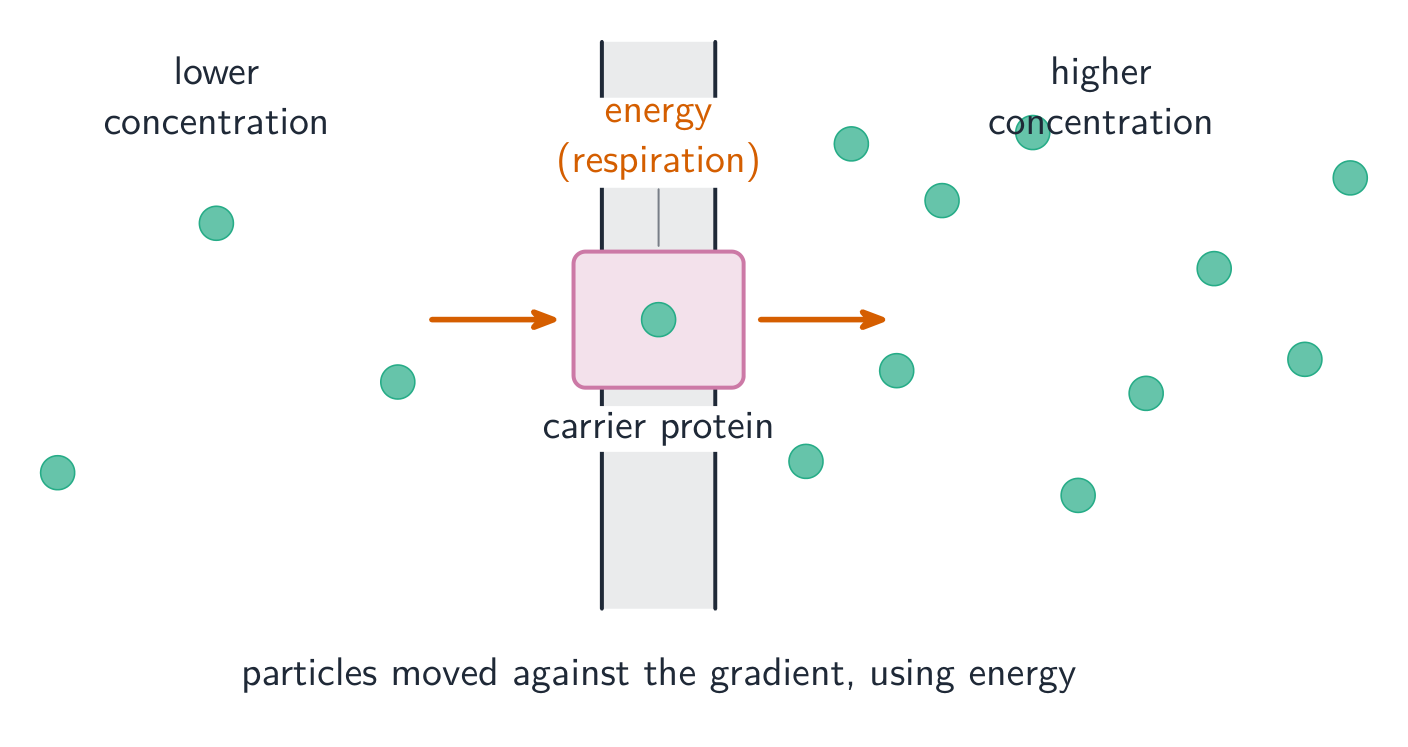
Transporte ativo move partículas contra o gradiente, usando energia e uma proteína transportadora
Active transport step by step · Transporte ativo passo a passo
Step the carrier protein through its cycle: it uses energy from ATP to move a particle against the gradient, from low to high. · Passo a proteína carreadora através de seu ciclo: ela usa energia da ATP para mover uma partícula contra o gradiente, de baixo para alto.
Active transport — pumping uphill · Transporte ativo — bombear morro acima
Unlike diffusion, active transport moves substances AGAINST the concentration gradient, so it needs energy. · Diferente da difusão, o transporte ativo move substâncias CONTRA o gradiente de concentração, portanto precisa de energia.
Root hair cells use active transport to absorb: · As células do pelos radiculares usam transporte ativo para absorver:
Minerals are scarce in soil, so they must be pulled in actively. · Os minerais são escassos no solo, então devem ser puxados ativamente.
Why cells need it
- It lets cells absorb substances that are scarce outside.
- Root hair cells use it to take in minerals from very dilute soil water.
Water entering or leaving a plant cell makes it turgid, flaccid or plasmolysed
Por que as células precisam dele
- Permite que as células absorvam substâncias que são escassas fora.
- Células epidérmicas radiculares usam isso para absorver minerais da água do solo muito diluída.

Entrada ou saída de água em uma célula vegetal torna-a turgente, flácida ou plasmolisada
Diffusion and osmosis are passive (no energy), while active transport needs energy. · Difusão e osmose são passivas (sem energia), enquanto o transporte ativo precisa de energia.
Only active transport requires energy. · Apenas o transporte ativo requer energia.
Comparing the three
- Diffusion and osmosis: high → low, no energy (passive 被动的).
- Active transport: low → high, needs energy (active).
Worked example. Soil has very little mineral salt, yet a root must absorb it. Diffusion can't help (it would go the wrong way), so the root hair cell uses active transport, powered by respiration, to pull minerals in.
Comparando os três
- Difusão e osmose: alta → baixa, sem energia (passivo 被动的).
- Transporte ativo: baixa → alta, precisa de energia (ativo).
Exemplo resolvido. O solo tem muito pouco sal mineral, mas uma raiz deve absorvê-lo. A difusão não ajuda (iria na direção errada), então a célula do pelo radicular usa transporte ativo, impulsionado pela respiração, para puxar minerais para dentro.
You've got it
- active transport moves particles low → high concentration, using energy from respiration
- it absorbs substances that are scarce outside (e.g. minerals in roots)
- diffusion/osmosis are passive (no energy); active transport is active (needs energy)
Entendeu?
- transporte ativo move partículas baixa → alta concentração, usando energia da respiração
- absorve substâncias que são escassas fora (ex. minerais nas raízes)
- difusão/osmose são passivos (sem energia); transporte ativo é ativo (precisa de energia)