Resistor-Capacitor (RC) Circuits · Circuitos Resistor-Capacitor (RC)
| English | Português |
|---|---|
| time constant/taɪm ˈkɒnstənt/ | constante de tempo |
| exponential/ˌekspəˈnenʃl/ | exponencial |
Why does a camera flash take a moment to recharge?
- Press the shutter, and the flash needs a second before it can fire again.
- A capacitor is refilling with charge through a resistor.
- The resistor limits the current, so the filling is gradual, not instant.
- A resistor and capacitor together make an RC circuit — the physics of timing.
Por que o flash da câmera demora para recarregar?
- Pressione o obturador e o flash precisa de um segundo antes de disparar novamente.
- Um capacitor está sendo carregado com carga através de um resistor.
- O resistor limita a corrente, então o enchimento é gradual, não instantâneo.
- Um resistor e um capacitor juntos formam um circuito RC — a física do tempo.
Charging rises toward a limit
- Close the switch and charge flows onto the capacitor: $Q(t) = CV\left(1 - e^{-t/RC}\right)$.
- It climbs fast at first, then slows as the capacitor fills.
- It approaches, but never quite reaches, the final charge $CV$.
- The current does the opposite: large at first, fading to zero.
O carregamento sobe até um limite
- Feche o interruptor e a carga flui para o capacitor: $Q(t) = CV\left(1 - e^{-t/RC}\right)$.
- Sobe rápido inicialmente, depois desacelera conforme o capacitor enche.
- Aproxima-se, mas nunca chega exatamente à carga final $CV$.
- A corrente faz o oposto: grande inicialmente, desaparecendo até zero.
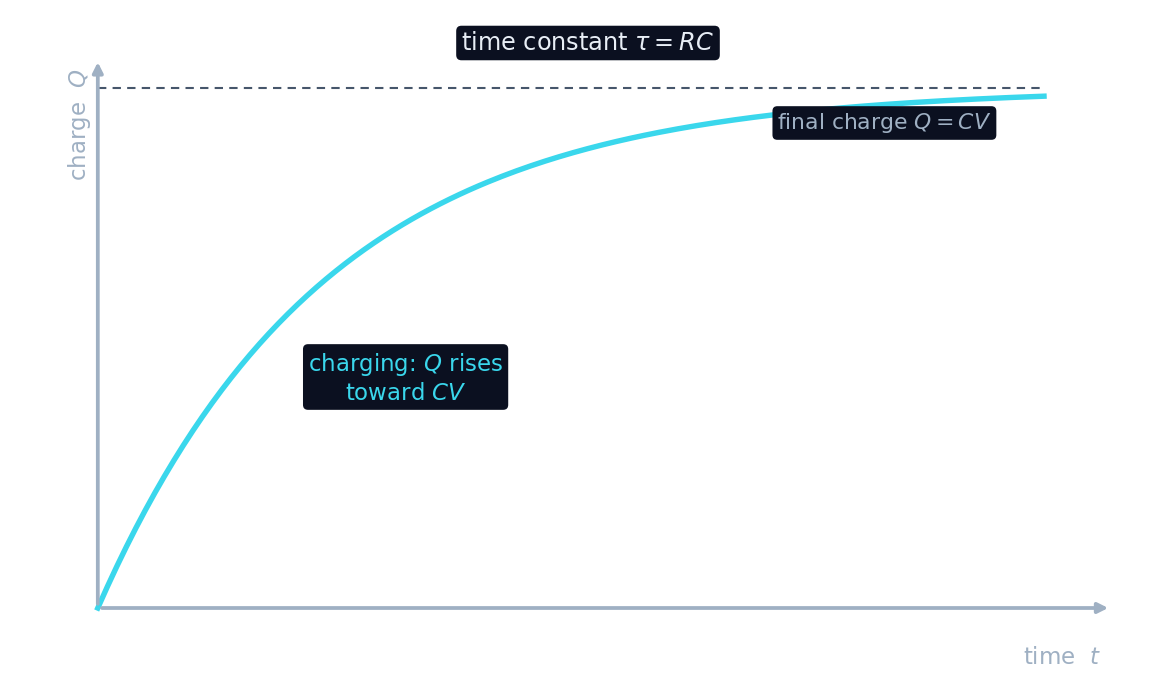
Charge through a resistor · Carga através de um resistor
Watch the capacitor fill gradually and the charging current fade toward zero. · Observe o capacitor enchendo gradualmente e a corrente de carregamento diminuindo em direção a zero.
The time constant τ = RC
- The product $\tau = RC$ is the time constant 时间常数 — the natural timescale.
- In one $\tau$, the charge reaches about $63\%$ of its final value.
- After about $5\tau$, it is essentially fully charged.
- Bigger $R$ or bigger $C$ means slower charging.
A constante de tempo τ = RC
- O produto $\tau = RC$ é a constante de tempo 时间常数 — a escala de tempo natural.
- Em um $\tau$, a carga atinge cerca de $63\%$ de seu valor final.
- Após cerca de $5\tau$, ela está essencialmente totalmente carregada.
- Maior $R$ ou maior $C$ significa carregamento mais lento.
The time constant of an RC circuit is: · A constante de tempo de um circuito RC é:
$\tau = RC$ sets the charging and discharging timescale. · $\tau = RC$ define a escala de tempo de carregamento e descarga.
A $5\ \Omega$ resistor charges a $4\ \text{F}$ capacitor. Find $\tau$ (in s). · Um resistor de $5\ \Omega$ carrega um capacitor de $4\ \text{F}$. Encontre $\tau$ (em s).
$\tau = RC = 5 \times 4 = 20\ \text{s}$.
After one time constant, the charge reaches about 63% of its final value. · Após uma constante de tempo, a carga atinge cerca de 63% de seu valor final.
$1 - e^{-1} \approx 0.63$ after one $\tau$. · $1 - e^{-1} \approx 0.63$ após uma $\tau$.
Discharging fades away
- Disconnect the source and let the capacitor drive the resistor.
- The charge decays: $Q(t) = Q_0\, e^{-t/RC}$ — an exponential 指数 fall.
- The current and voltage decay with the same time constant $\tau = RC$.
- Each $\tau$ the charge drops to about $37\%$ of what it was.
O descarregamento desvanece
- Desconecte a fonte e deixe o capacitor impulsionar o resistor.
- A carga decai: $Q(t) = Q_0\, e^{-t/RC}$ — uma queda exponencial 指数.
- A corrente e a tensão decaem com a mesma constante de tempo $\tau = RC$.
- A cada $\tau$, a carga cai para cerca de $37\%$ do que era.
A discharging capacitor loses charge as an ____ decay, $Q = Q_0 e^{-t/RC}$. · Um capacitor descargando perde carga como um decaimento ____ , $Q = Q_0 e^{-t/RC}$.
Discharge is exponential: $Q = Q_0 e^{-t/RC}$. · Descarga é exponencial: $Q = Q_0 e^{-t/RC}$.
The capacitor's two extremes
- At the first instant ($t = 0$): the empty capacitor acts like a plain wire.
- After a long time ($t \to \infty$): the full capacitor acts like an open gap.
- So current starts high and ends at zero as the capacitor fills.
- Those two limits let you check any RC answer quickly.
Os dois extremos do capacitor
- No instante inicial ($t = 0$): o capacitor vazio age como um fio simples.
- Após muito tempo ($t \to \infty$): o capacitor cheio age como uma abertura (circuito aberto).
- Logo a corrente começa alta e termina em zero conforme o capacitor enche.
- Esses dois limites permitem verificar rapidamente qualquer resposta RC.
At the first instant of charging ($t = 0$), an uncharged capacitor acts like: · No primeiro instante de carregamento ($t = 0$), um capacitor descarregado age como:
Empty, it offers no back-voltage, so it behaves like a wire (max current). · Vazio, não oferece tensão oposta, então age como um fio (corrente máxima).
Select all · todos true statements about RC circuits. · Selecione todas as afirmações verdadeiras sobre circuitos RC.
Exponential charging, τ = RC, open gap when full. Charging is gradual, never instant. · Carregamento exponencial, τ = RC, lacerta aberta quando cheio. Carregamento é gradual, nunca instantâneo.
A $2\ \Omega$ resistor charges a $3\ \text{F}$ capacitor. Find the time constant.
- $\tau = RC = 2 \times 3 = 6\ \text{s}$.
- After $6\ \text{s}$ the charge is about $63\%$ of its final value.
Um resistor $2\ \Omega$ carrega um capacitor $3\ \text{F}$. Encontre a constante de tempo.
- $\tau = RC = 2 \times 3 = 6\ \text{s}$.
- Após $6\ \text{s}$, a carga é cerca de $63\%$ de seu valor final.
At $t = 0$ an uncharged capacitor behaves like a wire (max current), and at $t \to \infty$ a charged one behaves like an open gap (zero current). Swapping these two limits is the classic RC mistake — check which instant the question asks about.
Em $t = 0$, um capacitor descarregado comporta-se como um fio (máxima corrente), e em $t \to \infty$, um carregado comporta-se como uma abertura (zero corrente). Inverter esses dois limites é o erro clássico RC — verifique qual instante a questão pede.
In an RC circuit, charging follows $Q = CV(1 - e^{-t/RC})$ and discharging $Q = Q_0 e^{-t/RC}$, both with time constant $\tau = RC$ (about $63\%$ per $\tau$). A capacitor starts like a wire ($t=0$) and ends like an open gap ($t\to\infty$).
Em um circuito RC, o carregamento segue $Q = CV(1 - e^{-t/RC})$ e o descarregamento $Q = Q_0 e^{-t/RC}$, ambos com constante de tempo $\tau = RC$ (cerca de $63\%$ por $\tau$). Um capacitor começa como um fio ($t=0$) e termina como uma abertura ($t\to\infty$).