Kirchhoff's Junction Rule · Regra dos Nós de Kirchhoff
| English | Português |
|---|---|
| junction/ˈdʒʌŋkʃn/ | nó |
| Kirchhoff's junction rule/ˈkɜːkhɒfs ˈdʒʌŋkʃn ruːl/ | Regra dos nós de Kirchhoff |
At a fork in the wire, where does the current go?
- Wires often split: one path becomes two or three.
- The current can't pile up or vanish at the split.
- Whatever flows in must flow out — that is the junction rule.
- It is the partner of the loop rule for solving networks.
Em um desvio do fio, para onde vai a corrente?
- Os fios frequentemente se ramificam: um caminho torna-se dois ou três.
- A corrente não pode acumular nem desaparecer no desvio.
- Tudo o que entra em deve sair para fora — essa é a regra do nó.
- Ela é a parceira da regra do laço na resolução de redes.
The junction rule: current in = current out
- At any junction 节点 (a meeting of wires), $\sum I_{\text{in}} = \sum I_{\text{out}}$.
- Charge is conserved, so none builds up at the point.
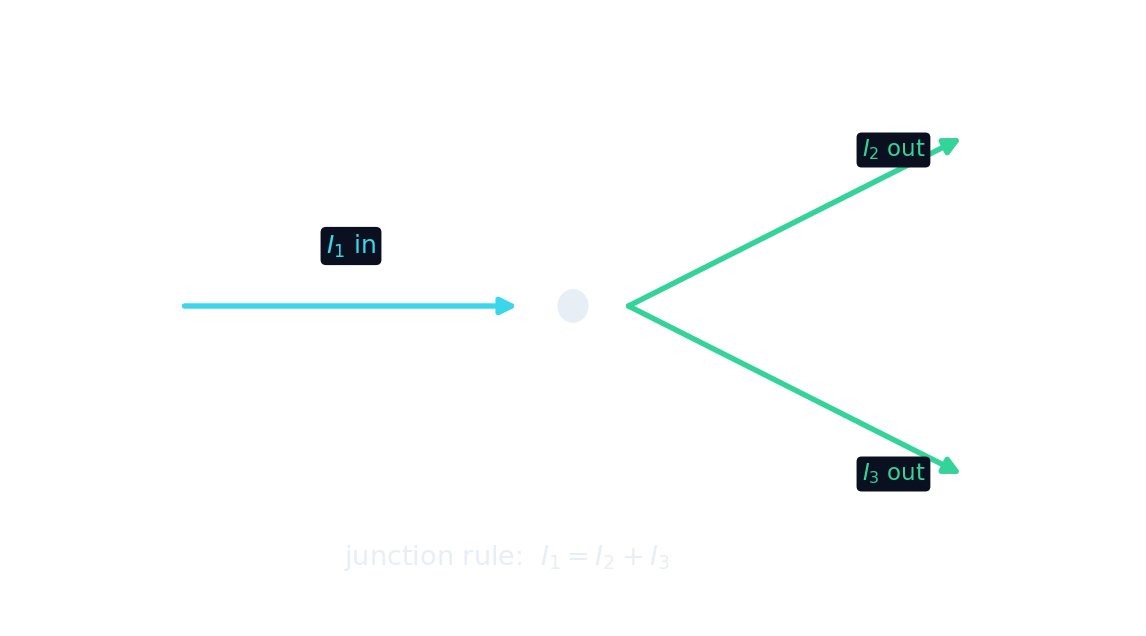
- If $I_1$ enters and $I_2, I_3$ leave: $I_1 = I_2 + I_3$.
- The branches share the incoming current between them.
A regra do nó: corrente entrante = corrente saiente
- Em qualquer nó 节点 (encontro de fios), $\sum I_{\text{in}} = \sum I_{\text{out}}$.
- A carga é conservada, logo nenhuma se acumula no ponto.
- Se $I_1$ entra e $I_2, I_3$ sai: $I_1 = I_2 + I_3$.
- Os ramos compartilham a corrente entrante entre si.
Split the current · Dividir a corrente
Wire two parallel branches and see the current divide between them at the junction. · Fie duas ramificações em paralelo e veja a corrente se dividir entre elas no nó.
Kirchhoff's junction rule states that at a junction: · A regra do nó de Kirchhoff afirma que em um nó:
$\sum I_{\text{in}} = \sum I_{\text{out}}$ — charge is conserved. · $\sum I_{\text{in}} = \sum I_{\text{out}}$ — a carga é conservada.
$7\ \text{A}$ enters a junction and one branch carries $4\ \text{A}$. Find the other branch current (in A). · $7\ \text{A}$ entra em um nó e um ramo carrega $4\ \text{A}$. Encontre a corrente do outro ramo (em A).
$7 = 4 + I_2 \Rightarrow I_2 = 3\ \text{A}$.
A point where wires meet and current can split is called a ____. · Um ponto onde fios se encontram e a corrente pode se dividir é chamado de ____.
That meeting point is a junction (or node). · Esse ponto de encontro é um nó (ou junção).
Why: charge can't accumulate
- A junction is just a point of wire — it holds no charge.
- So the rate in must equal the rate out at every instant.
- This is the conservation of charge applied to a point.
- Break it and charge would build up without limit — impossible.
Por que: a carga não pode acumular
- Um nó é apenas um ponto do fio — ele não armazena carga.
- Logo, a taxa de entrada deve igualar a taxa de saída em todo instante.
- Esta é a conservação de carga aplicada a um ponto.
- Violar isso faria a carga acumular sem limite — impossível.
The junction rule expresses the conservation of: · A regra do nó expressa a conservação de:
No charge accumulates at a point — charge is conserved. · Nenhuma carga se acumula em um ponto — a carga é conservada.
Bigger branches carry more current
- At equal voltage, the branch with less resistance carries more current.
- Current splits in inverse proportion to the branch resistances.
- The easiest path takes the biggest share.
- Add up all the branch currents and you recover the total.
Ramos maiores conduzem mais corrente
- Com mesma tensão, o ramo com menos resistência leva mais corrente.
- A corrente se divide proporcionalmente inversa às resistências dos ramos.
- O caminho mais fácil leva a maior parcela.
- Some todas as correntes dos ramos e você recupera o total.
At a split, the branch with less resistance carries more current. · Em uma divisão, o ramo com menos resistência carrega mais corrente.
At equal voltage, current is largest in the lowest-resistance branch. · Na mesma tensão, a corrente é maior no ramo de menor resistência.
Select all · todos true statements about the junction rule. · Selecione todas as afirmações verdadeiras sobre a regra do nó.
Junction rule: current in = out, charge conservation, more current in easy branches. Voltage-round-a-loop is the loop rule. · Regra do nó: corrente entrada = saída, conservação de carga, mais corrente em ramos fáceis. Tensão-ao-redor-de-malha é a regra da malha.
Solving with both rules
- Junction rule gives current equations; loop rule gives voltage equations.
- Together they give enough equations for every unknown current.
- Label each branch current, apply both rules, and solve.
- This pair cracks any resistor network, however tangled.
Resolvendo com ambas as regras
- A regra do nó fornece equações de corrente; a regra do laço fornece equações de tensão.
- Juntas, elas oferecem equações suficientes para toda corrente desconhecida.
- Rotule cada corrente de ramo, aplique ambas as regras e resolva.
- Este par resolve qualquer rede de resistores, por mais intrincada que seja.
A $5\ \text{A}$ current reaches a junction and splits into two branches; one carries $2\ \text{A}$.
- Junction rule: $5 = 2 + I_2$.
- So the other branch carries $I_2 = 3\ \text{A}$.
Uma corrente $5\ \text{A}$ atinge um nó e se divide em dois ramos; um leva $2\ \text{A}$.
- Regra do nó: $5 = 2 + I_2$.
- Então o outro ramo leva $I_2 = 3\ \text{A}$.
The junction rule is about current (charge conservation), while the loop rule is about voltage (energy conservation). Don't mix them up: currents meet at junctions, voltages balance around loops.
A regra do nó trata de corrente (conservação de carga), enquanto a regra do laço trata de tensão (conservação de energia). Não as misture: correntes encontram-se em nós, tensões se equilibram em laços.
Kirchhoff's junction rule 基尔霍夫节点定则 says the current into a junction equals the current out: $\sum I_{\text{in}} = \sum I_{\text{out}}$. It is conservation of charge at a point. Paired with the loop rule, it solves any resistor network.
Regra do nó de Kirchhoff 基尔霍夫节点定则 afirma que a corrente em um nó iguala a corrente que sai: $\sum I_{\text{in}} = \sum I_{\text{out}}$. É a conservação de carga num ponto. Combinada com a regra do laço, resolve qualquer rede de resistores.