Electric Potential · Potencial Elétrico
| English | Português |
|---|---|
| volt/vəʊlt/ | volt |
| electric potential/ɪˈlektrɪk pəˈtenʃl/ | potencial elétrico |
| equipotential/ˌiːkwɪpəˈtenʃl/ | equipotencial |
| gradient/ˈɡreɪdɪənt/ | gradiente |
The "height" of the electric landscape
- Imagine the field as a hilly landscape and charge as a ball.
- Potential tells you the "height" at each point — energy per unit charge.
- A $+$ charge rolls downhill (to low potential); a $-$ charge rolls uphill.
- Because it is energy per charge, it is a scalar — no arrows to juggle.
A "altitude" da paisagem elétrica
- Imagine o campo como uma paisagem montanhosa e a carga como uma bola.
- Potencial diz qual é a "altitude" em cada ponto — energia por unidade de carga.
- Uma carga $+$ rola col abaixo (para baixo potencial); uma carga $-$ rola col acima.
- Como é energia por carga, é um escalar — sem setas para brigar.
Volts: energy per charge
- The electric potential 电势 $V$ is the potential energy per unit charge: $V = \dfrac{U}{q}$.
- Its unit is the volt 伏特 (1 V $= 1$ J/C).
- For a point charge: $V = \dfrac{kQ}{r}$ — positive near $+$, negative near $-$.
- The energy of a charge placed there is simply $U = qV$.
Volts: energia por carga
- O potencial elétrico 电势 $V$ é a energia potencial por unidade de carga: $V = \dfrac{U}{q}$.
- Sua unidade é o volt 伏特 (1 V $= 1$ J/C).
- Para uma carga pontual: $V = \dfrac{kQ}{r}$ — positiva perto de $+$, negativa perto de $-$.
- A energia de uma carga colocada ali é simplesmente $U = qV$.
Electric potential · Potencial elétrico $V$ is: · O potencial elétrico $V$ é:
$V = U/q$ — potential energy per unit charge, in volts. · $V = U/q$ — energia potencial por unidade de carga, em volts.
Scalars add the easy way
- Potential is a scalar, so many charges just add their $V$ values.
- $V = \sum \dfrac{kQ_i}{r_i}$ — no components, no angles.
- This is why potential is often easier to compute than the field.
- Find $V$ everywhere first, then get the field from it.
Escalares somam da forma fácil
- O potencial é um escalar, então muitas cargas apenas somam seus valores de $V$.
- $V = \sum \dfrac{kQ_i}{r_i}$ — sem componentes, sem ângulos.
- É por isso que o potencial é frequentemente mais fácil de calcular do que o campo.
- Encontre $V$ em todos os lugares primeiro, depois obtenha o campo a partir dele.
Potentials from several charges add as simple scalars — no vectors needed. · Potenciais de várias cargas somam como escalares simples — sem vetores necessários.
$V$ is a scalar: $V = \sum kQ_i/r_i$, just add the numbers. · $V$ é um escalar: $V = \sum kQ_i/r_i$, basta somar os números.
Two charges give $+50\ \text{V}$ and · e $-20\ \text{V}$ at a point. Find the total $V$ (in V). · Duas cargas dão $+50\ \text{V}$ e $-20\ \text{V}$ em um ponto. Encontre o total $V$ (em V).
Scalars add: $50 + (-20) = 30\ \text{V}$. · Escalares somam: $50 + (-20) = 30\ \text{V}$.
Equipotentials map the field
- An equipotential 等势面 is a line (or surface) of constant $V$.
- No work is done moving a charge along an equipotential.
- Equipotentials are always perpendicular to field lines.
- For a point charge they are circles; for a uniform field, parallel lines.
Superfícies equipotenciais mapeiam o campo
- Uma superfície equipotencial 等势面 é uma linha (ou superfície) de $V$ constante.
- Nenhum trabalho é realizado ao mover uma carga ao longo de uma superfície equipotencial.
- As superfícies equipotenciais são sempre perpendiculares às linhas de campo.
- Para uma carga pontual, elas são círculos; para um campo uniforme, linhas paralelas.
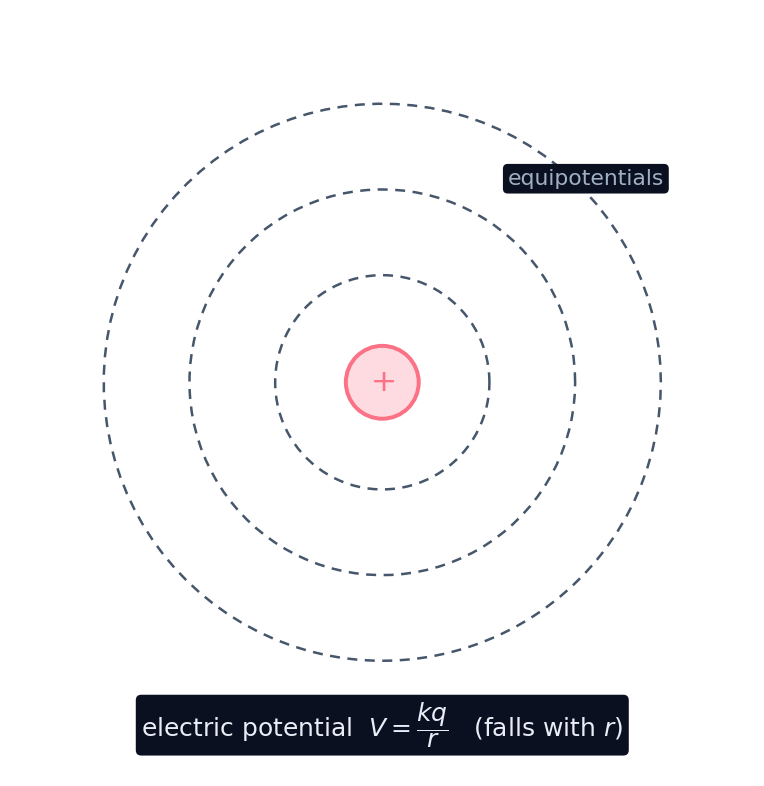
Field and equipotentials · Campo e equipotenciais
See how the field lines from a charge cross its circular equipotentials at right angles. · Veja como as linhas de campo de uma carga cruzam seus equipotenciais circulares em ângulos retos.
Equipotential surfaces are always ____ to the electric field lines. · Superfícies equipotenciais são sempre ____ às linhas de campo elétrico.
Field lines cross equipotentials at right angles. · Linhas de campo cruzam equipotenciais em ângulos retos.
Field is the slope of potential
- The field points downhill, from high $V$ to low $V$.
- Its size is the steepness: $E = -\dfrac{dV}{dx}$ (a gradient 梯度).
- Closely packed equipotentials mean a steep slope — a strong field.
- So $E$ (a vector) and $V$ (a scalar) carry the same information.
O campo é a inclinação do potencial
- O campo aponta para baixo, de alto $V$ para baixo $V$.
- Sua magnitude é a inclinação: $E = -\dfrac{dV}{dx}$ (um gradiente 梯度).
- Superfícies equipotenciais próximas significam uma inclinação íngreme — um campo forte.
- Então $E$ (um vetor) e $V$ (um escalar) carregam as mesmas informações.
Where equipotentials are packed closely together, the field is: · Onde os equipotenciais estão agrupados juntos, o campo é:
A steep potential slope ($E = -dV/dx$) means a strong field. · Uma inclinação íngreme de potencial ($E = -dV/dx$) significa um campo forte.
Select all · todos true statements about $V$ and · e $E$. · Selecione todas as afirmações verdadeiras sobre $V$ e $E$.
$V$ scalar, $E$ vector, $E = -dV/dx$. But $V=0$ does NOT force $E=0$. · $V$ escalar, $E$ vetor, $E = -dV/dx$. Mas $V=0$ NÃO implica $E=0$.
Two charges give $V = +30\ \text{V}$ and $V = -12\ \text{V}$ at a point. What is the total potential?
- Potential is a scalar, so just add: $V = 30 + (-12)$.
- $V = +18\ \text{V}$ — no vectors needed.
Duas cargas produzem $V = +30\ \text{V}$ e $V = -12\ \text{V}$ em um ponto. Qual é o potencial total?
- O potencial é um escalar, então basta somar: $V = 30 + (-12)$.
- $V = +18\ \text{V}$ — não são necessários vetores.
$V$ is a scalar; $E$ is a vector. They are not the same: at the midpoint between two equal opposite charges, $V = 0$ but $E$ is not zero. Never assume "$V=0$ means $E=0$".
$V$ é um escalar; $E$ é um vetor. Eles não são o mesmo: no ponto médio entre duas cargas iguais e opostas, $V = 0$ mas $E$ não é zero. Nunca assuma que "$V=0$ significa $E=0$".
Electric potential is energy per charge, $V = U/q$ (volts), a scalar you can add: $V = \sum kQ_i/r_i$. Equipotentials are constant-$V$ surfaces, perpendicular to the field, and the field is the slope $E = -dV/dx$.
Potencial elétrico é energia por carga, $V = U/q$ (volts), um escalar que você pode somar: $V = \sum kQ_i/r_i$. Superfícies equipotenciais são superfícies de $V$ constante, perpendiculares ao campo, e o campo é a inclinação $E = -dV/dx$.